Request Free Sample ×

Kindly complete the form below to receive a free sample of this Report

* Please use a valid business email

Leading companies partner with us for data-driven Insights

clients tt-cursor
Hero Background

Sensor Fusion Market

ID: MRFR/SEM/1164-HCR
200 Pages
Nirmit Biswas
April 2026

Sensor Fusion Market Size, Share & Industry Analysis By Technology (Software based, Hardware based, Hybrid systems), By Application (Automotive, Aerospace, Industrial Automation, Consumer Electronics, Healthcare), By Sensor Type (Inertial Sensors, Geospatial Sensors, Temperature Sensors, Vision Sensors, Sound Sensors), By End Use (Military, Commercial, Residential) andBy Regional (North America, Europe, South America, Asia Pacific, Middle East and Africa)- Industry Forecast Till 2035

Share:
Download PDF ×

We do not share your information with anyone. However, we may send you emails based on your report interest from time to time. You may contact us at any time to opt-out.

Sensor Fusion Market Infographic
Purchase Options

Sensor Fusion Market Summary

As per MRFR analysis, the Sensor Fusion Market Size was estimated at 9.43 USD Billion in 2024. The Sensor Fusion industry is projected to grow from 11.29 USD Billion in 2025 to 68.2 USD Billion by 2035, exhibiting a compound annual growth rate (CAGR) of 19.7% during the forecast period 2025 - 2035.

Key Market Trends & Highlights

The Sensor Fusion Market is poised for substantial growth driven by technological advancements and increasing applications across various sectors.

  • The integration of AI and machine learning is transforming sensor fusion capabilities, enhancing data processing and decision-making.
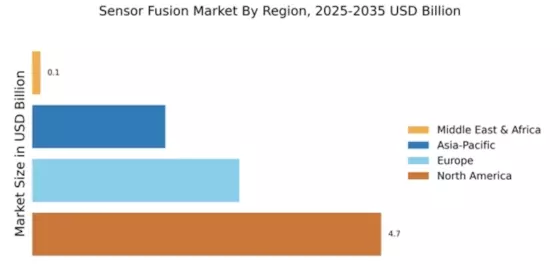
  • North America remains the largest market for sensor fusion, while Asia-Pacific is emerging as the fastest-growing region, driven by rapid technological adoption.
  • In the automotive sector, which is the largest segment, sensor fusion is critical for the development of advanced driver assistance systems.
  • Key market drivers include the rising demand for smart devices and the expansion of robotics and automation, particularly in the aerospace segment.

Market Size & Forecast

2024 Market Size 9.43 (USD Billion)
2035 Market Size 68.2 (USD Billion)
CAGR (2025 - 2035) 19.7%

Major Players

Robert Bosch GmbH (DE), Honeywell International Inc. (US), Texas Instruments Inc. (US), NVIDIA Corporation (US), STMicroelectronics N.V. (FR), Analog Devices, Inc. (US), Infineon Technologies AG (DE), Qualcomm Technologies, Inc. (US), Renesas Electronics Corporation (JP) , many of which are recognized as companies offering robust processing for sensor fusion and robotic vision solutions.

Our Impact
Enabled $4.3B Revenue Impact for Fortune 500 and Leading Multinationals
Partnering with 2000+ Global Organizations Each Year
30K+ Citations by Top-Tier Firms in the Industry

Sensor Fusion Market Trends

The Sensor Fusion Market is currently experiencing a transformative phase, driven by advancements in technology and increasing demand across various sectors. This sensor fusion market integrates data from multiple fusion sensors to enhance accuracy and reliability in applications such as automotive, healthcare, and consumer electronics. The convergence of artificial intelligence and machine learning with sensor fusion software appears to be a pivotal factor, enabling more sophisticated data analysis and decision-making processes. As industries seek to improve operational efficiency and safety, the adoption of sensor fusion market solutions is likely to accelerate, fostering innovation and competitive advantage.

Moreover, the growing emphasis on automation and smart systems is propelling the sensor fusion market forward. Industries are increasingly recognizing the value of real-time data processing and analytics, which can lead to improved performance and reduced costs. The integration of Internet of Things (IoT) devices with fusion sensors seems to create new opportunities for enhanced connectivity and functionality. As the market evolves, it may witness the emergence of novel applications and use cases, further solidifying its importance in the global technological landscape.

Integration with Artificial Intelligence

The Sensor Fusion Market is increasingly integrating artificial intelligence technologies, strengthening sensor fusion software capabilities and enabling intelligent interpretation of multi-sensor data. This integration allows for more accurate predictions and insights, thereby improving decision-making processes across various applications.

Rise of Autonomous Systems

The demand for autonomous systems, particularly in the automotive sector, is driving growth in the sensor fusion in autonomous vehicle market. Advanced automotive sensor fusion systems combine camera, radar, and LiDAR inputs to ensure safe and efficient navigation.

Expansion in Healthcare Applications

There is a notable expansion of sensor fusion technologies in healthcare, where fusion sensors are utilized for patient monitoring and diagnostics, contributing to the continued expansion of the sensor fusion market. This trend indicates a growing recognition of the potential benefits of sensor fusion in improving patient outcomes and operational efficiency.

Sensor Fusion Market Drivers

Market Growth Projections

The Global Sensor Fusion Market Industry is poised for substantial growth, with projections indicating a market size of 8.49 USD Billion in 2024 and an anticipated increase to 25 USD Billion by 2035. This growth trajectory suggests a compound annual growth rate of 10.32% from 2025 to 2035. The expansion is driven by various factors, including advancements in technology, increasing demand across multiple sectors, and the integration of sensor fusion in emerging applications. The market's evolution reflects a broader trend towards data-driven decision-making and automation, highlighting the critical role of sensor fusion in shaping future technological landscapes.

Enhanced Consumer Electronics

The demand for sophisticated consumer electronics is a driving force in the Global Sensor Fusion Market Industry. As devices such as smartphones, wearables, and smart home products evolve, the integration of sensor fusion technologies becomes essential for improved functionality and user experience. For instance, smartphones utilize sensor fusion for features like augmented reality and advanced photography. This trend is likely to sustain market growth, as consumers increasingly seek devices that offer enhanced capabilities. The continuous innovation in consumer electronics suggests that sensor fusion will remain a critical component in meeting consumer expectations and driving market expansion.

Increased Focus on Smart Cities

The Global Sensor Fusion Market Industry is significantly impacted by the growing emphasis on smart city initiatives worldwide. Urban planners and governments are increasingly adopting sensor fusion technologies to enhance city management and improve public services. By integrating data from various sensors, cities can optimize traffic flow, monitor environmental conditions, and enhance public safety. This trend is expected to propel the market forward, as investments in smart infrastructure are projected to escalate. The anticipated market size of 25 USD Billion by 2035 underscores the potential of sensor fusion in transforming urban environments into more efficient and livable spaces.

Advancements in IoT Technologies

The proliferation of Internet of Things (IoT) devices significantly influences the Global Sensor Fusion Market Industry. As smart devices become increasingly interconnected, the need for effective data integration and analysis rises. Sensor fusion technologies facilitate the seamless amalgamation of data from various sources, enhancing decision-making processes across industries such as healthcare, agriculture, and smart cities. This trend is expected to contribute to the market's growth, with projections indicating a compound annual growth rate of 10.32% from 2025 to 2035. The ability to harness real-time data through sensor fusion is likely to drive innovation and efficiency in numerous applications.

Growing Applications in Healthcare

The Global Sensor Fusion Market Industry is witnessing a burgeoning interest in healthcare applications, where sensor fusion technologies are utilized for patient monitoring and diagnostics. By integrating data from various medical sensors, healthcare providers can achieve more accurate and timely assessments of patient conditions. This trend is particularly relevant in telemedicine and remote patient monitoring, where real-time data is crucial. The increasing adoption of wearable health devices further underscores the importance of sensor fusion in healthcare. As the industry evolves, the potential for sensor fusion to enhance patient care and operational efficiency appears promising.

Rising Demand for Autonomous Vehicles

The Global Sensor Fusion Market Industry experiences a notable surge in demand driven by the automotive sector's shift towards autonomous vehicles. As manufacturers integrate advanced sensor technologies, including LiDAR, radar, and cameras, the market is projected to reach 8.49 USD Billion in 2024. This integration enhances vehicle safety and navigation capabilities, thereby appealing to consumers and regulatory bodies alike. The anticipated growth in this sector is indicative of a broader trend towards automation in transportation, suggesting that sensor fusion technologies will play a pivotal role in shaping the future of mobility.

Market Segment Insights

By Application: Automotive (Largest) vs. Healthcare (Fastest-Growing)

The Sensor Fusion Market is experiencing significant growth across various applications, with the automotive segment leading the way as the largest contributor. This dominance is primarily driven by the increasing integration of advanced driver-assistance systems (ADAS) and autonomous driving technologies, which utilize sensor fusion to enhance safety and performance. Other notable segments such as aerospace and consumer electronics also contribute to the market but are overshadowed by the automotive sector's substantial demand. In contrast, the healthcare application is emerging as the fastest-growing segment within the Sensor Fusion Market. The rise in wearable health devices and remote patient monitoring systems has fueled this growth. These technologies rely on sensor fusion to provide accurate readings and real-time analysis, thus improving patient outcomes. As the healthcare sector increasingly adopts advanced technologies, the market potential for sensor fusion applications in this area continues to expand.

Automotive: ADAS (Dominant) vs. Consumer Electronics: Wearables (Emerging)

Within the automotive sector, advanced driver-assistance systems (ADAS) stand as the dominant force in the Sensor Fusion Market. These systems leverage multiple sensors, such as cameras, radar, and LiDAR, to enhance vehicle safety and enable features like lane-keeping assistance and adaptive cruise control. As the automotive industry moves towards full autonomy, the reliance on sophisticated sensor fusion technology is expected to grow. Conversely, in the consumer electronics sector, wearables represent an emerging segment, capturing significant attention due to the rising trend of health and fitness monitoring. Wearables utilize sensor fusion to combine data from multiple sensors, improving accuracy in health metrics and providing users with valuable insights. This comparative analysis highlights the contrasting roles of ADAS and wearables in shaping the Sensor Fusion Market.

By Sensor Type: Accelerometer (Largest) vs. Camera (Fastest-Growing)

In the Sensor Fusion Market, accelerometers hold the largest market share among the segment values, attributed to their widespread usage in consumer electronics and automotive applications. Following closely are gyroscopes and magnetometers, which also demonstrate substantial market presence. Cameras, while traditionally a smaller segment, are gaining traction due to their pivotal role in advanced applications, such as autonomous vehicles and augmented reality, thus reshaping market dynamics. Growth trends in the sensor type segment are driven by the increasing adoption of IoT devices and the rising need for enhanced accuracy in data collection. The demand for multi-sensor integration systems is propelling innovation across accelerometers and gyroscopes, while advancements in imaging technologies elevate the role of cameras. Lidar shows promise in emerging fields, particularly in autonomous navigation, attracting interest and fostering competitive growth within the market.

Sensor Type: Accelerometer (Dominant) vs. Camera (Emerging)

Accelerometers are the dominant player in the sensor fusion market due to their essential role in motion detection and orientation sensing across various industries, including smartphones, gaming, and automotive systems. They are highly regarded for their robustness and reliability. In contrast, cameras are emerging as powerful sensor components, significantly influenced by advancements in computer vision and artificial intelligence. Their integration into sensor fusion systems enhances machine perception and navigation capabilities. The rapid development of AI-driven applications and augmented reality systems has spotlighted cameras, leading to increasing investments in research and development to elevate their capabilities further and broaden their applications.

By End Use: Wearable Devices (Largest) vs. Drones (Fastest-Growing)

In the Sensor Fusion Market, the 'Wearable Devices' segment holds a substantial market share, driven by the increasing adoption of health tracking technologies and fitness applications. The integration of advanced sensors in smart watches and fitness trackers enhances user experience, making this segment the largest in terms of market contribution. Meanwhile, the Drones segment has emerged as a popular choice among consumers and industries alike, leveraging sensors for navigation, obstacle avoidance, and data collection. This growth is significantly attributed to advancements in drone technology and rising demand for aerial surveillance and delivery services. The growth trends within the Sensor Fusion Market showcase the differentiation in application and innovation across segments. Wearable Devices are primarily benefitting from rising health consciousness and technology integration, while Drones are witnessing rapid growth due to applications in delivery and logistics, agriculture, and surveillance. The convergence of technologies such as AI and machine learning is propelling these segments further, enabling enhanced functionality and efficiency in sensor applications across diverse use cases.

Wearable Devices (Dominant) vs. Drones (Emerging)

Wearable Devices represent the dominant force in the Sensor Fusion Market, characterized by their robust integration of sensors enabling health monitoring, fitness tracking, and lifestyle management. This segment thrives on consumer demand for innovative, convenient, and real-time data analysis, promoting an active lifestyle. In contrast, Drones, while currently classified as an emerging segment, are rapidly becoming essential in various industries. Their applications range from agricultural monitoring to search and rescue operations, supported by improvement in battery life and sensor technology. The competitive landscape is evolving, as advancements in miniaturization and sensor accuracy position Drones as a transformative technology, illustrating their potential to capture significant market share in the near future.

Get more detailed insights about Sensor Fusion Market

Regional Insights

North America : Market Leader in Innovation

North America continues to dominate the sensor fusion market, supported by strong demand for automotive sensor fusion and investments from companies offering robust processing for sensor fusion and robotic vision. The region's growth is driven by advancements in automotive technology, IoT applications, and smart devices. Regulatory support for innovation and safety standards further catalyzes demand, ensuring a robust market environment. The increasing integration of AI and machine learning in sensor technologies is also a key growth driver, enhancing functionality and efficiency.

The competitive landscape in North America is characterized by the presence of major players such as Honeywell International Inc., Texas Instruments Inc., and NVIDIA Corporation. These companies are at the forefront of technological advancements, focusing on R&D to enhance sensor capabilities. The U.S. and Canada are leading countries in this sector, with a strong emphasis on automotive and industrial applications, ensuring a vibrant market for sensor fusion technologies.

Europe : Emerging Market with Potential

Europe is witnessing increased adoption of fusion sensors and sensor fusion software, contributing to steady expansion of the sensor fusion market. The region's growth is fueled by increasing demand for automation in manufacturing, smart cities, and healthcare applications. Regulatory frameworks promoting sustainability and innovation are also significant catalysts for market expansion. The European Union's focus on digital transformation and smart technologies is expected to further enhance the adoption of sensor fusion solutions across various sectors.

Leading countries in Europe include Germany, France, and the UK, where key players like Robert Bosch GmbH and STMicroelectronics N.V. are actively investing in sensor fusion technologies. The competitive landscape is evolving, with a mix of established companies and startups driving innovation. The region's emphasis on research and development, coupled with a skilled workforce, positions Europe as a promising market for sensor fusion solutions.

Asia-Pacific : Rapid Growth and Adoption

Asia-Pacific is emerging as a key growth region for the sensor fusion market, driven by expanding sensor fusion in autonomous vehicle market initiatives and consumer electronics adoption. The region's growth is driven by rapid urbanization, increasing adoption of smart devices, and advancements in automotive technologies. Government initiatives promoting digital transformation and smart city projects are key regulatory catalysts that are enhancing market dynamics. The rising demand for consumer electronics and industrial automation is also contributing to the growth of sensor fusion technologies in this region.

Countries like Japan, China, and South Korea are leading the charge in sensor fusion innovations, with companies such as Qualcomm Technologies, Inc. and Renesas Electronics Corporation at the forefront. The competitive landscape is characterized by a mix of global and local players, fostering a dynamic environment for technological advancements. The region's focus on R&D and collaboration between industries is expected to drive further growth in the sensor fusion market.

Middle East and Africa : Emerging Market Opportunities

The Middle East and Africa region is in the nascent stages of sensor fusion market development, with a market size of 0.11. Growth is primarily driven by increasing investments in smart infrastructure and the adoption of IoT technologies. Governments are focusing on digital transformation initiatives, which are expected to catalyze demand for sensor fusion applications across various sectors, including healthcare and transportation. The region's unique challenges also present opportunities for innovative sensor solutions. Countries like the UAE and South Africa are leading the charge in adopting sensor fusion technologies. The competitive landscape is evolving, with both local and international players entering the market. As the region continues to invest in technology and infrastructure, the sensor fusion market is expected to grow, driven by increasing awareness and demand for smart solutions.

Sensor Fusion Market Regional Image

Key Players and Competitive Insights

The Sensor Fusion Market is currently characterized by a dynamic competitive landscape, driven by advancements in technology and increasing demand for integrated sensor solutions across various applications, including automotive, consumer electronics, and industrial automation. Key players such as Robert Bosch GmbH (Germany), Honeywell International Inc. (US), and NVIDIA Corporation (US) are at the forefront, leveraging their expertise in innovation and strategic partnerships to enhance their market positioning. These companies are focusing on developing advanced algorithms and integrating artificial intelligence (AI) capabilities into their sensor fusion technologies, which collectively shapes a competitive environment that emphasizes technological superiority and operational efficiency. In terms of business tactics, companies are increasingly localizing manufacturing to reduce costs and enhance supply chain resilience. The market structure appears moderately fragmented, with several players vying for market share while also collaborating through strategic alliances. This collective influence of key players fosters a competitive atmosphere where innovation and adaptability are paramount. In November 2025, NVIDIA Corporation (US) announced a partnership with a leading automotive manufacturer to develop next-generation autonomous driving systems utilizing advanced sensor fusion techniques. This collaboration is strategically significant as it positions NVIDIA to capitalize on the growing demand for autonomous vehicles, thereby enhancing its competitive edge in the automotive sector. Similarly, in October 2025, Honeywell International Inc. (US) unveiled a new line of sensor fusion products aimed at the industrial automation market. This launch is indicative of Honeywell's commitment to expanding its product portfolio and addressing the increasing need for smart manufacturing solutions. By integrating AI and machine learning into its offerings, Honeywell is likely to strengthen its market presence and drive operational efficiencies for its clients. Furthermore, in September 2025, Robert Bosch GmbH (Germany) expanded its sensor fusion capabilities through the acquisition of a tech startup specializing in AI-driven sensor technologies. This strategic move not only enhances Bosch's technological capabilities but also reflects a broader trend of consolidation within the market, as companies seek to bolster their innovation pipelines and maintain competitive differentiation. As of December 2025, current trends in the Sensor Fusion Market are heavily influenced by digitalization, sustainability, and the integration of AI technologies. Strategic alliances are increasingly shaping the competitive landscape, allowing companies to pool resources and expertise to drive innovation. Looking ahead, it is anticipated that competitive differentiation will evolve, shifting from price-based competition to a focus on technological innovation, reliability in supply chains, and the ability to deliver integrated solutions that meet the complex demands of modern applications.

Key Companies in the Sensor Fusion Market include

Industry Developments

Recent developments highlight increasing investment in sensor fusion software, automotive sensor fusion, and advanced processing platforms developed by companies offering robust processing for sensor fusion and robotic vision.

In September 2023, Bosch announced advancements in its sensor technologies aimed at enhancing autonomous vehicle capabilities, indicating a growing focus on automotive applications.

Additionally, in May 2023, Xilinx revealed new innovations in signal processing and sensor algorithms, emphasizing the importance of real-time processing in sensor fusion applications. A notable acquisition took place in July 2023 when Intel acquired a startup specializing in Artificial Intelligence technology to bolster its sensor fusion solutions.

The market has seen a pronounced growth trend, with companies like Qualcomm reporting increased valuation due to the rising demand for integrated sensor solutions in various industries, including healthcare and automotive.

The Sensor Fusion Market is expected to continue expanding as industries increasingly adopt advanced technologies for more accurate data interpretation. In light of the past two years, key developments included STMicroelectronics expanding its sensor product line in June 2022, showcasing the urgent need for enhanced sensing capabilities across multiple domains.

Overall, these advancements highlight the dynamic nature and escalating importance of sensor fusion in the global technology landscape.

Future Outlook

Sensor Fusion Market Future Outlook

The Sensor Fusion Market is projected to grow at a 19.7% CAGR from 2025 to 2035, driven by advancements in IoT, autonomous systems, and AI integration.

New opportunities lie in:

  • Development of advanced automotive sensor fusion systems for enhanced safety features. Integration of sensor fusion in smart city infrastructure for improved urban management. Creation of wearable health monitoring devices utilizing multi-sensor data fusion.

By 2035, the sensor fusion market is expected to be a pivotal component of technological innovation.

Market Segmentation

Sensor Fusion Market End Use Outlook

  • Robotics
  • Smartphones
  • Wearable Devices
  • Drones
  • Autonomous Vehicles

Sensor Fusion Market Application Outlook

  • Automotive
  • Aerospace
  • Consumer Electronics
  • Healthcare
  • Industrial Automation

Sensor Fusion Market Sensor Type Outlook

  • Accelerometer
  • Gyroscope
  • Magnetometer
  • Camera
  • Lidar

Report Scope

MARKET SIZE 2024 9.43(USD Billion)
MARKET SIZE 2025 11.29(USD Billion)
MARKET SIZE 2035 68.2(USD Billion)
COMPOUND ANNUAL GROWTH RATE (CAGR) 19.7% (2025 - 2035)
REPORT COVERAGE Revenue Forecast, Competitive Landscape, Growth Factors, and Trends
BASE YEAR 2024
Market Forecast Period 2025 - 2035
Historical Data 2019 - 2024
Market Forecast Units USD Billion
Key Companies Profiled Robert Bosch GmbH (DE), Honeywell International Inc. (US), NVIDIA Corporation (US), Texas Instruments Incorporated (US), STMicroelectronics N.V. (FR), Analog Devices, Inc. (US), Infineon Technologies AG (DE), Qualcomm Technologies, Inc. (US), Renesas Electronics Corporation (JP)
Segments Covered Application, Sensor Type, End Use
Key Market Opportunities Integration of artificial intelligence enhances capabilities in the Sensor Fusion Market.
Key Market Dynamics Rising demand for autonomous systems drives innovation and competition in the Sensor Fusion Market.
Countries Covered North America, Europe, APAC, South America, MEA

Market Highlights

Author
Author
Author Profile
Nirmit Biswas LinkedIn
Senior Research Analyst
With 5+ years of expertise in Market Intelligence and Strategic Research, Nirmit Biswas specializes in ICT, Semiconductors, and BFSI. Backed by an MBA in Financial Services and a Computer Science foundation, Nirmit blends technical depth with business acumen. He has successfully led 100+ projects for global enterprises and startups, including Amazon, Cisco, L&T and Huawei, delivering market estimations, competitive benchmarking, and GTM strategies. His focus lies in transforming complex data into clear, actionable insights that drive growth, innovation, and investment decisions. Recognized for bridging engineering innovation with executive strategy, Nirmit helps businesses navigate dynamic markets with confidence.
Co-Author
Co-Author Profile
Aarti Dhapte LinkedIn
AVP - Research
A consulting professional focused on helping businesses navigate complex markets through structured research and strategic insights. I partner with clients to solve high-impact business problems across market entry strategy, competitive intelligence, and opportunity assessment. Over the course of my experience, I have led and contributed to 100+ market research and consulting engagements, delivering insights across multiple industries and geographies, and supporting strategic decisions linked to $500M+ market opportunities. My core expertise lies in building robust market sizing, forecasting, and commercial models (top-down and bottom-up), alongside deep-dive competitive and industry analysis. I have played a key role in shaping go-to-market strategies, investment cases, and growth roadmaps, enabling clients to make confident, data-backed decisions in dynamic markets.
Leave a Comment

FAQs

What is the projected market valuation of the Sensor Fusion Market by 2035?

The Sensor Fusion Market is projected to reach a valuation of 68.2 USD Billion by 2035.

What was the market valuation of the Sensor Fusion Market in 2024?

In 2024, the Sensor Fusion Market had a valuation of 9.43 USD Billion.

What is the expected CAGR for the Sensor Fusion Market during the forecast period 2025 - 2035?

The expected CAGR for the Sensor Fusion Market during the forecast period 2025 - 2035 is 19.7%.

Which application segment is expected to dominate the Sensor Fusion Market?

The Consumer Electronics segment is expected to dominate the Sensor Fusion Market, projected to grow from 3.0 to 25.0 USD Billion.

What are the key players in the Sensor Fusion Market?

Key players in the Sensor Fusion Market include Robert Bosch GmbH, Honeywell International Inc., and NVIDIA Corporation.

How does the Automotive segment perform in the Sensor Fusion Market?

The Automotive segment is projected to grow from 2.5 to 20.0 USD Billion, indicating strong demand.

What is the projected growth for the Autonomous Vehicles segment in the Sensor Fusion Market?

The Autonomous Vehicles segment is expected to grow from 3.43 to 17.7 USD Billion, reflecting significant advancements.

Which sensor type is anticipated to have the highest market value?

The Camera sensor type is anticipated to have the highest market value, projected to grow from 2.5 to 20.0 USD Billion.

What is the expected growth trajectory for the Healthcare segment in the Sensor Fusion Market?

The Healthcare segment is projected to grow from 1.0 to 7.0 USD Billion, suggesting increasing integration of sensor technologies.

How does the Robotics segment contribute to the Sensor Fusion Market?

The Robotics segment is expected to grow from 1.5 to 12.5 USD Billion, indicating a rising trend in automation.

Research Approach

Secondary Research

The secondary research process involved comprehensive analysis of regulatory databases, peer-reviewed engineering journals, semiconductor industry publications, and authoritative technology organizations. Key sources included the US Department of Transportation National Highway Traffic Safety Administration (NHTSA), European Commission Horizon Europe Programme, Institute of Electrical and Electronics Engineers (IEEE), Society of Automotive Engineers (SAE International), International Organization for Standardization (ISO), Semiconductor Industry Association (SIA), European Semiconductor Industry Association (ESIA), National Institute of Standards and Technology (NIST), US Bureau of Transportation Statistics, International Telecommunication Union (ITU), EU Eurostat Digital Economy Database, and national semiconductor associations from key markets including China Semiconductor Industry Association (CSIA) and India Electronics and Semiconductor Association (IESA). These sources were used to collect shipment statistics, regulatory approval data, automotive safety standards compliance, patent landscapes, and technology adoption trends for MEMS sensors, radar systems, IMUs, image sensors, and sensor fusion algorithms.

Primary Research

In order to gather both qualitative and quantitative insights, supply-side and demand-side stakeholders were interviewed during the primary research process. CEOs, VPs of engineering, heads of product management, and business development directors from semiconductor manufacturers, sensor fusion software providers, and Tier 1 automotive suppliers were examples of supply-side sources. Chief engineers from automakers, heads of autonomous driving divisions, robots and drone manufacturers, product managers for consumer electronics, and procurement leaders from smart device, medical device, and industrial automation companies were examples of demand-side sources. Market segmentation, autonomous vehicle deployment schedules, algorithm adoption trends, pricing dynamics, and supply chain limitations were all confirmed by primary research.

Primary Respondent Breakdown:

By Designation: C-level Executives (32%), Director Level (30%), Senior Engineers/Managers (38%)

By Region: North America (32%), Europe (30%), Asia-Pacific (28%), Rest of World (10%)

Market Size Estimation

Global market valuation was derived through revenue mapping and unit shipment analysis. The methodology included:

Identification of 55+ key manufacturers across North America, Europe, Asia-Pacific, and Latin America

Product mapping across radar sensors, image sensors, IMUs, temperature sensors, and other sensor categories

Technology segmentation across MEMS and non-MEMS implementations

Analysis of reported and modeled annual revenues specific to sensor fusion portfolios

Coverage of manufacturers representing 75-80% of global market share in 2024

Extrapolation using bottom-up (unit shipment × ASP by application) and top-down (manufacturer revenue validation) approaches to derive segment-specific valuations

Cross-validation through automotive production data, consumer electronics shipment reports, and IoT device deployment statistics from regional regulatory bodies

Download Free Sample

Kindly complete the form below to receive a free sample of this Report

Compare Licence

×
Features License Type
Single User Multiuser License Enterprise User
Price $4,950 $5,950 $7,250
Maximum User Access Limit 1 User Upto 10 Users Unrestricted Access Throughout the Organization
Free Customization
Direct Access to Analyst
Deliverable Format
Platform Access
Discount on Next Purchase 10% 15% 15%
Printable Versions