Request Free Sample ×

Kindly complete the form below to receive a free sample of this Report

* Please use a valid business email

Leading companies partner with us for data-driven Insights

clients tt-cursor
Hero Background
English
Chinese
French
Japanese
Korean
German
Spanish

Sensor Fusion Market Trends

ID: MRFR/SEM/1164-HCR
200 Pages
Nirmit Biswas
March 2026

Sensor Fusion Market Size, Share & Industry Analysis By Technology (Software based, Hardware based, Hybrid systems), By Application (Automotive, Aerospace, Industrial Automation, Consumer Electronics, Healthcare), By Sensor Type (Inertial Sensors, Geospatial Sensors, Temperature Sensors, Vision Sensors, Sound Sensors), By End Use (Military, Commercial, Residential) andBy Regional (North America, Europe, South America, Asia Pacific, Middle East and Africa)- Industry Forecast Till 2035

Share:
Download PDF ×

We do not share your information with anyone. However, we may send you emails based on your report interest from time to time. You may contact us at any time to opt-out.

Sensor Fusion Market Infographic
Purchase Options

Market Trends

Key Emerging Trends in the Sensor Fusion Market

The Sensor Fusion market today is witnessing a plethora of trends resulting in an industry landscape that is quite different from the past. But one of the most obvious trends that can be observed is the integration of Artificial Intelligence (AI) and machine learning algorithms into sensor fusion solutions. By doing this, what is achieved is a capability for processing sensors data which enhances their real time decision making and increases the general efficiency of systems as well. Complex data which requires optimal performance calls for AI powered sensor fusion in usages like robotics, smart cities and autonomous vehicles.

On the other side, The Internet of things (IoT) explosion has also had a significant impact on Sensor Fusion Market. With more connected devices getting online by day, there will be need to have sensor fusion technologies that will be able to combine information from different sensors seamlessly across various platforms. This leads to a comprehensive picture through collecting data from IoT devices thereby promoting adoption of sensor fusion technology in various sectors including healthcare agriculture and industrial automation.

A trend towards smaller, more efficient sensor fusionsolutions has been driven by miniaturization coupled with advancements in sensor technology. The diminutive size and reduced energy consumption alongside widening data capture capabilities for sensing instruments has seen its application expanded into wearable gadgets and portable devices such as smartphones.This can clearly be demonstrated by wearable health monitoring inventions used in medical care that integrate readings taken from accelerometers gyroscope as well as pulse meters among other sensors to give users useful health tips.

Another aspect corroborating this growth reveals higher take-up Of sensor fusion technologies within the automotive sector particularly with respect to advanced driver assistance system(ADAS)and autonomous cars.This means that multiple sensors are used together in order to provide vital features such as collision avoidance,lane departure warning or even adaptive cruise control.Towards achieving better vehicle safety measures,the auto industry projects increasing reliance on these attributes so as make vehicles smarter.

Focus on real-time data processing and edge computing gains ground in Sensor Fusion market. In other words, sensor fusion solutions are now increasing their reliance on the edge of the network where there is decentralized processing to cater for low latency requirements in applications. This is applicable where instant decision-making is a must as seen in smart manufacturing, healthcare monitoring and surveillance systems.

For this reason, cyber security has emerged as one of the major concerns within Sensor Fusion market leading to an emphasized trend on secure measures. There are several applications that deal with sensitive data which are handled by sensor fusion solutions hence it becomes important to ensure its safety and confidentiality. The latest market trends indicate the adoption of encryption, authentication and secure communication protocols as part of sensor fusion systems against possible cyber threats.


Author
Author Profile
Nirmit Biswas
Senior Research Analyst

With 5+ years of expertise in Market Intelligence and Strategic Research, Nirmit Biswas specializes in ICT, Semiconductors, and BFSI. Backed by an MBA in Financial Services and a Computer Science foundation, Nirmit blends technical depth with business acumen. He has successfully led 100+ projects for global enterprises and startups, including Amazon, Cisco, L&T and Huawei, delivering market estimations, competitive benchmarking, and GTM strategies. His focus lies in transforming complex data into clear, actionable insights that drive growth, innovation, and investment decisions. Recognized for bridging engineering innovation with executive strategy, Nirmit helps businesses navigate dynamic markets with confidence.

Leave a Comment

FAQs

What is the projected market valuation of the Sensor Fusion Market by 2035?

<p>The Sensor Fusion Market is projected to reach a valuation of 68.2 USD Billion by 2035.</p>

What was the market valuation of the Sensor Fusion Market in 2024?

<p>In 2024, the Sensor Fusion Market had a valuation of 9.43 USD Billion.</p>

What is the expected CAGR for the Sensor Fusion Market during the forecast period 2025 - 2035?

<p>The expected CAGR for the Sensor Fusion Market during the forecast period 2025 - 2035 is 19.7%.</p>

Which application segment is expected to dominate the Sensor Fusion Market?

<p>The Consumer Electronics segment is expected to dominate the Sensor Fusion Market, projected to grow from 3.0 to 25.0 USD Billion.</p>

What are the key players in the Sensor Fusion Market?

<p>Key players in the Sensor Fusion Market include Robert Bosch GmbH, Honeywell International Inc., and NVIDIA Corporation.</p>

How does the Automotive segment perform in the Sensor Fusion Market?

<p>The Automotive segment is projected to grow from 2.5 to 20.0 USD Billion, indicating strong demand.</p>

What is the projected growth for the Autonomous Vehicles segment in the Sensor Fusion Market?

<p>The Autonomous Vehicles segment is expected to grow from 3.43 to 17.7 USD Billion, reflecting significant advancements.</p>

Which sensor type is anticipated to have the highest market value?

<p>The Camera sensor type is anticipated to have the highest market value, projected to grow from 2.5 to 20.0 USD Billion.</p>

What is the expected growth trajectory for the Healthcare segment in the Sensor Fusion Market?

<p>The Healthcare segment is projected to grow from 1.0 to 7.0 USD Billion, suggesting increasing integration of sensor technologies.</p>

How does the Robotics segment contribute to the Sensor Fusion Market?

<p>The Robotics segment is expected to grow from 1.5 to 12.5 USD Billion, indicating a rising trend in automation.</p>

Market Summary

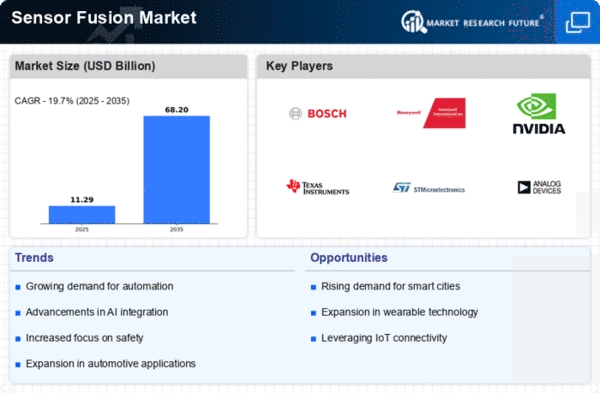
As per MRFR analysis, the Sensor Fusion Market Size was estimated at 9.43 USD Billion in 2024. The Sensor Fusion industry is projected to grow from 11.29 USD Billion in 2025 to 68.2 USD Billion by 2035, exhibiting a compound annual growth rate (CAGR) of 19.7% during the forecast period 2025 - 2035.

Key Market Trends & Highlights

The Sensor Fusion Market is poised for substantial growth driven by technological advancements and increasing applications across various sectors.

  • The integration of AI and machine learning is transforming sensor fusion capabilities, enhancing data processing and decision-making. North America remains the largest market for sensor fusion, while Asia-Pacific is emerging as the fastest-growing region, driven by rapid technological adoption. In the automotive sector, which is the largest segment, sensor fusion is critical for the development of advanced driver assistance systems. Key market drivers include the rising demand for smart devices and the expansion of robotics and automation, particularly in the aerospace segment.

Market Size & Forecast

2024 Market Size 9.43 (USD Billion)
2035 Market Size 68.2 (USD Billion)
CAGR (2025 - 2035) 19.7%
Largest Regional Market Share in 2024 North America

Major Players

Robert Bosch GmbH (DE), Honeywell International Inc. (US), Texas Instruments Inc. (US), NVIDIA Corporation (US), STMicroelectronics N.V. (FR), Analog Devices, Inc. (US), Infineon Technologies AG (DE), Qualcomm Technologies, Inc. (US), Renesas Electronics Corporation (JP) , many of which are recognized as companies offering robust processing for sensor fusion and robotic vision solutions.

Market Trends

The Sensor Fusion Market is currently experiencing a transformative phase, driven by advancements in technology and increasing demand across various sectors. This sensor fusion market integrates data from multiple fusion sensors to enhance accuracy and reliability in applications such as automotive, healthcare, and consumer electronics. The convergence of artificial intelligence and machine learning with sensor fusion software appears to be a pivotal factor, enabling more sophisticated data analysis and decision-making processes. As industries seek to improve operational efficiency and safety, the adoption of sensor fusion market solutions is likely to accelerate, fostering innovation and competitive advantage.

Moreover, the growing emphasis on automation and smart systems is propelling the sensor fusion market forward. Industries are increasingly recognizing the value of real-time data processing and analytics, which can lead to improved performance and reduced costs. The integration of Internet of Things (IoT) devices with fusion sensors seems to create new opportunities for enhanced connectivity and functionality. As the market evolves, it may witness the emergence of novel applications and use cases, further solidifying its importance in the global technological landscape.

Integration with Artificial Intelligence

The Sensor Fusion Market is increasingly integrating artificial intelligence technologies, strengthening sensor fusion software capabilities and enabling intelligent interpretation of multi-sensor data. This integration allows for more accurate predictions and insights, thereby improving decision-making processes across various applications.

Rise of Autonomous Systems

The demand for autonomous systems, particularly in the automotive sector, is driving growth in the sensor fusion in autonomous vehicle market. Advanced automotive sensor fusion systems combine camera, radar, and LiDAR inputs to ensure safe and efficient navigation.

Expansion in Healthcare Applications

There is a notable expansion of sensor fusion technologies in healthcare, where fusion sensors are utilized for patient monitoring and diagnostics, contributing to the continued expansion of the sensor fusion market. This trend indicates a growing recognition of the potential benefits of sensor fusion in improving patient outcomes and operational efficiency.

Sensor Fusion Market Market Drivers

Market Growth Projections

The Global Sensor Fusion Market Industry is poised for substantial growth, with projections indicating a market size of 8.49 USD Billion in 2024 and an anticipated increase to 25 USD Billion by 2035. This growth trajectory suggests a compound annual growth rate of 10.32% from 2025 to 2035. The expansion is driven by various factors, including advancements in technology, increasing demand across multiple sectors, and the integration of sensor fusion in emerging applications. The market's evolution reflects a broader trend towards data-driven decision-making and automation, highlighting the critical role of sensor fusion in shaping future technological landscapes.

Enhanced Consumer Electronics

The demand for sophisticated consumer electronics is a driving force in the Global Sensor Fusion Market Industry. As devices such as smartphones, wearables, and smart home products evolve, the integration of sensor fusion technologies becomes essential for improved functionality and user experience. For instance, smartphones utilize sensor fusion for features like augmented reality and advanced photography. This trend is likely to sustain market growth, as consumers increasingly seek devices that offer enhanced capabilities. The continuous innovation in consumer electronics suggests that sensor fusion will remain a critical component in meeting consumer expectations and driving market expansion.

Increased Focus on Smart Cities

The Global Sensor Fusion Market Industry is significantly impacted by the growing emphasis on smart city initiatives worldwide. Urban planners and governments are increasingly adopting sensor fusion technologies to enhance city management and improve public services. By integrating data from various sensors, cities can optimize traffic flow, monitor environmental conditions, and enhance public safety. This trend is expected to propel the market forward, as investments in smart infrastructure are projected to escalate. The anticipated market size of 25 USD Billion by 2035 underscores the potential of sensor fusion in transforming urban environments into more efficient and livable spaces.

Advancements in IoT Technologies

The proliferation of Internet of Things (IoT) devices significantly influences the Global Sensor Fusion Market Industry. As smart devices become increasingly interconnected, the need for effective data integration and analysis rises. Sensor fusion technologies facilitate the seamless amalgamation of data from various sources, enhancing decision-making processes across industries such as healthcare, agriculture, and smart cities. This trend is expected to contribute to the market's growth, with projections indicating a compound annual growth rate of 10.32% from 2025 to 2035. The ability to harness real-time data through sensor fusion is likely to drive innovation and efficiency in numerous applications.

Growing Applications in Healthcare

The Global Sensor Fusion Market Industry is witnessing a burgeoning interest in healthcare applications, where sensor fusion technologies are utilized for patient monitoring and diagnostics. By integrating data from various medical sensors, healthcare providers can achieve more accurate and timely assessments of patient conditions. This trend is particularly relevant in telemedicine and remote patient monitoring, where real-time data is crucial. The increasing adoption of wearable health devices further underscores the importance of sensor fusion in healthcare. As the industry evolves, the potential for sensor fusion to enhance patient care and operational efficiency appears promising.

Rising Demand for Autonomous Vehicles

The Global Sensor Fusion Market Industry experiences a notable surge in demand driven by the automotive sector's shift towards autonomous vehicles. As manufacturers integrate advanced sensor technologies, including LiDAR, radar, and cameras, the market is projected to reach 8.49 USD Billion in 2024. This integration enhances vehicle safety and navigation capabilities, thereby appealing to consumers and regulatory bodies alike. The anticipated growth in this sector is indicative of a broader trend towards automation in transportation, suggesting that sensor fusion technologies will play a pivotal role in shaping the future of mobility.

Market Segment Insights

By Application: Automotive (Largest) vs. Healthcare (Fastest-Growing)

<p>The Sensor Fusion Market is experiencing significant growth across various applications, with the automotive segment leading the way as the largest contributor. This dominance is primarily driven by the increasing integration of advanced driver-assistance systems (ADAS) and autonomous driving technologies, which utilize sensor fusion to enhance safety and performance. Other notable segments such as aerospace and consumer electronics also contribute to the market but are overshadowed by the automotive sector's substantial demand. In contrast, the healthcare application is emerging as the fastest-growing segment within the Sensor Fusion Market. The rise in wearable health devices and remote patient monitoring systems has fueled this growth. These technologies rely on sensor fusion to provide accurate readings and real-time analysis, thus improving patient outcomes. As the healthcare sector increasingly adopts advanced technologies, the market potential for sensor fusion applications in this area continues to expand.</p>

<p>Automotive: ADAS (Dominant) vs. Consumer Electronics: Wearables (Emerging)</p>

<p>Within the automotive sector, advanced driver-assistance systems (ADAS) stand as the dominant force in the Sensor Fusion Market. These systems leverage multiple sensors, such as cameras, radar, and LiDAR, to enhance vehicle safety and enable features like lane-keeping assistance and adaptive cruise control. As the automotive industry moves towards full autonomy, the reliance on sophisticated sensor fusion technology is expected to grow. Conversely, in the consumer electronics sector, wearables represent an emerging segment, capturing significant attention due to the rising trend of health and fitness monitoring. Wearables utilize sensor fusion to combine data from multiple sensors, improving accuracy in health metrics and providing users with valuable insights. This comparative analysis highlights the contrasting roles of ADAS and wearables in shaping the Sensor Fusion Market.</p>

By Sensor Type: Accelerometer (Largest) vs. Camera (Fastest-Growing)

<p>In the Sensor Fusion Market, accelerometers hold the largest market share among the segment values, attributed to their widespread usage in consumer electronics and automotive applications. Following closely are gyroscopes and magnetometers, which also demonstrate substantial market presence. Cameras, while traditionally a smaller segment, are gaining traction due to their pivotal role in advanced applications, such as autonomous vehicles and augmented reality, thus reshaping market dynamics. Growth trends in the sensor type segment are driven by the increasing adoption of IoT devices and the rising need for enhanced accuracy in data collection. The demand for multi-sensor integration systems is propelling innovation across accelerometers and gyroscopes, while advancements in imaging technologies elevate the role of cameras. Lidar shows promise in emerging fields, particularly in autonomous navigation, attracting interest and fostering competitive growth within the market.</p>

<p>Sensor Type: Accelerometer (Dominant) vs. Camera (Emerging)</p>

<p>Accelerometers are the dominant player in the sensor fusion market due to their essential role in motion detection and orientation sensing across various industries, including smartphones, gaming, and automotive systems. They are highly regarded for their robustness and reliability. In contrast, cameras are emerging as powerful sensor components, significantly influenced by advancements in computer vision and artificial intelligence. Their integration into sensor fusion systems enhances machine perception and navigation capabilities. The rapid development of AI-driven applications and augmented reality systems has spotlighted cameras, leading to increasing investments in research and development to elevate their capabilities further and broaden their applications.</p>

By End Use: Wearable Devices (Largest) vs. Drones (Fastest-Growing)

<p>In the Sensor Fusion Market, the 'Wearable Devices' segment holds a substantial market share, driven by the increasing adoption of health tracking technologies and fitness applications. The integration of advanced sensors in smart watches and fitness trackers enhances user experience, making this segment the largest in terms of market contribution. Meanwhile, the Drones segment has emerged as a popular choice among consumers and industries alike, leveraging sensors for navigation, obstacle avoidance, and data collection. This growth is significantly attributed to advancements in drone technology and rising demand for aerial surveillance and delivery services. The growth trends within the Sensor Fusion Market showcase the differentiation in application and innovation across segments. Wearable Devices are primarily benefitting from rising health consciousness and technology integration, while Drones are witnessing rapid growth due to applications in delivery and logistics, agriculture, and surveillance. The convergence of technologies such as AI and machine learning is propelling these segments further, enabling enhanced functionality and efficiency in sensor applications across diverse use cases.</p>

<p>Wearable Devices (Dominant) vs. Drones (Emerging)</p>

<p>Wearable Devices represent the dominant force in the Sensor Fusion Market, characterized by their robust integration of sensors enabling health monitoring, fitness tracking, and lifestyle management. This segment thrives on consumer demand for innovative, convenient, and real-time data analysis, promoting an active lifestyle. In contrast, Drones, while currently classified as an emerging segment, are rapidly becoming essential in various industries. Their applications range from agricultural monitoring to search and rescue operations, supported by improvement in battery life and sensor technology. The competitive landscape is evolving, as advancements in miniaturization and sensor accuracy position Drones as a transformative technology, illustrating their potential to capture significant market share in the near future.</p>

Get more detailed insights about Sensor Fusion Market Research Report - Global Forecast till 2035

Regional Insights

North America : Market Leader in Innovation

North America continues to dominate the sensor fusion market, supported by strong demand for automotive sensor fusion and investments from companies offering robust processing for sensor fusion and robotic vision. The region's growth is driven by advancements in automotive technology, IoT applications, and smart devices. Regulatory support for innovation and safety standards further catalyzes demand, ensuring a robust market environment. The increasing integration of AI and machine learning in sensor technologies is also a key growth driver, enhancing functionality and efficiency.

The competitive landscape in North America is characterized by the presence of major players such as Honeywell International Inc., Texas Instruments Inc., and NVIDIA Corporation. These companies are at the forefront of technological advancements, focusing on R&D to enhance sensor capabilities. The U.S. and Canada are leading countries in this sector, with a strong emphasis on automotive and industrial applications, ensuring a vibrant market for sensor fusion technologies.

Europe : Emerging Market with Potential

Europe is witnessing increased adoption of fusion sensors and sensor fusion software, contributing to steady expansion of the sensor fusion market. The region's growth is fueled by increasing demand for automation in manufacturing, smart cities, and healthcare applications. Regulatory frameworks promoting sustainability and innovation are also significant catalysts for market expansion. The European Union's focus on digital transformation and smart technologies is expected to further enhance the adoption of sensor fusion solutions across various sectors.

Leading countries in Europe include Germany, France, and the UK, where key players like Robert Bosch GmbH and STMicroelectronics N.V. are actively investing in sensor fusion technologies. The competitive landscape is evolving, with a mix of established companies and startups driving innovation. The region's emphasis on research and development, coupled with a skilled workforce, positions Europe as a promising market for sensor fusion solutions.

Asia-Pacific : Rapid Growth and Adoption

Asia-Pacific is emerging as a key growth region for the sensor fusion market, driven by expanding sensor fusion in autonomous vehicle market initiatives and consumer electronics adoption. The region's growth is driven by rapid urbanization, increasing adoption of smart devices, and advancements in automotive technologies. Government initiatives promoting digital transformation and smart city projects are key regulatory catalysts that are enhancing market dynamics. The rising demand for consumer electronics and industrial automation is also contributing to the growth of sensor fusion technologies in this region.

Countries like Japan, China, and South Korea are leading the charge in sensor fusion innovations, with companies such as Qualcomm Technologies, Inc. and Renesas Electronics Corporation at the forefront. The competitive landscape is characterized by a mix of global and local players, fostering a dynamic environment for technological advancements. The region's focus on R&D and collaboration between industries is expected to drive further growth in the sensor fusion market.

Middle East and Africa : Emerging Market Opportunities

The Middle East and Africa region is in the nascent stages of sensor fusion market development, with a market size of 0.11. Growth is primarily driven by increasing investments in smart infrastructure and the adoption of IoT technologies. Governments are focusing on digital transformation initiatives, which are expected to catalyze demand for sensor fusion applications across various sectors, including healthcare and transportation. The region's unique challenges also present opportunities for innovative sensor solutions. Countries like the UAE and South Africa are leading the charge in adopting sensor fusion technologies. The competitive landscape is evolving, with both local and international players entering the market. As the region continues to invest in technology and infrastructure, the sensor fusion market is expected to grow, driven by increasing awareness and demand for smart solutions.

Key Players and Competitive Insights

The Sensor Fusion Market is currently characterized by a dynamic competitive landscape, driven by advancements in technology and increasing demand for integrated sensor solutions across various applications, including automotive, consumer electronics, and industrial automation. Key players such as Robert Bosch GmbH (Germany), Honeywell International Inc. (US), and NVIDIA Corporation (US) are at the forefront, leveraging their expertise in innovation and strategic partnerships to enhance their market positioning. These companies are focusing on developing advanced algorithms and integrating artificial intelligence (AI) capabilities into their sensor fusion technologies, which collectively shapes a competitive environment that emphasizes technological superiority and operational efficiency. In terms of business tactics, companies are increasingly localizing manufacturing to reduce costs and enhance supply chain resilience. The market structure appears moderately fragmented, with several players vying for market share while also collaborating through strategic alliances. This collective influence of key players fosters a competitive atmosphere where innovation and adaptability are paramount. In November 2025, NVIDIA Corporation (US) announced a partnership with a leading automotive manufacturer to develop next-generation autonomous driving systems utilizing advanced sensor fusion techniques. This collaboration is strategically significant as it positions NVIDIA to capitalize on the growing demand for autonomous vehicles, thereby enhancing its competitive edge in the automotive sector. Similarly, in October 2025, Honeywell International Inc. (US) unveiled a new line of sensor fusion products aimed at the industrial automation market. This launch is indicative of Honeywell's commitment to expanding its product portfolio and addressing the increasing need for smart manufacturing solutions. By integrating AI and machine learning into its offerings, Honeywell is likely to strengthen its market presence and drive operational efficiencies for its clients. Furthermore, in September 2025, Robert Bosch GmbH (Germany) expanded its sensor fusion capabilities through the acquisition of a tech startup specializing in AI-driven sensor technologies. This strategic move not only enhances Bosch's technological capabilities but also reflects a broader trend of consolidation within the market, as companies seek to bolster their innovation pipelines and maintain competitive differentiation. As of December 2025, current trends in the Sensor Fusion Market are heavily influenced by digitalization, sustainability, and the integration of AI technologies. Strategic alliances are increasingly shaping the competitive landscape, allowing companies to pool resources and expertise to drive innovation. Looking ahead, it is anticipated that competitive differentiation will evolve, shifting from price-based competition to a focus on technological innovation, reliability in supply chains, and the ability to deliver integrated solutions that meet the complex demands of modern applications.

Key Companies in the Sensor Fusion Market include

Industry Developments

Recent developments highlight increasing investment in sensor fusion software, automotive sensor fusion, and advanced processing platforms developed by companies offering robust processing for sensor fusion and robotic vision.

In September 2023, Bosch announced advancements in its sensor technologies aimed at enhancing autonomous vehicle capabilities, indicating a growing focus on automotive applications.

Additionally, in May 2023, Xilinx revealed new innovations in signal processing and sensor algorithms, emphasizing the importance of real-time processing in sensor fusion applications. A notable acquisition took place in July 2023 when Intel acquired a startup specializing in Artificial Intelligence technology to bolster its sensor fusion solutions.

The market has seen a pronounced growth trend, with companies like Qualcomm reporting increased valuation due to the rising demand for integrated sensor solutions in various industries, including healthcare and automotive.

The Sensor Fusion Market is expected to continue expanding as industries increasingly adopt advanced technologies for more accurate data interpretation. In light of the past two years, key developments included STMicroelectronics expanding its sensor product line in June 2022, showcasing the urgent need for enhanced sensing capabilities across multiple domains.

Overall, these advancements highlight the dynamic nature and escalating importance of sensor fusion in the global technology landscape.

Future Outlook

Sensor Fusion Market Future Outlook

The Sensor Fusion Market is projected to grow at a 19.7% CAGR from 2025 to 2035, driven by advancements in IoT, autonomous systems, and AI integration.

New opportunities lie in:

  • <p>Development of advanced automotive sensor fusion systems for enhanced safety features. Integration of sensor fusion in smart city infrastructure for improved urban management. Creation of wearable health monitoring devices utilizing multi-sensor data fusion.</p>

By 2035, the sensor fusion market is expected to be a pivotal component of technological innovation.

Market Segmentation

Sensor Fusion Market End Use Outlook

  • Robotics
  • Smartphones
  • Wearable Devices
  • Drones
  • Autonomous Vehicles

Sensor Fusion Market Application Outlook

  • Automotive
  • Aerospace
  • Consumer Electronics
  • Healthcare
  • Industrial Automation

Sensor Fusion Market Sensor Type Outlook

  • Accelerometer
  • Gyroscope
  • Magnetometer
  • Camera
  • Lidar

Report Scope

MARKET SIZE 2024 9.43(USD Billion)
MARKET SIZE 2025 11.29(USD Billion)
MARKET SIZE 2035 68.2(USD Billion)
COMPOUND ANNUAL GROWTH RATE (CAGR) 19.7% (2025 - 2035)
REPORT COVERAGE Revenue Forecast, Competitive Landscape, Growth Factors, and Trends
BASE YEAR 2024
Market Forecast Period 2025 - 2035
Historical Data 2019 - 2024
Market Forecast Units USD Billion
Key Companies Profiled Robert Bosch GmbH (DE), Honeywell International Inc. (US), NVIDIA Corporation (US), Texas Instruments Incorporated (US), STMicroelectronics N.V. (FR), Analog Devices, Inc. (US), Infineon Technologies AG (DE), Qualcomm Technologies, Inc. (US), Renesas Electronics Corporation (JP)
Segments Covered Application, Sensor Type, End Use
Key Market Opportunities Integration of artificial intelligence enhances capabilities in the Sensor Fusion Market.
Key Market Dynamics Rising demand for autonomous systems drives innovation and competition in the Sensor Fusion Market.
Countries Covered North America, Europe, APAC, South America, MEA

FAQs

What is the projected market valuation of the Sensor Fusion Market by 2035?

<p>The Sensor Fusion Market is projected to reach a valuation of 68.2 USD Billion by 2035.</p>

What was the market valuation of the Sensor Fusion Market in 2024?

<p>In 2024, the Sensor Fusion Market had a valuation of 9.43 USD Billion.</p>

What is the expected CAGR for the Sensor Fusion Market during the forecast period 2025 - 2035?

<p>The expected CAGR for the Sensor Fusion Market during the forecast period 2025 - 2035 is 19.7%.</p>

Which application segment is expected to dominate the Sensor Fusion Market?

<p>The Consumer Electronics segment is expected to dominate the Sensor Fusion Market, projected to grow from 3.0 to 25.0 USD Billion.</p>

What are the key players in the Sensor Fusion Market?

<p>Key players in the Sensor Fusion Market include Robert Bosch GmbH, Honeywell International Inc., and NVIDIA Corporation.</p>

How does the Automotive segment perform in the Sensor Fusion Market?

<p>The Automotive segment is projected to grow from 2.5 to 20.0 USD Billion, indicating strong demand.</p>

What is the projected growth for the Autonomous Vehicles segment in the Sensor Fusion Market?

<p>The Autonomous Vehicles segment is expected to grow from 3.43 to 17.7 USD Billion, reflecting significant advancements.</p>

Which sensor type is anticipated to have the highest market value?

<p>The Camera sensor type is anticipated to have the highest market value, projected to grow from 2.5 to 20.0 USD Billion.</p>

What is the expected growth trajectory for the Healthcare segment in the Sensor Fusion Market?

<p>The Healthcare segment is projected to grow from 1.0 to 7.0 USD Billion, suggesting increasing integration of sensor technologies.</p>

How does the Robotics segment contribute to the Sensor Fusion Market?

<p>The Robotics segment is expected to grow from 1.5 to 12.5 USD Billion, indicating a rising trend in automation.</p>

  1. SECTION I: EXECUTIVE SUMMARY AND KEY HIGHLIGHTS
    1. | 1.1 EXECUTIVE SUMMARY
    2. | | 1.1.1 Market Overview
    3. | | 1.1.2 Key Findings
    4. | | 1.1.3 Market Segmentation
    5. | | 1.1.4 Competitive Landscape
    6. | | 1.1.5 Challenges and Opportunities
    7. | | 1.1.6 Future Outlook
  2. SECTION II: SCOPING, METHODOLOGY AND MARKET STRUCTURE
    1. | 2.1 MARKET INTRODUCTION
    2. | | 2.1.1 Definition
    3. | | 2.1.2 Scope of the study
    4. | | | 2.1.2.1 Research Objective
    5. | | | 2.1.2.2 Assumption
    6. | | | 2.1.2.3 Limitations
    7. | 2.2 RESEARCH METHODOLOGY
    8. | | 2.2.1 Overview
    9. | | 2.2.2 Data Mining
    10. | | 2.2.3 Secondary Research
    11. | | 2.2.4 Primary Research
    12. | | | 2.2.4.1 Primary Interviews and Information Gathering Process
    13. | | | 2.2.4.2 Breakdown of Primary Respondents
    14. | | 2.2.5 Forecasting Model
    15. | | 2.2.6 Market Size Estimation
    16. | | | 2.2.6.1 Bottom-Up Approach
    17. | | | 2.2.6.2 Top-Down Approach
    18. | | 2.2.7 Data Triangulation
    19. | | 2.2.8 Validation
  3. SECTION III: QUALITATIVE ANALYSIS
    1. | 3.1 MARKET DYNAMICS
    2. | | 3.1.1 Overview
    3. | | 3.1.2 Drivers
    4. | | 3.1.3 Restraints
    5. | | 3.1.4 Opportunities
    6. | 3.2 MARKET FACTOR ANALYSIS
    7. | | 3.2.1 Value chain Analysis
    8. | | 3.2.2 Porter's Five Forces Analysis
    9. | | | 3.2.2.1 Bargaining Power of Suppliers
    10. | | | 3.2.2.2 Bargaining Power of Buyers
    11. | | | 3.2.2.3 Threat of New Entrants
    12. | | | 3.2.2.4 Threat of Substitutes
    13. | | | 3.2.2.5 Intensity of Rivalry
    14. | | 3.2.3 COVID-19 Impact Analysis
    15. | | | 3.2.3.1 Market Impact Analysis
    16. | | | 3.2.3.2 Regional Impact
    17. | | | 3.2.3.3 Opportunity and Threat Analysis
  4. SECTION IV: QUANTITATIVE ANALYSIS
    1. | 4.1 Semiconductor & Electronics, BY Application (USD Billion)
    2. | | 4.1.1 Automotive
    3. | | 4.1.2 Aerospace
    4. | | 4.1.3 Consumer Electronics
    5. | | 4.1.4 Healthcare
    6. | | 4.1.5 Industrial Automation
    7. | 4.2 Semiconductor & Electronics, BY Sensor Type (USD Billion)
    8. | | 4.2.1 Accelerometer
    9. | | 4.2.2 Gyroscope
    10. | | 4.2.3 Magnetometer
    11. | | 4.2.4 Camera
    12. | | 4.2.5 Lidar
    13. | 4.3 Semiconductor & Electronics, BY End Use (USD Billion)
    14. | | 4.3.1 Robotics
    15. | | 4.3.2 Smartphones
    16. | | 4.3.3 Wearable Devices
    17. | | 4.3.4 Drones
    18. | | 4.3.5 Autonomous Vehicles
    19. | 4.4 Semiconductor & Electronics, BY Region (USD Billion)
    20. | | 4.4.1 North America
    21. | | | 4.4.1.1 US
    22. | | | 4.4.1.2 Canada
    23. | | 4.4.2 Europe
    24. | | | 4.4.2.1 Germany
    25. | | | 4.4.2.2 UK
    26. | | | 4.4.2.3 France
    27. | | | 4.4.2.4 Russia
    28. | | | 4.4.2.5 Italy
    29. | | | 4.4.2.6 Spain
    30. | | | 4.4.2.7 Rest of Europe
    31. | | 4.4.3 APAC
    32. | | | 4.4.3.1 China
    33. | | | 4.4.3.2 India
    34. | | | 4.4.3.3 Japan
    35. | | | 4.4.3.4 South Korea
    36. | | | 4.4.3.5 Malaysia
    37. | | | 4.4.3.6 Thailand
    38. | | | 4.4.3.7 Indonesia
    39. | | | 4.4.3.8 Rest of APAC
    40. | | 4.4.4 South America
    41. | | | 4.4.4.1 Brazil
    42. | | | 4.4.4.2 Mexico
    43. | | | 4.4.4.3 Argentina
    44. | | | 4.4.4.4 Rest of South America
    45. | | 4.4.5 MEA
    46. | | | 4.4.5.1 GCC Countries
    47. | | | 4.4.5.2 South Africa
    48. | | | 4.4.5.3 Rest of MEA
  5. SECTION V: COMPETITIVE ANALYSIS
    1. | 5.1 Competitive Landscape
    2. | | 5.1.1 Overview
    3. | | 5.1.2 Competitive Analysis
    4. | | 5.1.3 Market share Analysis
    5. | | 5.1.4 Major Growth Strategy in the Semiconductor & Electronics
    6. | | 5.1.5 Competitive Benchmarking
    7. | | 5.1.6 Leading Players in Terms of Number of Developments in the Semiconductor & Electronics
    8. | | 5.1.7 Key developments and growth strategies
    9. | | | 5.1.7.1 New Product Launch/Service Deployment
    10. | | | 5.1.7.2 Merger & Acquisitions
    11. | | | 5.1.7.3 Joint Ventures
    12. | | 5.1.8 Major Players Financial Matrix
    13. | | | 5.1.8.1 Sales and Operating Income
    14. | | | 5.1.8.2 Major Players R&D Expenditure. 2023
    15. | 5.2 Company Profiles
    16. | | 5.2.1 Robert Bosch GmbH (DE)
    17. | | | 5.2.1.1 Financial Overview
    18. | | | 5.2.1.2 Products Offered
    19. | | | 5.2.1.3 Key Developments
    20. | | | 5.2.1.4 SWOT Analysis
    21. | | | 5.2.1.5 Key Strategies
    22. | | 5.2.2 Honeywell International Inc. (US)
    23. | | | 5.2.2.1 Financial Overview
    24. | | | 5.2.2.2 Products Offered
    25. | | | 5.2.2.3 Key Developments
    26. | | | 5.2.2.4 SWOT Analysis
    27. | | | 5.2.2.5 Key Strategies
    28. | | 5.2.3 Texas Instruments Inc. (US)
    29. | | | 5.2.3.1 Financial Overview
    30. | | | 5.2.3.2 Products Offered
    31. | | | 5.2.3.3 Key Developments
    32. | | | 5.2.3.4 SWOT Analysis
    33. | | | 5.2.3.5 Key Strategies
    34. | | 5.2.4 NVIDIA Corporation (US)
    35. | | | 5.2.4.1 Financial Overview
    36. | | | 5.2.4.2 Products Offered
    37. | | | 5.2.4.3 Key Developments
    38. | | | 5.2.4.4 SWOT Analysis
    39. | | | 5.2.4.5 Key Strategies
    40. | | 5.2.5 STMicroelectronics N.V. (FR)
    41. | | | 5.2.5.1 Financial Overview
    42. | | | 5.2.5.2 Products Offered
    43. | | | 5.2.5.3 Key Developments
    44. | | | 5.2.5.4 SWOT Analysis
    45. | | | 5.2.5.5 Key Strategies
    46. | | 5.2.6 Analog Devices, Inc. (US)
    47. | | | 5.2.6.1 Financial Overview
    48. | | | 5.2.6.2 Products Offered
    49. | | | 5.2.6.3 Key Developments
    50. | | | 5.2.6.4 SWOT Analysis
    51. | | | 5.2.6.5 Key Strategies
    52. | | 5.2.7 Infineon Technologies AG (DE)
    53. | | | 5.2.7.1 Financial Overview
    54. | | | 5.2.7.2 Products Offered
    55. | | | 5.2.7.3 Key Developments
    56. | | | 5.2.7.4 SWOT Analysis
    57. | | | 5.2.7.5 Key Strategies
    58. | | 5.2.8 Qualcomm Technologies, Inc. (US)
    59. | | | 5.2.8.1 Financial Overview
    60. | | | 5.2.8.2 Products Offered
    61. | | | 5.2.8.3 Key Developments
    62. | | | 5.2.8.4 SWOT Analysis
    63. | | | 5.2.8.5 Key Strategies
    64. | | 5.2.9 Renesas Electronics Corporation (JP)
    65. | | | 5.2.9.1 Financial Overview
    66. | | | 5.2.9.2 Products Offered
    67. | | | 5.2.9.3 Key Developments
    68. | | | 5.2.9.4 SWOT Analysis
    69. | | | 5.2.9.5 Key Strategies
    70. | 5.3 Appendix
    71. | | 5.3.1 References
    72. | | 5.3.2 Related Reports
  6. LIST OF FIGURES
    1. | 6.1 MARKET SYNOPSIS
    2. | 6.2 NORTH AMERICA MARKET ANALYSIS
    3. | 6.3 US MARKET ANALYSIS BY APPLICATION
    4. | 6.4 US MARKET ANALYSIS BY SENSOR TYPE
    5. | 6.5 US MARKET ANALYSIS BY END USE
    6. | 6.6 CANADA MARKET ANALYSIS BY APPLICATION
    7. | 6.7 CANADA MARKET ANALYSIS BY SENSOR TYPE
    8. | 6.8 CANADA MARKET ANALYSIS BY END USE
    9. | 6.9 EUROPE MARKET ANALYSIS
    10. | 6.10 GERMANY MARKET ANALYSIS BY APPLICATION
    11. | 6.11 GERMANY MARKET ANALYSIS BY SENSOR TYPE
    12. | 6.12 GERMANY MARKET ANALYSIS BY END USE
    13. | 6.13 UK MARKET ANALYSIS BY APPLICATION
    14. | 6.14 UK MARKET ANALYSIS BY SENSOR TYPE
    15. | 6.15 UK MARKET ANALYSIS BY END USE
    16. | 6.16 FRANCE MARKET ANALYSIS BY APPLICATION
    17. | 6.17 FRANCE MARKET ANALYSIS BY SENSOR TYPE
    18. | 6.18 FRANCE MARKET ANALYSIS BY END USE
    19. | 6.19 RUSSIA MARKET ANALYSIS BY APPLICATION
    20. | 6.20 RUSSIA MARKET ANALYSIS BY SENSOR TYPE
    21. | 6.21 RUSSIA MARKET ANALYSIS BY END USE
    22. | 6.22 ITALY MARKET ANALYSIS BY APPLICATION
    23. | 6.23 ITALY MARKET ANALYSIS BY SENSOR TYPE
    24. | 6.24 ITALY MARKET ANALYSIS BY END USE
    25. | 6.25 SPAIN MARKET ANALYSIS BY APPLICATION
    26. | 6.26 SPAIN MARKET ANALYSIS BY SENSOR TYPE
    27. | 6.27 SPAIN MARKET ANALYSIS BY END USE
    28. | 6.28 REST OF EUROPE MARKET ANALYSIS BY APPLICATION
    29. | 6.29 REST OF EUROPE MARKET ANALYSIS BY SENSOR TYPE
    30. | 6.30 REST OF EUROPE MARKET ANALYSIS BY END USE
    31. | 6.31 APAC MARKET ANALYSIS
    32. | 6.32 CHINA MARKET ANALYSIS BY APPLICATION
    33. | 6.33 CHINA MARKET ANALYSIS BY SENSOR TYPE
    34. | 6.34 CHINA MARKET ANALYSIS BY END USE
    35. | 6.35 INDIA MARKET ANALYSIS BY APPLICATION
    36. | 6.36 INDIA MARKET ANALYSIS BY SENSOR TYPE
    37. | 6.37 INDIA MARKET ANALYSIS BY END USE
    38. | 6.38 JAPAN MARKET ANALYSIS BY APPLICATION
    39. | 6.39 JAPAN MARKET ANALYSIS BY SENSOR TYPE
    40. | 6.40 JAPAN MARKET ANALYSIS BY END USE
    41. | 6.41 SOUTH KOREA MARKET ANALYSIS BY APPLICATION
    42. | 6.42 SOUTH KOREA MARKET ANALYSIS BY SENSOR TYPE
    43. | 6.43 SOUTH KOREA MARKET ANALYSIS BY END USE
    44. | 6.44 MALAYSIA MARKET ANALYSIS BY APPLICATION
    45. | 6.45 MALAYSIA MARKET ANALYSIS BY SENSOR TYPE
    46. | 6.46 MALAYSIA MARKET ANALYSIS BY END USE
    47. | 6.47 THAILAND MARKET ANALYSIS BY APPLICATION
    48. | 6.48 THAILAND MARKET ANALYSIS BY SENSOR TYPE
    49. | 6.49 THAILAND MARKET ANALYSIS BY END USE
    50. | 6.50 INDONESIA MARKET ANALYSIS BY APPLICATION
    51. | 6.51 INDONESIA MARKET ANALYSIS BY SENSOR TYPE
    52. | 6.52 INDONESIA MARKET ANALYSIS BY END USE
    53. | 6.53 REST OF APAC MARKET ANALYSIS BY APPLICATION
    54. | 6.54 REST OF APAC MARKET ANALYSIS BY SENSOR TYPE
    55. | 6.55 REST OF APAC MARKET ANALYSIS BY END USE
    56. | 6.56 SOUTH AMERICA MARKET ANALYSIS
    57. | 6.57 BRAZIL MARKET ANALYSIS BY APPLICATION
    58. | 6.58 BRAZIL MARKET ANALYSIS BY SENSOR TYPE
    59. | 6.59 BRAZIL MARKET ANALYSIS BY END USE
    60. | 6.60 MEXICO MARKET ANALYSIS BY APPLICATION
    61. | 6.61 MEXICO MARKET ANALYSIS BY SENSOR TYPE
    62. | 6.62 MEXICO MARKET ANALYSIS BY END USE
    63. | 6.63 ARGENTINA MARKET ANALYSIS BY APPLICATION
    64. | 6.64 ARGENTINA MARKET ANALYSIS BY SENSOR TYPE
    65. | 6.65 ARGENTINA MARKET ANALYSIS BY END USE
    66. | 6.66 REST OF SOUTH AMERICA MARKET ANALYSIS BY APPLICATION
    67. | 6.67 REST OF SOUTH AMERICA MARKET ANALYSIS BY SENSOR TYPE
    68. | 6.68 REST OF SOUTH AMERICA MARKET ANALYSIS BY END USE
    69. | 6.69 MEA MARKET ANALYSIS
    70. | 6.70 GCC COUNTRIES MARKET ANALYSIS BY APPLICATION
    71. | 6.71 GCC COUNTRIES MARKET ANALYSIS BY SENSOR TYPE
    72. | 6.72 GCC COUNTRIES MARKET ANALYSIS BY END USE
    73. | 6.73 SOUTH AFRICA MARKET ANALYSIS BY APPLICATION
    74. | 6.74 SOUTH AFRICA MARKET ANALYSIS BY SENSOR TYPE
    75. | 6.75 SOUTH AFRICA MARKET ANALYSIS BY END USE
    76. | 6.76 REST OF MEA MARKET ANALYSIS BY APPLICATION
    77. | 6.77 REST OF MEA MARKET ANALYSIS BY SENSOR TYPE
    78. | 6.78 REST OF MEA MARKET ANALYSIS BY END USE
    79. | 6.79 KEY BUYING CRITERIA OF SEMICONDUCTOR & ELECTRONICS
    80. | 6.80 RESEARCH PROCESS OF MRFR
    81. | 6.81 DRO ANALYSIS OF SEMICONDUCTOR & ELECTRONICS
    82. | 6.82 DRIVERS IMPACT ANALYSIS: SEMICONDUCTOR & ELECTRONICS
    83. | 6.83 RESTRAINTS IMPACT ANALYSIS: SEMICONDUCTOR & ELECTRONICS
    84. | 6.84 SUPPLY / VALUE CHAIN: SEMICONDUCTOR & ELECTRONICS
    85. | 6.85 SEMICONDUCTOR & ELECTRONICS, BY APPLICATION, 2024 (% SHARE)
    86. | 6.86 SEMICONDUCTOR & ELECTRONICS, BY APPLICATION, 2024 TO 2035 (USD Billion)
    87. | 6.87 SEMICONDUCTOR & ELECTRONICS, BY SENSOR TYPE, 2024 (% SHARE)
    88. | 6.88 SEMICONDUCTOR & ELECTRONICS, BY SENSOR TYPE, 2024 TO 2035 (USD Billion)
    89. | 6.89 SEMICONDUCTOR & ELECTRONICS, BY END USE, 2024 (% SHARE)
    90. | 6.90 SEMICONDUCTOR & ELECTRONICS, BY END USE, 2024 TO 2035 (USD Billion)
    91. | 6.91 BENCHMARKING OF MAJOR COMPETITORS
  7. LIST OF TABLES
    1. | 7.1 LIST OF ASSUMPTIONS
    2. | | 7.1.1
    3. | 7.2 North America MARKET SIZE ESTIMATES; FORECAST
    4. | | 7.2.1 BY APPLICATION, 2025-2035 (USD Billion)
    5. | | 7.2.2 BY SENSOR TYPE, 2025-2035 (USD Billion)
    6. | | 7.2.3 BY END USE, 2025-2035 (USD Billion)
    7. | 7.3 US MARKET SIZE ESTIMATES; FORECAST
    8. | | 7.3.1 BY APPLICATION, 2025-2035 (USD Billion)
    9. | | 7.3.2 BY SENSOR TYPE, 2025-2035 (USD Billion)
    10. | | 7.3.3 BY END USE, 2025-2035 (USD Billion)
    11. | 7.4 Canada MARKET SIZE ESTIMATES; FORECAST
    12. | | 7.4.1 BY APPLICATION, 2025-2035 (USD Billion)
    13. | | 7.4.2 BY SENSOR TYPE, 2025-2035 (USD Billion)
    14. | | 7.4.3 BY END USE, 2025-2035 (USD Billion)
    15. | 7.5 Europe MARKET SIZE ESTIMATES; FORECAST
    16. | | 7.5.1 BY APPLICATION, 2025-2035 (USD Billion)
    17. | | 7.5.2 BY SENSOR TYPE, 2025-2035 (USD Billion)
    18. | | 7.5.3 BY END USE, 2025-2035 (USD Billion)
    19. | 7.6 Germany MARKET SIZE ESTIMATES; FORECAST
    20. | | 7.6.1 BY APPLICATION, 2025-2035 (USD Billion)
    21. | | 7.6.2 BY SENSOR TYPE, 2025-2035 (USD Billion)
    22. | | 7.6.3 BY END USE, 2025-2035 (USD Billion)
    23. | 7.7 UK MARKET SIZE ESTIMATES; FORECAST
    24. | | 7.7.1 BY APPLICATION, 2025-2035 (USD Billion)
    25. | | 7.7.2 BY SENSOR TYPE, 2025-2035 (USD Billion)
    26. | | 7.7.3 BY END USE, 2025-2035 (USD Billion)
    27. | 7.8 France MARKET SIZE ESTIMATES; FORECAST
    28. | | 7.8.1 BY APPLICATION, 2025-2035 (USD Billion)
    29. | | 7.8.2 BY SENSOR TYPE, 2025-2035 (USD Billion)
    30. | | 7.8.3 BY END USE, 2025-2035 (USD Billion)
    31. | 7.9 Russia MARKET SIZE ESTIMATES; FORECAST
    32. | | 7.9.1 BY APPLICATION, 2025-2035 (USD Billion)
    33. | | 7.9.2 BY SENSOR TYPE, 2025-2035 (USD Billion)
    34. | | 7.9.3 BY END USE, 2025-2035 (USD Billion)
    35. | 7.10 Italy MARKET SIZE ESTIMATES; FORECAST
    36. | | 7.10.1 BY APPLICATION, 2025-2035 (USD Billion)
    37. | | 7.10.2 BY SENSOR TYPE, 2025-2035 (USD Billion)
    38. | | 7.10.3 BY END USE, 2025-2035 (USD Billion)
    39. | 7.11 Spain MARKET SIZE ESTIMATES; FORECAST
    40. | | 7.11.1 BY APPLICATION, 2025-2035 (USD Billion)
    41. | | 7.11.2 BY SENSOR TYPE, 2025-2035 (USD Billion)
    42. | | 7.11.3 BY END USE, 2025-2035 (USD Billion)
    43. | 7.12 Rest of Europe MARKET SIZE ESTIMATES; FORECAST
    44. | | 7.12.1 BY APPLICATION, 2025-2035 (USD Billion)
    45. | | 7.12.2 BY SENSOR TYPE, 2025-2035 (USD Billion)
    46. | | 7.12.3 BY END USE, 2025-2035 (USD Billion)
    47. | 7.13 APAC MARKET SIZE ESTIMATES; FORECAST
    48. | | 7.13.1 BY APPLICATION, 2025-2035 (USD Billion)
    49. | | 7.13.2 BY SENSOR TYPE, 2025-2035 (USD Billion)
    50. | | 7.13.3 BY END USE, 2025-2035 (USD Billion)
    51. | 7.14 China MARKET SIZE ESTIMATES; FORECAST
    52. | | 7.14.1 BY APPLICATION, 2025-2035 (USD Billion)
    53. | | 7.14.2 BY SENSOR TYPE, 2025-2035 (USD Billion)
    54. | | 7.14.3 BY END USE, 2025-2035 (USD Billion)
    55. | 7.15 India MARKET SIZE ESTIMATES; FORECAST
    56. | | 7.15.1 BY APPLICATION, 2025-2035 (USD Billion)
    57. | | 7.15.2 BY SENSOR TYPE, 2025-2035 (USD Billion)
    58. | | 7.15.3 BY END USE, 2025-2035 (USD Billion)
    59. | 7.16 Japan MARKET SIZE ESTIMATES; FORECAST
    60. | | 7.16.1 BY APPLICATION, 2025-2035 (USD Billion)
    61. | | 7.16.2 BY SENSOR TYPE, 2025-2035 (USD Billion)
    62. | | 7.16.3 BY END USE, 2025-2035 (USD Billion)
    63. | 7.17 South Korea MARKET SIZE ESTIMATES; FORECAST
    64. | | 7.17.1 BY APPLICATION, 2025-2035 (USD Billion)
    65. | | 7.17.2 BY SENSOR TYPE, 2025-2035 (USD Billion)
    66. | | 7.17.3 BY END USE, 2025-2035 (USD Billion)
    67. | 7.18 Malaysia MARKET SIZE ESTIMATES; FORECAST
    68. | | 7.18.1 BY APPLICATION, 2025-2035 (USD Billion)
    69. | | 7.18.2 BY SENSOR TYPE, 2025-2035 (USD Billion)
    70. | | 7.18.3 BY END USE, 2025-2035 (USD Billion)
    71. | 7.19 Thailand MARKET SIZE ESTIMATES; FORECAST
    72. | | 7.19.1 BY APPLICATION, 2025-2035 (USD Billion)
    73. | | 7.19.2 BY SENSOR TYPE, 2025-2035 (USD Billion)
    74. | | 7.19.3 BY END USE, 2025-2035 (USD Billion)
    75. | 7.20 Indonesia MARKET SIZE ESTIMATES; FORECAST
    76. | | 7.20.1 BY APPLICATION, 2025-2035 (USD Billion)
    77. | | 7.20.2 BY SENSOR TYPE, 2025-2035 (USD Billion)
    78. | | 7.20.3 BY END USE, 2025-2035 (USD Billion)
    79. | 7.21 Rest of APAC MARKET SIZE ESTIMATES; FORECAST
    80. | | 7.21.1 BY APPLICATION, 2025-2035 (USD Billion)
    81. | | 7.21.2 BY SENSOR TYPE, 2025-2035 (USD Billion)
    82. | | 7.21.3 BY END USE, 2025-2035 (USD Billion)
    83. | 7.22 South America MARKET SIZE ESTIMATES; FORECAST
    84. | | 7.22.1 BY APPLICATION, 2025-2035 (USD Billion)
    85. | | 7.22.2 BY SENSOR TYPE, 2025-2035 (USD Billion)
    86. | | 7.22.3 BY END USE, 2025-2035 (USD Billion)
    87. | 7.23 Brazil MARKET SIZE ESTIMATES; FORECAST
    88. | | 7.23.1 BY APPLICATION, 2025-2035 (USD Billion)
    89. | | 7.23.2 BY SENSOR TYPE, 2025-2035 (USD Billion)
    90. | | 7.23.3 BY END USE, 2025-2035 (USD Billion)
    91. | 7.24 Mexico MARKET SIZE ESTIMATES; FORECAST
    92. | | 7.24.1 BY APPLICATION, 2025-2035 (USD Billion)
    93. | | 7.24.2 BY SENSOR TYPE, 2025-2035 (USD Billion)
    94. | | 7.24.3 BY END USE, 2025-2035 (USD Billion)
    95. | 7.25 Argentina MARKET SIZE ESTIMATES; FORECAST
    96. | | 7.25.1 BY APPLICATION, 2025-2035 (USD Billion)
    97. | | 7.25.2 BY SENSOR TYPE, 2025-2035 (USD Billion)
    98. | | 7.25.3 BY END USE, 2025-2035 (USD Billion)
    99. | 7.26 Rest of South America MARKET SIZE ESTIMATES; FORECAST
    100. | | 7.26.1 BY APPLICATION, 2025-2035 (USD Billion)
    101. | | 7.26.2 BY SENSOR TYPE, 2025-2035 (USD Billion)
    102. | | 7.26.3 BY END USE, 2025-2035 (USD Billion)
    103. | 7.27 MEA MARKET SIZE ESTIMATES; FORECAST
    104. | | 7.27.1 BY APPLICATION, 2025-2035 (USD Billion)
    105. | | 7.27.2 BY SENSOR TYPE, 2025-2035 (USD Billion)
    106. | | 7.27.3 BY END USE, 2025-2035 (USD Billion)
    107. | 7.28 GCC Countries MARKET SIZE ESTIMATES; FORECAST
    108. | | 7.28.1 BY APPLICATION, 2025-2035 (USD Billion)
    109. | | 7.28.2 BY SENSOR TYPE, 2025-2035 (USD Billion)
    110. | | 7.28.3 BY END USE, 2025-2035 (USD Billion)
    111. | 7.29 South Africa MARKET SIZE ESTIMATES; FORECAST
    112. | | 7.29.1 BY APPLICATION, 2025-2035 (USD Billion)
    113. | | 7.29.2 BY SENSOR TYPE, 2025-2035 (USD Billion)
    114. | | 7.29.3 BY END USE, 2025-2035 (USD Billion)
    115. | 7.30 Rest of MEA MARKET SIZE ESTIMATES; FORECAST
    116. | | 7.30.1 BY APPLICATION, 2025-2035 (USD Billion)
    117. | | 7.30.2 BY SENSOR TYPE, 2025-2035 (USD Billion)
    118. | | 7.30.3 BY END USE, 2025-2035 (USD Billion)
    119. | 7.31 PRODUCT LAUNCH/PRODUCT DEVELOPMENT/APPROVAL
    120. | | 7.31.1
    121. | 7.32 ACQUISITION/PARTNERSHIP
    122. | | 7.32.1

Semiconductor & Electronics Market Segmentation

Semiconductor & Electronics By Application (USD Billion, 2025-2035)

  • Automotive
  • Aerospace
  • Consumer Electronics
  • Healthcare
  • Industrial Automation

Semiconductor & Electronics By Sensor Type (USD Billion, 2025-2035)

  • Accelerometer
  • Gyroscope
  • Magnetometer
  • Camera
  • Lidar

Semiconductor & Electronics By End Use (USD Billion, 2025-2035)

  • Robotics
  • Smartphones
  • Wearable Devices
  • Drones
  • Autonomous Vehicles
Infographic

Free Sample Request

Kindly complete the form below to receive a free sample of this Report

Get Free Sample

Customer Strories

Compare Licence

×
Features License Type
Single User Multiuser License Enterprise User
Price $4,950 $5,950 $7,250
Maximum User Access Limit 1 User Upto 10 Users Unrestricted Access Throughout the Organization
Free Customization
Direct Access to Analyst
Deliverable Format
Platform Access
Discount on Next Purchase 10% 15% 15%
Printable Versions