Request Free Sample ×

Kindly complete the form below to receive a free sample of this Report

* Please use a valid business email

Leading companies partner with us for data-driven Insights

clients tt-cursor
Hero Background
English
Chinese
French
Japanese
Korean
German
Spanish

Semi-Trailer Market Analysis

ID: MRFR/AT/3926-HCR
100 Pages
Triveni Bhoyar
March 2026

Semi-Trailer Market Research Report Information By Type (Tankers, Flatbed, Dry van, Lowboy, and Refrigerator), By Length (Above 45 feet and Below 45 feet), By Tonnage (25 t to 50 T, 51 T to 100 T, and Above 100 T), By Axles (Below 3 axles, 3 to 4 axles, and 4 axles), And By Region (North America, Europe, Asia-Pacific, And Rest Of The World) - Growth & Industry Forecast to 2035

Share:
Download PDF ×

We do not share your information with anyone. However, we may send you emails based on your report interest from time to time. You may contact us at any time to opt-out.

Semi-Trailer Market Infographic
Purchase Options

Market Analysis

In-depth Analysis of Semi-Trailer Market Industry Landscape

Over the projected period, the semi-trailer market will grow as experience and eco-travel grow. Many state-run organizations throughout the world are developing fuel-saving technologies for their rugged vehicles like semi-trailers. This is done to address corporate car fuel use and GHG emissions.

Many factors govern the Semi-Trailer market's features and growth designs. The market is driven by planned operations and transportation expansion. Semi-trailers are in demand as global trade expands and supply systems become more complicated. These trailers help develop products by providing a flexible and cost-effective way to move many components across long distances.

Semi-trailer demand is affected by economic factors including GDP growth and modernization. A growing economy implies more manufacturing and shipping, requiring reliable and efficient transportation. Financial slumps might limit planned operations, affecting demand in new semi-trailers. Thus, market actors closely monitor financial indicators to anticipate developments and adjust their strategies.

Mechanical advances in semi-trailer planning and assembly boost the industry. Telematics, high-level security, and network configurations are crucial to semi trailers. These advances boost transportation productivity and security and meet operational companies' growing needs for tracking, monitoring, and streamlining their armadas. Producers in significant markets often need such high-level characteristics to stand apart.

International trade and complex supply networks are shaping the semi-trailer business. Global transportation is becoming increasingly popular as companies expand internationally. Semi-trailers with cross-line coordinated operations features like normalized aspects and global vehicle rules are becoming common. Market participants who can accommodate worldwide commerce are set to advance.

Energy efficiency and fuel prices affect the semi-trailer market. With fuel expenses a large functional cost for planned operations companies, eco-friendly semi-trailers are gaining popularity. Manufacturers are developing fuel-efficient trailers using lightweight materials, simplified designs, and improved motors. Energy efficiency helps administrators save money and meet supportability goals, fueling demand for cutting-edge semi-trailers.

Central members compete for market share through consolidations, acquisitions, and organizations in a brutal market. As manufacturers offer comprehensive packages beyond the trailer, joint initiatives with innovative suppliers and coordinated operational groups are increasingly common. Customizability and adaptability in product contributions are essential for meeting end-user needs, from automotive requirements to industry applications.

Overall, the semi-trailer market is a unique biological system affected by financial, administrative, mechanical, and critical factors. Semi-trailers are vital to profitable and sustainable transportation as the global economy grows and operations evolve. In the growing semi-trailer business, makers that can adapt to market factors, improve for changing demands, and accommodate industry trends will succeed.


Author
Author Profile
Triveni Bhoyar
Senior Research Analyst

Triveni Bhoyar has over 5 years of experience in the market research industry, specializing in the Automotive and Aerospace & Defense sectors. She has contributed to 200+ reports, including numerous custom projects for leading global companies, delivering solutions to complex business challenges. Renowned for her ability to generate valuable insights, Triveni excels in addressing unique market dynamics with precision and depth. Her expertise spans market sizing, competitive intelligence, and trend analysis, enabling clients to craft data-driven growth strategies. With strong analytical rigor and a client-centric approach, she plays a pivotal role in driving impactful, strategic decision-making.

Leave a Comment

FAQs

What is the projected market valuation of the Semi-Trailer Market by 2035?

<p>The Semi-Trailer Market is projected to reach a valuation of 50.63 USD Billion by 2035.</p>

What was the market valuation of the Semi-Trailer Market in 2024?

<p>In 2024, the Semi-Trailer Market was valued at 31.2 USD Billion.</p>

What is the expected CAGR for the Semi-Trailer Market during the forecast period 2025 - 2035?

<p>The expected CAGR for the Semi-Trailer Market during the forecast period 2025 - 2035 is 4.5%.</p>

Which companies are considered key players in the Semi-Trailer Market?

<p>Key players in the Semi-Trailer Market include Wabash National Corporation, Utility Trailer Manufacturing Company, and Great Dane Trailers.</p>

What are the projected valuations for different types of semi-trailers by 2035?

<p>By 2035, projected valuations for semi-trailer types include tankers at 8.0 USD Billion, flatbeds at 9.0 USD Billion, and dry vans at 15.0 USD Billion.</p>

How does the length of semi-trailers affect market valuation?

<p>The market valuation for semi-trailers below 45 feet is projected to reach 26.63 USD Billion by 2035, while those above 45 feet may reach 24.0 USD Billion.</p>

What is the market outlook for semi-trailers based on tonnage segments?

The market outlook indicates that semi-trailers with a tonnage of 51 T to 100 T could reach a valuation of 18.0 USD Billion by 2035.

What are the projected valuations for semi-trailers based on axle configurations?

Projected valuations for semi-trailers with 3 to 4 axles may reach 24.0 USD Billion by 2035, while those with below 3 axles could reach 12.0 USD Billion.

How do the key players influence the Semi-Trailer Market?

Key players like Fontaine Trailer Company and Dorsey Trailers likely influence market dynamics through innovation and competitive pricing.

What trends are shaping the Semi-Trailer Market in 2025?

In 2025, trends such as increasing demand for specialized trailers and advancements in materials are shaping the Semi-Trailer Market.

Market Summary

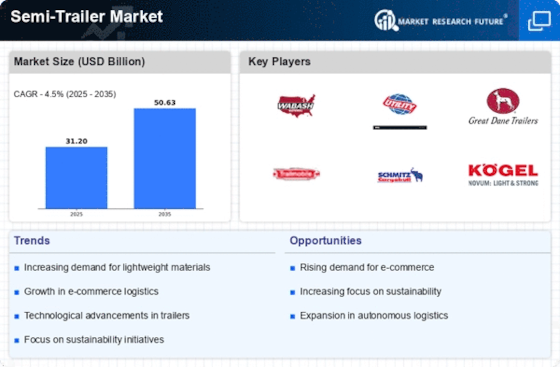
As per Market Research Future analysis, the Semi-Trailer Market Size was estimated at 31.2 USD Billion in 2024. The Semi-Trailer industry is projected to grow from USD 32.6 Billion in 2025 to USD 50.63 Billion by 2035, exhibiting a compound annual growth rate (CAGR) of 4.5% during the forecast period 2025 - 2035.

Key Market Trends & Highlights

The Semi-Trailer Market is poised for growth driven by technological advancements and increasing demand for freight transportation.

  • Technological advancements are reshaping the semi-trailer market, enhancing efficiency and performance. Sustainability initiatives are gaining traction, influencing manufacturers to adopt eco-friendly practices. The e-commerce sector is significantly impacting demand, particularly for last-mile delivery solutions. The growth of freight transportation demand and regulatory compliance are key drivers propelling the market forward.

Market Size & Forecast

2024 Market Size 31.2 (USD Billion)
2035 Market Size 50.63 (USD Billion)
CAGR (2025 - 2035) 4.5%
Largest Regional Market Share in 2024 North America

Major Players

Wabash National Corporation (US), Utility Trailer Manufacturing Company (US), Great Dane Trailers (US), Trailmobile (US), Schmitz Cargobull AG (DE), Kögel Trailer GmbH (DE), Fontaine Trailer Company (US), Dorsey Trailers (US), Lufkin Industries (US)

Market Trends

The Semi-Trailer Market is currently experiencing a dynamic evolution, driven by various factors that influence demand and supply. The increasing need for efficient transportation solutions, coupled with the growth of e-commerce, appears to be propelling the market forward. As logistics companies seek to optimize their operations, the adoption of advanced technologies in semi-trailer design and manufacturing is becoming more prevalent.

This trend suggests a shift towards more durable, lightweight, and fuel-efficient models, which may enhance overall performance and reduce operational costs. Moreover, environmental considerations are gaining traction within the Semi-Trailer Market. Regulatory pressures aimed at reducing emissions and promoting sustainability are likely to shape product offerings in the near future.

Manufacturers may focus on developing eco-friendly materials and innovative designs that comply with stringent regulations. This evolving landscape indicates that the Semi-Trailer Market is not only adapting to current demands but is also preparing for future challenges, potentially leading to a more sustainable and efficient transportation sector.

Technological Advancements

The Semi-Trailer Market is witnessing a surge in technological innovations, particularly in the areas of automation and connectivity. Manufacturers are increasingly integrating smart technologies into their products, which may enhance operational efficiency and safety. Features such as telematics systems and advanced braking technologies are becoming more common, indicating a trend towards smarter logistics solutions.

Sustainability Initiatives

There is a growing emphasis on sustainability within the Semi-Trailer Market, driven by both regulatory requirements and consumer preferences. Companies are exploring eco-friendly materials and energy-efficient designs to meet environmental standards. This trend suggests a potential shift towards greener practices in manufacturing and operation, which could reshape the market landscape.

E-commerce Influence

The rise of e-commerce is significantly impacting the Semi-Trailer Market, as logistics providers adapt to the increasing demand for rapid delivery services. This trend indicates a need for more versatile and efficient semi-trailer designs that can accommodate diverse cargo types and facilitate quicker turnaround times, thereby enhancing supply chain efficiency.

Semi-Trailer Market Market Drivers

Infrastructure Development and Investment

Infrastructure development and investment are critical drivers of the Semi-Trailer Market. Governments and private entities are increasingly investing in transportation infrastructure, including roads, bridges, and logistics hubs. This investment is essential for facilitating the efficient movement of goods and is expected to bolster the demand for semi-trailers. In 2025, infrastructure spending is projected to increase, creating a favorable environment for the Semi-Trailer Market. Enhanced infrastructure not only improves transportation efficiency but also reduces transit times, thereby increasing the attractiveness of semi-trailers for logistics providers. The synergy between infrastructure development and the semi-trailer market is likely to yield substantial growth opportunities.

Regulatory Compliance and Safety Standards

Regulatory compliance and safety standards are becoming increasingly stringent, influencing the Semi-Trailer Market. Governments are implementing more rigorous regulations regarding emissions, safety, and operational efficiency. For instance, the introduction of new emissions standards is prompting manufacturers to innovate and produce semi-trailers that meet these requirements. This shift not only enhances safety but also aligns with broader sustainability goals. As a result, the Semi-Trailer Sector is likely to see a surge in demand for compliant vehicles, as companies strive to adhere to these regulations while maintaining operational efficiency. The emphasis on safety and compliance is expected to drive technological advancements within the industry.

Growth of E-commerce and Last-Mile Delivery

The growth of e-commerce is reshaping the logistics landscape, significantly impacting the Semi-Trailer Market. As online shopping continues to gain traction, the demand for efficient last-mile delivery solutions is escalating. In 2025, e-commerce sales are anticipated to reach unprecedented levels, necessitating a robust transportation infrastructure. Semi-trailers are essential for transporting goods from distribution centers to retail locations or directly to consumers. This trend is likely to drive investments in semi-trailer fleets, as companies seek to optimize their delivery capabilities. The Semi-Trailer Sector stands to benefit from this shift, as logistics providers adapt to the evolving demands of e-commerce.

Technological Innovations in Trailer Design

Technological innovations in trailer design are significantly influencing the Semi-Trailer Market. Advancements such as lightweight materials, aerodynamic designs, and smart technology integration are enhancing the efficiency and performance of semi-trailers. For instance, the adoption of telematics systems allows for real-time tracking and monitoring of trailer conditions, improving operational efficiency. In 2025, it is expected that the market for technologically advanced semi-trailers will expand, driven by the need for improved fuel efficiency and reduced operational costs. These innovations not only enhance the functionality of semi-trailers but also contribute to the overall competitiveness of the Semi-Trailer Landscape.

Increasing Demand for Freight Transportation

The rising demand for freight transportation is a primary driver of the Semi-Trailer Market. As economies expand, the need for efficient logistics and supply chain solutions intensifies. In 2025, the freight transportation sector is projected to grow at a compound annual growth rate of approximately 4.5%. This growth is largely attributed to the increasing volume of goods being transported across various regions. Semi-trailers play a crucial role in this ecosystem, providing the necessary capacity and flexibility to meet the demands of shippers and carriers alike. The Semi-Trailer Industry is thus positioned to benefit from this upward trend, as companies seek to enhance their transportation capabilities to accommodate the growing freight volumes.

Market Segment Insights

By Type: Dry Van (Largest) vs. Refrigerated (Fastest-Growing)

<p>In the Semi-Trailer Market, the dry van segment maintains a commanding lead due to its versatility and broad application in various industries. This type is preferred for transporting goods that require protection from weather and environmental factors, thus ensuring cargo safety. On the other hand, the refrigerated segment is rapidly gaining traction, driven by the increasing demand for perishable goods transportation. It reflects a shift towards more specialized freight solutions, catering to sectors such as food and pharmaceuticals.</p>

<p>Dry Van (Dominant) vs. Refrigerated (Emerging)</p>

<p>The dry van segment is characterized by its extensive use across a range of industries, serving as the backbone of overland freight transport. Known for their standardization and efficiency, dry vans are designed for the transportation of non-perishable goods, offering protection from environmental elements. Conversely, the refrigerated segment is emerging as a critical player in the market due to the rising demand for temperature-sensitive products. As consumer preferences shift towards fresh and frozen food, the refrigerated semi-trailer continues to evolve, incorporating advanced technologies to maintain optimal temperature control, thereby boosting its market presence.</p>

By Length: Above 45 Feet (Largest) vs. Below 45 Feet (Fastest-Growing)

<p>In the Semi-Trailer Market, the length segment showcases a dynamic distribution between trailers above and below 45 feet. Currently, semi-trailers exceeding 45 feet represent the largest share of the market, catering primarily to long-haul trucking operations. Their size allows for greater capacity, making them an optimal choice for transporting bulk goods over vast distances. Conversely, trailers under 45 feet are capturing a growing portion of the market, favored for their maneuverability and suitability for urban deliveries.</p>

<p>Length: Above 45 Feet (Dominant) vs. Below 45 Feet (Emerging)</p>

<p>Trailers exceeding 45 feet are pivotal in the semi-trailer market, dominating the logistics industry with their significant cargo capacity and efficiency in long-distance transport. This segment often features designs optimized for aerodynamics and fuel efficiency, appealing to businesses seeking to balance performance and operational costs. In contrast, the segment of trailers below 45 feet is emerging rapidly due to the increasing demand for last-mile delivery solutions. These smaller trailers provide flexibility in urban environments, fitting into tighter spaces, making them a preferred choice among delivery services aiming to enhance agility and reduce turnaround times. As e-commerce continues to grow, the demand for compact semi-trailers is poised for substantial growth.</p>

By Tonnage: 51 T to 100 T (Largest) vs. Above 100 T (Fastest-Growing)

<p>The semi-trailer market exhibits a diverse tonnage distribution, with the 51 T to 100 T segment commanding the largest market share. This segment is preferred by logistics companies for its balance between load capacity and maneuverability, making it suitable for a range of applications. In contrast, the above 100 T segment, while smaller in share, is gaining traction due to the rising demand for heavy-duty transportation solutions, driven by infrastructure and construction projects.</p>

<p>Tonnage: 51 T to 100 T (Dominant) vs. Above 100 T (Emerging)</p>

<p>The 51 T to 100 T tonnage segment stands out as the dominant value in the semi-trailer market, characterized by versatile applications and widespread adoption among freight carriers. These trailers are recognized for their effectiveness in transporting goods across various industries, including agriculture and manufacturing. Meanwhile, the Above 100 T segment is emerging rapidly, fueled by the increasing need for transportation of oversized and heavy loads. This segment is highly specialized, appealing to niche industries such as mining and large-scale construction, indicating a shift towards meeting specific logistical needs.</p>

By Axles: 3 to 4 Axles (Largest) vs. 4 Axles (Fastest-Growing)

<p>In the semi-trailer market, the '3 to 4 axles' segment holds the largest market share due to its widespread application across various industries, including transportation and logistics. These axles provide an optimal balance of load capacity and maneuverability, making them a preferred choice for manufacturers and businesses that require robust freight solutions. In contrast, the '4 axles' category is emerging as a fast-growing segment, especially in regions where larger payloads are mandated to comply with regulations.</p>

<p>3 to 4 Axles (Dominant) vs. 4 Axles (Emerging)</p>

<p>The '3 to 4 axles' segment is characterized by its extensive use in heavy-duty trailers, providing significant advantages in terms of stability and weight distribution during transport. This dominance is driven by demand from industries requiring reliable and efficient transportation of goods. On the other hand, '4 axles' are gaining traction as they allow for the transport of heavier loads, responding to regulatory changes favoring higher payload capacities. Their emerging popularity is attributed to advancements in engineering and manufacturing techniques that enhance performance and durability.</p>

Get more detailed insights about Semi-Trailer Market Research Report- Forecast 2035

Regional Insights

North America : Market Leader in Trailers

North America is the largest market for semi-trailers, accounting for approximately 45% of the global market share. The region's growth is driven by the booming e-commerce sector, increasing freight transportation needs, and stringent regulations promoting safety and efficiency. The U.S. leads this market, followed closely by Canada, which contributes around 15% to the overall market. Regulatory support, such as the Federal Motor Carrier Safety Administration's guidelines, further catalyzes growth.

The competitive landscape in North America is robust, featuring key players like Wabash National Corporation, Utility Trailer Manufacturing Company, and Great Dane Trailers. These companies are innovating with lightweight materials and advanced technologies to enhance fuel efficiency and reduce emissions. The presence of a well-established logistics network and increasing demand for refrigerated trailers also bolster market growth, making it a dynamic environment for semi-trailer manufacturers.

Europe : Emerging Market Dynamics

Europe is witnessing significant growth in the semi-trailer market, holding approximately 30% of the global share. The demand is driven by the increasing need for efficient logistics solutions and the rise of e-commerce. Germany and France are the largest markets, contributing around 12% and 8% respectively. Regulatory frameworks, such as the European Union's Green Deal, are pushing for more sustainable transport solutions, which is expected to further stimulate market growth.

Leading countries in Europe include Germany, France, and the UK, with major players like Schmitz Cargobull AG and Kögel Trailer GmbH dominating the landscape. The competitive environment is characterized by innovation in trailer design and materials, focusing on weight reduction and aerodynamic efficiency. The presence of established manufacturers and a growing emphasis on sustainability are key factors shaping the market dynamics in this region.

Asia-Pacific : Rapidly Growing Market

The Asia-Pacific region is rapidly emerging as a significant player in the semi-trailer market, accounting for about 20% of the global share. The growth is fueled by increasing industrialization, urbanization, and a surge in logistics and transportation activities. China and India are the largest markets, with China alone contributing approximately 12% to the global market.

Government initiatives to improve infrastructure and logistics efficiency are also key growth drivers in this region. China leads the competitive landscape, with numerous local manufacturers entering the market. Key players include major companies like Lufkin Industries and Fontaine Trailer Company, which are expanding their operations to meet rising demand. The region's focus on enhancing supply chain efficiency and the growing trend of e-commerce are expected to further propel the semi-trailer market in the coming years, making it a vibrant and competitive environment.

Middle East and Africa : Untapped Market Potential

The Middle East and Africa (MEA) region is gradually emerging in the semi-trailer market, holding around 5% of the global share. The growth is primarily driven by increasing investments in infrastructure and logistics, alongside a growing demand for efficient transportation solutions. Countries like South Africa and the UAE are leading the market, with South Africa contributing approximately 3% to the global share.

Government initiatives aimed at improving trade routes and logistics capabilities are expected to further enhance market growth. The competitive landscape in MEA is still developing, with several local and international players vying for market share. Key players are focusing on establishing manufacturing facilities to cater to the growing demand. The region's strategic location as a trade hub between continents also presents significant opportunities for semi-trailer manufacturers, making it an attractive market for investment and growth.

Key Players and Competitive Insights

The Semi-Trailer Market is currently characterized by a dynamic competitive landscape, driven by factors such as increasing demand for freight transportation, advancements in trailer technology, and a growing emphasis on sustainability. Major players like Wabash National Corporation (US), Utility Trailer Manufacturing Company (US), and Schmitz Cargobull AG (DE) are strategically positioning themselves through innovation and regional expansion.
Wabash National Corporation (US) focuses on lightweight trailer designs to enhance fuel efficiency, while Utility Trailer Manufacturing Company (US) emphasizes durability and customization in its offerings. Schmitz Cargobull AG (DE) is leveraging its strong European presence to expand into emerging markets, thereby shaping a competitive environment that prioritizes technological advancement and customer-centric solutions. In terms of business tactics, companies are increasingly localizing manufacturing to reduce lead times and optimize supply chains.
The market appears moderately fragmented, with several key players exerting influence over specific regions. This fragmentation allows for niche players to thrive, while larger companies consolidate their market share through strategic partnerships and acquisitions. The collective influence of these key players fosters a competitive structure that encourages innovation and responsiveness to market demands.
In August 2025, Wabash National Corporation (US) announced a partnership with a leading technology firm to develop smart trailer solutions that integrate IoT capabilities. This strategic move is likely to enhance operational efficiency for fleet operators, as real-time data analytics can optimize route planning and maintenance schedules. Such innovations may position Wabash as a frontrunner in the digital transformation of the semi-trailer sector.
Similarly, in September 2025, Schmitz Cargobull AG (DE) unveiled a new line of eco-friendly trailers designed to meet stringent emissions regulations. This initiative not only aligns with global sustainability trends but also demonstrates the company's commitment to reducing the carbon footprint of freight transport. By investing in environmentally friendly technologies, Schmitz Cargobull is likely to attract environmentally conscious customers and enhance its competitive edge.
In October 2025, Utility Trailer Manufacturing Company (US) expanded its production capabilities by opening a new facility in the Midwest. This strategic expansion is expected to improve supply chain efficiency and meet the growing demand for trailers in the region. By localizing production, Utility Trailer can respond more swiftly to customer needs, thereby solidifying its market position.
As of October 2025, the Semi-Trailer Market is witnessing trends such as digitalization, sustainability, and the integration of artificial intelligence. Strategic alliances are increasingly shaping the competitive landscape, as companies collaborate to enhance technological capabilities and market reach. Looking ahead, competitive differentiation is likely to evolve from traditional price-based competition to a focus on innovation, technology integration, and supply chain reliability. This shift underscores the importance of adaptability and forward-thinking strategies in maintaining a competitive advantage.
In September 2025, Ascendance Truck Centers acquired Thompson Truck & Trailer, strengthening its commercial vehicle service and dealership network. The move enhances Ascendance’s regional footprint and improves customer support capabilities. It represents a strategic expansion in the competitive North American trucking market.
In August 2025, Mercedes-Benz set a new world record with its electric semi-truck, showcasing exceptional range and efficiency performance. The achievement highlights Mercedes’ progress in heavy-duty electrification. It reinforces the company’s ambition to lead the zero-emission commercial truck segment.

Key Companies in the Semi-Trailer Market include

Industry Developments

  • Q4 2025: BMW Group has expanded real-world testing of its next-generation electric semitrailer across complex logistics routes, with recent trials showing improved traction, higher efficiency, and better load performance. Updated energy-management software also delivered measurable gains, bringing the platform closer to full-scale commercial integration.


  • Q4 2025: A new semi-trailer rail service is set to launch in September as Helrom expands its intermodal logistics network. The service will support freight operators with faster loading technology, improved cross-border connectivity, and reduced emissions for long-distance cargo movement.

  • Q2 2025: Truck Semi-Trailer Market: What was purchased in June 2025? In June 2025, Ukrainian carriers purchased 1,144 new and used semi-trailers, with Schmitz Cargobull leading new semi-trailer registrations (26 units), followed by Wielton (11 units) and Krone (9 units). Dump trucks were the most popular new semi-trailer type, followed by platforms and refrigerated vans.

Future Outlook

Semi-Trailer Market Future Outlook

The global semi-trailer market is projected to grow at a 4.5% CAGR from 2025 to 2035, driven by increasing e-commerce demand, technological advancements, and sustainability initiatives.

New opportunities lie in:

  • <p>Development of lightweight composite materials for enhanced fuel efficiency. Integration of <a href="https://www.marketresearchfuture.com/reports/telematics-market-1121" target="_blank" title="telematics">telematics</a> for real-time fleet management solutions. Expansion into electric semi-trailer production to meet regulatory demands.</p>

By 2035, the Semi-Trailer Market is expected to be robust, driven by innovation and sustainability.

Market Segmentation

Semi-Trailer Market Type Outlook

  • tankers
  • flatbed
  • dry van
  • lowboy
  • refrigerator

Semi-Trailer Market Axles Outlook

  • below 3 axles
  • 3 to 4 axles
  • 4 axles

Semi-Trailer Market Length Outlook

  • above 45 feet
  • below 45 feet

Semi-Trailer Market Tonnage Outlook

  • 25 t to 50 T
  • 51 T to 100 T
  • Above 100 T

Report Scope

MARKET SIZE 2024 31.2(USD Billion)
MARKET SIZE 2025 32.6(USD Billion)
MARKET SIZE 2035 50.63(USD Billion)
COMPOUND ANNUAL GROWTH RATE (CAGR) 4.5% (2025 - 2035)
REPORT COVERAGE Revenue Forecast, Competitive Landscape, Growth Factors, and Trends
BASE YEAR 2024
Market Forecast Period 2025 - 2035
Historical Data 2019 - 2024
Market Forecast Units USD Billion
Key Companies Profiled Wabash National Corporation (US), Utility Trailer Manufacturing Company (US), Great Dane Trailers (US), Trailmobile (US), Schmitz Cargobull AG (DE), Kögel Trailer GmbH (DE), Fontaine Trailer Company (US), Dorsey Trailers (US), Lufkin Industries (US)
Segments Covered Type, Length, Tonnage, Axles, Region
Key Market Opportunities Integration of advanced telematics for enhanced fleet management in the Semi-Trailer Market.
Key Market Dynamics Rising demand for lightweight materials in semi-trailer manufacturing enhances fuel efficiency and reduces operational costs.
Countries Covered North America, Europe, APAC, South America, MEA

FAQs

What is the projected market valuation of the Semi-Trailer Market by 2035?

<p>The Semi-Trailer Market is projected to reach a valuation of 50.63 USD Billion by 2035.</p>

What was the market valuation of the Semi-Trailer Market in 2024?

<p>In 2024, the Semi-Trailer Market was valued at 31.2 USD Billion.</p>

What is the expected CAGR for the Semi-Trailer Market during the forecast period 2025 - 2035?

<p>The expected CAGR for the Semi-Trailer Market during the forecast period 2025 - 2035 is 4.5%.</p>

Which companies are considered key players in the Semi-Trailer Market?

<p>Key players in the Semi-Trailer Market include Wabash National Corporation, Utility Trailer Manufacturing Company, and Great Dane Trailers.</p>

What are the projected valuations for different types of semi-trailers by 2035?

<p>By 2035, projected valuations for semi-trailer types include tankers at 8.0 USD Billion, flatbeds at 9.0 USD Billion, and dry vans at 15.0 USD Billion.</p>

How does the length of semi-trailers affect market valuation?

<p>The market valuation for semi-trailers below 45 feet is projected to reach 26.63 USD Billion by 2035, while those above 45 feet may reach 24.0 USD Billion.</p>

What is the market outlook for semi-trailers based on tonnage segments?

The market outlook indicates that semi-trailers with a tonnage of 51 T to 100 T could reach a valuation of 18.0 USD Billion by 2035.

What are the projected valuations for semi-trailers based on axle configurations?

Projected valuations for semi-trailers with 3 to 4 axles may reach 24.0 USD Billion by 2035, while those with below 3 axles could reach 12.0 USD Billion.

How do the key players influence the Semi-Trailer Market?

Key players like Fontaine Trailer Company and Dorsey Trailers likely influence market dynamics through innovation and competitive pricing.

What trends are shaping the Semi-Trailer Market in 2025?

In 2025, trends such as increasing demand for specialized trailers and advancements in materials are shaping the Semi-Trailer Market.

  1. SECTION I: EXECUTIVE SUMMARY AND KEY HIGHLIGHTS
    1. | 1.1 EXECUTIVE SUMMARY
    2. | | 1.1.1 Market Overview
    3. | | 1.1.2 Key Findings
    4. | | 1.1.3 Market Segmentation
    5. | | 1.1.4 Competitive Landscape
    6. | | 1.1.5 Challenges and Opportunities
    7. | | 1.1.6 Future Outlook
  2. SECTION II: SCOPING, METHODOLOGY AND MARKET STRUCTURE
    1. | 2.1 MARKET INTRODUCTION
    2. | | 2.1.1 Definition
    3. | | 2.1.2 Scope of the study
    4. | | | 2.1.2.1 Research Objective
    5. | | | 2.1.2.2 Assumption
    6. | | | 2.1.2.3 Limitations
    7. | 2.2 RESEARCH METHODOLOGY
    8. | | 2.2.1 Overview
    9. | | 2.2.2 Data Mining
    10. | | 2.2.3 Secondary Research
    11. | | 2.2.4 Primary Research
    12. | | | 2.2.4.1 Primary Interviews and Information Gathering Process
    13. | | | 2.2.4.2 Breakdown of Primary Respondents
    14. | | 2.2.5 Forecasting Model
    15. | | 2.2.6 Market Size Estimation
    16. | | | 2.2.6.1 Bottom-Up Approach
    17. | | | 2.2.6.2 Top-Down Approach
    18. | | 2.2.7 Data Triangulation
    19. | | 2.2.8 Validation
  3. SECTION III: QUALITATIVE ANALYSIS
    1. | 3.1 MARKET DYNAMICS
    2. | | 3.1.1 Overview
    3. | | 3.1.2 Drivers
    4. | | 3.1.3 Restraints
    5. | | 3.1.4 Opportunities
    6. | 3.2 MARKET FACTOR ANALYSIS
    7. | | 3.2.1 Value chain Analysis
    8. | | 3.2.2 Porter's Five Forces Analysis
    9. | | | 3.2.2.1 Bargaining Power of Suppliers
    10. | | | 3.2.2.2 Bargaining Power of Buyers
    11. | | | 3.2.2.3 Threat of New Entrants
    12. | | | 3.2.2.4 Threat of Substitutes
    13. | | | 3.2.2.5 Intensity of Rivalry
    14. | | 3.2.3 COVID-19 Impact Analysis
    15. | | | 3.2.3.1 Market Impact Analysis
    16. | | | 3.2.3.2 Regional Impact
    17. | | | 3.2.3.3 Opportunity and Threat Analysis
  4. SECTION IV: QUANTITATIVE ANALYSIS
    1. | 4.1 Automobile, BY Type (USD Billion)
    2. | | 4.1.1 tankers
    3. | | 4.1.2 flatbed
    4. | | 4.1.3 dry van
    5. | | 4.1.4 lowboy
    6. | | 4.1.5 refrigerator
    7. | 4.2 Automobile, BY Length (USD Billion)
    8. | | 4.2.1 above 45 feet
    9. | | 4.2.2 below 45 feet
    10. | 4.3 Automobile, BY Tonnage (USD Billion)
    11. | | 4.3.1 25 t to 50 T
    12. | | 4.3.2 51 T to 100 T
    13. | | 4.3.3 Above 100 T
    14. | 4.4 Automobile, BY Axles (USD Billion)
    15. | | 4.4.1 below 3 axles
    16. | | 4.4.2 3 to 4 axles
    17. | | 4.4.3 4 axles
    18. | 4.5 Automobile, BY Region (USD Billion)
    19. | | 4.5.1 North America
    20. | | | 4.5.1.1 US
    21. | | | 4.5.1.2 Canada
    22. | | 4.5.2 Europe
    23. | | | 4.5.2.1 Germany
    24. | | | 4.5.2.2 UK
    25. | | | 4.5.2.3 France
    26. | | | 4.5.2.4 Russia
    27. | | | 4.5.2.5 Italy
    28. | | | 4.5.2.6 Spain
    29. | | | 4.5.2.7 Rest of Europe
    30. | | 4.5.3 APAC
    31. | | | 4.5.3.1 China
    32. | | | 4.5.3.2 India
    33. | | | 4.5.3.3 Japan
    34. | | | 4.5.3.4 South Korea
    35. | | | 4.5.3.5 Malaysia
    36. | | | 4.5.3.6 Thailand
    37. | | | 4.5.3.7 Indonesia
    38. | | | 4.5.3.8 Rest of APAC
    39. | | 4.5.4 South America
    40. | | | 4.5.4.1 Brazil
    41. | | | 4.5.4.2 Mexico
    42. | | | 4.5.4.3 Argentina
    43. | | | 4.5.4.4 Rest of South America
    44. | | 4.5.5 MEA
    45. | | | 4.5.5.1 GCC Countries
    46. | | | 4.5.5.2 South Africa
    47. | | | 4.5.5.3 Rest of MEA
  5. SECTION V: COMPETITIVE ANALYSIS
    1. | 5.1 Competitive Landscape
    2. | | 5.1.1 Overview
    3. | | 5.1.2 Competitive Analysis
    4. | | 5.1.3 Market share Analysis
    5. | | 5.1.4 Major Growth Strategy in the Automobile
    6. | | 5.1.5 Competitive Benchmarking
    7. | | 5.1.6 Leading Players in Terms of Number of Developments in the Automobile
    8. | | 5.1.7 Key developments and growth strategies
    9. | | | 5.1.7.1 New Product Launch/Service Deployment
    10. | | | 5.1.7.2 Merger & Acquisitions
    11. | | | 5.1.7.3 Joint Ventures
    12. | | 5.1.8 Major Players Financial Matrix
    13. | | | 5.1.8.1 Sales and Operating Income
    14. | | | 5.1.8.2 Major Players R&D Expenditure. 2023
    15. | 5.2 Company Profiles
    16. | | 5.2.1 Wabash National Corporation (US)
    17. | | | 5.2.1.1 Financial Overview
    18. | | | 5.2.1.2 Products Offered
    19. | | | 5.2.1.3 Key Developments
    20. | | | 5.2.1.4 SWOT Analysis
    21. | | | 5.2.1.5 Key Strategies
    22. | | 5.2.2 Utility Trailer Manufacturing Company (US)
    23. | | | 5.2.2.1 Financial Overview
    24. | | | 5.2.2.2 Products Offered
    25. | | | 5.2.2.3 Key Developments
    26. | | | 5.2.2.4 SWOT Analysis
    27. | | | 5.2.2.5 Key Strategies
    28. | | 5.2.3 Great Dane Trailers (US)
    29. | | | 5.2.3.1 Financial Overview
    30. | | | 5.2.3.2 Products Offered
    31. | | | 5.2.3.3 Key Developments
    32. | | | 5.2.3.4 SWOT Analysis
    33. | | | 5.2.3.5 Key Strategies
    34. | | 5.2.4 Trailmobile (US)
    35. | | | 5.2.4.1 Financial Overview
    36. | | | 5.2.4.2 Products Offered
    37. | | | 5.2.4.3 Key Developments
    38. | | | 5.2.4.4 SWOT Analysis
    39. | | | 5.2.4.5 Key Strategies
    40. | | 5.2.5 Schmitz Cargobull AG (DE)
    41. | | | 5.2.5.1 Financial Overview
    42. | | | 5.2.5.2 Products Offered
    43. | | | 5.2.5.3 Key Developments
    44. | | | 5.2.5.4 SWOT Analysis
    45. | | | 5.2.5.5 Key Strategies
    46. | | 5.2.6 Kögel Trailer GmbH (DE)
    47. | | | 5.2.6.1 Financial Overview
    48. | | | 5.2.6.2 Products Offered
    49. | | | 5.2.6.3 Key Developments
    50. | | | 5.2.6.4 SWOT Analysis
    51. | | | 5.2.6.5 Key Strategies
    52. | | 5.2.7 Fontaine Trailer Company (US)
    53. | | | 5.2.7.1 Financial Overview
    54. | | | 5.2.7.2 Products Offered
    55. | | | 5.2.7.3 Key Developments
    56. | | | 5.2.7.4 SWOT Analysis
    57. | | | 5.2.7.5 Key Strategies
    58. | | 5.2.8 Dorsey Trailers (US)
    59. | | | 5.2.8.1 Financial Overview
    60. | | | 5.2.8.2 Products Offered
    61. | | | 5.2.8.3 Key Developments
    62. | | | 5.2.8.4 SWOT Analysis
    63. | | | 5.2.8.5 Key Strategies
    64. | | 5.2.9 Lufkin Industries (US)
    65. | | | 5.2.9.1 Financial Overview
    66. | | | 5.2.9.2 Products Offered
    67. | | | 5.2.9.3 Key Developments
    68. | | | 5.2.9.4 SWOT Analysis
    69. | | | 5.2.9.5 Key Strategies
    70. | 5.3 Appendix
    71. | | 5.3.1 References
    72. | | 5.3.2 Related Reports
  6. LIST OF FIGURES
    1. | 6.1 MARKET SYNOPSIS
    2. | 6.2 NORTH AMERICA MARKET ANALYSIS
    3. | 6.3 US MARKET ANALYSIS BY TYPE
    4. | 6.4 US MARKET ANALYSIS BY LENGTH
    5. | 6.5 US MARKET ANALYSIS BY TONNAGE
    6. | 6.6 US MARKET ANALYSIS BY AXLES
    7. | 6.7 CANADA MARKET ANALYSIS BY TYPE
    8. | 6.8 CANADA MARKET ANALYSIS BY LENGTH
    9. | 6.9 CANADA MARKET ANALYSIS BY TONNAGE
    10. | 6.10 CANADA MARKET ANALYSIS BY AXLES
    11. | 6.11 EUROPE MARKET ANALYSIS
    12. | 6.12 GERMANY MARKET ANALYSIS BY TYPE
    13. | 6.13 GERMANY MARKET ANALYSIS BY LENGTH
    14. | 6.14 GERMANY MARKET ANALYSIS BY TONNAGE
    15. | 6.15 GERMANY MARKET ANALYSIS BY AXLES
    16. | 6.16 UK MARKET ANALYSIS BY TYPE
    17. | 6.17 UK MARKET ANALYSIS BY LENGTH
    18. | 6.18 UK MARKET ANALYSIS BY TONNAGE
    19. | 6.19 UK MARKET ANALYSIS BY AXLES
    20. | 6.20 FRANCE MARKET ANALYSIS BY TYPE
    21. | 6.21 FRANCE MARKET ANALYSIS BY LENGTH
    22. | 6.22 FRANCE MARKET ANALYSIS BY TONNAGE
    23. | 6.23 FRANCE MARKET ANALYSIS BY AXLES
    24. | 6.24 RUSSIA MARKET ANALYSIS BY TYPE
    25. | 6.25 RUSSIA MARKET ANALYSIS BY LENGTH
    26. | 6.26 RUSSIA MARKET ANALYSIS BY TONNAGE
    27. | 6.27 RUSSIA MARKET ANALYSIS BY AXLES
    28. | 6.28 ITALY MARKET ANALYSIS BY TYPE
    29. | 6.29 ITALY MARKET ANALYSIS BY LENGTH
    30. | 6.30 ITALY MARKET ANALYSIS BY TONNAGE
    31. | 6.31 ITALY MARKET ANALYSIS BY AXLES
    32. | 6.32 SPAIN MARKET ANALYSIS BY TYPE
    33. | 6.33 SPAIN MARKET ANALYSIS BY LENGTH
    34. | 6.34 SPAIN MARKET ANALYSIS BY TONNAGE
    35. | 6.35 SPAIN MARKET ANALYSIS BY AXLES
    36. | 6.36 REST OF EUROPE MARKET ANALYSIS BY TYPE
    37. | 6.37 REST OF EUROPE MARKET ANALYSIS BY LENGTH
    38. | 6.38 REST OF EUROPE MARKET ANALYSIS BY TONNAGE
    39. | 6.39 REST OF EUROPE MARKET ANALYSIS BY AXLES
    40. | 6.40 APAC MARKET ANALYSIS
    41. | 6.41 CHINA MARKET ANALYSIS BY TYPE
    42. | 6.42 CHINA MARKET ANALYSIS BY LENGTH
    43. | 6.43 CHINA MARKET ANALYSIS BY TONNAGE
    44. | 6.44 CHINA MARKET ANALYSIS BY AXLES
    45. | 6.45 INDIA MARKET ANALYSIS BY TYPE
    46. | 6.46 INDIA MARKET ANALYSIS BY LENGTH
    47. | 6.47 INDIA MARKET ANALYSIS BY TONNAGE
    48. | 6.48 INDIA MARKET ANALYSIS BY AXLES
    49. | 6.49 JAPAN MARKET ANALYSIS BY TYPE
    50. | 6.50 JAPAN MARKET ANALYSIS BY LENGTH
    51. | 6.51 JAPAN MARKET ANALYSIS BY TONNAGE
    52. | 6.52 JAPAN MARKET ANALYSIS BY AXLES
    53. | 6.53 SOUTH KOREA MARKET ANALYSIS BY TYPE
    54. | 6.54 SOUTH KOREA MARKET ANALYSIS BY LENGTH
    55. | 6.55 SOUTH KOREA MARKET ANALYSIS BY TONNAGE
    56. | 6.56 SOUTH KOREA MARKET ANALYSIS BY AXLES
    57. | 6.57 MALAYSIA MARKET ANALYSIS BY TYPE
    58. | 6.58 MALAYSIA MARKET ANALYSIS BY LENGTH
    59. | 6.59 MALAYSIA MARKET ANALYSIS BY TONNAGE
    60. | 6.60 MALAYSIA MARKET ANALYSIS BY AXLES
    61. | 6.61 THAILAND MARKET ANALYSIS BY TYPE
    62. | 6.62 THAILAND MARKET ANALYSIS BY LENGTH
    63. | 6.63 THAILAND MARKET ANALYSIS BY TONNAGE
    64. | 6.64 THAILAND MARKET ANALYSIS BY AXLES
    65. | 6.65 INDONESIA MARKET ANALYSIS BY TYPE
    66. | 6.66 INDONESIA MARKET ANALYSIS BY LENGTH
    67. | 6.67 INDONESIA MARKET ANALYSIS BY TONNAGE
    68. | 6.68 INDONESIA MARKET ANALYSIS BY AXLES
    69. | 6.69 REST OF APAC MARKET ANALYSIS BY TYPE
    70. | 6.70 REST OF APAC MARKET ANALYSIS BY LENGTH
    71. | 6.71 REST OF APAC MARKET ANALYSIS BY TONNAGE
    72. | 6.72 REST OF APAC MARKET ANALYSIS BY AXLES
    73. | 6.73 SOUTH AMERICA MARKET ANALYSIS
    74. | 6.74 BRAZIL MARKET ANALYSIS BY TYPE
    75. | 6.75 BRAZIL MARKET ANALYSIS BY LENGTH
    76. | 6.76 BRAZIL MARKET ANALYSIS BY TONNAGE
    77. | 6.77 BRAZIL MARKET ANALYSIS BY AXLES
    78. | 6.78 MEXICO MARKET ANALYSIS BY TYPE
    79. | 6.79 MEXICO MARKET ANALYSIS BY LENGTH
    80. | 6.80 MEXICO MARKET ANALYSIS BY TONNAGE
    81. | 6.81 MEXICO MARKET ANALYSIS BY AXLES
    82. | 6.82 ARGENTINA MARKET ANALYSIS BY TYPE
    83. | 6.83 ARGENTINA MARKET ANALYSIS BY LENGTH
    84. | 6.84 ARGENTINA MARKET ANALYSIS BY TONNAGE
    85. | 6.85 ARGENTINA MARKET ANALYSIS BY AXLES
    86. | 6.86 REST OF SOUTH AMERICA MARKET ANALYSIS BY TYPE
    87. | 6.87 REST OF SOUTH AMERICA MARKET ANALYSIS BY LENGTH
    88. | 6.88 REST OF SOUTH AMERICA MARKET ANALYSIS BY TONNAGE
    89. | 6.89 REST OF SOUTH AMERICA MARKET ANALYSIS BY AXLES
    90. | 6.90 MEA MARKET ANALYSIS
    91. | 6.91 GCC COUNTRIES MARKET ANALYSIS BY TYPE
    92. | 6.92 GCC COUNTRIES MARKET ANALYSIS BY LENGTH
    93. | 6.93 GCC COUNTRIES MARKET ANALYSIS BY TONNAGE
    94. | 6.94 GCC COUNTRIES MARKET ANALYSIS BY AXLES
    95. | 6.95 SOUTH AFRICA MARKET ANALYSIS BY TYPE
    96. | 6.96 SOUTH AFRICA MARKET ANALYSIS BY LENGTH
    97. | 6.97 SOUTH AFRICA MARKET ANALYSIS BY TONNAGE
    98. | 6.98 SOUTH AFRICA MARKET ANALYSIS BY AXLES
    99. | 6.99 REST OF MEA MARKET ANALYSIS BY TYPE
    100. | 6.100 REST OF MEA MARKET ANALYSIS BY LENGTH
    101. | 6.101 REST OF MEA MARKET ANALYSIS BY TONNAGE
    102. | 6.102 REST OF MEA MARKET ANALYSIS BY AXLES
    103. | 6.103 KEY BUYING CRITERIA OF AUTOMOBILE
    104. | 6.104 RESEARCH PROCESS OF MRFR
    105. | 6.105 DRO ANALYSIS OF AUTOMOBILE
    106. | 6.106 DRIVERS IMPACT ANALYSIS: AUTOMOBILE
    107. | 6.107 RESTRAINTS IMPACT ANALYSIS: AUTOMOBILE
    108. | 6.108 SUPPLY / VALUE CHAIN: AUTOMOBILE
    109. | 6.109 AUTOMOBILE, BY TYPE, 2024 (% SHARE)
    110. | 6.110 AUTOMOBILE, BY TYPE, 2024 TO 2035 (USD Billion)
    111. | 6.111 AUTOMOBILE, BY LENGTH, 2024 (% SHARE)
    112. | 6.112 AUTOMOBILE, BY LENGTH, 2024 TO 2035 (USD Billion)
    113. | 6.113 AUTOMOBILE, BY TONNAGE, 2024 (% SHARE)
    114. | 6.114 AUTOMOBILE, BY TONNAGE, 2024 TO 2035 (USD Billion)
    115. | 6.115 AUTOMOBILE, BY AXLES, 2024 (% SHARE)
    116. | 6.116 AUTOMOBILE, BY AXLES, 2024 TO 2035 (USD Billion)
    117. | 6.117 BENCHMARKING OF MAJOR COMPETITORS
  7. LIST OF TABLES
    1. | 7.1 LIST OF ASSUMPTIONS
    2. | | 7.1.1
    3. | 7.2 North America MARKET SIZE ESTIMATES; FORECAST
    4. | | 7.2.1 BY TYPE, 2025-2035 (USD Billion)
    5. | | 7.2.2 BY LENGTH, 2025-2035 (USD Billion)
    6. | | 7.2.3 BY TONNAGE, 2025-2035 (USD Billion)
    7. | | 7.2.4 BY AXLES, 2025-2035 (USD Billion)
    8. | 7.3 US MARKET SIZE ESTIMATES; FORECAST
    9. | | 7.3.1 BY TYPE, 2025-2035 (USD Billion)
    10. | | 7.3.2 BY LENGTH, 2025-2035 (USD Billion)
    11. | | 7.3.3 BY TONNAGE, 2025-2035 (USD Billion)
    12. | | 7.3.4 BY AXLES, 2025-2035 (USD Billion)
    13. | 7.4 Canada MARKET SIZE ESTIMATES; FORECAST
    14. | | 7.4.1 BY TYPE, 2025-2035 (USD Billion)
    15. | | 7.4.2 BY LENGTH, 2025-2035 (USD Billion)
    16. | | 7.4.3 BY TONNAGE, 2025-2035 (USD Billion)
    17. | | 7.4.4 BY AXLES, 2025-2035 (USD Billion)
    18. | 7.5 Europe MARKET SIZE ESTIMATES; FORECAST
    19. | | 7.5.1 BY TYPE, 2025-2035 (USD Billion)
    20. | | 7.5.2 BY LENGTH, 2025-2035 (USD Billion)
    21. | | 7.5.3 BY TONNAGE, 2025-2035 (USD Billion)
    22. | | 7.5.4 BY AXLES, 2025-2035 (USD Billion)
    23. | 7.6 Germany MARKET SIZE ESTIMATES; FORECAST
    24. | | 7.6.1 BY TYPE, 2025-2035 (USD Billion)
    25. | | 7.6.2 BY LENGTH, 2025-2035 (USD Billion)
    26. | | 7.6.3 BY TONNAGE, 2025-2035 (USD Billion)
    27. | | 7.6.4 BY AXLES, 2025-2035 (USD Billion)
    28. | 7.7 UK MARKET SIZE ESTIMATES; FORECAST
    29. | | 7.7.1 BY TYPE, 2025-2035 (USD Billion)
    30. | | 7.7.2 BY LENGTH, 2025-2035 (USD Billion)
    31. | | 7.7.3 BY TONNAGE, 2025-2035 (USD Billion)
    32. | | 7.7.4 BY AXLES, 2025-2035 (USD Billion)
    33. | 7.8 France MARKET SIZE ESTIMATES; FORECAST
    34. | | 7.8.1 BY TYPE, 2025-2035 (USD Billion)
    35. | | 7.8.2 BY LENGTH, 2025-2035 (USD Billion)
    36. | | 7.8.3 BY TONNAGE, 2025-2035 (USD Billion)
    37. | | 7.8.4 BY AXLES, 2025-2035 (USD Billion)
    38. | 7.9 Russia MARKET SIZE ESTIMATES; FORECAST
    39. | | 7.9.1 BY TYPE, 2025-2035 (USD Billion)
    40. | | 7.9.2 BY LENGTH, 2025-2035 (USD Billion)
    41. | | 7.9.3 BY TONNAGE, 2025-2035 (USD Billion)
    42. | | 7.9.4 BY AXLES, 2025-2035 (USD Billion)
    43. | 7.10 Italy MARKET SIZE ESTIMATES; FORECAST
    44. | | 7.10.1 BY TYPE, 2025-2035 (USD Billion)
    45. | | 7.10.2 BY LENGTH, 2025-2035 (USD Billion)
    46. | | 7.10.3 BY TONNAGE, 2025-2035 (USD Billion)
    47. | | 7.10.4 BY AXLES, 2025-2035 (USD Billion)
    48. | 7.11 Spain MARKET SIZE ESTIMATES; FORECAST
    49. | | 7.11.1 BY TYPE, 2025-2035 (USD Billion)
    50. | | 7.11.2 BY LENGTH, 2025-2035 (USD Billion)
    51. | | 7.11.3 BY TONNAGE, 2025-2035 (USD Billion)
    52. | | 7.11.4 BY AXLES, 2025-2035 (USD Billion)
    53. | 7.12 Rest of Europe MARKET SIZE ESTIMATES; FORECAST
    54. | | 7.12.1 BY TYPE, 2025-2035 (USD Billion)
    55. | | 7.12.2 BY LENGTH, 2025-2035 (USD Billion)
    56. | | 7.12.3 BY TONNAGE, 2025-2035 (USD Billion)
    57. | | 7.12.4 BY AXLES, 2025-2035 (USD Billion)
    58. | 7.13 APAC MARKET SIZE ESTIMATES; FORECAST
    59. | | 7.13.1 BY TYPE, 2025-2035 (USD Billion)
    60. | | 7.13.2 BY LENGTH, 2025-2035 (USD Billion)
    61. | | 7.13.3 BY TONNAGE, 2025-2035 (USD Billion)
    62. | | 7.13.4 BY AXLES, 2025-2035 (USD Billion)
    63. | 7.14 China MARKET SIZE ESTIMATES; FORECAST
    64. | | 7.14.1 BY TYPE, 2025-2035 (USD Billion)
    65. | | 7.14.2 BY LENGTH, 2025-2035 (USD Billion)
    66. | | 7.14.3 BY TONNAGE, 2025-2035 (USD Billion)
    67. | | 7.14.4 BY AXLES, 2025-2035 (USD Billion)
    68. | 7.15 India MARKET SIZE ESTIMATES; FORECAST
    69. | | 7.15.1 BY TYPE, 2025-2035 (USD Billion)
    70. | | 7.15.2 BY LENGTH, 2025-2035 (USD Billion)
    71. | | 7.15.3 BY TONNAGE, 2025-2035 (USD Billion)
    72. | | 7.15.4 BY AXLES, 2025-2035 (USD Billion)
    73. | 7.16 Japan MARKET SIZE ESTIMATES; FORECAST
    74. | | 7.16.1 BY TYPE, 2025-2035 (USD Billion)
    75. | | 7.16.2 BY LENGTH, 2025-2035 (USD Billion)
    76. | | 7.16.3 BY TONNAGE, 2025-2035 (USD Billion)
    77. | | 7.16.4 BY AXLES, 2025-2035 (USD Billion)
    78. | 7.17 South Korea MARKET SIZE ESTIMATES; FORECAST
    79. | | 7.17.1 BY TYPE, 2025-2035 (USD Billion)
    80. | | 7.17.2 BY LENGTH, 2025-2035 (USD Billion)
    81. | | 7.17.3 BY TONNAGE, 2025-2035 (USD Billion)
    82. | | 7.17.4 BY AXLES, 2025-2035 (USD Billion)
    83. | 7.18 Malaysia MARKET SIZE ESTIMATES; FORECAST
    84. | | 7.18.1 BY TYPE, 2025-2035 (USD Billion)
    85. | | 7.18.2 BY LENGTH, 2025-2035 (USD Billion)
    86. | | 7.18.3 BY TONNAGE, 2025-2035 (USD Billion)
    87. | | 7.18.4 BY AXLES, 2025-2035 (USD Billion)
    88. | 7.19 Thailand MARKET SIZE ESTIMATES; FORECAST
    89. | | 7.19.1 BY TYPE, 2025-2035 (USD Billion)
    90. | | 7.19.2 BY LENGTH, 2025-2035 (USD Billion)
    91. | | 7.19.3 BY TONNAGE, 2025-2035 (USD Billion)
    92. | | 7.19.4 BY AXLES, 2025-2035 (USD Billion)
    93. | 7.20 Indonesia MARKET SIZE ESTIMATES; FORECAST
    94. | | 7.20.1 BY TYPE, 2025-2035 (USD Billion)
    95. | | 7.20.2 BY LENGTH, 2025-2035 (USD Billion)
    96. | | 7.20.3 BY TONNAGE, 2025-2035 (USD Billion)
    97. | | 7.20.4 BY AXLES, 2025-2035 (USD Billion)
    98. | 7.21 Rest of APAC MARKET SIZE ESTIMATES; FORECAST
    99. | | 7.21.1 BY TYPE, 2025-2035 (USD Billion)
    100. | | 7.21.2 BY LENGTH, 2025-2035 (USD Billion)
    101. | | 7.21.3 BY TONNAGE, 2025-2035 (USD Billion)
    102. | | 7.21.4 BY AXLES, 2025-2035 (USD Billion)
    103. | 7.22 South America MARKET SIZE ESTIMATES; FORECAST
    104. | | 7.22.1 BY TYPE, 2025-2035 (USD Billion)
    105. | | 7.22.2 BY LENGTH, 2025-2035 (USD Billion)
    106. | | 7.22.3 BY TONNAGE, 2025-2035 (USD Billion)
    107. | | 7.22.4 BY AXLES, 2025-2035 (USD Billion)
    108. | 7.23 Brazil MARKET SIZE ESTIMATES; FORECAST
    109. | | 7.23.1 BY TYPE, 2025-2035 (USD Billion)
    110. | | 7.23.2 BY LENGTH, 2025-2035 (USD Billion)
    111. | | 7.23.3 BY TONNAGE, 2025-2035 (USD Billion)
    112. | | 7.23.4 BY AXLES, 2025-2035 (USD Billion)
    113. | 7.24 Mexico MARKET SIZE ESTIMATES; FORECAST
    114. | | 7.24.1 BY TYPE, 2025-2035 (USD Billion)
    115. | | 7.24.2 BY LENGTH, 2025-2035 (USD Billion)
    116. | | 7.24.3 BY TONNAGE, 2025-2035 (USD Billion)
    117. | | 7.24.4 BY AXLES, 2025-2035 (USD Billion)
    118. | 7.25 Argentina MARKET SIZE ESTIMATES; FORECAST
    119. | | 7.25.1 BY TYPE, 2025-2035 (USD Billion)
    120. | | 7.25.2 BY LENGTH, 2025-2035 (USD Billion)
    121. | | 7.25.3 BY TONNAGE, 2025-2035 (USD Billion)
    122. | | 7.25.4 BY AXLES, 2025-2035 (USD Billion)
    123. | 7.26 Rest of South America MARKET SIZE ESTIMATES; FORECAST
    124. | | 7.26.1 BY TYPE, 2025-2035 (USD Billion)
    125. | | 7.26.2 BY LENGTH, 2025-2035 (USD Billion)
    126. | | 7.26.3 BY TONNAGE, 2025-2035 (USD Billion)
    127. | | 7.26.4 BY AXLES, 2025-2035 (USD Billion)
    128. | 7.27 MEA MARKET SIZE ESTIMATES; FORECAST
    129. | | 7.27.1 BY TYPE, 2025-2035 (USD Billion)
    130. | | 7.27.2 BY LENGTH, 2025-2035 (USD Billion)
    131. | | 7.27.3 BY TONNAGE, 2025-2035 (USD Billion)
    132. | | 7.27.4 BY AXLES, 2025-2035 (USD Billion)
    133. | 7.28 GCC Countries MARKET SIZE ESTIMATES; FORECAST
    134. | | 7.28.1 BY TYPE, 2025-2035 (USD Billion)
    135. | | 7.28.2 BY LENGTH, 2025-2035 (USD Billion)
    136. | | 7.28.3 BY TONNAGE, 2025-2035 (USD Billion)
    137. | | 7.28.4 BY AXLES, 2025-2035 (USD Billion)
    138. | 7.29 South Africa MARKET SIZE ESTIMATES; FORECAST
    139. | | 7.29.1 BY TYPE, 2025-2035 (USD Billion)
    140. | | 7.29.2 BY LENGTH, 2025-2035 (USD Billion)
    141. | | 7.29.3 BY TONNAGE, 2025-2035 (USD Billion)
    142. | | 7.29.4 BY AXLES, 2025-2035 (USD Billion)
    143. | 7.30 Rest of MEA MARKET SIZE ESTIMATES; FORECAST
    144. | | 7.30.1 BY TYPE, 2025-2035 (USD Billion)
    145. | | 7.30.2 BY LENGTH, 2025-2035 (USD Billion)
    146. | | 7.30.3 BY TONNAGE, 2025-2035 (USD Billion)
    147. | | 7.30.4 BY AXLES, 2025-2035 (USD Billion)
    148. | 7.31 PRODUCT LAUNCH/PRODUCT DEVELOPMENT/APPROVAL
    149. | | 7.31.1
    150. | 7.32 ACQUISITION/PARTNERSHIP
    151. | | 7.32.1

Automobile Market Segmentation

Automobile By Type (USD Billion, 2025-2035)

  • tankers
  • flatbed
  • dry van
  • lowboy
  • refrigerator

Automobile By Length (USD Billion, 2025-2035)

  • above 45 feet
  • below 45 feet

Automobile By Tonnage (USD Billion, 2025-2035)

  • 25 t to 50 T
  • 51 T to 100 T
  • Above 100 T

Automobile By Axles (USD Billion, 2025-2035)

  • below 3 axles
  • 3 to 4 axles
  • 4 axles
Infographic

Free Sample Request

Kindly complete the form below to receive a free sample of this Report

Get Free Sample

Customer Strories

Compare Licence

×
Features License Type
Single User Multiuser License Enterprise User
Price $4,950 $5,950 $7,250
Maximum User Access Limit 1 User Upto 10 Users Unrestricted Access Throughout the Organization
Free Customization
Direct Access to Analyst
Deliverable Format
Platform Access
Discount on Next Purchase 10% 15% 15%
Printable Versions