
Request Free Sample ×

Kindly complete the form below to receive a free sample of this Report

* Please use a valid business email

Leading companies partner with us for data-driven Insights

clients tt-cursor
Hero Background
English
Chinese
French
Japanese
Korean
German
Spanish

Self Service Analytics Market Size

ID: MRFR/ICT/1452-HCR
110 Pages
Aarti Dhapte
March 2026

Self-Service Analytics Market Research Report Information By Type (Tableau, Sas, Logi Analytics, Qlik, and Others), By Services (Business User, Consultants, Corporate IT Professionals, and Other), By Company Size (Large Business and Small and Medium Business), by Deployment (On-Premises and On Cloud), by Industries (BFSI, Healthcare, Retail, IT &Telecommunication, and Others) And By Region (North America, Europe, Asia-Pacific, And Rest Of The World) –Market Forecast Till 2035.

Share:
Download PDF ×

We do not share your information with anyone. However, we may send you emails based on your report interest from time to time. You may contact us at any time to opt-out.

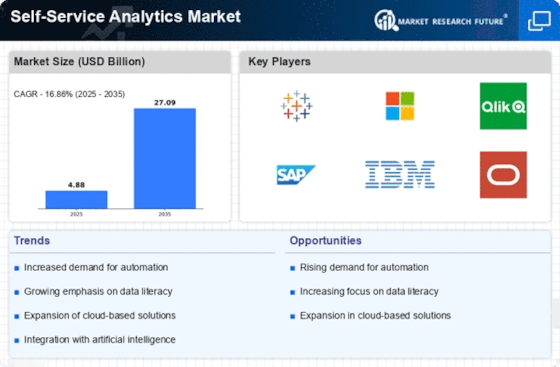
Self Service Analytics Market Infographic
Purchase Options

Self Service Analytics Size

Self Service Analytics Market Growth Projections and Opportunities

Self-service analytics market is consistently developing, driven by a large number of market factors that shape its development and direction. One key element is the rising interest for information driven dynamic across different enterprises. Associations are perceiving the significance of tackling the force of information to acquire bits of knowledge and remain cutthroat in the present unique business scene. Thus, oneself help examination market is seeing a flood in reception, as organizations look for easy to understand devices that engage non-specialized clients to dissect and decipher information without depending on IT offices.

The self-service analytics market is largely shaped by technological advancements. With the quick improvement of cutting-edge investigation instruments, AI, and computerized reasoning, clients can now get additional significant bits of knowledge from their information. The incorporation of these innovations into self-administration examination stages upgrades information handling abilities, empowering clients to reveal stowed away examples and patterns. Subsequently, associations are more disposed to put resources into self-administration examination arrangements that influence state of the art advances to drive development and proficiency in their dynamic cycles.

The developing accentuation on information administration and security is another basic market factor impacting the self-service analytics scene. As the volume of information created keeps on soaring, associations are progressively worried about keeping up with information trustworthiness, guaranteeing consistence with guidelines, and protecting touchy data. Responding to the security concerns of businesses and fostering trust in these platforms, vendors in the self-service analytics market are enhancing their solutions with robust data governance features, encryption mechanisms, and access controls.

Self-service analytics' significant market driver is the democratization of data. Conventional examination processes frequently elaborate particular information experts, making bottlenecks in information access and examination. Notwithstanding, self-administration investigation stages engage a more extensive scope of clients, including business investigators and departmental directors, to investigate and dissect information freely. This democratization speeds up direction as well as advances an information driven culture inside associations, where experiences are open to the people who need them, when they need them.

The ascent of distributed computing has essentially influenced self-service analytics market. As a result of their cost-effectiveness, scalability, and flexibility, cloud-based analytics solutions are appealing to businesses looking to improve their analytics infrastructure. Cloud arrangement empowers clients to get to and dissect information from anyplace, cultivating coordinated effort and guaranteeing continuous experiences. Additionally, the scalability of cloud solutions enables businesses to adapt to shifting data volumes and analytical requirements without making significant upfront hardware and infrastructure investments.

Market contest and seller elements are moulding the development of self-administration investigation contributions. As additional players enter the market, merchants are separating themselves through highlights, client experience, and combinations with other business applications. End-users will eventually benefit from assorted options and advanced tools for the data analysis for this competitive environment, which is driving modernization and pushing vendors to always amend their solutions.

The requirement for data-driven decision-making, technological progressions, data governance and security apprehensions, democratization of data, the influence of cloud computing, and the changing aspects of market competition all have an influence on the market. As associations keep on focusing on information examination as an essential objective, oneself help investigation market is ready for supported development and development before long.
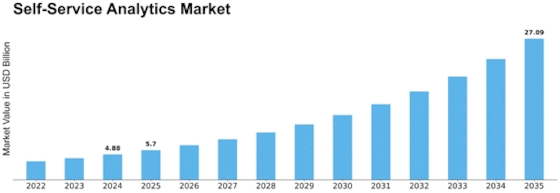

Self Service Analytics Market Size Graph
Author
Aarti Dhapte
AVP - Research

A consulting professional focused on helping businesses navigate complex markets through structured research and strategic insights. I partner with clients to solve high-impact business problems across market entry strategy, competitive intelligence, and opportunity assessment. Over the course of my experience, I have led and contributed to 100+ market research and consulting engagements, delivering insights across multiple industries and geographies, and supporting strategic decisions linked to $500M+ market opportunities. My core expertise lies in building robust market sizing, forecasting, and commercial models (top-down and bottom-up), alongside deep-dive competitive and industry analysis. I have played a key role in shaping go-to-market strategies, investment cases, and growth roadmaps, enabling clients to make confident, data-backed decisions in dynamic markets.

Leave a Comment

FAQs

What is the current valuation of the Self-Service Analytics Market in 2024?

<p>The Self-Service Analytics Market was valued at 4.88 USD Billion in 2024.</p>

What is the projected market size for the Self-Service Analytics Market by 2035?

<p>The market is projected to reach 27.09 USD Billion by 2035.</p>

What is the expected CAGR for the Self-Service Analytics Market during the forecast period 2025 - 2035?

<p>The expected CAGR for the Self-Service Analytics Market during 2025 - 2035 is 16.86%.</p>

Which companies are considered key players in the Self-Service Analytics Market?

<p>Key players in the market include Tableau, Microsoft, Qlik, SAP, IBM, Oracle, Sisense, Domo, and Looker.</p>

How does the market valuation of Tableau compare to other key players in 2024?

<p>In 2024, Tableau's market valuation was 1.22 USD Billion, which is higher than Logi Analytics but lower than Qlik.</p>

What segment of the Self-Service Analytics Market is expected to grow the most by 2035?

<p>The Business User segment, valued at 1.46 USD Billion in 2024, is expected to grow significantly by 2035.</p>

What is the market size for large businesses in the Self-Service Analytics Market?

The market size for large businesses was 3.0 USD Billion in 2024 and is projected to grow to 16.0 USD Billion by 2035.

What are the deployment types in the Self-Service Analytics Market and their valuations?

In 2024, both On-Premise and On-Cloud deployments were valued at 2.44 USD Billion, with On-Cloud slightly increasing by 2035.

Which industry had the highest valuation in the Self-Service Analytics Market in 2024?

The Retail industry had the highest valuation at 1.3 USD Billion in 2024, indicating strong demand.

What is the projected growth for the Corporate IT Professionals segment by 2035?

The Corporate IT Professionals segment, valued at 1.1 USD Billion in 2024, is expected to grow to 5.95 USD Billion by 2035.

Market Summary

As per Market Research Future analysis, the Self-Service Analytics Market was estimated at 4.88 USD Billion in 2024. The Self-Service Analytics industry is projected to grow from 5.703 USD Billion in 2025 to 27.09 USD Billion by 2035, exhibiting a compound annual growth rate (CAGR) of 16.86% during the forecast period 2025 - 2035

Key Market Trends & Highlights

The Self-Service Analytics Market is experiencing robust growth driven by technological advancements and evolving user needs.

  • The market is witnessing increased adoption of cloud solutions, particularly in North America, which remains the largest market. User experience is becoming a focal point, with tools like Tableau leading the way for business users seeking intuitive analytics. AI and machine learning integration is on the rise, enhancing the capabilities of self-service analytics tools across various sectors. The growing demand for data-driven decision making and the rise of advanced analytics tools are key drivers propelling market expansion.

Market Size & Forecast

2024 Market Size 4.88 (USD Billion)
2035 Market Size 27.09 (USD Billion)
CAGR (2025 - 2035) 16.86%
Largest Regional Market Share in 2024 North America

Major Players

Tableau (US), Microsoft (US), Qlik (US), SAP (DE), IBM (US), Oracle (US), Sisense (IL), Domo (US), Looker (US)

Market Trends

The Self-Service Analytics Market is currently experiencing a transformative phase, characterized by an increasing demand for user-friendly data analysis tools. Organizations are recognizing the necessity of empowering non-technical users to derive insights from data independently. This shift is driven by the growing volume of data generated across various sectors, necessitating efficient and accessible analytical solutions. As businesses strive for agility and data-driven decision-making, self-service analytics platforms are becoming integral to their operations. Furthermore, advancements in artificial intelligence and machine learning are enhancing the capabilities of these tools, enabling users to uncover patterns and trends without requiring extensive technical expertise. In addition, the Self-Service Analytics Market is witnessing a rise in cloud-based solutions, which offer scalability and flexibility. This trend allows organizations to adapt to changing business needs while minimizing infrastructure costs. The integration of collaborative features within these platforms is also noteworthy, as it fosters teamwork and knowledge sharing among users. As the market evolves, it appears that the focus will increasingly shift towards enhancing user experience and ensuring data governance, thereby balancing accessibility with security. Overall, the Self-Service Analytics Market is poised for continued growth, driven by technological advancements and the pressing need for data democratization.

Increased Adoption of Cloud Solutions

The Self-Service Analytics Market is seeing a notable shift towards cloud-based platforms. This trend is largely attributed to the flexibility and scalability that cloud solutions provide, allowing organizations to manage their data analytics needs more efficiently. As businesses increasingly migrate to the cloud, they are able to leverage advanced analytics tools without the burden of extensive on-premises infrastructure.

Focus on User Experience

There is a growing emphasis on enhancing user experience within self-service analytics tools. Companies are prioritizing intuitive interfaces and streamlined workflows to ensure that users, regardless of their technical background, can easily navigate and utilize these platforms. This focus on usability is likely to drive wider adoption across various sectors.

Integration of AI and Machine Learning

The incorporation of artificial intelligence and machine learning technologies into self-service analytics tools is becoming more prevalent. These advancements enable users to perform complex analyses and derive insights with minimal effort. By automating data processing and visualization, organizations can enhance their decision-making capabilities and respond more swiftly to market changes.

Self Service Analytics Market Market Drivers

Rise of Advanced Analytics Tools

The Self-Service Analytics Market is witnessing a rise in advanced analytics tools that cater to the needs of diverse users. These tools are designed to simplify complex data analysis processes, making it easier for users to generate insights without extensive technical knowledge. The integration of intuitive interfaces and visualization capabilities allows users to interact with data more effectively. Market data suggests that the adoption of these advanced tools is expected to increase by over 30% in the coming years, as organizations prioritize user-friendly solutions. This trend not only enhances user engagement but also drives the overall growth of the self-service analytics market, as more individuals become capable of leveraging data for their specific needs.

Growing Demand for Data-Driven Decision Making

The Self-Service Analytics Market is experiencing a notable surge in demand as organizations increasingly recognize the value of data-driven decision making. Companies are seeking to empower employees at all levels with the ability to analyze data independently, thereby enhancing operational efficiency and strategic planning. According to recent estimates, the market is projected to grow at a compound annual growth rate of approximately 25% over the next five years. This trend indicates a shift towards democratizing data access, allowing non-technical users to derive insights without relying heavily on IT departments. As businesses strive to remain competitive, the emphasis on self-service analytics tools is likely to intensify, fostering a culture of data literacy and informed decision-making across various sectors.

Increased Focus on Data Governance and Security

As the Self-Service Analytics Market expands, organizations are placing a heightened emphasis on data governance and security. With the proliferation of data access among non-technical users, ensuring data integrity and compliance with regulations becomes paramount. Companies are investing in robust governance frameworks to manage data access and usage effectively. This focus on security is likely to drive the development of self-service analytics solutions that incorporate advanced security features, such as role-based access controls and data encryption. Market analysts indicate that the demand for secure self-service analytics tools could increase by 40% as organizations seek to balance accessibility with stringent security measures, thereby fostering trust in data-driven initiatives.

Emergence of Mobile Self-Service Analytics Solutions

The Self-Service Analytics Market is witnessing the emergence of mobile self-service analytics solutions, catering to the growing need for on-the-go data access. As mobile devices become ubiquitous in the workplace, organizations are increasingly adopting mobile analytics tools that allow users to analyze data anytime and anywhere. This shift is particularly relevant in industries where timely decision-making is critical. Market data suggests that the mobile analytics segment is projected to grow by over 50% in the next few years, reflecting the demand for flexibility and accessibility in data analysis. By enabling users to engage with data through mobile platforms, organizations can enhance productivity and responsiveness, further driving the growth of the self-service analytics market.

Integration of Self-Service Analytics with Business Intelligence

The Self-Service Analytics Market is increasingly integrating with traditional business intelligence (BI) systems, creating a more cohesive data ecosystem. This integration allows organizations to leverage existing BI investments while enhancing user accessibility to analytics tools. By combining self-service capabilities with established BI frameworks, companies can provide users with a comprehensive view of data, facilitating better insights and decision-making. Market trends indicate that this integration is expected to grow by approximately 35% in the next few years, as organizations recognize the benefits of a unified approach to data analysis. This trend not only streamlines workflows but also enhances the overall effectiveness of analytics initiatives.

Market Segment Insights

By Type: Tableau (Largest) vs. Qlik (Fastest-Growing)

In the Self-Service Analytics Market, Tableau emerges as the largest player, commanding a significant share due to its user-friendly interface and extensive functionality, which makes data visualization accessible to both technical and non-technical users. Meanwhile, Qlik is recognized as the fastest-growing segment, driven by its innovative associative data model that allows users to explore their data freely without being restricted by predetermined queries. This dynamic enables businesses to uncover insights quickly and efficiently, catering to the evolving needs of organizations in a data-driven landscape.

Tableau (Dominant) vs. Logi Analytics (Emerging)

Tableau stands as the dominant force in the self-service analytics space, boasting a rich ecosystem that includes community support, vast resources, and partnerships that enhance its capabilities. Its drag-and-drop functionality allows users to create compelling data visuals effortlessly, fostering a more informed decision-making process. In contrast, Logi Analytics is an emerging player, focusing on embedding analytics into applications. This approach appeals to organizations seeking to integrate data insights directly into their operational workflows, thus enhancing real-time decision-making. While Tableau continues to thrive in standalone analytics, Logi Analytics is carving a niche by prioritizing contextual analytics within business applications.

By Service: Business User (Largest) vs. Corporate IT Professionals (Fastest-Growing)

In the Self-Service Analytics Market, the 'Service' segment shows a distinct distribution among its values. Business Users hold the largest share, reflecting a growing demand for intuitive analytics tools that empower non-technical users to derive insights from data independently. On the other hand, the market for Corporate IT Professionals is on the rise, as organizations increasingly seek specialized services that enable robust data governance and integration of self-service analytics platforms with existing <a title="IT infrastructure" href="https://www.marketresearchfuture.com/reports/it-infrastructure-services-market-8639" target="_blank" rel="noopener">IT infrastructures</a>. The growth trends in this segment are fueled by several factors. Business Users are being driven by the need for agile decision-making and data-driven strategies, leading to the proliferation of user-friendly analytics solutions. Conversely, Corporate IT Professionals are experiencing rapid growth due to organizations concentrating on enhancing data security and compliance measures, ensuring that self-service analytics align with corporate IT policies and standards.

Business Users: Dominant vs. Corporate IT Professionals: Emerging

Business Users are at the forefront of the Self-Service Analytics Market, characterized by their demand for easy-to-use tools that facilitate data exploration and visualization without requiring extensive technical skills. This segment thrives on innovations that streamline analysis and democratize data access across various organizational functions. In contrast, Corporate IT Professionals represent an emerging segment, focusing on the intersection of self-service analytics with enterprise architecture. They prioritize the integration of analytics tools with existing systems and emphasize the importance of data governance, compliance, and security. As organizations balance the empowerment of business users with the structural needs dictated by IT professionals, both segments are likely to coexist and evolve in alignment with the broader market trends.

By Company Size: Large Business (Largest) vs. Small & Medium Business (Fastest-Growing)

In the Self-Service Analytics Market, the distribution of market share reveals that Large Businesses occupy a significant portion of the market, capitalizing on their resources and extensive data management capabilities. Their established operational structures enable them to leverage advanced analytics solutions effectively, which further enhances their market presence. Meanwhile, Small and Medium Businesses (SMBs) are rapidly catching up, driven by a surge in demand for data-driven decision-making and cost-effective analytics solutions tailored to their needs.

Large Business: Dominant vs. Small &amp; Medium Business: Emerging

Large Businesses dominate the Self-Service Analytics Market due to their expansive datasets, robust IT infrastructure, and dedicated analytics teams that can fully exploit sophisticated self-service tools. Their ability to invest in advanced technologies enables them to achieve significant insights and competitive advantages. In contrast, Small and Medium Businesses are emerging rapidly in this segment, propelled by a greater need for agility and operational efficiency. They seek affordable, user-friendly analytics solutions that empower non-technical users to make data-driven decisions without overwhelming support from IT departments. This shift creates opportunities for vendors who can deliver scalable and intuitive platforms suitable for the SMB landscape.

By Deployment: On-Cloud (Largest) vs. On-Premise (Fastest-Growing)

In the Self-Service Analytics Market, the deployment segment is primarily characterized by the dominance of On-Cloud solutions. As organizations increasingly look for flexibility and scalability, On-Cloud deployments have gained substantial traction, allowing users to access analytic tools from anywhere. Conversely, On-Premise solutions still maintain a solid share, appealing to businesses that prioritize data control and security. Despite their smaller share, On-Premise analytics are experiencing significant adoption, driven by regulatory compliance and unique business needs.

Deployment: On-Cloud (Dominant) vs. On-Premise (Emerging)

On-Cloud solutions are becoming the dominant deployment choice in the Self-Service Analytics Market, as they offer unparalleled flexibility, cost-effectiveness, and ease of access for users across various locations. These cloud-based platforms support a broad array of analytics functions and integration with external data sources, making them highly attractive to organizations looking to enhance data-driven decision-making. On-Premise deployments, although classified as emerging, are experiencing rapid growth due to companies' need for enhanced control over their data environments and compliance with strict data regulations. This segment appeals largely to industries with sensitive information, wherein data privacy is paramount.

By Industries: BFSI (Largest) vs. Healthcare (Fastest-Growing)

The Self-Service Analytics Market is prominently driven by the BFSI sector, which holds the largest share due to its extensive need for real-time data analysis and reporting. Following closely, the Healthcare industry is witnessing a surge in adoption, attributed to the increasing requirement for data-driven decision-making in patient care and operational efficiency. Retail and IT &amp; Telecommunication industries also contribute significantly to the market, albeit at a slower pace than BFSI and Healthcare. This distribution reflects the varied demands across sectors, where BFSI remains the leading force with its layered analytics needs.

Healthcare: Rapid Growth (Emerging) vs. Retail: Stable Presence (Dominant)

The Healthcare sector is increasingly recognized as an emerging powerhouse within the Self-Service Analytics Market, as organizations leverage analytics to transform patient care and streamline operations. With the growing complexities of healthcare data, analytics empower providers to derive actionable insights enhancing clinical outcomes. In contrast, the Retail sector maintains a dominant presence, utilizing self-service analytics to optimize inventory management and enhance customer experiences. While Retail relies on established practices, Healthcare's rapid growth, driven by innovation and regulatory demands, illustrates a significant shift towards advanced data analytics, positioning it as a formidable player in the market's future.

Get more detailed insights about Self-Service Analytics Market Research Report- Global Forecast 2035

Regional Insights

North America : Analytics Innovation Leader

North America is the largest market for self-service analytics, holding approximately 45% of the global share. The region's growth is driven by the increasing demand for data-driven decision-making, advancements in cloud computing, and a strong emphasis on business intelligence. Regulatory support for data privacy and security further catalyzes market expansion, ensuring compliance while fostering innovation. The United States leads the market, with significant contributions from Canada. Major players like Tableau, Microsoft, and IBM dominate the landscape, offering robust solutions that cater to diverse industries. The competitive environment is characterized by continuous innovation and strategic partnerships, enhancing the overall market dynamics.

Europe : Emerging Analytics Hub

Europe is witnessing a rapid increase in the adoption of self-service analytics, accounting for around 30% of the global market share. The growth is fueled by the rising need for real-time data analysis and the implementation of GDPR, which encourages organizations to leverage data responsibly. Countries like Germany and the UK are at the forefront, driving demand through regulatory frameworks that support data transparency and accessibility. Germany stands out as a key player, with significant contributions from the UK and France. The competitive landscape features major companies like SAP and IBM, which are enhancing their offerings to meet the evolving needs of businesses. The presence of innovative startups also adds to the dynamic nature of the market, fostering a culture of continuous improvement and adaptation.

Asia-Pacific : Rapidly Growing Market

Asia-Pacific is emerging as a significant player in the self-service analytics market, holding approximately 20% of the global share. The region's growth is driven by rapid digital transformation, increasing internet penetration, and a growing emphasis on data analytics across various sectors. Countries like China and India are leading this trend, supported by favorable government initiatives that promote technology adoption and innovation. China is the largest market in the region, followed closely by India and Japan. The competitive landscape is marked by the presence of both global giants and local players, creating a diverse ecosystem. Companies like Qlik and Oracle are expanding their footprint, while local startups are innovating to cater to specific regional needs, enhancing the overall market competitiveness.

Middle East and Africa : Emerging Analytics Frontier

The Middle East and Africa are gradually embracing self-service analytics, capturing about 5% of the global market share. The growth is driven by increasing investments in technology and a rising awareness of the importance of data analytics in decision-making processes. Countries like South Africa and the UAE are leading the charge, supported by government initiatives aimed at enhancing digital infrastructure and promoting data literacy. South Africa is the largest market in the region, with the UAE following closely. The competitive landscape is characterized by a mix of international and local players, with companies like Sisense and Domo making significant inroads. The region's unique challenges and opportunities create a dynamic environment for innovation and growth in self-service analytics.

Key Players and Competitive Insights

The Self-Service Analytics Market is currently characterized by a dynamic competitive landscape, driven by the increasing demand for data-driven decision-making across various sectors. Key players such as Tableau (US), Microsoft (US), and Qlik (US) are at the forefront, each adopting distinct strategies to enhance their market positioning. Tableau (US) focuses on continuous innovation in user experience and data visualization capabilities, while Microsoft (US) leverages its extensive cloud infrastructure to integrate self-service analytics into its broader suite of business applications. Qlik (US), on the other hand, emphasizes its associative data indexing technology, which allows users to explore data freely, thereby enhancing analytical capabilities. Collectively, these strategies contribute to a competitive environment that is increasingly centered around user empowerment and accessibility in analytics.
In terms of business tactics, companies are increasingly localizing their operations and optimizing supply chains to better serve regional markets. The Self-Service Analytics Market appears moderately fragmented, with a mix of established players and emerging startups. This fragmentation allows for diverse offerings and innovation, as smaller companies often introduce niche solutions that challenge the status quo. The collective influence of these key players shapes a competitive structure where agility and responsiveness to market needs are paramount.
In August 2025, Tableau (US) announced the launch of a new AI-driven analytics feature that automates data preparation and visualization, significantly reducing the time users spend on these tasks. This strategic move not only enhances user experience but also positions Tableau as a leader in integrating artificial intelligence into self-service analytics, potentially attracting a broader user base seeking efficiency in data handling.
In September 2025, Microsoft (US) expanded its Power BI capabilities by integrating advanced machine learning algorithms, allowing users to generate predictive insights directly within the platform. This development underscores Microsoft's commitment to enhancing its analytics offerings, making it easier for businesses to derive actionable insights from their data. Such advancements may solidify Microsoft’s competitive edge in the market, particularly among enterprises looking for comprehensive analytics solutions.
In July 2025, Qlik (US) entered into a strategic partnership with a leading cloud service provider to enhance its data integration capabilities. This collaboration aims to streamline data access and improve the overall user experience, indicating Qlik's focus on creating a more interconnected analytics ecosystem. By aligning with cloud services, Qlik may enhance its appeal to organizations seeking scalable and flexible analytics solutions.
As of October 2025, the Self-Service Analytics Market is witnessing trends that emphasize digitalization, sustainability, and the integration of artificial intelligence. Strategic alliances among key players are increasingly shaping the competitive landscape, fostering innovation and collaboration. Looking ahead, it appears that competitive differentiation will evolve from traditional price-based competition to a focus on innovation, technological advancements, and supply chain reliability. Companies that can effectively leverage these trends are likely to secure a more prominent position in the market.

Key Companies in the Self Service Analytics Market include

Industry Developments

  • Q2 2024: Microsoft launches Copilot for Power BI, bringing generative AI to self-service analytics Microsoft announced the general availability of Copilot for Power BI, integrating generative AI capabilities to help users create reports and analyze data using natural language, marking a significant product launch in the self-service analytics market.
  • Q2 2024: Tableau unveils Tableau Pulse, a new AI-powered analytics experience Tableau, a Salesforce company, launched Tableau Pulse, an AI-driven analytics tool designed to simplify self-service analytics for business users by providing personalized, automated insights.
  • Q2 2024: Qlik acquires Mozaic Data to enhance self-service analytics capabilities Qlik announced the acquisition of Mozaic Data, a startup specializing in data integration and self-service analytics, to strengthen its platform's ability to deliver seamless, user-driven analytics experiences.
  • Q1 2024: Sisense appoints Ariel Katz as new CEO to drive next phase of self-service analytics growth Sisense, a leading self-service analytics provider, announced the appointment of Ariel Katz as CEO, signaling a strategic leadership change aimed at accelerating innovation and market expansion.
  • Q2 2024: ThoughtSpot launches ThoughtSpot Sage, a generative AI platform for self-service analytics ThoughtSpot introduced ThoughtSpot Sage, a generative AI-powered platform that enables business users to analyze data and generate insights using conversational language, expanding its self-service analytics offerings.
  • Q2 2024: Alteryx announces partnership with Google Cloud to deliver self-service analytics at scale Alteryx and Google Cloud announced a strategic partnership to integrate Alteryx's self-service analytics platform with Google Cloud's data services, aiming to accelerate cloud-based analytics adoption for enterprise customers.
  • Q1 2024: Domo launches Domo.AI, bringing generative AI to self-service analytics Domo announced the launch of Domo.AI, a suite of generative AI features designed to empower business users to create dashboards, analyze data, and generate insights without technical expertise.
  • Q2 2024: SAP acquires WalkMe to boost self-service analytics and digital adoption SAP announced the acquisition of WalkMe, a digital adoption platform, to enhance its self-service analytics and user enablement capabilities across its business intelligence solutions.
  • Q2 2024: Oracle launches new self-service analytics features in Oracle Analytics Cloud Oracle introduced new self-service analytics capabilities in its Oracle Analytics Cloud platform, including enhanced natural language queries and automated insights, to improve accessibility for business users.
  • Q1 2024: IBM unveils Watsonx BI, a new self-service analytics solution powered by generative AI IBM launched Watsonx BI, a self-service analytics platform leveraging generative AI to help users explore data and generate insights through conversational interfaces.
  • Q2 2024: Sigma Computing raises $200M Series D to expand self-service analytics platform Sigma Computing secured $200 million in Series D funding to accelerate the development and global expansion of its cloud-native self-service analytics platform.
  • Q2 2024: Snowflake and DataRobot announce partnership to deliver AI-powered self-service analytics Snowflake and DataRobot announced a partnership to integrate DataRobot's AI capabilities with Snowflake's data cloud, enabling business users to access advanced self-service analytics and machine learning tools.

Future Outlook

Self Service Analytics Market Future Outlook

The Self-Service Analytics Market is projected to grow at a 16.86% CAGR from 2025 to 2035, driven by increasing data democratization, technological advancements, and rising demand for real-time insights.

New opportunities lie in:

  • Integration of AI-driven predictive analytics tools
  • Development of industry-specific self-service platforms
  • Expansion into emerging markets with tailored solutions

By 2035, the Self-Service Analytics Market is expected to be robust, reflecting substantial growth and innovation.

Market Segmentation

Self Service Analytics Market Type Outlook

  • Tableau
  • Sas
  • Logi Analytics
  • Qlik
  • Others

Self Service Analytics Market Service Outlook

  • Business User
  • Consultants
  • Corporate IT Professionals
  • Others

Self Service Analytics Market Deployment Outlook

  • On-Premise
  • On-Cloud

Self Service Analytics Market Industries Outlook

  • BFSI
  • Healthcare
  • Retail
  • IT & Telecommunication
  • Others

Self Service Analytics Market Company Size Outlook

  • Large Business
  • Small & Medium Business

Report Scope

MARKET SIZE 2024 4.88(USD Billion)
MARKET SIZE 2025 5.703(USD Billion)
MARKET SIZE 2035 27.09(USD Billion)
COMPOUND ANNUAL GROWTH RATE (CAGR) 16.86% (2025 - 2035)
REPORT COVERAGE Revenue Forecast, Competitive Landscape, Growth Factors, and Trends
BASE YEAR 2024
Market Forecast Period 2025 - 2035
Historical Data 2019 - 2024
Market Forecast Units USD Billion
Key Companies Profiled Tableau (US), Microsoft (US), Qlik (US), SAP (DE), IBM (US), Oracle (US), Sisense (IL), Domo (US), Looker (US)
Segments Covered Type, Services, Company Size, Deployment, Industries, Region
Key Market Opportunities Integration of artificial intelligence enhances user experience in the Self-Service Analytics Market.
Key Market Dynamics Rising demand for user-friendly data tools drives innovation and competition in the Self-Service Analytics Market.
Countries Covered North America, Europe, APAC, South America, MEA

FAQs

What is the current valuation of the Self-Service Analytics Market in 2024?

<p>The Self-Service Analytics Market was valued at 4.88 USD Billion in 2024.</p>

What is the projected market size for the Self-Service Analytics Market by 2035?

<p>The market is projected to reach 27.09 USD Billion by 2035.</p>

What is the expected CAGR for the Self-Service Analytics Market during the forecast period 2025 - 2035?

<p>The expected CAGR for the Self-Service Analytics Market during 2025 - 2035 is 16.86%.</p>

Which companies are considered key players in the Self-Service Analytics Market?

<p>Key players in the market include Tableau, Microsoft, Qlik, SAP, IBM, Oracle, Sisense, Domo, and Looker.</p>

How does the market valuation of Tableau compare to other key players in 2024?

<p>In 2024, Tableau's market valuation was 1.22 USD Billion, which is higher than Logi Analytics but lower than Qlik.</p>

What segment of the Self-Service Analytics Market is expected to grow the most by 2035?

<p>The Business User segment, valued at 1.46 USD Billion in 2024, is expected to grow significantly by 2035.</p>

What is the market size for large businesses in the Self-Service Analytics Market?

The market size for large businesses was 3.0 USD Billion in 2024 and is projected to grow to 16.0 USD Billion by 2035.

What are the deployment types in the Self-Service Analytics Market and their valuations?

In 2024, both On-Premise and On-Cloud deployments were valued at 2.44 USD Billion, with On-Cloud slightly increasing by 2035.

Which industry had the highest valuation in the Self-Service Analytics Market in 2024?

The Retail industry had the highest valuation at 1.3 USD Billion in 2024, indicating strong demand.

What is the projected growth for the Corporate IT Professionals segment by 2035?

The Corporate IT Professionals segment, valued at 1.1 USD Billion in 2024, is expected to grow to 5.95 USD Billion by 2035.

  1. SECTION I: EXECUTIVE SUMMARY AND KEY HIGHLIGHTS
    1. | 1.1 EXECUTIVE SUMMARY
    2. | | 1.1.1 Market Overview
    3. | | 1.1.2 Key Findings
    4. | | 1.1.3 Market Segmentation
    5. | | 1.1.4 Competitive Landscape
    6. | | 1.1.5 Challenges and Opportunities
    7. | | 1.1.6 Future Outlook
  2. SECTION II: SCOPING, METHODOLOGY AND MARKET STRUCTURE
    1. | 2.1 MARKET INTRODUCTION
    2. | | 2.1.1 Definition
    3. | | 2.1.2 Scope of the study
    4. | | | 2.1.2.1 Research Objective
    5. | | | 2.1.2.2 Assumption
    6. | | | 2.1.2.3 Limitations
    7. | 2.2 RESEARCH METHODOLOGY
    8. | | 2.2.1 Overview
    9. | | 2.2.2 Data Mining
    10. | | 2.2.3 Secondary Research
    11. | | 2.2.4 Primary Research
    12. | | | 2.2.4.1 Primary Interviews and Information Gathering Process
    13. | | | 2.2.4.2 Breakdown of Primary Respondents
    14. | | 2.2.5 Forecasting Model
    15. | | 2.2.6 Market Size Estimation
    16. | | | 2.2.6.1 Bottom-Up Approach
    17. | | | 2.2.6.2 Top-Down Approach
    18. | | 2.2.7 Data Triangulation
    19. | | 2.2.8 Validation
  3. SECTION III: QUALITATIVE ANALYSIS
    1. | 3.1 MARKET DYNAMICS
    2. | | 3.1.1 Overview
    3. | | 3.1.2 Drivers
    4. | | 3.1.3 Restraints
    5. | | 3.1.4 Opportunities
    6. | 3.2 MARKET FACTOR ANALYSIS
    7. | | 3.2.1 Value chain Analysis
    8. | | 3.2.2 Porter's Five Forces Analysis
    9. | | | 3.2.2.1 Bargaining Power of Suppliers
    10. | | | 3.2.2.2 Bargaining Power of Buyers
    11. | | | 3.2.2.3 Threat of New Entrants
    12. | | | 3.2.2.4 Threat of Substitutes
    13. | | | 3.2.2.5 Intensity of Rivalry
    14. | | 3.2.3 COVID-19 Impact Analysis
    15. | | | 3.2.3.1 Market Impact Analysis
    16. | | | 3.2.3.2 Regional Impact
    17. | | | 3.2.3.3 Opportunity and Threat Analysis
  4. SECTION IV: QUANTITATIVE ANALYSIS
    1. | 4.1 Information and Communications Technology, BY Type (USD Billion)
    2. | | 4.1.1 Tableau
    3. | | 4.1.2 Sas
    4. | | 4.1.3 Logi Analytics
    5. | | 4.1.4 Qlik
    6. | | 4.1.5 Others
    7. | 4.2 Information and Communications Technology, BY Service (USD Billion)
    8. | | 4.2.1 Business User
    9. | | 4.2.2 Consultants
    10. | | 4.2.3 Corporate IT Professionals
    11. | | 4.2.4 Others
    12. | 4.3 Information and Communications Technology, BY Company Size (USD Billion)
    13. | | 4.3.1 Large Business
    14. | | 4.3.2 Small & Medium Business
    15. | 4.4 Information and Communications Technology, BY Deployment (USD Billion)
    16. | | 4.4.1 On-Premise
    17. | | 4.4.2 On-Cloud
    18. | 4.5 Information and Communications Technology, BY Industries (USD Billion)
    19. | | 4.5.1 BFSI
    20. | | 4.5.2 Healthcare
    21. | | 4.5.3 Retail
    22. | | 4.5.4 IT & Telecommunication
    23. | | 4.5.5 Others
    24. | 4.6 Information and Communications Technology, BY Region (USD Billion)
    25. | | 4.6.1 North America
    26. | | | 4.6.1.1 US
    27. | | | 4.6.1.2 Canada
    28. | | 4.6.2 Europe
    29. | | | 4.6.2.1 Germany
    30. | | | 4.6.2.2 UK
    31. | | | 4.6.2.3 France
    32. | | | 4.6.2.4 Russia
    33. | | | 4.6.2.5 Italy
    34. | | | 4.6.2.6 Spain
    35. | | | 4.6.2.7 Rest of Europe
    36. | | 4.6.3 APAC
    37. | | | 4.6.3.1 China
    38. | | | 4.6.3.2 India
    39. | | | 4.6.3.3 Japan
    40. | | | 4.6.3.4 South Korea
    41. | | | 4.6.3.5 Malaysia
    42. | | | 4.6.3.6 Thailand
    43. | | | 4.6.3.7 Indonesia
    44. | | | 4.6.3.8 Rest of APAC
    45. | | 4.6.4 South America
    46. | | | 4.6.4.1 Brazil
    47. | | | 4.6.4.2 Mexico
    48. | | | 4.6.4.3 Argentina
    49. | | | 4.6.4.4 Rest of South America
    50. | | 4.6.5 MEA
    51. | | | 4.6.5.1 GCC Countries
    52. | | | 4.6.5.2 South Africa
    53. | | | 4.6.5.3 Rest of MEA
  5. SECTION V: COMPETITIVE ANALYSIS
    1. | 5.1 Competitive Landscape
    2. | | 5.1.1 Overview
    3. | | 5.1.2 Competitive Analysis
    4. | | 5.1.3 Market share Analysis
    5. | | 5.1.4 Major Growth Strategy in the Information and Communications Technology
    6. | | 5.1.5 Competitive Benchmarking
    7. | | 5.1.6 Leading Players in Terms of Number of Developments in the Information and Communications Technology
    8. | | 5.1.7 Key developments and growth strategies
    9. | | | 5.1.7.1 New Product Launch/Service Deployment
    10. | | | 5.1.7.2 Merger & Acquisitions
    11. | | | 5.1.7.3 Joint Ventures
    12. | | 5.1.8 Major Players Financial Matrix
    13. | | | 5.1.8.1 Sales and Operating Income
    14. | | | 5.1.8.2 Major Players R&D Expenditure. 2023
    15. | 5.2 Company Profiles
    16. | | 5.2.1 Tableau (US)
    17. | | | 5.2.1.1 Financial Overview
    18. | | | 5.2.1.2 Products Offered
    19. | | | 5.2.1.3 Key Developments
    20. | | | 5.2.1.4 SWOT Analysis
    21. | | | 5.2.1.5 Key Strategies
    22. | | 5.2.2 Microsoft (US)
    23. | | | 5.2.2.1 Financial Overview
    24. | | | 5.2.2.2 Products Offered
    25. | | | 5.2.2.3 Key Developments
    26. | | | 5.2.2.4 SWOT Analysis
    27. | | | 5.2.2.5 Key Strategies
    28. | | 5.2.3 Qlik (US)
    29. | | | 5.2.3.1 Financial Overview
    30. | | | 5.2.3.2 Products Offered
    31. | | | 5.2.3.3 Key Developments
    32. | | | 5.2.3.4 SWOT Analysis
    33. | | | 5.2.3.5 Key Strategies
    34. | | 5.2.4 SAP (DE)
    35. | | | 5.2.4.1 Financial Overview
    36. | | | 5.2.4.2 Products Offered
    37. | | | 5.2.4.3 Key Developments
    38. | | | 5.2.4.4 SWOT Analysis
    39. | | | 5.2.4.5 Key Strategies
    40. | | 5.2.5 IBM (US)
    41. | | | 5.2.5.1 Financial Overview
    42. | | | 5.2.5.2 Products Offered
    43. | | | 5.2.5.3 Key Developments
    44. | | | 5.2.5.4 SWOT Analysis
    45. | | | 5.2.5.5 Key Strategies
    46. | | 5.2.6 Oracle (US)
    47. | | | 5.2.6.1 Financial Overview
    48. | | | 5.2.6.2 Products Offered
    49. | | | 5.2.6.3 Key Developments
    50. | | | 5.2.6.4 SWOT Analysis
    51. | | | 5.2.6.5 Key Strategies
    52. | | 5.2.7 Sisense (IL)
    53. | | | 5.2.7.1 Financial Overview
    54. | | | 5.2.7.2 Products Offered
    55. | | | 5.2.7.3 Key Developments
    56. | | | 5.2.7.4 SWOT Analysis
    57. | | | 5.2.7.5 Key Strategies
    58. | | 5.2.8 Domo (US)
    59. | | | 5.2.8.1 Financial Overview
    60. | | | 5.2.8.2 Products Offered
    61. | | | 5.2.8.3 Key Developments
    62. | | | 5.2.8.4 SWOT Analysis
    63. | | | 5.2.8.5 Key Strategies
    64. | | 5.2.9 Looker (US)
    65. | | | 5.2.9.1 Financial Overview
    66. | | | 5.2.9.2 Products Offered
    67. | | | 5.2.9.3 Key Developments
    68. | | | 5.2.9.4 SWOT Analysis
    69. | | | 5.2.9.5 Key Strategies
    70. | 5.3 Appendix
    71. | | 5.3.1 References
    72. | | 5.3.2 Related Reports
  6. LIST OF FIGURES
    1. | 6.1 MARKET SYNOPSIS
    2. | 6.2 NORTH AMERICA MARKET ANALYSIS
    3. | 6.3 US MARKET ANALYSIS BY TYPE
    4. | 6.4 US MARKET ANALYSIS BY SERVICE
    5. | 6.5 US MARKET ANALYSIS BY COMPANY SIZE
    6. | 6.6 US MARKET ANALYSIS BY DEPLOYMENT
    7. | 6.7 US MARKET ANALYSIS BY INDUSTRIES
    8. | 6.8 CANADA MARKET ANALYSIS BY TYPE
    9. | 6.9 CANADA MARKET ANALYSIS BY SERVICE
    10. | 6.10 CANADA MARKET ANALYSIS BY COMPANY SIZE
    11. | 6.11 CANADA MARKET ANALYSIS BY DEPLOYMENT
    12. | 6.12 CANADA MARKET ANALYSIS BY INDUSTRIES
    13. | 6.13 EUROPE MARKET ANALYSIS
    14. | 6.14 GERMANY MARKET ANALYSIS BY TYPE
    15. | 6.15 GERMANY MARKET ANALYSIS BY SERVICE
    16. | 6.16 GERMANY MARKET ANALYSIS BY COMPANY SIZE
    17. | 6.17 GERMANY MARKET ANALYSIS BY DEPLOYMENT
    18. | 6.18 GERMANY MARKET ANALYSIS BY INDUSTRIES
    19. | 6.19 UK MARKET ANALYSIS BY TYPE
    20. | 6.20 UK MARKET ANALYSIS BY SERVICE
    21. | 6.21 UK MARKET ANALYSIS BY COMPANY SIZE
    22. | 6.22 UK MARKET ANALYSIS BY DEPLOYMENT
    23. | 6.23 UK MARKET ANALYSIS BY INDUSTRIES
    24. | 6.24 FRANCE MARKET ANALYSIS BY TYPE
    25. | 6.25 FRANCE MARKET ANALYSIS BY SERVICE
    26. | 6.26 FRANCE MARKET ANALYSIS BY COMPANY SIZE
    27. | 6.27 FRANCE MARKET ANALYSIS BY DEPLOYMENT
    28. | 6.28 FRANCE MARKET ANALYSIS BY INDUSTRIES
    29. | 6.29 RUSSIA MARKET ANALYSIS BY TYPE
    30. | 6.30 RUSSIA MARKET ANALYSIS BY SERVICE
    31. | 6.31 RUSSIA MARKET ANALYSIS BY COMPANY SIZE
    32. | 6.32 RUSSIA MARKET ANALYSIS BY DEPLOYMENT
    33. | 6.33 RUSSIA MARKET ANALYSIS BY INDUSTRIES
    34. | 6.34 ITALY MARKET ANALYSIS BY TYPE
    35. | 6.35 ITALY MARKET ANALYSIS BY SERVICE
    36. | 6.36 ITALY MARKET ANALYSIS BY COMPANY SIZE
    37. | 6.37 ITALY MARKET ANALYSIS BY DEPLOYMENT
    38. | 6.38 ITALY MARKET ANALYSIS BY INDUSTRIES
    39. | 6.39 SPAIN MARKET ANALYSIS BY TYPE
    40. | 6.40 SPAIN MARKET ANALYSIS BY SERVICE
    41. | 6.41 SPAIN MARKET ANALYSIS BY COMPANY SIZE
    42. | 6.42 SPAIN MARKET ANALYSIS BY DEPLOYMENT
    43. | 6.43 SPAIN MARKET ANALYSIS BY INDUSTRIES
    44. | 6.44 REST OF EUROPE MARKET ANALYSIS BY TYPE
    45. | 6.45 REST OF EUROPE MARKET ANALYSIS BY SERVICE
    46. | 6.46 REST OF EUROPE MARKET ANALYSIS BY COMPANY SIZE
    47. | 6.47 REST OF EUROPE MARKET ANALYSIS BY DEPLOYMENT
    48. | 6.48 REST OF EUROPE MARKET ANALYSIS BY INDUSTRIES
    49. | 6.49 APAC MARKET ANALYSIS
    50. | 6.50 CHINA MARKET ANALYSIS BY TYPE
    51. | 6.51 CHINA MARKET ANALYSIS BY SERVICE
    52. | 6.52 CHINA MARKET ANALYSIS BY COMPANY SIZE
    53. | 6.53 CHINA MARKET ANALYSIS BY DEPLOYMENT
    54. | 6.54 CHINA MARKET ANALYSIS BY INDUSTRIES
    55. | 6.55 INDIA MARKET ANALYSIS BY TYPE
    56. | 6.56 INDIA MARKET ANALYSIS BY SERVICE
    57. | 6.57 INDIA MARKET ANALYSIS BY COMPANY SIZE
    58. | 6.58 INDIA MARKET ANALYSIS BY DEPLOYMENT
    59. | 6.59 INDIA MARKET ANALYSIS BY INDUSTRIES
    60. | 6.60 JAPAN MARKET ANALYSIS BY TYPE
    61. | 6.61 JAPAN MARKET ANALYSIS BY SERVICE
    62. | 6.62 JAPAN MARKET ANALYSIS BY COMPANY SIZE
    63. | 6.63 JAPAN MARKET ANALYSIS BY DEPLOYMENT
    64. | 6.64 JAPAN MARKET ANALYSIS BY INDUSTRIES
    65. | 6.65 SOUTH KOREA MARKET ANALYSIS BY TYPE
    66. | 6.66 SOUTH KOREA MARKET ANALYSIS BY SERVICE
    67. | 6.67 SOUTH KOREA MARKET ANALYSIS BY COMPANY SIZE
    68. | 6.68 SOUTH KOREA MARKET ANALYSIS BY DEPLOYMENT
    69. | 6.69 SOUTH KOREA MARKET ANALYSIS BY INDUSTRIES
    70. | 6.70 MALAYSIA MARKET ANALYSIS BY TYPE
    71. | 6.71 MALAYSIA MARKET ANALYSIS BY SERVICE
    72. | 6.72 MALAYSIA MARKET ANALYSIS BY COMPANY SIZE
    73. | 6.73 MALAYSIA MARKET ANALYSIS BY DEPLOYMENT
    74. | 6.74 MALAYSIA MARKET ANALYSIS BY INDUSTRIES
    75. | 6.75 THAILAND MARKET ANALYSIS BY TYPE
    76. | 6.76 THAILAND MARKET ANALYSIS BY SERVICE
    77. | 6.77 THAILAND MARKET ANALYSIS BY COMPANY SIZE
    78. | 6.78 THAILAND MARKET ANALYSIS BY DEPLOYMENT
    79. | 6.79 THAILAND MARKET ANALYSIS BY INDUSTRIES
    80. | 6.80 INDONESIA MARKET ANALYSIS BY TYPE
    81. | 6.81 INDONESIA MARKET ANALYSIS BY SERVICE
    82. | 6.82 INDONESIA MARKET ANALYSIS BY COMPANY SIZE
    83. | 6.83 INDONESIA MARKET ANALYSIS BY DEPLOYMENT
    84. | 6.84 INDONESIA MARKET ANALYSIS BY INDUSTRIES
    85. | 6.85 REST OF APAC MARKET ANALYSIS BY TYPE
    86. | 6.86 REST OF APAC MARKET ANALYSIS BY SERVICE
    87. | 6.87 REST OF APAC MARKET ANALYSIS BY COMPANY SIZE
    88. | 6.88 REST OF APAC MARKET ANALYSIS BY DEPLOYMENT
    89. | 6.89 REST OF APAC MARKET ANALYSIS BY INDUSTRIES
    90. | 6.90 SOUTH AMERICA MARKET ANALYSIS
    91. | 6.91 BRAZIL MARKET ANALYSIS BY TYPE
    92. | 6.92 BRAZIL MARKET ANALYSIS BY SERVICE
    93. | 6.93 BRAZIL MARKET ANALYSIS BY COMPANY SIZE
    94. | 6.94 BRAZIL MARKET ANALYSIS BY DEPLOYMENT
    95. | 6.95 BRAZIL MARKET ANALYSIS BY INDUSTRIES
    96. | 6.96 MEXICO MARKET ANALYSIS BY TYPE
    97. | 6.97 MEXICO MARKET ANALYSIS BY SERVICE
    98. | 6.98 MEXICO MARKET ANALYSIS BY COMPANY SIZE
    99. | 6.99 MEXICO MARKET ANALYSIS BY DEPLOYMENT
    100. | 6.100 MEXICO MARKET ANALYSIS BY INDUSTRIES
    101. | 6.101 ARGENTINA MARKET ANALYSIS BY TYPE
    102. | 6.102 ARGENTINA MARKET ANALYSIS BY SERVICE
    103. | 6.103 ARGENTINA MARKET ANALYSIS BY COMPANY SIZE
    104. | 6.104 ARGENTINA MARKET ANALYSIS BY DEPLOYMENT
    105. | 6.105 ARGENTINA MARKET ANALYSIS BY INDUSTRIES
    106. | 6.106 REST OF SOUTH AMERICA MARKET ANALYSIS BY TYPE
    107. | 6.107 REST OF SOUTH AMERICA MARKET ANALYSIS BY SERVICE
    108. | 6.108 REST OF SOUTH AMERICA MARKET ANALYSIS BY COMPANY SIZE
    109. | 6.109 REST OF SOUTH AMERICA MARKET ANALYSIS BY DEPLOYMENT
    110. | 6.110 REST OF SOUTH AMERICA MARKET ANALYSIS BY INDUSTRIES
    111. | 6.111 MEA MARKET ANALYSIS
    112. | 6.112 GCC COUNTRIES MARKET ANALYSIS BY TYPE
    113. | 6.113 GCC COUNTRIES MARKET ANALYSIS BY SERVICE
    114. | 6.114 GCC COUNTRIES MARKET ANALYSIS BY COMPANY SIZE
    115. | 6.115 GCC COUNTRIES MARKET ANALYSIS BY DEPLOYMENT
    116. | 6.116 GCC COUNTRIES MARKET ANALYSIS BY INDUSTRIES
    117. | 6.117 SOUTH AFRICA MARKET ANALYSIS BY TYPE
    118. | 6.118 SOUTH AFRICA MARKET ANALYSIS BY SERVICE
    119. | 6.119 SOUTH AFRICA MARKET ANALYSIS BY COMPANY SIZE
    120. | 6.120 SOUTH AFRICA MARKET ANALYSIS BY DEPLOYMENT
    121. | 6.121 SOUTH AFRICA MARKET ANALYSIS BY INDUSTRIES
    122. | 6.122 REST OF MEA MARKET ANALYSIS BY TYPE
    123. | 6.123 REST OF MEA MARKET ANALYSIS BY SERVICE
    124. | 6.124 REST OF MEA MARKET ANALYSIS BY COMPANY SIZE
    125. | 6.125 REST OF MEA MARKET ANALYSIS BY DEPLOYMENT
    126. | 6.126 REST OF MEA MARKET ANALYSIS BY INDUSTRIES
    127. | 6.127 KEY BUYING CRITERIA OF INFORMATION AND COMMUNICATIONS TECHNOLOGY
    128. | 6.128 RESEARCH PROCESS OF MRFR
    129. | 6.129 DRO ANALYSIS OF INFORMATION AND COMMUNICATIONS TECHNOLOGY
    130. | 6.130 DRIVERS IMPACT ANALYSIS: INFORMATION AND COMMUNICATIONS TECHNOLOGY
    131. | 6.131 RESTRAINTS IMPACT ANALYSIS: INFORMATION AND COMMUNICATIONS TECHNOLOGY
    132. | 6.132 SUPPLY / VALUE CHAIN: INFORMATION AND COMMUNICATIONS TECHNOLOGY
    133. | 6.133 INFORMATION AND COMMUNICATIONS TECHNOLOGY, BY TYPE, 2024 (% SHARE)
    134. | 6.134 INFORMATION AND COMMUNICATIONS TECHNOLOGY, BY TYPE, 2024 TO 2035 (USD Billion)
    135. | 6.135 INFORMATION AND COMMUNICATIONS TECHNOLOGY, BY SERVICE, 2024 (% SHARE)
    136. | 6.136 INFORMATION AND COMMUNICATIONS TECHNOLOGY, BY SERVICE, 2024 TO 2035 (USD Billion)
    137. | 6.137 INFORMATION AND COMMUNICATIONS TECHNOLOGY, BY COMPANY SIZE, 2024 (% SHARE)
    138. | 6.138 INFORMATION AND COMMUNICATIONS TECHNOLOGY, BY COMPANY SIZE, 2024 TO 2035 (USD Billion)
    139. | 6.139 INFORMATION AND COMMUNICATIONS TECHNOLOGY, BY DEPLOYMENT, 2024 (% SHARE)
    140. | 6.140 INFORMATION AND COMMUNICATIONS TECHNOLOGY, BY DEPLOYMENT, 2024 TO 2035 (USD Billion)
    141. | 6.141 INFORMATION AND COMMUNICATIONS TECHNOLOGY, BY INDUSTRIES, 2024 (% SHARE)
    142. | 6.142 INFORMATION AND COMMUNICATIONS TECHNOLOGY, BY INDUSTRIES, 2024 TO 2035 (USD Billion)
    143. | 6.143 BENCHMARKING OF MAJOR COMPETITORS
  7. LIST OF TABLES
    1. | 7.1 LIST OF ASSUMPTIONS
    2. | | 7.1.1
    3. | 7.2 North America MARKET SIZE ESTIMATES; FORECAST
    4. | | 7.2.1 BY TYPE, 2025-2035 (USD Billion)
    5. | | 7.2.2 BY SERVICE, 2025-2035 (USD Billion)
    6. | | 7.2.3 BY COMPANY SIZE, 2025-2035 (USD Billion)
    7. | | 7.2.4 BY DEPLOYMENT, 2025-2035 (USD Billion)
    8. | | 7.2.5 BY INDUSTRIES, 2025-2035 (USD Billion)
    9. | 7.3 US MARKET SIZE ESTIMATES; FORECAST
    10. | | 7.3.1 BY TYPE, 2025-2035 (USD Billion)
    11. | | 7.3.2 BY SERVICE, 2025-2035 (USD Billion)
    12. | | 7.3.3 BY COMPANY SIZE, 2025-2035 (USD Billion)
    13. | | 7.3.4 BY DEPLOYMENT, 2025-2035 (USD Billion)
    14. | | 7.3.5 BY INDUSTRIES, 2025-2035 (USD Billion)
    15. | 7.4 Canada MARKET SIZE ESTIMATES; FORECAST
    16. | | 7.4.1 BY TYPE, 2025-2035 (USD Billion)
    17. | | 7.4.2 BY SERVICE, 2025-2035 (USD Billion)
    18. | | 7.4.3 BY COMPANY SIZE, 2025-2035 (USD Billion)
    19. | | 7.4.4 BY DEPLOYMENT, 2025-2035 (USD Billion)
    20. | | 7.4.5 BY INDUSTRIES, 2025-2035 (USD Billion)
    21. | 7.5 Europe MARKET SIZE ESTIMATES; FORECAST
    22. | | 7.5.1 BY TYPE, 2025-2035 (USD Billion)
    23. | | 7.5.2 BY SERVICE, 2025-2035 (USD Billion)
    24. | | 7.5.3 BY COMPANY SIZE, 2025-2035 (USD Billion)
    25. | | 7.5.4 BY DEPLOYMENT, 2025-2035 (USD Billion)
    26. | | 7.5.5 BY INDUSTRIES, 2025-2035 (USD Billion)
    27. | 7.6 Germany MARKET SIZE ESTIMATES; FORECAST
    28. | | 7.6.1 BY TYPE, 2025-2035 (USD Billion)
    29. | | 7.6.2 BY SERVICE, 2025-2035 (USD Billion)
    30. | | 7.6.3 BY COMPANY SIZE, 2025-2035 (USD Billion)
    31. | | 7.6.4 BY DEPLOYMENT, 2025-2035 (USD Billion)
    32. | | 7.6.5 BY INDUSTRIES, 2025-2035 (USD Billion)
    33. | 7.7 UK MARKET SIZE ESTIMATES; FORECAST
    34. | | 7.7.1 BY TYPE, 2025-2035 (USD Billion)
    35. | | 7.7.2 BY SERVICE, 2025-2035 (USD Billion)
    36. | | 7.7.3 BY COMPANY SIZE, 2025-2035 (USD Billion)
    37. | | 7.7.4 BY DEPLOYMENT, 2025-2035 (USD Billion)
    38. | | 7.7.5 BY INDUSTRIES, 2025-2035 (USD Billion)
    39. | 7.8 France MARKET SIZE ESTIMATES; FORECAST
    40. | | 7.8.1 BY TYPE, 2025-2035 (USD Billion)
    41. | | 7.8.2 BY SERVICE, 2025-2035 (USD Billion)
    42. | | 7.8.3 BY COMPANY SIZE, 2025-2035 (USD Billion)
    43. | | 7.8.4 BY DEPLOYMENT, 2025-2035 (USD Billion)
    44. | | 7.8.5 BY INDUSTRIES, 2025-2035 (USD Billion)
    45. | 7.9 Russia MARKET SIZE ESTIMATES; FORECAST
    46. | | 7.9.1 BY TYPE, 2025-2035 (USD Billion)
    47. | | 7.9.2 BY SERVICE, 2025-2035 (USD Billion)
    48. | | 7.9.3 BY COMPANY SIZE, 2025-2035 (USD Billion)
    49. | | 7.9.4 BY DEPLOYMENT, 2025-2035 (USD Billion)
    50. | | 7.9.5 BY INDUSTRIES, 2025-2035 (USD Billion)
    51. | 7.10 Italy MARKET SIZE ESTIMATES; FORECAST
    52. | | 7.10.1 BY TYPE, 2025-2035 (USD Billion)
    53. | | 7.10.2 BY SERVICE, 2025-2035 (USD Billion)
    54. | | 7.10.3 BY COMPANY SIZE, 2025-2035 (USD Billion)
    55. | | 7.10.4 BY DEPLOYMENT, 2025-2035 (USD Billion)
    56. | | 7.10.5 BY INDUSTRIES, 2025-2035 (USD Billion)
    57. | 7.11 Spain MARKET SIZE ESTIMATES; FORECAST
    58. | | 7.11.1 BY TYPE, 2025-2035 (USD Billion)
    59. | | 7.11.2 BY SERVICE, 2025-2035 (USD Billion)
    60. | | 7.11.3 BY COMPANY SIZE, 2025-2035 (USD Billion)
    61. | | 7.11.4 BY DEPLOYMENT, 2025-2035 (USD Billion)
    62. | | 7.11.5 BY INDUSTRIES, 2025-2035 (USD Billion)
    63. | 7.12 Rest of Europe MARKET SIZE ESTIMATES; FORECAST
    64. | | 7.12.1 BY TYPE, 2025-2035 (USD Billion)
    65. | | 7.12.2 BY SERVICE, 2025-2035 (USD Billion)
    66. | | 7.12.3 BY COMPANY SIZE, 2025-2035 (USD Billion)
    67. | | 7.12.4 BY DEPLOYMENT, 2025-2035 (USD Billion)
    68. | | 7.12.5 BY INDUSTRIES, 2025-2035 (USD Billion)
    69. | 7.13 APAC MARKET SIZE ESTIMATES; FORECAST
    70. | | 7.13.1 BY TYPE, 2025-2035 (USD Billion)
    71. | | 7.13.2 BY SERVICE, 2025-2035 (USD Billion)
    72. | | 7.13.3 BY COMPANY SIZE, 2025-2035 (USD Billion)
    73. | | 7.13.4 BY DEPLOYMENT, 2025-2035 (USD Billion)
    74. | | 7.13.5 BY INDUSTRIES, 2025-2035 (USD Billion)
    75. | 7.14 China MARKET SIZE ESTIMATES; FORECAST
    76. | | 7.14.1 BY TYPE, 2025-2035 (USD Billion)
    77. | | 7.14.2 BY SERVICE, 2025-2035 (USD Billion)
    78. | | 7.14.3 BY COMPANY SIZE, 2025-2035 (USD Billion)
    79. | | 7.14.4 BY DEPLOYMENT, 2025-2035 (USD Billion)
    80. | | 7.14.5 BY INDUSTRIES, 2025-2035 (USD Billion)
    81. | 7.15 India MARKET SIZE ESTIMATES; FORECAST
    82. | | 7.15.1 BY TYPE, 2025-2035 (USD Billion)
    83. | | 7.15.2 BY SERVICE, 2025-2035 (USD Billion)
    84. | | 7.15.3 BY COMPANY SIZE, 2025-2035 (USD Billion)
    85. | | 7.15.4 BY DEPLOYMENT, 2025-2035 (USD Billion)
    86. | | 7.15.5 BY INDUSTRIES, 2025-2035 (USD Billion)
    87. | 7.16 Japan MARKET SIZE ESTIMATES; FORECAST
    88. | | 7.16.1 BY TYPE, 2025-2035 (USD Billion)
    89. | | 7.16.2 BY SERVICE, 2025-2035 (USD Billion)
    90. | | 7.16.3 BY COMPANY SIZE, 2025-2035 (USD Billion)
    91. | | 7.16.4 BY DEPLOYMENT, 2025-2035 (USD Billion)
    92. | | 7.16.5 BY INDUSTRIES, 2025-2035 (USD Billion)
    93. | 7.17 South Korea MARKET SIZE ESTIMATES; FORECAST
    94. | | 7.17.1 BY TYPE, 2025-2035 (USD Billion)
    95. | | 7.17.2 BY SERVICE, 2025-2035 (USD Billion)
    96. | | 7.17.3 BY COMPANY SIZE, 2025-2035 (USD Billion)
    97. | | 7.17.4 BY DEPLOYMENT, 2025-2035 (USD Billion)
    98. | | 7.17.5 BY INDUSTRIES, 2025-2035 (USD Billion)
    99. | 7.18 Malaysia MARKET SIZE ESTIMATES; FORECAST
    100. | | 7.18.1 BY TYPE, 2025-2035 (USD Billion)
    101. | | 7.18.2 BY SERVICE, 2025-2035 (USD Billion)
    102. | | 7.18.3 BY COMPANY SIZE, 2025-2035 (USD Billion)
    103. | | 7.18.4 BY DEPLOYMENT, 2025-2035 (USD Billion)
    104. | | 7.18.5 BY INDUSTRIES, 2025-2035 (USD Billion)
    105. | 7.19 Thailand MARKET SIZE ESTIMATES; FORECAST
    106. | | 7.19.1 BY TYPE, 2025-2035 (USD Billion)
    107. | | 7.19.2 BY SERVICE, 2025-2035 (USD Billion)
    108. | | 7.19.3 BY COMPANY SIZE, 2025-2035 (USD Billion)
    109. | | 7.19.4 BY DEPLOYMENT, 2025-2035 (USD Billion)
    110. | | 7.19.5 BY INDUSTRIES, 2025-2035 (USD Billion)
    111. | 7.20 Indonesia MARKET SIZE ESTIMATES; FORECAST
    112. | | 7.20.1 BY TYPE, 2025-2035 (USD Billion)
    113. | | 7.20.2 BY SERVICE, 2025-2035 (USD Billion)
    114. | | 7.20.3 BY COMPANY SIZE, 2025-2035 (USD Billion)
    115. | | 7.20.4 BY DEPLOYMENT, 2025-2035 (USD Billion)
    116. | | 7.20.5 BY INDUSTRIES, 2025-2035 (USD Billion)
    117. | 7.21 Rest of APAC MARKET SIZE ESTIMATES; FORECAST
    118. | | 7.21.1 BY TYPE, 2025-2035 (USD Billion)
    119. | | 7.21.2 BY SERVICE, 2025-2035 (USD Billion)
    120. | | 7.21.3 BY COMPANY SIZE, 2025-2035 (USD Billion)
    121. | | 7.21.4 BY DEPLOYMENT, 2025-2035 (USD Billion)
    122. | | 7.21.5 BY INDUSTRIES, 2025-2035 (USD Billion)
    123. | 7.22 South America MARKET SIZE ESTIMATES; FORECAST
    124. | | 7.22.1 BY TYPE, 2025-2035 (USD Billion)
    125. | | 7.22.2 BY SERVICE, 2025-2035 (USD Billion)
    126. | | 7.22.3 BY COMPANY SIZE, 2025-2035 (USD Billion)
    127. | | 7.22.4 BY DEPLOYMENT, 2025-2035 (USD Billion)
    128. | | 7.22.5 BY INDUSTRIES, 2025-2035 (USD Billion)
    129. | 7.23 Brazil MARKET SIZE ESTIMATES; FORECAST
    130. | | 7.23.1 BY TYPE, 2025-2035 (USD Billion)
    131. | | 7.23.2 BY SERVICE, 2025-2035 (USD Billion)
    132. | | 7.23.3 BY COMPANY SIZE, 2025-2035 (USD Billion)
    133. | | 7.23.4 BY DEPLOYMENT, 2025-2035 (USD Billion)
    134. | | 7.23.5 BY INDUSTRIES, 2025-2035 (USD Billion)
    135. | 7.24 Mexico MARKET SIZE ESTIMATES; FORECAST
    136. | | 7.24.1 BY TYPE, 2025-2035 (USD Billion)
    137. | | 7.24.2 BY SERVICE, 2025-2035 (USD Billion)
    138. | | 7.24.3 BY COMPANY SIZE, 2025-2035 (USD Billion)
    139. | | 7.24.4 BY DEPLOYMENT, 2025-2035 (USD Billion)
    140. | | 7.24.5 BY INDUSTRIES, 2025-2035 (USD Billion)
    141. | 7.25 Argentina MARKET SIZE ESTIMATES; FORECAST
    142. | | 7.25.1 BY TYPE, 2025-2035 (USD Billion)
    143. | | 7.25.2 BY SERVICE, 2025-2035 (USD Billion)
    144. | | 7.25.3 BY COMPANY SIZE, 2025-2035 (USD Billion)
    145. | | 7.25.4 BY DEPLOYMENT, 2025-2035 (USD Billion)
    146. | | 7.25.5 BY INDUSTRIES, 2025-2035 (USD Billion)
    147. | 7.26 Rest of South America MARKET SIZE ESTIMATES; FORECAST
    148. | | 7.26.1 BY TYPE, 2025-2035 (USD Billion)
    149. | | 7.26.2 BY SERVICE, 2025-2035 (USD Billion)
    150. | | 7.26.3 BY COMPANY SIZE, 2025-2035 (USD Billion)
    151. | | 7.26.4 BY DEPLOYMENT, 2025-2035 (USD Billion)
    152. | | 7.26.5 BY INDUSTRIES, 2025-2035 (USD Billion)
    153. | 7.27 MEA MARKET SIZE ESTIMATES; FORECAST
    154. | | 7.27.1 BY TYPE, 2025-2035 (USD Billion)
    155. | | 7.27.2 BY SERVICE, 2025-2035 (USD Billion)
    156. | | 7.27.3 BY COMPANY SIZE, 2025-2035 (USD Billion)
    157. | | 7.27.4 BY DEPLOYMENT, 2025-2035 (USD Billion)
    158. | | 7.27.5 BY INDUSTRIES, 2025-2035 (USD Billion)
    159. | 7.28 GCC Countries MARKET SIZE ESTIMATES; FORECAST
    160. | | 7.28.1 BY TYPE, 2025-2035 (USD Billion)
    161. | | 7.28.2 BY SERVICE, 2025-2035 (USD Billion)
    162. | | 7.28.3 BY COMPANY SIZE, 2025-2035 (USD Billion)
    163. | | 7.28.4 BY DEPLOYMENT, 2025-2035 (USD Billion)
    164. | | 7.28.5 BY INDUSTRIES, 2025-2035 (USD Billion)
    165. | 7.29 South Africa MARKET SIZE ESTIMATES; FORECAST
    166. | | 7.29.1 BY TYPE, 2025-2035 (USD Billion)
    167. | | 7.29.2 BY SERVICE, 2025-2035 (USD Billion)
    168. | | 7.29.3 BY COMPANY SIZE, 2025-2035 (USD Billion)
    169. | | 7.29.4 BY DEPLOYMENT, 2025-2035 (USD Billion)
    170. | | 7.29.5 BY INDUSTRIES, 2025-2035 (USD Billion)
    171. | 7.30 Rest of MEA MARKET SIZE ESTIMATES; FORECAST
    172. | | 7.30.1 BY TYPE, 2025-2035 (USD Billion)
    173. | | 7.30.2 BY SERVICE, 2025-2035 (USD Billion)
    174. | | 7.30.3 BY COMPANY SIZE, 2025-2035 (USD Billion)
    175. | | 7.30.4 BY DEPLOYMENT, 2025-2035 (USD Billion)
    176. | | 7.30.5 BY INDUSTRIES, 2025-2035 (USD Billion)
    177. | 7.31 PRODUCT LAUNCH/PRODUCT DEVELOPMENT/APPROVAL
    178. | | 7.31.1
    179. | 7.32 ACQUISITION/PARTNERSHIP
    180. | | 7.32.1

Information and Communications Technology Market Segmentation

Information and Communications Technology By Type (USD Billion, 2025-2035)

  • Tableau
  • Sas
  • Logi Analytics
  • Qlik
  • Others

Information and Communications Technology By Service (USD Billion, 2025-2035)

  • Business User
  • Consultants
  • Corporate IT Professionals
  • Others

Information and Communications Technology By Company Size (USD Billion, 2025-2035)

  • Large Business
  • Small & Medium Business

Information and Communications Technology By Deployment (USD Billion, 2025-2035)

  • On-Premise
  • On-Cloud

Information and Communications Technology By Industries (USD Billion, 2025-2035)

  • BFSI
  • Healthcare
  • Retail
  • IT & Telecommunication
  • Others
Infographic

Free Sample Request

Kindly complete the form below to receive a free sample of this Report

Get Free Sample

Customer Strories

Compare Licence

×
Features License Type
Single User Multiuser License Enterprise User
Price $4,950 $5,950 $7,250
Maximum User Access Limit 1 User Upto 10 Users Unrestricted Access Throughout the Organization
Free Customization
Direct Access to Analyst
Deliverable Format
Platform Access
Discount on Next Purchase 10% 15% 15%
Printable Versions