Request Free Sample ×

Kindly complete the form below to receive a free sample of this Report

* Please use a valid business email

Leading companies partner with us for data-driven Insights

clients tt-cursor
Hero Background
English
Chinese
French
Japanese
Korean
German
Spanish

Sebacic Acid Market Trends

ID: MRFR/CnM/0493-HCR
139 Pages
Priya Nagrale
March 2026

Sebacic Acid Market Research Report Information By Application (Personal Care & Cosmetics, Lubricants, Textiles, Household Care, Paints & Coatings, and Plasticizers), And By Region (North America, Europe, Asia-Pacific, And Rest Of The World) –Market Forecast Till 2035

Share:
Download PDF ×

We do not share your information with anyone. However, we may send you emails based on your report interest from time to time. You may contact us at any time to opt-out.

Sebacic Acid Market Infographic
Purchase Options

Market Trends

Key Emerging Trends in the Sebacic Acid Market

The Sebacic Acid Market is affected by factors including the growing need for affordable and bio-based synthetic chemicals, end-use enterprises, and sustainable feedstocks. Normally determined dicarboxylic acid sebacic acid has versatile uses in polymers, materials, cosmetic care items, and oils. Sebacic acid is increasingly used to make biodegradable plastics and polyamides. Sebacic acid is becoming more popular for its role in bio-based material production as firms adopt sustainable practices.

The bio-based and supportable compound pattern drives Sebacic Acid Market patterns. Sebacic acid from castor oil is inexhaustible and eco-friendly, unlike dicarboxylic acids. Bio-based synthetic chemicals are becoming more popular as corporations become more environmentally conscientious, and sebacic acid is a key player.

The polymers and plastics sector is crucial to sebacic acid interest. Sebacic acid connects polyamides, or nylon, for usage in materials, plastics, and automobile components. Sebacic acid's capacity to improve polyamide qualities including adaptability and solidness increases its attractiveness in the polymer sector.

Biotechnology and development are shaping Sebacic Acid Market trends. Microbial aging and biocatalysis are improving as makers seek better ways to make sebacic acid from sustainable feedstocks. These advances make sebacic acid production more manageable, fulfilling the company's duty to reduce its environmental impact.

Sebacic Acid Market trends are also impacted by end-use industries including materials, cosmetic goods, and ointments. Sebacic acid is essential to the assembly of nylon strands for materials, strengthening and executing textures. Sebacic acid is used to detail cosmetics like lotions and salves. Additionally, it pioneers bio-based oils to promote eco-friendly oil combinations.

The Sebacic Acid Market is gaining attention for its potential usage in biodegradable polymers. The concern about plastic waste and natural contamination is driving interest in bio-based and biodegradable materials. Its resemblance to biodegradable polymers makes sebacic acid an important aspect of packaging solutions.

Market fluctuations reflect global economic factors on the Sebacic Acid Market. Sebacic acid demand across end-use applications is affected by economic factors including growth, production, and consumer expenditure. Financial fluctuations can affect market aspects, forcing manufacturers to adapt and provide new opportunities.

Medical and environmental issues have hampered market expansion. Individual lifestyle change is the hardest for market interest. Speculation, mandatory compensation, and state authority influence and market participant initiatives have made corporate expansion difficult.

Author
Author Profile
Priya Nagrale
Senior Research Analyst

With an experience of over five years in market research industry (Chemicals & Materials domain), I gather and analyze market data from diverse sources to produce results, which are then presented back to a client. Also, provide recommendations based on the findings. As a Senior Research Analyst, I perform quality checks (QC) for market estimations, QC for reports, and handle queries and work extensively on client customizations. Also, handle the responsibilities of client proposals, report planning, report finalization, and execution

Leave a Comment

FAQs

What is the projected market valuation of the Sebacic Acid Market by 2035?

<p>The projected market valuation of the Sebacic Acid Market is expected to reach 0.2895 USD Billion by 2035.</p>

What was the market valuation of the Sebacic Acid Market in 2024?

<p>The market valuation of the Sebacic Acid Market was 0.21 USD Billion in 2024.</p>

What is the expected CAGR for the Sebacic Acid Market during the forecast period 2025 - 2035?

<p>The expected CAGR for the Sebacic Acid Market during the forecast period 2025 - 2035 is 2.96%.</p>

Which companies are considered key players in the Sebacic Acid Market?

<p>Key players in the Sebacic Acid Market include Huanghua Chemical, BASF SE, Emery Oleochemicals, and Mitsubishi Chemical, among others.</p>

What segment of the Sebacic Acid Market had the highest valuation in 2024?

<p>In 2024, the Personal Care & Cosmetics segment had the highest valuation at 0.0675 USD Billion.</p>

How does the valuation of the Lubricants segment compare to that of the Textiles segment in 2024?

In 2024, the Lubricants segment was valued at 0.055 USD Billion, which is higher than the Textiles segment valued at 0.045 USD Billion.

What is the projected growth trend for the Household Care segment from 2024 to 2035?

The Household Care segment is projected to grow from 0.0375 USD Billion in 2024 to a higher valuation by 2035.

What is the expected market performance of the Paints & Coatings segment during the forecast period?

The Paints &amp; Coatings segment is anticipated to grow from 0.0225 USD Billion in 2024, reflecting the overall market growth.

Which segment is expected to show the least growth in the Sebacic Acid Market?

The Plasticizers segment, valued at 0.0125 USD Billion in 2024, is expected to show the least growth compared to other segments.

How does the overall market growth of the Sebacic Acid Market reflect on its key players?

The overall market growth of the Sebacic Acid Market may provide opportunities for key players like Kraton Corporation and SABIC to expand their market share.

Market Summary

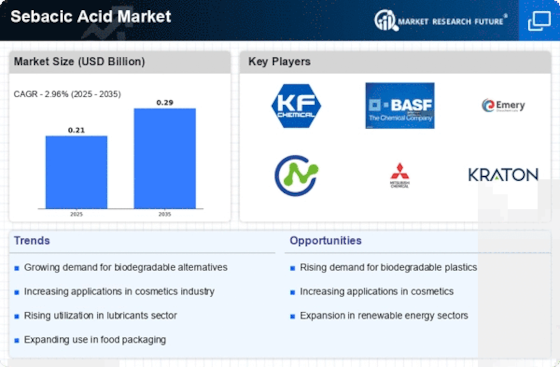
As per Market Research Future analysis, the Sebacic Acid Market Size was estimated at 0.21 USD Billion in 2024. The Sebacic Acid industry is projected to grow from USD 0.2162 Billion in 2025 to USD 0.2895 Billion by 2035, exhibiting a compound annual growth rate (CAGR) of 2.96% during the forecast period 2025 - 2035

Key Market Trends & Highlights

The Sebacic Acid Market is experiencing a dynamic shift driven by sustainability and technological advancements.

  • The market is increasingly influenced by a focus on sustainability, leading to innovative applications. North America remains the largest market for sebacic acid, while Asia-Pacific is recognized as the fastest-growing region. The Personal Care and Cosmetics segment holds the largest share, whereas the Plasticizers segment is witnessing rapid growth. Rising demand in biodegradable plastics and expansion in automotive applications are key drivers propelling market growth.

Market Size & Forecast

2024 Market Size 0.21 (USD Billion)
2035 Market Size 0.2895 (USD Billion)
CAGR (2025 - 2035) 2.96%
Largest Regional Market Share in 2024 North America

Major Players

Huanghua Chemical (CN), BASF SE (DE), Emery Oleochemicals (MY), Nanjing Chemical (CN), Mitsubishi Chemical (JP), Kraton Corporation (US), Fujian Zhongke (CN), SABIC (SA), Oxea GmbH (DE)

Market Trends

The Silicone Sealants Market is currently experiencing a dynamic evolution, driven by various factors that influence demand across multiple sectors. The construction industry, in particular, appears to be a significant contributor, as the need for durable and flexible sealing solutions becomes increasingly paramount. This market segment is characterized by a growing emphasis on energy efficiency and sustainability, prompting manufacturers to innovate and develop products that meet stringent environmental standards. Additionally, the automotive sector is also witnessing a surge in the adoption of silicone sealants, as these materials offer superior performance in terms of temperature resistance and adhesion, which are critical for modern vehicle designs.

Beyond industrial applications, the rise of DIY culture and home improvement projects is broadening the consumer base within the silicone sealants market. Homeowners are seeking easy-to-apply, multi-purpose sealants for plumbing, insulation, roofing, and interior repairs. This shift toward accessible and user-friendly products is contributing to steady expansion in overall silicone sealants market size, particularly in retail and residential segments. As innovation in material science continues, manufacturers are introducing improved formulations designed to meet evolving consumer and industrial expectations.

Sustainability Focus

The emphasis on sustainable practices is reshaping the Sebacic Acid Market. As industries increasingly prioritize eco-friendly materials, the demand for bio-based sebacic acid is likely to rise, reflecting a broader trend towards environmental responsibility.

Technological Advancements

Innovations in production technologies are expected to enhance the efficiency of sebacic acid manufacturing. These advancements may lead to cost reductions and improved product quality, potentially attracting new players to the market.

Diverse Applications

The expanding range of applications for sebacic acid across various sectors, including automotive and textiles, indicates a growing market potential. This diversification may drive demand and encourage further research into new uses.

Sebacic Acid Market Market Drivers

Expansion in Automotive Applications

The automotive sector is increasingly adopting sebacic acid for various applications, including the production of lubricants, coatings, and plastics. The Sebacic Acid Market is benefiting from this trend as manufacturers recognize the advantages of using sebacic acid in enhancing the performance and durability of automotive components. With the automotive industry projected to grow steadily, the demand for high-performance materials is expected to rise. Reports indicate that the automotive lubricants segment alone is anticipated to reach a market value of several billion dollars by 2026. This expansion in automotive applications is likely to drive the demand for sebacic acid, reinforcing its position in the market.

Growth in Personal Care and Cosmetics

The personal care and cosmetics sector is increasingly incorporating sebacic acid due to its beneficial properties, such as emollience and skin conditioning. The Sebacic Acid Market is experiencing growth as formulators seek to enhance product performance and consumer appeal. With The Sebacic Acid Market projected to exceed 800 billion dollars by 2025, the demand for high-quality ingredients like sebacic acid is expected to rise. This trend is further supported by the growing consumer awareness regarding ingredient transparency and safety. As brands strive to meet these demands, the incorporation of sebacic acid into personal care formulations is likely to become more prevalent, thereby boosting its market presence.

Innovations in Chemical Manufacturing

Advancements in chemical manufacturing processes are contributing to the growth of the sebacic acid market. The Sebacic Acid Market is witnessing innovations that enhance production efficiency and reduce costs. Techniques such as biotechnological methods and improved catalytic processes are being explored to optimize sebacic acid production. These innovations not only increase the availability of sebacic acid but also improve its economic viability for various applications. As the market for sebacic acid expands, these advancements are likely to play a crucial role in meeting the rising demand across multiple sectors, including plastics and lubricants.

Rising Demand in Biodegradable Plastics

The increasing emphasis on sustainability has led to a notable rise in the demand for biodegradable plastics, which utilize sebacic acid as a key component. The Sebacic Acid Market is witnessing a shift as manufacturers seek eco-friendly alternatives to traditional plastics. This trend is driven by consumer preferences for sustainable products, prompting companies to innovate and incorporate sebacic acid into their offerings. As a result, the market for biodegradable plastics is projected to grow significantly, with estimates suggesting a compound annual growth rate of over 20% in the coming years. This growth not only enhances the demand for sebacic acid but also positions it as a critical ingredient in the development of environmentally friendly materials.

Increasing Use in Industrial Applications

Sebacic acid is gaining traction in various industrial applications, including the production of nylon, plasticizers, and surfactants. The Sebacic Acid Market is benefiting from the growing need for high-performance materials in industrial settings. As industries seek to enhance product quality and performance, the demand for sebacic acid is expected to rise. Reports indicate that the nylon market alone is projected to reach a value of over 30 billion dollars by 2027, with sebacic acid playing a vital role in its production. This increasing use in industrial applications is likely to drive the growth of the sebacic acid market, highlighting its versatility and importance in modern manufacturing.

Market Segment Insights

By Application: Personal Care & Cosmetics (Largest) vs. Plasticizers (Fastest-Growing)

<p>In the Sebacic Acid Market, the application segment reveals a diverse landscape of end-user applications. Personal Care & Cosmetics dominate the market, capturing a significant share due to the increased demand for natural and biodegradable ingredients in beauty products. Lubricants and Household Care also contribute notably, leveraging the unique properties of sebacic acid to enhance performance and sustainability. Other applications such as Textiles, Paints & Coatings, and Plasticizers, although smaller in market share, are crucial in their respective niches.</p>

<p>Personal Care & Cosmetics (Dominant) vs. Plasticizers (Emerging)</p>

<p>Within the Sebacic Acid Market, Personal Care & Cosmetics stands out as the dominant application segment. This sector benefits from the rising trend of eco-friendly and clean-label products, spurring demand for sebacic acid as a biodegradable ingredient in lotions, creams, and hair products. On the other hand, Plasticizers represent an emerging application, fueled by the growing requirement for sustainable materials in the manufacturing of plastics. While Personal Care & Cosmetics leverages established consumer preferences and trends, Plasticizers are rapidly gaining ground as industries seek to replace traditional plastics with more environmentally friendly alternatives, indicating a shift towards sustainable practices.</p>

Get more detailed insights about Sebacic Acid Market Research Report - Forecast to 2035

Regional Insights

North America : Innovation and Demand Growth

The North American sebacic acid market is driven by increasing demand in various applications, particularly in plastics and lubricants. The region is characterized by a robust regulatory framework that supports sustainable practices, contributing to a projected market share of approximately 35%. The U.S. leads this market, followed closely by Canada, which holds around 20% of the market share. Key players such as Kraton Corporation and BASF SE are pivotal in shaping the competitive landscape. The presence of advanced manufacturing facilities and a focus on R&D further enhance the region's market position. The U.S. government’s initiatives to promote bio-based chemicals are also expected to bolster growth, making North America a significant player in The Sebacic Acid Market.

Europe : Sustainability and Innovation Focus

Europe is witnessing a surge in the sebacic acid market, driven by stringent environmental regulations and a shift towards bio-based products. The region holds a market share of approximately 30%, with Germany and France being the largest contributors, accounting for about 15% and 10% respectively. The European Union's Green Deal is a significant regulatory catalyst, promoting sustainable chemical production. Leading companies like BASF SE and Oxea GmbH are at the forefront of innovation, focusing on eco-friendly production methods. The competitive landscape is characterized by collaborations and partnerships aimed at enhancing product offerings. The presence of a well-established chemical industry and supportive government policies further solidify Europe’s position in the global market.

Asia-Pacific : Emerging Markets and Growth Potential

The Asia-Pacific region is emerging as a powerhouse in the sebacic acid market, driven by rapid industrialization and increasing demand from end-use industries such as automotive and textiles. This region holds a market share of approximately 25%, with China and Japan being the largest markets, contributing around 15% and 5% respectively. The growing focus on sustainable practices is also influencing market dynamics. Key players like Huanghua Chemical and Nanjing Chemical are expanding their production capacities to meet the rising demand. The competitive landscape is marked by a mix of local and international players, fostering innovation and price competitiveness. Government initiatives aimed at boosting the chemical sector further enhance the growth prospects in this region.

Middle East and Africa : Resource-Rich and Growing Demand

The Middle East and Africa region is witnessing gradual growth in the sebacic acid market, driven by increasing industrial activities and a focus on diversifying economies. This region holds a market share of approximately 10%, with countries like South Africa and Saudi Arabia leading the way. The region's rich natural resources and strategic location are key drivers for market expansion. The competitive landscape is still developing, with emerging players looking to capitalize on the growing demand. Companies like SABIC are exploring opportunities to enhance their market presence. The region's potential for growth is significant, especially as governments invest in infrastructure and industrial development, paving the way for increased production and consumption of sebacic acid.

Key Players and Competitive Insights

Leading market players are investing heavily in research and development to expand their product lines, which will help the Sebacic Acid Market, grow even more. Additionally, market participants are engaging in a variety of strategic initiatives to increase their footprint, with important market developments including new product launches, contractual agreements, mergers and acquisitions, higher investments, and collaboration with other organizations. The sebacic acid industry must offer cost-effective items to expand and survive in a more competitive and rising market climate. Manufacturing locally to minimize operational costs is one of the key business tactics manufacturers use in the sebacic acid industry to benefit clients and increase the market sector. In recent years, the sebacic acid industry has offered some of the most significant advantages to medicine. Major players in the sebacic acid market, including Arkema Group (France), HOKOKU KOGYO Co. Ltd (Japan), Shanxi Zhengang Chemical Co., Ltd. (China), Casda biomaterials co. Ltd (China), EVONIK (Germany), Sebacic India Limited (India), Croda International Plc (U.K), Tianxing Biotechnology Co., Ltd. (China), and Inolex Incorporation (U.S.). Hokoku Kogyo Co.,Ltd. was founded in 1957. The company's line of business comprises the production of fabricated structural metal and steel or other metal products for structural uses. For instance, In 2017, Hokoku Corporation constructed a second commercial centre in Tokyo to increase its presence in North Japan. A variety of chemicals are produced and sold by Arkema SA. The company manufactures industrial chemicals, performance goods, and technical polymers such acrylics, polymethyl methacrylate (PMMA), hydrogen peroxide, and helpful additives.

Key Companies in the Sebacic Acid Market include

Industry Developments

May 2015: Businessman Shaikh Hilal Bin Khalid al Mawali of the Sultanate of Oman and Shipra Agrichem Pvt. Ltd. inked a contract in May 2015 to build the first sebacic acid plant in the Middle East at Duqm. Sebacic acid will be produced at a rate of 30,000 tonnes annually. This acquisition reinforced its position in the Middle East and Africa.

August 2021: Glow & Get by Tula Skincare The newest Cooling & Brightening Eye Balm has been launched, according to the announcement. The product offers an immediate and simple remedy for eye issues. It guarantees to instantly revive drained eyes. Tula claims that the cream is suitable for usage both during the day and at night. The business went on to say that the most innovative hyaluronic acid eye balm provides a lit-from-within glow while moisturizing, cooling, and assisting in the appearance of fine lines and wrinkles around the eyes. Dermatologists examine the item.

June 2020: India's Jayant Agro warned that because demand for castor oil, a key ingredient in the production of sebacic acid, has decreased by 10%, export growth may be affected. The COVID-19 dilemma is mostly to blame for this. Several industries came to a grinding halt as a result of the epidemic. As a result, demand fell precipitously, and the supply chain was broken. The need for sebacic acid will decline in the construction and automobile industries, adversely affected by lockdowns worldwide.

The market's biggest challenges include a limited labor force, stalled investments, and a lack of demand to combat the economic crisis.

Future Outlook

Sebacic Acid Market Future Outlook

The Sebacic Acid Market is projected to grow at 2.96% CAGR from 2025 to 2035, driven by increasing demand in bio-based products and sustainable applications.

New opportunities lie in:

  • <p>Expansion into bio-lubricants for automotive applications. Development of <a href="https://www.marketresearchfuture.com/reports/biodegradable-plastics-market-2431" target="_blank" title="biodegradable plastics">biodegradable plastics</a> incorporating sebacic acid. Strategic partnerships with renewable energy firms for sustainable sourcing.</p>

By 2035, the Sebacic Acid Market is expected to solidify its position as a key player in sustainable chemical solutions.

Market Segmentation

Sebacic Acid Market Application Outlook

  • Personal Care & Cosmetics
  • Lubricants
  • Textiles
  • Household Care
  • Paints & Coatings
  • Plasticizers

Report Scope

MARKET SIZE 2024 0.21(USD Billion)
MARKET SIZE 2025 0.2162(USD Billion)
MARKET SIZE 2035 0.2895(USD Billion)
COMPOUND ANNUAL GROWTH RATE (CAGR) 2.96% (2025 - 2035)
REPORT COVERAGE Revenue Forecast, Competitive Landscape, Growth Factors, and Trends
BASE YEAR 2024
Market Forecast Period 2025 - 2035
Historical Data 2019 - 2024
Market Forecast Units USD Billion
Key Companies Profiled Huanghua Chemical (CN), BASF SE (DE), Emery Oleochemicals (MY), Nanjing Chemical (CN), Mitsubishi Chemical (JP), Kraton Corporation (US), Fujian Zhongke (CN), SABIC (SA), Oxea GmbH (DE)
Segments Covered Application, Region
Key Market Opportunities Growing demand for bio-based plastics presents opportunities in the Sebacic Acid Market.
Key Market Dynamics Rising demand for biodegradable plastics drives innovation and competition in the sebacic acid market.
Countries Covered North America, Europe, APAC, South America, MEA

FAQs

What is the projected market valuation of the Sebacic Acid Market by 2035?

<p>The projected market valuation of the Sebacic Acid Market is expected to reach 0.2895 USD Billion by 2035.</p>

What was the market valuation of the Sebacic Acid Market in 2024?

<p>The market valuation of the Sebacic Acid Market was 0.21 USD Billion in 2024.</p>

What is the expected CAGR for the Sebacic Acid Market during the forecast period 2025 - 2035?

<p>The expected CAGR for the Sebacic Acid Market during the forecast period 2025 - 2035 is 2.96%.</p>

Which companies are considered key players in the Sebacic Acid Market?

<p>Key players in the Sebacic Acid Market include Huanghua Chemical, BASF SE, Emery Oleochemicals, and Mitsubishi Chemical, among others.</p>

What segment of the Sebacic Acid Market had the highest valuation in 2024?

<p>In 2024, the Personal Care & Cosmetics segment had the highest valuation at 0.0675 USD Billion.</p>

How does the valuation of the Lubricants segment compare to that of the Textiles segment in 2024?

In 2024, the Lubricants segment was valued at 0.055 USD Billion, which is higher than the Textiles segment valued at 0.045 USD Billion.

What is the projected growth trend for the Household Care segment from 2024 to 2035?

The Household Care segment is projected to grow from 0.0375 USD Billion in 2024 to a higher valuation by 2035.

What is the expected market performance of the Paints & Coatings segment during the forecast period?

The Paints &amp; Coatings segment is anticipated to grow from 0.0225 USD Billion in 2024, reflecting the overall market growth.

Which segment is expected to show the least growth in the Sebacic Acid Market?

The Plasticizers segment, valued at 0.0125 USD Billion in 2024, is expected to show the least growth compared to other segments.

How does the overall market growth of the Sebacic Acid Market reflect on its key players?

The overall market growth of the Sebacic Acid Market may provide opportunities for key players like Kraton Corporation and SABIC to expand their market share.

  1. SECTION I: EXECUTIVE SUMMARY AND KEY HIGHLIGHTS
    1. | 1.1 EXECUTIVE SUMMARY
    2. | | 1.1.1 Market Overview
    3. | | 1.1.2 Key Findings
    4. | | 1.1.3 Market Segmentation
    5. | | 1.1.4 Competitive Landscape
    6. | | 1.1.5 Challenges and Opportunities
    7. | | 1.1.6 Future Outlook
  2. SECTION II: SCOPING, METHODOLOGY AND MARKET STRUCTURE
    1. | 2.1 MARKET INTRODUCTION
    2. | | 2.1.1 Definition
    3. | | 2.1.2 Scope of the study
    4. | | | 2.1.2.1 Research Objective
    5. | | | 2.1.2.2 Assumption
    6. | | | 2.1.2.3 Limitations
    7. | 2.2 RESEARCH METHODOLOGY
    8. | | 2.2.1 Overview
    9. | | 2.2.2 Data Mining
    10. | | 2.2.3 Secondary Research
    11. | | 2.2.4 Primary Research
    12. | | | 2.2.4.1 Primary Interviews and Information Gathering Process
    13. | | | 2.2.4.2 Breakdown of Primary Respondents
    14. | | 2.2.5 Forecasting Model
    15. | | 2.2.6 Market Size Estimation
    16. | | | 2.2.6.1 Bottom-Up Approach
    17. | | | 2.2.6.2 Top-Down Approach
    18. | | 2.2.7 Data Triangulation
    19. | | 2.2.8 Validation
  3. SECTION III: QUALITATIVE ANALYSIS
    1. | 3.1 MARKET DYNAMICS
    2. | | 3.1.1 Overview
    3. | | 3.1.2 Drivers
    4. | | 3.1.3 Restraints
    5. | | 3.1.4 Opportunities
    6. | 3.2 MARKET FACTOR ANALYSIS
    7. | | 3.2.1 Value chain Analysis
    8. | | 3.2.2 Porter's Five Forces Analysis
    9. | | | 3.2.2.1 Bargaining Power of Suppliers
    10. | | | 3.2.2.2 Bargaining Power of Buyers
    11. | | | 3.2.2.3 Threat of New Entrants
    12. | | | 3.2.2.4 Threat of Substitutes
    13. | | | 3.2.2.5 Intensity of Rivalry
    14. | | 3.2.3 COVID-19 Impact Analysis
    15. | | | 3.2.3.1 Market Impact Analysis
    16. | | | 3.2.3.2 Regional Impact
    17. | | | 3.2.3.3 Opportunity and Threat Analysis
  4. SECTION IV: QUANTITATIVE ANALYSIS
    1. | 4.1 Chemicals and Materials, BY Application (USD Billion)
    2. | | 4.1.1 Personal Care & Cosmetics
    3. | | 4.1.2 Lubricants
    4. | | 4.1.3 Textiles
    5. | | 4.1.4 Household Care
    6. | | 4.1.5 Paints & Coatings
    7. | | 4.1.6 Plasticizers
    8. | 4.2 Chemicals and Materials, BY Region (USD Billion)
    9. | | 4.2.1 North America
    10. | | | 4.2.1.1 US
    11. | | | 4.2.1.2 Canada
    12. | | 4.2.2 Europe
    13. | | | 4.2.2.1 Germany
    14. | | | 4.2.2.2 UK
    15. | | | 4.2.2.3 France
    16. | | | 4.2.2.4 Russia
    17. | | | 4.2.2.5 Italy
    18. | | | 4.2.2.6 Spain
    19. | | | 4.2.2.7 Rest of Europe
    20. | | 4.2.3 APAC
    21. | | | 4.2.3.1 China
    22. | | | 4.2.3.2 India
    23. | | | 4.2.3.3 Japan
    24. | | | 4.2.3.4 South Korea
    25. | | | 4.2.3.5 Malaysia
    26. | | | 4.2.3.6 Thailand
    27. | | | 4.2.3.7 Indonesia
    28. | | | 4.2.3.8 Rest of APAC
    29. | | 4.2.4 South America
    30. | | | 4.2.4.1 Brazil
    31. | | | 4.2.4.2 Mexico
    32. | | | 4.2.4.3 Argentina
    33. | | | 4.2.4.4 Rest of South America
    34. | | 4.2.5 MEA
    35. | | | 4.2.5.1 GCC Countries
    36. | | | 4.2.5.2 South Africa
    37. | | | 4.2.5.3 Rest of MEA
  5. SECTION V: COMPETITIVE ANALYSIS
    1. | 5.1 Competitive Landscape
    2. | | 5.1.1 Overview
    3. | | 5.1.2 Competitive Analysis
    4. | | 5.1.3 Market share Analysis
    5. | | 5.1.4 Major Growth Strategy in the Chemicals and Materials
    6. | | 5.1.5 Competitive Benchmarking
    7. | | 5.1.6 Leading Players in Terms of Number of Developments in the Chemicals and Materials
    8. | | 5.1.7 Key developments and growth strategies
    9. | | | 5.1.7.1 New Product Launch/Service Deployment
    10. | | | 5.1.7.2 Merger & Acquisitions
    11. | | | 5.1.7.3 Joint Ventures
    12. | | 5.1.8 Major Players Financial Matrix
    13. | | | 5.1.8.1 Sales and Operating Income
    14. | | | 5.1.8.2 Major Players R&D Expenditure. 2023
    15. | 5.2 Company Profiles
    16. | | 5.2.1 Huanghua Chemical (CN)
    17. | | | 5.2.1.1 Financial Overview
    18. | | | 5.2.1.2 Products Offered
    19. | | | 5.2.1.3 Key Developments
    20. | | | 5.2.1.4 SWOT Analysis
    21. | | | 5.2.1.5 Key Strategies
    22. | | 5.2.2 BASF SE (DE)
    23. | | | 5.2.2.1 Financial Overview
    24. | | | 5.2.2.2 Products Offered
    25. | | | 5.2.2.3 Key Developments
    26. | | | 5.2.2.4 SWOT Analysis
    27. | | | 5.2.2.5 Key Strategies
    28. | | 5.2.3 Emery Oleochemicals (MY)
    29. | | | 5.2.3.1 Financial Overview
    30. | | | 5.2.3.2 Products Offered
    31. | | | 5.2.3.3 Key Developments
    32. | | | 5.2.3.4 SWOT Analysis
    33. | | | 5.2.3.5 Key Strategies
    34. | | 5.2.4 Nanjing Chemical (CN)
    35. | | | 5.2.4.1 Financial Overview
    36. | | | 5.2.4.2 Products Offered
    37. | | | 5.2.4.3 Key Developments
    38. | | | 5.2.4.4 SWOT Analysis
    39. | | | 5.2.4.5 Key Strategies
    40. | | 5.2.5 Mitsubishi Chemical (JP)
    41. | | | 5.2.5.1 Financial Overview
    42. | | | 5.2.5.2 Products Offered
    43. | | | 5.2.5.3 Key Developments
    44. | | | 5.2.5.4 SWOT Analysis
    45. | | | 5.2.5.5 Key Strategies
    46. | | 5.2.6 Kraton Corporation (US)
    47. | | | 5.2.6.1 Financial Overview
    48. | | | 5.2.6.2 Products Offered
    49. | | | 5.2.6.3 Key Developments
    50. | | | 5.2.6.4 SWOT Analysis
    51. | | | 5.2.6.5 Key Strategies
    52. | | 5.2.7 Fujian Zhongke (CN)
    53. | | | 5.2.7.1 Financial Overview
    54. | | | 5.2.7.2 Products Offered
    55. | | | 5.2.7.3 Key Developments
    56. | | | 5.2.7.4 SWOT Analysis
    57. | | | 5.2.7.5 Key Strategies
    58. | | 5.2.8 SABIC (SA)
    59. | | | 5.2.8.1 Financial Overview
    60. | | | 5.2.8.2 Products Offered
    61. | | | 5.2.8.3 Key Developments
    62. | | | 5.2.8.4 SWOT Analysis
    63. | | | 5.2.8.5 Key Strategies
    64. | | 5.2.9 Oxea GmbH (DE)
    65. | | | 5.2.9.1 Financial Overview
    66. | | | 5.2.9.2 Products Offered
    67. | | | 5.2.9.3 Key Developments
    68. | | | 5.2.9.4 SWOT Analysis
    69. | | | 5.2.9.5 Key Strategies
    70. | 5.3 Appendix
    71. | | 5.3.1 References
    72. | | 5.3.2 Related Reports
  6. LIST OF FIGURES
    1. | 6.1 MARKET SYNOPSIS
    2. | 6.2 NORTH AMERICA MARKET ANALYSIS
    3. | 6.3 US MARKET ANALYSIS BY APPLICATION
    4. | 6.4 CANADA MARKET ANALYSIS BY APPLICATION
    5. | 6.5 EUROPE MARKET ANALYSIS
    6. | 6.6 GERMANY MARKET ANALYSIS BY APPLICATION
    7. | 6.7 UK MARKET ANALYSIS BY APPLICATION
    8. | 6.8 FRANCE MARKET ANALYSIS BY APPLICATION
    9. | 6.9 RUSSIA MARKET ANALYSIS BY APPLICATION
    10. | 6.10 ITALY MARKET ANALYSIS BY APPLICATION
    11. | 6.11 SPAIN MARKET ANALYSIS BY APPLICATION
    12. | 6.12 REST OF EUROPE MARKET ANALYSIS BY APPLICATION
    13. | 6.13 APAC MARKET ANALYSIS
    14. | 6.14 CHINA MARKET ANALYSIS BY APPLICATION
    15. | 6.15 INDIA MARKET ANALYSIS BY APPLICATION
    16. | 6.16 JAPAN MARKET ANALYSIS BY APPLICATION
    17. | 6.17 SOUTH KOREA MARKET ANALYSIS BY APPLICATION
    18. | 6.18 MALAYSIA MARKET ANALYSIS BY APPLICATION
    19. | 6.19 THAILAND MARKET ANALYSIS BY APPLICATION
    20. | 6.20 INDONESIA MARKET ANALYSIS BY APPLICATION
    21. | 6.21 REST OF APAC MARKET ANALYSIS BY APPLICATION
    22. | 6.22 SOUTH AMERICA MARKET ANALYSIS
    23. | 6.23 BRAZIL MARKET ANALYSIS BY APPLICATION
    24. | 6.24 MEXICO MARKET ANALYSIS BY APPLICATION
    25. | 6.25 ARGENTINA MARKET ANALYSIS BY APPLICATION
    26. | 6.26 REST OF SOUTH AMERICA MARKET ANALYSIS BY APPLICATION
    27. | 6.27 MEA MARKET ANALYSIS
    28. | 6.28 GCC COUNTRIES MARKET ANALYSIS BY APPLICATION
    29. | 6.29 SOUTH AFRICA MARKET ANALYSIS BY APPLICATION
    30. | 6.30 REST OF MEA MARKET ANALYSIS BY APPLICATION
    31. | 6.31 KEY BUYING CRITERIA OF CHEMICALS AND MATERIALS
    32. | 6.32 RESEARCH PROCESS OF MRFR
    33. | 6.33 DRO ANALYSIS OF CHEMICALS AND MATERIALS
    34. | 6.34 DRIVERS IMPACT ANALYSIS: CHEMICALS AND MATERIALS
    35. | 6.35 RESTRAINTS IMPACT ANALYSIS: CHEMICALS AND MATERIALS
    36. | 6.36 SUPPLY / VALUE CHAIN: CHEMICALS AND MATERIALS
    37. | 6.37 CHEMICALS AND MATERIALS, BY APPLICATION, 2024 (% SHARE)
    38. | 6.38 CHEMICALS AND MATERIALS, BY APPLICATION, 2024 TO 2035 (USD Billion)
    39. | 6.39 BENCHMARKING OF MAJOR COMPETITORS
  7. LIST OF TABLES
    1. | 7.1 LIST OF ASSUMPTIONS
    2. | | 7.1.1
    3. | 7.2 North America MARKET SIZE ESTIMATES; FORECAST
    4. | | 7.2.1 BY APPLICATION, 2025-2035 (USD Billion)
    5. | 7.3 US MARKET SIZE ESTIMATES; FORECAST
    6. | | 7.3.1 BY APPLICATION, 2025-2035 (USD Billion)
    7. | 7.4 Canada MARKET SIZE ESTIMATES; FORECAST
    8. | | 7.4.1 BY APPLICATION, 2025-2035 (USD Billion)
    9. | 7.5 Europe MARKET SIZE ESTIMATES; FORECAST
    10. | | 7.5.1 BY APPLICATION, 2025-2035 (USD Billion)
    11. | 7.6 Germany MARKET SIZE ESTIMATES; FORECAST
    12. | | 7.6.1 BY APPLICATION, 2025-2035 (USD Billion)
    13. | 7.7 UK MARKET SIZE ESTIMATES; FORECAST
    14. | | 7.7.1 BY APPLICATION, 2025-2035 (USD Billion)
    15. | 7.8 France MARKET SIZE ESTIMATES; FORECAST
    16. | | 7.8.1 BY APPLICATION, 2025-2035 (USD Billion)
    17. | 7.9 Russia MARKET SIZE ESTIMATES; FORECAST
    18. | | 7.9.1 BY APPLICATION, 2025-2035 (USD Billion)
    19. | 7.10 Italy MARKET SIZE ESTIMATES; FORECAST
    20. | | 7.10.1 BY APPLICATION, 2025-2035 (USD Billion)
    21. | 7.11 Spain MARKET SIZE ESTIMATES; FORECAST
    22. | | 7.11.1 BY APPLICATION, 2025-2035 (USD Billion)
    23. | 7.12 Rest of Europe MARKET SIZE ESTIMATES; FORECAST
    24. | | 7.12.1 BY APPLICATION, 2025-2035 (USD Billion)
    25. | 7.13 APAC MARKET SIZE ESTIMATES; FORECAST
    26. | | 7.13.1 BY APPLICATION, 2025-2035 (USD Billion)
    27. | 7.14 China MARKET SIZE ESTIMATES; FORECAST
    28. | | 7.14.1 BY APPLICATION, 2025-2035 (USD Billion)
    29. | 7.15 India MARKET SIZE ESTIMATES; FORECAST
    30. | | 7.15.1 BY APPLICATION, 2025-2035 (USD Billion)
    31. | 7.16 Japan MARKET SIZE ESTIMATES; FORECAST
    32. | | 7.16.1 BY APPLICATION, 2025-2035 (USD Billion)
    33. | 7.17 South Korea MARKET SIZE ESTIMATES; FORECAST
    34. | | 7.17.1 BY APPLICATION, 2025-2035 (USD Billion)
    35. | 7.18 Malaysia MARKET SIZE ESTIMATES; FORECAST
    36. | | 7.18.1 BY APPLICATION, 2025-2035 (USD Billion)
    37. | 7.19 Thailand MARKET SIZE ESTIMATES; FORECAST
    38. | | 7.19.1 BY APPLICATION, 2025-2035 (USD Billion)
    39. | 7.20 Indonesia MARKET SIZE ESTIMATES; FORECAST
    40. | | 7.20.1 BY APPLICATION, 2025-2035 (USD Billion)
    41. | 7.21 Rest of APAC MARKET SIZE ESTIMATES; FORECAST
    42. | | 7.21.1 BY APPLICATION, 2025-2035 (USD Billion)
    43. | 7.22 South America MARKET SIZE ESTIMATES; FORECAST
    44. | | 7.22.1 BY APPLICATION, 2025-2035 (USD Billion)
    45. | 7.23 Brazil MARKET SIZE ESTIMATES; FORECAST
    46. | | 7.23.1 BY APPLICATION, 2025-2035 (USD Billion)
    47. | 7.24 Mexico MARKET SIZE ESTIMATES; FORECAST
    48. | | 7.24.1 BY APPLICATION, 2025-2035 (USD Billion)
    49. | 7.25 Argentina MARKET SIZE ESTIMATES; FORECAST
    50. | | 7.25.1 BY APPLICATION, 2025-2035 (USD Billion)
    51. | 7.26 Rest of South America MARKET SIZE ESTIMATES; FORECAST
    52. | | 7.26.1 BY APPLICATION, 2025-2035 (USD Billion)
    53. | 7.27 MEA MARKET SIZE ESTIMATES; FORECAST
    54. | | 7.27.1 BY APPLICATION, 2025-2035 (USD Billion)
    55. | 7.28 GCC Countries MARKET SIZE ESTIMATES; FORECAST
    56. | | 7.28.1 BY APPLICATION, 2025-2035 (USD Billion)
    57. | 7.29 South Africa MARKET SIZE ESTIMATES; FORECAST
    58. | | 7.29.1 BY APPLICATION, 2025-2035 (USD Billion)
    59. | 7.30 Rest of MEA MARKET SIZE ESTIMATES; FORECAST
    60. | | 7.30.1 BY APPLICATION, 2025-2035 (USD Billion)
    61. | 7.31 PRODUCT LAUNCH/PRODUCT DEVELOPMENT/APPROVAL
    62. | | 7.31.1
    63. | 7.32 ACQUISITION/PARTNERSHIP
    64. | | 7.32.1

Chemicals and Materials Market Segmentation

Chemicals and Materials By Application (USD Billion, 2025-2035)

  • Personal Care & Cosmetics
  • Lubricants
  • Textiles
  • Household Care
  • Paints & Coatings
  • Plasticizers
Infographic

Free Sample Request

Kindly complete the form below to receive a free sample of this Report

Get Free Sample

Customer Strories

Compare Licence

×
Features License Type
Single User Multiuser License Enterprise User
Price $4,950 $5,950 $7,250
Maximum User Access Limit 1 User Upto 10 Users Unrestricted Access Throughout the Organization
Free Customization
Direct Access to Analyst
Deliverable Format
Platform Access
Discount on Next Purchase 10% 15% 15%
Printable Versions