Request Free Sample ×

Kindly complete the form below to receive a free sample of this Report

* Please use a valid business email

Leading companies partner with us for data-driven Insights

clients tt-cursor
Hero Background
English
Chinese
French
Japanese
Korean
German
Spanish

Rigid Plastic Packaging Market Share

ID: MRFR/PCM/3538-HCR
111 Pages
Snehal Singh
March 2026

Rigid Plastic Packaging Market Size, Share & Industry Analysis Research Report By Application (Food Packaging, Beverage Packaging, Pharmaceutical Packaging, Personal Care Packaging, Household Goods Packaging), By Material Type (Polyethylene Terephthalate, Polypropylene, Polyvinyl Chloride, Polyethylene, Polystyrene), By Product Type (Bottles, Containers, Cups, Trays, Jars), By End Use (Food Industry, Beverage Industry, Pharmaceutical Industry, Cosmetics Industry, Household Products Industry) and By Regional (North America, Europe, South America, Asia Pacific, Middle East and Africa) - Forecast to 2035

Share:
Download PDF ×

We do not share your information with anyone. However, we may send you emails based on your report interest from time to time. You may contact us at any time to opt-out.

Rigid Plastic Packaging Market Infographic
Purchase Options

Market Share

Rigid Plastic Packaging Market Share Analysis

Companies in the Rigid Plastic Packaging Market use diverse market share positioning strategies to remain competitive and thrive. One of these is differentiation, where they concentrate on established packaging solutions that make them stand out. This strategy often requires investment in research and development to come up with cutting-edge designs, materials or features that respond to specific consumer needs or industry trends. By providing unique products, businesses can attract a niche market segment and foster loyalty towards their brands, thereby attaining a portion of the market.

Another frequently used strategy is cost leadership which aims at becoming the low-cost producer in the rigid plastic packaging industry. This involves enhancing operational efficiency, making production processes leaner and obtaining favourable terms from suppliers. Once costs are lowered down then companies are able to price their customers competitively hence attracting budget-minded consumers thus leading it to gain more market through affordability. However quality maintenance is vital in this approach so as not to devalue the perceived value of the packaging.

Market segmentation is also an important strategy in Rigid Plastic Packaging Market. Market segments are created by firms based on geography, industry or consumer demographics among others. By tailoring packaging solutions for each segment’s particular requirements and preferences effectively satisfying diverse markets’ demands becomes achievable. This focused approach leads to greater customer satisfaction resulting in increased market share within each identified segment.

In order for any company to succeed at capturing its share of the Rigid Plastic Packaging Market, adaptability and responsiveness must be key elements of its market positioning efforts. To this end it has been found that those organizations that have managed to align their strategies with altering consumer tastes, regulation changes as well as environmental issues had been able to win significant proportions of their various markets. In light of growing eco-friendliness concerns among users today’s industrial players have invested heavily into sustainable material utilization and process alignment toward meeting green demand perception.

Growth in packaging industry will resultantly increase the demand for rigid plastic packaging industry . growth of the global market will be determined by the Asia pacific packaging industry. Market demand has increased by 20% this year. This is mainly as a result of high demand for consumer goods in this region. In Asia pacific, rigid plastic packaging is vital in pharmaceuticals, food processing and other industries. The covid analysis changes the Rigid Plastic Packaging market Outlook.

Author
Author Profile
Snehal Singh
Manager - Research

High acumen in analyzing complex macro & micro markets with more than 6 years of work experience in the field of market research. By implementing her analytical skills in forecasting and estimation into market research reports, she has expertise in Packaging, Construction, and Equipment domains. She handles a team size of 20-25 resources and ensures smooth running of the projects, associated marketing activities, and client servicing.

Leave a Comment

FAQs

What is the current valuation of the rigid plastic packaging market?

<p>As of 2024, the rigid plastic packaging market was valued at 250.0 USD Billion.</p>

What is the projected market valuation for the rigid plastic packaging sector in 2035?

<p>The rigid plastic packaging market is projected to reach 350.0 USD Billion by 2035.</p>

What is the expected CAGR for the rigid plastic packaging market from 2025 to 2035?

<p>The expected CAGR for the rigid plastic packaging market during the forecast period 2025 - 2035 is 3.11%.</p>

Which application segment holds the largest market share in rigid plastic packaging?

<p>The food packaging segment, valued at 140.0 USD Billion in 2024, holds the largest market share in rigid plastic packaging.</p>

How does the beverage packaging segment compare to food packaging in terms of market valuation?

<p>In 2024, the beverage packaging segment was valued at 100.0 USD Billion, which is significantly lower than the food packaging segment.</p>

What are the key materials used in rigid plastic packaging?

<p>The primary materials used in rigid plastic packaging include polyethylene, polypropylene, and polyvinyl chloride, with valuations ranging from 10.0 to 70.0 USD Billion.</p>

Which end-use industry is expected to drive growth in the rigid plastic packaging market?

<p>The food and beverage industry, valued at 140.0 USD Billion in 2024, is expected to drive substantial growth in the rigid plastic packaging market.</p>

Who are the leading companies in the rigid plastic packaging market?

<p>Key players in the rigid plastic packaging market include Amcor, Berry Global, and Sealed Air, among others.</p>

What is the valuation of the pharmaceutical packaging segment in 2024?

<p>The pharmaceutical packaging segment was valued at 60.0 USD Billion in 2024.</p>

How does the growth of the personal care packaging segment compare to the healthcare segment?

<p>In 2024, the personal care packaging segment was valued at 50.0 USD Billion, slightly lower than the healthcare segment, which was valued at 70.0 USD Billion.</p>

Market Summary

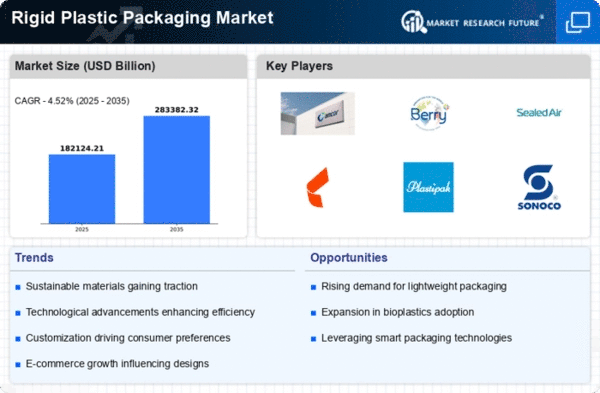
As per Market Research Future analysis, the Rigid Plastic Packaging Market Size was estimated at 174248.19 USD Billion in 2024. The Rigid Plastic Packaging industry is projected to grow from 182124.63 USD Billion in 2025 to 283382.32 USD Billion by 2035, exhibiting a compound annual growth rate (CAGR) of 4.52% during the forecast period 2025 - 2035

Key Market Trends & Highlights

The Rigid Plastic Packaging Market is experiencing a dynamic shift towards sustainability and innovation.

  • North America remains the largest market for rigid plastic packaging, driven by robust demand across various sectors. Asia-Pacific is identified as the fastest-growing region, reflecting increasing consumer preferences for packaged goods. Food packaging continues to dominate the market, while beverage packaging is emerging as the fastest-growing segment. Sustainability initiatives and technological advancements are key drivers propelling the market forward.

Market Size & Forecast

2024 Market Size 174248.19 (USD Billion)
2035 Market Size 283382.32 (USD Billion)
CAGR (2025 - 2035) 4.52%
Largest Regional Market Share in 2024 North America

Major Players

Amcor (AU), Berry Global (US), Sealed Air (US), Mondi Group (GB), Plastipak (US), Sonoco Products (US), Graham Packaging (US), ALPLA (AT), RPC Group (GB)

Market Trends

The Rigid Plastic Packaging Market is currently experiencing a transformative phase, driven by evolving consumer preferences and increasing environmental awareness. As sustainability becomes a focal point for both manufacturers and consumers, there is a noticeable shift towards eco-friendly materials and practices. This trend is not merely a response to regulatory pressures but also reflects a broader societal movement towards reducing plastic waste. Companies are exploring innovative solutions, such as biodegradable plastics and recyclable designs, to align with these changing expectations.

Moreover, the global Rigid Plastic Packaging Market is witnessing advancements in technology that enhance product functionality and design. Innovations in manufacturing processes are enabling the production of lighter, more durable packaging options that cater to diverse industries, including food and beverage, pharmaceuticals, and personal care. This evolution not only improves supply chain efficiency but also contributes to cost savings for businesses. As the market continues to adapt, it appears poised for growth, with a focus on balancing performance, sustainability, and consumer satisfaction.

Sustainability Initiatives

The Rigid Plastic Packaging Market trends is increasingly prioritizing sustainability, with companies adopting eco-friendly materials and practices. This trend reflects a growing consumer demand for environmentally responsible products, prompting manufacturers to innovate in biodegradable and recyclable packaging solutions.

Technological Advancements

Technological innovations are reshaping the Rigid Plastic Packaging Market, leading to the development of lighter and more durable packaging options. Enhanced manufacturing processes are improving product functionality, which benefits various sectors, including food and beverage and pharmaceuticals.

Customization and Personalization

There is a rising trend towards customization in the Rigid Plastic Packaging Market, as brands seek to differentiate themselves. Tailored packaging solutions not only enhance brand identity but also cater to specific consumer preferences, thereby fostering customer loyalty.

Rigid Plastic Packaging Market Market Drivers

Growth in E-commerce

The Global Rigid Plastic Packaging Market Industry is experiencing a surge due to the rapid expansion of e-commerce. As online shopping continues to gain traction, the demand for durable and protective packaging solutions is escalating. Rigid plastic packaging offers advantages such as lightweight, strength, and versatility, making it ideal for shipping a variety of products. This trend is further supported by the increasing consumer preference for convenience and the need for safe transportation of goods. The e-commerce sector's growth is anticipated to significantly contribute to the market's expansion, with projections indicating a market size of 450.2 USD Billion by 2035.

Sustainable Packaging Initiatives

The Global Rigid Plastic Packaging Market Industry is increasingly influenced by the rising demand for sustainable packaging solutions. Companies are adopting eco-friendly materials and practices to meet consumer preferences for environmentally responsible products. This shift is evident as brands seek to reduce their carbon footprint and enhance their corporate social responsibility. For instance, major corporations are investing in biodegradable plastics and recycling programs, which not only appeal to eco-conscious consumers but also comply with stringent regulations. This trend is expected to drive market growth, contributing to the projected market size of 332.6 USD Billion in 2024.

Market Size and Growth Projections

The Global Rigid Plastic Packaging Market Industry is poised for substantial growth, with projections indicating a market size of 332.6 USD Billion in 2024 and an anticipated increase to 450.2 USD Billion by 2035. This growth trajectory reflects a compound annual growth rate (CAGR) of 2.79% from 2025 to 2035. The expansion is driven by various factors, including the rising demand for sustainable packaging, technological advancements, and the increasing consumption of packaged goods across multiple sectors. The market's evolution is indicative of broader trends in consumer behavior and industry practices, suggesting a robust future for rigid plastic packaging.

Technological Advancements in Packaging

Technological innovations are playing a pivotal role in shaping the Global Rigid Plastic Packaging Market Industry. Advances in manufacturing processes, such as injection molding and blow molding, enhance the efficiency and quality of rigid plastic products. Additionally, the integration of smart packaging technologies, including QR codes and RFID tags, is becoming more prevalent. These technologies not only improve product traceability but also enhance consumer engagement. As manufacturers adopt these innovations, they are likely to gain a competitive edge, thereby driving market growth. The anticipated CAGR of 2.79% from 2025 to 2035 reflects the positive impact of these advancements.

Regulatory Compliance and Safety Standards

Regulatory compliance is a critical factor influencing the Global Rigid Plastic Packaging Market Industry. Governments worldwide are implementing stringent regulations concerning packaging materials and safety standards. These regulations aim to ensure consumer safety and environmental sustainability. Companies are compelled to adapt their packaging solutions to meet these requirements, which often leads to increased investments in research and development. Compliance not only enhances brand reputation but also opens up new market opportunities. As businesses navigate these regulatory landscapes, the demand for compliant rigid plastic packaging is likely to grow, contributing to the market's overall expansion.

Rising Demand from Food and Beverage Sector

The food and beverage sector is a significant driver of the Global Rigid Plastic Packaging Market Industry. With the increasing consumption of packaged foods and beverages, the need for reliable and safe packaging solutions is paramount. Rigid plastic packaging provides excellent barrier properties, ensuring product freshness and extending shelf life. This is particularly relevant in the context of ready-to-eat meals and beverages, where convenience is a key factor for consumers. As the global population continues to grow, the demand for packaged food is expected to rise, further propelling the market forward. This sector's influence is crucial in achieving the projected market size of 332.6 USD Billion in 2024.

Market Segment Insights

By Application: Food Packaging (Largest) vs. Pharmaceutical Packaging (Fastest-Growing)

<p>In the rigid plastic packaging market, the Food Packaging segment holds the largest share, primarily driven by the increasing demand for convenience and longer shelf life. This segment encompasses various products, including containers, trays, and meal boxes, playing a critical role in food safety and preservation. Following closely, the Pharmaceutical Packaging segment is recognized for its rapid expansion, fueled by the rising need for safe and effective drug delivery systems. The emphasis on patient compliance and regulatory standards continues to strengthen this sector's presence in the market. The growth trends within these segments illustrate a dynamic shift towards eco-friendly and sustainable materials, as consumers become increasingly environmentally conscious. Innovations in design and the introduction of biodegradable plastics are shaping the future of Food Packaging. Meanwhile, the Pharmaceutical Packaging sector is experiencing heightened investment in advanced technologies such as smart packaging and tamper-evident seals to enhance product safety and integrity, aligning with evolving healthcare needs.</p>

<p>Food Packaging (Dominant) vs. Cosmetic Packaging (Emerging)</p>

<p>The Food Packaging segment is recognized as the dominant force in the rigid plastic packaging market due to its extensive range of applications, including fresh produce, dairy products, and processed foods. This segment is characterized by continuous innovation aimed at improving shelf life, freshness, and user convenience. On the other hand, the Cosmetic Packaging segment is emerging rapidly, fueled by a growing beauty and personal care industry. This segment's packaging solutions focus on aesthetics and functionality, with increasing demand for sustainable options, such as refillable and recyclable containers. As consumers prioritize environmentally responsible products, both segments are adapting to meet these evolving preferences, although Food Packaging maintains a strong lead in market share.</p>

By Material Type: Polyethylene (Largest) vs. Polypropylene (Fastest-Growing)

In the Rigid Plastic Packaging Market, the material type segment exhibits varying market share distributions among five major types: Polyethylene, Polypropylene, Polyvinyl Chloride, <a href="https://www.marketresearchfuture.com/reports/polyethylene-terephthalate-market-5521">Polyethylene Terephthalate</a>, and Polystyrene. Currently, Polyethylene holds the largest share, being favored for its flexibility and durability, while Polypropylene is emerging rapidly due to its high-temperature tolerance and light weight, making it an ideal choice for diverse applications. The growth trends within this segment are driven by increasing demand for lightweight packaging solutions and sustainability initiatives. Polypropylene, in particular, is witnessing faster growth rates as consumers and manufacturers lean toward recyclable and efficient materials. The emphasis on reducing environmental impact and enhancing product shelf life fosters innovation and adoption of materials that align with sustainable practices, thereby strengthening the material type segment overall.

Polyethylene (Dominant) vs. Polystyrene (Emerging)

Polyethylene is the dominant material in the rigid plastic packaging market because of its exceptional properties, such as excellent chemical resistance and superior elasticity. Its adaptability allows it to be used in various applications, from food packaging to household products. In contrast, Polystyrene is considered an emerging material with unique characteristics like clarity and rigidity, making it suitable for specialized packaging needs. While Polystyrene is not as widely used as Polyethylene, its growth potential lies in niche markets, such as foam products and transparent containers. As industries push toward innovation, the use of Polystyrene is expected to gain traction, especially in products requiring lightweight and sturdy packaging solutions.

By End Use Industry: Food and Beverage (Largest) vs. Healthcare (Fastest-Growing)

In the Rigid Plastic Packaging Market, the Food and Beverage segment commands the largest share, driven by the increasing demand for convenient and sustainable packaging solutions. This segment captures a significant portion of the market due to the expansion of the food delivery sector and the rising preference for <a href="https://www.marketresearchfuture.com/reports/packaged-food-market-10540">packaged food</a> products. Following closely is the Healthcare sector, which has shown a strong uptick in demand, particularly in response to the ongoing emphasis on health and wellness, leading to a notable investment in healthcare packaging solutions. Growth trends in the rigid plastic packaging segment are significantly influenced by consumer preferences and regulatory changes. The Food and Beverage industry is focusing on innovation in packaging design, promoting sustainability, and enhancing user experience. Meanwhile, the Healthcare industry is witnessing rapid growth as companies invest in advanced packaging technologies to ensure product safety and integrity. The shift towards eco-friendly materials is a common trend across both segments, fostering growth and adapting to changing consumer expectations.

Food and Beverage (Dominant) vs. Healthcare (Emerging)

The Food and Beverage segment is a dominant player in the rigid plastic packaging market, characterized by its vast array of products ranging from containers for beverages to packaging for snacks and perishables. This segment benefits from high consumer demand for convenience and the increasing prevalence of on-the-go consumption. Companies are innovating in biodegradable materials and user-friendly designs to attract eco-conscious consumers. In contrast, the Healthcare segment is emerging, driven by advancements in medical technologies and increasing healthcare expenditures. It focuses on specialized packaging solutions designed to maintain product sterility and integrity. As the population ages and health awareness rises, the demand for effective healthcare packaging is expected to grow, making it an exciting avenue for future market opportunities.

Get more detailed insights about Rigid Plastic Packaging Market Research Report - Global Forecast to 2035

Regional Insights

North America : Market Leader in Rigid Packaging

North America is poised to maintain its leadership in the rigid plastic packaging market, holding a significant market share of 60.0 in 2024. The region's growth is driven by increasing demand for sustainable packaging solutions, stringent regulations on plastic waste, and a shift towards recyclable materials. The presence of major players and advanced manufacturing technologies further catalyze market expansion. The United States and Canada are the leading countries in this sector, with key players like Amcor, Berry Global, and Sealed Air driving innovation and competition. The competitive landscape is characterized by a focus on sustainability and technological advancements, ensuring that North America remains at the forefront of the rigid plastic packaging market. The region's robust infrastructure and investment in R&D also contribute to its market dominance.

Europe : Sustainable Packaging Initiatives

Europe's rigid plastic packaging market is projected to grow significantly, with a market size of 45.0 in 2025. The region is witnessing a strong push towards sustainability, driven by EU regulations aimed at reducing plastic waste and promoting recycling. This regulatory environment is fostering innovation in eco-friendly packaging solutions, which is a key growth driver in the market. Leading countries such as Germany, France, and the UK are at the forefront of this transformation, with major players like Mondi Group and RPC Group actively participating in the shift towards sustainable practices. The competitive landscape is marked by collaborations and investments in green technologies, positioning Europe as a leader in the rigid plastic packaging sector. The focus on circular economy principles is expected to further enhance market growth.

Asia-Pacific : Emerging Market Potential

The Asia-Pacific region is experiencing rapid growth in the rigid plastic packaging market, with a projected market size of 55.0 by 2025. This growth is fueled by increasing urbanization, rising disposable incomes, and a growing demand for packaged food and beverages. Additionally, favorable government policies supporting manufacturing and investment in infrastructure are significant catalysts for market expansion. Countries like China, India, and Japan are leading the charge, with key players such as Plastipak and Sonoco Products establishing a strong presence. The competitive landscape is characterized by a mix of local and international companies, all vying for market share in this dynamic environment. The region's diverse consumer preferences and rapid industrialization are expected to drive further innovation in rigid plastic packaging solutions.

Middle East and Africa : Developing Market Landscape

The Middle East and Africa region is gradually emerging in the rigid plastic packaging market, with a market size of 14.19 in 2025. The growth is primarily driven by increasing demand for packaged goods, particularly in the food and beverage sector. Additionally, government initiatives aimed at boosting manufacturing capabilities and reducing import dependency are fostering a conducive environment for market growth. Countries like South Africa and the UAE are leading the market, with local and international players such as ALPLA and Graham Packaging making significant inroads. The competitive landscape is evolving, with a focus on innovation and sustainability. As the region continues to develop, opportunities for growth in rigid plastic packaging are expected to expand, driven by changing consumer behaviors and economic development.

Key Players and Competitive Insights

The Rigid Plastic Packaging Market is currently characterized by a dynamic competitive landscape, driven by increasing demand for sustainable packaging solutions and innovations in material technology. Key players such as Amcor (AU), Berry Global (US), and Sealed Air (US) are strategically positioning themselves to capitalize on these trends. Amcor (AU) has focused on enhancing its sustainability initiatives, aiming for 100% of its packaging to be recyclable or reusable by 2025. Berry Global (US) emphasizes innovation in product design, particularly in lightweight packaging, which reduces material usage while maintaining performance. Sealed Air (US) is leveraging digital transformation to optimize its supply chain and improve customer engagement, thereby enhancing its competitive edge in the market. The business tactics employed by these companies reflect a concerted effort to localize manufacturing and optimize supply chains, which is crucial in a moderately fragmented market. This competitive structure allows for a diverse range of offerings, yet the influence of major players remains significant. Their collective strategies not only enhance operational efficiencies but also contribute to a more resilient market environment, capable of adapting to changing consumer preferences and regulatory pressures. In November 2025, Amcor (AU) announced a partnership with a leading technology firm to develop advanced biodegradable materials for packaging. This strategic move underscores Amcor's commitment to sustainability and positions it as a frontrunner in the eco-friendly packaging segment. The collaboration is expected to yield innovative solutions that could redefine packaging standards in the industry, aligning with global sustainability goals. In October 2025, Berry Global (US) launched a new line of lightweight rigid containers designed specifically for the food and beverage sector. This initiative not only addresses the growing demand for sustainable packaging but also enhances operational efficiency by reducing transportation costs. The introduction of these containers is likely to strengthen Berry's market position and appeal to environmentally conscious consumers. In September 2025, Sealed Air (US) unveiled a new digital platform aimed at streamlining its packaging solutions for e-commerce businesses. This platform integrates AI-driven analytics to optimize packaging design and reduce waste. By enhancing its digital capabilities, Sealed Air is poised to capture a larger share of the rapidly growing e-commerce market, which increasingly demands efficient and sustainable packaging solutions. As of December 2025, the competitive trends in the Rigid Plastic Packaging Market are heavily influenced by digitalization, sustainability, and the integration of AI technologies. Strategic alliances among key players are shaping the landscape, fostering innovation and enhancing supply chain reliability. The shift from price-based competition to a focus on technological advancement and sustainable practices is evident. Moving forward, companies that prioritize innovation and adaptability are likely to differentiate themselves in an increasingly competitive environment.

Key Companies in the Rigid Plastic Packaging Market include

Industry Developments

  • Q2 2024: Berry Global to Sell European Rigid Food Packaging Unit to Apollo Funds Berry Global announced the sale of its European Rigid Food Packaging business to Apollo Funds for approximately €950 million, as part of its strategy to streamline operations and focus on core businesses.
  • Q2 2024: Berry Global Announces Sale of European Rigid Food Packaging Business to Apollo Funds Berry Global Group, Inc. entered into a definitive agreement to sell its European Rigid Food Packaging business to Apollo Funds, with the transaction expected to close in the third quarter of 2024.
  • Q2 2024: Alpla Group opens new PET recycling plant in Romania Alpla Group inaugurated a new PET recycling facility in Targu Mures, Romania, expanding its rigid plastic packaging recycling capacity in Eastern Europe.
  • Q1 2024: Amcor to Acquire Moda Systems, Expanding Rigid Packaging Automation Portfolio Amcor announced the acquisition of Moda Systems, a New Zealand-based company specializing in automated packaging systems, to enhance its rigid packaging automation capabilities.
  • Q1 2024: Silgan Holdings Announces Acquisition of Gateway Plastics Silgan Holdings completed the acquisition of Gateway Plastics, a manufacturer of rigid plastic packaging for food and beverage applications, strengthening its position in the North American market.
  • Q2 2024: Berry Global Launches New Recyclable Rigid Packaging Line for Food Applications Berry Global introduced a new line of recyclable rigid plastic packaging designed for food applications, aiming to meet increasing demand for sustainable packaging solutions.
  • Q1 2024: ALPLA and Coca-Cola HBC Open New High-Tech Recycling Plant in Italy ALPLA and Coca-Cola HBC jointly opened a new high-tech PET recycling plant in Gaglianico, Italy, to support the production of recycled rigid plastic packaging for beverages.
  • Q2 2024: Amcor Launches New Lightweight Rigid Container for Personal Care Market Amcor launched a new lightweight rigid plastic container targeting the personal care sector, designed to reduce material usage and improve recyclability.
  • Q1 2024: Plastipak Opens New Rigid Plastic Packaging Market Facility in Spain Plastipak Packaging opened a new manufacturing facility in Toledo, Spain, to increase its production capacity for rigid plastic packaging in Southern Europe.
  • Q2 2024: Berry Global Appoints New President of Rigid Packaging Division Berry Global announced the appointment of a new president for its Rigid Packaging Division, effective June 2024, to lead the segment’s growth and innovation strategy.
  • Q1 2024: Silgan Holdings Launches New Tamper-Evident Rigid Plastic Closure Silgan Holdings introduced a new tamper-evident rigid plastic closure for food and beverage packaging, enhancing product safety and consumer confidence.
  • Q2 2024: Amcor Partners with Nestlé to Develop Recyclable Rigid Packaging for Dairy Products Amcor announced a partnership with Nestlé to co-develop recyclable rigid plastic packaging solutions for dairy products, aiming to advance circular economy initiatives.

Future Outlook

Rigid Plastic Packaging Market Future Outlook

The global Rigid Plastic Packaging Market size is projected to grow at a 4.52% CAGR from 2024 to 2035, driven by sustainability trends, technological advancements, and increasing consumer demand.<br>The future of Cosmetic Packaging Market focuses on circular design and technological integration. Expect a shift toward refillable systems, mono-material plastics for easier recycling, and "smart" features like QR-enabled transparency and personalized AR-driven unboxing experiences.

New opportunities lie in:

  • <p>Invest in biodegradable rigid plastic alternatives to meet eco-friendly consumer preferences. Develop smart packaging solutions integrating IoT for enhanced supply chain efficiency. Expand into emerging markets with tailored packaging solutions for local industries.</p>

By 2035, the Rigid Plastic Packaging Market is expected to achieve robust growth, reflecting evolving consumer and industry needs.

Market Segmentation

Rigid Plastic Packaging Market Application Outlook

  • Food Packaging
  • Beverage Packaging
  • Pharmaceutical Packaging
  • Personal Care Packaging
  • Household Products Packaging

Rigid Plastic Packaging Market Material Type Outlook

  • Polyethylene
  • Polypropylene
  • Polyvinyl Chloride
  • Polyethylene Terephthalate
  • Polystyrene

Rigid Plastic Packaging Market End Use Industry Outlook

  • Food and Beverage
  • Healthcare
  • Cosmetics
  • Household Products
  • Industrial

Report Scope

MARKET SIZE 2024 174248.19(USD Billion)
MARKET SIZE 2025 182124.63(USD Billion)
MARKET SIZE 2035 283382.32(USD Billion)
COMPOUND ANNUAL GROWTH RATE (CAGR) 4.52% (2025 - 2035)
REPORT COVERAGE Revenue Forecast, Competitive Landscape, Growth Factors, and Trends
BASE YEAR 2024
Market Forecast Period 2025 - 2035
Historical Data 2019 - 2024
Market Forecast Units USD Billion
Key Companies Profiled Amcor (AU), Berry Global (US), Sealed Air (US), Mondi Group (GB), Plastipak (US), Sonoco Products (US), Graham Packaging (US), ALPLA (AT), RPC Group (GB)
Segments Covered Application, Material Type, End Use Industry
Key Market Opportunities Growing demand for sustainable materials drives innovation in the Rigid Plastic Packaging Market.
Key Market Dynamics Rising consumer demand for sustainable packaging drives innovation and competition in the rigid plastic packaging sector.
Countries Covered North America, Europe, APAC, South America, MEA

FAQs

What is the current valuation of the rigid plastic packaging market?

<p>As of 2024, the rigid plastic packaging market was valued at 250.0 USD Billion.</p>

What is the projected market valuation for the rigid plastic packaging sector in 2035?

<p>The rigid plastic packaging market is projected to reach 350.0 USD Billion by 2035.</p>

What is the expected CAGR for the rigid plastic packaging market from 2025 to 2035?

<p>The expected CAGR for the rigid plastic packaging market during the forecast period 2025 - 2035 is 3.11%.</p>

Which application segment holds the largest market share in rigid plastic packaging?

<p>The food packaging segment, valued at 140.0 USD Billion in 2024, holds the largest market share in rigid plastic packaging.</p>

How does the beverage packaging segment compare to food packaging in terms of market valuation?

<p>In 2024, the beverage packaging segment was valued at 100.0 USD Billion, which is significantly lower than the food packaging segment.</p>

What are the key materials used in rigid plastic packaging?

<p>The primary materials used in rigid plastic packaging include polyethylene, polypropylene, and polyvinyl chloride, with valuations ranging from 10.0 to 70.0 USD Billion.</p>

Which end-use industry is expected to drive growth in the rigid plastic packaging market?

<p>The food and beverage industry, valued at 140.0 USD Billion in 2024, is expected to drive substantial growth in the rigid plastic packaging market.</p>

Who are the leading companies in the rigid plastic packaging market?

<p>Key players in the rigid plastic packaging market include Amcor, Berry Global, and Sealed Air, among others.</p>

What is the valuation of the pharmaceutical packaging segment in 2024?

<p>The pharmaceutical packaging segment was valued at 60.0 USD Billion in 2024.</p>

How does the growth of the personal care packaging segment compare to the healthcare segment?

<p>In 2024, the personal care packaging segment was valued at 50.0 USD Billion, slightly lower than the healthcare segment, which was valued at 70.0 USD Billion.</p>

  1. SECTION I: EXECUTIVE SUMMARY AND KEY HIGHLIGHTS
    1. | 1.1 EXECUTIVE SUMMARY
    2. | | 1.1.1 Market Overview
    3. | | 1.1.2 Key Findings
    4. | | 1.1.3 Market Segmentation
    5. | | 1.1.4 Competitive Landscape
    6. | | 1.1.5 Challenges and Opportunities
    7. | | 1.1.6 Future Outlook
  2. SECTION II: SCOPING, METHODOLOGY AND MARKET STRUCTURE
    1. | 2.1 MARKET INTRODUCTION
    2. | | 2.1.1 Definition
    3. | | 2.1.2 Scope of the study
    4. | | | 2.1.2.1 Research Objective
    5. | | | 2.1.2.2 Assumption
    6. | | | 2.1.2.3 Limitations
    7. | 2.2 RESEARCH METHODOLOGY
    8. | | 2.2.1 Overview
    9. | | 2.2.2 Data Mining
    10. | | 2.2.3 Secondary Research
    11. | | 2.2.4 Primary Research
    12. | | | 2.2.4.1 Primary Interviews and Information Gathering Process
    13. | | | 2.2.4.2 Breakdown of Primary Respondents
    14. | | 2.2.5 Forecasting Model
    15. | | 2.2.6 Market Size Estimation
    16. | | | 2.2.6.1 Bottom-Up Approach
    17. | | | 2.2.6.2 Top-Down Approach
    18. | | 2.2.7 Data Triangulation
    19. | | 2.2.8 Validation
  3. SECTION III: QUALITATIVE ANALYSIS
    1. | 3.1 MARKET DYNAMICS
    2. | | 3.1.1 Overview
    3. | | 3.1.2 Drivers
    4. | | 3.1.3 Restraints
    5. | | 3.1.4 Opportunities
    6. | 3.2 MARKET FACTOR ANALYSIS
    7. | | 3.2.1 Value chain Analysis
    8. | | 3.2.2 Porter's Five Forces Analysis
    9. | | | 3.2.2.1 Bargaining Power of Suppliers
    10. | | | 3.2.2.2 Bargaining Power of Buyers
    11. | | | 3.2.2.3 Threat of New Entrants
    12. | | | 3.2.2.4 Threat of Substitutes
    13. | | | 3.2.2.5 Intensity of Rivalry
    14. | | 3.2.3 COVID-19 Impact Analysis
    15. | | | 3.2.3.1 Market Impact Analysis
    16. | | | 3.2.3.2 Regional Impact
    17. | | | 3.2.3.3 Opportunity and Threat Analysis
  4. SECTION IV: QUANTITATIVE ANALYSIS
    1. | 4.1 Packaging & Transport, BY Application (USD Billion)
    2. | | 4.1.1 Food Packaging
    3. | | 4.1.2 Beverage Packaging
    4. | | 4.1.3 Pharmaceutical Packaging
    5. | | 4.1.4 Cosmetic Packaging
    6. | | 4.1.5 Industrial Packaging
    7. | 4.2 Packaging & Transport, BY Material Type (USD Billion)
    8. | | 4.2.1 Polyethylene
    9. | | 4.2.2 Polypropylene
    10. | | 4.2.3 Polyvinyl Chloride
    11. | | 4.2.4 Polystyrene
    12. | | 4.2.5 Polyethylene Terephthalate
    13. | 4.3 Packaging & Transport, BY End Use Industry (USD Billion)
    14. | | 4.3.1 Food and Beverage
    15. | | 4.3.2 Healthcare
    16. | | 4.3.3 Personal Care
    17. | | 4.3.4 Household Products
    18. | | 4.3.5 Industrial Goods
    19. | 4.4 Packaging & Transport, BY Region (USD Billion)
    20. | | 4.4.1 North America
    21. | | | 4.4.1.1 US
    22. | | | 4.4.1.2 Canada
    23. | | 4.4.2 Europe
    24. | | | 4.4.2.1 Germany
    25. | | | 4.4.2.2 UK
    26. | | | 4.4.2.3 France
    27. | | | 4.4.2.4 Russia
    28. | | | 4.4.2.5 Italy
    29. | | | 4.4.2.6 Spain
    30. | | | 4.4.2.7 Rest of Europe
    31. | | 4.4.3 APAC
    32. | | | 4.4.3.1 China
    33. | | | 4.4.3.2 India
    34. | | | 4.4.3.3 Japan
    35. | | | 4.4.3.4 South Korea
    36. | | | 4.4.3.5 Malaysia
    37. | | | 4.4.3.6 Thailand
    38. | | | 4.4.3.7 Indonesia
    39. | | | 4.4.3.8 Rest of APAC
    40. | | 4.4.4 South America
    41. | | | 4.4.4.1 Brazil
    42. | | | 4.4.4.2 Mexico
    43. | | | 4.4.4.3 Argentina
    44. | | | 4.4.4.4 Rest of South America
    45. | | 4.4.5 MEA
    46. | | | 4.4.5.1 GCC Countries
    47. | | | 4.4.5.2 South Africa
    48. | | | 4.4.5.3 Rest of MEA
  5. SECTION V: COMPETITIVE ANALYSIS
    1. | 5.1 Competitive Landscape
    2. | | 5.1.1 Overview
    3. | | 5.1.2 Competitive Analysis
    4. | | 5.1.3 Market share Analysis
    5. | | 5.1.4 Major Growth Strategy in the Packaging & Transport
    6. | | 5.1.5 Competitive Benchmarking
    7. | | 5.1.6 Leading Players in Terms of Number of Developments in the Packaging & Transport
    8. | | 5.1.7 Key developments and growth strategies
    9. | | | 5.1.7.1 New Product Launch/Service Deployment
    10. | | | 5.1.7.2 Merger & Acquisitions
    11. | | | 5.1.7.3 Joint Ventures
    12. | | 5.1.8 Major Players Financial Matrix
    13. | | | 5.1.8.1 Sales and Operating Income
    14. | | | 5.1.8.2 Major Players R&D Expenditure. 2023
    15. | 5.2 Company Profiles
    16. | | 5.2.1 Amcor (AU)
    17. | | | 5.2.1.1 Financial Overview
    18. | | | 5.2.1.2 Products Offered
    19. | | | 5.2.1.3 Key Developments
    20. | | | 5.2.1.4 SWOT Analysis
    21. | | | 5.2.1.5 Key Strategies
    22. | | 5.2.2 Berry Global (US)
    23. | | | 5.2.2.1 Financial Overview
    24. | | | 5.2.2.2 Products Offered
    25. | | | 5.2.2.3 Key Developments
    26. | | | 5.2.2.4 SWOT Analysis
    27. | | | 5.2.2.5 Key Strategies
    28. | | 5.2.3 Sealed Air (US)
    29. | | | 5.2.3.1 Financial Overview
    30. | | | 5.2.3.2 Products Offered
    31. | | | 5.2.3.3 Key Developments
    32. | | | 5.2.3.4 SWOT Analysis
    33. | | | 5.2.3.5 Key Strategies
    34. | | 5.2.4 Plastipak (US)
    35. | | | 5.2.4.1 Financial Overview
    36. | | | 5.2.4.2 Products Offered
    37. | | | 5.2.4.3 Key Developments
    38. | | | 5.2.4.4 SWOT Analysis
    39. | | | 5.2.4.5 Key Strategies
    40. | | 5.2.5 Sonoco Products (US)
    41. | | | 5.2.5.1 Financial Overview
    42. | | | 5.2.5.2 Products Offered
    43. | | | 5.2.5.3 Key Developments
    44. | | | 5.2.5.4 SWOT Analysis
    45. | | | 5.2.5.5 Key Strategies
    46. | | 5.2.6 Greiner Packaging (AT)
    47. | | | 5.2.6.1 Financial Overview
    48. | | | 5.2.6.2 Products Offered
    49. | | | 5.2.6.3 Key Developments
    50. | | | 5.2.6.4 SWOT Analysis
    51. | | | 5.2.6.5 Key Strategies
    52. | | 5.2.7 ALPLA (AT)
    53. | | | 5.2.7.1 Financial Overview
    54. | | | 5.2.7.2 Products Offered
    55. | | | 5.2.7.3 Key Developments
    56. | | | 5.2.7.4 SWOT Analysis
    57. | | | 5.2.7.5 Key Strategies
    58. | | 5.2.8 RPC Group (GB)
    59. | | | 5.2.8.1 Financial Overview
    60. | | | 5.2.8.2 Products Offered
    61. | | | 5.2.8.3 Key Developments
    62. | | | 5.2.8.4 SWOT Analysis
    63. | | | 5.2.8.5 Key Strategies
    64. | | 5.2.9 Constantia Flexibles (AT)
    65. | | | 5.2.9.1 Financial Overview
    66. | | | 5.2.9.2 Products Offered
    67. | | | 5.2.9.3 Key Developments
    68. | | | 5.2.9.4 SWOT Analysis
    69. | | | 5.2.9.5 Key Strategies
    70. | 5.3 Appendix
    71. | | 5.3.1 References
    72. | | 5.3.2 Related Reports
  6. LIST OF FIGURES
    1. | 6.1 MARKET SYNOPSIS
    2. | 6.2 NORTH AMERICA MARKET ANALYSIS
    3. | 6.3 US MARKET ANALYSIS BY APPLICATION
    4. | 6.4 US MARKET ANALYSIS BY MATERIAL TYPE
    5. | 6.5 US MARKET ANALYSIS BY END USE INDUSTRY
    6. | 6.6 CANADA MARKET ANALYSIS BY APPLICATION
    7. | 6.7 CANADA MARKET ANALYSIS BY MATERIAL TYPE
    8. | 6.8 CANADA MARKET ANALYSIS BY END USE INDUSTRY
    9. | 6.9 EUROPE MARKET ANALYSIS
    10. | 6.10 GERMANY MARKET ANALYSIS BY APPLICATION
    11. | 6.11 GERMANY MARKET ANALYSIS BY MATERIAL TYPE
    12. | 6.12 GERMANY MARKET ANALYSIS BY END USE INDUSTRY
    13. | 6.13 UK MARKET ANALYSIS BY APPLICATION
    14. | 6.14 UK MARKET ANALYSIS BY MATERIAL TYPE
    15. | 6.15 UK MARKET ANALYSIS BY END USE INDUSTRY
    16. | 6.16 FRANCE MARKET ANALYSIS BY APPLICATION
    17. | 6.17 FRANCE MARKET ANALYSIS BY MATERIAL TYPE
    18. | 6.18 FRANCE MARKET ANALYSIS BY END USE INDUSTRY
    19. | 6.19 RUSSIA MARKET ANALYSIS BY APPLICATION
    20. | 6.20 RUSSIA MARKET ANALYSIS BY MATERIAL TYPE
    21. | 6.21 RUSSIA MARKET ANALYSIS BY END USE INDUSTRY
    22. | 6.22 ITALY MARKET ANALYSIS BY APPLICATION
    23. | 6.23 ITALY MARKET ANALYSIS BY MATERIAL TYPE
    24. | 6.24 ITALY MARKET ANALYSIS BY END USE INDUSTRY
    25. | 6.25 SPAIN MARKET ANALYSIS BY APPLICATION
    26. | 6.26 SPAIN MARKET ANALYSIS BY MATERIAL TYPE
    27. | 6.27 SPAIN MARKET ANALYSIS BY END USE INDUSTRY
    28. | 6.28 REST OF EUROPE MARKET ANALYSIS BY APPLICATION
    29. | 6.29 REST OF EUROPE MARKET ANALYSIS BY MATERIAL TYPE
    30. | 6.30 REST OF EUROPE MARKET ANALYSIS BY END USE INDUSTRY
    31. | 6.31 APAC MARKET ANALYSIS
    32. | 6.32 CHINA MARKET ANALYSIS BY APPLICATION
    33. | 6.33 CHINA MARKET ANALYSIS BY MATERIAL TYPE
    34. | 6.34 CHINA MARKET ANALYSIS BY END USE INDUSTRY
    35. | 6.35 INDIA MARKET ANALYSIS BY APPLICATION
    36. | 6.36 INDIA MARKET ANALYSIS BY MATERIAL TYPE
    37. | 6.37 INDIA MARKET ANALYSIS BY END USE INDUSTRY
    38. | 6.38 JAPAN MARKET ANALYSIS BY APPLICATION
    39. | 6.39 JAPAN MARKET ANALYSIS BY MATERIAL TYPE
    40. | 6.40 JAPAN MARKET ANALYSIS BY END USE INDUSTRY
    41. | 6.41 SOUTH KOREA MARKET ANALYSIS BY APPLICATION
    42. | 6.42 SOUTH KOREA MARKET ANALYSIS BY MATERIAL TYPE
    43. | 6.43 SOUTH KOREA MARKET ANALYSIS BY END USE INDUSTRY
    44. | 6.44 MALAYSIA MARKET ANALYSIS BY APPLICATION
    45. | 6.45 MALAYSIA MARKET ANALYSIS BY MATERIAL TYPE
    46. | 6.46 MALAYSIA MARKET ANALYSIS BY END USE INDUSTRY
    47. | 6.47 THAILAND MARKET ANALYSIS BY APPLICATION
    48. | 6.48 THAILAND MARKET ANALYSIS BY MATERIAL TYPE
    49. | 6.49 THAILAND MARKET ANALYSIS BY END USE INDUSTRY
    50. | 6.50 INDONESIA MARKET ANALYSIS BY APPLICATION
    51. | 6.51 INDONESIA MARKET ANALYSIS BY MATERIAL TYPE
    52. | 6.52 INDONESIA MARKET ANALYSIS BY END USE INDUSTRY
    53. | 6.53 REST OF APAC MARKET ANALYSIS BY APPLICATION
    54. | 6.54 REST OF APAC MARKET ANALYSIS BY MATERIAL TYPE
    55. | 6.55 REST OF APAC MARKET ANALYSIS BY END USE INDUSTRY
    56. | 6.56 SOUTH AMERICA MARKET ANALYSIS
    57. | 6.57 BRAZIL MARKET ANALYSIS BY APPLICATION
    58. | 6.58 BRAZIL MARKET ANALYSIS BY MATERIAL TYPE
    59. | 6.59 BRAZIL MARKET ANALYSIS BY END USE INDUSTRY
    60. | 6.60 MEXICO MARKET ANALYSIS BY APPLICATION
    61. | 6.61 MEXICO MARKET ANALYSIS BY MATERIAL TYPE
    62. | 6.62 MEXICO MARKET ANALYSIS BY END USE INDUSTRY
    63. | 6.63 ARGENTINA MARKET ANALYSIS BY APPLICATION
    64. | 6.64 ARGENTINA MARKET ANALYSIS BY MATERIAL TYPE
    65. | 6.65 ARGENTINA MARKET ANALYSIS BY END USE INDUSTRY
    66. | 6.66 REST OF SOUTH AMERICA MARKET ANALYSIS BY APPLICATION
    67. | 6.67 REST OF SOUTH AMERICA MARKET ANALYSIS BY MATERIAL TYPE
    68. | 6.68 REST OF SOUTH AMERICA MARKET ANALYSIS BY END USE INDUSTRY
    69. | 6.69 MEA MARKET ANALYSIS
    70. | 6.70 GCC COUNTRIES MARKET ANALYSIS BY APPLICATION
    71. | 6.71 GCC COUNTRIES MARKET ANALYSIS BY MATERIAL TYPE
    72. | 6.72 GCC COUNTRIES MARKET ANALYSIS BY END USE INDUSTRY
    73. | 6.73 SOUTH AFRICA MARKET ANALYSIS BY APPLICATION
    74. | 6.74 SOUTH AFRICA MARKET ANALYSIS BY MATERIAL TYPE
    75. | 6.75 SOUTH AFRICA MARKET ANALYSIS BY END USE INDUSTRY
    76. | 6.76 REST OF MEA MARKET ANALYSIS BY APPLICATION
    77. | 6.77 REST OF MEA MARKET ANALYSIS BY MATERIAL TYPE
    78. | 6.78 REST OF MEA MARKET ANALYSIS BY END USE INDUSTRY
    79. | 6.79 KEY BUYING CRITERIA OF PACKAGING & TRANSPORT
    80. | 6.80 RESEARCH PROCESS OF MRFR
    81. | 6.81 DRO ANALYSIS OF PACKAGING & TRANSPORT
    82. | 6.82 DRIVERS IMPACT ANALYSIS: PACKAGING & TRANSPORT
    83. | 6.83 RESTRAINTS IMPACT ANALYSIS: PACKAGING & TRANSPORT
    84. | 6.84 SUPPLY / VALUE CHAIN: PACKAGING & TRANSPORT
    85. | 6.85 PACKAGING & TRANSPORT, BY APPLICATION, 2024 (% SHARE)
    86. | 6.86 PACKAGING & TRANSPORT, BY APPLICATION, 2024 TO 2035 (USD Billion)
    87. | 6.87 PACKAGING & TRANSPORT, BY MATERIAL TYPE, 2024 (% SHARE)
    88. | 6.88 PACKAGING & TRANSPORT, BY MATERIAL TYPE, 2024 TO 2035 (USD Billion)
    89. | 6.89 PACKAGING & TRANSPORT, BY END USE INDUSTRY, 2024 (% SHARE)
    90. | 6.90 PACKAGING & TRANSPORT, BY END USE INDUSTRY, 2024 TO 2035 (USD Billion)
    91. | 6.91 BENCHMARKING OF MAJOR COMPETITORS
  7. LIST OF TABLES
    1. | 7.1 LIST OF ASSUMPTIONS
    2. | | 7.1.1
    3. | 7.2 North America MARKET SIZE ESTIMATES; FORECAST
    4. | | 7.2.1 BY APPLICATION, 2025-2035 (USD Billion)
    5. | | 7.2.2 BY MATERIAL TYPE, 2025-2035 (USD Billion)
    6. | | 7.2.3 BY END USE INDUSTRY, 2025-2035 (USD Billion)
    7. | 7.3 US MARKET SIZE ESTIMATES; FORECAST
    8. | | 7.3.1 BY APPLICATION, 2025-2035 (USD Billion)
    9. | | 7.3.2 BY MATERIAL TYPE, 2025-2035 (USD Billion)
    10. | | 7.3.3 BY END USE INDUSTRY, 2025-2035 (USD Billion)
    11. | 7.4 Canada MARKET SIZE ESTIMATES; FORECAST
    12. | | 7.4.1 BY APPLICATION, 2025-2035 (USD Billion)
    13. | | 7.4.2 BY MATERIAL TYPE, 2025-2035 (USD Billion)
    14. | | 7.4.3 BY END USE INDUSTRY, 2025-2035 (USD Billion)
    15. | 7.5 Europe MARKET SIZE ESTIMATES; FORECAST
    16. | | 7.5.1 BY APPLICATION, 2025-2035 (USD Billion)
    17. | | 7.5.2 BY MATERIAL TYPE, 2025-2035 (USD Billion)
    18. | | 7.5.3 BY END USE INDUSTRY, 2025-2035 (USD Billion)
    19. | 7.6 Germany MARKET SIZE ESTIMATES; FORECAST
    20. | | 7.6.1 BY APPLICATION, 2025-2035 (USD Billion)
    21. | | 7.6.2 BY MATERIAL TYPE, 2025-2035 (USD Billion)
    22. | | 7.6.3 BY END USE INDUSTRY, 2025-2035 (USD Billion)
    23. | 7.7 UK MARKET SIZE ESTIMATES; FORECAST
    24. | | 7.7.1 BY APPLICATION, 2025-2035 (USD Billion)
    25. | | 7.7.2 BY MATERIAL TYPE, 2025-2035 (USD Billion)
    26. | | 7.7.3 BY END USE INDUSTRY, 2025-2035 (USD Billion)
    27. | 7.8 France MARKET SIZE ESTIMATES; FORECAST
    28. | | 7.8.1 BY APPLICATION, 2025-2035 (USD Billion)
    29. | | 7.8.2 BY MATERIAL TYPE, 2025-2035 (USD Billion)
    30. | | 7.8.3 BY END USE INDUSTRY, 2025-2035 (USD Billion)
    31. | 7.9 Russia MARKET SIZE ESTIMATES; FORECAST
    32. | | 7.9.1 BY APPLICATION, 2025-2035 (USD Billion)
    33. | | 7.9.2 BY MATERIAL TYPE, 2025-2035 (USD Billion)
    34. | | 7.9.3 BY END USE INDUSTRY, 2025-2035 (USD Billion)
    35. | 7.10 Italy MARKET SIZE ESTIMATES; FORECAST
    36. | | 7.10.1 BY APPLICATION, 2025-2035 (USD Billion)
    37. | | 7.10.2 BY MATERIAL TYPE, 2025-2035 (USD Billion)
    38. | | 7.10.3 BY END USE INDUSTRY, 2025-2035 (USD Billion)
    39. | 7.11 Spain MARKET SIZE ESTIMATES; FORECAST
    40. | | 7.11.1 BY APPLICATION, 2025-2035 (USD Billion)
    41. | | 7.11.2 BY MATERIAL TYPE, 2025-2035 (USD Billion)
    42. | | 7.11.3 BY END USE INDUSTRY, 2025-2035 (USD Billion)
    43. | 7.12 Rest of Europe MARKET SIZE ESTIMATES; FORECAST
    44. | | 7.12.1 BY APPLICATION, 2025-2035 (USD Billion)
    45. | | 7.12.2 BY MATERIAL TYPE, 2025-2035 (USD Billion)
    46. | | 7.12.3 BY END USE INDUSTRY, 2025-2035 (USD Billion)
    47. | 7.13 APAC MARKET SIZE ESTIMATES; FORECAST
    48. | | 7.13.1 BY APPLICATION, 2025-2035 (USD Billion)
    49. | | 7.13.2 BY MATERIAL TYPE, 2025-2035 (USD Billion)
    50. | | 7.13.3 BY END USE INDUSTRY, 2025-2035 (USD Billion)
    51. | 7.14 China MARKET SIZE ESTIMATES; FORECAST
    52. | | 7.14.1 BY APPLICATION, 2025-2035 (USD Billion)
    53. | | 7.14.2 BY MATERIAL TYPE, 2025-2035 (USD Billion)
    54. | | 7.14.3 BY END USE INDUSTRY, 2025-2035 (USD Billion)
    55. | 7.15 India MARKET SIZE ESTIMATES; FORECAST
    56. | | 7.15.1 BY APPLICATION, 2025-2035 (USD Billion)
    57. | | 7.15.2 BY MATERIAL TYPE, 2025-2035 (USD Billion)
    58. | | 7.15.3 BY END USE INDUSTRY, 2025-2035 (USD Billion)
    59. | 7.16 Japan MARKET SIZE ESTIMATES; FORECAST
    60. | | 7.16.1 BY APPLICATION, 2025-2035 (USD Billion)
    61. | | 7.16.2 BY MATERIAL TYPE, 2025-2035 (USD Billion)
    62. | | 7.16.3 BY END USE INDUSTRY, 2025-2035 (USD Billion)
    63. | 7.17 South Korea MARKET SIZE ESTIMATES; FORECAST
    64. | | 7.17.1 BY APPLICATION, 2025-2035 (USD Billion)
    65. | | 7.17.2 BY MATERIAL TYPE, 2025-2035 (USD Billion)
    66. | | 7.17.3 BY END USE INDUSTRY, 2025-2035 (USD Billion)
    67. | 7.18 Malaysia MARKET SIZE ESTIMATES; FORECAST
    68. | | 7.18.1 BY APPLICATION, 2025-2035 (USD Billion)
    69. | | 7.18.2 BY MATERIAL TYPE, 2025-2035 (USD Billion)
    70. | | 7.18.3 BY END USE INDUSTRY, 2025-2035 (USD Billion)
    71. | 7.19 Thailand MARKET SIZE ESTIMATES; FORECAST
    72. | | 7.19.1 BY APPLICATION, 2025-2035 (USD Billion)
    73. | | 7.19.2 BY MATERIAL TYPE, 2025-2035 (USD Billion)
    74. | | 7.19.3 BY END USE INDUSTRY, 2025-2035 (USD Billion)
    75. | 7.20 Indonesia MARKET SIZE ESTIMATES; FORECAST
    76. | | 7.20.1 BY APPLICATION, 2025-2035 (USD Billion)
    77. | | 7.20.2 BY MATERIAL TYPE, 2025-2035 (USD Billion)
    78. | | 7.20.3 BY END USE INDUSTRY, 2025-2035 (USD Billion)
    79. | 7.21 Rest of APAC MARKET SIZE ESTIMATES; FORECAST
    80. | | 7.21.1 BY APPLICATION, 2025-2035 (USD Billion)
    81. | | 7.21.2 BY MATERIAL TYPE, 2025-2035 (USD Billion)
    82. | | 7.21.3 BY END USE INDUSTRY, 2025-2035 (USD Billion)
    83. | 7.22 South America MARKET SIZE ESTIMATES; FORECAST
    84. | | 7.22.1 BY APPLICATION, 2025-2035 (USD Billion)
    85. | | 7.22.2 BY MATERIAL TYPE, 2025-2035 (USD Billion)
    86. | | 7.22.3 BY END USE INDUSTRY, 2025-2035 (USD Billion)
    87. | 7.23 Brazil MARKET SIZE ESTIMATES; FORECAST
    88. | | 7.23.1 BY APPLICATION, 2025-2035 (USD Billion)
    89. | | 7.23.2 BY MATERIAL TYPE, 2025-2035 (USD Billion)
    90. | | 7.23.3 BY END USE INDUSTRY, 2025-2035 (USD Billion)
    91. | 7.24 Mexico MARKET SIZE ESTIMATES; FORECAST
    92. | | 7.24.1 BY APPLICATION, 2025-2035 (USD Billion)
    93. | | 7.24.2 BY MATERIAL TYPE, 2025-2035 (USD Billion)
    94. | | 7.24.3 BY END USE INDUSTRY, 2025-2035 (USD Billion)
    95. | 7.25 Argentina MARKET SIZE ESTIMATES; FORECAST
    96. | | 7.25.1 BY APPLICATION, 2025-2035 (USD Billion)
    97. | | 7.25.2 BY MATERIAL TYPE, 2025-2035 (USD Billion)
    98. | | 7.25.3 BY END USE INDUSTRY, 2025-2035 (USD Billion)
    99. | 7.26 Rest of South America MARKET SIZE ESTIMATES; FORECAST
    100. | | 7.26.1 BY APPLICATION, 2025-2035 (USD Billion)
    101. | | 7.26.2 BY MATERIAL TYPE, 2025-2035 (USD Billion)
    102. | | 7.26.3 BY END USE INDUSTRY, 2025-2035 (USD Billion)
    103. | 7.27 MEA MARKET SIZE ESTIMATES; FORECAST
    104. | | 7.27.1 BY APPLICATION, 2025-2035 (USD Billion)
    105. | | 7.27.2 BY MATERIAL TYPE, 2025-2035 (USD Billion)
    106. | | 7.27.3 BY END USE INDUSTRY, 2025-2035 (USD Billion)
    107. | 7.28 GCC Countries MARKET SIZE ESTIMATES; FORECAST
    108. | | 7.28.1 BY APPLICATION, 2025-2035 (USD Billion)
    109. | | 7.28.2 BY MATERIAL TYPE, 2025-2035 (USD Billion)
    110. | | 7.28.3 BY END USE INDUSTRY, 2025-2035 (USD Billion)
    111. | 7.29 South Africa MARKET SIZE ESTIMATES; FORECAST
    112. | | 7.29.1 BY APPLICATION, 2025-2035 (USD Billion)
    113. | | 7.29.2 BY MATERIAL TYPE, 2025-2035 (USD Billion)
    114. | | 7.29.3 BY END USE INDUSTRY, 2025-2035 (USD Billion)
    115. | 7.30 Rest of MEA MARKET SIZE ESTIMATES; FORECAST
    116. | | 7.30.1 BY APPLICATION, 2025-2035 (USD Billion)
    117. | | 7.30.2 BY MATERIAL TYPE, 2025-2035 (USD Billion)
    118. | | 7.30.3 BY END USE INDUSTRY, 2025-2035 (USD Billion)
    119. | 7.31 PRODUCT LAUNCH/PRODUCT DEVELOPMENT/APPROVAL
    120. | | 7.31.1
    121. | 7.32 ACQUISITION/PARTNERSHIP
    122. | | 7.32.1

Packaging & Transport Market Segmentation

Packaging & Transport By Application (USD Billion, 2025-2035)

  • Food Packaging
  • Beverage Packaging
  • Pharmaceutical Packaging
  • Cosmetic Packaging
  • Industrial Packaging

Packaging & Transport By Material Type (USD Billion, 2025-2035)

  • Polyethylene
  • Polypropylene
  • Polyvinyl Chloride
  • Polystyrene
  • Polyethylene Terephthalate

Packaging & Transport By End Use Industry (USD Billion, 2025-2035)

  • Food and Beverage
  • Healthcare
  • Personal Care
  • Household Products
  • Industrial Goods
Infographic

Free Sample Request

Kindly complete the form below to receive a free sample of this Report

Get Free Sample

Customer Strories

Compare Licence

×
Features License Type
Single User Multiuser License Enterprise User
Price $4,950 $5,950 $7,250
Maximum User Access Limit 1 User Upto 10 Users Unrestricted Access Throughout the Organization
Free Customization
Direct Access to Analyst
Deliverable Format
Platform Access
Discount on Next Purchase 10% 15% 15%
Printable Versions