Request Free Sample ×

Kindly complete the form below to receive a free sample of this Report

* Please use a valid business email

Leading companies partner with us for data-driven Insights

clients tt-cursor
Hero Background
English
Chinese
French
Japanese
Korean
German
Spanish

Reusable Satellite Launch Vehicle Market Analysis

ID: MRFR/AD/4699-HCR
100 Pages
Shubham Munde
Last Updated: April 06, 2026

Reusable Satellite Launch Vehicle (RSLV) Market Size, Share, Industry Trend & Analysis Research Report Information By Orbit Type (Low Earth Orbit, Geosynchronous Transfer Orbit, and Others), By Payload (Upto 5,000 Kg, 5,000 to 10.000 Kg, and Over 10,000 Kg), And By Region (North America, Europe, Asia-Pacific, And Rest Of The World) – Forecast Till 2035.

Share:
Download PDF ×

We do not share your information with anyone. However, we may send you emails based on your report interest from time to time. You may contact us at any time to opt-out.

Reusable Satellite Launch Vehicle Market Infographic
Purchase Options

Market Analysis

In-depth Analysis of Reusable Satellite Launch Vehicle Market Industry Landscape

The reusable satellite launch vehicle (RSLV) market is witnessing an evolution driven by technological advancements, cost-efficiency, and sustainability. Unlike traditional launch systems, RSLVs are designed to be reusable, significantly reducing the cost per launch and revolutionizing the satellite launch industry. One of the pivotal factors shaping the RSLV market dynamics is cost-effectiveness. Traditional expendable rockets are costly as they are discarded after a single use. However, RSLVs, with their reusability feature, lower the overall cost per launch. This affordability makes satellite launches more accessible to a wider range of customers, including commercial satellite companies, research institutions, and governments. Technological innovation serves as another crucial driver in this market. Advancements in engineering, materials science, and propulsion systems have led to the development of reusable rockets that can withstand multiple launches without compromising safety or performance. These technological strides have enhanced the reliability and efficiency of RSLVs, attracting interest from various sectors seeking reliable and cost-effective access to space. Environmental sustainability is emerging as a significant factor in the RSLV market. Reusability minimizes the number of discarded rocket components, thereby reducing space debris and environmental impact. This aspect appeals to environmentally conscious customers and regulatory bodies concerned about space debris accumulation and its potential hazards. Competition within the RSLV market is intensifying. Several aerospace companies and space agencies are investing in research and development to create and enhance their reusable launch systems. This competitive landscape drives innovation and pushes companies to improve their technologies, driving the market towards more efficient and reliable RSLVs. Government policies and initiatives also influence the RSLV market dynamics. Governments worldwide are increasingly investing in space exploration, satellite deployment, and related technologies. Supportive policies, funding, and partnerships between public and private entities contribute to the growth of the RSLV market, fostering innovation and market expansion. The satellite industry's growing demand for efficient and reliable launch services further propels the RSLV market. With an increasing number of satellites being launched for telecommunications, Earth observation, scientific research, and national security purposes, there is a continuous need for cost-effective and dependable launch solutions. International collaborations and partnerships play a significant role in shaping the RSLV market dynamics. Collaborations between different countries, space agencies, and private companies enable the sharing of resources, expertise, and technology, fostering innovation and market growth while also promoting global cooperation in space exploration. Moreover, the scalability and versatility of RSLVs contribute to their market dynamics. These launch vehicles can accommodate various payload sizes and mission requirements, providing flexibility to satellite operators and reducing the barriers to entry for smaller payloads and emerging space-based applications.


Author
Author Profile
Shubham Munde
Team Lead - Research

Shubham brings over 7 years of expertise in Market Intelligence and Strategic Consulting, with a strong focus on the Automotive, Aerospace, and Defense sectors. Backed by a solid foundation in semiconductors, electronics, and software, he has successfully delivered high-impact syndicated and custom research on a global scale. His core strengths include market sizing, forecasting, competitive intelligence, consumer insights, and supply chain mapping. Widely recognized for developing scalable growth strategies, Shubham empowers clients to navigate complex markets and achieve a lasting competitive edge. Trusted by start-ups and Fortune 500 companies alike, he consistently converts challenges into strategic opportunities that drive sustainable growth.

Leave a Comment

FAQs

What is the current valuation of the Reusable Satellite Launch Vehicle (RSLV) market?

<p>As of 2024, the RSLV market was valued at 4.39 USD Billion.</p>

What is the projected market size for the RSLV market by 2035?

<p>The RSLV market is projected to reach 13.05 USD Billion by 2035.</p>

What is the expected CAGR for the RSLV market during the forecast period 2025 - 2035?

<p>The expected CAGR for the RSLV market during 2025 - 2035 is 10.41%.</p>

Which companies are considered key players in the RSLV market?

<p>Key players in the RSLV market include SpaceX, Blue Origin, Boeing, Lockheed Martin, Northrop Grumman, Arianespace, ISRO, and Rocket Lab.</p>

What are the primary segments of the RSLV market based on orbit type?

<p>The primary segments based on orbit type include Low Earth Orbit, Geosynchronous Transfer Orbit, and Others.</p>

What were the valuation ranges for the Low Earth Orbit segment in 2024?

<p>In 2024, the valuation range for the Low Earth Orbit segment was between 1.75 and 5.25 USD Billion.</p>

How does the payload capacity segment categorize the RSLV market?

The payload capacity segment categorizes the RSLV market into three groups: Up to 5,000 Kg, 5,000 to 10,000 Kg, and Over 10,000 Kg.

What was the valuation range for the Over 10,000 Kg payload segment in 2024?

The valuation range for the Over 10,000 Kg payload segment in 2024 was between 1.14 and 3.3 USD Billion.

What trends are expected to influence the RSLV market from 2025 to 2035?

Trends influencing the RSLV market from 2025 to 2035 may include advancements in reusable technology and increasing demand for satellite launches.

How does the RSLV market's growth compare to other aerospace sectors?

The RSLV market's growth, with a projected CAGR of 10.41%, suggests a robust expansion compared to other aerospace sectors.

Market Summary

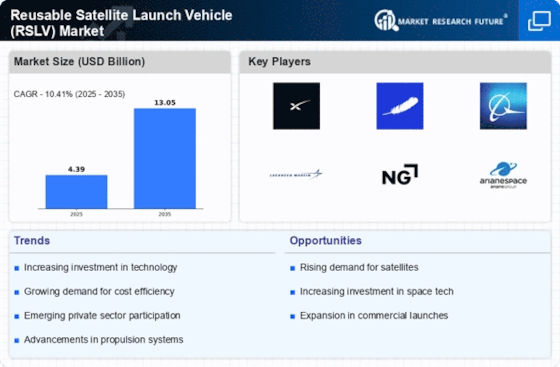
As per Market Research Future analysis, the Reusable Satellite Launch Vehicle Market (RSLV) Market Size was estimated at 4.39 USD Billion in 2024. The RSLV industry is projected to grow from 4.848 USD Billion in 2025 to 13.05 USD Billion by 2035, exhibiting a compound annual growth rate (CAGR) of 10.41% during the forecast period 2025 - 2035

Key Market Trends & Highlights

The Reusable Satellite Launch Vehicle Market (RSLV) market is poised for substantial growth driven by technological advancements and increased private sector participation.

  • North America remains the largest market for RSLVs, driven by robust government support and investment.
  • The Asia-Pacific region is emerging as the fastest-growing market, fueled by rising demand for satellite services.
  • The Low Earth Orbit segment dominates the market, while the Geosynchronous Transfer Orbit segment is experiencing rapid growth.
  • Cost efficiency in launch operations and a heightened focus on sustainability are key drivers propelling the RSLV market forward.

Market Size & Forecast

2024 Market Size 4.39 (USD Billion)
2035 Market Size 13.05 (USD Billion)
CAGR (2025 - 2035) 10.41%
Largest Regional Market Share in 2024 North America

Major Players

SpaceX (US), Blue Origin (US), Boeing (US), Lockheed Martin (US), Northrop Grumman (US), Arianespace (FR), ISRO (IN), Rocket Lab (NZ)

Market Trends

The Reusable Satellite Launch Vehicle Market (RSLV) Market is currently experiencing a transformative phase, driven by advancements in technology and increasing demand for cost-effective space access. The focus on sustainability and environmental considerations is reshaping the landscape, as stakeholders seek to minimize waste and enhance the efficiency of launch operations. This market appears to be characterized by a growing interest from both governmental and private entities, which are investing in innovative solutions to reduce the overall cost of satellite deployment. Furthermore, the competitive dynamics within the industry suggest a potential for collaboration among various players, fostering an environment conducive to rapid technological advancements. In addition, the Reusable Satellite Launch Vehicle Market (RSLV) Market is likely to benefit from the expanding applications of satellite technology across diverse sectors, including telecommunications, earth observation, and scientific research. As the global appetite for satellite-based services continues to rise, the demand for reliable and efficient launch systems is expected to increase correspondingly. This trend indicates a promising future for the RSLV sector, as it aligns with broader trends in space exploration and commercial satellite operations, potentially leading to a more interconnected and technologically advanced world.

Technological Advancements

The Reusable Satellite Launch Vehicle Market (RSLV) Market is witnessing rapid technological innovations that enhance launch efficiency and reduce costs. Developments in materials science, propulsion systems, and automation are contributing to more reliable and reusable launch vehicles.

Increased Private Sector Participation

There is a noticeable rise in private companies entering the Reusable Satellite Launch Vehicle Market (RSLV) Market, driven by the potential for profit and innovation. This influx of new players is fostering competition and accelerating advancements in launch technologies.

Sustainability Initiatives

The emphasis on sustainability is becoming a central theme in the Reusable Satellite Launch Vehicle Market (RSLV) Market. Companies are increasingly focusing on eco-friendly practices, aiming to minimize environmental impact while maximizing operational efficiency.

Reusable Satellite Launch Vehicle Market Market Drivers

Government Support and Investment

The Reusable Satellite Launch Vehicle Market (RSLV) Market benefits significantly from government support and investment initiatives. Various nations are recognizing the strategic importance of space capabilities and are investing in RSLV technologies to enhance their national security and economic competitiveness. For instance, government funding for space programs has seen a marked increase, with some countries allocating billions to develop indigenous RSLV capabilities. This financial backing not only accelerates technological advancements but also encourages private sector collaboration, thereby fostering innovation within the RSLV market. As governments continue to prioritize space exploration and satellite deployment, the RSLV market is poised for substantial growth.

Increased Focus on Sustainability

The Reusable Satellite Launch Vehicle Market (RSLV) Market is increasingly aligning with sustainability goals as environmental concerns gain prominence. The shift towards reusable launch systems is seen as a crucial step in reducing the carbon footprint associated with space launches. RSLVs are designed to minimize waste and optimize resource utilization, which resonates with global sustainability initiatives. Market participants are actively exploring eco-friendly propulsion systems and practices to further enhance their environmental credentials. This focus on sustainability is likely to attract environmentally conscious investors and customers, thereby expanding the RSLV market as it aligns with broader efforts to promote sustainable practices in the aerospace sector.

Cost Efficiency in Launch Operations

The Reusable Satellite Launch Vehicle Market (RSLV) Market is experiencing a notable shift towards cost efficiency. The ability to reuse launch vehicles significantly reduces the cost per launch, which is a critical factor for both governmental and commercial entities. Reports indicate that reusability can lower launch costs by up to 30%, making space access more affordable. This economic advantage is particularly appealing to small satellite operators and emerging space companies, who are increasingly entering the market. As the demand for satellite deployment rises, the emphasis on cost-effective solutions is likely to drive the RSLV market forward, fostering a competitive landscape where affordability becomes a key differentiator.

Growing Demand for Satellite Services

The Reusable Satellite Launch Vehicle Market (RSLV) Market is propelled by the escalating demand for satellite services across various sectors. With the proliferation of satellite applications in telecommunications, Earth observation, and global internet coverage, the need for reliable and frequent launches is paramount. Market data suggests that the satellite services sector is projected to grow at a compound annual growth rate of approximately 5% over the next decade. This growth necessitates a robust launch infrastructure, where RSLVs play a pivotal role in meeting the increasing launch frequency and payload capacity requirements. Consequently, the RSLV market is likely to expand in response to this burgeoning demand.

Technological Innovations in Launch Systems

The Reusable Satellite Launch Vehicle Market (RSLV) Market is characterized by rapid technological innovations that enhance launch systems' efficiency and reliability. Advancements in materials science, propulsion technologies, and autonomous flight systems are transforming the capabilities of RSLVs. For example, the integration of advanced composite materials has improved vehicle durability while reducing weight, which is crucial for maximizing payload capacity. Furthermore, innovations in reusable rocket engines are enabling multiple flights with minimal refurbishment. These technological strides not only improve operational efficiency but also attract investment and interest from various stakeholders, thereby propelling the RSLV market forward.

Market Segment Insights

By Orbit Type: Low Earth Orbit (Largest) vs. Geosynchronous Transfer Orbit (Fastest-Growing)

<p>The Reusable Satellite Launch Vehicle (RSLV) market is notably segmented by orbit type, with Low Earth Orbit (LEO) holding the largest market share. This segment's popularity stems from its suitability for a wide range of applications, including Earth observation, telecommunications, and space science. In comparison, the Geosynchronous Transfer Orbit (GTO) segment, while smaller in current share, is emerging rapidly due to increased demand for satellite communications and advanced positioning technologies. The collective participation of emerging companies is also enhancing the competitive landscape within this segment.</p>

<p>Orbit Type: LEO (Dominant) vs. GTO (Emerging)</p>

<p>Low Earth Orbit (LEO) remains the dominant segment in the RSLV market, characterized by its accessible altitude and reduced launch costs, making it an attractive option for both governmental and commercial missions. Many satellites in this orbit benefit from lower latency and greater data transfer rates, catering to industries such as broadband and mobile communications. In contrast, Geosynchronous Transfer Orbit (GTO) is considered an emerging segment, gaining traction due to its critical role in deploying satellites that require stable communication links. This segment is driven by the increasing launch frequency of large communication satellites, which are essential for the growing demand for high-speed internet and global connectivity.</p>

By Payload: Up to 5,000 Kg (Largest) vs. Over 10,000 Kg (Fastest-Growing)

<p>In the Reusable Satellite Launch Vehicle (RSLV) market, the payload segment is primarily dominated by the category of payloads weighing up to 5,000 Kg. This segment holds a significant portion of the market share due to its widespread application in deploying <a href="https://www.marketresearchfuture.com/reports/small-satellite-market-6007" target="_blank" title="small satellite">small satellites</a>, where various industries are highly active. On the other hand, the segment for payloads over 10,000 Kg is emerging as a fast-growing category, driven by increased interest in larger geostationary satellites and the expanding needs of governmental and commercial space missions.</p>

<p>Payload Capacity: Up to 5,000 Kg (Dominant) vs. Over 10,000 Kg (Emerging)</p>

<p>The payload capacity segment of Reusable Satellite Launch Vehicles is characterized by its distinct categories of payloads. The 'Up to 5,000 Kg' segment is dominant in the RSLV landscape, primarily catering to small satellite launch requirements. This category benefits from a well-established market with a reliable customer base, including commercial satellite operators, research institutions, and emerging aerospace startups. Conversely, the 'Over 10,000 Kg' segment is gaining traction as more enterprises seek to launch larger, more complex satellites into orbit. This expanding focus on heavy payloads is attributed to the rising demand for advanced telecommunications services, climate monitoring systems, and defense applications, marking it as an emerging field within the RSLV market.</p>

Get more detailed insights about Reusable Satellite Launch Vehicle (RSLV) Market Research Report Information - Global Forecast to 20232

Regional Insights

North America : Innovation and Leadership Hub

North America is the largest market for Reusable Satellite Launch Vehicles (RSLVs), holding approximately 60% of the global market share. The region's growth is driven by significant investments in space technology, increasing demand for satellite launches, and supportive government policies. The U.S. government has been actively promoting commercial space initiatives, which further catalyze market expansion. Leading the charge are key players like SpaceX, Blue Origin, and Boeing, which are at the forefront of RSLV technology. The competitive landscape is characterized by rapid innovation and collaboration between private companies and government agencies. The presence of established aerospace giants and emerging startups fosters a dynamic environment for RSLV advancements.

Europe : Strategic Growth and Collaboration

Europe is the second-largest market for Reusable Satellite Launch Vehicles (RSLVs), accounting for around 25% of the global market share. The region benefits from strong governmental support and collaborative projects among European Space Agency (ESA) member states. Regulatory frameworks are evolving to encourage private sector participation, which is crucial for market growth. Countries like France and Germany are leading the charge, with Arianespace and other companies pushing the boundaries of RSLV technology. The competitive landscape is marked by partnerships between established aerospace firms and innovative startups, enhancing Europe's position in The Reusable Satellite Launch Vehicle Market (RSLV). The focus on sustainability and cost-effectiveness is driving further advancements in this sector.

Asia-Pacific : Rapidly Growing Space Economy

Asia-Pacific is witnessing rapid growth in the Reusable Satellite Launch Vehicle Market (RSLV) market, driven by increasing satellite deployment and government initiatives. The region holds about 10% of the global market share, with countries like India and Japan leading the way. The Indian Space Research Organisation (ISRO) is making significant strides in RSLV technology, supported by favorable policies and investments. The competitive landscape is evolving, with emerging players like Rocket Lab and established firms like ISRO competing for market share. The region's focus on enhancing satellite capabilities and reducing launch costs is propelling the RSLV market forward. As demand for satellite services grows, Asia-Pacific is poised for substantial advancements in RSLV technology.

Middle East and Africa : Emerging Market Opportunities

The Middle East and Africa region is gradually emerging in the Reusable Satellite Launch Vehicle Market (RSLV) market, currently holding about 5% of the global market share. The growth is fueled by increasing investments in space technology and a rising number of satellite launches. Countries like the UAE are leading initiatives to develop their space capabilities, supported by government funding and international partnerships. The competitive landscape is still developing, with a focus on collaboration between local and international players. The presence of companies like Arianespace and emerging startups indicates a growing interest in RSLV technology. As the region continues to invest in its space sector, significant opportunities for growth and innovation are anticipated.

Key Players and Competitive Insights

Aerostructures

Key Companies in the Reusable Satellite Launch Vehicle Market include

Industry Developments

For Instance, January 2023 56 Starlink satellites were launched by Falcon 9 of SpaceX to low-Earth orbit, at the Cape Canaveral Space Force Stations, from Space Launch Complex 40, Florida, being the ninth launch and landing for this Falcon 9 first-stage booster.

For Instance, January 2022 The India Space Research Organization (ISRO) informed that it is working on a technology that will allow a GSLV MK-III rocket to land vertically and recover the first and second stages. This will eventually help the space agency to reutilize GSLV MK-III, thus saving money.

For Instance, May 2021 A contract was signed by Sener Aero special with Thales Alenia Space Italia for the development of a reusable unmanned orbital spacecraft, which is the continuation of the Intermediate Experimental Vehicles (IXV)

Future Outlook

Reusable Satellite Launch Vehicle Market Future Outlook

The Reusable <a href="https://www.marketresearchfuture.com/reports/satellite-market-8025" target="_blank" title="satellite">Satellite</a> Launch Vehicle Market is projected to grow at a 10.41% CAGR from 2025 to 2035, driven by technological advancements, increasing satellite demand, and cost reduction strategies.

New opportunities lie in:

  • Development of hybrid propulsion systems for enhanced efficiency.
  • Expansion of launch service partnerships with emerging space nations.
  • Investment in reusable launch infrastructure to reduce operational costs.

By 2035, the RSLV market is expected to be robust, driven by innovation and strategic partnerships.

Market Segmentation

Reusable Satellite Launch Vehicle Market Payload Outlook

  • Up to 5,000 Kg
  • 5,000 to 10,000 Kg
  • Over 10,000 Kg

Reusable Satellite Launch Vehicle Market Orbit Type Outlook

  • Low Earth Orbit
  • Geosynchronous Transfer Orbit
  • Others

Report Scope

MARKET SIZE 2024 4.39(USD Billion)
MARKET SIZE 2025 4.848(USD Billion)
MARKET SIZE 2035 13.05(USD Billion)
COMPOUND ANNUAL GROWTH RATE (CAGR) 10.41% (2025 - 2035)
REPORT COVERAGE Revenue Forecast, Competitive Landscape, Growth Factors, and Trends
BASE YEAR 2024
Market Forecast Period 2025 - 2035
Historical Data 2019 - 2024
Market Forecast Units USD Billion
Key Companies Profiled SpaceX (US), Blue Origin (US), Boeing (US), Lockheed Martin (US), Northrop Grumman (US), Arianespace (FR), ISRO (IN), Rocket Lab (NZ)
Segments Covered Orbit Type, Payload, Region
Key Market Opportunities Advancements in propulsion technology enhance cost-efficiency in the Reusable Satellite Launch Vehicle (RSLV) Market.
Key Market Dynamics Technological advancements and regulatory shifts drive competition and innovation in the Reusable Satellite Launch Vehicle market.
Countries Covered North America, Europe, APAC, South America, MEA

FAQs

What is the current valuation of the Reusable Satellite Launch Vehicle (RSLV) market?

<p>As of 2024, the RSLV market was valued at 4.39 USD Billion.</p>

What is the projected market size for the RSLV market by 2035?

<p>The RSLV market is projected to reach 13.05 USD Billion by 2035.</p>

What is the expected CAGR for the RSLV market during the forecast period 2025 - 2035?

<p>The expected CAGR for the RSLV market during 2025 - 2035 is 10.41%.</p>

Which companies are considered key players in the RSLV market?

<p>Key players in the RSLV market include SpaceX, Blue Origin, Boeing, Lockheed Martin, Northrop Grumman, Arianespace, ISRO, and Rocket Lab.</p>

What are the primary segments of the RSLV market based on orbit type?

<p>The primary segments based on orbit type include Low Earth Orbit, Geosynchronous Transfer Orbit, and Others.</p>

What were the valuation ranges for the Low Earth Orbit segment in 2024?

<p>In 2024, the valuation range for the Low Earth Orbit segment was between 1.75 and 5.25 USD Billion.</p>

How does the payload capacity segment categorize the RSLV market?

The payload capacity segment categorizes the RSLV market into three groups: Up to 5,000 Kg, 5,000 to 10,000 Kg, and Over 10,000 Kg.

What was the valuation range for the Over 10,000 Kg payload segment in 2024?

The valuation range for the Over 10,000 Kg payload segment in 2024 was between 1.14 and 3.3 USD Billion.

What trends are expected to influence the RSLV market from 2025 to 2035?

Trends influencing the RSLV market from 2025 to 2035 may include advancements in reusable technology and increasing demand for satellite launches.

How does the RSLV market's growth compare to other aerospace sectors?

The RSLV market's growth, with a projected CAGR of 10.41%, suggests a robust expansion compared to other aerospace sectors.

  1. SECTION I: EXECUTIVE SUMMARY AND KEY HIGHLIGHTS
    1. | 1.1 EXECUTIVE SUMMARY
    2. | | 1.1.1 Market Overview
    3. | | 1.1.2 Key Findings
    4. | | 1.1.3 Market Segmentation
    5. | | 1.1.4 Competitive Landscape
    6. | | 1.1.5 Challenges and Opportunities
    7. | | 1.1.6 Future Outlook
  2. SECTION II: SCOPING, METHODOLOGY AND MARKET STRUCTURE
    1. | 2.1 MARKET INTRODUCTION
    2. | | 2.1.1 Definition
    3. | | 2.1.2 Scope of the study
    4. | | | 2.1.2.1 Research Objective
    5. | | | 2.1.2.2 Assumption
    6. | | | 2.1.2.3 Limitations
    7. | 2.2 RESEARCH METHODOLOGY
    8. | | 2.2.1 Overview
    9. | | 2.2.2 Data Mining
    10. | | 2.2.3 Secondary Research
    11. | | 2.2.4 Primary Research
    12. | | | 2.2.4.1 Primary Interviews and Information Gathering Process
    13. | | | 2.2.4.2 Breakdown of Primary Respondents
    14. | | 2.2.5 Forecasting Model
    15. | | 2.2.6 Market Size Estimation
    16. | | | 2.2.6.1 Bottom-Up Approach
    17. | | | 2.2.6.2 Top-Down Approach
    18. | | 2.2.7 Data Triangulation
    19. | | 2.2.8 Validation
  3. SECTION III: QUALITATIVE ANALYSIS
    1. | 3.1 MARKET DYNAMICS
    2. | | 3.1.1 Overview
    3. | | 3.1.2 Drivers
    4. | | 3.1.3 Restraints
    5. | | 3.1.4 Opportunities
    6. | 3.2 MARKET FACTOR ANALYSIS
    7. | | 3.2.1 Value chain Analysis
    8. | | 3.2.2 Porter's Five Forces Analysis
    9. | | | 3.2.2.1 Bargaining Power of Suppliers
    10. | | | 3.2.2.2 Bargaining Power of Buyers
    11. | | | 3.2.2.3 Threat of New Entrants
    12. | | | 3.2.2.4 Threat of Substitutes
    13. | | | 3.2.2.5 Intensity of Rivalry
    14. | | 3.2.3 COVID-19 Impact Analysis
    15. | | | 3.2.3.1 Market Impact Analysis
    16. | | | 3.2.3.2 Regional Impact
    17. | | | 3.2.3.3 Opportunity and Threat Analysis
  4. SECTION IV: QUANTITATIVE ANALYSIS
    1. | 4.1 Aerospace & Defense, BY Orbit Type (USD Billion)
    2. | | 4.1.1 Low Earth Orbit
    3. | | 4.1.2 Geosynchronous Transfer Orbit
    4. | | 4.1.3 Others
    5. | 4.2 Aerospace & Defense, BY Payload (USD Billion)
    6. | | 4.2.1 Up to 5,000 Kg
    7. | | 4.2.2 5,000 to 10,000 Kg
    8. | | 4.2.3 Over 10,000 Kg
    9. | 4.3 Aerospace & Defense, BY Region (USD Billion)
    10. | | 4.3.1 North America
    11. | | | 4.3.1.1 US
    12. | | | 4.3.1.2 Canada
    13. | | 4.3.2 Europe
    14. | | | 4.3.2.1 Germany
    15. | | | 4.3.2.2 UK
    16. | | | 4.3.2.3 France
    17. | | | 4.3.2.4 Russia
    18. | | | 4.3.2.5 Italy
    19. | | | 4.3.2.6 Spain
    20. | | | 4.3.2.7 Rest of Europe
    21. | | 4.3.3 APAC
    22. | | | 4.3.3.1 China
    23. | | | 4.3.3.2 India
    24. | | | 4.3.3.3 Japan
    25. | | | 4.3.3.4 South Korea
    26. | | | 4.3.3.5 Malaysia
    27. | | | 4.3.3.6 Thailand
    28. | | | 4.3.3.7 Indonesia
    29. | | | 4.3.3.8 Rest of APAC
    30. | | 4.3.4 South America
    31. | | | 4.3.4.1 Brazil
    32. | | | 4.3.4.2 Mexico
    33. | | | 4.3.4.3 Argentina
    34. | | | 4.3.4.4 Rest of South America
    35. | | 4.3.5 MEA
    36. | | | 4.3.5.1 GCC Countries
    37. | | | 4.3.5.2 South Africa
    38. | | | 4.3.5.3 Rest of MEA
  5. SECTION V: COMPETITIVE ANALYSIS
    1. | 5.1 Competitive Landscape
    2. | | 5.1.1 Overview
    3. | | 5.1.2 Competitive Analysis
    4. | | 5.1.3 Market share Analysis
    5. | | 5.1.4 Major Growth Strategy in the Aerospace & Defense
    6. | | 5.1.5 Competitive Benchmarking
    7. | | 5.1.6 Leading Players in Terms of Number of Developments in the Aerospace & Defense
    8. | | 5.1.7 Key developments and growth strategies
    9. | | | 5.1.7.1 New Product Launch/Service Deployment
    10. | | | 5.1.7.2 Merger & Acquisitions
    11. | | | 5.1.7.3 Joint Ventures
    12. | | 5.1.8 Major Players Financial Matrix
    13. | | | 5.1.8.1 Sales and Operating Income
    14. | | | 5.1.8.2 Major Players R&D Expenditure. 2023
    15. | 5.2 Company Profiles
    16. | | 5.2.1 SpaceX (US)
    17. | | | 5.2.1.1 Financial Overview
    18. | | | 5.2.1.2 Products Offered
    19. | | | 5.2.1.3 Key Developments
    20. | | | 5.2.1.4 SWOT Analysis
    21. | | | 5.2.1.5 Key Strategies
    22. | | 5.2.2 Blue Origin (US)
    23. | | | 5.2.2.1 Financial Overview
    24. | | | 5.2.2.2 Products Offered
    25. | | | 5.2.2.3 Key Developments
    26. | | | 5.2.2.4 SWOT Analysis
    27. | | | 5.2.2.5 Key Strategies
    28. | | 5.2.3 Boeing (US)
    29. | | | 5.2.3.1 Financial Overview
    30. | | | 5.2.3.2 Products Offered
    31. | | | 5.2.3.3 Key Developments
    32. | | | 5.2.3.4 SWOT Analysis
    33. | | | 5.2.3.5 Key Strategies
    34. | | 5.2.4 Lockheed Martin (US)
    35. | | | 5.2.4.1 Financial Overview
    36. | | | 5.2.4.2 Products Offered
    37. | | | 5.2.4.3 Key Developments
    38. | | | 5.2.4.4 SWOT Analysis
    39. | | | 5.2.4.5 Key Strategies
    40. | | 5.2.5 Northrop Grumman (US)
    41. | | | 5.2.5.1 Financial Overview
    42. | | | 5.2.5.2 Products Offered
    43. | | | 5.2.5.3 Key Developments
    44. | | | 5.2.5.4 SWOT Analysis
    45. | | | 5.2.5.5 Key Strategies
    46. | | 5.2.6 Arianespace (FR)
    47. | | | 5.2.6.1 Financial Overview
    48. | | | 5.2.6.2 Products Offered
    49. | | | 5.2.6.3 Key Developments
    50. | | | 5.2.6.4 SWOT Analysis
    51. | | | 5.2.6.5 Key Strategies
    52. | | 5.2.7 ISRO (IN)
    53. | | | 5.2.7.1 Financial Overview
    54. | | | 5.2.7.2 Products Offered
    55. | | | 5.2.7.3 Key Developments
    56. | | | 5.2.7.4 SWOT Analysis
    57. | | | 5.2.7.5 Key Strategies
    58. | | 5.2.8 Rocket Lab (NZ)
    59. | | | 5.2.8.1 Financial Overview
    60. | | | 5.2.8.2 Products Offered
    61. | | | 5.2.8.3 Key Developments
    62. | | | 5.2.8.4 SWOT Analysis
    63. | | | 5.2.8.5 Key Strategies
    64. | 5.3 Appendix
    65. | | 5.3.1 References
    66. | | 5.3.2 Related Reports
  6. LIST OF FIGURES
    1. | 6.1 MARKET SYNOPSIS
    2. | 6.2 NORTH AMERICA MARKET ANALYSIS
    3. | 6.3 US MARKET ANALYSIS BY ORBIT TYPE
    4. | 6.4 US MARKET ANALYSIS BY PAYLOAD
    5. | 6.5 CANADA MARKET ANALYSIS BY ORBIT TYPE
    6. | 6.6 CANADA MARKET ANALYSIS BY PAYLOAD
    7. | 6.7 EUROPE MARKET ANALYSIS
    8. | 6.8 GERMANY MARKET ANALYSIS BY ORBIT TYPE
    9. | 6.9 GERMANY MARKET ANALYSIS BY PAYLOAD
    10. | 6.10 UK MARKET ANALYSIS BY ORBIT TYPE
    11. | 6.11 UK MARKET ANALYSIS BY PAYLOAD
    12. | 6.12 FRANCE MARKET ANALYSIS BY ORBIT TYPE
    13. | 6.13 FRANCE MARKET ANALYSIS BY PAYLOAD
    14. | 6.14 RUSSIA MARKET ANALYSIS BY ORBIT TYPE
    15. | 6.15 RUSSIA MARKET ANALYSIS BY PAYLOAD
    16. | 6.16 ITALY MARKET ANALYSIS BY ORBIT TYPE
    17. | 6.17 ITALY MARKET ANALYSIS BY PAYLOAD
    18. | 6.18 SPAIN MARKET ANALYSIS BY ORBIT TYPE
    19. | 6.19 SPAIN MARKET ANALYSIS BY PAYLOAD
    20. | 6.20 REST OF EUROPE MARKET ANALYSIS BY ORBIT TYPE
    21. | 6.21 REST OF EUROPE MARKET ANALYSIS BY PAYLOAD
    22. | 6.22 APAC MARKET ANALYSIS
    23. | 6.23 CHINA MARKET ANALYSIS BY ORBIT TYPE
    24. | 6.24 CHINA MARKET ANALYSIS BY PAYLOAD
    25. | 6.25 INDIA MARKET ANALYSIS BY ORBIT TYPE
    26. | 6.26 INDIA MARKET ANALYSIS BY PAYLOAD
    27. | 6.27 JAPAN MARKET ANALYSIS BY ORBIT TYPE
    28. | 6.28 JAPAN MARKET ANALYSIS BY PAYLOAD
    29. | 6.29 SOUTH KOREA MARKET ANALYSIS BY ORBIT TYPE
    30. | 6.30 SOUTH KOREA MARKET ANALYSIS BY PAYLOAD
    31. | 6.31 MALAYSIA MARKET ANALYSIS BY ORBIT TYPE
    32. | 6.32 MALAYSIA MARKET ANALYSIS BY PAYLOAD
    33. | 6.33 THAILAND MARKET ANALYSIS BY ORBIT TYPE
    34. | 6.34 THAILAND MARKET ANALYSIS BY PAYLOAD
    35. | 6.35 INDONESIA MARKET ANALYSIS BY ORBIT TYPE
    36. | 6.36 INDONESIA MARKET ANALYSIS BY PAYLOAD
    37. | 6.37 REST OF APAC MARKET ANALYSIS BY ORBIT TYPE
    38. | 6.38 REST OF APAC MARKET ANALYSIS BY PAYLOAD
    39. | 6.39 SOUTH AMERICA MARKET ANALYSIS
    40. | 6.40 BRAZIL MARKET ANALYSIS BY ORBIT TYPE
    41. | 6.41 BRAZIL MARKET ANALYSIS BY PAYLOAD
    42. | 6.42 MEXICO MARKET ANALYSIS BY ORBIT TYPE
    43. | 6.43 MEXICO MARKET ANALYSIS BY PAYLOAD
    44. | 6.44 ARGENTINA MARKET ANALYSIS BY ORBIT TYPE
    45. | 6.45 ARGENTINA MARKET ANALYSIS BY PAYLOAD
    46. | 6.46 REST OF SOUTH AMERICA MARKET ANALYSIS BY ORBIT TYPE
    47. | 6.47 REST OF SOUTH AMERICA MARKET ANALYSIS BY PAYLOAD
    48. | 6.48 MEA MARKET ANALYSIS
    49. | 6.49 GCC COUNTRIES MARKET ANALYSIS BY ORBIT TYPE
    50. | 6.50 GCC COUNTRIES MARKET ANALYSIS BY PAYLOAD
    51. | 6.51 SOUTH AFRICA MARKET ANALYSIS BY ORBIT TYPE
    52. | 6.52 SOUTH AFRICA MARKET ANALYSIS BY PAYLOAD
    53. | 6.53 REST OF MEA MARKET ANALYSIS BY ORBIT TYPE
    54. | 6.54 REST OF MEA MARKET ANALYSIS BY PAYLOAD
    55. | 6.55 KEY BUYING CRITERIA OF AEROSPACE & DEFENSE
    56. | 6.56 RESEARCH PROCESS OF MRFR
    57. | 6.57 DRO ANALYSIS OF AEROSPACE & DEFENSE
    58. | 6.58 DRIVERS IMPACT ANALYSIS: AEROSPACE & DEFENSE
    59. | 6.59 RESTRAINTS IMPACT ANALYSIS: AEROSPACE & DEFENSE
    60. | 6.60 SUPPLY / VALUE CHAIN: AEROSPACE & DEFENSE
    61. | 6.61 AEROSPACE & DEFENSE, BY ORBIT TYPE, 2024 (% SHARE)
    62. | 6.62 AEROSPACE & DEFENSE, BY ORBIT TYPE, 2024 TO 2035 (USD Billion)
    63. | 6.63 AEROSPACE & DEFENSE, BY PAYLOAD, 2024 (% SHARE)
    64. | 6.64 AEROSPACE & DEFENSE, BY PAYLOAD, 2024 TO 2035 (USD Billion)
    65. | 6.65 BENCHMARKING OF MAJOR COMPETITORS
  7. LIST OF TABLES
    1. | 7.1 LIST OF ASSUMPTIONS
    2. | | 7.1.1
    3. | 7.2 North America MARKET SIZE ESTIMATES; FORECAST
    4. | | 7.2.1 BY ORBIT TYPE, 2025-2035 (USD Billion)
    5. | | 7.2.2 BY PAYLOAD, 2025-2035 (USD Billion)
    6. | 7.3 US MARKET SIZE ESTIMATES; FORECAST
    7. | | 7.3.1 BY ORBIT TYPE, 2025-2035 (USD Billion)
    8. | | 7.3.2 BY PAYLOAD, 2025-2035 (USD Billion)
    9. | 7.4 Canada MARKET SIZE ESTIMATES; FORECAST
    10. | | 7.4.1 BY ORBIT TYPE, 2025-2035 (USD Billion)
    11. | | 7.4.2 BY PAYLOAD, 2025-2035 (USD Billion)
    12. | 7.5 Europe MARKET SIZE ESTIMATES; FORECAST
    13. | | 7.5.1 BY ORBIT TYPE, 2025-2035 (USD Billion)
    14. | | 7.5.2 BY PAYLOAD, 2025-2035 (USD Billion)
    15. | 7.6 Germany MARKET SIZE ESTIMATES; FORECAST
    16. | | 7.6.1 BY ORBIT TYPE, 2025-2035 (USD Billion)
    17. | | 7.6.2 BY PAYLOAD, 2025-2035 (USD Billion)
    18. | 7.7 UK MARKET SIZE ESTIMATES; FORECAST
    19. | | 7.7.1 BY ORBIT TYPE, 2025-2035 (USD Billion)
    20. | | 7.7.2 BY PAYLOAD, 2025-2035 (USD Billion)
    21. | 7.8 France MARKET SIZE ESTIMATES; FORECAST
    22. | | 7.8.1 BY ORBIT TYPE, 2025-2035 (USD Billion)
    23. | | 7.8.2 BY PAYLOAD, 2025-2035 (USD Billion)
    24. | 7.9 Russia MARKET SIZE ESTIMATES; FORECAST
    25. | | 7.9.1 BY ORBIT TYPE, 2025-2035 (USD Billion)
    26. | | 7.9.2 BY PAYLOAD, 2025-2035 (USD Billion)
    27. | 7.10 Italy MARKET SIZE ESTIMATES; FORECAST
    28. | | 7.10.1 BY ORBIT TYPE, 2025-2035 (USD Billion)
    29. | | 7.10.2 BY PAYLOAD, 2025-2035 (USD Billion)
    30. | 7.11 Spain MARKET SIZE ESTIMATES; FORECAST
    31. | | 7.11.1 BY ORBIT TYPE, 2025-2035 (USD Billion)
    32. | | 7.11.2 BY PAYLOAD, 2025-2035 (USD Billion)
    33. | 7.12 Rest of Europe MARKET SIZE ESTIMATES; FORECAST
    34. | | 7.12.1 BY ORBIT TYPE, 2025-2035 (USD Billion)
    35. | | 7.12.2 BY PAYLOAD, 2025-2035 (USD Billion)
    36. | 7.13 APAC MARKET SIZE ESTIMATES; FORECAST
    37. | | 7.13.1 BY ORBIT TYPE, 2025-2035 (USD Billion)
    38. | | 7.13.2 BY PAYLOAD, 2025-2035 (USD Billion)
    39. | 7.14 China MARKET SIZE ESTIMATES; FORECAST
    40. | | 7.14.1 BY ORBIT TYPE, 2025-2035 (USD Billion)
    41. | | 7.14.2 BY PAYLOAD, 2025-2035 (USD Billion)
    42. | 7.15 India MARKET SIZE ESTIMATES; FORECAST
    43. | | 7.15.1 BY ORBIT TYPE, 2025-2035 (USD Billion)
    44. | | 7.15.2 BY PAYLOAD, 2025-2035 (USD Billion)
    45. | 7.16 Japan MARKET SIZE ESTIMATES; FORECAST
    46. | | 7.16.1 BY ORBIT TYPE, 2025-2035 (USD Billion)
    47. | | 7.16.2 BY PAYLOAD, 2025-2035 (USD Billion)
    48. | 7.17 South Korea MARKET SIZE ESTIMATES; FORECAST
    49. | | 7.17.1 BY ORBIT TYPE, 2025-2035 (USD Billion)
    50. | | 7.17.2 BY PAYLOAD, 2025-2035 (USD Billion)
    51. | 7.18 Malaysia MARKET SIZE ESTIMATES; FORECAST
    52. | | 7.18.1 BY ORBIT TYPE, 2025-2035 (USD Billion)
    53. | | 7.18.2 BY PAYLOAD, 2025-2035 (USD Billion)
    54. | 7.19 Thailand MARKET SIZE ESTIMATES; FORECAST
    55. | | 7.19.1 BY ORBIT TYPE, 2025-2035 (USD Billion)
    56. | | 7.19.2 BY PAYLOAD, 2025-2035 (USD Billion)
    57. | 7.20 Indonesia MARKET SIZE ESTIMATES; FORECAST
    58. | | 7.20.1 BY ORBIT TYPE, 2025-2035 (USD Billion)
    59. | | 7.20.2 BY PAYLOAD, 2025-2035 (USD Billion)
    60. | 7.21 Rest of APAC MARKET SIZE ESTIMATES; FORECAST
    61. | | 7.21.1 BY ORBIT TYPE, 2025-2035 (USD Billion)
    62. | | 7.21.2 BY PAYLOAD, 2025-2035 (USD Billion)
    63. | 7.22 South America MARKET SIZE ESTIMATES; FORECAST
    64. | | 7.22.1 BY ORBIT TYPE, 2025-2035 (USD Billion)
    65. | | 7.22.2 BY PAYLOAD, 2025-2035 (USD Billion)
    66. | 7.23 Brazil MARKET SIZE ESTIMATES; FORECAST
    67. | | 7.23.1 BY ORBIT TYPE, 2025-2035 (USD Billion)
    68. | | 7.23.2 BY PAYLOAD, 2025-2035 (USD Billion)
    69. | 7.24 Mexico MARKET SIZE ESTIMATES; FORECAST
    70. | | 7.24.1 BY ORBIT TYPE, 2025-2035 (USD Billion)
    71. | | 7.24.2 BY PAYLOAD, 2025-2035 (USD Billion)
    72. | 7.25 Argentina MARKET SIZE ESTIMATES; FORECAST
    73. | | 7.25.1 BY ORBIT TYPE, 2025-2035 (USD Billion)
    74. | | 7.25.2 BY PAYLOAD, 2025-2035 (USD Billion)
    75. | 7.26 Rest of South America MARKET SIZE ESTIMATES; FORECAST
    76. | | 7.26.1 BY ORBIT TYPE, 2025-2035 (USD Billion)
    77. | | 7.26.2 BY PAYLOAD, 2025-2035 (USD Billion)
    78. | 7.27 MEA MARKET SIZE ESTIMATES; FORECAST
    79. | | 7.27.1 BY ORBIT TYPE, 2025-2035 (USD Billion)
    80. | | 7.27.2 BY PAYLOAD, 2025-2035 (USD Billion)
    81. | 7.28 GCC Countries MARKET SIZE ESTIMATES; FORECAST
    82. | | 7.28.1 BY ORBIT TYPE, 2025-2035 (USD Billion)
    83. | | 7.28.2 BY PAYLOAD, 2025-2035 (USD Billion)
    84. | 7.29 South Africa MARKET SIZE ESTIMATES; FORECAST
    85. | | 7.29.1 BY ORBIT TYPE, 2025-2035 (USD Billion)
    86. | | 7.29.2 BY PAYLOAD, 2025-2035 (USD Billion)
    87. | 7.30 Rest of MEA MARKET SIZE ESTIMATES; FORECAST
    88. | | 7.30.1 BY ORBIT TYPE, 2025-2035 (USD Billion)
    89. | | 7.30.2 BY PAYLOAD, 2025-2035 (USD Billion)
    90. | 7.31 PRODUCT LAUNCH/PRODUCT DEVELOPMENT/APPROVAL
    91. | | 7.31.1
    92. | 7.32 ACQUISITION/PARTNERSHIP
    93. | | 7.32.1

Aerospace & Defense Market Segmentation

Aerospace & Defense By Orbit Type (USD Billion, 2025-2035)

  • Low Earth Orbit
  • Geosynchronous Transfer Orbit
  • Others

Aerospace & Defense By Payload (USD Billion, 2025-2035)

  • Up to 5,000 Kg
  • 5,000 to 10,000 Kg
  • Over 10,000 Kg
Infographic

Free Sample Request

Kindly complete the form below to receive a free sample of this Report

Get Free Sample

Customer Strories

Compare Licence

×
Features License Type
Single User Multiuser License Enterprise User
Price $4,950 $5,950 $7,250
Maximum User Access Limit 1 User Upto 10 Users Unrestricted Access Throughout the Organization
Free Customization
Direct Access to Analyst
Deliverable Format
Platform Access
Discount on Next Purchase 10% 15% 15%
Printable Versions