×
Request Free Sample ×

Kindly complete the form below to receive a free sample of this Report

* Please use a valid business email

Leading companies partner with us for data-driven Insights

clients tt-cursor
Hero Background
English
Chinese
French
Japanese
Korean
German
Spanish

Residential Water Softener Consumables Market Size

ID: MRFR/Equip/9873-CR
113 Pages
Garvit Vyas
March 2023

Residential Water Softener Consumables Market Research Report Information By Type {Resin (Cation, Anion, Catalytic Exchange Media, Others), Salt (Rock Salt, Solar Salt, Evaporated Salt), Cleaners (Liquid, Powder), Filters (Backwashing Carbon Filters, Iron & Sulfur Removal Filters, Others)}, And By Region (North America, Europe, Asia-Pacific, Middle East & Africa, And South America) - Forecast Till 2035

Share:
Download PDF ×

We do not share your information with anyone. However, we may send you emails based on your report interest from time to time. You may contact us at any time to opt-out.

Residential Water Softener Consumables Market Infographic
Purchase Options

Residential Water Softener Consumables Size

Residential Water Softener Consumables Market Growth Projections and Opportunities

The global residential water softening consumables market is set to experience significant growth, driven by several factors such as increasing awareness about water-borne diseases, ongoing smart city projects in developing countries, and a rise in water contamination concerns. The market is categorized based on type and region, with various segments contributing to its overall dynamics.

Looking at the types of residential water softening consumables, the market is divided into four main categories: resin, salt, cleaners, and filters. Among these, the filters segment took the lead in 2020, holding the largest market share at 35.45%, equivalent to a market value of USD 1,074.5 million. This segment is expected to maintain robust growth, projecting a Compound Annual Growth Rate (CAGR) of 6.16% during the forecast period.

Regionally, Asia-Pacific emerged as the dominant player in the residential water softening consumables market in 2020, capturing a substantial market share of 35.82% and reaching a market value of USD 1,085.6 million. The Asia-Pacific region is anticipated to sustain this momentum, with a projected CAGR of 6.97% over the forecast period.

The escalating awareness surrounding water-borne diseases has become a significant catalyst for the market's growth trajectory. Consumers are increasingly recognizing the importance of ensuring their household water is free from contaminants that could pose health risks. Water softening consumables, particularly filters, play a crucial role in enhancing water quality and safeguarding individuals from water-related illnesses.

In parallel, the ongoing smart city projects in developing countries contribute to the market's expansion. As cities evolve into smart ecosystems, there is a heightened focus on ensuring the delivery of clean and safe water to residents. Residential water softening consumables become integral components of these initiatives, contributing to improved water quality within urban areas.

The surge in water contamination concerns further propels the demand for residential water softening consumables. Pollution, industrial discharges, and environmental factors contribute to the deterioration of water quality. Consumers are increasingly turning to water softening solutions to address issues related to hard water and contaminants, ensuring a healthier and safer water supply for their households.

Delving into the specific types of residential water softening consumables, filters emerge as the leading segment. Filters play a vital role in removing impurities, particles, and contaminants from water, providing an effective solution for enhancing water quality. The dominance of the filters segment is reflected in its substantial market share and the projected robust CAGR, indicating sustained demand for these consumables.

Geographically, Asia-Pacific stands out as a key player in the residential water softening consumables market. The region's significant market share and projected CAGR underscore its role as a growth engine for the industry. Factors such as population growth, urbanization, and rising disposable incomes contribute to the increasing demand for water softening consumables in Asia-Pacific.

As the market continues to evolve, manufacturers and stakeholders in the residential water softening consumables industry are poised to capitalize on these growth drivers. Innovation in product development, increased marketing efforts to raise awareness, and strategic partnerships with stakeholders involved in smart city projects can position companies for success in this dynamic market.

The global residential water softening consumables market is on a growth trajectory fueled by heightened awareness, smart city initiatives, and concerns about water contamination. The market's segmentation by type and region provides valuable insights into the specific dynamics driving its expansion. As the demand for water softening consumables, especially filters, continues to rise, the industry is presented with opportunities to address evolving consumer needs and contribute to ensuring access to clean and safe water for households worldwide.
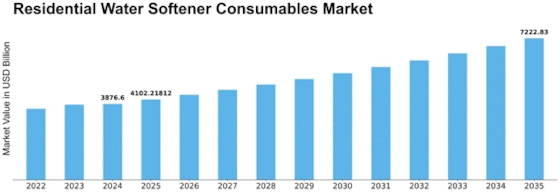

Residential Water Softener Consumables Market Size Graph
Author
Garvit Vyas
Analyst

Explore the profile of Garvit Vyas, one of our esteemed authors at Market Research Future, and access their expert research contributions in the field of market research and industry analysis

Leave a Comment

FAQs

What is the current valuation of the Residential Water Softener Consumables Market?

<p>As of 2024, the market valuation stands at 3876.6 USD Billion.</p>

What is the projected market size for the Residential Water Softener Consumables Market by 2035?

<p>The market is expected to reach a valuation of 7222.83 USD Billion by 2035.</p>

What is the expected CAGR for the Residential Water Softener Consumables Market during the forecast period?

<p>The market is projected to grow at a CAGR of 5.82% from 2025 to 2035.</p>

Which companies are considered key players in the Residential Water Softener Consumables Market?

<p>Key players include Culligan International, Pentair plc, Kinetico Inc., and EcoWater Systems LLC.</p>

What are the main segments within the Residential Water Softener Consumables Market?

<p>The main segments include Resin, Salt, Cleaners, and Filters.</p>

What was the valuation of the Salt segment in the Residential Water Softener Consumables Market?

<p>The Salt segment was valued between 2500.0 and 4500.0 USD Billion.</p>

How does the valuation of the Resin segment compare to other segments?

The Resin segment had a valuation ranging from 600.0 to 1100.0 USD Billion, indicating a smaller market size compared to Salt.

What is the valuation range for the Cleaners segment in the market?

The Cleaners segment is valued between 600.0 and 1000.0 USD Billion.

What is the projected growth trend for the Filters segment by 2035?

The Filters segment, valued between 176.6 and 1222.83 USD Billion, is likely to experience growth in line with overall market trends.

How do the key players influence the Residential Water Softener Consumables Market?

Key players like A. O. Smith Corporation and Water-Right Inc. are likely to drive innovation and competition within the market.

Market Summary

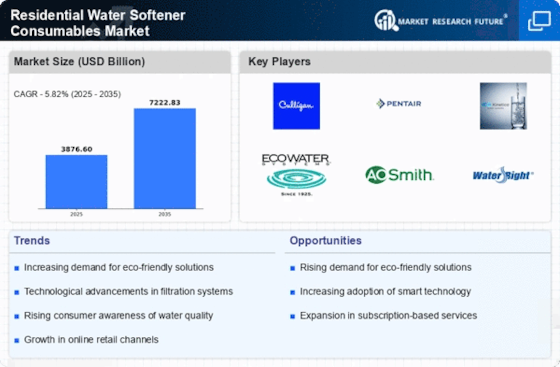
As per Market Research Future analysis, the Residential Water Softener Consumables Market was estimated at 3876.6 USD Billion in 2024. The Residential Water Softener Consumables industry is projected to grow from 4102.23 USD Billion in 2025 to 7222.83 USD Billion by 2035, exhibiting a compound annual growth rate (CAGR) of 5.82% during the forecast period 2025 - 2035

Key Market Trends & Highlights

The Residential Water Softener Consumables Market is experiencing a shift towards sustainability and technological advancements.

  • The market is increasingly driven by a focus on sustainability and health awareness among consumers. North America remains the largest market, while Asia-Pacific is emerging as the fastest-growing region in this sector. Resin continues to dominate the market, whereas the salt segment is witnessing rapid growth due to rising consumer interest. Key drivers include rising water quality concerns and increased appliance longevity, which are shaping consumer preferences.

Market Size & Forecast

2024 Market Size 3876.6 (USD Billion)
2035 Market Size 7222.83 (USD Billion)
CAGR (2025 - 2035) 5.82%
Largest Regional Market Share in 2024 North America

Major Players

Culligan International (US), <a href="https://www.pentair.com/en-us/water-softening-filtration/water-softening.html">Pentair </a>plc (US), Kinetico Inc. (US), EcoWater Systems LLC (US), A. O. Smith Corporation (US), Water-Right Inc. (US), Harvey Water Softeners (GB), <a href="https://www.bwt.com/en/shop/Domestic-Water/Water-Softener/">BWT AG </a>(AT), Fleck (US)

Market Trends

The Residential Water Softener Consumables Market is currently experiencing a notable evolution, driven by increasing consumer awareness regarding water quality and its impact on health. As households become more conscious of the adverse effects of hard water, the demand for water softening solutions is on the rise. This trend is further fueled by the growing prevalence of water-related issues, such as scale buildup in plumbing and appliances, which can lead to costly repairs and inefficiencies. Consequently, manufacturers are innovating to provide more effective and sustainable consumables, enhancing the overall user experience. Moreover, the market landscape is shifting towards eco-friendly products, as consumers increasingly prioritize sustainability in their purchasing decisions. This shift is prompting companies to develop biodegradable and less harmful alternatives to traditional salt-based softeners. The integration of smart technology into water softening systems also appears to be gaining traction, offering users enhanced control and monitoring capabilities. As the Residential Water Softener Consumables Market continues to evolve, it is likely to reflect broader trends in environmental consciousness and technological advancement, shaping the future of water treatment solutions.

Sustainability Focus

There is a growing emphasis on eco-friendly products within the Residential Water Softener Consumables Market. Consumers are increasingly seeking sustainable alternatives to traditional water softening solutions, prompting manufacturers to innovate and develop biodegradable and less harmful options.

Technological Integration

The incorporation of smart technology into water softening systems is becoming more prevalent. This trend allows users to monitor and control their systems remotely, enhancing convenience and efficiency in managing water quality.

Health Awareness

Heightened awareness regarding the health implications of hard water is driving demand for water softening solutions. Consumers are more informed about the potential negative effects of hard water on skin, hair, and household appliances, leading to increased interest in effective water treatment options.

Residential Water Softener Consumables Market Market Drivers

Increased Appliance Longevity

The desire for longer-lasting household appliances is significantly influencing the Residential Water Softener Consumables Market. Hard water can cause mineral deposits that reduce the efficiency and lifespan of appliances such as dishwashers and commercial water heaters. By utilizing water softeners, homeowners can mitigate these issues, leading to a growing demand for consumables that support these systems. The market data indicates that households using water softeners can extend the life of their appliances by up to 30%. This potential for cost savings and enhanced appliance performance is likely to drive further investment in the Residential Water Softener Consumables Market.

Rising Water Quality Concerns

The increasing awareness regarding water quality is a pivotal driver for the Residential Water Softener Consumables Market. Consumers are becoming more cognizant of the adverse effects of hard water, which can lead to scale buildup in plumbing and appliances. This awareness is prompting homeowners to invest in water softening solutions, thereby driving demand for consumables such as salt and resin. According to recent data, the market for water softeners is projected to grow at a compound annual growth rate of approximately 8% over the next few years. As consumers prioritize the quality of their water supply, the Residential Water Softener Consumables Market is likely to experience sustained growth.

Growing DIY Home Improvement Trends

The rising trend of do-it-yourself home improvement projects is significantly impacting the Residential Water Softener Consumables Market. Homeowners are increasingly taking on projects that enhance their living spaces, including the installation of water softening systems. This trend is driving demand for consumables, as DIY enthusiasts seek to maintain and replenish their systems. Market data indicates that the DIY home improvement sector has seen a surge, with a notable increase in sales of water softening products. As more consumers engage in DIY projects, the Residential Water Softener Consumables Market is poised for growth, reflecting the changing dynamics of consumer behavior.

Regulatory Standards and Guidelines

Government regulations regarding water quality and safety are emerging as a significant driver for the Residential Water Softener Consumables Market. Many regions are implementing stricter guidelines to ensure that water supplied to households meets certain quality standards. This regulatory environment is encouraging homeowners to adopt water softening solutions to comply with these standards. As a result, the demand for consumables such as salt and filters is expected to rise. The Residential Water Softener Consumables Market may see a boost as consumers seek to adhere to these regulations, thereby enhancing the overall market landscape.

Technological Advancements in Water Softening

Innovations in water softening technology are playing a crucial role in shaping the Residential Water Softener Consumables Market. The introduction of smart water softeners, which can monitor water usage and optimize salt consumption, is attracting consumers who seek efficiency and convenience. These advancements not only improve the performance of water softeners but also reduce the frequency of consumable replacement. Market analysis suggests that the integration of technology in water softening systems could lead to a 15% increase in the adoption rate of these products. Consequently, the Residential Water Softener Consumables Market is likely to benefit from this trend.

Market Segment Insights

By Type: Resin (Largest) vs. Salt (Fastest-Growing)

<p>In the Residential Water Softener Consumables Market, the main types include resin, salt, cleaners, and filters. Among these, resin holds the largest market share due to its essential role in the ion-exchange process that removes hardness from water. Salt also retains a significant share, providing crucial regeneration support to resin, while cleaners and filters play supportive roles in ensuring optimal system performance and longevity. Although they are less prominent in terms of market share, they are vital for the overall maintenance of water softeners.</p>

<p>Resin (Dominant) vs. Salt (Emerging)</p>

<p>Resin is a dominant player in the Residential Water Softener Consumables Market. It is primarily utilized for ion-exchange processes to effectively remove calcium and magnesium ions from hard water, thus preventing scale buildup. In contrast, salt, while considered an emerging segment, is gaining traction due to its critical function in regenerating the resin beads, increasing the efficiency and lifespan of the water softeners. Both resins and salts are supported by increasing consumer awareness about water quality and the benefits of water softening systems. The rising trends towards sustainable practices also favor these consumables, making them vital components of residential water treatment solutions.</p>

Get more detailed insights about Residential Water Softener Consumables Market Research Report—Global Forecast till 2035

Regional Insights

North America : Market Leader in Water Solutions

North America is the largest market for residential water softener consumables, holding approximately 45% of the global market share. The region's growth is driven by increasing water quality concerns, rising disposable incomes, and stringent regulations on water treatment. The demand for efficient water softening solutions is further propelled by the growing awareness of the benefits of soft water in household applications. The United States is the leading country in this market, with key players like Culligan International, Pentair plc, and Kinetico Inc. dominating the landscape. The competitive environment is characterized by innovation and a focus on sustainable solutions. The presence of established brands and a robust distribution network further enhance market penetration, making North America a focal point for water softener consumables.

Europe : Emerging Market with Regulations

Europe is witnessing significant growth in the residential water softener consumables market, accounting for about 30% of the global share. The region's expansion is driven by increasing environmental regulations and a growing emphasis on sustainable water management practices. Countries are implementing stricter guidelines for water quality, which boosts the demand for effective water softening solutions in households. Germany and the United Kingdom are the leading markets in Europe, with companies like Harvey Water Softeners and BWT AG playing pivotal roles. The competitive landscape is marked by innovation and a shift towards eco-friendly products. The presence of established brands and a focus on customer education regarding water quality further enhance market dynamics, positioning Europe as a key player in the global market.

Asia-Pacific : Rapid Growth in Emerging Economies

Asia-Pacific is rapidly emerging as a significant player in the residential water softener consumables market, holding approximately 20% of the global market share. The region's growth is fueled by urbanization, increasing disposable incomes, and a rising awareness of water quality issues. Countries are investing in infrastructure to improve water treatment facilities, which is expected to drive demand for water softening solutions in households. China and India are the leading countries in this region, with a growing number of local and international players entering the market. The competitive landscape is evolving, with companies focusing on affordability and accessibility of water softening products. The presence of key players like EcoWater Systems LLC and A. O. Smith Corporation is enhancing market dynamics, making Asia-Pacific a promising region for future growth.

Middle East and Africa : Untapped Potential in Water Solutions

The Middle East and Africa region is gradually emerging in the residential water softener consumables market, accounting for about 5% of the global share. The growth is driven by increasing water scarcity issues and a rising demand for clean water solutions. Governments are recognizing the importance of water treatment technologies, leading to investments in infrastructure and regulatory frameworks that support the adoption of water softening solutions. Countries like South Africa and the UAE are at the forefront of this market, with a growing number of local and international companies entering the space. The competitive landscape is characterized by a mix of established brands and new entrants, focusing on innovative solutions tailored to regional needs. The presence of key players is expected to drive market growth, making the Middle East and Africa a region of untapped potential.

Key Players and Competitive Insights

Major market players are spending a lot of money on R&D to increase their product lines, which will help the Residential Water Softener Consumables Market grow even more. Market participants are also taking a range of strategic initiatives to grow their worldwide footprint, including new product launches, contractual agreements, mergers and acquisitions, increased investments, and collaboration with other organizations. Competitors in the Residential Water Softener Consumables industry must offer cost-effective items to expand and survive in an increasingly competitive and rising market environment.
One of the primary business strategies adopted by manufacturers in the global Residential Water Softener Consumables industry to benefit clients and expand the Residential Water Softener Consumables Market sector is to manufacture locally to reduce operating costs. In recent years, Residential Water Softener Consumables Market have provided medicine with some of the most significant benefits.
Also, Pentair is primarily engaged in offering smart water solutions worldwide.
In February Pentair Plc announced that it completed the acquisition of Aquion (US), a diverse line of water conditioner, water filter, drinking-water purifier, ozone & ultraviolet disinfection system, reverse osmosis system, and acid neutralizer provider operating in the residential and commercial water treatment industry..

Key Companies in the Residential Water Softener Consumables Market include

Industry Developments

March 2018 Unilever signed an agreement with Alibaba (China) Co., Ltd. in Hangzhou to collaborate in the Chinese and worldwide markets. As per the agreement, Truliva (renewed brand name for Qinyuan), the water purification brand under Unilever, was the core brand to land the projects in China for the first time. 

The Truliva brand partnered with Alibaba to jointly explore the cooperation possibilities in the new retail business development, new technology application, and new business model exploration areas and provide safe drinking solutions to local consumers by sustainably developing the water purification market.

March 2018 Culligan acquired Paragon Water Systems (US) with an aim to focus on developing water filtration systems and expanding into new geographies

March 2017 Pentair Plc announced its collaboration with the University of California to deliver innovative water and wastewater solutions for municipal, industrial, residential, and commercial applications.

Future Outlook

Residential Water Softener Consumables Market Future Outlook

The Residential Water Softener Consumables Market is projected to grow at a 5.82% CAGR from 2025 to 2035, driven by increasing water quality concerns and technological advancements.

New opportunities lie in:

  • <p>Development of eco-friendly salt alternatives for water softeners. Expansion into smart home integration for automated water softening solutions. Launch of subscription-based consumable delivery services for convenience.</p>

By 2035, the market is expected to be robust, reflecting sustained growth and innovation.

Market Segmentation

Residential Water Softener Consumables Market Type Outlook

  • Resin
  • Salt
  • Cleaners
  • Filters

Report Scope

MARKET SIZE 2024 3876.6(USD Billion)
MARKET SIZE 2025 4102.23(USD Billion)
MARKET SIZE 2035 7222.83(USD Billion)
COMPOUND ANNUAL GROWTH RATE (CAGR) 5.82% (2025 - 2035)
REPORT COVERAGE Revenue Forecast, Competitive Landscape, Growth Factors, and Trends
BASE YEAR 2024
Market Forecast Period 2025 - 2035
Historical Data 2019 - 2024
Market Forecast Units USD Billion
Key Companies Profiled Culligan International (US), Pentair plc (US), Kinetico Inc. (US), EcoWater Systems LLC (US), A. O. Smith Corporation (US), Water-Right Inc. (US), Harvey Water Softeners (GB), BWT AG (AT), Fleck (US)
Segments Covered Type {Resin, Region
Key Market Opportunities Growing demand for eco-friendly and efficient water softening solutions in the Residential Water Softener Consumables Market.
Key Market Dynamics Rising consumer awareness drives demand for eco-friendly water softener consumables amid regulatory shifts and technological advancements.
Countries Covered North America, Europe, APAC, South America, MEA

FAQs

What is the current valuation of the Residential Water Softener Consumables Market?

<p>As of 2024, the market valuation stands at 3876.6 USD Billion.</p>

What is the projected market size for the Residential Water Softener Consumables Market by 2035?

<p>The market is expected to reach a valuation of 7222.83 USD Billion by 2035.</p>

What is the expected CAGR for the Residential Water Softener Consumables Market during the forecast period?

<p>The market is projected to grow at a CAGR of 5.82% from 2025 to 2035.</p>

Which companies are considered key players in the Residential Water Softener Consumables Market?

<p>Key players include Culligan International, Pentair plc, Kinetico Inc., and EcoWater Systems LLC.</p>

What are the main segments within the Residential Water Softener Consumables Market?

<p>The main segments include Resin, Salt, Cleaners, and Filters.</p>

What was the valuation of the Salt segment in the Residential Water Softener Consumables Market?

<p>The Salt segment was valued between 2500.0 and 4500.0 USD Billion.</p>

How does the valuation of the Resin segment compare to other segments?

The Resin segment had a valuation ranging from 600.0 to 1100.0 USD Billion, indicating a smaller market size compared to Salt.

What is the valuation range for the Cleaners segment in the market?

The Cleaners segment is valued between 600.0 and 1000.0 USD Billion.

What is the projected growth trend for the Filters segment by 2035?

The Filters segment, valued between 176.6 and 1222.83 USD Billion, is likely to experience growth in line with overall market trends.

How do the key players influence the Residential Water Softener Consumables Market?

Key players like A. O. Smith Corporation and Water-Right Inc. are likely to drive innovation and competition within the market.

  1. SECTION I: EXECUTIVE SUMMARY AND KEY HIGHLIGHTS
    1. | 1.1 EXECUTIVE SUMMARY
    2. | | 1.1.1 Market Overview
    3. | | 1.1.2 Key Findings
    4. | | 1.1.3 Market Segmentation
    5. | | 1.1.4 Competitive Landscape
    6. | | 1.1.5 Challenges and Opportunities
    7. | | 1.1.6 Future Outlook
  2. SECTION II: SCOPING, METHODOLOGY AND MARKET STRUCTURE
    1. | 2.1 MARKET INTRODUCTION
    2. | | 2.1.1 Definition
    3. | | 2.1.2 Scope of the study
    4. | | | 2.1.2.1 Research Objective
    5. | | | 2.1.2.2 Assumption
    6. | | | 2.1.2.3 Limitations
    7. | 2.2 RESEARCH METHODOLOGY
    8. | | 2.2.1 Overview
    9. | | 2.2.2 Data Mining
    10. | | 2.2.3 Secondary Research
    11. | | 2.2.4 Primary Research
    12. | | | 2.2.4.1 Primary Interviews and Information Gathering Process
    13. | | | 2.2.4.2 Breakdown of Primary Respondents
    14. | | 2.2.5 Forecasting Model
    15. | | 2.2.6 Market Size Estimation
    16. | | | 2.2.6.1 Bottom-Up Approach
    17. | | | 2.2.6.2 Top-Down Approach
    18. | | 2.2.7 Data Triangulation
    19. | | 2.2.8 Validation
  3. SECTION III: QUALITATIVE ANALYSIS
    1. | 3.1 MARKET DYNAMICS
    2. | | 3.1.1 Overview
    3. | | 3.1.2 Drivers
    4. | | 3.1.3 Restraints
    5. | | 3.1.4 Opportunities
    6. | 3.2 MARKET FACTOR ANALYSIS
    7. | | 3.2.1 Value chain Analysis
    8. | | 3.2.2 Porter's Five Forces Analysis
    9. | | | 3.2.2.1 Bargaining Power of Suppliers
    10. | | | 3.2.2.2 Bargaining Power of Buyers
    11. | | | 3.2.2.3 Threat of New Entrants
    12. | | | 3.2.2.4 Threat of Substitutes
    13. | | | 3.2.2.5 Intensity of Rivalry
    14. | | 3.2.3 COVID-19 Impact Analysis
    15. | | | 3.2.3.1 Market Impact Analysis
    16. | | | 3.2.3.2 Regional Impact
    17. | | | 3.2.3.3 Opportunity and Threat Analysis
  4. SECTION IV: QUANTITATIVE ANALYSIS
    1. | 4.1 Food, Beverages & Nutrition, BY Type (USD Billion)
    2. | | 4.1.1 Resin
    3. | | 4.1.2 Salt
    4. | | 4.1.3 Cleaners
    5. | | 4.1.4 Filters
    6. | 4.2 Food, Beverages & Nutrition, BY Region (USD Billion)
    7. | | 4.2.1 North America
    8. | | | 4.2.1.1 US
    9. | | | 4.2.1.2 Canada
    10. | | 4.2.2 Europe
    11. | | | 4.2.2.1 Germany
    12. | | | 4.2.2.2 UK
    13. | | | 4.2.2.3 France
    14. | | | 4.2.2.4 Russia
    15. | | | 4.2.2.5 Italy
    16. | | | 4.2.2.6 Spain
    17. | | | 4.2.2.7 Rest of Europe
    18. | | 4.2.3 APAC
    19. | | | 4.2.3.1 China
    20. | | | 4.2.3.2 India
    21. | | | 4.2.3.3 Japan
    22. | | | 4.2.3.4 South Korea
    23. | | | 4.2.3.5 Malaysia
    24. | | | 4.2.3.6 Thailand
    25. | | | 4.2.3.7 Indonesia
    26. | | | 4.2.3.8 Rest of APAC
    27. | | 4.2.4 South America
    28. | | | 4.2.4.1 Brazil
    29. | | | 4.2.4.2 Mexico
    30. | | | 4.2.4.3 Argentina
    31. | | | 4.2.4.4 Rest of South America
    32. | | 4.2.5 MEA
    33. | | | 4.2.5.1 GCC Countries
    34. | | | 4.2.5.2 South Africa
    35. | | | 4.2.5.3 Rest of MEA
  5. SECTION V: COMPETITIVE ANALYSIS
    1. | 5.1 Competitive Landscape
    2. | | 5.1.1 Overview
    3. | | 5.1.2 Competitive Analysis
    4. | | 5.1.3 Market share Analysis
    5. | | 5.1.4 Major Growth Strategy in the Food, Beverages & Nutrition
    6. | | 5.1.5 Competitive Benchmarking
    7. | | 5.1.6 Leading Players in Terms of Number of Developments in the Food, Beverages & Nutrition
    8. | | 5.1.7 Key developments and growth strategies
    9. | | | 5.1.7.1 New Product Launch/Service Deployment
    10. | | | 5.1.7.2 Merger & Acquisitions
    11. | | | 5.1.7.3 Joint Ventures
    12. | | 5.1.8 Major Players Financial Matrix
    13. | | | 5.1.8.1 Sales and Operating Income
    14. | | | 5.1.8.2 Major Players R&D Expenditure. 2023
    15. | 5.2 Company Profiles
    16. | | 5.2.1 Culligan International (US)
    17. | | | 5.2.1.1 Financial Overview
    18. | | | 5.2.1.2 Products Offered
    19. | | | 5.2.1.3 Key Developments
    20. | | | 5.2.1.4 SWOT Analysis
    21. | | | 5.2.1.5 Key Strategies
    22. | | 5.2.2 Pentair plc (US)
    23. | | | 5.2.2.1 Financial Overview
    24. | | | 5.2.2.2 Products Offered
    25. | | | 5.2.2.3 Key Developments
    26. | | | 5.2.2.4 SWOT Analysis
    27. | | | 5.2.2.5 Key Strategies
    28. | | 5.2.3 Kinetico Inc. (US)
    29. | | | 5.2.3.1 Financial Overview
    30. | | | 5.2.3.2 Products Offered
    31. | | | 5.2.3.3 Key Developments
    32. | | | 5.2.3.4 SWOT Analysis
    33. | | | 5.2.3.5 Key Strategies
    34. | | 5.2.4 EcoWater Systems LLC (US)
    35. | | | 5.2.4.1 Financial Overview
    36. | | | 5.2.4.2 Products Offered
    37. | | | 5.2.4.3 Key Developments
    38. | | | 5.2.4.4 SWOT Analysis
    39. | | | 5.2.4.5 Key Strategies
    40. | | 5.2.5 A. O. Smith Corporation (US)
    41. | | | 5.2.5.1 Financial Overview
    42. | | | 5.2.5.2 Products Offered
    43. | | | 5.2.5.3 Key Developments
    44. | | | 5.2.5.4 SWOT Analysis
    45. | | | 5.2.5.5 Key Strategies
    46. | | 5.2.6 Water-Right Inc. (US)
    47. | | | 5.2.6.1 Financial Overview
    48. | | | 5.2.6.2 Products Offered
    49. | | | 5.2.6.3 Key Developments
    50. | | | 5.2.6.4 SWOT Analysis
    51. | | | 5.2.6.5 Key Strategies
    52. | | 5.2.7 Harvey Water Softeners (GB)
    53. | | | 5.2.7.1 Financial Overview
    54. | | | 5.2.7.2 Products Offered
    55. | | | 5.2.7.3 Key Developments
    56. | | | 5.2.7.4 SWOT Analysis
    57. | | | 5.2.7.5 Key Strategies
    58. | | 5.2.8 BWT AG (AT)
    59. | | | 5.2.8.1 Financial Overview
    60. | | | 5.2.8.2 Products Offered
    61. | | | 5.2.8.3 Key Developments
    62. | | | 5.2.8.4 SWOT Analysis
    63. | | | 5.2.8.5 Key Strategies
    64. | | 5.2.9 Fleck (US)
    65. | | | 5.2.9.1 Financial Overview
    66. | | | 5.2.9.2 Products Offered
    67. | | | 5.2.9.3 Key Developments
    68. | | | 5.2.9.4 SWOT Analysis
    69. | | | 5.2.9.5 Key Strategies
    70. | 5.3 Appendix
    71. | | 5.3.1 References
    72. | | 5.3.2 Related Reports
  6. LIST OF FIGURES
    1. | 6.1 MARKET SYNOPSIS
    2. | 6.2 NORTH AMERICA MARKET ANALYSIS
    3. | 6.3 US MARKET ANALYSIS BY TYPE
    4. | 6.4 CANADA MARKET ANALYSIS BY TYPE
    5. | 6.5 EUROPE MARKET ANALYSIS
    6. | 6.6 GERMANY MARKET ANALYSIS BY TYPE
    7. | 6.7 UK MARKET ANALYSIS BY TYPE
    8. | 6.8 FRANCE MARKET ANALYSIS BY TYPE
    9. | 6.9 RUSSIA MARKET ANALYSIS BY TYPE
    10. | 6.10 ITALY MARKET ANALYSIS BY TYPE
    11. | 6.11 SPAIN MARKET ANALYSIS BY TYPE
    12. | 6.12 REST OF EUROPE MARKET ANALYSIS BY TYPE
    13. | 6.13 APAC MARKET ANALYSIS
    14. | 6.14 CHINA MARKET ANALYSIS BY TYPE
    15. | 6.15 INDIA MARKET ANALYSIS BY TYPE
    16. | 6.16 JAPAN MARKET ANALYSIS BY TYPE
    17. | 6.17 SOUTH KOREA MARKET ANALYSIS BY TYPE
    18. | 6.18 MALAYSIA MARKET ANALYSIS BY TYPE
    19. | 6.19 THAILAND MARKET ANALYSIS BY TYPE
    20. | 6.20 INDONESIA MARKET ANALYSIS BY TYPE
    21. | 6.21 REST OF APAC MARKET ANALYSIS BY TYPE
    22. | 6.22 SOUTH AMERICA MARKET ANALYSIS
    23. | 6.23 BRAZIL MARKET ANALYSIS BY TYPE
    24. | 6.24 MEXICO MARKET ANALYSIS BY TYPE
    25. | 6.25 ARGENTINA MARKET ANALYSIS BY TYPE
    26. | 6.26 REST OF SOUTH AMERICA MARKET ANALYSIS BY TYPE
    27. | 6.27 MEA MARKET ANALYSIS
    28. | 6.28 GCC COUNTRIES MARKET ANALYSIS BY TYPE
    29. | 6.29 SOUTH AFRICA MARKET ANALYSIS BY TYPE
    30. | 6.30 REST OF MEA MARKET ANALYSIS BY TYPE
    31. | 6.31 KEY BUYING CRITERIA OF FOOD, BEVERAGES & NUTRITION
    32. | 6.32 RESEARCH PROCESS OF MRFR
    33. | 6.33 DRO ANALYSIS OF FOOD, BEVERAGES & NUTRITION
    34. | 6.34 DRIVERS IMPACT ANALYSIS: FOOD, BEVERAGES & NUTRITION
    35. | 6.35 RESTRAINTS IMPACT ANALYSIS: FOOD, BEVERAGES & NUTRITION
    36. | 6.36 SUPPLY / VALUE CHAIN: FOOD, BEVERAGES & NUTRITION
    37. | 6.37 FOOD, BEVERAGES & NUTRITION, BY TYPE, 2024 (% SHARE)
    38. | 6.38 FOOD, BEVERAGES & NUTRITION, BY TYPE, 2024 TO 2035 (USD Billion)
    39. | 6.39 BENCHMARKING OF MAJOR COMPETITORS
  7. LIST OF TABLES
    1. | 7.1 LIST OF ASSUMPTIONS
    2. | | 7.1.1
    3. | 7.2 North America MARKET SIZE ESTIMATES; FORECAST
    4. | | 7.2.1 BY TYPE, 2025-2035 (USD Billion)
    5. | 7.3 US MARKET SIZE ESTIMATES; FORECAST
    6. | | 7.3.1 BY TYPE, 2025-2035 (USD Billion)
    7. | 7.4 Canada MARKET SIZE ESTIMATES; FORECAST
    8. | | 7.4.1 BY TYPE, 2025-2035 (USD Billion)
    9. | 7.5 Europe MARKET SIZE ESTIMATES; FORECAST
    10. | | 7.5.1 BY TYPE, 2025-2035 (USD Billion)
    11. | 7.6 Germany MARKET SIZE ESTIMATES; FORECAST
    12. | | 7.6.1 BY TYPE, 2025-2035 (USD Billion)
    13. | 7.7 UK MARKET SIZE ESTIMATES; FORECAST
    14. | | 7.7.1 BY TYPE, 2025-2035 (USD Billion)
    15. | 7.8 France MARKET SIZE ESTIMATES; FORECAST
    16. | | 7.8.1 BY TYPE, 2025-2035 (USD Billion)
    17. | 7.9 Russia MARKET SIZE ESTIMATES; FORECAST
    18. | | 7.9.1 BY TYPE, 2025-2035 (USD Billion)
    19. | 7.10 Italy MARKET SIZE ESTIMATES; FORECAST
    20. | | 7.10.1 BY TYPE, 2025-2035 (USD Billion)
    21. | 7.11 Spain MARKET SIZE ESTIMATES; FORECAST
    22. | | 7.11.1 BY TYPE, 2025-2035 (USD Billion)
    23. | 7.12 Rest of Europe MARKET SIZE ESTIMATES; FORECAST
    24. | | 7.12.1 BY TYPE, 2025-2035 (USD Billion)
    25. | 7.13 APAC MARKET SIZE ESTIMATES; FORECAST
    26. | | 7.13.1 BY TYPE, 2025-2035 (USD Billion)
    27. | 7.14 China MARKET SIZE ESTIMATES; FORECAST
    28. | | 7.14.1 BY TYPE, 2025-2035 (USD Billion)
    29. | 7.15 India MARKET SIZE ESTIMATES; FORECAST
    30. | | 7.15.1 BY TYPE, 2025-2035 (USD Billion)
    31. | 7.16 Japan MARKET SIZE ESTIMATES; FORECAST
    32. | | 7.16.1 BY TYPE, 2025-2035 (USD Billion)
    33. | 7.17 South Korea MARKET SIZE ESTIMATES; FORECAST
    34. | | 7.17.1 BY TYPE, 2025-2035 (USD Billion)
    35. | 7.18 Malaysia MARKET SIZE ESTIMATES; FORECAST
    36. | | 7.18.1 BY TYPE, 2025-2035 (USD Billion)
    37. | 7.19 Thailand MARKET SIZE ESTIMATES; FORECAST
    38. | | 7.19.1 BY TYPE, 2025-2035 (USD Billion)
    39. | 7.20 Indonesia MARKET SIZE ESTIMATES; FORECAST
    40. | | 7.20.1 BY TYPE, 2025-2035 (USD Billion)
    41. | 7.21 Rest of APAC MARKET SIZE ESTIMATES; FORECAST
    42. | | 7.21.1 BY TYPE, 2025-2035 (USD Billion)
    43. | 7.22 South America MARKET SIZE ESTIMATES; FORECAST
    44. | | 7.22.1 BY TYPE, 2025-2035 (USD Billion)
    45. | 7.23 Brazil MARKET SIZE ESTIMATES; FORECAST
    46. | | 7.23.1 BY TYPE, 2025-2035 (USD Billion)
    47. | 7.24 Mexico MARKET SIZE ESTIMATES; FORECAST
    48. | | 7.24.1 BY TYPE, 2025-2035 (USD Billion)
    49. | 7.25 Argentina MARKET SIZE ESTIMATES; FORECAST
    50. | | 7.25.1 BY TYPE, 2025-2035 (USD Billion)
    51. | 7.26 Rest of South America MARKET SIZE ESTIMATES; FORECAST
    52. | | 7.26.1 BY TYPE, 2025-2035 (USD Billion)
    53. | 7.27 MEA MARKET SIZE ESTIMATES; FORECAST
    54. | | 7.27.1 BY TYPE, 2025-2035 (USD Billion)
    55. | 7.28 GCC Countries MARKET SIZE ESTIMATES; FORECAST
    56. | | 7.28.1 BY TYPE, 2025-2035 (USD Billion)
    57. | 7.29 South Africa MARKET SIZE ESTIMATES; FORECAST
    58. | | 7.29.1 BY TYPE, 2025-2035 (USD Billion)
    59. | 7.30 Rest of MEA MARKET SIZE ESTIMATES; FORECAST
    60. | | 7.30.1 BY TYPE, 2025-2035 (USD Billion)
    61. | 7.31 PRODUCT LAUNCH/PRODUCT DEVELOPMENT/APPROVAL
    62. | | 7.31.1
    63. | 7.32 ACQUISITION/PARTNERSHIP
    64. | | 7.32.1

Food, Beverages & Nutrition Market Segmentation

Food, Beverages & Nutrition By Type (USD Billion, 2025-2035)

  • Resin
  • Salt
  • Cleaners
  • Filters
Infographic

Free Sample Request

Kindly complete the form below to receive a free sample of this Report

Get Free Sample

Customer Strories

Compare Licence

×
Features License Type
Single User Multiuser License Enterprise User
Price $4,950 $5,950 $7,250
Maximum User Access Limit 1 User Upto 10 Users Unrestricted Access Throughout the Organization
Free Customization
Direct Access to Analyst
Deliverable Format
Platform Access
Discount on Next Purchase 10% 15% 15%
Printable Versions