
×
Request Free Sample ×

Kindly complete the form below to receive a free sample of this Report

* Please use a valid business email

Leading companies partner with us for data-driven Insights

clients tt-cursor
Hero Background
English
Chinese
French
Japanese
Korean
German
Spanish

Residential Real Estate Market Analysis

ID: MRFR/PCM/10057-HCR
111 Pages
Snehal Singh
October 2025

Residential Real Estate Market Size, Share & Industry Analysis Research Report By Property Type (Single-Family Homes, Multi-Family Homes, Condos, Townhouses, Vacation Homes), By Purchase Purpose (Primary Residence, Investment Property, Second Home, Rental Property), By Buyer Profile (First-Time Homebuyers, Move-Up Buyers, Luxury Buyers, Investors), By Financing Method (Cash Purchase, Conventional Loan, FHA Loan, VA Loan), and By Regional : Global Opportunity Analysis and Industry Forecast, 2025 - 2035

Share:
Download PDF ×

We do not share your information with anyone. However, we may send you emails based on your report interest from time to time. You may contact us at any time to opt-out.

Residential Real Estate Market Infographic
×
Residential Real Estate Market Infographic Full View
Purchase Options

Market Analysis

In-depth Analysis of Residential Real Estate Market Industry Landscape

The market dynamics of the residential real estate sector are shaped by a myriad of factors that influence both supply and demand in the housing market. Residential real estate involves the buying, selling, and renting of homes, apartments, and other dwellings, making it a critical component of the broader real estate industry. Market dynamics in this sector are characterized by factors such as economic conditions, demographic trends, interest rates, government policies, and consumer preferences.

Economic conditions play a fundamental role in determining the dynamics of the residential real estate market. Factors such as employment rates, income levels, and overall economic growth impact the purchasing power of potential homebuyers. During periods of economic expansion, with rising incomes and low unemployment, there tends to be increased demand for residential properties. Conversely, economic downturns may lead to decreased consumer confidence and a slowdown in the housing market.

Demographic trends are significant drivers shaping the dynamic nature of the residential real estate market. Population growth, generational shifts, and changes in household structures influence the demand for housing. For example, the preferences of millennials, who represent a substantial portion of homebuyers, may differ from those of previous generations, impacting the types of properties in demand. As urbanization and population migration occur, these demographic shifts contribute to the evolving landscape of the residential real estate market.

Interest rates are crucial factors influencing the market dynamics of residential real estate. Changes in mortgage rates directly affect the affordability of homes for potential buyers. Lower interest rates typically stimulate demand as borrowing costs decrease, making homeownership more accessible. Conversely, higher interest rates may deter buyers and lead to a slowdown in the housing market. The fluctuation of interest rates plays a pivotal role in shaping the dynamics of home sales and prices.

Government policies and regulations significantly impact the residential real estate market dynamics. Policies related to mortgage lending, tax incentives, zoning regulations, and housing affordability initiatives can either stimulate or constrain the housing market. For example, first-time homebuyer programs or tax credits can incentivize home purchases, while stricter lending regulations may pose challenges for potential buyers. The interplay between government policies and market dynamics shapes the overall health and trajectory of the residential real estate sector.

Consumer preferences and lifestyle choices contribute to the dynamic landscape of the residential real estate market. Changes in living preferences, such as a growing interest in sustainable and smart homes, impact the types of properties in demand. Accessibility to amenities, proximity to workplaces, and neighborhood characteristics also influence purchasing decisions. As consumer expectations evolve, real estate developers and agents must adapt to meet the changing preferences within the housing market.

Competition within the market fosters innovation and efficiency in residential real estate. Real estate developers, agents, and homebuilders continuously strive to differentiate themselves by offering unique features, adopting new technologies, and providing personalized services. Collaborations between industry stakeholders, technological advancements, and sustainable building practices contribute to ongoing research and development, driving innovation and influencing the competitive landscape of the residential real estate market.

Socio-economic factors, including lifestyle changes, cultural shifts, and urbanization, contribute to the market dynamics of residential real estate. As societies evolve, so do housing preferences and demands. Urbanization trends, with more people moving to cities, impact the availability and types of housing options. Cultural shifts, such as the increasing emphasis on remote work, influence decisions related to location and property features. Economic prosperity and lifestyle changes directly influence the consumption patterns within the residential real estate market.


Author
Snehal Singh
Assistant Manager - Research

High acumen in analyzing complex macro & micro markets with more than 6 years of work experience in the field of market research. By implementing her analytical skills in forecasting and estimation into market research reports, she has expertise in Packaging, Construction, and Equipment domains. She handles a team size of 20-25 resources and ensures smooth running of the projects, associated marketing activities, and client servicing.

Leave a Comment

FAQs

What was the market size of the Residential Real Estate Market in 2024?

The Residential Real Estate Market was valued at 195.59 USD Billion in 2024.

What is the expected compound annual growth rate (CAGR) for the market from 2025 to 2035?

Residential Real Estate Market is expected to grow with a CAGR of 25.2% in the period 2025-2035

Which region dominated the Residential Real Estate Market in 2024?

In 2024, North America dominated the Residential Real Estate Market with a value of 70.0 USD Billion.

Who are the key players in the Residential Real Estate Market?

Major players in the market include Coldwell Banker, Century 21, Compass, Redfin, and Zillow Group among others.

What is the anticipated value of Condos in the market by 2035?

Condos are expected to have a market value of approximately 37.0 USD Billion by 2035.

What was the market value of Townhouses in 2024?

The market value for Townhouses in 2024 was 25.0 USD Billion.

How much is the Asia Pacific region expected to contribute to the market by 2035?

The Asia Pacific region is expected to contribute approximately 70.0 USD Billion to the market by 2035.

What growth opportunities are present in the vacation homes segment?

The vacation homes segment is expected to grow from 25.59 USD Billion in 2024 to 29.0 USD Billion by 2035.

Market Summary

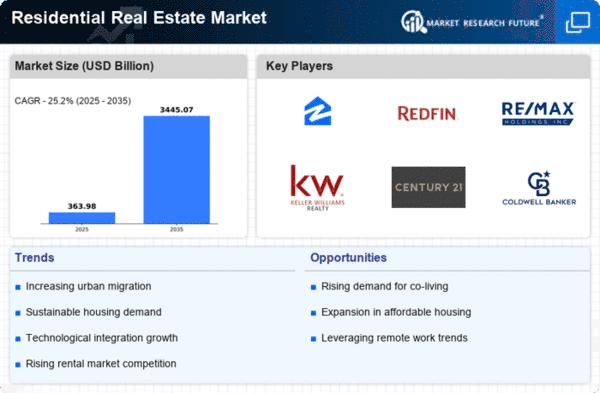
As per MRFR analysis, the Residential Real Estate Market Size was estimated at 290.72 USD Billion in 2024. The Residential Real Estate industry is projected to grow from 363.99 USD Billion in 2025 to 3445.07 USD Billion by 2035, exhibiting a compound annual growth rate (CAGR) of 25.2 during the forecast period 2025 - 2035.

Key Market Trends & Highlights

The Residential Real Estate Market is currently experiencing a dynamic shift towards sustainability and technology integration.

  • Sustainable living solutions are increasingly prioritized by homebuyers in North America, reflecting a broader trend towards eco-friendly housing. The influence of remote work continues to reshape residential preferences, particularly in suburban areas across the Asia-Pacific region. Technology integration in homes is becoming a standard expectation, enhancing convenience and energy efficiency for families and first-time homebuyers alike. Demographic shifts and urbanization trends are driving demand for single family homes in North America, while first-time homebuyers in Asia-Pacific are gravitating towards condominiums.

Market Size & Forecast

2024 Market Size 290.72 (USD Billion)
2035 Market Size 3445.07 (USD Billion)
CAGR (2025 - 2035) 25.2%
Largest Regional Market Share in 2024 North America

Major Players

<p>Zillow Group (US), Redfin Corporation (US), RE/MAX Holdings (US), Keller Williams Realty (US), Century 21 Real Estate (US), Coldwell Banker Real Estate (US), eXp Realty (US), Realty ONE Group (US)</p>

Market Trends

The Residential Real Estate Market is currently experiencing a dynamic phase characterized by evolving buyer preferences and shifting economic conditions. As urbanization continues to influence housing demand, there is a noticeable trend towards sustainable living solutions. Buyers increasingly seek properties that offer energy efficiency and environmentally friendly features, reflecting a broader societal shift towards sustainability. Additionally, the rise of remote work has altered the landscape of residential preferences, with many individuals prioritizing space and amenities that accommodate home offices. This shift may lead to increased interest in suburban and rural areas, as individuals seek larger homes with outdoor spaces. Moreover, the Residential Real Estate Market is witnessing a growing emphasis on technology integration within properties. Smart home features are becoming more prevalent, appealing to tech-savvy buyers who value convenience and security. This trend suggests that properties equipped with advanced technology may command higher interest and potentially higher prices. Furthermore, the market appears to be adapting to demographic changes, with younger generations entering the housing market and influencing design and location preferences. Overall, the current state of the Residential Real Estate Market indicates a complex interplay of factors that could shape its trajectory in the near future.

Sustainable Living Solutions

There is a marked increase in demand for properties that incorporate eco-friendly features. Buyers are gravitating towards homes that promote energy efficiency and sustainable practices, reflecting a growing awareness of environmental issues.

Remote Work Influence

The rise of remote work is reshaping residential preferences. Many individuals are now prioritizing larger living spaces that can accommodate home offices, leading to a potential shift in demand towards suburban and rural areas.

Technology Integration

Smart home technology is becoming a key selling point in the Residential Real Estate Market. Properties equipped with advanced technological features are likely to attract tech-savvy buyers, enhancing their appeal and market value.

Residential Real Estate Market Market Drivers

Demographic Shifts

Demographic shifts are a key driver of the Global Residential Real Estate Market Industry, as changes in population dynamics influence housing demand. For example, the aging population in many developed countries is leading to increased demand for retirement communities and accessible housing options. Conversely, younger generations are seeking urban living spaces that offer convenience and connectivity. These demographic trends suggest that the market must adapt to cater to diverse needs, potentially leading to a more varied housing stock. As the population continues to evolve, the Global Residential Real Estate Industry will likely experience shifts in demand patterns, necessitating strategic responses from developers and investors.

Urbanization Trends

The global residential real estate market industry is significantly influenced by urbanization trends, as more individuals migrate to urban areas in search of better employment opportunities and living conditions. As of 2024, the market is valued at approximately 195.6 USD Billion, reflecting the increasing demand for housing in metropolitan regions. This urban influx drives the need for residential properties, leading to a surge in construction and development projects. Furthermore, by 2035, the market is projected to reach 250 USD Billion, indicating a robust growth trajectory. Urbanization not only enhances property values but also stimulates local economies, thereby reinforcing the importance of the Global Residential Real Estate Market Industry.

Technological Advancements

Technological advancements play a pivotal role in shaping the Global Residential Real Estate Market Industry. Innovations such as smart home technology, virtual reality tours, and online property management systems have transformed how properties are marketed and managed. These technologies enhance the buying and renting experience for consumers, making it more efficient and user-friendly. As the industry adapts to these changes, it is likely to attract a broader demographic, including tech-savvy millennials and Gen Z buyers. The integration of technology is expected to contribute to the market's growth, supporting the projected CAGR of 2.26% from 2025 to 2035.

Economic Growth and Stability

Economic growth and stability are fundamental drivers of the Global Residential Real Estate Market Industry. A robust economy typically correlates with increased disposable income, enabling individuals to invest in residential properties. In 2024, the market is valued at 195.6 USD Billion, reflecting the positive economic conditions that support real estate investments. As economies recover and grow, the demand for housing is expected to rise, contributing to the projected market expansion to 250 USD Billion by 2035. Furthermore, stable economic conditions foster consumer confidence, which is crucial for sustaining long-term growth in the Global Residential Real Estate Market Industry.

Government Policies and Regulations

Government policies and regulations significantly impact the Global Residential Real Estate Market Industry, influencing everything from zoning laws to tax incentives for homebuyers. In many regions, favorable policies aimed at increasing homeownership rates can stimulate demand for residential properties. For instance, various countries have implemented first-time homebuyer programs, which can lead to increased sales and construction activity. Additionally, regulatory frameworks that promote sustainable building practices may also shape market dynamics. As the market evolves, these policies will likely continue to play a crucial role in determining the trajectory of the Global Residential Real Estate Market Industry.

Market Trends and Consumer Preferences

Market trends and consumer preferences are essential components of the Global Residential Real Estate Market Industry. As buyers become more environmentally conscious, there is a growing demand for sustainable and energy-efficient window homes. This shift in consumer preferences is prompting developers to incorporate green building practices and eco-friendly materials into their projects. Additionally, the rise of remote work has altered housing preferences, with many individuals seeking larger homes in suburban areas rather than urban centers. These evolving trends indicate a dynamic market landscape, where adaptability to consumer demands will be critical for success in the Global Residential Real Estate Market Industry.

Market Segment Insights

By Property Type: Single Family Home (Largest) vs. Condominium (Fastest-Growing)

<p>The Residential Real Estate Market is predominantly dominated by Single Family Homes, which cater to a wide demographic seeking privacy and space. This property type remains the most preferred choice among buyers, contributing significantly to the overall market share. On the other hand, Condominiums are rapidly gaining traction due to urbanization and lifestyle changes, attracting a younger audience looking for affordable housing options and low maintenance. Market trends indicate a shift towards more compact living solutions, with Condominiums emerging as a viable alternative to traditional housing. As more individuals prioritize proximity to urban centers, this segment is expected to experience substantial growth. Factors such as changing lifestyle preferences, increased demand for amenities, and the rise of remote working continue to drive the popularity of Condominiums in the residential real estate landscape.</p>

<p>Single Family Home (Dominant) vs. Cooperative Housing (Emerging)</p>

<p>Single Family Homes are characterized by their independence and dedicated space for families, making them the dominant choice in the residential sector. They typically come with larger living areas, yards, and are often located in suburban neighborhoods. This segment appeals to buyers investing in long-term ownership and family needs. Conversely, Cooperative Housing is an emerging segment that offers a unique ownership model, where residents purchase shares in a corporation owning the building. While Cooperative Housing presents an affordable entry into real estate in urban settings, it comes with limitations on modifications and selling freedoms. However, as younger generations show interest in shared living arrangements and community-driven developments, Cooperative Housing is set to grow.</p>

By Buyer Demographics: Families (Largest) vs. First-Time Homebuyers (Fastest-Growing)

<p>In the Residential Real Estate Market, families represent the largest buyer demographic, characterized by their substantial purchasing power and preference for suburban areas. They typically seek spacious homes with access to good schools, parks, and amenities to cater to children. Meanwhile, first-time homebuyers are an emerging force, rapidly gaining traction as they look to enter the property market. This group comprises young professionals and millennials who prioritize affordability and proximity to urban centers.</p>

<p>Families (Dominant) vs. First-Time Homebuyers (Emerging)</p>

<p>Families constitute a dominant segment in the residential real estate market, driven by the need for larger living spaces that accommodate children and provide stability. Their purchasing decisions are heavily influenced by factors like school districts and community features. In contrast, first-time homebuyers are considered an emerging segment, often motivated by the desire to build equity and invest in their futures. They face unique challenges, such as navigating financing options, but their readiness to explore diverse neighborhoods makes them a vital part of the market's evolution.</p>

By Financing Options: Conventional Loans (Largest) vs. Cash Purchases (Fastest-Growing)

<p>In the Residential Real Estate Market, the segment of Financing Options is primarily dominated by Conventional Loans, which represent the largest share. These loans appeal to a wide range of homebuyers due to their favorable interest rates and terms. Other financing options, such as FHA and VA loans, also hold significant positions, catering to first-time buyers and veterans respectively. While Cash Purchases are gaining traction, they represent a smaller segment of the overall market share compared to Conventional Loans.</p>

<p>Conventional Loans (Dominant) vs. FHA Loans (Emerging)</p>

<p>Conventional Loans remain the dominant financing option in the Residential Real Estate Market due to their flexibility and accessibility for a variety of buyers. These loans typically require higher credit scores but offer lower interest rates and terms, making them attractive to a wide demographic. In contrast, FHA Loans present an emerging option particularly appealing to first-time homebuyers and those with lower credit scores. They require a smaller down payment and allow for a more lenient qualification process, although they come with additional insurance costs that can increase monthly expenses.</p>

By Market Trends: Sustainable Housing (Largest) vs. Smart Home Technology (Fastest-Growing)

<p>Sustainable housing currently leads the market trends in the residential real estate sector, reflecting a significant shift towards eco-friendly living. Many buyers are prioritizing energy-efficient homes, which offer long-term savings on utility bills and a lower environmental impact. This trend has resulted in a growing number of builders incorporating sustainable practices into their developments, making this segment increasingly influential in shaping consumer preferences. The smart home technology segment, on the other hand, is rapidly gaining traction. With advances in IoT and automation, homes equipped with smart technology are becoming more desirable for a tech-savvy population. The integration of smart features, like energy management systems and security applications, is not only attracting younger buyers but is also marking this segment as the fastest-growing demand in the market, indicating a dynamic shift in customer expectations.</p>

<p>Sustainable Housing (Dominant) vs. Smart Home Technology (Emerging)</p>

<p>Sustainable housing is dominating the residential real estate market, characterized by homes built with eco-friendly materials and designed for energy efficiency. This segment has become synonymous with sustainable living, as buyers increasingly seek to minimize their carbon footprint. As government policies and incentives favor <a href="https://www.marketresearchfuture.com/reports/green-building-market-4982">green building</a> practices, developers are responding with innovative designs and sustainable technologies. Meanwhile, smart home technology is emerging rapidly, appealing particularly to millennials and Gen Z buyers who value convenience and connectivity. Integration of systems for security, lighting, and temperature control enhances the living experience, making homes more appealing. This trend not only enhances comfort but also provides potential energy savings, as home automation leads to smarter energy usage.</p>

By Investment Purpose: Primary Residence (Largest) vs. Rental Income (Fastest-Growing)

<p>In the Residential Real Estate Market, the investments are primarily divided among five categories: Primary Residence, Rental Income, Vacation Homes, Flipping, and Long-Term Investments. Among these, the Primary Residence holds the largest market share, as it is the most common form of real estate investment for individuals. Meanwhile, Rental Income is emerging as the fastest-growing segment, driven by the increasing demand for rental properties in urban areas and a shift towards flexible living arrangements.</p>

<p>Primary Residence (Dominant) vs. Rental Income (Emerging)</p>

<p>The Primary Residence segment remains dominant in the Residential Real Estate Market, as it encompasses a significant portion of homebuyers who prioritize stability and personal ownership. This category appeals to families and individuals seeking long-term residence, reflecting societal values of stability and permanence. On the other hand, Rental Income has seen rapid growth, notably influenced by millennials and Gen Z who prefer to rent rather than buy. This growing trend is bolstered by shifting lifestyles and urban migration, as investors capitalize on increasing rental demands, transforming this sector into an emerging powerhouse.</p>

Get more detailed insights about Residential Real Estate Market Research Report - Forecast 2035

Regional Insights

North America : Market Leader in Real Estate

North America continues to lead The Residential Real Estate, holding a significant share of 145.36 billion in 2024. Key growth drivers include a robust economy, low mortgage rates, and increasing demand for suburban living. Regulatory support, such as favorable tax policies and housing incentives, further fuels this growth. The market is also witnessing a shift towards digital platforms, enhancing accessibility for buyers and sellers alike. The competitive landscape is dominated by major players like Zillow Group, Redfin Corporation, and RE/MAX Holdings, which are leveraging technology to streamline transactions. The U.S. remains the largest market, with Canada and Mexico also contributing to growth. The presence of established real estate firms and innovative startups is reshaping the market, making it more dynamic and responsive to consumer needs.

Europe : Emerging Market Opportunities

Europe's residential real estate market is valued at 85.21 billion, driven by urbanization, increasing disposable incomes, and a growing preference for home ownership. Regulatory frameworks across various countries are evolving to support sustainable housing initiatives, which are becoming increasingly important. The market is also benefiting from low interest rates, making home financing more accessible to a broader demographic. Leading countries in this region include Germany, France, and the UK, each contributing significantly to the market's growth. The competitive landscape features both traditional real estate firms and innovative tech-driven platforms. Companies are focusing on enhancing customer experience and operational efficiency, with a notable presence of key players like Century 21 and Keller Williams Realty. The European market is poised for further expansion as it adapts to changing consumer preferences and regulatory landscapes.

Asia-Pacific : Rapid Growth and Urbanization

The Asia-Pacific residential real estate market, valued at 50.15 billion, is experiencing rapid growth driven by urbanization, rising incomes, and a burgeoning middle class. Countries like China and India are at the forefront, with increasing demand for housing and infrastructure development. Regulatory initiatives aimed at improving housing affordability and sustainability are also playing a crucial role in market expansion. The competitive landscape is characterized by a mix of local and international players, with significant contributions from companies like eXp Realty and Realty ONE Group. The region is witnessing a shift towards digital platforms, enhancing the buying and selling experience. As urban centers continue to grow, the demand for residential properties is expected to rise, making this region a focal point for real estate investment.

Middle East and Africa : Emerging Market Potential

The Middle East and Africa residential real estate market, valued at 10.0 billion, is on the rise, driven by urbanization, population growth, and increasing foreign investment. Countries like the UAE and South Africa are leading the charge, with government initiatives aimed at boosting housing supply and affordability. Regulatory frameworks are evolving to attract international investors, further stimulating market growth. The competitive landscape is diverse, with a mix of local developers and international firms. Key players are focusing on innovative housing solutions and sustainable development practices. As the region continues to develop, the demand for residential properties is expected to grow, presenting significant opportunities for investors and developers alike.

Key Players and Competitive Insights

The residential real estate market is currently characterized by a dynamic competitive landscape, driven by technological advancements, shifting consumer preferences, and evolving regulatory frameworks. Key players such as Zillow Group (US), Redfin Corporation (US), and Keller Williams Realty (US) are at the forefront of this transformation. Zillow Group (US) has strategically positioned itself as a leader in digital real estate services, focusing on enhancing user experience through innovative technology and data analytics. Redfin Corporation (US), on the other hand, emphasizes a tech-driven approach to streamline the home buying and selling process, leveraging its proprietary platform to offer lower commission rates. Keller Williams Realty (US) continues to expand its market presence through a robust agent-centric model, fostering a culture of collaboration and innovation among its agents, which collectively shapes a competitive environment that is increasingly reliant on technology and customer-centric strategies.

The business tactics employed by these companies reflect a nuanced understanding of market demands. For instance, the market structure appears moderately fragmented, with a mix of established players and emerging startups vying for market share. This fragmentation allows for localized strategies, where companies optimize their operations to cater to specific regional needs. The collective influence of these key players is significant, as they set benchmarks for service quality and technological integration, thereby shaping consumer expectations and competitive dynamics.

In November 2025, Zillow Group (US) announced a partnership with a leading AI firm to enhance its property valuation algorithms. This strategic move is likely to bolster Zillow's competitive edge by providing more accurate and timely property assessments, thereby improving user trust and engagement. Such advancements in AI integration may redefine how consumers interact with real estate platforms, positioning Zillow as a pioneer in leveraging technology for enhanced service delivery.

In October 2025, Redfin Corporation (US) launched a new feature that allows users to conduct virtual home tours using augmented reality (AR). This initiative not only caters to the growing demand for immersive experiences but also reflects Redfin's commitment to innovation in the home buying process. By integrating AR technology, Redfin is likely to attract a tech-savvy demographic, enhancing its market appeal and potentially increasing transaction volumes.

In September 2025, Keller Williams Realty (US) expanded its international footprint by entering the European market, specifically targeting the UK and Germany. This expansion signifies a strategic move to diversify its revenue streams and tap into new customer bases. By establishing a presence in these markets, Keller Williams is poised to leverage its successful agent-centric model, which may resonate well with European consumers seeking personalized real estate services.

As of December 2025, current competitive trends in the Residential Real Estate Market are heavily influenced by digitalization, sustainability, and AI integration. Strategic alliances among key players are increasingly shaping the landscape, fostering innovation and enhancing service offerings. The shift from price-based competition to a focus on technological differentiation and supply chain reliability is evident. Companies that prioritize innovation and customer experience are likely to thrive, as the market continues to evolve towards a more integrated and technology-driven future.

Key Companies in the Residential Real Estate Market include

Industry Developments

As ultra-wealthy purchasers seek tax-efficient, high-end residences, Dubai has been leading the world's super-prime residential markets since 2024, according to a June 2025 Knight Frank analysis, with 111 purchases totaling $1.9 billion in Q1. According to Savills, Dubai prime capital prices increased 6.8% in 2024 and rental values increased a record 23.5% over the same time period.

The company projects that this rise will continue through 2025 as a result of branded homes and ongoing international demand. Dubai's residential growth plan was announced in June 2025, with 73,000 new houses scheduled for 2025 and 300,000 units by 2028. Despite a minor quarterly decline, Q1 transaction volumes were up 23% year over year.

In the meanwhile, even as household disposable incomes gradually decreased in June 2025, mortgage approvals in the UK increased in May and mortgage rates plateaued, showing cautious consumer attitude in residential markets. Compass accused Zillow of using restrictive listing tactics in the residential real estate market in the United States and launched an antitrust complaint against the company on June 23, 2025.

Furthermore, even as finance flows slowed, foreign investment in housing remained a major focus of India's residential funding in H1 2025. Residential sales in Kolkata fell 10% in Q2 2025, despite a 54% rise in new supply, indicating a market in transition as it awaits macroeconomic stability.

Future Outlook

Residential Real Estate Market Future Outlook

<p>The Residential Real Estate Market is projected to grow at a 25.2% CAGR from 2024 to 2035, driven by urbanization, technological advancements, and changing consumer preferences.</p>

New opportunities lie in:

  • <p>Integration of smart home technologies in new developments.</p>
  • <p>Expansion of eco-friendly housing solutions targeting sustainability-conscious buyers.</p>
  • <p>Development of affordable housing projects in urban areas to meet rising demand.</p>

<p>By 2035, the market is expected to be robust, reflecting substantial growth and innovation.</p>

Market Segmentation

Residential Real Estate Market Market Trends Outlook

  • Sustainable Housing
  • Smart Home Technology
  • Urban Living
  • Affordable Housing
  • Luxury Real Estate

Residential Real Estate Market Property Type Outlook

  • Single Family Home
  • Condominium
  • Townhouse
  • Multi-Family Home
  • Cooperative Housing

Residential Real Estate Market Financing Options Outlook

  • Conventional Loans
  • FHA Loans
  • VA Loans
  • Cash Purchases
  • Adjustable Rate Mortgages

Residential Real Estate Market Buyer Demographics Outlook

  • First-Time Homebuyers
  • Investors
  • Retirees
  • Families
  • Young Professionals

Residential Real Estate Market Investment Purpose Outlook

  • Primary Residence
  • Rental Income
  • Vacation Home
  • Flipping
  • Long-Term Investment

Report Scope

MARKET SIZE 2024 290.72(USD Billion)
MARKET SIZE 2025 363.99(USD Billion)
MARKET SIZE 2035 3445.07(USD Billion)
COMPOUND ANNUAL GROWTH RATE (CAGR) 25.2% (2024 - 2035)
REPORT COVERAGE Revenue Forecast, Competitive Landscape, Growth Factors, and Trends
BASE YEAR 2024
Market Forecast Period 2025 - 2035
Historical Data 2019 - 2024
Market Forecast Units USD Billion
Key Companies Profiled Zillow Group (US), Redfin Corporation (US), RE/MAX Holdings (US), Keller Williams Realty (US), Century 21 Real Estate (US), Coldwell Banker Real Estate (US), eXp Realty (US), Realty ONE Group (US)
Segments Covered Property Type, Buyer Demographics, Financing Options, Market Trends, Investment Purpose
Key Market Opportunities Integration of smart home technologies enhances consumer appeal in the Residential Real Estate Market.
Key Market Dynamics Rising consumer demand for sustainable housing drives innovation and competition in the residential real estate market.

Countries Covered North America, Europe, APAC, South America, MEA

FAQs

What was the market size of the Residential Real Estate Market in 2024?

The Residential Real Estate Market was valued at 195.59 USD Billion in 2024.

What is the expected compound annual growth rate (CAGR) for the market from 2025 to 2035?

Residential Real Estate Market is expected to grow with a CAGR of 25.2% in the period 2025-2035

Which region dominated the Residential Real Estate Market in 2024?

In 2024, North America dominated the Residential Real Estate Market with a value of 70.0 USD Billion.

Who are the key players in the Residential Real Estate Market?

Major players in the market include Coldwell Banker, Century 21, Compass, Redfin, and Zillow Group among others.

What is the anticipated value of Condos in the market by 2035?

Condos are expected to have a market value of approximately 37.0 USD Billion by 2035.

What was the market value of Townhouses in 2024?

The market value for Townhouses in 2024 was 25.0 USD Billion.

How much is the Asia Pacific region expected to contribute to the market by 2035?

The Asia Pacific region is expected to contribute approximately 70.0 USD Billion to the market by 2035.

What growth opportunities are present in the vacation homes segment?

The vacation homes segment is expected to grow from 25.59 USD Billion in 2024 to 29.0 USD Billion by 2035.

  1. SECTION I: EXECUTIVE SUMMARY AND KEY HIGHLIGHTS |
    1. EXECUTIVE SUMMARY 2
  2. SECTION II: SCOPING, METHODOLOGY AND MARKET STRUCTURE |
    1. MARKET INTRODUCTION |
    2. RESEARCH METHODOLOGY 3
  3. SECTION III: QUALITATIVE ANALYSIS |
    1. MARKET DYNAMICS |
    2. MARKET FACTOR ANALYSIS 4
  4. SECTION IV: QUANTITATIVE ANALYSIS |
    1. Packaging & Transport, BY Property Type (USD Billion) |
    2. Packaging & Transport, BY Buyer Demographics (USD Billion) |
    3. Packaging & Transport, BY Financing Options (USD Billion) |
    4. Packaging & Transport, BY Market Trends (USD Billion) |
    5. Packaging & Transport, BY Investment Purpose (USD Billion) |
    6. Packaging & Transport, BY Region (USD Billion) 5
  5. SECTION V: COMPETITIVE ANALYSIS |
    1. Competitive Landscape |
    2. Company Profiles |
    3. Appendix

Residential Real Estate Market Segmentation

Market Segmentation Overview

  • Detailed segmentation data will be available in the full report
  • Comprehensive analysis by multiple parameters
  • Regional and country-level breakdowns
  • Market size forecasts by segment
Infographic

Free Sample Request

Kindly complete the form below to receive a free sample of this Report

Get Free Sample

Customer Strories

Compare Licence

×
Features License Type
Single User Multiuser License Enterprise User
Price $4,950 $5,950 $7,250
Maximum User Access Limit 1 User Upto 10 Users Unrestricted Access Throughout the Organization
Free Customization
Direct Access to Analyst
Deliverable Format
Platform Access
Discount on Next Purchase 10% 15% 15%
Printable Versions