×
Hero Background
English
Chinese
French
Japanese
Korean
German
Spanish

Reduced Sugar food beverage Market Analysis

ID: MRFR/FnB/9960-CR
188 Pages
Tejas Chaudhary
October 2023

Reduced Sugar Food & Beverages Market Research Report Information By Type (Bakery & Confectionery, Beverages, Dairy & Desserts, Snacks & Savory, Others), By Consumer Group (Gen X, Gen Z, Millennials, Boomers), By End User (Residential, Commercial), By Distribution Channel (Supermarkets & Hypermarkets, Convenience Stores, Specialty Stores, Online, Others) By Region (North America, Europe, Asia-Pacific, And Rest Of The World) - Forecast Till 2032

Share:
Download PDF ×

We do not share your information with anyone. However, we may send you emails based on your report interest from time to time. You may contact us at any time to opt-out.

Reduced Sugar food beverage Market Infographic
Purchase Options

Market Analysis

In-depth Analysis of Reduced Sugar food beverage Market Industry Landscape

The Reduced Sugar Food and Beverage Market is experiencing significant trends that mirror the changing consumer landscape and a heightened focus on health and wellness. One of the predominant trends is the increasing demand for products with reduced sugar content. As health-conscious consumers seek ways to manage their sugar intake, food and beverage manufacturers are responding by reformulating products to offer reduced sugar alternatives. This trend aligns with the global movement towards healthier lifestyles and the recognition that excessive sugar consumption is linked to various health issues, including obesity and diabetes.

The demand for reduced sugar options is driving innovation in the food and beverage industry. Manufacturers are exploring a variety of sugar-reducing ingredients and technologies to maintain the taste and quality of their products while meeting consumer expectations for lower sugar content. Natural sweeteners like stevia, monk fruit, and erythritol are gaining popularity as they provide sweetness without the calorie load associated with traditional sugars. Additionally, advancements in ingredient technology, such as the use of sugar alcohols and novel plant-based sweeteners, contribute to the development of reduced sugar formulations across various product categories.

The Reduced Sugar Food and Beverage Market is witnessing a surge in product diversification, spanning from traditionally high-sugar items like carbonated beverages and breakfast cereals to sauces, snacks, and even bakery products. This expansion reflects the industry's response to consumer demands for reduced sugar options in a wide array of everyday food and beverage choices. The shift towards offering reduced sugar alternatives is not limited to specific product categories but has become a pervasive trend across the entire spectrum of the market.

In addition to meeting consumer preferences for healthier options, the Reduced Sugar Food and Beverage Market is influenced by regulatory measures and guidelines. Governments and health organizations worldwide are implementing initiatives to address rising concerns about obesity and diet-related health issues. These regulatory interventions often include recommendations to reduce sugar content in food and beverage products. Manufacturers are proactively adjusting their formulations to comply with these regulations, contributing to the overall momentum towards reduced sugar options in the market.

The growing awareness of the impact of sugar on overall well-being is leading to increased scrutiny of product labels. Consumers are becoming more adept at reading nutritional information and actively seeking products with lower sugar content. This heightened awareness is driving the adoption of reduced sugar options as consumers make informed choices to support their health goals. Brands that transparently communicate their commitment to reduced sugar formulations are likely to gain consumer trust and loyalty in this evolving market landscape.

Sustainability is emerging as a noteworthy trend within the Reduced Sugar Food and Beverage Market. Consumers are not only concerned about their personal health but are increasingly mindful of the environmental impact of their food choices. Manufacturers are responding by incorporating sustainable sourcing practices, eco-friendly packaging, and responsible production methods into their reduced sugar product lines. This dual focus on health and sustainability resonates with a growing segment of conscious consumers who seek products that align with both personal and planetary well-being.

Author
Tejas Chaudhary
Research Analyst Level II

I have a degree in Engineering (Civil), with masters in Business Administration (Marketing). With more than 4 years of experience in market research and consulting, I am involved in end-to-end process of market research, proposals, project kickoffs and delivery. I have research knowledge and expertise in consumer goods/packaging domain. Also I have worked for various other domains like construction & equipment. Effectively managed and delivered more than 60 report studies for regional as well as global clientele.

Leave a Comment

FAQs

How much is the reduced sugar food & beverages market accounted?

The reduced sugar food & beverages market accounted for USD 58.63 billion.

What is the key driving factor for Reduced sugar food & beverages?

Rising Prevalence of Obesity

What is the growth rate of the reduced sugar food & beverages?

The growth rate of the Reduced sugar food & beverages is 7.17% CAGR.

Which region held the largest market share in the Reduced sugar food & beverages?

The Asia Pacific region held the largest market share in the reduced sugar food & beverages.

Who are the key players in the Reduced sugar food & beverages?

Bunge Limited, Cosan Limited, Südzucker AG, Jalles Machado S/A, Nestle SA (US), PepsiCo Inc. (US), Coca Cola (US), Kraft Heinz (US), Kellogg Company (US).

Market Summary

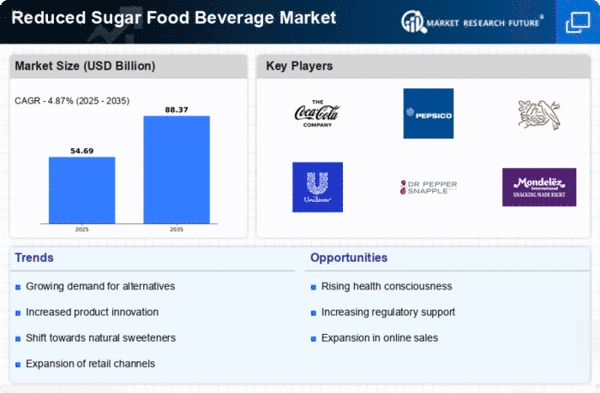
As per MRFR analysis, the Reduced Sugar Food Beverage Market Size was estimated at 52.15 USD Billion in 2024. The Reduced Sugar food beverage industry is projected to grow from 55.29 USD Billion in 2025 to 88.37 USD Billion by 2035, exhibiting a compound annual growth rate (CAGR) of 4.87 during the forecast period 2025 - 2035.

Key Market Trends & Highlights

The Reduced Sugar food beverage market is experiencing a robust shift towards health-conscious consumption patterns.

  • Health consciousness is driving a notable increase in demand for reduced sugar products, particularly in North America.
  • The beverage segment remains the largest contributor to the market, while the snacks segment is witnessing the fastest growth.
  • Natural sweeteners dominate the market, although stevia is emerging as the fastest-growing alternative.
  • Health awareness and regulatory pressures are key drivers influencing product formulation and innovation in the market.

Market Size & Forecast

2024 Market Size 52.15 (USD Billion)
2035 Market Size 88.37 (USD Billion)
CAGR (2025 - 2035) 4.87%
Largest Regional Market Share in 2024 North America

Major Players

<p>Coca-Cola (US), PepsiCo (US), Nestle (CH), Unilever (GB), Dr Pepper Snapple Group (US), Mondelez International (US), Kraft Heinz (US), Danone (FR), Reed's Inc. (US)</p>

Market Trends

The Reduced Sugar food beverage Market is currently experiencing a notable transformation, driven by evolving consumer preferences and heightened awareness regarding health and wellness. As individuals increasingly seek alternatives to traditional sugary beverages, manufacturers are responding by innovating and reformulating products to meet these demands. This shift appears to be influenced by a growing understanding of the adverse effects of excessive sugar consumption, prompting consumers to gravitate towards options that offer lower sugar content without compromising on taste. Furthermore, the market landscape is characterized by a diverse array of products, ranging from flavored waters to low-calorie sodas, which cater to a wide spectrum of dietary needs and preferences. In addition to changing consumer behavior, regulatory frameworks are also shaping the Reduced Sugar food beverage Market. Governments worldwide are implementing policies aimed at reducing sugar intake among populations, which may further encourage manufacturers to adapt their offerings. This regulatory push, combined with the increasing prevalence of health-related issues linked to high sugar consumption, suggests that the market will continue to evolve. As companies strive to balance taste, health benefits, and consumer expectations, the future of the Reduced Sugar food beverage Market appears promising, with potential for sustained growth and innovation in product development.

Health Consciousness Drives Demand

The growing awareness of health issues related to high sugar intake is significantly influencing consumer choices. Individuals are increasingly prioritizing their well-being, leading to a surge in demand for beverages with reduced sugar content. This trend reflects a broader societal shift towards healthier lifestyles, prompting manufacturers to innovate and offer products that align with these preferences.

Regulatory Influence on Product Formulation

Government initiatives aimed at curbing sugar consumption are shaping the Reduced Sugar food beverage Market. Policies such as sugar taxes and labeling requirements encourage manufacturers to reformulate their products, resulting in a wider range of reduced sugar options. This regulatory environment not only impacts product development but also enhances consumer awareness regarding sugar content.

Diverse Product Offerings

The Reduced Sugar food beverage Market is characterized by an expanding variety of products that cater to diverse consumer tastes and dietary needs. From flavored teas to sparkling waters, manufacturers are exploring innovative formulations that maintain flavor while reducing sugar levels. This diversity not only attracts health-conscious consumers but also appeals to those seeking enjoyable beverage experiences.

Reduced Sugar food beverage Market Market Drivers

Regulatory Support

Government initiatives aimed at reducing sugar intake significantly influence the Global Reduced Sugar Food and Beverages Industry. Various countries have implemented regulations and guidelines to limit sugar consumption, particularly among children. For instance, taxes on sugary drinks have been introduced in several nations, encouraging manufacturers to innovate and provide healthier alternatives. This regulatory landscape not only promotes public health but also creates a favorable environment for reduced sugar products. As a result, the market is expected to expand, potentially reaching 153.4 USD Billion by 2035, driven by compliance with these regulations and the growing consumer preference for healthier options.

Health Consciousness

The increasing awareness of health and wellness among consumers drives the Global Reduced Sugar Food and Beverages Industry. As individuals become more informed about the adverse effects of excessive sugar consumption, they actively seek alternatives that align with healthier lifestyles. This trend is particularly evident in regions like North America and Europe, where consumers are gravitating towards products labeled as low-sugar or sugar-free. The market is projected to reach 69.5 USD Billion in 2024, reflecting a growing demand for reduced sugar options. Brands are responding by reformulating existing products and introducing new ones that cater to this health-conscious demographic.

Market Growth Projections

The Global Reduced Sugar Food and Beverages Industry is projected to experience robust growth in the coming years. With a market value of 69.5 USD Billion in 2024, it is expected to reach 153.4 USD Billion by 2035. This growth trajectory indicates a compound annual growth rate of 7.46% from 2025 to 2035. Such projections reflect the increasing consumer demand for healthier food and beverage options, driven by health consciousness, regulatory support, and innovative product development. The market's expansion is likely to create opportunities for manufacturers and retailers to capitalize on the growing trend towards reduced sugar consumption.

Changing Consumer Preferences

Shifts in consumer preferences towards healthier eating habits are a significant driver of the Global Reduced Sugar Food and Beverages Industry. As more individuals prioritize nutrition and wellness, there is a marked decline in the consumption of traditional sugary products. This change is particularly pronounced among younger demographics, who are more inclined to choose reduced sugar options. Brands are responding by reformulating existing products and launching new lines that emphasize lower sugar content. This evolving landscape is expected to propel the market forward, with projections indicating a substantial increase in demand for reduced sugar products in the coming years.

Innovative Product Development

Innovation plays a crucial role in shaping the Global Reduced Sugar Food and Beverages Industry. Companies are increasingly investing in research and development to create new formulations that maintain taste while reducing sugar content. This includes the use of natural sweeteners and advanced processing techniques that enhance flavor without compromising health benefits. The introduction of innovative products, such as low-sugar snacks and beverages, caters to diverse consumer preferences and dietary needs. This trend is likely to contribute to a compound annual growth rate of 7.46% from 2025 to 2035, as brands strive to meet the evolving demands of health-conscious consumers.

Increased Availability of Products

The expansion of distribution channels and increased availability of reduced sugar products significantly impact the Global Reduced Sugar Food and Beverages Industry. Retailers are increasingly stocking a variety of low-sugar options, making them more accessible to consumers. This trend is observed in both physical stores and online platforms, where consumers can easily find and purchase reduced sugar alternatives. The growing presence of these products in mainstream retail settings enhances consumer awareness and encourages trial. As a result, the market is poised for growth, with an anticipated increase in sales as more consumers opt for reduced sugar choices.

Market Segment Insights

By Application: Beverages (Largest) vs. Snacks (Fastest-Growing)

<p>The Reduced Sugar food beverage market displays a diverse application landscape, with beverages holding the largest share. This category encompasses a wide array of drinks that appeal to health-conscious consumers. Dairy products, while significant, follow closely, contributing to the overall trend towards healthier options. Snacks and confectionery make up the remaining segments, showcasing the growing demand for reduced sugar options across various food categories. Despite being smaller, these segments are gaining traction as consumers look for healthier snack alternatives that do not compromise on taste. Growth trends in the Reduced Sugar food beverage market are predominantly driven by changing consumer preferences towards healthier lifestyles. As awareness around the adverse effects of excessive sugar intake rises, we see an increasing demand for reduced sugar alternatives across beverages, snacks, dairy, and confectionery. Innovations in product formulations and the introduction of clean label ingredients further stimulate growth in these segments. The snacks category, in particular, is emerging rapidly, appealing to on-the-go consumers looking for guilt-free indulgence.</p>

<p>Beverages: Dominant vs. Snacks: Emerging</p>

<p>In the Reduced Sugar food beverage market, beverages are recognized as the dominant segment due to their extensive variety and widespread consumer acceptance. This category includes low-sugar sodas, flavored waters, and other refreshment options that maintain great taste without high sugar content. Conversely, the snacks segment is emerging rapidly, characterized by healthier options like protein bars, baked chips, and fruit snacks. The unique selling proposition for snacks lies in convenience and guilt-free eating, capturing the interest of health-conscious consumers eager for tasty yet healthier alternatives. The market strategy for both segments is increasingly focusing on natural ingredients and innovative flavors.</p>

By Type: Natural Sweeteners (Largest) vs. Stevia (Fastest-Growing)

<p>In the Reduced Sugar food beverage market, the distribution of market share among the segment values reveals that Natural Sweeteners hold the largest portion, owing to their increasing acceptance among health-conscious consumers. They are preferred for their organic profiles and minimal processing. Following closely are Sugar Alcohols, which are popular for their low-calorie content, and Artificial Sweeteners, which cater to those seeking calorie reduction without sacrificing taste. Stevia, as an emerging player, is rapidly gaining traction due to its natural origin and zero-calorie profile, appealing especially to the health-focused demographic.</p>

<p>Natural Sweeteners (Dominant) vs. Stevia (Emerging)</p>

<p>Natural Sweeteners dominate the Reduced Sugar food beverage market due to their broad range of options like honey, agave syrup, and fruit extracts, which are often perceived as healthier alternatives. These sweeteners not only provide desirable sweetness but also carry nutritional benefits, which enhance their appeal among conscious consumers. On the other hand, Stevia, while still emerging, is witnessing a significant acceleration in adoption rates, primarily driven by its plant-derived nature and health benefits. As consumers seek more natural solutions for sweetness, Stevia's profile continues to rise, supported by its zero-calorie attribute and versatile applications across various beverage categories.</p>

By Consumer Demographics: Health-Conscious Consumers (Largest) vs. Diabetic Consumers (Fastest-Growing)

<p>In the Reduced Sugar food beverage market, Health-Conscious Consumers hold the largest market share, reflecting a strong preference for healthier lifestyle choices that align with their dietary goals. This group prioritizes products low in sugar and high in nutritional value, contributing significantly to the demand for reduced sugar beverages. In contrast, Diabetic Consumers are emerging as the fastest-growing segment, driven by an increasing awareness of sugar-related health issues and the need for suitable dietary options that cater to their condition.</p>

<p>Health-Conscious Consumers (Dominant) vs. Diabetic Consumers (Emerging)</p>

<p>Health-Conscious Consumers dominate the reduced sugar beverage segment as they actively seek products that support overall well-being and healthier living. This subgroup is typically well-informed about nutrition and closely follows dietary trends, often favoring products that incorporate natural sweeteners and superior ingredients. On the other hand, Diabetic Consumers, while currently smaller in market share, represent an emerging group increasingly influencing product development. Their growth is fueled by collaborations between health professionals and beverage manufacturers to create tailored products that help manage blood sugar levels, making them a vital segment for innovation and targeted marketing.</p>

By Distribution Channel: Supermarkets (Largest) vs. Online Retail (Fastest-Growing)

<p>In the Reduced Sugar food beverage market, supermarkets dominate the distribution channel, holding a significant share due to their extensive reach and consumer trust. They serve as the primary touchpoint for most consumers, particularly those who prefer to shop in brick-and-mortar stores. Online retail, while smaller in share, is rapidly gaining traction, driven by the convenience of home delivery and a wider selection of products compared to traditional stores.</p>

<p>Supermarkets (Dominant) vs. Online Retail (Emerging)</p>

<p>Supermarkets hold a dominant position in the Reduced Sugar food beverage market, leveraging their widespread network and established relationships with consumers. They provide accessibility and visual merchandising that encourages impulse purchases. On the other hand, online retail is emerging as a formidable challenger, capitalizing on the increasing preference for e-commerce among health-conscious consumers. The growing trend of personalized online shopping experiences, coupled with enhanced delivery options, is propelling online channels forward. Both channels cater to evolving consumer demands but differ in their strategic approaches, with supermarkets focusing on in-store experiences and online retailers emphasizing convenience and variety.</p>

Get more detailed insights about Reduced Sugar Food and Beverage Market Research Report—Global Forecast till 2035

Regional Insights

North America : Market Leader in Innovation

North America continues to lead the Reduced Sugar food beverage market, holding a significant share of 26.0% in 2024. The growth is driven by increasing health consciousness among consumers, regulatory support for healthier options, and innovative product launches. The demand for low-sugar alternatives is further fueled by rising obesity rates and diabetes prevalence, prompting manufacturers to reformulate existing products to meet consumer preferences. The competitive landscape is robust, with key players like Coca-Cola, PepsiCo, and Kraft Heinz leading the charge. The U.S. remains the largest market, supported by a diverse range of offerings from established brands and emerging startups. Companies are investing heavily in marketing and R&D to capture the growing demand for healthier beverages, ensuring a dynamic market environment.

Europe : Health-Conscious Consumer Base

Europe's Reduced Sugar food beverage market is expanding, with a market size of €15.0 billion. The growth is driven by stringent regulations on sugar content and a rising consumer preference for healthier options. Initiatives by the European Union to reduce sugar consumption are catalyzing this trend, as consumers become more aware of the health implications of high sugar intake. The market is expected to continue growing as more brands adapt to these regulatory changes and consumer demands. Leading countries in this region include Germany, France, and the UK, where major players like Nestle and Unilever are actively reformulating products. The competitive landscape is characterized by a mix of multinational corporations and local brands, all vying for market share. The presence of innovative startups focusing on natural sweeteners is also reshaping the market dynamics, making it a vibrant space for reduced sugar offerings.

Asia-Pacific : Emerging Market Potential

The Asia-Pacific region is witnessing a burgeoning interest in Reduced Sugar food beverages, with a market size of $8.0 billion. This growth is primarily driven by increasing urbanization, rising disposable incomes, and a shift towards healthier lifestyles. Consumers are becoming more health-conscious, leading to a surge in demand for low-sugar alternatives. Regulatory bodies are also encouraging manufacturers to reduce sugar content in beverages, further propelling market growth. Countries like China and Japan are at the forefront of this trend, with major players such as Coca-Cola and PepsiCo investing in product innovation. The competitive landscape is evolving, with both international and local brands competing to capture the growing health-conscious consumer base. The presence of traditional beverages is also being challenged by the influx of modern, reduced sugar options, making this a dynamic market.

Middle East and Africa : Untapped Market Opportunities

The Middle East and Africa region represents an emerging market for Reduced Sugar food beverages, with a market size of $3.15 billion. The growth is slower compared to other regions, primarily due to varying consumer awareness and economic factors. However, there is a growing trend towards healthier lifestyles, driven by increasing urbanization and changing dietary habits. Regulatory initiatives aimed at reducing sugar consumption are also beginning to take shape, which could catalyze market growth in the coming years. Countries like South Africa and the UAE are leading the charge, with local and international brands exploring opportunities in this space. The competitive landscape is still developing, with key players like Danone and Unilever looking to expand their presence. As consumer awareness increases, the market is expected to evolve, presenting opportunities for innovative products that cater to health-conscious consumers.

Key Players and Competitive Insights

The Reduced Sugar food beverage Market is currently characterized by a dynamic competitive landscape, driven by increasing consumer demand for healthier options and a growing awareness of the adverse effects of excessive sugar consumption. Major players such as Coca-Cola (US), PepsiCo (US), and Nestle (CH) are strategically positioning themselves through innovation and product reformulation to capture market share. Coca-Cola (US) has focused on diversifying its product portfolio with low-sugar and no-sugar alternatives, while PepsiCo (US) emphasizes sustainability in its operations, aligning with consumer preferences for environmentally friendly products. Nestle (CH) has adopted a strategy of regional expansion, particularly in emerging markets, to leverage the rising health consciousness among consumers, thereby shaping a competitive environment that prioritizes health and wellness.

Key business tactics within the Reduced Sugar food beverage Market include localizing manufacturing and optimizing supply chains to enhance efficiency and responsiveness to consumer trends. The market structure appears moderately fragmented, with several key players exerting influence over their respective segments. This fragmentation allows for niche brands to emerge, catering to specific consumer preferences, while larger corporations leverage their scale to dominate the market.

In November 2025, Coca-Cola (US) announced the launch of a new line of reduced-sugar beverages aimed at the health-conscious demographic, which is expected to significantly enhance its market presence. This strategic move underscores Coca-Cola's commitment to innovation and its responsiveness to shifting consumer preferences towards healthier options. The introduction of these products may not only attract new customers but also reinforce brand loyalty among existing consumers seeking healthier alternatives.

In October 2025, PepsiCo (US) unveiled a partnership with a leading health technology firm to develop AI-driven personalized nutrition solutions. This initiative is indicative of PepsiCo's forward-thinking approach, as it seeks to integrate technology into its product offerings. By leveraging AI, the company aims to provide tailored beverage options that meet individual dietary needs, potentially setting a new standard in the industry and enhancing consumer engagement.

In September 2025, Nestle (CH) expanded its reduced-sugar product line in Asia, responding to the region's growing demand for healthier beverage options. This expansion not only reflects Nestle's strategic focus on regional growth but also highlights the importance of adapting to local market dynamics. By catering to the specific tastes and preferences of Asian consumers, Nestle positions itself as a leader in the reduced sugar segment, potentially increasing its competitive edge in a rapidly evolving market.

As of December 2025, current trends in the Reduced Sugar food beverage Market are increasingly defined by digitalization, sustainability, and the integration of advanced technologies such as AI. Strategic alliances among key players are shaping the competitive landscape, fostering innovation and collaboration. The shift from price-based competition to a focus on innovation, technology, and supply chain reliability is becoming evident. Companies that prioritize these aspects are likely to differentiate themselves in a market that is evolving towards healthier and more sustainable options.

Key Companies in the Reduced Sugar food beverage Market market include

Industry Developments

Prigat introduced a line of new, lower-sugar soft drinks in 2024. "Prigat" introduces new lower-sugar soft drinks with only 19 calories per 100 milliliters (per 100 milliliters) and 40% less sugar in popular flavors including orange, grapefruit, and grape.

September 2022: Nestle Froneries launched its new Ice Creams bar’s with cutting 70% of sugar. The product produced with the help of resugar cooperation helped the company to encourage the overall sales.

September 2020: Coca cola Australia announced to launch its non-alcoholic beverages by reducing the sugar by 25%. The company announced around 27 sugar reduced products in the region

January 2019: Conagra Brand Launched its extensive summer line up of new production of the new food products such as Quick Roasters.

Future Outlook

Reduced Sugar food beverage Market Future Outlook

<p>The Reduced Sugar food beverage market is projected to grow at a 4.87% CAGR from 2024 to 2035, driven by health consciousness, regulatory support, and innovation in sweetening technologies.</p>

New opportunities lie in:

  • <p>Development of personalized nutrition beverages targeting specific health needs.</p>
  • <p>Expansion of online distribution channels for reduced sugar products.</p>
  • <p>Investment in R&D for natural sweeteners to enhance product appeal.</p>

<p>By 2035, the market is expected to be robust, reflecting evolving consumer preferences and innovative product offerings.</p>

Market Segmentation

Reduced Sugar food beverage Market Type Outlook

  • Natural Sweeteners
  • Artificial Sweeteners
  • Sugar Alcohols
  • Stevia

Reduced Sugar food beverage Market Application Outlook

  • Beverages
  • Dairy Products
  • Snacks
  • Confectionery

Reduced Sugar food beverage Market Distribution Channel Outlook

  • Supermarkets
  • Online Retail
  • Health Food Stores
  • Convenience Stores

Reduced Sugar food beverage Market Consumer Demographics Outlook

  • Health-Conscious Consumers
  • Diabetic Consumers
  • Weight Management Seekers
  • Parents of Young Children

Report Scope

MARKET SIZE 202452.15(USD Billion)
MARKET SIZE 202555.29(USD Billion)
MARKET SIZE 203588.37(USD Billion)
COMPOUND ANNUAL GROWTH RATE (CAGR)4.87% (2024 - 2035)
REPORT COVERAGERevenue Forecast, Competitive Landscape, Growth Factors, and Trends
BASE YEAR2024
Market Forecast Period2025 - 2035
Historical Data2019 - 2024
Market Forecast UnitsUSD Billion
Key Companies ProfiledCoca-Cola (US), PepsiCo (US), Nestle (CH), Unilever (GB), Dr Pepper Snapple Group (US), Mondelez International (US), Kraft Heinz (US), Danone (FR), Reed's Inc. (US)
Segments CoveredApplication, Type, Consumer Demographics, Distribution Channel
Key Market OpportunitiesGrowing consumer demand for healthier options drives innovation in the Reduced Sugar food beverage Market.
Key Market DynamicsRising consumer demand for healthier options drives innovation and competition in the reduced sugar food beverage market.
Countries CoveredNorth America, Europe, APAC, South America, MEA

FAQs

How much is the reduced sugar food & beverages market accounted?

The reduced sugar food & beverages market accounted for USD 58.63 billion.

What is the key driving factor for Reduced sugar food & beverages?

Rising Prevalence of Obesity

What is the growth rate of the reduced sugar food & beverages?

The growth rate of the Reduced sugar food &amp; beverages is 7.17% CAGR.

Which region held the largest market share in the Reduced sugar food & beverages?

The Asia Pacific region held the largest market share in the reduced sugar food &amp; beverages.

Who are the key players in the Reduced sugar food & beverages?

Bunge Limited, Cosan Limited, Südzucker AG, Jalles Machado S/A, Nestle SA (US), PepsiCo Inc. (US), Coca Cola (US), Kraft Heinz (US), Kellogg Company (US).

  1. EXECUTIVE SUMMARY 19
    1. MARKET ATTRACTIVENESS ANALYSIS 21
      1. GLOBAL REDUCED SUGAR FOOD & BEVERAGES MARKET, BY TYPE 22
      2. GLOBAL REDUCED SUGAR FOOD & BEVERAGES MARKET, BY CONSUMER GROUP 23
      3. GLOBAL REDUCED SUGAR FOOD & BEVERAGES MARKET, BY END USER 24
      4. GLOBAL REDUCED SUGAR FOOD & BEVERAGES MARKET, BY DISTRIBUTION CHANNEL 25
      5. GLOBAL REDUCED SUGAR FOOD & BEVERAGES MARKET, BY REGION 26
  2. MARKET INTRODUCTION 27
    1. DEFINITION 27
    2. SCOPE OF THE STUDY 27
    3. RESEARCH OBJECTIVE 28
    4. MARKET STRUCTURE 28
    5. KEY BUYING CRITERIA 29
  3. RESEARCH METHODOLOGY 30
    1. RESEARCH PROCESS 30
    2. PRIMARY RESEARCH 31
    3. SECONDARY RESEARCH 32
    4. MARKET SIZE ESTIMATION 33
    5. FORECAST MODEL 34
    6. LIST OF ASSUMPTIONS & LIMITATIONS 35
      1. LIST OF ASSUMPTIONS & LIMITATIONS 35
  4. MARKET DYNAMICS 36
    1. INTRODUCTION 36
    2. DRIVERS 37
      1. RISING PREVALENCE OF OBESITY 37
      2. GOVERNMENT''S INITIATIVES ON REDUCED SUGAR CONSUMPTION ACROSS THE GLOBE 38
      3. DRIVER IMPACT ANALYSIS 40
    3. RESTRAINTS 40
      1. CONCERNS REGARDING THE USE OF ARTIFICIAL SWEETENERS IN MEDICAL RESEARCH 40
      2. RESTRAINT IMPACT ANALYSIS 41
    4. OPPORTUNITIES 41
      1. MILLENNIAL POPULATION CREATING GROWTH AVENUES OWING TO INCREASING HEALTH CONCERNS 41
    5. CHALLENGES 42
      1. REDUCED SUGAR DRINKS HAVE BEEN ASSOCIATED WITH DENTAL EROSION 42
  5. MARKET FACTOR ANALYSIS 43
    1. VALUE CHAIN ANALYSIS 43
      1. RAW MATERIAL 44
      2. PROCESSING METHODS 44
      3. PACKAGING 44
    2. SUPPLY CHAIN ANALYSIS 45
      1. RAW MATERIALS SOURCING 45
      2. MANUFACTURING 46
      3. DISTRIBUTION 46
      4. END-USER 46
    3. PORTER''S FIVE FORCES MODEL 47
      1. THREAT OF NEW ENTRANTS 47
      2. BARGAINING POWER OF SUPPLIERS 48
      3. THREAT OF SUBSTITUTES 48
      4. BARGAINING POWER OF BUYERS 48
      5. INTENSITY OF RIVALRY 48
    4. IMPACT OF INFLATION ON REDUCED SUGAR FOOD & BEVERAGE MARKET 49
    5. IMPACT OF UKRAINE WAR ON REDUCED SUGAR MARKET 49
    6. SUSTAINABILITY IN THE REDUCED SUGAR FOOD & BEVERAGE MARKET 50
    7. BIODIVERSITY IN REDUCED SUGAR FOOD & BEVERAGE MARKET 50
    8. CONSUMERS BUYING BEHAVIOUR OF REDUCED SUGAR FOOD & BEVERAGE PRODUCTS 51
    9. COVID-19 IMPACT ANALYSIS 51
      1. IMPACT ON PRODUCTION 51
      2. IMPACT ON SUPPLY CHAIN 52
      3. IMPACT ON PRICING 52
  6. GLOBAL REDUCED SUGAR FOOD AND BEVERAGES MARKET, BY TYPE 53
    1. INTRODUCTION 53
      1. GLOBAL REDUCED SUGAR FOOD AND BEVERAGES MARKET ESTIMATES & FORECAST, BY TYPE,
    2. BAKERY & CONFECTIONERY 55
      1. BAKERY & CONFECTIONERY: MARKET ESTIMATES & FORECAST, BY REGION, 2020-2032 55
    3. BEVERAGES 56
      1. BEVERAGES: MARKET ESTIMATES & FORECAST, BY REGION, 2020-2032 56
    4. DAIRY & DESSERTS 57
      1. DAIRY & DESSERTS: MARKET ESTIMATES & FORECAST, BY REGION, 2020-2032 57
    5. SNACKS & SAVORY 58
      1. SNACKS & SAVORY: MARKET ESTIMATES & FORECAST, BY REGION, 2020-2032 58
    6. OTHERS 59
      1. OTHERS: MARKET ESTIMATES & FORECAST, BY REGION, 2020-2032 59
  7. GLOBAL REDUCED SUGAR FOOD AND BEVERAGE MARKET, BY CONSUMER GROUP 60
    1. INTRODUCTION 60
      1. GLOBAL REDUCED SUGAR FOOD AND BEVERAGES MARKET ESTIMATES & FORECAST, BY CONSUMER
    2. GROUP, 2020–2032 62
    3. GEN X 63
      1. GEN X: MARKET ESTIMATES & FORECAST, BY REGION, 2020-2032 63
    4. GEN Z 64
      1. GEN Z: MARKET ESTIMATES & FORECAST, BY REGION, 2020-2032 64
    5. MILLENNIALS 65
      1. MILLENNIALS: MARKET ESTIMATES & FORECAST, BY REGION, 2020-2032 65
    6. BOOMERS 66
      1. BOOMERS: MARKET ESTIMATES & FORECAST, BY REGION, 2020-2032 66
  8. GLOBAL REDUCED SUGAR FOOD AND BEVERAGE MARKET, BY END USER 67
    1. INTRODUCTION 67
      1. GLOBAL REDUCED SUGAR FOOD AND BEVERAGES MARKET ESTIMATES & FORECAST, BY END USER,
    2. RESIDENTIAL 69
      1. RESIDENTIAL: MARKET ESTIMATES & FORECAST, BY REGION, 2020-2032 69
    3. COMMERCIAL 70
      1. COMMERCIAL: MARKET ESTIMATES & FORECAST, BY REGION, 2020-2032 70
  9. GLOBAL REDUCED SUGAR FOOD AND BEVERAGES MARKET, BY DISTRIBUTION
    1. CHANNEL 71
    2. INTRODUCTION 71
      1. GLOBAL REDUCED SUGAR FOOD AND BEVERAGES MARKET ESTIMATES & FORECAST, BY DISTRIBUTION
    3. CHANNEL, 2020–2032 73
    4. SUPERMARKET AND HYPERMARKET 74
      1. SUPERMARKETS AND HYPERMARKETS: MARKET ESTIMATES & FORECAST, BY REGION, 2020-2032 74
    5. CONVENIENCE STORE 75
      1. CONVENIENCE STORES: MARKET ESTIMATES & FORECAST, BY REGION, 2020-2032 75
    6. SPECIALTY STORES 76
      1. SPECIALTY STORES: MARKET ESTIMATES & FORECAST, BY REGION, 2020-2032 76
    7. ONLINE 77
      1. ONLINE: MARKET ESTIMATES & FORECAST, BY REGION, 2020-2032 77
    8. OTHERS 78
      1. OTHERS: MARKET ESTIMATES & FORECAST, BY REGION, 2020-2032 78
  10. GLOBAL REDUCED SUGAR FOOD AND BEVERAGES MARKET, BY REGION 79
    1. INTRODUCTION 79
      1. GLOBAL REDUCED SUGAR FOOD AND BEVERAGES MARKET ESTIMATES & FORECAST, BY REGION,
    2. NORTH AMERICA 82
      1. US 87
      2. CANADA 90
      3. MEXICO 93
    3. EUROPE 96
      1. GERMANY 101
      2. UK 104
      3. FRANCE 106
      4. SPAIN 109
      5. ITALY 112
      6. POLAND 115
      7. REST OF EUROPE 118
    4. ASIA-PACIFIC 121
      1. CHINA 125
      2. INDIA 128
      3. JAPAN 131
      4. AUSTRALIA & NEW ZEALAND 134
      5. REST OF ASIA-PACIFIC 137
    5. REST OF THE WORLD 140
      1. SOUTH AMERICA 144
      2. MIDDLE EAST 147
      3. AFRICA 150
  11. COMPETITIVE LANDSCAPE 153
    1. INTRODUCTION 153
      1. MARKET STRATEGY ANALYSIS 153
    2. COMPETITIVE BENCHMARKING 154
      1. INTRODUCTION 154
      2. PRODUCT PORTFOLIO 155
      3. REGIONAL PRESENCE 155
      4. STRATEGIC ALLIANCES 155
      5. INDUSTRY EXPERIENCES 155
    3. KEY DEVELOPMENTS & GROWTH STRATEGIES 155
      1. NEW PRODUCT LAUNCH 155
      2. ACQUISITION 156
  12. COMPANY PROFILES 157
    1. NESTLÉ S.A. 157
      1. COMPANY OVERVIEW 157
      2. FINANCIAL OVERVIEW 158
      3. PRODUCTS OFFERED 159
      4. KEY DEVELOPMENTS 159
      5. SWOT ANALYSIS 160
      6. KEY STRATEGIES 160
    2. PEPSICO, INC 161
      1. COMPANY OVERVIEW 161
      2. FINANCIAL OVERVIEW 162
      3. PRODUCTS OFFERED 162
      4. KEY DEVELOPMENTS 163
      5. SWOT ANALYSIS 164
      6. KEY STRATEGIES 164
    3. COCA COLA 165
      1. COMPANY OVERVIEW 165
      2. FINANCIAL OVERVIEW 165
      3. PRODUCTS OFFERED 166
      4. KEY DEVELOPMENTS 166
      5. SWOT ANALYSIS 167
      6. KEY STRATEGIES 167
    4. KRAFT HEINZ 168
      1. COMPANY OVERVIEW 168
      2. FINANCIAL OVERVIEW 169
      3. PRODUCTS OFFERED 169
      4. KEY DEVELOPMENTS 170
      5. SWOT ANALYSIS 170
      6. KEY STRATEGIES 171
    5. KELLOGG COMPANY 172
      1. COMPANY OVERVIEW 172
      2. FINANCIAL OVERVIEW 173
      3. PRODUCTS OFFERED 174
      4. KEY DEVELOPMENTS 174
      5. SWOT ANALYSIS 175
      6. KEY STRATEGIES 175
    6. THE HERSHEY COMPANY 176
      1. COMPANY OVERVIEW 176
      2. FINANCIAL OVERVIEW 177
      3. PRODUCTS OFFERED 178
      4. KEY DEVELOPMENTS 178
      5. SWOT ANALYSIS 178
      6. KEY STRATEGIES 179
    7. CONAGRA BRANDS 180
      1. COMPANY OVERVIEW 180
      2. FINANCIAL OVERVIEW 181
      3. PRODUCTS OFFERED 181
      4. KEY DEVELOPMENTS 182
      5. KEY STRATEGIES 182
    8. MARS INC. 183
      1. COMPANY OVERVIEW 183
      2. FINANCIAL OVERVIEW 183
      3. PRODUCTS OFFERED 183
      4. KEY DEVELOPMENTS 183
      5. KEY STRATEGIES 184
    9. UNILEVER 185
      1. COMPANY OVERVIEW 185
      2. FINANCIAL OVERVIEW 186
      3. PRODUCTS OFFERED 186
      4. KEY DEVELOPMENTS 187
      5. SWOT ANALYSIS 187
      6. KEY STRATEGIES 187
    10. MONDELEZ INTERNATIONAL INC. 188
      1. COMPANY OVERVIEW 188
      2. FINANCIAL OVERVIEW 189
      3. PRODUCTS OFFERED 189
      4. KEY DEVELOPMENTS 190
      5. KEY STRATEGIES 190
  13. APPENDIX 191
    1. REFERENCES 191
    2. RELATED REPORTS 192

Reduced Sugar Food & Beverages Market Segmentation

Reduced Sugar Food & Beverages Type Outlook (USD Billion, 2020-2032)

  • Bakery & Confectionery
  • Beverages
  • Dairy & Desserts
  • Snacks & Savory
  • Others

Reduced Sugar Food & Beverages Consumer Group Outlook (USD Billion, 2020-2032)

  • Gen X
  • Gen Z
  • Millennials
  • Boomers

Reduced Sugar Food & Beverages End User Outlook (USD Billion, 2020-2032)

  • Residential
  • Commercial

Reduced Sugar Food & Beverages Distribution Channel Outlook (USD Billion, 2020-2032)

  • Specialty Stores
  • Convenience Stores
  • Specialty Stores
  • Online
  • Others

Reduced Sugar Food & Beverages Regional Outlook (USD Billion, 2020-2032)

  • North America Outlook (USD Billion, 2020-2032)
    • North America Reduced Sugar Food & Beverages by Type
      • Bakery & Confectionery
      • Beverages
      • Dairy & Desserts
      • Snacks & Savory
      • Others
    • North America Reduced Sugar Food & Beverages by Type
      • Gen X
      • Gen Z
      • Millennials
      • Boomers
    • North America Reduced Sugar Food & Beverages by End User
      • Residential
      • Commercial
    • North America Reduced Sugar Food & Beverages by Distribution Channel
  • Supermarkets & Hypermarkets
  • Specialty Stores
  • Convenience Stores
  • Online
  • Others


  • US Outlook (USD Billion, 2020-2032)
  • US Reduced Sugar Food & Beverages by Type
    • Bakery & Confectionery
    • Beverages
    • Dairy & Desserts
    • Snacks & Savory
    • Others
  • US Reduced Sugar Food & Beverages by Type
    • Gen X
    • Gen Z
    • Millennials
    • Boomers
    •  
  • US Reduced Sugar Food & Beverages by End User
    • Residential
    • Commercial
  • US Reduced Sugar Food & Beverages by Distribution Channel
  • Supermarkets & Hypermarkets
  • Specialty Stores
  • Convenience Stores
  • Online
  • Others
    • CANADA Outlook (USD Billion, 2020-2032)
    • CANADA Reduced Sugar Food & Beverages by Type
      • Bakery & Confectionery
      • Beverages
      • Dairy & Desserts
      • Snacks & Savory
      • Others
    • Canada North America Reduced Sugar Food & Beverages by Type
      • Gen X
      • Gen Z
      • Millennials
      • Boomers


  • CANADA Reduced Sugar Food & Beverages by End User
    • Residential
    • Commercial
  • CANADA Reduced Sugar Food & Beverages by Distribution Channel
  • Supermarkets & Hypermarkets
  • Specialty Stores
  • Convenience Stores
  • Online
  • Others
  • Europe Outlook (USD Billion, 2020-2032)
    • Europe Reduced Sugar Food & Beverages by Type
      • Bakery & Confectionery
      • Beverages
      • Dairy & Desserts
      • Snacks & Savory
      • Others
    • Europe Reduced Sugar Food & Beverages by Type
      • Gen X
      • Gen Z
      • Millennials
      • Boomers


  • Europe Reduced Sugar Food & Beverages by End User
    • Residential
    • Commercial
  • Europe Reduced Sugar Food & Beverages by Distribution Channel
  • Supermarkets & Hypermarkets
  • Specialty Stores
  • Convenience Stores
  • Online
  • Others
    • Germany Outlook (USD Billion, 2020-2032)
    • Germany Reduced Sugar Food & Beverages by Type
      • Bakery & Confectionery
      • Beverages
      • Dairy & Desserts
      • Snacks & Savory
      • Others
    • Germany Reduced Sugar Food & Beverages by Type
      • Gen X
      • Gen Z
      • Millennials
      • Boomers
    • Germany Reduced Sugar Food & Beverages by End User
      • Residential
      • Commercial
    • Germany Reduced Sugar Food & Beverages by Distribution Channel
  • Supermarkets & Hypermarkets
  • Specialty Stores
  • Convenience Stores
  • Online
  • Others
    • France Outlook (USD Billion, 2020-2032)
    • France Reduced Sugar Food & Beverages by Type
      • Bakery & Confectionery
      • Beverages
      • Dairy & Desserts
      • Snacks & Savory
France America Reduced Sugar Food & Beverages by Type
  • Gen X
  • Gen Z
  • Millennials
  • Boomers
  • France Reduced Sugar Food & Beverages by End User
    • Residential
    • Commercial
  • France Reduced Sugar Food & Beverages by Distribution Channel
  • Supermarkets & Hypermarkets
  • Specialty Stores
  • Convenience Stores
  • Online
  • Others
    • UK Outlook (USD Billion, 2020-2032)
    • UK Reduced Sugar Food & Beverages by Type
      • Bakery & Confectionery
      • Beverages
      • Dairy & Desserts
      • Snacks & Savory
      • Others
    • UK Reduced Sugar Food & Beverages by Type
      • Gen X
      • Gen Z
      • Millennials
      • Boomers
      •  
    • UK Reduced Sugar Food & Beverages by End User
      • Organic
      • Conventional
    • UK Reduced Sugar Food & Beverages by Distribution Channel
  • Supermarkets & Hypermarkets
  • Specialty Stores
  • Convenience Stores
  • Online
  • Others
    • ITALY Outlook (USD Billion, 2020-2032)
    • ITALY Reduced Sugar Food & Beverages by Type
      • Bakery & Confectionery
      • Beverages
      • Dairy & Desserts
      • Snacks & Savory
      • Others
    • Italy Reduced Sugar Food & Beverages by Consumer Group
      • Gen X
      • Gen Z
      • Millennials
      • Boomers
    • ITALY Reduced Sugar Food & Beverages by End User
      • Residential
      • Commercial
    • ITALY Reduced Sugar Food & Beverages by Distribution Channel
  • Supermarkets & Hypermarkets
  • Specialty Stores
  • Convenience Stores
  • Online
  • Others
    • SPAIN Outlook (USD Billion, 2020-2032)
    • Spain Reduced Sugar Food & Beverages by Type
      • Bakery & Confectionery
      • Beverages
      • Dairy & Desserts
      • Snacks & Savory
      • Others
    • Spain Reduced Sugar Food & Beverages by Consumer Group
      • Gen X
      • Gen Z
      • Millennials
      • Boomers
    • Spain Reduced Sugar Food & Beverages by End User
      • Residential
      • Commercial
    • Spain Reduced Sugar Food & Beverages by Distribution Channel
  • Supermarkets & Hypermarkets
  • Specialty Stores
  • Convenience Stores
  • Online
  • Others
    • Rest Of Europe Outlook (USD Billion, 2020-2032)
    • Rest Of Europe Reduced Sugar Food & Beverages by Type
  • Bakery & Confectionery
  • Beverages
  • Dairy & Desserts
  • Snacks & Savory
  • Others
    • Rest of the Europe Reduced Sugar Food & Beverages by Consumer Group
      • Gen X
      • Gen Z
      • Millennials
      • Boomers
      •  
    • REST OF EUROPE Reduced Sugar Food & Beverages by End User
      • Residential
      • Commercial
    • REST OF EUROPE Reduced Sugar Food & Beverages by Distribution Channel
  • Supermarkets & Hypermarkets
  • Specialty Stores
  • Convenience Stores
  • Online
  • Others
  • Asia-Pacific Outlook (USD Billion, 2020-2032)
    • Asia-Pacific Reduced Sugar Food & Beverages by Type
      • Bakery & Confectionery
      • Beverages
      • Dairy & Desserts
      • Snacks & Savory
      • Others
    • Asia Pacific Reduced Sugar Food & Beverages by Consumer Group
      • Gen X
      • Gen Z
      • Millennials
      • Boomers
    • Asia-Pacific Reduced Sugar Food & Beverages by End User
      • Residential
      • Commercial
    • Asia-Pacific Reduced Sugar Food & Beverages by Distribution Channel
  • Supermarkets & Hypermarkets
  • Specialty Stores
  • Convenience Stores
  • Online
  • Others
    • China Outlook (USD Billion, 2020-2032)
    • China Reduced Sugar Food & Beverages by Type
      • Bakery & Confectionery
      • Beverages
      • Dairy & Desserts
      • Snacks & Savory
      • Others
    • China Reduced Sugar Food & Beverages by Consumer Group
      • Gen X
      • Gen Z
      • Millennials
      • Boomers
      •  
    • China Reduced Sugar Food & Beverages by End User
      • Residential
      • Commercial
    • China Reduced Sugar Food & Beverages by Distribution Channel
  • Supermarkets & Hypermarkets
  • Specialty Stores
  • Convenience Stores
  • Online
  • Others
    • Japan Outlook (USD Billion, 2020-2032)
    • Japan Reduced Sugar Food & Beverages by Type
      • Bakery & Confectionery
      • Beverages
      • Dairy & Desserts
      • Snacks & Savory
      • Others
    • China Reduced Sugar Food & Beverages by Consumer Group
      • Gen X
      • Gen Z
      • Millennials
      • Boomers


  • Japan Reduced Sugar Food & Beverages by End User
    • Residential
    • Commercial
  • Japan Reduced Sugar Food & Beverages by Distribution Channel
  • Supermarkets & Hypermarkets
  • Specialty Stores
  • Convenience Stores
  • Online
  • Others
    • India Outlook (USD Billion, 2020-2032)
    • India Reduced Sugar Food & Beverages by Type
      • Bakery & Confectionery
      • Beverages
      • Dairy & Desserts
      • Snacks & Savory
      • Others
    • India Reduced Sugar Food & Beverages by Consumer Group
      • Gen X
      • Gen Z
      • Millennials
      • Boomers
      •  
    • India Reduced Sugar Food & Beverages by End User
      • Residential
      • Commercial
    • India Reduced Sugar Food & Beverages by Distribution Channel
  • Supermarkets & Hypermarkets
  • Specialty Stores
  • Convenience Stores
  • Online
  • Others
    • Australia Outlook (USD Billion, 2020-2032)
    • Australia Reduced Sugar Food & Beverages by Type
      • Bakery & Confectionery
      • Beverages
      • Dairy & Desserts
      • Snacks & Savory
      • Others
    • Australia Reduced Sugar Food & Beverages by Consumer Group
      • Gen X
      • Gen Z
      • Millennials
      • Boomers
      •  
    • Australia Reduced Sugar Food & Beverages by End User
      • Residential
      • Commercial
    • Australia Reduced Sugar Food & Beverages by Distribution Channel
  • Supermarkets & Hypermarkets
  • Specialty Stores
  • Convenience Stores
  • Online
  • Others
    • Rest of Asia-Pacific Outlook (USD Billion, 2020-2032)
    • Rest of Asia-Pacific Reduced Sugar Food & Beverages by Type
      • Bakery & Confectionery
      • Beverages
      • Dairy & Desserts
      • Snacks & Savory
      • Others
    • Rest of the Asia Pacific Reduced Sugar Food & Beverages by Consumer Group
      • Gen X
      • Gen Z
      • Millennials
      • Boomers
      •  
    • Rest of Asia-Pacific Reduced Sugar Food & Beverages by End User
      • Residential
      • Commercial
    • Rest of Asia-Pacific Reduced Sugar Food & Beverages by Distribution Channel
  • Supermarkets & Hypermarkets
  • Specialty Stores
  • Convenience Stores
  • Online
  • Others
  • Rest of the World Outlook (USD Billion, 2020-2032)
    • Rest of the World Reduced Sugar Food & Beverages by Type
      • Bakery & Confectionery
      • Beverages
      • Dairy & Desserts
      • Snacks & Savory
      • Others
    • Rest of the World Reduced Sugar Food & Beverages by Consumer Group
      • Gen X
      • Gen Z
      • Millennials
      • Boomers
      •  
    • Rest of the World Reduced Sugar Food & Beverages by End User
      • Residential
      • Commercial
    • Rest of the World Reduced Sugar Food & Beverages by Distribution Channel
  • Supermarkets & Hypermarkets
  • Specialty Stores
  • Convenience Stores
  • Online
  • Others
    • Middle East Outlook (USD Billion, 2020-2032)
    • Middle East Reduced Sugar Food & Beverages by Type
      • Meat Snacks
      • Bakery & Confectionery
      • Beverages
      • Dairy & Desserts
      • Snacks & Savory
      • Others
    • Middle East Reduced Sugar Food & Beverages by Consumer Group
      • Gen X
      • Gen Z
      • Millennials
      • Boomers
    • Middle East Reduced Sugar Food & Beverages by End User
      • Residential
      • Commercial
    • Middle East Reduced Sugar Food & Beverages by Distribution Channel
  • Supermarkets & Hypermarkets
  • Specialty Stores
  • Convenience Stores
  • Online
  • Others
    • Africa Outlook (USD Billion, 2020-2032)
    • Africa Reduced Sugar Food & Beverages by Type
      • Bakery & Confectionery
      • Beverages
      • Dairy & Desserts
      • Snacks & Savory
      • Others
    • Africa Reduced Sugar Food & Beverages by Consumer Group
      • Gen X
      • Gen Z
      • Millennials
      • Boomers
      •  
    • Africa Reduced Sugar Food & Beverages by End User
      • Residential
      • Commercial
    • Africa Reduced Sugar Food & Beverages by Distribution Channel
  • Supermarkets & Hypermarkets
  • Specialty Stores
  • Convenience Stores
  • Online
  • Others
    • Latin America Outlook (USD Billion, 2020-2032)
    • Latin America Reduced Sugar Food & Beverages by Type
      • Bakery & Confectionery
      • Beverages
      • Dairy & Desserts
      • Snacks & Savory
      • Others
    • Latin America Reduced Sugar Food & Beverages by Consumer Group
      • Gen X
      • Gen Z
      • Millennials
      • Boomers
    • Latin America Reduced Sugar Food & Beverages by End User
      • Residential
      • Commercial
    • Latin America Reduced Sugar Food & Beverages by Distribution Channel
  • Supermarkets & Hypermarkets
  • Specialty Stores
  • Convenience Stores
  • Online
  • Others
Infographic

Free Sample Request

Kindly complete the form below to receive a free sample of this Report

Get Free Sample

Customer Strories

Compare Licence

×
Features License Type
Single User Multiuser License Enterprise User
Price $4,950 $5,950 $7,250
Maximum User Access Limit 1 User Upto 10 Users Unrestricted Access Throughout the Organization
Free Customization
Direct Access to Analyst
Deliverable Format
Platform Access
Discount on Next Purchase 10% 15% 15%
Printable Versions