Request Free Sample ×

Kindly complete the form below to receive a free sample of this Report

* Please use a valid business email

Leading companies partner with us for data-driven Insights

clients tt-cursor
Hero Background
English
Chinese
French
Japanese
Korean
German
Spanish

Recombinant Vaccines Market Share

ID: MRFR/Pharma/4672-HCR
100 Pages
Rahul Gotadki
March 2026

Recombinant Vaccines Market Research Report Information: By Product (Subunit Recombinant and Attenuated Recombinant Vaccines), by Disease (Cancer, Pneumococcal Disease, Hepatitis B, and DPT), and End-Users (Pediatrics, Adults, and Veterinary) - Global Forecast Till 2035

Share:
Download PDF ×

We do not share your information with anyone. However, we may send you emails based on your report interest from time to time. You may contact us at any time to opt-out.

Recombinant Vaccines Market Infographic
Purchase Options

Market Share

Recombinant Vaccines Market Share Analysis

Within the broad pharmaceutical and biotechnology sector, the Recombinant Vaccines market employs various strategic methods aimed at gaining competitive edge in addition to responding to changing vaccine development landscapes. A chief tactic is through ongoing research and innovation in recombinant vaccines’ manufacturing. They spend a lot of money on research and development for vaccines made through genetic engineering that can enhance safety, have better efficacy rates, as well as offer more extensive protection against diseases targeted. Consequently, these companies bring advanced solutions into the market to distinguish themselves from competition and occupy a huge share of the prices of this kind of vaccines.

Recombinant Vaccines sector’s positioning on market share is determined by pricing strategies. Due to their significance in public health, some companies adopt different pricing models for their vaccines. Some firms may choose competitive pricing so that many people can afford their medicines while others might prefer value-based pricing where they sell at higher prices just because recombinant vaccines have distinct advantages over the other types of vaccines that are currently available in the market. This balance between how much it costs and how valuable it is guarantees spread of such innovations across most populations but also demands profits.

Success within the Recombinant Vaccines market depends heavily on collaborations and partnerships. Partnerships with research institutions, governmental bodies or global organizations assist companies during vaccine development and distribution process thereby enabling them pool resources together with knowledge that relates to complexities involved in doing so. Such collaborative works expedite both scientific investigations as well as regulatory processes besides offering opportunities for global marketing thus strengthening supply chains which makes businesses major players within Recombinant Vaccines industry.

Influencing any given segment’s market share in Recombinant Vaccines necessitates having proper marketing plus branding strategies implemented diligently by companies operating there. Companies run heavy marketing campaigns geared towards communicating product benefits to clients, creating awareness among healthcare providers and general population about its availability while establishing trust of people towards its safety along with effectiveness. The overall idea is to get involved in education, public relations and global health forums among other things that will create a strong brand presence, thus influencing market share and positioning within the competitive arena.

For firms aiming at consolidating their market share in the Recombinant Vaccines segment, geographical expansion is an important consideration. Picking locations with high prevalence rates of diseases and adapting strategies that are appropriate to local needs are imperative. When dealing with different parts of the world, businesses must tailor products so as to align them with respective cultural backgrounds or regulatory environments. In this way, it becomes possible for companies to penetrate markets successfully by tailoring their product offerings, distribution channels as well as marketing approaches depending on the distinct cultural settings and regulations existing there.

Investment in post-market surveillance, pharmacovigilance and public health interventions is also essential in order to keep up as well as expand dominance within Recombinant Vaccines industry. Constant monitoring of vaccine safety plus efficacy alongside effective patient education programs enhance trust from professionals within healthcare industry including common people who use vaccines on patients. Therefore, vendors’ continuous commitment towards safety together with general welfare is what maintains their sales levels ensuring they remain recognized stakeholders within the recombinant vaccines industry.


Author
Author Profile
Rahul Gotadki
Research Manager

He holds an experience of about 9+ years in Market Research and Business Consulting, working under the spectrum of Life Sciences and Healthcare domains. Rahul conceptualizes and implements a scalable business strategy and provides strategic leadership to the clients. His expertise lies in market estimation, competitive intelligence, pipeline analysis, customer assessment, etc.

Leave a Comment

FAQs

What is the projected market valuation of the Recombinant Vaccines Market by 2035?

<p>The Recombinant Vaccines Market is projected to reach approximately 1.942 USD Billion by 2035.</p>

What was the market valuation of the Recombinant Vaccines Market in 2024?

<p>In 2024, the market valuation of the Recombinant Vaccines Market was 0.36 USD Billion.</p>

What is the expected CAGR for the Recombinant Vaccines Market during the forecast period 2025 - 2035?

<p>The expected CAGR for the Recombinant Vaccines Market during the forecast period 2025 - 2035 is 16.56%.</p>

Which companies are considered key players in the Recombinant Vaccines Market?

<p>Key players in the Recombinant Vaccines Market include Pfizer, Merck, Sanofi, GlaxoSmithKline, Novartis, Bayer, AstraZeneca, Moderna, and Bharat Biotech.</p>

What are the different types of recombinant vaccines and their market valuations?

<p>The market valuations for different types of recombinant vaccines include Subunit recombinant vaccines at 0.65 USD Billion, Attenuated recombinant vaccines at 0.75 USD Billion, and Vector recombinant vaccines at 0.5 USD Billion.</p>

Which diseases are targeted by recombinant vaccines and what are their market valuations?

Recombinant vaccines target diseases such as Pneumococcal Disease at 0.25 USD Billion, Cancer at 0.4 USD Billion, and Hepatitis B at 0.35 USD Billion.

What are the end-user segments for recombinant vaccines and their respective market valuations?

End-user segments for recombinant vaccines include Hospitals &amp; Clinics at 0.62 USD Billion, Pediatrics at 0.42 USD Billion, and Adults at 0.31 USD Billion.

How does the market for recombinant vaccines compare across different disease segments?

The market for recombinant vaccines shows varying valuations, with Influenza at 0.5 USD Billion and DPT at 0.3 USD Billion, indicating diverse demand across disease segments.

What is the potential growth outlook for the Recombinant Vaccines Market?

The Recombinant Vaccines Market appears poised for substantial growth, with projections indicating a rise from 0.36 USD Billion in 2024 to 1.942 USD Billion by 2035.

How do the market valuations of recombinant vaccines reflect their adoption in healthcare?

The increasing market valuations of recombinant vaccines, particularly in segments like Hospitals &amp; Clinics, suggest a growing adoption and reliance on these vaccines in healthcare settings.

Market Summary

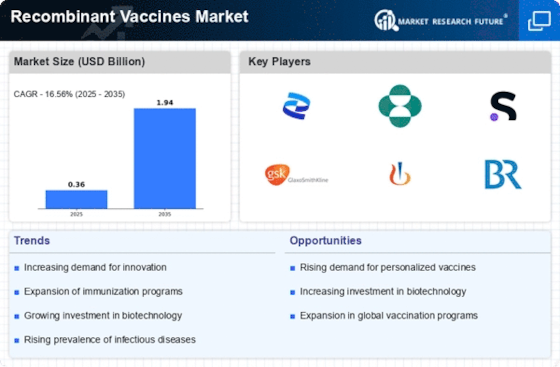
As per Market Research Future analysis, the Recombinant Vaccines Market Size was estimated at 0.36 USD Billion in 2024. The Recombinant Vaccines industry is projected to grow from USD 0.4196 Billion in 2025 to USD 1.942 Billion by 2035, exhibiting a compound annual growth rate (CAGR) of 16.56% during the forecast period 2025 - 2035

Key Market Trends & Highlights

The Recombinant Vaccines Market is poised for substantial growth driven by technological advancements and increasing demand for personalized healthcare solutions.

  • North America remains the largest market for recombinant vaccines, driven by robust healthcare infrastructure and research capabilities. The Asia-Pacific region is emerging as the fastest-growing market, fueled by increasing investments in biotechnology and healthcare access. Subunit recombinant vaccines dominate the market, while vector recombinant vaccines are experiencing rapid growth due to their innovative delivery methods. Key market drivers include the rising incidence of infectious diseases and increased government funding and support for vaccine development.

Market Size & Forecast

2024 Market Size 0.36 (USD Billion)
2035 Market Size 1.942 (USD Billion)
CAGR (2025 - 2035) 16.56%
Largest Regional Market Share in 2024 Americas

Major Players

<a href="https://www.pfizer.com/news/articles/understanding_six_types_of_vaccine_technologies">Pfizer </a>(US), Merck (US), Sanofi (FR), GlaxoSmithKline (GB), Novartis (CH), Bayer (DE), <a href="https://www.astrazeneca.com/content/astraz/country-sites/thailand/press-releases/astrazenecas-covid-19-vaccine-manufactured-in-thailand-authorised-for-world-health-organization-emergency-use.html#modal-historic-confirmation">AstraZeneca</a> (GB), Moderna (US), Bharat Biotech (IN)

Market Trends

The Recombinant Vaccines Market is currently experiencing a notable transformation, driven by advancements in biotechnology and an increasing emphasis on preventive healthcare. This market encompasses vaccines produced through recombinant DNA technology, which allows for the precise manipulation of genetic material to create effective immunizations. As public awareness regarding the importance of vaccination grows, the demand for these innovative solutions is likely to rise. Furthermore, the global landscape is witnessing a shift towards personalized medicine, which may influence the development of tailored vaccines that cater to specific populations or individual needs. In addition to technological advancements, regulatory frameworks are evolving to accommodate the unique characteristics of recombinant vaccines. This evolution may facilitate faster approval processes, thereby encouraging research and development activities. The Recombinant Vaccines Market appears poised for growth, with potential collaborations between pharmaceutical companies and research institutions. As the market continues to expand, it is essential to monitor emerging trends and innovations that could shape its future trajectory.

Technological Advancements

The Recombinant Vaccines Market is witnessing rapid technological progress, particularly in genetic engineering and production techniques. These advancements enhance the efficacy and safety profiles of vaccines, potentially leading to broader acceptance among healthcare providers and patients.

Regulatory Evolution

Regulatory bodies are adapting their frameworks to better accommodate the unique aspects of recombinant vaccines. This evolution may streamline approval processes, encouraging innovation and expediting the introduction of new vaccines into the market.

Personalized Vaccination Approaches

There is a growing interest in personalized vaccination strategies within the Recombinant Vaccines Market. Tailoring vaccines to meet the specific needs of diverse populations could improve immunization outcomes and increase overall vaccine uptake.

Recombinant Vaccines Market Market Drivers

Advancements in Biotechnology

Technological innovations in biotechnology are significantly influencing the Recombinant Vaccines Market. The advent of genetic engineering techniques, such as CRISPR and synthetic biology, has enhanced the ability to design and produce vaccines with improved efficacy and safety profiles. These advancements facilitate the rapid development of vaccines tailored to specific pathogens, thereby addressing public health challenges more effectively. The Recombinant Vaccines Market is expected to benefit from these technological breakthroughs, as they enable manufacturers to streamline production processes and reduce costs. Consequently, the market is likely to expand as more players enter the field, leveraging these cutting-edge technologies.

Emerging Markets and Expanding Access

Emerging markets are becoming increasingly important for the Recombinant Vaccines Market. As economies develop, there is a growing demand for vaccines, driven by rising incomes and improved healthcare infrastructure. Countries in Asia, Africa, and Latin America are witnessing a surge in vaccination programs, supported by international organizations and local governments. This expansion of access to vaccines is likely to create new opportunities for manufacturers in the Recombinant Vaccines Market. Furthermore, as these markets continue to grow, the demand for innovative and effective vaccines will likely increase, prompting companies to invest in research and development to meet the needs of diverse populations.

Rising Incidence of Infectious Diseases

The increasing prevalence of infectious diseases is a primary driver for the Recombinant Vaccines Market. As pathogens evolve and new strains emerge, the demand for effective vaccines rises. For instance, the World Health Organization has reported a surge in vaccine-preventable diseases, which necessitates the development of innovative vaccines. This trend is likely to propel investments in recombinant vaccine technologies, as they offer rapid development and adaptability to emerging threats. The Recombinant Vaccines Market is projected to witness substantial growth, with estimates suggesting a compound annual growth rate of over 10% in the coming years, driven by the urgent need for effective immunization strategies.

Increased Government Funding and Support

Government initiatives and funding play a crucial role in shaping the Recombinant Vaccines Market. Many countries are recognizing the importance of vaccine development in safeguarding public health and are allocating substantial resources to support research and development. For example, various governments have established grants and incentives for companies engaged in recombinant vaccine research. This financial backing not only accelerates the development of new vaccines but also fosters collaboration between public and private sectors. As a result, the Recombinant Vaccines Market is poised for growth, with increased investment likely to lead to the introduction of novel vaccines that address unmet medical needs.

Growing Awareness of Preventive Healthcare

The rising awareness of preventive healthcare is driving the Recombinant Vaccines Market. As populations become more health-conscious, there is a growing emphasis on vaccination as a proactive measure to prevent diseases. Public health campaigns and educational initiatives are effectively promoting the benefits of vaccination, leading to higher immunization rates. This trend is particularly evident in emerging markets, where access to vaccines is improving. The Recombinant Vaccines Market stands to gain from this shift in consumer behavior, as individuals increasingly seek out vaccines that offer protection against a range of infectious diseases. This heightened demand is likely to stimulate market growth in the coming years.

Market Segment Insights

By Type: Subunit Recombinant Vaccines (Largest) vs. Vector Recombinant Vaccines (Fastest-Growing)

The Recombinant Vaccines Market is characterized by distinct segments, with subunit recombinant vaccines taking the lead in market share. These vaccines predominantly utilize specific protein subunits derived from pathogens to stimulate a robust immune response. Vector recombinant vaccines, while not holding the largest share, are rapidly gaining traction due to their innovative approach of using modified viruses to deliver specific antigens. This combination of safety and effectiveness positions subunit vaccines as the primary choice among healthcare providers, while vector vaccines attract attention for their advancement in terms of technology and application. In recent years, the growth of the recombinant vaccines sector has been significantly influenced by the rising prevalence of infectious diseases and the ongoing global health challenges. Subunit vaccines have demonstrated consistent demand, especially in regions facing outbreaks, thereby bolstering their market presence. Vector vaccines, categorized as the fastest-growing segment, are witnessing increased investment and research, making them an attractive option for new vaccine development due to their potential for broad-ranging applications and effective immune responses. Overall, the growth trends in these segments reflect a shift towards advanced vaccine formulations that cater to modern healthcare needs.

Subunit (Dominant) vs. Vector (Emerging)

Subunit recombinant vaccines are defined by their use of harmless fragments of the pathogen, enabling the elicitation of an immune response without the risk of causing disease. This segment enjoys widespread acceptance because of its safety profile and efficacy in inducing targeted immunity. On the other hand, vector recombinant vaccines are an emerging alternative, utilizing a harmless virus as a vector to deliver the desired antigen. They hold promise for enhanced immune responses and can incorporate multiple antigens, which is particularly beneficial for complex diseases. While subunit vaccines are currently dominant, the innovative capabilities of vector vaccines position them favorably for future growth, indicating a dynamic balance in market preferences.

By Disease: Pneumococcal Disease (Largest) vs. Influenza (Fastest-Growing)

In the Recombinant Vaccines Market, Pneumococcal Disease holds the largest market share among the analyzed segments, depicting a strong demand driven by rising awareness and prevention efforts. Other segments like Cancer, Hepatitis B, DPT, and Others also contribute significantly; however, Pneumococcal and Influenza dominate the landscape. The inclusion of combinations targeting multiple diseases is further enhancing market accessibility and consumer interest. The growth trends indicate that while Pneumococcal Disease remains a key focus due to its established protocol and vaccination strategies, Influenza is emerging rapidly as the fastest-growing segment thanks to technological advances and the increasing prevalence of flu outbreaks. The rising incidence of seasonal and pandemic influenza is propelling research and development activities, which is expected to drive further innovations in vaccine formulations.

Pneumococcal Disease (Dominant) vs. Cancer (Emerging)

Pneumococcal Disease is currently positioned as the dominant player in the Recombinant Vaccines Market, owing to extensive vaccination programs and concerted global health efforts aimed at combating bacterial infections. The vaccines developed for this disease are well-established and backed by robust clinical data, leading to wide acceptance in the medical community. In contrast, Cancer vaccines are emerging with a wealth of research supporting their potential and efficacy, primarily targeting specific types of cancer such as HPV-related conditions. The demand for Cancer vaccines is primarily driven by an increase in cancer cases and patient advocacy, thereby creating a burgeoning market that promises significant growth as new therapies and preventative measures are introduced.

By End-User: Hospitals & Clinics (Largest) vs. Pediatrics (Fastest-Growing)

In the Recombinant Vaccines Market, Hospitals &amp; Clinics represent the largest segment due to their significant role in administering vaccines to a wide population base, ensuring a steady demand. This segment capitalizes on the increasing prevalence of vaccine-preventable diseases and the focus on public health initiatives. Pediatrics is identified as the fastest-growing segment, driven by the rising awareness of vaccination's importance in early childhood, supported by health policies promoting immunization and preventive care in younger demographics.

End-User: Hospitals &amp; Clinics (Dominant) vs. Pediatrics (Emerging)

The Hospitals &amp; Clinics segment dominates the Recombinant Vaccines Market as these institutions have established infrastructure and expertise in vaccine delivery, catering to various age groups and conditions. This segment benefits from strong partnerships with healthcare providers and organizations, ensuring efficient immunization programs. In contrast, the Pediatric segment is emerging rapidly, driven by an increasing emphasis on childhood vaccination schedules and preventative healthcare measures. Pediatric healthcare providers are actively working to address vaccine hesitancy and expand access, contributing to its growth. Together, these segments highlight the diverse applications and critical roles of recombinant vaccines in both adult and child populations.

Get more detailed insights about Recombinant Vaccines Market Research Report – Forecast to 2035

Regional Insights

North America : Leading Innovation and Research

North America is the largest market for recombinant vaccines, holding approximately 45% of the global share. The region benefits from advanced healthcare infrastructure, significant R&D investments, and a strong regulatory framework that encourages innovation. The demand for vaccines has surged due to recent health crises, driving growth in this sector. Regulatory bodies like the FDA play a crucial role in expediting vaccine approvals, further enhancing market dynamics. The United States is the primary contributor, with key players such as Pfizer, Merck, and Moderna leading the charge. Canada also plays a significant role, focusing on public health initiatives and collaborations with pharmaceutical companies. The competitive landscape is characterized by continuous innovation and strategic partnerships, ensuring a robust supply chain and access to cutting-edge technologies.

Europe : Regulatory Framework and Growth

Europe is the second-largest market for recombinant vaccines, accounting for approximately 30% of the global market share. The region's growth is driven by increasing vaccination programs, government initiatives to enhance public health, and a strong emphasis on research and development. The European Medicines Agency (EMA) plays a pivotal role in regulating vaccine approvals, ensuring safety and efficacy, which fosters consumer confidence and market expansion. Leading countries in this region include Germany, France, and the United Kingdom, where major pharmaceutical companies like Sanofi and GlaxoSmithKline are headquartered. The competitive landscape is marked by collaborations between public health organizations and private firms, enhancing vaccine accessibility. The presence of established players and a focus on innovation position Europe as a key player in the recombinant vaccines market.

Asia-Pacific : Rapid Growth and Demand

Asia-Pacific is witnessing rapid growth in the recombinant vaccines market, holding approximately 20% of the global share. The region's expansion is fueled by increasing healthcare investments, rising awareness about vaccination, and government initiatives aimed at combating infectious diseases. Countries like India and China are at the forefront, with significant investments in biotechnology and vaccine development, supported by favorable regulatory environments. India, home to Bharat Biotech, is a key player in the market, focusing on affordable vaccine solutions. China is also emerging as a significant contributor, with its robust manufacturing capabilities. The competitive landscape is characterized by a mix of local and international players, fostering innovation and collaboration. As public health initiatives gain momentum, the demand for recombinant vaccines is expected to rise significantly in this region.

Middle East and Africa : Untapped Potential and Growth

The Middle East and Africa represent an emerging market for recombinant vaccines, holding approximately 5% of the global share. The region's growth is driven by increasing healthcare investments, rising disease prevalence, and government initiatives to improve vaccination rates. Countries like South Africa and the UAE are focusing on enhancing their healthcare infrastructure, which is crucial for vaccine distribution and accessibility. South Africa is a key player, with local manufacturers and partnerships with global firms to boost vaccine production. The competitive landscape is evolving, with an increasing number of players entering the market. As public health awareness grows and international collaborations strengthen, the demand for recombinant vaccines is expected to rise, unlocking significant market potential in this region.

Key Players and Competitive Insights

The Recombinant Vaccines Market is currently characterized by a dynamic competitive landscape, driven by innovation, strategic partnerships, and a focus on regional expansion. Key players such as Pfizer (US), Merck (US), and Sanofi (FR) are at the forefront, each employing distinct strategies to enhance their market presence. Pfizer (US) has been particularly focused on leveraging its mRNA technology, which has shown promise in developing vaccines for various infectious diseases. Meanwhile, Merck (US) is concentrating on expanding its portfolio through strategic acquisitions and collaborations, aiming to enhance its capabilities in recombinant vaccine development. Sanofi (FR), on the other hand, is investing heavily in research and development, particularly in the area of combination vaccines, which could potentially streamline immunization processes and improve patient compliance. Collectively, these strategies contribute to a competitive environment that is increasingly centered around innovation and collaboration.

In terms of business tactics, companies are increasingly localizing manufacturing to enhance supply chain resilience and reduce costs. This approach not only mitigates risks associated with global supply chain disruptions but also aligns with regional regulatory requirements. The market structure appears moderately fragmented, with several players vying for market share, yet the influence of major companies remains substantial. Their collective actions shape market dynamics, as they set benchmarks for quality and efficacy that smaller firms often strive to meet.

In August 2025, Moderna (US) announced a partnership with a leading biotechnology firm to co-develop a new recombinant vaccine targeting a range of viral infections. This collaboration is significant as it underscores Moderna's commitment to expanding its vaccine portfolio beyond COVID-19, potentially positioning it as a leader in the recombinant vaccine space. The partnership may also facilitate access to novel technologies and expertise, enhancing Moderna's research capabilities.

In September 2025, GlaxoSmithKline (GB) launched a new recombinant vaccine aimed at combating a prevalent infectious disease in developing regions. This strategic move not only reflects GSK's dedication to addressing global health challenges but also highlights its focus on expanding its footprint in emerging markets. By targeting diseases that disproportionately affect low-income populations, GSK is likely to enhance its corporate social responsibility profile while simultaneously driving revenue growth.

In October 2025, Bharat Biotech (IN) received regulatory approval for its latest recombinant vaccine, which is designed to provide broader immunity against a specific viral strain. This approval is pivotal as it not only validates Bharat Biotech's innovative approach but also positions the company as a key player in The Recombinant Vaccines. The ability to navigate regulatory pathways effectively may enhance Bharat Biotech's competitive edge, particularly in regions where vaccine access is critical.

As of October 2025, the Recombinant Vaccines Market is witnessing trends that emphasize digitalization, sustainability, and the integration of artificial intelligence in vaccine development. Strategic alliances are increasingly shaping the competitive landscape, allowing companies to pool resources and expertise to accelerate innovation. Looking ahead, it appears that competitive differentiation will evolve from traditional price-based competition to a focus on technological advancements, supply chain reliability, and the ability to respond swiftly to emerging health threats.

Key Companies in the Recombinant Vaccines Market include

Industry Developments

Future Outlook

Recombinant Vaccines Market Future Outlook

The Recombinant Vaccines Market is projected to grow at a 16.56% CAGR from 2025 to 2035, driven by technological advancements, increasing disease prevalence, and rising healthcare investments.

New opportunities lie in:

  • <p>Development of personalized vaccine platforms for targeted therapies. Expansion into emerging markets with tailored vaccination programs. Investment in <a href="https://www.marketresearchfuture.com/reports/digital-healthcare-market-7636">digital health</a> technologies for vaccine distribution efficiency.</p>

By 2035, the Recombinant Vaccines Market is expected to be robust, reflecting substantial growth and innovation.

Market Segmentation

Recombinant Vaccines Market Type Outlook

  • Subunit recombinant vaccines
  • Attenuated recombinant vaccines
  • Vector recombinant vaccines

Recombinant Vaccines Market Disease Outlook

  • Pneumococcal Disease
  • Cancer
  • Hepatitis B
  • Influenza
  • DPT
  • Others

Recombinant Vaccines Market End-User Outlook

  • Hospitals & Clinics
  • Pediatrics
  • Adults
  • Veterinary
  • Poultry
  • Livestock
  • Others

Report Scope

MARKET SIZE 2024 0.36(USD Billion)
MARKET SIZE 2025 0.4196(USD Billion)
MARKET SIZE 2035 1.942(USD Billion)
COMPOUND ANNUAL GROWTH RATE (CAGR) 16.56% (2025 - 2035)
REPORT COVERAGE Revenue Forecast, Competitive Landscape, Growth Factors, and Trends
BASE YEAR 2024
Market Forecast Period 2025 - 2035
Historical Data 2019 - 2024
Market Forecast Units USD Billion
Key Companies Profiled Pfizer (US), Merck (US), Sanofi (FR), GlaxoSmithKline (GB), Novartis (CH), Bayer (DE), AstraZeneca (GB), Moderna (US), Bharat Biotech (IN)
Segments Covered Product, Disease
Key Market Opportunities Advancements in genetic engineering enhance efficacy and safety in the Recombinant Vaccines Market.
Key Market Dynamics Technological advancements and regulatory changes drive innovation and competition in the recombinant vaccines market.
Countries Covered North America, Europe, APAC, South America, MEA

FAQs

What is the projected market valuation of the Recombinant Vaccines Market by 2035?

<p>The Recombinant Vaccines Market is projected to reach approximately 1.942 USD Billion by 2035.</p>

What was the market valuation of the Recombinant Vaccines Market in 2024?

<p>In 2024, the market valuation of the Recombinant Vaccines Market was 0.36 USD Billion.</p>

What is the expected CAGR for the Recombinant Vaccines Market during the forecast period 2025 - 2035?

<p>The expected CAGR for the Recombinant Vaccines Market during the forecast period 2025 - 2035 is 16.56%.</p>

Which companies are considered key players in the Recombinant Vaccines Market?

<p>Key players in the Recombinant Vaccines Market include Pfizer, Merck, Sanofi, GlaxoSmithKline, Novartis, Bayer, AstraZeneca, Moderna, and Bharat Biotech.</p>

What are the different types of recombinant vaccines and their market valuations?

<p>The market valuations for different types of recombinant vaccines include Subunit recombinant vaccines at 0.65 USD Billion, Attenuated recombinant vaccines at 0.75 USD Billion, and Vector recombinant vaccines at 0.5 USD Billion.</p>

Which diseases are targeted by recombinant vaccines and what are their market valuations?

Recombinant vaccines target diseases such as Pneumococcal Disease at 0.25 USD Billion, Cancer at 0.4 USD Billion, and Hepatitis B at 0.35 USD Billion.

What are the end-user segments for recombinant vaccines and their respective market valuations?

End-user segments for recombinant vaccines include Hospitals &amp; Clinics at 0.62 USD Billion, Pediatrics at 0.42 USD Billion, and Adults at 0.31 USD Billion.

How does the market for recombinant vaccines compare across different disease segments?

The market for recombinant vaccines shows varying valuations, with Influenza at 0.5 USD Billion and DPT at 0.3 USD Billion, indicating diverse demand across disease segments.

What is the potential growth outlook for the Recombinant Vaccines Market?

The Recombinant Vaccines Market appears poised for substantial growth, with projections indicating a rise from 0.36 USD Billion in 2024 to 1.942 USD Billion by 2035.

How do the market valuations of recombinant vaccines reflect their adoption in healthcare?

The increasing market valuations of recombinant vaccines, particularly in segments like Hospitals &amp; Clinics, suggest a growing adoption and reliance on these vaccines in healthcare settings.

  1. SECTION I: EXECUTIVE SUMMARY AND KEY HIGHLIGHTS
    1. | 1.1 EXECUTIVE SUMMARY
    2. | | 1.1.1 Market Overview
    3. | | 1.1.2 Key Findings
    4. | | 1.1.3 Market Segmentation
    5. | | 1.1.4 Competitive Landscape
    6. | | 1.1.5 Challenges and Opportunities
    7. | | 1.1.6 Future Outlook
  2. SECTION II: SCOPING, METHODOLOGY AND MARKET STRUCTURE
    1. | 2.1 MARKET INTRODUCTION
    2. | | 2.1.1 Definition
    3. | | 2.1.2 Scope of the study
    4. | | | 2.1.2.1 Research Objective
    5. | | | 2.1.2.2 Assumption
    6. | | | 2.1.2.3 Limitations
    7. | 2.2 RESEARCH METHODOLOGY
    8. | | 2.2.1 Overview
    9. | | 2.2.2 Data Mining
    10. | | 2.2.3 Secondary Research
    11. | | 2.2.4 Primary Research
    12. | | | 2.2.4.1 Primary Interviews and Information Gathering Process
    13. | | | 2.2.4.2 Breakdown of Primary Respondents
    14. | | 2.2.5 Forecasting Model
    15. | | 2.2.6 Market Size Estimation
    16. | | | 2.2.6.1 Bottom-Up Approach
    17. | | | 2.2.6.2 Top-Down Approach
    18. | | 2.2.7 Data Triangulation
    19. | | 2.2.8 Validation
  3. SECTION III: QUALITATIVE ANALYSIS
    1. | 3.1 MARKET DYNAMICS
    2. | | 3.1.1 Overview
    3. | | 3.1.2 Drivers
    4. | | 3.1.3 Restraints
    5. | | 3.1.4 Opportunities
    6. | 3.2 MARKET FACTOR ANALYSIS
    7. | | 3.2.1 Value chain Analysis
    8. | | 3.2.2 Porter's Five Forces Analysis
    9. | | | 3.2.2.1 Bargaining Power of Suppliers
    10. | | | 3.2.2.2 Bargaining Power of Buyers
    11. | | | 3.2.2.3 Threat of New Entrants
    12. | | | 3.2.2.4 Threat of Substitutes
    13. | | | 3.2.2.5 Intensity of Rivalry
    14. | | 3.2.3 COVID-19 Impact Analysis
    15. | | | 3.2.3.1 Market Impact Analysis
    16. | | | 3.2.3.2 Regional Impact
    17. | | | 3.2.3.3 Opportunity and Threat Analysis
  4. SECTION IV: QUANTITATIVE ANALYSIS
    1. | 4.1 Healthcare, BY Type (USD Billion)
    2. | | 4.1.1 Subunit recombinant vaccines
    3. | | 4.1.2 Attenuated recombinant vaccines
    4. | | 4.1.3 Vector recombinant vaccines
    5. | 4.2 Healthcare, BY Disease (USD Billion)
    6. | | 4.2.1 Pneumococcal Disease
    7. | | 4.2.2 Cancer
    8. | | 4.2.3 Hepatitis B
    9. | | 4.2.4 Influenza
    10. | | 4.2.5 DPT
    11. | | 4.2.6 Others
    12. | 4.3 Healthcare, BY End-User (USD Billion)
    13. | | 4.3.1 Hospitals & Clinics
    14. | | 4.3.2 Pediatrics
    15. | | 4.3.3 Adults
    16. | | 4.3.4 Veterinary
    17. | | 4.3.5 Poultry
    18. | | 4.3.6 Livestock
    19. | | 4.3.7 Others
    20. | 4.4 Healthcare, BY Region (USD Billion)
    21. | | 4.4.1 North America
    22. | | | 4.4.1.1 US
    23. | | | 4.4.1.2 Canada
    24. | | 4.4.2 Europe
    25. | | | 4.4.2.1 Germany
    26. | | | 4.4.2.2 UK
    27. | | | 4.4.2.3 France
    28. | | | 4.4.2.4 Russia
    29. | | | 4.4.2.5 Italy
    30. | | | 4.4.2.6 Spain
    31. | | | 4.4.2.7 Rest of Europe
    32. | | 4.4.3 APAC
    33. | | | 4.4.3.1 China
    34. | | | 4.4.3.2 India
    35. | | | 4.4.3.3 Japan
    36. | | | 4.4.3.4 South Korea
    37. | | | 4.4.3.5 Malaysia
    38. | | | 4.4.3.6 Thailand
    39. | | | 4.4.3.7 Indonesia
    40. | | | 4.4.3.8 Rest of APAC
    41. | | 4.4.4 South America
    42. | | | 4.4.4.1 Brazil
    43. | | | 4.4.4.2 Mexico
    44. | | | 4.4.4.3 Argentina
    45. | | | 4.4.4.4 Rest of South America
    46. | | 4.4.5 MEA
    47. | | | 4.4.5.1 GCC Countries
    48. | | | 4.4.5.2 South Africa
    49. | | | 4.4.5.3 Rest of MEA
  5. SECTION V: COMPETITIVE ANALYSIS
    1. | 5.1 Competitive Landscape
    2. | | 5.1.1 Overview
    3. | | 5.1.2 Competitive Analysis
    4. | | 5.1.3 Market share Analysis
    5. | | 5.1.4 Major Growth Strategy in the Healthcare
    6. | | 5.1.5 Competitive Benchmarking
    7. | | 5.1.6 Leading Players in Terms of Number of Developments in the Healthcare
    8. | | 5.1.7 Key developments and growth strategies
    9. | | | 5.1.7.1 New Product Launch/Service Deployment
    10. | | | 5.1.7.2 Merger & Acquisitions
    11. | | | 5.1.7.3 Joint Ventures
    12. | | 5.1.8 Major Players Financial Matrix
    13. | | | 5.1.8.1 Sales and Operating Income
    14. | | | 5.1.8.2 Major Players R&D Expenditure. 2023
    15. | 5.2 Company Profiles
    16. | | 5.2.1 Pfizer (US)
    17. | | | 5.2.1.1 Financial Overview
    18. | | | 5.2.1.2 Products Offered
    19. | | | 5.2.1.3 Key Developments
    20. | | | 5.2.1.4 SWOT Analysis
    21. | | | 5.2.1.5 Key Strategies
    22. | | 5.2.2 Merck (US)
    23. | | | 5.2.2.1 Financial Overview
    24. | | | 5.2.2.2 Products Offered
    25. | | | 5.2.2.3 Key Developments
    26. | | | 5.2.2.4 SWOT Analysis
    27. | | | 5.2.2.5 Key Strategies
    28. | | 5.2.3 Sanofi (FR)
    29. | | | 5.2.3.1 Financial Overview
    30. | | | 5.2.3.2 Products Offered
    31. | | | 5.2.3.3 Key Developments
    32. | | | 5.2.3.4 SWOT Analysis
    33. | | | 5.2.3.5 Key Strategies
    34. | | 5.2.4 GlaxoSmithKline (GB)
    35. | | | 5.2.4.1 Financial Overview
    36. | | | 5.2.4.2 Products Offered
    37. | | | 5.2.4.3 Key Developments
    38. | | | 5.2.4.4 SWOT Analysis
    39. | | | 5.2.4.5 Key Strategies
    40. | | 5.2.5 Novartis (CH)
    41. | | | 5.2.5.1 Financial Overview
    42. | | | 5.2.5.2 Products Offered
    43. | | | 5.2.5.3 Key Developments
    44. | | | 5.2.5.4 SWOT Analysis
    45. | | | 5.2.5.5 Key Strategies
    46. | | 5.2.6 Bayer (DE)
    47. | | | 5.2.6.1 Financial Overview
    48. | | | 5.2.6.2 Products Offered
    49. | | | 5.2.6.3 Key Developments
    50. | | | 5.2.6.4 SWOT Analysis
    51. | | | 5.2.6.5 Key Strategies
    52. | | 5.2.7 AstraZeneca (GB)
    53. | | | 5.2.7.1 Financial Overview
    54. | | | 5.2.7.2 Products Offered
    55. | | | 5.2.7.3 Key Developments
    56. | | | 5.2.7.4 SWOT Analysis
    57. | | | 5.2.7.5 Key Strategies
    58. | | 5.2.8 Moderna (US)
    59. | | | 5.2.8.1 Financial Overview
    60. | | | 5.2.8.2 Products Offered
    61. | | | 5.2.8.3 Key Developments
    62. | | | 5.2.8.4 SWOT Analysis
    63. | | | 5.2.8.5 Key Strategies
    64. | | 5.2.9 Bharat Biotech (IN)
    65. | | | 5.2.9.1 Financial Overview
    66. | | | 5.2.9.2 Products Offered
    67. | | | 5.2.9.3 Key Developments
    68. | | | 5.2.9.4 SWOT Analysis
    69. | | | 5.2.9.5 Key Strategies
    70. | 5.3 Appendix
    71. | | 5.3.1 References
    72. | | 5.3.2 Related Reports
  6. LIST OF FIGURES
    1. | 6.1 MARKET SYNOPSIS
    2. | 6.2 NORTH AMERICA MARKET ANALYSIS
    3. | 6.3 US MARKET ANALYSIS BY TYPE
    4. | 6.4 US MARKET ANALYSIS BY DISEASE
    5. | 6.5 US MARKET ANALYSIS BY END-USER
    6. | 6.6 CANADA MARKET ANALYSIS BY TYPE
    7. | 6.7 CANADA MARKET ANALYSIS BY DISEASE
    8. | 6.8 CANADA MARKET ANALYSIS BY END-USER
    9. | 6.9 EUROPE MARKET ANALYSIS
    10. | 6.10 GERMANY MARKET ANALYSIS BY TYPE
    11. | 6.11 GERMANY MARKET ANALYSIS BY DISEASE
    12. | 6.12 GERMANY MARKET ANALYSIS BY END-USER
    13. | 6.13 UK MARKET ANALYSIS BY TYPE
    14. | 6.14 UK MARKET ANALYSIS BY DISEASE
    15. | 6.15 UK MARKET ANALYSIS BY END-USER
    16. | 6.16 FRANCE MARKET ANALYSIS BY TYPE
    17. | 6.17 FRANCE MARKET ANALYSIS BY DISEASE
    18. | 6.18 FRANCE MARKET ANALYSIS BY END-USER
    19. | 6.19 RUSSIA MARKET ANALYSIS BY TYPE
    20. | 6.20 RUSSIA MARKET ANALYSIS BY DISEASE
    21. | 6.21 RUSSIA MARKET ANALYSIS BY END-USER
    22. | 6.22 ITALY MARKET ANALYSIS BY TYPE
    23. | 6.23 ITALY MARKET ANALYSIS BY DISEASE
    24. | 6.24 ITALY MARKET ANALYSIS BY END-USER
    25. | 6.25 SPAIN MARKET ANALYSIS BY TYPE
    26. | 6.26 SPAIN MARKET ANALYSIS BY DISEASE
    27. | 6.27 SPAIN MARKET ANALYSIS BY END-USER
    28. | 6.28 REST OF EUROPE MARKET ANALYSIS BY TYPE
    29. | 6.29 REST OF EUROPE MARKET ANALYSIS BY DISEASE
    30. | 6.30 REST OF EUROPE MARKET ANALYSIS BY END-USER
    31. | 6.31 APAC MARKET ANALYSIS
    32. | 6.32 CHINA MARKET ANALYSIS BY TYPE
    33. | 6.33 CHINA MARKET ANALYSIS BY DISEASE
    34. | 6.34 CHINA MARKET ANALYSIS BY END-USER
    35. | 6.35 INDIA MARKET ANALYSIS BY TYPE
    36. | 6.36 INDIA MARKET ANALYSIS BY DISEASE
    37. | 6.37 INDIA MARKET ANALYSIS BY END-USER
    38. | 6.38 JAPAN MARKET ANALYSIS BY TYPE
    39. | 6.39 JAPAN MARKET ANALYSIS BY DISEASE
    40. | 6.40 JAPAN MARKET ANALYSIS BY END-USER
    41. | 6.41 SOUTH KOREA MARKET ANALYSIS BY TYPE
    42. | 6.42 SOUTH KOREA MARKET ANALYSIS BY DISEASE
    43. | 6.43 SOUTH KOREA MARKET ANALYSIS BY END-USER
    44. | 6.44 MALAYSIA MARKET ANALYSIS BY TYPE
    45. | 6.45 MALAYSIA MARKET ANALYSIS BY DISEASE
    46. | 6.46 MALAYSIA MARKET ANALYSIS BY END-USER
    47. | 6.47 THAILAND MARKET ANALYSIS BY TYPE
    48. | 6.48 THAILAND MARKET ANALYSIS BY DISEASE
    49. | 6.49 THAILAND MARKET ANALYSIS BY END-USER
    50. | 6.50 INDONESIA MARKET ANALYSIS BY TYPE
    51. | 6.51 INDONESIA MARKET ANALYSIS BY DISEASE
    52. | 6.52 INDONESIA MARKET ANALYSIS BY END-USER
    53. | 6.53 REST OF APAC MARKET ANALYSIS BY TYPE
    54. | 6.54 REST OF APAC MARKET ANALYSIS BY DISEASE
    55. | 6.55 REST OF APAC MARKET ANALYSIS BY END-USER
    56. | 6.56 SOUTH AMERICA MARKET ANALYSIS
    57. | 6.57 BRAZIL MARKET ANALYSIS BY TYPE
    58. | 6.58 BRAZIL MARKET ANALYSIS BY DISEASE
    59. | 6.59 BRAZIL MARKET ANALYSIS BY END-USER
    60. | 6.60 MEXICO MARKET ANALYSIS BY TYPE
    61. | 6.61 MEXICO MARKET ANALYSIS BY DISEASE
    62. | 6.62 MEXICO MARKET ANALYSIS BY END-USER
    63. | 6.63 ARGENTINA MARKET ANALYSIS BY TYPE
    64. | 6.64 ARGENTINA MARKET ANALYSIS BY DISEASE
    65. | 6.65 ARGENTINA MARKET ANALYSIS BY END-USER
    66. | 6.66 REST OF SOUTH AMERICA MARKET ANALYSIS BY TYPE
    67. | 6.67 REST OF SOUTH AMERICA MARKET ANALYSIS BY DISEASE
    68. | 6.68 REST OF SOUTH AMERICA MARKET ANALYSIS BY END-USER
    69. | 6.69 MEA MARKET ANALYSIS
    70. | 6.70 GCC COUNTRIES MARKET ANALYSIS BY TYPE
    71. | 6.71 GCC COUNTRIES MARKET ANALYSIS BY DISEASE
    72. | 6.72 GCC COUNTRIES MARKET ANALYSIS BY END-USER
    73. | 6.73 SOUTH AFRICA MARKET ANALYSIS BY TYPE
    74. | 6.74 SOUTH AFRICA MARKET ANALYSIS BY DISEASE
    75. | 6.75 SOUTH AFRICA MARKET ANALYSIS BY END-USER
    76. | 6.76 REST OF MEA MARKET ANALYSIS BY TYPE
    77. | 6.77 REST OF MEA MARKET ANALYSIS BY DISEASE
    78. | 6.78 REST OF MEA MARKET ANALYSIS BY END-USER
    79. | 6.79 KEY BUYING CRITERIA OF HEALTHCARE
    80. | 6.80 RESEARCH PROCESS OF MRFR
    81. | 6.81 DRO ANALYSIS OF HEALTHCARE
    82. | 6.82 DRIVERS IMPACT ANALYSIS: HEALTHCARE
    83. | 6.83 RESTRAINTS IMPACT ANALYSIS: HEALTHCARE
    84. | 6.84 SUPPLY / VALUE CHAIN: HEALTHCARE
    85. | 6.85 HEALTHCARE, BY TYPE, 2024 (% SHARE)
    86. | 6.86 HEALTHCARE, BY TYPE, 2024 TO 2035 (USD Billion)
    87. | 6.87 HEALTHCARE, BY DISEASE, 2024 (% SHARE)
    88. | 6.88 HEALTHCARE, BY DISEASE, 2024 TO 2035 (USD Billion)
    89. | 6.89 HEALTHCARE, BY END-USER, 2024 (% SHARE)
    90. | 6.90 HEALTHCARE, BY END-USER, 2024 TO 2035 (USD Billion)
    91. | 6.91 BENCHMARKING OF MAJOR COMPETITORS
  7. LIST OF TABLES
    1. | 7.1 LIST OF ASSUMPTIONS
    2. | | 7.1.1
    3. | 7.2 North America MARKET SIZE ESTIMATES; FORECAST
    4. | | 7.2.1 BY TYPE, 2025-2035 (USD Billion)
    5. | | 7.2.2 BY DISEASE, 2025-2035 (USD Billion)
    6. | | 7.2.3 BY END-USER, 2025-2035 (USD Billion)
    7. | 7.3 US MARKET SIZE ESTIMATES; FORECAST
    8. | | 7.3.1 BY TYPE, 2025-2035 (USD Billion)
    9. | | 7.3.2 BY DISEASE, 2025-2035 (USD Billion)
    10. | | 7.3.3 BY END-USER, 2025-2035 (USD Billion)
    11. | 7.4 Canada MARKET SIZE ESTIMATES; FORECAST
    12. | | 7.4.1 BY TYPE, 2025-2035 (USD Billion)
    13. | | 7.4.2 BY DISEASE, 2025-2035 (USD Billion)
    14. | | 7.4.3 BY END-USER, 2025-2035 (USD Billion)
    15. | 7.5 Europe MARKET SIZE ESTIMATES; FORECAST
    16. | | 7.5.1 BY TYPE, 2025-2035 (USD Billion)
    17. | | 7.5.2 BY DISEASE, 2025-2035 (USD Billion)
    18. | | 7.5.3 BY END-USER, 2025-2035 (USD Billion)
    19. | 7.6 Germany MARKET SIZE ESTIMATES; FORECAST
    20. | | 7.6.1 BY TYPE, 2025-2035 (USD Billion)
    21. | | 7.6.2 BY DISEASE, 2025-2035 (USD Billion)
    22. | | 7.6.3 BY END-USER, 2025-2035 (USD Billion)
    23. | 7.7 UK MARKET SIZE ESTIMATES; FORECAST
    24. | | 7.7.1 BY TYPE, 2025-2035 (USD Billion)
    25. | | 7.7.2 BY DISEASE, 2025-2035 (USD Billion)
    26. | | 7.7.3 BY END-USER, 2025-2035 (USD Billion)
    27. | 7.8 France MARKET SIZE ESTIMATES; FORECAST
    28. | | 7.8.1 BY TYPE, 2025-2035 (USD Billion)
    29. | | 7.8.2 BY DISEASE, 2025-2035 (USD Billion)
    30. | | 7.8.3 BY END-USER, 2025-2035 (USD Billion)
    31. | 7.9 Russia MARKET SIZE ESTIMATES; FORECAST
    32. | | 7.9.1 BY TYPE, 2025-2035 (USD Billion)
    33. | | 7.9.2 BY DISEASE, 2025-2035 (USD Billion)
    34. | | 7.9.3 BY END-USER, 2025-2035 (USD Billion)
    35. | 7.10 Italy MARKET SIZE ESTIMATES; FORECAST
    36. | | 7.10.1 BY TYPE, 2025-2035 (USD Billion)
    37. | | 7.10.2 BY DISEASE, 2025-2035 (USD Billion)
    38. | | 7.10.3 BY END-USER, 2025-2035 (USD Billion)
    39. | 7.11 Spain MARKET SIZE ESTIMATES; FORECAST
    40. | | 7.11.1 BY TYPE, 2025-2035 (USD Billion)
    41. | | 7.11.2 BY DISEASE, 2025-2035 (USD Billion)
    42. | | 7.11.3 BY END-USER, 2025-2035 (USD Billion)
    43. | 7.12 Rest of Europe MARKET SIZE ESTIMATES; FORECAST
    44. | | 7.12.1 BY TYPE, 2025-2035 (USD Billion)
    45. | | 7.12.2 BY DISEASE, 2025-2035 (USD Billion)
    46. | | 7.12.3 BY END-USER, 2025-2035 (USD Billion)
    47. | 7.13 APAC MARKET SIZE ESTIMATES; FORECAST
    48. | | 7.13.1 BY TYPE, 2025-2035 (USD Billion)
    49. | | 7.13.2 BY DISEASE, 2025-2035 (USD Billion)
    50. | | 7.13.3 BY END-USER, 2025-2035 (USD Billion)
    51. | 7.14 China MARKET SIZE ESTIMATES; FORECAST
    52. | | 7.14.1 BY TYPE, 2025-2035 (USD Billion)
    53. | | 7.14.2 BY DISEASE, 2025-2035 (USD Billion)
    54. | | 7.14.3 BY END-USER, 2025-2035 (USD Billion)
    55. | 7.15 India MARKET SIZE ESTIMATES; FORECAST
    56. | | 7.15.1 BY TYPE, 2025-2035 (USD Billion)
    57. | | 7.15.2 BY DISEASE, 2025-2035 (USD Billion)
    58. | | 7.15.3 BY END-USER, 2025-2035 (USD Billion)
    59. | 7.16 Japan MARKET SIZE ESTIMATES; FORECAST
    60. | | 7.16.1 BY TYPE, 2025-2035 (USD Billion)
    61. | | 7.16.2 BY DISEASE, 2025-2035 (USD Billion)
    62. | | 7.16.3 BY END-USER, 2025-2035 (USD Billion)
    63. | 7.17 South Korea MARKET SIZE ESTIMATES; FORECAST
    64. | | 7.17.1 BY TYPE, 2025-2035 (USD Billion)
    65. | | 7.17.2 BY DISEASE, 2025-2035 (USD Billion)
    66. | | 7.17.3 BY END-USER, 2025-2035 (USD Billion)
    67. | 7.18 Malaysia MARKET SIZE ESTIMATES; FORECAST
    68. | | 7.18.1 BY TYPE, 2025-2035 (USD Billion)
    69. | | 7.18.2 BY DISEASE, 2025-2035 (USD Billion)
    70. | | 7.18.3 BY END-USER, 2025-2035 (USD Billion)
    71. | 7.19 Thailand MARKET SIZE ESTIMATES; FORECAST
    72. | | 7.19.1 BY TYPE, 2025-2035 (USD Billion)
    73. | | 7.19.2 BY DISEASE, 2025-2035 (USD Billion)
    74. | | 7.19.3 BY END-USER, 2025-2035 (USD Billion)
    75. | 7.20 Indonesia MARKET SIZE ESTIMATES; FORECAST
    76. | | 7.20.1 BY TYPE, 2025-2035 (USD Billion)
    77. | | 7.20.2 BY DISEASE, 2025-2035 (USD Billion)
    78. | | 7.20.3 BY END-USER, 2025-2035 (USD Billion)
    79. | 7.21 Rest of APAC MARKET SIZE ESTIMATES; FORECAST
    80. | | 7.21.1 BY TYPE, 2025-2035 (USD Billion)
    81. | | 7.21.2 BY DISEASE, 2025-2035 (USD Billion)
    82. | | 7.21.3 BY END-USER, 2025-2035 (USD Billion)
    83. | 7.22 South America MARKET SIZE ESTIMATES; FORECAST
    84. | | 7.22.1 BY TYPE, 2025-2035 (USD Billion)
    85. | | 7.22.2 BY DISEASE, 2025-2035 (USD Billion)
    86. | | 7.22.3 BY END-USER, 2025-2035 (USD Billion)
    87. | 7.23 Brazil MARKET SIZE ESTIMATES; FORECAST
    88. | | 7.23.1 BY TYPE, 2025-2035 (USD Billion)
    89. | | 7.23.2 BY DISEASE, 2025-2035 (USD Billion)
    90. | | 7.23.3 BY END-USER, 2025-2035 (USD Billion)
    91. | 7.24 Mexico MARKET SIZE ESTIMATES; FORECAST
    92. | | 7.24.1 BY TYPE, 2025-2035 (USD Billion)
    93. | | 7.24.2 BY DISEASE, 2025-2035 (USD Billion)
    94. | | 7.24.3 BY END-USER, 2025-2035 (USD Billion)
    95. | 7.25 Argentina MARKET SIZE ESTIMATES; FORECAST
    96. | | 7.25.1 BY TYPE, 2025-2035 (USD Billion)
    97. | | 7.25.2 BY DISEASE, 2025-2035 (USD Billion)
    98. | | 7.25.3 BY END-USER, 2025-2035 (USD Billion)
    99. | 7.26 Rest of South America MARKET SIZE ESTIMATES; FORECAST
    100. | | 7.26.1 BY TYPE, 2025-2035 (USD Billion)
    101. | | 7.26.2 BY DISEASE, 2025-2035 (USD Billion)
    102. | | 7.26.3 BY END-USER, 2025-2035 (USD Billion)
    103. | 7.27 MEA MARKET SIZE ESTIMATES; FORECAST
    104. | | 7.27.1 BY TYPE, 2025-2035 (USD Billion)
    105. | | 7.27.2 BY DISEASE, 2025-2035 (USD Billion)
    106. | | 7.27.3 BY END-USER, 2025-2035 (USD Billion)
    107. | 7.28 GCC Countries MARKET SIZE ESTIMATES; FORECAST
    108. | | 7.28.1 BY TYPE, 2025-2035 (USD Billion)
    109. | | 7.28.2 BY DISEASE, 2025-2035 (USD Billion)
    110. | | 7.28.3 BY END-USER, 2025-2035 (USD Billion)
    111. | 7.29 South Africa MARKET SIZE ESTIMATES; FORECAST
    112. | | 7.29.1 BY TYPE, 2025-2035 (USD Billion)
    113. | | 7.29.2 BY DISEASE, 2025-2035 (USD Billion)
    114. | | 7.29.3 BY END-USER, 2025-2035 (USD Billion)
    115. | 7.30 Rest of MEA MARKET SIZE ESTIMATES; FORECAST
    116. | | 7.30.1 BY TYPE, 2025-2035 (USD Billion)
    117. | | 7.30.2 BY DISEASE, 2025-2035 (USD Billion)
    118. | | 7.30.3 BY END-USER, 2025-2035 (USD Billion)
    119. | 7.31 PRODUCT LAUNCH/PRODUCT DEVELOPMENT/APPROVAL
    120. | | 7.31.1
    121. | 7.32 ACQUISITION/PARTNERSHIP
    122. | | 7.32.1

Healthcare Market Segmentation

Healthcare By Type (USD Billion, 2025-2035)

  • Subunit recombinant vaccines
  • Attenuated recombinant vaccines
  • Vector recombinant vaccines

Healthcare By Disease (USD Billion, 2025-2035)

  • Pneumococcal Disease
  • Cancer
  • Hepatitis B
  • Influenza
  • DPT
  • Others

Healthcare By End-User (USD Billion, 2025-2035)

  • Hospitals & Clinics
  • Pediatrics
  • Adults
  • Veterinary
  • Poultry
  • Livestock
  • Others
Infographic

Free Sample Request

Kindly complete the form below to receive a free sample of this Report

Get Free Sample

Customer Strories

Compare Licence

×
Features License Type
Single User Multiuser License Enterprise User
Price $4,950 $5,950 $7,250
Maximum User Access Limit 1 User Upto 10 Users Unrestricted Access Throughout the Organization
Free Customization
Direct Access to Analyst
Deliverable Format
Platform Access
Discount on Next Purchase 10% 15% 15%
Printable Versions