Request Free Sample ×

Kindly complete the form below to receive a free sample of this Report

* Please use a valid business email

Leading companies partner with us for data-driven Insights

clients tt-cursor
Hero Background
English
Chinese
French
Japanese
Korean
German
Spanish

Rabies Diagnostics Market Share

ID: MRFR/MED/6326-HCR
85 Pages
Vikita Thakur
April 2026

Rabies Diagnostics Market Research Report: Size, Share, Trend Analysis By Method (Fluorescent Antibody Test (FAT), Serology Tests, and Others), by Technology (ELISA/Immunohistochemistry, and Others), By End Users (Hospitals Diagnostic centers, others) - Growth Outlook & Industry Forecast 2025 To 2035

Share:
Download PDF ×

We do not share your information with anyone. However, we may send you emails based on your report interest from time to time. You may contact us at any time to opt-out.

Rabies Diagnostics Market Infographic
Purchase Options

Market Share

Rabies Diagnostics Market Share Analysis

One important way to fight the dangerous rabies virus is through the Rabies Diagnostics Market. It uses a range of market share placement tactics to stay ahead of the competition and meet the needs of the global healthcare system. These strategies are meant to keep the market full of people who want to buy and stay. One important strategy is to be able to think of new products all the time. Rabies-detecting tools might be more accurate and useful if companies spend money on research and development to make them better. A lot of different technologies are used in these plans, like quick tests, complicated chemistry processes, and more. When big companies in a field open new offices around the world, they do so to get a bigger share of the market. Businesses can make sure that a lot of people can get their testing tools, which will help them get a bigger share of the market. To do this, you could spend a lot of time in poor countries and talk to the doctors and nurses there. Companies need to build ties with big players like health organizations run by the government and schools to take this step. Because of these relationships, it is possible to do thorough rabies tests, which in turn helps the company do better in the market. Firms also have to follow the law very closely if they want the market to trust them. Businesses have to pay for licenses and approvals to make sure that the testing goods they sell meet the safety and efficiency standards. A lot of companies can get an edge over their rivals. Awareness among healthcare workers and the public is crucial. Successful marketing and awareness campaigns promote the brand and educate stakeholders about the need of early rabies diagnosis, which affects market share. Strategically tailoring diagnostic solutions to a region or healthcare facility is recommended. Customizable diagnostic packages meet a broad variety of market needs, giving companies a competitive advantage by tackling local difficulties. Competitive pricing is key to market share positioning. Excellent diagnostic solutions and affordable prices must be balanced to provide accessibility, especially in price-sensitive regions. This increases market share. Technical advances are necessary to stay ahead in the rabies diagnostics business. Artificial intelligence, automation, and data analytics improve diagnostic tools' efficiency and accuracy, attracting healthcare providers and researchers and increasing market share. Provide healthcare professionals with comprehensive after-sales support and training to meet strategic objectives. Businesses that provide comprehensive training and support services improve market share by building customer loyalty and satisfaction. Corporate social responsibility is driving companies to adopt green practices. This aligns with worldwide trends and attracts environmentally conscious buyers, improving market positioning.


Author
Author Profile
Vikita Thakur
Senior Research Analyst

She holds an experience of about 5+ years in market research and business consulting projects for sectors such as life sciences, medical devices, and healthcare IT. She possesses a robust background in data analysis, market estimation, competitive intelligence, pipeline analysis market trend identification, and consumer behavior insights. Her expertise lies in technical Sales support, client interaction and project management, designing and implementing market research studies, conducting competitive analysis, and synthesizing complex data into actionable recommendations that drive business growth.

Leave a Comment

FAQs

What is the current valuation of the Rabies Diagnostics Market as of 2025?

<p>The Rabies Diagnostics Market is valued at approximately 3566.1 USD Million in 2024.</p>

What is the projected market size for the Rabies Diagnostics Market by 2035?

<p>The market is expected to reach around 6106.81 USD Million by 2035.</p>

What is the expected CAGR for the Rabies Diagnostics Market during the forecast period 2025 - 2035?

<p>The market is anticipated to grow at a CAGR of 4.97% from 2025 to 2035.</p>

Which companies are considered key players in the Rabies Diagnostics Market?

<p>Key players include Fujirebio, Bio-Rad Laboratories, Thermo Fisher Scientific, and Merck KGaA.</p>

What are the primary applications of rabies diagnostics in the market?

<p>The main applications include Diagnostic Testing, Research and Development, Surveillance, and Vaccination Programs.</p>

How do the segment valuations for Diagnostic Testing compare to Vaccination Programs?

Diagnostic Testing was valued between 850.0 and 1500.0 USD Million, whereas Vaccination Programs ranged from 1616.1 to 2806.81 USD Million.

What types of tests are utilized in the Rabies Diagnostics Market?

The market employs Serological Tests, Molecular Tests, Histopathological Tests, and Rapid Tests.

What is the valuation range for Molecular Tests in the Rabies Diagnostics Market?

Molecular Tests are valued between 900.0 and 1600.0 USD Million.

Which end users are primarily involved in the Rabies Diagnostics Market?

End users include Hospitals, Diagnostic Laboratories, Research Institutions, and Public Health Organizations.

What technologies are being utilized in rabies diagnostics?

Key technologies include Polymerase Chain Reaction, Enzyme-Linked Immunosorbent Assay, Immunofluorescence Assay, and Next-Generation Sequencing.

Market Summary

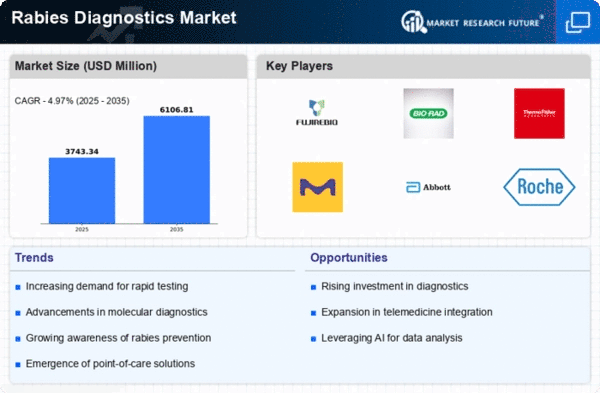
As per MRFR analysis, the Rabies Diagnostics Market Size was estimated at 3566.1 USD Million in 2024. The Rabies Diagnostics industry is projected to grow from 3784.2 USD Million in 2025 to 6106.81 USD Million by 2035, exhibiting a compound annual growth rate (CAGR) of 4.97% during the forecast period 2025 - 2035.

Key Market Trends & Highlights

The Rabies Diagnostics Market is experiencing notable growth driven by technological advancements and increased awareness.

  • Technological advancements in diagnostic tools are enhancing the accuracy and speed of rabies detection. North America remains the largest market for rabies diagnostics, while Asia-Pacific is emerging as the fastest-growing region. The diagnostic testing segment holds the largest market share, whereas the veterinary diagnostics segment is witnessing rapid growth. Rising incidence of rabies cases and increased public awareness are key drivers propelling market expansion.

Market Size & Forecast

2024 Market Size 3566.1 (USD Million)
2035 Market Size 6106.81 (USD Million)
CAGR (2025 - 2035) 4.97%
Largest Regional Market Share in 2024 North America

Major Players

Fujirebio (JP), Bio-Rad Laboratories (US), Thermo Fisher Scientific (US), Merck KGaA (DE), Abbott Laboratories (US), Roche Diagnostics (CH), IDEXX Laboratories (US), Herd Health (CA)

Market Trends

The Rabies Diagnostics Market is currently experiencing a notable evolution, driven by advancements in technology and increasing awareness regarding the disease's impact on public health. The growing incidence of rabies, particularly in developing regions, has prompted a surge in demand for effective diagnostic tools. This market appears to be characterized by a diverse range of products, including rapid tests and laboratory-based assays, which are essential for timely diagnosis and management of rabies. Furthermore, the integration of innovative technologies, such as molecular diagnostics, is likely to enhance the accuracy and speed of rabies detection, thereby improving patient outcomes and shaping rabies diagnostics market trends.

In addition to technological advancements, the rabies diagnostics market is influenced by collaborative efforts among various stakeholders, including government agencies, non-profit organizations, and private companies. These collaborations seem to foster research and development initiatives aimed at creating more efficient diagnostic solutions. Moreover, educational campaigns aimed at raising awareness about rabies prevention and control are expected to further drive market growth. As the global health community continues to prioritize rabies elimination, the market is poised for continued expansion, reflecting a commitment to addressing this preventable yet deadly disease.

Technological Advancements

The rabies diagnostics market is witnessing a shift towards the adoption of advanced technologies, such as molecular diagnostics and rapid testing methods. These innovations are likely to enhance the speed and accuracy of rabies detection, facilitating timely intervention and treatment.

Increased Awareness and Education

There is a growing emphasis on public education regarding rabies prevention and control. This heightened awareness is likely to drive demand for diagnostic tools, as communities recognize the importance of early detection and intervention in managing rabies cases.

Collaborative Efforts in Research

Partnerships among governmental bodies, non-profits, and private enterprises are fostering research in the rabies diagnostics market . These collaborations may lead to the development of novel diagnostic solutions, ultimately improving rabies management and control efforts.

Rabies Diagnostics Market Market Drivers

Market Growth Projections

The Global Rabies Diagnostics Market Industry is projected to experience substantial growth in the coming years. With a market value of 2.26 USD Billion in 2024, it is expected to reach 4.15 USD Billion by 2035. This growth reflects a compound annual growth rate of 5.67% from 2025 to 2035. Factors contributing to this upward trajectory include increasing rabies cases, advancements in diagnostic technologies, and enhanced government initiatives. The market's expansion is indicative of a growing recognition of the importance of rabies diagnostics in public health and animal health management.

Global Travel and Trade Expansion

The expansion of global travel and trade is influencing the Global Rabies Diagnostics Market Industry. Increased movement of people and animals across borders raises the risk of rabies transmission, particularly in regions where the disease is endemic. This interconnectedness necessitates robust diagnostic measures to prevent outbreaks. Countries are increasingly recognizing the importance of rabies surveillance and diagnostics as part of their public health strategies. As international travel continues to rise, the demand for effective rabies diagnostics is likely to grow, potentially leading to a compound annual growth rate of 5.67% from 2025 to 2035.

Government Initiatives and Funding

Government initiatives and funding play a crucial role in shaping the Global Rabies Diagnostics Market Industry. Many countries are implementing national rabies control programs, which often include increased funding for diagnostic research and development. For example, the Centers for Disease Control and Prevention in the United States has allocated resources to enhance rabies surveillance and diagnostics. Such initiatives not only promote awareness but also stimulate the market by encouraging the development of innovative diagnostic solutions. As governments prioritize rabies control, the market is likely to experience growth, with projections indicating a market value of 2.26 USD Billion in 2024.

Increasing Incidence of Rabies Cases

The rising incidence of rabies cases globally is a primary driver for the Global Rabies Diagnostics Market Industry. Rabies, a preventable viral disease, continues to pose a significant health threat, particularly in developing regions. According to the World Health Organization, rabies causes approximately 59,000 deaths annually, predominantly in Asia and Africa. This alarming statistic underscores the urgent need for effective diagnostics to facilitate timely treatment and control measures. As awareness of rabies transmission and prevention grows, the demand for diagnostic tools is likely to increase, contributing to the market's expansion.

Technological Advancements in Diagnostic Tools

Technological advancements in diagnostic tools are significantly influencing the Global Rabies Diagnostics Market Industry. Innovations such as rapid diagnostic tests, molecular techniques, and improved serological assays enhance the accuracy and speed of rabies detection. For instance, the development of point-of-care testing devices allows for immediate results, which is crucial in managing rabies exposure. These advancements not only improve diagnostic capabilities but also encourage healthcare providers to adopt new technologies, thereby driving market growth. As these technologies become more accessible, the market is expected to witness substantial growth, particularly in regions with high rabies prevalence.

Rising Pet Ownership and Animal Health Awareness

The increasing trend of pet ownership and heightened awareness of animal health are driving factors in the Global Rabies Diagnostics Market Industry. As more households adopt pets, the risk of rabies transmission from animals to humans rises, necessitating effective diagnostic measures. Public campaigns aimed at educating pet owners about rabies prevention and vaccination further contribute to this trend. This growing awareness is expected to lead to increased demand for rabies diagnostics, as pet owners seek to ensure the health of their animals. Consequently, the market is projected to grow, with an anticipated value of 4.15 USD Billion by 2035.

Market Segment Insights

By Application: Diagnostic Testing (Largest) vs. Research and Development (Fastest-Growing)

In the Rabies Diagnostics Market, Diagnostic Testing emerges as the largest segment, commanding a significant share due to its critical role in identifying rabies infections. The demand for accurate and quick diagnostic tests is paramount, especially in regions where rabies is prevalent. Following closely is the Research and Development segment, which is rapidly gaining momentum as advancements in technology and new methodologies in rabies diagnostics continue to evolve, enhancing diagnostic capabilities and overall effectiveness.

Diagnostic Testing (Dominant) vs. Research and Development (Emerging)

The Diagnostic Testing segment, known for its wide-ranging applications, remains dominant in the Rabies Diagnostics Market. It includes various testing methodologies such as serology and molecular diagnostics, all aimed at the precise identification of rabies in animals and humans. Its prominence is fueled by increasing awareness of rabies outbreaks and strict regulatory requirements for diagnostics. In contrast, the Research and Development segment is emerging as a key player, driven by the need for innovative solutions and next-generation diagnostics that provide faster, more reliable results, thus signifying significant growth potential as investments in rabies research escalate.

By Test Type: Serological Tests (Largest) vs. Molecular Tests (Fastest-Growing)

The Rabies Diagnostics Market exhibits a diverse range of testing methods, among which serological tests dominate the market share due to their established reliability and extensive use in diagnostics. These tests are pivotal in identifying rabies exposure and assessing immune responses in vaccinated individuals, thus maintaining a significant presence in the sector. Conversely, molecular tests, characterized by their high sensitivity and rapid results, are increasingly gaining traction. The advent of advanced technologies is allowing these tests to penetrate the market effectively, contributing to their growing share.

Serological Tests (Dominant) vs. Molecular Tests (Emerging)

Serological tests are currently the dominant method in the rabies diagnostics market, providing validated results for rabies exposure through antibody detection. These tests are essential in veterinary settings and human health assessments, making them a critical component in rabies surveillance programs. On the other hand, molecular tests, which detect the virus's genetic material, are emerging rapidly due to their accuracy and speed. They are increasingly favored in clinical settings, particularly for acute rabies cases, as they enable prompt diagnosis. This shift towards molecular methods is driven by technological advancements and rising awareness about rabies, positioning molecular tests as a key factor in evolving rabies diagnosis.

By End User: Hospitals (Largest) vs. Diagnostic Laboratories (Fastest-Growing)

The Rabies Diagnostics Market is characterized by a diverse array of end users, including hospitals, diagnostic laboratories, research institutions, and public health organizations. Hospitals account for the largest share of the market as they serve as primary healthcare providers, offering rabies diagnostics as an integral part of their services. In contrast, diagnostic laboratories are experiencing rapid growth due to increasing demand for specialized testing and advanced diagnostic technologies. This shift is enabling laboratories to expand their offerings and reach a wider patient base, ultimately contributing to their fast-growing market presence. Market dynamics are further influenced by a growing awareness of rabies-related health risks and the need for immediate diagnosis following potential exposure. Public health organizations play a vital role in steering diagnostic trends by implementing nationwide rabies prevention programs, which reflects positively on diagnostic service demand. Additionally, research institutions are continuously innovating, seeking to enhance diagnostic methodologies, thereby pushing boundaries for improved accuracy and speed in testing, and marking them as an essential player in the evolving landscape of rabies diagnostics.

Hospitals (Dominant) vs. Research Institutions (Emerging)

Hospitals remain the dominant force in the Rabies Diagnostics Market, providing a wide range of services, including rapid screening, patient care, and management of rabies cases. These institutions have well-established protocols and infrastructures to handle rabies diagnostics effectively, ensuring timely access to treatment, which is critical in rabies cases. In contrast, research institutions are emerging as significant players, focusing on innovative approaches and advancements in diagnostic technologies. They conduct extensive research to develop new diagnostic tests that could offer higher sensitivity and specificity for rabies detection. While hospitals prioritize immediate patient care, research institutions are crucial for long-term improvements and innovations in rabies diagnostics, thus complementing the healthcare ecosystem.

By Technology: Polymerase Chain Reaction (Largest) vs. Enzyme-Linked Immunosorbent Assay (Fastest-Growing)

In the Rabies Diagnostics Market, the Polymerase Chain Reaction (PCR) technology holds the largest market share among diagnostic methods, widely favored for its sensitivity and specificity in detecting rabies viral RNA. Following PCR, the Enzyme-Linked Immunosorbent Assay (ELISA) also has a significant presence, utilized for its ability to detect specific antibodies in the serum. Immunofluorescence Assay (IFA) and Next Generation Sequencing (NGS) are also key players, though they occupy smaller niches within the market.

Technology: PCR (Dominant) vs. ELISA (Emerging)

The Polymerase Chain Reaction (PCR) is recognized as the dominant technology in rabies diagnostics due to its precision in identifying rabies virus presence at early stages of infection. Its capability to amplify minute quantities of viral RNA allows for early and accurate detection, making it crucial in timely diagnosis and intervention. Conversely, Enzyme-Linked Immunosorbent Assay (ELISA) is emerging as a useful tool in the market, especially for serological tests to determine rabies immunity and past exposure. With advancements in assay development and increasing demand for rapid testing methods, ELISA is seeing a swift rise in market adoption.

Get more detailed insights about Rabies Diagnostics Market Report Research Report - Global Forecast Till 2035

Regional Insights

North America : Market Leader in Diagnostics

North America is poised to maintain its leadership in the Rabies Diagnostics Market, holding a significant market share of $1785.0 million as of 2024. The region's growth is driven by increasing awareness of rabies prevention, advancements in diagnostic technologies, and supportive regulatory frameworks. The demand for rapid and accurate diagnostic tests is on the rise, fueled by public health initiatives and the need for effective disease management. The United States and Canada are the leading countries in this market, with major players like Thermo Fisher Scientific, Abbott Laboratories, and IDEXX Laboratories establishing a strong presence. The competitive landscape is characterized by continuous innovation and strategic partnerships among key players, enhancing the availability of advanced diagnostic solutions. The focus on research and development further solidifies North America's position as a hub for rabies diagnostics.

Europe : Emerging Market with Growth Potential

Europe is witnessing a growing interest in the Rabies Diagnostics Market, with a market size of $1070.0 million. The region's growth is propelled by increasing incidences of rabies in certain areas, alongside stringent regulations aimed at disease control. The European Union's commitment to public health and animal welfare is driving demand for effective diagnostic solutions, ensuring compliance with health standards and regulations. Leading countries such as Germany, France, and the UK are at the forefront of this market, supported by key players like Merck KGaA and Roche Diagnostics. The competitive landscape is marked by collaborations between public health organizations and private companies, fostering innovation in diagnostic technologies. As the market evolves, Europe is expected to enhance its capabilities in rabies diagnostics, contributing to global health initiatives.

Asia-Pacific : Growing Demand for Diagnostics

The Asia-Pacific region is emerging as a significant player in the Rabies Diagnostics Market, with a market size of $550.0 million. The growth is driven by rising awareness of rabies prevention, increasing pet ownership, and government initiatives aimed at controlling the disease. Regulatory support and funding for public health campaigns are also contributing to the demand for advanced diagnostic solutions in this region. Countries like India, China, and Australia are leading the charge, with a mix of local and international players such as Fujirebio and Bio-Rad Laboratories. The competitive landscape is evolving, with a focus on enhancing diagnostic accuracy and accessibility. As the region continues to develop its healthcare infrastructure, the rabies diagnostics market is expected to expand significantly, addressing both human and animal health needs.

Middle East and Africa : Emerging Market with Challenges

The Middle East and Africa region is gradually developing its Rabies Diagnostics Market, currently valued at $161.1 million. The growth is hindered by limited healthcare infrastructure and awareness, but increasing government initiatives and international support are fostering improvements. The region faces challenges in disease management, yet there is a growing recognition of the need for effective rabies diagnostics to enhance public health outcomes. Countries such as South Africa and Kenya are making strides in rabies control, supported by organizations focused on animal health and public safety. The competitive landscape is characterized by collaborations between local entities and global players, aiming to improve diagnostic capabilities. As awareness and resources increase, the market is expected to grow, addressing the critical need for rabies prevention and control.

Key Players and Competitive Insights

The Rabies Diagnostics Market is characterized by a competitive landscape that is increasingly shaped by innovation, strategic partnerships, and regional expansions. Key players such as Fujirebio (JP), Bio-Rad Laboratories (US), and Thermo Fisher Scientific (US) are at the forefront, leveraging their technological capabilities to enhance diagnostic accuracy and speed. Fujirebio (JP) has focused on developing advanced serological tests that improve the detection of rabies antibodies, while Bio-Rad Laboratories (US) emphasizes the integration of digital solutions to streamline laboratory workflows. Thermo Fisher Scientific (US) is actively pursuing collaborations with research institutions to foster innovation in rabies diagnostics, thereby enhancing its market position. Collectively, these strategies contribute to a dynamic competitive environment, where companies are not only competing on product offerings but also on technological advancements and service delivery.In terms of business tactics, companies are increasingly localizing manufacturing to reduce costs and improve supply chain efficiency. This approach is particularly relevant in the Rabies Diagnostics Market, which is moderately fragmented, with several players vying for market share. The collective influence of these key players is significant, as they drive advancements in diagnostic technologies and expand their geographical reach, thereby shaping the overall market structure.
In November Merck KGaA (DE) announced a strategic partnership with a leading veterinary research institute to develop a novel rabies diagnostic test that utilizes next-generation sequencing technology. This collaboration is expected to enhance the sensitivity and specificity of rabies detection, positioning Merck KGaA (DE) as a leader in innovative diagnostic solutions. The strategic importance of this partnership lies in its potential to address the growing demand for rapid and accurate rabies diagnostics, particularly in regions with high rabies prevalence.
In October Abbott Laboratories (US) launched a new point-of-care diagnostic device designed for rapid rabies testing in remote areas. This device aims to facilitate timely diagnosis and treatment, thereby reducing mortality rates associated with rabies. The introduction of this technology underscores Abbott Laboratories' commitment to addressing public health challenges and expanding access to essential diagnostic tools in underserved regions.
In September Roche Diagnostics (CH) expanded its product portfolio by introducing a comprehensive rabies diagnostic kit that integrates serological and molecular testing methods. This innovative kit is designed to provide healthcare professionals with a more holistic approach to rabies diagnosis. The strategic significance of this expansion is evident in Roche's efforts to enhance diagnostic capabilities and improve patient outcomes, thereby solidifying its competitive edge in the market.
As of December the Rabies Diagnostics Market is witnessing trends that emphasize digitalization, sustainability, and the integration of artificial intelligence (AI) in diagnostic processes. Strategic alliances among key players are increasingly shaping the competitive landscape, fostering innovation and enhancing product offerings. The shift from price-based competition to a focus on technological advancements and supply chain reliability is becoming more pronounced. Companies that prioritize innovation and adaptability are likely to thrive in this evolving market, as they respond to the growing demand for efficient and effective rabies diagnostics.

Key Companies in the Rabies Diagnostics Market include

Industry Developments

In April 2022

Cadila Pharmaceuticals announced that it had developed the world's first novel three-dose vaccine against rabies. The three-dose vaccine, named 'ThRabis,' is a recombinant nano-particle-based G protein vaccine prepared using Virus-like Particle technology.

The company added that the three-dose schedule is spread over one week.

The new vaccine will prove to be a game-changer because all the other rabies vaccines require five injections over 28 days to eliminate the threatCadila, Pharmaceuticals said at the launch ceremony of the new vaccine.

Future Outlook

Rabies Diagnostics Market Future Outlook

The Rabies Diagnostics Market is projected to grow at a 4.97% CAGR from 2025 to 2035, driven by advancements in diagnostic technologies and increasing awareness of rabies prevention.

New opportunities lie in:

  • <p>Development of rapid point-of-care diagnostic kits for rural areas. Expansion of telemedicine services for rabies diagnostics. Partnerships with veterinary clinics for integrated rabies testing solutions.</p>

By 2035, the Rabies Diagnostics Market is expected to be robust, driven by innovation and strategic partnerships.

Market Segmentation

Rabies Diagnostics Market End User Outlook

  • Hospitals
  • Diagnostic Laboratories
  • Research Institutions
  • Veterinary Clinics

Rabies Diagnostics Market Test Type Outlook

  • Serological Tests
  • Molecular Tests
  • Histopathological Tests
  • Rapid Tests

Rabies Diagnostics Market Technology Outlook

  • Polymerase Chain Reaction
  • Enzyme-Linked Immunosorbent Assay
  • Immunofluorescence Assay
  • Next Generation Sequencing

Rabies Diagnostics Market Application Outlook

  • Diagnostic Testing
  • Research and Development
  • Public Health Surveillance
  • Veterinary Diagnostics

Report Scope

MARKET SIZE 2024 3566.1(USD Million)
MARKET SIZE 2025 3784.2(USD Million)
MARKET SIZE 2035 6106.81(USD Million)
COMPOUND ANNUAL GROWTH RATE (CAGR) 4.97% (2025 - 2035)
REPORT COVERAGE Revenue Forecast, Competitive Landscape, Growth Factors, and Trends
BASE YEAR 2024
Market Forecast Period 2025 - 2035
Historical Data 2019 - 2024
Market Forecast Units USD Million
Key Companies Profiled Fujirebio (JP), Bio-Rad Laboratories (US), Thermo Fisher Scientific (US), Merck KGaA (DE), Abbott Laboratories (US), Roche Diagnostics (CH), IDEXX Laboratories (US), Herd Health (CA)
Segments Covered Application, Test Type, End User, Technology
Key Market Opportunities Advancements in rapid testing technologies enhance early detection in the Rabies Diagnostics Market.
Key Market Dynamics Technological advancements in diagnostics are enhancing rabies detection accuracy and accelerating market growth.
Countries Covered North America, Europe, APAC, South America, MEA

FAQs

What is the current valuation of the Rabies Diagnostics Market as of 2025?

<p>The Rabies Diagnostics Market is valued at approximately 3566.1 USD Million in 2024.</p>

What is the projected market size for the Rabies Diagnostics Market by 2035?

<p>The market is expected to reach around 6106.81 USD Million by 2035.</p>

What is the expected CAGR for the Rabies Diagnostics Market during the forecast period 2025 - 2035?

<p>The market is anticipated to grow at a CAGR of 4.97% from 2025 to 2035.</p>

Which companies are considered key players in the Rabies Diagnostics Market?

<p>Key players include Fujirebio, Bio-Rad Laboratories, Thermo Fisher Scientific, and Merck KGaA.</p>

What are the primary applications of rabies diagnostics in the market?

<p>The main applications include Diagnostic Testing, Research and Development, Surveillance, and Vaccination Programs.</p>

How do the segment valuations for Diagnostic Testing compare to Vaccination Programs?

Diagnostic Testing was valued between 850.0 and 1500.0 USD Million, whereas Vaccination Programs ranged from 1616.1 to 2806.81 USD Million.

What types of tests are utilized in the Rabies Diagnostics Market?

The market employs Serological Tests, Molecular Tests, Histopathological Tests, and Rapid Tests.

What is the valuation range for Molecular Tests in the Rabies Diagnostics Market?

Molecular Tests are valued between 900.0 and 1600.0 USD Million.

Which end users are primarily involved in the Rabies Diagnostics Market?

End users include Hospitals, Diagnostic Laboratories, Research Institutions, and Public Health Organizations.

What technologies are being utilized in rabies diagnostics?

Key technologies include Polymerase Chain Reaction, Enzyme-Linked Immunosorbent Assay, Immunofluorescence Assay, and Next-Generation Sequencing.

  1. SECTION I: EXECUTIVE SUMMARY AND KEY HIGHLIGHTS |
    1. EXECUTIVE SUMMARY | |
      1. Market Overview | |
      2. Key Findings | |
      3. Market Segmentation | |
      4. Competitive Landscape | |
      5. Challenges and Opportunities | |
      6. Future Outlook 2
  2. SECTION II: SCOPING, METHODOLOGY AND MARKET STRUCTURE |
    1. MARKET INTRODUCTION | |
      1. Definition | |
      2. Scope of the study | | |
    2. RESEARCH METHODOLOGY | |
      1. Overview | |
      2. Data Mining | |
      3. Secondary Research | |
      4. Primary Research | | |
      5. Forecasting Model | |
      6. Market Size Estimation | | |
      7. Data Triangulation | |
      8. Validation 3
  3. SECTION III: QUALITATIVE ANALYSIS |
    1. MARKET DYNAMICS | |
      1. Overview | |
      2. Drivers | |
      3. Restraints | |
      4. Opportunities |
    2. MARKET FACTOR ANALYSIS | |
      1. Value chain Analysis | |
      2. Porter's Five Forces Analysis | | |
      3. COVID-19 Impact Analysis | | |
  4. SECTION IV: QUANTITATIVE ANALYSIS |
    1. Healthcare, BY Application (USD Million) | |
      1. Diagnostic Testing | |
      2. Research and Development | |
      3. Surveillance | |
      4. Vaccination Programs |
    2. Healthcare, BY Test Type (USD Million) | |
      1. Serological Tests | |
      2. Molecular Tests | |
      3. Histopathological Tests | |
      4. Rapid Tests |
    3. Healthcare, BY End User (USD Million) | |
      1. Hospitals | |
      2. Diagnostic Laboratories | |
      3. Research Institutions | |
      4. Public Health Organizations |
    4. Healthcare, BY Technology (USD Million) | |
      1. Polymerase Chain Reaction | |
      2. Enzyme-Linked Immunosorbent Assay | |
      3. Immunofluorescence Assay | |
      4. Next-Generation Sequencing |
    5. Healthcare, BY Region (USD Million) | |
      1. North America | | |
      2. Europe | | |
      3. APAC | | |
      4. South America | | |
      5. MEA | | |
  5. SECTION V: COMPETITIVE ANALYSIS |
    1. Competitive Landscape | |
      1. Overview | |
      2. Competitive Analysis | |
      3. Market share Analysis | |
      4. Major Growth Strategy in the Healthcare | |
      5. Competitive Benchmarking | |
      6. Leading Players in Terms of Number of Developments in the Healthcare | |
      7. Key developments and growth strategies | | |
      8. Major Players Financial Matrix | | |
    2. Company Profiles | |
      1. Fujirebio (JP) | | |
      2. Bio-Rad Laboratories (US) | | |
      3. Thermo Fisher Scientific (US) | | |
      4. Merck KGaA (DE) | | |
      5. IDEXX Laboratories (US) | | |
      6. Abbott Laboratories (US) | | |
      7. Roche Diagnostics (CH) | | |
      8. Boehringer Ingelheim (DE) | | |
    3. Appendix | |
      1. References | |
      2. Related Reports 6 LIST OF FIGURES |
    4. MARKET SYNOPSIS |
    5. NORTH AMERICA MARKET ANALYSIS |
    6. US MARKET ANALYSIS BY APPLICATION |
    7. US MARKET ANALYSIS BY TEST TYPE |
    8. US MARKET ANALYSIS BY END USER |
    9. US MARKET ANALYSIS BY TECHNOLOGY |
    10. CANADA MARKET ANALYSIS BY APPLICATION |
    11. CANADA MARKET ANALYSIS BY TEST TYPE |
    12. CANADA MARKET ANALYSIS BY END USER |
    13. CANADA MARKET ANALYSIS BY TECHNOLOGY |
    14. EUROPE MARKET ANALYSIS |
    15. GERMANY MARKET ANALYSIS BY APPLICATION |
    16. GERMANY MARKET ANALYSIS BY TEST TYPE |
    17. GERMANY MARKET ANALYSIS BY END USER |
    18. GERMANY MARKET ANALYSIS BY TECHNOLOGY |
    19. UK MARKET ANALYSIS BY APPLICATION |
    20. UK MARKET ANALYSIS BY TEST TYPE |
    21. UK MARKET ANALYSIS BY END USER |
    22. UK MARKET ANALYSIS BY TECHNOLOGY |
    23. FRANCE MARKET ANALYSIS BY APPLICATION |
    24. FRANCE MARKET ANALYSIS BY TEST TYPE |
    25. FRANCE MARKET ANALYSIS BY END USER |
    26. FRANCE MARKET ANALYSIS BY TECHNOLOGY |
    27. RUSSIA MARKET ANALYSIS BY APPLICATION |
    28. RUSSIA MARKET ANALYSIS BY TEST TYPE |
    29. RUSSIA MARKET ANALYSIS BY END USER |
    30. RUSSIA MARKET ANALYSIS BY TECHNOLOGY |
    31. ITALY MARKET ANALYSIS BY APPLICATION |
    32. ITALY MARKET ANALYSIS BY TEST TYPE |
    33. ITALY MARKET ANALYSIS BY END USER |
    34. ITALY MARKET ANALYSIS BY TECHNOLOGY |
    35. SPAIN MARKET ANALYSIS BY APPLICATION |
    36. SPAIN MARKET ANALYSIS BY TEST TYPE |
    37. SPAIN MARKET ANALYSIS BY END USER |
    38. SPAIN MARKET ANALYSIS BY TECHNOLOGY |
    39. REST OF EUROPE MARKET ANALYSIS BY APPLICATION |
    40. REST OF EUROPE MARKET ANALYSIS BY TEST TYPE |
    41. REST OF EUROPE MARKET ANALYSIS BY END USER |
    42. REST OF EUROPE MARKET ANALYSIS BY TECHNOLOGY |
    43. APAC MARKET ANALYSIS |
    44. CHINA MARKET ANALYSIS BY APPLICATION |
    45. CHINA MARKET ANALYSIS BY TEST TYPE |
    46. CHINA MARKET ANALYSIS BY END USER |
    47. CHINA MARKET ANALYSIS BY TECHNOLOGY |
    48. INDIA MARKET ANALYSIS BY APPLICATION |
    49. INDIA MARKET ANALYSIS BY TEST TYPE |
    50. INDIA MARKET ANALYSIS BY END USER |
    51. INDIA MARKET ANALYSIS BY TECHNOLOGY |
    52. JAPAN MARKET ANALYSIS BY APPLICATION |
    53. JAPAN MARKET ANALYSIS BY TEST TYPE |
    54. JAPAN MARKET ANALYSIS BY END USER |
    55. JAPAN MARKET ANALYSIS BY TECHNOLOGY |
    56. SOUTH KOREA MARKET ANALYSIS BY APPLICATION |
    57. SOUTH KOREA MARKET ANALYSIS BY TEST TYPE |
    58. SOUTH KOREA MARKET ANALYSIS BY END USER |
    59. SOUTH KOREA MARKET ANALYSIS BY TECHNOLOGY |
    60. MALAYSIA MARKET ANALYSIS BY APPLICATION |
    61. MALAYSIA MARKET ANALYSIS BY TEST TYPE |
    62. MALAYSIA MARKET ANALYSIS BY END USER |
    63. MALAYSIA MARKET ANALYSIS BY TECHNOLOGY |
    64. THAILAND MARKET ANALYSIS BY APPLICATION |
    65. THAILAND MARKET ANALYSIS BY TEST TYPE |
    66. THAILAND MARKET ANALYSIS BY END USER |
    67. THAILAND MARKET ANALYSIS BY TECHNOLOGY |
    68. INDONESIA MARKET ANALYSIS BY APPLICATION |
    69. INDONESIA MARKET ANALYSIS BY TEST TYPE |
    70. INDONESIA MARKET ANALYSIS BY END USER |
    71. INDONESIA MARKET ANALYSIS BY TECHNOLOGY |
    72. REST OF APAC MARKET ANALYSIS BY APPLICATION |
    73. REST OF APAC MARKET ANALYSIS BY TEST TYPE |
    74. REST OF APAC MARKET ANALYSIS BY END USER |
    75. REST OF APAC MARKET ANALYSIS BY TECHNOLOGY |
    76. SOUTH AMERICA MARKET ANALYSIS |
    77. BRAZIL MARKET ANALYSIS BY APPLICATION |
    78. BRAZIL MARKET ANALYSIS BY TEST TYPE |
    79. BRAZIL MARKET ANALYSIS BY END USER |
    80. BRAZIL MARKET ANALYSIS BY TECHNOLOGY |
    81. MEXICO MARKET ANALYSIS BY APPLICATION |
    82. MEXICO MARKET ANALYSIS BY TEST TYPE |
    83. MEXICO MARKET ANALYSIS BY END USER |
    84. MEXICO MARKET ANALYSIS BY TECHNOLOGY |
    85. ARGENTINA MARKET ANALYSIS BY APPLICATION |
    86. ARGENTINA MARKET ANALYSIS BY TEST TYPE |
    87. ARGENTINA MARKET ANALYSIS BY END USER |
    88. ARGENTINA MARKET ANALYSIS BY TECHNOLOGY |
    89. REST OF SOUTH AMERICA MARKET ANALYSIS BY APPLICATION |
    90. REST OF SOUTH AMERICA MARKET ANALYSIS BY TEST TYPE |
    91. REST OF SOUTH AMERICA MARKET ANALYSIS BY END USER |
    92. REST OF SOUTH AMERICA MARKET ANALYSIS BY TECHNOLOGY |
    93. MEA MARKET ANALYSIS |
    94. GCC COUNTRIES MARKET ANALYSIS BY APPLICATION |
    95. GCC COUNTRIES MARKET ANALYSIS BY TEST TYPE |
    96. GCC COUNTRIES MARKET ANALYSIS BY END USER |
    97. GCC COUNTRIES MARKET ANALYSIS BY TECHNOLOGY |
    98. SOUTH AFRICA MARKET ANALYSIS BY APPLICATION |
    99. SOUTH AFRICA MARKET ANALYSIS BY TEST TYPE |
    100. SOUTH AFRICA MARKET ANALYSIS BY END USER |
    101. SOUTH AFRICA MARKET ANALYSIS BY TECHNOLOGY |
    102. REST OF MEA MARKET ANALYSIS BY APPLICATION |
    103. REST OF MEA MARKET ANALYSIS BY TEST TYPE |
    104. REST OF MEA MARKET ANALYSIS BY END USER |
    105. REST OF MEA MARKET ANALYSIS BY TECHNOLOGY |
    106. KEY BUYING CRITERIA OF HEALTHCARE |
    107. RESEARCH PROCESS OF MRFR |
    108. DRO ANALYSIS OF HEALTHCARE |
    109. DRIVERS IMPACT ANALYSIS: HEALTHCARE |
    110. RESTRAINTS IMPACT ANALYSIS: HEALTHCARE |
    111. SUPPLY / VALUE CHAIN: HEALTHCARE |
    112. HEALTHCARE, BY APPLICATION, 2024 (% SHARE) |
    113. HEALTHCARE, BY APPLICATION, 2024 TO 2035 (USD Million) |
    114. HEALTHCARE, BY TEST TYPE, 2024 (% SHARE) |
    115. HEALTHCARE, BY TEST TYPE, 2024 TO 2035 (USD Million) |
    116. HEALTHCARE, BY END USER, 2024 (% SHARE) |
    117. HEALTHCARE, BY END USER, 2024 TO 2035 (USD Million) |
    118. HEALTHCARE, BY TECHNOLOGY, 2024 (% SHARE) |
    119. HEALTHCARE, BY TECHNOLOGY, 2024 TO 2035 (USD Million) |
    120. BENCHMARKING OF MAJOR COMPETITORS 7 LIST OF TABLES |
    121. LIST OF ASSUMPTIONS | |
      1. |
    122. North America MARKET SIZE ESTIMATES; FORECAST | |
      1. BY APPLICATION, 2025-2035 (USD Million) | |
      2. BY TEST TYPE, 2025-2035 (USD Million) | |
      3. BY END USER, 2025-2035 (USD Million) | |
      4. BY TECHNOLOGY, 2025-2035 (USD Million) |
    123. US MARKET SIZE ESTIMATES; FORECAST | |
      1. BY APPLICATION, 2025-2035 (USD Million) | |
      2. BY TEST TYPE, 2025-2035 (USD Million) | |
      3. BY END USER, 2025-2035 (USD Million) | |
      4. BY TECHNOLOGY, 2025-2035 (USD Million) |
    124. Canada MARKET SIZE ESTIMATES; FORECAST | |
      1. BY APPLICATION, 2025-2035 (USD Million) | |
      2. BY TEST TYPE, 2025-2035 (USD Million) | |
      3. BY END USER, 2025-2035 (USD Million) | |
      4. BY TECHNOLOGY, 2025-2035 (USD Million) |
    125. Europe MARKET SIZE ESTIMATES; FORECAST | |
      1. BY APPLICATION, 2025-2035 (USD Million) | |
      2. BY TEST TYPE, 2025-2035 (USD Million) | |
      3. BY END USER, 2025-2035 (USD Million) | |
      4. BY TECHNOLOGY, 2025-2035 (USD Million) |
    126. Germany MARKET SIZE ESTIMATES; FORECAST | |
      1. BY APPLICATION, 2025-2035 (USD Million) | |
      2. BY TEST TYPE, 2025-2035 (USD Million) | |
      3. BY END USER, 2025-2035 (USD Million) | |
      4. BY TECHNOLOGY, 2025-2035 (USD Million) |
    127. UK MARKET SIZE ESTIMATES; FORECAST | |
      1. BY APPLICATION, 2025-2035 (USD Million) | |
      2. BY TEST TYPE, 2025-2035 (USD Million) | |
      3. BY END USER, 2025-2035 (USD Million) | |
      4. BY TECHNOLOGY, 2025-2035 (USD Million) |
    128. France MARKET SIZE ESTIMATES; FORECAST | |
      1. BY APPLICATION, 2025-2035 (USD Million) | |
      2. BY TEST TYPE, 2025-2035 (USD Million) | |
      3. BY END USER, 2025-2035 (USD Million) | |
      4. BY TECHNOLOGY, 2025-2035 (USD Million) |
    129. Russia MARKET SIZE ESTIMATES; FORECAST | |
      1. BY APPLICATION, 2025-2035 (USD Million) | |
      2. BY TEST TYPE, 2025-2035 (USD Million) | |
      3. BY END USER, 2025-2035 (USD Million) | |
      4. BY TECHNOLOGY, 2025-2035 (USD Million) |
    130. Italy MARKET SIZE ESTIMATES; FORECAST | |
      1. BY APPLICATION, 2025-2035 (USD Million) | |
      2. BY TEST TYPE, 2025-2035 (USD Million) | |
      3. BY END USER, 2025-2035 (USD Million) | |
      4. BY TECHNOLOGY, 2025-2035 (USD Million) |
    131. Spain MARKET SIZE ESTIMATES; FORECAST | |
      1. BY APPLICATION, 2025-2035 (USD Million) | |
      2. BY TEST TYPE, 2025-2035 (USD Million) | |
      3. BY END USER, 2025-2035 (USD Million) | |
      4. BY TECHNOLOGY, 2025-2035 (USD Million) |
    132. Rest of Europe MARKET SIZE ESTIMATES; FORECAST | |
      1. BY APPLICATION, 2025-2035 (USD Million) | |
      2. BY TEST TYPE, 2025-2035 (USD Million) | |
      3. BY END USER, 2025-2035 (USD Million) | |
      4. BY TECHNOLOGY, 2025-2035 (USD Million) |
    133. APAC MARKET SIZE ESTIMATES; FORECAST | |
      1. BY APPLICATION, 2025-2035 (USD Million) | |
      2. BY TEST TYPE, 2025-2035 (USD Million) | |
      3. BY END USER, 2025-2035 (USD Million) | |
      4. BY TECHNOLOGY, 2025-2035 (USD Million) |
    134. China MARKET SIZE ESTIMATES; FORECAST | |
      1. BY APPLICATION, 2025-2035 (USD Million) | |
      2. BY TEST TYPE, 2025-2035 (USD Million) | |
      3. BY END USER, 2025-2035 (USD Million) | |
      4. BY TECHNOLOGY, 2025-2035 (USD Million) |
    135. India MARKET SIZE ESTIMATES; FORECAST | |
      1. BY APPLICATION, 2025-2035 (USD Million) | |
      2. BY TEST TYPE, 2025-2035 (USD Million) | |
      3. BY END USER, 2025-2035 (USD Million) | |
      4. BY TECHNOLOGY, 2025-2035 (USD Million) |
    136. Japan MARKET SIZE ESTIMATES; FORECAST | |
      1. BY APPLICATION, 2025-2035 (USD Million) | |
      2. BY TEST TYPE, 2025-2035 (USD Million) | |
      3. BY END USER, 2025-2035 (USD Million) | |
      4. BY TECHNOLOGY, 2025-2035 (USD Million) |
    137. South Korea MARKET SIZE ESTIMATES; FORECAST | |
      1. BY APPLICATION, 2025-2035 (USD Million) | |
      2. BY TEST TYPE, 2025-2035 (USD Million) | |
      3. BY END USER, 2025-2035 (USD Million) | |
      4. BY TECHNOLOGY, 2025-2035 (USD Million) |
    138. Malaysia MARKET SIZE ESTIMATES; FORECAST | |
      1. BY APPLICATION, 2025-2035 (USD Million) | |
      2. BY TEST TYPE, 2025-2035 (USD Million) | |
      3. BY END USER, 2025-2035 (USD Million) | |
      4. BY TECHNOLOGY, 2025-2035 (USD Million) |
    139. Thailand MARKET SIZE ESTIMATES; FORECAST | |
      1. BY APPLICATION, 2025-2035 (USD Million) | |
      2. BY TEST TYPE, 2025-2035 (USD Million) | |
      3. BY END USER, 2025-2035 (USD Million) | |
      4. BY TECHNOLOGY, 2025-2035 (USD Million) |
    140. Indonesia MARKET SIZE ESTIMATES; FORECAST | |
      1. BY APPLICATION, 2025-2035 (USD Million) | |
      2. BY TEST TYPE, 2025-2035 (USD Million) | |
      3. BY END USER, 2025-2035 (USD Million) | |
      4. BY TECHNOLOGY, 2025-2035 (USD Million) |
    141. Rest of APAC MARKET SIZE ESTIMATES; FORECAST | |
      1. BY APPLICATION, 2025-2035 (USD Million) | |
      2. BY TEST TYPE, 2025-2035 (USD Million) | |
      3. BY END USER, 2025-2035 (USD Million) | |
      4. BY TECHNOLOGY, 2025-2035 (USD Million) |
    142. South America MARKET SIZE ESTIMATES; FORECAST | |
      1. BY APPLICATION, 2025-2035 (USD Million) | |
      2. BY TEST TYPE, 2025-2035 (USD Million) | |
      3. BY END USER, 2025-2035 (USD Million) | |
      4. BY TECHNOLOGY, 2025-2035 (USD Million) |
    143. Brazil MARKET SIZE ESTIMATES; FORECAST | |
      1. BY APPLICATION, 2025-2035 (USD Million) | |
      2. BY TEST TYPE, 2025-2035 (USD Million) | |
      3. BY END USER, 2025-2035 (USD Million) | |
      4. BY TECHNOLOGY, 2025-2035 (USD Million) |
    144. Mexico MARKET SIZE ESTIMATES; FORECAST | |
      1. BY APPLICATION, 2025-2035 (USD Million) | |
      2. BY TEST TYPE, 2025-2035 (USD Million) | |
      3. BY END USER, 2025-2035 (USD Million) | |
      4. BY TECHNOLOGY, 2025-2035 (USD Million) |
    145. Argentina MARKET SIZE ESTIMATES; FORECAST | |
      1. BY APPLICATION, 2025-2035 (USD Million) | |
      2. BY TEST TYPE, 2025-2035 (USD Million) | |
      3. BY END USER, 2025-2035 (USD Million) | |
      4. BY TECHNOLOGY, 2025-2035 (USD Million) |
    146. Rest of South America MARKET SIZE ESTIMATES; FORECAST | |
      1. BY APPLICATION, 2025-2035 (USD Million) | |
      2. BY TEST TYPE, 2025-2035 (USD Million) | |
      3. BY END USER, 2025-2035 (USD Million) | |
      4. BY TECHNOLOGY, 2025-2035 (USD Million) |
    147. MEA MARKET SIZE ESTIMATES; FORECAST | |
      1. BY APPLICATION, 2025-2035 (USD Million) | |
      2. BY TEST TYPE, 2025-2035 (USD Million) | |
      3. BY END USER, 2025-2035 (USD Million) | |
      4. BY TECHNOLOGY, 2025-2035 (USD Million) |
    148. GCC Countries MARKET SIZE ESTIMATES; FORECAST | |
      1. BY APPLICATION, 2025-2035 (USD Million) | |
      2. BY TEST TYPE, 2025-2035 (USD Million) | |
      3. BY END USER, 2025-2035 (USD Million) | |
      4. BY TECHNOLOGY, 2025-2035 (USD Million) |
    149. South Africa MARKET SIZE ESTIMATES; FORECAST | |
      1. BY APPLICATION, 2025-2035 (USD Million) | |
      2. BY TEST TYPE, 2025-2035 (USD Million) | |
      3. BY END USER, 2025-2035 (USD Million) | |
      4. BY TECHNOLOGY, 2025-2035 (USD Million) |
    150. Rest of MEA MARKET SIZE ESTIMATES; FORECAST | |
      1. BY APPLICATION, 2025-2035 (USD Million) | |
      2. BY TEST TYPE, 2025-2035 (USD Million) | |
      3. BY END USER, 2025-2035 (USD Million) | |
      4. BY TECHNOLOGY, 2025-2035 (USD Million) |
    151. PRODUCT LAUNCH/PRODUCT DEVELOPMENT/APPROVAL | |
      1. |
    152. ACQUISITION/PARTNERSHIP | |

Healthcare Market Segmentation

Healthcare By Application (USD Million, 2025-2035)

  • Diagnostic Testing
  • Research and Development
  • Surveillance
  • Vaccination Programs

Healthcare By Test Type (USD Million, 2025-2035)

  • Serological Tests
  • Molecular Tests
  • Histopathological Tests
  • Rapid Tests

Healthcare By End User (USD Million, 2025-2035)

  • Hospitals
  • Diagnostic Laboratories
  • Research Institutions
  • Public Health Organizations

Healthcare By Technology (USD Million, 2025-2035)

  • Polymerase Chain Reaction
  • Enzyme-Linked Immunosorbent Assay
  • Immunofluorescence Assay
  • Next-Generation Sequencing
Infographic

Free Sample Request

Kindly complete the form below to receive a free sample of this Report

Get Free Sample

Customer Strories

Compare Licence

×
Features License Type
Single User Multiuser License Enterprise User
Price $4,950 $5,950 $7,250
Maximum User Access Limit 1 User Upto 10 Users Unrestricted Access Throughout the Organization
Free Customization
Direct Access to Analyst
Deliverable Format
Platform Access
Discount on Next Purchase 10% 15% 15%
Printable Versions