Request Free Sample ×

Kindly complete the form below to receive a free sample of this Report

* Please use a valid business email

Leading companies partner with us for data-driven Insights

clients tt-cursor
Hero Background
English
Chinese
French
Japanese
Korean
German
Spanish

Quantum Warfare Market Share

ID: MRFR/ICT/10720-HCR
128 Pages
Ankit Gupta
March 2026

Quantum Warfare Market Research Report Information by Application (Land, Naval, Airborne, Space-Based), Quantum Computing and Simulations (Digital Quantum Computer, Analog Quantum Computer, Quantum Simulator), Quantum Communication (Quantum Network and Communication, Post-Quantum Cryptography), Quantum PNT (Navigation, Positioning, Precision Timing, Geolocation), Quantum Component (Sensor, Antenna, Radar, Clock, Magnetometer) And By Region (North America, Europe, Asia-Pacific, And Rest Of The World) –Market Forecast Till 2035

Share:
Download PDF ×

We do not share your information with anyone. However, we may send you emails based on your report interest from time to time. You may contact us at any time to opt-out.

Quantum Warfare Market Infographic
Purchase Options

Market Share

Quantum Warfare Market Share Analysis

The Quantum Warfare market is at the crossroads of quantum technologies and military applications. The emergence of the possibility of the use of quantum computing for military aims is among the major tendencies of the market. The quantum computing can be a game changer for military operations as it can solve complex problems at speeds that are difficult to achieve with classical computers. The development of quantum algorithms and the competition for "quantum superiority" are vital elements of this trend, with military organizations all over the world investing in quantum research to acquire an information advantage in information processing and decision-making.

The leading edge of the trends in the Quantum Warfare market is Quantum encryption and secure communication. As the traditional cryptographic methods become vulnerable to the threats of the quantum computers, the military agencies are investing in the quantum key distribution (QKD) systems to secure the communication channels. QKD utilizes quantum mechanics principles to generate hack-proof communication and keep the confidentiality and integrity of the sensitive military data. With the threat of quantum computers to classical encryption on the rise, this trend is of great concern to military communications.

Quantum sensors and imaging technologies represent the leading trend in the Quantum Warfare market, allowing military forces to do surveillance, reconnaissance and goal identification more efficiently and effectively. Quantum sensors employ quantum properties to accomplish the ultimate level of precision in measurement of physical quantities like time, gravity and magnetic fields. Quantum imaging will include quantum radar and lidar, which could provide an option for stealthy and highly precise detection, making the modern battlefield more advantageous for the military.

The rise of quantum-resistant cryptography makes a place in the Quantum Warfare market trend. However, the awareness that quantum computers might succeed in breaking the widely used cryptographic algorithms, has generated an increasing interest in developing post-quantum algorithms. Military organizations have allocated resources to the field of research and development of quantum resistant encryption techniques that can withstand quantum attacks, which in turn guarantees the protection of military communications and data against future quantum threats.

Space-based quantum technologies are increasingly seen as the strategic priority for the Quantum Warfare market. The capabilities of military satellites with quantum sensors and communication systems are expected to play a key role in the future space-based operations promising enhanced situational awareness, secure communication and navigation. This tendency demonstrates the growing militarization of space and the acknowledgment of quantum technologies as a key factor for having the upper hand in the Space domain.

Author
Author Profile
Ankit Gupta
Team Lead - Research

Ankit Gupta is a seasoned market intelligence and strategic research professional with over six plus years of experience in the ICT and Semiconductor industries. With academic roots in Telecom, Marketing, and Electronics, he blends technical insight with business strategy. Ankit has led 200+ projects, including work for Fortune 500 clients like Microsoft and Rio Tinto, covering market sizing, tech forecasting, and go-to-market strategies. Known for bridging engineering and enterprise decision-making, his insights support growth, innovation, and investment planning across diverse technology markets.

Leave a Comment

FAQs

What is the projected market valuation of the Quantum Warfare Market by 2035?

<p>The Quantum Warfare Market is projected to reach a valuation of 2.653 USD Billion by 2035.</p>

What was the market valuation of the Quantum Warfare Market in 2024?

<p>In 2024, the Quantum Warfare Market had a valuation of 0.2033 USD Billion.</p>

What is the expected CAGR for the Quantum Warfare Market during the forecast period 2025 - 2035?

<p>The expected CAGR for the Quantum Warfare Market during the forecast period 2025 - 2035 is 26.3%.</p>

Which companies are considered key players in the Quantum Warfare Market?

<p>Key players in the Quantum Warfare Market include Lockheed Martin, Raytheon Technologies, Northrop Grumman, Boeing, Thales Group, BAE Systems, General Dynamics, L3Harris Technologies, and Leonardo S.p.A.</p>

What are the main application segments of the Quantum Warfare Market?

<p>The main application segments of the Quantum Warfare Market include Land, Naval, Airborne, and Space-Based applications.</p>

How does the Quantum Communication segment perform in terms of market valuation?

<p>The Quantum Communication segment is expected to grow from 0.1 USD Billion in 2024 to 1.2 USD Billion by 2035.</p>

What is the projected growth for the Quantum Computing and Simulations segment?

The Quantum Computing and Simulations segment is anticipated to increase from 0.061 USD Billion in 2024 to 1.187 USD Billion by 2035.

What are the expected valuations for Quantum PNT applications by 2035?

By 2035, Quantum PNT applications are projected to reach valuations of 0.65 USD Billion for Navigation, 0.75 USD Billion for Positioning, 0.85 USD Billion for Precision Timing, and 0.95 USD Billion for Geolocation.

What is the expected performance of the Quantum Component segment?

The Quantum Component segment is likely to grow from 0.05 USD Billion in 2024 to 0.65 USD Billion by 2035 for Sensors, and from 0.03 USD Billion to 0.45 USD Billion for Antennas.

How does the market growth of Quantum Warfare compare to traditional defense sectors?

The rapid growth of the Quantum Warfare Market, with a projected CAGR of 26.3%, suggests a potential shift in defense investments towards advanced quantum technologies compared to traditional sectors.

Market Summary

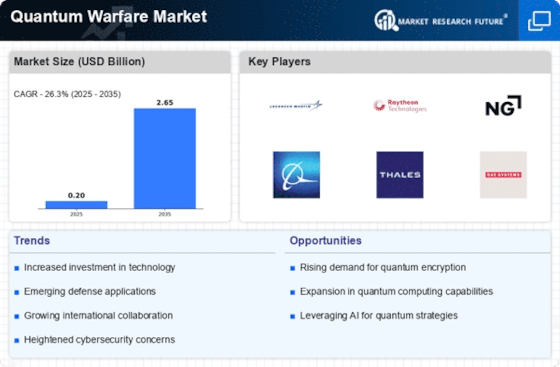
As per Market Research Future analysis, the Quantum Warfare Market Size was estimated at 0.2033 USD Billion in 2024. The Quantum Warfare industry is projected to grow from USD 0.2568 Billion in 2025 to USD 2.653 Billion by 2035, exhibiting a compound annual growth rate (CAGR) of 26.3% during the forecast period 2025 - 2035

Key Market Trends & Highlights

The Quantum Warfare Market is poised for substantial growth driven by technological advancements and geopolitical dynamics.

  • North America remains the largest market for quantum warfare technologies, reflecting its robust investment in quantum research.
  • The Asia-Pacific region is emerging as the fastest-growing market, fueled by increasing defense budgets and technological innovation.
  • The land segment dominates the market, while the airborne segment is experiencing rapid growth due to evolving military strategies.
  • Advancements in quantum computing and emerging threats in cyber warfare are key drivers propelling market expansion.

Market Size & Forecast

2024 Market Size 0.2033 (USD Billion)
2035 Market Size 2.653 (USD Billion)
CAGR (2025 - 2035) 26.3%
Largest Regional Market Share in 2024 North America

Major Players

Lockheed Martin (US), Raytheon Technologies (US), Northrop Grumman (US), Boeing (US), Thales Group (FR), BAE Systems (GB), General Dynamics (US), L3Harris Technologies (US), Leonardo S.p.A. (IT)

Market Trends

The Quantum Warfare Market is currently experiencing a transformative phase, driven by advancements in quantum computing and its implications for national security. As nations invest heavily in research and development, the landscape of warfare is evolving, with quantum technologies promising to enhance capabilities in communication, cryptography, and surveillance. This shift indicates a growing recognition of the strategic importance of quantum technologies in maintaining a competitive edge. Furthermore, the integration of artificial intelligence with quantum systems appears to be a focal point, potentially revolutionizing decision-making processes in military operations. In addition to technological advancements, geopolitical tensions are likely to influence the trajectory of the Quantum Warfare Market. Countries are increasingly aware of the potential vulnerabilities associated with quantum technologies, leading to a surge in protective measures and countermeasures. This dynamic environment suggests that the market will continue to expand as nations seek to secure their interests and safeguard against emerging threats. The interplay between innovation and security concerns may shape the future of warfare, making the Quantum Warfare Market a critical area of focus for policymakers and defense strategists alike.

Increased Investment in Quantum Research

Nations are allocating substantial resources towards quantum research initiatives, recognizing the strategic advantages that quantum technologies can provide in military applications. This trend reflects a broader commitment to enhancing national security through cutting-edge innovations.

Integration of AI and Quantum Technologies

The convergence of artificial intelligence with quantum computing is becoming increasingly prominent, as military organizations explore ways to leverage these technologies for improved operational efficiency and decision-making. This integration may lead to unprecedented advancements in warfare capabilities.

Focus on Cybersecurity and Quantum Resilience

As quantum technologies advance, there is a heightened emphasis on developing robust cybersecurity measures to protect sensitive information. This trend underscores the necessity for nations to adapt their defense strategies in response to the unique challenges posed by quantum computing.

Quantum Warfare Market Market Drivers

Advancements in Quantum Computing

The Quantum Warfare Market is experiencing a surge in advancements in quantum computing technologies. These innovations are pivotal in enhancing computational capabilities, enabling faster data processing and complex problem-solving. As nations invest heavily in quantum research, the market is projected to grow significantly, with estimates suggesting a compound annual growth rate of over 25% in the coming years. This growth is driven by the need for superior military applications, including cryptography and secure communications. The integration of quantum computing into defense strategies is likely to redefine operational capabilities, making it a critical area of focus for military organizations worldwide.

Emerging Threats in Cyber Warfare

The Quantum Warfare Market is increasingly influenced by the emergence of sophisticated cyber threats. As adversaries develop advanced cyber capabilities, the demand for quantum technologies that can counteract these threats is rising. Quantum encryption methods, which leverage the principles of quantum mechanics, offer unprecedented security measures that traditional systems cannot match. This shift is reflected in defense budgets, with a notable increase in allocations for quantum cybersecurity initiatives. The urgency to protect sensitive information and critical infrastructure from cyber attacks is propelling investments in quantum solutions, thereby shaping the future landscape of military operations.

Regulatory Frameworks and Standards

The Quantum Warfare Market is also influenced by the development of regulatory frameworks and standards governing quantum technologies. As the market matures, the establishment of clear guidelines is essential to ensure the safe and ethical use of quantum capabilities in warfare. Governments are actively working to create policies that address the unique challenges posed by quantum technologies, including issues related to security, privacy, and international cooperation. The formulation of these regulations is likely to impact investment decisions and the pace of innovation within the Quantum Warfare Market. A robust regulatory environment may foster trust and encourage broader adoption of quantum solutions in military applications.

International Arms Race in Quantum Technologies

The Quantum Warfare Market is witnessing an international arms race as countries strive to gain a competitive edge in quantum technologies. This race is characterized by significant investments in research and development, with nations recognizing the strategic importance of quantum capabilities in warfare. Reports indicate that defense spending on quantum technologies is expected to reach billions of dollars in the next decade. The pursuit of quantum supremacy is not merely a technological endeavor; it is a matter of national security. As countries enhance their quantum arsenals, the implications for global stability and military strategy are profound, necessitating a reevaluation of defense policies.

Collaboration Between Public and Private Sectors

The Quantum Warfare Market is increasingly shaped by collaboration between public and private sectors. Governments are partnering with private enterprises to accelerate the development of quantum technologies, recognizing that innovation often stems from the private sector. This collaboration is fostering a vibrant ecosystem for quantum research, leading to breakthroughs that enhance military capabilities. The establishment of public-private partnerships is likely to streamline funding and resources, enabling faster deployment of quantum solutions in defense applications. As these partnerships evolve, they may redefine the landscape of the Quantum Warfare Market, creating new opportunities for technological advancements.

Market Segment Insights

By Application: Land (Largest) vs. Airborne (Fastest-Growing)

<p>The Quantum Warfare Market displays a diverse application landscape, with the Land segment leading in market share due to its extensive integration within military operations. The Land application encompasses ground forces utilizing quantum technologies for their strategic advantages and enhanced operational capabilities. Following this, the Naval and Airborne segments are also significant, with the Naval segment benefiting from advancements in stealth and surveillance technologies. Meanwhile, the Space-Based segment is gradually gaining traction as nations explore quantum solutions for space security and communications.</p>

<p>Application: Land (Dominant) vs. Airborne (Emerging)</p>

<p>The Land application of the Quantum Warfare Market stands out as the dominant force, largely due to its pivotal role in ground-based military operations where quantum technologies enhance situational awareness and decision-making processes. As countries modernize their armed forces, the focus on quantum capabilities for land operations intensifies. On the other hand, the Airborne application is emerging rapidly, fueled by the increasing need for advanced aerial systems that leverage <a href="https://www.marketresearchfuture.com/reports/quantum-communication-market-12240" target="_blank" title="quantum communication">quantum communication</a> and encryption to secure airspace. This segment is characterized by ongoing research and development, making it one of the fastest-growing segments in the market as nations seek superiority in aerial combat through innovative quantum solutions.</p>

By Quantum Computing and Simulations: Digital Quantum Computer (Largest) vs. Analog Quantum Computer (Fastest-Growing)

<p>Within the Quantum Computing and Simulations segment, the Digital Quantum Computer holds a significant market share, being the most widely adopted technology among military and defense sectors due to its advanced computational capabilities. In contrast, the Analog Quantum Computer, while currently a smaller segment, is rapidly gaining traction, driven by unique applications in specific quantum warfare scenarios that demand real-time data processing and fast simulations.</p>

<p>Digital Quantum Computer (Dominant) vs. Analog Quantum Computer (Emerging)</p>

<p>The Digital Quantum Computer stands out as the dominant force in the quantum computing arena, featuring advanced qubit technologies that allow for unparalleled processing power and precision in simulations required for modern warfare applications. Conversely, the Analog Quantum Computer is emerging as a promising alternative for specific tasks, particularly in scenarios requiring swift, continuous computations. It excels in simulating quantum systems, making it invaluable for strategic planning in quantum warfare. The differentiation in applications between these two technologies suggests that while digital remains a mainstay, analog's growth could redefine operational paradigms in the coming years.</p>

By Quantum Communication: Quantum Network and Communication (Largest) vs. Post-Quantum Cryptography (Fastest-Growing)

<p>In the Quantum Warfare Market, the Quantum Network and Communication segment holds the largest market share, attributed to its foundational role in establishing secure communication channels and enabling real-time data processing. As defense organizations increasingly prioritize secure data transfer, this segment secures a dominant position, catering to military needs and operational efficiency, which further reinforces its market presence. Conversely, Post-Quantum Cryptography is emerging rapidly as a vital component to counteract threats posed by quantum computing advancements. This segment experiences growth driven by the need for enhanced encryption methods that can withstand potential vulnerabilities introduced by quantum technologies. As concerns regarding traditional cryptographic systems intensify, investments in post-quantum solutions are expected to surge, indicating its promising trajectory in the market.</p>

<p>Quantum Network and Communication (Dominant) vs. Post-Quantum Cryptography (Emerging)</p>

<p>Within the Quantum Warfare Market, Quantum Network and Communication stands out as the dominant segment, playing a crucial role in safeguarding sensitive <a href="https://www.marketresearchfuture.com/reports/military-communication-market-11064" target="_blank" title="military communication">military communications</a> through advanced quantum technologies. This segment capitalizes on the urgency for secure data channels, fostering enhanced situational awareness and operational responsiveness for defense forces. On the other hand, Post-Quantum Cryptography emerges as a critical response to the impending challenges posed by quantum computing, aiming to develop encryption methods that resist potential quantum attacks. Its fast-growing nature is linked to ongoing research and development, governmental support, and increasing realization of future security needs, positioning it as a key focus area for investment and technological advancement in the defense sector.</p>

By Quantum PNT: Navigation (Largest) vs. Precision Timing (Fastest-Growing)

<p>In the Quantum Warfare Market, the Quantum PNT segment is witnessing a dynamic distribution of market share among its key components. Navigation stands out as the largest segment, driven by significant investments in quantum-enhanced technologies that promise unparalleled accuracy and reliability. Precision Timing, while smaller in share, is rapidly gaining traction due to its critical role in synchronizing operations and enhancing overall performance in military applications. It emphasizes the importance of precise timing in complex coordinated missions, making it an essential element in modern warfare tactics.</p>

<p>Navigation (Dominant) vs. Precision Timing (Emerging)</p>

<p>Navigation is currently the dominant player within the Quantum PNT segment, leveraging advanced quantum technologies to enhance situational awareness and tactical precision. It plays a crucial role in military operations by providing real-time data that improves strategic decision-making. On the other hand, Precision Timing is emerging as a critical component, driven by the increasing reliance on synchronized operations across various platforms. Its capacity to provide ultra-accurate time references enables soldiers and systems to operate more cohesively, thereby eliminating vulnerabilities or discrepancies in communication and engagement protocols. As technology progresses, both segments are likely to evolve, with Precision Timing gaining prominence in future military strategy.</p>

By Quantum Component: Sensor (Largest) vs. Antenna (Fastest-Growing)

<p>The Quantum Warfare Market presents a diverse array of components, with sensors holding the largest market share. Their capability to detect and respond to various quantum threats establishes them as essential tools in modern warfare strategies. Antennas, on the other hand, are emerging rapidly, fueled by advancements that enhance their operational range and reliability. As military forces increasingly adopt quantum technology, these components are becoming pivotal in ensuring strategic advantage. The growth trends in the Quantum Component segment demonstrate a strong inclination towards innovative solutions that leverage quantum mechanics for improved performance. Drivers for this growth include heightened security concerns and the demand for real-time data processing capabilities in defensive systems. Antennas are particularly poised for expansion as the integration of quantum technologies evolves, presenting opportunities for companies to invest in and develop cutting-edge solutions.</p>

<p>Sensor (Dominant) vs. Antenna (Emerging)</p>

<p>In the Quantum Warfare Market, sensors are recognized as the dominant force, integral to the detection and response framework necessary for counteracting quantum threats. Their advanced technology enables unparalleled accuracy and sensitivity, essential for contemporary military applications. Meanwhile, antennas, though currently emerging, are gaining traction due to rapid developments in signal processing and miniaturization. This technological evolution is critical as it allows for the deployment of antennas in various platforms, maintaining communication superiority in complex operational environments. As both segments evolve, their interplay will likely redefine quantum engagement strategies, making continuous innovation vital to maintain a competitive edge in the market.</p>

Get more detailed insights about Quantum Warfare Market Research Report – Forecast till 2035

Regional Insights

North America : Defense Innovation Leader

North America is the largest market for quantum warfare, holding approximately 60% of the global share. The region's growth is driven by significant investments in defense technology, government initiatives, and a robust research ecosystem. The U.S. Department of Defense is actively pursuing quantum technologies, which are seen as critical for maintaining national security and technological superiority. Regulatory support and funding for quantum research are also key catalysts for market expansion. The United States is the leading country in this sector, with major players like Lockheed Martin, Raytheon Technologies, and Northrop Grumman spearheading advancements. The competitive landscape is characterized by a focus on innovation and collaboration between private companies and government agencies. This synergy fosters a dynamic environment for the development of quantum warfare technologies, ensuring that North America remains at the forefront of this emerging field.

Europe : Emerging Quantum Powerhouse

Europe is rapidly emerging as a significant player in the quantum warfare market, holding around 25% of the global share. The region's growth is fueled by increasing defense budgets, collaborative research initiatives, and a focus on technological sovereignty. The European Union has launched several programs aimed at enhancing quantum capabilities, which serve as regulatory catalysts for market growth. Countries like France and Germany are leading the charge in developing quantum technologies for defense applications. Key players in Europe include Thales Group and BAE Systems, which are actively involved in research and development. The competitive landscape is marked by partnerships between governments and private firms, fostering innovation and accelerating the deployment of quantum solutions. As European nations prioritize defense technology, the market is expected to expand significantly, driven by both national security concerns and technological advancements.

Asia-Pacific : Rapidly Advancing Technologies

Asia-Pacific is witnessing rapid advancements in the quantum warfare market, accounting for approximately 10% of the global share. The region's growth is driven by increasing military modernization efforts, government investments in research, and a focus on technological innovation. Countries like China and India are at the forefront, with significant funding allocated to quantum research and development. Regulatory frameworks are evolving to support these initiatives, further catalyzing market growth. China is leading the charge in quantum technology, with substantial investments from both the government and private sector. The competitive landscape features a mix of state-owned enterprises and private companies, all vying for a share of the burgeoning market. As nations in the Asia-Pacific region prioritize quantum warfare capabilities, the market is expected to grow, driven by both strategic imperatives and technological advancements.

Middle East and Africa : Emerging Defense Technologies

The Middle East and Africa are gradually entering the quantum warfare market, holding about 5% of the global share. The region's growth is primarily driven by increasing defense spending and a focus on modernizing military capabilities. Countries like the UAE and South Africa are investing in quantum technologies, supported by government initiatives aimed at enhancing national security. Regulatory frameworks are being developed to facilitate research and development in this area, which is crucial for market expansion. The competitive landscape in this region is still developing, with a few key players beginning to emerge. Local governments are collaborating with international firms to leverage expertise in quantum technologies. As the region continues to invest in defense innovation, the quantum warfare market is expected to grow, driven by both geopolitical considerations and technological advancements.

Key Players and Competitive Insights

Leading market players are investing heavily in research and development in order to expand their product lines, which will help the Quantum Warfare Market (QW) market, grow even more. Market participants are also undertaking a variety of strategic activities to expand their global footprint, with important market developments including new product launches, contractual agreements, mergers and acquisitions, higher investments, and collaboration with other organizations. To expand and survive in a more competitive and rising market climate, Quantum Warfare Market (QW) industry must offer cost-effective items.
Manufacturing locally to minimize operational costs is one of the key business tactics used by manufacturers in the global Quantum Warfare Market (QW) industry to benefit clients and increase the market sector. In recent years, the Quantum Warfare Market (QW) industry has offered some of the most significant advantages to medicine. Major players in the Quantum Warfare Market (QW) market, including Xanadu, Airbus, D-Wave Quantum Inc., Quantinuum Ltd., Infleqtion, IonQ, Inc., Quantum Computing Inc. (QCi), Rigetti & Co, LLC., Zapata Computing, IBM and others, are attempting to increase market demand by investing in research and development operations.
Xanadu is a pioneering player in the Quantum Warfare Market (QW) market with an emphasis on cutting-edge quantum computing technologies for military purposes. Xanadu creates quantum-resistant encryption technologies, cutting-edge quantum sensors, and quantum algorithms to bolster national security and defence capabilities by utilising quantum computing's enormous computational capacity and cryptographic benefits. The diverse team at Xanadu is committed to staying on the cutting edge of QW research and is focused on addressing new threats and improving military operations by utilising the revolutionary potential of quantum technology.
D-Wave Quantum Inc., a key player in the quantum warfare (QW) sector, specialises in quantum computing systems and solutions intended for military applications. With its unmatched processing speed, D-Wave's quantum annealing technology enables the complicated simulations, optimisation, and data analysis necessary for QW. Their technologies have the capacity to solve issues that were previously insurmountable quickly, revolutionising cryptography, intelligence analysis, and mission planning.
D-Wave's dedication to developing quantum technology for defence and security applications places them in a unique position to make significant contributions to the emerging field of quantum warfare and guarantee that armed forces have access to the cutting-edge equipment required to maintain a competitive advantage..

Key Companies in the Quantum Warfare Market include

Industry Developments

September 2022: Rigetti Computing Inc. unveiled Rigetti QCSTM in Public Preview in conjunction with Microsoft's Azure Quantum platform. This solution has access to Microsoft's processor through the company's public cloud, allowing users to advance their quantum computing capabilities and deal with a variety of challenges.

July 2022: CryptoNext Security SAS, a post-quantum cryptography company, collaborated with ID Quantique. Through this partnership, the company provides mobile phone consumers with a reliable and ongoing quantum-safe communication option.

Future Outlook

Quantum Warfare Market Future Outlook

The Quantum Warfare Market is projected to grow at a 26.3% CAGR from 2025 to 2035, driven by advancements in <a href="https://www.marketresearchfuture.com/reports/quantum-computing-market-2583" target="_blank" title="quantum computing">quantum computing</a>, increased defense budgets, and rising cybersecurity threats.

New opportunities lie in:

  • Development of quantum encryption solutions for secure military communications.
  • Investment in quantum radar technology for enhanced surveillance capabilities.
  • Creation of quantum simulation platforms for advanced military training and strategy development.

By 2035, the Quantum Warfare Market is expected to be a pivotal sector in global defense strategies.

Market Segmentation

Quantum Warfare Market Application Outlook

  • Land
  • Naval
  • Airborne
  • Space-Based

Quantum Warfare Market Quantum PNT Outlook

  • Navigation
  • Positioning
  • Precision Timing
  • Geolocation

Quantum Warfare Market Quantum Component Outlook

  • Sensor
  • Antenna
  • Radar
  • Clock
  • Magnetometer
  • Others

Quantum Warfare Market Quantum Communication Outlook

  • Quantum Network and Communication
  • Post-Quantum Cryptography

Quantum Warfare Market Quantum Computing and Simulations Outlook

  • Digital Quantum Computer
  • Analog Quantum Computer
  • Quantum Simulator

Report Scope

MARKET SIZE 2024 0.2033(USD Billion)
MARKET SIZE 2025 0.2568(USD Billion)
MARKET SIZE 2035 2.653(USD Billion)
COMPOUND ANNUAL GROWTH RATE (CAGR) 26.3% (2025 - 2035)
REPORT COVERAGE Revenue Forecast, Competitive Landscape, Growth Factors, and Trends
BASE YEAR 2024
Market Forecast Period 2025 - 2035
Historical Data 2019 - 2024
Market Forecast Units USD Billion
Key Companies Profiled Lockheed Martin (US), Raytheon Technologies (US), Northrop Grumman (US), Boeing (US), Thales Group (FR), BAE Systems (GB), General Dynamics (US), L3Harris Technologies (US), Leonardo S.p.A. (IT)
Segments Covered Application, Region
Key Market Opportunities Advancements in quantum encryption technologies enhance secure communications in the Quantum Warfare Market.
Key Market Dynamics Technological advancements in quantum computing drive competitive dynamics and regulatory scrutiny in the Quantum Warfare Market.
Countries Covered North America, Europe, APAC, South America, MEA

FAQs

What is the projected market valuation of the Quantum Warfare Market by 2035?

<p>The Quantum Warfare Market is projected to reach a valuation of 2.653 USD Billion by 2035.</p>

What was the market valuation of the Quantum Warfare Market in 2024?

<p>In 2024, the Quantum Warfare Market had a valuation of 0.2033 USD Billion.</p>

What is the expected CAGR for the Quantum Warfare Market during the forecast period 2025 - 2035?

<p>The expected CAGR for the Quantum Warfare Market during the forecast period 2025 - 2035 is 26.3%.</p>

Which companies are considered key players in the Quantum Warfare Market?

<p>Key players in the Quantum Warfare Market include Lockheed Martin, Raytheon Technologies, Northrop Grumman, Boeing, Thales Group, BAE Systems, General Dynamics, L3Harris Technologies, and Leonardo S.p.A.</p>

What are the main application segments of the Quantum Warfare Market?

<p>The main application segments of the Quantum Warfare Market include Land, Naval, Airborne, and Space-Based applications.</p>

How does the Quantum Communication segment perform in terms of market valuation?

<p>The Quantum Communication segment is expected to grow from 0.1 USD Billion in 2024 to 1.2 USD Billion by 2035.</p>

What is the projected growth for the Quantum Computing and Simulations segment?

The Quantum Computing and Simulations segment is anticipated to increase from 0.061 USD Billion in 2024 to 1.187 USD Billion by 2035.

What are the expected valuations for Quantum PNT applications by 2035?

By 2035, Quantum PNT applications are projected to reach valuations of 0.65 USD Billion for Navigation, 0.75 USD Billion for Positioning, 0.85 USD Billion for Precision Timing, and 0.95 USD Billion for Geolocation.

What is the expected performance of the Quantum Component segment?

The Quantum Component segment is likely to grow from 0.05 USD Billion in 2024 to 0.65 USD Billion by 2035 for Sensors, and from 0.03 USD Billion to 0.45 USD Billion for Antennas.

How does the market growth of Quantum Warfare compare to traditional defense sectors?

The rapid growth of the Quantum Warfare Market, with a projected CAGR of 26.3%, suggests a potential shift in defense investments towards advanced quantum technologies compared to traditional sectors.

  1. SECTION I: EXECUTIVE SUMMARY AND KEY HIGHLIGHTS
    1. | 1.1 EXECUTIVE SUMMARY
    2. | | 1.1.1 Market Overview
    3. | | 1.1.2 Key Findings
    4. | | 1.1.3 Market Segmentation
    5. | | 1.1.4 Competitive Landscape
    6. | | 1.1.5 Challenges and Opportunities
    7. | | 1.1.6 Future Outlook
  2. SECTION II: SCOPING, METHODOLOGY AND MARKET STRUCTURE
    1. | 2.1 MARKET INTRODUCTION
    2. | | 2.1.1 Definition
    3. | | 2.1.2 Scope of the study
    4. | | | 2.1.2.1 Research Objective
    5. | | | 2.1.2.2 Assumption
    6. | | | 2.1.2.3 Limitations
    7. | 2.2 RESEARCH METHODOLOGY
    8. | | 2.2.1 Overview
    9. | | 2.2.2 Data Mining
    10. | | 2.2.3 Secondary Research
    11. | | 2.2.4 Primary Research
    12. | | | 2.2.4.1 Primary Interviews and Information Gathering Process
    13. | | | 2.2.4.2 Breakdown of Primary Respondents
    14. | | 2.2.5 Forecasting Model
    15. | | 2.2.6 Market Size Estimation
    16. | | | 2.2.6.1 Bottom-Up Approach
    17. | | | 2.2.6.2 Top-Down Approach
    18. | | 2.2.7 Data Triangulation
    19. | | 2.2.8 Validation
  3. SECTION III: QUALITATIVE ANALYSIS
    1. | 3.1 MARKET DYNAMICS
    2. | | 3.1.1 Overview
    3. | | 3.1.2 Drivers
    4. | | 3.1.3 Restraints
    5. | | 3.1.4 Opportunities
    6. | 3.2 MARKET FACTOR ANALYSIS
    7. | | 3.2.1 Value chain Analysis
    8. | | 3.2.2 Porter's Five Forces Analysis
    9. | | | 3.2.2.1 Bargaining Power of Suppliers
    10. | | | 3.2.2.2 Bargaining Power of Buyers
    11. | | | 3.2.2.3 Threat of New Entrants
    12. | | | 3.2.2.4 Threat of Substitutes
    13. | | | 3.2.2.5 Intensity of Rivalry
    14. | | 3.2.3 COVID-19 Impact Analysis
    15. | | | 3.2.3.1 Market Impact Analysis
    16. | | | 3.2.3.2 Regional Impact
    17. | | | 3.2.3.3 Opportunity and Threat Analysis
  4. SECTION IV: QUANTITATIVE ANALYSIS
    1. | 4.1 Information and Communications Technology, BY Application (USD Billion)
    2. | | 4.1.1 Land
    3. | | 4.1.2 Naval
    4. | | 4.1.3 Airborne
    5. | | 4.1.4 Space-Based
    6. | 4.2 Information and Communications Technology, BY Quantum Computing and Simulations (USD Billion)
    7. | | 4.2.1 Digital Quantum Computer
    8. | | 4.2.2 Analog Quantum Computer
    9. | | 4.2.3 Quantum Simulator
    10. | 4.3 Information and Communications Technology, BY Quantum Communication (USD Billion)
    11. | | 4.3.1 Quantum Network and Communication
    12. | | 4.3.2 Post-Quantum Cryptography
    13. | 4.4 Information and Communications Technology, BY Quantum PNT (USD Billion)
    14. | | 4.4.1 Navigation
    15. | | 4.4.2 Positioning
    16. | | 4.4.3 Precision Timing
    17. | | 4.4.4 Geolocation
    18. | 4.5 Information and Communications Technology, BY Quantum Component (USD Billion)
    19. | | 4.5.1 Sensor
    20. | | 4.5.2 Antenna
    21. | | 4.5.3 Radar
    22. | | 4.5.4 Clock
    23. | | 4.5.5 Magnetometer
    24. | | 4.5.6 Others
    25. | 4.6 Information and Communications Technology, BY Region (USD Billion)
    26. | | 4.6.1 North America
    27. | | | 4.6.1.1 US
    28. | | | 4.6.1.2 Canada
    29. | | 4.6.2 Europe
    30. | | | 4.6.2.1 Germany
    31. | | | 4.6.2.2 UK
    32. | | | 4.6.2.3 France
    33. | | | 4.6.2.4 Russia
    34. | | | 4.6.2.5 Italy
    35. | | | 4.6.2.6 Spain
    36. | | | 4.6.2.7 Rest of Europe
    37. | | 4.6.3 APAC
    38. | | | 4.6.3.1 China
    39. | | | 4.6.3.2 India
    40. | | | 4.6.3.3 Japan
    41. | | | 4.6.3.4 South Korea
    42. | | | 4.6.3.5 Malaysia
    43. | | | 4.6.3.6 Thailand
    44. | | | 4.6.3.7 Indonesia
    45. | | | 4.6.3.8 Rest of APAC
    46. | | 4.6.4 South America
    47. | | | 4.6.4.1 Brazil
    48. | | | 4.6.4.2 Mexico
    49. | | | 4.6.4.3 Argentina
    50. | | | 4.6.4.4 Rest of South America
    51. | | 4.6.5 MEA
    52. | | | 4.6.5.1 GCC Countries
    53. | | | 4.6.5.2 South Africa
    54. | | | 4.6.5.3 Rest of MEA
  5. SECTION V: COMPETITIVE ANALYSIS
    1. | 5.1 Competitive Landscape
    2. | | 5.1.1 Overview
    3. | | 5.1.2 Competitive Analysis
    4. | | 5.1.3 Market share Analysis
    5. | | 5.1.4 Major Growth Strategy in the Information and Communications Technology
    6. | | 5.1.5 Competitive Benchmarking
    7. | | 5.1.6 Leading Players in Terms of Number of Developments in the Information and Communications Technology
    8. | | 5.1.7 Key developments and growth strategies
    9. | | | 5.1.7.1 New Product Launch/Service Deployment
    10. | | | 5.1.7.2 Merger & Acquisitions
    11. | | | 5.1.7.3 Joint Ventures
    12. | | 5.1.8 Major Players Financial Matrix
    13. | | | 5.1.8.1 Sales and Operating Income
    14. | | | 5.1.8.2 Major Players R&D Expenditure. 2023
    15. | 5.2 Company Profiles
    16. | | 5.2.1 Lockheed Martin (US)
    17. | | | 5.2.1.1 Financial Overview
    18. | | | 5.2.1.2 Products Offered
    19. | | | 5.2.1.3 Key Developments
    20. | | | 5.2.1.4 SWOT Analysis
    21. | | | 5.2.1.5 Key Strategies
    22. | | 5.2.2 Raytheon Technologies (US)
    23. | | | 5.2.2.1 Financial Overview
    24. | | | 5.2.2.2 Products Offered
    25. | | | 5.2.2.3 Key Developments
    26. | | | 5.2.2.4 SWOT Analysis
    27. | | | 5.2.2.5 Key Strategies
    28. | | 5.2.3 Northrop Grumman (US)
    29. | | | 5.2.3.1 Financial Overview
    30. | | | 5.2.3.2 Products Offered
    31. | | | 5.2.3.3 Key Developments
    32. | | | 5.2.3.4 SWOT Analysis
    33. | | | 5.2.3.5 Key Strategies
    34. | | 5.2.4 Boeing (US)
    35. | | | 5.2.4.1 Financial Overview
    36. | | | 5.2.4.2 Products Offered
    37. | | | 5.2.4.3 Key Developments
    38. | | | 5.2.4.4 SWOT Analysis
    39. | | | 5.2.4.5 Key Strategies
    40. | | 5.2.5 Thales Group (FR)
    41. | | | 5.2.5.1 Financial Overview
    42. | | | 5.2.5.2 Products Offered
    43. | | | 5.2.5.3 Key Developments
    44. | | | 5.2.5.4 SWOT Analysis
    45. | | | 5.2.5.5 Key Strategies
    46. | | 5.2.6 BAE Systems (GB)
    47. | | | 5.2.6.1 Financial Overview
    48. | | | 5.2.6.2 Products Offered
    49. | | | 5.2.6.3 Key Developments
    50. | | | 5.2.6.4 SWOT Analysis
    51. | | | 5.2.6.5 Key Strategies
    52. | | 5.2.7 General Dynamics (US)
    53. | | | 5.2.7.1 Financial Overview
    54. | | | 5.2.7.2 Products Offered
    55. | | | 5.2.7.3 Key Developments
    56. | | | 5.2.7.4 SWOT Analysis
    57. | | | 5.2.7.5 Key Strategies
    58. | | 5.2.8 L3Harris Technologies (US)
    59. | | | 5.2.8.1 Financial Overview
    60. | | | 5.2.8.2 Products Offered
    61. | | | 5.2.8.3 Key Developments
    62. | | | 5.2.8.4 SWOT Analysis
    63. | | | 5.2.8.5 Key Strategies
    64. | | 5.2.9 Leonardo S.p.A. (IT)
    65. | | | 5.2.9.1 Financial Overview
    66. | | | 5.2.9.2 Products Offered
    67. | | | 5.2.9.3 Key Developments
    68. | | | 5.2.9.4 SWOT Analysis
    69. | | | 5.2.9.5 Key Strategies
    70. | 5.3 Appendix
    71. | | 5.3.1 References
    72. | | 5.3.2 Related Reports
  6. LIST OF FIGURES
    1. | 6.1 MARKET SYNOPSIS
    2. | 6.2 NORTH AMERICA MARKET ANALYSIS
    3. | 6.3 US MARKET ANALYSIS BY APPLICATION
    4. | 6.4 US MARKET ANALYSIS BY QUANTUM COMPUTING AND SIMULATIONS
    5. | 6.5 US MARKET ANALYSIS BY QUANTUM COMMUNICATION
    6. | 6.6 US MARKET ANALYSIS BY QUANTUM PNT
    7. | 6.7 US MARKET ANALYSIS BY QUANTUM COMPONENT
    8. | 6.8 CANADA MARKET ANALYSIS BY APPLICATION
    9. | 6.9 CANADA MARKET ANALYSIS BY QUANTUM COMPUTING AND SIMULATIONS
    10. | 6.10 CANADA MARKET ANALYSIS BY QUANTUM COMMUNICATION
    11. | 6.11 CANADA MARKET ANALYSIS BY QUANTUM PNT
    12. | 6.12 CANADA MARKET ANALYSIS BY QUANTUM COMPONENT
    13. | 6.13 EUROPE MARKET ANALYSIS
    14. | 6.14 GERMANY MARKET ANALYSIS BY APPLICATION
    15. | 6.15 GERMANY MARKET ANALYSIS BY QUANTUM COMPUTING AND SIMULATIONS
    16. | 6.16 GERMANY MARKET ANALYSIS BY QUANTUM COMMUNICATION
    17. | 6.17 GERMANY MARKET ANALYSIS BY QUANTUM PNT
    18. | 6.18 GERMANY MARKET ANALYSIS BY QUANTUM COMPONENT
    19. | 6.19 UK MARKET ANALYSIS BY APPLICATION
    20. | 6.20 UK MARKET ANALYSIS BY QUANTUM COMPUTING AND SIMULATIONS
    21. | 6.21 UK MARKET ANALYSIS BY QUANTUM COMMUNICATION
    22. | 6.22 UK MARKET ANALYSIS BY QUANTUM PNT
    23. | 6.23 UK MARKET ANALYSIS BY QUANTUM COMPONENT
    24. | 6.24 FRANCE MARKET ANALYSIS BY APPLICATION
    25. | 6.25 FRANCE MARKET ANALYSIS BY QUANTUM COMPUTING AND SIMULATIONS
    26. | 6.26 FRANCE MARKET ANALYSIS BY QUANTUM COMMUNICATION
    27. | 6.27 FRANCE MARKET ANALYSIS BY QUANTUM PNT
    28. | 6.28 FRANCE MARKET ANALYSIS BY QUANTUM COMPONENT
    29. | 6.29 RUSSIA MARKET ANALYSIS BY APPLICATION
    30. | 6.30 RUSSIA MARKET ANALYSIS BY QUANTUM COMPUTING AND SIMULATIONS
    31. | 6.31 RUSSIA MARKET ANALYSIS BY QUANTUM COMMUNICATION
    32. | 6.32 RUSSIA MARKET ANALYSIS BY QUANTUM PNT
    33. | 6.33 RUSSIA MARKET ANALYSIS BY QUANTUM COMPONENT
    34. | 6.34 ITALY MARKET ANALYSIS BY APPLICATION
    35. | 6.35 ITALY MARKET ANALYSIS BY QUANTUM COMPUTING AND SIMULATIONS
    36. | 6.36 ITALY MARKET ANALYSIS BY QUANTUM COMMUNICATION
    37. | 6.37 ITALY MARKET ANALYSIS BY QUANTUM PNT
    38. | 6.38 ITALY MARKET ANALYSIS BY QUANTUM COMPONENT
    39. | 6.39 SPAIN MARKET ANALYSIS BY APPLICATION
    40. | 6.40 SPAIN MARKET ANALYSIS BY QUANTUM COMPUTING AND SIMULATIONS
    41. | 6.41 SPAIN MARKET ANALYSIS BY QUANTUM COMMUNICATION
    42. | 6.42 SPAIN MARKET ANALYSIS BY QUANTUM PNT
    43. | 6.43 SPAIN MARKET ANALYSIS BY QUANTUM COMPONENT
    44. | 6.44 REST OF EUROPE MARKET ANALYSIS BY APPLICATION
    45. | 6.45 REST OF EUROPE MARKET ANALYSIS BY QUANTUM COMPUTING AND SIMULATIONS
    46. | 6.46 REST OF EUROPE MARKET ANALYSIS BY QUANTUM COMMUNICATION
    47. | 6.47 REST OF EUROPE MARKET ANALYSIS BY QUANTUM PNT
    48. | 6.48 REST OF EUROPE MARKET ANALYSIS BY QUANTUM COMPONENT
    49. | 6.49 APAC MARKET ANALYSIS
    50. | 6.50 CHINA MARKET ANALYSIS BY APPLICATION
    51. | 6.51 CHINA MARKET ANALYSIS BY QUANTUM COMPUTING AND SIMULATIONS
    52. | 6.52 CHINA MARKET ANALYSIS BY QUANTUM COMMUNICATION
    53. | 6.53 CHINA MARKET ANALYSIS BY QUANTUM PNT
    54. | 6.54 CHINA MARKET ANALYSIS BY QUANTUM COMPONENT
    55. | 6.55 INDIA MARKET ANALYSIS BY APPLICATION
    56. | 6.56 INDIA MARKET ANALYSIS BY QUANTUM COMPUTING AND SIMULATIONS
    57. | 6.57 INDIA MARKET ANALYSIS BY QUANTUM COMMUNICATION
    58. | 6.58 INDIA MARKET ANALYSIS BY QUANTUM PNT
    59. | 6.59 INDIA MARKET ANALYSIS BY QUANTUM COMPONENT
    60. | 6.60 JAPAN MARKET ANALYSIS BY APPLICATION
    61. | 6.61 JAPAN MARKET ANALYSIS BY QUANTUM COMPUTING AND SIMULATIONS
    62. | 6.62 JAPAN MARKET ANALYSIS BY QUANTUM COMMUNICATION
    63. | 6.63 JAPAN MARKET ANALYSIS BY QUANTUM PNT
    64. | 6.64 JAPAN MARKET ANALYSIS BY QUANTUM COMPONENT
    65. | 6.65 SOUTH KOREA MARKET ANALYSIS BY APPLICATION
    66. | 6.66 SOUTH KOREA MARKET ANALYSIS BY QUANTUM COMPUTING AND SIMULATIONS
    67. | 6.67 SOUTH KOREA MARKET ANALYSIS BY QUANTUM COMMUNICATION
    68. | 6.68 SOUTH KOREA MARKET ANALYSIS BY QUANTUM PNT
    69. | 6.69 SOUTH KOREA MARKET ANALYSIS BY QUANTUM COMPONENT
    70. | 6.70 MALAYSIA MARKET ANALYSIS BY APPLICATION
    71. | 6.71 MALAYSIA MARKET ANALYSIS BY QUANTUM COMPUTING AND SIMULATIONS
    72. | 6.72 MALAYSIA MARKET ANALYSIS BY QUANTUM COMMUNICATION
    73. | 6.73 MALAYSIA MARKET ANALYSIS BY QUANTUM PNT
    74. | 6.74 MALAYSIA MARKET ANALYSIS BY QUANTUM COMPONENT
    75. | 6.75 THAILAND MARKET ANALYSIS BY APPLICATION
    76. | 6.76 THAILAND MARKET ANALYSIS BY QUANTUM COMPUTING AND SIMULATIONS
    77. | 6.77 THAILAND MARKET ANALYSIS BY QUANTUM COMMUNICATION
    78. | 6.78 THAILAND MARKET ANALYSIS BY QUANTUM PNT
    79. | 6.79 THAILAND MARKET ANALYSIS BY QUANTUM COMPONENT
    80. | 6.80 INDONESIA MARKET ANALYSIS BY APPLICATION
    81. | 6.81 INDONESIA MARKET ANALYSIS BY QUANTUM COMPUTING AND SIMULATIONS
    82. | 6.82 INDONESIA MARKET ANALYSIS BY QUANTUM COMMUNICATION
    83. | 6.83 INDONESIA MARKET ANALYSIS BY QUANTUM PNT
    84. | 6.84 INDONESIA MARKET ANALYSIS BY QUANTUM COMPONENT
    85. | 6.85 REST OF APAC MARKET ANALYSIS BY APPLICATION
    86. | 6.86 REST OF APAC MARKET ANALYSIS BY QUANTUM COMPUTING AND SIMULATIONS
    87. | 6.87 REST OF APAC MARKET ANALYSIS BY QUANTUM COMMUNICATION
    88. | 6.88 REST OF APAC MARKET ANALYSIS BY QUANTUM PNT
    89. | 6.89 REST OF APAC MARKET ANALYSIS BY QUANTUM COMPONENT
    90. | 6.90 SOUTH AMERICA MARKET ANALYSIS
    91. | 6.91 BRAZIL MARKET ANALYSIS BY APPLICATION
    92. | 6.92 BRAZIL MARKET ANALYSIS BY QUANTUM COMPUTING AND SIMULATIONS
    93. | 6.93 BRAZIL MARKET ANALYSIS BY QUANTUM COMMUNICATION
    94. | 6.94 BRAZIL MARKET ANALYSIS BY QUANTUM PNT
    95. | 6.95 BRAZIL MARKET ANALYSIS BY QUANTUM COMPONENT
    96. | 6.96 MEXICO MARKET ANALYSIS BY APPLICATION
    97. | 6.97 MEXICO MARKET ANALYSIS BY QUANTUM COMPUTING AND SIMULATIONS
    98. | 6.98 MEXICO MARKET ANALYSIS BY QUANTUM COMMUNICATION
    99. | 6.99 MEXICO MARKET ANALYSIS BY QUANTUM PNT
    100. | 6.100 MEXICO MARKET ANALYSIS BY QUANTUM COMPONENT
    101. | 6.101 ARGENTINA MARKET ANALYSIS BY APPLICATION
    102. | 6.102 ARGENTINA MARKET ANALYSIS BY QUANTUM COMPUTING AND SIMULATIONS
    103. | 6.103 ARGENTINA MARKET ANALYSIS BY QUANTUM COMMUNICATION
    104. | 6.104 ARGENTINA MARKET ANALYSIS BY QUANTUM PNT
    105. | 6.105 ARGENTINA MARKET ANALYSIS BY QUANTUM COMPONENT
    106. | 6.106 REST OF SOUTH AMERICA MARKET ANALYSIS BY APPLICATION
    107. | 6.107 REST OF SOUTH AMERICA MARKET ANALYSIS BY QUANTUM COMPUTING AND SIMULATIONS
    108. | 6.108 REST OF SOUTH AMERICA MARKET ANALYSIS BY QUANTUM COMMUNICATION
    109. | 6.109 REST OF SOUTH AMERICA MARKET ANALYSIS BY QUANTUM PNT
    110. | 6.110 REST OF SOUTH AMERICA MARKET ANALYSIS BY QUANTUM COMPONENT
    111. | 6.111 MEA MARKET ANALYSIS
    112. | 6.112 GCC COUNTRIES MARKET ANALYSIS BY APPLICATION
    113. | 6.113 GCC COUNTRIES MARKET ANALYSIS BY QUANTUM COMPUTING AND SIMULATIONS
    114. | 6.114 GCC COUNTRIES MARKET ANALYSIS BY QUANTUM COMMUNICATION
    115. | 6.115 GCC COUNTRIES MARKET ANALYSIS BY QUANTUM PNT
    116. | 6.116 GCC COUNTRIES MARKET ANALYSIS BY QUANTUM COMPONENT
    117. | 6.117 SOUTH AFRICA MARKET ANALYSIS BY APPLICATION
    118. | 6.118 SOUTH AFRICA MARKET ANALYSIS BY QUANTUM COMPUTING AND SIMULATIONS
    119. | 6.119 SOUTH AFRICA MARKET ANALYSIS BY QUANTUM COMMUNICATION
    120. | 6.120 SOUTH AFRICA MARKET ANALYSIS BY QUANTUM PNT
    121. | 6.121 SOUTH AFRICA MARKET ANALYSIS BY QUANTUM COMPONENT
    122. | 6.122 REST OF MEA MARKET ANALYSIS BY APPLICATION
    123. | 6.123 REST OF MEA MARKET ANALYSIS BY QUANTUM COMPUTING AND SIMULATIONS
    124. | 6.124 REST OF MEA MARKET ANALYSIS BY QUANTUM COMMUNICATION
    125. | 6.125 REST OF MEA MARKET ANALYSIS BY QUANTUM PNT
    126. | 6.126 REST OF MEA MARKET ANALYSIS BY QUANTUM COMPONENT
    127. | 6.127 KEY BUYING CRITERIA OF INFORMATION AND COMMUNICATIONS TECHNOLOGY
    128. | 6.128 RESEARCH PROCESS OF MRFR
    129. | 6.129 DRO ANALYSIS OF INFORMATION AND COMMUNICATIONS TECHNOLOGY
    130. | 6.130 DRIVERS IMPACT ANALYSIS: INFORMATION AND COMMUNICATIONS TECHNOLOGY
    131. | 6.131 RESTRAINTS IMPACT ANALYSIS: INFORMATION AND COMMUNICATIONS TECHNOLOGY
    132. | 6.132 SUPPLY / VALUE CHAIN: INFORMATION AND COMMUNICATIONS TECHNOLOGY
    133. | 6.133 INFORMATION AND COMMUNICATIONS TECHNOLOGY, BY APPLICATION, 2024 (% SHARE)
    134. | 6.134 INFORMATION AND COMMUNICATIONS TECHNOLOGY, BY APPLICATION, 2024 TO 2035 (USD Billion)
    135. | 6.135 INFORMATION AND COMMUNICATIONS TECHNOLOGY, BY QUANTUM COMPUTING AND SIMULATIONS, 2024 (% SHARE)
    136. | 6.136 INFORMATION AND COMMUNICATIONS TECHNOLOGY, BY QUANTUM COMPUTING AND SIMULATIONS, 2024 TO 2035 (USD Billion)
    137. | 6.137 INFORMATION AND COMMUNICATIONS TECHNOLOGY, BY QUANTUM COMMUNICATION, 2024 (% SHARE)
    138. | 6.138 INFORMATION AND COMMUNICATIONS TECHNOLOGY, BY QUANTUM COMMUNICATION, 2024 TO 2035 (USD Billion)
    139. | 6.139 INFORMATION AND COMMUNICATIONS TECHNOLOGY, BY QUANTUM PNT, 2024 (% SHARE)
    140. | 6.140 INFORMATION AND COMMUNICATIONS TECHNOLOGY, BY QUANTUM PNT, 2024 TO 2035 (USD Billion)
    141. | 6.141 INFORMATION AND COMMUNICATIONS TECHNOLOGY, BY QUANTUM COMPONENT, 2024 (% SHARE)
    142. | 6.142 INFORMATION AND COMMUNICATIONS TECHNOLOGY, BY QUANTUM COMPONENT, 2024 TO 2035 (USD Billion)
    143. | 6.143 BENCHMARKING OF MAJOR COMPETITORS
  7. LIST OF TABLES
    1. | 7.1 LIST OF ASSUMPTIONS
    2. | | 7.1.1
    3. | 7.2 North America MARKET SIZE ESTIMATES; FORECAST
    4. | | 7.2.1 BY APPLICATION, 2025-2035 (USD Billion)
    5. | | 7.2.2 BY QUANTUM COMPUTING AND SIMULATIONS, 2025-2035 (USD Billion)
    6. | | 7.2.3 BY QUANTUM COMMUNICATION, 2025-2035 (USD Billion)
    7. | | 7.2.4 BY QUANTUM PNT, 2025-2035 (USD Billion)
    8. | | 7.2.5 BY QUANTUM COMPONENT, 2025-2035 (USD Billion)
    9. | 7.3 US MARKET SIZE ESTIMATES; FORECAST
    10. | | 7.3.1 BY APPLICATION, 2025-2035 (USD Billion)
    11. | | 7.3.2 BY QUANTUM COMPUTING AND SIMULATIONS, 2025-2035 (USD Billion)
    12. | | 7.3.3 BY QUANTUM COMMUNICATION, 2025-2035 (USD Billion)
    13. | | 7.3.4 BY QUANTUM PNT, 2025-2035 (USD Billion)
    14. | | 7.3.5 BY QUANTUM COMPONENT, 2025-2035 (USD Billion)
    15. | 7.4 Canada MARKET SIZE ESTIMATES; FORECAST
    16. | | 7.4.1 BY APPLICATION, 2025-2035 (USD Billion)
    17. | | 7.4.2 BY QUANTUM COMPUTING AND SIMULATIONS, 2025-2035 (USD Billion)
    18. | | 7.4.3 BY QUANTUM COMMUNICATION, 2025-2035 (USD Billion)
    19. | | 7.4.4 BY QUANTUM PNT, 2025-2035 (USD Billion)
    20. | | 7.4.5 BY QUANTUM COMPONENT, 2025-2035 (USD Billion)
    21. | 7.5 Europe MARKET SIZE ESTIMATES; FORECAST
    22. | | 7.5.1 BY APPLICATION, 2025-2035 (USD Billion)
    23. | | 7.5.2 BY QUANTUM COMPUTING AND SIMULATIONS, 2025-2035 (USD Billion)
    24. | | 7.5.3 BY QUANTUM COMMUNICATION, 2025-2035 (USD Billion)
    25. | | 7.5.4 BY QUANTUM PNT, 2025-2035 (USD Billion)
    26. | | 7.5.5 BY QUANTUM COMPONENT, 2025-2035 (USD Billion)
    27. | 7.6 Germany MARKET SIZE ESTIMATES; FORECAST
    28. | | 7.6.1 BY APPLICATION, 2025-2035 (USD Billion)
    29. | | 7.6.2 BY QUANTUM COMPUTING AND SIMULATIONS, 2025-2035 (USD Billion)
    30. | | 7.6.3 BY QUANTUM COMMUNICATION, 2025-2035 (USD Billion)
    31. | | 7.6.4 BY QUANTUM PNT, 2025-2035 (USD Billion)
    32. | | 7.6.5 BY QUANTUM COMPONENT, 2025-2035 (USD Billion)
    33. | 7.7 UK MARKET SIZE ESTIMATES; FORECAST
    34. | | 7.7.1 BY APPLICATION, 2025-2035 (USD Billion)
    35. | | 7.7.2 BY QUANTUM COMPUTING AND SIMULATIONS, 2025-2035 (USD Billion)
    36. | | 7.7.3 BY QUANTUM COMMUNICATION, 2025-2035 (USD Billion)
    37. | | 7.7.4 BY QUANTUM PNT, 2025-2035 (USD Billion)
    38. | | 7.7.5 BY QUANTUM COMPONENT, 2025-2035 (USD Billion)
    39. | 7.8 France MARKET SIZE ESTIMATES; FORECAST
    40. | | 7.8.1 BY APPLICATION, 2025-2035 (USD Billion)
    41. | | 7.8.2 BY QUANTUM COMPUTING AND SIMULATIONS, 2025-2035 (USD Billion)
    42. | | 7.8.3 BY QUANTUM COMMUNICATION, 2025-2035 (USD Billion)
    43. | | 7.8.4 BY QUANTUM PNT, 2025-2035 (USD Billion)
    44. | | 7.8.5 BY QUANTUM COMPONENT, 2025-2035 (USD Billion)
    45. | 7.9 Russia MARKET SIZE ESTIMATES; FORECAST
    46. | | 7.9.1 BY APPLICATION, 2025-2035 (USD Billion)
    47. | | 7.9.2 BY QUANTUM COMPUTING AND SIMULATIONS, 2025-2035 (USD Billion)
    48. | | 7.9.3 BY QUANTUM COMMUNICATION, 2025-2035 (USD Billion)
    49. | | 7.9.4 BY QUANTUM PNT, 2025-2035 (USD Billion)
    50. | | 7.9.5 BY QUANTUM COMPONENT, 2025-2035 (USD Billion)
    51. | 7.10 Italy MARKET SIZE ESTIMATES; FORECAST
    52. | | 7.10.1 BY APPLICATION, 2025-2035 (USD Billion)
    53. | | 7.10.2 BY QUANTUM COMPUTING AND SIMULATIONS, 2025-2035 (USD Billion)
    54. | | 7.10.3 BY QUANTUM COMMUNICATION, 2025-2035 (USD Billion)
    55. | | 7.10.4 BY QUANTUM PNT, 2025-2035 (USD Billion)
    56. | | 7.10.5 BY QUANTUM COMPONENT, 2025-2035 (USD Billion)
    57. | 7.11 Spain MARKET SIZE ESTIMATES; FORECAST
    58. | | 7.11.1 BY APPLICATION, 2025-2035 (USD Billion)
    59. | | 7.11.2 BY QUANTUM COMPUTING AND SIMULATIONS, 2025-2035 (USD Billion)
    60. | | 7.11.3 BY QUANTUM COMMUNICATION, 2025-2035 (USD Billion)
    61. | | 7.11.4 BY QUANTUM PNT, 2025-2035 (USD Billion)
    62. | | 7.11.5 BY QUANTUM COMPONENT, 2025-2035 (USD Billion)
    63. | 7.12 Rest of Europe MARKET SIZE ESTIMATES; FORECAST
    64. | | 7.12.1 BY APPLICATION, 2025-2035 (USD Billion)
    65. | | 7.12.2 BY QUANTUM COMPUTING AND SIMULATIONS, 2025-2035 (USD Billion)
    66. | | 7.12.3 BY QUANTUM COMMUNICATION, 2025-2035 (USD Billion)
    67. | | 7.12.4 BY QUANTUM PNT, 2025-2035 (USD Billion)
    68. | | 7.12.5 BY QUANTUM COMPONENT, 2025-2035 (USD Billion)
    69. | 7.13 APAC MARKET SIZE ESTIMATES; FORECAST
    70. | | 7.13.1 BY APPLICATION, 2025-2035 (USD Billion)
    71. | | 7.13.2 BY QUANTUM COMPUTING AND SIMULATIONS, 2025-2035 (USD Billion)
    72. | | 7.13.3 BY QUANTUM COMMUNICATION, 2025-2035 (USD Billion)
    73. | | 7.13.4 BY QUANTUM PNT, 2025-2035 (USD Billion)
    74. | | 7.13.5 BY QUANTUM COMPONENT, 2025-2035 (USD Billion)
    75. | 7.14 China MARKET SIZE ESTIMATES; FORECAST
    76. | | 7.14.1 BY APPLICATION, 2025-2035 (USD Billion)
    77. | | 7.14.2 BY QUANTUM COMPUTING AND SIMULATIONS, 2025-2035 (USD Billion)
    78. | | 7.14.3 BY QUANTUM COMMUNICATION, 2025-2035 (USD Billion)
    79. | | 7.14.4 BY QUANTUM PNT, 2025-2035 (USD Billion)
    80. | | 7.14.5 BY QUANTUM COMPONENT, 2025-2035 (USD Billion)
    81. | 7.15 India MARKET SIZE ESTIMATES; FORECAST
    82. | | 7.15.1 BY APPLICATION, 2025-2035 (USD Billion)
    83. | | 7.15.2 BY QUANTUM COMPUTING AND SIMULATIONS, 2025-2035 (USD Billion)
    84. | | 7.15.3 BY QUANTUM COMMUNICATION, 2025-2035 (USD Billion)
    85. | | 7.15.4 BY QUANTUM PNT, 2025-2035 (USD Billion)
    86. | | 7.15.5 BY QUANTUM COMPONENT, 2025-2035 (USD Billion)
    87. | 7.16 Japan MARKET SIZE ESTIMATES; FORECAST
    88. | | 7.16.1 BY APPLICATION, 2025-2035 (USD Billion)
    89. | | 7.16.2 BY QUANTUM COMPUTING AND SIMULATIONS, 2025-2035 (USD Billion)
    90. | | 7.16.3 BY QUANTUM COMMUNICATION, 2025-2035 (USD Billion)
    91. | | 7.16.4 BY QUANTUM PNT, 2025-2035 (USD Billion)
    92. | | 7.16.5 BY QUANTUM COMPONENT, 2025-2035 (USD Billion)
    93. | 7.17 South Korea MARKET SIZE ESTIMATES; FORECAST
    94. | | 7.17.1 BY APPLICATION, 2025-2035 (USD Billion)
    95. | | 7.17.2 BY QUANTUM COMPUTING AND SIMULATIONS, 2025-2035 (USD Billion)
    96. | | 7.17.3 BY QUANTUM COMMUNICATION, 2025-2035 (USD Billion)
    97. | | 7.17.4 BY QUANTUM PNT, 2025-2035 (USD Billion)
    98. | | 7.17.5 BY QUANTUM COMPONENT, 2025-2035 (USD Billion)
    99. | 7.18 Malaysia MARKET SIZE ESTIMATES; FORECAST
    100. | | 7.18.1 BY APPLICATION, 2025-2035 (USD Billion)
    101. | | 7.18.2 BY QUANTUM COMPUTING AND SIMULATIONS, 2025-2035 (USD Billion)
    102. | | 7.18.3 BY QUANTUM COMMUNICATION, 2025-2035 (USD Billion)
    103. | | 7.18.4 BY QUANTUM PNT, 2025-2035 (USD Billion)
    104. | | 7.18.5 BY QUANTUM COMPONENT, 2025-2035 (USD Billion)
    105. | 7.19 Thailand MARKET SIZE ESTIMATES; FORECAST
    106. | | 7.19.1 BY APPLICATION, 2025-2035 (USD Billion)
    107. | | 7.19.2 BY QUANTUM COMPUTING AND SIMULATIONS, 2025-2035 (USD Billion)
    108. | | 7.19.3 BY QUANTUM COMMUNICATION, 2025-2035 (USD Billion)
    109. | | 7.19.4 BY QUANTUM PNT, 2025-2035 (USD Billion)
    110. | | 7.19.5 BY QUANTUM COMPONENT, 2025-2035 (USD Billion)
    111. | 7.20 Indonesia MARKET SIZE ESTIMATES; FORECAST
    112. | | 7.20.1 BY APPLICATION, 2025-2035 (USD Billion)
    113. | | 7.20.2 BY QUANTUM COMPUTING AND SIMULATIONS, 2025-2035 (USD Billion)
    114. | | 7.20.3 BY QUANTUM COMMUNICATION, 2025-2035 (USD Billion)
    115. | | 7.20.4 BY QUANTUM PNT, 2025-2035 (USD Billion)
    116. | | 7.20.5 BY QUANTUM COMPONENT, 2025-2035 (USD Billion)
    117. | 7.21 Rest of APAC MARKET SIZE ESTIMATES; FORECAST
    118. | | 7.21.1 BY APPLICATION, 2025-2035 (USD Billion)
    119. | | 7.21.2 BY QUANTUM COMPUTING AND SIMULATIONS, 2025-2035 (USD Billion)
    120. | | 7.21.3 BY QUANTUM COMMUNICATION, 2025-2035 (USD Billion)
    121. | | 7.21.4 BY QUANTUM PNT, 2025-2035 (USD Billion)
    122. | | 7.21.5 BY QUANTUM COMPONENT, 2025-2035 (USD Billion)
    123. | 7.22 South America MARKET SIZE ESTIMATES; FORECAST
    124. | | 7.22.1 BY APPLICATION, 2025-2035 (USD Billion)
    125. | | 7.22.2 BY QUANTUM COMPUTING AND SIMULATIONS, 2025-2035 (USD Billion)
    126. | | 7.22.3 BY QUANTUM COMMUNICATION, 2025-2035 (USD Billion)
    127. | | 7.22.4 BY QUANTUM PNT, 2025-2035 (USD Billion)
    128. | | 7.22.5 BY QUANTUM COMPONENT, 2025-2035 (USD Billion)
    129. | 7.23 Brazil MARKET SIZE ESTIMATES; FORECAST
    130. | | 7.23.1 BY APPLICATION, 2025-2035 (USD Billion)
    131. | | 7.23.2 BY QUANTUM COMPUTING AND SIMULATIONS, 2025-2035 (USD Billion)
    132. | | 7.23.3 BY QUANTUM COMMUNICATION, 2025-2035 (USD Billion)
    133. | | 7.23.4 BY QUANTUM PNT, 2025-2035 (USD Billion)
    134. | | 7.23.5 BY QUANTUM COMPONENT, 2025-2035 (USD Billion)
    135. | 7.24 Mexico MARKET SIZE ESTIMATES; FORECAST
    136. | | 7.24.1 BY APPLICATION, 2025-2035 (USD Billion)
    137. | | 7.24.2 BY QUANTUM COMPUTING AND SIMULATIONS, 2025-2035 (USD Billion)
    138. | | 7.24.3 BY QUANTUM COMMUNICATION, 2025-2035 (USD Billion)
    139. | | 7.24.4 BY QUANTUM PNT, 2025-2035 (USD Billion)
    140. | | 7.24.5 BY QUANTUM COMPONENT, 2025-2035 (USD Billion)
    141. | 7.25 Argentina MARKET SIZE ESTIMATES; FORECAST
    142. | | 7.25.1 BY APPLICATION, 2025-2035 (USD Billion)
    143. | | 7.25.2 BY QUANTUM COMPUTING AND SIMULATIONS, 2025-2035 (USD Billion)
    144. | | 7.25.3 BY QUANTUM COMMUNICATION, 2025-2035 (USD Billion)
    145. | | 7.25.4 BY QUANTUM PNT, 2025-2035 (USD Billion)
    146. | | 7.25.5 BY QUANTUM COMPONENT, 2025-2035 (USD Billion)
    147. | 7.26 Rest of South America MARKET SIZE ESTIMATES; FORECAST
    148. | | 7.26.1 BY APPLICATION, 2025-2035 (USD Billion)
    149. | | 7.26.2 BY QUANTUM COMPUTING AND SIMULATIONS, 2025-2035 (USD Billion)
    150. | | 7.26.3 BY QUANTUM COMMUNICATION, 2025-2035 (USD Billion)
    151. | | 7.26.4 BY QUANTUM PNT, 2025-2035 (USD Billion)
    152. | | 7.26.5 BY QUANTUM COMPONENT, 2025-2035 (USD Billion)
    153. | 7.27 MEA MARKET SIZE ESTIMATES; FORECAST
    154. | | 7.27.1 BY APPLICATION, 2025-2035 (USD Billion)
    155. | | 7.27.2 BY QUANTUM COMPUTING AND SIMULATIONS, 2025-2035 (USD Billion)
    156. | | 7.27.3 BY QUANTUM COMMUNICATION, 2025-2035 (USD Billion)
    157. | | 7.27.4 BY QUANTUM PNT, 2025-2035 (USD Billion)
    158. | | 7.27.5 BY QUANTUM COMPONENT, 2025-2035 (USD Billion)
    159. | 7.28 GCC Countries MARKET SIZE ESTIMATES; FORECAST
    160. | | 7.28.1 BY APPLICATION, 2025-2035 (USD Billion)
    161. | | 7.28.2 BY QUANTUM COMPUTING AND SIMULATIONS, 2025-2035 (USD Billion)
    162. | | 7.28.3 BY QUANTUM COMMUNICATION, 2025-2035 (USD Billion)
    163. | | 7.28.4 BY QUANTUM PNT, 2025-2035 (USD Billion)
    164. | | 7.28.5 BY QUANTUM COMPONENT, 2025-2035 (USD Billion)
    165. | 7.29 South Africa MARKET SIZE ESTIMATES; FORECAST
    166. | | 7.29.1 BY APPLICATION, 2025-2035 (USD Billion)
    167. | | 7.29.2 BY QUANTUM COMPUTING AND SIMULATIONS, 2025-2035 (USD Billion)
    168. | | 7.29.3 BY QUANTUM COMMUNICATION, 2025-2035 (USD Billion)
    169. | | 7.29.4 BY QUANTUM PNT, 2025-2035 (USD Billion)
    170. | | 7.29.5 BY QUANTUM COMPONENT, 2025-2035 (USD Billion)
    171. | 7.30 Rest of MEA MARKET SIZE ESTIMATES; FORECAST
    172. | | 7.30.1 BY APPLICATION, 2025-2035 (USD Billion)
    173. | | 7.30.2 BY QUANTUM COMPUTING AND SIMULATIONS, 2025-2035 (USD Billion)
    174. | | 7.30.3 BY QUANTUM COMMUNICATION, 2025-2035 (USD Billion)
    175. | | 7.30.4 BY QUANTUM PNT, 2025-2035 (USD Billion)
    176. | | 7.30.5 BY QUANTUM COMPONENT, 2025-2035 (USD Billion)
    177. | 7.31 PRODUCT LAUNCH/PRODUCT DEVELOPMENT/APPROVAL
    178. | | 7.31.1
    179. | 7.32 ACQUISITION/PARTNERSHIP
    180. | | 7.32.1

Information and Communications Technology Market Segmentation

Information and Communications Technology By Application (USD Billion, 2025-2035)

  • Land
  • Naval
  • Airborne
  • Space-Based

Information and Communications Technology By Quantum Computing and Simulations (USD Billion, 2025-2035)

  • Digital Quantum Computer
  • Analog Quantum Computer
  • Quantum Simulator

Information and Communications Technology By Quantum Communication (USD Billion, 2025-2035)

  • Quantum Network and Communication
  • Post-Quantum Cryptography

Information and Communications Technology By Quantum PNT (USD Billion, 2025-2035)

  • Navigation
  • Positioning
  • Precision Timing
  • Geolocation

Information and Communications Technology By Quantum Component (USD Billion, 2025-2035)

  • Sensor
  • Antenna
  • Radar
  • Clock
  • Magnetometer
  • Others
Infographic

Free Sample Request

Kindly complete the form below to receive a free sample of this Report

Get Free Sample

Customer Strories

Compare Licence

×
Features License Type
Single User Multiuser License Enterprise User
Price $4,950 $5,950 $7,250
Maximum User Access Limit 1 User Upto 10 Users Unrestricted Access Throughout the Organization
Free Customization
Direct Access to Analyst
Deliverable Format
Platform Access
Discount on Next Purchase 10% 15% 15%
Printable Versions
%>