×
Hero Background
English
Chinese
French
Japanese
Korean
German
Spanish

Quantum Dots Market Analysis

ID: MRFR/SEM/7236-HCR
111 Pages
Aarti Dhapte
October 2025

Quantum Dots Market Research Report Information By Material (Cadmium-based and Cadmium-free), By Product (Displays, Other Products (Lasers, Solar Cells, Medical Devices, Photodetectors/Sensors, Lighting (LED) Product, Batteries and Energy Storage Systems, Transistors, and Chips & Tags)), By Vertical (Consumer, Commercial, Healthcare, Defense, Telecommunications, Others), By Production (Colloidal Synthesis, & Plasma Synthesis), and By Region (North America, Europe, Asia-Pacific & Rest Of The World)– Industry Size, Share and Foreca... read more

Share:
Download PDF ×

We do not share your information with anyone. However, we may send you emails based on your report interest from time to time. You may contact us at any time to opt-out.

Quantum Dots Market Infographic
Purchase Options

Market Analysis

In-depth Analysis of Quantum Dots Market Industry Landscape

Dynamic and varied market dynamics shape the Quantum Dots Market's growth, competitiveness, and trajectory. These dynamics are driven by rapid technology breakthroughs. Research and development of quantum dot technologies keep the market dynamic. Innovations in quantum dot materials, manufacturing, and applications shape market trends and competition.

Changing consumer preferences and needs also affect the Quantum Dots Market. Quantum dots demand changes as end-users seek improved display technology, healthcare solutions, and energy-efficient lighting. Market actors must adapt to changing consumer tastes to meet their needs. A deep understanding of client needs helps organizations remain ahead and seize opportunities.

Global economic variables affect quantum dot market dynamics. Economic factors, trade policies, and currency fluctuations affect production costs, price, and market accessibility. Quantum Dots Market companies must handle these economic dynamics to stay competitive and resilient amid global uncertainties.

Regulatory factors also affect the market. Governments and regulators shape industry standards, safety, and environmental rules. Market participants must follow these regulations for product development, manufacture, and market entry. Companies who comply with regulations do well in the Quantum Dots Market.

As enterprises compete for market share and dominance, market dynamics are further complicated. Companies innovate to differentiate and improve their products due to intense competition. In the Quantum Dots Market, corporations form strategic alliances, mergers, and acquisitions to gain market share, reach new markets, or acquire complementary technology. New market entries heighten competition and force incumbent businesses to strengthen their strategy.

Environmental sustainability affects market dynamics. The world is becoming more ecologically concerned, thus eco-friendly and energy-efficient technology are prioritized. Quantum dots, which might be used in energy-efficient displays and lighting, are under environmental investigation. In a market driven by environmental concerns, sustainable businesses can gain an edge.

Global pandemics, natural disasters, and geopolitical tensions can also affect the Quantum Dots Market. External forces can disrupt supply networks, production, and demand. Companies must be resilient and adaptable to weather such uncertainty and ensure market stability.

Author
Aarti Dhapte
Team Lead - Research

She holds an experience of about 6+ years in Market Research and Business Consulting, working under the spectrum of Information Communication Technology, Telecommunications and Semiconductor domains. Aarti conceptualizes and implements a scalable business strategy and provides strategic leadership to the clients. Her expertise lies in market estimation, competitive intelligence, pipeline analysis, customer assessment, etc.

Leave a Comment

FAQs

What is the current valuation of the Quantum Dots Market as of 2024?

The Quantum Dots Market was valued at 5.58 USD Billion in 2024.

What is the projected market size for Quantum Dots by 2035?

The market is projected to reach 53.49 USD Billion by 2035.

What is the expected CAGR for the Quantum Dots Market during the forecast period 2025 - 2035?

The expected CAGR for the Quantum Dots Market during 2025 - 2035 is 22.81%.

Which companies are considered key players in the Quantum Dots Market?

Key players include Samsung Electronics, Nanosys, QD Vision, Nanoco Technologies, LG Display, BASF, Dow, Osram, and Sharp Corporation.

What are the primary segments of the Quantum Dots Market?

The primary segments include Material, Product, Vertical, and Production.

How did the valuation of cadmium-based Quantum Dots compare to cadmium-free in 2024?

In 2024, cadmium-based Quantum Dots were valued at 2.79 USD Billion, while cadmium-free Quantum Dots also held a valuation of 2.79 USD Billion.

Market Summary

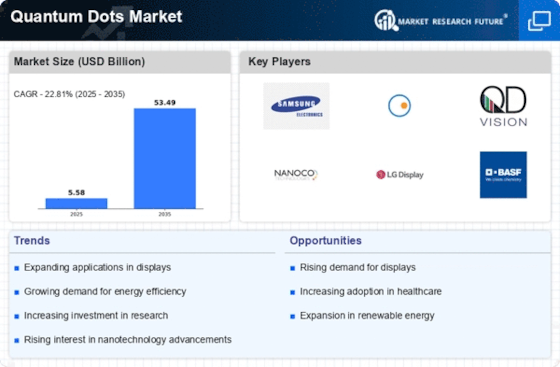
As per MRFR analysis, the Quantum Dots Market Size was estimated at 5.58 USD Billion in 2024. The Quantum Dots industry is projected to grow from 6.853 USD Billion in 2025 to 53.49 USD Billion by 2035, exhibiting a compound annual growth rate (CAGR) of 22.81 during the forecast period 2025 - 2035.

Key Market Trends & Highlights

The Quantum Dots Market is poised for substantial growth driven by technological advancements and increasing applications across various sectors.

  • North America remains the largest market for quantum dots, primarily due to its robust consumer electronics sector.
  • The Asia-Pacific region is emerging as the fastest-growing market, fueled by rapid advancements in display technologies.
  • Cadmium-based quantum dots continue to dominate the market, while cadmium-free variants are gaining traction due to sustainability concerns.
  • Rising demand for high-performance displays and the expansion of quantum dot applications in lighting are key drivers propelling market growth.

Market Size & Forecast

2024 Market Size 5.58 (USD Billion)
2035 Market Size 53.49 (USD Billion)
CAGR (2025 - 2035) 22.81%
Largest Regional Market Share in 2024 Asia Pacific

Major Players

<p>Samsung Electronics (KR), Nanosys (US), QD Vision (US), Nanoco Technologies (GB), LG Display (KR), BASF (DE), Dow (US), Osram (DE), Sharp Corporation (JP)</p>

Market Trends

The Quantum Dots Market is currently experiencing a transformative phase, driven by advancements in nanotechnology and increasing demand for high-performance displays. These tiny semiconductor particles, which emit light when excited, are finding applications across various sectors, including consumer electronics, healthcare, and renewable energy. The market appears to be expanding as manufacturers seek to enhance the color quality and energy efficiency of their products. Furthermore, the integration of quantum dots into display technologies, such as televisions and smartphones, suggests a shift towards more vibrant and energy-efficient screens, which could redefine user experiences. In addition to consumer electronics, the Quantum Dots Market is likely to witness growth in the fields of biomedical applications and solar energy. Researchers are exploring the potential of quantum dots in drug delivery systems and imaging techniques, indicating a promising future for medical diagnostics. Moreover, the utilization of quantum dots in photovoltaic cells may enhance the efficiency of solar panels, contributing to the global push for sustainable energy solutions. As these trends unfold, the Quantum Dots Market is poised for significant evolution, reflecting broader technological advancements and societal needs.

Advancements in Display Technologies

The Quantum Dots Market is increasingly influenced by innovations in display technologies. Manufacturers are integrating quantum dots into screens to improve color accuracy and brightness, leading to enhanced visual experiences. This trend is particularly evident in high-end televisions and mobile devices, where consumers demand superior image quality.

Growth in Biomedical Applications

There is a notable rise in the exploration of quantum dots for biomedical applications. Researchers are investigating their use in targeted drug delivery and imaging, which may revolutionize medical diagnostics. This trend indicates a potential expansion of the Quantum Dots Market beyond traditional sectors.

Sustainability and Energy Efficiency

The Quantum Dots Market is also aligning with global sustainability goals. The incorporation of quantum dots in solar energy technologies suggests a move towards more efficient photovoltaic systems. This trend reflects a broader commitment to renewable energy solutions and may drive future market growth.

Quantum Dots Market Market Drivers

Growth in Consumer Electronics Sector

The Quantum Dots Market is significantly influenced by the growth in the consumer electronics sector. With the proliferation of smart devices, there is an escalating demand for advanced display technologies that quantum dots can provide. The market for consumer electronics is projected to reach over 1 trillion USD by 2025, with a substantial portion attributed to display innovations. Quantum dots enhance the visual experience in smartphones, tablets, and televisions, making them a preferred choice for manufacturers. As consumer preferences evolve towards high-definition and vibrant displays, the Quantum Dots Market is likely to expand in tandem with this sector's growth.

Innovations in Photovoltaic Technologies

The Quantum Dots Market is also benefiting from innovations in photovoltaic technologies. Quantum dots are being explored for their potential to enhance solar cell efficiency, which could revolutionize the renewable energy sector. Research indicates that quantum dot solar cells may achieve efficiencies exceeding 30%, significantly higher than conventional silicon-based cells. This advancement is particularly relevant as the world shifts towards sustainable energy solutions. The integration of quantum dots into solar technology not only promises improved performance but also aligns with global efforts to reduce carbon footprints. Thus, the Quantum Dots Market stands to gain from the increasing focus on renewable energy applications.

Rising Demand for High-Performance Displays

The Quantum Dots Market is experiencing a notable surge in demand for high-performance displays, particularly in sectors such as consumer electronics and automotive. As manufacturers strive to enhance visual quality, quantum dots offer superior color accuracy and brightness compared to traditional display technologies. Reports indicate that the market for quantum dot displays is projected to reach approximately 10 billion USD by 2026, driven by the increasing adoption of 4K and 8K televisions. This trend is further supported by the growing consumer preference for immersive viewing experiences, which quantum dots can effectively deliver. Consequently, the Quantum Dots Market is poised for substantial growth as it aligns with the evolving needs of display technology.

Increased Investment in Research and Development

The Quantum Dots Market is experiencing increased investment in research and development, which is crucial for driving innovation and expanding applications. Companies and research institutions are focusing on developing new quantum dot materials and improving production techniques. This investment is expected to yield advancements that could lower production costs and enhance the performance of quantum dot technologies. As a result, the market is likely to see a diversification of applications, ranging from displays to biomedical uses. The emphasis on R&D not only fosters competition but also positions the Quantum Dots Market for sustained growth in the future.

Expansion of Quantum Dot Applications in Lighting

The Quantum Dots Market is witnessing an expansion in applications related to lighting technologies. Quantum dots are being integrated into LED lighting systems to enhance color rendering and energy efficiency. The market for quantum dot-based lighting solutions is expected to grow significantly, with estimates suggesting a compound annual growth rate of over 20% in the coming years. This growth is attributed to the increasing demand for energy-efficient lighting solutions in residential, commercial, and industrial sectors. As regulations around energy consumption become more stringent, the adoption of quantum dot technology in lighting applications is likely to accelerate, thereby bolstering the Quantum Dots Market.

Market Segment Insights

By Material: Cadmium-based (Largest) vs. Cadmium-free (Fastest-Growing)

<p>In the Quantum Dots Market, the material segment is primarily divided into cadmium-based and cadmium-free quantum dots. Cadmium-based quantum dots hold a significant share of the market due to their superior optical properties and high efficiency in applications such as displays and lighting. However, regulatory concerns associated with cadmium utilization have led to a growing preference for cadmium-free options, particularly among environmentally conscious consumers and manufacturers. Consequently, while cadmium-based materials dominate in the short term, cadmium-free alternatives are rapidly gaining traction. The growth trends in the quantum dots market are heavily influenced by technological advancements, especially in cadmium-free quantum dots, which are setting new benchmarks in performance and sustainability. As industries adapt to stringent environmental regulations and seek greener technologies, the demand for cadmium-free quantum dots is expected to surge. Innovations in material science and production techniques are also driving this segment, making cadmium-free quantum dots not only a responsible choice but also a competitive option in various applications, including OLEDs and solar cells.</p>

<p>Material: Cadmium-based (Dominant) vs. Cadmium-free (Emerging)</p>

<p>Cadmium-based quantum dots have established themselves as a dominant force in the Quantum Dots Market, prized for their impressive light-emitting capabilities and robust performance across various applications. Their ability to produce vivid colors and high luminous efficacy has made them the preferred choice for high-end displays and lighting solutions. However, the rising scrutiny over environmental health has propelled cadmium-free quantum dots to the forefront as an emerging alternative. Made from materials like indium phosphide and other eco-friendly compounds, cadmium-free quantum dots not only comply with environmental regulations but also exhibit impressive optical characteristics. As a result, the market is witnessing a strategic shift, where manufacturers invest heavily in developing cadmium-free solutions to cater to a wider range of environmentally-aware consumers and businesses.</p>

By Product: Displays (Largest) vs. Lasers (Fastest-Growing)

<p>The Quantum Dots Market is primarily driven by the product categories of Displays and Lasers, which command substantial portions of the overall market. Displays, especially in the context of television and monitor applications, have emerged as the largest segment due to the growing demand for superior picture quality and energy efficiency. On the other hand, Lasers are quickly gaining momentum, reflecting a shift towards more versatile and advanced applications in various industries, contributing to their notable growth in market share.</p>

<p>Displays (Dominant) vs. Lasers (Emerging)</p>

<p>Displays hold a dominant position in the Quantum Dots Market, primarily propelled by their integration into high-end consumer electronics such as televisions and monitors. Quantum dots enhance display characteristics, providing improved color accuracy and brightness while maintaining energy efficiency. As consumer expectations for visual quality continue to rise, manufacturers are increasingly adopting quantum dot technology to stay competitive. In contrast, Lasers represent an emerging segment fueled by advancements in precision and performance, finding applications in sectors like telecommunications and medical devices. Their versatility and efficiency are attracting significant interest, driving innovation and investment in laser-based quantum dot solutions.</p>

By Vertical: Consumer (Largest) vs. Healthcare (Fastest-Growing)

<p>The Quantum Dots Market shows a diverse distribution among its vertical segments, with the consumer sector holding the largest share, driven primarily by increased demand for high-performance displays and consumer electronics. Within this segment, applications in televisions and personal devices have been pivotal in establishing a robust market presence, demonstrating significant adoption rates across various consumer electronics brands. On the other hand, the healthcare segment is recognized as the fastest-growing area within the Quantum Dots Market. Its growth is spurred by advancements in biomedical applications, particularly in medical diagnostics and imaging technologies. The increasing emphasis on precision medicine and the development of innovative quantum dot-based imaging agents significantly enhance the appeal and utilization of these technologies in healthcare settings.</p>

<p>Consumer (Dominant) vs. Defense (Emerging)</p>

<p>The consumer segment remains dominant in the Quantum Dots Market, characterized by its wide-ranging applications in displays and the rapid proliferation of quantum dot-enhanced televisions and smartphones. The demand for OLED and QLED technologies continues to propel this segment forward, making it a cornerstone of the market. In contrast, the defense sector is emerging as a promising avenue, where quantum dots are finding applications in advanced sensing technologies and surveillance systems. This segment is driven by military modernization initiatives seeking enhanced imaging capabilities and the development of military-grade display technologies, thus highlighting its potential for growth in specialized applications.</p>

By Production: Colloidal Synthesis (Largest) vs. Plasma Synthesis (Fastest-Growing)

<p>In the Quantum Dots Market, colloidal synthesis remains the largest production method, accounting for a significant portion of market share. Its popularity stems from the ability to produce high-quality quantum dots in a cost-effective manner, catering to a variety of applications such as display technologies and solar cells. Plasma synthesis, while currently smaller in market share, is emerging rapidly as a preferred choice in sectors requiring precision and uniformity, capturing the interest of various stakeholders in the industry.</p>

<p>Production Method: Colloidal Synthesis (Dominant) vs. Plasma Synthesis (Emerging)</p>

<p>Colloidal synthesis is established as the dominant production method in the Quantum Dots Market, characterized by its energy efficiency and scalability, making it suitable for mass production. It allows for the fine-tuning of quantum dot properties, thus enhancing performance across various applications. On the other hand, plasma synthesis is labeled as an emerging method, gaining traction due to its ability to produce quantum dots with consistent size and shape, leading to improved optoelectronic properties. As more advancements are made, plasma synthesis is positioned to challenge colloidal methods, especially in high-tech applications like photonics and quantum computing.</p>

Get more detailed insights about Quantum Dots Market Research Report - Forecast till 2035

Regional Insights

North America : Innovation and Market Leadership

North America is the largest market for quantum dots, holding approximately 45% of the global share, driven by technological advancements and increasing demand for high-performance displays. The region benefits from strong investments in R&D and a favorable regulatory environment that encourages innovation. The growing adoption of quantum dot technology in consumer electronics and displays is further propelling market growth. The United States leads the market, with key players like Samsung Electronics, Nanosys, and QD Vision driving competition. The presence of major tech companies and a robust supply chain enhances the region's competitive landscape. Canada also contributes significantly, focusing on research and development in quantum technologies, which supports the overall growth of the market.

Europe : Emerging Market with Regulations

Europe is witnessing significant growth in the quantum dots market, holding around 30% of the global share. The region's growth is fueled by increasing investments in nanotechnology and stringent regulations promoting sustainable practices. The European Union's Green Deal and Horizon Europe initiatives are pivotal in fostering innovation and attracting investments in quantum technologies, enhancing market dynamics. Germany and the United Kingdom are the leading countries in this market, with companies like BASF and Nanoco Technologies playing crucial roles. The competitive landscape is characterized by collaborations between academia and industry, driving advancements in quantum dot applications. The presence of regulatory bodies ensures compliance and encourages the development of eco-friendly quantum dot solutions.

Asia-Pacific : Rapid Growth and Adoption

Asia-Pacific is rapidly emerging as a significant player in the quantum dots market, accounting for approximately 20% of the global share. The region's growth is driven by increasing demand for consumer electronics, particularly in countries like China and South Korea. Government initiatives promoting advanced manufacturing and technology adoption are also key growth drivers, enhancing the market landscape. China is the largest market in the region, with major companies like LG Display and Sharp Corporation leading the charge. South Korea follows closely, supported by strong investments in display technologies. The competitive landscape is marked by a surge in local startups and collaborations with established players, fostering innovation and expanding the application of quantum dots in various sectors.

Middle East and Africa : Emerging Market Potential

The Middle East and Africa region is at the nascent stage of the quantum dots market, holding about 5% of the global share. However, the region presents significant growth opportunities driven by increasing investments in technology and infrastructure. Governments are recognizing the potential of quantum technologies, leading to initiatives aimed at fostering innovation and attracting foreign investments, which are crucial for market development. Countries like the United Arab Emirates and South Africa are leading the charge, with a focus on diversifying their economies through technology. The competitive landscape is still developing, with a few local players and international companies exploring opportunities in the region. As awareness and demand for quantum dot applications grow, the market is expected to expand significantly in the coming years.

Key Players and Competitive Insights

The Quantum Dots Market is currently characterized by a dynamic competitive landscape, driven by rapid technological advancements and increasing demand for high-performance displays. Key players such as Samsung Electronics (South Korea), Nanosys (United States), and LG Display (South Korea) are at the forefront, each adopting distinct strategies to enhance their market positioning. Samsung Electronics (South Korea) focuses on innovation, particularly in the development of quantum dot displays for televisions, which are gaining traction due to their superior color accuracy and energy efficiency. Meanwhile, Nanosys (United States) emphasizes partnerships with major display manufacturers to integrate its quantum dot technology into a variety of applications, thereby expanding its market reach. LG Display (South Korea) is also heavily investing in research and development to enhance its quantum dot technology, aiming to solidify its leadership in the OLED and LCD markets. Collectively, these strategies contribute to a competitive environment that is increasingly centered around technological innovation and strategic collaborations.

In terms of business tactics, companies are localizing manufacturing and optimizing supply chains to enhance efficiency and reduce costs. The Quantum Dots Market appears to be moderately fragmented, with several key players exerting significant influence. This fragmentation allows for a diverse range of products and innovations, but also intensifies competition as companies vie for market share. The collective influence of these key players shapes the market structure, fostering an environment where technological advancements are paramount.

In August 2025, LG Display (South Korea) announced a strategic partnership with a leading semiconductor manufacturer to co-develop next-generation quantum dot materials. This collaboration is expected to enhance the performance of their display technologies, allowing LG Display to maintain its competitive edge in the rapidly evolving market. The strategic importance of this partnership lies in its potential to accelerate innovation and improve product offerings, thereby attracting more consumers.

In September 2025, Nanosys (United States) unveiled a new line of quantum dot materials designed specifically for use in solar energy applications. This move not only diversifies Nanosys's product portfolio but also aligns with the growing trend towards sustainability in technology. The strategic significance of this development is profound, as it positions Nanosys at the intersection of renewable energy and advanced materials, potentially opening new revenue streams.

In October 2025, Samsung Electronics (South Korea) launched a new quantum dot television series that incorporates AI-driven features for enhanced user experience. This initiative reflects Samsung's commitment to integrating cutting-edge technology into its products, thereby reinforcing its market leadership. The strategic importance of this launch is underscored by the increasing consumer demand for smart home technologies, suggesting that Samsung is well-positioned to capitalize on this trend.

As of October 2025, current competitive trends in the Quantum Dots Market include a pronounced focus on digitalization, sustainability, and the integration of artificial intelligence. Strategic alliances are increasingly shaping the landscape, enabling companies to pool resources and expertise to drive innovation. Looking ahead, competitive differentiation is likely to evolve, with a shift from price-based competition to a greater emphasis on technological innovation, supply chain reliability, and sustainable practices. This evolution suggests that companies that prioritize these aspects will be better positioned to thrive in the future.

Key Companies in the Quantum Dots Market market include

Industry Developments

  • Q2 2024: Samsung Display launches new QD-OLED reference monitors for film and broadcast productions Samsung Display, in collaboration with SmallHD and Flanders Scientific Inc. (FSI), launched new QD-OLED reference monitors designed for film and broadcast production, enabling professionals to check footage quality and calibrate color tones and images for content concepts.

Future Outlook

Quantum Dots Market Future Outlook

<p>The Quantum Dots Market is projected to grow at a 22.81% CAGR from 2024 to 2035, driven by advancements in display technologies, healthcare applications, and renewable energy solutions.</p>

New opportunities lie in:

  • <p>Development of quantum dot-based solar panels for enhanced energy efficiency.</p>
  • <p>Integration of quantum dots in next-generation display technologies for superior image quality.</p>
  • <p>Expansion into biomedical applications for targeted drug delivery systems.</p>

<p>By 2035, the Quantum Dots Market is expected to achieve substantial growth, solidifying its position as a key technology sector.</p>

Market Segmentation

Quantum Dots Market Product Outlook

  • Displays
  • Lasers
  • Solar Cells
  • Medical Devices
  • Photodetectors/Sensors
  • Lighting (LED) Products
  • Batteries and Energy Storage Systems
  • Transistors
  • Chips & Tags

Quantum Dots Market Material Outlook

  • Cadmium-based
  • Cadmium-free

Quantum Dots Market Vertical Outlook

  • Consumer
  • Commercial
  • Healthcare
  • Defense
  • Telecommunications
  • Others

Quantum Dots Market Production Outlook

  • Colloidal synthesis
  • Plasma synthesis

Report Scope

MARKET SIZE 20245.58(USD Billion)
MARKET SIZE 20256.853(USD Billion)
MARKET SIZE 203553.49(USD Billion)
COMPOUND ANNUAL GROWTH RATE (CAGR)22.81% (2024 - 2035)
REPORT COVERAGERevenue Forecast, Competitive Landscape, Growth Factors, and Trends
BASE YEAR2024
Market Forecast Period2025 - 2035
Historical Data2019 - 2024
Market Forecast UnitsUSD Billion
Key Companies ProfiledMarket analysis in progress
Segments CoveredMarket segmentation analysis in progress
Key Market OpportunitiesAdvancements in display technologies drive demand for Quantum Dots Market innovations and applications.
Key Market DynamicsRising demand for advanced displays drives innovation and competition in the Quantum Dots Market.
Countries CoveredNorth America, Europe, APAC, South America, MEA

FAQs

What is the current valuation of the Quantum Dots Market as of 2024?

The Quantum Dots Market was valued at 5.58 USD Billion in 2024.

What is the projected market size for Quantum Dots by 2035?

The market is projected to reach 53.49 USD Billion by 2035.

What is the expected CAGR for the Quantum Dots Market during the forecast period 2025 - 2035?

The expected CAGR for the Quantum Dots Market during 2025 - 2035 is 22.81%.

Which companies are considered key players in the Quantum Dots Market?

Key players include Samsung Electronics, Nanosys, QD Vision, Nanoco Technologies, LG Display, BASF, Dow, Osram, and Sharp Corporation.

What are the primary segments of the Quantum Dots Market?

The primary segments include Material, Product, Vertical, and Production.

How did the valuation of cadmium-based Quantum Dots compare to cadmium-free in 2024?

In 2024, cadmium-based Quantum Dots were valued at 2.79 USD Billion, while cadmium-free Quantum Dots also held a valuation of 2.79 USD Billion.

  1. SECTION I: EXECUTIVE SUMMARY AND KEY HIGHLIGHTS
    1. EXECUTIVE SUMMARY
      1. Market Overview
      2. Key Findings
      3. Market Segmentation
      4. Competitive Landscape
      5. Challenges and Opportunities
      6. Future Outlook
  2. SECTION II: SCOPING, METHODOLOGY AND MARKET STRUCTURE
    1. MARKET INTRODUCTION
      1. Definition
      2. Scope of the study
    2. RESEARCH METHODOLOGY
      1. Overview
      2. Data Mining
      3. Secondary Research
      4. Primary Research
      5. Forecasting Model
      6. Market Size Estimation
      7. Data Triangulation
      8. Validation
  3. SECTION III: QUALITATIVE ANALYSIS
    1. MARKET DYNAMICS
      1. Overview
      2. Drivers
      3. Restraints
      4. Opportunities
    2. MARKET FACTOR ANALYSIS
      1. Value chain Analysis
      2. Porter's Five Forces Analysis
      3. COVID-19 Impact Analysis
  4. SECTION IV: QUANTITATIVE ANALYSIS
    1. Semiconductor & Electronics, BY Material (USD Billion)
      1. Cadmium-based
      2. Cadmium-free
    2. Semiconductor & Electronics, BY Product (USD Billion)
      1. Displays
      2. Lasers
      3. Solar Cells
      4. Medical Devices
      5. Photodetectors/Sensors
      6. Lighting (LED) Products
      7. Batteries and Energy Storage Systems
      8. Transistors
      9. Chips & Tags
    3. Semiconductor & Electronics, BY Vertical (USD Billion)
      1. Consumer
      2. Commercial
      3. Healthcare
      4. Defense
      5. Telecommunications
      6. Others
    4. Semiconductor & Electronics, BY Production (USD Billion)
      1. Colloidal synthesis
      2. Plasma synthesis
    5. Semiconductor & Electronics, BY Region (USD Billion)
      1. North America
      2. Europe
      3. APAC
      4. South America
      5. MEA
  5. SECTION V: COMPETITIVE ANALYSIS
    1. Competitive Landscape
      1. Overview
      2. Competitive Analysis
      3. Market share Analysis
      4. Major Growth Strategy in the Semiconductor & Electronics
      5. Competitive Benchmarking
      6. Leading Players in Terms of Number of Developments in the Semiconductor & Electronics
      7. Key developments and growth strategies
      8. Major Players Financial Matrix
    2. Company Profiles
      1. Samsung Electronics (KR)
      2. Nanosys (US)
      3. QD Vision (US)
      4. Nanoco Technologies (GB)
      5. LG Display (KR)
      6. BASF (DE)
      7. Dow (US)
      8. Osram (DE)
      9. Sharp Corporation (JP)
    3. Appendix
      1. References
      2. Related Reports
  6. LIST OF FIGURES
    1. MARKET SYNOPSIS
    2. NORTH AMERICA MARKET ANALYSIS
    3. US MARKET ANALYSIS BY MATERIAL
    4. US MARKET ANALYSIS BY PRODUCT
    5. US MARKET ANALYSIS BY VERTICAL
    6. US MARKET ANALYSIS BY PRODUCTION
    7. CANADA MARKET ANALYSIS BY MATERIAL
    8. CANADA MARKET ANALYSIS BY PRODUCT
    9. CANADA MARKET ANALYSIS BY VERTICAL
    10. CANADA MARKET ANALYSIS BY PRODUCTION
    11. EUROPE MARKET ANALYSIS
    12. GERMANY MARKET ANALYSIS BY MATERIAL
    13. GERMANY MARKET ANALYSIS BY PRODUCT
    14. GERMANY MARKET ANALYSIS BY VERTICAL
    15. GERMANY MARKET ANALYSIS BY PRODUCTION
    16. UK MARKET ANALYSIS BY MATERIAL
    17. UK MARKET ANALYSIS BY PRODUCT
    18. UK MARKET ANALYSIS BY VERTICAL
    19. UK MARKET ANALYSIS BY PRODUCTION
    20. FRANCE MARKET ANALYSIS BY MATERIAL
    21. FRANCE MARKET ANALYSIS BY PRODUCT
    22. FRANCE MARKET ANALYSIS BY VERTICAL
    23. FRANCE MARKET ANALYSIS BY PRODUCTION
    24. RUSSIA MARKET ANALYSIS BY MATERIAL
    25. RUSSIA MARKET ANALYSIS BY PRODUCT
    26. RUSSIA MARKET ANALYSIS BY VERTICAL
    27. RUSSIA MARKET ANALYSIS BY PRODUCTION
    28. ITALY MARKET ANALYSIS BY MATERIAL
    29. ITALY MARKET ANALYSIS BY PRODUCT
    30. ITALY MARKET ANALYSIS BY VERTICAL
    31. ITALY MARKET ANALYSIS BY PRODUCTION
    32. SPAIN MARKET ANALYSIS BY MATERIAL
    33. SPAIN MARKET ANALYSIS BY PRODUCT
    34. SPAIN MARKET ANALYSIS BY VERTICAL
    35. SPAIN MARKET ANALYSIS BY PRODUCTION
    36. REST OF EUROPE MARKET ANALYSIS BY MATERIAL
    37. REST OF EUROPE MARKET ANALYSIS BY PRODUCT
    38. REST OF EUROPE MARKET ANALYSIS BY VERTICAL
    39. REST OF EUROPE MARKET ANALYSIS BY PRODUCTION
    40. APAC MARKET ANALYSIS
    41. CHINA MARKET ANALYSIS BY MATERIAL
    42. CHINA MARKET ANALYSIS BY PRODUCT
    43. CHINA MARKET ANALYSIS BY VERTICAL
    44. CHINA MARKET ANALYSIS BY PRODUCTION
    45. INDIA MARKET ANALYSIS BY MATERIAL
    46. INDIA MARKET ANALYSIS BY PRODUCT
    47. INDIA MARKET ANALYSIS BY VERTICAL
    48. INDIA MARKET ANALYSIS BY PRODUCTION
    49. JAPAN MARKET ANALYSIS BY MATERIAL
    50. JAPAN MARKET ANALYSIS BY PRODUCT
    51. JAPAN MARKET ANALYSIS BY VERTICAL
    52. JAPAN MARKET ANALYSIS BY PRODUCTION
    53. SOUTH KOREA MARKET ANALYSIS BY MATERIAL
    54. SOUTH KOREA MARKET ANALYSIS BY PRODUCT
    55. SOUTH KOREA MARKET ANALYSIS BY VERTICAL
    56. SOUTH KOREA MARKET ANALYSIS BY PRODUCTION
    57. MALAYSIA MARKET ANALYSIS BY MATERIAL
    58. MALAYSIA MARKET ANALYSIS BY PRODUCT
    59. MALAYSIA MARKET ANALYSIS BY VERTICAL
    60. MALAYSIA MARKET ANALYSIS BY PRODUCTION
    61. THAILAND MARKET ANALYSIS BY MATERIAL
    62. THAILAND MARKET ANALYSIS BY PRODUCT
    63. THAILAND MARKET ANALYSIS BY VERTICAL
    64. THAILAND MARKET ANALYSIS BY PRODUCTION
    65. INDONESIA MARKET ANALYSIS BY MATERIAL
    66. INDONESIA MARKET ANALYSIS BY PRODUCT
    67. INDONESIA MARKET ANALYSIS BY VERTICAL
    68. INDONESIA MARKET ANALYSIS BY PRODUCTION
    69. REST OF APAC MARKET ANALYSIS BY MATERIAL
    70. REST OF APAC MARKET ANALYSIS BY PRODUCT
    71. REST OF APAC MARKET ANALYSIS BY VERTICAL
    72. REST OF APAC MARKET ANALYSIS BY PRODUCTION
    73. SOUTH AMERICA MARKET ANALYSIS
    74. BRAZIL MARKET ANALYSIS BY MATERIAL
    75. BRAZIL MARKET ANALYSIS BY PRODUCT
    76. BRAZIL MARKET ANALYSIS BY VERTICAL
    77. BRAZIL MARKET ANALYSIS BY PRODUCTION
    78. MEXICO MARKET ANALYSIS BY MATERIAL
    79. MEXICO MARKET ANALYSIS BY PRODUCT
    80. MEXICO MARKET ANALYSIS BY VERTICAL
    81. MEXICO MARKET ANALYSIS BY PRODUCTION
    82. ARGENTINA MARKET ANALYSIS BY MATERIAL
    83. ARGENTINA MARKET ANALYSIS BY PRODUCT
    84. ARGENTINA MARKET ANALYSIS BY VERTICAL
    85. ARGENTINA MARKET ANALYSIS BY PRODUCTION
    86. REST OF SOUTH AMERICA MARKET ANALYSIS BY MATERIAL
    87. REST OF SOUTH AMERICA MARKET ANALYSIS BY PRODUCT
    88. REST OF SOUTH AMERICA MARKET ANALYSIS BY VERTICAL
    89. REST OF SOUTH AMERICA MARKET ANALYSIS BY PRODUCTION
    90. MEA MARKET ANALYSIS
    91. GCC COUNTRIES MARKET ANALYSIS BY MATERIAL
    92. GCC COUNTRIES MARKET ANALYSIS BY PRODUCT
    93. GCC COUNTRIES MARKET ANALYSIS BY VERTICAL
    94. GCC COUNTRIES MARKET ANALYSIS BY PRODUCTION
    95. SOUTH AFRICA MARKET ANALYSIS BY MATERIAL
    96. SOUTH AFRICA MARKET ANALYSIS BY PRODUCT
    97. SOUTH AFRICA MARKET ANALYSIS BY VERTICAL
    98. SOUTH AFRICA MARKET ANALYSIS BY PRODUCTION
    99. REST OF MEA MARKET ANALYSIS BY MATERIAL
    100. REST OF MEA MARKET ANALYSIS BY PRODUCT
    101. REST OF MEA MARKET ANALYSIS BY VERTICAL
    102. REST OF MEA MARKET ANALYSIS BY PRODUCTION
    103. KEY BUYING CRITERIA OF SEMICONDUCTOR & ELECTRONICS
    104. RESEARCH PROCESS OF MRFR
    105. DRO ANALYSIS OF SEMICONDUCTOR & ELECTRONICS
    106. DRIVERS IMPACT ANALYSIS: SEMICONDUCTOR & ELECTRONICS
    107. RESTRAINTS IMPACT ANALYSIS: SEMICONDUCTOR & ELECTRONICS
    108. SUPPLY / VALUE CHAIN: SEMICONDUCTOR & ELECTRONICS
    109. SEMICONDUCTOR & ELECTRONICS, BY MATERIAL, 2024 (% SHARE)
    110. SEMICONDUCTOR & ELECTRONICS, BY MATERIAL, 2024 TO 2035 (USD Billion)
    111. SEMICONDUCTOR & ELECTRONICS, BY PRODUCT, 2024 (% SHARE)
    112. SEMICONDUCTOR & ELECTRONICS, BY PRODUCT, 2024 TO 2035 (USD Billion)
    113. SEMICONDUCTOR & ELECTRONICS, BY VERTICAL, 2024 (% SHARE)
    114. SEMICONDUCTOR & ELECTRONICS, BY VERTICAL, 2024 TO 2035 (USD Billion)
    115. SEMICONDUCTOR & ELECTRONICS, BY PRODUCTION, 2024 (% SHARE)
    116. SEMICONDUCTOR & ELECTRONICS, BY PRODUCTION, 2024 TO 2035 (USD Billion)
    117. BENCHMARKING OF MAJOR COMPETITORS
  7. LIST OF TABLES
    1. LIST OF ASSUMPTIONS
    2. North America MARKET SIZE ESTIMATES; FORECAST
      1. BY MATERIAL, 2025-2035 (USD Billion)
      2. BY PRODUCT, 2025-2035 (USD Billion)
      3. BY VERTICAL, 2025-2035 (USD Billion)
      4. BY PRODUCTION, 2025-2035 (USD Billion)
    3. US MARKET SIZE ESTIMATES; FORECAST
      1. BY MATERIAL, 2025-2035 (USD Billion)
      2. BY PRODUCT, 2025-2035 (USD Billion)
      3. BY VERTICAL, 2025-2035 (USD Billion)
      4. BY PRODUCTION, 2025-2035 (USD Billion)
    4. Canada MARKET SIZE ESTIMATES; FORECAST
      1. BY MATERIAL, 2025-2035 (USD Billion)
      2. BY PRODUCT, 2025-2035 (USD Billion)
      3. BY VERTICAL, 2025-2035 (USD Billion)
      4. BY PRODUCTION, 2025-2035 (USD Billion)
    5. Europe MARKET SIZE ESTIMATES; FORECAST
      1. BY MATERIAL, 2025-2035 (USD Billion)
      2. BY PRODUCT, 2025-2035 (USD Billion)
      3. BY VERTICAL, 2025-2035 (USD Billion)
      4. BY PRODUCTION, 2025-2035 (USD Billion)
    6. Germany MARKET SIZE ESTIMATES; FORECAST
      1. BY MATERIAL, 2025-2035 (USD Billion)
      2. BY PRODUCT, 2025-2035 (USD Billion)
      3. BY VERTICAL, 2025-2035 (USD Billion)
      4. BY PRODUCTION, 2025-2035 (USD Billion)
    7. UK MARKET SIZE ESTIMATES; FORECAST
      1. BY MATERIAL, 2025-2035 (USD Billion)
      2. BY PRODUCT, 2025-2035 (USD Billion)
      3. BY VERTICAL, 2025-2035 (USD Billion)
      4. BY PRODUCTION, 2025-2035 (USD Billion)
    8. France MARKET SIZE ESTIMATES; FORECAST
      1. BY MATERIAL, 2025-2035 (USD Billion)
      2. BY PRODUCT, 2025-2035 (USD Billion)
      3. BY VERTICAL, 2025-2035 (USD Billion)
      4. BY PRODUCTION, 2025-2035 (USD Billion)
    9. Russia MARKET SIZE ESTIMATES; FORECAST
      1. BY MATERIAL, 2025-2035 (USD Billion)
      2. BY PRODUCT, 2025-2035 (USD Billion)
      3. BY VERTICAL, 2025-2035 (USD Billion)
      4. BY PRODUCTION, 2025-2035 (USD Billion)
    10. Italy MARKET SIZE ESTIMATES; FORECAST
      1. BY MATERIAL, 2025-2035 (USD Billion)
      2. BY PRODUCT, 2025-2035 (USD Billion)
      3. BY VERTICAL, 2025-2035 (USD Billion)
      4. BY PRODUCTION, 2025-2035 (USD Billion)
    11. Spain MARKET SIZE ESTIMATES; FORECAST
      1. BY MATERIAL, 2025-2035 (USD Billion)
      2. BY PRODUCT, 2025-2035 (USD Billion)
      3. BY VERTICAL, 2025-2035 (USD Billion)
      4. BY PRODUCTION, 2025-2035 (USD Billion)
    12. Rest of Europe MARKET SIZE ESTIMATES; FORECAST
      1. BY MATERIAL, 2025-2035 (USD Billion)
      2. BY PRODUCT, 2025-2035 (USD Billion)
      3. BY VERTICAL, 2025-2035 (USD Billion)
      4. BY PRODUCTION, 2025-2035 (USD Billion)
    13. APAC MARKET SIZE ESTIMATES; FORECAST
      1. BY MATERIAL, 2025-2035 (USD Billion)
      2. BY PRODUCT, 2025-2035 (USD Billion)
      3. BY VERTICAL, 2025-2035 (USD Billion)
      4. BY PRODUCTION, 2025-2035 (USD Billion)
    14. China MARKET SIZE ESTIMATES; FORECAST
      1. BY MATERIAL, 2025-2035 (USD Billion)
      2. BY PRODUCT, 2025-2035 (USD Billion)
      3. BY VERTICAL, 2025-2035 (USD Billion)
      4. BY PRODUCTION, 2025-2035 (USD Billion)
    15. India MARKET SIZE ESTIMATES; FORECAST
      1. BY MATERIAL, 2025-2035 (USD Billion)
      2. BY PRODUCT, 2025-2035 (USD Billion)
      3. BY VERTICAL, 2025-2035 (USD Billion)
      4. BY PRODUCTION, 2025-2035 (USD Billion)
    16. Japan MARKET SIZE ESTIMATES; FORECAST
      1. BY MATERIAL, 2025-2035 (USD Billion)
      2. BY PRODUCT, 2025-2035 (USD Billion)
      3. BY VERTICAL, 2025-2035 (USD Billion)
      4. BY PRODUCTION, 2025-2035 (USD Billion)
    17. South Korea MARKET SIZE ESTIMATES; FORECAST
      1. BY MATERIAL, 2025-2035 (USD Billion)
      2. BY PRODUCT, 2025-2035 (USD Billion)
      3. BY VERTICAL, 2025-2035 (USD Billion)
      4. BY PRODUCTION, 2025-2035 (USD Billion)
    18. Malaysia MARKET SIZE ESTIMATES; FORECAST
      1. BY MATERIAL, 2025-2035 (USD Billion)
      2. BY PRODUCT, 2025-2035 (USD Billion)
      3. BY VERTICAL, 2025-2035 (USD Billion)
      4. BY PRODUCTION, 2025-2035 (USD Billion)
    19. Thailand MARKET SIZE ESTIMATES; FORECAST
      1. BY MATERIAL, 2025-2035 (USD Billion)
      2. BY PRODUCT, 2025-2035 (USD Billion)
      3. BY VERTICAL, 2025-2035 (USD Billion)
      4. BY PRODUCTION, 2025-2035 (USD Billion)
    20. Indonesia MARKET SIZE ESTIMATES; FORECAST
      1. BY MATERIAL, 2025-2035 (USD Billion)
      2. BY PRODUCT, 2025-2035 (USD Billion)
      3. BY VERTICAL, 2025-2035 (USD Billion)
      4. BY PRODUCTION, 2025-2035 (USD Billion)
    21. Rest of APAC MARKET SIZE ESTIMATES; FORECAST
      1. BY MATERIAL, 2025-2035 (USD Billion)
      2. BY PRODUCT, 2025-2035 (USD Billion)
      3. BY VERTICAL, 2025-2035 (USD Billion)
      4. BY PRODUCTION, 2025-2035 (USD Billion)
    22. South America MARKET SIZE ESTIMATES; FORECAST
      1. BY MATERIAL, 2025-2035 (USD Billion)
      2. BY PRODUCT, 2025-2035 (USD Billion)
      3. BY VERTICAL, 2025-2035 (USD Billion)
      4. BY PRODUCTION, 2025-2035 (USD Billion)
    23. Brazil MARKET SIZE ESTIMATES; FORECAST
      1. BY MATERIAL, 2025-2035 (USD Billion)
      2. BY PRODUCT, 2025-2035 (USD Billion)
      3. BY VERTICAL, 2025-2035 (USD Billion)
      4. BY PRODUCTION, 2025-2035 (USD Billion)
    24. Mexico MARKET SIZE ESTIMATES; FORECAST
      1. BY MATERIAL, 2025-2035 (USD Billion)
      2. BY PRODUCT, 2025-2035 (USD Billion)
      3. BY VERTICAL, 2025-2035 (USD Billion)
      4. BY PRODUCTION, 2025-2035 (USD Billion)
    25. Argentina MARKET SIZE ESTIMATES; FORECAST
      1. BY MATERIAL, 2025-2035 (USD Billion)
      2. BY PRODUCT, 2025-2035 (USD Billion)
      3. BY VERTICAL, 2025-2035 (USD Billion)
      4. BY PRODUCTION, 2025-2035 (USD Billion)
    26. Rest of South America MARKET SIZE ESTIMATES; FORECAST
      1. BY MATERIAL, 2025-2035 (USD Billion)
      2. BY PRODUCT, 2025-2035 (USD Billion)
      3. BY VERTICAL, 2025-2035 (USD Billion)
      4. BY PRODUCTION, 2025-2035 (USD Billion)
    27. MEA MARKET SIZE ESTIMATES; FORECAST
      1. BY MATERIAL, 2025-2035 (USD Billion)
      2. BY PRODUCT, 2025-2035 (USD Billion)
      3. BY VERTICAL, 2025-2035 (USD Billion)
      4. BY PRODUCTION, 2025-2035 (USD Billion)
    28. GCC Countries MARKET SIZE ESTIMATES; FORECAST
      1. BY MATERIAL, 2025-2035 (USD Billion)
      2. BY PRODUCT, 2025-2035 (USD Billion)
      3. BY VERTICAL, 2025-2035 (USD Billion)
      4. BY PRODUCTION, 2025-2035 (USD Billion)
    29. South Africa MARKET SIZE ESTIMATES; FORECAST
      1. BY MATERIAL, 2025-2035 (USD Billion)
      2. BY PRODUCT, 2025-2035 (USD Billion)
      3. BY VERTICAL, 2025-2035 (USD Billion)
      4. BY PRODUCTION, 2025-2035 (USD Billion)
    30. Rest of MEA MARKET SIZE ESTIMATES; FORECAST
      1. BY MATERIAL, 2025-2035 (USD Billion)
      2. BY PRODUCT, 2025-2035 (USD Billion)
      3. BY VERTICAL, 2025-2035 (USD Billion)
      4. BY PRODUCTION, 2025-2035 (USD Billion)
    31. PRODUCT LAUNCH/PRODUCT DEVELOPMENT/APPROVAL
    32. ACQUISITION/PARTNERSHIP

Quantum Dots Market Segmentation

Quantum Dots Market Material Outlook (USD Billion, 2019-2032)

Cadmium-based

Cadmium-free

Quantum Dots Market Product Outlook (USD Billion, 2019-2032)

Displays

Other Products

Lasers

Solar Cells

Medical Devices

Photodetectors/Sensors

Lighting (LED) Products

Batteries and Energy Storage Systems

Transistors

Chips & Tags

Quantum Dots Market Vertical Outlook (USD Billion, 2019-2032)

Consumer

Commercial

Healthcare

Defense

Telecommunications

Others

Quantum Dots Market Production Outlook (USD Billion, 2019-2032)

Colloidal synthesis

Plasma synthesis

Quantum Dots Market Regional Outlook (USD Billion, 2019-2032)

North America Outlook (USD Billion, 2019-2032)

North America Quantum Dots Market by Material

Cadmium-based

Cadmium-free

North America Quantum Dots Market by Product
  •  
    •  

Displays

Other Products

Lasers

Solar Cells

Medical Devices

Photodetectors/Sensors

Lighting (LED) Products

Batteries and Energy Storage Systems

Transistors

Chips & Tags

North America Quantum Dots Market by Vertical

Consumer

Commercial

Healthcare

Defense

Telecommunications

Others

North America Quantum Dots Market by Production

Colloidal synthesis

Plasma synthesis

US Outlook (USD Billion, 2019-2032)

US Quantum Dots Market by Material

Cadmium-based

Cadmium-free

US Quantum Dots Market by Product
  •  
    •  

Displays

Other Products

Lasers

Solar Cells

Medical Devices

Photodetectors/Sensors

Lighting (LED) Products

Batteries and Energy Storage Systems

Transistors

Chips & Tags

US Quantum Dots Market by Vertical

Consumer

Commercial

Healthcare

Defense

Telecommunications

Others

US Quantum Dots Market by Production

Colloidal synthesis

Plasma synthesis

Canada Outlook (USD Billion, 2019-2032)

Canada Quantum Dots Market by Material

Cadmium-based

Cadmium-free

Canada Quantum Dots Market by Product
  •  
    •  

Displays

Other Products

Lasers

Solar Cells

Medical Devices

Photodetectors/Sensors

Lighting (LED) Products

Batteries and Energy Storage Systems

Transistors

Chips & Tags

Canada Quantum Dots Market by Vertical

Consumer

Commercial

Healthcare

Defense

Telecommunications

Others

Canada Quantum Dots Market by Production

Colloidal synthesis

Plasma synthesis

Europe Outlook (USD Billion, 2019-2032)

Europe Quantum Dots Market by Material

Cadmium-based

Cadmium-free

Europe Quantum Dots Market by Product
  •  
    •  

Displays

Other Products

Lasers

Solar Cells

Medical Devices

Photodetectors/Sensors

Lighting (LED) Products

Batteries and Energy Storage Systems

Transistors

Chips & Tags

Europe Quantum Dots Market by Vertical

Consumer

Commercial

Healthcare

Defense

Telecommunications

Others

Europe Quantum Dots Market by Production

Colloidal synthesis

Plasma synthesis

Germany Outlook (USD Billion, 2019-2032)

Germany Quantum Dots Market by Material

Cadmium-based

Cadmium-free

Germany Quantum Dots Market by Product
  •  
    •  

Displays

Other Products

  •  
    •  
      •  

Lasers

Solar Cells

Medical Devices

Photodetectors/Sensors

Lighting (LED) Products

Batteries and Energy Storage Systems

Transistors

Chips & Tags

Germany Quantum Dots Market by Vertical

Consumer

Commercial

Healthcare

Defense

Telecommunications

Others

Germany Quantum Dots Market by Production

Colloidal synthesis

Plasma synthesis

France Outlook (USD Billion, 2019-2032)

France Quantum Dots Market by Material

Cadmium-based

Cadmium-free

France Quantum Dots Market by Product
  •  
    •  

Displays

Other Products

Lasers

Solar Cells

Medical Devices

Photodetectors/Sensors

Lighting (LED) Products

Batteries and Energy Storage Systems

Transistors

Chips & Tags

France Quantum Dots Market by Vertical

Consumer

Commercial

Healthcare

Defense

Telecommunications

Others

France Quantum Dots Market by Production

Colloidal synthesis

Plasma synthesis

UK Outlook (USD Billion, 2019-2032)

UK Quantum Dots Market by Material

Cadmium-based

Cadmium-free

UK Quantum Dots Market by Product
  •  
    •  

Displays

Other Products

Lasers

Solar Cells

Medical Devices

Photodetectors/Sensors

Lighting (LED) Products

Batteries and Energy Storage Systems

Transistors

Chips & Tags

UK Quantum Dots Market by Vertical

Consumer

Commercial

Healthcare

Defense

Telecommunications

Others

UK Quantum Dots Market by Production

Colloidal synthesis

Plasma synthesis

Italy Outlook (USD Billion, 2019-2032)

Italy Quantum Dots Market by Material

Cadmium-based

Cadmium-free

Italy Quantum Dots Market by Product
  •  
    •  

Displays

Other Products

Lasers

Solar Cells

Medical Devices

Photodetectors/Sensors

Lighting (LED) Products

Batteries and Energy Storage Systems

Transistors

Chips & Tags

Italy Quantum Dots Market by Vertical

Consumer

Commercial

Healthcare

Defense

Telecommunications

Others

Italy Quantum Dots Market by Production

Colloidal synthesis

Plasma synthesis

Spain Outlook (USD Billion, 2019-2032)

Spain Quantum Dots Market by Material

Cadmium-based

Cadmium-free

Spain Quantum Dots Market by Product
  •  
    •  

Displays

Other Products

Lasers

Solar Cells

Medical Devices

Photodetectors/Sensors

Lighting (LED) Products

Batteries and Energy Storage Systems

Transistors

Chips & Tags

Spain Quantum Dots Market by Vertical

Consumer

Commercial

Healthcare

Defense

Telecommunications

Others

Spain Quantum Dots Market by Production

Colloidal synthesis

Plasma synthesis

Rest of Europe Outlook (USD Billion, 2019-2032)

Rest of Europe Quantum Dots Market by Material

Cadmium-based

Cadmium-free

Rest of Europe Quantum Dots Market by Product
  •  
    •  

Displays

Other Products

  •  
    •  
      •  

Lasers

Solar Cells

Medical Devices

Photodetectors/Sensors

Lighting (LED) Products

Batteries and Energy Storage Systems

Transistors

Chips & Tags

Rest of Europe Quantum Dots Market by Vertical

Consumer

Commercial

Healthcare

Defense

Telecommunications

Others

Rest of Europe Quantum Dots Market by Production

Colloidal synthesis

Plasma synthesis

Asia-Pacific Outlook (USD Billion, 2019-2032)

Asia-Pacific Quantum Dots Market by Material

Cadmium-based

Cadmium-free

Asia-Pacific Quantum Dots Market by Product
  •  
    •  

Displays

Other Products

Lasers

Solar Cells

Medical Devices

Photodetectors/Sensors

Lighting (LED) Products

Batteries and Energy Storage Systems

Transistors

Chips & Tags

Asia-Pacific Quantum Dots Market by Vertical

Consumer

Commercial

Healthcare

Defense

Telecommunications

Others

Asia-Pacific Quantum Dots Market by Production

Colloidal synthesis

Plasma synthesis

China Outlook (USD Billion, 2019-2032)

China Quantum Dots Market by Material

Cadmium-based

Cadmium-free

China Quantum Dots Market by Product
  •  
    •  

Displays

Other Products

Lasers

Solar Cells

Medical Devices

Photodetectors/Sensors

Lighting (LED) Products

Batteries and Energy Storage Systems

Transistors

Chips & Tags

China Quantum Dots Market by Vertical

Consumer

Commercial

Healthcare

Defense

Telecommunications

Others

China Quantum Dots Market by Production

Colloidal synthesis

Plasma synthesis

Japan Outlook (USD Billion, 2019-2032)

Japan Quantum Dots Market by Material

Cadmium-based

Cadmium-free

Japan Quantum Dots Market by Product
  •  
    •  

Displays

Other Products

Lasers

Solar Cells

Medical Devices

Photodetectors/Sensors

Lighting (LED) Products

Batteries and Energy Storage Systems

Transistors

Chips & Tags

Japan Quantum Dots Market by Vertical

Consumer

Commercial

Healthcare

Defense

Telecommunications

Others

Japan Quantum Dots Market by Production

Colloidal synthesis

Plasma synthesis

India Outlook (USD Billion, 2019-2032)

India Quantum Dots Market by Material

Cadmium-based

Cadmium-free

India Quantum Dots Market by Product
  •  
    •  

Displays

Other Products

Lasers

Solar Cells

Medical Devices

Photodetectors/Sensors

Lighting (LED) Products

Batteries and Energy Storage Systems

Transistors

Chips & Tags

India Quantum Dots Market by Vertical

Consumer

Commercial

Healthcare

Defense

Telecommunications

Others

India Quantum Dots Market by Production

Colloidal synthesis

Plasma synthesis

Australia Outlook (USD Billion, 2019-2032)

Australia Quantum Dots Market by Material

Cadmium-based

Cadmium-free

Australia Quantum Dots Market by Product
  •  
    •  

Displays

Other Products

Lasers

Solar Cells

Medical Devices

Photodetectors/Sensors

Lighting (LED) Products

Batteries and Energy Storage Systems

Transistors

Chips & Tags

Australia Quantum Dots Market by Vertical

Consumer

Commercial

Healthcare

Defense

Telecommunications

Others

Australia Quantum Dots Market by Production

Colloidal synthesis

Plasma synthesis

Rest of Asia-Pacific Outlook (USD Billion, 2019-2032)

Rest of Asia-Pacific Quantum Dots Market by Material

Cadmium-based

Cadmium-free

Rest of Asia-Pacific Quantum Dots Market by Product
  •  
    •  

Displays

Other Products

Lasers

Solar Cells

Medical Devices

Photodetectors/Sensors

Lighting (LED) Products

Batteries and Energy Storage Systems

Transistors

Chips & Tags

Rest of Asia-Pacific Quantum Dots Market by Vertical

Consumer

Commercial

Healthcare

Defense

Telecommunications

Others

Rest of Asia-Pacific Quantum Dots Market by Production

Colloidal synthesis

Plasma synthesis

Rest of the World Outlook (USD Billion, 2019-2032)

Rest of the World Quantum Dots Market by Material

Cadmium-based

Cadmium-free

Rest of the World Quantum Dots Market by Product
  •  
    •  

Displays

Other Products

Lasers

Solar Cells

Medical Devices

Photodetectors/Sensors

Lighting (LED) Products

Batteries and Energy Storage Systems

Transistors

Chips & Tags

Rest of the World Quantum Dots Market by Vertical

Consumer

Commercial

Healthcare

Defense

Telecommunications

Others

Rest of the World Quantum Dots Market by Production

Colloidal synthesis

Plasma synthesis

Middle East Outlook (USD Billion, 2019-2032)

Middle East Quantum Dots Market by Material

Cadmium-based

Cadmium-free

Middle East Quantum Dots Market by Product
  •  
    •  

Displays

Other Products

Lasers

Solar Cells

Medical Devices

Photodetectors/Sensors

Lighting (LED) Products

Batteries and Energy Storage Systems

Transistors

Chips & Tags

Middle East Quantum Dots Market by Vertical

Consumer

Commercial

Healthcare

Defense

Telecommunications

Others

Middle East Quantum Dots Market by Production

Colloidal synthesis

Plasma synthesis

Non-Store-Based

Africa Outlook (USD Billion, 2019-2032)

Africa Quantum Dots Market by Material

Cadmium-based

Cadmium-free

Africa Quantum Dots Market by Product
  •  
    •  

Displays

Other Products

Lasers

Solar Cells

Medical Devices

Photodetectors/Sensors

Lighting (LED) Products

Batteries and Energy Storage Systems

Transistors

Chips & Tags

Africa Quantum Dots Market by Vertical

Consumer

Commercial

Healthcare

Defense

Telecommunications

Others

Africa Quantum Dots Market by Production

Colloidal synthesis

Plasma synthesis

Latin America Outlook (USD Billion, 2019-2032)

Latin America Quantum Dots Market by Material

Cadmium-based

Cadmium-free

Latin America Quantum Dots Market by Product
  •  
    •  

Displays

Other Products

Lasers

Solar Cells

Medical Devices

Photodetectors/Sensors

Lighting (LED) Products

Batteries and Energy Storage Systems

Transistors

Chips & Tags

Latin America Quantum Dots Market by Vertical

Consumer

Commercial

Healthcare

Defense

Telecommunications

Others

Latin America Quantum Dots Market by Production

Colloidal synthesis

Plasma synthesis

Infographic

Free Sample Request

Kindly complete the form below to receive a free sample of this Report

Get Free Sample

Customer Strories

Compare Licence

×
Features License Type
Single User Multiuser License Enterprise User
Price $4,950 $5,950 $7,250
Maximum User Access Limit 1 User Upto 10 Users Unrestricted Access Throughout the Organization
Free Customization
Direct Access to Analyst
Deliverable Format
Platform Access
Discount on Next Purchase 10% 15% 15%
Printable Versions