×
Request Free Sample ×

Kindly complete the form below to receive a free sample of this Report

* Please use a valid business email

Leading companies partner with us for data-driven Insights

clients tt-cursor
Hero Background

Butyl Rubber Market

ID: MRFR/CnM/2041-CR
111 Pages
Chitranshi Jaiswal
December 2018

Butyl Rubber Market Size, Share & Industry Analysis Research Report Information- By Types (Regular Butyl Rubber, Chlorinated Butyl Rubber, Brominated Butyl Rubber), By Application (Adhesives, Sealant for Rubber Roof Repair, Tubeless Tire Liners, Medicine Bottles, Mechanical Goods and Others), By End User (Automotive Industry, Pharmaceutical Industry, Consumer Products, Rubber Industries, Construction Industries and Others) - Forecast to 2035

Share:
Download PDF ×

We do not share your information with anyone. However, we may send you emails based on your report interest from time to time. You may contact us at any time to opt-out.

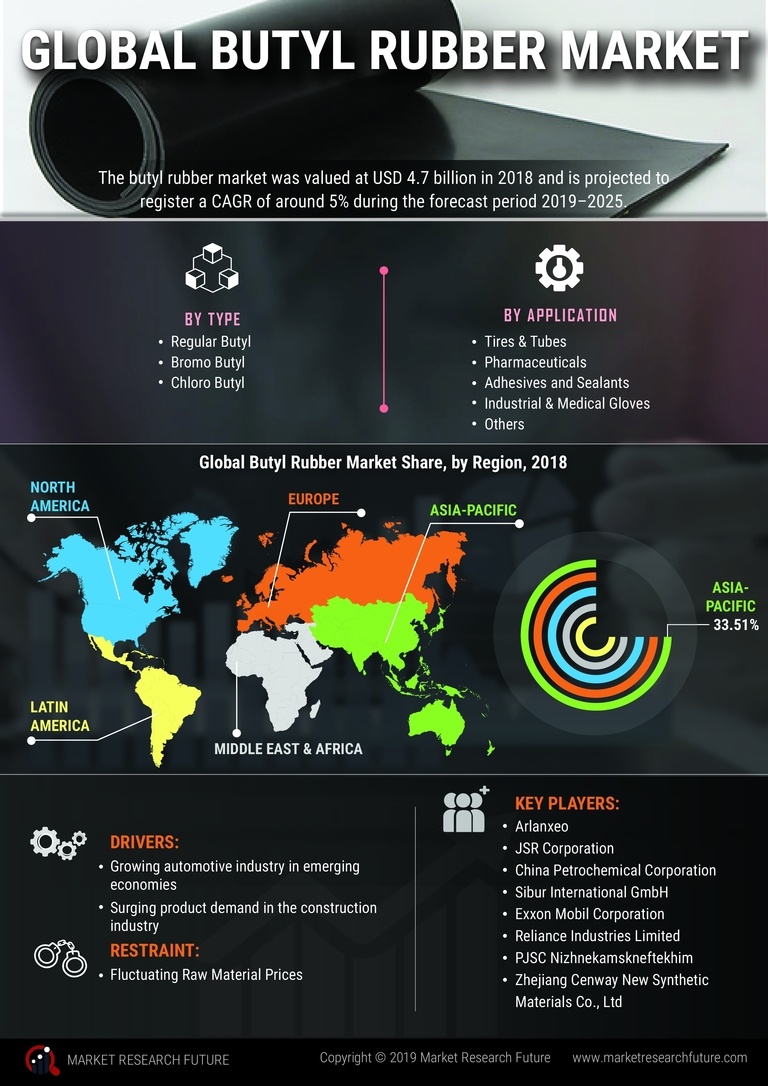
Butyl Rubber Market Infographic
×
Butyl Rubber Market Infographic Full View
Purchase Options

Butyl Rubber Market Summary

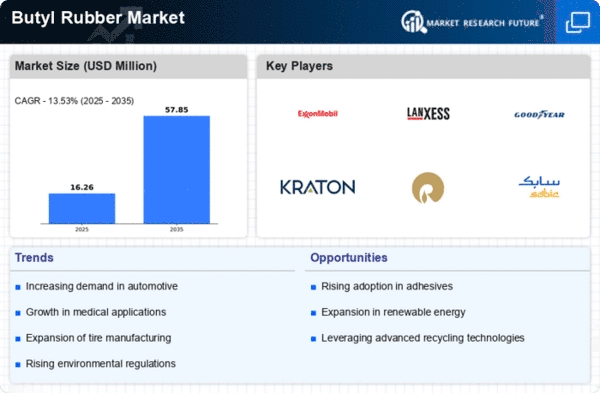
As per MRFR analysis, the Butyl Rubber Market Size was estimated at 14.32 USD Million in 2024. The Butyl Rubber industry is projected to grow from 16.26 in 2025 to 57.85 by 2035, exhibiting a compound annual growth rate (CAGR) of 13.53 during the forecast period 2025 - 2035.

Key Market Trends & Highlights

The Butyl Rubber Market is currently experiencing robust growth driven by sustainability and technological advancements.

  • North America remains the largest market for butyl rubber, primarily due to its extensive automotive sector.
  • Asia-Pacific is recognized as the fastest-growing region, fueled by increasing industrial activities and demand for innovative applications.
  • The tire segment continues to dominate the market, while the adhesives segment is emerging as the fastest-growing area.
  • Key market drivers include rising automotive production and expansion in construction activities, which are significantly influencing demand.

Market Size & Forecast

2024 Market Size 14.32 (USD Million)
2035 Market Size 57.85 (USD Million)
CAGR (2025 - 2035) 13.53%

Major Players

ExxonMobil (US), Lanxess (DE), Goodyear Tire and Rubber Company (US), Kraton Corporation (US), Reliance Industries Limited (IN), SABIC (SA), JSR Corporation (JP), Kumho Petrochemical (KR), Tianjin Synthetic Rubber Group (CN)

Butyl Rubber Market Trends

The Butyl Rubber Market is currently experiencing a dynamic phase characterized by evolving consumer preferences and technological advancements. This synthetic rubber, known for its excellent impermeability to gases and superior aging properties, finds extensive applications in various sectors, including automotive, pharmaceuticals, and adhesives. The increasing demand for high-performance materials in tire manufacturing is particularly noteworthy, as manufacturers seek to enhance fuel efficiency and reduce rolling resistance. Furthermore, the growing emphasis on sustainability is prompting companies to explore eco-friendly alternatives and recycling methods, which could reshape the market landscape in the coming years. In addition to the automotive sector, the Butyl Rubber Market is witnessing a surge in demand from the healthcare industry, where its properties are utilized in the production of medical devices and pharmaceutical packaging. The ongoing innovations in polymer technology are likely to drive the development of new grades of butyl rubber, catering to specific applications. As the market evolves, stakeholders must remain vigilant to emerging trends and shifts in consumer behavior, which may influence future growth trajectories and competitive dynamics within this sector.

Sustainability Initiatives

The Butyl Rubber Market is increasingly influenced by sustainability initiatives, as manufacturers strive to reduce their environmental footprint. This trend encompasses the development of bio-based butyl rubber and the implementation of recycling processes, which may enhance the appeal of products to environmentally conscious consumers.

Technological Advancements

Technological advancements in polymer science are shaping the Butyl Rubber Market, leading to the creation of innovative formulations with enhanced performance characteristics. These developments could potentially improve the material's durability and versatility, making it suitable for a broader range of applications.

Rising Demand in Healthcare

The healthcare sector's growing reliance on butyl rubber for medical devices and packaging is a notable trend. This demand is driven by the material's excellent barrier properties and biocompatibility, suggesting a robust future for butyl rubber in medical applications.

Butyl Rubber Market Drivers

Expansion in Medical Applications

The Global Butyl Rubber Market Industry is witnessing an expansion in medical applications, particularly in the production of medical devices and pharmaceutical packaging. Butyl rubber's excellent barrier properties and biocompatibility make it an ideal material for these applications. As healthcare demands evolve, the need for reliable and safe packaging solutions is becoming increasingly critical. This trend indicates that the medical sector could significantly contribute to market growth, aligning with the overall projected CAGR of 3.66% from 2025 to 2035. The increasing focus on healthcare innovation is likely to bolster the demand for butyl rubber in this sector.

Increasing Environmental Regulations

The Global Butyl Rubber Market Industry is influenced by increasing environmental regulations that encourage the use of sustainable materials. As governments worldwide implement stricter regulations on emissions and waste, manufacturers are compelled to explore eco-friendly alternatives. Butyl rubber, with its potential for recycling and reduced environmental footprint, may gain traction in this context. This shift towards sustainability could drive innovation and investment in the butyl rubber sector, potentially leading to a market value of 5200 USD Million by 2035. The alignment of industry practices with regulatory frameworks may further enhance the market's growth prospects.

Growing Demand from Automotive Sector

The automotive sector is a primary driver of the Global Butyl Rubber Market Industry, as butyl rubber is extensively utilized in tire manufacturing due to its superior air retention properties. In 2024, the market is projected to reach 3500 USD Million, with the automotive industry accounting for a substantial portion of this demand. As vehicle production increases globally, particularly in emerging markets, the need for high-performance tires is expected to rise. This trend suggests that the automotive sector will continue to fuel growth in the butyl rubber market, potentially leading to a market value of 5200 USD Million by 2035.

Rising Demand for Adhesives and Sealants

The Global Butyl Rubber Market Industry is experiencing a surge in demand for adhesives and sealants, driven by the construction and manufacturing sectors. Butyl rubber's properties, such as flexibility and resistance to moisture, make it a preferred choice for various applications, including roofing and automotive sealing. As construction activities ramp up globally, particularly in developing regions, the demand for high-performance adhesives is expected to increase. This trend may contribute to the overall market growth, with projections indicating a market value of 5200 USD Million by 2035, reflecting the expanding applications of butyl rubber in diverse industries.

Technological Advancements in Production

Technological advancements in the production of butyl rubber are poised to enhance the efficiency and sustainability of the Global Butyl Rubber Market Industry. Innovations in polymerization processes and recycling technologies are likely to reduce production costs and environmental impact. As manufacturers adopt these advanced techniques, the quality and performance of butyl rubber products may improve, thereby attracting new applications and customers. This evolution in production technology could support the market's growth trajectory, aligning with the anticipated CAGR of 3.66% from 2025 to 2035, as companies strive to meet evolving consumer demands.

Market Segment Insights

By Application: Tires (Largest) vs. Adhesives (Fastest-Growing)

In the Butyl Rubber Market, the application of Tires holds the largest market share, largely driven by the automotive industry's consistent demand for high-performance tires. Adhesives, while currently a smaller segment, is emerging as the fastest-growing category due to the increasing use of butyl rubber in various applications such as construction, packaging, and product assembly. This shift is indicative of the growing trend toward high-performance and environmentally friendly materials across industries.

Tires: Dominant vs. Adhesives: Emerging

The Tires segment is characterized by its critical role in the automotive sector, demanding high durability and performance standards. Butyl rubber's excellent fatigue resistance, air retention properties, and capability to perform well under varying temperatures make it indispensable in tire manufacturing. In contrast, the Adhesives segment is rapidly gaining traction due to innovations in eco-friendly bonding solutions, which appeal to industries aiming for sustainability. As these diverse markets continue to evolve, the application of butyl rubber is expected to play a pivotal role in meeting both performance and environmental objectives.

By End Use: Automotive (Largest) vs. Construction (Fastest-Growing)

In the Butyl Rubber Market, the automotive segment holds the largest share, driven by its extensive use in tires, seals, and adhesives. This segment benefits from the increasing vehicle production and higher demand for performance materials that enhance durability and fuel efficiency. Meanwhile, the construction segment is experiencing rapid growth as butyl rubber is increasingly utilized in roofing, sealants, and waterproofing applications, leveraging the expansion in residential and commercial construction activities. Growth trends indicate that the automotive end use will continue to dominate due to ongoing advancements in manufacturing technologies and an increasing shift toward electric vehicles, which require specialized butyl rubber applications. Conversely, the construction segment is expected to gain momentum owing to the global emphasis on sustainable development and long-lasting materials, driving innovation and eco-friendly formulations. Additionally, the rising investments in infrastructure development across emerging economies will further contribute to its rapid expansion.

Automotive: Dominant vs. Construction: Emerging

The automotive segment is positioned as the dominant player in the Butyl Rubber Market, characterized by a significant reliance on the material for tire production, sound insulation, and sealing applications. This segment's strength is derived from its established supply chains, advanced processing techniques, and continual innovation aimed at enhancing performance and sustainability. On the other hand, the construction segment, while emerging, is rapidly gaining influence as it harnesses butyl rubber for diverse applications such as sealing, flooring, and roofing materials. Its growth is driven by increasing construction activities and a shift towards eco-friendly solutions that offer durability and moisture resistance. As the construction sector grows, the adoption of butyl rubber is expected to rise, offering substantial opportunities for market players.

By Type: Regular Butyl Rubber (Largest) vs. Halobutyl Rubber (Fastest-Growing)

In the Butyl Rubber Market, the segment values showcase a diverse distribution in terms of share. Regular Butyl Rubber remains the largest segment, widely utilized in various applications such as tires and automotive products. Halobutyl Rubber follows closely, rapidly gaining traction due to its enhanced properties and rising demand for low permeability solutions. Polybutylene and Reinforced Butyl Rubber make up the remaining segments, with specific applications highlighting their importance within niche markets. The growth trends in the Butyl Rubber Market are driven by increasing automotive production and the growing need for effective sound and vibration damping materials. Halobutyl Rubber is emerging as the fastest-growing segment, fueled by heightened environmental concerns and a shift towards sustainable rubber solutions. Moreover, the versatility and performance advantages of Regular Butyl Rubber continue to solidify its market presence, while Polybutylene and Reinforced Butyl Rubber cater to specialized demands that support overall market expansion.

Regular Butyl Rubber (Dominant) vs. Halobutyl Rubber (Emerging)

Regular Butyl Rubber is known for its excellent gas impermeability and aging stability, making it indispensable in the tire and automotive industries. This dominant position is underpinned by a well-established supply chain and extensive applications. In contrast, Halobutyl Rubber is gaining recognition as an emerging player, mainly due to its enhanced performance characteristics. It boasts superior resistance to gas permeation and is increasingly favored for products that require tight sealing properties. This combination of attributes positions Halobutyl Rubber as a competitive alternative to regular butyl rubber, attracting a diverse range of industries seeking innovative and efficient rubber materials.

By Form: Solid (Largest) vs. Liquid (Fastest-Growing)

In the Butyl Rubber Market, the distribution of forms reflects distinct preferences among end-users. Solid butyl rubber currently dominates the segment, favored for its superior characteristics such as excellent gas impermeability and resilience. Liquid butyl rubber, while holding a smaller share, is gaining traction owing to its versatility in applications like adhesives and sealants. Powdered forms represent a niche yet essential segment, primarily utilized in specialized applications where unique performance attributes are required.

Solid (Dominant) vs. Liquid (Emerging)

Solid butyl rubber is a staple in various applications, making it the dominant form in the market. Its solid state provides enhanced durability and performance in products such as tires, automotive parts, and industrial goods. In contrast, liquid butyl rubber is an emerging segment poised for growth, offering adaptability for formulations in coatings, adhesives and sealants. The flexibility of liquid forms enables manufacturers to create customized solutions for specific applications, thereby attracting investments and boosting innovation in product development.

By Processing Method: Extrusion (Largest) vs. Molding (Fastest-Growing)

In the Butyl Rubber market, the processing methods exhibit diverse market share levels. Presently, the extrusion method dominates the segment, leveraging its efficiency and cost-effectiveness for high-volume applications. In contrast, molding methods, while having a smaller share, are rapidly gaining traction due to their precision and suitability for complex designs, indicating a shift towards more specialized applications within the industry. As industries continue to evolve, growth trends show that molding is emerging as the fastest-growing processing method. Increasing demand for custom and intricate rubber components, particularly in automotive and consumer goods, is driving investment in molding technologies. Additionally, innovations in materials and processes are enhancing the efficiency and viability of molding as manufacturers seek to optimize production methods.

Extrusion (Dominant) vs. Blending (Emerging)

Extrusion is positioned as the dominant processing method in the Butyl Rubber market due to its ability to produce large volumes of uniform rubber products efficiently. It is particularly favored in the automotive and construction sectors for creating profiles, seals, and tubing. Conversely, blending emerges as a novel processing method gaining interest for its role in enhancing the performance characteristics of butyl rubber. This process allows manufacturers to achieve desired properties by combining different polymers, leading to innovative applications in specialty markets. This flexibility in formulation and performance is propelling the blending segment forward, as industries seek bespoke solutions to meet evolving regulatory and sustainability standards.

Get more detailed insights about Butyl Rubber Market

Regional Insights

North America : Established Market with Growth Potential

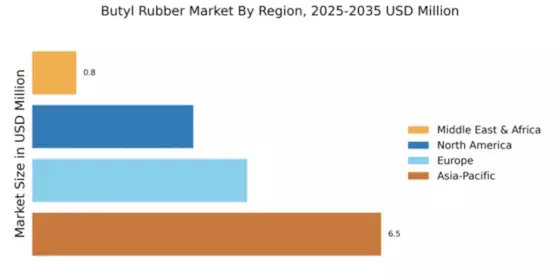
The North American butyl rubber market is projected to reach $3.0 billion by 2025, driven by increasing demand in automotive and tire manufacturing sectors. Regulatory support for sustainable materials and innovations in production processes are key growth catalysts. The region's focus on reducing carbon emissions is also influencing the adoption of butyl rubber, which is known for its low permeability and durability. Leading countries in this region include the US and Canada, where major players like ExxonMobil and Goodyear Tire and Rubber Company dominate the market. The competitive landscape is characterized by a mix of established companies and emerging players, all vying for market share. The presence of advanced manufacturing facilities and R&D centers further strengthens North America's position in The Butyl Rubber.

Europe : Innovation and Sustainability Focus

Europe's butyl rubber market is expected to reach $4.0 billion by 2025, fueled by stringent regulations promoting sustainable practices and innovations in material science. The automotive sector's shift towards eco-friendly solutions is a significant driver, with butyl rubber being favored for its performance characteristics. The region's commitment to reducing greenhouse gas emissions is also a catalyst for growth, aligning with EU regulations. Germany, France, and the UK are leading countries in this market, with key players like Lanxess and Kraton Corporation making substantial contributions. The competitive landscape is marked by a strong emphasis on R&D, with companies investing in new technologies to enhance product performance. The presence of established manufacturers and a growing number of startups is fostering a dynamic market environment.

Asia-Pacific : Dominant Market with High Demand

The Asia-Pacific region is the largest market for butyl rubber, projected to reach $6.5 billion by 2025. This growth is driven by rapid industrialization, increasing automotive production, and rising demand for tires. Countries like China and India are significant contributors, with government initiatives supporting infrastructure development and automotive manufacturing. The region's focus on enhancing production efficiency and sustainability is also a key driver. China stands out as a major player, hosting companies like Tianjin Synthetic Rubber Group and Kumho Petrochemical. The competitive landscape is characterized by a mix of domestic and international firms, all striving to capture market share. The presence of a robust supply chain and favorable regulatory environment further enhances the region's attractiveness for butyl rubber production and consumption.

Middle East and Africa : Emerging Market with Growth Opportunities

The Middle East and Africa region is witnessing a gradual increase in the butyl rubber market, projected to reach $0.82 billion by 2025. The growth is primarily driven by rising automotive production and increasing demand for tires in emerging economies. Additionally, government initiatives aimed at boosting local manufacturing capabilities are expected to catalyze market expansion. The region's rich natural resources also provide a competitive advantage in raw material sourcing. Countries like South Africa and the UAE are leading the way in this market, with a growing number of local and international players entering the scene. The competitive landscape is evolving, with companies focusing on establishing production facilities to meet local demand. The presence of key players and investment in infrastructure development are crucial for the region's market growth.

Butyl Rubber Market Regional Image

Key Players and Competitive Insights

The Butyl Rubber Market is currently characterized by a competitive landscape that is both dynamic and multifaceted. Key growth drivers include the increasing demand for high-performance tires, advancements in automotive technology, and a growing emphasis on sustainability. Major players such as ExxonMobil (US), Lanxess (DE), and Goodyear Tire and Rubber Company (US) are strategically positioned to leverage these trends. ExxonMobil (US) focuses on innovation in polymer technology, while Lanxess (DE) emphasizes sustainability through its production processes. Goodyear Tire and Rubber Company (US) is actively pursuing partnerships to enhance its product offerings, thereby shaping a competitive environment that is increasingly reliant on technological advancements and sustainable practices.In terms of business tactics, companies are localizing manufacturing to reduce costs and optimize supply chains. The market structure appears moderately fragmented, with a mix of large multinational corporations and smaller regional players. This fragmentation allows for a diverse range of products and innovations, although the collective influence of key players like Reliance Industries Limited (IN) and SABIC (SA) is notable, as they continue to expand their market share through strategic initiatives.

In November Goodyear Tire and Rubber Company (US) announced a partnership with a leading technology firm to develop AI-driven solutions for tire performance monitoring. This strategic move is likely to enhance Goodyear's competitive edge by integrating advanced analytics into its product offerings, thereby improving customer satisfaction and operational efficiency. The partnership underscores the importance of technology in driving innovation within the market.

In October Lanxess (DE) unveiled a new sustainable butyl rubber product line aimed at reducing carbon emissions during production. This initiative not only aligns with global sustainability goals but also positions Lanxess as a leader in eco-friendly materials. The strategic importance of this move lies in its potential to attract environmentally conscious consumers and businesses, thereby expanding Lanxess's market reach.

In September ExxonMobil (US) completed the expansion of its butyl rubber production facility in Texas, increasing its capacity by 20%. This expansion is significant as it enables ExxonMobil to meet the rising demand for high-performance materials in the automotive sector. The enhanced capacity is expected to strengthen ExxonMobil's market position and provide a competitive advantage in terms of supply reliability.

As of December current competitive trends indicate a strong shift towards digitalization, sustainability, and AI integration within the Butyl Rubber Market. Strategic alliances are increasingly shaping the landscape, allowing companies to pool resources and expertise. The evolution of competitive differentiation appears to be moving away from price-based competition towards innovation, technology, and supply chain reliability. This shift suggests that companies that prioritize these aspects are likely to thrive in the future.

Key Companies in the Butyl Rubber Market include

Industry Developments

  • Q1 2024: Reliance Sibur Elastomers Private Limited inaugurates new butyl rubber plant in Jamnagar, Gujarat Reliance Industries, in partnership with SIBUR, opened a new butyl rubber manufacturing facility in Jamnagar, Gujarat, with an annual capacity of 120,000 metric tonnes, aiming to reduce India's reliance on imports and strengthen domestic supply.
  • Q2 2024: Indian government announces INR 18,000 crore investment in public bus transportation infrastructure The Indian government committed INR 18,000 crore to expand public bus transportation, which is expected to boost demand for butyl rubber in the automotive sector due to increased tire production.
  • Q2 2024: Reliance-Sibur Elastomers Pvt. Ltd. receives INR 4,000 crore investment for synthetic rubber production expansion Reliance-Sibur Elastomers Pvt. Ltd. secured over INR 4,000 crore in investments to expand its synthetic rubber production facilities, including butyl rubber, supporting India's Make in India and Atmanirbhar Bharat initiatives.
  • Q2 2024: Reliance Sibur Elastomers Private Limited launches new butyl rubber product line for pharmaceutical closures Reliance Sibur Elastomers introduced a new butyl rubber product line specifically designed for pharmaceutical closures, targeting increased demand in the healthcare sector.
  • Q2 2024: Government of India increases planting subsidies for natural rubber cultivation Under the 12th Five-Year Plan, the Indian government raised planting subsidies for natural rubber to INR 25,000 per hectare in traditional regions and INR 35,000 per hectare in non-traditional areas, supporting raw material supply for butyl rubber production.

Future Outlook

Butyl Rubber Market Future Outlook

The Butyl Rubber Market is projected to grow at a 13.53% CAGR from 2025 to 2035, driven by increasing demand in automotive and medical applications.

New opportunities lie in:

  • Expansion into emerging markets with tailored product offerings. Investment in sustainable production technologies to meet regulatory demands. Development of high-performance butyl rubber for specialized industrial applications.

By 2035, the Butyl Rubber Market is expected to achieve robust growth, solidifying its global position.

Market Segmentation

Butyl Rubber Market Form Outlook

  • Solid
  • Liquid
  • Powder

Butyl Rubber Market Type Outlook

  • Regular Butyl Rubber
  • Halobutyl Rubber
  • Polybutylene
  • Reinforced Butyl Rubber

Butyl Rubber Market End Use Outlook

  • Automotive
  • Construction
  • Consumer Goods
  • Medical
  • Industrial

Butyl Rubber Market Application Outlook

  • Tires
  • Adhesives
  • Sealants
  • Coatings
  • Pharmaceuticals

Butyl Rubber Market Processing Method Outlook

  • Extrusion
  • Molding
  • Calendering
  • Blending

Report Scope

MARKET SIZE 2024 14.32(USD Million)
MARKET SIZE 2025 16.26(USD Million)
MARKET SIZE 2035 57.85(USD Million)
COMPOUND ANNUAL GROWTH RATE (CAGR) 13.53% (2025 - 2035)
REPORT COVERAGE Revenue Forecast, Competitive Landscape, Growth Factors, and Trends
BASE YEAR 2024
Market Forecast Period 2025 - 2035
Historical Data 2019 - 2024
Market Forecast Units USD Million
Key Companies Profiled ExxonMobil (US), Lanxess (DE), Goodyear Tire and Rubber Company (US), Kraton Corporation (US), Reliance Industries Limited (IN), SABIC (SA), JSR Corporation (JP), Kumho Petrochemical (KR), Tianjin Synthetic Rubber Group (CN)
Segments Covered Application, End Use, Type, Form, Processing Method
Key Market Opportunities Growing demand for sustainable materials in automotive and medical applications drives Butyl Rubber Market opportunities.
Key Market Dynamics Rising demand for eco-friendly products drives innovation and competition in the Butyl Rubber Market.
Countries Covered North America, Europe, APAC, South America, MEA

Market Highlights

Author
Chitranshi Jaiswal
Research Analyst Level I

In her 3 years of experience in the market research field, she has handled critical cross-domain projects. She has an in-depth knowledge of market estimation & analysis, problem-solving, primary as well as secondary research, and team management.She holds an engineering degree and is an MBA professional from a well-known university, capable of evaluating the market and competitive conditions. An exceptional strategist with excellent communication skills and a passion for delivering cutting-edge & practical insights for the market. Proficient in multi-tasking, and can successfully deal with competing demands, while maintaining complete confidentiality. Generated business through active client and project development, networking, and high-quality responses. Her knowledge and skills have helped in making solid business decisions, securing funding from investors, and avoiding business failures.

Leave a Comment

FAQs

How big is the butyl rubber market expected to turn out by 2035?

The butyl rubber market would cross a mark of USD significant million by 2035.

At what CAGR, the global butyl rubber market would register its growth between 2025-2035, the forecast period?

The butyl rubber market has the opportunity to score a CAGR of 4.66% during the forecast period of 2025-2035.

Which industry would impact the maximum growth for the butyl rubber market?

The increasing demand for automotive components like tires and tubes would ensure growth for the butyl rubber segment.

Which type-base segment would hold the reins of the butyl rubber market?

The bromobutyl segment would have the reins of the butyl rubber market.

Which application-based segment has the scope to dominate the butyl rubber market?

The tires and tubes segment would dominate the global butyl rubber market.

Download Free Sample

Kindly complete the form below to receive a free sample of this Report

Compare Licence

×
Features License Type
Single User Multiuser License Enterprise User
Price $4,950 $5,950 $7,250
Maximum User Access Limit 1 User Upto 10 Users Unrestricted Access Throughout the Organization
Free Customization
Direct Access to Analyst
Deliverable Format
Platform Access
Discount on Next Purchase 10% 15% 15%
Printable Versions