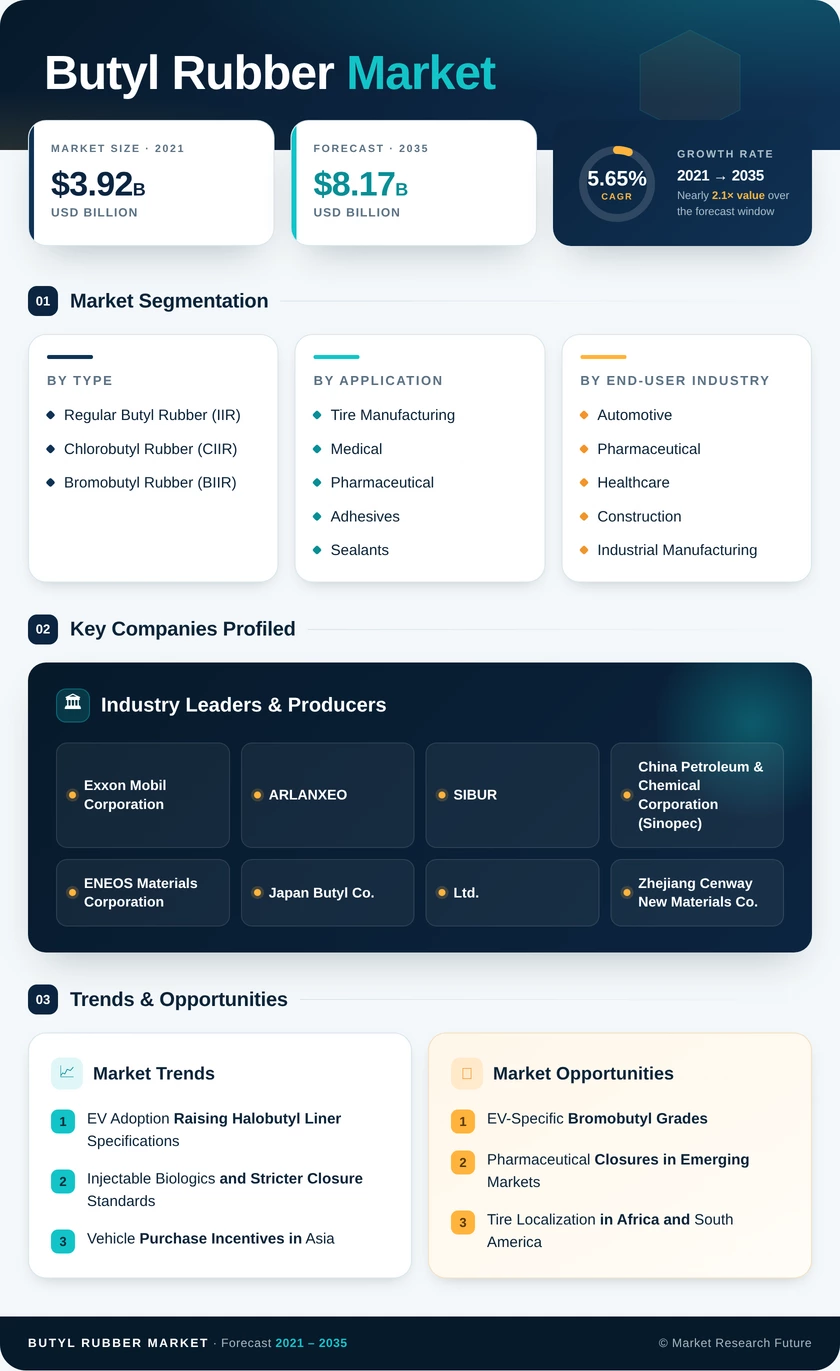
Segmentation Quick Reference
| Dimension | Sub-Segments | Dominant Segment | Fastest Growing Segment |
|---|
| By Type | Regular Butyl Rubber (IIR); Chlorobutyl Rubber (CIIR); Bromobutyl Rubber (BIIR) | Regular Butyl Rubber (IIR) (46.4% share) | Bromobutyl Rubber (BIIR) (6.6% CAGR) |
| By Application | Tire Manufacturing; Medical and Pharmaceutical; Adhesives and Sealants; Hoses and Belts; Protective Clothing and Industrial Products; Roofing and Waterproofing Membranes; Other Applications | Tire Manufacturing (69.8% share) | Medical and Pharmaceutical (6.9% CAGR) |
| By End-user Industry | Automotive; Pharmaceutical and Healthcare; Construction; Industrial Manufacturing; Consumer Goods; Other End-user Industries | Automotive (65.0% share) | Pharmaceutical and Healthcare (7.8% CAGR) |
| By Region | North America; Europe; Asia-Pacific; South America; Middle East & Africa | Asia-Pacific (51.8% share) | North America (6.4% CAGR) |
Market Segmentation Overview
| Sub-Segment | Key Trend |
|---|
| Regular Butyl Rubber (IIR) | Stable demand in inner tubes, cable insulation and gum base; price pressure from new Chinese capacity |
| Chlorobutyl Rubber (CIIR) | Preferred for coated pharmaceutical closures that need low extractables and tight dimensions |
| Bromobutyl Rubber (BIIR) | Rapid adoption in EV and premium tire liners for faster cure and co-vulcanization with natural rubber |
Regular Butyl Rubber (IIR) leads by share because inner tubes and general rubber goods still consume large volumes in uses where cure speed matters less. Bromobutyl Rubber (BIIR) grows fastest, as EV tire approvals require liners that co-cure with natural rubber carcasses and hold pressure under heavier loads. Chlorobutyl Rubber (CIIR) keeps its place in closure applications, where extractables limits decide which grade is used.
| Sub-Segment | Key Trend |
|---|
| Tire Manufacturing | Shift from tubes to halobutyl tubeless liners, especially for EVs |
| Medical and Pharmaceutical | Growth in biologics, vaccines and prefilled syringes |
| Adhesives and Sealants | Insulating glass and airtight building envelope sealing |
| Hoses and Belts | Heat-resistant hoses for hybrid thermal management |
| Protective Clothing and Industrial Products | Chemical-resistant gloves, suits and tank linings |
| Roofing and Waterproofing Membranes | Commercial roofing and infrastructure waterproofing |
| Other Applications | Chewing gum base, sports balls and cable insulation |
Tire Manufacturing leads because every tubeless tire depends on an impermeable inner liner, so tire output sets the baseline for consumption. Medical and Pharmaceutical grows fastest, as biologic drugs and prefilled syringes need closures qualified against Annex 1 and USP <382>. Adhesives and Sealants and Roofing and Waterproofing Membranes follow construction activity rather than vehicle cycles.
| Sub-Segment | Key Trend |
|---|
| Automotive | Material mix moving toward halobutyl as EV platforms scale |
| Pharmaceutical and Healthcare | Highest revenue per kilogram; long supplier qualification |
| Construction | Roofing membranes, HVAC seals and expansion joints |
| Industrial Manufacturing | Vibration mounts, conveyor components and chemical-resistant liners |
| Consumer Goods | Weather stripping, sports equipment and food-grade seals |
| Other End-user Industries | Agriculture, energy and defense uses |
Automotive leads because tires, hoses and mounts account for most tonnage through vehicle supply chains. Pharmaceutical and Healthcare grows fastest, since injectable drug packaging pays a premium for certified, low-extractable halobutyl grades. Construction and Industrial Manufacturing reduce dependence on the automotive cycle through sealing and chemical-resistance uses.


 Noah Malgeri
Co-Founder

 Peter Groot koerkamp
Account and Business Manager

 Younghwan Choi
Senior Retail Manager

 Mark Irwin
Management Consultant

 Akif Moroglu
Strategy & Business Development Director

 Guilherme Gomes Martins
Product Management Director

 Joseph Aguayo
Sales Operations & Pricing Manager

 La Terria Dodd
Program Support Specialist

 Rob Kooiker
Group Product Manager HVAC & Fire Protection GMA