×
Hero Background
English
Chinese
French
Japanese
Korean
German
Spanish

Pyroxenite Market Analysis

ID: MRFR/CnM/9559-HCR
110 Pages
Anshula Mandaokar
October 2025

Pyroxenite Market Research Report Information By Application (Iron & Steel Making, Countertops/Kitchen, Building Stone/Dimension Stone, Others) Forecast 2022-2030

Share:
Download PDF ×

We do not share your information with anyone. However, we may send you emails based on your report interest from time to time. You may contact us at any time to opt-out.

Pyroxenite Market Infographic
Purchase Options

Market Analysis

In-depth Analysis of Pyroxenite Market Industry Landscape

The Pyroxenite Market is experiencing shifts in its dynamics resulting from different factors affecting both supply-side and demand-side aspects, influencing it on a large scale. For instance, pyroxenite, which is an ultramafic rock rich in the pyroxene group of minerals, is applied in a variety of areas, from construction to metallurgy and landscaping. One of the leading factors shaping market dynamics is the use of pyroxenite in the building industry. The production processes carried out for pyroxenite are also one of the biggest determinants of its market dynamics. High melting point and chemical composition make pyroxenite valuable as a raw material for producing ferrochrome and other alloys. With global demand for stainless steel and other alloy products forecasted to continue rising, consumption of pyroxenite within the metallurgical domain will be influenced by this trend, thus impacting market dynamics. Moreover, a geographical distribution exists that affects how Pyroxenite markets operate. In general, regions with more deposits often play a key role in supply chains, which affects overall market dynamics. Moreover, environmental considerations and sustainability concerns are gaining significance in determining the market dynamics around pyroxenite. Like any other natural resource, mining, and extraction processes involved in obtaining Pyroxenites are scrutinized on environmental grounds. To influence these towards responsible methods, however, companies dealing with them have adopted ecologically friendly mining procedures, including embracing sustainable mining practices, thereby influencing market dynamics in that direction. Furthermore, changes occurring on the technology level contribute to the shifting nature that characterizes Pyroxenite markets today. Accordingly, advancements made within extraction technologies or even processing methodologies can directly affect efficiency within mining operations, hence the overall dynamic of the supply chain. When it comes to supply-side aspects regarding this mineral product, stability and sustainability associated with its extraction significantly drive market dynamics. Likewise, issues such as how efficiently firms perform their mining operations while adhering to laid down environmental protection regulations and coming up with responsible mines dictate how this resource reaches consumers at large. All things being equal, any company prioritizing greener techniques would continue to hold sway over Pyroxenite markets as environmental concerns now start to drive market dynamics.


Author
Anshula Mandaokar
Team Lead - Research

Anshula Mandaokar holds an academic degree in Chemical Engineering and has been contributing to the field for more than 5 years. She has expertise in Market Research and Business Consulting and serves as a Team Lead for a reputed Market Research firm under the Chemicals and Materials domain spectrum. She has worked on multiple projects, generating explicit results in a quick turnaround time. Her understanding of data interpretation justifies her role as a leader.

Leave a Comment

FAQs

What growth rate global pyroxenite market would register in the future?

The global pyroxenite market would register a growth of 4.54%.

Which application will play a crucial role in taking the pyroxenite market ahead??

The iron & steel application will play a prominent role in taking the market forward.

What is the key restraining factor for the global pyroxenite market?

High cost associated with pyroxenite extraction, regulatory restraint, and availability of close substitutes may hamper market growth.

Which region would enjoy the upper hand in the pyroxenite market?

Asia-Pacific would enjoy the upper hand in the pyroxenite market.

Which Asia-Pacific country would set the trend in the pyroxenite market?

China, as the largest consumer, would set the trend.

Market Summary

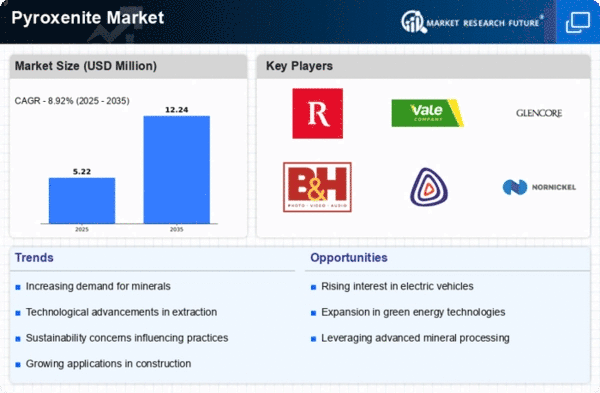
As per MRFR analysis, the Pyroxenite Market Size was estimated at 4.79 USD Million in 2024. The Pyroxenite industry is projected to grow from 5.21 in 2025 to 12.24 by 2035, exhibiting a compound annual growth rate (CAGR) of 8.92 during the forecast period 2025 - 2035.

Key Market Trends & Highlights

The Pyroxenite Market is poised for growth driven by sustainable practices and technological advancements.

  • North America remains the largest market for pyroxenite, driven by robust industrial demand.
  • Asia-Pacific is emerging as the fastest-growing region, reflecting increasing investments in mining and infrastructure.
  • The construction segment leads in market size, while the refractory materials segment is experiencing rapid growth.
  • Rising demand for nickel and cobalt, alongside growing interest in sustainable materials, are key drivers of market expansion.

Market Size & Forecast

2024 Market Size 4.79 (USD Million)
2035 Market Size 12.24 (USD Million)
CAGR (2025 - 2035) 8.92%
Largest Regional Market Share in 2024 North America

Major Players

<p>Rio Tinto (AU), Vale (BR), Glencore (CH), BHP (AU), Anglo American (GB), Norilsk Nickel (RU), Southern Copper Corporation (US), Teck Resources (CA)</p>

Market Trends

The Pyroxenite Market is currently experiencing a notable evolution, driven by various factors that influence its demand and supply dynamics. This metamorphosis appears to be shaped by the increasing interest in sustainable mining practices and the growing utilization of pyroxenite in various industrial applications. As industries seek to reduce their carbon footprint, the demand for pyroxenite, which is often used in the production of high-performance materials, seems to be on the rise. Furthermore, the exploration of pyroxenite deposits in different regions indicates a potential expansion of the market, as companies aim to diversify their resource base and enhance their production capabilities. In addition to sustainability, technological advancements in extraction and processing methods are likely to play a crucial role in shaping the Pyroxenite Market. Innovations that improve efficiency and reduce environmental impact may attract more players to this sector. Moreover, the increasing awareness of the benefits of pyroxenite in various applications, such as construction and metallurgy, suggests a growing acceptance of this mineral among manufacturers. Overall, the Pyroxenite Market appears poised for growth, with several factors converging to create a favorable environment for investment and development.

Sustainable Mining Practices

The Pyroxenite Market is witnessing a shift towards sustainable mining practices. Companies are increasingly adopting eco-friendly methods to extract and process pyroxenite, which aligns with global efforts to minimize environmental impact. This trend not only enhances the market's appeal but also attracts environmentally conscious investors.

Technological Advancements

Technological innovations in extraction and processing are transforming the Pyroxenite Market. Enhanced techniques that improve efficiency and reduce waste are becoming more prevalent. These advancements may lead to increased production capabilities and lower operational costs, thereby attracting new entrants to the market.

Diverse Industrial Applications

The versatility of pyroxenite is driving its adoption across various industries. Its use in construction, metallurgy, and other sectors is expanding, as manufacturers recognize its benefits. This trend suggests a growing market potential, as diverse applications may lead to increased demand for pyroxenite.

Pyroxenite Market Market Drivers

Market Growth Projections

The Global Pyroxenite Market Industry exhibits promising growth projections, with a market value expected to reach 195.2 USD Million by 2035. This growth is underpinned by various factors, including the increasing demand for nickel in multiple sectors, advancements in mining technologies, and the rising popularity of electric vehicles. The market is anticipated to experience a CAGR of 3.55% from 2025 to 2035, reflecting a stable growth trajectory. These projections suggest that the pyroxenite market will continue to evolve, adapting to changing industry dynamics and consumer preferences, thereby solidifying its position in the global minerals landscape.

Increasing Demand for Nickel

The Global Pyroxenite Market Industry experiences a notable surge in demand for nickel, a key component derived from pyroxenite. Nickel is essential for various applications, particularly in the production of stainless steel and batteries for electric vehicles. As industries pivot towards sustainable energy solutions, the demand for nickel is projected to rise significantly. In 2024, the market value is estimated at 133.0 USD Million, reflecting the growing interest in nickel-rich pyroxenite. This trend is likely to continue, with projections indicating a market value of 195.2 USD Million by 2035, suggesting a robust growth trajectory driven by the increasing utilization of nickel in modern technologies.

Growing Electric Vehicle Market

The rise of the electric vehicle (EV) market significantly influences the Global Pyroxenite Market Industry. Pyroxenite Market serves as a vital source of nickel, which is a crucial component in lithium-ion batteries used in EVs. With governments worldwide promoting green transportation initiatives, the demand for EVs is expected to escalate. This trend is reflected in the anticipated growth of the pyroxenite market, which is projected to reach 195.2 USD Million by 2035. The increasing adoption of EVs not only drives the demand for nickel but also underscores the importance of sustainable mining practices in the pyroxenite sector, further enhancing its market potential.

Technological Advancements in Mining

Technological innovations in mining processes are transforming the Global Pyroxenite Market Industry. Enhanced extraction techniques, such as automated drilling and advanced mineral processing, improve efficiency and reduce operational costs. These advancements not only optimize resource recovery but also minimize environmental impact, aligning with global sustainability goals. The integration of technology in mining operations is expected to bolster production rates, thereby increasing the availability of pyroxenite for various applications. As a result, the market is likely to witness a steady growth rate, with a projected CAGR of 3.55% from 2025 to 2035, indicating a positive outlook for the industry.

Infrastructure Development Initiatives

Infrastructure development initiatives across the globe are poised to impact the Global Pyroxenite Market Industry positively. Governments are investing heavily in infrastructure projects, including roads, bridges, and public transportation systems, which require substantial amounts of steel and other materials. Pyroxenite Market, being a source of nickel, plays a crucial role in the production of these materials. As infrastructure projects expand, the demand for pyroxenite is likely to increase, contributing to the market's growth. The projected market value of 133.0 USD Million in 2024 is indicative of this trend, with expectations of continued growth as infrastructure investments rise in the coming years.

Environmental Regulations and Sustainability

The Global Pyroxenite Market Industry is increasingly shaped by stringent environmental regulations and a growing emphasis on sustainability. Governments are implementing policies aimed at reducing carbon footprints and promoting responsible mining practices. This shift encourages the adoption of sustainable methods in pyroxenite extraction and processing, which may enhance the industry's reputation and marketability. Companies that prioritize environmentally friendly practices are likely to gain a competitive edge, attracting investments and partnerships. As the market evolves, the focus on sustainability could drive growth, with a projected CAGR of 3.55% from 2025 to 2035, indicating a long-term commitment to responsible resource management.

Market Segment Insights

By Application: Construction (Largest) vs. Refractory Materials (Fastest-Growing)

<p>The Pyroxenite Market exhibits a diverse distribution across its application segments, with 'Construction' holding the largest share. This segment benefits from the ongoing demand for high-quality materials in structural applications. Following closely are 'Metallurgy', 'Glass Manufacturing', 'Ceramics', and 'Refractory Materials', each contributing significantly to the overall market dynamics. The unique properties of pyroxenite, such as heat resistance and stability, make it a preferred choice in these sectors. As industries evolve, growth trends indicate that 'Refractory Materials' is the fastest-growing segment. Increased focus on energy efficiency, advanced manufacturing processes, and the demand for high-performance materials drive this growth. The push towards sustainability and innovative applications in the metallurgy and glass sectors further bolster the relevance of pyroxenite, making it a critical player in modern industrial applications.</p>

<p>Construction: Dominant vs. Refractory Materials: Emerging</p>

<p>The construction sector remains dominant in the Pyroxenite Market, primarily due to its extensive use in foundational and structural applications. Pyroxenite's physical properties, such as density and durability, make it ideal for constructing robust structures. Meanwhile, 'Refractory Materials' is emerging rapidly due to its essential role in high-temperature environments, where it is deployed in furnaces and kilns. This segment is characterized by innovations that enhance material performance and sustainability. As industries adapt to stringent regulations and technological advancements, both segments showcase strong and distinct market positions, with construction being a staple and refractory materials paving the path for future growth.</p>

By End Use: Building Materials (Largest) vs. Metal Alloys (Fastest-Growing)

<p>In the Pyroxenite market, the end-use applications are diversified across various industries. Building materials account for a significant portion of the overall market share, driven by the demand for sustainable construction practices and innovative architectural designs. Metal alloys, while smaller in share, are rapidly catching up in overall relevance, spurred by advancements in metallurgy and applications in specialized industries. This distribution highlights the importance of both established and emerging uses in shaping market dynamics. Looking towards future growth, the building materials segment is expected to maintain its dominance due to ongoing infrastructure projects and increasing urbanization trends. Conversely, metal alloys are projected as a fast-growing segment, benefiting from the rise in high-performance materials in automotive and aerospace applications. The increasing need for lightweight and durable materials plays a crucial role in this growth, positioning metal alloys as a key focus area for new technological innovations.</p>

<p>Building Materials (Dominant) vs. Metal Alloys (Emerging)</p>

<p>Building materials represent the dominant segment in the Pyroxenite market, characterized by an extensive range of applications in construction, infrastructure, and sustainability efforts. This segment benefits from a growing trend towards eco-friendly building practices, which leverage the natural properties of pyroxenite. In contrast, metal alloys, while emerging, are crucial in the production of advanced materials that require specific physical properties such as strength and corrosion resistance. This segment is increasingly utilized in industries like aerospace and automotive, where performance is essential. The growth of these two segments reflects the broader trends in the construction and manufacturing sectors, highlighting a shift towards materials that combine functionality with sustainability.</p>

By Form: Crushed Pyroxenite (Largest) vs. Powdered Pyroxenite (Fastest-Growing)

<p>In the Pyroxenite Market, the distribution of share among the different forms is notably dominated by Crushed Pyroxenite. This form occupies a substantial segment due to its widespread application in various industries, such as construction and metallurgy. Meanwhile, Powdered Pyroxenite is gaining momentum and increasing its market share rapidly, fueled by its growing usage in specialized applications requiring finer materials.</p>

<p>Crushed Pyroxenite (Dominant) vs. Powdered Pyroxenite (Emerging)</p>

<p>Crushed Pyroxenite has established itself as the dominant form in the market, mainly because of its versatile applications. It is preferred in construction and manufacturing processes where larger aggregate sizes are necessary. On the other hand, Powdered Pyroxenite is emerging as a popular choice owing to its advantages in applications requiring fine consistency and greater surface area, such as in chemical formulations and specialty products. The increasing demand for powdered materials in emerging technologies positions it as an exciting opportunity for growth.</p>

By Purity Level: High Purity (Largest) vs. Medium Purity (Fastest-Growing)

<p>The Pyroxenite market's purity level segment is characterized by three main categories: high purity, medium purity, and low purity. Among these, high purity pyroxenite holds the largest market share, reflecting its preference across various applications due to its superior quality and performance. Medium purity, while currently representing a smaller portion of the market, is rapidly gaining traction as industries seek cost-effective alternatives, positioning it as the fastest-growing segment in the market.</p>

<p>High Purity (Dominant) vs. Medium Purity (Emerging)</p>

<p>High purity pyroxenite is considered the dominant segment in the market due to its extensive use in specialized applications that demand superior quality, such as aerospace and electronics. This segment benefits from advancements in extraction and refining technologies, ensuring consistent quality in the final product. Conversely, medium purity pyroxenite is emerging as a favorable choice for industries looking for a balance between quality and price, making it increasingly popular within sectors such as construction and manufacturing. This shift highlights a growing trend towards using materials that fulfill functional requirements while providing cost savings.</p>

By Processing Method: Crushing (Largest) vs. Grinding (Fastest-Growing)

<p>In the Pyroxenite Market, the processing method segment is characterized by a clear distribution of shares among different techniques. Crushing holds the largest share due to its fundamental role in the initial stages of mineral processing, allowing for the effective breakdown of raw materials. In contrast, grinding, while smaller in share, is rapidly gaining traction and is identified as the fastest-growing method, primarily driven by the need for finer particles in subsequent processing applications.</p>

<p>Crushing: Dominant vs. Grinding: Emerging</p>

<p>Crushing is the dominant processing method in the Pyroxenite Market, primarily due to its efficiency in reducing the size of larger rocks to facilitate further processing. It employs various equipment, including jaw and cone crushers, to achieve the desired granularity. Conversely, grinding, although classified as emerging, is experiencing significant growth owing to advancements in technology that allow for greater precision and energy efficiency. Grinding technology caters to the demand for ultra-fine materials, crucial in numerous industrial applications. As the minerals extracted from pyroxenite continue to be utilized in increasingly specialized sectors, both of these processing methods remain pivotal to fulfilling market demands.</p>

Get more detailed insights about Pyroxenite Market Research Report—Global Forecast till 2035

Regional Insights

North America : Market Leader in Pyroxenite

North America is poised to maintain its leadership in the pyroxenite market, holding a significant share of 2.0 in 2024. The region's growth is driven by increasing demand for minerals in various industries, including construction and electronics. Regulatory support for sustainable mining practices further enhances market potential, encouraging investment and innovation in extraction technologies. The United States and Canada are the leading countries in this sector, with major players like Southern Copper Corporation and Teck Resources driving competition. The presence of established companies such as Rio Tinto and BHP also contributes to a robust competitive landscape, ensuring that North America remains a focal point for pyroxenite production and export.

Europe : Emerging Market Dynamics

Europe's pyroxenite market is evolving, with a market size of 1.5 in 2024. The region is experiencing growth due to rising demand for high-quality minerals in the automotive and aerospace sectors. Regulatory frameworks promoting sustainable mining practices are catalyzing investments, making Europe a key player in the global market. Leading countries such as Germany and Finland are at the forefront, with companies like Glencore and Anglo American actively participating in the market. The competitive landscape is characterized by a mix of established firms and emerging players, ensuring a dynamic environment for pyroxenite production. "The European Union is committed to enhancing the sustainability of mineral extraction to support the green transition," European Commission report, 2023.

Asia-Pacific : Growing Demand and Investment

The Asia-Pacific region, with a market size of 1.2 in 2024, is witnessing a surge in demand for pyroxenite, driven by rapid industrialization and urbanization. Countries like China and India are leading this growth, with increasing investments in infrastructure and manufacturing sectors. Regulatory initiatives aimed at improving mining efficiency and environmental standards are also contributing to market expansion. China stands out as a dominant player, with significant contributions from local companies. The competitive landscape is marked by both domestic and international firms, including Vale and Norilsk Nickel, which are expanding their operations in the region. The growing focus on sustainable practices is expected to shape the future of the pyroxenite market in Asia-Pacific.

Middle East and Africa : Emerging Market Opportunities

The Middle East and Africa region, with a market size of 0.09 in 2024, is still in the nascent stages of developing its pyroxenite market. However, there is significant potential for growth driven by increasing mineral demand in construction and energy sectors. Regulatory frameworks are gradually evolving to support mining activities, which could catalyze investment in the region. Countries like South Africa and Morocco are beginning to emerge as key players, with local companies exploring opportunities in pyroxenite extraction. The competitive landscape is still developing, but the presence of international firms may enhance market dynamics. As the region focuses on resource development, the pyroxenite market is expected to gain traction in the coming years.

Key Players and Competitive Insights

The Pyroxenite Market is characterized by a competitive landscape that is increasingly shaped by innovation, sustainability, and strategic partnerships. Key players such as Rio Tinto (AU), Vale (BR), and Glencore (CH) are actively pursuing strategies that emphasize operational efficiency and environmental responsibility. For instance, Rio Tinto (AU) has focused on enhancing its mining technologies to reduce carbon emissions, while Vale (BR) has been investing in sustainable mining practices to align with global environmental standards. These strategies not only bolster their market positions but also contribute to a collective shift towards more responsible mining practices within the industry.

The market structure appears moderately fragmented, with several players vying for market share through localized manufacturing and optimized supply chains. Companies are increasingly localizing their operations to mitigate risks associated with global supply chain disruptions. This tactic not only enhances operational efficiency but also allows for quicker responses to regional market demands. The collective influence of major players like BHP (AU) and Anglo American (GB) further solidifies the competitive dynamics, as they leverage their extensive resources to maintain a competitive edge.

In November 2025, Vale (BR) announced a strategic partnership with a leading technology firm to develop AI-driven solutions for mineral exploration. This initiative is expected to enhance the accuracy of resource identification, thereby reducing operational costs and improving sustainability outcomes. The integration of AI into their exploration processes signifies a pivotal shift towards technology-driven mining, which could set a new standard in the industry.

In October 2025, Glencore (CH) unveiled its ambitious plan to transition to renewable energy sources for its mining operations. This move is part of a broader strategy to achieve net-zero emissions by 2040. By investing in renewable energy infrastructure, Glencore (CH) aims to not only comply with regulatory pressures but also to position itself as a leader in sustainable mining practices. This strategic pivot could potentially reshape the competitive landscape, as other companies may feel compelled to follow suit.

In December 2025, BHP (AU) launched a new initiative aimed at enhancing supply chain transparency through blockchain technology. This development is anticipated to improve traceability and accountability in the sourcing of pyroxenite, thereby addressing growing consumer demand for ethically sourced materials. The adoption of blockchain technology reflects a broader trend towards digitalization in the mining sector, which is likely to influence competitive strategies moving forward.

As of December 2025, the Pyroxenite Market is witnessing a pronounced shift towards digitalization, sustainability, and strategic alliances. Companies are increasingly recognizing the importance of innovation and technology in maintaining competitive differentiation. The current trends suggest a transition from traditional price-based competition to a focus on technological advancements and supply chain reliability. This evolution may redefine competitive dynamics, compelling companies to innovate continuously and collaborate strategically to thrive in an ever-evolving market.

Key Companies in the Pyroxenite Market market include

Industry Developments

Future Outlook

Pyroxenite Market Future Outlook

<p>The Pyroxenite Market is projected to grow at an 8.92% CAGR from 2024 to 2035, driven by increasing demand in metallurgy, construction, and energy sectors.</p>

New opportunities lie in:

  • <p>Development of advanced pyroxenite-based composites for construction applications.</p>
  • <p>Expansion into emerging markets with tailored pyroxenite solutions.</p>
  • <p>Investment in sustainable mining technologies to enhance resource efficiency.</p>

<p>By 2035, the Pyroxenite Market is expected to achieve robust growth, solidifying its global presence.</p>

Market Segmentation

Pyroxenite Market Form Outlook

  • Crushed Pyroxenite
  • Powdered Pyroxenite
  • Granular Pyroxenite
  • Lump Pyroxenite

Pyroxenite Market End Use Outlook

  • Building Materials
  • Metal Alloys
  • Glass Products
  • Ceramic Products
  • Industrial Applications

Pyroxenite Market Application Outlook

  • Construction
  • Metallurgy
  • Glass Manufacturing
  • Ceramics
  • Refractory Materials

Pyroxenite Market Purity Level Outlook

  • High Purity
  • Medium Purity
  • Low Purity

Pyroxenite Market Processing Method Outlook

  • Crushing
  • Grinding
  • Sintering
  • Pelletizing

Report Scope

MARKET SIZE 20244.79(USD Million)
MARKET SIZE 20255.21(USD Million)
MARKET SIZE 203512.24(USD Million)
COMPOUND ANNUAL GROWTH RATE (CAGR)8.92% (2024 - 2035)
REPORT COVERAGERevenue Forecast, Competitive Landscape, Growth Factors, and Trends
BASE YEAR2024
Market Forecast Period2025 - 2035
Historical Data2019 - 2024
Market Forecast UnitsUSD Million
Key Companies ProfiledRio Tinto (AU), Vale (BR), Glencore (CH), BHP (AU), Anglo American (GB), Norilsk Nickel (RU), Southern Copper Corporation (US), Teck Resources (CA)
Segments CoveredApplication, End Use, Form, Purity Level, Processing Method
Key Market OpportunitiesGrowing demand for sustainable materials in construction enhances opportunities in the Pyroxenite Market.
Key Market DynamicsRising demand for pyroxenite in steel production drives competition and influences supply chain dynamics.
Countries CoveredNorth America, Europe, APAC, South America, MEA

FAQs

What growth rate global pyroxenite market would register in the future?

The global pyroxenite market would register a growth of 4.54%.

Which application will play a crucial role in taking the pyroxenite market ahead??

The iron &amp; steel application will play a prominent role in taking the market forward.

What is the key restraining factor for the global pyroxenite market?

High cost associated with pyroxenite extraction, regulatory restraint, and availability of close substitutes may hamper market growth.

Which region would enjoy the upper hand in the pyroxenite market?

Asia-Pacific would enjoy the upper hand in the pyroxenite market.

Which Asia-Pacific country would set the trend in the pyroxenite market?

China, as the largest consumer, would set the trend.

  1. Executive Summary
  2. Scope of the Report
    1. Market
    2. Definition
    3. Scope of the Study
    4. List of Assumptions
    5. Markets Structure
    6. Market Research Methodology
    7. Research Process
    8. Primary Research
    9. Secondary Research
    10. Market Size Estimation
    11. Forecast Model
  3. Market Factor Analysis
    1. Supply Chain Analysis
      1. Raw Material Suppliers
      2. Manufacturers/Service Providers of Pyroxenite
      3. Distributors/Retailers/Wholesalers/E-Commerce
      4. Threat of New Entrants
      5. Intensity of Competitive Rivalry
      6. Threat of Substitutes
      7. Bargaining
    2. Merchants
    3. End-Users
    4. Porter’s Five Forces Model
    5. Power of Suppliers
    6. Bargaining Power of Buyers
    7. Pricing Analysis
  4. Market Dynamics of Global Pyroxenite Market
    1. Introduction
    2. Drivers
    3. Restraints
    4. Opportunities
    5. Challenges
  5. Global Pyroxenite Market,
    1. by Application
    2. Introduction
    3. Iron & Steel Making
    4. Forecast, by Region, 2019–2030
    5. & Forecast, by Region, 2019–2030
    6. Forecast, 2019–2030
    7. & Forecast, 2019–2030
  6. Market Estimates & Forecast, 2019–2030
  7. Market Estimates &
    1. Countertops/Kitchen
      1. Market Estimates & Forecast, 2019–2030
      2. Market Estimates
    2. Building Stone/Dimension Stone
      1. Market Estimates &
      2. Market Estimates & Forecast, by Region, 2019–2030
    3. Others
      1. Market Estimates
      2. Market Estimates & Forecast, by Region, 2019–2030
  8. Global Pyroxenite Market,
    1. by Region
    2. Introduction
    3. North America
    4. Market Estimates & Forecast, 2019–2030
    5. US
    6. Market Estimates & Forecast, 2019–2030
    7. Canada
    8. Market Estimates & Forecast, 2019–2030
    9. Europe
    10. Market Estimates & Forecast, 2019–2030
    11. Germany
    12. Market Estimates & Forecast, 2019–2030
    13. France
    14. Market Estimates & Forecast, 2019–2030
    15. Italy
    16. Market Estimates & Forecast, 2019–2030
    17. Spain
    18. Market Estimates & Forecast, 2019–2030
    19. UK
    20. Market Estimates & Forecast, 2019–2030
    21. Russia
    22. Market Estimates & Forecast, 2019–2030
    23. Rest of Europe
    24. Market Estimates & Forecast, 2019–2030
    25. Asia-Pacific
    26. Market Estimates & Forecast, 2019–2030
    27. China
    28. Market Estimates & Forecast, 2019–2030
    29. India
    30. Market Estimates & Forecast, 2019–2030
    31. South Korea
    32. Market Estimates & Forecast, 2019–2030
    33. Indonesia
    34. Market Estimates & Forecast, 2019–2030
    35. Australia & New Zealand
    36. & Forecast, by Application, 2019–2030
    37. & Forecast, by Application, 2019–2030
    38. & Forecast, by Application, 2019–2030
    39. & Forecast, by Application, 2019–2030
    40. & Forecast, by Application, 2019–2030
    41. & Forecast, by Application, 2019–2030
    42. & Forecast, 2019–2030
    43. & Forecast, 2019–2030
    44. & Forecast, 2019–2030
    45. & Forecast, 2019–2030
    46. & Forecast, 2019–2030
    47. Estimates & Forecast, 2019–2030
    48. Competitive Landscape
    49. Introduction
    50. Market Key Strategies
    51. Competitive Benchmarking
    52. Ventures/New Pyroxenite Developments/Agreements/Investments)
  9. Market Estimates & Forecast, by Application,
  10. Market Estimates & Forecast, by Application,
  11. Market Estimates & Forecast, by Application,
  12. Market Estimates & Forecast, by Application,
  13. Market Estimates & Forecast, by Application,
  14. Market Estimates & Forecast, by Application,
  15. Market Estimates & Forecast, by Application,
  16. Market Estimates & Forecast, by Application,
  17. Market Estimates & Forecast, by Application,
  18. Market Estimates & Forecast, by Application,
  19. Market Estimates & Forecast, by Application,
  20. Market Estimates & Forecast, by Application,
  21. Market Estimates & Forecast, by Application,
  22. Market Estimates & Forecast, by Application,
  23. Market Estimates & Forecast, by Application,
  24. Market Estimates & Forecast, by Application,
  25. Market Estimates & Forecast, 2019–2030
  26. Market Estimates
  27. Rest of Asia-Pacific
  28. Market Estimates & Forecast, 2019–2030
  29. Market Estimates
    1. Middle East & Africa
      1. Market Estimates & Forecast, 2019–2030
      2. Market Estimates
      3. Turkey
      4. GCC Countries
      5. South Africa
      6. Rest of the Middle East & Africa
    2. Latin America
      1. Market Estimates
      2. Market Estimates & Forecast, by Application, 2019–2030
      3. Brazil
      4. Argentina
      5. Mexico
      6. Rest of Latin America
    3. Key Development Analysis (Expansions/Mergers & Acquisitions/Joint
  30. Company Profiles
    1. Tata Steel Ltd.
      1. Company Overview
      2. Financial Overview
      3. Products Offered
      4. Key Developments
      5. SWOT Analysis
      6. Key Strategies
    2. Bharat Mining Company
    3. Foskor (Pty) Ltd.
    4. TVI Resource Development
    5. Philippines Inc.
    6. Aegis Group.
    7. Others
  31. Appendix
  32. LIST OF TABLES
    1. Table 1: Global Pyroxenite
  33. Market, by Region, 2019–2030
  34. Table 2: North America: Pyroxenite Market, by Country, 2019–2030
    1. Table 3: Europe: Pyroxenite
  35. Market, by Country, 2019–2030
  36. Table 4: Asia-Pacific: Pyroxenite Market, by Country, 2019–2030
    1. Table 5: Middle East
  37. & Africa: Pyroxenite Market, by Country, 2019–2030
  38. Table 6: Latin America: Pyroxenite Market, by Country,
    1. Table
  39. 13: Global Pyroxenite Market, by Region, 2019–2030
  40. Table 14: North America: Pyroxenite Market, by Country,
    1. Table
  41. 15: Europe: Pyroxenite Market, by Country, 2019–2030
  42. Table 16: Asia-Pacific: Pyroxenite Market, by Country,
    1. Table
  43. 17: Middle East & Africa: Pyroxenite Market, by Country, 2019–2030
    1. Table 18: Latin America:
  44. Pyroxenite Market, by Country, 2019–2030
  45. Table 19: Global Pyroxenite Market, by Region, 2019–2030
    1. Table 20: North America:
  46. Pyroxenite Market, by Country, 2019–2030
  47. Table 21: Europe: Pyroxenite Market, by Country,
    1. Table
  48. 22: Asia-Pacific: Pyroxenite Market, by Country, 2019–2030
    1. Table 23: Middle East & Africa:
  49. Pyroxenite Market, by Country, 2019–2030
  50. Table 24: Latin America: Pyroxenite Market, by Country,
    1. Table
  51. 25: Global Pyroxenite Market, by Region, 2019–2030
  52. Table 26: Global Pyroxenite Market, by Region, 2019–2030
    1. Table 27: North America:
  53. Pyroxenite Market, by Country, 2019–2030
  54. Table 30: North America: Pyroxenite Market, by Application,
    1. Table
  55. 31: Europe: Pyroxenite Market, by Country, 2019–2030
  56. Table 33: Europe: Pyroxenite Market, by Application,
    1. Table
  57. 34: Asia-Pacific: Pyroxenite Market, by Country, 2019–2030
    1. Table 36: Asia-Pacific: Pyroxenite
  58. Market, by Application, 2019–2030
    1. Table 37: Middle East & Africa: Pyroxenite Market, by
    2. Country, 2019–2030
  59. Table 39: Middle East & Africa: Pyroxenite Market, by Application,
    1. Table
  60. 40: Latin America: Pyroxenite Market, by Country, 2019–2030
    1. Table 42: Latin America: Pyroxenite
  61. Market, by Application, 2019–2030
  62. LIST OF FIGURES
  63. Global Pyroxenite
    1. Market Segmentation
    2. FIGURE
  64. Forecast Research Methodology
  65. Porter’s Five Forces Analysis of Global Pyroxenite Market
  66. Value Chain/Supply
    1. Chain of Global Pyroxenite Market
  67. Share of Global Pyroxenite Market, by Country, 2021 (%)
  68. Global Pyroxenite
    1. Market, 2019–2030
  69. Global Pyroxenite Market Size, by Application, 2019–2030
  70. Share of Global
  71. Pyroxenite Market, by Application, 2021 (%)

Pyroxenite Market Segmentation

Market Segmentation Overview

  • Detailed segmentation data will be available in the full report
  • Comprehensive analysis by multiple parameters
  • Regional and country-level breakdowns
  • Market size forecasts by segment
Infographic

Free Sample Request

Kindly complete the form below to receive a free sample of this Report

Get Free Sample

Customer Strories

Compare Licence

×
Features License Type
Single User Multiuser License Enterprise User
Price $4,950 $5,950 $7,250
Maximum User Access Limit 1 User Upto 10 Users Unrestricted Access Throughout the Organization
Free Customization
Direct Access to Analyst
Deliverable Format
Platform Access
Discount on Next Purchase 10% 15% 15%
Printable Versions