Property and Casualty Insurance Market

ID: MRFR/BS/31582-HCR
200 Pages
Aarti Dhapte
Last Updated: June 25, 2026
Property Casualty Insurance Market Size, Share and Research Report By Product Type (Motor Insurance, Homeowner Insurance, Liability Insurance, Other (Marine, Aviation, etc.)), By Distribution Channel (Brokers, Agents, Digital Aggregators & InsurTechs, Bancassurance & Other), By Customer Type (Individuals, SMEs, Large Enterprises), By Risk Line (Commercial Lines, Personal Lines) and By Region (North America, Europe, South America, Asia Pacific, Middle East and Africa) - Industry Forecast to 2035.
Download PDF ×

We do not share your information with anyone. However, we may send you emails based on your report interest from time to time. You may contact us at any time to opt-out.

Property and Casualty Insurance Market

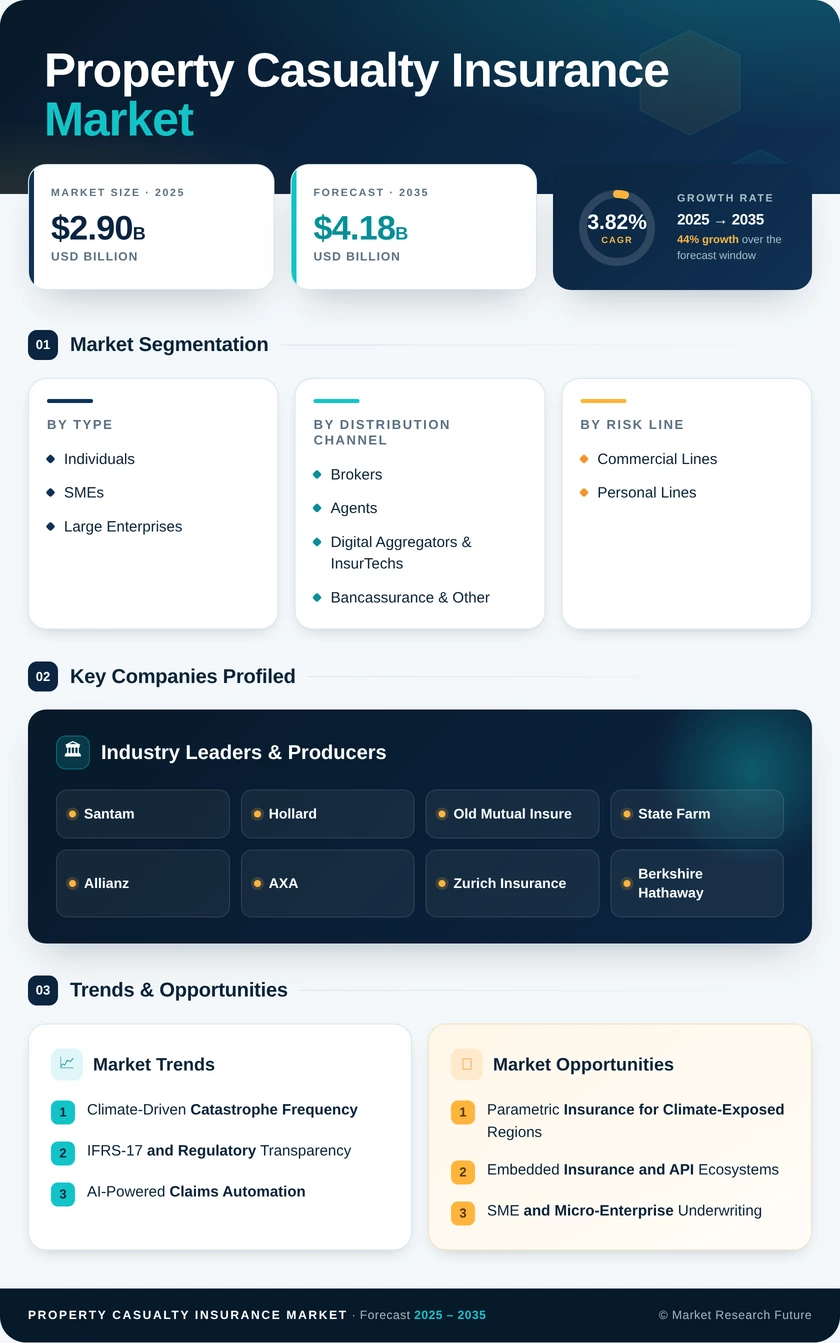
Market Size

Forecast Period2026-2035
CAGR (2026-2035)3.82%
2025 Market SizeUSD 2.90 Billion
2026 Market SizeUSD 3.01 Billion
2035 Market SizeUSD 4.18 Billion

Key Players

Santam
Hollard
Old Mutual Insure
State Farm
Allianz
AXA
Opportunities
  • Parametric Insurance for Climate-Exposed Regions
  • Embedded Insurance and API Ecosystems
  • SME and Micro-Enterprise Underwriting
  1. 1 Market Overview |
    1. 1.1 Study Assumptions & Market Definition |
    2. 1.2 Scope of the Study |
    3. 1.3 Research Methodology
  2. 2 Market Summary & Key Takeaways
  3. 3 Market Dynamics |
    1. 3.1 Market Drivers Analysis | |
      1. 3.1.1 Climate-Driven Catastrophe Frequency | |
      2. 3.1.2 IFRS-17 and Solvency II Transparency | |
      3. 3.1.3 AI-Powered P&C Claims Automation Adoption | |
      4. 3.1.4 Mandatory Motor Insurance Expansion | |
      5. 3.1.5 SME and Micro-Enterprise Coverage Mandates | |
      6. 3.1.6 Digital Distribution for Personal Lines P&C | |
      7. 3.1.7 Usage-Based Telematics and Embedded APIs |
    2. 3.2 Market Restraints Analysis | |
      1. 3.2.1 Reinsurance Cost Escalation | |
      2. 3.2.2 Regulatory Fragmentation | |
      3. 3.2.3 Cyber Risk Accumulation Uncertainty | |
      4. 3.2.4 Talent Shortage in Actuarial/Data Science | |
      5. 3.2.5 Legacy System Migration Friction |
    3. 3.3 Market Opportunity Analysis | |
      1. 3.3.1 Parametric Insurance for Climate-Exposed Regions | |
      2. 3.3.2 Embedded Insurance and API Ecosystems | |
      3. 3.3.3 SME and Micro-Enterprise Underwriting | |
      4. 3.3.4 ESG-Linked Underwriting Products | |
      5. 3.3.5 Data Monetization through Telematics |
    4. 3.4 Industry Value Chain Analysis |
    5. 3.5 Porter's Five Forces Analysis
  4. 4 Global Property Casualty Insurance Market Size & Forecast (2021–2035) |
    1. 4.1 Historical Market Size (2021–2025) |
    2. 4.2 Current & Forecast Market Size (2026–2035) |
    3. 4.3 Market Size by Revenue (USD Billion) |
    4. 4.4 Year-over-Year Growth Analysis
  5. 5 Segmentation Analysis |
    1. 5.1 By Product Type | |
      1. 5.1.1 Motor Insurance | |
      2. 5.1.2 Homeowner Insurance | |
      3. 5.1.3 Liability Insurance | |
      4. 5.1.4 Other (Marine, Aviation, etc.) |
    2. 5.2 By Distribution Channel | |
      1. 5.2.1 Brokers | |
      2. 5.2.2 Agents | |
      3. 5.2.3 Digital Aggregators & InsurTechs | |
      4. 5.2.4 Bancassurance & Other |
    3. 5.3 By Customer Type | |
      1. 5.3.1 Individuals | |
      2. 5.3.2 SMEs | |
      3. 5.3.3 Large Enterprises |
    4. 5.4 By Risk Line | |
      1. 5.4.1 Commercial Lines | |
      2. 5.4.2 Personal Lines
  6. 6 Regional Analysis |
    1. 6.1 North America | |
      1. 6.1.1 United States | |
      2. 6.1.2 Canada | |
      3. 6.1.3 Mexico |
    2. 6.2 Europe | |
      1. 6.2.1 Germany | |
      2. 6.2.2 United Kingdom | |
      3. 6.2.3 France | |
      4. 6.2.4 Italy | |
      5. 6.2.5 Spain | |
      6. 6.2.6 Nordic Countries | |
      7. 6.2.7 Russia | |
      8. 6.2.8 Rest of Europe |
    3. 6.3 Asia-Pacific | |
      1. 6.3.1 China | |
      2. 6.3.2 India | |
      3. 6.3.3 Japan | |
      4. 6.3.4 South Korea | |
      5. 6.3.5 ASEAN | |
      6. 6.3.6 Rest of Asia-Pacific |
    4. 6.4 South America | |
      1. 6.4.1 Brazil | |
      2. 6.4.2 Argentina | |
      3. 6.4.3 Rest of South America |
    5. 6.5 Middle East & Africa | |
      1. 6.5.1 Saudi Arabia | |
      2. 6.5.2 UAE | |
      3. 6.5.3 South Africa | |
      4. 6.5.4 Egypt | |
      5. 6.5.5 Rest of MEA
  7. 7 Competitive Landscape |
    1. 7.1 Market Share Analysis (2025) |
    2. 7.2 Competitive Benchmarking Matrix |
    3. 7.3 Company Profiles | |
      1. 7.3.1 Santam | |
      2. 7.3.2 Hollard | |
      3. 7.3.3 Old Mutual Insure | |
      4. 7.3.4 State Farm | |
      5. 7.3.5 Allianz | |
      6. 7.3.6 AXA | |
      7. 7.3.7 Zurich Insurance | |
      8. 7.3.8 Berkshire Hathaway | |
      9. 7.3.9 Progressive | |
      10. 7.3.10 Ping An P&C
  8. 8 Future Outlook & Strategic Recommendations (2026–2035) |
    1. 8.1 AI and Autonomous Claims Operations |
    2. 8.2 Platform Economics and Embedded Distribution |
    3. 8.3 Climate Adaptation and Parametric Scale-Up |
    4. 8.4 ESG Integration and Transition-Risk Underwriting
  9. 9 Recent Developments & News
  10. 10 Frequently Asked Questions (FAQs)
  11. 11 Report Scope & Methodology |
    1. 11.1 Study Period & Base Year |
    2. 11.2 Data Sources & Citations |
    3. 11.3 Abbreviations
  12. 12 LIST OF TABLES |
  13. TABLE 1 Global Property Casualty Insurance Market Size & Forecast, by Revenue (USD Billion), 2021–2035 |
  14. TABLE 2 Global Property Casualty Insurance Market – Year-over-Year Growth Analysis, 2021–2035 |
  15. TABLE 3 Global Property Casualty Insurance Market – Driver Impact Analysis |
  16. TABLE 4 Global Property Casualty Insurance Market – Restraint Impact Analysis |
  17. TABLE 5 Global Property Casualty Insurance Market Size, by Product Type, 2021–2035 (USD Billion) |
  18. TABLE 6 Global Property Casualty Insurance Market Size, by Distribution Channel, 2021–2035 (USD Billion) |
  19. TABLE 7 Global Property Casualty Insurance Market Size, by Customer Type, 2021–2035 (USD Billion) |
  20. TABLE 8 Global Property Casualty Insurance Market Size, by Risk Line, 2021–2035 (USD Billion) |
  21. TABLE 9 Global Property Casualty Insurance Market Size, by Region, 2021–2035 (USD Billion) |
  22. TABLE 10 North America Property Casualty Insurance Market Size, by Country, 2021–2035 (USD Billion) |
  23. TABLE 11 Europe Property Casualty Insurance Market Size, by Country, 2021–2035 (USD Billion) |
  24. TABLE 12 Asia-Pacific Property Casualty Insurance Market Size, by Country, 2021–2035 (USD Billion) |
  25. TABLE 13 South America Property Casualty Insurance Market Size, by Country, 2021–2035 (USD Billion) |
  26. TABLE 14 Middle East & Africa Property Casualty Insurance Market Size, by Country, 2021–2035 (USD Billion) |
  27. TABLE 15 Competitive Benchmarking Matrix – Property Casualty Insurance Market, 2025 |
  28. TABLE 16 Company Profiles – Key Players, Property Casualty Insurance Market |
  29. TABLE 17 Recent Developments & Strategic Announcements, 2023–2025 |
  30. TABLE 18 Report Scope & Methodology Summary |
  31. TABLE 19 Detailed Sources and Citations
  32. 13 LIST OF FIGURES |
  33. FIGURE 1 Property Casualty Insurance Market Dynamics – Drivers, Restraints, and Opportunities |
  34. FIGURE 2 Industry Value Chain Analysis – Property Casualty Insurance Market |
  35. FIGURE 3 Porter's Five Forces Analysis – Property Casualty Insurance Market |
  36. FIGURE 4 Global Property Casualty Insurance Market Size Trend (USD Billion), 2021–2035 |
  37. FIGURE 5 Property Casualty Insurance Market Share, by Product Type (2025) |
  38. FIGURE 6 Property Casualty Insurance Market Share, by Distribution Channel (2025) |
  39. FIGURE 7 Property Casualty Insurance Market Share, by Customer Type (2025) |
  40. FIGURE 8 Property Casualty Insurance Market Share, by Risk Line (2025) |
  41. FIGURE 9 Property Casualty Insurance Market Share, by Region (2025) |
  42. FIGURE 10 North America Property Casualty Insurance Market – Country Share (2025) |
  43. FIGURE 11 Europe Property Casualty Insurance Market – Country Share (2025) |
  44. FIGURE 12 Asia-Pacific Property Casualty Insurance Market – Country Share (2025) |
  45. FIGURE 13 South America Property Casualty Insurance Market – Country Share (2025) |
  46. FIGURE 14 Middle East & Africa Property Casualty Insurance Market – Country Share (2025) |
  47. FIGURE 15 Competitive Landscape – Market Share Analysis (2025)

Segmentation Quick Reference

DimensionSub-SegmentsDominant SegmentFastest Growing Segment
Product TypeMotor Insurance, Homeowner Insurance, Liability Insurance, OtherMotor InsuranceLiability Insurance
Distribution ChannelBrokers, Agents, Digital Aggregators & InsurTechs, Bancassurance & OtherBrokersDigital Aggregators & InsurTechs
Customer TypeIndividuals, SMEs, Large EnterprisesIndividualsSMEs
Risk LineCommercial Lines, Personal LinesCommercial LinesPersonal Lines
RegionNorth America, Europe, Asia-Pacific, South America, Middle East & AfricaNorth AmericaAsia-Pacific


Market Segmentation Overview

By Product Type

Sub-SegmentKey Trend
Motor InsuranceTelematics-based pricing and connected-vehicle data integration
Homeowner InsuranceClimate repricing and catastrophe-model adoption
Liability InsuranceD&O and professional indemnity rate hardening
Other (Marine, Aviation, etc.)Trade volume recovery is driving marine hull demand.


Motor insurance remains the largest contributor to the property casualty insurance market, anchored by global compulsory coverage mandates. Liability insurance is emerging as the fastest-growing segment as litigation frequency and commercial property liability underwriting complexity increase across jurisdictions.

By Distribution Channel

Sub-SegmentKey Trend
BrokersAdvisory-led placement for complex commercial risks
AgentsPersonal lines relationship management
Digital Aggregators & InsurTechsAPI-driven embedded distribution and comparison platforms.
Bancassurance & OtherBundled financial product cross-selling


Brokers continue to dominate, but digital aggregators powered by InsurTech solutions for property and casualty are capturing share rapidly in standardized personal lines, compressing traditional intermediary margins.

By Customer Type

Sub-SegmentKey Trend
IndividualsMobile-first policy origination and self-service claims
SMEsSimplified digital underwriting for micro-commercial accounts
Large EnterprisesIntegrated risk management and captive insurance programs


Individuals represent the majority of policyholders, while SMEs post the fastest growth, driven by regulatory mandates and digital distribution for personal lines P&C platforms extending coverage to previously underserved small businesses.

By Risk Line

Sub-SegmentKey Trend
Commercial LinesIndustrial property, general liability, and workers' compensation
Personal LinesAuto, homeowner, and renters insurance


Commercial lines generate higher per-policy premiums, but personal lines are advancing faster through digital-first acquisition models and usage-based pricing innovations that expand the addressable population within the property casualty insurance market.