Request Free Sample ×

Kindly complete the form below to receive a free sample of this Report

* Please use a valid business email

Leading companies partner with us for data-driven Insights

clients tt-cursor
Hero Background

Xylene Market

ID: MRFR/CnM/0495-CR
128 Pages
Chitranshi Jaiswal
October 2023

Xylene Market Research Report Information By Product (P-Xylene, O-Xylene, M-Xylene, Mixed Xylene) By End Use (Automotive, Textile, Chemical, Oil and Gas, Leather, Paints and Coating, Other End User) and By Region -Global Forecast to 2035

Share:
Download PDF ×

We do not share your information with anyone. However, we may send you emails based on your report interest from time to time. You may contact us at any time to opt-out.

Xylene Market Infographic
Purchase Options
⚠ CRITICAL SUPPLY CHAIN & PRICE VOLATILITY ALERT
Middle East Conflict Disrupts Chemical Feedstock Flows & Triggers Price Volatility Across Naphtha, LPG, Natural Gas Derivatives, Steel Feedstocks & Fertilizers — 20% of Global LNG Exports at Risk, Supply Chains Rerouting | Get Real-Time Impact Analysis, Pricing Scenarios & Alternative Sourcing Strategies

Xylene Market Summary

As per MRFR analysis, the Xylene Market Size was estimated at 52754.91 USD Million in 2024. The Xylene industry is projected to grow from 57503.92 USD Million in 2025 to 136157.97 USD Million by 2035, exhibiting a compound annual growth rate (CAGR) of 9.0% during the forecast period 2025 - 2035.

Key Market Trends & Highlights

The Xylene Market is currently experiencing a dynamic shift driven by sustainability and technological advancements.

  • North America remains the largest market for xylene, primarily due to its robust chemical industry.
  • Asia-Pacific is identified as the fastest-growing region, fueled by increasing industrialization and urbanization.
  • The solvent segment dominates the market, while the chemical intermediate segment is witnessing rapid growth.
  • Key market drivers include the rising demand for solvents and the expansion of the chemical industry.

Market Size & Forecast

2024 Market Size 52754.91 (USD Million)
2035 Market Size 136157.97 (USD Million)
CAGR (2025 - 2035) 9.0%

Major Players

ExxonMobil (US), Royal Dutch Shell (NL), BASF (DE), SABIC (SA), Chevron Phillips Chemical (US), LyondellBasell Industries (US), TotalEnergies (FR), Formosa Plastics (TW), Mitsubishi Chemical (JP)

Our Impact
Enabled $4.3B Revenue Impact for Fortune 500 and Leading Multinationals
Partnering with 2000+ Global Organizations Each Year
30K+ Citations by Top-Tier Firms in the Industry

Xylene Market Trends

The Xylene Market is currently experiencing a dynamic phase characterized by evolving demand patterns and shifting production dynamics. The increasing utilization of xylene in various applications, particularly in the production of solvents, paints, and coatings, appears to be driving growth. Additionally, the rise in the automotive and construction sectors is likely contributing to the heightened consumption of xylene derivatives. As industries seek to enhance product performance and sustainability, the Xylene Market is adapting to these changing requirements, indicating a potential for innovation and diversification in product offerings.

Moreover, environmental regulations and sustainability initiatives are reshaping the broader xylene market landscape. . Manufacturers are increasingly focusing on developing eco-friendly xylene production methods and exploring bio-based alternatives. This shift not only aligns with global sustainability goals but also caters to the growing consumer preference for greener products. As competitive pressures intensify, stakeholders across the mixed xylene market must remain attentive to regulatory developments, technological progress, and evolving end-use demand to sustain long-term growth.

Sustainable Production Practices

The Xylene Market is increasingly influenced by a shift towards sustainable production methods. Companies are exploring bio-based alternatives to traditional xylene, driven by environmental regulations and consumer preferences for greener products. This trend may lead to innovations in production techniques, potentially altering the competitive landscape.

Technological Advancements

Technological innovations are playing a pivotal role in the Xylene Market, with advancements aimed at improving production efficiency and reducing environmental impact. These developments could enhance the overall competitiveness of xylene producers, as they seek to meet both regulatory requirements and market demands.

Growing Demand from End-Use Industries

The demand for xylene is being bolstered by its applications in various end-use industries, particularly automotive and construction. As these sectors continue to expand, the need for xylene derivatives is likely to increase, suggesting a positive trajectory for the market in the coming years.

Xylene Market Drivers

Market Growth Projections

The Global Xylene Market Industry is projected to experience substantial growth over the next decade. With a market value anticipated to reach 52.8 USD Billion by 2024 and 136.1 USD Billion by 2035, the industry is expected to witness a compound annual growth rate of 9.0% from 2025 to 2035. This growth trajectory reflects the increasing demand across various sectors, including automotive, paints, coatings, and pharmaceuticals. The market's expansion is indicative of the broader trends in industrial growth and innovation, suggesting a robust future for xylene applications globally.

Growth in Paints and Coatings

The Global Xylene Market Industry is significantly influenced by the growth in the paints and coatings sector. Xylene Market serves as a solvent and thinner in various paint formulations, enhancing the application properties and drying times. The increasing demand for decorative and protective coatings across residential, commercial, and industrial applications is likely to drive market expansion. With the global paints and coatings market projected to grow substantially, the xylene market is expected to benefit from this trend. By 2035, the market could potentially reach 136.1 USD Billion, reflecting a robust compound annual growth rate of 9.0% from 2025 to 2035.

Increasing Use in Pharmaceuticals

The Global Xylene Market Industry is also witnessing growth due to its increasing use in the pharmaceutical sector. Xylene Market is utilized as a solvent in the formulation of various pharmaceutical products, including ointments and creams. The ongoing advancements in drug development and the rising demand for innovative healthcare solutions are likely to bolster the market. As pharmaceutical companies seek to enhance product efficacy and stability, the role of xylene as a solvent becomes increasingly critical. This trend may contribute to the overall growth of the xylene market, aligning with the broader healthcare industry's expansion.

Rising Demand in Automotive Sector

The Global Xylene Market Industry is experiencing a notable surge in demand driven by the automotive sector. Xylene Market is extensively utilized in the production of automotive coatings, adhesives, and sealants. As the automotive industry continues to evolve, particularly with the rise of electric vehicles, the need for high-performance materials is increasing. This trend is expected to contribute significantly to the market's growth, with projections indicating that the market could reach 52.8 USD Billion in 2024. The automotive sector's shift towards lightweight materials and advanced coatings further underscores the potential for xylene applications in enhancing vehicle performance and sustainability.

Expansion of Chemical Manufacturing

The Global Xylene Market Industry is poised for growth due to the expansion of chemical manufacturing processes. Xylene Market is a critical intermediate in the production of various chemicals, including phthalic anhydride and dimethyl terephthalate, which are essential for producing plastics and fibers. As global chemical production ramps up to meet increasing consumer demand, the need for xylene as a feedstock is likely to rise. This trend is indicative of a broader shift towards more sustainable and efficient chemical processes, which may further enhance the market's growth prospects in the coming years.

Emerging Applications in Renewable Energy

The Global Xylene Market Industry is beginning to explore emerging applications in the renewable energy sector. Xylene Market is being investigated for its potential use in the production of biofuels and other renewable energy sources. As global energy policies shift towards sustainability and reduced carbon emissions, the demand for alternative energy solutions is likely to increase. This could lead to new avenues for xylene applications, potentially driving market growth. The exploration of xylene in renewable energy aligns with global efforts to transition towards greener energy sources, indicating a promising future for the xylene market.

Market Segment Insights

By Application: Solvent (Largest) vs. Chemical Intermediate (Fastest-Growing)

In the Xylene Market, the application segment is characterized by diverse uses ranging from solvents to chemical intermediates. The solvent segment holds the largest share as it is widely utilized in coatings, varnishes, and paints due to its efficacy in dissolving resins and other materials. In contrast, the chemical intermediate segment, while smaller, is witnessing rapid growth, driven by its essential role in the production of more complex organic chemicals and pharmaceuticals. Growth trends within the application segment reveal significant movements, particularly in the chemical intermediate category, which is being propelled by increasing demand for specialty chemicals across industries. Additionally, innovations in processes and technology are enhancing the efficiency of xylene use in various applications, fostering market dynamics that favor sustainable and effective solutions. As regulations tighten around VOC emissions, alternative usages of xylenes are also gaining traction, showcasing a shift in market focus toward environmentally friendly practices.

Solvent (Dominant) vs. Fuel Additive (Emerging)

The solvent segment holds a dominant position in the Xylene Market, characterized by its extensive application in paint thinners, varnishes, and coatings. This widespread acceptance results from xylenes’ ability to dissolve a variety of compounds, making them indispensable in many industrial processes. In contrast, the fuel additive segment is emerging as a significant player amidst rising demand for enhanced fuel performance and quality. Xylene-based additives are being increasingly integrated into fuels to improve octane ratings and reduce emissions, aligning with global initiatives for greener fuels. This emerging segment is gaining traction due to its potential benefits, making it an area of interest for future developments and innovations within the xylene market landscape.

By End Use: Automotive (Largest) vs. Pharmaceutical (Fastest-Growing)

In the Xylene Market, the end-use segment showcases significant diversity, with notable contributions from automotive, construction, pharmaceutical, agriculture, and textile industries. The automotive sector holds the largest share, driven by its demand for products such as automotive coatings and adhesives that utilize Xylene. Following closely, the pharmaceutical sector, while smaller in total share compared to automotive, is rapidly gaining traction due to its essential applications in drug formulation and synthesis processes. The growth pattern within the end-use segment is influenced by several key factors—particularly sustainability initiatives and technological advancements. The pharmaceutical industry, in particular, is emerging as the fastest-growing sector, propelled by increasing healthcare needs and ongoing research in drug development. In contrast, despite its strong presence, the automotive sector faces challenges due to shifts towards electric vehicles, leading to a re-assessment of Xylene's role within that market.

Automotive (Dominant) vs. Pharmaceutical (Emerging)

Within the end-use segment of the Xylene Market, the automotive industry stands out as a dominant force, primarily utilizing Xylene in paints, coatings, and adhesives, which are integral to vehicle production and maintenance. As consumers prioritize durability and performance, the demand for high-quality automotive coatings incorporating Xylene is expected to remain robust. Conversely, the pharmaceutical industry is emerging as a significant and growing sector. It strategically leverages Xylene for essential roles in the formulation of drugs and chemical processes. The increasing focus on research and development, along with a rising global demand for advanced pharmaceuticals, positions the pharmaceutical sector as a vital area for growth. As a result, while the automotive segment remains dominant, pharmaceutical applications are rapidly evolving, marking a pivotal shift in the overall end-use landscape.

By Type: Para-Xylene (Largest) vs. Ortho-Xylene (Fastest-Growing)

In the Xylene Market, Para-Xylene leads in market share, significantly driven by its applications in the production of polyester and other petrochemicals. Ortho-Xylene, while smaller in size compared to its counterpart, is rapidly gaining traction due to its increasing use in the manufacturing of phthalic anhydride and other specialized chemicals. The competition within these xylene types creates a dynamic market landscape where preferences are shifting based on demand from various industries. The growth trends for xylene types reveal a compelling scenario, with Para-Xylene remaining essential for established applications, whereas Ortho-Xylene is expanding into new growth areas. Factors contributing to this growth include technological advancements, increased production capabilities, and the rising demand for sustainable products. The xylene market is becoming increasingly competitive as manufacturers strive to meet the evolving needs of the end-user markets, particularly in emerging economies.

Para-Xylene (Dominant) vs. Ortho-Xylene (Emerging)

Para-Xylene stands as the dominant player in the Xylene Market, characterized by its critical role in the synthesis of terephthalic acid, a precursor for polyester fibers and films. Its wide usage across the textile and packaging industries underlines its importance in the chemical landscape. Ortho-Xylene, on the other hand, is labeled as an emerging option due to its rising utilization in the production of specialty chemicals and solvents. While currently less prominent compared to Para-Xylene, Ortho-Xylene is experiencing substantial growth fueled by its applications in the automotive and electronics sectors. As demand for environmentally friendly products continues to rise, Ortho-Xylene's adaptability positions it well for future growth, making it a segment to watch in the evolving Xylene Market.

By Distribution Channel: Direct Sales (Largest) vs. Distributors (Fastest-Growing)

In the Xylene Market, the distribution channel landscape is primarily dominated by direct sales, which capture a significant portion of market shares due to their ability to offer lower prices and build strong relationships with end-users. Distributors also play a vital role, contributing to market reach and ensuring the availability of xylene products in various regions. Their share is progressively gaining ground as they leverage local knowledge to meet specific customer needs more effectively.

Direct Sales (Dominant) vs. Distributors (Emerging)

Direct sales have emerged as the dominant distribution channel in the Xylene Market due to their efficiency and cost-effectiveness for manufacturers and buyers alike. This method enables companies to have better control over pricing and inventory management, thus fostering stronger customer loyalty. Conversely, distributors are becoming an important emerging channel, driven by the increasing complexity of market dynamics and the need for specialized knowledge in handling xylene products. They add value by offering localized support and facilitating access to a wider network of customers, thereby optimizing the supply chain.

By Form: Liquid (Largest) vs. Solid (Fastest-Growing)

In the Xylene Market, the distribution of forms is a crucial aspect, with Liquid Xylene holding the largest share. This is primarily due to its extensive use in various applications, including solvents and chemical intermediates. Solid Xylene, on the other hand, is increasingly gaining attention, particularly in specific niche applications, which contribute to its growing market presence. This contrast highlights the dynamics of consumer preferences and industrial usage patterns within the sector. Growth trends in the Xylene Market show a significant upward trajectory for Solid Xylene, as it is being recognized for its potential in advanced applications such as specialty chemicals and high-performance materials. The expansion of manufacturing capabilities and the adoption of innovative technologies are key drivers behind this growth, alongside increasing demand from various industries looking for reliable and efficient xylene forms. The rising focus on sustainability and eco-friendly solutions also plays a role in promoting emerging forms like Solid Xylene.

Liquid (Dominant) vs. Solid (Emerging)

Liquid Xylene remains the dominant form in the Xylene Market, primarily due to its versatility and widespread application in chemical processes and solvent formulations. Its liquid nature allows for easy handling and transportation, making it a preferred choice for manufacturers and consumers alike. On the other hand, Solid Xylene represents an emerging segment, gaining traction for its unique properties and applications in fields such as pharmaceuticals and specialty chemicals. This transition to Solid Xylene is fueled by the need for innovative solutions that meet stringent environmental and efficiency standards. Overall, while Liquid Xylene continues to lead the market, Solid Xylene is positioned for growth, catering to evolving customer demands.

Get more detailed insights about Xylene Market

Regional Insights

North America : Stable Growth Environment

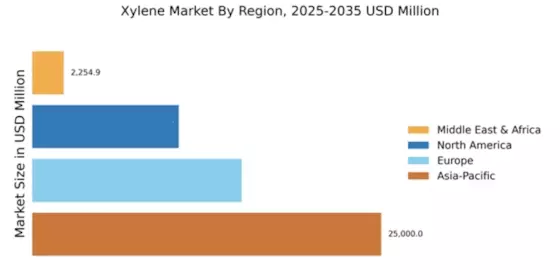
The North American xylene market is projected to maintain steady growth, driven by increasing demand from the petrochemical sector and the automotive industry. With a market size of $10,500.0 million, the region benefits from a robust regulatory framework that supports sustainable practices. The shift towards eco-friendly products is also a significant catalyst for growth, as companies adapt to changing consumer preferences and environmental regulations. Leading countries such as the US and Canada dominate the market, with key players like ExxonMobil and Chevron Phillips Chemical leading the charge. The competitive landscape is characterized by strategic partnerships and technological advancements aimed at enhancing production efficiency. As the market evolves, these companies are expected to leverage their strengths to capture a larger share of the growing demand for xylene-based products.

Europe : Diverse Market Dynamics

Europe's xylene market, valued at $15,000.0 million, is shaped by diverse demand across various sectors, including automotive, paints, and coatings. Regulatory frameworks in the EU promote sustainability, pushing manufacturers to innovate and reduce emissions. The region's commitment to environmental standards is a key driver, as companies adapt to stringent regulations while meeting consumer needs for greener products. Germany, France, and the Netherlands are leading players in this market, with significant contributions from companies like BASF and Royal Dutch Shell. The competitive landscape is marked by a mix of established firms and emerging players, all vying for market share. The presence of major chemical manufacturers ensures a steady supply of xylene, catering to the growing demand across multiple industries.

Asia-Pacific : Emerging Powerhouse

Asia-Pacific is the largest xylene market globally, with a market size of $25,000.0 million, driven by rapid industrialization and urbanization. The region's growth is fueled by increasing demand from the automotive and packaging industries, alongside favorable government policies that encourage investment in petrochemical production. The shift towards sustainable practices is also influencing market dynamics, as companies seek to align with environmental regulations. China, Japan, and South Korea are the leading countries in this market, with major players like Mitsubishi Chemical and Formosa Plastics dominating the landscape. The competitive environment is characterized by significant investments in production capacity and technological advancements. As the region continues to grow, these companies are well-positioned to capitalize on the increasing demand for xylene and its derivatives.

Middle East and Africa : Resource-Rich Frontier

The Middle East and Africa xylene market, valued at $2,254.91 million, is emerging as a significant player due to abundant natural resources and increasing industrial activities. The region's growth is supported by investments in petrochemical infrastructure and favorable government policies aimed at boosting local production. As demand for xylene rises, particularly in the construction and automotive sectors, the market is expected to expand further. Countries like Saudi Arabia and the UAE are at the forefront of this growth, with key players such as SABIC leading the charge. The competitive landscape is evolving, with new entrants and established firms working to enhance production capabilities. As the market matures, the focus will be on innovation and sustainability to meet both local and international demand for xylene products.

Xylene Market Regional Image

Key Players and Competitive Insights

The Xylene Market is currently characterized by a competitive landscape that is both dynamic and multifaceted. Key growth drivers include the increasing demand for xylene derivatives in the production of plastics, solvents, and chemicals, alongside a growing emphasis on sustainability and innovation. Major players such as ExxonMobil (US), BASF (DE), and SABIC (SA) are strategically positioned to leverage their extensive operational capabilities and technological advancements. ExxonMobil (US) focuses on enhancing its production efficiency through digital transformation initiatives, while BASF (DE) emphasizes innovation in sustainable chemical solutions. SABIC (SA) is actively pursuing regional expansion to tap into emerging markets, collectively shaping a competitive environment that is increasingly focused on sustainability and technological integration.In terms of business tactics, companies are localizing manufacturing and optimizing supply chains to enhance responsiveness to market demands. The market structure appears moderately fragmented, with a mix of large multinational corporations and regional players. The collective influence of these key players is significant, as they drive trends in production efficiency and sustainability practices, thereby influencing overall market dynamics.
In November ExxonMobil (US) announced a strategic partnership with a leading technology firm to develop advanced digital solutions aimed at optimizing xylene production processes. This move is likely to enhance operational efficiency and reduce environmental impact, aligning with the industry's shift towards sustainability. The partnership underscores ExxonMobil's commitment to innovation and positions the company favorably in a competitive landscape increasingly driven by technological advancements.
In October BASF (DE) unveiled a new line of bio-based xylene derivatives, marking a significant step towards sustainable product offerings. This initiative not only caters to the growing consumer demand for environmentally friendly products but also reinforces BASF's reputation as a leader in sustainable chemistry. The introduction of these bio-based products could potentially reshape market preferences and set new standards for sustainability in the xylene sector.
In September SABIC (SA) expanded its production capacity in the Middle East, aiming to meet the rising demand for xylene in Asia. This expansion is strategically important as it positions SABIC to capitalize on the growing market in Asia, which is expected to witness substantial growth in the coming years. By increasing its production capabilities, SABIC is likely to enhance its competitive edge and strengthen its market presence in a region that is becoming increasingly vital for xylene consumption.
As of December current competitive trends in the Xylene Market are heavily influenced by digitalization, sustainability, and the integration of AI technologies. Strategic alliances are becoming more prevalent, as companies seek to enhance their capabilities and market reach. The competitive differentiation is expected to evolve, shifting from traditional price-based competition to a focus on innovation, technological advancements, and supply chain reliability. This transition indicates a broader industry trend where companies that prioritize sustainability and technological integration are likely to emerge as leaders in the Xylene Market.

Key Companies in the Xylene Market include

Industry Developments

2018

: Idemitsu Kosan Co, Ltd. commenced mixed xylene production At its Aichi Refinery. Under its Fifth Consolidated Medium-term Management Plan, which calls for the promotion of the fuel-to-chemical business, Idemitsu has made progress on the installation of new equipment at the Aichi Refinery. Recent completion and commercial operation of mixed xylene equipment at the Aichi Refinery*2. With a production capacity of 170,000 t/year, this equipment will not only contribute to the expansion of the petrochemical business. Still, it will also allow us to respond flexibly to the fluctuating supply and demand trends for petroleum products and petrochemical raw materials.

Future Outlook

Xylene Market Future Outlook

The Xylene Market is projected to grow at a 9.0% CAGR from 2025 to 2035, driven by increasing demand in the automotive and chemical industries.

New opportunities lie in:

  • Expansion of xylene production facilities in emerging markets. Development of bio-based xylene alternatives for sustainability. Investment in advanced recycling technologies for xylene recovery.

By 2035, the Xylene Market is expected to achieve robust growth, positioning itself as a key player in the global chemical industry.

Market Segmentation

Xylene Market Type Outlook

  • Ortho-Xylene
  • Meta-Xylene
  • Para-Xylene

Xylene Market End Use Outlook

  • Automotive
  • Paints and Coatings
  • Pharmaceuticals
  • Textiles

Xylene Market Application Outlook

  • Solvent
  • Chemical Intermediate
  • Fuel Additive
  • Dyes and Pigments

Xylene Market Purity Level Outlook

  • High Purity
  • Standard Purity
  • Technical Grade

Report Scope

MARKET SIZE 2024 52754.91(USD Million)
MARKET SIZE 2025 57503.92(USD Million)
MARKET SIZE 2035 136157.97(USD Million)
COMPOUND ANNUAL GROWTH RATE (CAGR) 9.0% (2025 - 2035)
REPORT COVERAGE Revenue Forecast, Competitive Landscape, Growth Factors, and Trends
BASE YEAR 2024
Market Forecast Period 2025 - 2035
Historical Data 2019 - 2024
Market Forecast Units USD Million
Key Companies Profiled ExxonMobil (US), Royal Dutch Shell (NL), BASF (DE), SABIC (SA), Chevron Phillips Chemical (US), LyondellBasell Industries (US), TotalEnergies (FR), Formosa Plastics (TW), Mitsubishi Chemical (JP)
Segments Covered Application, End Use, Type, Purity Level
Key Market Opportunities Growing demand for eco-friendly solvents and coatings drives innovation in the Xylene Market.
Key Market Dynamics Rising demand for xylene in petrochemical applications drives competitive dynamics and influences supply chain strategies.
Countries Covered North America, Europe, APAC, South America, MEA

Market Highlights

Author
Author
Author Profile
Chitranshi Jaiswal LinkedIn
Team Lead - Research
Chitranshi is a Team Leader in the Chemicals & Materials (CnM) and Energy & Power (EnP) domains, with 6+ years of experience in market research. She leads and mentors teams to deliver cross-domain projects that equip clients with actionable insights and growth strategies. She is skilled in market estimation, forecasting, competitive benchmarking, and both primary & secondary research, enabling her to turn complex data into decision-ready insights. An engineer and MBA professional, she combines technical expertise with strategic acumen to solve dynamic market challenges. Chitranshi has successfully managed projects that support market entry, investment planning, and competitive positioning, while building strong client relationships. Certified in Advanced Excel & Power BI she leverages data-driven approaches to ensure accuracy, clarity, and impactful outcomes.
Leave a Comment

FAQs

What is the current valuation of the Xylene Market as of 2024?

<p>The Xylene Market was valued at approximately 52754.91 USD Million in 2024.</p>

What is the projected market valuation for the Xylene Market in 2035?

<p>The market is projected to reach a valuation of around 136157.97 USD Million by 2035.</p>

What is the expected CAGR for the Xylene Market during the forecast period 2025 - 2035?

<p>The expected CAGR for the Xylene Market during the forecast period 2025 - 2035 is 9.0%.</p>

Which companies are considered key players in the Xylene Market?

<p>Key players in the Xylene Market include ExxonMobil, Royal Dutch Shell, BP, SABIC, TotalEnergies, LyondellBasell, Mitsubishi Chemical, Formosa Plastics, and Reliance Industries.</p>

What are the primary applications of xylene in the market?

<p>The primary applications of xylene include solvent, chemical intermediate, fuel additive, coating, and adhesive.</p>

How does the automotive sector contribute to the Xylene Market?

<p>The automotive sector is projected to contribute between 10500.0 and 27000.0 USD Million to the Xylene Market.</p>

What is the market size for para-xylene compared to other types?

Para-xylene is expected to dominate the market with a valuation range of approximately 32754.91 to 85157.97 USD Million.

What distribution channels are utilized in the Xylene Market?

Distribution channels in the Xylene Market include direct sales, distributors, and online sales, with varying contributions.

What forms of xylene are available in the market?

Xylene is available in liquid, solid, and gas forms, with liquid xylene having the largest market share.

How does the construction industry impact the Xylene Market?

The construction industry is anticipated to contribute between 8000.0 and 20000.0 USD Million to the Xylene Market.

Research Approach


Secondary Research

The secondary research process involved comprehensive analysis of petrochemical industry databases, regulatory filings, technical journals, and authoritative energy organizations. Key sources included the US Energy Information Administration (EIA), International Energy Agency (IEA), Organization of the Petroleum Exporting Countries (OPEC), American Fuel & Petrochemical Manufacturers (AFPM), European Chemical Industry Council (Cefic), American Chemistry Council (ACC), National Institute of Standards and Technology (NIST), US Environmental Protection Agency (EPA), European Chemicals Agency (ECHA), International Agency for Research on Cancer (IARC), World Bank Commodity Markets, UN Comtrade Database, China Petroleum and Chemical Industry Federation (CPCIF), Japan Petrochemical Industry Association (JPIA), and national petrochemical ministry reports from key producing markets. These sources were used to collect production capacity statistics, refinery output data, regulatory compliance standards, safety handling protocols, trade flow analysis, and market landscape evaluation for P-Xylene, O-Xylene, M-Xylene, and Mixed Xylene segments across automotive, textile, chemical, oil & gas, leather, and paints & coatings end-use industries.


Primary Research

Qualitative and quantitative insights were obtained by interviewing supply-side and demand-side stakeholders during the primary research process. The supply-side sources consisted of CEOs, VPs of Manufacturing, refinery operations leaders, and commercial directors from xylene producers, petrochemical manufacturers, and aromatics refiners. Demand-side sources included procurement directors from polyester manufacturers, textile industry purchasers, chemical synthesis plant managers, automotive OEM material scientists, and coating formulators from the industrial and automotive sectors. Market segmentation was verified, capacity expansion timelines were confirmed, and insights regarding feedstock pricing dynamics, supply chain logistics, substitution trends, and regional demand patterns were obtained through primary research.

Primary Respondent Breakdown:

By Designation: C-level Primaries (28%), Director Level (32%), Others (40%)

By Region: North America (28%), Europe (32%), Asia-Pacific (35%), Rest of World (5%)


Market Size Estimation

Global market valuation was derived through production capacity mapping and consumption volume analysis. The methodology included:

Identification of over 50 significant manufacturers and refiners in North America, Europe, Asia-Pacific, the Middle East and Africa, and Latin America

Product mapping across P-Xylene, O-Xylene, M-Xylene, and Mixed Xylene categories with purity grades and application specifications

Analysis of reported and modeled annual revenues specific to xylene and aromatics portfolios

Coverage of manufacturers representing 75-80% of global production capacity in 2024

Extrapolation using bottom-up (consumption volume × ASP by region/end-use) and top-down (producer revenue validation) approaches to derive segment-specific valuations, accounting for refinery integration economics and cracker feedstock differentials

Download Free Sample

Kindly complete the form below to receive a free sample of this Report

Compare Licence

×
Features License Type
Single User Multiuser License Enterprise User
Price $4,950 $5,950 $7,250
Maximum User Access Limit 1 User Upto 10 Users Unrestricted Access Throughout the Organization
Free Customization
Direct Access to Analyst
Deliverable Format
Platform Access
Discount on Next Purchase 10% 15% 15%
Printable Versions
%>