
×
Request Free Sample ×

Kindly complete the form below to receive a free sample of this Report

* Please use a valid business email

Leading companies partner with us for data-driven Insights

clients tt-cursor
Hero Background
English
Chinese
French
Japanese
Korean
German
Spanish

Procurement Software Market Analysis

ID: MRFR/ICT/2242-CR
135 Pages
Shubham Munde
February 2020

Procurement Software Market Size, Share and Trends Analysis Report By Deployment (On-Cloud and On-Premise), By Software Type (Spend Analysis, E-Sourcing, E-Procurement, Contract Management, Supplier Management and others), By Organization Size (Small & Medium Enterprise and Large Enterprises), By Vertical (Retail, Automotive, Travel & Logistics, Electronics, IT & Telecommunication, Mining and others) - Forecast till 2035

Share:
Download PDF ×

We do not share your information with anyone. However, we may send you emails based on your report interest from time to time. You may contact us at any time to opt-out.

Procurement Software Market Infographic
Purchase Options

Market Analysis

In-depth Analysis of Procurement Software Market Industry Landscape

The procurement software market is experiencing dynamic shifts driven by the evolving needs of businesses in the modern era. As organizations increasingly recognize the importance of efficient procurement processes, the demand for advanced procurement software has surged. Market dynamics in this sector are shaped by several key factors, including technological advancements, globalization, and a growing emphasis on cost optimization.

Technological innovations play a pivotal role in shaping the procurement software market landscape. With the advent of artificial intelligence (AI) and machine learning (ML), procurement solutions have become more sophisticated, offering enhanced automation, predictive analytics, and real-time insights. These technological advancements empower organizations to streamline their procurement workflows, reduce manual intervention, and make data-driven decisions. As a result, businesses are actively seeking procurement software that not only meets their current needs but also aligns with the future trajectory of technological progress.

Globalization has also been a driving force in shaping the market dynamics of procurement software. As businesses expand their operations across borders, the need for centralized and standardized procurement processes becomes imperative. Procurement software enables organizations to manage their sourcing, supplier relationships, and purchasing activities on a global scale, fostering consistency and efficiency. This trend is particularly evident in large enterprises and multinational corporations seeking unified solutions to navigate the complexities of diverse regulatory environments and supply chain networks.

Cost optimization remains a key focus for businesses, driving the adoption of procurement software to achieve better financial efficiency. Organizations recognize the potential of these solutions to enhance cost visibility, negotiate favorable terms with suppliers, and identify opportunities for savings. The dynamic nature of the market is reflected in the continuous evolution of procurement software functionalities, with vendors actively incorporating features such as spend analysis, contract management, and supplier collaboration to address the multifaceted aspects of cost management.

Moreover, the procurement software market is witnessing a shift towards cloud-based solutions. Cloud deployment offers scalability, flexibility, and accessibility, allowing businesses to adapt to changing requirements and access procurement tools from anywhere with an internet connection. This shift is driven by the desire for cost-effective solutions that reduce the burden of maintaining on-premise infrastructure while providing seamless integration with other enterprise systems.

The competitive landscape of the procurement software market is marked by a diverse range of vendors, each offering unique features and capabilities. Market players are engaged in strategic partnerships, acquisitions, and continuous product enhancements to stay ahead in this competitive space. As a result, buyers are presented with a wide array of options, contributing to the dynamic nature of procurement software procurement.


 

Author
Shubham Munde
Research Analyst Level II

With a technical background in information technology & semiconductors, Shubham has 4.5+ years of experience in market research and analytics with the tasks of data mining, analysis, and project execution. He is the POC for our clients, for their consulting projects running under the ICT/Semiconductor domain. Shubham holds a Bachelor’s in Information and Technology and a Master of Business Administration (MBA). Shubham has executed over 150 research projects for our clients under the brand name Market Research Future in the last 2 years. His core skill is building the research respondent relation for gathering the primary information from industry and market estimation for niche markets. He is having expertise in conducting secondary & primary research, market estimations, market projections, competitive analysis, analysing current market trends and market dynamics, deep-dive analysis on market scenarios, consumer behaviour, technological impact analysis, consulting, analytics, etc. He has worked on fortune 500 companies' syndicate and consulting projects along with several government projects. He has worked on the projects of top tech brands such as IBM, Google, Microsoft, AWS, Meta, Oracle, Cisco Systems, Samsung, Accenture, VMware, Schneider Electric, Dell, HP, Ericsson, and so many others. He has worked on Metaverse, Web 3.0, Zero-Trust security, cyber-security, blockchain, quantum computing, robotics, 5G technology, High-Performance computing, data centers, AI, automation, IT equipment, sensors, semiconductors, consumer electronics and so many tech domain projects.

Leave a Comment

FAQs

How big is the procurement market?

The procurement Software Market is predicted to grow at a 10.2% CAGR by 2032 end and will reach US$ 15.2 billion.

Who are the top players contributing towards the growth of the market?

IBM Corporation (US), Oracle Corporation (US), SAP SE (Germany), Coupa Software Incorporated (US), Infor Inc. (US), Epicor Software Corporation (US), Zycus Inc. (US), JDA Software Inc. (US), and Mercateo AG (Germany).

Which region is leading the global market and what the reasons behind its dominance?

The procurement software market in North America is the largest, on account of the presence of key market players such as IBM Corporation, Oracle Corporation, and Coupa Software Incorporated. Moreover, developed infrastructure and rising demand for centralized procurement process in the region is further expected to propel the growth of procurement software market in North America shortly.

What are some of the emerging trends noted in the market?

Adoption of blockchain and AI in procurement and supply chain process and E-procurement are the emerging trends having a positive impact on market growth. Review reporting and tail spend management are the use cases of the procurement software market.

What will be the growth rate by 2032?

The Global Procurement Software Market is expected to expand at a 10.4% CAGR during the forecast period from 2024 to 2032.

What are the segments mentioned on the basis of deployment?

On-cloud and on-premise are the primary segments mentioned with respect to deployment.

What software is used for procurement?

SAP SE Easily manage the entire procurement cycle.

Market Summary

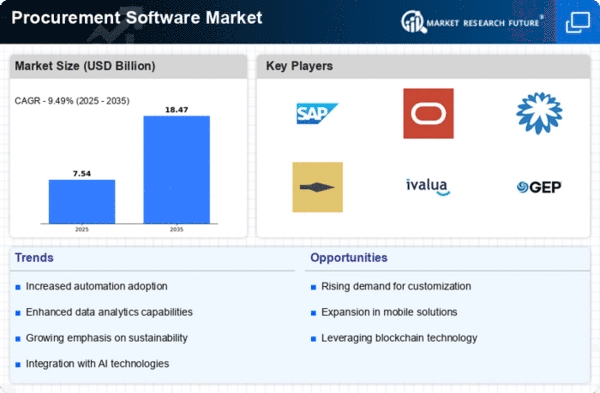
As per MRFR analysis, the Procurement Software Market was estimated at 6.89 USD Billion in 2024. The Procurement Software industry is projected to grow from 7.46 USD Billion in 2025 to 18.47 USD Billion by 2035, exhibiting a compound annual growth rate (CAGR) of 9.49 during the forecast period 2025 - 2035.

Key Market Trends & Highlights

The Procurement Software Market is experiencing robust growth driven by automation and advanced analytics.

  • The market is witnessing increased automation, streamlining procurement processes across various sectors. Enhanced data analytics capabilities are enabling organizations to make informed purchasing decisions and optimize supplier relationships. North America remains the largest market, while Asia-Pacific is emerging as the fastest-growing region in procurement software adoption. Rising demand for cost efficiency and the integration of artificial intelligence are key drivers propelling market expansion.

Market Size & Forecast

2024 Market Size 6.89 (USD Billion)
2035 Market Size 18.47 (USD Billion)
CAGR (2025 - 2035) 9.49%
Largest Regional Market Share in 2024 North America

Major Players

SAP (DE), <a title="Oracle" href="https://www.oracle.com/in/erp/procurement/" target="_blank" rel="noopener">Oracle</a> (US), Coupa Software (US), Jaggaer (US), Ivalua (FR), GEP Worldwide (US), <a title="Basware" href="https://www.basware.com/en/solutions/e-procurement/" target="_blank" rel="noopener">Basware</a> (FI), Procurify (CA), SynerTrade (DE)

Market Trends

The Procurement Software Market is currently experiencing a transformative phase, characterized by the integration of advanced technologies and evolving business needs. Organizations are increasingly recognizing the necessity of streamlining their procurement processes to enhance efficiency and reduce costs. This shift is driven by the demand for greater transparency and accountability in supply chain management. As a result, procurement software solutions are being designed to offer comprehensive functionalities that cater to diverse industry requirements. Furthermore, the emphasis on sustainability and ethical sourcing is prompting companies to adopt procurement tools that facilitate responsible purchasing decisions. In addition, the rise of cloud-based solutions is reshaping the Procurement Software Market landscape. These platforms provide flexibility and scalability, allowing businesses to adapt to changing market conditions with ease. The growing trend of remote work has also influenced the adoption of digital procurement solutions, as organizations seek to maintain operational continuity. Overall, the Procurement Software Market appears poised for continued growth, driven by technological advancements and the need for more efficient procurement practices.

Increased Automation

The trend towards automation in procurement processes is gaining momentum. Organizations are leveraging software solutions to automate repetitive tasks, thereby reducing manual errors and enhancing productivity. This shift not only streamlines operations but also allows procurement professionals to focus on strategic decision-making.

Enhanced Data Analytics

The utilization of data analytics within procurement software is becoming increasingly prevalent. Companies are harnessing data insights to make informed purchasing decisions, optimize supplier relationships, and forecast demand more accurately. This analytical approach enables organizations to identify cost-saving opportunities and improve overall procurement strategies.

Focus on Supplier Collaboration

There is a growing emphasis on fostering collaboration with suppliers through procurement software. Businesses are recognizing the value of building strong partnerships to enhance supply chain resilience. Collaborative tools within procurement platforms facilitate communication and information sharing, leading to improved outcomes for both parties.

Procurement Software Market Market Drivers

Focus on Cost Reduction

Cost reduction remains a pivotal driver in the Global Procurement Software Market Industry. Organizations are under constant pressure to minimize expenses while maintaining quality and efficiency. Procurement software provides tools for better supplier management, contract negotiation, and spend analysis, enabling companies to identify cost-saving opportunities. As the market evolves, procurement software is expected to play a crucial role in achieving these objectives. The anticipated growth from 7 USD Billion in 2024 to 20.3 USD Billion by 2035 indicates a strong correlation between effective procurement strategies and financial performance. This focus on cost reduction is likely to propel the adoption of procurement software across various sectors.

Market Growth Projections

The Global Procurement Software Market Industry is poised for substantial growth, with projections indicating an increase from 7 USD Billion in 2024 to 20.3 USD Billion by 2035. This growth trajectory suggests a compound annual growth rate (CAGR) of 10.18% from 2025 to 2035. Such projections highlight the increasing reliance on procurement software as organizations strive to enhance efficiency, reduce costs, and improve supplier relationships. The anticipated market expansion reflects the broader trends in digital transformation and the ongoing evolution of procurement practices across various industries. As businesses continue to adapt to changing market dynamics, the demand for innovative procurement solutions is likely to intensify.

Global Supply Chain Resilience

The Global Procurement Software Market Industry is significantly driven by the need for supply chain resilience. In an increasingly interconnected world, organizations are recognizing the importance of robust procurement strategies to withstand disruptions. Procurement software enables companies to gain real-time insights into their supply chains, facilitating better decision-making and risk assessment. The anticipated growth of the market from 7 USD Billion in 2024 to 20.3 USD Billion by 2035 suggests that businesses are investing in technologies that enhance their supply chain capabilities. This focus on resilience is likely to drive the adoption of procurement software, as organizations seek to build more agile and responsive supply chains.

Increased Demand for Automation

The Global Procurement Software Market Industry experiences a notable surge in demand for automation solutions. Organizations are increasingly recognizing the potential of procurement software to streamline processes, reduce manual errors, and enhance efficiency. As of 2024, the market is valued at approximately 7 USD Billion, reflecting a growing inclination towards automated procurement processes. This trend is likely to continue as companies seek to optimize their supply chains and improve operational performance. The integration of artificial intelligence and machine learning into procurement software further enhances its capabilities, allowing for predictive analytics and better decision-making. Consequently, the demand for automation in procurement is a significant driver of market growth.

Integration of Advanced Technologies

The integration of advanced technologies is a key driver in the Global Procurement Software Market Industry. The incorporation of artificial intelligence, machine learning, and data analytics into procurement software enhances its functionality and effectiveness. These technologies enable organizations to automate repetitive tasks, analyze vast amounts of data, and derive actionable insights. As the market is projected to grow at a CAGR of 10.18% from 2025 to 2035, the adoption of advanced technologies in procurement processes is expected to accelerate. This trend not only improves operational efficiency but also empowers organizations to make informed decisions, ultimately driving the demand for procurement software.

Regulatory Compliance and Risk Management

Regulatory compliance and risk management are increasingly influencing the Global Procurement Software Market Industry. Organizations face stringent regulations regarding procurement practices, necessitating robust software solutions to ensure compliance. Procurement software aids in tracking supplier performance, managing contracts, and maintaining audit trails, which are essential for meeting regulatory requirements. The growing emphasis on transparency and accountability in procurement processes further underscores the importance of these solutions. As businesses navigate complex regulatory landscapes, the demand for procurement software that facilitates compliance and mitigates risks is expected to rise, contributing to the overall market growth.

Market Segment Insights

By Deployment Type: Cloud-Based (Largest) vs. Hybrid (Fastest-Growing)

In the Procurement Software Market, the deployment type segment is characterized by a distinct distribution of market share among On-Premises, Cloud-Based, and Hybrid solutions. Cloud-Based deployment holds the largest share, attributed to its flexibility, scalability, and reduced upfront costs, making it a preferred choice for many organizations. On-Premises, while still significant, has seen a decline as businesses shift towards more agile solutions. Hybrid solutions also play a crucial role, integrating both Cloud and On-Premises models to offer tailored benefits.

Cloud-Based (Dominant) vs. Hybrid (Emerging)

Cloud-Based procurement software is currently the dominant deployment type in the market, favored for its cost-effectiveness, ease of implementation, and continuous updates without user intervention. Organizations are increasingly adopting Cloud solutions to enhance collaboration and streamline processes. On the other hand, Hybrid deployment models are emerging quickly as businesses seek to combine the reliability of On-Premises systems with the agility of Cloud-based solutions. This segment is gaining traction as companies aim to meet diverse regulatory and operational needs, providing the adaptability required to navigate dynamic market conditions.

By End User: Small Enterprises (Largest) vs. Large Enterprises (Fastest-Growing)

In the Procurement Software Market, the distribution of market share among end user segments is defined by distinct characteristics. Small enterprises hold the largest share, driven by their need for affordable and accessible procurement solutions that fit their budget constraints. They often leverage cloud-based procurement software, which offers scalability and flexibility. In contrast, large enterprises, while currently accounting for a smaller share, are rapidly increasing their investment in advanced procurement software to streamline operations and improve efficiency, indicating a potential shift in market dynamics as they adopt more sophisticated tools. The growth trends in this segment are highly favorable for both small and large enterprises. Small enterprises are increasingly adopting procurement software to enhance their operational capabilities and adapt to a competitive market. With the rise of eCommerce and digital transformation, small businesses are recognizing the importance of efficient procurement processes to remain agile. Meanwhile, large enterprises are experiencing growth driven by the need to integrate procurement with other enterprise systems, leveraging advanced analytics and technology to optimize their supply chains. This is making procurement software a critical component of their strategic operations as they strive for greater efficiency and cost savings.

Small Enterprises (Dominant) vs. Large Enterprises (Emerging)

In the Procurement Software Market, small enterprises represent the dominant force due to their extensive adoption of user-friendly and cost-effective procurement solutions. These businesses are often more nimble, allowing for quick implementation and utilization of such software. The focus for small enterprises lies in maximizing limited resources, leading them to prefer procurement solutions that offer integration capabilities without extensive overhead costs. On the other hand, large enterprises are emerging as a significant market player, investing in robust procurement software that aligns with their complex operational needs. They tend to seek software solutions that provide scalability, advanced analytics, and improved collaboration across departments, which is essential for managing their expansive and intricate supply chains. This dynamic creates an interesting landscape where small enterprises continue to stay dominant while large enterprises are poised for significant growth.

By Functionality: Spend Analysis (Largest) vs. Supplier Management (Fastest-Growing)

The procurement software market is segmented into various functionalities that cater to different aspects of procurement operations. Among these, Spend Analysis stands out as the largest segment, reflecting its indispensable role in helping organizations monitor and control their spending. Following closely is Supplier Management, which, while not as large, is rapidly gaining traction among businesses aiming to optimize vendor relationships and enhance procurement efficiencies. The growth of the Procurement Software Market is driven by several factors, particularly the increasing need for organizations to manage costs effectively and the growing trend toward digital transformation. The demand for data-driven decision-making is pushing companies to adopt Spend Analysis tools, while the evolving regulatory landscape and the necessity for agile supplier relationships have positioned Supplier Management as the fastest-growing segment, indicative of an overall shift toward more strategic and technology-enabled procurement processes.

Spend Analysis (Dominant) vs. Contract Management (Emerging)

Spend Analysis has established itself as a dominant player in the procurement software market, primarily due to its ability to provide comprehensive insights into spending patterns. Organizations leverage Spend Analysis tools to identify cost-saving opportunities, enhance supplier negotiations, and ultimately drive profitability. In contrast, Contract Management is emerging as a vital functionality within procurement software, focusing on the lifecycle of contracts from creation to compliance. As organizations increasingly recognize the importance of effective contract governance and risk management, investment in Contract Management solutions is on the rise. This functionality not only standardizes contract processes but also improves visibility and controls, making it essential for organizations looking to mitigate compliance risks while maximizing value from their contractual agreements.

By Industry: Manufacturing (Largest) vs. Retail (Fastest-Growing)

In the Procurement Software Market, the industry segment is characterized by a diverse distribution of market share among various sectors. Manufacturing stands out as the largest segment, capturing substantial resources for procurement activities, driven by the need for efficiency in supply chain management. In contrast, the retail sector, while smaller in share, exhibits rapid adoption of procurement technologies, indicating a growing trend toward digital transformation in retail operations that enhances inventory management and customer satisfaction.

Manufacturing: (Dominant) vs. Retail (Emerging)

The Manufacturing sector remains dominant in the Procurement Software Market, primarily due to its established infrastructures and high volume of transactions that necessitate robust procurement solutions. Manufacturers leverage software to optimize their supply chains, reduce costs, and implement strategic sourcing. Meanwhile, the Retail sector is emerging as a vital player, driven by the acceleration of e-commerce and the importance of agile procurement processes. Retailers are increasingly investing in software solutions to manage supplier relationships, streamline product sourcing, and respond to rapidly changing consumer demands, positioning them for future growth.

Get more detailed insights about Procurement Software Market Research Report - Global Forecast to 2035

Regional Insights

North America : Market Leader in Procurement Software

North America continues to lead the Procurement Software Market, holding a significant share of 3.45B in 2024. The region's growth is driven by increasing digital transformation initiatives, a focus on cost efficiency, and the adoption of cloud-based solutions. Regulatory support for technology adoption and procurement efficiency further catalyzes market expansion. Companies are increasingly investing in procurement software to streamline operations and enhance supplier relationships. The competitive landscape in North America is robust, featuring key players such as SAP, Oracle, and Coupa Software. The U.S. stands out as the largest market, driven by its advanced technological infrastructure and a high concentration of procurement software providers. The presence of innovative firms like Jaggaer and GEP Worldwide enhances the region's competitive edge, ensuring a dynamic market environment that fosters continuous improvement and innovation.

Europe : Emerging Market with Growth Potential

Europe's Procurement Software Market is poised for growth, with a market size of 2.0B in 2024. The region benefits from increasing regulatory frameworks aimed at enhancing procurement efficiency and transparency. Demand for procurement solutions is rising as organizations seek to optimize supply chains and reduce costs. The European Union's initiatives to digitize public procurement processes are also significant growth drivers, encouraging businesses to adopt advanced software solutions. Leading countries in this region include Germany, France, and the UK, where major players like Ivalua and Basware are making substantial impacts. The competitive landscape is characterized by a mix of established firms and emerging startups, fostering innovation. The presence of diverse industries, from manufacturing to services, creates a fertile ground for procurement software adoption, ensuring a vibrant market landscape.

Asia-Pacific : Rapidly Growing Procurement Sector

The Asia-Pacific region is witnessing rapid growth in the Procurement Software Market, with a market size of 1.2B in 2024. This growth is fueled by increasing investments in technology and a rising demand for efficient procurement processes. Countries in this region are focusing on digital transformation to enhance operational efficiency, driven by both private and public sector initiatives. Regulatory support for technology adoption is also a key factor in this growth trajectory. Leading countries such as China, India, and Japan are at the forefront of this market expansion. The competitive landscape features a mix of global players and local firms, with companies like Coupa Software and Jaggaer establishing a strong presence. The region's diverse economic landscape and increasing focus on supply chain optimization are driving the adoption of procurement software, making it a key area for future growth.

Middle East and Africa : Emerging Market with Untapped Potential

The Middle East and Africa (MEA) region is an emerging market for Procurement Software, with a market size of 0.24B in 2024. The growth in this region is driven by increasing investments in technology and a growing awareness of the benefits of procurement software. Governments are implementing initiatives to enhance procurement processes, which is fostering demand for innovative solutions. The region's focus on economic diversification is also a catalyst for growth in the procurement sector. Countries like South Africa and the UAE are leading the way in adopting procurement software, supported by a mix of local and international players. The competitive landscape is evolving, with firms like Procurify and SynerTrade gaining traction. As businesses in the MEA region seek to improve operational efficiency and transparency, the procurement software market is expected to expand significantly in the coming years.

Key Players and Competitive Insights

The Procurement Software Market is currently characterized by a dynamic competitive landscape, driven by the increasing need for efficiency and transparency in supply chain management. Key players such as SAP (DE), Oracle (US), and Coupa Software (US) are at the forefront, each adopting distinct strategies to enhance their market positioning. SAP (DE) focuses on integrating advanced analytics and AI capabilities into its procurement solutions, thereby facilitating data-driven decision-making. Oracle (US) emphasizes cloud-based solutions, aiming to streamline procurement processes and enhance user experience through digital transformation. Coupa Software (US) is leveraging partnerships with various technology firms to expand its ecosystem, thereby enhancing its service offerings and customer reach. Collectively, these strategies indicate a trend towards innovation and collaboration, shaping a competitive environment that prioritizes technological advancement and customer-centric solutions.
In terms of business tactics, companies are increasingly localizing their operations and optimizing supply chains to respond to regional demands effectively. The market structure appears moderately fragmented, with several players vying for market share while also collaborating through strategic alliances. This fragmentation allows for a diverse range of solutions, catering to various customer needs, while the influence of key players remains substantial in setting industry standards and driving innovation.
In November 2025, SAP (DE) announced a strategic partnership with a leading AI firm to enhance its procurement analytics capabilities. This move is likely to bolster SAP's position in the market by providing clients with more sophisticated tools for predictive analytics, thereby improving procurement efficiency and decision-making processes. The integration of AI into procurement solutions is expected to be a game-changer, allowing organizations to anticipate market trends and adjust their strategies accordingly.
In October 2025, Coupa Software (US) launched a new sustainability module within its procurement platform, aimed at helping organizations track and reduce their carbon footprint. This initiative reflects a growing trend towards sustainability in procurement practices, as companies increasingly seek to align their operations with environmental goals. By offering tools that facilitate sustainable procurement, Coupa Software positions itself as a leader in this emerging market segment, potentially attracting environmentally conscious clients.
In September 2025, Oracle (US) expanded its cloud procurement solutions to include enhanced mobile capabilities, allowing users to manage procurement processes on-the-go. This strategic enhancement is indicative of the increasing demand for mobile accessibility in procurement software, as organizations seek to empower their teams with flexible and efficient tools. By prioritizing mobile functionality, Oracle is likely to improve user engagement and satisfaction, thereby strengthening its competitive edge.
As of December 2025, the competitive trends in the Procurement Software Market are increasingly defined by digitalization, sustainability, and AI integration. Strategic alliances are playing a crucial role in shaping the landscape, as companies collaborate to enhance their technological capabilities and service offerings. Looking ahead, competitive differentiation is expected to evolve, with a notable shift from price-based competition towards innovation, technology, and supply chain reliability. This transition underscores the importance of adaptability and forward-thinking strategies in maintaining a competitive advantage in a rapidly changing market.

Key Companies in the Procurement Software Market include

Industry Developments

  • Q2 2024: Zip raises $100M Series C to expand procurement software platform Zip, a procurement software startup, announced a $100 million Series C funding round led by Y Combinator Continuity to accelerate product development and global expansion.
  • Q2 2024: Coupa Software Announces Acquisition of BELLIN to Expand Treasury and Procurement Offerings Coupa Software completed the acquisition of BELLIN, a treasury management provider, to enhance its procurement software suite with integrated treasury capabilities.
  • Q2 2024: Ivalua and PwC Announce Strategic Partnership to Accelerate Digital Procurement Transformation Ivalua, a procurement software provider, entered a strategic partnership with PwC to deliver joint digital procurement transformation services to enterprise clients.
  • Q3 2024: SAP Appoints New Chief Product Officer to Lead Procurement Software Market Innovation SAP announced the appointment of a new Chief Product Officer, tasking them with driving innovation in the company's procurement software portfolio.
  • Q3 2024: Proactis Launches Next-Generation Procurement Platform for Mid-Market Organizations Proactis unveiled a new procurement software platform designed to streamline sourcing and supplier management for mid-sized businesses.
  • Q3 2024: Basware secures multi-year contract with European government for e-procurement platform Basware won a multi-year contract to provide its e-procurement software platform to a major European government agency, supporting digital transformation of public sector purchasing.
  • Q4 2024: JAGGAER Announces Partnership with Mastercard to Enhance B2B Procurement Payments JAGGAER partnered with Mastercard to integrate advanced payment solutions into its procurement software, aiming to streamline B2B transactions for enterprise clients.
  • Q4 2024: GEP Launches AI-Powered Procurement Software Market Module GEP introduced a new AI-powered module for its procurement software platform, designed to automate supplier risk assessment and contract management.
  • Q1 2025: Oracle Expands Procurement Cloud Suite with New Supplier Collaboration Tools Oracle announced the launch of enhanced supplier collaboration features within its Procurement Cloud Suite, enabling improved communication and workflow automation.
  • Q1 2025: Workday acquires Scout RFP to strengthen procurement software capabilities Workday completed the acquisition of Scout RFP, a cloud-based sourcing and procurement platform, to bolster its enterprise procurement software offerings.
  • Q2 2025: ProcureTech raises $30M Series B to scale AI-driven procurement solutions ProcureTech, a provider of AI-driven procurement software, secured $30 million in Series B funding to expand its product suite and accelerate global growth.
  • Q2 2025: SynerTrade opens new R&D facility in Berlin to advance procurement software innovation SynerTrade inaugurated a new research and development center in Berlin focused on developing next-generation procurement software technologies.

Report Scope

Global Procurement Software Market report by MRFR analyzes the shift to digitization and move by large buyers and contractors for adopting software for management of business tasks. The report takes into consideration of trends, niches, opportunities, and challenges for estimating market revenue and growth trajectories.  It is segmented in the following manner:

By Deployment

  • On-cloud
  • On-premise

By Software Type

  • Supplier Management
  • Contract Management
  • E-procurement
  • E-sourcing
  • Spend Analysis

By Organization Size

  • Small and medium size Enterprises (SME)
  • Large Enterprises

By Vertical

  • Travel & Logistics
  • IT & Telecommunications
  • Electronics
  • Automotive
  • Retail
  • Mining
  • Others

Future Outlook

Procurement Software Market Future Outlook

The Procurement Software Market is projected to grow at a 9.49% CAGR from 2025 to 2035, driven by digital transformation, increased automation, and enhanced supply chain visibility.

New opportunities lie in:

  • Integration of AI-driven analytics for procurement optimization.
  • Development of mobile procurement applications for on-the-go management.
  • Expansion into emerging markets with tailored software solutions.

By 2035, the market is expected to be robust, reflecting substantial growth and innovation.

Market Segmentation

Procurement Software Market End User Outlook

  • Small Enterprises
  • Medium Enterprises
  • Large Enterprises

Procurement Software Market Industry Outlook

  • Manufacturing
  • Retail
  • Healthcare
  • Construction

Procurement Software Market Functionality Outlook

  • Spend Analysis
  • Procurement Planning
  • Supplier Management
  • Contract Management

Procurement Software Market Deployment Type Outlook

  • On-Premises
  • Cloud-Based
  • Hybrid

Report Scope

MARKET SIZE 2024 6.89(USD Billion)
MARKET SIZE 2025 7.46(USD Billion)
MARKET SIZE 2035 18.47(USD Billion)
COMPOUND ANNUAL GROWTH RATE (CAGR) 9.49% (2025 - 2035)
REPORT COVERAGE Revenue Forecast, Competitive Landscape, Growth Factors, and Trends
BASE YEAR 2024
Market Forecast Period 2025 - 2035
Historical Data 2019 - 2024
Market Forecast Units USD Billion
Key Companies Profiled SAP (DE), Oracle (US), Coupa Software (US), Jaggaer (US), Ivalua (FR), GEP Worldwide (US), Basware (FI), Procurify (CA), SynerTrade (DE)
Segments Covered Deployment Type, End User, Functionality, Industry
Key Market Opportunities Integration of artificial intelligence enhances efficiency and decision-making in the Procurement Software Market.
Key Market Dynamics Rising demand for automation in procurement processes drives innovation and competition among software providers.
Countries Covered North America, Europe, APAC, South America, MEA

FAQs

How big is the procurement market?

The procurement Software Market is predicted to grow at a 10.2% CAGR by 2032 end and will reach US$ 15.2 billion.

Who are the top players contributing towards the growth of the market?

IBM Corporation (US), Oracle Corporation (US), SAP SE (Germany), Coupa Software Incorporated (US), Infor Inc. (US), Epicor Software Corporation (US), Zycus Inc. (US), JDA Software Inc. (US), and Mercateo AG (Germany).

Which region is leading the global market and what the reasons behind its dominance?

The procurement software market in North America is the largest, on account of the presence of key market players such as IBM Corporation, Oracle Corporation, and Coupa Software Incorporated. Moreover, developed infrastructure and rising demand for centralized procurement process in the region is further expected to propel the growth of procurement software market in North America shortly.

What are some of the emerging trends noted in the market?

Adoption of blockchain and AI in procurement and supply chain process and E-procurement are the emerging trends having a positive impact on market growth. Review reporting and tail spend management are the use cases of the procurement software market.

What will be the growth rate by 2032?

The Global Procurement Software Market is expected to expand at a 10.4% CAGR during the forecast period from 2024 to 2032.

What are the segments mentioned on the basis of deployment?

On-cloud and on-premise are the primary segments mentioned with respect to deployment.

What software is used for procurement?

SAP SE Easily manage the entire procurement cycle.

  1. SECTION I: EXECUTIVE SUMMARY AND KEY HIGHLIGHTS
    1. | 1.1 EXECUTIVE SUMMARY
    2. | 1.1.1 Market Overview
    3. | 1.1.2 Key Findings
    4. | 1.1.3 Market Segmentation
    5. | 1.1.4 Competitive Landscape
    6. | 1.1.5 Challenges and Opportunities
    7. | 1.1.6 Future Outlook
  2. SECTION II: SCOPING, METHODOLOGY AND MARKET STRUCTURE
    1. | 2.1 MARKET INTRODUCTION
    2. | 2.1.1 Definition
    3. | 2.1.2 Scope of the study
    4. |-- 2.1.2.1 Research Objective
    5. |-- 2.1.2.2 Assumption
    6. |-- 2.1.2.3 Limitations
    7. | 2.2 RESEARCH METHODOLOGY
    8. | 2.2.1 Overview
    9. | 2.2.2 Data Mining
    10. | 2.2.3 Secondary Research
    11. | 2.2.4 Primary Research
    12. |-- 2.2.4.1 Primary Interviews and Information Gathering Process
    13. |-- 2.2.4.2 Breakdown of Primary Respondents
    14. | 2.2.5 Forecasting Model
    15. | 2.2.6 Market Size Estimation
    16. |-- 2.2.6.1 Bottom-Up Approach
    17. |-- 2.2.6.2 Top-Down Approach
    18. | 2.2.7 Data Triangulation
    19. | 2.2.8 Validation
  3. SECTION III: QUALITATIVE ANALYSIS
    1. | 3.1 MARKET DYNAMICS
    2. | 3.1.1 Overview
    3. | 3.1.2 Drivers
    4. | 3.1.3 Restraints
    5. | 3.1.4 Opportunities
    6. | 3.2 MARKET FACTOR ANALYSIS
    7. | 3.2.1 Value chain Analysis
    8. | 3.2.2 Porter's Five Forces Analysis
    9. |-- 3.2.2.1 Bargaining Power of Suppliers
    10. |-- 3.2.2.2 Bargaining Power of Buyers
    11. |-- 3.2.2.3 Threat of New Entrants
    12. |-- 3.2.2.4 Threat of Substitutes
    13. |-- 3.2.2.5 Intensity of Rivalry
    14. | 3.2.3 COVID-19 Impact Analysis
    15. |-- 3.2.3.1 Market Impact Analysis
    16. |-- 3.2.3.2 Regional Impact
    17. |-- 3.2.3.3 Opportunity and Threat Analysis
  4. SECTION IV: QUANTITATIVE ANALYSIS
    1. | 4.1 Information and Communications Technology, BY Deployment Type (USD Billion)
    2. | 4.1.1 On-Premises
    3. | 4.1.2 Cloud-Based
    4. | 4.1.3 Hybrid
    5. | 4.2 Information and Communications Technology, BY End User (USD Billion)
    6. | 4.2.1 Small Enterprises
    7. | 4.2.2 Medium Enterprises
    8. | 4.2.3 Large Enterprises
    9. | 4.3 Information and Communications Technology, BY Functionality (USD Billion)
    10. | 4.3.1 Spend Analysis
    11. | 4.3.2 Procurement Planning
    12. | 4.3.3 Supplier Management
    13. | 4.3.4 Contract Management
    14. | 4.4 Information and Communications Technology, BY Industry (USD Billion)
    15. | 4.4.1 Manufacturing
    16. | 4.4.2 Retail
    17. | 4.4.3 Healthcare
    18. | 4.4.4 Construction
    19. | 4.5 Information and Communications Technology, BY Region (USD Billion)
    20. | 4.5.1 North America
    21. |-- 4.5.1.1 US
    22. |-- 4.5.1.2 Canada
    23. | 4.5.2 Europe
    24. |-- 4.5.2.1 Germany
    25. |-- 4.5.2.2 UK
    26. |-- 4.5.2.3 France
    27. |-- 4.5.2.4 Russia
    28. |-- 4.5.2.5 Italy
    29. |-- 4.5.2.6 Spain
    30. |-- 4.5.2.7 Rest of Europe
    31. | 4.5.3 APAC
    32. |-- 4.5.3.1 China
    33. |-- 4.5.3.2 India
    34. |-- 4.5.3.3 Japan
    35. |-- 4.5.3.4 South Korea
    36. |-- 4.5.3.5 Malaysia
    37. |-- 4.5.3.6 Thailand
    38. |-- 4.5.3.7 Indonesia
    39. |-- 4.5.3.8 Rest of APAC
    40. | 4.5.4 South America
    41. |-- 4.5.4.1 Brazil
    42. |-- 4.5.4.2 Mexico
    43. |-- 4.5.4.3 Argentina
    44. |-- 4.5.4.4 Rest of South America
    45. | 4.5.5 MEA
    46. |-- 4.5.5.1 GCC Countries
    47. |-- 4.5.5.2 South Africa
    48. |-- 4.5.5.3 Rest of MEA
  5. SECTION V: COMPETITIVE ANALYSIS
    1. | 5.1 Competitive Landscape
    2. | 5.1.1 Overview
    3. | 5.1.2 Competitive Analysis
    4. | 5.1.3 Market share Analysis
    5. | 5.1.4 Major Growth Strategy in the Information and Communications Technology
    6. | 5.1.5 Competitive Benchmarking
    7. | 5.1.6 Leading Players in Terms of Number of Developments in the Information and Communications Technology
    8. | 5.1.7 Key developments and growth strategies
    9. |-- 5.1.7.1 New Product Launch/Service Deployment
    10. |-- 5.1.7.2 Merger & Acquisitions
    11. |-- 5.1.7.3 Joint Ventures
    12. | 5.1.8 Major Players Financial Matrix
    13. |-- 5.1.8.1 Sales and Operating Income
    14. |-- 5.1.8.2 Major Players R&D Expenditure. 2023
    15. | 5.2 Company Profiles
    16. | 5.2.1 SAP (DE)
    17. |-- 5.2.1.1 Financial Overview
    18. |-- 5.2.1.2 Products Offered
    19. |-- 5.2.1.3 Key Developments
    20. |-- 5.2.1.4 SWOT Analysis
    21. |-- 5.2.1.5 Key Strategies
    22. | 5.2.2 Oracle (US)
    23. |-- 5.2.2.1 Financial Overview
    24. |-- 5.2.2.2 Products Offered
    25. |-- 5.2.2.3 Key Developments
    26. |-- 5.2.2.4 SWOT Analysis
    27. |-- 5.2.2.5 Key Strategies
    28. | 5.2.3 Coupa Software (US)
    29. |-- 5.2.3.1 Financial Overview
    30. |-- 5.2.3.2 Products Offered
    31. |-- 5.2.3.3 Key Developments
    32. |-- 5.2.3.4 SWOT Analysis
    33. |-- 5.2.3.5 Key Strategies
    34. | 5.2.4 Jaggaer (US)
    35. |-- 5.2.4.1 Financial Overview
    36. |-- 5.2.4.2 Products Offered
    37. |-- 5.2.4.3 Key Developments
    38. |-- 5.2.4.4 SWOT Analysis
    39. |-- 5.2.4.5 Key Strategies
    40. | 5.2.5 Ivalua (FR)
    41. |-- 5.2.5.1 Financial Overview
    42. |-- 5.2.5.2 Products Offered
    43. |-- 5.2.5.3 Key Developments
    44. |-- 5.2.5.4 SWOT Analysis
    45. |-- 5.2.5.5 Key Strategies
    46. | 5.2.6 GEP Worldwide (US)
    47. |-- 5.2.6.1 Financial Overview
    48. |-- 5.2.6.2 Products Offered
    49. |-- 5.2.6.3 Key Developments
    50. |-- 5.2.6.4 SWOT Analysis
    51. |-- 5.2.6.5 Key Strategies
    52. | 5.2.7 Basware (FI)
    53. |-- 5.2.7.1 Financial Overview
    54. |-- 5.2.7.2 Products Offered
    55. |-- 5.2.7.3 Key Developments
    56. |-- 5.2.7.4 SWOT Analysis
    57. |-- 5.2.7.5 Key Strategies
    58. | 5.2.8 Procurify (CA)
    59. |-- 5.2.8.1 Financial Overview
    60. |-- 5.2.8.2 Products Offered
    61. |-- 5.2.8.3 Key Developments
    62. |-- 5.2.8.4 SWOT Analysis
    63. |-- 5.2.8.5 Key Strategies
    64. | 5.2.9 SynerTrade (DE)
    65. |-- 5.2.9.1 Financial Overview
    66. |-- 5.2.9.2 Products Offered
    67. |-- 5.2.9.3 Key Developments
    68. |-- 5.2.9.4 SWOT Analysis
    69. |-- 5.2.9.5 Key Strategies
    70. | 5.3 Appendix
    71. | 5.3.1 References
    72. | 5.3.2 Related Reports

Information and Communications Technology Market Segmentation

Information and Communications Technology By Deployment Type (USD Billion, 2025-2035)

  • On-Premises
  • Cloud-Based
  • Hybrid

Information and Communications Technology By End User (USD Billion, 2025-2035)

  • Small Enterprises
  • Medium Enterprises
  • Large Enterprises

Information and Communications Technology By Functionality (USD Billion, 2025-2035)

  • Spend Analysis
  • Procurement Planning
  • Supplier Management
  • Contract Management

Information and Communications Technology By Industry (USD Billion, 2025-2035)

  • Manufacturing
  • Retail
  • Healthcare
  • Construction
Infographic

Free Sample Request

Kindly complete the form below to receive a free sample of this Report

Get Free Sample

Customer Strories

Compare Licence

×
Features License Type
Single User Multiuser License Enterprise User
Price $4,950 $5,950 $7,250
Maximum User Access Limit 1 User Upto 10 Users Unrestricted Access Throughout the Organization
Free Customization
Direct Access to Analyst
Deliverable Format
Platform Access
Discount on Next Purchase 10% 15% 15%
Printable Versions