×
Hero Background
English
Chinese
French
Japanese
Korean
German
Spanish

Printing Machinery Market Size

ID: MRFR/Equip/10334-CR
128 Pages
Snehal Singh
September 2023

Printing Machinery Market Research Report Information By Type (Printers and Plotters), By Technology (Digital, Lazer, Flexographic, and Rotogravure), By End User (Manufacturing, Packaging, and Research), and By Region (North America, Europe, Asia-Pacific, and Rest Of The World) – Global Industry Size, Share, Growth, Trends and Forecast To 2035

Share:
Download PDF ×

We do not share your information with anyone. However, we may send you emails based on your report interest from time to time. You may contact us at any time to opt-out.

Printing Machinery Market Infographic
Purchase Options

Printing Machinery Size

Printing Machinery Market Growth Projections and Opportunities

The development and patterns of the printing machinery market are formed by a broad cluster of market factors, delivering it a unique area. This business is largely driven by technological advancements. The market is essentially impacted by the ceaseless advancement of printing innovation, which envelops headways in computerized printing, robotization, and further developed functionalities. The interest for cutting edge printing contraption stays high as associations endeavour to execute more smoothed out and affordable cycles.

Moreover, financial circumstances essentially affect the improvement of the printing apparatus market. Very delicate to variances in worldwide economies is the market. Businesses frequently put off purchasing new printing equipment during times of economic recession, which causes a brief market slowdown. Then again, periods of monetary extension commonly motivate organizations to put resources into modernized and complex printing gear to keep an upper hand.

As of late, ecological worries have arisen as a significant determinant influencing the market for printing hardware. As ecological effect and supportability become all the more broadly perceived, the interest for energy-productive and earth ideal printing arrangements increments. Accordingly, makers inside the area are attempted the turn of events and advancement of apparatus that utilizes energy-proficient practices, limits squander, and uses naturally positive materials. This shift toward sustainability is in line with consumer preferences and regulatory requirements that encourage the use of green technologies.

An extra critical market factor that impacts the printing hardware market is globalization. As endeavors widen their procedure on a worldwide scale, the interest for printing arrangements that are both productive and of better quality increments than oblige the shifted needs of business sectors. This peculiarity has brought about a more prominent commonness of modern printing gear that is able to do quickly and exactly creating a great many pieces of literature. Besides, there has been an expansion in the requirement for printing hardware that has multifunctional abilities, as endeavors endeavor to give versatile arrangements that can oblige different business sectors and shopper requests.

Printing machinery markets are also significantly impacted by regulatory policies. Printing apparatus plan and creation are impacted by thorough guidelines relating to discharges, quality control, and security norms. To achieve market acknowledgment and guarantee that their items fulfill the vital guidelines, makers are committed to comply to these guidelines. Consistence with administrative rules not just ensures the trustworthiness and constancy of printing hardware yet additionally develops client certainty and reinforces the remaining of the printing business.

Market competition is a constant driver of innovation and productivity in the printing machinery market. To stay cutthroat on the lookout and gain a bigger part of the market, makers are obliged to develop, further develop item credits, and proposition serious evaluating. This opposition furnishes buyers with a wide exhibit of printing hardware decisions, each having one-of-a-kind functionalities and cost levels.

The market for printing machinery dynamic and complex area that is impacted by a huge number of market factors. The market's development and direction are by and large impacted by mechanical headways, monetary circumstances, natural contemplations, globalization, administrative approaches, and market rivalry. Makers should handily explore these variables in the midst of the continuous development of the business to keep up with seriousness and fulfill the moving requests of organizations on a worldwide scale.

Printing Machinery Market Size Graph
Author
Snehal Singh
Assistant Manager - Research

High acumen in analyzing complex macro & micro markets with more than 6 years of work experience in the field of market research. By implementing her analytical skills in forecasting and estimation into market research reports, she has expertise in Packaging, Construction, and Equipment domains. She handles a team size of 20-25 resources and ensures smooth running of the projects, associated marketing activities, and client servicing.

Leave a Comment

FAQs

What is the current valuation of the Printing Machinery Market?

As of 2024, the Printing Machinery Market was valued at 25.66 USD Billion.

What is the projected market valuation for the Printing Machinery Market in 2035?

The Printing Machinery Market is projected to reach a valuation of 44.36 USD Billion by 2035.

What is the expected CAGR for the Printing Machinery Market during the forecast period 2025 - 2035?

The expected CAGR for the Printing Machinery Market during the forecast period 2025 - 2035 is 5.1%.

Which segments are included in the Printing Machinery Market analysis?

The Printing Machinery Market analysis includes segments such as Type, Technology, and End User.

What are the projected revenues for printers and plotters in the Printing Machinery Market?

The projected revenues for printers are expected to grow from 15.0 to 25.0 USD Billion, while plotters are anticipated to increase from 10.66 to 19.36 USD Billion.

How does the digital printing segment perform in terms of revenue?

The digital printing segment is projected to grow from 10.0 to 18.0 USD Billion during the forecast period.

Market Summary

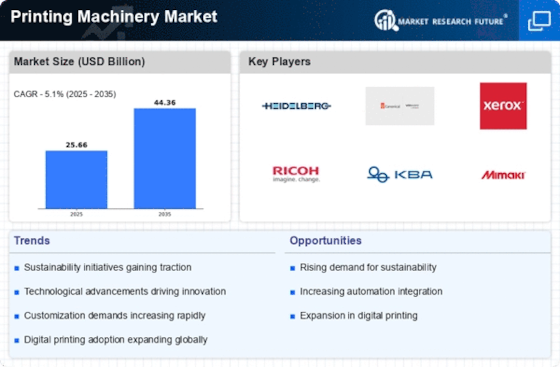
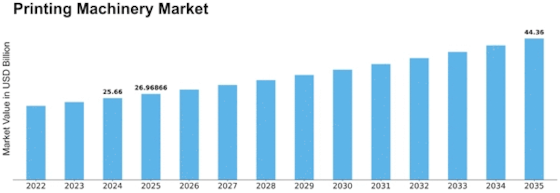
As per MRFR analysis, the Printing Machinery Market Size was estimated at 25.66 USD Billion in 2024. The Printing Machinery industry is projected to grow from 26.97 USD Billion in 2025 to 44.36 USD Billion by 2035, exhibiting a compound annual growth rate (CAGR) of 5.1 during the forecast period 2025 - 2035.

Key Market Trends & Highlights

The Printing Machinery Market is experiencing a transformative shift towards automation and sustainability.

  • North America remains the largest market for printing machinery, driven by advanced technological infrastructure. Asia-Pacific is recognized as the fastest-growing region, fueled by increasing industrialization and demand for innovative printing solutions. The printers segment continues to dominate the market, while the plotters segment is witnessing rapid growth due to customization trends. Technological advancements and rising demand for packaging solutions are key drivers propelling market expansion.

Market Size & Forecast

2024 Market Size 25.66 (USD Billion)
2035 Market Size 44.36 (USD Billion)
CAGR (2025 - 2035) 5.1%
Largest Regional Market Share in 2024 North America

Major Players

<p>Heidelberg (DE), Canon (JP), <a href="https://www.xerox.com/en-in/printing-equipment">Xerox </a>(US), Ricoh (JP), KBA (DE), Mimaki (JP), Epson (JP), <a href="https://www.durst-group.com/en/inks/textile-printing">Durst</a> (IT), Konica Minolta (JP)</p>

Market Trends

The Printing Machinery Market is currently experiencing a dynamic evolution, driven by advancements in technology and shifting consumer preferences. Manufacturers are increasingly focusing on automation and digitalization, which enhances efficiency and reduces operational costs. This trend appears to be fostering a competitive landscape where companies strive to innovate and offer superior products. Additionally, sustainability has emerged as a pivotal concern, prompting firms to adopt eco-friendly practices and materials in their production processes. As environmental regulations tighten, the market is likely to witness a growing demand for sustainable printing solutions. Moreover, the rise of e-commerce and online retailing is reshaping the Printing Machinery Market. Businesses are seeking high-quality printing solutions to meet the demands of personalized packaging and branding. This shift suggests that there is a potential for growth in sectors such as packaging and labels, where customization plays a crucial role. Furthermore, the integration of smart technologies, such as the Internet of Things, is anticipated to enhance operational capabilities, allowing for real-time monitoring and improved decision-making. Overall, the Printing Machinery Market is poised for transformation, with various factors influencing its trajectory in the coming years.

Automation and Digitalization

The Printing Machinery Market is witnessing a notable shift towards automation and digitalization. This trend is characterized by the adoption of advanced technologies that streamline production processes, enhance efficiency, and minimize costs. Manufacturers are increasingly investing in automated systems that facilitate faster turnaround times and improved quality control, thereby meeting the evolving demands of consumers.

Sustainability Initiatives

Sustainability has become a central theme within the Printing Machinery Market. Companies are actively pursuing eco-friendly practices, including the use of sustainable materials and energy-efficient technologies. This focus on environmental responsibility is not only driven by regulatory pressures but also by consumer preferences for greener products, indicating a significant shift in market dynamics.

Customization and Personalization

The rise of e-commerce is propelling demand for customized printing solutions in the Printing Machinery Market. Businesses are increasingly seeking high-quality printing for personalized packaging and branding, which enhances customer engagement. This trend suggests a growing opportunity for manufacturers to innovate and cater to the specific needs of diverse industries.

Printing Machinery Market Market Drivers

Technological Advancements

The Printing Machinery Market is experiencing a surge in technological advancements, particularly in the areas of digital printing and automation. Innovations such as high-speed inkjet and laser printing technologies are enhancing production efficiency and reducing operational costs. According to recent data, the adoption of digital printing technologies is projected to grow at a compound annual growth rate of approximately 7% over the next five years. This trend indicates a shift towards more efficient and versatile printing solutions, allowing businesses to meet diverse customer demands. Furthermore, advancements in software solutions for print management are streamlining workflows, thereby increasing productivity. As these technologies continue to evolve, they are likely to redefine operational standards within the Printing Machinery Market.

Emergence of Smart Manufacturing

The emergence of smart manufacturing is reshaping the Printing Machinery Market, as companies increasingly integrate Industry 4.0 principles into their operations. This trend involves the use of IoT, big data, and artificial intelligence to optimize production processes and enhance decision-making. By leveraging these technologies, manufacturers can achieve greater efficiency, reduce waste, and improve product quality. The adoption of smart manufacturing practices is expected to grow significantly, with projections indicating a potential market expansion of around 10% in the coming years. This shift not only enhances operational capabilities but also positions companies to respond more effectively to market demands. As such, the Printing Machinery Market is likely to see a transformation in how printing processes are managed and executed.

Growth of the Textile Printing Sector

The textile printing sector is experiencing robust growth, significantly impacting the Printing Machinery Market. With the increasing popularity of custom apparel and home textiles, the demand for advanced textile printing technologies is on the rise. Digital textile printing, in particular, is gaining traction due to its ability to produce high-quality prints with reduced lead times. Market analysis suggests that the textile printing segment could expand at a rate of around 8% annually, driven by fashion trends and consumer preferences for unique designs. This growth is prompting manufacturers to innovate and develop specialized printing machinery tailored for the textile industry, thereby enhancing their competitive edge within the Printing Machinery Market.

Rising Demand for Packaging Solutions

The Printing Machinery Market is witnessing a notable increase in demand for packaging solutions, driven by the expansion of e-commerce and retail sectors. The packaging segment is projected to account for a significant share of the printing machinery market, with estimates suggesting a growth rate of around 5% annually. This demand is largely attributed to the need for innovative and sustainable packaging options that enhance product visibility and consumer engagement. Additionally, the rise of personalized packaging is prompting manufacturers to invest in advanced printing technologies that can accommodate short runs and customized designs. As a result, the Printing Machinery Market is adapting to these evolving consumer preferences, positioning itself to capitalize on the burgeoning packaging market.

Sustainability and Eco-Friendly Practices

Sustainability has emerged as a pivotal driver within the Printing Machinery Market, as companies increasingly prioritize eco-friendly practices. The demand for sustainable printing solutions is on the rise, with many businesses seeking to reduce their carbon footprint and utilize environmentally friendly materials. This shift is reflected in the growing popularity of water-based inks and recyclable substrates, which are becoming standard in modern printing processes. Furthermore, regulatory pressures and consumer preferences are pushing manufacturers to adopt greener technologies. It is estimated that the market for sustainable printing solutions could grow by approximately 6% over the next few years, indicating a strong trend towards environmentally responsible practices in the Printing Machinery Market.

Market Segment Insights

By Type: Printers (Largest) vs. Plotters (Fastest-Growing)

<p>In the Printing Machinery Market, the distribution of market share among the segment values reveals that Printers hold a dominating position, significantly outpacing Plotters in terms of unit sales and applications. The extensive use of Printers in various sectors, such as commercial printing, packaging, and textiles, contributes to their substantial market presence, while Plotters, though smaller in share, have found their niche in specialized applications such as graphic design and architecture. Growth trends indicate a robust expansion in the Plotters segment, driven by the increasing demand for high-quality prints in diverse formats. This growth is fueled by advancements in printing technology, leading to faster production speeds and higher resolution outputs in Plotters, making them a preferred choice for industries embracing digital transformation and personalization in printing processes.</p>

<p>Printers: Dominant vs. Plotters: Emerging</p>

<p>Printers are recognized as the dominant force in the Printing Machinery Market, characterized by their versatility and widespread application across multiple industries, including commercial, industrial, and home printing. They encompass a range of technologies, including inkjet and laser printing, catering to various requirements from high-volume production to single-unit print jobs. On the other hand, Plotters are emerging significantly, primarily used for creating large-format prints with high precision, often employed in fields such as architecture, engineering, and graphic design. The rise of <a href="https://www.marketresearchfuture.com/reports/digital-textile-printing-machine-market-30646">digital textile printing machine</a> and the need for customized outputs are propelling Plotters into a growth trajectory, enabling businesses to offer specialized services that align with market demands.</p>

By Technology: Digital (Largest) vs. Flexographic (Fastest-Growing)

<p>The Printing Machinery Market segment based on technology exhibits a diverse distribution among Digital, Laser, Flexographic, and Rotogravure printing processes. Digital printing remains the largest segment due to its ability to deliver quick turnaround times and flexibility in production. As businesses increasingly demand shorter print runs and personalization, Digital technology captures significant market share. Conversely, Flexographic printing, known for its efficiency in high-volume print jobs, is gaining traction, showcasing rapid growth driven by advancements in ink formulations and substrate compatibility.</p>

<p>Technology: Digital (Dominant) vs. Flexographic (Emerging)</p>

<p>Digital printing technology has established itself as the dominant force in the Printing Machinery Market, characterized by its versatility and ability to produce high-quality prints at a lower cost for short run jobs. With the advent of inkjet and laser technologies, digital printers can accommodate a range of substrates and formats, appealing to a broad customer base. In contrast, Flexographic printing is emerging due to its high-speed production and cost-effectiveness for large volumes, making it ideal for packaging materials. The flexibility to print on various substrates combined with ongoing innovations in automation and workflow optimization position Flexographic printing as a key player in the evolving landscape of the printing industry.</p>

By End User: Manufacturing (Largest) vs. Packaging (Fastest-Growing)

<p>The Printing Machinery Market is significantly influenced by diverse end-user segments, notably Manufacturing and Packaging. Manufacturing holds the largest share in this market, driven by the consistent demand for commercial printing solutions. This sector benefits from advancements in printing technology that enhance operational efficiency and product quality. Meanwhile, the Packaging segment also displays robust growth, gaining traction amid the increasing consumer demand for customized packaging solutions across various industries. The rapid growth in the Packaging segment is primarily fueled by the shifting consumer preferences towards sustainable and innovative packaging. As companies invest more in packaging machinery to cater to these preferences, they also seek solutions that improve cost-effectiveness and reduce waste. Additionally, the trend of e-commerce is fostering this segment's expansion as businesses require efficient printing solutions for packaging, labeling, and branding purposes. Overall, the Printing Machinery Market's end-user segments reflect critical dynamics that impact trends and strategies within the industry.</p>

<p>Manufacturing (Dominant) vs. Research (Emerging)</p>

<p>The Manufacturing segment remains the dominant player in the Printing Machinery Market, characterized by a broad application spectrum that includes textiles, labels, and industrial applications. This segment benefits from established relationships with equipment manufacturers and an ongoing demand for high-quality, durable printed materials. In contrast, the Research segment represents an emerging avenue within this market, focusing on innovation and prototyping solutions. This segment is characterized by its requirement for specialty printing technologies, which cater to advanced applications like <a href="https://www.marketresearchfuture.com/reports/3d-printing-education-market-31129">3D printing education</a> and experimental materials. While the Research segment currently holds a smaller market share, its growth potential is significant as advancements in printing technology pave the way for increased adoption in research and development facilities.</p>

Get more detailed insights about Printing Machinery Market Research Report—Global Forecast till 2035

Regional Insights

North America : Innovation and Technology Hub

North America is witnessing robust growth in the printing machinery market, driven by technological advancements and increasing demand for high-quality printing solutions. The region holds approximately 40% of the global market share, making it the largest market. The second largest is Europe, accounting for around 30%. Regulatory support for sustainable practices and digital transformation initiatives further catalyze market expansion. The United States and Canada are the leading countries in this region, with a competitive landscape featuring major players like Xerox, Canon, and Epson. These companies are investing heavily in R&D to innovate and meet the evolving needs of consumers. The presence of advanced manufacturing facilities and a strong distribution network enhances the market's growth potential, positioning North America as a leader in the printing machinery sector.

Europe : Diverse Market with Strong Demand

Europe's printing machinery market is characterized by a diverse range of applications and a strong emphasis on sustainability. The region accounts for approximately 30% of the global market share, making it the second largest after North America. Key drivers include stringent environmental regulations and a growing demand for eco-friendly printing solutions. The European Union's Green Deal is a significant regulatory catalyst promoting sustainable practices in the industry. Germany, the UK, and France are the leading countries in this market, with Germany being home to major manufacturers like Heidelberg and KBA. The competitive landscape is marked by innovation and collaboration among key players, who are focusing on digital printing technologies and automation. This dynamic environment fosters growth and positions Europe as a significant player in The Printing Machinery Market.

Asia-Pacific : Emerging Markets and Growth Potential

The Asia-Pacific region is experiencing rapid growth in the printing machinery market, driven by increasing urbanization and rising disposable incomes. This region holds approximately 25% of the global market share, with countries like China and India leading the charge. The demand for packaging and labeling solutions is a significant growth driver, supported by the booming e-commerce sector and favorable government initiatives promoting manufacturing. China is the largest market in the region, followed by India and Japan. The competitive landscape is evolving, with local manufacturers emerging alongside established global players like Canon and Ricoh. Investments in advanced technologies and automation are enhancing production capabilities, making the Asia-Pacific region a key player in The Printing Machinery Market.

Middle East and Africa : Untapped Potential and Growth Opportunities

The Middle East and Africa region presents untapped potential in the printing machinery market, driven by increasing investments in infrastructure and a growing demand for printed materials. This region holds approximately 5% of the global market share, with significant growth opportunities in countries like South Africa and the UAE. The rise of digital printing technologies and government initiatives to boost local manufacturing are key factors contributing to market growth. South Africa is the leading market in this region, with a competitive landscape that includes both local and international players. Companies are focusing on innovation and sustainability to meet the unique demands of the region. The presence of key players like Durst and Konica Minolta further enhances the market's growth prospects, positioning the Middle East and Africa as an emerging market in the global printing machinery sector.

Key Players and Competitive Insights

The Printing Machinery Market is currently characterized by a dynamic competitive landscape, driven by technological advancements and evolving customer demands. Major players such as Heidelberg (Germany), Canon (Japan), and Xerox (United States) are at the forefront, each adopting distinct strategies to enhance their market positioning. Heidelberg (Germany) focuses on innovation in digital printing technologies, aiming to streamline production processes and reduce waste. Canon (Japan), on the other hand, emphasizes regional expansion and partnerships, particularly in Asia, to capture emerging markets. Xerox (United States) is increasingly investing in AI-driven solutions to optimize print workflows, thereby enhancing operational efficiency. Collectively, these strategies contribute to a competitive environment that is both fragmented and rapidly evolving, as companies strive to differentiate themselves through technological prowess and customer-centric solutions.

Key business tactics within the Printing Machinery Market include localizing manufacturing and optimizing supply chains to enhance responsiveness to market demands. The market structure appears moderately fragmented, with several key players exerting influence over various segments. This fragmentation allows for niche players to thrive, while larger corporations leverage their scale to implement cost-effective solutions. The collective influence of these key players shapes the market dynamics, as they compete not only on price but also on innovation and service quality.

In August 2025, Canon (Japan) announced a strategic partnership with a leading software firm to develop integrated solutions that enhance the efficiency of print operations. This collaboration is expected to bolster Canon's offerings in the digital printing segment, allowing it to provide more comprehensive solutions to its customers. The strategic importance of this partnership lies in its potential to position Canon as a leader in the rapidly growing market for integrated print solutions, thereby enhancing its competitive edge.

In September 2025, Xerox (United States) unveiled a new line of eco-friendly printing machines designed to minimize environmental impact. This launch reflects Xerox's commitment to sustainability, which is increasingly becoming a critical factor for customers in the printing industry. By prioritizing eco-friendly technologies, Xerox not only addresses regulatory pressures but also aligns itself with the growing consumer demand for sustainable practices, potentially attracting a broader customer base.

In October 2025, Heidelberg (Germany) revealed its latest digital printing technology, which incorporates advanced AI capabilities to optimize print quality and reduce operational costs. This innovation is significant as it underscores Heidelberg's focus on leveraging technology to enhance productivity and efficiency in printing operations. By investing in AI, Heidelberg positions itself to meet the increasing demand for high-quality, cost-effective printing solutions, thereby reinforcing its competitive stance in the market.

As of October 2025, the Printing Machinery Market is witnessing trends that emphasize digitalization, sustainability, and the integration of AI technologies. Strategic alliances are becoming increasingly prevalent, as companies recognize the need to collaborate to enhance their technological capabilities and market reach. Looking ahead, competitive differentiation is likely to evolve, shifting from traditional price-based competition to a focus on innovation, technological advancement, and supply chain reliability. This transition suggests that companies that can effectively leverage these trends will be better positioned to thrive in the competitive landscape.

Key Companies in the Printing Machinery Market market include

Industry Developments

February 2021: Japanese giant Canon announced the launch of seven new ink tank printers at a starting price of INR 11,048, to expand its PIXMA G Series line-up in India.

November 2019: CEAD, a Netherlands-based provider of large-scale, composite 3D printing, and Siemens are expanding on existing collaboration and will be jointly presenting their latest development of AM Flexbot. The new AM Flexbot is controlled by Siemens’ technology.

Future Outlook

Printing Machinery Market Future Outlook

<p>The Printing Machinery Market is projected to grow at a 5.1% CAGR from 2024 to 2035, driven by technological advancements, increasing demand for customized printing solutions, and sustainability initiatives.</p>

New opportunities lie in:

  • <p>Integration of IoT for real-time monitoring and maintenance services.</p><p>Development of eco-friendly printing materials to meet sustainability demands.</p><p>Expansion into emerging markets with tailored printing solutions for local industries.</p>

<p>By 2035, the Printing Machinery Market is expected to be robust, driven by innovation and strategic market positioning.</p>

Market Segmentation

Printing Machinery Market Type Outlook

  • Printers
  • Plotters

Printing Machinery Market End User Outlook

  • Manufacturing
  • Packaging
  • Research

Printing Machinery Market Technology Outlook

  • Digital
  • Lazer
  • Flexographic
  • Rotogravure

Report Scope

MARKET SIZE 202425.66(USD Billion)
MARKET SIZE 202526.97(USD Billion)
MARKET SIZE 203544.36(USD Billion)
COMPOUND ANNUAL GROWTH RATE (CAGR)5.1% (2024 - 2035)
REPORT COVERAGERevenue Forecast, Competitive Landscape, Growth Factors, and Trends
BASE YEAR2024
Market Forecast Period2025 - 2035
Historical Data2019 - 2024
Market Forecast UnitsUSD Billion
Key Companies ProfiledMarket analysis in progress
Segments CoveredMarket segmentation analysis in progress
Key Market OpportunitiesIntegration of digital printing technologies enhances customization and efficiency in the Printing Machinery Market.
Key Market DynamicsTechnological advancements and sustainability concerns drive innovation and competition in the Printing Machinery Market.
Countries CoveredNorth America, Europe, APAC, South America, MEA

FAQs

What is the current valuation of the Printing Machinery Market?

As of 2024, the Printing Machinery Market was valued at 25.66 USD Billion.

What is the projected market valuation for the Printing Machinery Market in 2035?

The Printing Machinery Market is projected to reach a valuation of 44.36 USD Billion by 2035.

What is the expected CAGR for the Printing Machinery Market during the forecast period 2025 - 2035?

The expected CAGR for the Printing Machinery Market during the forecast period 2025 - 2035 is 5.1%.

Which segments are included in the Printing Machinery Market analysis?

The Printing Machinery Market analysis includes segments such as Type, Technology, and End User.

What are the projected revenues for printers and plotters in the Printing Machinery Market?

The projected revenues for printers are expected to grow from 15.0 to 25.0 USD Billion, while plotters are anticipated to increase from 10.66 to 19.36 USD Billion.

How does the digital printing segment perform in terms of revenue?

The digital printing segment is projected to grow from 10.0 to 18.0 USD Billion during the forecast period.

  1. SECTION I: EXECUTIVE SUMMARY AND KEY HIGHLIGHTS
    1. EXECUTIVE SUMMARY
      1. Market Overview
      2. Key Findings
      3. Market Segmentation
      4. Competitive Landscape
      5. Challenges and Opportunities
      6. Future Outlook 2 SECTION II: SCOPING, METHODOLOGY AND MARKET STRUCTURE
    2. MARKET INTRODUCTION
      1. Definition
      2. Scope of the study
    3. RESEARCH METHODOLOGY
      1. Overview
      2. Data Mining
      3. Secondary Research
      4. Primary Research
      5. Forecasting Model
      6. Market Size Estimation
      7. Data Triangulation
      8. Validation 3 SECTION III: QUALITATIVE ANALYSIS
    4. MARKET DYNAMICS
      1. Overview
      2. Drivers
      3. Restraints
      4. Opportunities
    5. MARKET FACTOR ANALYSIS
      1. Value chain Analysis
      2. Porter's Five Forces Analysis
      3. COVID-19 Impact Analysis
    6. Medical Device, BY Type (USD Billion)
      1. Printers
      2. Plotters
    7. Medical Device, BY Technology (USD Billion)
      1. Digital
      2. Lazer
      3. Flexographic
      4. Rotogravure
    8. Medical Device, BY End User (USD Billion)
      1. Manufacturing
      2. Packaging
      3. Research
    9. Medical Device, BY Region (USD Billion)
      1. North America
      2. Europe
      3. APAC
      4. South America
      5. MEA
    10. Competitive Landscape
      1. Overview
      2. Competitive Analysis
      3. Market share Analysis
      4. Major Growth Strategy in the Medical Device
      5. Competitive Benchmarking
      6. Leading Players in Terms of Number of Developments in the Medical Device
      7. Key developments and growth strategies
      8. Major Players Financial Matrix
    11. Company Profiles
      1. Heidelberg (DE)
      2. Canon (JP)
      3. Xerox (US)
      4. Ricoh (JP)
      5. KBA (DE)
      6. Mimaki (JP)
      7. Epson (JP)
      8. Durst (IT)
      9. Konica Minolta (JP)
    12. Appendix
      1. References
      2. Related Reports 6 LIST OF FIGURES
    13. MARKET SYNOPSIS
    14. NORTH AMERICA MARKET ANALYSIS
    15. US MARKET ANALYSIS BY TYPE
    16. US MARKET ANALYSIS BY TECHNOLOGY
    17. US MARKET ANALYSIS BY END USER
    18. CANADA MARKET ANALYSIS BY TYPE
    19. CANADA MARKET ANALYSIS BY TECHNOLOGY
    20. CANADA MARKET ANALYSIS BY END USER
    21. EUROPE MARKET ANALYSIS
    22. GERMANY MARKET ANALYSIS BY TYPE
    23. GERMANY MARKET ANALYSIS BY TECHNOLOGY
    24. GERMANY MARKET ANALYSIS BY END USER
    25. UK MARKET ANALYSIS BY TYPE
    26. UK MARKET ANALYSIS BY TECHNOLOGY
    27. UK MARKET ANALYSIS BY END USER
    28. FRANCE MARKET ANALYSIS BY TYPE
    29. FRANCE MARKET ANALYSIS BY TECHNOLOGY
    30. FRANCE MARKET ANALYSIS BY END USER
    31. RUSSIA MARKET ANALYSIS BY TYPE
    32. RUSSIA MARKET ANALYSIS BY TECHNOLOGY
    33. RUSSIA MARKET ANALYSIS BY END USER
    34. ITALY MARKET ANALYSIS BY TYPE
    35. ITALY MARKET ANALYSIS BY TECHNOLOGY
    36. ITALY MARKET ANALYSIS BY END USER
    37. SPAIN MARKET ANALYSIS BY TYPE
    38. SPAIN MARKET ANALYSIS BY TECHNOLOGY
    39. SPAIN MARKET ANALYSIS BY END USER
    40. REST OF EUROPE MARKET ANALYSIS BY TYPE
    41. REST OF EUROPE MARKET ANALYSIS BY TECHNOLOGY
    42. REST OF EUROPE MARKET ANALYSIS BY END USER
    43. APAC MARKET ANALYSIS
    44. CHINA MARKET ANALYSIS BY TYPE
    45. CHINA MARKET ANALYSIS BY TECHNOLOGY
    46. CHINA MARKET ANALYSIS BY END USER
    47. INDIA MARKET ANALYSIS BY TYPE
    48. INDIA MARKET ANALYSIS BY TECHNOLOGY
    49. INDIA MARKET ANALYSIS BY END USER
    50. JAPAN MARKET ANALYSIS BY TYPE
    51. JAPAN MARKET ANALYSIS BY TECHNOLOGY
    52. JAPAN MARKET ANALYSIS BY END USER
    53. SOUTH KOREA MARKET ANALYSIS BY TYPE
    54. SOUTH KOREA MARKET ANALYSIS BY TECHNOLOGY
    55. SOUTH KOREA MARKET ANALYSIS BY END USER
    56. MALAYSIA MARKET ANALYSIS BY TYPE
    57. MALAYSIA MARKET ANALYSIS BY TECHNOLOGY
    58. MALAYSIA MARKET ANALYSIS BY END USER
    59. THAILAND MARKET ANALYSIS BY TYPE
    60. THAILAND MARKET ANALYSIS BY TECHNOLOGY
    61. THAILAND MARKET ANALYSIS BY END USER
    62. INDONESIA MARKET ANALYSIS BY TYPE
    63. INDONESIA MARKET ANALYSIS BY TECHNOLOGY
    64. INDONESIA MARKET ANALYSIS BY END USER
    65. REST OF APAC MARKET ANALYSIS BY TYPE
    66. REST OF APAC MARKET ANALYSIS BY TECHNOLOGY
    67. REST OF APAC MARKET ANALYSIS BY END USER
    68. SOUTH AMERICA MARKET ANALYSIS
    69. BRAZIL MARKET ANALYSIS BY TYPE
    70. BRAZIL MARKET ANALYSIS BY TECHNOLOGY
    71. BRAZIL MARKET ANALYSIS BY END USER
    72. MEXICO MARKET ANALYSIS BY TYPE
    73. MEXICO MARKET ANALYSIS BY TECHNOLOGY
    74. MEXICO MARKET ANALYSIS BY END USER
    75. ARGENTINA MARKET ANALYSIS BY TYPE
    76. ARGENTINA MARKET ANALYSIS BY TECHNOLOGY
    77. ARGENTINA MARKET ANALYSIS BY END USER
    78. REST OF SOUTH AMERICA MARKET ANALYSIS BY TYPE
    79. REST OF SOUTH AMERICA MARKET ANALYSIS BY TECHNOLOGY
    80. REST OF SOUTH AMERICA MARKET ANALYSIS BY END USER
    81. MEA MARKET ANALYSIS
    82. GCC COUNTRIES MARKET ANALYSIS BY TYPE
    83. GCC COUNTRIES MARKET ANALYSIS BY TECHNOLOGY
    84. GCC COUNTRIES MARKET ANALYSIS BY END USER
    85. SOUTH AFRICA MARKET ANALYSIS BY TYPE
    86. SOUTH AFRICA MARKET ANALYSIS BY TECHNOLOGY
    87. SOUTH AFRICA MARKET ANALYSIS BY END USER
    88. REST OF MEA MARKET ANALYSIS BY TYPE
    89. REST OF MEA MARKET ANALYSIS BY TECHNOLOGY
    90. REST OF MEA MARKET ANALYSIS BY END USER
    91. KEY BUYING CRITERIA OF MEDICAL DEVICE
    92. RESEARCH PROCESS OF MRFR
    93. DRO ANALYSIS OF MEDICAL DEVICE
    94. DRIVERS IMPACT ANALYSIS: MEDICAL DEVICE
    95. RESTRAINTS IMPACT ANALYSIS: MEDICAL DEVICE
    96. SUPPLY / VALUE CHAIN: MEDICAL DEVICE
    97. MEDICAL DEVICE, BY TYPE, 2024 (% SHARE)
    98. MEDICAL DEVICE, BY TYPE, 2024 TO 2035 (USD Billion)
    99. MEDICAL DEVICE, BY TECHNOLOGY, 2024 (% SHARE)
    100. MEDICAL DEVICE, BY TECHNOLOGY, 2024 TO 2035 (USD Billion)
    101. MEDICAL DEVICE, BY END USER, 2024 (% SHARE)
    102. MEDICAL DEVICE, BY END USER, 2024 TO 2035 (USD Billion)
    103. BENCHMARKING OF MAJOR COMPETITORS 7 LIST OF TABLES
    104. LIST OF ASSUMPTIONS
    105. North America MARKET SIZE ESTIMATES; FORECAST
      1. BY TYPE, 2025-2035 (USD Billion)
      2. BY TECHNOLOGY, 2025-2035 (USD Billion)
      3. BY END USER, 2025-2035 (USD Billion)
    106. US MARKET SIZE ESTIMATES; FORECAST
      1. BY TYPE, 2025-2035 (USD Billion)
      2. BY TECHNOLOGY, 2025-2035 (USD Billion)
      3. BY END USER, 2025-2035 (USD Billion)
    107. Canada MARKET SIZE ESTIMATES; FORECAST
      1. BY TYPE, 2025-2035 (USD Billion)
      2. BY TECHNOLOGY, 2025-2035 (USD Billion)
      3. BY END USER, 2025-2035 (USD Billion)
    108. Europe MARKET SIZE ESTIMATES; FORECAST
      1. BY TYPE, 2025-2035 (USD Billion)
      2. BY TECHNOLOGY, 2025-2035 (USD Billion)
      3. BY END USER, 2025-2035 (USD Billion)
    109. Germany MARKET SIZE ESTIMATES; FORECAST
      1. BY TYPE, 2025-2035 (USD Billion)
      2. BY TECHNOLOGY, 2025-2035 (USD Billion)
      3. BY END USER, 2025-2035 (USD Billion)
    110. UK MARKET SIZE ESTIMATES; FORECAST
      1. BY TYPE, 2025-2035 (USD Billion)
      2. BY TECHNOLOGY, 2025-2035 (USD Billion)
      3. BY END USER, 2025-2035 (USD Billion)
    111. France MARKET SIZE ESTIMATES; FORECAST
      1. BY TYPE, 2025-2035 (USD Billion)
      2. BY TECHNOLOGY, 2025-2035 (USD Billion)
      3. BY END USER, 2025-2035 (USD Billion)
    112. Russia MARKET SIZE ESTIMATES; FORECAST
      1. BY TYPE, 2025-2035 (USD Billion)
      2. BY TECHNOLOGY, 2025-2035 (USD Billion)
      3. BY END USER, 2025-2035 (USD Billion)
    113. Italy MARKET SIZE ESTIMATES; FORECAST
      1. BY TYPE, 2025-2035 (USD Billion)
      2. BY TECHNOLOGY, 2025-2035 (USD Billion)
      3. BY END USER, 2025-2035 (USD Billion)
    114. Spain MARKET SIZE ESTIMATES; FORECAST
      1. BY TYPE, 2025-2035 (USD Billion)
      2. BY TECHNOLOGY, 2025-2035 (USD Billion)
      3. BY END USER, 2025-2035 (USD Billion)
    115. Rest of Europe MARKET SIZE ESTIMATES; FORECAST
      1. BY TYPE, 2025-2035 (USD Billion)
      2. BY TECHNOLOGY, 2025-2035 (USD Billion)
      3. BY END USER, 2025-2035 (USD Billion)
    116. APAC MARKET SIZE ESTIMATES; FORECAST
      1. BY TYPE, 2025-2035 (USD Billion)
      2. BY TECHNOLOGY, 2025-2035 (USD Billion)
      3. BY END USER, 2025-2035 (USD Billion)
    117. China MARKET SIZE ESTIMATES; FORECAST
      1. BY TYPE, 2025-2035 (USD Billion)
      2. BY TECHNOLOGY, 2025-2035 (USD Billion)
      3. BY END USER, 2025-2035 (USD Billion)
    118. India MARKET SIZE ESTIMATES; FORECAST
      1. BY TYPE, 2025-2035 (USD Billion)
      2. BY TECHNOLOGY, 2025-2035 (USD Billion)
      3. BY END USER, 2025-2035 (USD Billion)
    119. Japan MARKET SIZE ESTIMATES; FORECAST
      1. BY TYPE, 2025-2035 (USD Billion)
      2. BY TECHNOLOGY, 2025-2035 (USD Billion)
      3. BY END USER, 2025-2035 (USD Billion)
    120. South Korea MARKET SIZE ESTIMATES; FORECAST
      1. BY TYPE, 2025-2035 (USD Billion)
      2. BY TECHNOLOGY, 2025-2035 (USD Billion)
      3. BY END USER, 2025-2035 (USD Billion)
    121. Malaysia MARKET SIZE ESTIMATES; FORECAST
      1. BY TYPE, 2025-2035 (USD Billion)
      2. BY TECHNOLOGY, 2025-2035 (USD Billion)
      3. BY END USER, 2025-2035 (USD Billion)
    122. Thailand MARKET SIZE ESTIMATES; FORECAST
      1. BY TYPE, 2025-2035 (USD Billion)
      2. BY TECHNOLOGY, 2025-2035 (USD Billion)
      3. BY END USER, 2025-2035 (USD Billion)
    123. Indonesia MARKET SIZE ESTIMATES; FORECAST
      1. BY TYPE, 2025-2035 (USD Billion)
      2. BY TECHNOLOGY, 2025-2035 (USD Billion)
      3. BY END USER, 2025-2035 (USD Billion)
    124. Rest of APAC MARKET SIZE ESTIMATES; FORECAST
      1. BY TYPE, 2025-2035 (USD Billion)
      2. BY TECHNOLOGY, 2025-2035 (USD Billion)
      3. BY END USER, 2025-2035 (USD Billion)
    125. South America MARKET SIZE ESTIMATES; FORECAST
      1. BY TYPE, 2025-2035 (USD Billion)
      2. BY TECHNOLOGY, 2025-2035 (USD Billion)
      3. BY END USER, 2025-2035 (USD Billion)
    126. Brazil MARKET SIZE ESTIMATES; FORECAST
      1. BY TYPE, 2025-2035 (USD Billion)
      2. BY TECHNOLOGY, 2025-2035 (USD Billion)
      3. BY END USER, 2025-2035 (USD Billion)
    127. Mexico MARKET SIZE ESTIMATES; FORECAST
      1. BY TYPE, 2025-2035 (USD Billion)
      2. BY TECHNOLOGY, 2025-2035 (USD Billion)
      3. BY END USER, 2025-2035 (USD Billion)
    128. Argentina MARKET SIZE ESTIMATES; FORECAST
      1. BY TYPE, 2025-2035 (USD Billion)
      2. BY TECHNOLOGY, 2025-2035 (USD Billion)
      3. BY END USER, 2025-2035 (USD Billion)
    129. Rest of South America MARKET SIZE ESTIMATES; FORECAST
      1. BY TYPE, 2025-2035 (USD Billion)
      2. BY TECHNOLOGY, 2025-2035 (USD Billion)
      3. BY END USER, 2025-2035 (USD Billion)
    130. MEA MARKET SIZE ESTIMATES; FORECAST
      1. BY TYPE, 2025-2035 (USD Billion)
      2. BY TECHNOLOGY, 2025-2035 (USD Billion)
      3. BY END USER, 2025-2035 (USD Billion)
    131. GCC Countries MARKET SIZE ESTIMATES; FORECAST
      1. BY TYPE, 2025-2035 (USD Billion)
      2. BY TECHNOLOGY, 2025-2035 (USD Billion)
      3. BY END USER, 2025-2035 (USD Billion)
    132. South Africa MARKET SIZE ESTIMATES; FORECAST
      1. BY TYPE, 2025-2035 (USD Billion)
      2. BY TECHNOLOGY, 2025-2035 (USD Billion)
      3. BY END USER, 2025-2035 (USD Billion)
    133. Rest of MEA MARKET SIZE ESTIMATES; FORECAST
      1. BY TYPE, 2025-2035 (USD Billion)
      2. BY TECHNOLOGY, 2025-2035 (USD Billion)
      3. BY END USER, 2025-2035 (USD Billion)
    134. PRODUCT LAUNCH/PRODUCT DEVELOPMENT/APPROVAL
    135. ACQUISITION/PARTNERSHIP

Printing Machinery Market Segmentation

Printing Machinery Type Outlook (USD Billion, 2024-2032)

Printers

Plotters

Printing Machinery Technology Outlook (USD Billion, 2024-2032)

Digital

Lazer

Flexographic

Rotogravure

Printing Machinery End User Outlook (USD Billion, 2024-2032)

Manufacturing

Packaging

Research

Printing Machinery Regional Outlook (USD Billion, 2024-2032)

North America Outlook (USD Billion, 2024-2032)

Printing Machinery by Type

Printers

Plotters

Printing Machinery by Technology

Digital

Lazer

Flexographic

Rotogravure

Printing Machinery by End User

Manufacturing

Packaging

Research

US Outlook (USD Billion, 2024-2032)

Printing Machinery by Type

Printers

Plotters

Printing Machinery by Technology

Digital

Lazer

Flexographic

Rotogravure

Printing Machinery by End User

Manufacturing

Packaging

Research

Canada Outlook (USD Billion, 2024-2032)

Printing Machinery by Type

Printers

Plotters

Printing Machinery by Technology

Digital

Lazer

Flexographic

Rotogravure

Printing Machinery by End User

Manufacturing

Packaging

Research

Europe Outlook (USD Billion, 2024-2032)

Printing Machinery by Type

Printers

Plotters

Printing Machinery by Technology

Digital

Lazer

Flexographic

Rotogravure

Printing Machinery by End User

Manufacturing

Packaging

Research

Germany Outlook (USD Billion, 2024-2032)

Printing Machinery by Type

Printers

Plotters

Printing Machinery by Technology

Digital

Lazer

Flexographic

Rotogravure

Printing Machinery by End User

Manufacturing

Packaging

Research

France Outlook (USD Billion, 2024-2032)

Printing Machinery by Type

Printers

Plotters

Printing Machinery by Technology

Digital

Lazer

Flexographic

Rotogravure

Printing Machinery by End User

Manufacturing

Packaging

Research

UK Outlook (USD Billion, 2024-2032)

Printing Machinery by Type

Printers

Plotters

Printing Machinery by Technology

Digital

Lazer

Flexographic

Rotogravure

Printing Machinery by End User

Manufacturing

Packaging

Research

Italy Outlook (USD Billion, 2024-2032)

Printing Machinery by Type

Printers

Plotters

Printing Machinery by Technology

Digital

Lazer

Flexographic

Rotogravure

Printing Machinery by End User

Manufacturing

Packaging

Research

Spain Outlook (USD Billion, 2024-2032)

Printing Machinery by Type

Printers

Plotters

Printing Machinery by Technology

Digital

Lazer

Flexographic

Rotogravure

Printing Machinery by End User

Manufacturing

Packaging

Research

Rest Of Europe Outlook (USD Billion, 2024-2032)

Printing Machinery by Type

Printers

Plotters

Printing Machinery by Technology

Digital

Lazer

Flexographic

Rotogravure

Printing Machinery by End User

Manufacturing

Packaging

Research

Asia-Pacific Outlook (USD Billion, 2024-2032)

Printing Machinery by Type

Printers

Plotters

Printing Machinery by Technology

Digital

Lazer

Flexographic

Rotogravure

Printing Machinery by End User

Manufacturing

Packaging

Research

China Outlook (USD Billion, 2024-2032)

Printing Machinery by Type

Printers

Plotters

Printing Machinery by Technology

Digital

Lazer

Flexographic

Rotogravure

Printing Machinery by End User

Manufacturing

Packaging

Research

Japan Outlook (USD Billion, 2024-2032)

Printing Machinery by Type

Printers

Plotters

Printing Machinery by Technology

Digital

Lazer

Flexographic

Rotogravure

Printing Machinery by End User

Manufacturing

Packaging

Research

India Outlook (USD Billion, 2024-2032)

Printing Machinery by Type

Printers

Plotters

Printing Machinery by Technology

Digital

Lazer

Flexographic

Rotogravure

Printing Machinery by End User

Manufacturing

Packaging

Research

Australia Outlook (USD Billion, 2024-2032)

Printing Machinery by Type

Printers

Plotters

Printing Machinery by Technology

Digital

Lazer

Flexographic

Rotogravure

Printing Machinery by End User

Manufacturing

Packaging

Research

Rest of Asia-Pacific Outlook (USD Billion, 2024-2032)

Printing Machinery by Type

Printers

Plotters

Printing Machinery by Technology

Digital

Lazer

Flexographic

Rotogravure

Printing Machinery by End User

Manufacturing

Packaging

Research

Rest of the World Outlook (USD Billion, 2024-2032)

Printing Machinery by Type

Printers

Plotters

Printing Machinery by Technology

Digital

Lazer

Flexographic

Rotogravure

Printing Machinery by End User

Manufacturing

Packaging

Research

Middle East Outlook (USD Billion, 2024-2032)

Printing Machinery by Type

Printers

Plotters

Printing Machinery by Technology

Digital

Lazer

Flexographic

Rotogravure

Printing Machinery by End User

Manufacturing

Packaging

Research

Africa Outlook (USD Billion, 2024-2032)

Printing Machinery by Type

Printers

Plotters

Printing Machinery by Technology

Digital

Lazer

Flexographic

Rotogravure

Printing Machinery by End User

Manufacturing

Packaging

Research

Latin America Outlook (USD Billion, 2024-2032)

Printing Machinery by Type

Printers

Plotters

Printing Machinery by Technology

Digital

Lazer

Flexographic

Rotogravure

Printing Machinery by End User

Manufacturing

Packaging

Research

Infographic

Free Sample Request

Kindly complete the form below to receive a free sample of this Report

Get Free Sample

Customer Strories

Compare Licence

×
Features License Type
Single User Multiuser License Enterprise User
Price $4,950 $5,950 $7,250
Maximum User Access Limit 1 User Upto 10 Users Unrestricted Access Throughout the Organization
Free Customization
Direct Access to Analyst
Deliverable Format
Platform Access
Discount on Next Purchase 10% 15% 15%
Printable Versions