Request Free Sample ×

Kindly complete the form below to receive a free sample of this Report

* Please use a valid business email

Leading companies partner with us for data-driven Insights

clients tt-cursor
Hero Background
English
Chinese
French
Japanese
Korean
German
Spanish

Predictive Analytics Market Size

ID: MRFR/ICT/5380-HCR
100 Pages
Ankit Gupta
December 2024

Predictive Analytics Market Size, Share and Research Report: By Vertical (BFSI, Retail, Manufacturing, Government & Defense, Healthcare & Life Sciences, Energy & Utilities, Transportation & Logistics, Telecommunication & IT, and Others), By Organization Size (Small & Medium-sized Enterprises and Large Enterprises), By Deployment (On-Premise and Cloud), And By Region (North America, Europe, Asia-Pacific, And Rest Of The World) –Market Forecast Till 2035.

Share:
Download PDF ×

We do not share your information with anyone. However, we may send you emails based on your report interest from time to time. You may contact us at any time to opt-out.

Predictive Analytics Market Infographic
Purchase Options

Predictive Analytics Size

Predictive Analytics Market Growth Projections and Opportunities

Market share positioning strategies play a pivotal role in shaping the competitive landscape of the Predictive Analytics Market. In this dynamic sector, companies employ various approaches to secure a favorable position, ensuring a larger slice of the market pie. One common strategy is differentiation, where companies focus on offering unique and innovative predictive analytics solutions that set them apart from competitors. By providing distinct features, superior performance, or addressing specific industry needs, companies can attract a niche customer base and gain a competitive edge.

Predictive Analytics Market Size Graph
Author
Ankit Gupta
Team Lead - Research

Ankit Gupta is a seasoned market intelligence and strategic research professional with over six plus years of experience in the ICT and Semiconductor industries. With academic roots in Telecom, Marketing, and Electronics, he blends technical insight with business strategy. Ankit has led 200+ projects, including work for Fortune 500 clients like Microsoft and Rio Tinto, covering market sizing, tech forecasting, and go-to-market strategies. Known for bridging engineering and enterprise decision-making, his insights support growth, innovation, and investment planning across diverse technology markets.

Leave a Comment

FAQs

What is the current valuation of the Predictive Analytics Market in 2025?

<p>The Predictive Analytics Market is valued at 8.31 USD Billion in 2024 and is expected to grow significantly during the forecast period.</p>

What is the projected market size for the Predictive Analytics Market by 2035?

<p>The market is projected to reach 87.48 USD Billion by 2035, indicating substantial growth potential.</p>

What is the expected CAGR for the Predictive Analytics Market from 2025 to 2035?

<p>The expected CAGR for the Predictive Analytics Market during the forecast period is 23.86%.</p>

Which sectors are leading in the Predictive Analytics Market?

<p>The BFSI sector leads with a valuation of 17.25 USD Billion, followed by Retail at 12.85 USD Billion.</p>

How do small and medium-sized enterprises contribute to the Predictive Analytics Market?

<p>Small and medium-sized enterprises are projected to contribute 25.0 USD Billion, indicating their growing importance in the market.</p>

What is the market valuation for large enterprises in the Predictive Analytics sector?

<p>Large enterprises are expected to account for a valuation of 62.48 USD Billion, reflecting their significant role in the market.</p>

What are the deployment trends in the Predictive Analytics Market?

The Cloud deployment segment is projected to reach 52.48 USD Billion, surpassing the On-Premises segment at 35.0 USD Billion.

Who are the key players in the Predictive Analytics Market?

Key players include IBM, SAS, Microsoft, Oracle, SAP, TIBCO Software, Alteryx, Qlik, Tableau, and RapidMiner.

What is the valuation of the Government & Defense sector in the Predictive Analytics Market?

The Government &amp; Defense sector is valued at 8.5 USD Billion, showcasing its relevance in predictive analytics applications.

How does the Energy & Utilities sector perform in the Predictive Analytics Market?

The Energy &amp; Utilities sector is valued at 7.5 USD Billion, indicating its potential for growth within the market.

Market Summary

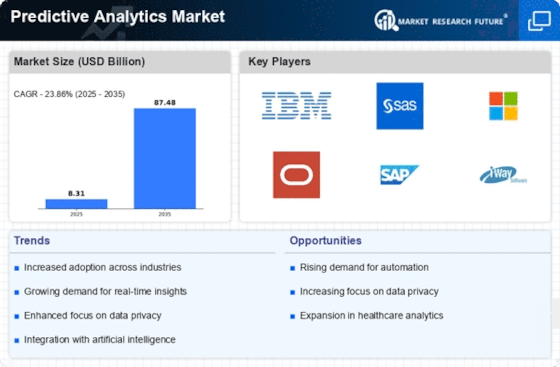
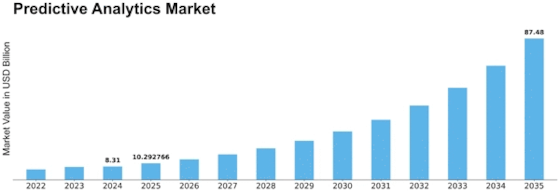
As per Market Research Future analysis, the Predictive Analytics Market Size was estimated at 8.31 USD Billion in 2024. The Predictive Analytics industry is projected to grow from 10.29 USD Billion in 2025 to 87.48 USD Billion by 2035, exhibiting a compound annual growth rate (CAGR) of 23.86% during the forecast period 2025 - 2035

Key Market Trends & Highlights

The Predictive Analytics Market is experiencing robust growth driven by technological advancements and increasing demand for data-driven insights.

  • The integration of Artificial Intelligence is transforming predictive analytics capabilities across various sectors. Real-time data processing is becoming essential for organizations to make timely and informed decisions. Cloud-based solutions are gaining traction, enabling scalability and flexibility for businesses of all sizes. The growing demand for data-driven decision making and advancements in machine learning algorithms are key drivers propelling the market forward, particularly in North America and the BFSI segment.

Market Size & Forecast

2024 Market Size 8.31 (USD Billion)
2035 Market Size 87.48 (USD Billion)
CAGR (2025 - 2035) 23.86%
Largest Regional Market Share in 2024 North America

Major Players

IBM (US), SAS (US), Microsoft (US), Oracle (US), SAP (DE), TIBCO Software (US), Alteryx (US), Qlik (US), Tableau (US), RapidMiner (US)

Market Trends

The Predictive Analytics Market is currently experiencing a notable evolution, driven by advancements in technology and the increasing demand for data-driven decision-making across various sectors. Organizations are increasingly recognizing the value of predictive analytics in enhancing operational efficiency, improving customer experiences, and gaining competitive advantages. This market encompasses a wide range of applications, including risk management, marketing optimization, and supply chain forecasting. As businesses strive to harness the power of data, the integration of machine learning and artificial intelligence into predictive analytics tools is becoming more prevalent, suggesting a shift towards more sophisticated analytical capabilities. Moreover, the growing emphasis on real-time data processing and the need for actionable insights are propelling the adoption of predictive analytics solutions. Companies are investing in cloud-based platforms that offer scalability and flexibility, enabling them to analyze vast amounts of data swiftly. This trend indicates a broader acceptance of predictive analytics as a core component of strategic planning and operational execution. As the market continues to mature, it appears poised for further growth, with innovations in technology likely to enhance its capabilities and applications across diverse industries.

Integration of Artificial Intelligence

The incorporation of artificial intelligence into predictive analytics tools is transforming the landscape. This integration enhances the accuracy of predictions and allows for more complex data analysis, enabling organizations to derive deeper insights from their data.

Real-Time Data Processing

The demand for real-time data processing is on the rise, as businesses seek immediate insights to inform their decisions. This trend is driving the development of advanced analytics solutions that can process and analyze data as it is generated.

Cloud-Based Solutions

The shift towards cloud-based predictive analytics solutions is becoming increasingly evident. These platforms offer scalability and flexibility, allowing organizations to manage and analyze large datasets without the constraints of traditional infrastructure.

Predictive Analytics Market Market Drivers

Rising Adoption of IoT Devices

The proliferation of Internet of Things (IoT) devices is a crucial factor propelling the Predictive Analytics Market. As more devices become interconnected, the volume of data generated is expanding exponentially. This influx of data presents both challenges and opportunities for organizations seeking to leverage predictive analytics. By utilizing predictive models, businesses can analyze real-time data from IoT devices to optimize operations, enhance customer experiences, and improve product offerings. The market is expected to witness substantial growth, with estimates suggesting it could reach USD 30 billion by 2028, driven by the increasing integration of IoT technologies across various sectors.

Need for Enhanced Customer Experience

The imperative for enhanced customer experience is driving the Predictive Analytics Market. Organizations are increasingly focused on understanding customer preferences and behaviors to tailor their offerings accordingly. Predictive analytics enables businesses to analyze historical data and forecast future customer interactions, thereby facilitating personalized marketing strategies. This trend is particularly evident in the retail and e-commerce sectors, where companies are investing in predictive analytics solutions to improve customer engagement and retention. The market is projected to grow significantly, with estimates indicating a potential valuation of USD 22 billion by 2026, as businesses prioritize customer-centric approaches.

Regulatory Compliance and Risk Management

Regulatory compliance and risk management are becoming increasingly critical in the Predictive Analytics Market. Organizations are required to adhere to stringent regulations, necessitating the use of predictive analytics to identify potential risks and ensure compliance. By leveraging predictive models, businesses can proactively address compliance issues and mitigate risks associated with financial transactions, data breaches, and operational inefficiencies. This trend is particularly pronounced in sectors such as finance and healthcare, where regulatory frameworks are evolving rapidly. The market is anticipated to grow, with projections suggesting it could reach USD 28 billion by 2027, as organizations seek to enhance their risk management capabilities through predictive analytics.

Advancements in Machine Learning Algorithms

Advancements in machine learning algorithms are significantly influencing the Predictive Analytics Market. These innovations enhance the accuracy and efficiency of predictive models, allowing organizations to derive actionable insights from complex datasets. The integration of sophisticated algorithms enables businesses to identify patterns and trends that were previously undetectable. As a result, the market is experiencing a notable uptick, with projections indicating a potential growth trajectory that could exceed USD 25 billion by 2027. This growth is driven by the increasing adoption of machine learning technologies across various industries, including finance, healthcare, and retail, where predictive analytics is becoming indispensable for informed decision making.

Growing Demand for Data-Driven Decision Making

The increasing emphasis on data-driven decision making is a primary driver for the Predictive Analytics Market. Organizations across various sectors are recognizing the value of leveraging data to enhance operational efficiency and strategic planning. According to recent estimates, the market is projected to reach USD 20 billion by 2026, reflecting a compound annual growth rate of approximately 25%. This surge is attributed to the need for businesses to remain competitive in a rapidly evolving landscape. As companies seek to harness insights from vast datasets, the demand for predictive analytics solutions is likely to escalate, enabling them to anticipate market trends and consumer behavior more effectively.


Market Segment Insights

By Vertical Outlook: BFSI (Largest) vs. Healthcare & Life Sciences (Fastest-Growing)

The predictive analytics market shows a diverse distribution across various verticals, with the Banking, Financial Services, and Insurance (BFSI) sector accounting for a significant portion of market share. This vertical leverages predictive insights to enhance risk management, fraud detection, and customer personalization, solidifying its position as the largest segment within the market. Other verticals, such as Retail and Manufacturing, also hold substantial shares, focusing on inventory management and supply chain optimization, contributing to the overall maturity of the market.

BFSI: Cloud Adoption (Dominant) vs. Healthcare &amp; Life Sciences: AI-Driven Insights (Emerging)

In the BFSI sector, the adoption of cloud-based predictive analytics solutions is a dominant trend, allowing institutions to harness vast amounts of data for better decision-making and operational efficiency. This segment thrives on regulatory compliance and risk assessment, leading to robust investments in technologies that support data-driven strategies. In contrast, the Healthcare &amp; Life Sciences sector is experiencing rapid growth through the integration of AI and machine learning, enabling personalized medicine and predictive patient care. These emerging solutions are not only enhancing operational workflows but also significantly improving patient outcomes, marking this sector as the fastest-growing within the predictive analytics landscape.

By Organization Size: Small & Medium-sized Enterprises (Largest) vs. Large Enterprises (Fastest-Growing)

The predictive analytics market exhibits a significant distribution of market share between small &amp; medium-sized enterprises (SMEs) and large enterprises. SMEs dominate this segment, leveraging predictive analytics tools to drive efficiency and enhance decision-making processes. Their need for affordable and scalable solutions has contributed to their market presence. Conversely, large enterprises are increasingly investing in advanced predictive analytics solutions, recognizing their potential to transform operations and gain insights from vast data sets. This has allowed them to quickly adapt to market changes and consumer demands. Looking at growth trends, SMEs are adopting predictive analytics at a rapid pace, driven by the need to remain competitive and responsive to market dynamics. The growing accessibility of data and user-friendly analytics tools are facilitating this transition. On the other hand, large enterprises are experiencing the fastest growth in this segment due to substantial investments in big data technologies and machine learning applications. The emphasis on data-driven decision-making is pivotal in shaping their strategies and enhancing operational performance.

SMEs (Dominant) vs. Large Enterprises (Emerging)

Small &amp; Medium-sized Enterprises (SMEs) are recognized as the dominant players in the predictive analytics market. Their focus on cost-effective solutions and ease of implementation allows them to harness the power of data analytics without significant investments. SMEs leverage predictive analytics to optimize operations, improve customer engagement, and enhance product offerings, which has become crucial in achieving competitive advantage. Meanwhile, Large Enterprises represent an emerging segment keen on integrating robust predictive analytics frameworks into their operations. They invest in sophisticated analytics tools to analyze large volumes of data, enabling them to make strategic decisions swiftly. Although SMEs currently hold a stronger market position, Large Enterprises are quickly catching up by adopting innovative technologies that enhance their analytics capabilities.

By Deployment Outlook: Cloud (Largest) vs. On-Premises (Fastest-Growing)

The Predictive Analytics Market is witnessing a dynamic shift in deployment strategies, primarily characterized by two segments: Cloud and On-Premises. The Cloud deployment model holds the largest share, attributed to its flexibility, scalability, and ease of integration. Organizations are increasingly opting for cloud solutions due to their cost-effectiveness and ability to facilitate real-time analytics. In contrast, On-Premises deployments are gaining traction, appealing to businesses that prioritize data security and regulatory compliance, thus creating a diverse market landscape.

Deployment Type: Cloud (Dominant) vs. On-Premises (Emerging)

Cloud deployment is a dominant force in the Predictive Analytics Market, favored for its ability to deliver seamless updates, enhanced collaboration, and access to advanced analytics tools. This model supports a wide range of organizations, from SMEs to large enterprises, providing them the necessary resources to harness data-driven insights efficiently. On-Premises solutions, while emerging, are seeing a resurgence as companies seek more control over their data environments. These systems offer higher levels of customization and security, making them attractive for sectors with stringent compliance mandates, ultimately shaping a competitive landscape between the two deployment models.

Get more detailed insights about Predictive Analytics Market Research Report - Global Forecast till 2035

Regional Insights

North America : Innovation and Leadership Hub

North America is the largest market for predictive analytics, holding approximately 45% of the global share. The region's growth is driven by rapid technological advancements, increasing data generation, and a strong focus on data-driven decision-making across industries. Regulatory support, particularly in data privacy and security, further catalyzes market expansion, ensuring compliance while fostering innovation. The United States leads the market, with significant contributions from Canada. Major players like IBM, Microsoft, and Oracle dominate the landscape, offering advanced solutions tailored to various sectors. The competitive environment is characterized by continuous innovation and strategic partnerships, enhancing the capabilities of predictive analytics tools and services.

Europe : Emerging Market with Potential

Europe is witnessing a significant rise in the predictive analytics market, currently holding around 30% of the global share. The region's growth is fueled by increasing investments in digital transformation and a growing emphasis on data analytics across various sectors. Regulatory frameworks, such as GDPR, are shaping the market by promoting data protection and privacy, which in turn drives demand for compliant analytics solutions. Leading countries in Europe include Germany, the UK, and France, where organizations are increasingly adopting predictive analytics to enhance operational efficiency. Key players like SAP and SAS are prominent in the region, contributing to a competitive landscape that encourages innovation and collaboration. The focus on sustainability and ethical data use is also influencing market dynamics, paving the way for responsible analytics practices.

Asia-Pacific : Rapid Growth and Adoption

Asia-Pacific is rapidly emerging as a significant player in the predictive analytics market, accounting for approximately 20% of the global share. The region's growth is driven by increasing digitalization, a surge in data generation, and a growing awareness of the benefits of predictive analytics across various industries. Government initiatives promoting technology adoption and innovation are also key catalysts for market expansion. Countries like China, India, and Japan are at the forefront of this growth, with a strong presence of both local and international players. Companies such as TIBCO Software and Alteryx are making strides in the market, enhancing their offerings to cater to diverse industry needs. The competitive landscape is characterized by a mix of established firms and startups, fostering a vibrant ecosystem for predictive analytics solutions.

Middle East and Africa : Emerging Market with Challenges

The Middle East and Africa region is gradually developing its predictive analytics market, currently holding about 5% of the global share. The growth is driven by increasing investments in technology and a rising demand for data-driven insights across various sectors. However, challenges such as limited infrastructure and regulatory hurdles can impede rapid growth. Governments are increasingly recognizing the importance of data analytics, leading to supportive policies that encourage market development. Countries like South Africa and the UAE are leading the way in adopting predictive analytics, with a focus on sectors such as finance and healthcare. The competitive landscape is evolving, with both local and international players vying for market share. Companies are increasingly collaborating to enhance their capabilities and address the unique challenges of the region, paving the way for future growth in predictive analytics.

Key Players and Competitive Insights

The Predictive Analytics Market is currently characterized by a dynamic competitive landscape, driven by the increasing demand for data-driven decision-making across various sectors. Key players such as IBM (US), Microsoft (US), and SAS (US) are at the forefront, leveraging their technological prowess to enhance their offerings. IBM (US) focuses on integrating artificial intelligence into its predictive analytics solutions, thereby enabling clients to derive actionable insights from vast datasets. Meanwhile, Microsoft (US) emphasizes cloud-based analytics, positioning itself as a leader in providing scalable solutions that cater to businesses of all sizes. SAS (US) continues to innovate with its advanced analytics capabilities, particularly in sectors like healthcare and finance, where predictive modeling is crucial for operational efficiency. Collectively, these strategies not only enhance their competitive positioning but also contribute to a rapidly evolving market landscape.In terms of business tactics, companies are increasingly localizing their operations to better serve regional markets, optimizing supply chains to enhance efficiency, and investing in partnerships to expand their technological capabilities. The competitive structure of the Predictive Analytics Market appears moderately fragmented, with several key players holding substantial market shares while also facing competition from emerging startups. This fragmentation allows for a diverse range of solutions, catering to various industry needs and preferences.

In August IBM (US) announced a strategic partnership with a leading cloud provider to enhance its predictive analytics capabilities. This collaboration aims to integrate IBM's AI-driven analytics tools with the cloud provider's infrastructure, thereby offering clients a more robust and scalable solution. The significance of this partnership lies in its potential to streamline data processing and improve the speed at which businesses can derive insights, ultimately driving better decision-making.

In September Microsoft (US) launched a new suite of predictive analytics tools designed specifically for the retail sector. This initiative reflects Microsoft's commitment to addressing industry-specific challenges, such as inventory management and customer behavior forecasting. By tailoring its offerings, Microsoft not only strengthens its market position but also enhances customer loyalty through targeted solutions that meet specific needs.

In July SAS (US) unveiled an innovative predictive analytics platform that incorporates machine learning algorithms to enhance forecasting accuracy. This development is particularly relevant in industries where precision is paramount, such as finance and supply chain management. The introduction of this platform signifies SAS's ongoing commitment to innovation and its ability to adapt to the evolving demands of the market.

As of October the competitive trends within the Predictive Analytics Market are increasingly defined by digitalization, sustainability, and the integration of artificial intelligence. Strategic alliances are becoming more prevalent, as companies recognize the value of collaboration in enhancing their technological capabilities and market reach. Looking ahead, it is likely that competitive differentiation will shift from traditional price-based strategies to a focus on innovation, advanced technology, and the reliability of supply chains. This evolution suggests that companies that prioritize these aspects will be better positioned to thrive in an increasingly competitive environment.

Key Companies in the Predictive Analytics Market include

Industry Developments

  • Q2 2024: Salesforce launches new AI-powered predictive analytics features for Data Cloud Salesforce announced the release of advanced predictive analytics capabilities integrated into its Data Cloud platform, aiming to help enterprises forecast customer behavior and optimize marketing strategies.
  • Q2 2024: Microsoft acquires predictive analytics startup Nuance Predict for undisclosed sum Microsoft completed the acquisition of Nuance Predict, a startup specializing in healthcare predictive analytics, to strengthen its cloud-based AI offerings for hospitals and clinics.
  • Q1 2024: DataRobot secures $150M funding round to expand predictive analytics platform DataRobot raised $150 million in a new funding round led by Tiger Global, with plans to accelerate development of its enterprise predictive analytics solutions and expand into new verticals.
  • Q2 2024: IBM partners with Mayo Clinic to deploy predictive analytics for patient outcome forecasting IBM announced a strategic partnership with Mayo Clinic to implement predictive analytics tools aimed at improving patient care and operational efficiency in clinical settings.
  • Q3 2024: SAP unveils new predictive analytics module for S/4HANA Cloud SAP launched a predictive analytics module for its S/4HANA Cloud ERP system, enabling businesses to leverage machine learning for financial forecasting and supply chain optimization.
  • Q1 2024: Oracle wins $80M contract with US Department of Defense for predictive analytics in logistics Oracle secured a multi-year, $80 million contract to provide predictive analytics solutions for the US Department of Defense, focusing on logistics and supply chain management.
  • Q2 2025: Google Cloud launches Vertex AI Predictive Analytics Market Suite Google Cloud introduced the Vertex AI Predictive Analytics Market Suite, a new set of tools designed to help organizations build, deploy, and manage predictive models at scale.
  • Q1 2025: C3.ai announces partnership with Shell to deploy predictive analytics for energy operations C3.ai entered into a partnership with Shell to implement predictive analytics solutions aimed at optimizing energy production and reducing operational risks.
  • Q2 2024: SAS Institute opens new predictive analytics R&D center in Dublin SAS Institute inaugurated a research and development center in Dublin focused on advancing predictive analytics technologies for financial services and healthcare.
  • Q3 2024: Palantir Technologies wins contract with NHS for predictive analytics in patient care Palantir Technologies secured a contract with the UK's National Health Service to deploy predictive analytics tools for improving patient care and resource allocation.
  • Q1 2025: Snowflake appoints new Chief Analytics Officer to lead predictive analytics strategy Snowflake named Dr. Lisa Chen as Chief Analytics Officer, tasking her with driving the company's predictive analytics product roadmap and market expansion.
  • Q2 2025: AWS launches Predictive Analytics Market Accelerator for startups Amazon Web Services announced the launch of its Predictive Analytics Market Accelerator program, offering funding and technical support to startups developing predictive analytics solutions.

Future Outlook

Predictive Analytics Market Future Outlook

The Predictive Analytics Market is poised for robust growth at 23.86% CAGR from 2025 to 2035, driven by advancements in AI, big data, and demand for data-driven decision-making.

New opportunities lie in:

  • Integration of predictive maintenance solutions in manufacturing sectors.</p><p>Development of personalized marketing analytics platforms for retail.</p><p>Implementation of real-time <a href="https://www.marketresearchfuture.com/reports/fraud-detection-prevention-market-2985">fraud detection</a> systems in financial services.

By 2035, the Predictive Analytics Market is expected to achieve substantial growth, solidifying its critical role in various industries.

Market Segmentation

Predictive Analytics Market Vertical Outlook Outlook

  • BFSI
  • Retail
  • Manufacturing
  • Government & Defense
  • Healthcare & Life Sciences
  • Energy & Utilities
  • Transportation & Logistics
  • Telecommunication & IT
  • Others

Predictive Analytics Market Organization Size Outlook

  • Small & Medium-sized Enterprises
  • Large Enterprises

Predictive Analytics Market Deployment Outlook Outlook

  • On-Premises
  • Cloud

Report Scope

MARKET SIZE 2024 8.31(USD Billion)
MARKET SIZE 2025 10.29(USD Billion)
MARKET SIZE 2035 87.48(USD Billion)
COMPOUND ANNUAL GROWTH RATE (CAGR) 23.86% (2025 - 2035)
REPORT COVERAGE Revenue Forecast, Competitive Landscape, Growth Factors, and Trends
BASE YEAR 2024
Market Forecast Period 2025 - 2035
Historical Data 2019 - 2024
Market Forecast Units USD Billion
Key Companies Profiled IBM (US), SAS (US), Microsoft (US), Oracle (US), SAP (DE), TIBCO Software (US), Alteryx (US), Qlik (US), Tableau (US), RapidMiner (US)
Segments Covered Vertical, Organization Size, Deployment, Region
Key Market Opportunities Integration of artificial intelligence enhances predictive capabilities in the Predictive Analytics Market.
Key Market Dynamics Rising demand for data-driven decision-making fuels competition and innovation in the Predictive Analytics Market.
Countries Covered North America, Europe, APAC, South America, MEA

FAQs

What is the current valuation of the Predictive Analytics Market in 2025?

<p>The Predictive Analytics Market is valued at 8.31 USD Billion in 2024 and is expected to grow significantly during the forecast period.</p>

What is the projected market size for the Predictive Analytics Market by 2035?

<p>The market is projected to reach 87.48 USD Billion by 2035, indicating substantial growth potential.</p>

What is the expected CAGR for the Predictive Analytics Market from 2025 to 2035?

<p>The expected CAGR for the Predictive Analytics Market during the forecast period is 23.86%.</p>

Which sectors are leading in the Predictive Analytics Market?

<p>The BFSI sector leads with a valuation of 17.25 USD Billion, followed by Retail at 12.85 USD Billion.</p>

How do small and medium-sized enterprises contribute to the Predictive Analytics Market?

<p>Small and medium-sized enterprises are projected to contribute 25.0 USD Billion, indicating their growing importance in the market.</p>

What is the market valuation for large enterprises in the Predictive Analytics sector?

<p>Large enterprises are expected to account for a valuation of 62.48 USD Billion, reflecting their significant role in the market.</p>

What are the deployment trends in the Predictive Analytics Market?

The Cloud deployment segment is projected to reach 52.48 USD Billion, surpassing the On-Premises segment at 35.0 USD Billion.

Who are the key players in the Predictive Analytics Market?

Key players include IBM, SAS, Microsoft, Oracle, SAP, TIBCO Software, Alteryx, Qlik, Tableau, and RapidMiner.

What is the valuation of the Government & Defense sector in the Predictive Analytics Market?

The Government &amp; Defense sector is valued at 8.5 USD Billion, showcasing its relevance in predictive analytics applications.

How does the Energy & Utilities sector perform in the Predictive Analytics Market?

The Energy &amp; Utilities sector is valued at 7.5 USD Billion, indicating its potential for growth within the market.

  1. SECTION I: EXECUTIVE SUMMARY AND KEY HIGHLIGHTS
    1. | 1.1 EXECUTIVE SUMMARY
    2. | | 1.1.1 Market Overview
    3. | | 1.1.2 Key Findings
    4. | | 1.1.3 Market Segmentation
    5. | | 1.1.4 Competitive Landscape
    6. | | 1.1.5 Challenges and Opportunities
    7. | | 1.1.6 Future Outlook
  2. SECTION II: SCOPING, METHODOLOGY AND MARKET STRUCTURE
    1. | 2.1 MARKET INTRODUCTION
    2. | | 2.1.1 Definition
    3. | | 2.1.2 Scope of the study
    4. | | | 2.1.2.1 Research Objective
    5. | | | 2.1.2.2 Assumption
    6. | | | 2.1.2.3 Limitations
    7. | 2.2 RESEARCH METHODOLOGY
    8. | | 2.2.1 Overview
    9. | | 2.2.2 Data Mining
    10. | | 2.2.3 Secondary Research
    11. | | 2.2.4 Primary Research
    12. | | | 2.2.4.1 Primary Interviews and Information Gathering Process
    13. | | | 2.2.4.2 Breakdown of Primary Respondents
    14. | | 2.2.5 Forecasting Model
    15. | | 2.2.6 Market Size Estimation
    16. | | | 2.2.6.1 Bottom-Up Approach
    17. | | | 2.2.6.2 Top-Down Approach
    18. | | 2.2.7 Data Triangulation
    19. | | 2.2.8 Validation
  3. SECTION III: QUALITATIVE ANALYSIS
    1. | 3.1 MARKET DYNAMICS
    2. | | 3.1.1 Overview
    3. | | 3.1.2 Drivers
    4. | | 3.1.3 Restraints
    5. | | 3.1.4 Opportunities
    6. | 3.2 MARKET FACTOR ANALYSIS
    7. | | 3.2.1 Value chain Analysis
    8. | | 3.2.2 Porter's Five Forces Analysis
    9. | | | 3.2.2.1 Bargaining Power of Suppliers
    10. | | | 3.2.2.2 Bargaining Power of Buyers
    11. | | | 3.2.2.3 Threat of New Entrants
    12. | | | 3.2.2.4 Threat of Substitutes
    13. | | | 3.2.2.5 Intensity of Rivalry
    14. | | 3.2.3 COVID-19 Impact Analysis
    15. | | | 3.2.3.1 Market Impact Analysis
    16. | | | 3.2.3.2 Regional Impact
    17. | | | 3.2.3.3 Opportunity and Threat Analysis
  4. SECTION IV: QUANTITATIVE ANALYSIS
    1. | 4.1 Information and Communications Technology, BY Vertical Outlook (USD Billion)
    2. | | 4.1.1 BFSI
    3. | | 4.1.2 Retail
    4. | | 4.1.3 Manufacturing
    5. | | 4.1.4 Government & Defense
    6. | | 4.1.5 Healthcare & Life Sciences
    7. | | 4.1.6 Energy & Utilities
    8. | | 4.1.7 Transportation & Logistics
    9. | | 4.1.8 Telecommunication & IT
    10. | | 4.1.9 Others
    11. | 4.2 Information and Communications Technology, BY Organization Size (USD Billion)
    12. | | 4.2.1 Small & Medium-sized Enterprises
    13. | | 4.2.2 Large Enterprises
    14. | 4.3 Information and Communications Technology, BY Deployment Outlook (USD Billion)
    15. | | 4.3.1 On-Premises
    16. | | 4.3.2 Cloud
    17. | 4.4 Information and Communications Technology, BY Region (USD Billion)
    18. | | 4.4.1 North America
    19. | | | 4.4.1.1 US
    20. | | | 4.4.1.2 Canada
    21. | | 4.4.2 Europe
    22. | | | 4.4.2.1 Germany
    23. | | | 4.4.2.2 UK
    24. | | | 4.4.2.3 France
    25. | | | 4.4.2.4 Russia
    26. | | | 4.4.2.5 Italy
    27. | | | 4.4.2.6 Spain
    28. | | | 4.4.2.7 Rest of Europe
    29. | | 4.4.3 APAC
    30. | | | 4.4.3.1 China
    31. | | | 4.4.3.2 India
    32. | | | 4.4.3.3 Japan
    33. | | | 4.4.3.4 South Korea
    34. | | | 4.4.3.5 Malaysia
    35. | | | 4.4.3.6 Thailand
    36. | | | 4.4.3.7 Indonesia
    37. | | | 4.4.3.8 Rest of APAC
    38. | | 4.4.4 South America
    39. | | | 4.4.4.1 Brazil
    40. | | | 4.4.4.2 Mexico
    41. | | | 4.4.4.3 Argentina
    42. | | | 4.4.4.4 Rest of South America
    43. | | 4.4.5 MEA
    44. | | | 4.4.5.1 GCC Countries
    45. | | | 4.4.5.2 South Africa
    46. | | | 4.4.5.3 Rest of MEA
  5. SECTION V: COMPETITIVE ANALYSIS
    1. | 5.1 Competitive Landscape
    2. | | 5.1.1 Overview
    3. | | 5.1.2 Competitive Analysis
    4. | | 5.1.3 Market share Analysis
    5. | | 5.1.4 Major Growth Strategy in the Information and Communications Technology
    6. | | 5.1.5 Competitive Benchmarking
    7. | | 5.1.6 Leading Players in Terms of Number of Developments in the Information and Communications Technology
    8. | | 5.1.7 Key developments and growth strategies
    9. | | | 5.1.7.1 New Product Launch/Service Deployment
    10. | | | 5.1.7.2 Merger & Acquisitions
    11. | | | 5.1.7.3 Joint Ventures
    12. | | 5.1.8 Major Players Financial Matrix
    13. | | | 5.1.8.1 Sales and Operating Income
    14. | | | 5.1.8.2 Major Players R&D Expenditure. 2023
    15. | 5.2 Company Profiles
    16. | | 5.2.1 IBM (US)
    17. | | | 5.2.1.1 Financial Overview
    18. | | | 5.2.1.2 Products Offered
    19. | | | 5.2.1.3 Key Developments
    20. | | | 5.2.1.4 SWOT Analysis
    21. | | | 5.2.1.5 Key Strategies
    22. | | 5.2.2 SAS (US)
    23. | | | 5.2.2.1 Financial Overview
    24. | | | 5.2.2.2 Products Offered
    25. | | | 5.2.2.3 Key Developments
    26. | | | 5.2.2.4 SWOT Analysis
    27. | | | 5.2.2.5 Key Strategies
    28. | | 5.2.3 Microsoft (US)
    29. | | | 5.2.3.1 Financial Overview
    30. | | | 5.2.3.2 Products Offered
    31. | | | 5.2.3.3 Key Developments
    32. | | | 5.2.3.4 SWOT Analysis
    33. | | | 5.2.3.5 Key Strategies
    34. | | 5.2.4 Oracle (US)
    35. | | | 5.2.4.1 Financial Overview
    36. | | | 5.2.4.2 Products Offered
    37. | | | 5.2.4.3 Key Developments
    38. | | | 5.2.4.4 SWOT Analysis
    39. | | | 5.2.4.5 Key Strategies
    40. | | 5.2.5 SAP (DE)
    41. | | | 5.2.5.1 Financial Overview
    42. | | | 5.2.5.2 Products Offered
    43. | | | 5.2.5.3 Key Developments
    44. | | | 5.2.5.4 SWOT Analysis
    45. | | | 5.2.5.5 Key Strategies
    46. | | 5.2.6 TIBCO Software (US)
    47. | | | 5.2.6.1 Financial Overview
    48. | | | 5.2.6.2 Products Offered
    49. | | | 5.2.6.3 Key Developments
    50. | | | 5.2.6.4 SWOT Analysis
    51. | | | 5.2.6.5 Key Strategies
    52. | | 5.2.7 Alteryx (US)
    53. | | | 5.2.7.1 Financial Overview
    54. | | | 5.2.7.2 Products Offered
    55. | | | 5.2.7.3 Key Developments
    56. | | | 5.2.7.4 SWOT Analysis
    57. | | | 5.2.7.5 Key Strategies
    58. | | 5.2.8 Qlik (US)
    59. | | | 5.2.8.1 Financial Overview
    60. | | | 5.2.8.2 Products Offered
    61. | | | 5.2.8.3 Key Developments
    62. | | | 5.2.8.4 SWOT Analysis
    63. | | | 5.2.8.5 Key Strategies
    64. | | 5.2.9 Tableau (US)
    65. | | | 5.2.9.1 Financial Overview
    66. | | | 5.2.9.2 Products Offered
    67. | | | 5.2.9.3 Key Developments
    68. | | | 5.2.9.4 SWOT Analysis
    69. | | | 5.2.9.5 Key Strategies
    70. | | 5.2.10 RapidMiner (US)
    71. | | | 5.2.10.1 Financial Overview
    72. | | | 5.2.10.2 Products Offered
    73. | | | 5.2.10.3 Key Developments
    74. | | | 5.2.10.4 SWOT Analysis
    75. | | | 5.2.10.5 Key Strategies
    76. | 5.3 Appendix
    77. | | 5.3.1 References
    78. | | 5.3.2 Related Reports
  6. LIST OF FIGURES
    1. | 6.1 MARKET SYNOPSIS
    2. | 6.2 NORTH AMERICA MARKET ANALYSIS
    3. | 6.3 US MARKET ANALYSIS BY VERTICAL OUTLOOK
    4. | 6.4 US MARKET ANALYSIS BY ORGANIZATION SIZE
    5. | 6.5 US MARKET ANALYSIS BY DEPLOYMENT OUTLOOK
    6. | 6.6 CANADA MARKET ANALYSIS BY VERTICAL OUTLOOK
    7. | 6.7 CANADA MARKET ANALYSIS BY ORGANIZATION SIZE
    8. | 6.8 CANADA MARKET ANALYSIS BY DEPLOYMENT OUTLOOK
    9. | 6.9 EUROPE MARKET ANALYSIS
    10. | 6.10 GERMANY MARKET ANALYSIS BY VERTICAL OUTLOOK
    11. | 6.11 GERMANY MARKET ANALYSIS BY ORGANIZATION SIZE
    12. | 6.12 GERMANY MARKET ANALYSIS BY DEPLOYMENT OUTLOOK
    13. | 6.13 UK MARKET ANALYSIS BY VERTICAL OUTLOOK
    14. | 6.14 UK MARKET ANALYSIS BY ORGANIZATION SIZE
    15. | 6.15 UK MARKET ANALYSIS BY DEPLOYMENT OUTLOOK
    16. | 6.16 FRANCE MARKET ANALYSIS BY VERTICAL OUTLOOK
    17. | 6.17 FRANCE MARKET ANALYSIS BY ORGANIZATION SIZE
    18. | 6.18 FRANCE MARKET ANALYSIS BY DEPLOYMENT OUTLOOK
    19. | 6.19 RUSSIA MARKET ANALYSIS BY VERTICAL OUTLOOK
    20. | 6.20 RUSSIA MARKET ANALYSIS BY ORGANIZATION SIZE
    21. | 6.21 RUSSIA MARKET ANALYSIS BY DEPLOYMENT OUTLOOK
    22. | 6.22 ITALY MARKET ANALYSIS BY VERTICAL OUTLOOK
    23. | 6.23 ITALY MARKET ANALYSIS BY ORGANIZATION SIZE
    24. | 6.24 ITALY MARKET ANALYSIS BY DEPLOYMENT OUTLOOK
    25. | 6.25 SPAIN MARKET ANALYSIS BY VERTICAL OUTLOOK
    26. | 6.26 SPAIN MARKET ANALYSIS BY ORGANIZATION SIZE
    27. | 6.27 SPAIN MARKET ANALYSIS BY DEPLOYMENT OUTLOOK
    28. | 6.28 REST OF EUROPE MARKET ANALYSIS BY VERTICAL OUTLOOK
    29. | 6.29 REST OF EUROPE MARKET ANALYSIS BY ORGANIZATION SIZE
    30. | 6.30 REST OF EUROPE MARKET ANALYSIS BY DEPLOYMENT OUTLOOK
    31. | 6.31 APAC MARKET ANALYSIS
    32. | 6.32 CHINA MARKET ANALYSIS BY VERTICAL OUTLOOK
    33. | 6.33 CHINA MARKET ANALYSIS BY ORGANIZATION SIZE
    34. | 6.34 CHINA MARKET ANALYSIS BY DEPLOYMENT OUTLOOK
    35. | 6.35 INDIA MARKET ANALYSIS BY VERTICAL OUTLOOK
    36. | 6.36 INDIA MARKET ANALYSIS BY ORGANIZATION SIZE
    37. | 6.37 INDIA MARKET ANALYSIS BY DEPLOYMENT OUTLOOK
    38. | 6.38 JAPAN MARKET ANALYSIS BY VERTICAL OUTLOOK
    39. | 6.39 JAPAN MARKET ANALYSIS BY ORGANIZATION SIZE
    40. | 6.40 JAPAN MARKET ANALYSIS BY DEPLOYMENT OUTLOOK
    41. | 6.41 SOUTH KOREA MARKET ANALYSIS BY VERTICAL OUTLOOK
    42. | 6.42 SOUTH KOREA MARKET ANALYSIS BY ORGANIZATION SIZE
    43. | 6.43 SOUTH KOREA MARKET ANALYSIS BY DEPLOYMENT OUTLOOK
    44. | 6.44 MALAYSIA MARKET ANALYSIS BY VERTICAL OUTLOOK
    45. | 6.45 MALAYSIA MARKET ANALYSIS BY ORGANIZATION SIZE
    46. | 6.46 MALAYSIA MARKET ANALYSIS BY DEPLOYMENT OUTLOOK
    47. | 6.47 THAILAND MARKET ANALYSIS BY VERTICAL OUTLOOK
    48. | 6.48 THAILAND MARKET ANALYSIS BY ORGANIZATION SIZE
    49. | 6.49 THAILAND MARKET ANALYSIS BY DEPLOYMENT OUTLOOK
    50. | 6.50 INDONESIA MARKET ANALYSIS BY VERTICAL OUTLOOK
    51. | 6.51 INDONESIA MARKET ANALYSIS BY ORGANIZATION SIZE
    52. | 6.52 INDONESIA MARKET ANALYSIS BY DEPLOYMENT OUTLOOK
    53. | 6.53 REST OF APAC MARKET ANALYSIS BY VERTICAL OUTLOOK
    54. | 6.54 REST OF APAC MARKET ANALYSIS BY ORGANIZATION SIZE
    55. | 6.55 REST OF APAC MARKET ANALYSIS BY DEPLOYMENT OUTLOOK
    56. | 6.56 SOUTH AMERICA MARKET ANALYSIS
    57. | 6.57 BRAZIL MARKET ANALYSIS BY VERTICAL OUTLOOK
    58. | 6.58 BRAZIL MARKET ANALYSIS BY ORGANIZATION SIZE
    59. | 6.59 BRAZIL MARKET ANALYSIS BY DEPLOYMENT OUTLOOK
    60. | 6.60 MEXICO MARKET ANALYSIS BY VERTICAL OUTLOOK
    61. | 6.61 MEXICO MARKET ANALYSIS BY ORGANIZATION SIZE
    62. | 6.62 MEXICO MARKET ANALYSIS BY DEPLOYMENT OUTLOOK
    63. | 6.63 ARGENTINA MARKET ANALYSIS BY VERTICAL OUTLOOK
    64. | 6.64 ARGENTINA MARKET ANALYSIS BY ORGANIZATION SIZE
    65. | 6.65 ARGENTINA MARKET ANALYSIS BY DEPLOYMENT OUTLOOK
    66. | 6.66 REST OF SOUTH AMERICA MARKET ANALYSIS BY VERTICAL OUTLOOK
    67. | 6.67 REST OF SOUTH AMERICA MARKET ANALYSIS BY ORGANIZATION SIZE
    68. | 6.68 REST OF SOUTH AMERICA MARKET ANALYSIS BY DEPLOYMENT OUTLOOK
    69. | 6.69 MEA MARKET ANALYSIS
    70. | 6.70 GCC COUNTRIES MARKET ANALYSIS BY VERTICAL OUTLOOK
    71. | 6.71 GCC COUNTRIES MARKET ANALYSIS BY ORGANIZATION SIZE
    72. | 6.72 GCC COUNTRIES MARKET ANALYSIS BY DEPLOYMENT OUTLOOK
    73. | 6.73 SOUTH AFRICA MARKET ANALYSIS BY VERTICAL OUTLOOK
    74. | 6.74 SOUTH AFRICA MARKET ANALYSIS BY ORGANIZATION SIZE
    75. | 6.75 SOUTH AFRICA MARKET ANALYSIS BY DEPLOYMENT OUTLOOK
    76. | 6.76 REST OF MEA MARKET ANALYSIS BY VERTICAL OUTLOOK
    77. | 6.77 REST OF MEA MARKET ANALYSIS BY ORGANIZATION SIZE
    78. | 6.78 REST OF MEA MARKET ANALYSIS BY DEPLOYMENT OUTLOOK
    79. | 6.79 KEY BUYING CRITERIA OF INFORMATION AND COMMUNICATIONS TECHNOLOGY
    80. | 6.80 RESEARCH PROCESS OF MRFR
    81. | 6.81 DRO ANALYSIS OF INFORMATION AND COMMUNICATIONS TECHNOLOGY
    82. | 6.82 DRIVERS IMPACT ANALYSIS: INFORMATION AND COMMUNICATIONS TECHNOLOGY
    83. | 6.83 RESTRAINTS IMPACT ANALYSIS: INFORMATION AND COMMUNICATIONS TECHNOLOGY
    84. | 6.84 SUPPLY / VALUE CHAIN: INFORMATION AND COMMUNICATIONS TECHNOLOGY
    85. | 6.85 INFORMATION AND COMMUNICATIONS TECHNOLOGY, BY VERTICAL OUTLOOK, 2024 (% SHARE)
    86. | 6.86 INFORMATION AND COMMUNICATIONS TECHNOLOGY, BY VERTICAL OUTLOOK, 2024 TO 2035 (USD Billion)
    87. | 6.87 INFORMATION AND COMMUNICATIONS TECHNOLOGY, BY ORGANIZATION SIZE, 2024 (% SHARE)
    88. | 6.88 INFORMATION AND COMMUNICATIONS TECHNOLOGY, BY ORGANIZATION SIZE, 2024 TO 2035 (USD Billion)
    89. | 6.89 INFORMATION AND COMMUNICATIONS TECHNOLOGY, BY DEPLOYMENT OUTLOOK, 2024 (% SHARE)
    90. | 6.90 INFORMATION AND COMMUNICATIONS TECHNOLOGY, BY DEPLOYMENT OUTLOOK, 2024 TO 2035 (USD Billion)
    91. | 6.91 BENCHMARKING OF MAJOR COMPETITORS
  7. LIST OF TABLES
    1. | 7.1 LIST OF ASSUMPTIONS
    2. | | 7.1.1
    3. | 7.2 North America MARKET SIZE ESTIMATES; FORECAST
    4. | | 7.2.1 BY VERTICAL OUTLOOK, 2025-2035 (USD Billion)
    5. | | 7.2.2 BY ORGANIZATION SIZE, 2025-2035 (USD Billion)
    6. | | 7.2.3 BY DEPLOYMENT OUTLOOK, 2025-2035 (USD Billion)
    7. | 7.3 US MARKET SIZE ESTIMATES; FORECAST
    8. | | 7.3.1 BY VERTICAL OUTLOOK, 2025-2035 (USD Billion)
    9. | | 7.3.2 BY ORGANIZATION SIZE, 2025-2035 (USD Billion)
    10. | | 7.3.3 BY DEPLOYMENT OUTLOOK, 2025-2035 (USD Billion)
    11. | 7.4 Canada MARKET SIZE ESTIMATES; FORECAST
    12. | | 7.4.1 BY VERTICAL OUTLOOK, 2025-2035 (USD Billion)
    13. | | 7.4.2 BY ORGANIZATION SIZE, 2025-2035 (USD Billion)
    14. | | 7.4.3 BY DEPLOYMENT OUTLOOK, 2025-2035 (USD Billion)
    15. | 7.5 Europe MARKET SIZE ESTIMATES; FORECAST
    16. | | 7.5.1 BY VERTICAL OUTLOOK, 2025-2035 (USD Billion)
    17. | | 7.5.2 BY ORGANIZATION SIZE, 2025-2035 (USD Billion)
    18. | | 7.5.3 BY DEPLOYMENT OUTLOOK, 2025-2035 (USD Billion)
    19. | 7.6 Germany MARKET SIZE ESTIMATES; FORECAST
    20. | | 7.6.1 BY VERTICAL OUTLOOK, 2025-2035 (USD Billion)
    21. | | 7.6.2 BY ORGANIZATION SIZE, 2025-2035 (USD Billion)
    22. | | 7.6.3 BY DEPLOYMENT OUTLOOK, 2025-2035 (USD Billion)
    23. | 7.7 UK MARKET SIZE ESTIMATES; FORECAST
    24. | | 7.7.1 BY VERTICAL OUTLOOK, 2025-2035 (USD Billion)
    25. | | 7.7.2 BY ORGANIZATION SIZE, 2025-2035 (USD Billion)
    26. | | 7.7.3 BY DEPLOYMENT OUTLOOK, 2025-2035 (USD Billion)
    27. | 7.8 France MARKET SIZE ESTIMATES; FORECAST
    28. | | 7.8.1 BY VERTICAL OUTLOOK, 2025-2035 (USD Billion)
    29. | | 7.8.2 BY ORGANIZATION SIZE, 2025-2035 (USD Billion)
    30. | | 7.8.3 BY DEPLOYMENT OUTLOOK, 2025-2035 (USD Billion)
    31. | 7.9 Russia MARKET SIZE ESTIMATES; FORECAST
    32. | | 7.9.1 BY VERTICAL OUTLOOK, 2025-2035 (USD Billion)
    33. | | 7.9.2 BY ORGANIZATION SIZE, 2025-2035 (USD Billion)
    34. | | 7.9.3 BY DEPLOYMENT OUTLOOK, 2025-2035 (USD Billion)
    35. | 7.10 Italy MARKET SIZE ESTIMATES; FORECAST
    36. | | 7.10.1 BY VERTICAL OUTLOOK, 2025-2035 (USD Billion)
    37. | | 7.10.2 BY ORGANIZATION SIZE, 2025-2035 (USD Billion)
    38. | | 7.10.3 BY DEPLOYMENT OUTLOOK, 2025-2035 (USD Billion)
    39. | 7.11 Spain MARKET SIZE ESTIMATES; FORECAST
    40. | | 7.11.1 BY VERTICAL OUTLOOK, 2025-2035 (USD Billion)
    41. | | 7.11.2 BY ORGANIZATION SIZE, 2025-2035 (USD Billion)
    42. | | 7.11.3 BY DEPLOYMENT OUTLOOK, 2025-2035 (USD Billion)
    43. | 7.12 Rest of Europe MARKET SIZE ESTIMATES; FORECAST
    44. | | 7.12.1 BY VERTICAL OUTLOOK, 2025-2035 (USD Billion)
    45. | | 7.12.2 BY ORGANIZATION SIZE, 2025-2035 (USD Billion)
    46. | | 7.12.3 BY DEPLOYMENT OUTLOOK, 2025-2035 (USD Billion)
    47. | 7.13 APAC MARKET SIZE ESTIMATES; FORECAST
    48. | | 7.13.1 BY VERTICAL OUTLOOK, 2025-2035 (USD Billion)
    49. | | 7.13.2 BY ORGANIZATION SIZE, 2025-2035 (USD Billion)
    50. | | 7.13.3 BY DEPLOYMENT OUTLOOK, 2025-2035 (USD Billion)
    51. | 7.14 China MARKET SIZE ESTIMATES; FORECAST
    52. | | 7.14.1 BY VERTICAL OUTLOOK, 2025-2035 (USD Billion)
    53. | | 7.14.2 BY ORGANIZATION SIZE, 2025-2035 (USD Billion)
    54. | | 7.14.3 BY DEPLOYMENT OUTLOOK, 2025-2035 (USD Billion)
    55. | 7.15 India MARKET SIZE ESTIMATES; FORECAST
    56. | | 7.15.1 BY VERTICAL OUTLOOK, 2025-2035 (USD Billion)
    57. | | 7.15.2 BY ORGANIZATION SIZE, 2025-2035 (USD Billion)
    58. | | 7.15.3 BY DEPLOYMENT OUTLOOK, 2025-2035 (USD Billion)
    59. | 7.16 Japan MARKET SIZE ESTIMATES; FORECAST
    60. | | 7.16.1 BY VERTICAL OUTLOOK, 2025-2035 (USD Billion)
    61. | | 7.16.2 BY ORGANIZATION SIZE, 2025-2035 (USD Billion)
    62. | | 7.16.3 BY DEPLOYMENT OUTLOOK, 2025-2035 (USD Billion)
    63. | 7.17 South Korea MARKET SIZE ESTIMATES; FORECAST
    64. | | 7.17.1 BY VERTICAL OUTLOOK, 2025-2035 (USD Billion)
    65. | | 7.17.2 BY ORGANIZATION SIZE, 2025-2035 (USD Billion)
    66. | | 7.17.3 BY DEPLOYMENT OUTLOOK, 2025-2035 (USD Billion)
    67. | 7.18 Malaysia MARKET SIZE ESTIMATES; FORECAST
    68. | | 7.18.1 BY VERTICAL OUTLOOK, 2025-2035 (USD Billion)
    69. | | 7.18.2 BY ORGANIZATION SIZE, 2025-2035 (USD Billion)
    70. | | 7.18.3 BY DEPLOYMENT OUTLOOK, 2025-2035 (USD Billion)
    71. | 7.19 Thailand MARKET SIZE ESTIMATES; FORECAST
    72. | | 7.19.1 BY VERTICAL OUTLOOK, 2025-2035 (USD Billion)
    73. | | 7.19.2 BY ORGANIZATION SIZE, 2025-2035 (USD Billion)
    74. | | 7.19.3 BY DEPLOYMENT OUTLOOK, 2025-2035 (USD Billion)
    75. | 7.20 Indonesia MARKET SIZE ESTIMATES; FORECAST
    76. | | 7.20.1 BY VERTICAL OUTLOOK, 2025-2035 (USD Billion)
    77. | | 7.20.2 BY ORGANIZATION SIZE, 2025-2035 (USD Billion)
    78. | | 7.20.3 BY DEPLOYMENT OUTLOOK, 2025-2035 (USD Billion)
    79. | 7.21 Rest of APAC MARKET SIZE ESTIMATES; FORECAST
    80. | | 7.21.1 BY VERTICAL OUTLOOK, 2025-2035 (USD Billion)
    81. | | 7.21.2 BY ORGANIZATION SIZE, 2025-2035 (USD Billion)
    82. | | 7.21.3 BY DEPLOYMENT OUTLOOK, 2025-2035 (USD Billion)
    83. | 7.22 South America MARKET SIZE ESTIMATES; FORECAST
    84. | | 7.22.1 BY VERTICAL OUTLOOK, 2025-2035 (USD Billion)
    85. | | 7.22.2 BY ORGANIZATION SIZE, 2025-2035 (USD Billion)
    86. | | 7.22.3 BY DEPLOYMENT OUTLOOK, 2025-2035 (USD Billion)
    87. | 7.23 Brazil MARKET SIZE ESTIMATES; FORECAST
    88. | | 7.23.1 BY VERTICAL OUTLOOK, 2025-2035 (USD Billion)
    89. | | 7.23.2 BY ORGANIZATION SIZE, 2025-2035 (USD Billion)
    90. | | 7.23.3 BY DEPLOYMENT OUTLOOK, 2025-2035 (USD Billion)
    91. | 7.24 Mexico MARKET SIZE ESTIMATES; FORECAST
    92. | | 7.24.1 BY VERTICAL OUTLOOK, 2025-2035 (USD Billion)
    93. | | 7.24.2 BY ORGANIZATION SIZE, 2025-2035 (USD Billion)
    94. | | 7.24.3 BY DEPLOYMENT OUTLOOK, 2025-2035 (USD Billion)
    95. | 7.25 Argentina MARKET SIZE ESTIMATES; FORECAST
    96. | | 7.25.1 BY VERTICAL OUTLOOK, 2025-2035 (USD Billion)
    97. | | 7.25.2 BY ORGANIZATION SIZE, 2025-2035 (USD Billion)
    98. | | 7.25.3 BY DEPLOYMENT OUTLOOK, 2025-2035 (USD Billion)
    99. | 7.26 Rest of South America MARKET SIZE ESTIMATES; FORECAST
    100. | | 7.26.1 BY VERTICAL OUTLOOK, 2025-2035 (USD Billion)
    101. | | 7.26.2 BY ORGANIZATION SIZE, 2025-2035 (USD Billion)
    102. | | 7.26.3 BY DEPLOYMENT OUTLOOK, 2025-2035 (USD Billion)
    103. | 7.27 MEA MARKET SIZE ESTIMATES; FORECAST
    104. | | 7.27.1 BY VERTICAL OUTLOOK, 2025-2035 (USD Billion)
    105. | | 7.27.2 BY ORGANIZATION SIZE, 2025-2035 (USD Billion)
    106. | | 7.27.3 BY DEPLOYMENT OUTLOOK, 2025-2035 (USD Billion)
    107. | 7.28 GCC Countries MARKET SIZE ESTIMATES; FORECAST
    108. | | 7.28.1 BY VERTICAL OUTLOOK, 2025-2035 (USD Billion)
    109. | | 7.28.2 BY ORGANIZATION SIZE, 2025-2035 (USD Billion)
    110. | | 7.28.3 BY DEPLOYMENT OUTLOOK, 2025-2035 (USD Billion)
    111. | 7.29 South Africa MARKET SIZE ESTIMATES; FORECAST
    112. | | 7.29.1 BY VERTICAL OUTLOOK, 2025-2035 (USD Billion)
    113. | | 7.29.2 BY ORGANIZATION SIZE, 2025-2035 (USD Billion)
    114. | | 7.29.3 BY DEPLOYMENT OUTLOOK, 2025-2035 (USD Billion)
    115. | 7.30 Rest of MEA MARKET SIZE ESTIMATES; FORECAST
    116. | | 7.30.1 BY VERTICAL OUTLOOK, 2025-2035 (USD Billion)
    117. | | 7.30.2 BY ORGANIZATION SIZE, 2025-2035 (USD Billion)
    118. | | 7.30.3 BY DEPLOYMENT OUTLOOK, 2025-2035 (USD Billion)
    119. | 7.31 PRODUCT LAUNCH/PRODUCT DEVELOPMENT/APPROVAL
    120. | | 7.31.1
    121. | 7.32 ACQUISITION/PARTNERSHIP
    122. | | 7.32.1

Information and Communications Technology Market Segmentation

Information and Communications Technology By Vertical Outlook (USD Billion, 2025-2035)

  • BFSI
  • Retail
  • Manufacturing
  • Government & Defense
  • Healthcare & Life Sciences
  • Energy & Utilities
  • Transportation & Logistics
  • Telecommunication & IT
  • Others

Information and Communications Technology By Organization Size (USD Billion, 2025-2035)

  • Small & Medium-sized Enterprises
  • Large Enterprises

Information and Communications Technology By Deployment Outlook (USD Billion, 2025-2035)

  • On-Premises
  • Cloud
Infographic

Free Sample Request

Kindly complete the form below to receive a free sample of this Report

Get Free Sample

Customer Strories

Compare Licence

×
Features License Type
Single User Multiuser License Enterprise User
Price $4,950 $5,950 $7,250
Maximum User Access Limit 1 User Upto 10 Users Unrestricted Access Throughout the Organization
Free Customization
Direct Access to Analyst
Deliverable Format
Platform Access
Discount on Next Purchase 10% 15% 15%
Printable Versions