
×
Request Free Sample ×

Kindly complete the form below to receive a free sample of this Report

* Please use a valid business email

Leading companies partner with us for data-driven Insights

clients tt-cursor
Hero Background
English
Chinese
French
Japanese
Korean
German
Spanish

Power over Ethernet Chipsets Market Size

ID: MRFR/SEM/5591-HCR
100 Pages
Shubham Munde
February 2026

Power over Ethernet (PoE) Chipsets Market Size, Share and Research Report By Standard (802.3af Standard, 802.3at Standard, 802.3bt Standard), By Application (LED Lighting, Security, Connectivity), By End-User (Commercial, Residential, Industrial), By Device (Network Cameras, VOIP Phone, Ethernet Switch & Injector) And By Region (North America, Europe, Asia-Pacific, And Rest Of The World) – Industry Forecast Till 2035

Share:
Download PDF ×

We do not share your information with anyone. However, we may send you emails based on your report interest from time to time. You may contact us at any time to opt-out.

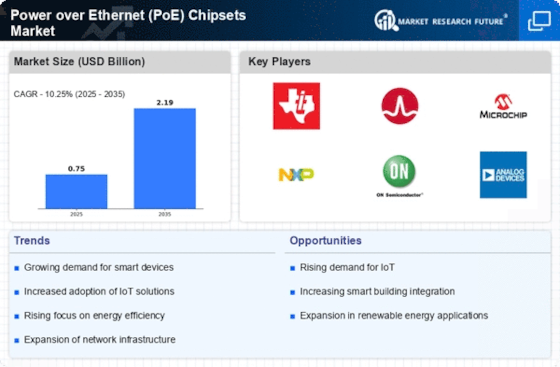
Power over Ethernet Chipsets Market Infographic
Purchase Options

Power Over Ethernet Chipsets Size

Power over Ethernet Chipsets Market Growth Projections and Opportunities

The Power over Ethernet (PoE) Chipsets market is profoundly influenced by a constellation of market factors that collectively mold its trajectory. Technological advancements stand out as a pivotal driver, steering the market towards innovation. As the demand for efficient power delivery solutions grows, PoE chipsets evolve to meet the needs of diverse applications. Manufacturers in this market are under constant pressure to enhance the capabilities of PoE chipsets, including higher power levels, improved energy efficiency, and compatibility with emerging technologies, to address the increasing demands of various industries.

Market demand plays a crucial role in shaping the PoE Chipsets market dynamics. The ubiquity of network-connected devices and the rise of the Internet of Things (IoT) have fueled a substantial demand for PoE-enabled solutions. From security cameras and wireless access points to smart lighting systems, the integration of PoE chipsets enables the simultaneous transmission of power and data over a single Ethernet cable, streamlining installations and reducing costs. The market's growth is closely tied to the expansion of PoE applications across different sectors, reflecting the need for efficient and scalable power solutions.

Cost considerations are significant factors influencing the PoE Chipsets market. As industries adopt PoE for its cost-saving benefits and simplified installations, manufacturers must balance the cost-effectiveness of their chipsets with the demand for advanced features. The cost of PoE chipsets directly impacts the overall affordability of PoE-enabled devices, influencing market adoption, especially in price-sensitive industries. Striking a balance between performance and cost is essential for manufacturers to remain competitive in this evolving market.

Global economic conditions contribute to the ebb and flow of the PoE Chipsets market. Economic stability and growth impact investments in infrastructure and technology. During economic downturns, some industries may postpone or scale back their adoption of PoE-enabled solutions, affecting the market demand. Conversely, economic prosperity tends to spur investments in smart buildings, IoT applications, and other PoE-dependent technologies, driving the demand for PoE chipsets.

Regulatory considerations also shape the PoE Chipsets market. Compliance with industry standards, safety regulations, and interoperability requirements is paramount for manufacturers. PoE chipsets must adhere to standards such as IEEE 802.3af and IEEE 802.3at to ensure compatibility with a broad range of PoE devices. Navigating regulatory frameworks is integral to the design and manufacturing process, influencing the development and market acceptance of PoE chipsets.

Competition among key players is a driving force in the PoE Chipsets market. Companies vie for market share by innovating and differentiating their chipsets. Strategic collaborations, acquisitions, and partnerships are common strategies as companies seek to enhance their product portfolios and gain a competitive edge. The competitive landscape influences product development cycles, pricing strategies, and overall market trends within the PoE Chipsets market.

Consumer preferences and industry trends also contribute to the dynamics of the PoE Chipsets market. The evolving needs of end-users, coupled with emerging technologies and applications, drive the demand for specific functionalities and features in PoE-enabled devices. Manufacturers must stay agile, anticipating and adapting to these trends to remain relevant in a dynamic market.

The fast growth of different industries worldwide is driving the global adoption of internet protocol (IP) telephony. This is a significant factor fueling the growth of the Power over Ethernet (PoE) Chipsets Market. The widespread use of network security cameras, combined with wireless access points and radio frequency identification readers connected through Ethernet, is boosting the market's demand. The development of energy-efficient PoE solutions for high-power devices is also a key factor contributing to market growth.
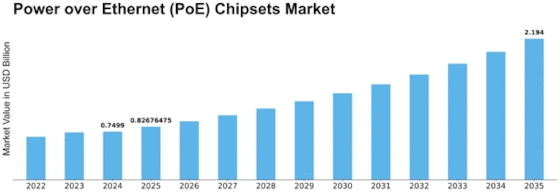

Power over Ethernet Chipsets Market Size Graph
Author
Shubham Munde
Team Lead - Research

Shubham brings over 7 years of expertise in Market Intelligence and Strategic Consulting, with a strong focus on the Automotive, Aerospace, and Defense sectors. Backed by a solid foundation in semiconductors, electronics, and software, he has successfully delivered high-impact syndicated and custom research on a global scale. His core strengths include market sizing, forecasting, competitive intelligence, consumer insights, and supply chain mapping. Widely recognized for developing scalable growth strategies, Shubham empowers clients to navigate complex markets and achieve a lasting competitive edge. Trusted by start-ups and Fortune 500 companies alike, he consistently converts challenges into strategic opportunities that drive sustainable growth.

Leave a Comment

FAQs

What is the projected market valuation for the Power over Ethernet (PoE) Chipsets Market in 2035?

<p>The projected market valuation for the Power over Ethernet (PoE) Chipsets Market in 2035 is 2.194 USD Billion.</p>

What was the market valuation for the Power over Ethernet (PoE) Chipsets Market in 2024?

<p>The overall market valuation for the Power over Ethernet (PoE) Chipsets Market was 0.7499 USD Billion in 2024.</p>

What is the expected CAGR for the Power over Ethernet (PoE) Chipsets Market during the forecast period 2025 - 2035?

<p>The expected CAGR for the Power over Ethernet (PoE) Chipsets Market during the forecast period 2025 - 2035 is 10.25%.</p>

Which companies are considered key players in the Power over Ethernet (PoE) Chipsets Market?

<p>Key players in the Power over Ethernet (PoE) Chipsets Market include Texas Instruments, Broadcom, Microchip Technology, and NXP Semiconductors.</p>

What are the main application segments for Power over Ethernet (PoE) Chipsets?

<p>The main application segments for Power over Ethernet (PoE) Chipsets include LED Lighting, Security, and Connectivity.</p>

What was the valuation of the LED Lighting segment in the Power over Ethernet (PoE) Chipsets Market in 2024?

<p>The valuation of the LED Lighting segment in the Power over Ethernet (PoE) Chipsets Market was 0.2999 USD Billion in 2024.</p>

How does the valuation of the 802.3bt Standard compare to other standards in the Power over Ethernet (PoE) Chipsets Market?

The valuation of the 802.3bt Standard ranges from 0.2999 to 0.834 USD Billion, indicating a competitive position among other standards.

What end-user segments are driving the Power over Ethernet (PoE) Chipsets Market?

The end-user segments driving the Power over Ethernet (PoE) Chipsets Market include Commercial, Residential, and Industrial sectors.

What is the projected valuation for the Commercial end-user segment by 2035?

The projected valuation for the Commercial end-user segment in the Power over Ethernet (PoE) Chipsets Market is expected to reach 0.8785 USD Billion by 2035.

Which devices are primarily supported by Power over Ethernet (PoE) Chipsets?

Devices primarily supported by Power over Ethernet (PoE) Chipsets include Network Cameras, VOIP Phones, and Ethernet Switch &amp; Injector.

Market Summary

As per Market Research Future analysis, the Power over Ethernet (PoE) Chipsets Market Size was estimated at 0.7499 USD Billion in 2024. The PoE industry is projected to grow from USD 0.8268 Billion in 2025 to USD 2.194 Billion by 2035, exhibiting a compound annual growth rate (CAGR) of 10.25% during the forecast period 2025 - 2035

Key Market Trends & Highlights

The Power over Ethernet (PoE) Chipsets Market is experiencing robust growth driven by technological advancements and increasing demand for smart solutions.

  • The market is witnessing a notable integration with smart technologies, enhancing connectivity and functionality. Energy efficiency remains a focal point, as manufacturers strive to meet regulatory standards and consumer expectations. North America leads the market, while Asia-Pacific emerges as the fastest-growing region, reflecting diverse adoption rates. The rising demand for IoT devices and the expansion of smart building initiatives are key drivers propelling market growth.

Market Size & Forecast

2024 Market Size 0.7499 (USD Billion)
2035 Market Size 2.194 (USD Billion)
CAGR (2025 - 2035) 10.25%
Largest Regional Market Share in 2024 North America

Major Players

Texas Instruments (US), Broadcom (US), Microchip Technology (US), NXP Semiconductors (NL), ON Semiconductor (US), Maxim Integrated (US), STMicroelectronics (CH), Analog Devices (US), Infineon Technologies (DE)

Market Trends

The Power over Ethernet (PoE) Chipsets Market is currently experiencing a notable transformation, driven by the increasing demand for efficient power delivery solutions in various applications. This market appears to be expanding as organizations seek to simplify their infrastructure while enhancing connectivity. The integration of PoE technology into devices such as IP cameras, wireless access points, and VoIP phones suggests a shift towards more streamlined operations. Furthermore, the growing emphasis on energy efficiency and sustainability may be influencing the adoption of PoE chipsets, as they provide a means to reduce energy consumption while maintaining performance. In addition, the rise of smart buildings and the Internet of Things (IoT) is likely to propel the Power over Ethernet (PoE) Chipsets Market forward. As more devices become interconnected, the need for reliable power sources that can be delivered alongside data becomes increasingly critical. This trend indicates a potential for innovation within the sector, as manufacturers strive to develop advanced chipsets that meet the evolving requirements of modern technology. Overall, the market appears poised for growth, with various factors converging to create a favorable environment for PoE solutions.

Integration with Smart Technologies

The Power over Ethernet (PoE) Chipsets Market is witnessing a trend towards integration with smart technologies. As smart devices proliferate, the demand for efficient power solutions that can support these innovations is increasing. This integration allows for seamless connectivity and power delivery, enhancing the functionality of smart systems.

Focus on Energy Efficiency

A growing emphasis on energy efficiency is shaping the Power over Ethernet (PoE) Chipsets Market. Organizations are increasingly prioritizing solutions that minimize energy consumption while maximizing performance. This trend reflects a broader commitment to sustainability and cost-effectiveness in technology deployment.

Expansion in Commercial Applications

The Power over Ethernet (PoE) Chipsets Market is expanding within commercial applications, particularly in sectors such as retail and healthcare. The need for reliable power sources in these environments is driving the adoption of PoE technology, as it simplifies installation and reduces infrastructure costs.

Power over Ethernet Chipsets Market Market Drivers

Rising Demand for IoT Devices

The increasing proliferation of Internet of Things (IoT) devices is a primary driver for the Power over Ethernet (PoE) Chipsets Market. As more devices require power and data connectivity, PoE technology offers a streamlined solution, eliminating the need for separate power supplies. According to recent estimates, the number of connected IoT devices is projected to reach 30 billion by 2030. This surge in IoT adoption necessitates efficient power delivery systems, thereby enhancing the demand for PoE chipsets. Furthermore, industries such as smart homes, healthcare, and industrial automation are increasingly integrating PoE technology to simplify installations and reduce costs. Consequently, the growth of IoT applications is likely to propel the PoE chipsets market, as manufacturers seek to meet the evolving needs of a connected world.

Increased Focus on Energy Efficiency

The heightened emphasis on energy efficiency is a crucial driver for the Power over Ethernet (PoE) Chipsets Market. As organizations strive to reduce energy consumption and operational costs, PoE technology presents an attractive solution by delivering power and data over a single cable. This not only simplifies installations but also minimizes energy waste. Recent studies suggest that PoE systems can reduce energy costs by up to 30% compared to traditional power delivery methods. Additionally, regulatory frameworks and sustainability initiatives are pushing businesses to adopt energy-efficient technologies. Consequently, the demand for PoE chipsets is likely to rise as companies seek to comply with energy regulations and enhance their sustainability profiles. This trend underscores the importance of energy efficiency in driving the growth of the PoE chipsets market.

Expansion of Smart Building Initiatives

The expansion of smart building initiatives is significantly impacting the Power over Ethernet (PoE) Chipsets Market. As urbanization continues to rise, there is an increasing focus on developing smart buildings that utilize advanced technologies for improved efficiency and sustainability. PoE technology plays a vital role in these initiatives by enabling the integration of various systems, such as lighting, security, and HVAC, through a single network infrastructure. Recent market analyses indicate that the smart building market is projected to reach USD 1 trillion by 2025, with PoE systems being a key component in achieving this growth. The ability to manage and control building systems through a centralized platform enhances operational efficiency and reduces costs, thereby driving the demand for PoE chipsets in smart building applications.

Advancements in Networking Infrastructure

The ongoing advancements in networking infrastructure are significantly influencing the Power over Ethernet (PoE) Chipsets Market. With the transition towards higher bandwidth requirements, particularly with the rollout of 5G technology, there is a growing need for robust networking solutions. PoE technology facilitates the deployment of high-speed data networks while simultaneously providing power to devices. Recent data indicates that the global market for networking equipment is expected to grow at a compound annual growth rate (CAGR) of 10% through 2027. This growth is likely to drive the demand for PoE chipsets, as businesses and organizations upgrade their infrastructure to support faster and more efficient connectivity. As a result, the integration of PoE technology into modern networking solutions is becoming increasingly prevalent, further bolstering the market.

Growth in Surveillance and Security Systems

The increasing focus on surveillance and security systems is a notable driver for the Power over Ethernet (PoE) Chipsets Market. As security concerns rise across various sectors, the demand for advanced surveillance solutions is escalating. PoE technology facilitates the installation of IP cameras and other security devices by providing both power and data connectivity through a single cable. This not only simplifies the installation process but also reduces costs associated with wiring. Recent reports suggest that The Power over Ethernet (PoE) Chipsets is expected to grow at a CAGR of 10% through 2026. This growth is likely to enhance the demand for PoE chipsets, as businesses and organizations seek to implement efficient and reliable security systems. The integration of PoE technology into surveillance solutions is thus becoming increasingly prevalent, further driving the market.

Market Segment Insights

By Standard: 802.3at Standard (Largest) vs. 802.3bt Standard (Fastest-Growing)

<p>In the Power over Ethernet (PoE) Chipsets Market, the 802.3at Standard currently holds the largest market share due to its widespread adoption in networking devices, offering a dependable solution for powering devices efficiently over existing Ethernet infrastructure. Conversely, the 802.3af Standard, while still notable, is diminishing in relative market presence; its older technology is being phased out in favor of more capable standards. The 802.3bt Standard is emerging strongly and attracting significant interest as it provides enhanced power delivery and supports a greater variety of devices and applications.</p>

<p>802.3at Standard (Dominant) vs. 802.3bt Standard (Emerging)</p>

<p>The 802.3at Standard, also known as PoE+, has established itself as the dominant player within the PoE chipset market by enabling devices to receive up to 30W of power, allowing for a wider range of applications, particularly in VoIP phones, surveillance cameras, and wireless access points. Meanwhile, the 802.3bt Standard is an emerging option, capable of delivering up to 60W or even 100W in some configurations. This emerging standard is gaining traction due to the increasing demands for higher power in smart Building technologies and IoT devices, thus positioning itself as a critical player in the evolving landscape of PoE solutions.</p>

By Application: LED Lighting (Largest) vs. Security (Fastest-Growing)

<p>In the Power over Ethernet (PoE) Chipsets Market, the 'Application' segment is prominently driven by LED lighting and security solutions, with LED lighting commanding the largest share among applications. This dominance stems from the widespread adoption of energy-efficient lighting solutions across residential and commercial infrastructures. In contrast, the security applications, including surveillance cameras and access control systems, are gaining significant traction, positioning them as the fastest-growing avenue within the market.</p>

<p>LED Lighting (Dominant) vs. Security (Emerging)</p>

<p>LED lighting solutions represent the dominant application in the Power over Ethernet (PoE) Chipsets Market, mainly due to their efficiency and ability to simplify installation by eliminating the need for separate power sources. Their compatibility with smart building technologies enhances their appeal, as they integrate seamlessly with PoE systems. On the other hand, security solutions, while currently ranked as an emerging market segment, are witnessing rapid expansion driven by increasing concerns over safety and security. The incorporation of IP-based cameras and advanced analytics into security systems promotes increased demand for PoE chipsets, making this sector a focal point for future growth.</p>

By End-User: Commercial (Largest) vs. Residential (Fastest-Growing)

<p>The Power over Ethernet (PoE) chipsets market delineates a significant distribution of market share across different end-user segments. Among these, the Commercial sector dominates, catering to businesses seeking efficient network integration. This preference underscores a growing trend in the adoption of smart technology in commercial spaces. In contrast, the Residential sector is experiencing the fastest growth, driven by the increasing demand for smart home devices and IoT applications that leverage PoE technology.</p>

<p>Commercial (Dominant) vs. Residential (Emerging)</p>

<p>The Commercial end-user segment holds a dominant position in the Power over Ethernet (PoE) chipsets market, characterized by extensive deployment in office buildings and retail environments. This sector’s preference for PoE technology stems from its ability to simplify wiring and enhance the management of connected devices, thereby optimizing operational efficiency. In parallel, the Residential segment emerges as a key player, driven by a surge in home automation and connectivity solutions. The rapid expansion of smart home technologies, including lighting, security, and entertainment systems, is propelling this segment’s growth. Residential users are increasingly drawn to the convenience and cost-effectiveness of PoE solutions, marking a significant shift in consumer behavior toward integrated home networks.</p>

By Device: Network Cameras (Largest) vs. VOIP Phones (Fastest-Growing)

<p>In the Power over Ethernet (PoE) Chipsets Market, the distribution of market share among segment values reveals a significant dominance of network cameras, which have established themselves as the largest category. VOIP phones, however, are quickly catching up due to their growing demand in unified communication solutions. Ethernet switches and injectors also hold a commendable share but do not match the expansive influence of network cameras and the speedy rise of VOIP phones in this sector.</p>

<p>Network Cameras (Dominant) vs. VOIP Phones (Emerging)</p>

<p>Network cameras represent the dominant player in the PoE chipsets market, leveraging their essential role in security and surveillance systems across various sectors. Their widespread adoption is driven by a surge in demand for robust security solutions. VOIP phones, on the other hand, are emerging rapidly due to the shift towards hybrid work environments, which necessitate reliable communication tools. While network cameras are well-entrenched, VOIP phones are gaining traction through advancements in technology, such as improved audio quality and seamless integration with cloud services, positioning them as critical components in modern communication systems.</p>

Get more detailed insights about Power over Ethernet (PoE) Chipsets Market Research Report - Forecast 2035

Regional Insights

North America : Technology Leadership and Innovation

North America is the largest market for Power over Ethernet (PoE) chipsets, holding approximately 45% of the global market share. The region's growth is driven by the increasing adoption of IoT devices, smart buildings, and the need for efficient power management solutions. Regulatory support for energy-efficient technologies further catalyzes market expansion, with initiatives promoting sustainable energy practices. The United States leads the North American market, with significant contributions from Canada. Key players such as Texas Instruments, Broadcom, and Microchip Technology are headquartered in this region, fostering a competitive landscape. The presence of advanced manufacturing facilities and R&D centers enhances innovation, ensuring that North America remains at the forefront of PoE technology development.

Europe : Emerging Market with Regulations

Europe is the second-largest market for Power over Ethernet (PoE) chipsets, accounting for around 30% of the global market share. The region's growth is propelled by stringent energy efficiency regulations and a rising demand for smart infrastructure. The European Union's Green Deal and various national initiatives are pivotal in promoting the adoption of PoE technologies, enhancing energy efficiency in commercial and residential sectors. Leading countries in Europe include Germany, France, and the Netherlands, where significant investments in smart city projects are underway. The competitive landscape features key players like NXP Semiconductors and Infineon Technologies, which are actively involved in developing innovative PoE solutions. The collaboration between industry and government entities further strengthens the market, ensuring compliance with evolving regulations.

Asia-Pacific : Rapid Growth and Adoption

Asia-Pacific is witnessing rapid growth in the Power over Ethernet (PoE) chipsets market, holding approximately 20% of the global market share. The region's expansion is driven by increasing urbanization, the proliferation of smart devices, and government initiatives aimed at enhancing digital infrastructure. Countries like China and India are at the forefront, with significant investments in smart city projects and IoT applications, further boosting demand for PoE technologies. China is the largest market in the region, followed by India and Japan. The competitive landscape is characterized by a mix of local and international players, including ON Semiconductor and STMicroelectronics. The presence of a robust manufacturing base and a growing emphasis on research and development contribute to the region's dynamic market environment, positioning Asia-Pacific as a key player in The Power over Ethernet (PoE) Chipsets.

Middle East and Africa : Untapped Potential and Growth

The Middle East and Africa (MEA) region is an emerging market for Power over Ethernet (PoE) chipsets, currently holding about 5% of the global market share. The growth in this region is driven by increasing investments in telecommunications and smart city initiatives. Governments are focusing on enhancing digital infrastructure, which is expected to catalyze the adoption of PoE technologies in various sectors, including healthcare and education. Leading countries in the MEA region include the United Arab Emirates and South Africa, where there is a growing demand for energy-efficient solutions. The competitive landscape is evolving, with both local and international players entering the market. Companies are increasingly collaborating with government entities to align with national development goals, paving the way for future growth in the PoE chipset market.

Key Players and Competitive Insights

Leading market players are investing heavily in research and development to expand their product lines, which will help the Power over Ethernet (PoE) Chipsets market, grow even more. Market participants are also undertaking various strategic activities to expand their global footprint, with important market developments including new product launches, contractual agreements, mergers and acquisitions, higher investments, and collaboration with other organizations. Power over Ethernet (PoE) Chipsets industry must offer cost-effective items to expand and survive in a more competitive and rising market climate.Manufacturing locally to minimize operational costs is one of the key business tactics manufacturer’s use in the global Power over Ethernet (PoE) Chipsets industry to benefit clients and increase the market sector. The Power over Ethernet (PoE) Chipsets industry has offered some of the most significant advantages in recent years. Major players in the Power over Ethernet (PoE) Chipsets market, including Intel Corporation (U.S.), Huawei Technologies Co. Ltd. (China), Ericsson (Sweden), Nokia Corporation (Finland), Quectel Wireless Solutions Co.Ltd. (China), Sierra Wireless (Canada), Deutsche Telekom AG (Germany), China United Network Communications Group Co., Ltd. (China), Qualcomm Technologies Inc., (U.S.), Vodafone Group plc (U.K)., and others, are attempting to increase market demand by investing in research and development operations.ROCKPI Trading Company is an electronic components distributor. It supplies various electronic components, including chip antennas, power over Ethernet (PoE) chipsets, and NB-IoT chipsets. ROCKPI Trading Company is headquartered in Hong Kong and has offices in China, the United States, and Europe. ROCKPI Trading Limited revealed its samples in the market for their ROCK5 Model B single-board computer. The company accepts pre-orders at discounted prices starting at USD 79 through distributors.The device specifications include octa-core Cortex-A76 and A55 Pico-ITX SBC with 16GB RAM, M.2 NVMe storage, optional WiFi 6E, and 8K video output via HDMI or USB-C ports, 2.5GbE, 4K HDMI input, and. 2.5 Gbps Ethernet RJ45 port with PoE support.Linksys Holdings, Inc., is an American brand of data networking hardware products mainly sold to home users and small businesses. It was founded in 1988 by the couple Victor and Janie Tsao, Taiwanese immigrants to the United States. Linksys, a WiFi solutions provider, has revealed the new Device WiFi 6 Cloud Managed Access Point launch. This Device has 4x4 internal antennas. It is proven to provide fast, reliable and secure WiFi built-in retail stores, medical sectors, small enterprises, and commercial spaces for supporting concurrent client connections.

Key Companies in the Power over Ethernet Chipsets Market include

Industry Developments

July 2023: saw Microchip Technology announce a $300 million investment in India to enable the company to take advantage of the rapidly growing semiconductor industry. The investments will focus on improving facilities, expanding engineering labs, hiring talent, and supporting technical consortia and academic institutions.

January 2023: At the Consumer Electronics Show (CES) held in January 2023, Kinetic Technologies launched the industry's smallest <13W Power over Ethernet (PoE)" compliant products based on higher powered IEEE802.3bt standards.

November 2022: Analog Devices introduced Single-pair Power over Ethernet (SPoE) solutions to enable greater levels of intelligence in smart buildings and factory automation at the edge of traditional networks.

January 2022: Linksys, a WiFi solutions provider, has revealed the new Device WiFi 6 Cloud Managed Access Point launch. This Device has 4x4 internal antennas. It is proven to provide fast, reliable and secure WiFi built-in retail stores, medical sectors, small enterprises, and commercial spaces for supporting concurrent client connections.

January 2022: ROCKPI Trading Limited revealed its samples in the market for their ROCK5 Model B single-board computer. The company accepts pre-orders at discounted prices starting at USD 79 through distributors. The device specifications include octa-core Cortex-A76 and A55 Pico-ITX SBC with 16GB RAM, M.2 NVMe storage, optional WiFi 6E, and 8K video output via HDMI or USB-C ports, 2.5GbE, 4K HDMI input, and. 2.5 Gbps Ethernet RJ45 port with PoE support.

Future Outlook

Power over Ethernet Chipsets Market Future Outlook

The Power over Ethernet (PoE) Chipsets Market is projected to grow at a 10.25% CAGR from 2025 to 2035, driven by increasing demand for smart devices and IoT applications.

New opportunities lie in:

  • Development of PoE-enabled smart lighting solutions for commercial spaces.</p><p>Integration of PoE technology in security systems for enhanced surveillance.</p><p>Expansion into renewable energy sectors with PoE for efficient power distribution.

By 2035, the PoE chipsets market is expected to be robust, reflecting substantial growth and innovation.

Market Segmentation

Power over Ethernet Chipsets Market Device Outlook

  • Network Cameras
  • VOIP Phones
  • Ethernet Switch & Injector

Power over Ethernet Chipsets Market End-User Outlook

  • Commercial
  • Residential
  • Industrial

Power over Ethernet Chipsets Market Standard Outlook

  • 802.3af Standard
  • 802.3at Standard
  • 802.3bt Standard

Power over Ethernet Chipsets Market Application Outlook

  • LED Lighting
  • Security
  • Connectivity

Report Scope

MARKET SIZE 2024 0.7499(USD Billion)
MARKET SIZE 2025 0.8268(USD Billion)
MARKET SIZE 2035 2.194(USD Billion)
COMPOUND ANNUAL GROWTH RATE (CAGR) 10.25% (2025 - 2035)
REPORT COVERAGE Revenue Forecast, Competitive Landscape, Growth Factors, and Trends
BASE YEAR 2024
Market Forecast Period 2025 - 2035
Historical Data 2019 - 2024
Market Forecast Units USD Billion
Key Companies Profiled Texas Instruments (US), Broadcom (US), Microchip Technology (US), NXP Semiconductors (NL), ON Semiconductor (US), Maxim Integrated (US), STMicroelectronics (CH), Analog Devices (US), Infineon Technologies (DE)
Segments Covered Standard, Application, End-User, Device, Region
Key Market Opportunities Integration of advanced security features in Power over Ethernet (PoE) Chipsets Market enhances device connectivity and safety.
Key Market Dynamics Rising demand for smart devices drives innovation and competition in the Power over Ethernet chipsets market.
Countries Covered North America, Europe, APAC, South America, MEA

FAQs

What is the projected market valuation for the Power over Ethernet (PoE) Chipsets Market in 2035?

<p>The projected market valuation for the Power over Ethernet (PoE) Chipsets Market in 2035 is 2.194 USD Billion.</p>

What was the market valuation for the Power over Ethernet (PoE) Chipsets Market in 2024?

<p>The overall market valuation for the Power over Ethernet (PoE) Chipsets Market was 0.7499 USD Billion in 2024.</p>

What is the expected CAGR for the Power over Ethernet (PoE) Chipsets Market during the forecast period 2025 - 2035?

<p>The expected CAGR for the Power over Ethernet (PoE) Chipsets Market during the forecast period 2025 - 2035 is 10.25%.</p>

Which companies are considered key players in the Power over Ethernet (PoE) Chipsets Market?

<p>Key players in the Power over Ethernet (PoE) Chipsets Market include Texas Instruments, Broadcom, Microchip Technology, and NXP Semiconductors.</p>

What are the main application segments for Power over Ethernet (PoE) Chipsets?

<p>The main application segments for Power over Ethernet (PoE) Chipsets include LED Lighting, Security, and Connectivity.</p>

What was the valuation of the LED Lighting segment in the Power over Ethernet (PoE) Chipsets Market in 2024?

<p>The valuation of the LED Lighting segment in the Power over Ethernet (PoE) Chipsets Market was 0.2999 USD Billion in 2024.</p>

How does the valuation of the 802.3bt Standard compare to other standards in the Power over Ethernet (PoE) Chipsets Market?

The valuation of the 802.3bt Standard ranges from 0.2999 to 0.834 USD Billion, indicating a competitive position among other standards.

What end-user segments are driving the Power over Ethernet (PoE) Chipsets Market?

The end-user segments driving the Power over Ethernet (PoE) Chipsets Market include Commercial, Residential, and Industrial sectors.

What is the projected valuation for the Commercial end-user segment by 2035?

The projected valuation for the Commercial end-user segment in the Power over Ethernet (PoE) Chipsets Market is expected to reach 0.8785 USD Billion by 2035.

Which devices are primarily supported by Power over Ethernet (PoE) Chipsets?

Devices primarily supported by Power over Ethernet (PoE) Chipsets include Network Cameras, VOIP Phones, and Ethernet Switch &amp; Injector.

  1. SECTION I: EXECUTIVE SUMMARY AND KEY HIGHLIGHTS
    1. | 1.1 EXECUTIVE SUMMARY
    2. | | 1.1.1 Market Overview
    3. | | 1.1.2 Key Findings
    4. | | 1.1.3 Market Segmentation
    5. | | 1.1.4 Competitive Landscape
    6. | | 1.1.5 Challenges and Opportunities
    7. | | 1.1.6 Future Outlook
  2. SECTION II: SCOPING, METHODOLOGY AND MARKET STRUCTURE
    1. | 2.1 MARKET INTRODUCTION
    2. | | 2.1.1 Definition
    3. | | 2.1.2 Scope of the study
    4. | | | 2.1.2.1 Research Objective
    5. | | | 2.1.2.2 Assumption
    6. | | | 2.1.2.3 Limitations
    7. | 2.2 RESEARCH METHODOLOGY
    8. | | 2.2.1 Overview
    9. | | 2.2.2 Data Mining
    10. | | 2.2.3 Secondary Research
    11. | | 2.2.4 Primary Research
    12. | | | 2.2.4.1 Primary Interviews and Information Gathering Process
    13. | | | 2.2.4.2 Breakdown of Primary Respondents
    14. | | 2.2.5 Forecasting Model
    15. | | 2.2.6 Market Size Estimation
    16. | | | 2.2.6.1 Bottom-Up Approach
    17. | | | 2.2.6.2 Top-Down Approach
    18. | | 2.2.7 Data Triangulation
    19. | | 2.2.8 Validation
  3. SECTION III: QUALITATIVE ANALYSIS
    1. | 3.1 MARKET DYNAMICS
    2. | | 3.1.1 Overview
    3. | | 3.1.2 Drivers
    4. | | 3.1.3 Restraints
    5. | | 3.1.4 Opportunities
    6. | 3.2 MARKET FACTOR ANALYSIS
    7. | | 3.2.1 Value chain Analysis
    8. | | 3.2.2 Porter's Five Forces Analysis
    9. | | | 3.2.2.1 Bargaining Power of Suppliers
    10. | | | 3.2.2.2 Bargaining Power of Buyers
    11. | | | 3.2.2.3 Threat of New Entrants
    12. | | | 3.2.2.4 Threat of Substitutes
    13. | | | 3.2.2.5 Intensity of Rivalry
    14. | | 3.2.3 COVID-19 Impact Analysis
    15. | | | 3.2.3.1 Market Impact Analysis
    16. | | | 3.2.3.2 Regional Impact
    17. | | | 3.2.3.3 Opportunity and Threat Analysis
  4. SECTION IV: QUANTITATIVE ANALYSIS
    1. | 4.1 Semiconductor & Electronics, BY Standard (USD Billion)
    2. | | 4.1.1 802.3af Standard
    3. | | 4.1.2 802.3at Standard
    4. | | 4.1.3 802.3bt Standard
    5. | 4.2 Semiconductor & Electronics, BY Application (USD Billion)
    6. | | 4.2.1 LED Lighting
    7. | | 4.2.2 Security
    8. | | 4.2.3 Connectivity
    9. | 4.3 Semiconductor & Electronics, BY End-User (USD Billion)
    10. | | 4.3.1 Commercial
    11. | | 4.3.2 Residential
    12. | | 4.3.3 Industrial
    13. | 4.4 Semiconductor & Electronics, BY Device (USD Billion)
    14. | | 4.4.1 Network Cameras
    15. | | 4.4.2 VOIP Phones
    16. | | 4.4.3 Ethernet Switch & Injector
    17. | 4.5 Semiconductor & Electronics, BY Region (USD Billion)
    18. | | 4.5.1 North America
    19. | | | 4.5.1.1 US
    20. | | | 4.5.1.2 Canada
    21. | | 4.5.2 Europe
    22. | | | 4.5.2.1 Germany
    23. | | | 4.5.2.2 UK
    24. | | | 4.5.2.3 France
    25. | | | 4.5.2.4 Russia
    26. | | | 4.5.2.5 Italy
    27. | | | 4.5.2.6 Spain
    28. | | | 4.5.2.7 Rest of Europe
    29. | | 4.5.3 APAC
    30. | | | 4.5.3.1 China
    31. | | | 4.5.3.2 India
    32. | | | 4.5.3.3 Japan
    33. | | | 4.5.3.4 South Korea
    34. | | | 4.5.3.5 Malaysia
    35. | | | 4.5.3.6 Thailand
    36. | | | 4.5.3.7 Indonesia
    37. | | | 4.5.3.8 Rest of APAC
    38. | | 4.5.4 South America
    39. | | | 4.5.4.1 Brazil
    40. | | | 4.5.4.2 Mexico
    41. | | | 4.5.4.3 Argentina
    42. | | | 4.5.4.4 Rest of South America
    43. | | 4.5.5 MEA
    44. | | | 4.5.5.1 GCC Countries
    45. | | | 4.5.5.2 South Africa
    46. | | | 4.5.5.3 Rest of MEA
  5. SECTION V: COMPETITIVE ANALYSIS
    1. | 5.1 Competitive Landscape
    2. | | 5.1.1 Overview
    3. | | 5.1.2 Competitive Analysis
    4. | | 5.1.3 Market share Analysis
    5. | | 5.1.4 Major Growth Strategy in the Semiconductor & Electronics
    6. | | 5.1.5 Competitive Benchmarking
    7. | | 5.1.6 Leading Players in Terms of Number of Developments in the Semiconductor & Electronics
    8. | | 5.1.7 Key developments and growth strategies
    9. | | | 5.1.7.1 New Product Launch/Service Deployment
    10. | | | 5.1.7.2 Merger & Acquisitions
    11. | | | 5.1.7.3 Joint Ventures
    12. | | 5.1.8 Major Players Financial Matrix
    13. | | | 5.1.8.1 Sales and Operating Income
    14. | | | 5.1.8.2 Major Players R&D Expenditure. 2023
    15. | 5.2 Company Profiles
    16. | | 5.2.1 Texas Instruments (US)
    17. | | | 5.2.1.1 Financial Overview
    18. | | | 5.2.1.2 Products Offered
    19. | | | 5.2.1.3 Key Developments
    20. | | | 5.2.1.4 SWOT Analysis
    21. | | | 5.2.1.5 Key Strategies
    22. | | 5.2.2 Broadcom (US)
    23. | | | 5.2.2.1 Financial Overview
    24. | | | 5.2.2.2 Products Offered
    25. | | | 5.2.2.3 Key Developments
    26. | | | 5.2.2.4 SWOT Analysis
    27. | | | 5.2.2.5 Key Strategies
    28. | | 5.2.3 Microchip Technology (US)
    29. | | | 5.2.3.1 Financial Overview
    30. | | | 5.2.3.2 Products Offered
    31. | | | 5.2.3.3 Key Developments
    32. | | | 5.2.3.4 SWOT Analysis
    33. | | | 5.2.3.5 Key Strategies
    34. | | 5.2.4 NXP Semiconductors (NL)
    35. | | | 5.2.4.1 Financial Overview
    36. | | | 5.2.4.2 Products Offered
    37. | | | 5.2.4.3 Key Developments
    38. | | | 5.2.4.4 SWOT Analysis
    39. | | | 5.2.4.5 Key Strategies
    40. | | 5.2.5 ON Semiconductor (US)
    41. | | | 5.2.5.1 Financial Overview
    42. | | | 5.2.5.2 Products Offered
    43. | | | 5.2.5.3 Key Developments
    44. | | | 5.2.5.4 SWOT Analysis
    45. | | | 5.2.5.5 Key Strategies
    46. | | 5.2.6 Maxim Integrated (US)
    47. | | | 5.2.6.1 Financial Overview
    48. | | | 5.2.6.2 Products Offered
    49. | | | 5.2.6.3 Key Developments
    50. | | | 5.2.6.4 SWOT Analysis
    51. | | | 5.2.6.5 Key Strategies
    52. | | 5.2.7 STMicroelectronics (CH)
    53. | | | 5.2.7.1 Financial Overview
    54. | | | 5.2.7.2 Products Offered
    55. | | | 5.2.7.3 Key Developments
    56. | | | 5.2.7.4 SWOT Analysis
    57. | | | 5.2.7.5 Key Strategies
    58. | | 5.2.8 Analog Devices (US)
    59. | | | 5.2.8.1 Financial Overview
    60. | | | 5.2.8.2 Products Offered
    61. | | | 5.2.8.3 Key Developments
    62. | | | 5.2.8.4 SWOT Analysis
    63. | | | 5.2.8.5 Key Strategies
    64. | | 5.2.9 Infineon Technologies (DE)
    65. | | | 5.2.9.1 Financial Overview
    66. | | | 5.2.9.2 Products Offered
    67. | | | 5.2.9.3 Key Developments
    68. | | | 5.2.9.4 SWOT Analysis
    69. | | | 5.2.9.5 Key Strategies
    70. | 5.3 Appendix
    71. | | 5.3.1 References
    72. | | 5.3.2 Related Reports
  6. LIST OF FIGURES
    1. | 6.1 MARKET SYNOPSIS
    2. | 6.2 NORTH AMERICA MARKET ANALYSIS
    3. | 6.3 US MARKET ANALYSIS BY STANDARD
    4. | 6.4 US MARKET ANALYSIS BY APPLICATION
    5. | 6.5 US MARKET ANALYSIS BY END-USER
    6. | 6.6 US MARKET ANALYSIS BY DEVICE
    7. | 6.7 CANADA MARKET ANALYSIS BY STANDARD
    8. | 6.8 CANADA MARKET ANALYSIS BY APPLICATION
    9. | 6.9 CANADA MARKET ANALYSIS BY END-USER
    10. | 6.10 CANADA MARKET ANALYSIS BY DEVICE
    11. | 6.11 EUROPE MARKET ANALYSIS
    12. | 6.12 GERMANY MARKET ANALYSIS BY STANDARD
    13. | 6.13 GERMANY MARKET ANALYSIS BY APPLICATION
    14. | 6.14 GERMANY MARKET ANALYSIS BY END-USER
    15. | 6.15 GERMANY MARKET ANALYSIS BY DEVICE
    16. | 6.16 UK MARKET ANALYSIS BY STANDARD
    17. | 6.17 UK MARKET ANALYSIS BY APPLICATION
    18. | 6.18 UK MARKET ANALYSIS BY END-USER
    19. | 6.19 UK MARKET ANALYSIS BY DEVICE
    20. | 6.20 FRANCE MARKET ANALYSIS BY STANDARD
    21. | 6.21 FRANCE MARKET ANALYSIS BY APPLICATION
    22. | 6.22 FRANCE MARKET ANALYSIS BY END-USER
    23. | 6.23 FRANCE MARKET ANALYSIS BY DEVICE
    24. | 6.24 RUSSIA MARKET ANALYSIS BY STANDARD
    25. | 6.25 RUSSIA MARKET ANALYSIS BY APPLICATION
    26. | 6.26 RUSSIA MARKET ANALYSIS BY END-USER
    27. | 6.27 RUSSIA MARKET ANALYSIS BY DEVICE
    28. | 6.28 ITALY MARKET ANALYSIS BY STANDARD
    29. | 6.29 ITALY MARKET ANALYSIS BY APPLICATION
    30. | 6.30 ITALY MARKET ANALYSIS BY END-USER
    31. | 6.31 ITALY MARKET ANALYSIS BY DEVICE
    32. | 6.32 SPAIN MARKET ANALYSIS BY STANDARD
    33. | 6.33 SPAIN MARKET ANALYSIS BY APPLICATION
    34. | 6.34 SPAIN MARKET ANALYSIS BY END-USER
    35. | 6.35 SPAIN MARKET ANALYSIS BY DEVICE
    36. | 6.36 REST OF EUROPE MARKET ANALYSIS BY STANDARD
    37. | 6.37 REST OF EUROPE MARKET ANALYSIS BY APPLICATION
    38. | 6.38 REST OF EUROPE MARKET ANALYSIS BY END-USER
    39. | 6.39 REST OF EUROPE MARKET ANALYSIS BY DEVICE
    40. | 6.40 APAC MARKET ANALYSIS
    41. | 6.41 CHINA MARKET ANALYSIS BY STANDARD
    42. | 6.42 CHINA MARKET ANALYSIS BY APPLICATION
    43. | 6.43 CHINA MARKET ANALYSIS BY END-USER
    44. | 6.44 CHINA MARKET ANALYSIS BY DEVICE
    45. | 6.45 INDIA MARKET ANALYSIS BY STANDARD
    46. | 6.46 INDIA MARKET ANALYSIS BY APPLICATION
    47. | 6.47 INDIA MARKET ANALYSIS BY END-USER
    48. | 6.48 INDIA MARKET ANALYSIS BY DEVICE
    49. | 6.49 JAPAN MARKET ANALYSIS BY STANDARD
    50. | 6.50 JAPAN MARKET ANALYSIS BY APPLICATION
    51. | 6.51 JAPAN MARKET ANALYSIS BY END-USER
    52. | 6.52 JAPAN MARKET ANALYSIS BY DEVICE
    53. | 6.53 SOUTH KOREA MARKET ANALYSIS BY STANDARD
    54. | 6.54 SOUTH KOREA MARKET ANALYSIS BY APPLICATION
    55. | 6.55 SOUTH KOREA MARKET ANALYSIS BY END-USER
    56. | 6.56 SOUTH KOREA MARKET ANALYSIS BY DEVICE
    57. | 6.57 MALAYSIA MARKET ANALYSIS BY STANDARD
    58. | 6.58 MALAYSIA MARKET ANALYSIS BY APPLICATION
    59. | 6.59 MALAYSIA MARKET ANALYSIS BY END-USER
    60. | 6.60 MALAYSIA MARKET ANALYSIS BY DEVICE
    61. | 6.61 THAILAND MARKET ANALYSIS BY STANDARD
    62. | 6.62 THAILAND MARKET ANALYSIS BY APPLICATION
    63. | 6.63 THAILAND MARKET ANALYSIS BY END-USER
    64. | 6.64 THAILAND MARKET ANALYSIS BY DEVICE
    65. | 6.65 INDONESIA MARKET ANALYSIS BY STANDARD
    66. | 6.66 INDONESIA MARKET ANALYSIS BY APPLICATION
    67. | 6.67 INDONESIA MARKET ANALYSIS BY END-USER
    68. | 6.68 INDONESIA MARKET ANALYSIS BY DEVICE
    69. | 6.69 REST OF APAC MARKET ANALYSIS BY STANDARD
    70. | 6.70 REST OF APAC MARKET ANALYSIS BY APPLICATION
    71. | 6.71 REST OF APAC MARKET ANALYSIS BY END-USER
    72. | 6.72 REST OF APAC MARKET ANALYSIS BY DEVICE
    73. | 6.73 SOUTH AMERICA MARKET ANALYSIS
    74. | 6.74 BRAZIL MARKET ANALYSIS BY STANDARD
    75. | 6.75 BRAZIL MARKET ANALYSIS BY APPLICATION
    76. | 6.76 BRAZIL MARKET ANALYSIS BY END-USER
    77. | 6.77 BRAZIL MARKET ANALYSIS BY DEVICE
    78. | 6.78 MEXICO MARKET ANALYSIS BY STANDARD
    79. | 6.79 MEXICO MARKET ANALYSIS BY APPLICATION
    80. | 6.80 MEXICO MARKET ANALYSIS BY END-USER
    81. | 6.81 MEXICO MARKET ANALYSIS BY DEVICE
    82. | 6.82 ARGENTINA MARKET ANALYSIS BY STANDARD
    83. | 6.83 ARGENTINA MARKET ANALYSIS BY APPLICATION
    84. | 6.84 ARGENTINA MARKET ANALYSIS BY END-USER
    85. | 6.85 ARGENTINA MARKET ANALYSIS BY DEVICE
    86. | 6.86 REST OF SOUTH AMERICA MARKET ANALYSIS BY STANDARD
    87. | 6.87 REST OF SOUTH AMERICA MARKET ANALYSIS BY APPLICATION
    88. | 6.88 REST OF SOUTH AMERICA MARKET ANALYSIS BY END-USER
    89. | 6.89 REST OF SOUTH AMERICA MARKET ANALYSIS BY DEVICE
    90. | 6.90 MEA MARKET ANALYSIS
    91. | 6.91 GCC COUNTRIES MARKET ANALYSIS BY STANDARD
    92. | 6.92 GCC COUNTRIES MARKET ANALYSIS BY APPLICATION
    93. | 6.93 GCC COUNTRIES MARKET ANALYSIS BY END-USER
    94. | 6.94 GCC COUNTRIES MARKET ANALYSIS BY DEVICE
    95. | 6.95 SOUTH AFRICA MARKET ANALYSIS BY STANDARD
    96. | 6.96 SOUTH AFRICA MARKET ANALYSIS BY APPLICATION
    97. | 6.97 SOUTH AFRICA MARKET ANALYSIS BY END-USER
    98. | 6.98 SOUTH AFRICA MARKET ANALYSIS BY DEVICE
    99. | 6.99 REST OF MEA MARKET ANALYSIS BY STANDARD
    100. | 6.100 REST OF MEA MARKET ANALYSIS BY APPLICATION
    101. | 6.101 REST OF MEA MARKET ANALYSIS BY END-USER
    102. | 6.102 REST OF MEA MARKET ANALYSIS BY DEVICE
    103. | 6.103 KEY BUYING CRITERIA OF SEMICONDUCTOR & ELECTRONICS
    104. | 6.104 RESEARCH PROCESS OF MRFR
    105. | 6.105 DRO ANALYSIS OF SEMICONDUCTOR & ELECTRONICS
    106. | 6.106 DRIVERS IMPACT ANALYSIS: SEMICONDUCTOR & ELECTRONICS
    107. | 6.107 RESTRAINTS IMPACT ANALYSIS: SEMICONDUCTOR & ELECTRONICS
    108. | 6.108 SUPPLY / VALUE CHAIN: SEMICONDUCTOR & ELECTRONICS
    109. | 6.109 SEMICONDUCTOR & ELECTRONICS, BY STANDARD, 2024 (% SHARE)
    110. | 6.110 SEMICONDUCTOR & ELECTRONICS, BY STANDARD, 2024 TO 2035 (USD Billion)
    111. | 6.111 SEMICONDUCTOR & ELECTRONICS, BY APPLICATION, 2024 (% SHARE)
    112. | 6.112 SEMICONDUCTOR & ELECTRONICS, BY APPLICATION, 2024 TO 2035 (USD Billion)
    113. | 6.113 SEMICONDUCTOR & ELECTRONICS, BY END-USER, 2024 (% SHARE)
    114. | 6.114 SEMICONDUCTOR & ELECTRONICS, BY END-USER, 2024 TO 2035 (USD Billion)
    115. | 6.115 SEMICONDUCTOR & ELECTRONICS, BY DEVICE, 2024 (% SHARE)
    116. | 6.116 SEMICONDUCTOR & ELECTRONICS, BY DEVICE, 2024 TO 2035 (USD Billion)
    117. | 6.117 BENCHMARKING OF MAJOR COMPETITORS
  7. LIST OF TABLES
    1. | 7.1 LIST OF ASSUMPTIONS
    2. | | 7.1.1
    3. | 7.2 North America MARKET SIZE ESTIMATES; FORECAST
    4. | | 7.2.1 BY STANDARD, 2025-2035 (USD Billion)
    5. | | 7.2.2 BY APPLICATION, 2025-2035 (USD Billion)
    6. | | 7.2.3 BY END-USER, 2025-2035 (USD Billion)
    7. | | 7.2.4 BY DEVICE, 2025-2035 (USD Billion)
    8. | 7.3 US MARKET SIZE ESTIMATES; FORECAST
    9. | | 7.3.1 BY STANDARD, 2025-2035 (USD Billion)
    10. | | 7.3.2 BY APPLICATION, 2025-2035 (USD Billion)
    11. | | 7.3.3 BY END-USER, 2025-2035 (USD Billion)
    12. | | 7.3.4 BY DEVICE, 2025-2035 (USD Billion)
    13. | 7.4 Canada MARKET SIZE ESTIMATES; FORECAST
    14. | | 7.4.1 BY STANDARD, 2025-2035 (USD Billion)
    15. | | 7.4.2 BY APPLICATION, 2025-2035 (USD Billion)
    16. | | 7.4.3 BY END-USER, 2025-2035 (USD Billion)
    17. | | 7.4.4 BY DEVICE, 2025-2035 (USD Billion)
    18. | 7.5 Europe MARKET SIZE ESTIMATES; FORECAST
    19. | | 7.5.1 BY STANDARD, 2025-2035 (USD Billion)
    20. | | 7.5.2 BY APPLICATION, 2025-2035 (USD Billion)
    21. | | 7.5.3 BY END-USER, 2025-2035 (USD Billion)
    22. | | 7.5.4 BY DEVICE, 2025-2035 (USD Billion)
    23. | 7.6 Germany MARKET SIZE ESTIMATES; FORECAST
    24. | | 7.6.1 BY STANDARD, 2025-2035 (USD Billion)
    25. | | 7.6.2 BY APPLICATION, 2025-2035 (USD Billion)
    26. | | 7.6.3 BY END-USER, 2025-2035 (USD Billion)
    27. | | 7.6.4 BY DEVICE, 2025-2035 (USD Billion)
    28. | 7.7 UK MARKET SIZE ESTIMATES; FORECAST
    29. | | 7.7.1 BY STANDARD, 2025-2035 (USD Billion)
    30. | | 7.7.2 BY APPLICATION, 2025-2035 (USD Billion)
    31. | | 7.7.3 BY END-USER, 2025-2035 (USD Billion)
    32. | | 7.7.4 BY DEVICE, 2025-2035 (USD Billion)
    33. | 7.8 France MARKET SIZE ESTIMATES; FORECAST
    34. | | 7.8.1 BY STANDARD, 2025-2035 (USD Billion)
    35. | | 7.8.2 BY APPLICATION, 2025-2035 (USD Billion)
    36. | | 7.8.3 BY END-USER, 2025-2035 (USD Billion)
    37. | | 7.8.4 BY DEVICE, 2025-2035 (USD Billion)
    38. | 7.9 Russia MARKET SIZE ESTIMATES; FORECAST
    39. | | 7.9.1 BY STANDARD, 2025-2035 (USD Billion)
    40. | | 7.9.2 BY APPLICATION, 2025-2035 (USD Billion)
    41. | | 7.9.3 BY END-USER, 2025-2035 (USD Billion)
    42. | | 7.9.4 BY DEVICE, 2025-2035 (USD Billion)
    43. | 7.10 Italy MARKET SIZE ESTIMATES; FORECAST
    44. | | 7.10.1 BY STANDARD, 2025-2035 (USD Billion)
    45. | | 7.10.2 BY APPLICATION, 2025-2035 (USD Billion)
    46. | | 7.10.3 BY END-USER, 2025-2035 (USD Billion)
    47. | | 7.10.4 BY DEVICE, 2025-2035 (USD Billion)
    48. | 7.11 Spain MARKET SIZE ESTIMATES; FORECAST
    49. | | 7.11.1 BY STANDARD, 2025-2035 (USD Billion)
    50. | | 7.11.2 BY APPLICATION, 2025-2035 (USD Billion)
    51. | | 7.11.3 BY END-USER, 2025-2035 (USD Billion)
    52. | | 7.11.4 BY DEVICE, 2025-2035 (USD Billion)
    53. | 7.12 Rest of Europe MARKET SIZE ESTIMATES; FORECAST
    54. | | 7.12.1 BY STANDARD, 2025-2035 (USD Billion)
    55. | | 7.12.2 BY APPLICATION, 2025-2035 (USD Billion)
    56. | | 7.12.3 BY END-USER, 2025-2035 (USD Billion)
    57. | | 7.12.4 BY DEVICE, 2025-2035 (USD Billion)
    58. | 7.13 APAC MARKET SIZE ESTIMATES; FORECAST
    59. | | 7.13.1 BY STANDARD, 2025-2035 (USD Billion)
    60. | | 7.13.2 BY APPLICATION, 2025-2035 (USD Billion)
    61. | | 7.13.3 BY END-USER, 2025-2035 (USD Billion)
    62. | | 7.13.4 BY DEVICE, 2025-2035 (USD Billion)
    63. | 7.14 China MARKET SIZE ESTIMATES; FORECAST
    64. | | 7.14.1 BY STANDARD, 2025-2035 (USD Billion)
    65. | | 7.14.2 BY APPLICATION, 2025-2035 (USD Billion)
    66. | | 7.14.3 BY END-USER, 2025-2035 (USD Billion)
    67. | | 7.14.4 BY DEVICE, 2025-2035 (USD Billion)
    68. | 7.15 India MARKET SIZE ESTIMATES; FORECAST
    69. | | 7.15.1 BY STANDARD, 2025-2035 (USD Billion)
    70. | | 7.15.2 BY APPLICATION, 2025-2035 (USD Billion)
    71. | | 7.15.3 BY END-USER, 2025-2035 (USD Billion)
    72. | | 7.15.4 BY DEVICE, 2025-2035 (USD Billion)
    73. | 7.16 Japan MARKET SIZE ESTIMATES; FORECAST
    74. | | 7.16.1 BY STANDARD, 2025-2035 (USD Billion)
    75. | | 7.16.2 BY APPLICATION, 2025-2035 (USD Billion)
    76. | | 7.16.3 BY END-USER, 2025-2035 (USD Billion)
    77. | | 7.16.4 BY DEVICE, 2025-2035 (USD Billion)
    78. | 7.17 South Korea MARKET SIZE ESTIMATES; FORECAST
    79. | | 7.17.1 BY STANDARD, 2025-2035 (USD Billion)
    80. | | 7.17.2 BY APPLICATION, 2025-2035 (USD Billion)
    81. | | 7.17.3 BY END-USER, 2025-2035 (USD Billion)
    82. | | 7.17.4 BY DEVICE, 2025-2035 (USD Billion)
    83. | 7.18 Malaysia MARKET SIZE ESTIMATES; FORECAST
    84. | | 7.18.1 BY STANDARD, 2025-2035 (USD Billion)
    85. | | 7.18.2 BY APPLICATION, 2025-2035 (USD Billion)
    86. | | 7.18.3 BY END-USER, 2025-2035 (USD Billion)
    87. | | 7.18.4 BY DEVICE, 2025-2035 (USD Billion)
    88. | 7.19 Thailand MARKET SIZE ESTIMATES; FORECAST
    89. | | 7.19.1 BY STANDARD, 2025-2035 (USD Billion)
    90. | | 7.19.2 BY APPLICATION, 2025-2035 (USD Billion)
    91. | | 7.19.3 BY END-USER, 2025-2035 (USD Billion)
    92. | | 7.19.4 BY DEVICE, 2025-2035 (USD Billion)
    93. | 7.20 Indonesia MARKET SIZE ESTIMATES; FORECAST
    94. | | 7.20.1 BY STANDARD, 2025-2035 (USD Billion)
    95. | | 7.20.2 BY APPLICATION, 2025-2035 (USD Billion)
    96. | | 7.20.3 BY END-USER, 2025-2035 (USD Billion)
    97. | | 7.20.4 BY DEVICE, 2025-2035 (USD Billion)
    98. | 7.21 Rest of APAC MARKET SIZE ESTIMATES; FORECAST
    99. | | 7.21.1 BY STANDARD, 2025-2035 (USD Billion)
    100. | | 7.21.2 BY APPLICATION, 2025-2035 (USD Billion)
    101. | | 7.21.3 BY END-USER, 2025-2035 (USD Billion)
    102. | | 7.21.4 BY DEVICE, 2025-2035 (USD Billion)
    103. | 7.22 South America MARKET SIZE ESTIMATES; FORECAST
    104. | | 7.22.1 BY STANDARD, 2025-2035 (USD Billion)
    105. | | 7.22.2 BY APPLICATION, 2025-2035 (USD Billion)
    106. | | 7.22.3 BY END-USER, 2025-2035 (USD Billion)
    107. | | 7.22.4 BY DEVICE, 2025-2035 (USD Billion)
    108. | 7.23 Brazil MARKET SIZE ESTIMATES; FORECAST
    109. | | 7.23.1 BY STANDARD, 2025-2035 (USD Billion)
    110. | | 7.23.2 BY APPLICATION, 2025-2035 (USD Billion)
    111. | | 7.23.3 BY END-USER, 2025-2035 (USD Billion)
    112. | | 7.23.4 BY DEVICE, 2025-2035 (USD Billion)
    113. | 7.24 Mexico MARKET SIZE ESTIMATES; FORECAST
    114. | | 7.24.1 BY STANDARD, 2025-2035 (USD Billion)
    115. | | 7.24.2 BY APPLICATION, 2025-2035 (USD Billion)
    116. | | 7.24.3 BY END-USER, 2025-2035 (USD Billion)
    117. | | 7.24.4 BY DEVICE, 2025-2035 (USD Billion)
    118. | 7.25 Argentina MARKET SIZE ESTIMATES; FORECAST
    119. | | 7.25.1 BY STANDARD, 2025-2035 (USD Billion)
    120. | | 7.25.2 BY APPLICATION, 2025-2035 (USD Billion)
    121. | | 7.25.3 BY END-USER, 2025-2035 (USD Billion)
    122. | | 7.25.4 BY DEVICE, 2025-2035 (USD Billion)
    123. | 7.26 Rest of South America MARKET SIZE ESTIMATES; FORECAST
    124. | | 7.26.1 BY STANDARD, 2025-2035 (USD Billion)
    125. | | 7.26.2 BY APPLICATION, 2025-2035 (USD Billion)
    126. | | 7.26.3 BY END-USER, 2025-2035 (USD Billion)
    127. | | 7.26.4 BY DEVICE, 2025-2035 (USD Billion)
    128. | 7.27 MEA MARKET SIZE ESTIMATES; FORECAST
    129. | | 7.27.1 BY STANDARD, 2025-2035 (USD Billion)
    130. | | 7.27.2 BY APPLICATION, 2025-2035 (USD Billion)
    131. | | 7.27.3 BY END-USER, 2025-2035 (USD Billion)
    132. | | 7.27.4 BY DEVICE, 2025-2035 (USD Billion)
    133. | 7.28 GCC Countries MARKET SIZE ESTIMATES; FORECAST
    134. | | 7.28.1 BY STANDARD, 2025-2035 (USD Billion)
    135. | | 7.28.2 BY APPLICATION, 2025-2035 (USD Billion)
    136. | | 7.28.3 BY END-USER, 2025-2035 (USD Billion)
    137. | | 7.28.4 BY DEVICE, 2025-2035 (USD Billion)
    138. | 7.29 South Africa MARKET SIZE ESTIMATES; FORECAST
    139. | | 7.29.1 BY STANDARD, 2025-2035 (USD Billion)
    140. | | 7.29.2 BY APPLICATION, 2025-2035 (USD Billion)
    141. | | 7.29.3 BY END-USER, 2025-2035 (USD Billion)
    142. | | 7.29.4 BY DEVICE, 2025-2035 (USD Billion)
    143. | 7.30 Rest of MEA MARKET SIZE ESTIMATES; FORECAST
    144. | | 7.30.1 BY STANDARD, 2025-2035 (USD Billion)
    145. | | 7.30.2 BY APPLICATION, 2025-2035 (USD Billion)
    146. | | 7.30.3 BY END-USER, 2025-2035 (USD Billion)
    147. | | 7.30.4 BY DEVICE, 2025-2035 (USD Billion)
    148. | 7.31 PRODUCT LAUNCH/PRODUCT DEVELOPMENT/APPROVAL
    149. | | 7.31.1
    150. | 7.32 ACQUISITION/PARTNERSHIP
    151. | | 7.32.1

Semiconductor & Electronics Market Segmentation

Semiconductor & Electronics By Standard (USD Billion, 2025-2035)

  • 802.3af Standard
  • 802.3at Standard
  • 802.3bt Standard

Semiconductor & Electronics By Application (USD Billion, 2025-2035)

  • LED Lighting
  • Security
  • Connectivity

Semiconductor & Electronics By End-User (USD Billion, 2025-2035)

  • Commercial
  • Residential
  • Industrial

Semiconductor & Electronics By Device (USD Billion, 2025-2035)

  • Network Cameras
  • VOIP Phones
  • Ethernet Switch & Injector
Infographic

Free Sample Request

Kindly complete the form below to receive a free sample of this Report

Get Free Sample

Customer Strories

Compare Licence

×
Features License Type
Single User Multiuser License Enterprise User
Price $4,950 $5,950 $7,250
Maximum User Access Limit 1 User Upto 10 Users Unrestricted Access Throughout the Organization
Free Customization
Direct Access to Analyst
Deliverable Format
Platform Access
Discount on Next Purchase 10% 15% 15%
Printable Versions