Request Free Sample ×

Kindly complete the form below to receive a free sample of this Report

* Please use a valid business email

Leading companies partner with us for data-driven Insights

clients tt-cursor
Hero Background
English
Chinese
French
Japanese
Korean
German
Spanish

Portable Water Purifier Market Size

ID: MRFR/Equip/10081-HCR
128 Pages
Garvit Vyas
April 2026

Portable Water Purifier Market Research Report Information By Technology (Gravity Purifier, UV Purifier, and RO Purifier), By End-user (Commercial and Residential), By Channel of Distribution (Retail Stores, Direct Sales, and Online), And By Region (North America, Europe, Asia-Pacific, And Rest of The World) –Market Forecast Till 2035

Share:
Download PDF ×

We do not share your information with anyone. However, we may send you emails based on your report interest from time to time. You may contact us at any time to opt-out.

Portable Water Purifier Market Infographic
Purchase Options

Portable Water Purifier Size

Portable Water Purifier Market Growth Projections and Opportunities

The market dynamics of the portable water purifier industry are evolving rapidly, driven by a growing global awareness of water quality issues and the increasing need for convenient and reliable solutions. This market, characterized by its dynamism, is witnessing a surge in demand due to factors such as population growth, urbanization, and concerns about contaminated water sources. As consumers become more health-conscious, the emphasis on access to safe and clean drinking water has intensified, propelling the portable water purifier market into a pivotal position.

One key driver behind the market's growth is the rising awareness of waterborne diseases and the need for portable solutions in regions with inadequate access to clean water. In developing countries, where waterborne illnesses are prevalent, consumers are increasingly turning to portable water purifiers as a cost-effective and accessible means to ensure the safety of their drinking water. This shift in consumer behavior is not only boosting sales but also encouraging manufacturers to innovate and develop technologically advanced purifiers to cater to diverse needs.

Moreover, the portable water purifier market is highly influenced by advancements in water purification technologies. As innovation continues to drive the industry forward, manufacturers are introducing products with enhanced features such as multi-stage filtration, UV-C light disinfection, and compact designs. These technological improvements not only contribute to the efficacy of water purification but also cater to the preferences of modern consumers who seek portable and user-friendly solutions. The competition among market players to introduce cutting-edge technologies is fostering a climate of continuous improvement and pushing the boundaries of portable water purifier capabilities.

In addition to technological advancements, the market dynamics are shaped by the influence of regulatory bodies and environmental considerations. Governments and regulatory agencies worldwide are implementing stringent water quality standards, prompting consumers to invest in reliable purification systems. Furthermore, the growing concern for plastic pollution is influencing consumer choices, with a preference for eco-friendly and sustainable water purification solutions. Manufacturers are responding to this trend by incorporating recyclable materials, reducing single-use components, and emphasizing the environmental impact of their products.

The market is also witnessing a shift towards online retail channels, as e-commerce platforms provide consumers with a convenient and accessible means to browse and purchase portable water purifiers. The ease of online shopping, coupled with a plethora of product reviews and comparisons, empowers consumers to make informed decisions. This digital transformation in the distribution channel is reshaping the market landscape and enabling both established brands and emerging players to reach a broader audience.

Despite the positive trajectory, challenges such as price sensitivity, competition, and the need for continuous product innovation persist in the portable water purifier market. Price remains a significant factor influencing consumer choices, particularly in emerging markets. Manufacturers are responding by developing affordable yet efficient water purifiers to cater to a wider demographic. Additionally, intense competition within the industry necessitates strategic marketing initiatives and a focus on building brand trust to gain a competitive edge.

In conclusion, the market dynamics of the portable water purifier industry are driven by a combination of factors, including technological advancements, regulatory influences, environmental considerations, and changing consumer preferences. As the demand for clean and safe drinking water continues to rise globally, the market is likely to witness sustained growth. Manufacturers that can navigate these dynamics, embrace innovation, and address evolving consumer needs are poised to thrive in this dynamic and vital market.
Portable Water Purifier Market Size Graph
Author
Author Profile
Garvit Vyas
Vice President - Operations

Garvit Vyas is a Research Analyst with experience in working across multiple industry domains in the market research sector. Over the past four years, he has been actively involved in analyzing diverse markets, gathering industry insights, and contributing to the development of comprehensive research reports. His work includes studying market trends, evaluating competitive landscapes, and supporting data-driven business insights. In the early phase of his career, Garvit worked on cross-domain research projects, which helped him build a strong foundation in market analysis, data interpretation, and industry intelligence across various sectors. Later, he transitioned into the Quality Control (QC) function, where he focuses on reviewing and refining research reports and marketing collaterals to ensure accuracy, consistency, and high editorial standards. His responsibilities include validating research data, improving report structure, and maintaining the overall quality of published content. Garvit is committed to maintaining strong research integrity and delivering reliable insights that support informed business decision-making.

Leave a Comment

FAQs

What is the projected market valuation of the Portable Water Purifier Market by 2035?

<p>The Portable Water Purifier Market is projected to reach a valuation of 0.4857 USD Billion by 2035.</p>

What was the market valuation of the Portable Water Purifier Market in 2024?

<p>In 2024, the market valuation of the Portable Water Purifier Market was 0.1619 USD Billion.</p>

What is the expected CAGR for the Portable Water Purifier Market during the forecast period 2025 - 2035?

<p>The expected CAGR for the Portable Water Purifier Market during the forecast period 2025 - 2035 is 10.5%.</p>

Which technology segment had the highest valuation in 2024?

<p>In 2024, the UV Purifier segment had the highest valuation at 0.0654 USD Billion.</p>

What are the key distribution channels for Portable Water Purifiers?

<p>The key distribution channels include Retail Stores, Direct Sales, and Online sales, with Online sales valued at 0.08094 USD Billion in 2024.</p>

How does the Residential end-user segment compare to the Commercial segment in 2024?

<p>In 2024, the Residential end-user segment was valued at 0.11333 USD Billion, significantly higher than the Commercial segment at 0.04857 USD Billion.</p>

Who are the leading companies in the Portable Water Purifier Market?

Key players in the Portable Water Purifier Market include Brita, Katadyn, Lifestraw, Sawyer Products, and AquaVenture Holdings.

What is the projected growth trend for the Gravity Purifier segment from 2024 to 2035?

The Gravity Purifier segment is expected to grow from 0.0486 USD Billion in 2024 to a higher valuation by 2035.

What is the significance of the Online sales channel in the Portable Water Purifier Market?

The Online sales channel is significant, with a valuation of 0.08094 USD Billion in 2024, indicating a growing trend in e-commerce.

How do the valuations of the RO Purifier segment compare to other technologies in 2024?

In 2024, the RO Purifier segment was valued at 0.0479 USD Billion, which is lower than both the UV and Gravity Purifier segments.

Market Summary

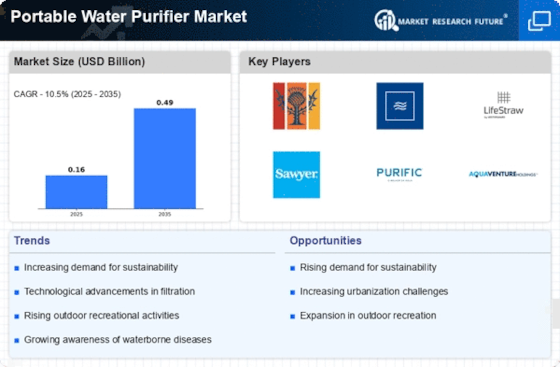
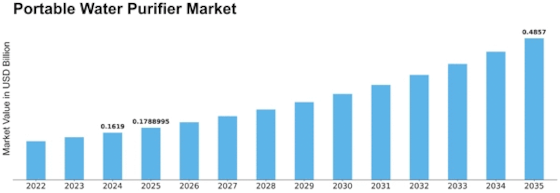
As per Market Research Future analysis, the Portable Water Purifier Market Size was estimated at 0.1619 USD Billion in 2024. The Portable Water Purifier industry is projected to grow from USD 0.1789 Billion in 2025 to USD 0.4857 Billion by 2035, exhibiting a compound annual growth rate (CAGR) of 10.5% during the forecast period 2025 - 2035

Key Market Trends & Highlights

The Portable Water Purifier Market is experiencing robust growth driven by technological advancements and increasing consumer awareness.

  • North America remains the largest market for portable water purifiers, driven by a high demand for safe drinking water. The Asia-Pacific region is the fastest-growing market, fueled by rising outdoor activities and urbanization. Gravity purifiers dominate the market, while UV purifiers are emerging as the fastest-growing segment due to their efficiency. Technological advancements in filtration and increased awareness of waterborne diseases are key drivers propelling market growth.

Market Size & Forecast

2024 Market Size 0.1619 (USD Billion)
2035 Market Size 0.4857 (USD Billion)
CAGR (2025 - 2035) 10.5%
Largest Regional Market Share in 2024 North America

Major Players

<a href="https://www.brita.in/water-filters/flow-water-filter-tank">Brita </a>(DE), Katadyn (CH), Lifestraw (US), Sawyer Products (US), Purific (US), AquaVenture Holdings (US), <a href="https://www.ecolab.com/offerings/water-filtration">Ecolab </a>(US), Tetra (DE), ZeroWater (US)

Market Trends

The Portable Water Purifier Market is currently experiencing a notable transformation driven by increasing awareness regarding waterborne diseases and the necessity for clean drinking water. As consumers become more conscious of health and environmental issues, the demand for portable water purification solutions is on the rise. This market is characterized by a diverse range of products, including filters, water purifier, UV purifiers, and chemical treatments, catering to various consumer needs. Innovations in technology are also playing a crucial role, with manufacturers focusing on enhancing the efficiency and portability of their products. Furthermore, the growing trend of outdoor activities and travel is propelling the need for reliable water purification systems, as individuals seek safe drinking water in remote locations. In addition to consumer preferences, regulatory frameworks are evolving to support the Portable Water Purifier Market. Governments are increasingly recognizing the importance of access to clean water, leading to initiatives that promote the use of water purification technologies. This regulatory support, combined with advancements in product design and functionality, suggests a promising future for the market. As sustainability becomes a focal point for consumers, eco-friendly purification methods are likely to gain traction, further shaping the landscape of the Portable Water Purifier Market. Overall, the interplay of consumer demand, technological innovation, and regulatory support indicates a dynamic and evolving market environment.

Technological Advancements

The Portable Water Purifier Market is witnessing rapid technological advancements that enhance product efficiency and user experience. Innovations such as advanced filtration systems, UV light purification, and smart technology integration are becoming increasingly prevalent. These developments not only improve the effectiveness of purification but also cater to the growing consumer demand for convenience and portability.

Sustainability Focus

There is a growing emphasis on sustainability within the Portable Water Purifier Market. Consumers are increasingly seeking eco-friendly solutions that minimize environmental impact. This trend is prompting manufacturers to develop products using sustainable materials and processes, aligning with the broader movement towards environmental responsibility.

Rising Outdoor Activities

The surge in outdoor activities and travel is significantly influencing the Portable Water Purifier Market. As more individuals engage in camping, hiking, and other recreational pursuits, the demand for portable purification solutions is likely to increase. This trend highlights the need for reliable and efficient water purification options for consumers seeking safe drinking water in remote areas.

Portable Water Purifier Market Market Drivers

Rising Outdoor and Travel Activities

The Portable Water Purifier Market is benefiting from the rising trend of outdoor and travel activities. As more individuals engage in hiking, camping, and international travel, the need for portable water purification solutions becomes increasingly apparent. Market analysis shows that the demand for compact and lightweight purifiers is on the rise, catering to the needs of outdoor enthusiasts. This trend is further supported by the growing popularity of adventure tourism, where access to clean water is often limited. Consequently, the Portable Water Purifier Market is likely to see substantial growth as consumers seek reliable solutions for safe drinking water during their adventures.

Government Initiatives and Regulations

The Portable Water Purifier Market is also influenced by government initiatives and regulations aimed at improving water quality. Many governments are implementing policies that encourage the use of water purification technologies, particularly in areas with inadequate access to clean water. These initiatives often include subsidies or incentives for consumers to purchase portable purifiers. Data indicates that regions with stringent water quality regulations are experiencing a corresponding increase in the adoption of portable water purification solutions. As a result, the Portable Water Purifier Market is expected to grow as regulatory frameworks support the widespread use of these essential products.

Sustainability and Eco-Friendly Products

The Portable Water Purifier Market is witnessing a growing trend towards sustainability and eco-friendly products. Consumers are increasingly seeking purifiers that utilize sustainable materials and energy-efficient technologies. This shift is driven by a broader societal movement towards environmental consciousness, where individuals are more inclined to invest in products that minimize ecological impact. Market data indicates that brands focusing on biodegradable materials and reusable components are gaining popularity. As a result, the Portable Water Purifier Market is likely to expand as manufacturers adapt to these consumer preferences, aligning their offerings with sustainable practices.

Technological Advancements in Filtration

The Portable Water Purifier Market is experiencing a surge in technological advancements that enhance filtration efficiency. Innovations such as multi-stage industrial filtration systems and UV purification technologies are becoming increasingly prevalent. These advancements not only improve the quality of purified water but also reduce the time required for purification. According to recent data, the introduction of smart water purifiers, which can monitor water quality in real-time, is gaining traction among consumers. This trend indicates a shift towards more sophisticated and user-friendly products, appealing to tech-savvy individuals. As a result, the Portable Water Purifier Market is likely to witness significant growth driven by these technological innovations.

Increased Awareness of Waterborne Diseases

The Portable Water Purifier Market is significantly influenced by the rising awareness of waterborne diseases. As populations become more informed about the health risks associated with contaminated water, the demand for portable water purifiers is expected to increase. Reports suggest that regions with limited access to clean drinking water are particularly affected, leading to a heightened focus on water purification solutions. This awareness is not only driving consumer behavior but also prompting governments and NGOs to promote the use of portable purifiers in vulnerable communities. Consequently, the Portable Water Purifier Market is poised for growth as consumers prioritize health and safety.

Market Segment Insights

By Technology: Gravity Purifier (Largest) vs. UV Purifier (Fastest-Growing)

<p>The Portable Water Purifier Market is primarily dominated by Gravity Purifiers, which hold the largest market share due to their simplicity, affordability, and effectiveness in various settings, particularly in developing regions. UV Purifiers are rapidly gaining traction, driven by increasing awareness of waterborne diseases and the need for effective disinfection methods. The RO Purifier segment, while innovative, trails in terms of overall market penetration compared to the other two technologies. Growth trends are significantly favoring UV Purifiers, which are experiencing the fastest growth driven by advancements in UV technology and a shift towards more compact and efficient purification solutions. Consumers are increasingly seeking convenient, lightweight options; thus, UV systems are becoming the preferred choice for outdoor and emergency situations. As sustainable practices gain popularity, all technology segments are expected to innovate further, adapting to changing consumer preferences.</p>

<p>Technology: Gravity Purifier (Dominant) vs. RO Purifier (Emerging)</p>

<p>Gravity Purifiers are regarded as the dominant technology in the Portable Water Purifier Market due to their ease of use and effectiveness in removing impurities without the need for electricity. They are particularly popular in rural areas where access to power is limited. On the other hand, RO Purifiers are emerging due to their advanced filtration capabilities that can remove dissolved solids and a wide range of contaminants. However, they require electricity, making them less versatile. While Gravity Purifiers appeal to a broad consumer base due to their low costs and portability, RO systems are gaining attention in urban markets where water quality concerns are significant, reflecting the evolving dynamics between these two technologies.</p>

By End-User: Residential (Largest) vs. Commercial (Fastest-Growing)

<p>The Portable Water Purifier Market is primarily segmented into two end-user categories: Residential and Commercial. The Residential sector holds the largest market share, driven by increasing awareness regarding safe drinking water and health concerns among homeowners. Consumers are increasingly opting for portable water purifiers to ensure they have access to clean and safe drinking water at home, particularly in areas where tap water quality is questionable. On the other hand, the Commercial segment is identified as the fastest-growing in the market. Institutions like hotels, restaurants, and offices are realizing the necessity of providing purified water for their customers and employees. The growth is further accelerated by stringent regulations concerning water quality and the rising demand for sustainable and convenient solutions in the commercial sector.</p>

<p>End-User: Residential (Dominant) vs. Commercial (Emerging)</p>

<p>The Residential segment is characterized by a high level of consumer engagement, with homeowners actively seeking effective purification solutions for their families. These purifiers cater to various household needs, including drinking, cooking, and even recreational uses like camping. Brands are focusing on user-friendly features and compact designs to appeal to this demographic. Conversely, the Commercial segment, while emerging, is experiencing rapid growth due to the need for compliance with health regulations and the demand for efficient water solutions in business operations. Companies in this segment are prioritizing larger capacities and advanced filtration technologies to meet the needs of numerous users, making it a vibrant area of innovation.</p>

By Channels of Distribution: Online (Largest) vs. Retail Stores (Fastest-Growing)

<p>In the Portable Water Purifier Market, distribution channels are vital in shaping consumer access and purchasing behavior. Currently, online channels dominate the market, leveraging the convenience of e-commerce to reach a broad audience. Retail stores, though trailing behind in terms of overall share, witness a substantial presence in urban areas and among consumers who prefer hands-on product examination before purchase. The growth trends in this segment reveal a shift towards online purchasing, driven by increased internet penetration and a growing preference for home delivery. Retail stores, while not the largest, are emerging rapidly due to their adaptability to changing consumer preferences, thereby enhancing their market presence and fostering a hybrid shopping experience that combines the benefits of both online and offline purchasing.</p>

<p>Online (Dominant) vs. Retail Stores (Emerging)</p>

<p>The online distribution channel has established itself as the dominant force in the Portable Water Purifier Market, characterized by its extensive reach and convenience for consumers. Online platforms provide a vast array of products, making it easy for consumers to compare features, prices, and reviews. In contrast, retail stores, while currently emerging, are experiencing rapid growth as they adapt to customer demands for immediate access and the tactile experience of physically assessing products. Retail outlets are enhancing their in-store offerings through better product displays and knowledgeable staff, creating an engaging shopping environment. This dual approach of online convenience and retail accessibility is shaping the future dynamics of distribution in the portable water purifier sector.</p>

Get more detailed insights about Portable Water Purifier Market Research Report - Global Forecast to 2035

Regional Insights

North America : Innovation and Sustainability Focus

The North American portable water purifier market is driven by increasing awareness of water quality and health concerns. The region holds the largest market share at approximately 40%, with a growing trend towards sustainable and eco-friendly products. Regulatory support from agencies like the EPA encourages innovation in water purification technologies, further boosting market growth. Leading countries in this region include the United States and Canada, with significant contributions from key players such as Lifestraw, Sawyer Products, and Ecolab. The competitive landscape is characterized by a mix of established brands and emerging startups, all striving to meet the rising consumer demand for portable water purification solutions. The focus on outdoor activities and travel also propels market expansion.

Europe : Regulatory Support and Innovation

Europe is witnessing a surge in the portable water purifier market, driven by stringent regulations on water quality and a growing emphasis on health and wellness. The region accounts for approximately 30% of the global market share, with countries like Germany and the UK leading the charge. Regulatory bodies are promoting the use of advanced purification technologies, which is a significant catalyst for market growth. Germany, Switzerland, and the UK are at the forefront, with key players like Brita and Katadyn dominating the landscape. The competitive environment is marked by innovation, with companies investing in R&D to develop more efficient and user-friendly products. The increasing popularity of outdoor activities and travel further fuels demand for portable solutions, making Europe a vibrant market for water purification.

Asia-Pacific : Rapid Growth and Urbanization

The Asia-Pacific region is experiencing rapid growth in the portable water purifier market, driven by urbanization, population growth, and increasing awareness of waterborne diseases. This region holds approximately 25% of the global market share, with countries like China and India leading in demand. Government initiatives aimed at improving water quality and access are significant growth drivers. China and India are the largest markets, with a competitive landscape featuring both local and international players. Companies like Lifestraw and AquaVenture Holdings are expanding their presence, catering to the rising demand for affordable and effective water purification solutions. The region's diverse consumer base and increasing disposable income further enhance market opportunities, making it a key area for growth.

Middle East and Africa : Resource Challenges and Solutions

The Middle East and Africa region faces significant challenges related to water scarcity, driving demand for portable water purifiers. This region holds about 5% of the global market share, with countries like South Africa and the UAE leading in adoption. The increasing frequency of droughts and water shortages has prompted governments to promote innovative water purification technologies as a solution. South Africa and the UAE are key markets, with a competitive landscape that includes both local and international brands. Companies like Purific and Ecolab are actively working to provide effective solutions tailored to the unique challenges of the region. The focus on sustainable practices and improving access to clean water is shaping the market dynamics, making it a critical area for investment and development.

Key Players and Competitive Insights

Leading market players are investing heavily in research and development to expand their product lines, which will help the Portable Water Purifier Industry, grow even more. Market participants are also undertaking a variety of strategic activities to expand their global footprint, with important market developments including new product launches, contractual agreements, mergers and acquisitions, higher investments, and collaboration with other organizations. To expand and survive in a more competitive and rising market climate, the Portable Water Purifier industry must offer cost-effective items. Manufacturing locally to minimize operational costs is one of the key business tactics used by manufacturers in the global Portable Water Purifier industry to benefit clients and increase the market sector. In recent years, the Portable Water Purifier industry has offered some of the most significant advantages to the global community, addressing pressing concerns related to water quality, accessibility, and public health. Major players in the Portable Water Filter Market, including Kent RO limited, GE Corporation, Best Water Technology, Whirlpool Corporation, Brita, SteriPEN, General Ecology Inc., Mechanical Equipment Co., Inc., Blue Spring Corporation, SAFH20 UV, GRAYL, Inc, Vestergaard, Portable Aqua, Aquasana, Inc.., Panasonic, Amway Corporation, HaloSource Inc., Eureka Forbes Limited are attempting to increase market demand by investing in research and development operations. Whirlpool Corp, a leading player in the home and kitchen appliances sector, specializes in the design, manufacturing, and supply of a diverse range of products. Its extensive portfolio encompasses laundry appliances, refrigerators, freezers, cooking appliances, dishwashers, mixers, washing machines, air conditioners, heating and cooling products, water filters, and various portable household appliances. Whirlpool markets its products under well-known brand names such as Gladiator, Speed Queen, Whirlpool, Roper, Ignis, Privileg, Ariston, Indesit, Bauknecht, Amana, Maytag, KitchenAid, Jenn-Air, Yummly, and Everydropwater. The company strategically sells its merchandise to retail and chain stores, distributors, and manufacturers. With a global footprint spanning the Americas, Europe, the Middle East, Africa, and Asia-Pacific, Whirlpool has established itself as a key player in the industry. The corporate headquarters of Whirlpool is situated in Benton Harbor, Michigan, in the United States. KENT, widely acknowledged as the frontrunner in the RO Water Purifier category, stands out as the pioneer that introduced the revolutionary Reverse Osmosis (RO) technology to the Indian market. Founded in 1999 with a commitment to fostering a healthier world and armed with technological prowess for innovative solutions, the brand originated its operations in Noida, India. Over the years, KENT has evolved into the largest manufacturer of water purifiers in India, marking a journey filled with notable milestones. Notable contributions include the introduction of the patented RO+UV+UF+TDS Controller technology, ensuring water purification while retaining essential natural minerals crucial for a healthy lifestyle. KENT's innovative use of UV light in the storage tank is designed to preserve the purity of water. The brand's commitment to ecological balance is evident in the development of Save Water Technology, aimed at preventing water wastage during the use of its RO water purifiers. Recognized globally for technological advancements, KENT proudly holds the distinction of being the sole water purifier company certified by esteemed agencies in India and abroad, including NSF.

Key Companies in the Portable Water Purifier Market include

Industry Developments

October 2021: In October 2021, LG Electronics unveiled its latest 2021 series of water purifiers and Charcoal Microwave Ovens in the Indian market. The company emphasized that these new additions to LG's health and hygiene portfolio were strategically designed to support consumers in adopting healthier lifestyles. The innovative water purifier series, comprising models WW184EPB, WW184EPC, and WW174NPC, was made available with prices starting at Rs 28,290.

September 2020: In September 2020, AO Smith India Water Products Pvt Ltd, a leader in water heating and treatment, announced the introduction of the 'ProPlanet' series, identified as the country's first 5-star-rated water purifiers in terms of water savings, according to the company's press release. The ProPlanet water purifiers were equipped with reverse osmosis (RO) and Silver Charged Membrane Technology (SCMT), ensuring 100% RO-purified, baby-safe water through an advanced 8-stage purification process.

Future Outlook

Portable Water Purifier Market Future Outlook

The Portable Water Purifier Market is projected to grow at a 10.5% CAGR from 2025 to 2035, driven by increasing health awareness, environmental concerns, and technological advancements.

New opportunities lie in:

  • <p>Expansion into emerging markets with tailored products Development of smart purification systems with IoT integration Partnerships with outdoor and travel companies for bundled offerings</p>

By 2035, the market is expected to be robust, driven by innovation and strategic partnerships.

Market Segmentation

Portable Water Purifier Market End-User Outlook

  • Commercial
  • Residential

Portable Water Purifier Market Technology Outlook

  • Gravity Purifier
  • UV Purifier
  • RO Purifier

Portable Water Purifier Market Channels of Distribution Outlook

  • Retail Stores
  • Direct sales
  • Online

Report Scope

MARKET SIZE 2024 0.1619(USD Billion)
MARKET SIZE 2025 0.1789(USD Billion)
MARKET SIZE 2035 0.4857(USD Billion)
COMPOUND ANNUAL GROWTH RATE (CAGR) 10.5% (2025 - 2035)
REPORT COVERAGE Revenue Forecast, Competitive Landscape, Growth Factors, and Trends
BASE YEAR 2024
Market Forecast Period 2025 - 2035
Historical Data 2019 - 2024
Market Forecast Units USD Billion
Key Companies Profiled Brita (DE), Katadyn (CH), Lifestraw (US), Sawyer Products (US), Purific (US), AquaVenture Holdings (US), Ecolab (US), Tetra (DE), ZeroWater (US)
Segments Covered Technology, End-user, Channel of Distribution, Region
Key Market Opportunities Integration of advanced filtration technologies enhances efficiency in the Portable Water Purifier Market.
Key Market Dynamics Rising consumer awareness drives demand for portable water purifiers, influencing market competition and innovation.
Countries Covered North America, Europe, APAC, South America, MEA

FAQs

What is the projected market valuation of the Portable Water Purifier Market by 2035?

<p>The Portable Water Purifier Market is projected to reach a valuation of 0.4857 USD Billion by 2035.</p>

What was the market valuation of the Portable Water Purifier Market in 2024?

<p>In 2024, the market valuation of the Portable Water Purifier Market was 0.1619 USD Billion.</p>

What is the expected CAGR for the Portable Water Purifier Market during the forecast period 2025 - 2035?

<p>The expected CAGR for the Portable Water Purifier Market during the forecast period 2025 - 2035 is 10.5%.</p>

Which technology segment had the highest valuation in 2024?

<p>In 2024, the UV Purifier segment had the highest valuation at 0.0654 USD Billion.</p>

What are the key distribution channels for Portable Water Purifiers?

<p>The key distribution channels include Retail Stores, Direct Sales, and Online sales, with Online sales valued at 0.08094 USD Billion in 2024.</p>

How does the Residential end-user segment compare to the Commercial segment in 2024?

<p>In 2024, the Residential end-user segment was valued at 0.11333 USD Billion, significantly higher than the Commercial segment at 0.04857 USD Billion.</p>

Who are the leading companies in the Portable Water Purifier Market?

Key players in the Portable Water Purifier Market include Brita, Katadyn, Lifestraw, Sawyer Products, and AquaVenture Holdings.

What is the projected growth trend for the Gravity Purifier segment from 2024 to 2035?

The Gravity Purifier segment is expected to grow from 0.0486 USD Billion in 2024 to a higher valuation by 2035.

What is the significance of the Online sales channel in the Portable Water Purifier Market?

The Online sales channel is significant, with a valuation of 0.08094 USD Billion in 2024, indicating a growing trend in e-commerce.

How do the valuations of the RO Purifier segment compare to other technologies in 2024?

In 2024, the RO Purifier segment was valued at 0.0479 USD Billion, which is lower than both the UV and Gravity Purifier segments.

  1. SECTION I: EXECUTIVE SUMMARY AND KEY HIGHLIGHTS
    1. | 1.1 EXECUTIVE SUMMARY
    2. | | 1.1.1 Market Overview
    3. | | 1.1.2 Key Findings
    4. | | 1.1.3 Market Segmentation
    5. | | 1.1.4 Competitive Landscape
    6. | | 1.1.5 Challenges and Opportunities
    7. | | 1.1.6 Future Outlook
  2. SECTION II: SCOPING, METHODOLOGY AND MARKET STRUCTURE
    1. | 2.1 MARKET INTRODUCTION
    2. | | 2.1.1 Definition
    3. | | 2.1.2 Scope of the study
    4. | | | 2.1.2.1 Research Objective
    5. | | | 2.1.2.2 Assumption
    6. | | | 2.1.2.3 Limitations
    7. | 2.2 RESEARCH METHODOLOGY
    8. | | 2.2.1 Overview
    9. | | 2.2.2 Data Mining
    10. | | 2.2.3 Secondary Research
    11. | | 2.2.4 Primary Research
    12. | | | 2.2.4.1 Primary Interviews and Information Gathering Process
    13. | | | 2.2.4.2 Breakdown of Primary Respondents
    14. | | 2.2.5 Forecasting Model
    15. | | 2.2.6 Market Size Estimation
    16. | | | 2.2.6.1 Bottom-Up Approach
    17. | | | 2.2.6.2 Top-Down Approach
    18. | | 2.2.7 Data Triangulation
    19. | | 2.2.8 Validation
  3. SECTION III: QUALITATIVE ANALYSIS
    1. | 3.1 MARKET DYNAMICS
    2. | | 3.1.1 Overview
    3. | | 3.1.2 Drivers
    4. | | 3.1.3 Restraints
    5. | | 3.1.4 Opportunities
    6. | 3.2 MARKET FACTOR ANALYSIS
    7. | | 3.2.1 Value chain Analysis
    8. | | 3.2.2 Porter's Five Forces Analysis
    9. | | | 3.2.2.1 Bargaining Power of Suppliers
    10. | | | 3.2.2.2 Bargaining Power of Buyers
    11. | | | 3.2.2.3 Threat of New Entrants
    12. | | | 3.2.2.4 Threat of Substitutes
    13. | | | 3.2.2.5 Intensity of Rivalry
    14. | | 3.2.3 COVID-19 Impact Analysis
    15. | | | 3.2.3.1 Market Impact Analysis
    16. | | | 3.2.3.2 Regional Impact
    17. | | | 3.2.3.3 Opportunity and Threat Analysis
  4. SECTION IV: QUANTITATIVE ANALYSIS
    1. | 4.1 Healthcare, BY Technology (USD Billion)
    2. | | 4.1.1 Gravity Purifier
    3. | | 4.1.2 UV Purifier
    4. | | 4.1.3 RO Purifier
    5. | 4.2 Healthcare, BY End-User (USD Billion)
    6. | | 4.2.1 Commercial
    7. | | 4.2.2 Residential
    8. | 4.3 Healthcare, BY Channels of Distribution (USD Billion)
    9. | | 4.3.1 Retail Stores
    10. | | 4.3.2 Direct sales
    11. | | 4.3.3 Online
    12. | 4.4 Healthcare, BY Region (USD Billion)
    13. | | 4.4.1 North America
    14. | | | 4.4.1.1 US
    15. | | | 4.4.1.2 Canada
    16. | | 4.4.2 Europe
    17. | | | 4.4.2.1 Germany
    18. | | | 4.4.2.2 UK
    19. | | | 4.4.2.3 France
    20. | | | 4.4.2.4 Russia
    21. | | | 4.4.2.5 Italy
    22. | | | 4.4.2.6 Spain
    23. | | | 4.4.2.7 Rest of Europe
    24. | | 4.4.3 APAC
    25. | | | 4.4.3.1 China
    26. | | | 4.4.3.2 India
    27. | | | 4.4.3.3 Japan
    28. | | | 4.4.3.4 South Korea
    29. | | | 4.4.3.5 Malaysia
    30. | | | 4.4.3.6 Thailand
    31. | | | 4.4.3.7 Indonesia
    32. | | | 4.4.3.8 Rest of APAC
    33. | | 4.4.4 South America
    34. | | | 4.4.4.1 Brazil
    35. | | | 4.4.4.2 Mexico
    36. | | | 4.4.4.3 Argentina
    37. | | | 4.4.4.4 Rest of South America
    38. | | 4.4.5 MEA
    39. | | | 4.4.5.1 GCC Countries
    40. | | | 4.4.5.2 South Africa
    41. | | | 4.4.5.3 Rest of MEA
  5. SECTION V: COMPETITIVE ANALYSIS
    1. | 5.1 Competitive Landscape
    2. | | 5.1.1 Overview
    3. | | 5.1.2 Competitive Analysis
    4. | | 5.1.3 Market share Analysis
    5. | | 5.1.4 Major Growth Strategy in the Healthcare
    6. | | 5.1.5 Competitive Benchmarking
    7. | | 5.1.6 Leading Players in Terms of Number of Developments in the Healthcare
    8. | | 5.1.7 Key developments and growth strategies
    9. | | | 5.1.7.1 New Product Launch/Service Deployment
    10. | | | 5.1.7.2 Merger & Acquisitions
    11. | | | 5.1.7.3 Joint Ventures
    12. | | 5.1.8 Major Players Financial Matrix
    13. | | | 5.1.8.1 Sales and Operating Income
    14. | | | 5.1.8.2 Major Players R&D Expenditure. 2023
    15. | 5.2 Company Profiles
    16. | | 5.2.1 Brita (DE)
    17. | | | 5.2.1.1 Financial Overview
    18. | | | 5.2.1.2 Products Offered
    19. | | | 5.2.1.3 Key Developments
    20. | | | 5.2.1.4 SWOT Analysis
    21. | | | 5.2.1.5 Key Strategies
    22. | | 5.2.2 Katadyn (CH)
    23. | | | 5.2.2.1 Financial Overview
    24. | | | 5.2.2.2 Products Offered
    25. | | | 5.2.2.3 Key Developments
    26. | | | 5.2.2.4 SWOT Analysis
    27. | | | 5.2.2.5 Key Strategies
    28. | | 5.2.3 Lifestraw (US)
    29. | | | 5.2.3.1 Financial Overview
    30. | | | 5.2.3.2 Products Offered
    31. | | | 5.2.3.3 Key Developments
    32. | | | 5.2.3.4 SWOT Analysis
    33. | | | 5.2.3.5 Key Strategies
    34. | | 5.2.4 Sawyer Products (US)
    35. | | | 5.2.4.1 Financial Overview
    36. | | | 5.2.4.2 Products Offered
    37. | | | 5.2.4.3 Key Developments
    38. | | | 5.2.4.4 SWOT Analysis
    39. | | | 5.2.4.5 Key Strategies
    40. | | 5.2.5 Purific (US)
    41. | | | 5.2.5.1 Financial Overview
    42. | | | 5.2.5.2 Products Offered
    43. | | | 5.2.5.3 Key Developments
    44. | | | 5.2.5.4 SWOT Analysis
    45. | | | 5.2.5.5 Key Strategies
    46. | | 5.2.6 AquaVenture Holdings (US)
    47. | | | 5.2.6.1 Financial Overview
    48. | | | 5.2.6.2 Products Offered
    49. | | | 5.2.6.3 Key Developments
    50. | | | 5.2.6.4 SWOT Analysis
    51. | | | 5.2.6.5 Key Strategies
    52. | | 5.2.7 Ecolab (US)
    53. | | | 5.2.7.1 Financial Overview
    54. | | | 5.2.7.2 Products Offered
    55. | | | 5.2.7.3 Key Developments
    56. | | | 5.2.7.4 SWOT Analysis
    57. | | | 5.2.7.5 Key Strategies
    58. | | 5.2.8 Tetra (DE)
    59. | | | 5.2.8.1 Financial Overview
    60. | | | 5.2.8.2 Products Offered
    61. | | | 5.2.8.3 Key Developments
    62. | | | 5.2.8.4 SWOT Analysis
    63. | | | 5.2.8.5 Key Strategies
    64. | | 5.2.9 ZeroWater (US)
    65. | | | 5.2.9.1 Financial Overview
    66. | | | 5.2.9.2 Products Offered
    67. | | | 5.2.9.3 Key Developments
    68. | | | 5.2.9.4 SWOT Analysis
    69. | | | 5.2.9.5 Key Strategies
    70. | 5.3 Appendix
    71. | | 5.3.1 References
    72. | | 5.3.2 Related Reports
  6. LIST OF FIGURES
    1. | 6.1 MARKET SYNOPSIS
    2. | 6.2 NORTH AMERICA MARKET ANALYSIS
    3. | 6.3 US MARKET ANALYSIS BY TECHNOLOGY
    4. | 6.4 US MARKET ANALYSIS BY END-USER
    5. | 6.5 US MARKET ANALYSIS BY CHANNELS OF DISTRIBUTION
    6. | 6.6 CANADA MARKET ANALYSIS BY TECHNOLOGY
    7. | 6.7 CANADA MARKET ANALYSIS BY END-USER
    8. | 6.8 CANADA MARKET ANALYSIS BY CHANNELS OF DISTRIBUTION
    9. | 6.9 EUROPE MARKET ANALYSIS
    10. | 6.10 GERMANY MARKET ANALYSIS BY TECHNOLOGY
    11. | 6.11 GERMANY MARKET ANALYSIS BY END-USER
    12. | 6.12 GERMANY MARKET ANALYSIS BY CHANNELS OF DISTRIBUTION
    13. | 6.13 UK MARKET ANALYSIS BY TECHNOLOGY
    14. | 6.14 UK MARKET ANALYSIS BY END-USER
    15. | 6.15 UK MARKET ANALYSIS BY CHANNELS OF DISTRIBUTION
    16. | 6.16 FRANCE MARKET ANALYSIS BY TECHNOLOGY
    17. | 6.17 FRANCE MARKET ANALYSIS BY END-USER
    18. | 6.18 FRANCE MARKET ANALYSIS BY CHANNELS OF DISTRIBUTION
    19. | 6.19 RUSSIA MARKET ANALYSIS BY TECHNOLOGY
    20. | 6.20 RUSSIA MARKET ANALYSIS BY END-USER
    21. | 6.21 RUSSIA MARKET ANALYSIS BY CHANNELS OF DISTRIBUTION
    22. | 6.22 ITALY MARKET ANALYSIS BY TECHNOLOGY
    23. | 6.23 ITALY MARKET ANALYSIS BY END-USER
    24. | 6.24 ITALY MARKET ANALYSIS BY CHANNELS OF DISTRIBUTION
    25. | 6.25 SPAIN MARKET ANALYSIS BY TECHNOLOGY
    26. | 6.26 SPAIN MARKET ANALYSIS BY END-USER
    27. | 6.27 SPAIN MARKET ANALYSIS BY CHANNELS OF DISTRIBUTION
    28. | 6.28 REST OF EUROPE MARKET ANALYSIS BY TECHNOLOGY
    29. | 6.29 REST OF EUROPE MARKET ANALYSIS BY END-USER
    30. | 6.30 REST OF EUROPE MARKET ANALYSIS BY CHANNELS OF DISTRIBUTION
    31. | 6.31 APAC MARKET ANALYSIS
    32. | 6.32 CHINA MARKET ANALYSIS BY TECHNOLOGY
    33. | 6.33 CHINA MARKET ANALYSIS BY END-USER
    34. | 6.34 CHINA MARKET ANALYSIS BY CHANNELS OF DISTRIBUTION
    35. | 6.35 INDIA MARKET ANALYSIS BY TECHNOLOGY
    36. | 6.36 INDIA MARKET ANALYSIS BY END-USER
    37. | 6.37 INDIA MARKET ANALYSIS BY CHANNELS OF DISTRIBUTION
    38. | 6.38 JAPAN MARKET ANALYSIS BY TECHNOLOGY
    39. | 6.39 JAPAN MARKET ANALYSIS BY END-USER
    40. | 6.40 JAPAN MARKET ANALYSIS BY CHANNELS OF DISTRIBUTION
    41. | 6.41 SOUTH KOREA MARKET ANALYSIS BY TECHNOLOGY
    42. | 6.42 SOUTH KOREA MARKET ANALYSIS BY END-USER
    43. | 6.43 SOUTH KOREA MARKET ANALYSIS BY CHANNELS OF DISTRIBUTION
    44. | 6.44 MALAYSIA MARKET ANALYSIS BY TECHNOLOGY
    45. | 6.45 MALAYSIA MARKET ANALYSIS BY END-USER
    46. | 6.46 MALAYSIA MARKET ANALYSIS BY CHANNELS OF DISTRIBUTION
    47. | 6.47 THAILAND MARKET ANALYSIS BY TECHNOLOGY
    48. | 6.48 THAILAND MARKET ANALYSIS BY END-USER
    49. | 6.49 THAILAND MARKET ANALYSIS BY CHANNELS OF DISTRIBUTION
    50. | 6.50 INDONESIA MARKET ANALYSIS BY TECHNOLOGY
    51. | 6.51 INDONESIA MARKET ANALYSIS BY END-USER
    52. | 6.52 INDONESIA MARKET ANALYSIS BY CHANNELS OF DISTRIBUTION
    53. | 6.53 REST OF APAC MARKET ANALYSIS BY TECHNOLOGY
    54. | 6.54 REST OF APAC MARKET ANALYSIS BY END-USER
    55. | 6.55 REST OF APAC MARKET ANALYSIS BY CHANNELS OF DISTRIBUTION
    56. | 6.56 SOUTH AMERICA MARKET ANALYSIS
    57. | 6.57 BRAZIL MARKET ANALYSIS BY TECHNOLOGY
    58. | 6.58 BRAZIL MARKET ANALYSIS BY END-USER
    59. | 6.59 BRAZIL MARKET ANALYSIS BY CHANNELS OF DISTRIBUTION
    60. | 6.60 MEXICO MARKET ANALYSIS BY TECHNOLOGY
    61. | 6.61 MEXICO MARKET ANALYSIS BY END-USER
    62. | 6.62 MEXICO MARKET ANALYSIS BY CHANNELS OF DISTRIBUTION
    63. | 6.63 ARGENTINA MARKET ANALYSIS BY TECHNOLOGY
    64. | 6.64 ARGENTINA MARKET ANALYSIS BY END-USER
    65. | 6.65 ARGENTINA MARKET ANALYSIS BY CHANNELS OF DISTRIBUTION
    66. | 6.66 REST OF SOUTH AMERICA MARKET ANALYSIS BY TECHNOLOGY
    67. | 6.67 REST OF SOUTH AMERICA MARKET ANALYSIS BY END-USER
    68. | 6.68 REST OF SOUTH AMERICA MARKET ANALYSIS BY CHANNELS OF DISTRIBUTION
    69. | 6.69 MEA MARKET ANALYSIS
    70. | 6.70 GCC COUNTRIES MARKET ANALYSIS BY TECHNOLOGY
    71. | 6.71 GCC COUNTRIES MARKET ANALYSIS BY END-USER
    72. | 6.72 GCC COUNTRIES MARKET ANALYSIS BY CHANNELS OF DISTRIBUTION
    73. | 6.73 SOUTH AFRICA MARKET ANALYSIS BY TECHNOLOGY
    74. | 6.74 SOUTH AFRICA MARKET ANALYSIS BY END-USER
    75. | 6.75 SOUTH AFRICA MARKET ANALYSIS BY CHANNELS OF DISTRIBUTION
    76. | 6.76 REST OF MEA MARKET ANALYSIS BY TECHNOLOGY
    77. | 6.77 REST OF MEA MARKET ANALYSIS BY END-USER
    78. | 6.78 REST OF MEA MARKET ANALYSIS BY CHANNELS OF DISTRIBUTION
    79. | 6.79 KEY BUYING CRITERIA OF HEALTHCARE
    80. | 6.80 RESEARCH PROCESS OF MRFR
    81. | 6.81 DRO ANALYSIS OF HEALTHCARE
    82. | 6.82 DRIVERS IMPACT ANALYSIS: HEALTHCARE
    83. | 6.83 RESTRAINTS IMPACT ANALYSIS: HEALTHCARE
    84. | 6.84 SUPPLY / VALUE CHAIN: HEALTHCARE
    85. | 6.85 HEALTHCARE, BY TECHNOLOGY, 2024 (% SHARE)
    86. | 6.86 HEALTHCARE, BY TECHNOLOGY, 2024 TO 2035 (USD Billion)
    87. | 6.87 HEALTHCARE, BY END-USER, 2024 (% SHARE)
    88. | 6.88 HEALTHCARE, BY END-USER, 2024 TO 2035 (USD Billion)
    89. | 6.89 HEALTHCARE, BY CHANNELS OF DISTRIBUTION, 2024 (% SHARE)
    90. | 6.90 HEALTHCARE, BY CHANNELS OF DISTRIBUTION, 2024 TO 2035 (USD Billion)
    91. | 6.91 BENCHMARKING OF MAJOR COMPETITORS
  7. LIST OF TABLES
    1. | 7.1 LIST OF ASSUMPTIONS
    2. | | 7.1.1
    3. | 7.2 North America MARKET SIZE ESTIMATES; FORECAST
    4. | | 7.2.1 BY TECHNOLOGY, 2025-2035 (USD Billion)
    5. | | 7.2.2 BY END-USER, 2025-2035 (USD Billion)
    6. | | 7.2.3 BY CHANNELS OF DISTRIBUTION, 2025-2035 (USD Billion)
    7. | 7.3 US MARKET SIZE ESTIMATES; FORECAST
    8. | | 7.3.1 BY TECHNOLOGY, 2025-2035 (USD Billion)
    9. | | 7.3.2 BY END-USER, 2025-2035 (USD Billion)
    10. | | 7.3.3 BY CHANNELS OF DISTRIBUTION, 2025-2035 (USD Billion)
    11. | 7.4 Canada MARKET SIZE ESTIMATES; FORECAST
    12. | | 7.4.1 BY TECHNOLOGY, 2025-2035 (USD Billion)
    13. | | 7.4.2 BY END-USER, 2025-2035 (USD Billion)
    14. | | 7.4.3 BY CHANNELS OF DISTRIBUTION, 2025-2035 (USD Billion)
    15. | 7.5 Europe MARKET SIZE ESTIMATES; FORECAST
    16. | | 7.5.1 BY TECHNOLOGY, 2025-2035 (USD Billion)
    17. | | 7.5.2 BY END-USER, 2025-2035 (USD Billion)
    18. | | 7.5.3 BY CHANNELS OF DISTRIBUTION, 2025-2035 (USD Billion)
    19. | 7.6 Germany MARKET SIZE ESTIMATES; FORECAST
    20. | | 7.6.1 BY TECHNOLOGY, 2025-2035 (USD Billion)
    21. | | 7.6.2 BY END-USER, 2025-2035 (USD Billion)
    22. | | 7.6.3 BY CHANNELS OF DISTRIBUTION, 2025-2035 (USD Billion)
    23. | 7.7 UK MARKET SIZE ESTIMATES; FORECAST
    24. | | 7.7.1 BY TECHNOLOGY, 2025-2035 (USD Billion)
    25. | | 7.7.2 BY END-USER, 2025-2035 (USD Billion)
    26. | | 7.7.3 BY CHANNELS OF DISTRIBUTION, 2025-2035 (USD Billion)
    27. | 7.8 France MARKET SIZE ESTIMATES; FORECAST
    28. | | 7.8.1 BY TECHNOLOGY, 2025-2035 (USD Billion)
    29. | | 7.8.2 BY END-USER, 2025-2035 (USD Billion)
    30. | | 7.8.3 BY CHANNELS OF DISTRIBUTION, 2025-2035 (USD Billion)
    31. | 7.9 Russia MARKET SIZE ESTIMATES; FORECAST
    32. | | 7.9.1 BY TECHNOLOGY, 2025-2035 (USD Billion)
    33. | | 7.9.2 BY END-USER, 2025-2035 (USD Billion)
    34. | | 7.9.3 BY CHANNELS OF DISTRIBUTION, 2025-2035 (USD Billion)
    35. | 7.10 Italy MARKET SIZE ESTIMATES; FORECAST
    36. | | 7.10.1 BY TECHNOLOGY, 2025-2035 (USD Billion)
    37. | | 7.10.2 BY END-USER, 2025-2035 (USD Billion)
    38. | | 7.10.3 BY CHANNELS OF DISTRIBUTION, 2025-2035 (USD Billion)
    39. | 7.11 Spain MARKET SIZE ESTIMATES; FORECAST
    40. | | 7.11.1 BY TECHNOLOGY, 2025-2035 (USD Billion)
    41. | | 7.11.2 BY END-USER, 2025-2035 (USD Billion)
    42. | | 7.11.3 BY CHANNELS OF DISTRIBUTION, 2025-2035 (USD Billion)
    43. | 7.12 Rest of Europe MARKET SIZE ESTIMATES; FORECAST
    44. | | 7.12.1 BY TECHNOLOGY, 2025-2035 (USD Billion)
    45. | | 7.12.2 BY END-USER, 2025-2035 (USD Billion)
    46. | | 7.12.3 BY CHANNELS OF DISTRIBUTION, 2025-2035 (USD Billion)
    47. | 7.13 APAC MARKET SIZE ESTIMATES; FORECAST
    48. | | 7.13.1 BY TECHNOLOGY, 2025-2035 (USD Billion)
    49. | | 7.13.2 BY END-USER, 2025-2035 (USD Billion)
    50. | | 7.13.3 BY CHANNELS OF DISTRIBUTION, 2025-2035 (USD Billion)
    51. | 7.14 China MARKET SIZE ESTIMATES; FORECAST
    52. | | 7.14.1 BY TECHNOLOGY, 2025-2035 (USD Billion)
    53. | | 7.14.2 BY END-USER, 2025-2035 (USD Billion)
    54. | | 7.14.3 BY CHANNELS OF DISTRIBUTION, 2025-2035 (USD Billion)
    55. | 7.15 India MARKET SIZE ESTIMATES; FORECAST
    56. | | 7.15.1 BY TECHNOLOGY, 2025-2035 (USD Billion)
    57. | | 7.15.2 BY END-USER, 2025-2035 (USD Billion)
    58. | | 7.15.3 BY CHANNELS OF DISTRIBUTION, 2025-2035 (USD Billion)
    59. | 7.16 Japan MARKET SIZE ESTIMATES; FORECAST
    60. | | 7.16.1 BY TECHNOLOGY, 2025-2035 (USD Billion)
    61. | | 7.16.2 BY END-USER, 2025-2035 (USD Billion)
    62. | | 7.16.3 BY CHANNELS OF DISTRIBUTION, 2025-2035 (USD Billion)
    63. | 7.17 South Korea MARKET SIZE ESTIMATES; FORECAST
    64. | | 7.17.1 BY TECHNOLOGY, 2025-2035 (USD Billion)
    65. | | 7.17.2 BY END-USER, 2025-2035 (USD Billion)
    66. | | 7.17.3 BY CHANNELS OF DISTRIBUTION, 2025-2035 (USD Billion)
    67. | 7.18 Malaysia MARKET SIZE ESTIMATES; FORECAST
    68. | | 7.18.1 BY TECHNOLOGY, 2025-2035 (USD Billion)
    69. | | 7.18.2 BY END-USER, 2025-2035 (USD Billion)
    70. | | 7.18.3 BY CHANNELS OF DISTRIBUTION, 2025-2035 (USD Billion)
    71. | 7.19 Thailand MARKET SIZE ESTIMATES; FORECAST
    72. | | 7.19.1 BY TECHNOLOGY, 2025-2035 (USD Billion)
    73. | | 7.19.2 BY END-USER, 2025-2035 (USD Billion)
    74. | | 7.19.3 BY CHANNELS OF DISTRIBUTION, 2025-2035 (USD Billion)
    75. | 7.20 Indonesia MARKET SIZE ESTIMATES; FORECAST
    76. | | 7.20.1 BY TECHNOLOGY, 2025-2035 (USD Billion)
    77. | | 7.20.2 BY END-USER, 2025-2035 (USD Billion)
    78. | | 7.20.3 BY CHANNELS OF DISTRIBUTION, 2025-2035 (USD Billion)
    79. | 7.21 Rest of APAC MARKET SIZE ESTIMATES; FORECAST
    80. | | 7.21.1 BY TECHNOLOGY, 2025-2035 (USD Billion)
    81. | | 7.21.2 BY END-USER, 2025-2035 (USD Billion)
    82. | | 7.21.3 BY CHANNELS OF DISTRIBUTION, 2025-2035 (USD Billion)
    83. | 7.22 South America MARKET SIZE ESTIMATES; FORECAST
    84. | | 7.22.1 BY TECHNOLOGY, 2025-2035 (USD Billion)
    85. | | 7.22.2 BY END-USER, 2025-2035 (USD Billion)
    86. | | 7.22.3 BY CHANNELS OF DISTRIBUTION, 2025-2035 (USD Billion)
    87. | 7.23 Brazil MARKET SIZE ESTIMATES; FORECAST
    88. | | 7.23.1 BY TECHNOLOGY, 2025-2035 (USD Billion)
    89. | | 7.23.2 BY END-USER, 2025-2035 (USD Billion)
    90. | | 7.23.3 BY CHANNELS OF DISTRIBUTION, 2025-2035 (USD Billion)
    91. | 7.24 Mexico MARKET SIZE ESTIMATES; FORECAST
    92. | | 7.24.1 BY TECHNOLOGY, 2025-2035 (USD Billion)
    93. | | 7.24.2 BY END-USER, 2025-2035 (USD Billion)
    94. | | 7.24.3 BY CHANNELS OF DISTRIBUTION, 2025-2035 (USD Billion)
    95. | 7.25 Argentina MARKET SIZE ESTIMATES; FORECAST
    96. | | 7.25.1 BY TECHNOLOGY, 2025-2035 (USD Billion)
    97. | | 7.25.2 BY END-USER, 2025-2035 (USD Billion)
    98. | | 7.25.3 BY CHANNELS OF DISTRIBUTION, 2025-2035 (USD Billion)
    99. | 7.26 Rest of South America MARKET SIZE ESTIMATES; FORECAST
    100. | | 7.26.1 BY TECHNOLOGY, 2025-2035 (USD Billion)
    101. | | 7.26.2 BY END-USER, 2025-2035 (USD Billion)
    102. | | 7.26.3 BY CHANNELS OF DISTRIBUTION, 2025-2035 (USD Billion)
    103. | 7.27 MEA MARKET SIZE ESTIMATES; FORECAST
    104. | | 7.27.1 BY TECHNOLOGY, 2025-2035 (USD Billion)
    105. | | 7.27.2 BY END-USER, 2025-2035 (USD Billion)
    106. | | 7.27.3 BY CHANNELS OF DISTRIBUTION, 2025-2035 (USD Billion)
    107. | 7.28 GCC Countries MARKET SIZE ESTIMATES; FORECAST
    108. | | 7.28.1 BY TECHNOLOGY, 2025-2035 (USD Billion)
    109. | | 7.28.2 BY END-USER, 2025-2035 (USD Billion)
    110. | | 7.28.3 BY CHANNELS OF DISTRIBUTION, 2025-2035 (USD Billion)
    111. | 7.29 South Africa MARKET SIZE ESTIMATES; FORECAST
    112. | | 7.29.1 BY TECHNOLOGY, 2025-2035 (USD Billion)
    113. | | 7.29.2 BY END-USER, 2025-2035 (USD Billion)
    114. | | 7.29.3 BY CHANNELS OF DISTRIBUTION, 2025-2035 (USD Billion)
    115. | 7.30 Rest of MEA MARKET SIZE ESTIMATES; FORECAST
    116. | | 7.30.1 BY TECHNOLOGY, 2025-2035 (USD Billion)
    117. | | 7.30.2 BY END-USER, 2025-2035 (USD Billion)
    118. | | 7.30.3 BY CHANNELS OF DISTRIBUTION, 2025-2035 (USD Billion)
    119. | 7.31 PRODUCT LAUNCH/PRODUCT DEVELOPMENT/APPROVAL
    120. | | 7.31.1
    121. | 7.32 ACQUISITION/PARTNERSHIP
    122. | | 7.32.1

Healthcare Market Segmentation

Healthcare By Technology (USD Billion, 2025-2035)

  • Gravity Purifier
  • UV Purifier
  • RO Purifier

Healthcare By End-User (USD Billion, 2025-2035)

  • Commercial
  • Residential

Healthcare By Channels of Distribution (USD Billion, 2025-2035)

  • Retail Stores
  • Direct sales
  • Online
Infographic

Free Sample Request

Kindly complete the form below to receive a free sample of this Report

Get Free Sample

Customer Strories

Compare Licence

×
Features License Type
Single User Multiuser License Enterprise User
Price $4,950 $5,950 $7,250
Maximum User Access Limit 1 User Upto 10 Users Unrestricted Access Throughout the Organization
Free Customization
Direct Access to Analyst
Deliverable Format
Platform Access
Discount on Next Purchase 10% 15% 15%
Printable Versions