


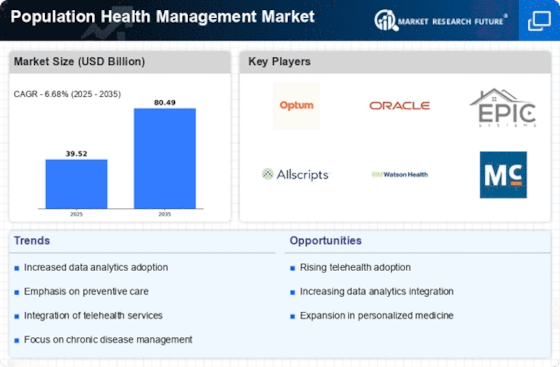
Market Trends
Introduction
In the year 2024, the population health management market is experiencing significant changes due to a confluence of macro-factors. The technological progress, especially in data analytics and artificial intelligence, enables the health care system to use the vast amount of patient data for better decision-making and more individual care. Regulations are driving organizations to focus on outcomes rather than volume. The changing behavior of the patients, who are more and more looking for preventive and preventive solutions, is reshaping the service delivery. These macro-factors are strategically important for the actors in the market, which have to navigate in a rapidly changing environment and focus on innovations that increase patient engagement and efficiency.
Top Trends
-
Integration of AI and Machine Learning
Artificial intelligence and machine learning are increasingly used in population health management to improve the accuracy of forecasts. For example, IBM Watson Health has developed algorithms that analyze patient data and make predictions about the health outcomes. According to a study, using artificial intelligence in the prevention of hospital readmissions can reduce the rate by up to 20 percent. The trend is expected to optimize processes and significantly improve the quality of care. -
Telehealth Expansion
During the epidemic of Covid-19, telehealth care grew at a rapid rate, with a reported increase of 154 percent in the number of telehealth consultations in 2020. In the United States, for example, UnitedHealth Group has been able to increase its telehealth services, which have allowed more people in the country to have access to care. In the future, this trend will probably continue, enhancing patient participation and reducing costs through remote monitoring and consultation. -
Value-Based Care Models
There is a significant trend towards value-based care, whereby the reimbursement is based on the results achieved rather than the services rendered. Among the pioneers in this field is Anthem, Inc., which has reported higher patient satisfaction and lower costs. It is expected that this trend will lead to improved efficiency and a greater emphasis on preventive care. -
Data Interoperability Initiatives
Interoperability efforts are growing, including the ONC’s Interoperability Roadmap. Actively working on solutions to facilitate seamless data exchange are Cerner and Epic. In the future, increased interoperability is expected to lead to improved care coordination, increased patient safety, and ultimately better health outcomes. -
Social Determinants of Health (SDOH) Integration
Social determinants of health (SDOH) are increasingly used by companies in their health management strategies. Tools for analyzing the SDOH have been developed by HealthCatalyst, which lead to targeted interventions. This trend is expected to promote health equity and improve population health by addressing the causes of health inequalities. -
Patient Engagement Technologies
HEALTH TECHNOLOGY APPS AND PORTALS IN POPULATION HEALTH MANAGEMENT OPTIMUM APPS AND PORTALS IN POPULATION HEALTH MANAGEMENT OPTIMUM The trend towards patient participation in health management is a trend that will likely improve patient satisfaction and health outcomes, as patients who are engaged in their care are more likely to be active participants in their care. -
Chronic Disease Management Programs
Chronic diseases are a priority for the health system. Medtronic has implemented remote monitoring programs to help manage diabetes effectively. This trend is expected to lead to better health outcomes and reduced health costs, as it can prevent complications. -
Regulatory Compliance and Reporting
The requirements of the regulatory bodies are becoming more and more demanding. As a result, the population health management systems of the hospitals are increasingly focused on the compliance and reporting capabilities. Change Healthcare has developed solutions that make it easier to meet the requirements. This trend will lead to increased operational efficiency and reduced risks of non-compliance. -
Personalized Medicine Approaches
Personalized medicine is influencing population health management by tailoring treatments to the characteristics of individual patients. The first to use genomics to guide treatment is Verily Life Sciences. This is expected to lead to better outcomes for patients, as a result of more targeted treatments. -
Collaboration Across Healthcare Ecosystems
The health care system is now a complex, interconnected system of which collaboration between different players is becoming a necessity for effective population health management. The MCKESSON Institute and other key players are forming strategic alliances to share data and resources. This will improve care coordination and resource allocation and ultimately lead to improved population health.
Conclusion: Navigating the Competitive Landscape Ahead
As we look ahead to 2024, the population health management market is characterized by a highly competitive environment and significant fragmentation, with a mix of established and new players. The geographical trends we are seeing point to a growing focus on solutions tailored to the needs of specific populations, which will push vendors to adopt new strategies. Using their established distribution channels, the older players are integrating new features such as artificial intelligence and automation into their solutions. While the new players are focusing on flexibility and scalability to differentiate themselves in a crowded marketplace. To be a leader in this market, vendors must harness the power of artificial intelligence for data analysis, implement automation to optimize operations, and commit to sustainable practices. We have mapped these capabilities to help you better understand the landscape and capitalize on emerging opportunities.





















Leave a Comment