Request Free Sample ×

Kindly complete the form below to receive a free sample of this Report

* Please use a valid business email

Leading companies partner with us for data-driven Insights

clients tt-cursor
Hero Background
English
Chinese
French
Japanese
Korean
German
Spanish

Polymer Chameleons Market Size

ID: MRFR/CnM/1541-HCR
111 Pages
Anshula Mandaokar
March 2026

Global Polymer Chameleons Market Research Report Information by Type (Ph Responsive, Electric & Magnetic-Responsive, Photo-Responsive, Shape Memory, Enzyme-Responsive, Self-Healing, Thermo-Responsive, and Others), Application (Drug Delivery, Molecular Separation, Flexible Chips, Biofilms, Automotive & Transportation, and Others), and Region (North America, Europe, Asia-Pacific, Latin America, and Middle East & Africa)—Forecast till 2035

Share:
Download PDF ×

We do not share your information with anyone. However, we may send you emails based on your report interest from time to time. You may contact us at any time to opt-out.

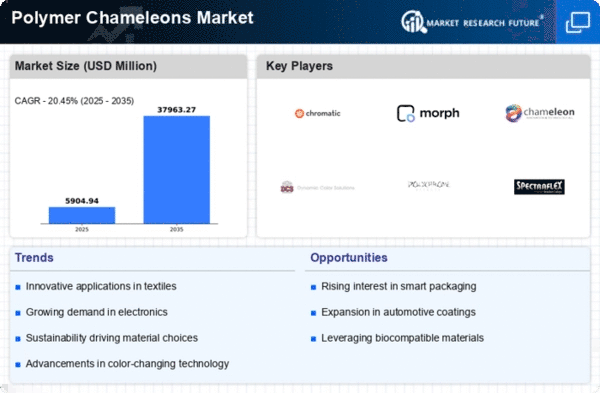
Polymer Chameleons Market Infographic
Purchase Options

Polymer Chameleons Size

Polymer Chameleons Market Growth Projections and Opportunities

It is a well-known property of smart materials called polymer chameleons that they can change color in response to outside factors like temperature, pH, or light. Some of these polymers can change their structure, shape, or other properties when they are exposed to their surroundings. These changes can be undone. Responding polymers and smart materials are becoming more popular in many fields, such as healthcare, packaging, clothing, and more. This means that polymer chameleons are in high demand. Polymer Chameleons have a considerable market in the biomedical industry, notably in the process of designing drug delivery systems. It is possible to build these polymers such that they release medications in reaction to certain physiological situations inside the body. .This makes it possible for medicines to be distributed in a controlled and measured way. More advanced drug transport methods and personalized medicine solutions are driving the use of polymer chameleons in the health field. Polymer chameleons can change colors to fit different situations, like temperature and moisture. This makes them useful for environmentally friendly packing. This makes it possible to make smart packages that can show if the product has been messed with, how fresh it is, or how it is kept. For the purpose of producing color-changing textiles, the textile industry makes use of polymer chameleon tools. These materials can change color when the temperature changes, which makes clothes and items more creative and fun. The textile industry uses polymer chameleons because users want one-of-a-kind and customized fabrics and the fashion industry wants to add smart and interactive parts. The creation of responsive coatings and intelligent surfaces includes the use of polymer chameleons. These coatings have the ability to adjust to changes in the environment, providing capabilities such as self-healing, anti-fouling, or resistance to corrosion (corrosion resistance).

Maintaining compliance with safety standards and procedures is very necessary for the acceptance and marketing of a product. It is necessary for industry stakeholders to handle regulatory limits, find solutions to safety problems, and work toward the establishment of standards for the use of polymer chameleons in a variety of applications.
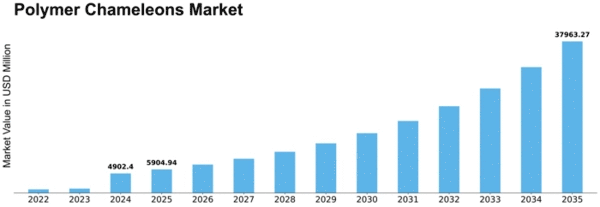
Polymer Chameleons Market Size Graph
Author
Author Profile
Anshula Mandaokar
Team Lead - Research

Anshula Mandaokar holds an academic degree in Chemical Engineering and has been contributing to the field for more than 5 years. She has expertise in Market Research and Business Consulting and serves as a Team Lead for a reputed Market Research firm under the Chemicals and Materials domain spectrum. She has worked on multiple projects, generating explicit results in a quick turnaround time. Her understanding of data interpretation justifies her role as a leader.

Leave a Comment

FAQs

What is the current valuation of the Polymer Chameleons Market?

<p>The Polymer Chameleons Market was valued at 4902.4 USD Million in 2024.</p>

What is the projected market size for the Polymer Chameleons Market by 2035?

<p>The market is projected to reach 37963.27 USD Million by 2035.</p>

What is the expected CAGR for the Polymer Chameleons Market during the forecast period?

<p>The expected CAGR for the Polymer Chameleons Market from 2025 to 2035 is 20.45%.</p>

Which application segment had the highest valuation in 2024?

<p>In 2024, the Medical Devices application segment had the highest valuation at 2902.4 USD Million.</p>

What are the key materials used in the Polymer Chameleons Market?

<p>Key materials include Thermoplastic Elastomers, Polyurethanes, Silicone Polymers, Polyvinyl Chloride, and Polyethylene.</p>

Which end-use segment is projected to grow the most by 2035?

The Fashion end-use segment is projected to grow significantly, reaching 1300.0 USD Million in 2024.

Who are the leading companies in the Polymer Chameleons Market?

Key players include Chromatic Technologies Inc, Nanosys Inc, Mimic Technologies, and BASF SE.

What technology segments are present in the Polymer Chameleons Market?

Technology segments include Electrochromic, Thermochromic, Photochromic, Hydrochromic, and Piezochromic.

How does the Automotive end-use segment perform in terms of valuation?

The Automotive end-use segment was valued at 800.0 USD Million in 2024.

What is the valuation of the Smart Textiles application segment?

The Smart Textiles application segment was valued at 900.0 USD Million in 2024.

Market Summary

As per MRFR analysis, the Polymer Chameleons Market Size was estimated at 4902.4 USD Million in 2024. The Polymer Chameleons industry is projected to grow from 5905.04 USD Million in 2025 to 37963.27 USD Million by 2035, exhibiting a compound annual growth rate (CAGR) of 20.45% during the forecast period 2025 - 2035.

Key Market Trends & Highlights

The Polymer Chameleons Market is poised for substantial growth driven by technological advancements and sustainability initiatives.

  • North America remains the largest market for polymer chameleons, reflecting a robust demand across various applications.

  • The Asia-Pacific region is emerging as the fastest-growing market, fueled by increasing investments in innovative materials.
  • The sensors segment dominates the market, while the medical devices segment is experiencing rapid growth due to advancements in healthcare technology.
  • Rising demand for smart materials and increased investment in research and development are key drivers propelling market expansion.

Market Size & Forecast

2024 Market Size 4902.4 (USD Million)
2035 Market Size 37963.27 (USD Million)
CAGR (2025 - 2035) 20.45%
Largest Regional Market Share in 2024 North America

Major Players

Chromatic Polymer Technologies (US), ColorMorph Inc. (US), Chameleon Innovations (DE), Dynamic Color Solutions (JP), Polychrome Dynamics (FR), SpectraFlex Materials (GB), Adaptive Polymers Ltd. (CA), HueShift Technologies (AU)

Market Trends

The Polymer Chameleons Market is currently experiencing a notable evolution, driven by advancements in material science and increasing demand for adaptive materials across various industries. These innovative polymers, which can change color or properties in response to environmental stimuli, are finding applications in sectors such as textiles, automotive, and consumer electronics. The growing emphasis on sustainability and energy efficiency is also influencing the market, as manufacturers seek to develop products that not only meet functional requirements but also align with eco-friendly practices. As a result, the Polymer Chameleons Market is poised for substantial growth, with ongoing research and development efforts aimed at enhancing the performance and versatility of these materials. In addition to technological advancements, the Polymer Chameleons Market is witnessing a shift in consumer preferences towards personalized and customizable products. This trend is particularly evident in the fashion and home decor industries, where consumers are increasingly seeking unique items that reflect their individual styles. Furthermore, the integration of smart technologies into polymer chameleons is likely to create new opportunities for innovation, as these materials can be utilized in smart textiles and interactive surfaces. Overall, the Polymer Chameleons Market appears to be on a trajectory of dynamic growth, driven by a combination of technological innovation, changing consumer demands, and a focus on sustainability.

Technological Advancements

Recent innovations in polymer chemistry are enhancing the capabilities of chameleonic materials, allowing for more responsive and durable products. These advancements are likely to expand the range of applications across various sectors.

Sustainability Focus

There is a growing emphasis on eco-friendly materials within the Polymer Chameleons Market. Manufacturers are increasingly prioritizing sustainable practices, which may lead to the development of greener alternatives.

Customization Trends

Consumer demand for personalized products is influencing the Polymer Chameleons Market. This trend is particularly strong in fashion and home decor, where unique, adaptable items are becoming more sought after.

Polymer Chameleons Market Market Drivers

Market Growth Projections

The Global Polymer Chameleons Market Industry is projected to experience substantial growth over the coming years. With an anticipated market size of 10.6 USD Billion in 2024, the industry is set to expand significantly, reaching an estimated 38.0 USD Billion by 2035. This growth trajectory, characterized by a compound annual growth rate of 12.3% from 2025 to 2035, reflects the increasing adoption of polymer chameleons across various sectors. The market's expansion is driven by technological advancements, rising consumer demand for smart materials, and a growing emphasis on sustainability, indicating a robust future for the industry.

Growing Environmental Awareness

Growing environmental awareness among consumers and industries contributes to the expansion of the Global Polymer Chameleons Market Industry. As sustainability becomes a priority, there is an increasing demand for eco-friendly materials that minimize environmental impact. Polymer chameleons, often designed to be more sustainable than traditional materials, align with this trend by offering alternatives that reduce waste and energy consumption. This shift towards greener solutions is likely to drive market growth, as companies seek to enhance their sustainability profiles and meet regulatory requirements. The emphasis on environmental responsibility is reshaping product development and consumer choices.

Rising Demand for Smart Materials

The Global Polymer Chameleons Market Industry experiences a surge in demand for smart materials, driven by advancements in technology and consumer preferences for innovative products. These materials, which can change color or properties in response to environmental stimuli, find applications in various sectors, including automotive, textiles, and electronics. As industries increasingly adopt these materials, the market is projected to reach 10.6 USD Billion in 2024, reflecting a growing recognition of the benefits of polymer chameleons. This trend indicates a shift towards more sustainable and adaptive materials, potentially enhancing product functionality and aesthetic appeal.

Diverse Applications Across Industries

The Global Polymer Chameleons Market Industry benefits from diverse applications across various sectors, including automotive, healthcare, and consumer goods. The versatility of polymer chameleons allows for their integration into products ranging from color-changing textiles to smart packaging solutions. This broad applicability enhances market potential, as different industries recognize the advantages of using responsive materials. As demand for innovative and functional products rises, the market is poised for growth, driven by the need for materials that can adapt to changing conditions and consumer preferences. This diversity in applications is a key factor in the industry's expansion.

Technological Advancements in Polymer Science

Technological advancements in polymer science significantly influence the Global Polymer Chameleons Market Industry. Innovations in synthesis and processing techniques enable the development of more efficient and versatile polymer chameleons. These advancements facilitate the creation of materials with enhanced responsiveness and durability, catering to diverse applications. As a result, the market is expected to grow at a compound annual growth rate of 12.3% from 2025 to 2035, potentially reaching 38.0 USD Billion by 2035. This growth underscores the importance of continuous research and development in driving market expansion and meeting evolving consumer demands.

Increased Investment in Research and Development

Increased investment in research and development plays a crucial role in the Global Polymer Chameleons Market Industry. Governments and private entities are allocating substantial resources to explore new applications and improve existing technologies related to polymer chameleons. This investment not only fosters innovation but also enhances the competitiveness of the industry on a global scale. As a result, the market is likely to witness significant growth, driven by the introduction of novel products and solutions that meet the needs of various sectors. This trend indicates a robust commitment to advancing polymer technology and expanding its applications.

Market Segment Insights

By Application: Color Changing Coatings (Largest) vs. Smart Textiles (Fastest-Growing)

<p>In the Polymer Chameleons Market, Color Changing Coatings hold the largest market share due to their diverse applications in automotive, architectural, and consumer goods. This segment benefits from increasing consumer preferences for personalized and dynamic aesthetics, which drive demand across various industries. Conversely, Smart Textiles are emerging as a significant force within the market, leveraging advancements in technology and material science to achieve seamless integration into everyday clothing and gear. These textiles enhance functionality while appealing to consumers interested in innovative clothing solutions.</p>

<p>Smart Textiles (Dominant) vs. Medical Devices (Emerging)</p>

<p>Smart Textiles represent a dominant trend in the Polymer Chameleons Market through their ability to respond to environmental stimuli and integrate electronics for functional outputs. This segment is characterized by its versatility across different applications, ranging from sportswear to health-monitoring clothing, appealing to both tech-savvy consumers and industries focused on wellness. On the other hand, Medical Devices are considered an emerging segment, leveraging polymer chameleon technology to enhance patient diagnostics and treatment. Although still developing, this segment shows promise for transformative solutions in healthcare, particularly in wearable devices that monitor physiological parameters.</p>

By End Use: Automotive (Largest) vs. Healthcare (Fastest-Growing)

<p>In the Polymer Chameleons Market, the end-use segment is notably diverse, with automotive applications holding the largest market share. Automotive applications leverage these innovative materials for a variety of components, enhancing performance and aesthetics. Meanwhile, healthcare is emerging rapidly, driven by the increasing demand for advanced medical devices and smart polymers that adapt to environmental stimuli. This dynamic landscape showcases the significant roles different sectors play in advancing polymer technologies.</p>

<p>Healthcare: Smart Applications (Dominant) vs. Fashion: Trendy Innovations (Emerging)</p>

<p>In the healthcare sector, smart applications of polymer chameleons dominate through their ability to respond to changes in conditions, making them invaluable in medical devices and diagnostics. These materials can enhance drug delivery systems, wound dressings, and implants by providing controlled responses to environmental stimuli. Meanwhile, in the fashion industry, the focus is on trendy innovations that integrate polymer chameleons into fabrics and clothing, appealing to environmentally conscious consumers seeking customizable and adaptive clothing options. As these segments evolve, healthcare maintains its robust position, while fashion is swiftly adapting to incorporate cutting-edge technological advancements.</p>

By Material Type: Thermoplastic Elastomers (Largest) vs. Polyurethanes (Fastest-Growing)

<p>The Polymer Chameleons Market exhibits a diverse distribution of material types, with <a href="https://www.marketresearchfuture.com/reports/thermoplastic-elastomers-market-6344" target="_blank" title="thermoplastic elastomers">Thermoplastic Elastomers</a> dominating the segment due to their versatile applications and superior performance characteristics. This material type is widely preferred for its adaptability and suitability across various industries, including automotive and consumer goods. Polyurethanes, while smaller in market share, are rapidly gaining traction due to their flexibility, durability, and the innovative applications they can support in construction and furniture sectors. The growth trends for this segment are influenced by several factors, including the increasing demand for lightweight materials in the automotive industry and advancements in manufacturing technologies. Driven by sustainability concerns, there is a notable shift towards materials like Polyurethanes which align with eco-friendly practices. Additionally, the push for innovation in product design and functionality is propelling the growth of Thermoplastic Elastomers, marking a dynamic evolution in the market landscape.</p>

<p>Thermoplastic Elastomers (Dominant) vs. Polyurethanes (Emerging)</p>

<p>Thermoplastic <a href="https://www.marketresearchfuture.com/reports/elastomers-market-8342" target="_blank" title="elastomers">Elastomers</a> (TPEs) are known for their rubber-like properties, providing flexibility and resilience, which makes them dominant in applications where both durability and comfort are essential. Industries such as automotive and consumer electronics favor TPEs for their ease of processing and ability to be molded into complex shapes. Meanwhile, Polyurethanes are emerging as a versatile alternative, exhibiting superior mechanical properties and adaptability. Their applications span from insulation materials in building construction to cushioning in furniture, making them increasingly popular. The versatility and eco-friendly innovations associated with Polyurethanes reflect a shifting consumer demand towards more sustainable options without compromising on quality.</p>

By Technology: Electrochromic (Largest) vs. Thermochromic (Fastest-Growing)

In the Polymer Chameleons Market, the technology segment is led by electrochromic materials, which account for a significant portion of the market share due to their advanced functionalities and wide array of applications, including smart windows and displays. In contrast, thermochromic technologies are rapidly gaining traction, driven by their unique ability to change color in response to temperature fluctuations, which creates strong opportunities for diverse industries, including textiles and packaging.

Technology: Electrochromic (Dominant) vs. Thermochromic (Emerging)

Electrochromic technology represents the dominant force within the Polymer Chameleons Market, providing significant advantages in energy efficiency and aesthetic appeal, making it a favorable choice for various architectural applications. This segment's robust growth is attributed to advancements in polymer materials that enhance responsiveness and durability. On the other hand, thermochromic materials are emerging as a vibrant player, leveraging their capacity to offer functional solutions in everyday products, particularly in temperature-sensitive applications. As consumer awareness about sustainability increases, the demand for thermochromic solutions is likely to rise, indicating strong growth potential in this segment. Both technologies exhibit unique properties that cater to specific market needs, reinforcing their positions in this evolving landscape.

Get more detailed insights about Polymer Chameleons Market Research Report - Global Forecast till 2035

Regional Insights

North America : Market Leader in Innovation

North America continues to lead the Polymer Chameleons market, holding a significant share of 2450.0M in 2024. The region's growth is driven by increasing demand for advanced materials in automotive, aerospace, and consumer goods. Regulatory support for sustainable materials and innovations in polymer technology further catalyze market expansion. The focus on eco-friendly solutions is reshaping consumer preferences, pushing manufacturers to adapt and innovate. The competitive landscape in North America is robust, featuring key players like Chromatic Polymer Technologies and ColorMorph Inc. These companies are at the forefront of research and development, driving technological advancements. The presence of established firms and a strong supply chain network enhances market dynamics, making North America a hub for polymer innovation. The region's investment in R&D is expected to sustain its market leadership in the coming years.

Europe : Emerging Market with Potential

Europe's Polymer Chameleons market is poised for growth, with a market size of 1300.0M. The region benefits from stringent regulations promoting sustainable materials, which drive demand for innovative polymer solutions. Countries like Germany and France are leading the charge, supported by government initiatives aimed at enhancing material efficiency and reducing environmental impact. The focus on circular economy principles is also a significant driver of market growth. The competitive landscape in Europe is characterized by key players such as Chameleon Innovations and Polychrome Dynamics. These companies are leveraging advanced technologies to meet the evolving needs of various industries, including packaging and automotive. The presence of a skilled workforce and strong research institutions further bolsters the region's market position. As stated by the European Commission, "The transition to sustainable materials is essential for the future of our economy."

Asia-Pacific : Rapidly Growing Market

The Asia-Pacific region is witnessing a surge in the Polymer Chameleons market, with a size of 950.0M. This growth is fueled by increasing industrialization and urbanization, particularly in countries like Japan and China. The demand for innovative materials in electronics and automotive sectors is driving market expansion. Additionally, supportive government policies aimed at enhancing manufacturing capabilities are further propelling growth in this region. The competitive landscape is evolving, with companies like Dynamic Color Solutions and HueShift Technologies emerging as key players. These firms are focusing on R&D to develop advanced polymer solutions tailored to local market needs. The region's diverse consumer base and growing middle class are also contributing to the rising demand for polymer products. However, challenges such as regulatory compliance and market fragmentation remain significant hurdles.

Middle East and Africa : Emerging Market Opportunities

The Middle East and Africa region is gradually emerging in the Polymer Chameleons market, currently valued at 202.4M. The growth is driven by increasing investments in infrastructure and manufacturing, particularly in the UAE and South Africa. The demand for innovative materials in construction and automotive sectors is on the rise, supported by government initiatives aimed at diversifying economies and enhancing local production capabilities. The competitive landscape is still developing, with local players beginning to establish their presence. Companies are focusing on partnerships and collaborations to enhance their market reach. The region's unique challenges, such as regulatory hurdles and market access, are being addressed through strategic initiatives. As noted by the African Development Bank, "Investments in innovative materials are crucial for sustainable development in Africa."

Key Players and Competitive Insights

The Polymer Chameleons Market is currently characterized by a dynamic competitive landscape, driven by innovation and technological advancements. Key players such as Chromatic Polymer Technologies (US), ColorMorph Inc. (US), and Chameleon Innovations (DE) are at the forefront, each adopting distinct strategies to enhance their market positioning. Chromatic Polymer Technologies (US) focuses on developing advanced materials that respond to environmental stimuli, while ColorMorph Inc. (US) emphasizes partnerships with tech firms to integrate digital solutions into their product offerings. Chameleon Innovations (DE) is leveraging its expertise in sustainable materials, which appears to resonate well with the growing demand for eco-friendly solutions. Collectively, these strategies contribute to a competitive environment that is increasingly centered around innovation and sustainability.In terms of business tactics, companies are localizing manufacturing to reduce lead times and optimize supply chains. The market structure is moderately fragmented, with several players vying for market share, yet the influence of major companies is palpable. This fragmentation allows for niche players to emerge, but the collective strength of key players like Dynamic Color Solutions (JP) and Polychrome Dynamics (FR) ensures that competition remains robust. These companies are actively pursuing supply chain efficiencies and localized production to enhance their responsiveness to market demands.

In November Dynamic Color Solutions (JP) announced a strategic partnership with a leading AI firm to develop smart polymer chameleons that can adapt in real-time to environmental changes. This move is significant as it positions the company at the intersection of material science and digital technology, potentially setting a new standard for responsiveness in the market. The integration of AI into their product line could lead to enhanced functionality and broaden their application scope across various industries.

In October Polychrome Dynamics (FR) launched a new line of eco-friendly polymer chameleons, which utilize biodegradable materials. This initiative not only aligns with global sustainability trends but also caters to a growing consumer base that prioritizes environmental responsibility. The strategic importance of this launch lies in its potential to capture market share from competitors who have yet to adopt sustainable practices, thereby reinforcing Polychrome Dynamics' position as a leader in innovation.

In September ColorMorph Inc. (US) expanded its operations into the Asian market by establishing a manufacturing facility in Vietnam. This expansion is indicative of the company's strategy to localize production and reduce costs, while also tapping into the rapidly growing demand for polymer chameleons in the region. Such moves are likely to enhance their competitive edge and allow for more agile responses to market fluctuations.

As of December the competitive trends in the Polymer Chameleons Market are increasingly defined by digitalization, sustainability, and the integration of AI technologies. Strategic alliances are becoming more prevalent, as companies recognize the value of collaboration in driving innovation. The shift from price-based competition to a focus on technological advancement and supply chain reliability is evident. Moving forward, differentiation will likely hinge on the ability to innovate and adapt to changing consumer preferences, with a strong emphasis on sustainable practices and advanced technological integration.

Key Companies in the Polymer Chameleons Market include

Industry Developments

May 2021 -

Scientists have developed a synthetic skin that changes color in reaction to the environment using luminogens and a bilayer structure. The new chameleon-like skin was created to identify the freshness of seafood, but the technology might be utilized for various purposes. A single layer matrix of different light-sensitive molecules creates the most color-changing synthetic skins. Researchers used luminogens, compounds that cause crystals to illuminate, coat two hydrogel layers — an inner core and an outer shell — for the new material. Scholars could generate a more complicated variety of color shifts and patterns by grouping luminogens into two layers.

Intended Audience:
    • Manufacturers and distributors of polymer chameleons
    • Suppliers and traders of polymer chameleons
    • Government, associations, and industrial bodies
    • Investors and trade experts
    • Consulting in chemical experts
    • Healthcare sector
    • R&D sectors
    • Raw material suppliers
    • Potential investors

Future Outlook

Polymer Chameleons Market Future Outlook

The Polymer Chameleons Market is projected to grow at a 20.45% CAGR from 2025 to 2035, driven by advancements in material science and increasing demand for adaptive materials.

New opportunities lie in:

  • Development of smart textiles incorporating polymer chameleons
  • Integration of polymer chameleons in automotive applications
  • Expansion into consumer electronics for customizable aesthetics

By 2035, the market is expected to achieve substantial growth, positioning itself as a leader in innovative material solutions.

Market Segmentation

Polymer Chameleons Market End Use Outlook

  • Consumer Electronics
  • Automotive
  • Aerospace
  • Healthcare
  • Industrial

Polymer Chameleons Market Technology Outlook

  • Electrochromic
  • Thermochromic
  • Photochromic
  • Hydrochromic
  • Piezochromic

Polymer Chameleons Market Application Outlook

  • Sensors
  • Displays
  • Coatings
  • Textiles
  • Medical Devices

Polymer Chameleons Market Material Type Outlook

  • Thermoplastics
  • Thermosetting Polymers
  • Elastomers
  • Biodegradable Polymers
  • Conductive Polymers

Report Scope

MARKET SIZE 2024 4902.4(USD Million)
MARKET SIZE 2025 5905.04(USD Million)
MARKET SIZE 2035 37963.27(USD Million)
COMPOUND ANNUAL GROWTH RATE (CAGR) 20.45% (2025 - 2035)
REPORT COVERAGE Revenue Forecast, Competitive Landscape, Growth Factors, and Trends
BASE YEAR 2024
Market Forecast Period 2025 - 2035
Historical Data 2019 - 2024
Market Forecast Units USD Million
Key Companies Profiled Chromatic Polymer Technologies (US), ColorMorph Inc. (US), Chameleon Innovations (DE), Dynamic Color Solutions (JP), Polychrome Dynamics (FR), SpectraFlex Materials (GB), Adaptive Polymers Ltd. (CA), HueShift Technologies (AU)
Segments Covered Application, End Use, Material Type, Technology
Key Market Opportunities Advancements in smart materials drive innovation in the Polymer Chameleons Market for diverse applications.
Key Market Dynamics Rising demand for adaptive materials drives innovation and competition in the Polymer Chameleons Market.
Countries Covered North America, Europe, APAC, South America, MEA

FAQs

What is the current valuation of the Polymer Chameleons Market?

<p>The Polymer Chameleons Market was valued at 4902.4 USD Million in 2024.</p>

What is the projected market size for the Polymer Chameleons Market by 2035?

<p>The market is projected to reach 37963.27 USD Million by 2035.</p>

What is the expected CAGR for the Polymer Chameleons Market during the forecast period?

<p>The expected CAGR for the Polymer Chameleons Market from 2025 to 2035 is 20.45%.</p>

Which application segment had the highest valuation in 2024?

<p>In 2024, the Medical Devices application segment had the highest valuation at 2902.4 USD Million.</p>

What are the key materials used in the Polymer Chameleons Market?

<p>Key materials include Thermoplastic Elastomers, Polyurethanes, Silicone Polymers, Polyvinyl Chloride, and Polyethylene.</p>

Which end-use segment is projected to grow the most by 2035?

The Fashion end-use segment is projected to grow significantly, reaching 1300.0 USD Million in 2024.

Who are the leading companies in the Polymer Chameleons Market?

Key players include Chromatic Technologies Inc, Nanosys Inc, Mimic Technologies, and BASF SE.

What technology segments are present in the Polymer Chameleons Market?

Technology segments include Electrochromic, Thermochromic, Photochromic, Hydrochromic, and Piezochromic.

How does the Automotive end-use segment perform in terms of valuation?

The Automotive end-use segment was valued at 800.0 USD Million in 2024.

What is the valuation of the Smart Textiles application segment?

The Smart Textiles application segment was valued at 900.0 USD Million in 2024.

  1. SECTION I: EXECUTIVE SUMMARY AND KEY HIGHLIGHTS
    1. | 1.1 EXECUTIVE SUMMARY
    2. | | 1.1.1 Market Overview
    3. | | 1.1.2 Key Findings
    4. | | 1.1.3 Market Segmentation
    5. | | 1.1.4 Competitive Landscape
    6. | | 1.1.5 Challenges and Opportunities
    7. | | 1.1.6 Future Outlook
  2. SECTION II: SCOPING, METHODOLOGY AND MARKET STRUCTURE
    1. | 2.1 MARKET INTRODUCTION
    2. | | 2.1.1 Definition
    3. | | 2.1.2 Scope of the study
    4. | | | 2.1.2.1 Research Objective
    5. | | | 2.1.2.2 Assumption
    6. | | | 2.1.2.3 Limitations
    7. | 2.2 RESEARCH METHODOLOGY
    8. | | 2.2.1 Overview
    9. | | 2.2.2 Data Mining
    10. | | 2.2.3 Secondary Research
    11. | | 2.2.4 Primary Research
    12. | | | 2.2.4.1 Primary Interviews and Information Gathering Process
    13. | | | 2.2.4.2 Breakdown of Primary Respondents
    14. | | 2.2.5 Forecasting Model
    15. | | 2.2.6 Market Size Estimation
    16. | | | 2.2.6.1 Bottom-Up Approach
    17. | | | 2.2.6.2 Top-Down Approach
    18. | | 2.2.7 Data Triangulation
    19. | | 2.2.8 Validation
  3. SECTION III: QUALITATIVE ANALYSIS
    1. | 3.1 MARKET DYNAMICS
    2. | | 3.1.1 Overview
    3. | | 3.1.2 Drivers
    4. | | 3.1.3 Restraints
    5. | | 3.1.4 Opportunities
    6. | 3.2 MARKET FACTOR ANALYSIS
    7. | | 3.2.1 Value chain Analysis
    8. | | 3.2.2 Porter's Five Forces Analysis
    9. | | | 3.2.2.1 Bargaining Power of Suppliers
    10. | | | 3.2.2.2 Bargaining Power of Buyers
    11. | | | 3.2.2.3 Threat of New Entrants
    12. | | | 3.2.2.4 Threat of Substitutes
    13. | | | 3.2.2.5 Intensity of Rivalry
    14. | | 3.2.3 COVID-19 Impact Analysis
    15. | | | 3.2.3.1 Market Impact Analysis
    16. | | | 3.2.3.2 Regional Impact
    17. | | | 3.2.3.3 Opportunity and Threat Analysis
  4. SECTION IV: QUANTITATIVE ANALYSIS
    1. | 4.1 Chemicals and Materials, BY Application (USD Million)
    2. | | 4.1.1 Color Changing Coatings
    3. | | 4.1.2 Smart Textiles
    4. | | 4.1.3 Sensors
    5. | | 4.1.4 Displays
    6. | | 4.1.5 Medical Devices
    7. | 4.2 Chemicals and Materials, BY End Use (USD Million)
    8. | | 4.2.1 Automotive
    9. | | 4.2.2 Aerospace
    10. | | 4.2.3 Consumer Electronics
    11. | | 4.2.4 Healthcare
    12. | | 4.2.5 Fashion
    13. | 4.3 Chemicals and Materials, BY Material Type (USD Million)
    14. | | 4.3.1 Thermoplastic Elastomers
    15. | | 4.3.2 Polyurethanes
    16. | | 4.3.3 Silicone Polymers
    17. | | 4.3.4 Polyvinyl Chloride
    18. | | 4.3.5 Polyethylene
    19. | 4.4 Chemicals and Materials, BY Technology (USD Million)
    20. | | 4.4.1 Electrochromic
    21. | | 4.4.2 Thermochromic
    22. | | 4.4.3 Photochromic
    23. | | 4.4.4 Hydrochromic
    24. | | 4.4.5 Piezochromic
    25. | 4.5 Chemicals and Materials, BY Region (USD Million)
    26. | | 4.5.1 North America
    27. | | | 4.5.1.1 US
    28. | | | 4.5.1.2 Canada
    29. | | 4.5.2 Europe
    30. | | | 4.5.2.1 Germany
    31. | | | 4.5.2.2 UK
    32. | | | 4.5.2.3 France
    33. | | | 4.5.2.4 Russia
    34. | | | 4.5.2.5 Italy
    35. | | | 4.5.2.6 Spain
    36. | | | 4.5.2.7 Rest of Europe
    37. | | 4.5.3 APAC
    38. | | | 4.5.3.1 China
    39. | | | 4.5.3.2 India
    40. | | | 4.5.3.3 Japan
    41. | | | 4.5.3.4 South Korea
    42. | | | 4.5.3.5 Malaysia
    43. | | | 4.5.3.6 Thailand
    44. | | | 4.5.3.7 Indonesia
    45. | | | 4.5.3.8 Rest of APAC
    46. | | 4.5.4 South America
    47. | | | 4.5.4.1 Brazil
    48. | | | 4.5.4.2 Mexico
    49. | | | 4.5.4.3 Argentina
    50. | | | 4.5.4.4 Rest of South America
    51. | | 4.5.5 MEA
    52. | | | 4.5.5.1 GCC Countries
    53. | | | 4.5.5.2 South Africa
    54. | | | 4.5.5.3 Rest of MEA
  5. SECTION V: COMPETITIVE ANALYSIS
    1. | 5.1 Competitive Landscape
    2. | | 5.1.1 Overview
    3. | | 5.1.2 Competitive Analysis
    4. | | 5.1.3 Market share Analysis
    5. | | 5.1.4 Major Growth Strategy in the Chemicals and Materials
    6. | | 5.1.5 Competitive Benchmarking
    7. | | 5.1.6 Leading Players in Terms of Number of Developments in the Chemicals and Materials
    8. | | 5.1.7 Key developments and growth strategies
    9. | | | 5.1.7.1 New Product Launch/Service Deployment
    10. | | | 5.1.7.2 Merger & Acquisitions
    11. | | | 5.1.7.3 Joint Ventures
    12. | | 5.1.8 Major Players Financial Matrix
    13. | | | 5.1.8.1 Sales and Operating Income
    14. | | | 5.1.8.2 Major Players R&D Expenditure. 2023
    15. | 5.2 Company Profiles
    16. | | 5.2.1 Chromatic Technologies Inc (US)
    17. | | | 5.2.1.1 Financial Overview
    18. | | | 5.2.1.2 Products Offered
    19. | | | 5.2.1.3 Key Developments
    20. | | | 5.2.1.4 SWOT Analysis
    21. | | | 5.2.1.5 Key Strategies
    22. | | 5.2.2 Nanosys Inc (US)
    23. | | | 5.2.2.1 Financial Overview
    24. | | | 5.2.2.2 Products Offered
    25. | | | 5.2.2.3 Key Developments
    26. | | | 5.2.2.4 SWOT Analysis
    27. | | | 5.2.2.5 Key Strategies
    28. | | 5.2.3 Mimic Technologies (US)
    29. | | | 5.2.3.1 Financial Overview
    30. | | | 5.2.3.2 Products Offered
    31. | | | 5.2.3.3 Key Developments
    32. | | | 5.2.3.4 SWOT Analysis
    33. | | | 5.2.3.5 Key Strategies
    34. | | 5.2.4 Smart Materials (GB)
    35. | | | 5.2.4.1 Financial Overview
    36. | | | 5.2.4.2 Products Offered
    37. | | | 5.2.4.3 Key Developments
    38. | | | 5.2.4.4 SWOT Analysis
    39. | | | 5.2.4.5 Key Strategies
    40. | | 5.2.5 Colorifix (GB)
    41. | | | 5.2.5.1 Financial Overview
    42. | | | 5.2.5.2 Products Offered
    43. | | | 5.2.5.3 Key Developments
    44. | | | 5.2.5.4 SWOT Analysis
    45. | | | 5.2.5.5 Key Strategies
    46. | | 5.2.6 Elekta (SE)
    47. | | | 5.2.6.1 Financial Overview
    48. | | | 5.2.6.2 Products Offered
    49. | | | 5.2.6.3 Key Developments
    50. | | | 5.2.6.4 SWOT Analysis
    51. | | | 5.2.6.5 Key Strategies
    52. | | 5.2.7 BASF SE (DE)
    53. | | | 5.2.7.1 Financial Overview
    54. | | | 5.2.7.2 Products Offered
    55. | | | 5.2.7.3 Key Developments
    56. | | | 5.2.7.4 SWOT Analysis
    57. | | | 5.2.7.5 Key Strategies
    58. | | 5.2.8 3M Company (US)
    59. | | | 5.2.8.1 Financial Overview
    60. | | | 5.2.8.2 Products Offered
    61. | | | 5.2.8.3 Key Developments
    62. | | | 5.2.8.4 SWOT Analysis
    63. | | | 5.2.8.5 Key Strategies
    64. | 5.3 Appendix
    65. | | 5.3.1 References
    66. | | 5.3.2 Related Reports
  6. LIST OF FIGURES
    1. | 6.1 MARKET SYNOPSIS
    2. | 6.2 NORTH AMERICA MARKET ANALYSIS
    3. | 6.3 US MARKET ANALYSIS BY APPLICATION
    4. | 6.4 US MARKET ANALYSIS BY END USE
    5. | 6.5 US MARKET ANALYSIS BY MATERIAL TYPE
    6. | 6.6 US MARKET ANALYSIS BY TECHNOLOGY
    7. | 6.7 CANADA MARKET ANALYSIS BY APPLICATION
    8. | 6.8 CANADA MARKET ANALYSIS BY END USE
    9. | 6.9 CANADA MARKET ANALYSIS BY MATERIAL TYPE
    10. | 6.10 CANADA MARKET ANALYSIS BY TECHNOLOGY
    11. | 6.11 EUROPE MARKET ANALYSIS
    12. | 6.12 GERMANY MARKET ANALYSIS BY APPLICATION
    13. | 6.13 GERMANY MARKET ANALYSIS BY END USE
    14. | 6.14 GERMANY MARKET ANALYSIS BY MATERIAL TYPE
    15. | 6.15 GERMANY MARKET ANALYSIS BY TECHNOLOGY
    16. | 6.16 UK MARKET ANALYSIS BY APPLICATION
    17. | 6.17 UK MARKET ANALYSIS BY END USE
    18. | 6.18 UK MARKET ANALYSIS BY MATERIAL TYPE
    19. | 6.19 UK MARKET ANALYSIS BY TECHNOLOGY
    20. | 6.20 FRANCE MARKET ANALYSIS BY APPLICATION
    21. | 6.21 FRANCE MARKET ANALYSIS BY END USE
    22. | 6.22 FRANCE MARKET ANALYSIS BY MATERIAL TYPE
    23. | 6.23 FRANCE MARKET ANALYSIS BY TECHNOLOGY
    24. | 6.24 RUSSIA MARKET ANALYSIS BY APPLICATION
    25. | 6.25 RUSSIA MARKET ANALYSIS BY END USE
    26. | 6.26 RUSSIA MARKET ANALYSIS BY MATERIAL TYPE
    27. | 6.27 RUSSIA MARKET ANALYSIS BY TECHNOLOGY
    28. | 6.28 ITALY MARKET ANALYSIS BY APPLICATION
    29. | 6.29 ITALY MARKET ANALYSIS BY END USE
    30. | 6.30 ITALY MARKET ANALYSIS BY MATERIAL TYPE
    31. | 6.31 ITALY MARKET ANALYSIS BY TECHNOLOGY
    32. | 6.32 SPAIN MARKET ANALYSIS BY APPLICATION
    33. | 6.33 SPAIN MARKET ANALYSIS BY END USE
    34. | 6.34 SPAIN MARKET ANALYSIS BY MATERIAL TYPE
    35. | 6.35 SPAIN MARKET ANALYSIS BY TECHNOLOGY
    36. | 6.36 REST OF EUROPE MARKET ANALYSIS BY APPLICATION
    37. | 6.37 REST OF EUROPE MARKET ANALYSIS BY END USE
    38. | 6.38 REST OF EUROPE MARKET ANALYSIS BY MATERIAL TYPE
    39. | 6.39 REST OF EUROPE MARKET ANALYSIS BY TECHNOLOGY
    40. | 6.40 APAC MARKET ANALYSIS
    41. | 6.41 CHINA MARKET ANALYSIS BY APPLICATION
    42. | 6.42 CHINA MARKET ANALYSIS BY END USE
    43. | 6.43 CHINA MARKET ANALYSIS BY MATERIAL TYPE
    44. | 6.44 CHINA MARKET ANALYSIS BY TECHNOLOGY
    45. | 6.45 INDIA MARKET ANALYSIS BY APPLICATION
    46. | 6.46 INDIA MARKET ANALYSIS BY END USE
    47. | 6.47 INDIA MARKET ANALYSIS BY MATERIAL TYPE
    48. | 6.48 INDIA MARKET ANALYSIS BY TECHNOLOGY
    49. | 6.49 JAPAN MARKET ANALYSIS BY APPLICATION
    50. | 6.50 JAPAN MARKET ANALYSIS BY END USE
    51. | 6.51 JAPAN MARKET ANALYSIS BY MATERIAL TYPE
    52. | 6.52 JAPAN MARKET ANALYSIS BY TECHNOLOGY
    53. | 6.53 SOUTH KOREA MARKET ANALYSIS BY APPLICATION
    54. | 6.54 SOUTH KOREA MARKET ANALYSIS BY END USE
    55. | 6.55 SOUTH KOREA MARKET ANALYSIS BY MATERIAL TYPE
    56. | 6.56 SOUTH KOREA MARKET ANALYSIS BY TECHNOLOGY
    57. | 6.57 MALAYSIA MARKET ANALYSIS BY APPLICATION
    58. | 6.58 MALAYSIA MARKET ANALYSIS BY END USE
    59. | 6.59 MALAYSIA MARKET ANALYSIS BY MATERIAL TYPE
    60. | 6.60 MALAYSIA MARKET ANALYSIS BY TECHNOLOGY
    61. | 6.61 THAILAND MARKET ANALYSIS BY APPLICATION
    62. | 6.62 THAILAND MARKET ANALYSIS BY END USE
    63. | 6.63 THAILAND MARKET ANALYSIS BY MATERIAL TYPE
    64. | 6.64 THAILAND MARKET ANALYSIS BY TECHNOLOGY
    65. | 6.65 INDONESIA MARKET ANALYSIS BY APPLICATION
    66. | 6.66 INDONESIA MARKET ANALYSIS BY END USE
    67. | 6.67 INDONESIA MARKET ANALYSIS BY MATERIAL TYPE
    68. | 6.68 INDONESIA MARKET ANALYSIS BY TECHNOLOGY
    69. | 6.69 REST OF APAC MARKET ANALYSIS BY APPLICATION
    70. | 6.70 REST OF APAC MARKET ANALYSIS BY END USE
    71. | 6.71 REST OF APAC MARKET ANALYSIS BY MATERIAL TYPE
    72. | 6.72 REST OF APAC MARKET ANALYSIS BY TECHNOLOGY
    73. | 6.73 SOUTH AMERICA MARKET ANALYSIS
    74. | 6.74 BRAZIL MARKET ANALYSIS BY APPLICATION
    75. | 6.75 BRAZIL MARKET ANALYSIS BY END USE
    76. | 6.76 BRAZIL MARKET ANALYSIS BY MATERIAL TYPE
    77. | 6.77 BRAZIL MARKET ANALYSIS BY TECHNOLOGY
    78. | 6.78 MEXICO MARKET ANALYSIS BY APPLICATION
    79. | 6.79 MEXICO MARKET ANALYSIS BY END USE
    80. | 6.80 MEXICO MARKET ANALYSIS BY MATERIAL TYPE
    81. | 6.81 MEXICO MARKET ANALYSIS BY TECHNOLOGY
    82. | 6.82 ARGENTINA MARKET ANALYSIS BY APPLICATION
    83. | 6.83 ARGENTINA MARKET ANALYSIS BY END USE
    84. | 6.84 ARGENTINA MARKET ANALYSIS BY MATERIAL TYPE
    85. | 6.85 ARGENTINA MARKET ANALYSIS BY TECHNOLOGY
    86. | 6.86 REST OF SOUTH AMERICA MARKET ANALYSIS BY APPLICATION
    87. | 6.87 REST OF SOUTH AMERICA MARKET ANALYSIS BY END USE
    88. | 6.88 REST OF SOUTH AMERICA MARKET ANALYSIS BY MATERIAL TYPE
    89. | 6.89 REST OF SOUTH AMERICA MARKET ANALYSIS BY TECHNOLOGY
    90. | 6.90 MEA MARKET ANALYSIS
    91. | 6.91 GCC COUNTRIES MARKET ANALYSIS BY APPLICATION
    92. | 6.92 GCC COUNTRIES MARKET ANALYSIS BY END USE
    93. | 6.93 GCC COUNTRIES MARKET ANALYSIS BY MATERIAL TYPE
    94. | 6.94 GCC COUNTRIES MARKET ANALYSIS BY TECHNOLOGY
    95. | 6.95 SOUTH AFRICA MARKET ANALYSIS BY APPLICATION
    96. | 6.96 SOUTH AFRICA MARKET ANALYSIS BY END USE
    97. | 6.97 SOUTH AFRICA MARKET ANALYSIS BY MATERIAL TYPE
    98. | 6.98 SOUTH AFRICA MARKET ANALYSIS BY TECHNOLOGY
    99. | 6.99 REST OF MEA MARKET ANALYSIS BY APPLICATION
    100. | 6.100 REST OF MEA MARKET ANALYSIS BY END USE
    101. | 6.101 REST OF MEA MARKET ANALYSIS BY MATERIAL TYPE
    102. | 6.102 REST OF MEA MARKET ANALYSIS BY TECHNOLOGY
    103. | 6.103 KEY BUYING CRITERIA OF CHEMICALS AND MATERIALS
    104. | 6.104 RESEARCH PROCESS OF MRFR
    105. | 6.105 DRO ANALYSIS OF CHEMICALS AND MATERIALS
    106. | 6.106 DRIVERS IMPACT ANALYSIS: CHEMICALS AND MATERIALS
    107. | 6.107 RESTRAINTS IMPACT ANALYSIS: CHEMICALS AND MATERIALS
    108. | 6.108 SUPPLY / VALUE CHAIN: CHEMICALS AND MATERIALS
    109. | 6.109 CHEMICALS AND MATERIALS, BY APPLICATION, 2024 (% SHARE)
    110. | 6.110 CHEMICALS AND MATERIALS, BY APPLICATION, 2024 TO 2035 (USD Million)
    111. | 6.111 CHEMICALS AND MATERIALS, BY END USE, 2024 (% SHARE)
    112. | 6.112 CHEMICALS AND MATERIALS, BY END USE, 2024 TO 2035 (USD Million)
    113. | 6.113 CHEMICALS AND MATERIALS, BY MATERIAL TYPE, 2024 (% SHARE)
    114. | 6.114 CHEMICALS AND MATERIALS, BY MATERIAL TYPE, 2024 TO 2035 (USD Million)
    115. | 6.115 CHEMICALS AND MATERIALS, BY TECHNOLOGY, 2024 (% SHARE)
    116. | 6.116 CHEMICALS AND MATERIALS, BY TECHNOLOGY, 2024 TO 2035 (USD Million)
    117. | 6.117 BENCHMARKING OF MAJOR COMPETITORS
  7. LIST OF TABLES
    1. | 7.1 LIST OF ASSUMPTIONS
    2. | | 7.1.1
    3. | 7.2 North America MARKET SIZE ESTIMATES; FORECAST
    4. | | 7.2.1 BY APPLICATION, 2025-2035 (USD Million)
    5. | | 7.2.2 BY END USE, 2025-2035 (USD Million)
    6. | | 7.2.3 BY MATERIAL TYPE, 2025-2035 (USD Million)
    7. | | 7.2.4 BY TECHNOLOGY, 2025-2035 (USD Million)
    8. | 7.3 US MARKET SIZE ESTIMATES; FORECAST
    9. | | 7.3.1 BY APPLICATION, 2025-2035 (USD Million)
    10. | | 7.3.2 BY END USE, 2025-2035 (USD Million)
    11. | | 7.3.3 BY MATERIAL TYPE, 2025-2035 (USD Million)
    12. | | 7.3.4 BY TECHNOLOGY, 2025-2035 (USD Million)
    13. | 7.4 Canada MARKET SIZE ESTIMATES; FORECAST
    14. | | 7.4.1 BY APPLICATION, 2025-2035 (USD Million)
    15. | | 7.4.2 BY END USE, 2025-2035 (USD Million)
    16. | | 7.4.3 BY MATERIAL TYPE, 2025-2035 (USD Million)
    17. | | 7.4.4 BY TECHNOLOGY, 2025-2035 (USD Million)
    18. | 7.5 Europe MARKET SIZE ESTIMATES; FORECAST
    19. | | 7.5.1 BY APPLICATION, 2025-2035 (USD Million)
    20. | | 7.5.2 BY END USE, 2025-2035 (USD Million)
    21. | | 7.5.3 BY MATERIAL TYPE, 2025-2035 (USD Million)
    22. | | 7.5.4 BY TECHNOLOGY, 2025-2035 (USD Million)
    23. | 7.6 Germany MARKET SIZE ESTIMATES; FORECAST
    24. | | 7.6.1 BY APPLICATION, 2025-2035 (USD Million)
    25. | | 7.6.2 BY END USE, 2025-2035 (USD Million)
    26. | | 7.6.3 BY MATERIAL TYPE, 2025-2035 (USD Million)
    27. | | 7.6.4 BY TECHNOLOGY, 2025-2035 (USD Million)
    28. | 7.7 UK MARKET SIZE ESTIMATES; FORECAST
    29. | | 7.7.1 BY APPLICATION, 2025-2035 (USD Million)
    30. | | 7.7.2 BY END USE, 2025-2035 (USD Million)
    31. | | 7.7.3 BY MATERIAL TYPE, 2025-2035 (USD Million)
    32. | | 7.7.4 BY TECHNOLOGY, 2025-2035 (USD Million)
    33. | 7.8 France MARKET SIZE ESTIMATES; FORECAST
    34. | | 7.8.1 BY APPLICATION, 2025-2035 (USD Million)
    35. | | 7.8.2 BY END USE, 2025-2035 (USD Million)
    36. | | 7.8.3 BY MATERIAL TYPE, 2025-2035 (USD Million)
    37. | | 7.8.4 BY TECHNOLOGY, 2025-2035 (USD Million)
    38. | 7.9 Russia MARKET SIZE ESTIMATES; FORECAST
    39. | | 7.9.1 BY APPLICATION, 2025-2035 (USD Million)
    40. | | 7.9.2 BY END USE, 2025-2035 (USD Million)
    41. | | 7.9.3 BY MATERIAL TYPE, 2025-2035 (USD Million)
    42. | | 7.9.4 BY TECHNOLOGY, 2025-2035 (USD Million)
    43. | 7.10 Italy MARKET SIZE ESTIMATES; FORECAST
    44. | | 7.10.1 BY APPLICATION, 2025-2035 (USD Million)
    45. | | 7.10.2 BY END USE, 2025-2035 (USD Million)
    46. | | 7.10.3 BY MATERIAL TYPE, 2025-2035 (USD Million)
    47. | | 7.10.4 BY TECHNOLOGY, 2025-2035 (USD Million)
    48. | 7.11 Spain MARKET SIZE ESTIMATES; FORECAST
    49. | | 7.11.1 BY APPLICATION, 2025-2035 (USD Million)
    50. | | 7.11.2 BY END USE, 2025-2035 (USD Million)
    51. | | 7.11.3 BY MATERIAL TYPE, 2025-2035 (USD Million)
    52. | | 7.11.4 BY TECHNOLOGY, 2025-2035 (USD Million)
    53. | 7.12 Rest of Europe MARKET SIZE ESTIMATES; FORECAST
    54. | | 7.12.1 BY APPLICATION, 2025-2035 (USD Million)
    55. | | 7.12.2 BY END USE, 2025-2035 (USD Million)
    56. | | 7.12.3 BY MATERIAL TYPE, 2025-2035 (USD Million)
    57. | | 7.12.4 BY TECHNOLOGY, 2025-2035 (USD Million)
    58. | 7.13 APAC MARKET SIZE ESTIMATES; FORECAST
    59. | | 7.13.1 BY APPLICATION, 2025-2035 (USD Million)
    60. | | 7.13.2 BY END USE, 2025-2035 (USD Million)
    61. | | 7.13.3 BY MATERIAL TYPE, 2025-2035 (USD Million)
    62. | | 7.13.4 BY TECHNOLOGY, 2025-2035 (USD Million)
    63. | 7.14 China MARKET SIZE ESTIMATES; FORECAST
    64. | | 7.14.1 BY APPLICATION, 2025-2035 (USD Million)
    65. | | 7.14.2 BY END USE, 2025-2035 (USD Million)
    66. | | 7.14.3 BY MATERIAL TYPE, 2025-2035 (USD Million)
    67. | | 7.14.4 BY TECHNOLOGY, 2025-2035 (USD Million)
    68. | 7.15 India MARKET SIZE ESTIMATES; FORECAST
    69. | | 7.15.1 BY APPLICATION, 2025-2035 (USD Million)
    70. | | 7.15.2 BY END USE, 2025-2035 (USD Million)
    71. | | 7.15.3 BY MATERIAL TYPE, 2025-2035 (USD Million)
    72. | | 7.15.4 BY TECHNOLOGY, 2025-2035 (USD Million)
    73. | 7.16 Japan MARKET SIZE ESTIMATES; FORECAST
    74. | | 7.16.1 BY APPLICATION, 2025-2035 (USD Million)
    75. | | 7.16.2 BY END USE, 2025-2035 (USD Million)
    76. | | 7.16.3 BY MATERIAL TYPE, 2025-2035 (USD Million)
    77. | | 7.16.4 BY TECHNOLOGY, 2025-2035 (USD Million)
    78. | 7.17 South Korea MARKET SIZE ESTIMATES; FORECAST
    79. | | 7.17.1 BY APPLICATION, 2025-2035 (USD Million)
    80. | | 7.17.2 BY END USE, 2025-2035 (USD Million)
    81. | | 7.17.3 BY MATERIAL TYPE, 2025-2035 (USD Million)
    82. | | 7.17.4 BY TECHNOLOGY, 2025-2035 (USD Million)
    83. | 7.18 Malaysia MARKET SIZE ESTIMATES; FORECAST
    84. | | 7.18.1 BY APPLICATION, 2025-2035 (USD Million)
    85. | | 7.18.2 BY END USE, 2025-2035 (USD Million)
    86. | | 7.18.3 BY MATERIAL TYPE, 2025-2035 (USD Million)
    87. | | 7.18.4 BY TECHNOLOGY, 2025-2035 (USD Million)
    88. | 7.19 Thailand MARKET SIZE ESTIMATES; FORECAST
    89. | | 7.19.1 BY APPLICATION, 2025-2035 (USD Million)
    90. | | 7.19.2 BY END USE, 2025-2035 (USD Million)
    91. | | 7.19.3 BY MATERIAL TYPE, 2025-2035 (USD Million)
    92. | | 7.19.4 BY TECHNOLOGY, 2025-2035 (USD Million)
    93. | 7.20 Indonesia MARKET SIZE ESTIMATES; FORECAST
    94. | | 7.20.1 BY APPLICATION, 2025-2035 (USD Million)
    95. | | 7.20.2 BY END USE, 2025-2035 (USD Million)
    96. | | 7.20.3 BY MATERIAL TYPE, 2025-2035 (USD Million)
    97. | | 7.20.4 BY TECHNOLOGY, 2025-2035 (USD Million)
    98. | 7.21 Rest of APAC MARKET SIZE ESTIMATES; FORECAST
    99. | | 7.21.1 BY APPLICATION, 2025-2035 (USD Million)
    100. | | 7.21.2 BY END USE, 2025-2035 (USD Million)
    101. | | 7.21.3 BY MATERIAL TYPE, 2025-2035 (USD Million)
    102. | | 7.21.4 BY TECHNOLOGY, 2025-2035 (USD Million)
    103. | 7.22 South America MARKET SIZE ESTIMATES; FORECAST
    104. | | 7.22.1 BY APPLICATION, 2025-2035 (USD Million)
    105. | | 7.22.2 BY END USE, 2025-2035 (USD Million)
    106. | | 7.22.3 BY MATERIAL TYPE, 2025-2035 (USD Million)
    107. | | 7.22.4 BY TECHNOLOGY, 2025-2035 (USD Million)
    108. | 7.23 Brazil MARKET SIZE ESTIMATES; FORECAST
    109. | | 7.23.1 BY APPLICATION, 2025-2035 (USD Million)
    110. | | 7.23.2 BY END USE, 2025-2035 (USD Million)
    111. | | 7.23.3 BY MATERIAL TYPE, 2025-2035 (USD Million)
    112. | | 7.23.4 BY TECHNOLOGY, 2025-2035 (USD Million)
    113. | 7.24 Mexico MARKET SIZE ESTIMATES; FORECAST
    114. | | 7.24.1 BY APPLICATION, 2025-2035 (USD Million)
    115. | | 7.24.2 BY END USE, 2025-2035 (USD Million)
    116. | | 7.24.3 BY MATERIAL TYPE, 2025-2035 (USD Million)
    117. | | 7.24.4 BY TECHNOLOGY, 2025-2035 (USD Million)
    118. | 7.25 Argentina MARKET SIZE ESTIMATES; FORECAST
    119. | | 7.25.1 BY APPLICATION, 2025-2035 (USD Million)
    120. | | 7.25.2 BY END USE, 2025-2035 (USD Million)
    121. | | 7.25.3 BY MATERIAL TYPE, 2025-2035 (USD Million)
    122. | | 7.25.4 BY TECHNOLOGY, 2025-2035 (USD Million)
    123. | 7.26 Rest of South America MARKET SIZE ESTIMATES; FORECAST
    124. | | 7.26.1 BY APPLICATION, 2025-2035 (USD Million)
    125. | | 7.26.2 BY END USE, 2025-2035 (USD Million)
    126. | | 7.26.3 BY MATERIAL TYPE, 2025-2035 (USD Million)
    127. | | 7.26.4 BY TECHNOLOGY, 2025-2035 (USD Million)
    128. | 7.27 MEA MARKET SIZE ESTIMATES; FORECAST
    129. | | 7.27.1 BY APPLICATION, 2025-2035 (USD Million)
    130. | | 7.27.2 BY END USE, 2025-2035 (USD Million)
    131. | | 7.27.3 BY MATERIAL TYPE, 2025-2035 (USD Million)
    132. | | 7.27.4 BY TECHNOLOGY, 2025-2035 (USD Million)
    133. | 7.28 GCC Countries MARKET SIZE ESTIMATES; FORECAST
    134. | | 7.28.1 BY APPLICATION, 2025-2035 (USD Million)
    135. | | 7.28.2 BY END USE, 2025-2035 (USD Million)
    136. | | 7.28.3 BY MATERIAL TYPE, 2025-2035 (USD Million)
    137. | | 7.28.4 BY TECHNOLOGY, 2025-2035 (USD Million)
    138. | 7.29 South Africa MARKET SIZE ESTIMATES; FORECAST
    139. | | 7.29.1 BY APPLICATION, 2025-2035 (USD Million)
    140. | | 7.29.2 BY END USE, 2025-2035 (USD Million)
    141. | | 7.29.3 BY MATERIAL TYPE, 2025-2035 (USD Million)
    142. | | 7.29.4 BY TECHNOLOGY, 2025-2035 (USD Million)
    143. | 7.30 Rest of MEA MARKET SIZE ESTIMATES; FORECAST
    144. | | 7.30.1 BY APPLICATION, 2025-2035 (USD Million)
    145. | | 7.30.2 BY END USE, 2025-2035 (USD Million)
    146. | | 7.30.3 BY MATERIAL TYPE, 2025-2035 (USD Million)
    147. | | 7.30.4 BY TECHNOLOGY, 2025-2035 (USD Million)
    148. | 7.31 PRODUCT LAUNCH/PRODUCT DEVELOPMENT/APPROVAL
    149. | | 7.31.1
    150. | 7.32 ACQUISITION/PARTNERSHIP
    151. | | 7.32.1

Chemicals and Materials Market Segmentation

Chemicals and Materials By Application (USD Million, 2025-2035)

  • Color Changing Coatings
  • Smart Textiles
  • Sensors
  • Displays
  • Medical Devices

Chemicals and Materials By End Use (USD Million, 2025-2035)

  • Automotive
  • Aerospace
  • Consumer Electronics
  • Healthcare
  • Fashion

Chemicals and Materials By Material Type (USD Million, 2025-2035)

  • Thermoplastic Elastomers
  • Polyurethanes
  • Silicone Polymers
  • Polyvinyl Chloride
  • Polyethylene

Chemicals and Materials By Technology (USD Million, 2025-2035)

  • Electrochromic
  • Thermochromic
  • Photochromic
  • Hydrochromic
  • Piezochromic
Infographic

Free Sample Request

Kindly complete the form below to receive a free sample of this Report

Get Free Sample

Customer Strories

Compare Licence

×
Features License Type
Single User Multiuser License Enterprise User
Price $4,950 $5,950 $7,250
Maximum User Access Limit 1 User Upto 10 Users Unrestricted Access Throughout the Organization
Free Customization
Direct Access to Analyst
Deliverable Format
Platform Access
Discount on Next Purchase 10% 15% 15%
Printable Versions