×
Request Free Sample ×

Kindly complete the form below to receive a free sample of this Report

* Please use a valid business email

Leading companies partner with us for data-driven Insights

clients tt-cursor
Hero Background
English
Chinese
French
Japanese
Korean
German
Spanish

Polycaprolactone Market Analysis

ID: MRFR/CnM/6072-HCR
140 Pages
Priya Nagrale
October 2025

Polycaprolactone Market Research Report Information by Form (Pellets, Nanosphere, Microsphere), Production Method (Ring Opening Polymerization, Polycondensation of Carboxylic Acid), Application (Thermoplastic Polyurethane, Healthcare), Region — Forecast till 2035

Share:
Download PDF ×

We do not share your information with anyone. However, we may send you emails based on your report interest from time to time. You may contact us at any time to opt-out.

Polycaprolactone Market Infographic
Purchase Options

Market Analysis

In-depth Analysis of Polycaprolactone Market Industry Landscape

The Polycaprolactone (PCL) market is experiencing drastic changes due to multiple factors that affect its supply and demand. PCL is among the most widely used biodegradable polyesters in various sectors, including packaging, biomedical, and automotive industries. The trends in this sector are influenced by macroeconomic issues as well as technological advancements and environmental policies. One important factor pushing the PCL market forward is the growing need for sustainable, eco-friendly materials. As people globally start becoming environmentally conscious, many industries shift towards more organic alternatives than normal plastics. The biodegradability nature of PCL, along with its source from renewable sources, has made it gain popularity over time. In this case, packaging firms are responding to customer needs for greener activities, leading them to buy environmentally friendly products as per consumer preferences while meeting regulatory standards. Technological trends highly influence PCL market dynamics. Innovations in PCL products through research and development efforts make them better performing and expand their application areas as a whole. It is this dynamic innovation landscape that draws new participants into the market while also fostering competition between those who were there before. Global economic trends also affect PCL market dynamics. For example, the rising economies in emerging markets, especially Asia-Pacific, have increased demand for many products, including ones with PCL inputs. The increase in end-user sectors such as health care, packaging, and textiles in these regions has contributed significantly to the overall demand for PCL. Market players are, therefore, strategically expanding their footprints into these emerging markets to take advantage of the prevailing opportunities emanating from economic growth. Nonetheless, the PCL's market dynamics come with several challenges within them. Raw material price volatility, such as caprolactone, which is important to PCL production, greatly affects producers' overall cost structures. As a result of fluctuations in the prices of raw materials, planning and taking risks have often been necessary for profitability purposes. The medical healthcare industry is one of the significant contributors to polycaprolactone (PCL) market dynamics. The use of polycaprolactone (PCL) is continuously increasing in biomedical applications such as tissue engineering and drug delivery systems. Thereby, making it an attractive medical material due to its biocompatibility and biodegradability. As such, the demand for PCL in healthcare will continue to increase due to advancements within medical studies, thus shaping market dynamics.

Author
Priya Nagrale
Senior Research Analyst

With an experience of over five years in market research industry (Chemicals & Materials domain), I gather and analyze market data from diverse sources to produce results, which are then presented back to a client. Also, provide recommendations based on the findings. As a Senior Research Analyst, I perform quality checks (QC) for market estimations, QC for reports, and handle queries and work extensively on client customizations. Also, handle the responsibilities of client proposals, report planning, report finalization, and execution

Leave a Comment

FAQs

What was the value of the global Polycaprolactone market in 2018?

Polycaprolactone market had valued at USD 370.42 BN in 2018.

At what CAGR is the global Polycaprolactone market projected to grow in the forecast period (2018-2024)?

Global Polycaprolactone market is estimated to register 10% CAGR during the forecast period (2018-2023).

Which are the major segments in the global Polycaprolactone market?

By form, the pellets segment and by applications, the thermoplastic polyurethane segment holds the leading share in the global Polycaprolactone market.

Which region holds the largest share in the global Polycaprolactone market?

Asia Pacific holds the largest share in the global Polycaprolactone market, followed by North America and Europe, respectively.

Who are the top players in the global Polycaprolactone market?

Daicel Corporation (Japan), Perstorp Holding AB (Sweden), Shenzhen Esun Industrial Co., Ltd (China), BASF SE (Germany), Corbion (the Netherlands), Merck KGaA (Germany), Haihang Group (China), Polysciences, Inc. (US), Durect Corporation (US), and Shenzhen Polymtek Biomaterial Co., Ltd (China), are some of the major players operating in the Polycaprolactone market.

Market Summary

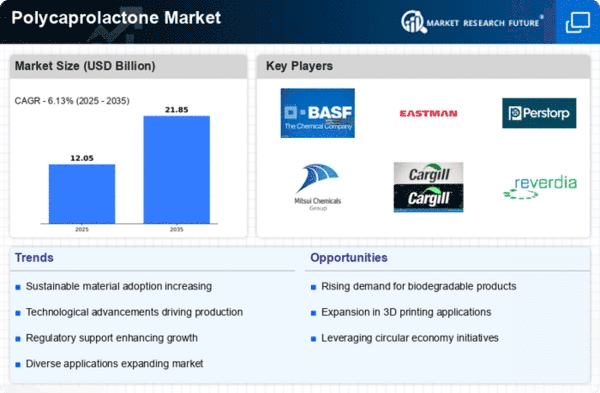
As per MRFR analysis, the Polycaprolactone Market Size was estimated at 11.35 USD Billion in 2024. The Polycaprolactone industry is projected to grow from 12.05 USD Billion in 2025 to 21.85 USD Billion by 2035, exhibiting a compound annual growth rate (CAGR) of 6.13 during the forecast period 2025 - 2035.

Key Market Trends & Highlights

The Polycaprolactone Market is experiencing robust growth driven by sustainability and technological advancements.

  • North America remains the largest market for polycaprolactone, driven by increasing demand in various applications.
  • Asia-Pacific is identified as the fastest-growing region, reflecting a surge in innovative uses and production capabilities.
  • The additive manufacturing segment leads the market, while the biomedical segment is rapidly expanding due to rising healthcare needs.
  • Sustainability initiatives and regulatory support for biodegradable materials are key drivers propelling market growth.

Market Size & Forecast

2024 Market Size 11.35 (USD Billion)
2035 Market Size 21.85 (USD Billion)
CAGR (2025 - 2035) 6.13%
Largest Regional Market Share in 2024 North America

Major Players

BASF SE (DE), Eastman Chemical Company (US), Perstorp Holding AB (SE), Mitsui Chemicals, Inc. (JP), Cargill, Incorporated (US), Reverdia (NL), Shenzhen Esun Industrial Co., Ltd. (CN), Fujian Wuhang Technology Co., Ltd. (CN), Kraton Corporation (US)

Market Trends

The Polycaprolactone Market is currently experiencing a notable transformation, driven by increasing demand for biodegradable materials and sustainable alternatives in various industries. This polymer, known for its versatility and favorable properties, is finding applications in sectors such as packaging, textiles, and medical devices. The growing awareness regarding environmental issues is prompting manufacturers to explore eco-friendly options, thereby enhancing the appeal of polycaprolactone. Furthermore, advancements in production technologies are likely to improve the efficiency and reduce the costs associated with polycaprolactone, making it a more attractive choice for businesses. In addition, the Polycaprolactone Market is witnessing a shift towards innovative applications, particularly in the field of 3D printing and additive manufacturing. As industries seek to adopt more sustainable practices, the integration of polycaprolactone in these technologies appears promising. The material's unique properties, such as its biodegradability and ease of processing, position it well for future growth. Overall, the Polycaprolactone Market seems poised for expansion, driven by a combination of environmental consciousness and technological advancements that could redefine its role across various sectors.

Sustainability Focus

The emphasis on sustainable materials is reshaping the Polycaprolactone Market. As consumers and industries prioritize eco-friendly options, polycaprolactone's biodegradable nature positions it as a favorable alternative to traditional plastics.

Technological Advancements

Innovations in production techniques are enhancing the efficiency of polycaprolactone manufacturing. These advancements may lead to reduced costs and improved quality, making the material more accessible to various industries.

Emerging Applications

The rise of 3D printing and additive manufacturing is creating new opportunities for polycaprolactone. Its unique properties make it suitable for innovative applications, potentially expanding its market reach.

Polycaprolactone Market Market Drivers

Market Growth Projections

The Global Polycaprolactone Market Industry is poised for substantial growth, with projections indicating a market value of 132.3 USD Billion in 2024 and an anticipated increase to 596.6 USD Billion by 2035. This remarkable growth trajectory suggests a compound annual growth rate of 14.68% from 2025 to 2035, reflecting the increasing adoption of polycaprolactone across various sectors. The market's expansion is driven by factors such as rising demand for biodegradable plastics, advancements in medical applications, and the integration of polycaprolactone in innovative manufacturing processes.

Growth in 3D Printing Technologies

The rise of 3D printing technologies is significantly influencing the Global Polycaprolactone Market Industry. Polycaprolactone Market's favorable properties, such as low melting point and excellent flow characteristics, make it an ideal material for 3D printing applications. Industries ranging from automotive to consumer goods are increasingly adopting 3D printing for prototyping and production, which in turn drives the demand for polycaprolactone. As this technology continues to advance, the market is expected to witness a compound annual growth rate of 14.68% from 2025 to 2035, reflecting the growing integration of polycaprolactone in innovative manufacturing processes.

Advancements in Medical Applications

The Global Polycaprolactone Market Industry is experiencing substantial growth due to advancements in medical applications. Polycaprolactone Market is increasingly utilized in drug delivery systems, tissue engineering, and sutures, owing to its biocompatibility and biodegradability. The material's ability to support cell growth and its favorable degradation rate make it a prime candidate for innovative medical solutions. As the healthcare sector continues to evolve, the demand for polycaprolactone in medical devices is likely to surge, contributing to the market's expansion. This growth aligns with the projected increase in market value, potentially reaching 596.6 USD Billion by 2035.

Increasing Use in Packaging Solutions

The Global Polycaprolactone Market Industry is benefiting from the increasing use of polycaprolactone in packaging solutions. As companies strive to reduce their environmental footprint, polycaprolactone's biodegradable properties make it an attractive option for packaging materials. This shift towards sustainable packaging is evident in various sectors, including food and consumer goods, where polycaprolactone is being utilized to create eco-friendly packaging alternatives. The growing consumer preference for sustainable products is likely to propel the market forward, contributing to the overall growth trajectory of the industry in the coming years.

Rising Demand in Biodegradable Plastics

The increasing global emphasis on sustainability drives the demand for biodegradable plastics, including polycaprolactone. As environmental concerns escalate, industries are seeking alternatives to conventional plastics. The Global Polycaprolactone Market Industry is witnessing a shift towards eco-friendly materials, with polycaprolactone being favored for its biodegradability and versatility. This trend is expected to contribute significantly to the market's growth, as consumers and manufacturers alike prioritize sustainable practices. The market is projected to reach 132.3 USD Billion in 2024, indicating a robust demand for biodegradable solutions in various applications.

Regulatory Support for Sustainable Materials

Regulatory frameworks promoting the use of sustainable materials are playing a crucial role in the Global Polycaprolactone Market Industry. Governments worldwide are implementing policies that encourage the adoption of biodegradable plastics, including polycaprolactone, to combat plastic pollution. This regulatory support is fostering innovation and investment in the development of sustainable materials, thereby enhancing the market's growth potential. As regulations become more stringent, industries are likely to pivot towards polycaprolactone, further solidifying its position in the market and contributing to its projected growth.

Market Segment Insights

By Application: Additive Manufacturing (Largest) vs. Biomedical (Fastest-Growing)

In the Polycaprolactone Market, the application segment showcases distinct distribution characteristics across various domains. Additive Manufacturing holds the largest share, driven by the increasing adoption of 3D printing technologies, which allow for innovative product designs. Conversely, the Biomedical segment is witnessing rapid growth, spurred by rising demand for biocompatible materials in medical devices, tissue engineering, and drug delivery systems. These applications highlight polycaprolactone's versatility and ability to meet industry demands. The growth trends in the Polycaprolactone Market application segment are influenced by several key drivers. As the healthcare sector evolves, the need for advanced medical solutions fuels the demand for Polycaprolactone in biomedical applications. Additionally, the sustainability push in manufacturing fosters innovation in packaging and textiles, with Polycaprolactone serving as a valuable alternative to conventional materials. Overall, the varied applications reflect the material's adaptability and relevance in modern industries.

Additive Manufacturing (Dominant) vs. Biomedical (Emerging)

Additive Manufacturing has established itself as a dominant force within the Polycaprolactone Market, thanks to its compatibility with 3D printing technology. This segment benefits from the ability to produce complex geometries and customize parts for various applications, from aerospace to consumer products. The ease of processing and excellent mechanical properties of polycaprolactone make it particularly suitable for prototyping and low-volume production runs, thereby attracting a growing base of manufacturers. On the other hand, the Biomedical segment is emerging as a significant player, expanding rapidly as advancements in medical technology necessitate innovative biomaterials. Polycaprolactone's biocompatibility and biodegradable nature make it ideal for applications such as sutures, scaffolding for tissue engineering, and drug delivery systems. This segment is experiencing heightened interest from researchers and practitioners alike, highlighting its potential for future growth and application in life sciences.

By End Use: Automotive (Largest) vs. Medical Devices (Fastest-Growing)

In the Polycaprolactone market, the end use segments are diverse, with automotive leading in market share. This dominance is driven by the demand for lightweight and durable materials that enhance fuel efficiency and sustainability in vehicles. Following automotive, the medical devices segment is experiencing rapid growth as Polycaprolactone's biocompatibility and biodegradability make it suitable for various medical applications, thus capturing a significant portion of the market. The consumer goods and construction segments, while important, hold smaller shares relative to these two major players. The growth trends in the Polycaprolactone market are closely linked to the increasing investment in R&D and innovation within the automotive and medical fields. The automotive industry is focusing on reducing environmental impact, propelling the demand for sustainable materials like Polycaprolactone. Conversely, the medical devices segment is benefiting from advancements in healthcare technologies and an aging population, leading to increased demand for biocompatible and innovative products. This creates a robust landscape for Polycaprolactone, with both segments working towards increased efficiency and sustainability in their respective applications.

Automotive (Dominant) vs. Electronics (Emerging)

The automotive sector remains dominant in the Polycaprolactone market, leveraging the polymer's beneficial properties to create lightweight, durable, and eco-friendly components. Automotive applications often focus on enhancing vehicle performance and safety, leading to high demand for advanced materials that help reduce emissions. Innovations such as interior components, seals, and gaskets are transforming the automotive manufacturing landscape. On the other hand, the electronics segment is seen as an emerging player in this market. Polycaprolactone’s versatility enables it to be used in insulation, casings, and various electronic devices. This segment is gaining traction due to the rapid advancement in electronics and shifting consumer preferences towards sustainable and recyclable materials, positioning itself as a vital component in the evolving electronics industry.

By Form: Filaments (Largest) vs. Powders (Fastest-Growing)

In the Polycaprolactone market, filaments currently hold the largest share among the various forms, primarily due to their versatility in applications such as 3D printing and medical devices. Granules and films follow behind, catering to different industrial needs, while powders are emerging rapidly, capturing attention in sectors like food packaging and advanced manufacturing. This distribution indicates a diverse market, where each form serves unique functional requirements, enhancing the overall potential of the market.

Filaments (Dominant) vs. Powders (Emerging)

Filaments are dominating the Polycaprolactone market due to their widespread applicability, especially in the 3D printing sector where they provide high precision and flexibility in design. Their durability and biocompatibility make them desirable for medical applications as well. Conversely, powders are emerging as a significant player, driven by their increasing utilization in innovative applications like bioprinting and powder coating processes. This segment is gaining momentum because of advancements in technology that allow for finer control over material properties, thus supporting a growing trend toward personalized and sustainable manufacturing solutions.

By Production Method: Ring Opening Polymerization (Largest) vs. Bulk Polymerization (Fastest-Growing)

In the Polycaprolactone market, the production methods exhibit varying degrees of dominance and growth potential. Ring Opening Polymerization (ROP) holds the largest market share due to its efficiency in producing high molecular weight polycaprolactone with desirable properties. Other methods, such as Bulk Polymerization and Solution Polymerization, account for smaller portions of the market but are significant in specific applications, contributing to an overall diverse production landscape. Meanwhile, Emulsion Polymerization is currently less prevalent but demonstrates unique capabilities in producing specialty formulations. The growth trends in the Polycaprolactone production methods are closely linked to the rising demand for biocompatible and biodegradable materials across multiple industries, including pharmaceuticals and packaging. Notably, Bulk Polymerization is emerging as one of the fastest-growing techniques due to its ability to enhance production efficiency and align with eco-friendly initiatives. The increasing emphasis on sustainability and innovation is driving investment and research into these production methods, particularly in ROP and Bulk Polymerization, as manufacturers look to optimize their processes and expand their product ranges.

Production Method: Ring Opening Polymerization (Dominant) vs. Bulk Polymerization (Emerging)

Ring Opening Polymerization (ROP) remains the dominant production method in the Polycaprolactone market, primarily due to its capacity for producing high-quality polymers with excellent mechanical properties and thermal stability. This method allows for better control over the molecular weight and distribution, making it favorable in applications requiring precision and high-performance materials. As consumer preference shifts toward sustainable solutions, ROP's efficiency in creating biodegradable options positions it strongly in the market. Conversely, Bulk Polymerization is recognized as an emerging production technique, accelerating its growth within the industry. Its simplified process and potential cost-effectiveness make it appealing for manufacturers aiming to meet the increasing demand for polycaprolactone in various sectors. The technique's ability to produce materials with tailored characteristics also offers significant advantages for specialty applications.

Get more detailed insights about Polycaprolactone Market Research Report – Forecast till 2035

Regional Insights

North America : Market Leader in Polycaprolactone

North America is poised to maintain its leadership in the Polycaprolactone market, holding a significant share of 5.5 in 2024. The region's growth is driven by increasing demand for biodegradable plastics and advancements in manufacturing technologies. Regulatory support for sustainable materials further enhances market potential, as companies seek eco-friendly alternatives to traditional plastics. The focus on innovation and sustainability is expected to propel market growth in the coming years. The competitive landscape in North America is robust, featuring key players such as BASF SE, Eastman Chemical Company, and Cargill, Incorporated. These companies are investing heavily in R&D to develop new applications for Polycaprolactone, particularly in the automotive and medical sectors. The presence of established firms and a strong supply chain network contribute to the region's dominance, making it a hub for Polycaprolactone production and innovation.

Europe : Emerging Market with Growth Potential

Europe is witnessing a growing interest in the Polycaprolactone market, with a market size of 3.5 in 2024. The region's growth is fueled by increasing environmental regulations and a shift towards sustainable materials. European countries are actively promoting the use of biodegradable plastics, which is expected to drive demand for Polycaprolactone. The regulatory landscape is supportive, encouraging innovation and investment in eco-friendly solutions. Leading countries in Europe, such as Germany and Sweden, are at the forefront of this market, with companies like Perstorp Holding AB and Reverdia leading the charge. The competitive environment is characterized by a mix of established players and emerging startups focused on sustainable practices. The European market is expected to grow as more industries adopt Polycaprolactone for various applications, including packaging and textiles.

Asia-Pacific : Rapid Growth in Emerging Economies

The Asia-Pacific region is experiencing rapid growth in the Polycaprolactone market, with a market size of 2.5 in 2024. This growth is driven by increasing industrialization, urbanization, and rising consumer awareness regarding sustainable materials. Countries like China and Japan are leading the charge, supported by government initiatives aimed at promoting biodegradable plastics. The region's regulatory framework is evolving to support the adoption of eco-friendly materials, further boosting market potential. China, in particular, is home to key players such as Shenzhen Esun Industrial Co., Ltd. and Fujian Wuhang Technology Co., Ltd., which are expanding their production capacities to meet rising demand. The competitive landscape is becoming increasingly dynamic, with both local and international companies vying for market share. As the region continues to embrace sustainability, the Polycaprolactone market is expected to flourish in the coming years.

Middle East and Africa : Emerging Market with Challenges

The Middle East and Africa region is still in the nascent stages of developing its Polycaprolactone market, with a market size of 0.85 in 2024. The growth is hindered by limited industrial infrastructure and lower awareness of biodegradable materials. However, there is a growing interest in sustainable practices, driven by global trends and increasing environmental concerns. Regulatory frameworks are gradually evolving to support the adoption of eco-friendly materials, which may catalyze market growth in the future. Countries like South Africa and the UAE are beginning to explore the potential of Polycaprolactone, with some local companies starting to invest in production capabilities. The competitive landscape is still developing, with few established players. However, as awareness and demand for sustainable materials increase, the region may see a gradual shift towards adopting Polycaprolactone in various applications, including packaging and agriculture.

Key Players and Competitive Insights

The Polycaprolactone Market is currently characterized by a dynamic competitive landscape, driven by increasing demand for biodegradable plastics and advancements in polymer technology. Key players such as BASF SE (Germany), Eastman Chemical Company (US), and Perstorp Holding AB (Sweden) are strategically positioning themselves through innovation and sustainability initiatives. These companies are not only focusing on enhancing their product portfolios but are also exploring partnerships and collaborations to strengthen their market presence. The collective strategies of these firms contribute to a moderately fragmented market structure, where competition is intensifying as companies seek to differentiate themselves through technological advancements and eco-friendly solutions.In terms of business tactics, companies are increasingly localizing manufacturing to reduce lead times and optimize supply chains. This approach appears to be a response to the growing need for agility in production and distribution. The competitive structure of the Polycaprolactone Market is moderately fragmented, with several players vying for market share. The influence of key players is significant, as their operational strategies and innovations set benchmarks for the industry, thereby shaping the overall market dynamics.

In November BASF SE (Germany) announced the launch of a new line of biodegradable polycaprolactone products aimed at the packaging sector. This strategic move is likely to enhance BASF's competitive edge by addressing the increasing consumer demand for sustainable packaging solutions. The introduction of these products not only aligns with global sustainability goals but also positions BASF as a leader in the eco-friendly materials segment, potentially attracting new customers and markets.

In October Eastman Chemical Company (US) revealed its plans to invest in a new production facility dedicated to polycaprolactone in the southeastern US. This investment is expected to bolster Eastman's production capacity and reduce operational costs, thereby enhancing its competitive positioning. The facility is anticipated to utilize advanced manufacturing technologies, which may lead to improved product quality and efficiency, further solidifying Eastman's role in the market.

In September Perstorp Holding AB (Sweden) entered into a strategic partnership with a leading bioplastics company to co-develop innovative polycaprolactone-based materials. This collaboration is indicative of Perstorp's commitment to sustainability and innovation, as it seeks to leverage synergies with its partner to accelerate product development. Such strategic alliances are becoming increasingly vital in the current market, as they enable companies to pool resources and expertise, thereby enhancing their competitive capabilities.

As of December the Polycaprolactone Market is witnessing trends that emphasize digitalization, sustainability, and the integration of AI technologies. These trends are reshaping the competitive landscape, as companies strive to enhance operational efficiencies and reduce environmental impacts. Strategic alliances are playing a crucial role in this evolution, allowing firms to innovate and adapt to changing market demands. Looking ahead, competitive differentiation is likely to shift from price-based strategies to a focus on innovation, technological advancements, and supply chain reliability, as companies seek to meet the growing expectations of environmentally conscious consumers.

Key Companies in the Polycaprolactone Market include

Industry Developments

May 2023- BASF said that its newly established PCL plant in China had started producing. There is capacity to produce up to 50,000 metric tons of PCL per year at the plant, which will cater to increasing demand from Asia.

June 2023 - Sabic has informed on signing an understanding letter with Teijin about the joint development of new PCL-based products. The two companies will join forces in developing various PCL-based materials, including car parts, electronic components, and medical tools.

In 2020, ITOCHU Chemical Frontier Corporation partnered with Chromocenter Inc. in order to expand cell therapy and regenerative medicine capabilities.

In 2021, Nestle and LyondellBasell have agreed on a long-term partnership under which they will produce Circulen Renew branded sustainable polymers.

In December 2022, polycaprolactone hybrid biomaterials containing bioactive glasses and calcium phosphate-based ceramics were developed; these materials exhibit increased mechanical strength, controlled degradation rates, and higher bioactivity, making them ideal for applications in bone tissue engineering.

Intended Audience

    • Polycaprolactone Market Manufacturers
    • Traders and Distributors of Polycaprolactone Market
    • Research and Development Institutes
    • Potential Investors
    • Raw Material Suppliers
    • Nationalized Laboratories

Future Outlook

Polycaprolactone Market Future Outlook

The Polycaprolactone Market is projected to grow at a 6.13% CAGR from 2025 to 2035, driven by increasing demand in biodegradable applications and advancements in manufacturing technologies.

New opportunities lie in:

  • Expansion into biodegradable packaging solutions
  • Development of customized polycaprolactone-based medical devices
  • Investment in R&D for enhanced polymer properties

By 2035, the Polycaprolactone Market is expected to achieve robust growth and diversification.

Market Segmentation

Polycaprolactone Market Form Outlook

  • Filaments
  • Granules
  • Powders
  • Films
  • Sheets

Polycaprolactone Market End Use Outlook

  • Automotive
  • Consumer Goods
  • Medical Devices
  • Electronics
  • Construction

Polycaprolactone Market Application Outlook

  • Additive Manufacturing
  • Biomedical
  • Packaging
  • Textiles
  • Coatings

Polycaprolactone Market Production Method Outlook

  • Ring Opening Polymerization
  • Bulk Polymerization
  • Solution Polymerization
  • Emulsion Polymerization

Report Scope

MARKET SIZE 202411.35(USD Billion)
MARKET SIZE 202512.05(USD Billion)
MARKET SIZE 203521.85(USD Billion)
COMPOUND ANNUAL GROWTH RATE (CAGR)6.13% (2025 - 2035)
REPORT COVERAGERevenue Forecast, Competitive Landscape, Growth Factors, and Trends
BASE YEAR2024
Market Forecast Period2025 - 2035
Historical Data2019 - 2024
Market Forecast UnitsUSD Billion
Key Companies ProfiledBASF SE (DE), Eastman Chemical Company (US), Perstorp Holding AB (SE), Mitsui Chemicals, Inc. (JP), Cargill, Incorporated (US), Reverdia (NL), Shenzhen Esun Industrial Co., Ltd. (CN), Fujian Wuhang Technology Co., Ltd. (CN), Kraton Corporation (US)
Segments CoveredApplication, End Use, Form, Production Method
Key Market OpportunitiesGrowing demand for biodegradable materials drives innovation in the Polycaprolactone Market.
Key Market DynamicsRising demand for biodegradable materials drives innovation and competition in the Polycaprolactone market.
Countries CoveredNorth America, Europe, APAC, South America, MEA

FAQs

What was the value of the global Polycaprolactone market in 2018?

Polycaprolactone market had valued at USD 370.42 BN in 2018.

At what CAGR is the global Polycaprolactone market projected to grow in the forecast period (2018-2024)?

Global Polycaprolactone market is estimated to register 10% CAGR during the forecast period (2018-2023).

Which are the major segments in the global Polycaprolactone market?

By form, the pellets segment and by applications, the thermoplastic polyurethane segment holds the leading share in the global Polycaprolactone market.

Which region holds the largest share in the global Polycaprolactone market?

Asia Pacific holds the largest share in the global Polycaprolactone market, followed by North America and Europe, respectively.

Who are the top players in the global Polycaprolactone market?

Daicel Corporation (Japan), Perstorp Holding AB (Sweden), Shenzhen Esun Industrial Co., Ltd (China), BASF SE (Germany), Corbion (the Netherlands), Merck KGaA (Germany), Haihang Group (China), Polysciences, Inc. (US), Durect Corporation (US), and Shenzhen Polymtek Biomaterial Co., Ltd (China), are some of the major players operating in the Polycaprolactone market.

  1. SECTION I: EXECUTIVE SUMMARY AND KEY HIGHLIGHTS
    1. EXECUTIVE SUMMARY
      1. Market Overview
      2. Key Findings
      3. Market Segmentation
      4. Competitive Landscape
      5. Challenges and Opportunities
      6. Future Outlook
  2. SECTION II: SCOPING, METHODOLOGY AND MARKET STRUCTURE
    1. MARKET INTRODUCTION
      1. Definition
      2. Scope of the study
    2. RESEARCH METHODOLOGY
      1. Overview
      2. Data Mining
      3. Secondary Research
      4. Primary Research
      5. Forecasting Model
      6. Market Size Estimation
      7. Data Triangulation
      8. Validation
  3. SECTION III: QUALITATIVE ANALYSIS
    1. MARKET DYNAMICS
      1. Overview
      2. Drivers
      3. Restraints
      4. Opportunities
    2. MARKET FACTOR ANALYSIS
      1. Value chain Analysis
      2. Porter's Five Forces Analysis
      3. COVID-19 Impact Analysis
  4. SECTION IV: QUANTITATIVE ANALYSIS
    1. Chemicals and Materials, BY Application (USD Billion)
      1. Additive Manufacturing
      2. Biomedical
      3. Packaging
      4. Textiles
      5. Coatings
    2. Chemicals and Materials, BY End Use (USD Billion)
      1. Automotive
      2. Consumer Goods
      3. Medical Devices
      4. Electronics
      5. Construction
    3. Chemicals and Materials, BY Form (USD Billion)
      1. Filaments
      2. Granules
      3. Powders
      4. Films
      5. Sheets
    4. Chemicals and Materials, BY Production Method (USD Billion)
      1. Ring Opening Polymerization
      2. Bulk Polymerization
      3. Solution Polymerization
      4. Emulsion Polymerization
    5. Chemicals and Materials, BY Region (USD Billion)
      1. North America
      2. Europe
      3. APAC
      4. South America
      5. MEA
  5. SECTION V: COMPETITIVE ANALYSIS
    1. Competitive Landscape
      1. Overview
      2. Competitive Analysis
      3. Market share Analysis
      4. Major Growth Strategy in the Chemicals and Materials
      5. Competitive Benchmarking
      6. Leading Players in Terms of Number of Developments in the Chemicals and Materials
      7. Key developments and growth strategies
      8. Major Players Financial Matrix
    2. Company Profiles
      1. BASF SE (DE)
      2. Eastman Chemical Company (US)
      3. Perstorp Holding AB (SE)
      4. Mitsui Chemicals, Inc. (JP)
      5. Cargill, Incorporated (US)
      6. Reverdia (NL)
      7. Shenzhen Esun Industrial Co., Ltd. (CN)
      8. Fujian Wuhang Technology Co., Ltd. (CN)
      9. Kraton Corporation (US)
    3. Appendix
      1. References
      2. Related Reports

Chemicals and Materials Market Segmentation

Chemicals and Materials By Application (USD Billion, 2025-2035)

  • Additive Manufacturing
  • Biomedical
  • Packaging
  • Textiles
  • Coatings

Chemicals and Materials By End Use (USD Billion, 2025-2035)

  • Automotive
  • Consumer Goods
  • Medical Devices
  • Electronics
  • Construction

Chemicals and Materials By Form (USD Billion, 2025-2035)

  • Filaments
  • Granules
  • Powders
  • Films
  • Sheets

Chemicals and Materials By Production Method (USD Billion, 2025-2035)

  • Ring Opening Polymerization
  • Bulk Polymerization
  • Solution Polymerization
  • Emulsion Polymerization
Infographic

Free Sample Request

Kindly complete the form below to receive a free sample of this Report

Get Free Sample

Customer Strories

Compare Licence

×
Features License Type
Single User Multiuser License Enterprise User
Price $4,950 $5,950 $7,250
Maximum User Access Limit 1 User Upto 10 Users Unrestricted Access Throughout the Organization
Free Customization
Direct Access to Analyst
Deliverable Format
Platform Access
Discount on Next Purchase 10% 15% 15%
Printable Versions