×
Request Free Sample ×

Kindly complete the form below to receive a free sample of this Report

* Please use a valid business email

Leading companies partner with us for data-driven Insights

clients tt-cursor
Hero Background

Plasticizers Market

ID: MRFR/CnM/1688-HCR
111 Pages
Priya Nagrale
February 2026

Plasticizer Market Research Report Information by Type (Phthalate Plasticizer and Non-Phthalate Plasticizer), Application (Flooring & Wall Covering, Wire & Cable, Packaging, Consumer Goods, Medical & Healthcare, Toys and Others) and Region Forecast till 2035.

Share:
Download PDF ×

We do not share your information with anyone. However, we may send you emails based on your report interest from time to time. You may contact us at any time to opt-out.

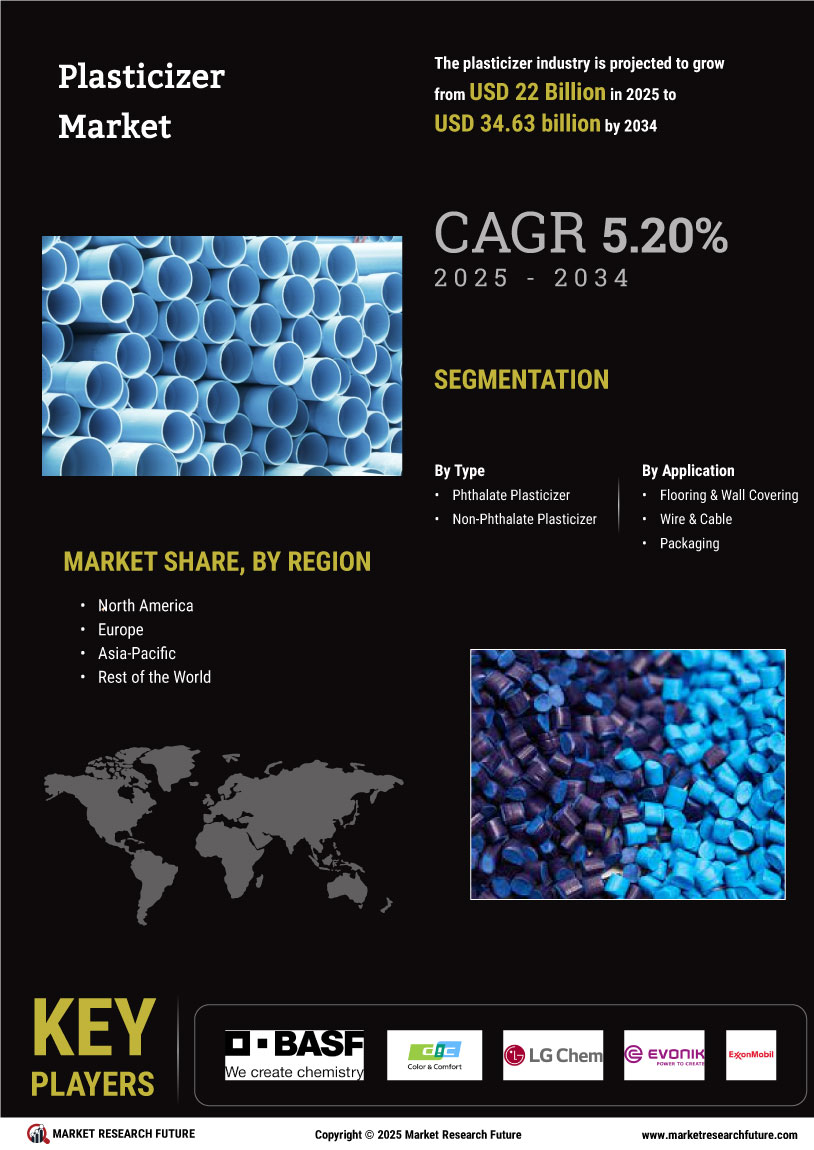
Plasticizers Market Infographic
Purchase Options

Plasticizers Market Summary

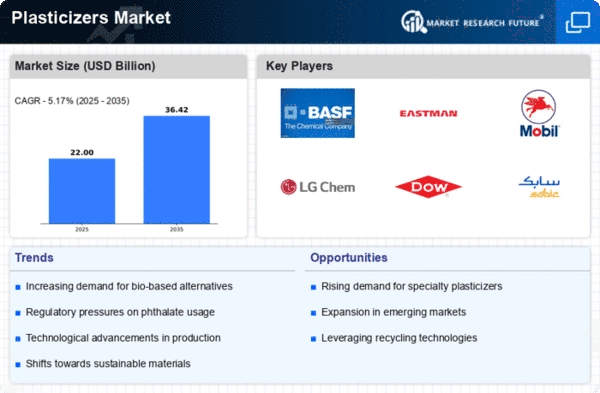
As per MRFR analysis, the Plasticizers Market Size was estimated at 20.92 USD Billion in 2024. The Plasticizers industry is projected to grow from 22.0 in 2025 to 36.42 by 2035, exhibiting a compound annual growth rate (CAGR) of 5.17 during the forecast period 2025 - 2035.

Key Market Trends & Highlights

The Plasticizers Market is currently experiencing a dynamic shift towards sustainability and innovation.

  • North America remains the largest market for plasticizers, driven by robust demand in the construction sector.
  • Asia-Pacific is identified as the fastest-growing region, with increasing applications in the automotive industry.
  • The plastics segment continues to dominate the market, while the coatings segment is emerging rapidly due to technological advancements.
  • Rising demand for flexible materials and innovations in product formulations are key drivers propelling market growth.

Market Size & Forecast

2024 Market Size 20.92 (USD Billion)
2035 Market Size 36.42 (USD Billion)
CAGR (2025 - 2035) 5.17%

Major Players

BASF SE (DE), Eastman Chemical Company (US), ExxonMobil Chemical (US), LG Chem Ltd. (KR), DOW Inc. (US), SABIC (SA), Evonik Industries AG (DE), Mitsubishi Chemical Corporation (JP), INEOS Group Limited (GB)

Our Impact
Enabled $4.3B Revenue Impact for Fortune 500 and Leading Multinationals
Partnering with 2000+ Global Organizations Each Year
30K+ Citations by Top-Tier Firms in the Industry

Plasticizers Market Trends

The Plasticizers Market is currently experiencing a dynamic evolution, driven by various factors that influence demand and supply. The increasing need for flexible and durable materials across multiple industries, such as construction, automotive, and consumer goods, appears to be a primary catalyst for growth. Additionally, the rising awareness regarding environmental sustainability is prompting manufacturers to explore bio-based alternatives, which may reshape the competitive landscape. As regulations tighten around traditional plasticizers, companies are likely to invest in research and development to innovate and meet changing consumer preferences. Moreover, the global shift towards sustainable practices is fostering a trend towards the adoption of non-phthalate plasticizers. This transition is not merely a response to regulatory pressures but also reflects a broader societal movement towards eco-friendly products. The Plasticizers Market seems poised for transformation, with stakeholders increasingly focusing on product safety and environmental impact. As the industry adapts to these challenges, it may witness the emergence of new players and technologies, further diversifying the market landscape. Overall, the future of the Plasticizers Market appears to be intertwined with sustainability and innovation, suggesting a complex yet promising trajectory ahead.

Sustainability Initiatives

The Plasticizers Market is witnessing a notable shift towards sustainability, as manufacturers increasingly prioritize eco-friendly alternatives. This trend is driven by consumer demand for greener products and stricter regulations on traditional plasticizers. Companies are exploring bio-based options, which may reduce environmental impact and enhance market appeal.

Technological Advancements

Innovations in production processes and materials are shaping the Plasticizers Market. Advanced technologies are enabling the development of high-performance plasticizers that meet stringent quality standards. This trend suggests a potential for enhanced product offerings, catering to diverse industry needs.

Regulatory Changes

The evolving regulatory landscape is significantly influencing the Plasticizers Market. Stricter guidelines regarding chemical safety and environmental impact are prompting manufacturers to adapt their product lines. This trend indicates a shift towards compliance-driven innovation, as companies seek to align with new standards.

Plasticizers Market Drivers

Rising Demand for Flexible PVC Products

The Global Plasticizer Market Industry experiences a notable surge in demand for flexible polyvinyl chloride (PVC) products. This demand is largely driven by the construction and automotive sectors, which utilize flexible PVC for applications such as flooring, roofing, and wiring insulation. As urbanization continues to expand, particularly in developing regions, the need for durable and flexible materials becomes increasingly critical. In 2024, the market is projected to reach 20.9 USD Billion, reflecting the growing preference for plasticizers that enhance the performance of PVC products. This trend suggests a robust growth trajectory for the Global Plasticizer Market Industry.

Market Segment Insights

By Application: Plastics (Largest) vs. Coatings (Fastest-Growing)

The Plasticizers Market exhibits a diverse distribution across various application segments, with plastics commanding the largest share due to their extensive use in consumer goods, automotive, and construction industries. Coatings follow closely behind, benefiting from their vital role in enhancing durability and aesthetic appeal across numerous substrates. Adhesives, textiles, and rubber applications also contribute significantly but occupy smaller shares within this competitive market landscape. In terms of growth trends, the coatings segment is currently the fastest-growing application within the Plasticizers Market, largely driven by increasing demand for high-performance coatings in industries such as automotive and construction. The rise of eco-friendly and sustainable product offerings is also propelling growth, as manufacturers seek to meet stringent regulations and consumer preferences. In addition, innovations and technological advancements in plasticizers further support the expansion of these segments, optimizing performance and versatility in various applications.

Plastics (Dominant) vs. Adhesives (Emerging)

Plastics serve as the dominant application in the Plasticizers Market, primarily due to their multifaceted usage in diverse sectors such as packaging, automotive, and construction, where flexibility and durability are paramount. The ability of plasticizers to enhance the performance of polymers makes them an essential ingredient in producing flexible plastic products. In contrast, adhesives are viewed as an emerging application with a growing market presence, propelled by trends towards lightweight materials and efficient bonding solutions. The increased use of adhesives in construction, automotive, and electronics sectors highlights their significance in providing structural integrity and design flexibility. As both segments evolve, innovation in formulation and application techniques will further define their growth trajectories.

By End Use Industry: Construction (Largest) vs. Automotive (Fastest-Growing)

The plasticizers market sees a diverse distribution of end-use applications, with the construction sector holding the largest share. This is primarily driven by the extensive use of plasticizers in manufacturing flexible PVC products such as pipes, flooring, and electrical cables. In contrast, the automotive industry is witnessing rapid adoption of plasticizers, particularly in vehicle interiors and exterior components, enhancing flexibility and durability. As consumer preferences shift towards lightweight and efficient automotive solutions, this sector is poised for significant growth in the coming years.

Construction: (Dominant) vs. Automotive (Emerging)

The construction industry represents a dominant force within the plasticizers market, leveraging plasticizers for a variety of applications including flooring, wall coverings, and insulation materials. The demand in this sector is bolstered by ongoing infrastructural advancements and a growing focus on sustainability, where plasticizers play a crucial role in enhancing product performance. On the other hand, the automotive sector is considered an emerging market for plasticizers, focusing on the lightweighting of vehicles to improve fuel efficiency. With innovations in material science and stringent regulations on vehicle emissions, automotive applications for plasticizers are expected to grow, driven by manufacturers' needs to enhance performance and compliance.

By Type: Phthalate Plasticizers (Largest) vs. Non-Phthalate Plasticizers (Fastest-Growing)

The Plasticizers Market is significantly influenced by the 'Type' segment, with Phthalate Plasticizers holding the largest market share due to their widespread application in flexible PVC products. Meanwhile, Non-Phthalate Plasticizers are gaining traction, appealing to environmentally conscious consumers and manufacturers looking for safer alternatives. Their emergence is shifting market dynamics, as regulatory changes favor substances that reduce health concerns associated with phthalates.

Plasticizers: Phthalate (Dominant) vs. Non-Phthalate (Emerging)

Phthalate Plasticizers dominate the plastics market mainly due to their versatility and effectiveness, particularly for applications requiring long-lasting flexibility and performance stability. However, Non-Phthalate Plasticizers are swiftly emerging, driven by growing environmental regulations and consumer demand for safer products. These alternatives are often derived from renewable resources and feature lower toxicity, making them more appealing to manufacturers focusing on sustainable practices. As a result, while phthalates still hold a significant market position, non-phthalate options are increasingly seen as the future of plasticizers, appealing to both regulatory bodies and end-users seeking greener choices.

By Chemical Structure: Linear Plasticizers (Largest) vs. Branched Plasticizers (Fastest-Growing)

The Plasticizers Market is characterized by a diverse range of chemical structures, with Linear Plasticizers holding the largest market share. These plasticizers, known for their efficient performance in enhancing flexibility and durability of polymers, have become the preferred choice in various industrial applications. Branched Plasticizers, on the other hand, are rapidly gaining traction due to their improved plasticizing efficiency and ability to lower viscosity, making them particularly appealing in high-performance applications. As the demand for flexible materials increases, the growth trends in the Plasticizers Market are showing a notable shift towards more sustainable and efficient solutions. Branched Plasticizers are anticipated to grow faster than their linear counterparts due to their performance advantages. The push for environmentally friendly products further supports the rise of bio-based plasticizers, which are often classified as branched types, indicating a robust shift towards innovation in this segment of the plasticizer market.

Linear Plasticizers (Dominant) vs. Branched Plasticizers (Emerging)

Linear Plasticizers are a dominant force in the market; they offer a balance of performance and cost-effectiveness, making them well-suited for general-purpose applications such as in the production of vinyl, which requires materials that provide excellent flexibility. Their chemical structure allows for stronger interactions with polymer chains, thus enhancing mechanical properties efficiently. In contrast, Branched Plasticizers, classified as emerging in this segment, are recognized for their superior plasticizing efficiency—allowing manufacturers to use less while still achieving the desired flexibility. These plasticizers are often employed in specialized applications where high performance is critical, such as in automotive and medical applications, reflecting a growing trend towards functionality and sustainability.

Get more detailed insights about Plasticizers Market

Regional Insights

North America : Mature Market with Steady Growth

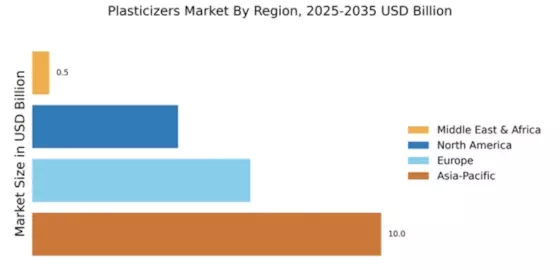
The North American plasticizers market is characterized by steady growth, driven by increasing demand in construction, automotive, and consumer goods sectors. With a market size of $4.18 billion, the region benefits from stringent regulations promoting eco-friendly alternatives, which are reshaping product offerings. The shift towards sustainable materials is a key growth driver, as manufacturers adapt to changing consumer preferences and regulatory requirements. Leading countries in this region include the US and Canada, where major players like DOW Inc. and ExxonMobil Chemical dominate the landscape. The competitive environment is marked by innovation and strategic partnerships aimed at enhancing product performance and sustainability. As the market evolves, companies are investing in R&D to develop advanced plasticizers that meet regulatory standards and consumer expectations.

Europe : Innovation and Sustainability Focus

Europe's plasticizers market, valued at €6.25 billion, is driven by a strong regulatory framework aimed at promoting sustainability and reducing environmental impact. The region's commitment to green chemistry and circular economy principles is fostering innovation in plasticizer formulations. Demand is particularly strong in the automotive and construction sectors, where eco-friendly alternatives are increasingly preferred, aligning with EU regulations on chemical safety and environmental protection. Germany, France, and the UK are leading countries in this market, hosting key players like BASF SE and Evonik Industries AG. The competitive landscape is characterized by a mix of established companies and emerging startups focused on sustainable solutions. As regulations tighten, companies are investing heavily in R&D to develop compliant products that cater to the growing demand for environmentally friendly plasticizers.

Asia-Pacific : Rapid Growth and Market Expansion

Asia-Pacific is the largest market for plasticizers, with a size of $10.0 billion, driven by rapid industrialization and urbanization. The region's growth is fueled by increasing demand from the construction, automotive, and packaging industries. Regulatory support for infrastructure development and rising consumer awareness regarding product safety are significant catalysts for market expansion. The shift towards non-phthalate plasticizers is also gaining traction, aligning with health and safety regulations in various countries. China, India, and Japan are the leading countries in this region, with major players like LG Chem Ltd. and Mitsubishi Chemical Corporation actively participating in the market. The competitive landscape is dynamic, with companies focusing on innovation and strategic collaborations to enhance their product offerings. As the market matures, the emphasis on sustainable and high-performance plasticizers is expected to grow, further solidifying Asia-Pacific's dominance in the global market.

Middle East and Africa : Emerging Market with Growth Potential

The Middle East and Africa plasticizers market, valued at $0.49 billion, is an emerging segment with significant growth potential. The region is witnessing increased demand driven by the construction and automotive sectors, supported by government initiatives aimed at infrastructure development. Regulatory frameworks are gradually evolving to promote safer and more sustainable chemical products, which is expected to enhance market growth in the coming years. Countries like Saudi Arabia and South Africa are leading the market, with a growing presence of key players such as SABIC and INEOS Group Limited. The competitive landscape is characterized by a mix of local and international companies striving to capture market share. As the region continues to develop, investments in sustainable practices and innovative product offerings will be crucial for long-term growth in the plasticizers market.

Plasticizers Market Regional Image

Key Players and Competitive Insights

The Plasticizers Market is currently characterized by a dynamic competitive landscape, driven by increasing demand for flexible materials across various industries, including construction, automotive, and consumer goods. Key players such as BASF SE (DE), Eastman Chemical Company (US), and DOW Inc. (US) are strategically positioned to leverage their extensive product portfolios and innovative capabilities. BASF SE (DE) focuses on sustainable solutions, emphasizing bio-based plasticizers, while Eastman Chemical Company (US) has been enhancing its product offerings through strategic partnerships aimed at expanding its market reach. DOW Inc. (US) is investing in digital transformation initiatives to optimize its operations and improve customer engagement, collectively shaping a competitive environment that prioritizes innovation and sustainability.In terms of business tactics, companies are increasingly localizing manufacturing to reduce lead times and enhance supply chain efficiency. The market structure appears moderately fragmented, with a mix of large multinational corporations and smaller regional players. This fragmentation allows for diverse competitive strategies, as key players influence market dynamics through localized production and tailored product offerings.

In November BASF SE (DE) announced the launch of a new line of bio-based plasticizers aimed at reducing environmental impact. This strategic move not only aligns with global sustainability trends but also positions BASF as a leader in eco-friendly solutions, potentially attracting environmentally conscious customers and enhancing brand loyalty. The introduction of these products may also stimulate competition among peers to innovate in sustainable materials.

In October Eastman Chemical Company (US) expanded its partnership with a leading automotive manufacturer to develop advanced plasticizer solutions for electric vehicles. This collaboration underscores Eastman's commitment to innovation in high-performance materials, which are essential for the evolving automotive landscape. By aligning with industry leaders, Eastman is likely to enhance its market presence and drive growth in a sector that increasingly prioritizes sustainability and performance.

In September DOW Inc. (US) unveiled a new digital platform designed to streamline customer interactions and improve supply chain transparency. This initiative reflects DOW's focus on digitalization as a means to enhance operational efficiency and customer satisfaction. By leveraging technology, DOW is positioned to respond more effectively to market demands, potentially gaining a competitive edge in an increasingly digital marketplace.

As of December current trends in the Plasticizers Market indicate a strong shift towards digitalization, sustainability, and the integration of advanced technologies such as AI. Strategic alliances are becoming increasingly vital, as companies seek to enhance their capabilities and market reach. The competitive landscape is evolving from traditional price-based competition to a focus on innovation, technology, and supply chain reliability. This shift suggests that companies that prioritize these aspects will likely emerge as leaders in the market, driving future growth and differentiation.

Key Companies in the Plasticizers Market include

Industry Developments

  • Q2 2024: BASF launches new non-phthalate plasticizer Hexamoll DINCH in North America BASF announced the launch of its non-phthalate plasticizer Hexamoll DINCH in the North American market, expanding its portfolio to meet growing demand for safer alternatives in sensitive applications such as toys, medical devices, and food packaging.
  • Q2 2024: Evonik opens new plasticizer production facility in Marl, Germany Evonik Industries inaugurated a new production facility for sustainable plasticizers in Marl, Germany, aiming to increase capacity for phthalate-free plasticizers used in flooring, cables, and automotive interiors.
  • Q3 2024: Arkema acquires Poliplas, expanding its plasticizer business in Latin America Arkema completed the acquisition of Poliplas, a Brazilian manufacturer of specialty plasticizers, strengthening its presence in the Latin American market and broadening its product offering for flexible PVC applications.
  • Q3 2024: Eastman Chemical announces $100 million investment in U.S. plasticizer plant expansion Eastman Chemical Company revealed plans to invest $100 million to expand its plasticizer manufacturing facility in Texas, targeting increased production of non-phthalate plasticizers for the construction and automotive sectors.
  • Q4 2024: INEOS signs long-term supply agreement with European cable manufacturer for bio-based plasticizers INEOS entered into a multi-year contract to supply bio-based plasticizers to a leading European cable manufacturer, supporting the shift toward sustainable materials in the wire and cable industry.
  • Q4 2024: ExxonMobil appoints new VP for Specialty Chemicals, including plasticizer division ExxonMobil announced the appointment of a new Vice President to oversee its Specialty Chemicals segment, which includes the company’s global plasticizer business, as part of a broader leadership restructuring.
  • Q1 2025: Dow introduces new phthalate-free plasticizer for medical device applications Dow launched a new phthalate-free plasticizer designed specifically for use in medical devices, addressing regulatory and customer demand for safer, high-performance materials in healthcare.
  • Q1 2025: LG Chem partners with European distributor to expand plasticizer sales in EMEA LG Chem entered a strategic partnership with a major European chemical distributor to boost sales and distribution of its plasticizer products across Europe, the Middle East, and Africa.
  • Q2 2025: Perstorp secures major contract to supply non-phthalate plasticizers to U.S. flooring manufacturer Perstorp signed a multi-year supply agreement with a leading U.S. flooring manufacturer for its non-phthalate plasticizers, supporting the customer's transition to safer and more sustainable materials.
  • Q2 2025: China’s BlueStar launches IPO to fund expansion of plasticizer production capacity BlueStar, a major Chinese chemical producer, launched an initial public offering to raise capital for expanding its plasticizer manufacturing facilities, aiming to meet rising domestic and international demand.
  • Q3 2025: ExxonMobil receives regulatory approval for new plasticizer plant in Singapore ExxonMobil secured regulatory approval to construct a new plasticizer production facility in Singapore, which will focus on high-performance, environmentally friendly plasticizers for the Asia-Pacific market.
  • Q3 2025: Sibur and Reliance Industries form joint venture for plasticizer production in India Russian petrochemical giant Sibur and India’s Reliance Industries announced a joint venture to build a new plasticizer manufacturing plant in India, targeting the growing demand in South Asia’s construction and automotive sectors.

Future Outlook

Plasticizers Market Future Outlook

The Plasticizers Market is projected to grow at a 5.17% CAGR from 2025 to 2035, driven by increasing demand in construction, automotive, and consumer goods sectors.

New opportunities lie in:

  • Development of bio-based plasticizers to meet sustainability demands.
  • Expansion into emerging markets with tailored product offerings.
  • Investment in advanced manufacturing technologies for cost efficiency.

By 2035, the Plasticizers Market is expected to achieve robust growth, reflecting evolving industry needs and innovations.

Market Segmentation

Plasticizers Market Type Outlook

  • Phthalate Plasticizers
  • Non-Phthalate Plasticizers
  • Bio-Based Plasticizers
  • Aromatic Plasticizers
  • Aliphatic Plasticizers

Plasticizers Market Application Outlook

  • Plastics
  • Coatings
  • Adhesives
  • Textiles
  • Rubber

Plasticizers Market End Use Industry Outlook

  • Construction
  • Automotive
  • Consumer Goods
  • Electronics
  • Healthcare

Plasticizers Market Chemical Structure Outlook

  • Linear Plasticizers
  • Branched Plasticizers
  • Cyclic Plasticizers
  • Aromatic Plasticizers
  • Aliphatic Plasticizers

Report Scope

MARKET SIZE 202420.92(USD Billion)
MARKET SIZE 202522.0(USD Billion)
MARKET SIZE 203536.42(USD Billion)
COMPOUND ANNUAL GROWTH RATE (CAGR)5.17% (2025 - 2035)
REPORT COVERAGERevenue Forecast, Competitive Landscape, Growth Factors, and Trends
BASE YEAR2024
Market Forecast Period2025 - 2035
Historical Data2019 - 2024
Market Forecast UnitsUSD Billion
Key Companies ProfiledBASF SE (DE), Eastman Chemical Company (US), ExxonMobil Chemical (US), LG Chem Ltd. (KR), DOW Inc. (US), SABIC (SA), Evonik Industries AG (DE), Mitsubishi Chemical Corporation (JP), INEOS Group Limited (GB)
Segments CoveredApplication, End Use Industry, Type, Chemical Structure
Key Market OpportunitiesGrowing demand for bio-based plasticizers driven by sustainability trends and regulatory changes.
Key Market DynamicsRising demand for eco-friendly plasticizers drives innovation and regulatory shifts in the plasticizers market.

Countries CoveredNorth America, Europe, APAC, South America, MEA

Market Highlights

Author
Priya Nagrale
Senior Research Analyst

With an experience of over five years in market research industry (Chemicals & Materials domain), I gather and analyze market data from diverse sources to produce results, which are then presented back to a client. Also, provide recommendations based on the findings. As a Senior Research Analyst, I perform quality checks (QC) for market estimations, QC for reports, and handle queries and work extensively on client customizations. Also, handle the responsibilities of client proposals, report planning, report finalization, and execution

Leave a Comment

FAQs

How much is the plasticizer market?

Plasticizers Market was valued at USD 20.92 Billion in 2024

What is the growth rate of the plasticizer market?

Plasticizers Market is projected to grow at a CAGR of 5.17% during the forecast period, 2025-2035

Which region held the largest market share in the plasticizer market?

Asia Pacific had the largest share in the market

Who are the key players in the plasticizer market?

The key players in the market are BASF SE (Germany), DIC Corporation (Japan), LG Chem (South Korea), Evonik (Germany), Exxon Mobil Corporation (US), Lanxess AG (Germany), Nan Ya Plastics (Taiwan), KAO Corporation (Japan), Polynt SPA (Italy), KLJ Group (India).

Which type led the plasticizer market?

The non-phthalate plasticizer category dominated the market in 2022.

Which application had the largest market share in the plasticizer market?

The wire & cable had the largest share in the market.

Download Free Sample

Kindly complete the form below to receive a free sample of this Report

Compare Licence

×
Features License Type
Single User Multiuser License Enterprise User
Price $4,950 $5,950 $7,250
Maximum User Access Limit 1 User Upto 10 Users Unrestricted Access Throughout the Organization
Free Customization
Direct Access to Analyst
Deliverable Format
Platform Access
Discount on Next Purchase 10% 15% 15%
Printable Versions