×
Request Free Sample ×

Kindly complete the form below to receive a free sample of this Report

* Please use a valid business email

Leading companies partner with us for data-driven Insights

clients tt-cursor
Hero Background
English
Chinese
French
Japanese
Korean
German
Spanish

Plastic Stabilizer Market Share

ID: MRFR/CnM/3031-CR
123 Pages
Chitranshi Jaiswal
September 2017

Plastic Stabilizer Market Research Report Information: Type (Heat Stabilizer, Antioxidant, Light Stabilizer and Others), Material (Thermoplastic, Thermosetting and Elastomers) and by End-Use Industry (Packaging, Building & Construction, Automotive, Consumer Goods, Electrical & Electronics, Agriculture and Others) - Forecast till 2035

Share:
Download PDF ×

We do not share your information with anyone. However, we may send you emails based on your report interest from time to time. You may contact us at any time to opt-out.

Plastic Stabilizer Market Infographic
×
Plastic Stabilizer Market Infographic Full View
Purchase Options

Market Share

Plastic Stabilizer Market Share Analysis

Plastic consumption has witnessed a significant surge in our daily lives, particularly in the automotive and packaging industries. This shift represents a departure from traditional materials such as paper, leaves, steel, and metal towards the innovative use of plastics. Notably, emerging economies like China, India, Indonesia, and Brazil are poised for substantial growth, driven by an escalating demand for plastic products.

In the packaging sector, there is a rising need for films across various industries, including food, medical, consumer goods, construction, and agriculture. This trend opens up opportunities for plastic stabilizer manufacturers to supply high-quality materials that meet the stringent requirements of the packaging industry. Similarly, advancements in automotive technology have led to the replacement of metal components with plastics, creating a significant market for plastic stabilizers that can match or exceed the performance standards of traditional materials.

The global plastic stabilizer market is characterized by fragmentation, with numerous small and medium-sized players contributing to the industry. Major market players such as Songwon Industrial Co., Ltd., BASF SE, Clariant AG, Akzo Nobel N.V., and Evonik Industries AG are leading the way. These companies are actively engaged in research and development activities to expand the applications of plastic stabilizers. Additionally, they focus on introducing new products to their portfolios, adapting to consumer demands and market trends. Some companies have increased their production capacities to capture a larger market share.

Furthermore, the plastic stabilizer market has witnessed strategic collaborations and expansions. For instance, in February 2017, Songwon entered into an agreement with Biesterfeld Turkey to offer a comprehensive range of polymer stabilizers. These initiatives aim to strengthen the market presence of key players and cater to the evolving needs of consumers.

The transition from a managed economy to a market-driven one has generated new demands for plastic consumption in various daily life products such as food contact films, toys, and medical devices. Among these, the food and beverages sector stands out with a notably high demand for packaging films. Factors such as increasing awareness, higher capital investments, technological advancements, and the widespread use of plastics anticipate substantial growth for the plastic stabilizer market in the foreseeable future. This transformation underscores the importance of adapting to the evolving market dynamics and consumer preferences within the plastic industry.

Author
Chitranshi Jaiswal
Research Analyst Level I

In her 3 years of experience in the market research field, she has handled critical cross-domain projects. She has an in-depth knowledge of market estimation & analysis, problem-solving, primary as well as secondary research, and team management.She holds an engineering degree and is an MBA professional from a well-known university, capable of evaluating the market and competitive conditions. An exceptional strategist with excellent communication skills and a passion for delivering cutting-edge & practical insights for the market. Proficient in multi-tasking, and can successfully deal with competing demands, while maintaining complete confidentiality. Generated business through active client and project development, networking, and high-quality responses. Her knowledge and skills have helped in making solid business decisions, securing funding from investors, and avoiding business failures.

Leave a Comment

FAQs

At what CAGR is the Plastic Stabilizer Market predicted to grow during the forecast period?

Plastic Stabilizer Market is predicted to grow at 4.5% through forecast period of 2025-2035.

What is the forecast period of Plastic Stabilizer Market research report?

The forecast period for Plastic Stabilizer Market research report is 2025-2035.

Who are the key players in the Plastic Stabilizer Market?

The prominent players operating in the Plastic Stabilizer Market include BASF SE (Germany),Songwon Industrial Co., Ltd. (South Korea),Clariant AG (Switzerland),Akzo Nobel N.V. (The Netherlands), Evonik Industries AG (Germany),ADEKA CORPORATION (Japan),Solvay SA (Belgium),INDOFIL INDUSTRIES LIMITED (India),Bruggemann Group (Germany),Baerlocher GmbH (Germany)

Market Summary

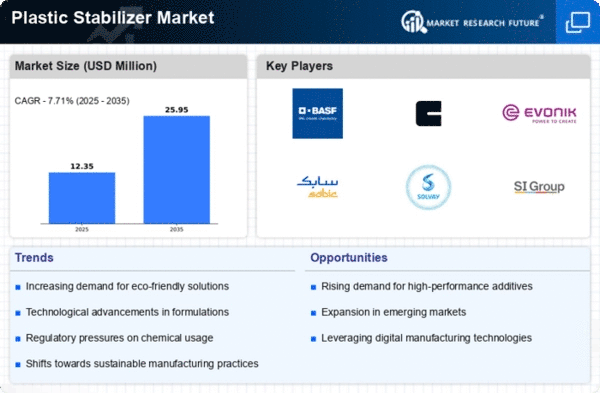
As per MRFR analysis, the Plastic Stabilizer Market Size was estimated at 11.47 USD Million in 2024. The Plastic Stabilizer industry is projected to grow from 12.35 USD Million in 2025 to 25.95 USD Million by 2035, exhibiting a compound annual growth rate (CAGR) of 7.71 during the forecast period 2025 - 2035.

Key Market Trends & Highlights

The Plastic Stabilizer Market is experiencing a dynamic shift towards sustainability and innovation.

  • The market is witnessing a notable shift towards eco-friendly solutions, driven by increasing consumer awareness.
  • Technological advancements in polymer science are enhancing the performance and efficiency of stabilizers.
  • North America remains the largest market, while Asia-Pacific is emerging as the fastest-growing region in this sector.
  • The rising demand for durable materials and regulatory compliance are key drivers propelling growth in the packaging segment.

Market Size & Forecast

2024 Market Size 11.47 (USD Million)
2035 Market Size 25.95 (USD Million)
CAGR (2025 - 2035) 7.71%
Largest Regional Market Share in 2024 Asia-Pacific

Major Players

<p>BASF (DE), Clariant (CH), Evonik Industries (DE), SABIC (SA), Solvay (BE), Addivant (US), A. Schulman (US), Kraton Corporation (US), Eastman Chemical Company (US)</p>

Market Trends

The Plastic Stabilizer Market is currently experiencing a dynamic evolution, driven by various factors that influence its growth trajectory. The increasing demand for durable and high-performance plastics across multiple industries, including automotive, construction, and packaging, appears to be a primary catalyst. As manufacturers seek to enhance the longevity and stability of their products, the incorporation of stabilizers becomes essential. Furthermore, the rising awareness regarding environmental sustainability is prompting a shift towards eco-friendly stabilizers, which may reshape product formulations and consumer preferences. This transition indicates a potential for innovation within the market, as companies strive to meet regulatory standards and consumer expectations. In addition, the ongoing advancements in polymer technology suggest that the Plastic Stabilizer Market could witness a surge in the development of new formulations that offer improved performance characteristics. The integration of advanced additives and the exploration of alternative materials may lead to enhanced product offerings. Moreover, the globalization of supply chains and the expansion of manufacturing capabilities in emerging economies are likely to create new opportunities for market participants. As the landscape continues to evolve, stakeholders must remain vigilant to adapt to changing trends and consumer demands, ensuring sustained growth in this competitive environment.

Shift Towards Eco-Friendly Solutions

The Plastic Stabilizer Market is witnessing a notable shift towards environmentally friendly solutions. Manufacturers are increasingly focusing on developing stabilizers that minimize environmental impact, aligning with global sustainability goals. This trend reflects a growing consumer preference for products that are not only effective but also contribute to ecological preservation.

Technological Advancements in Polymer Science

Ongoing advancements in polymer science are significantly influencing the Plastic Stabilizer Market. Innovations in formulation and processing techniques are enabling the creation of stabilizers that enhance the performance and durability of plastics. This trend suggests a potential for improved product characteristics, catering to diverse industrial applications.

Expansion in Emerging Markets

The expansion of manufacturing capabilities in emerging markets is reshaping the Plastic Stabilizer Market landscape. As these regions develop their industrial bases, the demand for high-quality plastic products is increasing. This growth presents opportunities for stabilizer manufacturers to tap into new markets and broaden their customer base.

Plastic Stabilizer Market Market Drivers

Market Growth Projections

The Global Plastic Stabilizer Market Industry is poised for substantial growth, with projections indicating a market value of 6.33 USD Billion in 2024 and an anticipated increase to 11.5 USD Billion by 2035. This growth trajectory reflects a compound annual growth rate of 5.58% from 2025 to 2035. The expansion is driven by various factors, including rising demand for durable plastics, technological advancements in stabilizer formulations, and increasing regulatory compliance. As industries continue to evolve and prioritize sustainability, the market for plastic stabilizers is expected to flourish, presenting opportunities for innovation and investment.

Growth in End-Use Industries

The expansion of end-use industries such as packaging, electronics, and construction significantly impacts the Global Plastic Stabilizer Market Industry. As these sectors grow, the demand for high-performance plastics that require stabilizers increases correspondingly. For example, the packaging industry is witnessing a surge in the use of flexible and rigid plastics, necessitating effective stabilizers to enhance product performance and shelf life. This growth trajectory is expected to propel the market, with analysts forecasting a valuation of 6.33 USD Billion in 2024. The interplay between industry growth and the need for advanced stabilizers creates a robust environment for market expansion.

Rising Demand for Durable Plastics

The Global Plastic Stabilizer Market Industry experiences a notable increase in demand for durable plastics across various sectors, including automotive, construction, and consumer goods. As industries prioritize longevity and performance, the need for effective stabilizers becomes paramount. For instance, the automotive sector is increasingly utilizing high-performance plastics that require stabilizers to withstand environmental stressors. This trend is projected to contribute to the market's growth, with the industry valued at 6.33 USD Billion in 2024. The emphasis on sustainability and recyclability further drives the demand for advanced stabilizers, which enhance the lifespan of plastic products.

Regulatory Compliance and Environmental Concerns

The Global Plastic Stabilizer Market Industry is increasingly shaped by stringent regulatory frameworks aimed at reducing environmental impact. Governments worldwide are implementing regulations that mandate the use of eco-friendly stabilizers, prompting manufacturers to adapt their formulations accordingly. This shift towards sustainable practices is not only a response to regulatory pressures but also aligns with consumer demand for environmentally responsible products. For instance, the European Union's REACH regulations have led to the development of safer stabilizers that comply with health and safety standards. Consequently, this regulatory landscape is likely to drive innovation and growth within the market.

Technological Advancements in Stabilizer Formulations

Innovations in the formulation of plastic stabilizers significantly influence the Global Plastic Stabilizer Market Industry. The development of new additives and compounds enhances the performance of plastics, making them more resistant to degradation and environmental factors. For example, advancements in UV stabilizers and antioxidants have led to improved durability and color retention in outdoor applications. These technological enhancements not only meet regulatory standards but also cater to consumer preferences for high-quality products. As a result, the market is expected to grow, with projections indicating a rise to 11.5 USD Billion by 2035, reflecting a compound annual growth rate of 5.58% from 2025 to 2035.

Consumer Awareness and Preference for Quality Products

There is a growing consumer awareness regarding the quality and safety of plastic products, which influences the Global Plastic Stabilizer Market Industry. Consumers are increasingly seeking products that not only meet functional requirements but also adhere to safety standards. This trend is prompting manufacturers to invest in high-quality stabilizers that enhance the performance and safety of their products. For instance, the demand for non-toxic and environmentally friendly stabilizers is on the rise, reflecting a shift in consumer preferences. As a result, this heightened awareness is likely to drive market growth, contributing to the projected increase in market value to 11.5 USD Billion by 2035.

Market Segment Insights

By Application: Polyvinyl Chloride (Largest) vs. Polypropylene (Fastest-Growing)

<p>The Plastic Stabilizer Market is predominantly driven by the applications in Polyvinyl Chloride (PVC), which holds a significant market share compared to other polymers. PVC's extensive use in construction materials, pipes, and wiring contributes to its dominance in the market. Polyethylene and Polystyrene follow closely, playing crucial roles in packaging and consumer products. Polyurethane and Polypropylene, although smaller in market share, are essential for various applications, which enhances the diversity of the segment.</p>

<p>Polyvinyl Chloride (Dominant) vs. Polypropylene (Emerging)</p>

<p>Polyvinyl Chloride (PVC) continues to be the dominant force in the Plastic Stabilizer Market due to its versatility and extensive applications in various industries, especially construction and infrastructure. The material's resistance to environmental factors makes it a preferred choice for long-lasting products. On the other hand, Polypropylene is emerging as a significant player, gaining traction due to its lightweight properties and adaptability in automotive and consumer goods. The rapid growth of Polypropylene applications stems from increasing demand for sustainable and high-performance materials, positioning it as a key growth segment in the market.</p>

By End Use Industry: Packaging (Largest) vs. Construction (Fastest-Growing)

<p>The 'End Use Industry' segment of the Plastic Stabilizer Market reveals that packaging holds the largest market share, driven by the increasing demand for flexible and durable packaging solutions in the food and beverage sectors. The automotive and consumer goods sectors also contribute significantly, although at a lesser scale, as consumer preferences shift towards lightweight and durable materials. Electrical and electronics represent a stable, albeit smaller, portion of this segment due to the persistent demand for high-performance plastics in various applications.</p>

<p>Packaging: Dominant vs. Construction: Emerging</p>

<p>The packaging sector is characterized by its innovative use of plastic stabilizers to enhance product longevity and sustainability. It employs a variety of stabilizers that ensure the durability of packaging materials, thus meeting the evolving consumer expectations for eco-friendly solutions. In contrast, the construction sector is emerging rapidly, driven by infrastructure growth and the need for enhanced performance materials. Construction applications demand specific properties, such as UV resistance and heat stability, which plastic stabilizers can provide to improve the lifespan and reliability of construction materials.</p>

By Type: Calcium-Based Stabilizers (Largest) vs. Lead-Based Stabilizers (Fastest-Growing)

<p>The Plastic Stabilizer Market exhibits a diverse range of segments, with Calcium-Based Stabilizers holding the largest share. These stabilizers are highly favored due to their non-toxic nature and effective performance in enhancing the durability of plastic products. In contrast, Lead-Based Stabilizers, despite being overshadowed in market share, are experiencing rapid growth driven by industries seeking cost-effective solutions for plastic stabilization. The segment distribution reflects evolving regulatory frameworks and shifting consumer preferences toward safer and more environmentally-friendly options.</p>

<p>Calcium-Based Stabilizers (Dominant) vs. Lead-Based Stabilizers (Emerging)</p>

<p>Calcium-Based Stabilizers are recognized for their reliability and non-toxic properties, making them a dominant force in the Plastic Stabilizer Market. This segment benefits from increasing demand for sustainable materials across various industries. Meanwhile, Lead-Based Stabilizers, although classified as emerging due to regulatory challenges and health concerns, are still essential in certain applications for their cost-effectiveness and effectiveness in stabilizing PVC products. While Lead-Based options face scrutiny, their rapid growth indicates a niche market where performance is prioritized over safety concerns, often in regions with less stringent regulations.</p>

By Formulation Type: Stabilizer Concentrates (Largest) vs. Liquid Stabilizers (Fastest-Growing)

<p>In the Plastic Stabilizer Market, Stabilizer Concentrates hold the largest share, dominating the formulation types due to their effectiveness and convenience. Liquid Stabilizers are emerging rapidly, capturing significant market interest for their versatility in applications across various plastic types. Powder Stabilizers and Masterbatch Stabilizers follow, yet they do not witness the same level of demand as the leading formulations. As industries increasingly prioritize tailor-made solutions, the market distribution showcases Stabilizer Concentrates and Liquid Stabilizers leading the charge.</p>

<p>Stabilizer Concentrates (Dominant) vs. Liquid Stabilizers (Emerging)</p>

<p>Stabilizer Concentrates are established as the dominant formulation type within the Plastic Stabilizer Market due to their high-performance characteristics and ease of incorporation into production processes. These products typically offer superior storage stability and excellent dispersion, making them a preferred choice among manufacturers. On the other hand, Liquid Stabilizers, categorized as emerging, are gaining traction for their adaptability and lower dosage requirements, which facilitate efficient processing in manufacturing. This versatility is especially attractive in the plastic industry, where evolving requirements demand innovative solutions. The growing focus on sustainable practices and improved end-product performance positions Liquid Stabilizers favorably for future growth.</p>

By Functionality: Heat Stabilizers (Largest) vs. Antioxidants (Fastest-Growing)

<p>In the Plastic Stabilizer Market, the functionality segment is characterized by a varied distribution of market shares among the distinct categories: heat stabilizers, light stabilizers, processing stabilizers, and antioxidants. Heat stabilizers are presently the largest segment, primarily due to their essential role in enhancing the thermal resistance of plastics, thereby extending product life and promoting reliability in various applications. Light stabilizers and processing stabilizers also hold significant portions of the market, catering to manufacturers focusing on specific plastic applications that require protection against UV degradation and processing complications respectively. The growth trends within this segment are driven by increasing demand for high-performance plastics in industries such as automotive, construction, and packaging. Antioxidants are emerging as the fastest-growing category in the plastic stabilizer market, spurred by the rising concern about product longevity and quality. Their ability to inhibit oxidative degradation is gaining traction, thereby attracting a broader customer base. As sustainability becomes a focal point in product development, innovations in stabilizer formulations are expected to further propel this segment's growth, highlighting the continuous evolution within the plastic stabilizer landscape.</p>

<p>Heat Stabilizers (Dominant) vs. Antioxidants (Emerging)</p>

<p>Heat stabilizers play a crucial role in the plastic stabilizer market by ensuring plastic products can withstand high-temperature conditions without deforming or degrading. This category is favored in industries where heat resistance is paramount, such as automotive and electronics. By restricting thermal degradation, they provide manufacturers with the assurance of durability and performance over time. In contrast, antioxidants have emerged as a key player focused on prolonging the lifespan of plastic products by combating the detrimental effects of oxidation. The increasing emphasis on sustainability and product durability drives the rapid growth of antioxidants, making them a vital consideration for manufacturers aiming to enhance product performance. As the market evolves, a balance will likely emerge between the established dominance of heat stabilizers and the ascending prominence of antioxidants.</p>

Get more detailed insights about Plastic Stabilizer Market Research Report- Forecast to 2035

Regional Insights

North America : Established Market with Growth Potential

The North American plastic stabilizer market is projected to grow steadily, driven by increasing demand in automotive and construction sectors. With a market size of $2.29 billion, the region is focusing on sustainable solutions and regulatory compliance, which are key growth drivers. The push for eco-friendly materials is expected to enhance market dynamics, as companies adapt to changing consumer preferences and environmental regulations. Leading countries like the USA and Canada dominate the market, with major players such as BASF, Clariant, and Eastman Chemical Company establishing a strong presence. The competitive landscape is characterized by innovation and strategic partnerships, as companies invest in R&D to develop advanced stabilizers. The market is also witnessing a trend towards consolidation, enhancing operational efficiencies and market reach.

Europe : Innovation and Sustainability Focus

Europe's plastic stabilizer market, valued at $3.44 billion, is characterized by a strong emphasis on innovation and sustainability. Regulatory frameworks, such as REACH, are driving manufacturers to develop eco-friendly stabilizers, aligning with the EU's Green Deal objectives. The region's commitment to reducing carbon footprints and enhancing product safety is a significant catalyst for market growth, as companies adapt to stringent regulations and consumer demands for sustainable products. Germany, France, and the UK are leading countries in this market, with key players like BASF and Evonik Industries spearheading innovation. The competitive landscape is marked by a focus on high-performance products and strategic collaborations. Companies are increasingly investing in R&D to create advanced stabilizers that meet regulatory standards while addressing market needs, ensuring a robust growth trajectory in the coming years.

Asia-Pacific : Emerging Powerhouse in Stabilizers

Asia-Pacific is the largest market for plastic stabilizers, with a market size of $5.74 billion, driven by rapid industrialization and urbanization. The region's growth is fueled by increasing demand from the packaging, automotive, and construction sectors. Regulatory support for manufacturing and trade is enhancing market dynamics, as countries focus on boosting their economies through industrial growth and infrastructure development. China, Japan, and India are the leading countries in this market, with significant contributions from major players like SABIC and Addivant. The competitive landscape is characterized by a mix of local and international companies, fostering innovation and competitive pricing. As the region continues to expand, investments in R&D and sustainable practices are expected to shape the future of the plastic stabilizer market, ensuring its continued dominance.

Middle East and Africa : Emerging Market with Growth Opportunities

The Middle East and Africa plastic stabilizer market, valued at $0.7 billion, is emerging with significant growth opportunities. The region is witnessing increased investments in infrastructure and manufacturing, driven by government initiatives to diversify economies away from oil dependency. This shift is creating a demand for plastic stabilizers in various applications, including construction and packaging, which are essential for economic development. Countries like Saudi Arabia and South Africa are leading the market, with a growing presence of key players such as SABIC and Kraton Corporation. The competitive landscape is evolving, with local manufacturers gaining traction alongside established international firms. As the region continues to develop, the focus on sustainable practices and regulatory compliance will be crucial for market growth and attracting foreign investments.

Key Players and Competitive Insights

The Plastic Stabilizer Market is characterized by a dynamic competitive landscape, driven by increasing demand for high-performance plastics across various industries, including automotive, packaging, and construction. Key players such as BASF (DE), Clariant (CH), and Evonik Industries (DE) are strategically positioned to leverage innovation and sustainability in their operations. BASF (DE) focuses on developing advanced stabilizers that enhance the durability and performance of plastics, while Clariant (CH) emphasizes sustainable solutions through its eco-friendly product lines. Evonik Industries (DE) is also investing in digital transformation to optimize its production processes, thereby enhancing operational efficiency and responsiveness to market demands. Collectively, these strategies contribute to a competitive environment that prioritizes innovation and sustainability.

In terms of business tactics, companies are increasingly localizing manufacturing to reduce lead times and enhance supply chain resilience. The market structure appears moderately fragmented, with several key players exerting influence over pricing and product development. This fragmentation allows for niche players to emerge, yet the collective strength of major companies shapes market dynamics significantly.

In November 2025, BASF (DE) announced the launch of a new line of bio-based plastic stabilizers aimed at reducing environmental impact. This strategic move not only aligns with global sustainability trends but also positions BASF (DE) as a leader in eco-friendly solutions, potentially attracting environmentally conscious customers and enhancing brand loyalty.

In October 2025, Clariant (CH) entered a strategic partnership with a leading automotive manufacturer to develop customized stabilizers for electric vehicle applications. This collaboration underscores Clariant's (CH) commitment to innovation in high-growth sectors, suggesting a proactive approach to meet the evolving needs of the automotive industry, particularly in the context of electrification.

In September 2025, Evonik Industries (DE) expanded its production capacity for specialty stabilizers in response to rising demand in Asia-Pacific markets. This expansion reflects Evonik's (DE) strategic focus on regional growth and its intent to capitalize on the burgeoning demand for high-performance plastics in emerging economies, thereby enhancing its competitive positioning.

As of December 2025, the competitive trends in the Plastic Stabilizer Market are increasingly defined by digitalization, sustainability, and the integration of advanced technologies such as AI. Strategic alliances are becoming more prevalent, enabling companies to pool resources and expertise to drive innovation. The competitive differentiation is likely to evolve from traditional price-based competition towards a focus on technological advancements, sustainability, and supply chain reliability, indicating a shift in how companies will compete in the future.

Key Companies in the Plastic Stabilizer Market include

Industry Developments

    • Owing to the increasing usage of hindered amine light stabilizers (HALS) for the increasing use of energy-efficient plastic mostly in the construction industry, the packaging industry is increasing at a very high pace and hence drives the market during the forecasted period.
    • Owing to the capacity of survival in extreme conditions like heat, humidity, and light the packaged products like food packaged items and bottles are increasing in the global market as it reduces the premature failure during the life of the product because of the presence of various stabilizers.
    • With the growing technology now plastic stabilizers are entering the agriculture sector as well by providing agriculture packaging services which are specifically designed for protection from extreme temperatures, chemicals, and heat, and owing to this advantage it is commonly used in mulches, tunnels, and irrigation system.
    • Owing the increasing demand in the United States for the retail market leads to growth of the packaging industry during the forecasted period.
    • Owing to the highly effective and cost-efficient, PVC flooring is trending for about 50 years and used in various private and public sectors like schools, hotels, and other commercial places as it is durable.

December 15, 2021 – Reagens and Evans Chemetics, a wholly owned subsidiary of Bruno Bock, have reached the final agreement under which Reagens USA is acquiring Evans Chemetics’ Thioester Business comprising the Evanstab® family of secondary antioxidants products.

Future Outlook

Plastic Stabilizer Market Future Outlook

<p>The Plastic Stabilizer Market is projected to grow at a 7.71% CAGR from 2024 to 2035, driven by increasing demand for durable plastics and regulatory standards.</p>

New opportunities lie in:

  • <p>Development of bio-based stabilizers for eco-friendly applications.</p>
  • <p>Expansion into emerging markets with tailored product offerings.</p>
  • <p>Investment in advanced R&D for innovative stabilizer formulations.</p>

<p>By 2035, the market is expected to achieve robust growth, positioning itself as a leader in sustainable plastic solutions.</p>

Market Segmentation

Plastic Stabilizer Market Type Outlook

  • Calcium-Based Stabilizers
  • Lead-Based Stabilizers
  • Tin-Based Stabilizers
  • Barium-Based Stabilizers
  • Zinc-Based Stabilizers

Plastic Stabilizer Market Application Outlook

  • Polyvinyl Chloride
  • Polyethylene
  • Polypropylene
  • Polystyrene
  • Polyurethane

Plastic Stabilizer Market Functionality Outlook

  • Heat Stabilizers
  • Light Stabilizers
  • Processing Stabilizers
  • Antioxidants

Plastic Stabilizer Market End Use Industry Outlook

  • Construction
  • Automotive
  • Packaging
  • Consumer Goods
  • Electrical and Electronics

Plastic Stabilizer Market Formulation Type Outlook

  • Stabilizer Concentrates
  • Liquid Stabilizers
  • Powder Stabilizers
  • Masterbatch Stabilizers

Report Scope

MARKET SIZE 202411.47(USD Million)
MARKET SIZE 202512.35(USD Million)
MARKET SIZE 203525.95(USD Million)
COMPOUND ANNUAL GROWTH RATE (CAGR)7.71% (2024 - 2035)
REPORT COVERAGERevenue Forecast, Competitive Landscape, Growth Factors, and Trends
BASE YEAR2024
Market Forecast Period2025 - 2035
Historical Data2019 - 2024
Market Forecast UnitsUSD Million
Key Companies ProfiledBASF (DE), Clariant (CH), Evonik Industries (DE), SABIC (SA), Solvay (BE), Addivant (US), A. Schulman (US), Kraton Corporation (US), Eastman Chemical Company (US)
Segments CoveredApplication, End Use Industry, Type, Formulation Type, Functionality
Key Market OpportunitiesGrowing demand for eco-friendly additives in the Plastic Stabilizer Market presents significant opportunities.
Key Market DynamicsRising demand for eco-friendly plastic stabilizers drives innovation and regulatory compliance in the industry.
Countries CoveredNorth America, Europe, APAC, South America, MEA

FAQs

At what CAGR is the Plastic Stabilizer Market predicted to grow during the forecast period?

Plastic Stabilizer Market is predicted to grow at 4.5% through forecast period of 2025-2035.

What is the forecast period of Plastic Stabilizer Market research report?

The forecast period for Plastic Stabilizer Market research report is 2025-2035.

Who are the key players in the Plastic Stabilizer Market?

The prominent players operating in the Plastic Stabilizer Market include BASF SE (Germany),Songwon Industrial Co., Ltd. (South Korea),Clariant AG (Switzerland),Akzo Nobel N.V. (The Netherlands), Evonik Industries AG (Germany),ADEKA CORPORATION (Japan),Solvay SA (Belgium),INDOFIL INDUSTRIES LIMITED (India),Bruggemann Group (Germany),Baerlocher GmbH (Germany)

  1. SECTION I: EXECUTIVE SUMMARY AND KEY HIGHLIGHTS
    1. | 1.1 EXECUTIVE SUMMARY
  2. SECTION II: SCOPING, METHODOLOGY AND MARKET STRUCTURE
    1. | 2.1 MARKET INTRODUCTION
    2. | 2.2 RESEARCH METHODOLOGY
  3. SECTION III: QUALITATIVE ANALYSIS
    1. | 3.1 MARKET DYNAMICS
    2. | 3.2 MARKET FACTOR ANALYSIS
  4. SECTION IV: QUANTITATIVE ANALYSIS
    1. | 4.1 Chemicals and Materials, BY Application (USD Million)
    2. | 4.2 Chemicals and Materials, BY End Use Industry (USD Million)
    3. | 4.3 Chemicals and Materials, BY Type (USD Million)
    4. | 4.4 Chemicals and Materials, BY Formulation Type (USD Million)
    5. | 4.5 Chemicals and Materials, BY Functionality (USD Million)
    6. | 4.6 Chemicals and Materials, BY Region (USD Million)
  5. SECTION V: COMPETITIVE ANALYSIS
    1. | 5.1 Competitive Landscape
    2. | 5.2 Company Profiles
    3. | 5.3 Appendix

Plastic Stabilizer Market Segmentation

Market Segmentation Overview

  • Detailed segmentation data will be available in the full report
  • Comprehensive analysis by multiple parameters
  • Regional and country-level breakdowns
  • Market size forecasts by segment
Infographic

Free Sample Request

Kindly complete the form below to receive a free sample of this Report

Get Free Sample

Customer Strories

Compare Licence

×
Features License Type
Single User Multiuser License Enterprise User
Price $4,950 $5,950 $7,250
Maximum User Access Limit 1 User Upto 10 Users Unrestricted Access Throughout the Organization
Free Customization
Direct Access to Analyst
Deliverable Format
Platform Access
Discount on Next Purchase 10% 15% 15%
Printable Versions