×
Request Free Sample ×

Kindly complete the form below to receive a free sample of this Report

* Please use a valid business email

Leading companies partner with us for data-driven Insights

clients tt-cursor
Hero Background
English
Chinese
French
Japanese
Korean
German
Spanish

Plastic Coating Market Trends

ID: MRFR/CnM/1175-HCR
116 Pages
Chitranshi Jaiswal
October 2025

Plastic Coatings Market Research Report Information By Type (Acrylics, Polyesters), Technology (Water-Borne, Solvent-Borne), Process (Powder Coating, Electrophoretic), End-Use Industry (Automotive, Building & Construction, Electronics), Region - Forecast Till 2035

Share:
Download PDF ×

We do not share your information with anyone. However, we may send you emails based on your report interest from time to time. You may contact us at any time to opt-out.

Plastic Coating Market Infographic
Purchase Options

Market Trends

Key Emerging Trends in the Plastic Coating Market

The Plastic Coatings Market is trending due to increased protective coating demand, coating technological advancements, and end use application variety. Plastic coatings increase substrate durability and efficiency due to their versatility and protection. Interiors, exteriors, and other parts of cars are progressively coated in plastic. Automakers' focus on aesthetics, corrosion resistance, and durability drives plastic coatings market growth.

Demand for functional and ornamental coatings drives Plastic Coatings Market trends. Plastic coatings protect against chemicals, abrasion, and weathering and improve aesthetics. Innovative plastic coating techniques are being developed for consumer items, electronics, and appliances due to the desire toward personalized and ornamental finishes.

Technology advances are defining Plastic Coatings Market trends. Manufacturers are enhancing plastic coating adhesion, flexibility, and sustainability. Water-based and low VOC coatings are becoming more popular due to regulatory constraints and the industry's dedication to environmental sustainability.

Market trends include plastic coatings to protect devices from environmental variables, chemicals, and moisture as the electronics and electrical sector grows. Electronic gadgets are becoming more complicated and miniaturized, requiring better protective coatings for dependability and endurance. In the electronics industry, smart and linked gadgets are boosting demand for specialized plastic coatings.

Collaborations and partnerships are becoming industry trends. Plastic coating manufacturers and distributors are forging alliances to boost their market share, share technology, and explore new prospects. These collaborations enhance the Plastic Coatings Market by encouraging innovation and meeting end-use industry demands.

Global economic variables affect market patterns. Industrial expansion, infrastructural development, and consumer expenditure on durable products affect plastic coating demand. Manufacturers must react to economic changes and new market prospects.

Author
Chitranshi Jaiswal
Research Analyst Level I

In her 3 years of experience in the market research field, she has handled critical cross-domain projects. She has an in-depth knowledge of market estimation & analysis, problem-solving, primary as well as secondary research, and team management.She holds an engineering degree and is an MBA professional from a well-known university, capable of evaluating the market and competitive conditions. An exceptional strategist with excellent communication skills and a passion for delivering cutting-edge & practical insights for the market. Proficient in multi-tasking, and can successfully deal with competing demands, while maintaining complete confidentiality. Generated business through active client and project development, networking, and high-quality responses. Her knowledge and skills have helped in making solid business decisions, securing funding from investors, and avoiding business failures.

Leave a Comment

FAQs

What is the major driving factor behind the growth of the plastic coatings market?

The amazing benefits of plastic coatings such as wear resistance, durability, electrical insulation, and decorative properties are increasing its demand in various end-user industries.

Which region leads the plastic coatings market in terms of value?

North America is the leading market segment of the plastic coatings market owing to the greater prevalence of automotive, aerospace & defense, and industrial machinery manufacturing Industries.

Which method of plastic coatings is expected to have the highest market value during the current forecast period?

The dip-coating process dominates the plastic coatings market owing to its cost-effectiveness and easy procedure.

Who are the key players of the global plastic coatings market?

The major global companies playing a key role in the plastic coatings market are : The DowDuPont Inc. (U.S.) BASF SE (Germany) The Sherwin-Williams Company (U.S.) PPG Industries, Inc. (U.S.) Axalta Coating Systems (U.S.) Akzo Nobel N.V. (Netherlands) The Valspar Corporation (U.S.) Bayer AG (Germany) Kansai Paint Co.Ltd. (Japan) Clariant (Switzerland) Wacker Chemie AG (Germany) 3M (U.S.) Eastman Chemical Company (U.S.) NIPPON PAINT (Japan) Diamond Vogel (U.S.)

Market Summary

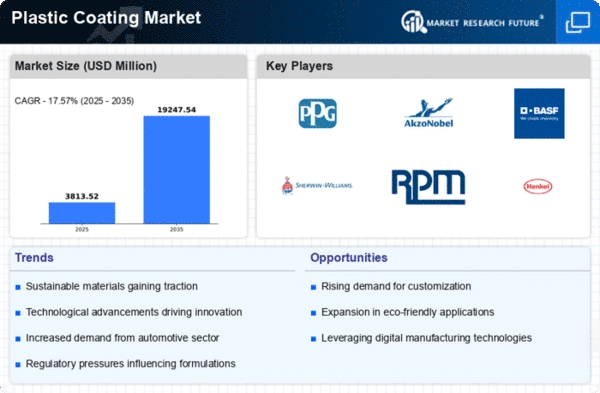
As per MRFR analysis, the Plastic Coating Market Size was estimated at 3243.62 USD Million in 2024. The Plastic Coating industry is projected to grow from 3813.59 USD Million in 2025 to 19247.54 USD Million by 2035, exhibiting a compound annual growth rate (CAGR) of 17.57 during the forecast period 2025 - 2035.

Key Market Trends & Highlights

The Plastic Coating Market is experiencing robust growth driven by sustainability and technological advancements.

  • North America remains the largest market for plastic coatings, driven by extensive automotive and construction activities. Asia-Pacific is the fastest-growing region, reflecting a surge in demand for innovative coating solutions in electronics and automotive components. The automotive segment continues to dominate, while the electronics segment is rapidly expanding due to technological innovations. Key market drivers include rising demand from the automotive sector and an increased focus on environmental sustainability.

Market Size & Forecast

2024 Market Size 3243.62 (USD Million)
2035 Market Size 19247.54 (USD Million)
CAGR (2025 - 2035) 17.57%
Largest Regional Market Share in 2024 North America

Major Players

<p>PPG Industries (US), AkzoNobel (NL), BASF (DE), Sherwin-Williams (US), RPM International (US), Henkel (DE), Eastman Chemical Company (US), Nippon Paint Holdings (JP), Kansai Paint (JP)</p>

Market Trends

The Plastic Coating Market is currently experiencing a dynamic evolution, driven by various factors that influence its growth trajectory. The increasing demand for durable and aesthetically pleasing surfaces across multiple industries, including automotive, electronics, and construction, appears to be a primary catalyst. Furthermore, advancements in technology and the development of innovative coating solutions are likely to enhance the performance characteristics of plastic coatings, making them more appealing to manufacturers and consumers alike. As sustainability becomes a focal point, the market is also witnessing a shift towards eco-friendly formulations, which may reshape product offerings and consumer preferences. In addition, the competitive landscape of the Plastic Coating Market is intensifying, with numerous players striving to differentiate their products through unique features and enhanced functionalities. This competitive pressure could lead to increased investment in research and development, fostering a culture of innovation. Moreover, the globalization of supply chains and the expansion of manufacturing capabilities in emerging markets may further influence market dynamics. Overall, the Plastic Coating Market is poised for continued growth, with various trends indicating a promising future for stakeholders involved in this sector.

Sustainability Initiatives

The Plastic Coating Market is increasingly aligning with sustainability initiatives, as manufacturers seek to develop eco-friendly products. This trend reflects a growing awareness of environmental issues and consumer demand for greener alternatives. Companies are exploring bio-based materials and low-VOC formulations, which may reduce the ecological footprint of plastic coatings.

Technological Advancements

Technological advancements are playing a crucial role in shaping the Plastic Coating Market. Innovations in application techniques and material science are enhancing the performance and durability of coatings. These developments could lead to improved adhesion, resistance to wear, and overall longevity, making plastic coatings more attractive for various applications.

Customization and Personalization

Customization and personalization are emerging trends within the Plastic Coating Market. As consumers increasingly seek unique and tailored solutions, manufacturers are responding by offering a wider range of colors, textures, and finishes. This trend may drive demand for specialized coatings that cater to specific aesthetic and functional requirements.

Plastic Coating Market Market Drivers

Growth in End-Use Industries

The Global Plastic Coatings Market Industry benefits from robust growth in end-use industries such as automotive, construction, and consumer goods. The automotive sector, in particular, is experiencing a surge in demand for lightweight and corrosion-resistant coatings, which enhance vehicle performance and aesthetics. Similarly, the construction industry is increasingly utilizing plastic coatings for protective and decorative purposes in residential and commercial buildings. This expansion in end-use industries is expected to propel the market forward, with projections indicating a market size of 7.3 USD Billion by 2024. The diverse applications of plastic coatings across these sectors underline their versatility and importance.

Rising Demand for Durable Coatings

The Global Plastic Coatings Market Industry experiences a notable increase in demand for durable coatings across various sectors. Industries such as automotive, construction, and electronics are increasingly adopting plastic coatings due to their superior resistance to wear, corrosion, and chemicals. This trend is driven by the need for long-lasting products that can withstand harsh environments. As a result, the market is projected to reach 7.3 USD Billion in 2024, reflecting a growing preference for high-performance coatings. The durability offered by these coatings not only enhances product lifespan but also reduces maintenance costs, making them an attractive option for manufacturers.

Emerging Markets and Global Expansion

Emerging markets are becoming increasingly significant in the Global Plastic Coatings Market Industry. Countries in Asia-Pacific, Latin America, and Africa are witnessing rapid industrialization and urbanization, leading to heightened demand for plastic coatings in various applications. The growth of the middle class in these regions is also driving consumer spending on durable goods, further boosting the market. As manufacturers seek to expand their global footprint, they are likely to invest in these emerging markets, capitalizing on the growth opportunities they present. This trend is expected to contribute to the overall market growth, with a projected CAGR of 5.33% from 2025 to 2035.

Technological Advancements in Coating Processes

Technological advancements play a pivotal role in shaping the Global Plastic Coatings Market Industry. Innovations in coating processes, such as electrostatic spraying and powder coating, enhance the efficiency and effectiveness of plastic coatings. These technologies enable better adhesion, uniform application, and reduced waste, which are crucial for meeting the stringent quality standards of various industries. Furthermore, the integration of automation and robotics in coating applications is likely to streamline production processes, thereby increasing output. As these technologies evolve, they are expected to contribute to the market's growth, potentially reaching 12.9 USD Billion by 2035.

Environmental Regulations and Sustainability Initiatives

The Global Plastic Coatings Market Industry is significantly influenced by increasing environmental regulations and sustainability initiatives. Governments worldwide are implementing stricter regulations to minimize the environmental impact of industrial processes, prompting manufacturers to adopt eco-friendly coatings. Water-based and solvent-free plastic coatings are gaining traction as they align with sustainability goals. This shift not only helps companies comply with regulations but also appeals to environmentally conscious consumers. As a result, the market is likely to witness a compound annual growth rate of 5.33% from 2025 to 2035, driven by the demand for sustainable coating solutions.

Market Segment Insights

By Application: Automotive (Largest) vs. Electronics (Fastest-Growing)

<p>In the Plastic Coating Market, the application segment showcases a diverse distribution of market share among various sectors, with the automotive industry being the largest contributor. Automotive coatings benefit from advancements in technology and increasing demand for aesthetic enhancements. Following closely, the electronics sector is emerging rapidly, driven by the surge in consumer electronics and technological innovations. Other notable segments include construction, industrial, and consumer goods, each playing a vital role in the overall market landscape. As we look towards future growth trends, the automotive application remains resilient due to a continuous need for durable and visually appealing products. The electronics sector is identified as the fastest-growing segment, fueled by the demand for high-performance coatings that provide protection against interference and environmental factors. Additionally, sustainability trends are leading to innovations in coatings that cater to eco-conscious consumers across all applications, further enhancing market dynamics.</p>

<p>Automotive (Dominant) vs. Consumer Goods (Emerging)</p>

<p>The automotive sector stands out as a dominant player in the Plastic Coating Market, primarily due to its extensive use in vehicle exteriors and interiors, which require coatings that offer durability, weather resistance, and aesthetic appeal. Manufacturers in this segment invest significantly in R&amp;D to produce coatings that cater to evolving automotive designs and environmental regulations. On the other hand, the consumer goods segment is emerging, characterized by innovative applications that range from packaging to housewares. This sector is increasingly focusing on consumer preferences for non-toxic and sustainable products, pushing manufacturers to adopt eco-friendly practices. The contrasting dynamics of the automotive and consumer goods segments reflect the overall versatility and adaptability of the plastic coating applications in meeting diverse market needs.</p>

By End Use: Packaging (Largest) vs. Automotive Components (Fastest-Growing)

<p>The Plastic Coating Market is significantly influenced by various end-use applications, among which Packaging holds the largest share. This segment benefits from the booming e-commerce industry, which demands efficient and sustainable packaging solutions. Additionally, sectors like Building Materials and Furniture are also notable contributors to the market, reflecting steady demand driven by construction and renovation activities. Conversely, Electrical Insulation showcases an essential role in safeguarding electronic devices, thereby maintaining a consistent share in the market.</p>

<p>Automotive Components (Dominant) vs. Furniture (Emerging)</p>

<p>In the Plastic Coating Market, Automotive Components are considered the dominant segment, driven by the increasing emphasis on lightweight materials to enhance fuel efficiency and reduce emissions. The adoption of innovative coatings enhances performance and durability in automobile manufacturing. Conversely, the Furniture segment is emerging as a viable player as consumer trends shift towards sustainable and visually appealing designs. The adaptability of plastic coatings to various furniture materials supports the growing demand. This longitudinal change is facilitated by consumer awareness of environmental impacts, resulting in a surge of interest in eco-friendly coating solutions.</p>

By Type: Polyurethane (Largest) vs. Epoxy (Fastest-Growing)

<p>In the Plastic Coating Market, the segment values are characterized by varying degrees of market penetration and consumer preference. Polyurethane holds the largest share due to its superior flexibility and durability, making it a go-to choice for diverse applications, including automotive and industrial uses. Epoxy coatings, while not as dominant, are rapidly gaining traction owing to their excellent adhesion properties and chemical resistance, especially in the construction and aerospace sectors. The market dynamics are shaped by innovations and changing requirements across industries, influencing the adoption of these types. As the industry moves forward, growth trends indicate a significant shift towards more environmentally friendly and efficient coatings. Polyurethane's robust reputation is bolstered by advancements in formulation technology that enhance its sustainability profile. Epoxy, on the other hand, is seeing a surge in demand driven by the robust growth of the construction and automotive sectors, where high-performance coatings are essential. This evolution reflects an industry increasingly focused on performance, sustainability, and long-term durability, steering consumer preference towards these key segments.</p>

<p>Polyurethane: Dominant vs. Epoxy: Emerging</p>

<p>Polyurethane coatings are renowned for their outstanding flexibility, scratch resistance, and durability, making them ideal for a wide array of applications, from automotive finishes to protective industrial coatings. Their excellent performance under diverse environments has established them as the dominant type in the Plastic Coating Market. Meanwhile, epoxy coatings are emerging rapidly as a favored choice in demanding applications due to their exceptional adhesion, mechanical properties, and resistance to chemicals and heat. Epoxy's ability to cure at room temperature also adds to its appeal, particularly in the construction and manufacturing sectors. Together, these two types showcase the spectrum of performance and adaptability within the market, positioning themselves at the forefront of innovation and application needs.</p>

Get more detailed insights about Plastic Coatings Market Research Report - Forecast to 2035

Regional Insights

North America : Market Leader in Plastic Coatings

North America is poised to maintain its leadership in the plastic coating market, holding a significant share of 1620.0 million in 2024. The region's growth is driven by robust demand from automotive, aerospace, and construction sectors, alongside stringent regulations promoting eco-friendly coatings. The increasing focus on sustainability and innovation in coating technologies further propels market expansion. The United States stands as the primary contributor, with key players like PPG Industries, Sherwin-Williams, and RPM International leading the competitive landscape. These companies are investing heavily in R&D to develop advanced coatings that meet regulatory standards and consumer preferences. The presence of established manufacturers ensures a dynamic market environment, fostering continuous growth and innovation.

Europe : Emerging Market with Growth Potential

Europe's plastic coating market, valued at 900.0 million, is experiencing significant growth, driven by increasing demand in automotive and industrial applications. Regulatory frameworks aimed at reducing VOC emissions are catalyzing the shift towards sustainable coating solutions. The region's commitment to environmental standards is fostering innovation in eco-friendly products, enhancing market attractiveness. Germany, France, and the UK are leading the charge, with major players like BASF and AkzoNobel dominating the landscape. The competitive environment is characterized by strategic partnerships and technological advancements, ensuring that European manufacturers remain at the forefront of the industry. The focus on sustainability and compliance with regulations is shaping the future of the market.

Asia-Pacific : Rapid Growth in Emerging Markets

The Asia-Pacific region, with a market size of 600.0 million, is witnessing rapid growth in the plastic coating sector, driven by urbanization and industrialization. Countries like China and India are experiencing a surge in demand for coatings in construction and automotive industries. The region's expanding middle class is also contributing to increased consumer spending on durable goods, further boosting market growth. China is the largest market, with significant contributions from local manufacturers and international players like Nippon Paint and Kansai Paint. The competitive landscape is evolving, with companies focusing on innovation and sustainability to meet the growing demand. As regulations become more stringent, the emphasis on eco-friendly coatings is expected to shape the market dynamics in the coming years.

Middle East and Africa : Emerging Market with Unique Challenges

The Middle East and Africa region, valued at 123.62 million, is gradually emerging in the plastic coating market, driven by infrastructural developments and a growing manufacturing base. The demand for coatings in construction and automotive sectors is on the rise, supported by government initiatives aimed at economic diversification. However, challenges such as fluctuating oil prices and regulatory hurdles may impact growth. Countries like South Africa and the UAE are leading the market, with local and international players vying for a share. The competitive landscape is characterized by a mix of established companies and new entrants, focusing on innovative solutions to cater to diverse market needs. As the region continues to develop, the plastic coating market is expected to expand, albeit at a measured pace.

Key Players and Competitive Insights

The Plastic Coating Market is currently characterized by a dynamic competitive landscape, driven by innovation, sustainability, and strategic partnerships. Key players such as PPG Industries (US), AkzoNobel (NL), and BASF (DE) are actively shaping the market through their distinct operational focuses. PPG Industries (US) emphasizes innovation in product development, particularly in eco-friendly coatings, which aligns with the growing demand for sustainable solutions. AkzoNobel (NL) has been pursuing strategic partnerships to enhance its market reach, while BASF (DE) focuses on digital transformation to optimize its supply chain and improve customer engagement. Collectively, these strategies contribute to a competitive environment that is increasingly focused on sustainability and technological advancement.In terms of business tactics, companies are localizing manufacturing to reduce lead times and enhance responsiveness to regional market demands. Supply chain optimization remains a critical focus, particularly in light of recent global disruptions. The market structure appears moderately fragmented, with several key players exerting influence while also facing competition from smaller, specialized firms. This fragmentation allows for a diverse range of products and innovations, catering to various customer needs across different sectors.


In November PPG Industries (US) announced the launch of a new line of bio-based coatings aimed at reducing environmental impact. This strategic move not only reinforces PPG's commitment to sustainability but also positions the company to capture a growing segment of environmentally conscious consumers. The introduction of these products is likely to enhance PPG's competitive edge in a market increasingly driven by eco-friendly solutions.


In October AkzoNobel (NL) entered into a strategic alliance with a leading technology firm to develop advanced digital solutions for its coating applications. This partnership is expected to facilitate the integration of AI and machine learning into their product offerings, thereby improving efficiency and customer service. Such a move indicates AkzoNobel's proactive approach to leveraging technology for competitive differentiation in the market.


In September BASF (DE) expanded its production capacity for specialty coatings in response to rising demand in the automotive sector. This expansion not only reflects BASF's commitment to meeting market needs but also enhances its ability to compete effectively against rivals. By increasing production capabilities, BASF positions itself to capitalize on growth opportunities in a sector that is increasingly focused on high-performance coatings.


As of December the competitive trends in the Plastic Coating Market are heavily influenced by digitalization, sustainability, and the integration of advanced technologies. Strategic alliances are becoming more prevalent, enabling companies to pool resources and expertise to drive innovation. The competitive landscape is shifting from traditional price-based competition to a focus on technological advancements and supply chain reliability. This evolution suggests that companies that prioritize innovation and sustainability will likely emerge as leaders in the market, shaping the future of the Plastic Coating Market.

Key Companies in the Plastic Coating Market include

Industry Developments

November 2021:

Stora Enso has developed UltraThinPE Tec, which minimizes the quantity of plastic coating in foodservice board (FSB) and applications like single-use paper cups, according to the business. The technique, according to Stora Enso, enables for paper cup designs that include less than 5% plastic, which helps package converters, brand owners, and retailers reach their plastics reduction goals. The method is now utilized to make UltraThinPE coatings for Stora Enso's Cupforma paper cup product line. Depending on local restrictions, collecting, and sorting facilities, FSB products with UltraThinPE Tec coatings can be recycled alongside paper or board.

When paired with other paper and board packaging, they can also make it easier to recycle FSB in regular recycling mills as one-sided, minimal-plastic coatings.

In May 2021

, PPG, a global supplier of paint coatings and specialty materials completed the acquisition of Worwag, another manufacturer of coatings for industrial and automotive applications.

Intended Audience

This report will be beneficial for every stakeholder of the plastic coatings market such as :

    • Plastic coatings materials manufacturers
    • End-user industries
    • Traders and Suppliers
    • Plastic coatings materials R&D institutes.
    • Investors

Future Outlook

Plastic Coating Market Future Outlook

<p>The Plastic Coating Market is projected to grow at a 17.57% CAGR from 2025 to 2035, driven by increasing demand in automotive, electronics, and construction sectors.</p>

New opportunities lie in:

  • <p>Development of eco-friendly coating formulations Expansion into emerging markets with tailored solutions Integration of smart coatings for enhanced functionality</p>

<p>By 2035, the market is expected to achieve substantial growth, reflecting evolving industry needs.</p>

Market Segmentation

Plastic Coating Market Type Outlook

  • Polyurethane
  • Epoxy
  • Acrylic
  • Polyester
  • Fluoropolymer

Plastic Coating Market End Use Outlook

  • Automotive Components
  • Building Materials
  • Electrical Insulation
  • Furniture
  • Packaging

Plastic Coating Market Application Outlook

  • Automotive
  • Construction
  • Electronics
  • Industrial
  • Consumer Goods

Report Scope

MARKET SIZE 2024 3243.62(USD Million)
MARKET SIZE 2025 3813.59(USD Million)
MARKET SIZE 2035 19247.54(USD Million)
COMPOUND ANNUAL GROWTH RATE (CAGR) 17.57% (2025 - 2035)
REPORT COVERAGE Revenue Forecast, Competitive Landscape, Growth Factors, and Trends
BASE YEAR 2024
Market Forecast Period 2025 - 2035
Historical Data 2019 - 2024
Market Forecast Units USD Million
Key Companies Profiled PPG Industries (US), AkzoNobel (NL), BASF (DE), Sherwin-Williams (US), RPM International (US), Henkel (DE), Eastman Chemical Company (US), Nippon Paint Holdings (JP), Kansai Paint (JP)
Segments Covered Application, End Use, Type
Key Market Opportunities Growing demand for eco-friendly coatings drives innovation in the Plastic Coating Market.
Key Market Dynamics Rising demand for eco-friendly coatings drives innovation and competition in the plastic coating sector.
Countries Covered North America, Europe, APAC, South America, MEA

FAQs

What is the major driving factor behind the growth of the plastic coatings market?

The amazing benefits of plastic coatings such as wear resistance, durability, electrical insulation, and decorative properties are increasing its demand in various end-user industries.

Which region leads the plastic coatings market in terms of value?

North America is the leading market segment of the plastic coatings market owing to the greater prevalence of automotive, aerospace &amp; defense, and industrial machinery manufacturing Industries.

Which method of plastic coatings is expected to have the highest market value during the current forecast period?

The dip-coating process dominates the plastic coatings market owing to its cost-effectiveness and easy procedure.

Who are the key players of the global plastic coatings market?

The major global companies playing a key role in the plastic coatings market are : The DowDuPont Inc. (U.S.) BASF SE (Germany) The Sherwin-Williams Company (U.S.) PPG Industries, Inc. (U.S.) Axalta Coating Systems (U.S.) Akzo Nobel N.V. (Netherlands) The Valspar Corporation (U.S.) Bayer AG (Germany) Kansai Paint Co.Ltd. (Japan) Clariant (Switzerland) Wacker Chemie AG (Germany) 3M (U.S.) Eastman Chemical Company (U.S.) NIPPON PAINT (Japan) Diamond Vogel (U.S.)

  1. SECTION I: EXECUTIVE SUMMARY AND KEY HIGHLIGHTS
    1. | 1.1 EXECUTIVE SUMMARY
    2. | 1.1.1 Market Overview
    3. | 1.1.2 Key Findings
    4. | 1.1.3 Market Segmentation
    5. | 1.1.4 Competitive Landscape
    6. | 1.1.5 Challenges and Opportunities
    7. | 1.1.6 Future Outlook
  2. SECTION II: SCOPING, METHODOLOGY AND MARKET STRUCTURE
    1. | 2.1 MARKET INTRODUCTION
    2. | 2.1.1 Definition
    3. | 2.1.2 Scope of the study
    4. |-- 2.1.2.1 Research Objective
    5. |-- 2.1.2.2 Assumption
    6. |-- 2.1.2.3 Limitations
    7. | 2.2 RESEARCH METHODOLOGY
    8. | 2.2.1 Overview
    9. | 2.2.2 Data Mining
    10. | 2.2.3 Secondary Research
    11. | 2.2.4 Primary Research
    12. |-- 2.2.4.1 Primary Interviews and Information Gathering Process
    13. |-- 2.2.4.2 Breakdown of Primary Respondents
    14. | 2.2.5 Forecasting Model
    15. | 2.2.6 Market Size Estimation
    16. |-- 2.2.6.1 Bottom-Up Approach
    17. |-- 2.2.6.2 Top-Down Approach
    18. | 2.2.7 Data Triangulation
    19. | 2.2.8 Validation
  3. SECTION III: QUALITATIVE ANALYSIS
    1. | 3.1 MARKET DYNAMICS
    2. | 3.1.1 Overview
    3. | 3.1.2 Drivers
    4. | 3.1.3 Restraints
    5. | 3.1.4 Opportunities
    6. | 3.2 MARKET FACTOR ANALYSIS
    7. | 3.2.1 Value chain Analysis
    8. | 3.2.2 Porter's Five Forces Analysis
    9. |-- 3.2.2.1 Bargaining Power of Suppliers
    10. |-- 3.2.2.2 Bargaining Power of Buyers
    11. |-- 3.2.2.3 Threat of New Entrants
    12. |-- 3.2.2.4 Threat of Substitutes
    13. |-- 3.2.2.5 Intensity of Rivalry
    14. | 3.2.3 COVID-19 Impact Analysis
    15. |-- 3.2.3.1 Market Impact Analysis
    16. |-- 3.2.3.2 Regional Impact
    17. |-- 3.2.3.3 Opportunity and Threat Analysis
  4. SECTION IV: QUANTITATIVE ANALYSIS
    1. | 4.1 Chemicals and Materials, BY Application (USD Million)
    2. | 4.1.1 Automotive
    3. | 4.1.2 Construction
    4. | 4.1.3 Electronics
    5. | 4.1.4 Industrial
    6. | 4.1.5 Consumer Goods
    7. | 4.2 Chemicals and Materials, BY End Use (USD Million)
    8. | 4.2.1 Automotive Components
    9. | 4.2.2 Building Materials
    10. | 4.2.3 Electrical Insulation
    11. | 4.2.4 Furniture
    12. | 4.2.5 Packaging
    13. | 4.3 Chemicals and Materials, BY Type (USD Million)
    14. | 4.3.1 Polyurethane
    15. | 4.3.2 Epoxy
    16. | 4.3.3 Acrylic
    17. | 4.3.4 Polyester
    18. | 4.3.5 Fluoropolymer
    19. | 4.4 Chemicals and Materials, BY Region (USD Million)
    20. | 4.4.1 North America
    21. |-- 4.4.1.1 US
    22. |-- 4.4.1.2 Canada
    23. | 4.4.2 Europe
    24. |-- 4.4.2.1 Germany
    25. |-- 4.4.2.2 UK
    26. |-- 4.4.2.3 France
    27. |-- 4.4.2.4 Russia
    28. |-- 4.4.2.5 Italy
    29. |-- 4.4.2.6 Spain
    30. |-- 4.4.2.7 Rest of Europe
    31. | 4.4.3 APAC
    32. |-- 4.4.3.1 China
    33. |-- 4.4.3.2 India
    34. |-- 4.4.3.3 Japan
    35. |-- 4.4.3.4 South Korea
    36. |-- 4.4.3.5 Malaysia
    37. |-- 4.4.3.6 Thailand
    38. |-- 4.4.3.7 Indonesia
    39. |-- 4.4.3.8 Rest of APAC
    40. | 4.4.4 South America
    41. |-- 4.4.4.1 Brazil
    42. |-- 4.4.4.2 Mexico
    43. |-- 4.4.4.3 Argentina
    44. |-- 4.4.4.4 Rest of South America
    45. | 4.4.5 MEA
    46. |-- 4.4.5.1 GCC Countries
    47. |-- 4.4.5.2 South Africa
    48. |-- 4.4.5.3 Rest of MEA
  5. SECTION V: COMPETITIVE ANALYSIS
    1. | 5.1 Competitive Landscape
    2. | 5.1.1 Overview
    3. | 5.1.2 Competitive Analysis
    4. | 5.1.3 Market share Analysis
    5. | 5.1.4 Major Growth Strategy in the Chemicals and Materials
    6. | 5.1.5 Competitive Benchmarking
    7. | 5.1.6 Leading Players in Terms of Number of Developments in the Chemicals and Materials
    8. | 5.1.7 Key developments and growth strategies
    9. |-- 5.1.7.1 New Product Launch/Service Deployment
    10. |-- 5.1.7.2 Merger & Acquisitions
    11. |-- 5.1.7.3 Joint Ventures
    12. | 5.1.8 Major Players Financial Matrix
    13. |-- 5.1.8.1 Sales and Operating Income
    14. |-- 5.1.8.2 Major Players R&D Expenditure. 2023
    15. | 5.2 Company Profiles
    16. | 5.2.1 PPG Industries (US)
    17. |-- 5.2.1.1 Financial Overview
    18. |-- 5.2.1.2 Products Offered
    19. |-- 5.2.1.3 Key Developments
    20. |-- 5.2.1.4 SWOT Analysis
    21. |-- 5.2.1.5 Key Strategies
    22. | 5.2.2 AkzoNobel (NL)
    23. |-- 5.2.2.1 Financial Overview
    24. |-- 5.2.2.2 Products Offered
    25. |-- 5.2.2.3 Key Developments
    26. |-- 5.2.2.4 SWOT Analysis
    27. |-- 5.2.2.5 Key Strategies
    28. | 5.2.3 BASF (DE)
    29. |-- 5.2.3.1 Financial Overview
    30. |-- 5.2.3.2 Products Offered
    31. |-- 5.2.3.3 Key Developments
    32. |-- 5.2.3.4 SWOT Analysis
    33. |-- 5.2.3.5 Key Strategies
    34. | 5.2.4 Sherwin-Williams (US)
    35. |-- 5.2.4.1 Financial Overview
    36. |-- 5.2.4.2 Products Offered
    37. |-- 5.2.4.3 Key Developments
    38. |-- 5.2.4.4 SWOT Analysis
    39. |-- 5.2.4.5 Key Strategies
    40. | 5.2.5 RPM International (US)
    41. |-- 5.2.5.1 Financial Overview
    42. |-- 5.2.5.2 Products Offered
    43. |-- 5.2.5.3 Key Developments
    44. |-- 5.2.5.4 SWOT Analysis
    45. |-- 5.2.5.5 Key Strategies
    46. | 5.2.6 Henkel (DE)
    47. |-- 5.2.6.1 Financial Overview
    48. |-- 5.2.6.2 Products Offered
    49. |-- 5.2.6.3 Key Developments
    50. |-- 5.2.6.4 SWOT Analysis
    51. |-- 5.2.6.5 Key Strategies
    52. | 5.2.7 Eastman Chemical Company (US)
    53. |-- 5.2.7.1 Financial Overview
    54. |-- 5.2.7.2 Products Offered
    55. |-- 5.2.7.3 Key Developments
    56. |-- 5.2.7.4 SWOT Analysis
    57. |-- 5.2.7.5 Key Strategies
    58. | 5.2.8 Nippon Paint Holdings (JP)
    59. |-- 5.2.8.1 Financial Overview
    60. |-- 5.2.8.2 Products Offered
    61. |-- 5.2.8.3 Key Developments
    62. |-- 5.2.8.4 SWOT Analysis
    63. |-- 5.2.8.5 Key Strategies
    64. | 5.2.9 Kansai Paint (JP)
    65. |-- 5.2.9.1 Financial Overview
    66. |-- 5.2.9.2 Products Offered
    67. |-- 5.2.9.3 Key Developments
    68. |-- 5.2.9.4 SWOT Analysis
    69. |-- 5.2.9.5 Key Strategies
    70. | 5.3 Appendix
    71. | 5.3.1 References
    72. | 5.3.2 Related Reports

Chemicals and Materials Market Segmentation

Chemicals and Materials By Application (USD Million, 2025-2035)

  • Automotive
  • Construction
  • Electronics
  • Industrial
  • Consumer Goods

Chemicals and Materials By End Use (USD Million, 2025-2035)

  • Automotive Components
  • Building Materials
  • Electrical Insulation
  • Furniture
  • Packaging

Chemicals and Materials By Type (USD Million, 2025-2035)

  • Polyurethane
  • Epoxy
  • Acrylic
  • Polyester
  • Fluoropolymer
Infographic

Free Sample Request

Kindly complete the form below to receive a free sample of this Report

Get Free Sample

Customer Strories

Compare Licence

×
Features License Type
Single User Multiuser License Enterprise User
Price $4,950 $5,950 $7,250
Maximum User Access Limit 1 User Upto 10 Users Unrestricted Access Throughout the Organization
Free Customization
Direct Access to Analyst
Deliverable Format
Platform Access
Discount on Next Purchase 10% 15% 15%
Printable Versions