Request Free Sample ×

Kindly complete the form below to receive a free sample of this Report

* Please use a valid business email

Leading companies partner with us for data-driven Insights

clients tt-cursor
Hero Background
English
Chinese
French
Japanese
Korean
German
Spanish

Pizza Market Size

ID: MRFR/FnB/10027-CR
200 Pages
Snehal Singh
July 2025

Pizza Market Size, Share, Industry Trend & Analysis Research Report By Type (Regular Pizza, Frozen Pizza, Organic Pizza, Gluten-Free Pizza, Vegan Pizza), By Crust Type (Thin Crust, Thick Crust, Stuffed Crust, Cauliflower Crust), By Toppings (Vegetarian, Meat Lover's, Cheese, Seafood, Spicy), By Sales Channel (Online Delivery, Takeaway, Sit-Down Restaurants, Supermarkets) and By Regional (North America, Europe, South America, Asia Pacific, Middle East and Africa) - Forecast to 2035

Share:
Download PDF ×

We do not share your information with anyone. However, we may send you emails based on your report interest from time to time. You may contact us at any time to opt-out.

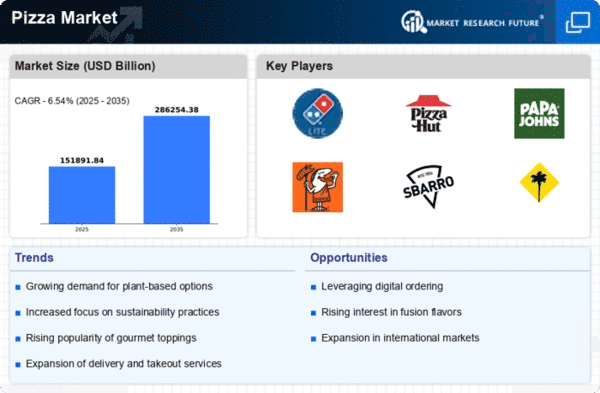
Pizza Market Infographic
Purchase Options

Pizza Size

Pizza Market Growth Projections and Opportunities

The pizza market is influenced by a multitude of market factors that shape its dynamics and drive consumer preferences. One of the primary factors is changing consumer lifestyles. As people lead increasingly busy lives, there is a growing demand for convenient and quick meal options. Pizza, with its widespread availability and ease of consumption, caters well to this need. Additionally, the rise of dual-income households has led to a higher reliance on ready-made meals, further boosting the pizza market.

Another significant market factor is globalization. The increasing interconnectedness of the world has introduced diverse cuisines to consumers, expanding their palates and preferences. This globalization has allowed pizza, originally an Italian dish, to become a global favorite. The adaptability of pizza to various regional tastes has played a crucial role in its widespread popularity. Localized toppings and flavors have emerged, contributing to the market's diversity.

Economic factors also play a pivotal role in shaping the pizza market. Disposable income levels influence consumer spending on dining out or ordering food. In times of economic prosperity, consumers may be more inclined to indulge in restaurant meals, including pizza. On the other hand, during economic downturns, the affordability and value-for-money aspects of pizza make it an attractive option for budget-conscious consumers.

Technological advancements have revolutionized the pizza industry, impacting both production and delivery. The introduction of advanced ovens and kitchen equipment has enhanced the efficiency of pizza preparation, ensuring consistent quality. Moreover, the integration of online ordering systems and delivery apps has streamlined the ordering process, making it more convenient for consumers to access their favorite pizzas. This technological shift has also led to the emergence of virtual kitchens and cloud kitchens, which focus solely on fulfilling online orders, altering the traditional restaurant model.

Health and wellness trends have significantly influenced the pizza market in recent years. With an increasing emphasis on healthier eating habits, consumers are seeking options that align with their dietary preferences. This has led to the introduction of healthier crust alternatives, gluten-free options, and an emphasis on fresh, organic ingredients. Pizza chains are adapting to these trends by incorporating healthier choices into their menus to cater to a more health-conscious consumer base.

Environmental sustainability has become a growing concern globally, impacting the pizza market as well. Consumers are increasingly aware of the environmental impact of their food choices. As a result, there is a rising demand for sustainable and eco-friendly practices within the pizza industry. This includes sourcing ingredients responsibly, minimizing packaging waste, and adopting energy-efficient practices in production and delivery.

Lastly, competition within the pizza market is intense and continually evolving. Not only do traditional pizzerias compete with each other, but they also face competition from newer entrants, such as fast-casual pizza chains and artisanal pizza makers. This competition drives innovation and forces players in the market to differentiate themselves through unique offerings, marketing strategies, and customer experiences.
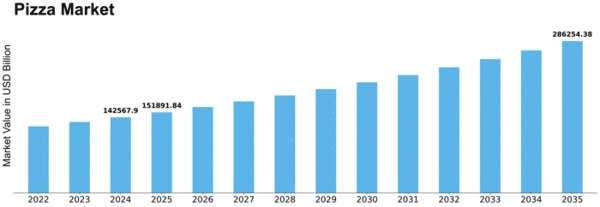

Pizza Market Size Graph
Author
Author Profile
Snehal Singh
Manager - Research

High acumen in analyzing complex macro & micro markets with more than 6 years of work experience in the field of market research. By implementing her analytical skills in forecasting and estimation into market research reports, she has expertise in Packaging, Construction, and Equipment domains. She handles a team size of 20-25 resources and ensures smooth running of the projects, associated marketing activities, and client servicing.

Leave a Comment

FAQs

What is the current valuation of the Pizza Market in 2025?

<p>The Pizza Market valuation stands at approximately 142.57 billion USD in 2024, with expectations to grow significantly by 2035.</p>

What is the projected market size for the Pizza Market by 2035?

<p>The Pizza Market is projected to reach around 286.25 billion USD by 2035, indicating robust growth.</p>

What is the expected CAGR for the Pizza Market during the forecast period 2025 - 2035?

<p>The expected CAGR for the Pizza Market during the forecast period 2025 - 2035 is 6.54%.</p>

Which pizza type segment shows the highest potential growth?

<p>The New York Style pizza segment, valued at 35 billion USD in 2024, is anticipated to grow to 70 billion USD by 2035.</p>

How does the valuation of Meat Lovers pizza compare to other topping preferences?

<p>The Meat Lovers pizza segment, valued at 45.12 billion USD in 2024, is projected to reach 92.45 billion USD by 2035, indicating strong consumer demand.</p>

What are the leading service types in the Pizza Market?

Dine-In service, valued at 40 billion USD in 2024, is expected to grow to 80 billion USD by 2035, highlighting its popularity.

Which demographic group is projected to spend the most on pizza by 2035?

Professionals, with a valuation of 35 billion USD in 2024, are expected to increase their spending to 70 billion USD by 2035.

What crust type is anticipated to see the most growth in the coming years?

The Thick Crust segment, valued at 40 billion USD in 2024, is projected to reach 80 billion USD by 2035, suggesting a strong consumer preference.

Who are the key players dominating the Pizza Market?

Key players in the Pizza Market include Domino's Pizza, Pizza Hut, and Papa John's, among others, leading the competitive landscape.

What is the valuation of the Gluten-Free Crust segment in 2025?

The Gluten-Free Crust segment, valued at 20 billion USD in 2024, is expected to grow to 40 billion USD by 2035, reflecting increasing health consciousness.

Market Summary

The global pizza market is valued at USD 212.3 billion in 2025 and is forecast to reach USD 360.3 billion by 2035, expanding at a CAGR of 5.4%. Surging demand for delivery convenience, health-driven menu innovation, and digital ordering platforms are the primary growth engines, while rising ingredient costs and broader fast-food competition remain key restraints.
North America dominates with roughly 40% of global revenue, supported by a mature delivery infrastructure and high consumption rates. Asia-Pacific is the fastest-growing region, driven by urbanisation and rising disposable incomes, followed by Europe (~28%), Latin America (~6%), and the Middle East & Africa (~3%).
By product type, non-vegetarian pizza leads with ~62% share, while vegetarian variants are growing faster on the back of plant-based trends. Within crust types, thick crust (~35%), thin crust (~33%), and stuffed crust (~32%) hold broadly equal footing, with gluten-free emerging as a high-growth niche. Distribution is led by quick-service restaurants (55%+ of sales), with online delivery platforms posting the strongest channel growth.
Competition in the market is anchored by Domino's Pizza, Pizza Hut (Yum! Brands), Papa John's, Little Caesars, and Sbarro in the foodservice segment, while Dr. Oetker, Nestlé, and General Mills lead the frozen retail aisle. Differentiation across players centers on delivery speed, digital capabilities, and menu innovation.

Key Market Trends & Highlights

The pizza market is experiencing a dynamic evolution driven by diverse consumer preferences and innovative offerings.

  • Gourmet and artisanal pizza options are gaining traction, particularly in North America, as consumers seek unique dining experiences. Health-conscious choices, including gluten-free crusts, are rapidly expanding in the Asia-Pacific region, reflecting a shift towards wellness-oriented diets. Technological integration in ordering systems is enhancing customer convenience, especially in the largest market of North America. Rising demand for convenience and innovative flavor profiles are key drivers propelling growth in both Neapolitan and Chicago style pizza segments.

Market Size & Forecast

2024 Market Size 201.4 (USD Billion)
2035 Market Size 360.3 (USD Billion)
CAGR (2025 - 2035) 5.4%
Largest Regional Market Share in 2024 North America

Major Players

Domino's Pizza (US), Pizza Hut (US), Papa John's (US), Little Caesars (US), Sbarro (US), California Pizza Kitchen (US), Round Table Pizza (US), Pizzahut (GB), Telepizza (ES)

Market Trends

The pizza market is currently experiencing a dynamic evolution, characterized by shifting consumer preferences and innovative culinary trends. As individuals increasingly seek diverse dining experiences, the demand for gourmet and artisanal pizzas has surged. This trend reflects a broader inclination towards high-quality ingredients and unique flavor combinations, which appeal to a more discerning clientele. Additionally, the rise of health-conscious eating habits has prompted many establishments to offer gluten-free, vegan, and organic options, including offerings similar to fresh market pizza and whole foods market pizza, catering to a wider audience.

This diversification not only enhances customer satisfaction but also fosters brand loyalty, as consumers gravitate towards establishments that align with their dietary preferences. Moreover, the pizza market is witnessing a significant transformation in distribution channels. The proliferation of online ordering and delivery services has reshaped how consumers access their favorite meals, including convenient options like market pizza offerings available through grocery chains and specialty food markets.

Health-Conscious Offerings

The Pizza Market is increasingly catering to health-conscious consumers by introducing gluten-free, vegan, and organic options. This trend reflects a growing awareness of dietary preferences and nutritional needs, allowing brands to attract a broader customer base.

Gourmet and Artisanal Pizzas

There is a notable rise in the popularity of gourmet and artisanal pizzas, characterized by unique toppings and high-quality ingredients. This trend indicates a shift towards more sophisticated dining experiences, appealing to consumers seeking distinct flavors.

Technological Integration in Ordering

The integration of technology in the Pizza Market is transforming the ordering process. Online platforms and mobile applications enhance convenience, while partnerships with delivery services streamline access to products, reflecting changing consumer behaviors.

Pizza Market Market Drivers

Market Growth Projections

The Global Pizza Market Industry is poised for substantial growth, with projections indicating a market value of 210 USD Billion by 2035. This anticipated growth is underpinned by various factors, including rising consumer demand for convenience foods and the expansion of delivery services. The compound annual growth rate of 2.8% from 2025 to 2035 reflects the industry's resilience and adaptability in meeting consumer preferences. As pizza continues to evolve, incorporating innovative flavors and healthier options, the market is likely to attract a diverse customer base. These growth projections underscore the industry's potential to thrive in an increasingly competitive food landscape.

Expansion of Delivery Services

The Global Pizza Market Industry benefits significantly from the expansion of delivery services, which have become integral to consumer purchasing behavior. The proliferation of online ordering platforms and mobile applications facilitates easy access to pizza, catering to the increasing demand for home delivery. This trend is particularly relevant in urban areas, where convenience is paramount. As a result, pizza chains are investing in technology to enhance their delivery capabilities, ensuring timely service and customer satisfaction. The industry's adaptation to this delivery-centric model is expected to contribute to a compound annual growth rate of 2.8% from 2025 to 2035, reflecting the importance of convenience in driving market growth.

Globalization of Pizza Culture

The Global Pizza Market Industry is significantly influenced by the globalization of pizza culture, which facilitates the exchange of culinary traditions across borders. As pizza becomes a staple in various countries, local adaptations emerge, enriching the overall market landscape. This cultural exchange not only diversifies product offerings but also enhances consumer engagement. For instance, the incorporation of regional ingredients and flavors into pizza recipes can attract a broader audience. The globalization trend suggests a vibrant and evolving market, with the potential for sustained growth as new consumer bases are cultivated. This dynamic environment may contribute to the industry's projected market value of 155.0 USD Billion in 2024.

Innovative Toppings and Flavors

Innovation within the Global Pizza Market Industry plays a crucial role in attracting diverse consumer segments. The introduction of unique toppings and flavors caters to evolving tastes and dietary preferences. For instance, the rise of plant-based and gourmet pizzas has expanded the market's reach, appealing to health-conscious consumers and food enthusiasts alike. This trend not only enhances customer satisfaction but also drives sales growth. As the industry adapts to these culinary trends, it is likely to witness sustained interest, contributing to the projected market value of 210 USD Billion by 2035. The continuous exploration of new flavor profiles indicates a dynamic and responsive market.

Health-Conscious Consumer Trends

The Global Pizza Market Industry is witnessing a shift towards health-conscious consumer trends, prompting pizza manufacturers to innovate healthier options. This includes the introduction of whole grain crusts, reduced-fat cheeses, and organic toppings, catering to consumers who prioritize nutrition without sacrificing taste. As awareness of health issues increases, the demand for pizzas that align with dietary preferences is likely to grow. This trend not only broadens the market's appeal but also positions it favorably in a competitive landscape. The industry's responsiveness to these health trends may play a pivotal role in sustaining its growth, potentially leading to a market value of 210 USD Billion by 2035.

Rising Demand for Convenience Foods

The Global Pizza Market Industry experiences a notable surge in demand for convenience foods, driven by the fast-paced lifestyle of consumers. As individuals increasingly seek quick meal solutions, pizza emerges as a preferred option due to its ready-to-eat nature. In 2024, the market is valued at approximately 155.0 USD Billion, reflecting a growing inclination towards fast food. This trend is particularly pronounced among younger demographics, who prioritize convenience and flavor. The industry's ability to adapt to consumer preferences, such as offering delivery and takeout options, further enhances its appeal, suggesting a robust growth trajectory in the coming years.

Market Segment Insights

By Pizza Type: Neapolitan (Largest) vs. Chicago Style (Fastest-Growing)

<p>In the competitive landscape of the pizza market, Neapolitan pizza holds a substantial market share, celebrated for its traditional preparation and use of high-quality ingredients like San Marzano tomatoes and mozzarella di bufala. This style, rooted in Italian culinary traditions, appeals to a broad demographic, including gourmet enthusiasts and health-conscious consumers seeking authentic flavors. In contrast, the Chicago Style garners increasing attention for its unique thick crust and deep-dish form, capturing the interest of adventurous diners and fast-casual restaurant operators alike, thus solidifying its role in market dynamics.</p>

<p>Neapolitan (Dominant) vs. Chicago Style (Emerging)</p>

<p>Neapolitan pizza is often regarded as the gold standard within the pizza market due to its rich history and adherence to traditional cooking methods. It boasts a thin, soft crust with a charred underbelly and is typically topped with simple yet fresh ingredients, delivering an authentic taste experience. Conversely, Chicago Style pizza, characterized by its thick crust and layered toppings, has emerged strongly over the past few years. This variant is particularly popular among families and group diners, offering a hearty, filling option suitable for sharing. As more restaurants embrace Chicago Style, its popularity continues to rise, appealing to consumers seeking comfort food with a unique twist.</p>

By Crust Type: Thin Crust (Largest) vs. Gluten-Free Crust (Fastest-Growing)

In the pizza market, the crust type plays a pivotal role in consumer preference and overall market dynamics. Among the various crust options, Thin Crust continues to dominate with a substantial market presence due to its popularity among health-conscious consumers seeking lower-calorie options. Following closely are Thick Crust and Stuffed Crust, which cater to a more indulgent segment of the market, appealing to those looking for a more filling pizza experience. Gluten-Free Crust is gaining traction, reflecting a shift in consumer dietary preferences, while Cauliflower Crust is emerging as a niche option for health-conscious eaters. The growth trends in the pizza crust segment are primarily driven by changing consumer tastes and dietary requirements. The demand for Gluten-Free Crust is on the rise as consumers increasingly seek gluten-free options due to health concerns such as celiac disease and gluten sensitivity. Additionally, the trend toward healthier eating leads to a surge in demand for alternative crusts like Cauliflower Crust, which appeal to those looking for a low-carb or vegetable-based option. The combination of convenience and health benefits is propelling the growth of these segments, indicating a shift in how consumers approach their pizza choices.

Thin Crust (Dominant) vs. Cauliflower Crust (Emerging)

Thin Crust is the dominant player in the pizza crust market, favored for its light and crispy texture that complements a wide variety of toppings. This crust type appeals to consumers seeking a balanced meal option and is often associated with traditional Italian styles, enhancing its popularity. In contrast, Cauliflower Crust is an emerging choice among health-conscious consumers, particularly those looking for gluten-free or low-carb diets. Its unique composition offers a vegetable-based alternative that is not only healthier but also caters to the growing demand for innovative food products. The rise of the health movement in the food industry positions Cauliflower Crust as a viable competitor, capturing a new segment of pizza lovers keen on maintaining their dietary preferences without sacrificing flavor.

By Topping Preference: Vegetarian (Largest) vs. Meat Lovers (Fastest-Growing)

<p>In the Pizza Market, topping preference plays a significant role in consumer choices. The vegetarian segment dominates with a considerable share among pizza lovers, characterized by a variety of options ranging from classic Margherita to innovative veggie-loaded creations. The meat lovers segment, while smaller in share, shows rapid growth as more consumers seek hearty and protein-rich options. Trends suggest a growing appetite for meat-inclusive pizzas, particularly in regions experiencing increased demand for bold flavors. As health consciousness rises, so does the demand for vegetarian options, fueling its market leading status. Conversely, the meat lovers segment is benefitting from evolving culinary trends, with many consumers drawn to specialty pizzas featuring gourmet meats and fusion flavors. This dual dynamic illustrates distinct consumer preferences shaping the pizza market landscape.</p>

<p>Vegetarian: Dominant vs. Meat Lovers: Emerging</p>

<p>The vegetarian segment in the pizza market stands out as the dominant choice among health-conscious consumers, characterized by its emphasis on fresh and organic ingredients, appealing not only to vegetarians but also to flexitarians. Its wide range of offerings, from traditional vegetable toppings to innovative plant-based substitutes, aligns well with current health and wellness trends. The meat lovers segment, on the other hand, has emerged as a compelling choice, driven by increasing consumer interest in superior meat quality and unique topping combinations. This segment's appeal is amplified by the trend of offering gourmet pizzas that feature artisanal meats, which have become particularly popular in urban areas. As more consumers experiment with diverse flavor profiles, both segments signify a vibrant and competitive landscape in the pizza market.</p>

By Service Type: Delivery (Largest) vs. Takeout (Fastest-Growing)

<p>In the Pizza Market, service types are pivotal in defining consumer preferences and purchasing behaviors. Currently, the Delivery segment holds the largest market share, as it caters to the rising demand for convenience among customers. Meanwhile, Takeout is rapidly gaining traction, ideal for consumers who prefer a quick and easy option without the time commitment of dining in. Other segments like Dine-In, Frozen, and Food Trucks are also essential, but they generally occupy smaller niches within the larger market landscape. Growth trends indicate that the Delivery segment benefits significantly from the proliferation of mobile ordering and delivery apps, which have transformed the consumer experience. Conversely, the Takeout segment is being propelled by changing lifestyle trends, where convenience and speed are prioritized. Additionally, as more people seek options that fit their busy lives, the demand for these service types in the Pizza Market continues to rise, solidifying their importance.</p>

<p>Delivery (Dominant) vs. Food Truck (Emerging)</p>

<p>The Delivery segment stands as the dominant force within the Pizza Market, characterized by its ability to reach a vast audience comforted by convenience. This segment thrives on efficient logistics and customer service, often leveraging technology to streamline orders and enhance user experience. In contrast, the Food Truck segment represents an emerging trend, appealing to adventurous eaters looking for unique and gourmet pizza experiences outside traditional settings. While still niche, Food Trucks are gaining popularity due to their ability to cater to local events and festivals, thus creating a loyal customer base. Both segments reflect diverse consumer preferences, showing the versatility and evolving nature of the Pizza Market.</p>

By Consumer Demographics: Families (Largest) vs. Young Adults (Fastest-Growing)

<p>In the Pizza Market, the consumer demographics segment showcases significant diversity in preferences and consumption patterns. Families represent the largest segment, driven by their need for convenient meal solutions that cater to all age groups. Meanwhile, young adults are emerging as the fastest-growing demographic, increasingly seeking adventurous flavors and unique pizza offerings that resonate with their lifestyle. This shift is indicative of changing market dynamics, where traditional consumption patterns are being challenged by evolving preferences. The growth trends within these demographics reveal several key drivers. Families tend to favor value-oriented, shareable pizza options designed for group dining, while young adults gravitate towards artisanal and health-conscious choices that are reflective of their lifestyles. The growing emphasis on online ordering and delivery services is also influencing consumer behavior, contributing to the rapid expansion of young adult consumers in the market. Understanding these trends helps in tailoring product offerings and marketing strategies that effectively target each customer segment.</p>

<p>Families: Dominant vs. Young Adults: Emerging</p>

<p>Families are a dominant force in the Pizza Market, characterized by their preference for larger, shareable pizzas that cater to diverse tastes and age ranges. They often opt for classic options that appeal to both children and adults, emphasizing convenience and value. On the other hand, young adults represent an emerging segment, known for their adventurous culinary preferences and openness to trying new toppings and specialty pizzas. This group actively influences market trends with their interest in unique flavors, specialty diets, and health-conscious options. The collaboration of these two segments creates a dynamic marketplace, where traditional values meet modern expectations, allowing pizza brands to innovate their offerings and capture a wider audience.</p>

Get more detailed insights about Pizza Market Research Report – Global Forecast till 2035

Regional Insights

North America : Market Leader in Pizza Sales

North America continues to lead The Pizza, holding a significant share of 71.54% in 2024. The region's growth is driven by a robust demand for convenience foods, increasing consumer preference for delivery and takeout options, and a diverse range of pizza offerings. Regulatory support for food safety and quality standards further enhances market stability and growth potential. The competitive landscape is characterized by major players such as Domino's Pizza, Pizza Hut, and Papa John's, which dominate the market with innovative menu options and aggressive marketing strategies. The U.S. remains the largest market, with a strong presence of both national chains and local pizzerias, ensuring a vibrant and competitive environment.

Europe : Emerging Trends in Pizza Consumption

Europe's pizza market is experiencing notable growth, with a market size of €38.77 billion. Factors such as increasing urbanization, changing lifestyles, and a growing preference for international cuisines are driving demand. Additionally, health-conscious trends are prompting pizzerias to offer more organic and gluten-free options, aligning with consumer preferences. Regulatory frameworks in the EU promote food safety and quality, further supporting market expansion. Leading countries in this region include Italy, the birthplace of pizza, and the UK, which has seen a surge in pizza consumption. Major players like Domino's and Pizza Hut are expanding their footprint, while local brands are innovating to capture market share. The competitive landscape is vibrant, with a mix of traditional and modern pizzerias catering to diverse consumer tastes.

Asia-Pacific : Rapid Growth in Pizza Demand

The Asia-Pacific pizza market is on an upward trajectory, with a market size of $25.0 billion. This growth is fueled by rising disposable incomes, urbanization, and a growing appetite for Western fast food. The region is witnessing an increase in pizza consumption, particularly among younger demographics who favor convenience and variety. Regulatory initiatives aimed at improving food safety standards are also contributing to market growth. Countries like Japan, Australia, and China are leading the charge, with a mix of international chains and local brands competing for market share. Key players such as Domino's and Pizza Hut are expanding their operations, while local pizzerias are innovating to cater to regional tastes. The competitive landscape is dynamic, with a focus on delivery services and unique flavor offerings.

Middle East and Africa : Emerging Market for Pizza

The Middle East and Africa (MEA) pizza market is gradually emerging, with a market size of $7.68 billion. Factors such as increasing urbanization, a young population, and a growing middle class are driving demand for pizza. The region is witnessing a shift in consumer preferences towards fast food and convenience dining, supported by regulatory frameworks that promote food safety and quality standards. Leading countries in this region include South Africa and the UAE, where international pizza chains are expanding their presence. Key players like Domino's and local brands are competing to capture the growing market. The competitive landscape is evolving, with a focus on delivery services and menu innovation to cater to diverse consumer tastes.

Key Players and Competitive Insights

The global pizza market is moderately consolidated, with the top chains competing across three primary dimensions: delivery speed and digital ordering capability, menu innovation, and value pricing. Regional operators continue to hold meaningful share through local relevance and pricing agility, particularly in Europe and Latin America.
Domino's Pizza, Inc. (US) Domino's is the largest pizza company in the world, operating more than 21,300 stores in over 90 markets, with global retail sales of over $19.1 billion in 2024. Its competitive strength is anchored in digital infrastructure — in 2024, Domino's generated more than 85% of US retail sales through digital channels. Fiscal 2024 results reflected global retail sales growth of 5.9% (excluding foreign currency impact), US same-store sales growth of 3.2%, and a global net store addition of 775 units — underpinned by the company's "Hungry for MORE" strategy focused on value and order count growth. (Source: Domino's Pizza FY2024 Earnings Release, SEC / ir.dominos.com, February 2025)
Pizza Hut (Yum! Brands, US) Yum! Brands crossed the milestone of 20,000 Pizza Hut locations globally in 2024, cementing the brand's position as one of the most widely distributed pizza chains in the world, operating across more than 110 countries. Across the Yum! Brands system in 2024, digital sales exceeded $30 billion, with over 50% of total system sales transacted through digital channels — a benchmark that reflects the group's continued investment in its proprietary digital and technology platform, Byte by Yum! Pizza Hut differentiates through multi-format operations — dine-in, carry-out, and delivery — combined with extensive menu localisation across Asia, the Middle East, and Latin America. (Sources: Yum! Brands FY2023 10-K, SEC, February 2024; Yum! Brands 2024 Annual Report)
Papa John's International, Inc. (US) Papa John's reported total revenues of $2,059.4 million in fiscal 2024, with 6,030 restaurants operating across 51 countries and territories as of December 29, 2024 — a net increase of 124 restaurants globally during the year. The North America region accounted for 3,514 restaurants, while the International segment contributed 2,516 locations. The brand competes on ingredient quality through its "Better Ingredients, Better Pizza" positioning, while investing in digital ordering and loyalty programmes to drive repeat visits and close the technology gap with category leaders. (Source: Papa John's International FY2024 10-K, SEC / ir.papajohns.com, February 2025)
Little Caesars (US) Little Caesars reached peak revenue of $1.1 billion in 2024, sustaining its position as the third-largest pizza chain in the US by location count. The brand's competitive model is built around its "Hot-N-Ready" carry-out format, which eliminates delivery infrastructure costs and enables aggressive value pricing — a structure that sustains strong performance in cost-sensitive consumer segments where delivery fees are a deterrent. Little Caesars continues to expand its domestic franchise footprint, focusing on high-density suburban and value-oriented markets. (Source: Zippia Company Revenue Data, 2024)
Telepizza (ES) Telepizza achieved €600 million in revenue in 2024 and reported a 15% rise in monthly unique users on its web and mobile platforms in Spain in 2025, reflecting strong digital growth momentum. In Q1 2024, Telepizza saw a 7% increase in average transaction value, partly driven by customers adding more items from an extended menu — supported by competitive pricing and combo deal promotions, particularly during peak family dining periods. Operating primarily across Spain, Latin America, and Southern Europe, Telepizza is the strongest regional challenger to US-headquartered chains in its home markets, competing through local pricing agility, franchise network density, and culturally adapted menus. (Sources: Pestel-analysis.com citing Telepizza 2024 data; MatrixBCG Telepizza Business Model Analysis)

Key Companies in the Pizza Market include

Industry Developments

The pizza market has recently witnessed significant developments, with notable companies like Domino's Pizza Market and Papa John's continuing to expand their market presence through innovative delivery solutions and menu diversification. These developments highlight the broader evolution of the pizza market and the emergence of hybrid dining concepts such as urban field pizza and market and specialty retail experiences centered around market pizza concepts.

In October 2023, Domino's Pizza Market announced a new partnership with a technology provider to enhance its online ordering system, responding to the growing demand for convenient and efficient service.

In September 2023, Pizza Market Hut launched a sustainability initiative aimed at reducing its carbon footprint and introducing more plant-based menu options, aligning with the increasing consumer preference for environmentally friendly dining choices.

Furthermore, in August 2023, Papa Murphy's reported an impressive growth in sales attributed to its focus on fresh and customizable pizzas, which has gained popularity amongst health-conscious consumers.

Mergers and acquisitions remain a topic of interest, with Marco's Pizza Market completing its acquisition of a regional chain, aimed at expanding its market share, which was announced in July 2023.

These developments reflect a dynamic and evolving landscape within the Pizza Market, as companies adapt to changing consumer preferences and competitive pressures.

The overall market is expected to continue growing, driven by innovations and strategic expansions by key players in the industry.

Future Outlook

Pizza Market Future Outlook

The Pizza is projected to grow at a 5.4% CAGR from 2025 to 2035, driven by increasing consumer demand for convenience, innovation in flavors, and health-conscious options.

New opportunities lie in:

  • <p>Expansion of plant-based pizza offerings to capture health-conscious consumers. Implementation of advanced delivery technologies for enhanced customer experience. Development of customizable pizza kits for at-home preparation and engagement.</p>

By 2035, the pizza market is expected to solidify its growth trajectory, adapting to evolving consumer preferences.

Market Segmentation

Pizza Market Crust Type Outlook

  • Thin Crust
  • Thick Crust
  • Stuffed Crust
  • Gluten-Free Crust
  • Cauliflower Crust

Pizza Market Pizza Type Outlook

  • Neapolitan Pizza
  • New York Style Pizza
  • Chicago Style Pizza
  • Sicilian Pizza
  • California Style Pizza

Pizza Market Purchase Channel Outlook

  • Online Delivery
  • In-Store Purchase
  • Takeout
  • Food Truck
  • Subscription Service

Pizza Market Topping Preference Outlook

  • Vegetarian Toppings
  • Meat Toppings
  • Seafood Toppings
  • Cheese Toppings
  • Exotic Toppings

Pizza Market Consumer Demographics Outlook

  • Families
  • Young Adults
  • Working Professionals
  • Students
  • Health-Conscious Consumers

Report Scope

MARKET SIZE 2024 201.4(USD Billion)
MARKET SIZE 2025 212.3(USD Billion)
MARKET SIZE 2035 360.3(USD Billion)
COMPOUND ANNUAL GROWTH RATE (CAGR) 5.4% (2025 - 2035)
REPORT COVERAGE Revenue Forecast, Competitive Landscape, Growth Factors, and Trends
BASE YEAR 2024
Market Forecast Period 2025 - 2035
Historical Data 2019 - 2024
Market Forecast Units USD Billion
Key Companies Profiled Domino's Pizza (US), Pizza Hut (US), Papa John's (US), Little Caesars (US), Sbarro (US), California Pizza Kitchen (US), Round Table Pizza (US), Pizzahut (GB), Telepizza (ES)
Segments Covered Pizza Type, Crust Type, Topping Preference, Purchase Channel, Consumer Demographics
Key Market Opportunities Integration of plant-based ingredients to cater to evolving consumer preferences in the Pizza Market.
Key Market Dynamics Rising consumer demand for plant-based options drives innovation and competition within the pizza market.
Countries Covered North America, Europe, APAC, South America, MEA

FAQs

What is the current valuation of the Pizza Market in 2025?

<p>The Pizza Market valuation stands at approximately 142.57 billion USD in 2024, with expectations to grow significantly by 2035.</p>

What is the projected market size for the Pizza Market by 2035?

<p>The Pizza Market is projected to reach around 286.25 billion USD by 2035, indicating robust growth.</p>

What is the expected CAGR for the Pizza Market during the forecast period 2025 - 2035?

<p>The expected CAGR for the Pizza Market during the forecast period 2025 - 2035 is 6.54%.</p>

Which pizza type segment shows the highest potential growth?

<p>The New York Style pizza segment, valued at 35 billion USD in 2024, is anticipated to grow to 70 billion USD by 2035.</p>

How does the valuation of Meat Lovers pizza compare to other topping preferences?

<p>The Meat Lovers pizza segment, valued at 45.12 billion USD in 2024, is projected to reach 92.45 billion USD by 2035, indicating strong consumer demand.</p>

What are the leading service types in the Pizza Market?

Dine-In service, valued at 40 billion USD in 2024, is expected to grow to 80 billion USD by 2035, highlighting its popularity.

Which demographic group is projected to spend the most on pizza by 2035?

Professionals, with a valuation of 35 billion USD in 2024, are expected to increase their spending to 70 billion USD by 2035.

What crust type is anticipated to see the most growth in the coming years?

The Thick Crust segment, valued at 40 billion USD in 2024, is projected to reach 80 billion USD by 2035, suggesting a strong consumer preference.

Who are the key players dominating the Pizza Market?

Key players in the Pizza Market include Domino's Pizza, Pizza Hut, and Papa John's, among others, leading the competitive landscape.

What is the valuation of the Gluten-Free Crust segment in 2025?

The Gluten-Free Crust segment, valued at 20 billion USD in 2024, is expected to grow to 40 billion USD by 2035, reflecting increasing health consciousness.

  1. SECTION I: EXECUTIVE SUMMARY AND KEY HIGHLIGHTS
    1. | 1.1 EXECUTIVE SUMMARY
    2. | | 1.1.1 Market Overview
    3. | | 1.1.2 Key Findings
    4. | | 1.1.3 Market Segmentation
    5. | | 1.1.4 Competitive Landscape
    6. | | 1.1.5 Challenges and Opportunities
    7. | | 1.1.6 Future Outlook
  2. SECTION II: SCOPING, METHODOLOGY AND MARKET STRUCTURE
    1. | 2.1 MARKET INTRODUCTION
    2. | | 2.1.1 Definition
    3. | | 2.1.2 Scope of the study
    4. | | | 2.1.2.1 Research Objective
    5. | | | 2.1.2.2 Assumption
    6. | | | 2.1.2.3 Limitations
    7. | 2.2 RESEARCH METHODOLOGY
    8. | | 2.2.1 Overview
    9. | | 2.2.2 Data Mining
    10. | | 2.2.3 Secondary Research
    11. | | 2.2.4 Primary Research
    12. | | | 2.2.4.1 Primary Interviews and Information Gathering Process
    13. | | | 2.2.4.2 Breakdown of Primary Respondents
    14. | | 2.2.5 Forecasting Model
    15. | | 2.2.6 Market Size Estimation
    16. | | | 2.2.6.1 Bottom-Up Approach
    17. | | | 2.2.6.2 Top-Down Approach
    18. | | 2.2.7 Data Triangulation
    19. | | 2.2.8 Validation
  3. SECTION III: QUALITATIVE ANALYSIS
    1. | 3.1 MARKET DYNAMICS
    2. | | 3.1.1 Overview
    3. | | 3.1.2 Drivers
    4. | | 3.1.3 Restraints
    5. | | 3.1.4 Opportunities
    6. | 3.2 MARKET FACTOR ANALYSIS
    7. | | 3.2.1 Value chain Analysis
    8. | | 3.2.2 Porter's Five Forces Analysis
    9. | | | 3.2.2.1 Bargaining Power of Suppliers
    10. | | | 3.2.2.2 Bargaining Power of Buyers
    11. | | | 3.2.2.3 Threat of New Entrants
    12. | | | 3.2.2.4 Threat of Substitutes
    13. | | | 3.2.2.5 Intensity of Rivalry
    14. | | 3.2.3 COVID-19 Impact Analysis
    15. | | | 3.2.3.1 Market Impact Analysis
    16. | | | 3.2.3.2 Regional Impact
    17. | | | 3.2.3.3 Opportunity and Threat Analysis
  4. SECTION IV: QUANTITATIVE ANALYSIS
    1. | 4.1 Food, Beverages & Nutrition, BY Pizza Type (USD Billion)
    2. | | 4.1.1 Neapolitan
    3. | | 4.1.2 New York Style
    4. | | 4.1.3 Chicago Style
    5. | | 4.1.4 Sicilian
    6. | | 4.1.5 California Style
    7. | 4.2 Food, Beverages & Nutrition, BY Crust Type (USD Billion)
    8. | | 4.2.1 Thin Crust
    9. | | 4.2.2 Thick Crust
    10. | | 4.2.3 Stuffed Crust
    11. | | 4.2.4 Gluten-Free Crust
    12. | | 4.2.5 Cauliflower Crust
    13. | 4.3 Food, Beverages & Nutrition, BY Topping Preference (USD Billion)
    14. | | 4.3.1 Vegetarian
    15. | | 4.3.2 Meat Lovers
    16. | | 4.3.3 Seafood
    17. | | 4.3.4 Cheese Only
    18. | | 4.3.5 Gourmet
    19. | 4.4 Food, Beverages & Nutrition, BY Service Type (USD Billion)
    20. | | 4.4.1 Delivery
    21. | | 4.4.2 Takeout
    22. | | 4.4.3 Dine-In
    23. | | 4.4.4 Frozen
    24. | | 4.4.5 Food Truck
    25. | 4.5 Food, Beverages & Nutrition, BY Consumer Demographics (USD Billion)
    26. | | 4.5.1 Families
    27. | | 4.5.2 Young Adults
    28. | | 4.5.3 Students
    29. | | 4.5.4 Professionals
    30. | | 4.5.5 Health-Conscious Consumers
    31. | 4.6 Food, Beverages & Nutrition, BY Region (USD Billion)
    32. | | 4.6.1 North America
    33. | | | 4.6.1.1 US
    34. | | | 4.6.1.2 Canada
    35. | | 4.6.2 Europe
    36. | | | 4.6.2.1 Germany
    37. | | | 4.6.2.2 UK
    38. | | | 4.6.2.3 France
    39. | | | 4.6.2.4 Russia
    40. | | | 4.6.2.5 Italy
    41. | | | 4.6.2.6 Spain
    42. | | | 4.6.2.7 Rest of Europe
    43. | | 4.6.3 APAC
    44. | | | 4.6.3.1 China
    45. | | | 4.6.3.2 India
    46. | | | 4.6.3.3 Japan
    47. | | | 4.6.3.4 South Korea
    48. | | | 4.6.3.5 Malaysia
    49. | | | 4.6.3.6 Thailand
    50. | | | 4.6.3.7 Indonesia
    51. | | | 4.6.3.8 Rest of APAC
    52. | | 4.6.4 South America
    53. | | | 4.6.4.1 Brazil
    54. | | | 4.6.4.2 Mexico
    55. | | | 4.6.4.3 Argentina
    56. | | | 4.6.4.4 Rest of South America
    57. | | 4.6.5 MEA
    58. | | | 4.6.5.1 GCC Countries
    59. | | | 4.6.5.2 South Africa
    60. | | | 4.6.5.3 Rest of MEA
  5. SECTION V: COMPETITIVE ANALYSIS
    1. | 5.1 Competitive Landscape
    2. | | 5.1.1 Overview
    3. | | 5.1.2 Competitive Analysis
    4. | | 5.1.3 Market share Analysis
    5. | | 5.1.4 Major Growth Strategy in the Food, Beverages & Nutrition
    6. | | 5.1.5 Competitive Benchmarking
    7. | | 5.1.6 Leading Players in Terms of Number of Developments in the Food, Beverages & Nutrition
    8. | | 5.1.7 Key developments and growth strategies
    9. | | | 5.1.7.1 New Product Launch/Service Deployment
    10. | | | 5.1.7.2 Merger & Acquisitions
    11. | | | 5.1.7.3 Joint Ventures
    12. | | 5.1.8 Major Players Financial Matrix
    13. | | | 5.1.8.1 Sales and Operating Income
    14. | | | 5.1.8.2 Major Players R&D Expenditure. 2023
    15. | 5.2 Company Profiles
    16. | | 5.2.1 Domino's Pizza (US)
    17. | | | 5.2.1.1 Financial Overview
    18. | | | 5.2.1.2 Products Offered
    19. | | | 5.2.1.3 Key Developments
    20. | | | 5.2.1.4 SWOT Analysis
    21. | | | 5.2.1.5 Key Strategies
    22. | | 5.2.2 Pizza Hut (US)
    23. | | | 5.2.2.1 Financial Overview
    24. | | | 5.2.2.2 Products Offered
    25. | | | 5.2.2.3 Key Developments
    26. | | | 5.2.2.4 SWOT Analysis
    27. | | | 5.2.2.5 Key Strategies
    28. | | 5.2.3 Papa John's (US)
    29. | | | 5.2.3.1 Financial Overview
    30. | | | 5.2.3.2 Products Offered
    31. | | | 5.2.3.3 Key Developments
    32. | | | 5.2.3.4 SWOT Analysis
    33. | | | 5.2.3.5 Key Strategies
    34. | | 5.2.4 Little Caesars (US)
    35. | | | 5.2.4.1 Financial Overview
    36. | | | 5.2.4.2 Products Offered
    37. | | | 5.2.4.3 Key Developments
    38. | | | 5.2.4.4 SWOT Analysis
    39. | | | 5.2.4.5 Key Strategies
    40. | | 5.2.5 Sbarro (US)
    41. | | | 5.2.5.1 Financial Overview
    42. | | | 5.2.5.2 Products Offered
    43. | | | 5.2.5.3 Key Developments
    44. | | | 5.2.5.4 SWOT Analysis
    45. | | | 5.2.5.5 Key Strategies
    46. | | 5.2.6 California Pizza Kitchen (US)
    47. | | | 5.2.6.1 Financial Overview
    48. | | | 5.2.6.2 Products Offered
    49. | | | 5.2.6.3 Key Developments
    50. | | | 5.2.6.4 SWOT Analysis
    51. | | | 5.2.6.5 Key Strategies
    52. | | 5.2.7 Papa Murphy's (US)
    53. | | | 5.2.7.1 Financial Overview
    54. | | | 5.2.7.2 Products Offered
    55. | | | 5.2.7.3 Key Developments
    56. | | | 5.2.7.4 SWOT Analysis
    57. | | | 5.2.7.5 Key Strategies
    58. | | 5.2.8 Round Table Pizza (US)
    59. | | | 5.2.8.1 Financial Overview
    60. | | | 5.2.8.2 Products Offered
    61. | | | 5.2.8.3 Key Developments
    62. | | | 5.2.8.4 SWOT Analysis
    63. | | | 5.2.8.5 Key Strategies
    64. | | 5.2.9 Blaze Pizza (US)
    65. | | | 5.2.9.1 Financial Overview
    66. | | | 5.2.9.2 Products Offered
    67. | | | 5.2.9.3 Key Developments
    68. | | | 5.2.9.4 SWOT Analysis
    69. | | | 5.2.9.5 Key Strategies
    70. | 5.3 Appendix
    71. | | 5.3.1 References
    72. | | 5.3.2 Related Reports
  6. LIST OF FIGURES
    1. | 6.1 MARKET SYNOPSIS
    2. | 6.2 NORTH AMERICA MARKET ANALYSIS
    3. | 6.3 US MARKET ANALYSIS BY PIZZA TYPE
    4. | 6.4 US MARKET ANALYSIS BY CRUST TYPE
    5. | 6.5 US MARKET ANALYSIS BY TOPPING PREFERENCE
    6. | 6.6 US MARKET ANALYSIS BY SERVICE TYPE
    7. | 6.7 US MARKET ANALYSIS BY CONSUMER DEMOGRAPHICS
    8. | 6.8 CANADA MARKET ANALYSIS BY PIZZA TYPE
    9. | 6.9 CANADA MARKET ANALYSIS BY CRUST TYPE
    10. | 6.10 CANADA MARKET ANALYSIS BY TOPPING PREFERENCE
    11. | 6.11 CANADA MARKET ANALYSIS BY SERVICE TYPE
    12. | 6.12 CANADA MARKET ANALYSIS BY CONSUMER DEMOGRAPHICS
    13. | 6.13 EUROPE MARKET ANALYSIS
    14. | 6.14 GERMANY MARKET ANALYSIS BY PIZZA TYPE
    15. | 6.15 GERMANY MARKET ANALYSIS BY CRUST TYPE
    16. | 6.16 GERMANY MARKET ANALYSIS BY TOPPING PREFERENCE
    17. | 6.17 GERMANY MARKET ANALYSIS BY SERVICE TYPE
    18. | 6.18 GERMANY MARKET ANALYSIS BY CONSUMER DEMOGRAPHICS
    19. | 6.19 UK MARKET ANALYSIS BY PIZZA TYPE
    20. | 6.20 UK MARKET ANALYSIS BY CRUST TYPE
    21. | 6.21 UK MARKET ANALYSIS BY TOPPING PREFERENCE
    22. | 6.22 UK MARKET ANALYSIS BY SERVICE TYPE
    23. | 6.23 UK MARKET ANALYSIS BY CONSUMER DEMOGRAPHICS
    24. | 6.24 FRANCE MARKET ANALYSIS BY PIZZA TYPE
    25. | 6.25 FRANCE MARKET ANALYSIS BY CRUST TYPE
    26. | 6.26 FRANCE MARKET ANALYSIS BY TOPPING PREFERENCE
    27. | 6.27 FRANCE MARKET ANALYSIS BY SERVICE TYPE
    28. | 6.28 FRANCE MARKET ANALYSIS BY CONSUMER DEMOGRAPHICS
    29. | 6.29 RUSSIA MARKET ANALYSIS BY PIZZA TYPE
    30. | 6.30 RUSSIA MARKET ANALYSIS BY CRUST TYPE
    31. | 6.31 RUSSIA MARKET ANALYSIS BY TOPPING PREFERENCE
    32. | 6.32 RUSSIA MARKET ANALYSIS BY SERVICE TYPE
    33. | 6.33 RUSSIA MARKET ANALYSIS BY CONSUMER DEMOGRAPHICS
    34. | 6.34 ITALY MARKET ANALYSIS BY PIZZA TYPE
    35. | 6.35 ITALY MARKET ANALYSIS BY CRUST TYPE
    36. | 6.36 ITALY MARKET ANALYSIS BY TOPPING PREFERENCE
    37. | 6.37 ITALY MARKET ANALYSIS BY SERVICE TYPE
    38. | 6.38 ITALY MARKET ANALYSIS BY CONSUMER DEMOGRAPHICS
    39. | 6.39 SPAIN MARKET ANALYSIS BY PIZZA TYPE
    40. | 6.40 SPAIN MARKET ANALYSIS BY CRUST TYPE
    41. | 6.41 SPAIN MARKET ANALYSIS BY TOPPING PREFERENCE
    42. | 6.42 SPAIN MARKET ANALYSIS BY SERVICE TYPE
    43. | 6.43 SPAIN MARKET ANALYSIS BY CONSUMER DEMOGRAPHICS
    44. | 6.44 REST OF EUROPE MARKET ANALYSIS BY PIZZA TYPE
    45. | 6.45 REST OF EUROPE MARKET ANALYSIS BY CRUST TYPE
    46. | 6.46 REST OF EUROPE MARKET ANALYSIS BY TOPPING PREFERENCE
    47. | 6.47 REST OF EUROPE MARKET ANALYSIS BY SERVICE TYPE
    48. | 6.48 REST OF EUROPE MARKET ANALYSIS BY CONSUMER DEMOGRAPHICS
    49. | 6.49 APAC MARKET ANALYSIS
    50. | 6.50 CHINA MARKET ANALYSIS BY PIZZA TYPE
    51. | 6.51 CHINA MARKET ANALYSIS BY CRUST TYPE
    52. | 6.52 CHINA MARKET ANALYSIS BY TOPPING PREFERENCE
    53. | 6.53 CHINA MARKET ANALYSIS BY SERVICE TYPE
    54. | 6.54 CHINA MARKET ANALYSIS BY CONSUMER DEMOGRAPHICS
    55. | 6.55 INDIA MARKET ANALYSIS BY PIZZA TYPE
    56. | 6.56 INDIA MARKET ANALYSIS BY CRUST TYPE
    57. | 6.57 INDIA MARKET ANALYSIS BY TOPPING PREFERENCE
    58. | 6.58 INDIA MARKET ANALYSIS BY SERVICE TYPE
    59. | 6.59 INDIA MARKET ANALYSIS BY CONSUMER DEMOGRAPHICS
    60. | 6.60 JAPAN MARKET ANALYSIS BY PIZZA TYPE
    61. | 6.61 JAPAN MARKET ANALYSIS BY CRUST TYPE
    62. | 6.62 JAPAN MARKET ANALYSIS BY TOPPING PREFERENCE
    63. | 6.63 JAPAN MARKET ANALYSIS BY SERVICE TYPE
    64. | 6.64 JAPAN MARKET ANALYSIS BY CONSUMER DEMOGRAPHICS
    65. | 6.65 SOUTH KOREA MARKET ANALYSIS BY PIZZA TYPE
    66. | 6.66 SOUTH KOREA MARKET ANALYSIS BY CRUST TYPE
    67. | 6.67 SOUTH KOREA MARKET ANALYSIS BY TOPPING PREFERENCE
    68. | 6.68 SOUTH KOREA MARKET ANALYSIS BY SERVICE TYPE
    69. | 6.69 SOUTH KOREA MARKET ANALYSIS BY CONSUMER DEMOGRAPHICS
    70. | 6.70 MALAYSIA MARKET ANALYSIS BY PIZZA TYPE
    71. | 6.71 MALAYSIA MARKET ANALYSIS BY CRUST TYPE
    72. | 6.72 MALAYSIA MARKET ANALYSIS BY TOPPING PREFERENCE
    73. | 6.73 MALAYSIA MARKET ANALYSIS BY SERVICE TYPE
    74. | 6.74 MALAYSIA MARKET ANALYSIS BY CONSUMER DEMOGRAPHICS
    75. | 6.75 THAILAND MARKET ANALYSIS BY PIZZA TYPE
    76. | 6.76 THAILAND MARKET ANALYSIS BY CRUST TYPE
    77. | 6.77 THAILAND MARKET ANALYSIS BY TOPPING PREFERENCE
    78. | 6.78 THAILAND MARKET ANALYSIS BY SERVICE TYPE
    79. | 6.79 THAILAND MARKET ANALYSIS BY CONSUMER DEMOGRAPHICS
    80. | 6.80 INDONESIA MARKET ANALYSIS BY PIZZA TYPE
    81. | 6.81 INDONESIA MARKET ANALYSIS BY CRUST TYPE
    82. | 6.82 INDONESIA MARKET ANALYSIS BY TOPPING PREFERENCE
    83. | 6.83 INDONESIA MARKET ANALYSIS BY SERVICE TYPE
    84. | 6.84 INDONESIA MARKET ANALYSIS BY CONSUMER DEMOGRAPHICS
    85. | 6.85 REST OF APAC MARKET ANALYSIS BY PIZZA TYPE
    86. | 6.86 REST OF APAC MARKET ANALYSIS BY CRUST TYPE
    87. | 6.87 REST OF APAC MARKET ANALYSIS BY TOPPING PREFERENCE
    88. | 6.88 REST OF APAC MARKET ANALYSIS BY SERVICE TYPE
    89. | 6.89 REST OF APAC MARKET ANALYSIS BY CONSUMER DEMOGRAPHICS
    90. | 6.90 SOUTH AMERICA MARKET ANALYSIS
    91. | 6.91 BRAZIL MARKET ANALYSIS BY PIZZA TYPE
    92. | 6.92 BRAZIL MARKET ANALYSIS BY CRUST TYPE
    93. | 6.93 BRAZIL MARKET ANALYSIS BY TOPPING PREFERENCE
    94. | 6.94 BRAZIL MARKET ANALYSIS BY SERVICE TYPE
    95. | 6.95 BRAZIL MARKET ANALYSIS BY CONSUMER DEMOGRAPHICS
    96. | 6.96 MEXICO MARKET ANALYSIS BY PIZZA TYPE
    97. | 6.97 MEXICO MARKET ANALYSIS BY CRUST TYPE
    98. | 6.98 MEXICO MARKET ANALYSIS BY TOPPING PREFERENCE
    99. | 6.99 MEXICO MARKET ANALYSIS BY SERVICE TYPE
    100. | 6.100 MEXICO MARKET ANALYSIS BY CONSUMER DEMOGRAPHICS
    101. | 6.101 ARGENTINA MARKET ANALYSIS BY PIZZA TYPE
    102. | 6.102 ARGENTINA MARKET ANALYSIS BY CRUST TYPE
    103. | 6.103 ARGENTINA MARKET ANALYSIS BY TOPPING PREFERENCE
    104. | 6.104 ARGENTINA MARKET ANALYSIS BY SERVICE TYPE
    105. | 6.105 ARGENTINA MARKET ANALYSIS BY CONSUMER DEMOGRAPHICS
    106. | 6.106 REST OF SOUTH AMERICA MARKET ANALYSIS BY PIZZA TYPE
    107. | 6.107 REST OF SOUTH AMERICA MARKET ANALYSIS BY CRUST TYPE
    108. | 6.108 REST OF SOUTH AMERICA MARKET ANALYSIS BY TOPPING PREFERENCE
    109. | 6.109 REST OF SOUTH AMERICA MARKET ANALYSIS BY SERVICE TYPE
    110. | 6.110 REST OF SOUTH AMERICA MARKET ANALYSIS BY CONSUMER DEMOGRAPHICS
    111. | 6.111 MEA MARKET ANALYSIS
    112. | 6.112 GCC COUNTRIES MARKET ANALYSIS BY PIZZA TYPE
    113. | 6.113 GCC COUNTRIES MARKET ANALYSIS BY CRUST TYPE
    114. | 6.114 GCC COUNTRIES MARKET ANALYSIS BY TOPPING PREFERENCE
    115. | 6.115 GCC COUNTRIES MARKET ANALYSIS BY SERVICE TYPE
    116. | 6.116 GCC COUNTRIES MARKET ANALYSIS BY CONSUMER DEMOGRAPHICS
    117. | 6.117 SOUTH AFRICA MARKET ANALYSIS BY PIZZA TYPE
    118. | 6.118 SOUTH AFRICA MARKET ANALYSIS BY CRUST TYPE
    119. | 6.119 SOUTH AFRICA MARKET ANALYSIS BY TOPPING PREFERENCE
    120. | 6.120 SOUTH AFRICA MARKET ANALYSIS BY SERVICE TYPE
    121. | 6.121 SOUTH AFRICA MARKET ANALYSIS BY CONSUMER DEMOGRAPHICS
    122. | 6.122 REST OF MEA MARKET ANALYSIS BY PIZZA TYPE
    123. | 6.123 REST OF MEA MARKET ANALYSIS BY CRUST TYPE
    124. | 6.124 REST OF MEA MARKET ANALYSIS BY TOPPING PREFERENCE
    125. | 6.125 REST OF MEA MARKET ANALYSIS BY SERVICE TYPE
    126. | 6.126 REST OF MEA MARKET ANALYSIS BY CONSUMER DEMOGRAPHICS
    127. | 6.127 KEY BUYING CRITERIA OF FOOD, BEVERAGES & NUTRITION
    128. | 6.128 RESEARCH PROCESS OF MRFR
    129. | 6.129 DRO ANALYSIS OF FOOD, BEVERAGES & NUTRITION
    130. | 6.130 DRIVERS IMPACT ANALYSIS: FOOD, BEVERAGES & NUTRITION
    131. | 6.131 RESTRAINTS IMPACT ANALYSIS: FOOD, BEVERAGES & NUTRITION
    132. | 6.132 SUPPLY / VALUE CHAIN: FOOD, BEVERAGES & NUTRITION
    133. | 6.133 FOOD, BEVERAGES & NUTRITION, BY PIZZA TYPE, 2024 (% SHARE)
    134. | 6.134 FOOD, BEVERAGES & NUTRITION, BY PIZZA TYPE, 2024 TO 2035 (USD Billion)
    135. | 6.135 FOOD, BEVERAGES & NUTRITION, BY CRUST TYPE, 2024 (% SHARE)
    136. | 6.136 FOOD, BEVERAGES & NUTRITION, BY CRUST TYPE, 2024 TO 2035 (USD Billion)
    137. | 6.137 FOOD, BEVERAGES & NUTRITION, BY TOPPING PREFERENCE, 2024 (% SHARE)
    138. | 6.138 FOOD, BEVERAGES & NUTRITION, BY TOPPING PREFERENCE, 2024 TO 2035 (USD Billion)
    139. | 6.139 FOOD, BEVERAGES & NUTRITION, BY SERVICE TYPE, 2024 (% SHARE)
    140. | 6.140 FOOD, BEVERAGES & NUTRITION, BY SERVICE TYPE, 2024 TO 2035 (USD Billion)
    141. | 6.141 FOOD, BEVERAGES & NUTRITION, BY CONSUMER DEMOGRAPHICS, 2024 (% SHARE)
    142. | 6.142 FOOD, BEVERAGES & NUTRITION, BY CONSUMER DEMOGRAPHICS, 2024 TO 2035 (USD Billion)
    143. | 6.143 BENCHMARKING OF MAJOR COMPETITORS
  7. LIST OF TABLES
    1. | 7.1 LIST OF ASSUMPTIONS
    2. | | 7.1.1
    3. | 7.2 North America MARKET SIZE ESTIMATES; FORECAST
    4. | | 7.2.1 BY PIZZA TYPE, 2025-2035 (USD Billion)
    5. | | 7.2.2 BY CRUST TYPE, 2025-2035 (USD Billion)
    6. | | 7.2.3 BY TOPPING PREFERENCE, 2025-2035 (USD Billion)
    7. | | 7.2.4 BY SERVICE TYPE, 2025-2035 (USD Billion)
    8. | | 7.2.5 BY CONSUMER DEMOGRAPHICS, 2025-2035 (USD Billion)
    9. | 7.3 US MARKET SIZE ESTIMATES; FORECAST
    10. | | 7.3.1 BY PIZZA TYPE, 2025-2035 (USD Billion)
    11. | | 7.3.2 BY CRUST TYPE, 2025-2035 (USD Billion)
    12. | | 7.3.3 BY TOPPING PREFERENCE, 2025-2035 (USD Billion)
    13. | | 7.3.4 BY SERVICE TYPE, 2025-2035 (USD Billion)
    14. | | 7.3.5 BY CONSUMER DEMOGRAPHICS, 2025-2035 (USD Billion)
    15. | 7.4 Canada MARKET SIZE ESTIMATES; FORECAST
    16. | | 7.4.1 BY PIZZA TYPE, 2025-2035 (USD Billion)
    17. | | 7.4.2 BY CRUST TYPE, 2025-2035 (USD Billion)
    18. | | 7.4.3 BY TOPPING PREFERENCE, 2025-2035 (USD Billion)
    19. | | 7.4.4 BY SERVICE TYPE, 2025-2035 (USD Billion)
    20. | | 7.4.5 BY CONSUMER DEMOGRAPHICS, 2025-2035 (USD Billion)
    21. | 7.5 Europe MARKET SIZE ESTIMATES; FORECAST
    22. | | 7.5.1 BY PIZZA TYPE, 2025-2035 (USD Billion)
    23. | | 7.5.2 BY CRUST TYPE, 2025-2035 (USD Billion)
    24. | | 7.5.3 BY TOPPING PREFERENCE, 2025-2035 (USD Billion)
    25. | | 7.5.4 BY SERVICE TYPE, 2025-2035 (USD Billion)
    26. | | 7.5.5 BY CONSUMER DEMOGRAPHICS, 2025-2035 (USD Billion)
    27. | 7.6 Germany MARKET SIZE ESTIMATES; FORECAST
    28. | | 7.6.1 BY PIZZA TYPE, 2025-2035 (USD Billion)
    29. | | 7.6.2 BY CRUST TYPE, 2025-2035 (USD Billion)
    30. | | 7.6.3 BY TOPPING PREFERENCE, 2025-2035 (USD Billion)
    31. | | 7.6.4 BY SERVICE TYPE, 2025-2035 (USD Billion)
    32. | | 7.6.5 BY CONSUMER DEMOGRAPHICS, 2025-2035 (USD Billion)
    33. | 7.7 UK MARKET SIZE ESTIMATES; FORECAST
    34. | | 7.7.1 BY PIZZA TYPE, 2025-2035 (USD Billion)
    35. | | 7.7.2 BY CRUST TYPE, 2025-2035 (USD Billion)
    36. | | 7.7.3 BY TOPPING PREFERENCE, 2025-2035 (USD Billion)
    37. | | 7.7.4 BY SERVICE TYPE, 2025-2035 (USD Billion)
    38. | | 7.7.5 BY CONSUMER DEMOGRAPHICS, 2025-2035 (USD Billion)
    39. | 7.8 France MARKET SIZE ESTIMATES; FORECAST
    40. | | 7.8.1 BY PIZZA TYPE, 2025-2035 (USD Billion)
    41. | | 7.8.2 BY CRUST TYPE, 2025-2035 (USD Billion)
    42. | | 7.8.3 BY TOPPING PREFERENCE, 2025-2035 (USD Billion)
    43. | | 7.8.4 BY SERVICE TYPE, 2025-2035 (USD Billion)
    44. | | 7.8.5 BY CONSUMER DEMOGRAPHICS, 2025-2035 (USD Billion)
    45. | 7.9 Russia MARKET SIZE ESTIMATES; FORECAST
    46. | | 7.9.1 BY PIZZA TYPE, 2025-2035 (USD Billion)
    47. | | 7.9.2 BY CRUST TYPE, 2025-2035 (USD Billion)
    48. | | 7.9.3 BY TOPPING PREFERENCE, 2025-2035 (USD Billion)
    49. | | 7.9.4 BY SERVICE TYPE, 2025-2035 (USD Billion)
    50. | | 7.9.5 BY CONSUMER DEMOGRAPHICS, 2025-2035 (USD Billion)
    51. | 7.10 Italy MARKET SIZE ESTIMATES; FORECAST
    52. | | 7.10.1 BY PIZZA TYPE, 2025-2035 (USD Billion)
    53. | | 7.10.2 BY CRUST TYPE, 2025-2035 (USD Billion)
    54. | | 7.10.3 BY TOPPING PREFERENCE, 2025-2035 (USD Billion)
    55. | | 7.10.4 BY SERVICE TYPE, 2025-2035 (USD Billion)
    56. | | 7.10.5 BY CONSUMER DEMOGRAPHICS, 2025-2035 (USD Billion)
    57. | 7.11 Spain MARKET SIZE ESTIMATES; FORECAST
    58. | | 7.11.1 BY PIZZA TYPE, 2025-2035 (USD Billion)
    59. | | 7.11.2 BY CRUST TYPE, 2025-2035 (USD Billion)
    60. | | 7.11.3 BY TOPPING PREFERENCE, 2025-2035 (USD Billion)
    61. | | 7.11.4 BY SERVICE TYPE, 2025-2035 (USD Billion)
    62. | | 7.11.5 BY CONSUMER DEMOGRAPHICS, 2025-2035 (USD Billion)
    63. | 7.12 Rest of Europe MARKET SIZE ESTIMATES; FORECAST
    64. | | 7.12.1 BY PIZZA TYPE, 2025-2035 (USD Billion)
    65. | | 7.12.2 BY CRUST TYPE, 2025-2035 (USD Billion)
    66. | | 7.12.3 BY TOPPING PREFERENCE, 2025-2035 (USD Billion)
    67. | | 7.12.4 BY SERVICE TYPE, 2025-2035 (USD Billion)
    68. | | 7.12.5 BY CONSUMER DEMOGRAPHICS, 2025-2035 (USD Billion)
    69. | 7.13 APAC MARKET SIZE ESTIMATES; FORECAST
    70. | | 7.13.1 BY PIZZA TYPE, 2025-2035 (USD Billion)
    71. | | 7.13.2 BY CRUST TYPE, 2025-2035 (USD Billion)
    72. | | 7.13.3 BY TOPPING PREFERENCE, 2025-2035 (USD Billion)
    73. | | 7.13.4 BY SERVICE TYPE, 2025-2035 (USD Billion)
    74. | | 7.13.5 BY CONSUMER DEMOGRAPHICS, 2025-2035 (USD Billion)
    75. | 7.14 China MARKET SIZE ESTIMATES; FORECAST
    76. | | 7.14.1 BY PIZZA TYPE, 2025-2035 (USD Billion)
    77. | | 7.14.2 BY CRUST TYPE, 2025-2035 (USD Billion)
    78. | | 7.14.3 BY TOPPING PREFERENCE, 2025-2035 (USD Billion)
    79. | | 7.14.4 BY SERVICE TYPE, 2025-2035 (USD Billion)
    80. | | 7.14.5 BY CONSUMER DEMOGRAPHICS, 2025-2035 (USD Billion)
    81. | 7.15 India MARKET SIZE ESTIMATES; FORECAST
    82. | | 7.15.1 BY PIZZA TYPE, 2025-2035 (USD Billion)
    83. | | 7.15.2 BY CRUST TYPE, 2025-2035 (USD Billion)
    84. | | 7.15.3 BY TOPPING PREFERENCE, 2025-2035 (USD Billion)
    85. | | 7.15.4 BY SERVICE TYPE, 2025-2035 (USD Billion)
    86. | | 7.15.5 BY CONSUMER DEMOGRAPHICS, 2025-2035 (USD Billion)
    87. | 7.16 Japan MARKET SIZE ESTIMATES; FORECAST
    88. | | 7.16.1 BY PIZZA TYPE, 2025-2035 (USD Billion)
    89. | | 7.16.2 BY CRUST TYPE, 2025-2035 (USD Billion)
    90. | | 7.16.3 BY TOPPING PREFERENCE, 2025-2035 (USD Billion)
    91. | | 7.16.4 BY SERVICE TYPE, 2025-2035 (USD Billion)
    92. | | 7.16.5 BY CONSUMER DEMOGRAPHICS, 2025-2035 (USD Billion)
    93. | 7.17 South Korea MARKET SIZE ESTIMATES; FORECAST
    94. | | 7.17.1 BY PIZZA TYPE, 2025-2035 (USD Billion)
    95. | | 7.17.2 BY CRUST TYPE, 2025-2035 (USD Billion)
    96. | | 7.17.3 BY TOPPING PREFERENCE, 2025-2035 (USD Billion)
    97. | | 7.17.4 BY SERVICE TYPE, 2025-2035 (USD Billion)
    98. | | 7.17.5 BY CONSUMER DEMOGRAPHICS, 2025-2035 (USD Billion)
    99. | 7.18 Malaysia MARKET SIZE ESTIMATES; FORECAST
    100. | | 7.18.1 BY PIZZA TYPE, 2025-2035 (USD Billion)
    101. | | 7.18.2 BY CRUST TYPE, 2025-2035 (USD Billion)
    102. | | 7.18.3 BY TOPPING PREFERENCE, 2025-2035 (USD Billion)
    103. | | 7.18.4 BY SERVICE TYPE, 2025-2035 (USD Billion)
    104. | | 7.18.5 BY CONSUMER DEMOGRAPHICS, 2025-2035 (USD Billion)
    105. | 7.19 Thailand MARKET SIZE ESTIMATES; FORECAST
    106. | | 7.19.1 BY PIZZA TYPE, 2025-2035 (USD Billion)
    107. | | 7.19.2 BY CRUST TYPE, 2025-2035 (USD Billion)
    108. | | 7.19.3 BY TOPPING PREFERENCE, 2025-2035 (USD Billion)
    109. | | 7.19.4 BY SERVICE TYPE, 2025-2035 (USD Billion)
    110. | | 7.19.5 BY CONSUMER DEMOGRAPHICS, 2025-2035 (USD Billion)
    111. | 7.20 Indonesia MARKET SIZE ESTIMATES; FORECAST
    112. | | 7.20.1 BY PIZZA TYPE, 2025-2035 (USD Billion)
    113. | | 7.20.2 BY CRUST TYPE, 2025-2035 (USD Billion)
    114. | | 7.20.3 BY TOPPING PREFERENCE, 2025-2035 (USD Billion)
    115. | | 7.20.4 BY SERVICE TYPE, 2025-2035 (USD Billion)
    116. | | 7.20.5 BY CONSUMER DEMOGRAPHICS, 2025-2035 (USD Billion)
    117. | 7.21 Rest of APAC MARKET SIZE ESTIMATES; FORECAST
    118. | | 7.21.1 BY PIZZA TYPE, 2025-2035 (USD Billion)
    119. | | 7.21.2 BY CRUST TYPE, 2025-2035 (USD Billion)
    120. | | 7.21.3 BY TOPPING PREFERENCE, 2025-2035 (USD Billion)
    121. | | 7.21.4 BY SERVICE TYPE, 2025-2035 (USD Billion)
    122. | | 7.21.5 BY CONSUMER DEMOGRAPHICS, 2025-2035 (USD Billion)
    123. | 7.22 South America MARKET SIZE ESTIMATES; FORECAST
    124. | | 7.22.1 BY PIZZA TYPE, 2025-2035 (USD Billion)
    125. | | 7.22.2 BY CRUST TYPE, 2025-2035 (USD Billion)
    126. | | 7.22.3 BY TOPPING PREFERENCE, 2025-2035 (USD Billion)
    127. | | 7.22.4 BY SERVICE TYPE, 2025-2035 (USD Billion)
    128. | | 7.22.5 BY CONSUMER DEMOGRAPHICS, 2025-2035 (USD Billion)
    129. | 7.23 Brazil MARKET SIZE ESTIMATES; FORECAST
    130. | | 7.23.1 BY PIZZA TYPE, 2025-2035 (USD Billion)
    131. | | 7.23.2 BY CRUST TYPE, 2025-2035 (USD Billion)
    132. | | 7.23.3 BY TOPPING PREFERENCE, 2025-2035 (USD Billion)
    133. | | 7.23.4 BY SERVICE TYPE, 2025-2035 (USD Billion)
    134. | | 7.23.5 BY CONSUMER DEMOGRAPHICS, 2025-2035 (USD Billion)
    135. | 7.24 Mexico MARKET SIZE ESTIMATES; FORECAST
    136. | | 7.24.1 BY PIZZA TYPE, 2025-2035 (USD Billion)
    137. | | 7.24.2 BY CRUST TYPE, 2025-2035 (USD Billion)
    138. | | 7.24.3 BY TOPPING PREFERENCE, 2025-2035 (USD Billion)
    139. | | 7.24.4 BY SERVICE TYPE, 2025-2035 (USD Billion)
    140. | | 7.24.5 BY CONSUMER DEMOGRAPHICS, 2025-2035 (USD Billion)
    141. | 7.25 Argentina MARKET SIZE ESTIMATES; FORECAST
    142. | | 7.25.1 BY PIZZA TYPE, 2025-2035 (USD Billion)
    143. | | 7.25.2 BY CRUST TYPE, 2025-2035 (USD Billion)
    144. | | 7.25.3 BY TOPPING PREFERENCE, 2025-2035 (USD Billion)
    145. | | 7.25.4 BY SERVICE TYPE, 2025-2035 (USD Billion)
    146. | | 7.25.5 BY CONSUMER DEMOGRAPHICS, 2025-2035 (USD Billion)
    147. | 7.26 Rest of South America MARKET SIZE ESTIMATES; FORECAST
    148. | | 7.26.1 BY PIZZA TYPE, 2025-2035 (USD Billion)
    149. | | 7.26.2 BY CRUST TYPE, 2025-2035 (USD Billion)
    150. | | 7.26.3 BY TOPPING PREFERENCE, 2025-2035 (USD Billion)
    151. | | 7.26.4 BY SERVICE TYPE, 2025-2035 (USD Billion)
    152. | | 7.26.5 BY CONSUMER DEMOGRAPHICS, 2025-2035 (USD Billion)
    153. | 7.27 MEA MARKET SIZE ESTIMATES; FORECAST
    154. | | 7.27.1 BY PIZZA TYPE, 2025-2035 (USD Billion)
    155. | | 7.27.2 BY CRUST TYPE, 2025-2035 (USD Billion)
    156. | | 7.27.3 BY TOPPING PREFERENCE, 2025-2035 (USD Billion)
    157. | | 7.27.4 BY SERVICE TYPE, 2025-2035 (USD Billion)
    158. | | 7.27.5 BY CONSUMER DEMOGRAPHICS, 2025-2035 (USD Billion)
    159. | 7.28 GCC Countries MARKET SIZE ESTIMATES; FORECAST
    160. | | 7.28.1 BY PIZZA TYPE, 2025-2035 (USD Billion)
    161. | | 7.28.2 BY CRUST TYPE, 2025-2035 (USD Billion)
    162. | | 7.28.3 BY TOPPING PREFERENCE, 2025-2035 (USD Billion)
    163. | | 7.28.4 BY SERVICE TYPE, 2025-2035 (USD Billion)
    164. | | 7.28.5 BY CONSUMER DEMOGRAPHICS, 2025-2035 (USD Billion)
    165. | 7.29 South Africa MARKET SIZE ESTIMATES; FORECAST
    166. | | 7.29.1 BY PIZZA TYPE, 2025-2035 (USD Billion)
    167. | | 7.29.2 BY CRUST TYPE, 2025-2035 (USD Billion)
    168. | | 7.29.3 BY TOPPING PREFERENCE, 2025-2035 (USD Billion)
    169. | | 7.29.4 BY SERVICE TYPE, 2025-2035 (USD Billion)
    170. | | 7.29.5 BY CONSUMER DEMOGRAPHICS, 2025-2035 (USD Billion)
    171. | 7.30 Rest of MEA MARKET SIZE ESTIMATES; FORECAST
    172. | | 7.30.1 BY PIZZA TYPE, 2025-2035 (USD Billion)
    173. | | 7.30.2 BY CRUST TYPE, 2025-2035 (USD Billion)
    174. | | 7.30.3 BY TOPPING PREFERENCE, 2025-2035 (USD Billion)
    175. | | 7.30.4 BY SERVICE TYPE, 2025-2035 (USD Billion)
    176. | | 7.30.5 BY CONSUMER DEMOGRAPHICS, 2025-2035 (USD Billion)
    177. | 7.31 PRODUCT LAUNCH/PRODUCT DEVELOPMENT/APPROVAL
    178. | | 7.31.1
    179. | 7.32 ACQUISITION/PARTNERSHIP
    180. | | 7.32.1

Food, Beverages & Nutrition Market Segmentation

Food, Beverages & Nutrition By Pizza Type (USD Billion, 2025-2035)

  • Neapolitan
  • New York Style
  • Chicago Style
  • Sicilian
  • California Style

Food, Beverages & Nutrition By Crust Type (USD Billion, 2025-2035)

  • Thin Crust
  • Thick Crust
  • Stuffed Crust
  • Gluten-Free Crust
  • Cauliflower Crust

Food, Beverages & Nutrition By Topping Preference (USD Billion, 2025-2035)

  • Vegetarian
  • Meat Lovers
  • Seafood
  • Cheese Only
  • Gourmet

Food, Beverages & Nutrition By Service Type (USD Billion, 2025-2035)

  • Delivery
  • Takeout
  • Dine-In
  • Frozen
  • Food Truck

Food, Beverages & Nutrition By Consumer Demographics (USD Billion, 2025-2035)

  • Families
  • Young Adults
  • Students
  • Professionals
  • Health-Conscious Consumers
Infographic

Free Sample Request

Kindly complete the form below to receive a free sample of this Report

Get Free Sample

Customer Strories

Compare Licence

×
Features License Type
Single User Multiuser License Enterprise User
Price $4,950 $5,950 $7,250
Maximum User Access Limit 1 User Upto 10 Users Unrestricted Access Throughout the Organization
Free Customization
Direct Access to Analyst
Deliverable Format
Platform Access
Discount on Next Purchase 10% 15% 15%
Printable Versions