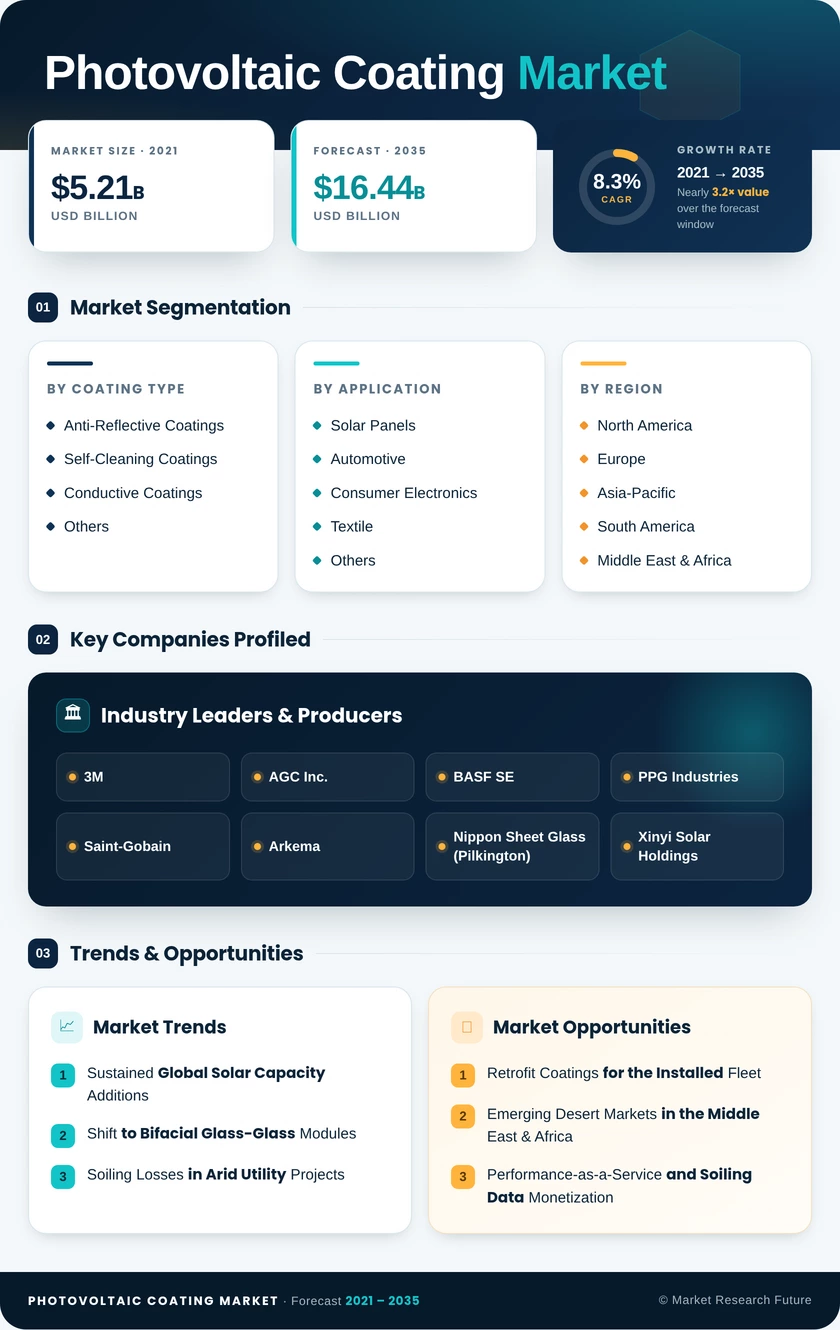
Segmentation Quick Reference
| Dimension | Sub-Segments | Dominant Segment | Fastest Growing Segment |
|---|
| By Coating Type | Anti-Reflective Coatings, Self-Cleaning Coatings, Conductive Coatings, Others | Anti-Reflective Coatings (45.6% share) | Self-Cleaning Coatings (8.8% CAGR) |
| By Application | Solar Panels, Automotive, Consumer Electronics, Textile, Others | Solar Panels (58.9% share) | Automotive (9.3% CAGR) |
| By Region | North America, Europe, Asia-Pacific, South America, Middle East & Africa | Asia-Pacific (58.4% share) | Middle East & Africa (9.4% CAGR) |
Market Segmentation Overview
| Sub-Segment | Key Trend |
|---|
| Anti-Reflective Coatings | Multilayer and hybrid stacks replace single-layer porous silica on bifacial glass |
| Self-Cleaning Coatings | Hydrophilic and hydrophobic layers specified for arid utility projects |
| Conductive Coatings | Transparent conductive oxides scale with heterojunction and thin-film modules |
| Others | Hydrophobic, anti-fogging and UV-protective layers for niche residential and electronics uses |
Anti-Reflective Coatings lead with a 45.6% share because almost every crystalline-silicon module ships with treated front glass, and bifacial designs now add a rear surface. Self-Cleaning Coatings grow fastest at an 8.8% CAGR as Gulf and Indian developers write soiling performance into procurement, and China's T/CADZ 0077-2026 standard gives buyers a test basis. Conductive Coatings track heterojunction adoption rather than total module volume.
| Sub-Segment | Key Trend |
|---|
| Solar Panels | Larger glass-glass modules expand treated area per watt |
| Automotive | Curved-glass PV roofs drive adhesion and safety-grade formulations |
| Consumer Electronics | Thin, flexible transparent conductors for device-integrated PV |
| Textile | Flexible coatings for wearable and fabric-based PV at pilot stage |
| Others | BIPV façades and agrivoltaic structures need colored and diffuse coatings |
Solar Panels hold a 58.9% share because module glass is by far the largest coated surface in the PV value chain. Automotive grows fastest at a 9.3% CAGR as automakers trial PV roofs that demand curvature tolerance and crash-safe adhesion beyond standard glass-line coatings. Consumer Electronics and Textile remain volume-limited, relying on flexible transparent conductors that are still maturing.


 Noah Malgeri
Co-Founder

 Peter Groot koerkamp
Account and Business Manager

 Younghwan Choi
Senior Retail Manager

 Mark Irwin
Management Consultant

 Akif Moroglu
Strategy & Business Development Director

 Guilherme Gomes Martins
Product Management Director

 Joseph Aguayo
Sales Operations & Pricing Manager

 La Terria Dodd
Program Support Specialist

 Rob Kooiker
Group Product Manager HVAC & Fire Protection GMA