×
Hero Background
English
Chinese
French
Japanese
Korean
German
Spanish

Phosgene Market Size

ID: MRFR/CnM/0678-HCR
140 Pages
Anshula Mandaokar
October 2025

Phosgene Market Research Report Information by Derivatives (Isocyanates, Chloroformates, Carbamoyl Chlorides and others), Application (Agrochemicals, Pharmaceuticals, Polycarbonates, Fine Chemicals, Dyes, Specialty Chemicals and others) and Region - Forecast till 2035

Share:
Download PDF ×

We do not share your information with anyone. However, we may send you emails based on your report interest from time to time. You may contact us at any time to opt-out.

Phosgene Market Infographic
Purchase Options

Phosgene Size

Phosgene Market Growth Projections and Opportunities

According to MRFR analysis, the Phosgene Market is estimated to reach USD 2.34 billion by the end of 2030 at a healthy CAGR of 4.60%.

The market for phosgene is subject to various factors that collectively influence its dynamics. Phosgene, a chemical compound with diverse industrial applications, is primarily used in the production of isocyanates, which are essential raw materials for manufacturing polyurethane. One of the main drivers of the phosgene market is the robust demand from the construction and automotive industries, where polyurethane is extensively used in insulation, coatings, adhesives, and foams. The growth in these end-use sectors contributes significantly to the overall demand for phosgene.

However, the phosgene market is heavily influenced by environmental and safety considerations. Phosgene is a highly toxic and reactive compound, posing risks to human health and the environment. Stringent regulations and safety standards governing the handling, transportation, and storage of phosgene impact the market dynamics. Manufacturers and end-users must adhere to strict safety protocols and invest in advanced technologies to mitigate the associated risks, which can influence the overall production costs and market accessibility.

Technological advancements and innovation are pivotal factors shaping the phosgene market. Continuous research and development efforts are directed towards developing safer and more efficient methods for phosgene production and handling. Improvements in technology contribute to enhancing the safety profile of phosgene-related processes, making it more feasible for use in various applications. Manufacturers strive to adopt state-of-the-art technologies to meet regulatory requirements and ensure sustainable and responsible practices in the production and utilization of phosgene.

Global economic conditions significantly impact the phosgene market. Economic growth and stability correlate with increased construction activities, automotive production, and industrialization, thereby influencing the demand for polyurethane and, consequently, phosgene. Conversely, economic downturns may result in a temporary reduction in construction and manufacturing activities, affecting the demand for phosgene. The market's susceptibility to economic fluctuations underscores the importance of monitoring global economic trends for stakeholders in the phosgene industry.

Raw material availability and pricing are critical considerations in the phosgene market. Phosgene is produced by reacting chlorine and carbon monoxide, with chlorine being a key raw material. Fluctuations in the prices and availability of chlorine, which is derived from the chlor-alkali industry, directly impact the production cost of phosgene. Manufacturers closely monitor raw material markets to adapt their strategies and maintain cost-effectiveness in the competitive phosgene market.

Geographical factors also play a role in shaping the phosgene market. The concentration of end-use industries, regulatory frameworks, and safety standards varies across regions. For instance, regions with a strong emphasis on sustainable practices and stringent safety regulations may witness greater challenges and costs associated with phosgene production and utilization. The global nature of the chemical industry necessitates careful consideration of regional variations in market dynamics.
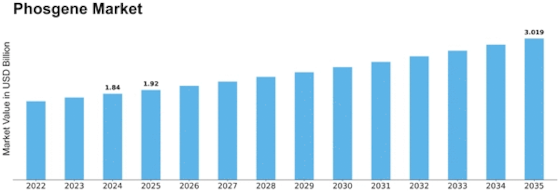
Phosgene Market Size Graph
Author
Anshula Mandaokar
Team Lead - Research

Anshula Mandaokar holds an academic degree in Chemical Engineering and has been contributing to the field for more than 5 years. She has expertise in Market Research and Business Consulting and serves as a Team Lead for a reputed Market Research firm under the Chemicals and Materials domain spectrum. She has worked on multiple projects, generating explicit results in a quick turnaround time. Her understanding of data interpretation justifies her role as a leader.

Leave a Comment

FAQs

What is the current valuation of the Phosgene Market as of 2024?

The Phosgene Market was valued at 1.841 USD Billion in 2024.

What is the projected market valuation for Phosgene by 2035?

The Phosgene Market is projected to reach 3.019 USD Billion by 2035.

What is the expected CAGR for the Phosgene Market during the forecast period 2025 - 2035?

The expected CAGR for the Phosgene Market during the forecast period 2025 - 2035 is 4.6%.

Which companies are considered key players in the Phosgene Market?

Key players in the Phosgene Market include BASF SE, Covestro AG, Huntsman Corporation, and others.

What are the main segments of the Phosgene Market?

The main segments of the Phosgene Market include Derivatives and Application.

Market Summary

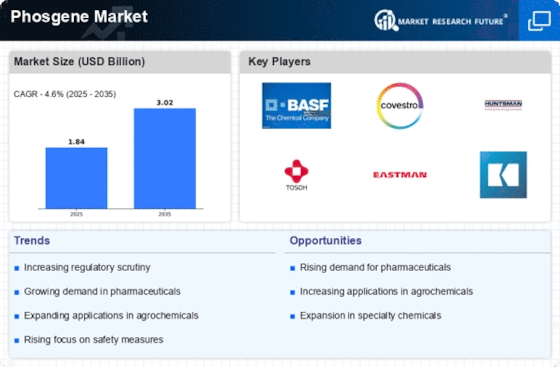
As per MRFR analysis, the Phosgene Market Size was estimated at 1.841 USD Billion in 2024. The Phosgene industry is projected to grow from 1.926 USD Billion in 2025 to 3.019 USD Billion by 2035, exhibiting a compound annual growth rate (CAGR) of 4.6 during the forecast period 2025 - 2035.

Key Market Trends & Highlights

The Phosgene Market is experiencing a dynamic shift driven by sustainability and regulatory compliance.

  • North America remains the largest market for phosgene, primarily due to its extensive chemical manufacturing base.
  • Asia-Pacific is emerging as the fastest-growing region, fueled by increasing industrialization and demand for chemical products.
  • The isocyanates segment dominates the market, while the chloroformates segment is witnessing rapid growth.
  • Key market drivers include rising demand in chemical synthesis and advancements in production technologies, particularly in agrochemicals and pharmaceuticals.

Market Size & Forecast

2024 Market Size 1.841 (USD Billion)
2035 Market Size 3.019 (USD Billion)
CAGR (2025 - 2035) 4.6%
Largest Regional Market Share in 2024 Asia Pacific

Major Players

<p>BASF SE (DE), Covestro AG (DE), Huntsman Corporation (US), Tosoh Corporation (JP), Eastman Chemical Company (US), Koch Industries, Inc. (US), Solvay S.A. (BE), Mitsubishi Gas Chemical Company, Inc. (JP), Wanhua Chemical Group Co., Ltd. (CN)</p>

Market Trends

The Phosgene Market is currently experiencing a dynamic phase characterized by evolving applications and regulatory frameworks. This chemical compound, primarily utilized in the production of isocyanates and various pharmaceuticals, has garnered attention due to its critical role in the synthesis of diverse industrial products. As industries increasingly prioritize sustainability, the demand for phosgene is likely to be influenced by innovations in production processes that minimize environmental impact. Furthermore, the market appears to be shaped by stringent safety regulations, which necessitate enhanced safety measures in handling and transportation. This regulatory landscape may drive companies to invest in advanced technologies to ensure compliance while maintaining operational efficiency. In addition to regulatory influences, the Phosgene Market is also witnessing shifts in consumer preferences, particularly towards more eco-friendly alternatives. This trend suggests that manufacturers may need to adapt their strategies to align with the growing emphasis on sustainability. Moreover, the global economic landscape, marked by fluctuations in supply chains and trade dynamics, could further impact the availability and pricing of phosgene. As such, stakeholders in the Phosgene Market must remain vigilant and responsive to these multifaceted trends to navigate the complexities of this evolving sector.

Sustainability Initiatives

The Phosgene Market is increasingly influenced by sustainability initiatives, prompting manufacturers to explore greener production methods. This shift may lead to the development of alternative processes that reduce environmental impact while maintaining product efficacy.

Regulatory Compliance

Stringent regulations surrounding the handling and transportation of phosgene are shaping market dynamics. Companies are likely to invest in advanced safety technologies to ensure compliance, which could enhance operational efficiency and mitigate risks.

Consumer Preference Shifts

There is a noticeable shift in consumer preferences towards eco-friendly alternatives in the Phosgene Market. This trend may compel manufacturers to adapt their offerings, focusing on sustainable solutions that align with evolving market demands.

Phosgene Market Market Drivers

Growth in Agricultural Chemicals

The agricultural sector's reliance on phosgene for the production of herbicides and pesticides is a significant driver for the Phosgene Market. As the global population continues to rise, the demand for agricultural chemicals is expected to increase, with projections indicating a growth rate of around 4% annually. Phosgene Market plays a crucial role in synthesizing various agrochemicals that enhance crop yields and protect against pests. This growing demand for effective agricultural solutions suggests that the Phosgene Market will likely see sustained growth as it caters to the needs of the agricultural sector.

Rising Demand in Chemical Synthesis

The Phosgene Market is experiencing a notable increase in demand due to its critical role in chemical synthesis. Phosgene Market is utilized extensively in the production of isocyanates, which are essential for manufacturing polyurethanes. The market for polyurethanes is projected to grow at a compound annual growth rate of approximately 5.5%, indicating a robust demand for phosgene as a precursor. Furthermore, the versatility of phosgene in synthesizing various pharmaceuticals and agrochemicals contributes to its rising significance. As industries seek efficient and effective chemical processes, the reliance on phosgene is likely to expand, thereby driving growth in the Phosgene Market.

Advancements in Production Technologies

Technological advancements in the production of phosgene are poised to enhance the efficiency and safety of its manufacturing processes. Innovations such as continuous flow reactors and improved catalytic processes are being integrated into the Phosgene Market. These advancements not only reduce production costs but also minimize environmental impact, aligning with sustainability goals. The introduction of more efficient production methods could potentially increase the output of phosgene, meeting the growing demand from various sectors. As a result, companies that adopt these technologies may gain a competitive edge, further propelling the growth of the Phosgene Market.

Expanding Applications in Pharmaceuticals

The pharmaceutical sector is increasingly recognizing the utility of phosgene in drug development, which is a significant driver for the Phosgene Market. Phosgene Market is instrumental in synthesizing various active pharmaceutical ingredients (APIs), particularly in the production of complex molecules. The pharmaceutical market is expected to reach a valuation of over 1.5 trillion dollars, with a substantial portion attributed to the use of phosgene in drug synthesis. This trend suggests that as the pharmaceutical industry continues to expand, the demand for phosgene will likely increase, thereby bolstering the Phosgene Market.

Regulatory Frameworks and Safety Standards

The Phosgene Market is influenced by stringent regulatory frameworks and safety standards that govern the handling and production of hazardous chemicals. Compliance with these regulations is essential for manufacturers, as it ensures safe operations and minimizes risks associated with phosgene exposure. The implementation of robust safety protocols not only protects workers but also enhances the reputation of companies within the industry. As regulatory bodies continue to enforce these standards, companies that prioritize safety and compliance may experience increased market share, thereby driving growth in the Phosgene Market.

Market Segment Insights

Phosgene Market Trends Insights 

The ongoing trend of sustainable production along with the increased demand for polyurethanes is aiding the market's growth.

The polyurethane industry has a substantial influence on the global phosgene market since it is a key customer of phosgene derivatives such as MDI and TDI. The usage of polyurethane foam (PU foam) in buildings, insulation, and furnishings is expected to continue to rise, according to the study carried out, which is mostly due to the rapid growth of urbanization and infrastructure throughout the world. Consequently, this leads to an increase in the requirement for phosgene. However, there is a factor that works against it, and that is the growing emphasis on sustainability.

In the realm of research and development, efforts are being made to develop methods of manufacturing phosgene that are much less harmful to the environment through organic synthesis. Carbonylation and other alternative methods of producing phosgene are being investigated by businesses worldwide as part of their efforts to lessen their reliance on hazardous chemicals. With this, the overall production of phosgene has boosted the market revenue and taken the said market segment among the top revenue grosses. 

February 2024 According to official papers, traces of the toxic gas phosgene, which was used during World War One, were found in an event that occurred at the headquarters of Sweden's security agency last Friday.According to an earlier statement made by Sapo, the security agency, which said that there was no gas detected either inside or outside the structure, this information contradicts that declaration. The building was evacuated by hundreds of people, and eight of them were sent to the hospital.

The majority of fatalities caused by chemicals during World War One were caused by phosphone, which is used in the production of plastics and insecticides. The Swedish daily Svenska Dagbladet was able to get a copy of the report that suggested the presence of the hazardous material on the premises. The report originated from the County Administrative Board of Stockholm.

Phosgene Market Segment Insights 

The global phosgene market is primarily segmented based on derivatives and applications. 

Based on derivatives, the phosgene market is further segmented into isocyanates, chloroformates, and carbamoyl chlorides. Out of which, the isocyanate segmentation dominates the global market share, which is attributed to the immense growth of the global automotive sector and the fast-paced industrialization in major emerging economies like India, China, Japan, Mexico, etc. Apart from this, the increased use of isocyanate derivatives in several crucial applications including the manufacturing of foams, paints and elastomers. 

Based on application, the global phosgene market is further sub-segmented into agrochemicals, pharmaceuticals, polycarbonates, fine chemicals, dyes, and speciality chemicals. Out of which, the speciality chemicals sub-segmentation dominates the market segment and is estimated to witness the highest growth rate during the forecast period. The estimated growth of the said segmentation is primarily due to the increased use of phosgene as a key raw material in the manufacturing of speciality polycarbonates. There is a rising demand for these carbonates in various industries such as construction, automotive, medical, and electronics.

Furthermore, the increasing adoption of research and development efforts to enhance the effectiveness, environmental friendliness, and security of phosgene-based procedures is expected to broaden the market potential and stimulate the need for specialized chemicals.

Get more detailed insights about Phosgene Market Research Report - Forecast till 2035

Regional Insights

North America : Chemical Innovation Hub

North America is witnessing robust growth in the phosgene market, driven by increasing demand from the pharmaceutical and agrochemical sectors. The region holds approximately 40% of the global market share, making it the largest market for phosgene. Regulatory support for chemical manufacturing and innovation further catalyzes this growth, with initiatives aimed at enhancing safety and sustainability in chemical processes. The United States is the leading country in this region, hosting major players such as BASF SE, Huntsman Corporation, and Eastman Chemical Company. The competitive landscape is characterized by significant investments in R&D and a focus on developing safer production methods. The presence of established companies and a strong regulatory framework contribute to a favorable environment for market expansion.

Europe : Regulatory-Driven Market Growth

Europe is experiencing significant growth in the phosgene market, primarily due to stringent regulations promoting safety and environmental sustainability. The region accounts for approximately 30% of the global market share, making it the second-largest market. The European Union's REACH regulations and other safety standards are driving innovation and compliance in chemical manufacturing, fostering a competitive landscape. Germany and Belgium are the leading countries in this market, with key players like Covestro AG and Solvay S.A. actively contributing to market dynamics. The competitive environment is marked by collaborations and partnerships aimed at enhancing product offerings and sustainability. The presence of advanced manufacturing facilities and a skilled workforce further bolster the region's market position.

Asia-Pacific : Emerging Market Potential

Asia-Pacific is emerging as a significant player in the phosgene market, driven by rapid industrialization and increasing demand from various sectors, including pharmaceuticals and agriculture. The region holds approximately 25% of the global market share, with countries like China and Japan leading the charge. Government initiatives aimed at boosting chemical production and enhancing safety standards are key growth drivers in this market. China is the largest market in the region, with companies like Wanhua Chemical Group and Tosoh Corporation playing pivotal roles. The competitive landscape is evolving, with a focus on innovation and sustainability. As the region continues to invest in chemical manufacturing capabilities, the phosgene market is expected to expand significantly, supported by a growing consumer base and regulatory frameworks.

Middle East and Africa : Resource-Rich Market Dynamics

The Middle East and Africa region is witnessing a gradual increase in the phosgene market, driven by the availability of natural resources and growing industrial activities. The region holds approximately 5% of the global market share, with potential for growth as local industries expand. Regulatory frameworks are evolving, focusing on safety and environmental standards, which are crucial for market development. Countries like South Africa and the UAE are emerging as key players in this market, with investments in chemical manufacturing and infrastructure. The competitive landscape is characterized by a mix of local and international companies, aiming to capitalize on the region's resource wealth. As the market matures, opportunities for collaboration and innovation are expected to rise, further enhancing the phosgene market's prospects.

Key Players and Competitive Insights

The Phosgene Market is characterized by a complex competitive landscape, driven by increasing demand for high-performance chemicals across various industries, including pharmaceuticals, agrochemicals, and plastics. Key players such as BASF SE (Germany), Covestro AG (Germany), and Huntsman Corporation (United States) are strategically positioned to leverage their extensive research and development capabilities, focusing on innovation and sustainability. These companies are not only enhancing their product portfolios but are also investing in digital transformation initiatives to optimize operations and improve customer engagement, thereby shaping a competitive environment that emphasizes technological advancement and environmental responsibility.

In terms of business tactics, companies are increasingly localizing manufacturing to reduce lead times and enhance supply chain resilience. The Phosgene Market appears moderately fragmented, with a mix of large multinational corporations and smaller regional players. The collective influence of these key players is significant, as they engage in strategic partnerships and collaborations to strengthen their market presence and drive growth.

In August 2025, BASF SE (Germany) announced the launch of a new phosgene-based production process aimed at reducing carbon emissions by 30%. This initiative underscores BASF's commitment to sustainability and positions the company as a leader in environmentally friendly chemical manufacturing. The strategic importance of this move lies in its potential to not only enhance BASF's competitive edge but also to align with global sustainability goals, appealing to environmentally conscious consumers and investors alike.

In September 2025, Covestro AG (Germany) revealed plans to expand its production capacity for phosgene derivatives in response to rising demand in the automotive and construction sectors. This expansion is expected to enhance Covestro's market share and solidify its position as a key supplier of high-performance materials. The strategic significance of this development is evident, as it allows Covestro to capitalize on emerging market trends while ensuring a reliable supply of critical materials to its customers.

In July 2025, Huntsman Corporation (United States) entered into a strategic partnership with a leading technology firm to integrate AI-driven analytics into its phosgene production processes. This collaboration aims to optimize operational efficiency and reduce production costs. The strategic importance of this partnership lies in its potential to enhance Huntsman's competitive positioning by leveraging cutting-edge technology to improve productivity and sustainability in its operations.

As of October 2025, the Phosgene Market is witnessing a shift towards digitalization, sustainability, and AI integration, which are defining current competitive trends. Strategic alliances are increasingly shaping the landscape, enabling companies to pool resources and expertise to drive innovation. Looking ahead, competitive differentiation is likely to evolve from traditional price-based competition to a focus on innovation, technological advancements, and supply chain reliability, as companies strive to meet the growing demands of a dynamic market.

Key Companies in the Phosgene Market market include

Industry Developments

November 2022 - 

In November 2022, Huntsman Corporation signed an agreement to sell its textile division to Archoma, a portfolio company of SK Capitals. 

October 2022 - 

In October 2022, the Department of Chemical Technology and Bioengineering Technologies announced their allied production of polyurethanes. 


Future Outlook

Phosgene Market Future Outlook

<p>The Phosgene Market is projected to grow at a 4.6% CAGR from 2024 to 2035, driven by increasing demand in pharmaceuticals, agrochemicals, and specialty chemicals.</p>

New opportunities lie in:

  • <p>Development of advanced phosgene synthesis technologies for cost reduction.</p>
  • <p>Expansion into emerging markets with tailored phosgene applications.</p>
  • <p>Investment in safety and environmental compliance solutions for phosgene handling.</p>

<p>By 2035, the Phosgene Market is expected to solidify its position as a key player in chemical manufacturing.</p>

Market Segmentation

Phosgene Market Application Outlook

  • Agrochemicals
  • Pharmaceuticals
  • Polycarbonates
  • Fine Chemicals
  • Dyes
  • Speciality Chemicals

Phosgene Market Derivatives Outlook

  • Isocyanates
  • Chloroformates
  • Carbamoyl Chlorides

Report Scope

MARKET SIZE 20241.841(USD Billion)
MARKET SIZE 20251.926(USD Billion)
MARKET SIZE 20353.019(USD Billion)
COMPOUND ANNUAL GROWTH RATE (CAGR)4.6% (2024 - 2035)
REPORT COVERAGERevenue Forecast, Competitive Landscape, Growth Factors, and Trends
BASE YEAR2024
Market Forecast Period2025 - 2035
Historical Data2019 - 2024
Market Forecast UnitsUSD Billion
Key Companies ProfiledMarket analysis in progress
Segments CoveredMarket segmentation analysis in progress
Key Market OpportunitiesAdvancements in green chemistry may enhance sustainable production methods in the Phosgene Market.
Key Market DynamicsRising regulatory scrutiny and safety concerns drive innovation and operational adjustments in the Phosgene Market.
Countries CoveredNorth America, Europe, APAC, South America, MEA

FAQs

What is the current valuation of the Phosgene Market as of 2024?

The Phosgene Market was valued at 1.841 USD Billion in 2024.

What is the projected market valuation for Phosgene by 2035?

The Phosgene Market is projected to reach 3.019 USD Billion by 2035.

What is the expected CAGR for the Phosgene Market during the forecast period 2025 - 2035?

The expected CAGR for the Phosgene Market during the forecast period 2025 - 2035 is 4.6%.

Which companies are considered key players in the Phosgene Market?

Key players in the Phosgene Market include BASF SE, Covestro AG, Huntsman Corporation, and others.

What are the main segments of the Phosgene Market?

The main segments of the Phosgene Market include Derivatives and Application.

  1. SECTION I: EXECUTIVE SUMMARY AND KEY HIGHLIGHTS
    1. EXECUTIVE SUMMARY
      1. Market Overview
      2. Key Findings
      3. Market Segmentation
      4. Competitive Landscape
      5. Challenges and Opportunities
      6. Future Outlook
  2. SECTION II: SCOPING, METHODOLOGY AND MARKET STRUCTURE
    1. MARKET INTRODUCTION
      1. Definition
      2. Scope of the study
    2. RESEARCH METHODOLOGY
      1. Overview
      2. Data Mining
      3. Secondary Research
      4. Primary Research
      5. Forecasting Model
      6. Market Size Estimation
      7. Data Triangulation
      8. Validation
  3. SECTION III: QUALITATIVE ANALYSIS
    1. MARKET DYNAMICS
      1. Overview
      2. Drivers
      3. Restraints
      4. Opportunities
    2. MARKET FACTOR ANALYSIS
      1. Value chain Analysis
      2. Porter's Five Forces Analysis
      3. COVID-19 Impact Analysis
  4. SECTION IV: QUANTITATIVE ANALYSIS
    1. Chemicals and Materials, BY Derivatives (USD Billion)
      1. Isocyanates
      2. Chloroformates
      3. Carbamoyl Chlorides
    2. Chemicals and Materials, BY Application (USD Billion)
      1. Agrochemicals
      2. Pharmaceuticals
      3. Polycarbonates
      4. Fine Chemicals
      5. Dyes
      6. Speciality Chemicals
    3. Chemicals and Materials, BY Region (USD Billion)
      1. North America
      2. Europe
      3. APAC
      4. South America
      5. MEA
  5. SECTION V: COMPETITIVE ANALYSIS
    1. Competitive Landscape
      1. Overview
      2. Competitive Analysis
      3. Market share Analysis
      4. Major Growth Strategy in the Chemicals and Materials
      5. Competitive Benchmarking
      6. Leading Players in Terms of Number of Developments in the Chemicals and Materials
      7. Key developments and growth strategies
      8. Major Players Financial Matrix
    2. Company Profiles
      1. BASF SE (DE)
      2. Covestro AG (DE)
      3. Huntsman Corporation (US)
      4. Tosoh Corporation (JP)
      5. Eastman Chemical Company (US)
      6. Koch Industries, Inc. (US)
      7. Solvay S.A. (BE)
      8. Mitsubishi Gas Chemical Company, Inc. (JP)
      9. Wanhua Chemical Group Co., Ltd. (CN)
    3. Appendix
      1. References
      2. Related Reports
  6. LIST OF FIGURES
    1. MARKET SYNOPSIS
    2. NORTH AMERICA MARKET ANALYSIS
    3. US MARKET ANALYSIS BY DERIVATIVES
    4. US MARKET ANALYSIS BY APPLICATION
    5. CANADA MARKET ANALYSIS BY DERIVATIVES
    6. CANADA MARKET ANALYSIS BY APPLICATION
    7. EUROPE MARKET ANALYSIS
    8. GERMANY MARKET ANALYSIS BY DERIVATIVES
    9. GERMANY MARKET ANALYSIS BY APPLICATION
    10. UK MARKET ANALYSIS BY DERIVATIVES
    11. UK MARKET ANALYSIS BY APPLICATION
    12. FRANCE MARKET ANALYSIS BY DERIVATIVES
    13. FRANCE MARKET ANALYSIS BY APPLICATION
    14. RUSSIA MARKET ANALYSIS BY DERIVATIVES
    15. RUSSIA MARKET ANALYSIS BY APPLICATION
    16. ITALY MARKET ANALYSIS BY DERIVATIVES
    17. ITALY MARKET ANALYSIS BY APPLICATION
    18. SPAIN MARKET ANALYSIS BY DERIVATIVES
    19. SPAIN MARKET ANALYSIS BY APPLICATION
    20. REST OF EUROPE MARKET ANALYSIS BY DERIVATIVES
    21. REST OF EUROPE MARKET ANALYSIS BY APPLICATION
    22. APAC MARKET ANALYSIS
    23. CHINA MARKET ANALYSIS BY DERIVATIVES
    24. CHINA MARKET ANALYSIS BY APPLICATION
    25. INDIA MARKET ANALYSIS BY DERIVATIVES
    26. INDIA MARKET ANALYSIS BY APPLICATION
    27. JAPAN MARKET ANALYSIS BY DERIVATIVES
    28. JAPAN MARKET ANALYSIS BY APPLICATION
    29. SOUTH KOREA MARKET ANALYSIS BY DERIVATIVES
    30. SOUTH KOREA MARKET ANALYSIS BY APPLICATION
    31. MALAYSIA MARKET ANALYSIS BY DERIVATIVES
    32. MALAYSIA MARKET ANALYSIS BY APPLICATION
    33. THAILAND MARKET ANALYSIS BY DERIVATIVES
    34. THAILAND MARKET ANALYSIS BY APPLICATION
    35. INDONESIA MARKET ANALYSIS BY DERIVATIVES
    36. INDONESIA MARKET ANALYSIS BY APPLICATION
    37. REST OF APAC MARKET ANALYSIS BY DERIVATIVES
    38. REST OF APAC MARKET ANALYSIS BY APPLICATION
    39. SOUTH AMERICA MARKET ANALYSIS
    40. BRAZIL MARKET ANALYSIS BY DERIVATIVES
    41. BRAZIL MARKET ANALYSIS BY APPLICATION
    42. MEXICO MARKET ANALYSIS BY DERIVATIVES
    43. MEXICO MARKET ANALYSIS BY APPLICATION
    44. ARGENTINA MARKET ANALYSIS BY DERIVATIVES
    45. ARGENTINA MARKET ANALYSIS BY APPLICATION
    46. REST OF SOUTH AMERICA MARKET ANALYSIS BY DERIVATIVES
    47. REST OF SOUTH AMERICA MARKET ANALYSIS BY APPLICATION
    48. MEA MARKET ANALYSIS
    49. GCC COUNTRIES MARKET ANALYSIS BY DERIVATIVES
    50. GCC COUNTRIES MARKET ANALYSIS BY APPLICATION
    51. SOUTH AFRICA MARKET ANALYSIS BY DERIVATIVES
    52. SOUTH AFRICA MARKET ANALYSIS BY APPLICATION
    53. REST OF MEA MARKET ANALYSIS BY DERIVATIVES
    54. REST OF MEA MARKET ANALYSIS BY APPLICATION
    55. KEY BUYING CRITERIA OF CHEMICALS AND MATERIALS
    56. RESEARCH PROCESS OF MRFR
    57. DRO ANALYSIS OF CHEMICALS AND MATERIALS
    58. DRIVERS IMPACT ANALYSIS: CHEMICALS AND MATERIALS
    59. RESTRAINTS IMPACT ANALYSIS: CHEMICALS AND MATERIALS
    60. SUPPLY / VALUE CHAIN: CHEMICALS AND MATERIALS
    61. CHEMICALS AND MATERIALS, BY DERIVATIVES, 2024 (% SHARE)
    62. CHEMICALS AND MATERIALS, BY DERIVATIVES, 2024 TO 2035 (USD Billion)
    63. CHEMICALS AND MATERIALS, BY APPLICATION, 2024 (% SHARE)
    64. CHEMICALS AND MATERIALS, BY APPLICATION, 2024 TO 2035 (USD Billion)
    65. BENCHMARKING OF MAJOR COMPETITORS
  7. LIST OF TABLES
    1. LIST OF ASSUMPTIONS
    2. North America MARKET SIZE ESTIMATES; FORECAST
      1. BY DERIVATIVES, 2025-2035 (USD Billion)
      2. BY APPLICATION, 2025-2035 (USD Billion)
    3. US MARKET SIZE ESTIMATES; FORECAST
      1. BY DERIVATIVES, 2025-2035 (USD Billion)
      2. BY APPLICATION, 2025-2035 (USD Billion)
    4. Canada MARKET SIZE ESTIMATES; FORECAST
      1. BY DERIVATIVES, 2025-2035 (USD Billion)
      2. BY APPLICATION, 2025-2035 (USD Billion)
    5. Europe MARKET SIZE ESTIMATES; FORECAST
      1. BY DERIVATIVES, 2025-2035 (USD Billion)
      2. BY APPLICATION, 2025-2035 (USD Billion)
    6. Germany MARKET SIZE ESTIMATES; FORECAST
      1. BY DERIVATIVES, 2025-2035 (USD Billion)
      2. BY APPLICATION, 2025-2035 (USD Billion)
    7. UK MARKET SIZE ESTIMATES; FORECAST
      1. BY DERIVATIVES, 2025-2035 (USD Billion)
      2. BY APPLICATION, 2025-2035 (USD Billion)
    8. France MARKET SIZE ESTIMATES; FORECAST
      1. BY DERIVATIVES, 2025-2035 (USD Billion)
      2. BY APPLICATION, 2025-2035 (USD Billion)
    9. Russia MARKET SIZE ESTIMATES; FORECAST
      1. BY DERIVATIVES, 2025-2035 (USD Billion)
      2. BY APPLICATION, 2025-2035 (USD Billion)
    10. Italy MARKET SIZE ESTIMATES; FORECAST
      1. BY DERIVATIVES, 2025-2035 (USD Billion)
      2. BY APPLICATION, 2025-2035 (USD Billion)
    11. Spain MARKET SIZE ESTIMATES; FORECAST
      1. BY DERIVATIVES, 2025-2035 (USD Billion)
      2. BY APPLICATION, 2025-2035 (USD Billion)
    12. Rest of Europe MARKET SIZE ESTIMATES; FORECAST
      1. BY DERIVATIVES, 2025-2035 (USD Billion)
      2. BY APPLICATION, 2025-2035 (USD Billion)
    13. APAC MARKET SIZE ESTIMATES; FORECAST
      1. BY DERIVATIVES, 2025-2035 (USD Billion)
      2. BY APPLICATION, 2025-2035 (USD Billion)
    14. China MARKET SIZE ESTIMATES; FORECAST
      1. BY DERIVATIVES, 2025-2035 (USD Billion)
      2. BY APPLICATION, 2025-2035 (USD Billion)
    15. India MARKET SIZE ESTIMATES; FORECAST
      1. BY DERIVATIVES, 2025-2035 (USD Billion)
      2. BY APPLICATION, 2025-2035 (USD Billion)
    16. Japan MARKET SIZE ESTIMATES; FORECAST
      1. BY DERIVATIVES, 2025-2035 (USD Billion)
      2. BY APPLICATION, 2025-2035 (USD Billion)
    17. South Korea MARKET SIZE ESTIMATES; FORECAST
      1. BY DERIVATIVES, 2025-2035 (USD Billion)
      2. BY APPLICATION, 2025-2035 (USD Billion)
    18. Malaysia MARKET SIZE ESTIMATES; FORECAST
      1. BY DERIVATIVES, 2025-2035 (USD Billion)
      2. BY APPLICATION, 2025-2035 (USD Billion)
    19. Thailand MARKET SIZE ESTIMATES; FORECAST
      1. BY DERIVATIVES, 2025-2035 (USD Billion)
      2. BY APPLICATION, 2025-2035 (USD Billion)
    20. Indonesia MARKET SIZE ESTIMATES; FORECAST
      1. BY DERIVATIVES, 2025-2035 (USD Billion)
      2. BY APPLICATION, 2025-2035 (USD Billion)
    21. Rest of APAC MARKET SIZE ESTIMATES; FORECAST
      1. BY DERIVATIVES, 2025-2035 (USD Billion)
      2. BY APPLICATION, 2025-2035 (USD Billion)
    22. South America MARKET SIZE ESTIMATES; FORECAST
      1. BY DERIVATIVES, 2025-2035 (USD Billion)
      2. BY APPLICATION, 2025-2035 (USD Billion)
    23. Brazil MARKET SIZE ESTIMATES; FORECAST
      1. BY DERIVATIVES, 2025-2035 (USD Billion)
      2. BY APPLICATION, 2025-2035 (USD Billion)
    24. Mexico MARKET SIZE ESTIMATES; FORECAST
      1. BY DERIVATIVES, 2025-2035 (USD Billion)
      2. BY APPLICATION, 2025-2035 (USD Billion)
    25. Argentina MARKET SIZE ESTIMATES; FORECAST
      1. BY DERIVATIVES, 2025-2035 (USD Billion)
      2. BY APPLICATION, 2025-2035 (USD Billion)
    26. Rest of South America MARKET SIZE ESTIMATES; FORECAST
      1. BY DERIVATIVES, 2025-2035 (USD Billion)
      2. BY APPLICATION, 2025-2035 (USD Billion)
    27. MEA MARKET SIZE ESTIMATES; FORECAST
      1. BY DERIVATIVES, 2025-2035 (USD Billion)
      2. BY APPLICATION, 2025-2035 (USD Billion)
    28. GCC Countries MARKET SIZE ESTIMATES; FORECAST
      1. BY DERIVATIVES, 2025-2035 (USD Billion)
      2. BY APPLICATION, 2025-2035 (USD Billion)
    29. South Africa MARKET SIZE ESTIMATES; FORECAST
      1. BY DERIVATIVES, 2025-2035 (USD Billion)
      2. BY APPLICATION, 2025-2035 (USD Billion)
    30. Rest of MEA MARKET SIZE ESTIMATES; FORECAST
      1. BY DERIVATIVES, 2025-2035 (USD Billion)
      2. BY APPLICATION, 2025-2035 (USD Billion)
    31. PRODUCT LAUNCH/PRODUCT DEVELOPMENT/APPROVAL
    32. ACQUISITION/PARTNERSHIP

Phosgene Market Segmentation

Market Segmentation Overview

  • Detailed segmentation data will be available in the full report
  • Comprehensive analysis by multiple parameters
  • Regional and country-level breakdowns
  • Market size forecasts by segment
Infographic

Free Sample Request

Kindly complete the form below to receive a free sample of this Report

Get Free Sample

Customer Strories

Compare Licence

×
Features License Type
Single User Multiuser License Enterprise User
Price $4,950 $5,950 $7,250
Maximum User Access Limit 1 User Upto 10 Users Unrestricted Access Throughout the Organization
Free Customization
Direct Access to Analyst
Deliverable Format
Platform Access
Discount on Next Purchase 10% 15% 15%
Printable Versions