Pharmacy Automation Market (2026 - 2035)

ID: MRFR/Pharma/7303-HCR
90 Pages
Vikita Thakur
Last Updated: July 07, 2026
Pharmacy Automation Market Size, Growth Research Report By Technology (Automated Dispensing Systems, Automated Storage and Retrieval Systems, Pharmacy Management Systems, Medication Compounding Systems), By Type (Hardware, Software, Services), By Application (Inpatient Pharmacy, Outpatient Pharmacy, Central Pharmacy), By End User (Hospitals, Retail Pharmacies, Pharmaceutical Companies) and By Regional (North America, Europe, South America, Asia Pacific, Middle East and Africa) - Competitor Industry Analysis and Trends Forecast Till 2035
Pharmacy Automation Market
Market Size
Forecast Period2026-2035
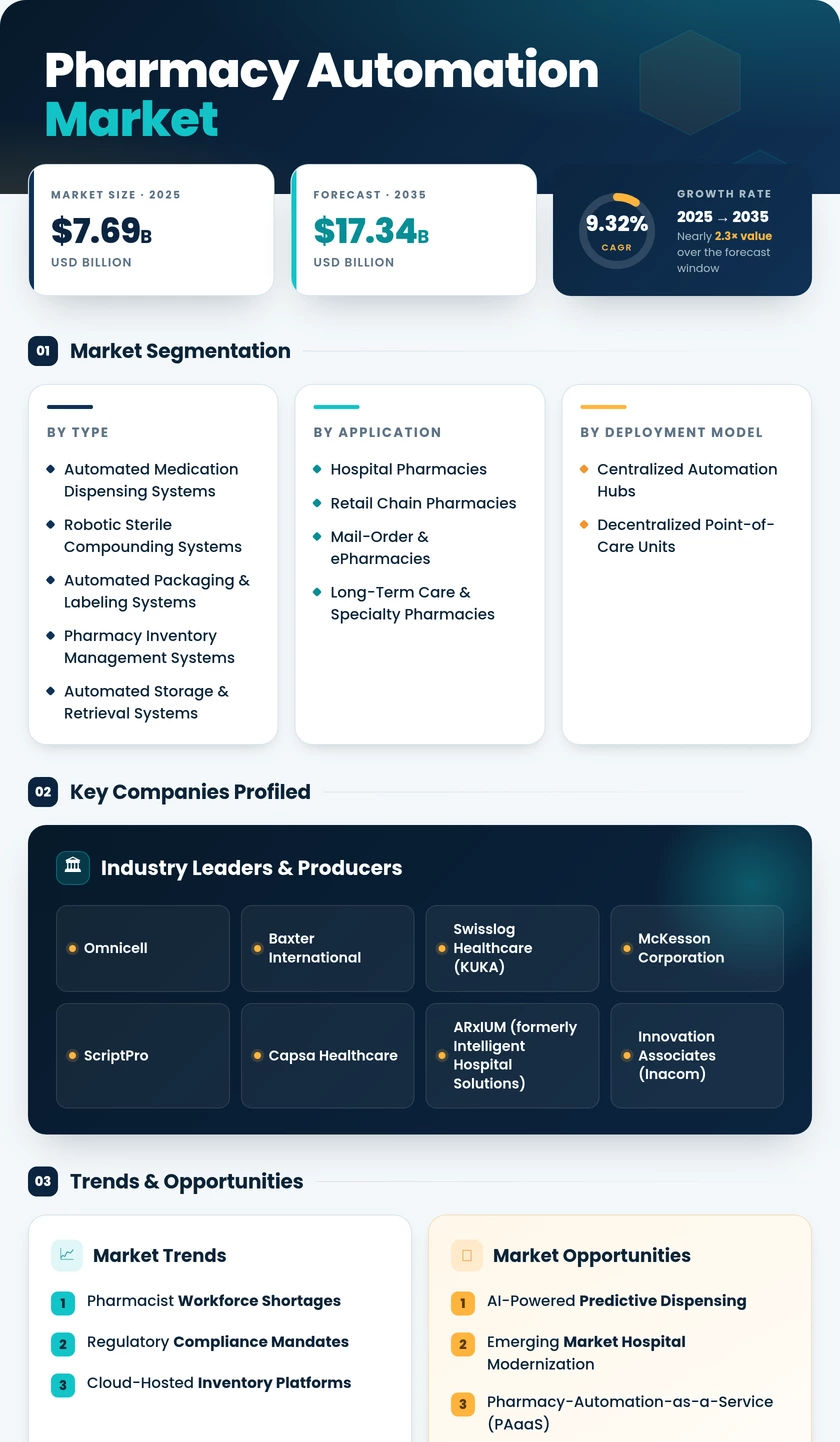
CAGR (2026-2035)9.32%
2025 Market SizeUSD 7.69 Billion
2035 Market SizeUSD 17.34 Billion
Key Players
Omnicell
Baxter International
Swisslog Healthcare
McKesson Corporation
ScriptPro
Capsa Healthcare
Opportunities
  • AI-Powered Predictive Dispensing
  • Emerging Market Hospital Modernization
  • Pharmacy-Automation-as-a-Service (PAaaS)
  1. 1 Market Overview |
    1. 1.1 Study Assumptions & Market Definition |
    2. 1.2 Scope of the Study |
    3. 1.3 Research Methodology
  2. 2 Market Summary & Key Takeaways
  3. 3 Market Dynamics |
    1. 3.1 Market Drivers Analysis | |
      1. 3.1.1 Pharmacist Workforce Shortages | |
      2. 3.1.2 Regulatory Compliance Mandates (FDA, EU FMD) | |
      3. 3.1.3 Cloud-Hosted Inventory Platforms | |
      4. 3.1.4 ePharmacy Competitive Pressure | |
      5. 3.1.5 Medicare/Medicaid Quality Incentives | |
      6. 3.1.6 AI-Enabled Medication Management Systems | |
      7. 3.1.7 Barcode Traceability Regulations |
    2. 3.2 Market Restraints Analysis | |
      1. 3.2.1 High Upfront Capital Requirements | |
      2. 3.2.2 Legacy System Integration Challenges | |
      3. 3.2.3 Cybersecurity Vulnerabilities | |
      4. 3.2.4 Resistance from Pharmacy Labor Unions | |
      5. 3.2.5 Limited Reimbursement for Automation in LMICs |
    3. 3.3 Market Opportunity Analysis | |
      1. 3.3.1 AI-Powered Predictive Dispensing | |
      2. 3.3.2 Emerging Market Hospital Modernization | |
      3. 3.3.3 Pharmacy-Automation-as-a-Service (PAaaS) | |
      4. 3.3.4 Data Monetization and Outcomes Analytics | |
      5. 3.3.5 Compounding Automation for Specialty Pharmacy |
    4. 3.4 Industry Value Chain Analysis |
    5. 3.5 Porter's Five Forces Analysis
  4. 4 Global Pharmacy Automation Market Size & Forecast (2021–2035) |
    1. 4.1 Historical Market Size (2021–2025) |
    2. 4.2 Current & Forecast Market Size (2026–2035) |
    3. 4.3 Market Size by Revenue (USD Billion) |
    4. 4.4 Year-over-Year Growth Analysis
  5. 5 Segmentation Analysis |
    1. 5.1 By Product | |
      1. 5.1.1 Automated Medication Dispensing Systems | |
      2. 5.1.2 Robotic Sterile Compounding Systems | |
      3. 5.1.3 Automated Packaging & Labeling Systems | |
      4. 5.1.4 Pharmacy Inventory Management Systems | |
      5. 5.1.5 Automated Storage & Retrieval Systems |
    2. 5.2 By End User | |
      1. 5.2.1 Hospital Pharmacies | |
      2. 5.2.2 Retail Chain Pharmacies | |
      3. 5.2.3 Mail-Order & ePharmacies | |
      4. 5.2.4 Long-Term Care & Specialty Pharmacies |
    3. 5.3 By Deployment Model | |
      1. 5.3.1 Centralized Automation Hubs | |
      2. 5.3.2 Decentralized Point-of-Care Units |
    4. 5.4 By Facility Size | |
      1. 5.4.1 >500 Beds / >250 Retail Outlets | |
      2. 5.4.2 200–500 Beds / 50–250 Outlets | |
      3. 5.4.3 <200 Beds / <50 Outlets / Independents
  6. 6 Regional Analysis |
    1. 6.1 North America | |
      1. 6.1.1 United States | |
      2. 6.1.2 Canada | |
      3. 6.1.3 Mexico |
    2. 6.2 Europe | |
      1. 6.2.1 Germany | |
      2. 6.2.2 United Kingdom | |
      3. 6.2.3 France | |
      4. 6.2.4 Italy | |
      5. 6.2.5 Spain | |
      6. 6.2.6 Nordic Countries | |
      7. 6.2.7 Russia | |
      8. 6.2.8 Rest of Europe |
    3. 6.3 Asia-Pacific | |
      1. 6.3.1 China | |
      2. 6.3.2 India | |
      3. 6.3.3 Japan | |
      4. 6.3.4 South Korea | |
      5. 6.3.5 ASEAN | |
      6. 6.3.6 Rest of Asia-Pacific |
    4. 6.4 South America | |
      1. 6.4.1 Brazil | |
      2. 6.4.2 Argentina | |
      3. 6.4.3 Rest of South America |
    5. 6.5 Middle East & Africa | |
      1. 6.5.1 Saudi Arabia | |
      2. 6.5.2 UAE | |
      3. 6.5.3 South Africa | |
      4. 6.5.4 Egypt | |
      5. 6.5.5 Rest of MEA
  7. 7 Competitive Landscape |
    1. 7.1 Market Share Analysis (2025) |
    2. 7.2 Competitive Benchmarking Matrix |
    3. 7.3 Company Profiles | |
      1. 7.3.1 BD (Becton, Dickinson and Company) | |
      2. 7.3.2 Omnicell | |
      3. 7.3.3 Baxter International | |
      4. 7.3.4 Swisslog Healthcare (KUKA) | |
      5. 7.3.5 McKesson Corporation | |
      6. 7.3.6 ScriptPro | |
      7. 7.3.7 Capsa Healthcare | |
      8. 7.3.8 ARxIUM | |
      9. 7.3.9 Innovation Associates (Inacom) | |
      10. 7.3.10 Yuyama Co., Ltd.
  8. 8 Future Outlook & Strategic Recommendations (2026–2035) |
    1. 8.1 Autonomous Pharmacy Operations |
    2. 8.2 Platform Economics and Interoperability |
    3. 8.3 Sustainability and Circular Pharmacy Supply Chains |
    4. 8.4 Pharmacy Workforce Augmentation Through Robotics
  9. 9 Recent Developments & News
  10. 10 Frequently Asked Questions (FAQs)
  11. 11 Report Scope & Methodology |
    1. 11.1 Study Period & Base Year |
    2. 11.2 Data Sources & Citations |
    3. 11.3 Abbreviations
  12. 12 LIST OF TABLES |
  13. TABLE 1 Global Pharmacy Automation Market Size & Forecast, by Revenue (USD Billion), 2021–2035 |
  14. TABLE 2 Global Pharmacy Automation Market – Year-over-Year Growth Analysis, 2021–2035 |
  15. TABLE 3 Driver Impact Analysis – Pharmacy Automation Market, 2026–2035 |
  16. TABLE 4 Restraint Impact Analysis – Pharmacy Automation Market, 2026–2035 |
  17. TABLE 5 Global Pharmacy Automation Market Size, by Product, 2021–2035 (USD Billion) |
  18. TABLE 6 Global Pharmacy Automation Market Size, by End User, 2021–2035 (USD Billion) |
  19. TABLE 7 Global Pharmacy Automation Market Size, by Deployment Model, 2021–2035 (USD Billion) |
  20. TABLE 8 Global Pharmacy Automation Market Size, by Facility Size, 2021–2035 (USD Billion) |
  21. TABLE 9 Global Pharmacy Automation Market Size, by Region, 2021–2035 (USD Billion) |
  22. TABLE 10 North America Pharmacy Automation Market Size, by Country, 2021–2035 (USD Billion) |
  23. TABLE 11 Europe Pharmacy Automation Market Size, by Country, 2021–2035 (USD Billion) |
  24. TABLE 12 Asia-Pacific Pharmacy Automation Market Size, by Country, 2021–2035 (USD Billion) |
  25. TABLE 13 South America Pharmacy Automation Market Size, by Country, 2021–2035 (USD Billion) |
  26. TABLE 14 Middle East & Africa Pharmacy Automation Market Size, by Country, 2021–2035 (USD Billion) |
  27. TABLE 15 Competitive Benchmarking Matrix – Pharmacy Automation Market, 2025 |
  28. TABLE 16 Company Profiles – Key Players, Pharmacy Automation Market |
  29. TABLE 17 Recent Developments & Strategic Announcements, 2024–2025 |
  30. TABLE 18 North America Pharmacy Automation Market Size, by Product, 2021–2035 (USD Billion) |
  31. TABLE 19 North America Pharmacy Automation Market Size, by End User, 2021–2035 (USD Billion) |
  32. TABLE 20 North America Pharmacy Automation Market Size, by Deployment Model, 2021–2035 (USD Billion) |
  33. TABLE 21 North America Pharmacy Automation Market Size, by Facility Size, 2021–2035 (USD Billion) |
  34. TABLE 22 Europe Pharmacy Automation Market Size, by Product, 2021–2035 (USD Billion) |
  35. TABLE 23 Europe Pharmacy Automation Market Size, by End User, 2021–2035 (USD Billion) |
  36. TABLE 24 Europe Pharmacy Automation Market Size, by Deployment Model, 2021–2035 (USD Billion) |
  37. TABLE 25 Europe Pharmacy Automation Market Size, by Facility Size, 2021–2035 (USD Billion) |
  38. TABLE 26 Asia-Pacific Pharmacy Automation Market Size, by Product, 2021–2035 (USD Billion) |
  39. TABLE 27 Asia-Pacific Pharmacy Automation Market Size, by End User, 2021–2035 (USD Billion) |
  40. TABLE 28 Asia-Pacific Pharmacy Automation Market Size, by Deployment Model, 2021–2035 (USD Billion) |
  41. TABLE 29 Asia-Pacific Pharmacy Automation Market Size, by Facility Size, 2021–2035 (USD Billion) |
  42. TABLE 30 South America Pharmacy Automation Market Size, by Product, 2021–2035 (USD Billion) |
  43. TABLE 31 South America Pharmacy Automation Market Size, by End User, 2021–2035 (USD Billion) |
  44. TABLE 32 South America Pharmacy Automation Market Size, by Deployment Model, 2021–2035 (USD Billion) |
  45. TABLE 33 South America Pharmacy Automation Market Size, by Facility Size, 2021–2035 (USD Billion) |
  46. TABLE 34 Middle East & Africa Pharmacy Automation Market Size, by Product, 2021–2035 (USD Billion) |
  47. TABLE 35 Middle East & Africa Pharmacy Automation Market Size, by End User, 2021–2035 (USD Billion) |
  48. TABLE 36 Middle East & Africa Pharmacy Automation Market Size, by Deployment Model, 2021–2035 (USD Billion) |
  49. TABLE 37 Middle East & Africa Pharmacy Automation Market Size, by Facility Size, 2021–2035 (USD Billion) |
  50. TABLE 38 Report Scope & Methodology – Pharmacy Automation Market |
  51. TABLE 39 Detailed Sources and Citations
  52. 13 LIST OF FIGURES |
  53. FIGURE 1 Pharmacy Automation Market Dynamics – Drivers, Restraints, Opportunities |
  54. FIGURE 2 Industry Value Chain Analysis – Pharmacy Automation Market |
  55. FIGURE 3 Porter's Five Forces Analysis – Pharmacy Automation Market |
  56. FIGURE 4 Global Pharmacy Automation Market Size Trend (USD Billion), 2021–2035 |
  57. FIGURE 5 Pharmacy Automation Market Share, by Product, 2025 (%) |
  58. FIGURE 6 Pharmacy Automation Market Share, by End User, 2025 (%) |
  59. FIGURE 7 Pharmacy Automation Market Share, by Deployment Model, 2025 (%) |
  60. FIGURE 8 Pharmacy Automation Market Share, by Facility Size, 2025 (%) |
  61. FIGURE 9 Pharmacy Automation Market Share, by Region, 2025 (%) |
  62. FIGURE 10 North America Pharmacy Automation Market Size Trend, 2021–2035 (USD Billion) |
  63. FIGURE 11 Europe Pharmacy Automation Market Size Trend, 2021–2035 (USD Billion) |
  64. FIGURE 12 Asia-Pacific Pharmacy Automation Market Size Trend, 2021–2035 (USD Billion) |
  65. FIGURE 13 South America Pharmacy Automation Market Size Trend, 2021–2035 (USD Billion) |
  66. FIGURE 14 Middle East & Africa Pharmacy Automation Market Size Trend, 2021–2035 (USD Billion) |
  67. FIGURE 15 Competitive Landscape – Market Share Distribution, 2025

Segmentation Quick Reference

DimensionSub-SegmentsDominant SegmentFastest Growing Segment
By ProductAutomated Medication Dispensing Systems; Robotic Sterile Compounding Systems; Automated Packaging & Labeling Systems; Pharmacy Inventory Management Systems; Automated Storage & Retrieval SystemsAutomated Medication Dispensing SystemsRobotic Sterile Compounding Systems
By End UserHospital Pharmacies; Retail Chain Pharmacies; Mail-Order & ePharmacies; Long-Term Care & Specialty PharmaciesHospital PharmaciesMail-Order & ePharmacies
By Deployment ModelCentralized Automation Hubs; Decentralized Point-of-Care UnitsCentralized Automation HubsDecentralized Point-of-Care Units
By Facility Size>500 Beds / >250 Retail Outlets; 200–500 Beds / 50–250 Outlets; <200 Beds / <50 Outlets / Independents>500 Beds / >250 Retail Outlets<200 Beds / <50 Outlets / Independents


Market Segmentation Overview

By Product

Sub-SegmentKey Trend
Automated Medication Dispensing SystemsAI-enhanced clinical decision support integration at the cabinet level
Robotic Sterile Compounding SystemsUSP <797>/<800> compliance driving rapid institutional adoption
Automated Packaging & Labeling SystemsHigh-speed multi-dose packaging for mail-order fulfillment
Pharmacy Inventory Management SystemsPharmacy Automation Market-native platforms enabling real-time multi-site stock optimization
Automated Storage & Retrieval SystemsVertical carousel adoption in space-constrained urban pharmacies


Product segmentation within the Pharmacy Automation Market reflects the migration from standalone cabinet-level automation toward integrated platform architectures that span dispensing, compounding, inventory, and packaging workflows under unified software control.

By End User

Sub-SegmentKey Trend
Hospital PharmaciesClosed-loop medication administration with bedside barcode scanning
Retail Chain PharmaciesCentral-fill hub-and-spoke models reduce in-store labor requirements
Mail-Order & ePharmaciesMega-hub robotics processing 10,000+ prescriptions per hour
Long-Term Care & Specialty PharmaciesMulti-dose compliance packaging with patient-specific blister automation


End-user dynamics in the Pharmacy Automation Market are increasingly shaped by fulfillment model innovation, with hospital pharmacies defending clinical safety standards while ePharmacies redefine throughput benchmarks through robotic prescription filling at an industrial scale.

By Deployment Model

Sub-SegmentKey Trend
Centralized Automation HubsHealth system consolidation is driving regional pharmacy hub construction
Decentralized Point-of-Care UnitsOR, ICU, and ED bedside dispensing cabinets with biometric access


Deployment model preferences in the Pharmacy Automation Market are shifting toward hybrid architectures where centralized hubs manage high-volume routine dispensing while decentralized point-of-care units serve time-critical clinical environments.

By Facility Size

Sub-SegmentKey Trend
>500 Beds / >250 Retail OutletsEnterprise-wide automation platforms with centralized analytics dashboards
200–500 Beds / 50–250 OutletsPAaaS subscription models are lowering adoption barriers
<200 Beds / <50 Outlets / IndependentsModular, scalable robotic systems designed for limited-footprint pharmacies


Facility size segmentation reveals that the most dynamic growth frontier in the Pharmacy Automation Market lies with smaller operators adopting subscription-based automation models that eliminate prohibitive capital expenditures.


Download PDF ×

We do not share your information with anyone. However, we may send you emails based on your report interest from time to time. You may contact us at any time to opt-out.