Request Free Sample ×

Kindly complete the form below to receive a free sample of this Report

* Please use a valid business email

Leading companies partner with us for data-driven Insights

clients tt-cursor
Hero Background
English
Chinese
French
Japanese
Korean
German
Spanish

Pharmacy Automation Market Analysis

ID: MRFR/Pharma/7303-HCR
90 Pages
Vikita Thakur
April 2026

Pharmacy Automation Market Size, Growth Research Report By Technology (Automated Dispensing Systems, Automated Storage and Retrieval Systems, Pharmacy Management Systems, Medication Compounding Systems), By Type (Hardware, Software, Services), By Application (Inpatient Pharmacy, Outpatient Pharmacy, Central Pharmacy), By End User (Hospitals, Retail Pharmacies, Pharmaceutical Companies) and By Regional (North America, Europe, South America, Asia Pacific, Middle East and Africa) - Competitor Industry Analysis and Trends Forecast Till 2035

Share:
Download PDF ×

We do not share your information with anyone. However, we may send you emails based on your report interest from time to time. You may contact us at any time to opt-out.

Pharmacy Automation Market Infographic
Purchase Options

Market Analysis

In-depth Analysis of Pharmacy Automation Market Industry Landscape

The pharmacy automation industry is growing rapidly due to many reasons that are changing medication dispensing and administration. Demand for drug administration efficiency and accuracy is a major motivator. Pharmacy automation technology can improve workflows and patient safety as healthcare organizations worldwide face increased prescription volumes and the requirement for error-free drug delivery.

Pharmacy automation market dynamics depend on technology. Robotic dispensing, drug storage and retrieval, and automated packaging systems evolve to satisfy pharmacies' different demands. The addition of artificial intelligence and machine learning improves inventory management, mistake reduction, and operational efficiency. Comprehensive automated systems for drug management, from prescription fulfillment to patient counseling, are emerging.

Partnerships between pharmacy automation system vendors and healthcare organizations boost industry growth. These collaborations customize and integrate automation technology into pharmaceutical procedures for smooth installation and user uptake. Partnerships with pharmaceutical producers and distributors improve supply chain efficiency, lowering lead times and assuring medicine availability. Pharmacies in varied healthcare settings need industry and healthcare provider collaboration to meet their changing demands.

Regulatory concerns and pharmaceutical safety focus affect market dynamics. Pharmacy operations are regulated, hence automation systems that meet these criteria are adopted. Pharmacies invest in error-reducing and regulatory-compliant technology to assure traceability, accountability, and drug safety. These expectations are met by market solutions that automate and improve drug management quality and safety.

Pharmaceutical automation benefits are becoming more widely known, affecting market dynamics. As healthcare stakeholders realize automation improves patient outcomes, they invest more in these technologies. Automated methods prevent medication mistakes and free up pharmacy professionals to advise patients. This awareness is encouraging pharmacy operations to improve continuously, driving automation solutions in retail pharmacies, hospitals, and long-term care institutions.

Research and development are driving pharmacy automation innovation. Automation solutions stay ahead of the continually changing healthcare industry by pursuing cutting-edge technology like robots, AI, and data analytics. Industry stakeholders are investing in user friendly interfaces, interoperable systems, and scalable solutions to help pharmacies adapt to changing healthcare delivery models.


Author
Author Profile
Vikita Thakur
Senior Research Analyst

She holds an experience of about 5+ years in market research and business consulting projects for sectors such as life sciences, medical devices, and healthcare IT. She possesses a robust background in data analysis, market estimation, competitive intelligence, pipeline analysis market trend identification, and consumer behavior insights. Her expertise lies in technical Sales support, client interaction and project management, designing and implementing market research studies, conducting competitive analysis, and synthesizing complex data into actionable recommendations that drive business growth.

Leave a Comment

FAQs

What is the current valuation of the Pharmacy Automation Market as of 2025?

<p>The Pharmacy Automation Market is valued at approximately 3762.57 USD Million in 2024.</p>

What is the projected market valuation for the market in 2035?

The market is expected to reach a valuation of around 8338.11 USD Million by 2035.

What is the expected CAGR for the Pharmacy Automation Market during the forecast period 2025 - 2035?

<p>The expected CAGR for the Pharmacy Automation Market during the forecast period 2025 - 2035 is 7.5%.</p>

Which application segment is projected to have the highest growth in the market?

The Medication Dispensing segment is projected to grow from 1000.0 USD Million to 2300.0 USD Million by 2035.

What are the key players in the market?

Key players include McKesson Corporation, Cardinal Health, and AmerisourceBergen, among others.

How does the Hospital Pharmacies segment perform in the Pharmacy Automation Market?

<p>The Hospital Pharmacies segment was valued at 1125.0 USD Million in 2024 and is expected to grow to 2500.0 USD Million by 2035.</p>

What is the projected growth for Pharmacy Management Systems in the market?

<p>Pharmacy Management Systems are expected to grow from 1200.0 USD Million to 2800.0 USD Million by 2035.</p>

What is the expected performance of the Automated Medication Dispensing Systems segment?

<p>The Automated Medication Dispensing Systems segment is projected to increase from 1500.0 USD Million to 3500.0 USD Million by 2035.</p>

How does the Retail Pharmacies segment compare to other end-use segments?

<p>The Retail Pharmacies segment was valued at 950.0 USD Million in 2024 and is expected to reach 2100.0 USD Million by 2035.</p>

What is the anticipated growth for the Automated Compounding Systems segment?

<p>The Automated Compounding Systems segment is expected to grow from 1000.0 USD Million to 2500.0 USD Million by 2035.</p>

Market Summary

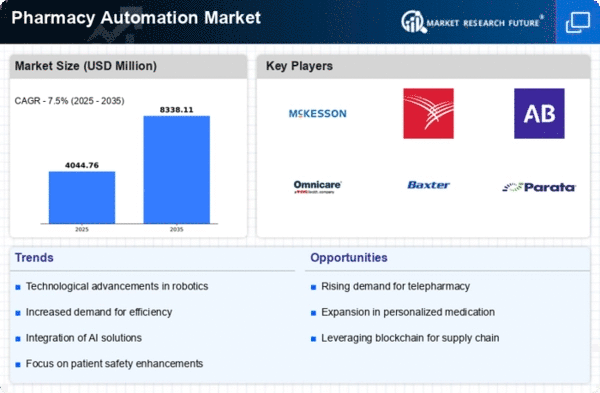
According to Market Research Future analysis, the Pharmacy Automation Market Size was valued at USD 3,762.57 Million in 2024 & the market is projected to grow from USD 4,044.84 Million in 2025 to USD 8,338.11 Million by 2035, registering a CAGR of 7.5% during the forecast period 2025–2035. North America led the market with over 49.99% share, generating around USD 1881.03 million in revenue.
 
The Pharmacy Automation Market is driven by rising demand for efficient medication management and error reduction in healthcare settings. Increasing prescription volumes, workforce shortages, and the need for streamlined workflows are accelerating adoption of automated dispensing and inventory systems globally.
 
According to WHO, medication errors harm millions annually, with unsafe medication practices costing nearly USD 42 billion globally each year. CDC reports that 6 in 10 adults suffer from chronic diseases requiring continuous medication, reinforcing demand for automation systems that improve dispensing accuracy and patient safety.

Key Market Trends & Highlights

The Pharmacy Automation Market is experiencing robust growth driven by technological advancements and a focus on patient-centric care.

  • North America dominates with over 49.99% share in 2025, driven by high prescription volumes and strong regulatory support. Europe reached USD 1,125.54 million in 2025, accounting for 29.91% share, supported by aging population and chronic disease burden. Rising chronic disease prevalence, affecting 60% of adults, significantly increases prescription demand, driving automation adoption across global healthcare systems. Medication errors costing USD 42 billion annually accelerate demand for automated dispensing systems improving accuracy and patient safety worldwide.

Market Size & Forecast

2024 Market Size 3762.57 (USD Million)
2035 Market Size 8338.11 (USD Million)
CAGR (2025 - 2035) 7.5%
Largest Regional Market Share in 2024 North America

Major Players

Companies such as McKesson Corporation (US), <a href="https://www.cardinalhealth.com/en/services/hospital-pharmacy/remote-pharmacy-services/medication-order-management-system.html" target="_blank" rel="noopener">Cardinal Health</a> (US), AmerisourceBergen (US), Omnicare (US), <a href="https://ushospitalproducts.baxter.com/exactamix-compounder-0" target="_blank" rel="noopener">Baxter International</a> (US), Parata Systems (US), ScriptPro (US), Talyst (US), Swisslog Healthcare (CH), Asteres (US) are some of the major participants in the global market.

Market Trends

The Pharmacy Automation Market is currently experiencing a transformative phase, driven by advancements in technology and an increasing demand for efficiency in medication management. Automation solutions are being integrated into various pharmacy operations, including dispensing, inventory management, and prescription verification. This shift not only enhances accuracy but also reduces the potential for human error, thereby improving patient safety.

As healthcare systems evolve, the emphasis on streamlined processes and cost-effectiveness becomes more pronounced, suggesting a robust future for automation in pharmacies. Moreover, the growing trend towards personalized medicine and the need for tailored patient care are influencing the Pharmacy Automation Market.

Automation technologies are being designed to accommodate individualized treatment plans, allowing pharmacists to focus more on patient interaction and less on routine tasks. This evolution indicates a potential shift in the role of pharmacists, who may increasingly become healthcare advisors rather than mere dispensers of medication. As the pharmacy automation devices market continues to adapt to these changes, it appears poised for sustained growth and innovation.

Integration of Artificial Intelligence

The incorporation of artificial intelligence into pharmacy automation systems is becoming increasingly prevalent. AI technologies facilitate improved decision-making processes, enhance inventory management, and optimize medication dispensing. This trend indicates a shift towards more intelligent systems that can learn from data and adapt to changing pharmacy environments.

Automation adoption in pharmacies is rising rapidly, with over 60% of hospital pharmacies now utilizing automated dispensing systems to improve medication management efficiency and reduce manual workload.

IHME highlights that chronic diseases account for over 70% of global deaths, significantly increasing prescription volumes and data complexity in healthcare systems. WHO reports growing adoption of digital health technologies, with AI improving clinical decision-making efficiency, supporting integration of intelligent pharmacy automation systems for optimized medication management and inventory control.

Focus on Patient Safety

There is a growing emphasis on patient safety within the Pharmacy Automation Market. Automation solutions are being developed to minimize medication errors and ensure accurate dispensing. This focus on safety not only enhances patient trust but also aligns with regulatory requirements, suggesting a commitment to high-quality healthcare.

Medication errors remain a major concern in healthcare, but studies show that automated dispensing and barcode verification systems can reduce medication errors by up to 50%, significantly improving patient safety in pharmacy operations.

WHO estimates medication errors cost approximately USD 42 billion annually, representing nearly 1% of global health expenditure, emphasizing the importance of automation in reducing errors. ECDC reports increasing patient safety initiatives across Europe, with hospitals adopting automated systems to minimize adverse drug events and improve healthcare quality outcomes.

Customization of Automation Solutions

Pharmacies are increasingly seeking customized automation solutions tailored to their specific needs. This trend reflects a recognition that one-size-fits-all approaches may not be effective. By investing in bespoke systems, pharmacies can enhance operational efficiency and better serve their patient populations.

The integration of digital technologies in pharmacies is accelerating, with nearly 65% of healthcare organizations planning to implement AI-enabled pharmacy management or medication tracking systems to enhance workflow efficiency and clinical decision support.

PAHO reports that over 30% of healthcare facilities in Latin America are adopting digital health solutions tailored to institutional needs, improving operational efficiency. UNFPA highlights increasing healthcare infrastructure investments globally, supporting customized automation technologies that address diverse pharmacy workflows, enhancing service delivery and medication accessibility across healthcare systems.

Pharmacy Automation Market Market Drivers

Rising Labor Costs

Labor costs in the pharmacy sector continue to escalate, prompting stakeholders to explore automation as a viable solution. The Global Pharmacy Automation Market is increasingly influenced by the need to mitigate these rising costs while maintaining service quality.
 
Automation technologies can alleviate the burden on pharmacy staff, allowing them to focus on patient care rather than repetitive tasks. This shift not only enhances operational efficiency but also contributes to cost savings. As a result, the market is anticipated to grow significantly, with projections indicating a value of 8.34 USD Billion by 2035, driven by the need to optimize labor resources.

Technological Advancements

Rapid advancements in technology are driving the evolution of the Global Pharmacy Automation Market. Innovations such as artificial intelligence, machine learning, and advanced robotics are enhancing the capabilities of pharmacy automation systems.
 
These technologies enable more sophisticated medication management, predictive analytics, and improved inventory control. As pharmacies increasingly adopt these advanced solutions, the market is poised for substantial growth. The integration of cutting-edge technology not only improves operational efficiency but also enhances patient outcomes, making automation an attractive option for pharmacies worldwide.

Increasing Demand for Efficiency

The Global Pharmacy Automation Market experiences a notable surge in demand for efficiency within pharmacy operations. Automation technologies, such as robotic dispensing systems and automated medication management, streamline workflows, reduce human error, and enhance overall productivity.
 
As pharmacies strive to optimize their operations, the market is projected to reach 3.76 USD Billion in 2024, reflecting a growing recognition of the benefits of automation. This trend is particularly evident in large healthcare systems where the integration of automated solutions has led to significant reductions in medication dispensing errors and improved patient safety outcomes.

Regulatory Compliance and Safety

The Global Pharmacy Automation Market is significantly shaped by stringent regulatory requirements aimed at ensuring medication safety and compliance. Automation solutions assist pharmacies in adhering to these regulations by providing accurate tracking and documentation of medication dispensing processes. Automated systems can help mitigate risks associated with human error, thereby enhancing patient safety.
 
As regulatory bodies continue to emphasize the importance of compliance, the adoption of pharmacy automation technologies is likely to increase. This trend is expected to contribute to a compound annual growth rate of 7.51% from 2025 to 2035, reflecting the growing importance of safety in pharmacy operations.

Aging Population and Chronic Diseases

The Global Pharmacy Automation Market is influenced by the demographic shift towards an aging population and the rising prevalence of chronic diseases. As the demand for medication management increases, pharmacies are turning to automation to handle the complexities of medication dispensing and adherence.
 
Automated systems can assist in managing prescriptions for chronic conditions, ensuring patients receive their medications on time. This trend is expected to drive market growth, as pharmacies seek to enhance their service offerings and improve patient care. The increasing need for efficient medication management solutions aligns with the projected growth of the market.

Market Segment Insights

By Application: Medication Dispensing (Largest) vs. Inventory Management (Fastest-Growing)

In the Pharmacy Automation Market, the application segment exhibits a diverse distribution of market share among its various functions. Medication Dispensing stands out as the most significant segment, holding the largest share at 54% due to its essential role in streamlining the medication provision process. Following closely is Inventory Management, which is gaining momentum as pharmacy increasingly adopt automated systems for effective stock management, reducing human errors and optimizing efficiency. Other applications such as Prescription Verification, Drug Storage, and Patient Management also contribute to the pharmacy automation systems market but occupy smaller portions of the overall share.

Medication Dispensing (Dominant) vs. Patient Management (Emerging)

Medication Dispensing is recognized as the dominant application within the market due to its essential function in ensuring patient safety and medication accuracy. It encompasses automated systems designed to streamline the dispensing process, thus reducing human errors and improving overall operational efficiency. In contrast, Patient Management is an emerging application that focuses on monitoring and managing patients' medication adherence and overall health outcomes. This segment is gaining traction as pharmacists and healthcare providers seek to enhance patient engagement and improve therapeutic outcomes through automated reminders and health tracking systems. As patient-centered care becomes a priority, tools that support effective patient management are expected to grow rapidly, creating opportunities for innovation within the pharmacy automation landscape.

By End Use: Hospital Pharmacies (Largest) vs. Retail Pharmacies (Fastest-Growing)

The distribution of market share among end-use segments reveals that Hospital Pharmacies hold the largest share of the Pharmacy Automation Market at 62%, driven by their increasing reliance on automation for efficiency and error reduction. Meanwhile, Retail Pharmacies are emerging as a fast-growing segment, as they adapt to consumer demands for quicker service and medication management solutions. This shifting landscape underscores the varying needs across different pharmacy types, influencing their growth trajectories. Additionally, growth trends indicate that technological advancements are playing a pivotal role in driving the adoption of pharmacy automation. Hospital Pharmacies are investing in sophisticated systems to streamline their operations, while Retail Pharmacies are increasingly integrating automation to enhance customer experience and meet regulatory requirements. Long-term care facilities and mail-order pharmacies are also witnessing growth but at a slower pace, as they continue to evolve with changing healthcare paradigms and patient demands.

Hospital Pharmacies (Dominant) vs. Retail Pharmacies (Emerging)

Hospital Pharmacies, as the dominant segment in the market, are characterized by their extensive use of advanced technologies to improve medication dispensing and inventory management. These pharmacies prioritize accuracy and efficiency, leading to a greater demand for automation solutions such as robotic dispensing systems and medication management software. On the other hand, Retail Pharmacies are emerging as a critical segment due to their need for faster services and enhanced patient engagement. They are rapidly adopting automation technologies like point-of-sale systems and automated dispensing units to keep up with consumer expectations. This duality between the established dominance of Hospital Pharmacies and the rising innovation within Retail Pharmacies showcases the dynamic nature of the market and the varying requirements of different pharmacy settings.

By Technology: Automated Dispensing Systems (Largest) vs. Robotic Prescription Dispensing (Fastest-Growing)

Automated Dispensing Systems hold the largest share of the Pharmacy Automation Market at 66%, driven by their widespread adoption across various healthcare settings. This segment is favored for its efficiency in medication management and error reduction, which is crucial for enhancing patient safety. On the other hand, Robotic Prescription Dispensing is rapidly gaining traction and is recognized as the fastest-growing segment. The increasing demand for precision in medication dispensing and the reduction of manual labor are key factors propelling this growth.

Technology: Automated Dispensing Systems (Dominant) vs. Robotic Prescription Dispensing (Emerging)

Automated Dispensing Systems are currently the dominant players in the Pharmacy Automation segment, stemming from their reliable performance in high-volume settings. These systems streamline the dispensing process, minimize errors, and enhance overall workflow efficiency, making them essential for pharmacy operations. Conversely, Robotic Prescription Dispensing is an emerging segment gaining momentum due to advancements in robotic technology and increasing investment in automation. These systems not only improve accuracy but also allow pharmacies to handle a larger volume of prescriptions efficiently, thereby addressing the growing demand for automation solutions in pharmacy environments.

By Product Type: Automated Medication Dispensing Systems (Largest) vs. Automated Compounding Systems (Fastest-Growing)

The market is segmented into Automated Medication Dispensing Systems, Automated Compounding Systems, and Pharmacy Workflow Management Solutions. Among these, Automated Medication Dispensing Systems hold the largest share at 58% due to their widespread adoption in hospitals and pharmacies. These systems streamline the medication dispensing process, reducing human error and improving patient safety. Following closely, Automated Compounding Systems are emerging as a significant segment, driven by their capabilities to create personalized medicine efficiently and accurately, responding to the growing trend for customized healthcare solutions. The growth trends in this market segment are largely influenced by technological advancements and the increasing demand for efficiency in pharmacy operations. Automated Medication Dispensing Systems continue to dominate due to their proven effectiveness in medication management. Meanwhile, Automated Compounding Systems are witnessing rapid adoption fueled by the rise of personalized medicine and the need for precise compounding solutions. As healthcare providers increasingly turn towards automation to enhance patient care and streamline operations, these segments are expected to experience dynamic growth in the coming years.

Automation Efficiency: Automated Medication Dispensing Systems (Dominant) vs. Automated Compounding Systems (Emerging)

Automated Medication Dispensing Systems are characterized by their ability to enhance operational efficiency and accuracy in medication dispensing within pharmacies and hospitals. These systems automate the traditional dispensing process, thus minimizing human errors and optimizing inventory control. On the other hand, Automated Compounding Systems are an emerging category that allows pharmacies to prepare individualized medication doses with high precision. They are particularly valuable in environments that require customized medications, such as for oncological or pediatric cases. As the demand for personalized medicine grows, Automated Compounding Systems are gaining traction, presenting a versatile solution for pharmacies looking to expand their service offerings. Together, these systems represent a significant shift towards automation in pharmacy operations.

Get more detailed insights about Pharmacy Automation Market Research Report - Global Forecast till 2035

Regional Insights

North America : Market Leader in Automation

North America leads in the Pharmacy Automation Market Size, accounting for over 49.99% of the global revenue in 2025.The region's growth is driven by increasing demand for efficient medication management, rising healthcare costs, and a focus on reducing human error in pharmacies. Regulatory support for automation technologies further catalyzes this growth, as healthcare providers seek to enhance operational efficiency and patient safety.

CDC reports that 6 in 10 adults in the U.S. have at least one chronic disease, and 4 in 10 have two or more, significantly increasing prescription demand. This high medication burden supports widespread adoption of pharmacy automation systems to improve efficiency, reduce errors, and enhance patient safety outcomes.

The competitive landscape in North America is robust, featuring key players such as McKesson Corporation, Cardinal Health, and AmerisourceBergen. These companies are investing heavily in innovative solutions to streamline pharmacy operations. The presence of advanced technologies and a strong healthcare infrastructure in the US and Canada positions North America as a hub for pharmacy automation, attracting investments and fostering innovation.

Europe : Emerging Market with Growth Potential

Europe Pharmacy Automation Market size was valued at USD 1125.54 million in 2025, making it the second-largest regional market with a 29.91% share. The region's growth is fueled by an aging population, increasing chronic diseases, and a shift towards automated solutions to enhance efficiency and accuracy in medication dispensing. Regulatory frameworks in countries like Germany and France are increasingly supportive of automation technologies, driving adoption across the continent.

WHO Europe reports that over 25% of the population is aged 60 years or older, increasing medication consumption and healthcare service demand. ECDC highlights rising prevalence of chronic conditions across the region, encouraging adoption of pharmacy automation technologies to enhance dispensing accuracy and manage increasing prescription volumes efficiently.

Leading countries such as Germany, the UK, and France are at the forefront of this market, with a competitive landscape featuring companies like Swisslog Healthcare and Asteres. The European market is characterized by a mix of established players and innovative startups, all vying to capture market share. The emphasis on patient safety and operational efficiency is pushing pharmacies to adopt automation solutions, making Europe a key player in the global market.

Asia-Pacific : Rapid Growth in Automation Adoption

The Asia-Pacific region is emerging as a significant player in the Pharmacy Automation Market, with a projected market size of $615.77 million by 2025. The growth is driven by increasing healthcare expenditures, a rising population, and a growing awareness of the benefits of automation in pharmacies. Countries like China and India are investing in healthcare infrastructure, which is expected to boost the adoption of automated pharmacy solutions.

In this region, the competitive landscape is evolving, with both local and international players vying for market share. Key companies are focusing on developing cost-effective solutions tailored to the unique needs of the region. The presence of a large patient base and the need for efficient medication management are propelling the demand for pharmacy automation technologies, making Asia-Pacific a vital market for future growth.

Middle East and Africa : Emerging Market with Untapped Potential

The Middle East and Africa region is gradually recognizing the potential of the Pharmacy Automation Market, with a market size of $140.23 million anticipated by 2025. The growth is driven by increasing healthcare investments, a rising prevalence of chronic diseases, and a push towards modernizing healthcare systems. Governments in the region are beginning to implement policies that support the adoption of automation technologies in pharmacies, which is expected to enhance operational efficiency and patient care.

Countries like South Africa and the UAE are leading the charge in adopting pharmacy automation solutions. The competitive landscape is still developing, with a mix of local and international players entering the market. As healthcare systems evolve and the demand for efficient medication management grows, the Middle East and Africa present significant opportunities for pharmacy automation providers to expand their footprint.

Key Players and Competitive Insights

The Pharmacy Automation Market is currently characterized by a dynamic competitive landscape, driven by technological advancements and an increasing demand for efficiency in pharmaceutical operations. Key players such as McKesson Corporation (US), Cardinal Health (US), and AmerisourceBergen (US) are strategically positioned to leverage innovation and digital transformation to enhance their operational capabilities.
 
These companies are focusing on automation solutions that streamline workflows, reduce errors, and improve patient safety, thereby shaping a competitive environment that emphasizes quality and reliability.In terms of business tactics, companies are increasingly localizing manufacturing and optimizing supply chains to respond to regional demands effectively. The market appears moderately fragmented, with several key players exerting considerable influence. This structure allows for a diverse range of solutions and services, fostering competition that drives continuous improvement and innovation across the sector.
 
In November McKesson Corporation (US) announced a partnership with a leading AI technology firm to develop advanced predictive analytics tools aimed at enhancing inventory management in pharmacies. This strategic move is likely to bolster McKesson's position in the market by enabling pharmacies to optimize stock levels, thereby reducing waste and improving service delivery. The integration of AI into their operations suggests a forward-thinking approach that aligns with current trends in digitalization.
 
Similarly, in October 2025, Cardinal Health (US) launched a new automated dispensing system designed to improve medication accuracy and efficiency in hospital settings. This initiative reflects Cardinal Health's commitment to innovation and its focus on addressing the growing need for reliable pharmacy automation solutions. By enhancing the accuracy of medication dispensing, the company is likely to strengthen its competitive edge in a market that increasingly prioritizes patient safety.
 
In September AmerisourceBergen (US) expanded its pharmacy automation offerings through the acquisition of a robotics company specializing in automated medication dispensing systems. This acquisition not only diversifies AmerisourceBergen's product portfolio but also positions the company to capitalize on the growing trend of automation in pharmacy operations. The strategic importance of this move lies in its potential to enhance operational efficiency and meet the evolving needs of healthcare providers.
 
As of December the competitive trends in the Pharmacy Automation Market are increasingly defined by digitalization, sustainability, and the integration of AI technologies. Strategic alliances among key players are shaping the landscape, fostering innovation and collaboration. The shift from price-based competition to a focus on technological advancement and supply chain reliability is evident, suggesting that future competitive differentiation will hinge on the ability to innovate and adapt to changing market demands.

Key Companies in the Pharmacy Automation Market include

Industry Developments

  • Q2 2024: Omnicell Launches Next-Generation XT Automated Dispensing System Omnicell unveiled its XT Automated Dispensing System, featuring enhanced security, real-time inventory tracking, and advanced analytics to improve medication management in hospital pharmacies.
  • Q3 2024: Swisslog Healthcare Announces Strategic Partnership with McKesson for Automated Pharmacy Solutions Swisslog Healthcare entered a strategic partnership with McKesson to co-develop and deploy advanced pharmacy automation systems across North American hospital networks.
  • Q3 2024: ARxIUM Secures Major Contract to Automate Medication Dispensing at Leading U.S. Hospital Chain ARxIUM won a multi-year contract to implement its pharmacy automation technology in a top U.S. hospital chain, aiming to improve medication safety and operational efficiency.
  • Q4 2024: Becton Dickinson (BD) Receives FDA Clearance for New BD Rowa Vmax Automated Storage System BD announced FDA clearance for its latest BD Rowa Vmax system, designed to automate medication storage and retrieval in hospital and retail pharmacy settings.
  • Q4 2024: Parata Systems Opens New Manufacturing Facility in North Carolina to Meet Growing Demand Parata Systems inaugurated a new manufacturing facility in North Carolina, expanding its production capacity for pharmacy automation equipment to address rising market demand.
  • Q1 2025: Baxter International Appoints New Head of Pharmacy Automation Market Division Baxter International named Dr. Lisa Chen as the new head of its Pharmacy Automation Market Division, signaling a renewed focus on innovation and global expansion.
  • Q1 2025: Omnicell Signs Multi-Year Agreement with NHS to Deploy Automated Dispensing Cabinets Across UK Hospitals Omnicell secured a multi-year agreement with the UK National Health Service (NHS) to install automated dispensing cabinets in hospitals nationwide, aiming to enhance medication safety and efficiency.
  • Q2 2025: BD Launches Cloud-Based Pharmacy Analytics Platform Becton Dickinson introduced a new cloud-based analytics platform for pharmacy automation, enabling real-time monitoring and predictive analytics for medication management.
  • Q2 2025: PharmBot Raises $40 Million Series C to Accelerate AI-Driven Pharmacy Automation Market PharmBot, a startup specializing in AI-powered pharmacy automation, closed a $40 million Series C funding round to scale its technology and expand into new markets.
  • Q3 2025: McKesson Acquires MedTech Automation to Bolster Hospital Pharmacy Solutions McKesson completed the acquisition of MedTech Automation, a developer of robotic medication dispensing systems, to enhance its hospital pharmacy automation portfolio.
  • Q3 2025: Swisslog Healthcare Receives CE Mark for New Automated Medication Packaging System Swisslog Healthcare announced it has received CE Mark approval for its latest automated medication packaging system, paving the way for commercialization across Europe.

Future Outlook

Pharmacy Automation Market Future Outlook

The Pharmacy Automation Market size is projected to reach USD 8,338.11 Million by 2035, growing at a CAGR of 7.5%, driven by technological advancements, increasing demand for efficiency, and rising medication management needs.

New opportunities lie in:

  • <p>Integration of AI-driven medication management systems Expansion of robotic dispensing solutions in outpatient settings Development of cloud-based pharmacy management platforms</p>

By 2035, the market is expected to be robust, driven by innovation and increased adoption of automation technologies.

Market Segmentation

Pharmacy Automation Market End Use Outlook

  • Retail Pharmacies
  • Hospital Pharmacies
  • Long-term Care Facilities
  • Mail-order Pharmacies

Pharmacy Automation Market Technology Outlook

  • Automated Dispensing Systems
  • Robotic Prescription Dispensing
  • Pharmacy Management Systems
  • Automated Storage and Retrieval Systems

Pharmacy Automation Market Application Outlook

  • Medication Dispensing
  • Inventory Management
  • Prescription Verification
  • Drug Storage
  • Patient Management

Pharmacy Automation Market Product Type Outlook

  • Automated Medication Dispensing Systems
  • Automated Compounding Systems
  • Pharmacy Workflow Management Solutions

Report Scope

MARKET SIZE 2024 3762.57(USD Million)
MARKET SIZE 2025 4044.84(USD Million)
MARKET SIZE 2035 8338.11(USD Million)
COMPOUND ANNUAL GROWTH RATE (CAGR) 7.5% (2025 - 2035)
REPORT COVERAGE Revenue Forecast, Competitive Landscape, Growth Factors, and Trends
BASE YEAR 2024
Market Forecast Period 2025 - 2035
Historical Data 2019 - 2024
Market Forecast Units USD Million
Key Companies Profiled McKesson Corporation (US), Cardinal Health (US), AmerisourceBergen (US), Omnicare (US), Baxter International (US), Parata Systems (US), ScriptPro (US), Talyst (US), Swisslog Healthcare (CH), Asteres (US)
Segments Covered Application, End Use, Technology, Product Type
Key Market Opportunities Integration of artificial intelligence and machine learning in the market enhances operational efficiency and accuracy.
Key Market Dynamics Rising demand for efficiency drives technological advancements and competitive consolidation in the market.
Countries Covered North America, Europe, APAC, South America, MEA

FAQs

What is the current valuation of the Pharmacy Automation Market as of 2025?

<p>The Pharmacy Automation Market is valued at approximately 3762.57 USD Million in 2024.</p>

What is the projected market valuation for the market in 2035?

The market is expected to reach a valuation of around 8338.11 USD Million by 2035.

What is the expected CAGR for the Pharmacy Automation Market during the forecast period 2025 - 2035?

<p>The expected CAGR for the Pharmacy Automation Market during the forecast period 2025 - 2035 is 7.5%.</p>

Which application segment is projected to have the highest growth in the market?

The Medication Dispensing segment is projected to grow from 1000.0 USD Million to 2300.0 USD Million by 2035.

What are the key players in the market?

Key players include McKesson Corporation, Cardinal Health, and AmerisourceBergen, among others.

How does the Hospital Pharmacies segment perform in the Pharmacy Automation Market?

<p>The Hospital Pharmacies segment was valued at 1125.0 USD Million in 2024 and is expected to grow to 2500.0 USD Million by 2035.</p>

What is the projected growth for Pharmacy Management Systems in the market?

<p>Pharmacy Management Systems are expected to grow from 1200.0 USD Million to 2800.0 USD Million by 2035.</p>

What is the expected performance of the Automated Medication Dispensing Systems segment?

<p>The Automated Medication Dispensing Systems segment is projected to increase from 1500.0 USD Million to 3500.0 USD Million by 2035.</p>

How does the Retail Pharmacies segment compare to other end-use segments?

<p>The Retail Pharmacies segment was valued at 950.0 USD Million in 2024 and is expected to reach 2100.0 USD Million by 2035.</p>

What is the anticipated growth for the Automated Compounding Systems segment?

<p>The Automated Compounding Systems segment is expected to grow from 1000.0 USD Million to 2500.0 USD Million by 2035.</p>

  1. SECTION I: EXECUTIVE SUMMARY AND KEY HIGHLIGHTS |
    1. EXECUTIVE SUMMARY | |
      1. Market Overview | |
      2. Key Findings | |
      3. Market Segmentation | |
      4. Competitive Landscape | |
      5. Challenges and Opportunities | |
      6. Future Outlook 2
  2. SECTION II: SCOPING, METHODOLOGY AND MARKET STRUCTURE |
    1. MARKET INTRODUCTION | |
      1. Definition | |
      2. Scope of the study | | |
    2. RESEARCH METHODOLOGY | |
      1. Overview | |
      2. Data Mining | |
      3. Secondary Research | |
      4. Primary Research | | |
      5. Forecasting Model | |
      6. Market Size Estimation | | |
      7. Data Triangulation | |
      8. Validation 3
  3. SECTION III: QUALITATIVE ANALYSIS |
    1. MARKET DYNAMICS | |
      1. Overview | |
      2. Drivers | |
      3. Restraints | |
      4. Opportunities |
    2. MARKET FACTOR ANALYSIS | |
      1. Value chain Analysis | |
      2. Porter's Five Forces Analysis | | |
      3. COVID-19 Impact Analysis | | |
  4. SECTION IV: QUANTITATIVE ANALYSIS |
    1. Healthcare, BY Application (USD Million) | |
      1. Medication Dispensing | |
      2. Inventory Management | |
      3. Prescription Verification | |
      4. Drug Storage | |
      5. Patient Management |
    2. Healthcare, BY End Use (USD Million) | |
      1. Hospital Pharmacies | |
      2. Retail Pharmacies | |
      3. Long-term Care Facilities | |
      4. Mail-order Pharmacies |
    3. Healthcare, BY Technology (USD Million) | |
      1. Automated Dispensing Systems | |
      2. Robotic Prescription Dispensing | |
      3. Pharmacy Management Systems | |
      4. Automated Storage and Retrieval Systems |
    4. Healthcare, BY Product Type (USD Million) | |
      1. Automated Medication Dispensing Systems | |
      2. Automated Compounding Systems | |
      3. Pharmacy Workflow Management Solutions |
    5. Healthcare, BY Region (USD Million) | |
      1. North America | | |
      2. Europe | | |
      3. APAC | | |
      4. South America | | |
      5. MEA | | |
  5. SECTION V: COMPETITIVE ANALYSIS |
    1. Competitive Landscape | |
      1. Overview | |
      2. Competitive Analysis | |
      3. Market share Analysis | |
      4. Major Growth Strategy in the Healthcare | |
      5. Competitive Benchmarking | |
      6. Leading Players in Terms of Number of Developments in the Healthcare | |
      7. Key developments and growth strategies | | |
      8. Major Players Financial Matrix | | |
    2. Company Profiles | |
      1. McKesson Corporation (US) | | |
      2. Cardinal Health (US) | | |
      3. AmerisourceBergen (US) | | |
      4. Omnicare (US) | | |
      5. Baxter International (US) | | |
      6. Parata Systems (US) | | |
      7. ScriptPro (US) | | |
      8. Talyst (US) | | |
      9. Swisslog Healthcare (CH) | | |
      10. Asteres (US) | | |
    3. Appendix | |
      1. References | |
      2. Related Reports 6 LIST OF FIGURES |
    4. MARKET SYNOPSIS |
    5. NORTH AMERICA MARKET ANALYSIS |
    6. US MARKET ANALYSIS BY APPLICATION |
    7. US MARKET ANALYSIS BY END USE |
    8. US MARKET ANALYSIS BY TECHNOLOGY |
    9. US MARKET ANALYSIS BY PRODUCT TYPE |
    10. CANADA MARKET ANALYSIS BY APPLICATION |
    11. CANADA MARKET ANALYSIS BY END USE |
    12. CANADA MARKET ANALYSIS BY TECHNOLOGY |
    13. CANADA MARKET ANALYSIS BY PRODUCT TYPE |
    14. EUROPE MARKET ANALYSIS |
    15. GERMANY MARKET ANALYSIS BY APPLICATION |
    16. GERMANY MARKET ANALYSIS BY END USE |
    17. GERMANY MARKET ANALYSIS BY TECHNOLOGY |
    18. GERMANY MARKET ANALYSIS BY PRODUCT TYPE |
    19. UK MARKET ANALYSIS BY APPLICATION |
    20. UK MARKET ANALYSIS BY END USE |
    21. UK MARKET ANALYSIS BY TECHNOLOGY |
    22. UK MARKET ANALYSIS BY PRODUCT TYPE |
    23. FRANCE MARKET ANALYSIS BY APPLICATION |
    24. FRANCE MARKET ANALYSIS BY END USE |
    25. FRANCE MARKET ANALYSIS BY TECHNOLOGY |
    26. FRANCE MARKET ANALYSIS BY PRODUCT TYPE |
    27. RUSSIA MARKET ANALYSIS BY APPLICATION |
    28. RUSSIA MARKET ANALYSIS BY END USE |
    29. RUSSIA MARKET ANALYSIS BY TECHNOLOGY |
    30. RUSSIA MARKET ANALYSIS BY PRODUCT TYPE |
    31. ITALY MARKET ANALYSIS BY APPLICATION |
    32. ITALY MARKET ANALYSIS BY END USE |
    33. ITALY MARKET ANALYSIS BY TECHNOLOGY |
    34. ITALY MARKET ANALYSIS BY PRODUCT TYPE |
    35. SPAIN MARKET ANALYSIS BY APPLICATION |
    36. SPAIN MARKET ANALYSIS BY END USE |
    37. SPAIN MARKET ANALYSIS BY TECHNOLOGY |
    38. SPAIN MARKET ANALYSIS BY PRODUCT TYPE |
    39. REST OF EUROPE MARKET ANALYSIS BY APPLICATION |
    40. REST OF EUROPE MARKET ANALYSIS BY END USE |
    41. REST OF EUROPE MARKET ANALYSIS BY TECHNOLOGY |
    42. REST OF EUROPE MARKET ANALYSIS BY PRODUCT TYPE |
    43. APAC MARKET ANALYSIS |
    44. CHINA MARKET ANALYSIS BY APPLICATION |
    45. CHINA MARKET ANALYSIS BY END USE |
    46. CHINA MARKET ANALYSIS BY TECHNOLOGY |
    47. CHINA MARKET ANALYSIS BY PRODUCT TYPE |
    48. INDIA MARKET ANALYSIS BY APPLICATION |
    49. INDIA MARKET ANALYSIS BY END USE |
    50. INDIA MARKET ANALYSIS BY TECHNOLOGY |
    51. INDIA MARKET ANALYSIS BY PRODUCT TYPE |
    52. JAPAN MARKET ANALYSIS BY APPLICATION |
    53. JAPAN MARKET ANALYSIS BY END USE |
    54. JAPAN MARKET ANALYSIS BY TECHNOLOGY |
    55. JAPAN MARKET ANALYSIS BY PRODUCT TYPE |
    56. SOUTH KOREA MARKET ANALYSIS BY APPLICATION |
    57. SOUTH KOREA MARKET ANALYSIS BY END USE |
    58. SOUTH KOREA MARKET ANALYSIS BY TECHNOLOGY |
    59. SOUTH KOREA MARKET ANALYSIS BY PRODUCT TYPE |
    60. MALAYSIA MARKET ANALYSIS BY APPLICATION |
    61. MALAYSIA MARKET ANALYSIS BY END USE |
    62. MALAYSIA MARKET ANALYSIS BY TECHNOLOGY |
    63. MALAYSIA MARKET ANALYSIS BY PRODUCT TYPE |
    64. THAILAND MARKET ANALYSIS BY APPLICATION |
    65. THAILAND MARKET ANALYSIS BY END USE |
    66. THAILAND MARKET ANALYSIS BY TECHNOLOGY |
    67. THAILAND MARKET ANALYSIS BY PRODUCT TYPE |
    68. INDONESIA MARKET ANALYSIS BY APPLICATION |
    69. INDONESIA MARKET ANALYSIS BY END USE |
    70. INDONESIA MARKET ANALYSIS BY TECHNOLOGY |
    71. INDONESIA MARKET ANALYSIS BY PRODUCT TYPE |
    72. REST OF APAC MARKET ANALYSIS BY APPLICATION |
    73. REST OF APAC MARKET ANALYSIS BY END USE |
    74. REST OF APAC MARKET ANALYSIS BY TECHNOLOGY |
    75. REST OF APAC MARKET ANALYSIS BY PRODUCT TYPE |
    76. SOUTH AMERICA MARKET ANALYSIS |
    77. BRAZIL MARKET ANALYSIS BY APPLICATION |
    78. BRAZIL MARKET ANALYSIS BY END USE |
    79. BRAZIL MARKET ANALYSIS BY TECHNOLOGY |
    80. BRAZIL MARKET ANALYSIS BY PRODUCT TYPE |
    81. MEXICO MARKET ANALYSIS BY APPLICATION |
    82. MEXICO MARKET ANALYSIS BY END USE |
    83. MEXICO MARKET ANALYSIS BY TECHNOLOGY |
    84. MEXICO MARKET ANALYSIS BY PRODUCT TYPE |
    85. ARGENTINA MARKET ANALYSIS BY APPLICATION |
    86. ARGENTINA MARKET ANALYSIS BY END USE |
    87. ARGENTINA MARKET ANALYSIS BY TECHNOLOGY |
    88. ARGENTINA MARKET ANALYSIS BY PRODUCT TYPE |
    89. REST OF SOUTH AMERICA MARKET ANALYSIS BY APPLICATION |
    90. REST OF SOUTH AMERICA MARKET ANALYSIS BY END USE |
    91. REST OF SOUTH AMERICA MARKET ANALYSIS BY TECHNOLOGY |
    92. REST OF SOUTH AMERICA MARKET ANALYSIS BY PRODUCT TYPE |
    93. MEA MARKET ANALYSIS |
    94. GCC COUNTRIES MARKET ANALYSIS BY APPLICATION |
    95. GCC COUNTRIES MARKET ANALYSIS BY END USE |
    96. GCC COUNTRIES MARKET ANALYSIS BY TECHNOLOGY |
    97. GCC COUNTRIES MARKET ANALYSIS BY PRODUCT TYPE |
    98. SOUTH AFRICA MARKET ANALYSIS BY APPLICATION |
    99. SOUTH AFRICA MARKET ANALYSIS BY END USE |
    100. SOUTH AFRICA MARKET ANALYSIS BY TECHNOLOGY |
    101. SOUTH AFRICA MARKET ANALYSIS BY PRODUCT TYPE |
    102. REST OF MEA MARKET ANALYSIS BY APPLICATION |
    103. REST OF MEA MARKET ANALYSIS BY END USE |
    104. REST OF MEA MARKET ANALYSIS BY TECHNOLOGY |
    105. REST OF MEA MARKET ANALYSIS BY PRODUCT TYPE |
    106. KEY BUYING CRITERIA OF HEALTHCARE |
    107. RESEARCH PROCESS OF MRFR |
    108. DRO ANALYSIS OF HEALTHCARE |
    109. DRIVERS IMPACT ANALYSIS: HEALTHCARE |
    110. RESTRAINTS IMPACT ANALYSIS: HEALTHCARE |
    111. SUPPLY / VALUE CHAIN: HEALTHCARE |
    112. HEALTHCARE, BY APPLICATION, 2024 (% SHARE) |
    113. HEALTHCARE, BY APPLICATION, 2024 TO 2035 (USD Million) |
    114. HEALTHCARE, BY END USE, 2024 (% SHARE) |
    115. HEALTHCARE, BY END USE, 2024 TO 2035 (USD Million) |
    116. HEALTHCARE, BY TECHNOLOGY, 2024 (% SHARE) |
    117. HEALTHCARE, BY TECHNOLOGY, 2024 TO 2035 (USD Million) |
    118. HEALTHCARE, BY PRODUCT TYPE, 2024 (% SHARE) |
    119. HEALTHCARE, BY PRODUCT TYPE, 2024 TO 2035 (USD Million) |
    120. BENCHMARKING OF MAJOR COMPETITORS 7 LIST OF TABLES |
    121. LIST OF ASSUMPTIONS | |
      1. |
    122. North America MARKET SIZE ESTIMATES; FORECAST | |
      1. BY APPLICATION, 2025-2035 (USD Million) | |
      2. BY END USE, 2025-2035 (USD Million) | |
      3. BY TECHNOLOGY, 2025-2035 (USD Million) | |
      4. BY PRODUCT TYPE, 2025-2035 (USD Million) |
    123. US MARKET SIZE ESTIMATES; FORECAST | |
      1. BY APPLICATION, 2025-2035 (USD Million) | |
      2. BY END USE, 2025-2035 (USD Million) | |
      3. BY TECHNOLOGY, 2025-2035 (USD Million) | |
      4. BY PRODUCT TYPE, 2025-2035 (USD Million) |
    124. Canada MARKET SIZE ESTIMATES; FORECAST | |
      1. BY APPLICATION, 2025-2035 (USD Million) | |
      2. BY END USE, 2025-2035 (USD Million) | |
      3. BY TECHNOLOGY, 2025-2035 (USD Million) | |
      4. BY PRODUCT TYPE, 2025-2035 (USD Million) |
    125. Europe MARKET SIZE ESTIMATES; FORECAST | |
      1. BY APPLICATION, 2025-2035 (USD Million) | |
      2. BY END USE, 2025-2035 (USD Million) | |
      3. BY TECHNOLOGY, 2025-2035 (USD Million) | |
      4. BY PRODUCT TYPE, 2025-2035 (USD Million) |
    126. Germany MARKET SIZE ESTIMATES; FORECAST | |
      1. BY APPLICATION, 2025-2035 (USD Million) | |
      2. BY END USE, 2025-2035 (USD Million) | |
      3. BY TECHNOLOGY, 2025-2035 (USD Million) | |
      4. BY PRODUCT TYPE, 2025-2035 (USD Million) |
    127. UK MARKET SIZE ESTIMATES; FORECAST | |
      1. BY APPLICATION, 2025-2035 (USD Million) | |
      2. BY END USE, 2025-2035 (USD Million) | |
      3. BY TECHNOLOGY, 2025-2035 (USD Million) | |
      4. BY PRODUCT TYPE, 2025-2035 (USD Million) |
    128. France MARKET SIZE ESTIMATES; FORECAST | |
      1. BY APPLICATION, 2025-2035 (USD Million) | |
      2. BY END USE, 2025-2035 (USD Million) | |
      3. BY TECHNOLOGY, 2025-2035 (USD Million) | |
      4. BY PRODUCT TYPE, 2025-2035 (USD Million) |
    129. Russia MARKET SIZE ESTIMATES; FORECAST | |
      1. BY APPLICATION, 2025-2035 (USD Million) | |
      2. BY END USE, 2025-2035 (USD Million) | |
      3. BY TECHNOLOGY, 2025-2035 (USD Million) | |
      4. BY PRODUCT TYPE, 2025-2035 (USD Million) |
    130. Italy MARKET SIZE ESTIMATES; FORECAST | |
      1. BY APPLICATION, 2025-2035 (USD Million) | |
      2. BY END USE, 2025-2035 (USD Million) | |
      3. BY TECHNOLOGY, 2025-2035 (USD Million) | |
      4. BY PRODUCT TYPE, 2025-2035 (USD Million) |
    131. Spain MARKET SIZE ESTIMATES; FORECAST | |
      1. BY APPLICATION, 2025-2035 (USD Million) | |
      2. BY END USE, 2025-2035 (USD Million) | |
      3. BY TECHNOLOGY, 2025-2035 (USD Million) | |
      4. BY PRODUCT TYPE, 2025-2035 (USD Million) |
    132. Rest of Europe MARKET SIZE ESTIMATES; FORECAST | |
      1. BY APPLICATION, 2025-2035 (USD Million) | |
      2. BY END USE, 2025-2035 (USD Million) | |
      3. BY TECHNOLOGY, 2025-2035 (USD Million) | |
      4. BY PRODUCT TYPE, 2025-2035 (USD Million) |
    133. APAC MARKET SIZE ESTIMATES; FORECAST | |
      1. BY APPLICATION, 2025-2035 (USD Million) | |
      2. BY END USE, 2025-2035 (USD Million) | |
      3. BY TECHNOLOGY, 2025-2035 (USD Million) | |
      4. BY PRODUCT TYPE, 2025-2035 (USD Million) |
    134. China MARKET SIZE ESTIMATES; FORECAST | |
      1. BY APPLICATION, 2025-2035 (USD Million) | |
      2. BY END USE, 2025-2035 (USD Million) | |
      3. BY TECHNOLOGY, 2025-2035 (USD Million) | |
      4. BY PRODUCT TYPE, 2025-2035 (USD Million) |
    135. India MARKET SIZE ESTIMATES; FORECAST | |
      1. BY APPLICATION, 2025-2035 (USD Million) | |
      2. BY END USE, 2025-2035 (USD Million) | |
      3. BY TECHNOLOGY, 2025-2035 (USD Million) | |
      4. BY PRODUCT TYPE, 2025-2035 (USD Million) |
    136. Japan MARKET SIZE ESTIMATES; FORECAST | |
      1. BY APPLICATION, 2025-2035 (USD Million) | |
      2. BY END USE, 2025-2035 (USD Million) | |
      3. BY TECHNOLOGY, 2025-2035 (USD Million) | |
      4. BY PRODUCT TYPE, 2025-2035 (USD Million) |
    137. South Korea MARKET SIZE ESTIMATES; FORECAST | |
      1. BY APPLICATION, 2025-2035 (USD Million) | |
      2. BY END USE, 2025-2035 (USD Million) | |
      3. BY TECHNOLOGY, 2025-2035 (USD Million) | |
      4. BY PRODUCT TYPE, 2025-2035 (USD Million) |
    138. Malaysia MARKET SIZE ESTIMATES; FORECAST | |
      1. BY APPLICATION, 2025-2035 (USD Million) | |
      2. BY END USE, 2025-2035 (USD Million) | |
      3. BY TECHNOLOGY, 2025-2035 (USD Million) | |
      4. BY PRODUCT TYPE, 2025-2035 (USD Million) |
    139. Thailand MARKET SIZE ESTIMATES; FORECAST | |
      1. BY APPLICATION, 2025-2035 (USD Million) | |
      2. BY END USE, 2025-2035 (USD Million) | |
      3. BY TECHNOLOGY, 2025-2035 (USD Million) | |
      4. BY PRODUCT TYPE, 2025-2035 (USD Million) |
    140. Indonesia MARKET SIZE ESTIMATES; FORECAST | |
      1. BY APPLICATION, 2025-2035 (USD Million) | |
      2. BY END USE, 2025-2035 (USD Million) | |
      3. BY TECHNOLOGY, 2025-2035 (USD Million) | |
      4. BY PRODUCT TYPE, 2025-2035 (USD Million) |
    141. Rest of APAC MARKET SIZE ESTIMATES; FORECAST | |
      1. BY APPLICATION, 2025-2035 (USD Million) | |
      2. BY END USE, 2025-2035 (USD Million) | |
      3. BY TECHNOLOGY, 2025-2035 (USD Million) | |
      4. BY PRODUCT TYPE, 2025-2035 (USD Million) |
    142. South America MARKET SIZE ESTIMATES; FORECAST | |
      1. BY APPLICATION, 2025-2035 (USD Million) | |
      2. BY END USE, 2025-2035 (USD Million) | |
      3. BY TECHNOLOGY, 2025-2035 (USD Million) | |
      4. BY PRODUCT TYPE, 2025-2035 (USD Million) |
    143. Brazil MARKET SIZE ESTIMATES; FORECAST | |
      1. BY APPLICATION, 2025-2035 (USD Million) | |
      2. BY END USE, 2025-2035 (USD Million) | |
      3. BY TECHNOLOGY, 2025-2035 (USD Million) | |
      4. BY PRODUCT TYPE, 2025-2035 (USD Million) |
    144. Mexico MARKET SIZE ESTIMATES; FORECAST | |
      1. BY APPLICATION, 2025-2035 (USD Million) | |
      2. BY END USE, 2025-2035 (USD Million) | |
      3. BY TECHNOLOGY, 2025-2035 (USD Million) | |
      4. BY PRODUCT TYPE, 2025-2035 (USD Million) |
    145. Argentina MARKET SIZE ESTIMATES; FORECAST | |
      1. BY APPLICATION, 2025-2035 (USD Million) | |
      2. BY END USE, 2025-2035 (USD Million) | |
      3. BY TECHNOLOGY, 2025-2035 (USD Million) | |
      4. BY PRODUCT TYPE, 2025-2035 (USD Million) |
    146. Rest of South America MARKET SIZE ESTIMATES; FORECAST | |
      1. BY APPLICATION, 2025-2035 (USD Million) | |
      2. BY END USE, 2025-2035 (USD Million) | |
      3. BY TECHNOLOGY, 2025-2035 (USD Million) | |
      4. BY PRODUCT TYPE, 2025-2035 (USD Million) |
    147. MEA MARKET SIZE ESTIMATES; FORECAST | |
      1. BY APPLICATION, 2025-2035 (USD Million) | |
      2. BY END USE, 2025-2035 (USD Million) | |
      3. BY TECHNOLOGY, 2025-2035 (USD Million) | |
      4. BY PRODUCT TYPE, 2025-2035 (USD Million) |
    148. GCC Countries MARKET SIZE ESTIMATES; FORECAST | |
      1. BY APPLICATION, 2025-2035 (USD Million) | |
      2. BY END USE, 2025-2035 (USD Million) | |
      3. BY TECHNOLOGY, 2025-2035 (USD Million) | |
      4. BY PRODUCT TYPE, 2025-2035 (USD Million) |
    149. South Africa MARKET SIZE ESTIMATES; FORECAST | |
      1. BY APPLICATION, 2025-2035 (USD Million) | |
      2. BY END USE, 2025-2035 (USD Million) | |
      3. BY TECHNOLOGY, 2025-2035 (USD Million) | |
      4. BY PRODUCT TYPE, 2025-2035 (USD Million) |
    150. Rest of MEA MARKET SIZE ESTIMATES; FORECAST | |
      1. BY APPLICATION, 2025-2035 (USD Million) | |
      2. BY END USE, 2025-2035 (USD Million) | |
      3. BY TECHNOLOGY, 2025-2035 (USD Million) | |
      4. BY PRODUCT TYPE, 2025-2035 (USD Million) |
    151. PRODUCT LAUNCH/PRODUCT DEVELOPMENT/APPROVAL | |
      1. |
    152. ACQUISITION/PARTNERSHIP | |

Healthcare Market Segmentation

Healthcare By Application (USD Million, 2025-2035)

  • Medication Dispensing
  • Inventory Management
  • Prescription Verification
  • Drug Storage
  • Patient Management

Healthcare By End Use (USD Million, 2025-2035)

  • Hospital Pharmacies
  • Retail Pharmacies
  • Long-term Care Facilities
  • Mail-order Pharmacies

Healthcare By Technology (USD Million, 2025-2035)

  • Automated Dispensing Systems
  • Robotic Prescription Dispensing
  • Pharmacy Management Systems
  • Automated Storage and Retrieval Systems

Healthcare By Product Type (USD Million, 2025-2035)

  • Automated Medication Dispensing Systems
  • Automated Compounding Systems
  • Pharmacy Workflow Management Solutions
Infographic

Free Sample Request

Kindly complete the form below to receive a free sample of this Report

Get Free Sample

Customer Strories

Compare Licence

×
Features License Type
Single User Multiuser License Enterprise User
Price $4,950 $5,950 $7,250
Maximum User Access Limit 1 User Upto 10 Users Unrestricted Access Throughout the Organization
Free Customization
Direct Access to Analyst
Deliverable Format
Platform Access
Discount on Next Purchase 10% 15% 15%
Printable Versions