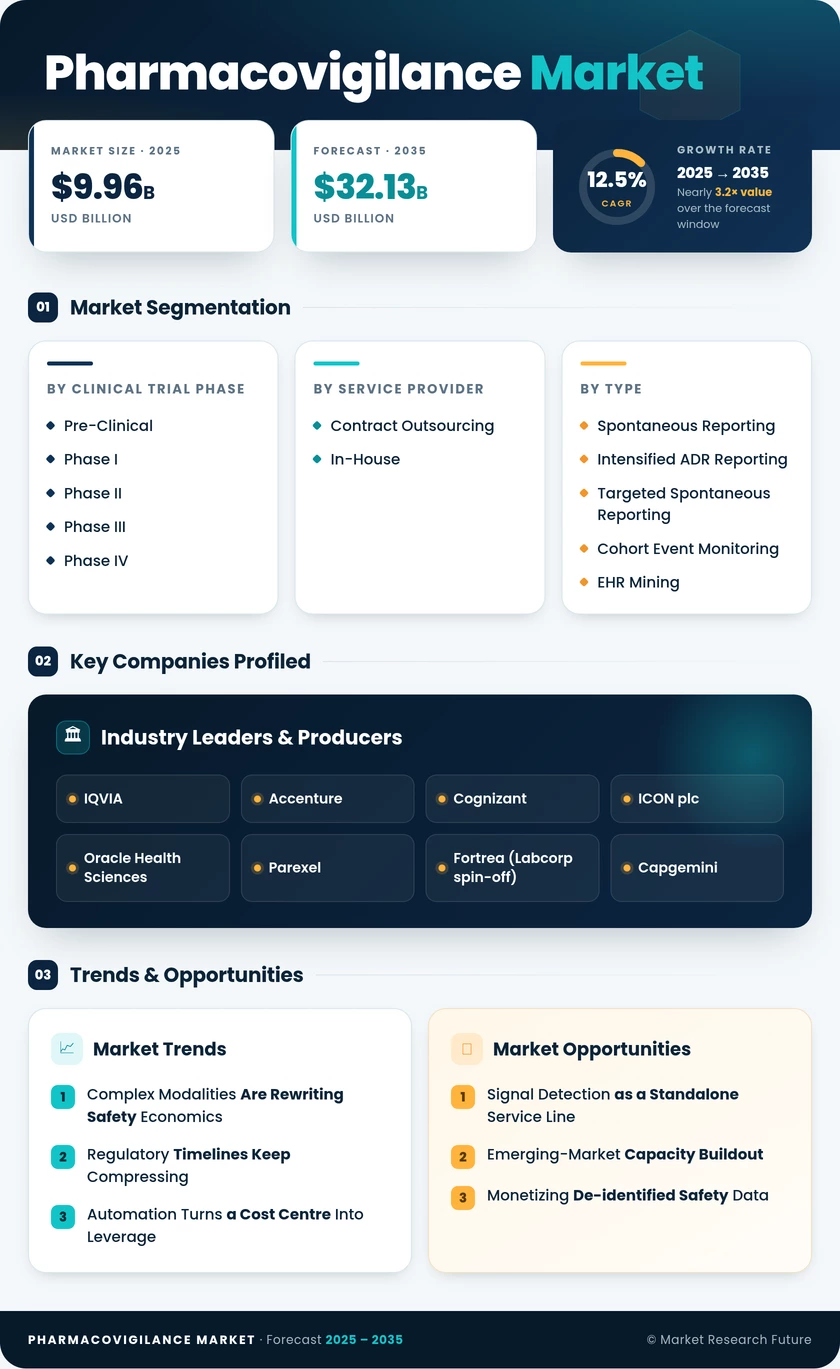
Segmentation Quick Reference
| Dimension | Sub-Segments | Dominant Segment | Fastest Growing Segment |
| By Clinical Trial Phase | Pre-Clinical; Phase I; Phase II; Phase III; Phase IV | Phase IV | Pre-Clinical |
| By Service Provider | In-House; Contract Outsourcing | Contract Outsourcing | Contract Outsourcing |
| By Type of Reporting | Spontaneous Reporting; Intensified ADR Reporting; Targeted Spontaneous Reporting; Cohort Event Monitoring; EHR Mining | Spontaneous Reporting | EHR Mining |
| By End User | Pharmaceutical Companies; Biotechnology Companies; Medical Device Manufacturers; Hospitals; Others | Pharmaceutical Companies | Hospitals |
| By Geography | North America; Europe; Asia-Pacific; South America; Middle East & Africa | North America | Asia-Pacific |
Market Segmentation Overview
By Clinical Trial Phase
| Sub-Segment | Key Trend |
| Pre-Clinical | Early toxicology documentation shifts left as sponsors build safety infrastructure before first-in-human |
| Phase I | Intensive monitoring protocols expand for cell and gene therapy candidates |
| Phase II | Dose-ranging safety characterization increasingly supported by automated coding |
| Phase III | Pivotal trial volumes drive peak per-study case handling demand. |
| Phase IV | Perpetual post-authorization obligations create a compounding installed base. |
Post-approval work dominates because obligations never expire while trial-phase demand cycles with pipeline timing. Sponsors of advanced therapies are the exception — their pre-clinical and Phase I spend now rivals late-phase budgets on a per-programme basis.
By Service Provider
| Sub-Segment | Key Trend |
| In-House | Retained for signal management and benefit-risk judgment at the largest sponsors |
| Contract Outsourcing | Majority of global spend; shifting from labour arbitrage toward platform-enabled delivery |
The outsourcing boundary is moving up the value chain. Transactional intake left first; analytical work is following as providers demonstrate defensible model governance and inspection-ready documentation.
By Type of Reporting
| Sub-Segment | Key Trend |
| Spontaneous Reporting | Statutory baseline; share erodes gradually despite absolute growth |
| Intensified ADR Reporting | Tied to specific post-authorization commitments and conditional approvals |
| Targeted Spontaneous Reporting | Deployed for public health programmes and vaccine campaigns |
| Cohort Event Monitoring | Applied to new chemical entity launches requiring close observation |
| EHR Mining | Fastest expansion as distributed data networks become queryable at scale. |
Methodology is diversifying away from passive collection. Regulators increasingly expect sponsors to look for signals rather than wait for them, which favours data-rich approaches over notification-dependent ones.
By End User
| Sub-Segment | Key Trend |
| Pharmaceutical Companies | Broadest obligations across geographies and product portfolios |
| Biotechnology Companies | Biologics and advanced therapy pipelines drive disproportionate per-product spend. |
| Medical Device Manufacturers | Vigilance requirements converging with pharmaceutical standards under MDR. |
| Hospitals | Institutional reporting mandates convert providers into budget-holding buyers. |
| Others | Academic centres, research organizations and public health bodies |
Buyer composition is broadening. Hospitals and device manufacturers were peripheral a decade ago; regulatory convergence has made them procurement decision-makers with distinct requirements from traditional pharmaceutical sponsors.
By Region
| Sub-Segment | Key Trend |
| North America | Litigation exposure and Sentinel expansion sustain premium pricing |
| Europe | GVP remediation and MDR convergence drive multi-year programme spend |
| Asia-Pacific | Harmonization plus local delivery capacity produces fastest regional growth. |
| South America | ANVISA modernization anchors regional demand from Brazil |
| Middle East & Africa | National centre buildout funded by Gulf health transformation programmes |
Regional divergence is widening rather than narrowing. Mature markets buy sophistication; emerging markets buy foundational capacity — and providers increasingly need distinct operating models for each.

 Noah Malgeri
Co-Founder
Noah Malgeri
Co-Founder

 Peter Groot koerkamp
Account and Business Manager
Peter Groot koerkamp
Account and Business Manager

 Younghwan Choi
Senior Retail Manager
Younghwan Choi
Senior Retail Manager

 Mark Irwin
Management Consultant
Mark Irwin
Management Consultant

 Akif Moroglu
Strategy & Business Development Director
Akif Moroglu
Strategy & Business Development Director

 Guilherme Gomes Martins
Product Management Director
Guilherme Gomes Martins
Product Management Director

 Joseph Aguayo
Sales Operations & Pricing Manager
Joseph Aguayo
Sales Operations & Pricing Manager

 La Terria Dodd
Program Support Specialist
La Terria Dodd
Program Support Specialist

 Rob Kooiker
Group Product Manager HVAC & Fire Protection GMA
Rob Kooiker
Group Product Manager HVAC & Fire Protection GMA