Pharmaceutical Analytical Testing Outsourcing Market (2026 - 2035)

Pharmaceutical Analytical Testing Outsourcing Market Research Report: Size, Share, Trend Analysis By Product (Finished Products and Active Pharmaceutical Ingredients), By Services (Bioanalytical Testing, Stability Testing, Method Development & Validation and others), By End-User (Biopharmaceutical Companies, Biotechnology Industry and Pharmaceutical), and By Region (North America, Europe, Asia-Pacific, And Rest Of The World) - Growth Outlook & Industry Forecast 2025 To 2035
ID: MRFR/HC/5722-CR 117 Pages Vikita Thakur, Kinjoll Dey Last Updated: October 13, 2026
Pharmaceutical Analytical Testing Outsourcing Market
Market Size
Forecast Period2026-2035
CAGR (2026-2035)8.4%
2025 Market SizeUSD 8.81 Billion
2035 Market SizeUSD 19.74 Billion
Key Players
Eurofins Scientific
Thermo Fisher Scientific
Charles River Laboratories
SGS SA
Intertek Group plc
Labcorp
Opportunities
  • Emerging-Market Laboratory Networks
  • Analytical Data Platforms and Subscription Models
  • Characterization of Next-Generation Modalities

Pharmaceutical Analytical Testing Outsourcing Market Summary

The Pharmaceutical Analytical Testing Outsourcing Market was valued at USD 8.81 Billion in 2025 and is expected to reach USD 9.55 Billion in 2026, expanding at a CAGR of 8.4% to USD 19.74 Billion by 2035. Two regulatory catalysts set the near-term pace. ICH Q2(R2) and Q14, finalized in November 2023, moved method validation onto a lifecycle footing [5], while the FDA's revised nitrosamine guidance set an August 2025 deadline for confirmatory testing of nitrosamine drug substance-related impurities . Both requirements land hardest on sponsors without deep in-house analytical benches.

Laboratory practice is shifting just as quickly. Single-method HPLC-UV release panels, adequate for small-molecule tablets, are giving way to orthogonal packages that combine LC-MS/MS, high-resolution mass spectrometry, cell-based potency assays, and ligand-binding methods for biologics. The FDA's Center for Drug Evaluation and Research approved 50 novel drugs in 2024 , and a growing proportion were antibodies, peptides, and other complex molecules that need specialized characterization. That mix pushes demand toward analytical CRO services able to validate methods across multiple platforms under one quality system.

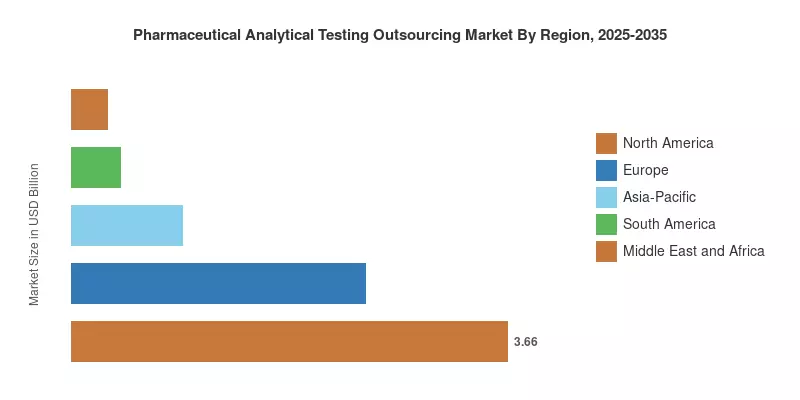
North America leads the Pharmaceutical Analytical Testing Outsourcing Market with 41.5% share, supported by the world's densest biotech pipeline and FDA inspection rigor. Asia-Pacific is the fastest-growing region at 10.6% CAGR, as India and China upgrade GMP frameworks and win stability and release contracts on cost. Europe ranks second, held up by the revised EU GMP Annex 1 and a strong biologics manufacturing base. Through 2035, growth will favor providers that pair regulatory-grade data with biologics and advanced-modality expertise.

Key Report Takeaways

• By Services

  • Bioanalytical Testing is the largest and fastest-expanding service line, rising at an 11.7% CAGR on antibody, ADC, and cell-therapy pipelines
  • Stability Testing generated USD 1.62 Billion in 2025, anchored by ICH Q1 shelf-life programs

• By Test Type

  • Chemistry Testing held 28.7% share in 2025 on identity, purity, and residual solvent volumes
  • Extractables & Leachables is the fastest-growing test type at 10.2% CAGR

• By Phase

  • Commercial / QC Release accounted for 29.9% share, reflecting recurring batch testing
  • Phase I will expand at 9.4% CAGR as early-stage biotech programs externalize analytics

• By Technology Platform

  • Chromatography-Based platforms led with 25.2% share across API and impurity work
  • Cell-Based Bioassays will grow at 10.5% CAGR on mechanism-of-action potency requirements

• By Outsourcing Model

  • Full-Service CRO contracts captured 45.6% share of the Pharmaceutical Analytical Testing Outsourcing Market in 2025
  • Functional Service Provider (FSP) arrangements will rise at 9.1% CAGR

• By End-User

  • Pharmaceutical & Biopharmaceutical Companies generated 61.3% share of 2025 demand
  • Contract Development & Manufacturing Organizations (CDMOs/CMOs) will grow at 9.5% CAGR

• By Region

  • North America anchored the Pharmaceutical Analytical Testing Outsourcing Market with 41.5% share
  • Europe represented USD 2.47 Billion in 2025
  • Asia-Pacific is the fastest-growing region at 10.6% CAGR

Market Size and Forecast (2021–2035)

Market Research Future built the Pharmaceutical Analytical Testing Outsourcing Market baseline from disclosed testing revenues of listed CROs and testing-inspection-certification groups, cross-checked against sponsor outsourcing ratios and regulatory filing volumes. Historical values for 2021–2024 reflect reported and estimated revenue, 2025 serves as the base year, and the 2026–2035 forecast follows an 8.4% growth trajectory validated through scenario testing.
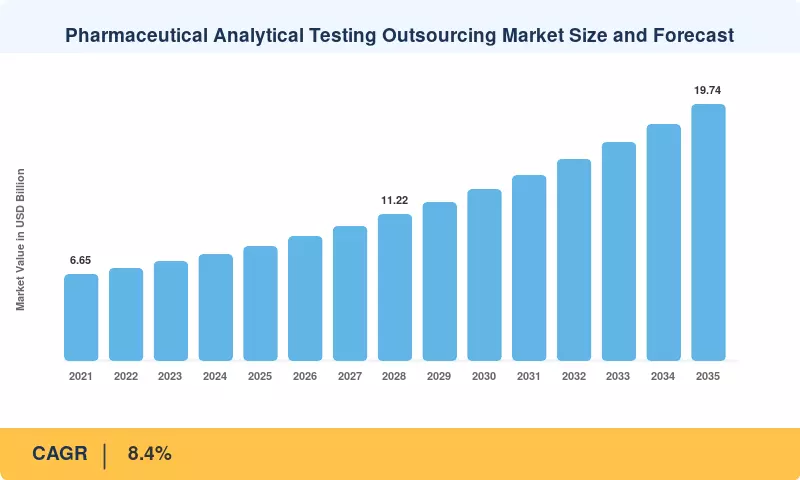
Pharmaceutical Analytical Testing Outsourcing Market Size and Forecast
Our Impact

Enabled $4.3B Revenue Impact for Fortune 500 and Leading Multinationals

Partnering with 2000+ Global Organizations Each Year

30K+ Citations by Top-Tier Firms in the Industry

Driver Impact Analysis

Driver ~% Impact on CAGR Geographic Relevance Impact Timeline
Biologics and advanced-modality pipeline expansion +1.9% Global; North America and Europe core Long-term (≥4 yr)
Lifecycle analytical procedure regulations +1.4% Europe, North America; spillover to Asia-Pacific Medium-term (2–4 yr)
Nitrosamine and extractables scrutiny +1.1% Global Short-term (≤2 yr)
Asset-light emerging biopharma models +1.2% North America, Europe Medium-term (2–4 yr)
CDMO capacity build-out +0.9% North America, Europe, Asia-Pacific Long-term (≥4 yr)
Asia-Pacific GMP upgrades and cost arbitrage +0.8% Asia-Pacific Medium-term (2–4 yr)

Biologics and Advanced-Modality Pipeline Expansion

The analytical effort of complex molecules is many times greater than that of comparable simple molecules. By 2025, FDA leadership anticipated 10–20 cell and gene therapy approvals per year . Validated release, stability, and comparability tests are necessary for each approval; sponsors typically arrange these tests with outside laboratories that have cell-based and molecular platforms.

Lifecycle Analytical Procedure Regulations

ICH Q2(R2) and Q14 were operative in the EU in June 2024 after reaching Step 4 in November 2023 [5]. Together, they request that sponsors monitor method modifications across the product lifecycle and document an analytical target profile, which causes historical methods to be revalidated. Effective August 25, 2023, the updated EU GMP Annex 1 separately requires a contamination control strategy for sterile products [6], increasing the frequency of microbiological testing and environmental monitoring. There aren't many sponsors with enough employees to handle both projects internally.

Nitrosamine and Extractables Scrutiny

Revision 2 of the FDA's nitrosamine guidance, issued September 2024, set recommended acceptable intake limits as low as 26.5 ng/day for the most potent impurity category, with an August 2025 compliance date . Meeting those limits requires sensitive LC-HRMS methods that few generic manufacturers run in-house. USP chapters <1663> and <1664> add parallel pressure on container-closure extractables and leachables assessments [8], and the EMA runs a comparable nitrosamine program in Europe [24].

Asset-Light Emerging Biopharma Models

Emerging biopharma companies originate roughly two-thirds of the global R&D pipeline, according to sources. These firms typically operate without GMP laboratories, outsourcing method development, release, and stability testing from the first IND-enabling study. Eurofins' 2024 reporting points to bundled offerings for small biotechs that combine protocol design, assay transfer, and regulatory writing . As venture funding returned in 2024, this cohort restarted programs paused during the 2022–2023 slowdown, lifting early-phase demand.

CDMO Capacity Build-Out

Manufacturing outsourcing pulls analytical work behind it. Novo Holdings completed its USD 16.5 billion acquisition of Catalent in December 2024 [10], one signal of heavy capital flowing into biologics and fill-finish capacity. New CDMO lines require method transfers, process validation testing, and recurring lot release. Many CDMOs subcontract specialized assays such as host-cell protein analysis or residual DNA testing to dedicated labs rather than equipping every site.

Asia-Pacific GMP Upgrades and Cost Arbitrage

India notified its revised Schedule M good manufacturing practice rules in December 2023, giving large manufacturers six months and smaller firms an extended window to comply [11]. The upgrade raises documentation, stability, and qualification testing obligations across thousands of facilities. China's NMPA has similarly tightened inspection standards [12]. Combined with labor costs often 30–40% below Western equivalents, these reforms position regional labs to win stability and routine release contracts from global sponsors.

Restraints Impact Analysis

Restraint ~% Impact on CAGR Geographic Relevance Impact Timeline
Data integrity and compliance exposure −0.7% Global; elevated in India and China Short-term (≤2 yr)
Shortage of specialized analytical scientists −0.6% North America, Europe Medium-term (2–4 yr)
Biotech funding volatility and pricing pressure −0.5% North America, Europe Short-term (≤2 yr)
High capital intensity of advanced instrumentation −0.4% South America, Middle East and Africa Long-term (≥4 yr)
Geopolitical restrictions on cross-border testing −0.4% North America, Asia-Pacific Medium-term (2–4 yr)

Data Integrity and Compliance Exposure

Work is transferred through outsourcing, but regulatory accountability is not. Sponsors are accountable for audit trails, raw data, and ALCOA principles at contract sites under the FDA's data integrity guidelines . Sponsors may be forced to requalify procedures elsewhere after receiving a single warning letter from a supplier, which might cause submissions to be delayed by months. Due to this exposure, some major pharmaceutical companies focus their external investment on a small number of audited vendors and maintain in-house commercial release testing.

Shortage of Specialized Analytical Scientists

Demand for mass spectrometry, bioassay, and GMP-qualified chemists outpaces graduate supply. The U.S. Bureau of Labor Statistics projects continued growth in chemist employment through 2033 [14], yet providers report that a new LC-MS analyst can need 12–18 months to work independently under GMP. Wage inflation and turnover erode margins and stretch turnaround times, pushing some sponsors toward in-house hiring instead.

Biotech Funding Volatility and Pricing Pressure

Early-phase analytical revenue tracks venture funding closely. Charles River's 2024 annual filing described softer demand from small and mid-sized biotech clients as funding tightened [15]. When cash runways shorten, sponsors defer stability studies and renegotiate rates, compressing project-based pricing. The resulting swings complicate capacity planning for mid-sized providers lacking long-term commercial testing contracts.

High Capital Intensity of Advanced Instrumentation

High-resolution mass spectrometers, NMR systems, and automated cell-culture platforms often cost USD 0.5–1.0 million per unit before qualification. IQ/OQ/PQ and computerized system validation add further expense and months of lead time. Smaller regional labs in South America and the Middle East struggle to fund these platforms, which limits their ability to bid for biologics work and keeps advanced testing concentrated among multinational providers.

Geopolitical Restrictions on Cross-Border Testing

The U.S. House passed the BIOSECURE Act by 306 to 81 in September 2024, targeting certain China-linked biotechnology providers [16]. The legislative push prompted U.S. sponsors to review where samples and data are handled. Transitioning validated methods to new sites takes time and money, and the uncertainty dampens the cost-arbitrage gains that Asia-Pacific laboratories would otherwise capture.

Pharmaceutical Analytical Testing Outsourcing Market Opportunities

Emerging-Market Laboratory Networks

India and South Korea show a gap between rising regulatory standards and limited local GMP lab capacity. Revised Schedule M [11] forces many domestic manufacturers to document stability and impurity data they previously handled informally, creating a domestic customer base alongside global outsourcing demand. Providers that build FDA- and EMA-inspected hubs in Hyderabad, Bengaluru, or Incheon can serve both pools from one cost base, capturing share as Asia-Pacific outpaces every other region in the Pharmaceutical Analytical Testing Outsourcing Market.

Analytical Data Platforms and Subscription Models

ICH Q14 emphasizes structured method knowledge and reuse of prior data [5]. That opens room for providers to sell curated method libraries, impurity databases, and continuous stability analytics on subscription rather than per-sample fees. A provider holding thousands of validated extractables profiles can license screening data to sponsors evaluating new container-closure systems, turning historical results into recurring revenue.

Characterization of Next-Generation Modalities

Antibody-drug conjugates, oligonucleotides, mRNA, and viral vectors each demand assays that conventional release labs do not run: drug-to-antibody ratio, sequence confirmation, capsid full/empty ratio, and cell-based potency. The FDA's expanding cell and gene therapy portfolio keeps these needs growing. Labs that combine mass spectrometry with cell-based platforms can price at a premium and lock in sponsors early through method development.

Real-Time Release and Advanced Manufacturing Support

The FDA's Advanced Manufacturing Technologies designation program encourages continuous manufacturing and process analytical technology . These approaches shift testing from end-product release toward in-line spectroscopy and model validation. Providers able to build chemometric models, validate PAT methods, and support filings can enter a new service category before it commoditizes.

Legacy Portfolio Remediation for Generics

Generic manufacturers hold thousands of older applications whose impurity and extractables data predate current expectations. Nitrosamine reassessment and USP <1663>/<1664> alignment [8] create multi-year remediation programs suited to project-based contracts. Bundled risk assessment, method development, and confirmatory testing packages can convert one-off nitrosamine work into longer portfolio agreements.

Pharmaceutical Analytical Testing Outsourcing Market Future Outlook

AI-Assisted and Automated Laboratory Operations

Robotic sample preparation, automated cell-culture systems, and machine-learning chromatogram review are moving from pilots into validated GMP use. The FDA's January 2025 draft guidance on AI supporting regulatory decisions gives sponsors a risk-based credibility framework . Providers that automate high-volume assays can cut turnaround times and offset analyst shortages, which matters as FSP pricing compresses margins. By the early 2030s, unattended overnight runs with AI-flagged exceptions are likely to be standard in large labs.

Consolidation and Integrated Testing Platforms

Scale is becoming a competitive requirement. Thermo Fisher's Olink acquisition [17] and its planned purchase of Solventum's purification and filtration business [25] show how large groups assemble adjacent capabilities around biologics workflows. IQVIA expects global medicine spending to reach about USD 2.2 trillion by 2028 [2], and sponsors managing that growth prefer fewer vendors with harmonized LIMS and shared data portals. Mid-sized labs will face pressure to specialize or sell.

Biologics and Genetic Medicine Shift

Through 2035, the analytical center of gravity in the Pharmaceutical Analytical Testing Outsourcing Market moves from small-molecule chemistry to biologics and genetic medicines. The FDA's projection of 10–20 cell and gene therapy approvals a year implies lasting demand for vector, potency, and comparability assays. Biosimilar waves following antibody patent expiries will add high-volume release testing, rewarding labs with validated immunoassay and mass spectrometry capacity.

Sustainability and Green Analytical Chemistry

Solvent use is drawing growing scrutiny. The ACS Green Chemistry Institute Pharmaceutical Roundtable promotes greener analytical methods [21], and moving from conventional HPLC to UHPLC can cut solvent consumption by roughly 70–80% per run. Large sponsors are adding supplier emissions to procurement scorecards, so providers that document energy and solvent intensity per test will hold an edge in contract renewals.

Regional Market Share Analysis

Region Key Metric (2025) Primary Investment Themes
North America 41.5% share Biologics pipeline density; FDA inspection rigor; CDMO expansion
Europe USD 2.47 Billion Annex 1 compliance; biosimilars; ICH Q14 revalidation
Asia-Pacific 10.6% CAGR GMP upgrades; cost arbitrage; domestic innovator growth
Middle East and Africa USD 0.30 Billion Pharmaceutical localization; regulatory capacity building
South America 4.6% share ANVISA alignment; generics stability testing
Total USD 8.81 Billion Global outsourcing of release, stability, and bioanalytical work

Regional demand in the Pharmaceutical Analytical Testing Outsourcing Market follows pipeline density, inspection intensity, and laboratory cost. North America and Europe hold the bulk of 2025 revenue, while Asia-Pacific gains share each year as sponsors diversify testing locations.

North America

Country Key Metric (2025) Key Driver
United States 84.2% of regional share Largest biotech pipeline; FDA approval volume
Canada 7.9% CAGR ICH-aligned Health Canada rules; biologics manufacturing
Mexico USD 0.24 Billion COFEPRIS reforms; nearshoring of generics

The United States dominates regional demand through dense biotech clusters in Boston, San Francisco, and San Diego and the most rigorous inspection regime in the industry. CDER's 50 novel approvals in 2024 each carried validated release and stability packages, much of it placed externally. BIOSECURE deliberations [16] are steering some sample flows from overseas labs back to domestic sites. Canada benefits from Health Canada's alignment with ICH guidance and a growing biologics base, while Mexico gains from COFEPRIS reforms and nearshoring of generic production.

Europe

Country Key Metric (2025) Key Driver
Germany 24.6% of regional share Biologics and generics manufacturing base
United Kingdom 8.3% CAGR Early-phase and human challenge study hub
France USD 0.37 Billion Vaccine and sterile product release testing
Italy 11.2% of regional share API and CDMO production volumes
Spain 7.8% CAGR Clinical trial growth; generics stability
Rest of Europe USD 0.52 Billion Biologics plants and specialist testing labs

Germany leads European demand on the strength of its biologics and generic production base. The revised Annex 1 [6] has lifted environmental monitoring and sterility assurance testing across the region, and the EMA's nitrosamine program [24] drives confirmatory work on older generics. The United Kingdom grows quickly as an early-phase hub, supported by human challenge study capacity and faster trial approvals. France, Italy, and Spain contribute steady release and stability volumes, and Rest of Europe hosts several large biologics manufacturing sites.

Asia-Pacific

Country Key Metric (2025) Key Driver
China 34.8% of regional share NMPA inspection tightening; deep provider base
Japan USD 0.42 Billion Quality-sensitive innovator demand
India 12.9% CAGR Revised Schedule M; cost-competitive GMP labs
Australia 7.4% of regional share First-in-human trial incentives
South Korea 10.8% CAGR Biologics CDMO capacity
Rest of Asia-Pacific USD 0.19 Billion Regional generics manufacturing

China holds the largest share of regional demand, supported by NMPA's tighter inspection standards [12] and a deep provider base led by WuXi AppTec [23]. India grows fastest as revised Schedule M [11] lifts domestic testing obligations and global sponsors place stability and release work in Hyderabad and Bengaluru. Japan offers premium, quality-sensitive demand, and South Korea's biologics CDMO capacity creates release testing pull. Australia attracts first-in-human studies through its refundable R&D tax incentive, sustaining early-phase bioanalytical work.

Middle East and Africa

Country Key Metric (2025) Key Driver
GCC 46.0% of regional share National pharmaceutical localization targets
South Africa 7.4% CAGR Vaccine and generics manufacturing
Rest of Middle East and Africa USD 0.08 Billion Import-dependent compliance testing

GCC states lead regional demand as Saudi Arabia and the UAE pursue pharmaceutical localization under national industrial strategies, raising the need for locally compliant release testing. Most advanced bioanalytical work is still shipped to Europe, leaving room for local capacity. South Africa's vaccine and generic manufacturers, regulated by SAHPRA, drive stability and microbiological testing, while Rest of Middle East and Africa remains small and import-dependent.

South America

Country Key Metric (2025) Key Driver
Brazil 58.5% of regional share ANVISA ICH alignment; stability regulation
Argentina 7.6% CAGR Domestic generics and bioequivalence work
Rest of South America USD 0.08 Billion Regional compliance testing for imports

Brazil dominates South American demand. ANVISA joined ICH in 2016, and its RDC 318/2019 stability regulation aligned local requirements with international climatic-zone protocols, creating sustained stability testing volumes. Argentina's ANMAT oversees a sizable domestic generics industry that increasingly outsources bioequivalence and impurity work. Rest of South America depends heavily on imported products and regional labs for compliance testing.

Pharmaceutical Analytical Testing Outsourcing Market By Region, 2025-2035

Pharmaceutical Analytical Testing Outsourcing Market Segmentation

By Services

Segment Key Metric (2025) Primary Demand Driver
Bioanalytical Testing 11.7% CAGR Clinical and Non-clinical PK, immunogenicity, and ligand-binding work for biologics
Method Development & Validation 21.4% share Extractables & Leachables, Impurity Methods, and Technical Consulting under ICH Q14
Stability Testing USD 1.62 Billion Drug Substance and Accelerated / Photostability studies for shelf-life claims
Other Services 6.9% CAGR Reference standard characterization and batch certification support

Within the Pharmaceutical Analytical Testing Outsourcing Market, Bioanalytical Testing is both the largest and the fastest-growing service line, with Clinical sample analysis outpacing Non-clinical work as antibody and cell-therapy trials multiply. Method Development & Validation draws on Extractables & Leachables, Impurity Methods, and Technical Consulting assignments triggered by ICH Q14 [5]. Stability Testing, split between Drug Substance and Accelerated / Photostability protocols, remains the core of drug stability testing outsourcing because multi-year ICH studies tie up chambers sponsors prefer not to own.

By Test Type

Segment Key Metric (2025) Primary Demand Driver
Chemistry Testing 28.7% share Identity, assay, and residual solvent testing on every batch
Microbiological Testing USD 1.41 Billion Annex 1 contamination control strategies
Extractables & Leachables 10.2% CAGR Prefilled syringes, single-use systems, USP <1663>/<1664>
Raw-Material & Excipient Testing 13.6% share Supplier qualification and pharmacopoeial compliance
Dissolution & Disintegration 7.2% CAGR Generic oral solid dose bioequivalence support
Other Test Types USD 0.74 Billion Physical characterization and specialty assays

Chemistry Testing remains the volume base of the Pharmaceutical Analytical Testing Outsourcing Market, covering identity, assay, and residual solvent work on nearly every small-molecule batch. Extractables & Leachables grows fastest as biologics move into prefilled syringes and single-use systems, and Intertek's long E&L track record shows the specialization sponsors reward [19]. Microbiological Testing gains from Annex 1 contamination control requirements [6], while Raw-Material & Excipient Testing and Dissolution & Disintegration track generic volumes.

By Phase

Segment Key Metric (2025) Primary Demand Driver
Discovery & Preclinical USD 1.67 Billion IND-enabling characterization and tox support
Phase I 9.4% CAGR Biotech funding and rapid PK turnaround needs
Phase II 16.8% share Formulation stability and dose-ranging analytics
Phase III USD 1.73 Billion Registration stability and comparability packages
Commercial / QC Release 29.9% share Recurring lot release under master service agreements

Commercial / QC Release holds the largest slice of the Pharmaceutical Analytical Testing Outsourcing Market by phase because lot release recurs for every marketed batch under multiyear master service agreements. Phase I is the fastest-growing stage, fed by biotech programs that need rapid pharmacokinetic turnaround and accelerated-pathway timelines. Discovery & Preclinical work stays steady, while Phase II and Phase III demand concentrates on stability and comparability testing ahead of filing.

By Technology Platform

Segment Key Metric (2025) Primary Demand Driver
Chromatography-Based 25.2% share API assay and impurity specifications
Mass Spectrometry USD 2.03 Billion Structural elucidation and nitrosamine quantitation
Spectroscopy (UV/IR/NMR) 6.8% CAGR Identity and raw-material confirmation
Cell-Based Bioassays 10.5% CAGR Mechanism-of-action potency for biologics
Molecular / Immunoassays (PCR, ELISA) 17.9% share Residual DNA, host-cell protein, and immunogenicity testing

Across platforms in the Pharmaceutical Analytical Testing Outsourcing Market, Chromatography-Based methods lead because nearly every API and impurity specification relies on HPLC or GC. Cell-Based Bioassays grow fastest as regulators expect mechanism-of-action potency data for biologics and gene therapies . Mass Spectrometry supports structural elucidation and nitrosamine quantitation , Molecular / Immunoassays (PCR, ELISA) handle residual DNA and host-cell protein release, and Spectroscopy (UV/IR/NMR) anchors identity testing.

By Outsourcing Model

Segment Key Metric (2025) Primary Demand Driver
Full-Service CRO 45.6% share Single-partner accountability for large sponsors
Functional Service Provider (FSP) 9.1% CAGR Dedicated analysts without fixed overhead
Project-Based (à la carte) USD 2.18 Billion Discrete needs such as nitrosamine confirmatory testing

Full-Service CRO contracts lead the Pharmaceutical Analytical Testing Outsourcing Market by outsourcing model, favored by large pharmaceutical sponsors that want one accountable partner across method development, release, and stability. Functional Service Provider (FSP) arrangements grow fastest as emerging biotechs buy dedicated analysts without fixed overhead, and providers absorb thinner FSP margins through automation and near-shore delivery. Project-Based (à la carte) work fills discrete needs such as nitrosamine confirmatory testing.

By End-User

Segment Key Metric (2025) Primary Demand Driver
Pharmaceutical & Biopharmaceutical Companies 61.3% share Broad portfolios and recurring release obligations
Contract Development & Manufacturing Organizations (CDMOs/CMOs) 9.5% CAGR Production outsourcing pulling analytics along
Virtual / Small Biotech USD 0.93 Billion Fully outsourced operating models
Academic & Research Institutes 4.1% share Translational research characterization
Other End-Users 5.8% CAGR Nutraceutical, veterinary, and device-combination sponsors

Pharmaceutical & Biopharmaceutical Companies account for most spending in the Pharmaceutical Analytical Testing Outsourcing Market, reflecting broad commercial portfolios and recurring release obligations. Contract Development & Manufacturing Organizations (CDMOs/CMOs) grow fastest as production outsourcing pulls analytics with it, a trend reinforced by Novo Holdings' Catalent acquisition [10]. Virtual / Small Biotech sponsors outsource nearly everything, while Academic & Research Institutes and Other End-Users buy targeted characterization.

Competitive Benchmarking

Competition in the Pharmaceutical Analytical Testing Outsourcing Market is moderately concentrated. Market Research Future estimates a Herfindahl-Hirschman Index of roughly 800–1,000, with the top five providers holding about 35–42% of revenue. Large testing groups compete on global footprint and inspection track record, while hundreds of regional and specialist labs win niche work in extractables, bioassays, and microbiology. Consolidation continues as scale players acquire biologics characterization capabilities.

Company Est. Revenue Share Range Key Offerings for Pharmaceutical Analytical Testing Outsourcing Market Strategic Positioning
Eurofins Scientific ~10–13% Bioanalytical, stability, E&L, microbiology, biopharma product testing Largest global lab network; bundled services for small and mid-sized biotechs
Thermo Fisher Scientific (PPD) ~7–10% GMP lab services, bioanalytical, biomarker and proteomics testing Integrates instruments, CRO, and CDMO assets end to end [17]
Charles River Laboratories ~6–9% Biologics testing, microbial solutions, preclinical bioanalysis Strong preclinical base expanding into biologics release [15]
SGS SA ~5–7% Chemistry, microbiology, stability, biologics characterization Testing-inspection breadth with growing health science labs
Intertek Group plc ~4–6% E&L, impurity profiling, stability, method validation Specialist E&L and chemistry leadership [19]
Labcorp ~4–6% Central lab, bioanalytical, CMC testing Laboratory-focused after Fortrea separation [18]
WuXi AppTec ~4–6% Analytical development, release, and stability for small molecules and biologics Cost-competitive integrated platform; exposed to BIOSECURE dynamics [16][23]
Element Materials Technology ~2–4% E&L, materials, and container-closure testing Materials-science depth for drug-device combinations
Pace Analytical Services ~2–3% Pharma chemistry, microbiology, stability U.S.-focused GMP lab network for mid-sized sponsors
Almac Group ~1–3% Analytical services, stability, method development Integrated with clinical supply and API services

Recent News & Developments

  • Labcorp (June 2023): Completed the spin-off of its clinical development business as Fortrea, keeping central and bioanalytical laboratory services, which positions lab testing as a stand-alone growth engine [18]
  • ICH (November 2023): Adopted Q2(R2) and Q14 at Step 4, introducing lifecycle-based analytical procedure development that triggers widespread method revalidation [5]
  • Thermo Fisher Scientific (July 2024): Completed its acquisition of Olink, adding high-throughput proteomics to its laboratory services for biomarker and bioanalytical programs [17]
  • U.S. House of Representatives (September 2024): Passed the BIOSECURE Act, prompting sponsors to review the location of outsourced testing and data handling [16]
  • FDA (September 2024): Issued Revision 2 of its nitrosamine guidance with an August 2025 compliance date, lifting confirmatory LC-HRMS testing demand
  • Novo Holdings (December 2024): Closed its USD 16.5 billion Catalent acquisition, expanding CDMO capacity that will draw method transfer and release testing [10]
  • Thermo Fisher Scientific (February 2025): Agreed to acquire Solventum's purification and filtration business, deepening its biologics production footprint and adjacent analytical demand [25]

Pharmaceutical Analytical Testing Outsourcing Market Report Scope

Parameter Details
Market Scope The Pharmaceutical Analytical Testing Outsourcing Market covers externally contracted bioanalytical, method development and validation, stability, and other analytical services delivered by CROs, CDMOs, and independent laboratories to pharmaceutical, biotech, and academic sponsors from discovery through commercial release.
Study Period 2021–2035
Base Year 2025
Historical Data 2021–2024
Forecast Period 2026–2035
Market Size in 2025 USD 8.81 Billion
Market Size in 2035 USD 19.74 Billion
CAGR (2026–2035) 8.4%
Fastest Growing Segments Bioanalytical Testing (11.7% CAGR); Cell-Based Bioassays (10.5% CAGR); Extractables & Leachables (10.2% CAGR); Contract Development & Manufacturing Organizations (CDMOs/CMOs) (9.5% CAGR)
Regions Covered North America, Europe, South America, Asia Pacific, Middle East and Africa and ROW
Companies Profiled Eurofins Scientific, Thermo Fisher Scientific (PPD), Charles River Laboratories, SGS SA, Intertek Group plc, Labcorp, WuXi AppTec, Element Materials Technology, Pace Analytical Services, Almac Group
Valuation Currency USD Billion
Methodology 350+ primary expert interviews; bottom-up market sizing; top-down validation; data triangulation; scenario-based forecasting; real-time project tracking

FAQs

How should a sponsor choose between FSP and full-service contracts in the Pharmaceutical Analytical Testing Outsourcing Market?
FSP fits sponsors with steady, high-volume assay work and internal quality staff to direct embedded analysts. Full-service contracts suit lean biotechs that need one provider accountable for deviations, investigations, and data integrity .
What should an audit cover before qualifying a testing provider?
Pharmaceutical Analytical Testing Outsourcing Market buyers should review recent FDA inspection outcomes, chromatography data system audit-trail settings, and analyst training files. Ask for backup-instrument coverage and a documented ALCOA+ self-assessment before signing a master service agreement .
How does ICH Q14 affect method transfer between sponsor and provider?
Q14 encourages sharing the analytical target profile and development knowledge, not just a final procedure. Transfers built on that knowledge need fewer comparative runs and handle post-approval changes with less regulatory friction [5].
Will regulators accept results from AI-assisted analytical workflows?
Yes, provided the model is validated for its context of use and outputs remain traceable and reviewable. The FDA's January 2025 draft guidance sets a credibility-assessment framework sponsors can apply to AI-supported data .
Which emerging modality creates the steepest analytical learning curve in the Pharmaceutical Analytical Testing Outsourcing Market?
Viral-vector gene therapies are the hardest, because potency, capsid full/empty ratio, and residual DNA assays lack harmonized reference standards. Providers often need two to three years to build validated platforms .
How are outsourced analytical services typically priced?
In the Pharmaceutical
Author
Author Author Profile Vikita Thakur LinkedIn Senior Research Analyst
She holds an experience of about 5+ years in market research and business consulting projects for sectors such as life sciences, medical devices, and healthcare IT. She possesses a robust background in data analysis, market estimation, competitive intelligence, pipeline analysis market trend identification, and consumer behavior insights. Her expertise lies in technical Sales support, client interaction and project management, designing and implementing market research studies, conducting competitive analysis, and synthesizing complex data into actionable recommendations that drive business growth.
Co-Author Co-Author Profile Kinjoll Dey LinkedIn Senior Research Analyst
He is an extremely curious individual currently working in Healthcare and Medical Devices Domain. Kinjoll is comfortably versed in data centric research backed by healthcare educational background. He leverages extensive data mining and analytics tools such as Primary and Secondary Research, Statistical Analysis, Machine Learning, Data Modelling. His key role also involves Technical Sales Support, Client Interaction and Project management within the Healthcare team. Lastly, he showcases extensive affinity towards learning new skills and remain fascinated in implementing them.
Download Free Sample

Kindly complete the form below to receive a free sample of this Report

Download PDF ×

We do not share your information with anyone. However, we may send you emails based on your report interest from time to time. You may contact us at any time to opt-out.


















