Request Free Sample ×

Kindly complete the form below to receive a free sample of this Report

* Please use a valid business email

Leading companies partner with us for data-driven Insights

clients tt-cursor
Hero Background
English
Chinese
French
Japanese
Korean
German
Spanish

Personal Transporter Market Trends

ID: MRFR/Equip/6806-HCR
100 Pages
Pradeep Nandi
Last Updated: April 06, 2026

Global Personal Transporter Market Research Report Information by Vehicle Type (E-bike, E-Scooter, Ehoverboard, E-skateboard and Others), by Product (Retro, Standing/Self-balancing and Folding), by Weight Capacity (Up to 10 kg, 10 kg-20kg and More than 20 kg), by Travel Range (Up to 20 km, 20 km-35km and More than 35 km), by Application (On-Road and Off-Road) And By Region (North America, Europe, Asia-Pacific, And Rest Of The World) –Market Forecast Till 2035

Share:
Download PDF ×

We do not share your information with anyone. However, we may send you emails based on your report interest from time to time. You may contact us at any time to opt-out.

Personal Transporter Market Infographic
Purchase Options

Market Trends

Key Emerging Trends in the Personal Transporter Market

Companies undertake various strategies to dominate the Personal Transporter market and secure their shares in the dynamic industry landscape. One such strategy includes differentiation, where businesses ensure that they produce unique features as well as cutting-edge technologies for their transporters. Cost leadership is another vital strategy within the Personal Transporter market that refers to companies striving to manufacture these devices at a low cost compared to competitors while ensuring quality standards remain high. The ability to reduce costs through efficient production enables companies to set competitive pricing, which is an important aspect for price-conscious consumers. Market segmentation has an impact on market share positioning when specific customer segments are being targeted with customized solutions of personal transporters. Companies highlight different requirements and the liking of diverse groupings like urban commuters, tourists, and leisure users. Strategic partnerships and collaborations are crucial components of market share positioning in the Personal Transporter sector. For example, firms partner with urban planning authorities, tourism boards, or technology providers in order to strengthen their product offerings and extend their reach within niches. Continuous innovation is essential for sustained market share growth in the Personal Transporter market. Companies invest heavily in research and development in order to stay ahead of technological advancements as well as consumer trends. The innovation may include battery efficiency improvement, among others, safety enhancement, folding designs, or easily portable devices. With every new solution, companies continue fulfilling the ever-changing demands of customers and, at the same time, set themselves as market leaders among those opting for high-end personal mobility solutions. In the Personal Transporter sector, effective CRM (customer relationship management) is an essential part of market share positioning. This is done by building strong relationships with urban planners, tour operators, and end-users through responsive customer care, education programs, and transparent communication. In conclusion, the Personal Transporter market experiences dynamic competition that necessitates a range of strategies to take up a position in the market effectively. Differentiation, cost leadership, market segmentation, strategic partnerships, innovation, and customer relationship management are some of the components of successful positioning in this industry. By adopting these strategies, companies can maneuver through the complexities of the Personal Transporter market and have a strong footing in it while thriving within an environment that is shaped by changing preferences on technology advancements and mobility.


Author
Author Profile
Pradeep Nandi
Senior Research Analyst

I have a bachelor's degree in mechanical engineering and an MBA. I have more than two years of expertise in the retail, food, and beverage, chemical, and material industries, and hence have developed a sound cross-domain expertise. A firm believer in lifelong learning and sharing of knowledge. Having a proclivity for hatching ideas and trying to absorb as much information as possible in a short amount of time. Introducing corporates to the data and insight, which enables them to move from probability to possibility, has been my key areas of interest. 

Leave a Comment

FAQs

What is the current valuation of the Personal Transporter Market?

<p>The Personal Transporter Market was valued at 57.92 USD Billion in 2024.</p>

What is the projected market size for the Personal Transporter Market by 2035?

<p>The market is expected to reach 127.05 USD Billion by 2035.</p>

What is the expected CAGR for the Personal Transporter Market during the forecast period?

<p>The expected CAGR for the Personal Transporter Market from 2025 to 2035 is 7.4%.</p>

Which segments are included in the Personal Transporter Market?

<p>The market includes segments such as E-bikes, E-scooters, E-hoverboards, E-skateboards, and others.</p>

What is the valuation range for E-scooters in the Personal Transporter Market?

<p>E-scooters are projected to have a valuation range of 15.0 to 35.0 USD Billion.</p>

How does the weight capacity segment perform in the Personal Transporter Market?

The weight capacity segment ranges from 10.0 to 22.0 USD Billion for up to 10 kg and 27.92 to 65.05 USD Billion for more than 20 kg.

What are the projected valuations for the standing/self-balancing product segment?

The standing/self-balancing product segment is expected to range from 25.0 to 55.0 USD Billion.

Which companies are considered key players in the Personal Transporter Market?

Key players include Segway, Xiaomi, Ninebot, InMotion, Hoverboard, Razor, Unagi, Airwheel, and Ecovacs.

What is the expected performance of the on-road application segment?

The on-road application segment is projected to range from 30.0 to 65.0 USD Billion.

What travel range segments are present in the Personal Transporter Market?

Travel range segments include up to 20 km, 20 km-35 km, and more than 35 km, with valuations of 20.0 to 40.0 USD Billion for up to 20 km.

Market Summary

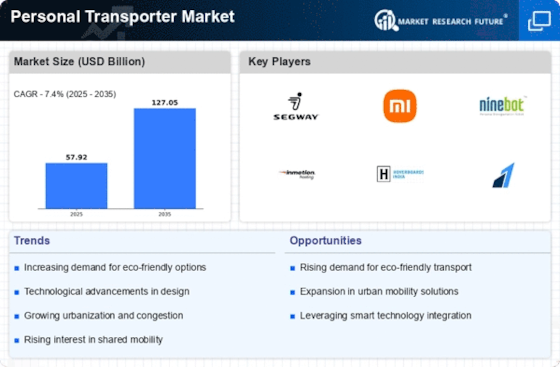
As per Market Research Future analysis, the Personal Transporter Market Size was estimated at 57.92 USD Billion in 2024. The Personal Transporter industry is projected to grow from 62.21 USD Billion in 2025 to 127.05 USD Billion by 2035, exhibiting a compound annual growth rate (CAGR) of 7.4% during the forecast period 2025 - 2035

Key Market Trends & Highlights

The Personal Transporter Market is experiencing a transformative shift towards electric and smart technologies.

  • The rise of electric personal transporters is reshaping consumer preferences in North America. Integration of smart technologies is enhancing user experience and safety in the Asia-Pacific region. E-Bikes dominate the market, while E-Scooters are emerging as the fastest-growing segment. Increasing demand for eco-friendly transport and urbanization are driving market growth across both regions.

Market Size & Forecast

2024 Market Size 57.92 (USD Billion)
2035 Market Size 127.05 (USD Billion)
CAGR (2025 - 2035) 7.4%
Largest Regional Market Share in 2024 Asia Pacific

Major Players

<a href="https://ie-en.segway.com/personal-transporter">Segway </a>(US), Xiaomi (CN), Ninebot (CN), InMotion (CN), Hoverboard (US), Razor (US), <a href="https://unagiscooters.com/scooter-articles/your-personal-liberation-device/?srsltid=AfmBOoowltVyEjmyFr5UdwcgUylLPDpVJgnaLqo-psIK872bsLLSuv2T">Unagi </a>(US), Airwheel (CN), Ecovacs (CN)

Market Trends

The Personal Transporter Market is currently experiencing a dynamic evolution, driven by a confluence of technological advancements and shifting consumer preferences. As urbanization accelerates, individuals increasingly seek efficient and eco-friendly modes of transportation. This trend is underscored by the growing awareness of environmental issues, prompting a shift towards electric and alternative energy vehicles. Furthermore, innovations in design and functionality are enhancing user experience, making personal transporters more appealing to a broader demographic. The integration of smart technologies, such as connectivity features and advanced safety systems, appears to be a pivotal factor in attracting consumers who prioritize convenience and security in their travel choices. In addition, the Personal Transporter Market is likely to witness a surge in demand for compact and portable solutions, particularly in densely populated urban areas. As cities grapple with congestion and limited parking, personal transporters offer a practical alternative to traditional vehicles. This shift may also be influenced by government initiatives promoting sustainable transport options, which could further bolster market growth. Overall, the landscape of the Personal Transporter Market is characterized by innovation, sustainability, and a growing emphasis on user-centric design, suggesting a promising future for this sector.

Rise of Electric Personal Transporters

The increasing focus on sustainability is driving the demand for electric personal transporters. These vehicles are perceived as environmentally friendly alternatives, appealing to consumers who are conscious of their carbon footprint. As battery technology improves, the range and efficiency of electric models are likely to enhance their attractiveness.

Integration of Smart Technologies

The incorporation of smart technologies into personal transporters is becoming more prevalent. Features such as GPS navigation, connectivity with mobile devices, and advanced safety systems are enhancing user experience. This trend suggests that consumers are seeking more than just basic functionality; they desire a seamless integration of technology in their travel.

Urban Mobility Solutions

As urban areas continue to expand, the need for efficient mobility solutions is growing. Personal transporters are emerging as viable options for navigating congested city environments. This trend indicates a shift in consumer behavior, with individuals increasingly opting for compact and agile transport solutions that can easily maneuver through urban landscapes.

Personal Transporter Market Market Drivers

Government Initiatives and Regulations

The Personal Transporter Market is significantly impacted by government initiatives and regulations aimed at promoting sustainable transportation. Many governments are implementing policies that encourage the use of electric and non-motorized transport options. Incentives such as tax breaks, subsidies, and infrastructure development for personal transporters are becoming increasingly common. In 2025, it is anticipated that government support will contribute to a 15% increase in the adoption of personal transporters. These initiatives not only facilitate market growth but also enhance public awareness regarding the benefits of using personal transporters. As regulatory frameworks evolve, the Personal Transporter Market is likely to see a surge in innovation and consumer adoption.

Rising Fuel Prices and Economic Factors

The Personal Transporter Market is also influenced by rising fuel prices and broader economic factors. As fuel costs continue to escalate, consumers are seeking cost-effective alternatives for their daily commutes. Personal transporters, particularly electric models, present a viable solution that can significantly reduce transportation expenses. In 2025, it is projected that the demand for personal transporters will increase by approximately 20% due to economic pressures and the need for affordable transport options. This trend suggests that consumers are becoming more price-sensitive, leading to a shift in purchasing behavior towards personal transporters. Consequently, the Personal Transporter Market is likely to benefit from these economic dynamics.

Urbanization and Changing Mobility Patterns

The Personal Transporter Market is being shaped by increasing urbanization and evolving mobility patterns. As urban areas expand, the demand for efficient and convenient transportation options rises. Personal transporters, such as e-scooters and hoverboards, offer a practical solution for navigating congested city streets. In 2025, urban areas are expected to account for over 60% of personal transporter sales, highlighting the importance of these devices in urban mobility. This trend is further supported by government initiatives promoting alternative transport modes to alleviate traffic congestion and reduce pollution. Consequently, the Personal Transporter Market is likely to thrive as cities adapt to the needs of their growing populations.

Increasing Demand for Eco-Friendly Transport

The Personal Transporter Market is experiencing a notable shift towards eco-friendly transportation solutions. As environmental concerns rise, consumers are increasingly seeking alternatives to traditional vehicles. This trend is reflected in the growing sales of electric scooters and bicycles, which have seen a surge in popularity. In 2025, the market for electric personal transporters is projected to reach approximately 10 billion USD, indicating a robust demand for sustainable options. This shift not only aligns with global sustainability goals but also encourages manufacturers to innovate and develop greener technologies. The emphasis on reducing carbon footprints is likely to drive further growth in the Personal Transporter Market, as consumers prioritize environmentally responsible choices.

Technological Advancements in Personal Transporters

The Personal Transporter Market is significantly influenced by rapid technological advancements. Innovations such as improved battery technologies, enhanced connectivity features, and smart navigation systems are transforming the landscape of personal transport. For instance, the integration of IoT devices allows for real-time tracking and monitoring, enhancing user experience. In 2025, it is estimated that smart personal transporters will account for over 30% of the market share, reflecting a growing consumer preference for high-tech solutions. These advancements not only improve the efficiency and safety of personal transporters but also attract a tech-savvy demographic, thereby expanding the market reach. As technology continues to evolve, the Personal Transporter Market is poised for substantial growth.

Market Segment Insights

By Vehicle Type: E-Bike (Largest) vs. E-Scooter (Fastest-Growing)

<p>The Personal Transporter Market showcases a dynamic distribution across various vehicle types. Among these, the E-bike segment stands out as the largest, capturing a significant share of the market through its popularity as a sustainable and efficient mode of transport. E-scooters, while relatively newer, are rapidly gaining traction and exhibiting strong market presence, appealing to urban commuters seeking convenience and affordability in personal transportation options.</p>

<p>E-Bike (Dominant) vs. E-Scooter (Emerging)</p>

<p>E-bikes are increasingly recognized as the dominant force in the Personal Transporter Market, characterized by their versatility and user-friendly design, which appeals to a wide demographic. They provide an eco-friendly alternative for commuters and recreational users alike, with features that enhance comfort and performance. On the other hand, E-scooters are emerging as a popular choice among younger consumers looking for quick and agile transport solutions primarily in urban settings. They are lightweight, easy to maneuver, and often preferred for short-distance travel, making them a compelling addition to the personal transporter category.</p>

By Product: Standing/Self-balancing (Largest) vs. Folding (Fastest-Growing)

<p>In the Personal Transporter Market, the distribution among product segments reveals a clear leader in the standing/self-balancing category, which encompasses a significant share of the total market. This segment’s popularity arises from its ease of use and efficiency in urban commutes. In contrast, the folding segment has seen increased interest as consumers look for space-saving solutions, particularly in metropolitan areas where storage constraints are common. As these types of personal transporters gain popularity, their market share continues to evolve. The growth trends within the Personal Transporter Market are shaped by various factors. The standing/self-balancing segment is driven by technological advancements and consumer demand for sustainable transportation methods. Meanwhile, the folding segment's rapid growth is influenced by the rise of compact living spaces and an increasing preference for portable solutions among urban dwellers. As awareness about environmental concerns increases, the inclination towards such innovative personal transporters is expected to strengthen further, leading to expanded market potential for both segments.</p>

<p>Standing/Self-balancing (Dominant) vs. Folding (Emerging)</p>

<p>The standing/self-balancing segment stands out as the dominant force in the Personal Transporter Market, appealing to a wide demographic of users, including commuters and recreational riders. Its design promotes a natural riding posture, enhancing comfort and control. The integration of smart technology, like automated balancing systems, has made these devices more accessible and enjoyable. Conversely, the folding segment is emerging rapidly, catering to urban consumers who require versatility without sacrificing convenience. These compact models offer the practicality of stowing away easily, making them ideal for people with limited transport space. Both segments highlight the trend towards personal mobility solutions that prioritize user-friendly features and adaptability to modern lifestyles.</p>

By Weight Capacity: 10 kg-20 kg (Largest) vs. More than 20 kg (Fastest-Growing)

<p>In the Personal Transporter Market, the weight capacity segment showcases distinct preferences among consumers. The distribution reveals that the '10 kg-20 kg' category holds the largest market share, appealing to users who seek a balance between portability and usability. This segment is favored for its versatile application in urban commuting and recreational use. In contrast, the 'Up to 10 kg' and 'More than 20 kg' categories occupy smaller niches, attracting consumers with specific needs, such as compact transport or heavy-duty capabilities, respectively.</p>

<p>Weight Capacity: 10 kg-20 kg (Dominant) vs. More than 20 kg (Emerging)</p>

<p>The '10 kg-20 kg' segment stands as the dominant force in the Personal Transporter Market, encompassing a range of products that cater to the needs of daily commuters and leisure users. This category offers a perfect balance of weight, making it highly portable while still supporting practical usage. On the other hand, the 'More than 20 kg' segment is emerging rapidly, driven by the increasing demand for powerful transport solutions capable of carrying heavier loads. This trend is particularly evident in sectors like goods delivery and equipment transport, where robust performance is essential. As technology advances, both segments are expected to evolve, enhancing user experience and expanding their market reach.</p>

By Travel Range: 20 km-35 km (Largest) vs. More than 35 km (Fastest-Growing)

<p>In the Personal Transporter Market, the travel range segment is largely dominated by the 20 km-35 km category, which holds significant market share due to its optimal blend of usability and convenience for short to medium commutes. This segment is particularly popular among urban commuters who seek efficient transportation solutions for their daily travel needs, thereby reinforcing its status in the market. Conversely, the 'More than 35 km' range is emerging as the fastest-growing segment, appealing to consumers who desire extended travel capabilities, especially for longer commutes or recreational uses. This growing interest is indicative of an evolving consumer preference for vehicles that can handle greater distances without compromising on performance or efficiency.</p>

<p>20 km-35 km (Dominant) vs. More than 35 km (Emerging)</p>

<p>The 20 km-35 km travel range is positioned as the dominant segment in the Personal Transporter Market, catering to daily commuters and those seeking an efficient balance between distance and speed. This segment is characterized by personal transporters that offer convenience and fit well within urban landscapes, making them ideal for short trips, errands, or daily commutes. On the other hand, the 'More than 35 km' segment is rapidly establishing itself as an emerging force, appealing to users requiring longer travel capabilities. This range typically encompasses advanced models equipped with improved battery life and features that enhance comfort and performance for extended journeys. Together, these segments illustrate the varied потребности of consumers as they opt for transport solutions that best align with their modern lifestyle.</p>

By Application: On-Road (Largest) vs. Off-Road (Fastest-Growing)

<p>In the Personal Transporter Market, the application segment is primarily divided into On-Road and Off-Road categories. Currently, the On-Road application dominates the market, capturing a significant share due to its extensive usage in urban commuting and logistics. This segment has been a staple in the market, supporting various personal transport needs in cities around the world.</p>

<p>On-Road: Dominant vs. Off-Road: Emerging</p>

<p>The On-Road application segment is the most established within the Personal Transporter Market, utilized mainly for commuting and services like ridesharing. It offers advantages such as convenience, efficiency, and adaptability within urban environments. Conversely, the Off-Road application segment is emerging rapidly, driven by increasing leisure activities, adventure sports, and a growing preference for outdoor experiences. This segment caters to consumers seeking utility and adventure, making it appealing for personal transport solutions in rugged and varied terrains. The expansion of recreational opportunities significantly contributes to its growth.</p>

Get more detailed insights about Global Personal Transporter Market Research Report – Forecast till 2035

Regional Insights

North America : Innovation and Adoption Leader

North America is witnessing robust growth in the personal transporter market, driven by increasing urbanization and a shift towards eco-friendly transportation solutions. The region holds approximately 40% of the global market share, making it the largest market. Regulatory support for electric vehicles and personal mobility devices further fuels demand, with cities implementing policies to promote their use. The United States and Canada are the leading countries in this market, with significant contributions from key players like Segway, Razor, and Unagi. The competitive landscape is characterized by innovation and technological advancements, with companies focusing on enhancing user experience and safety features. The presence of established brands and emerging startups creates a dynamic environment for growth.

Europe : Sustainable Mobility Focus

Europe is emerging as a significant player in the personal transporter market, driven by stringent environmental regulations and a strong push for sustainable mobility solutions. The region accounts for approximately 30% of the global market share, making it the second-largest market. Government initiatives aimed at reducing carbon emissions and promoting electric vehicles are key growth drivers, with many cities adopting policies to facilitate the use of personal transporters. Leading countries in Europe include Germany, France, and the UK, where companies like Xiaomi and InMotion are making substantial inroads. The competitive landscape is marked by a mix of established brands and innovative startups, all vying for market share. The presence of a well-developed infrastructure for electric vehicles further enhances the attractiveness of personal transporters in this region.

Asia-Pacific : Emerging Market Potential

Asia-Pacific is rapidly becoming a key player in the personal transporter market, driven by increasing urbanization and a growing middle class. The region holds approximately 25% of the global market share, with countries like China and India leading the charge. The demand for affordable and efficient personal transport solutions is on the rise, supported by government initiatives promoting electric mobility and reducing traffic congestion. China is the largest market in the region, with major players like Ninebot and Airwheel dominating the landscape. The competitive environment is characterized by aggressive pricing strategies and continuous innovation. As urban areas expand, the need for personal transporters is expected to grow, making Asia-Pacific a focal point for future investments and developments in this sector.

Middle East and Africa : Untapped Market Opportunities

The Middle East and Africa region presents significant growth potential in the personal transporter market, driven by increasing urbanization and a rising demand for alternative transportation solutions. The region currently holds about 5% of the global market share, but this is expected to grow as infrastructure improves and awareness of personal transporters increases. Government initiatives aimed at enhancing mobility and reducing traffic congestion are also contributing to market growth. Countries like South Africa and the UAE are leading the way in adopting personal transporters, with a growing presence of key players such as Ecovacs. The competitive landscape is still developing, with opportunities for both established brands and new entrants. As urban areas continue to expand, the demand for personal transporters is likely to rise, making this region an attractive market for investment.

Key Players and Competitive Insights

The Personal Transporter Market is currently characterized by a dynamic competitive landscape, driven by technological advancements and evolving consumer preferences. Key players such as Segway (US), Xiaomi (CN), and Ninebot (CN) are at the forefront, each adopting distinct strategies to enhance their market presence. Segway (US) focuses on innovation, particularly in electric scooters and personal mobility devices, while Xiaomi (CN) leverages its extensive ecosystem of smart devices to integrate personal transporters into a broader lifestyle offering. Ninebot (CN), a subsidiary of Xiaomi, emphasizes affordability and accessibility, appealing to a diverse consumer base. Collectively, these strategies contribute to a competitive environment that is increasingly centered around technological innovation and user experience. In terms of business tactics, companies are localizing manufacturing to reduce costs and enhance supply chain efficiency. This approach is particularly evident in the Personal Transporter Market, which is moderately fragmented, with several players vying for market share. The collective influence of these key players shapes a landscape where agility and responsiveness to consumer demands are paramount, fostering a competitive structure that encourages continuous improvement and adaptation. In August 2025, Segway (US) announced the launch of its latest electric scooter model, which features advanced AI capabilities for enhanced safety and navigation. This strategic move not only reinforces Segway's commitment to innovation but also positions the company to capture a larger share of the urban mobility segment, where demand for smart transport solutions is rapidly increasing. The integration of AI technology is likely to set a new standard in the industry, compelling competitors to elevate their offerings. In September 2025, Xiaomi (CN) unveiled a new line of personal transporters that seamlessly connect with its smart home ecosystem. This initiative underscores Xiaomi's strategy of creating a cohesive user experience across its product range, thereby enhancing customer loyalty and engagement. By integrating personal transporters with smart home technology, Xiaomi appears to be tapping into the growing trend of interconnected devices, which could significantly influence consumer purchasing decisions in the future. In October 2025, Ninebot (CN) announced a strategic partnership with a leading ride-sharing platform to provide electric scooters for urban commuters. This collaboration is indicative of a broader trend towards shared mobility solutions, which are gaining traction in urban areas. By aligning with a ride-sharing service, Ninebot not only expands its market reach but also positions itself as a key player in the evolving landscape of urban transportation, where convenience and sustainability are increasingly prioritized. As of October 2025, the Personal Transporter Market is witnessing trends that emphasize digitalization, sustainability, and the integration of artificial intelligence. Strategic alliances are becoming more prevalent, as companies recognize the value of collaboration in enhancing their competitive edge. Looking ahead, it is anticipated that competitive differentiation will increasingly hinge on innovation and technological advancements rather than solely on price. The focus on supply chain reliability and the ability to adapt to changing consumer preferences will likely define the future trajectory of the market.

Key Companies in the Personal Transporter Market include

Industry Developments

2021The INMOTION V12, an electric unicycle featuring a potent engine, cutting-edge suspension system, and clever connection capabilities, was introduced by INMOTION Technologies.

2020The Razor E-XR Electric Scooter was introduced by Razor. It has pneumatic tyres for a comfortable ride and an extended range capability of up to 25 kilometres

Future Outlook

Personal Transporter Market Future Outlook

The Personal Transporter Market is projected to grow at a 7.4% CAGR from 2025 to 2035, driven by urbanization, technological advancements, and sustainability initiatives.

New opportunities lie in:

  • <p>Integration of AI for route optimization in personal transporters. Development of subscription-based models for urban commuters. Expansion into emerging markets with tailored product offerings.</p>

By 2035, the market is expected to achieve substantial growth, reflecting evolving consumer preferences and technological innovations.

Market Segmentation

Personal Transporter Market Product Outlook

  • Retro
  • Standing/Self-balancing
  • Folding

Personal Transporter Market Application Outlook

  • On-Road
  • Off-Road

Personal Transporter Market Travel Range Outlook

  • Up to 20 km
  • 20 km-35km
  • More than 35 km

Personal Transporter Market Vehicle Type Outlook

  • E-bike
  • E-Scooter
  • Ehoverboard
  • E-skateboard
  • others

Personal Transporter Market Weight Capacity Outlook

  • Up to 10 kg
  • 10 kg-20kg
  • More than 20 kg

Report Scope

MARKET SIZE 2024 57.92(USD Billion)
MARKET SIZE 2025 62.21(USD Billion)
MARKET SIZE 2035 127.05(USD Billion)
COMPOUND ANNUAL GROWTH RATE (CAGR) 7.4% (2025 - 2035)
REPORT COVERAGE Revenue Forecast, Competitive Landscape, Growth Factors, and Trends
BASE YEAR 2024
Market Forecast Period 2025 - 2035
Historical Data 2019 - 2024
Market Forecast Units USD Billion
Key Companies Profiled Segway (US), Xiaomi (CN), Ninebot (CN), InMotion (CN), Hoverboard (US), Razor (US), Unagi (US), Airwheel (CN), Ecovacs (CN)
Segments Covered Vehicle Type, Product, Weight Capacity, Travel Range, Application, Region
Key Market Opportunities Integration of smart technology and sustainability drives growth in the Personal Transporter Market.
Key Market Dynamics Rising consumer preference for eco-friendly personal transporters drives innovation and competition in the market.
Countries Covered North America, Europe, APAC, South America, MEA

FAQs

What is the current valuation of the Personal Transporter Market?

<p>The Personal Transporter Market was valued at 57.92 USD Billion in 2024.</p>

What is the projected market size for the Personal Transporter Market by 2035?

<p>The market is expected to reach 127.05 USD Billion by 2035.</p>

What is the expected CAGR for the Personal Transporter Market during the forecast period?

<p>The expected CAGR for the Personal Transporter Market from 2025 to 2035 is 7.4%.</p>

Which segments are included in the Personal Transporter Market?

<p>The market includes segments such as E-bikes, E-scooters, E-hoverboards, E-skateboards, and others.</p>

What is the valuation range for E-scooters in the Personal Transporter Market?

<p>E-scooters are projected to have a valuation range of 15.0 to 35.0 USD Billion.</p>

How does the weight capacity segment perform in the Personal Transporter Market?

The weight capacity segment ranges from 10.0 to 22.0 USD Billion for up to 10 kg and 27.92 to 65.05 USD Billion for more than 20 kg.

What are the projected valuations for the standing/self-balancing product segment?

The standing/self-balancing product segment is expected to range from 25.0 to 55.0 USD Billion.

Which companies are considered key players in the Personal Transporter Market?

Key players include Segway, Xiaomi, Ninebot, InMotion, Hoverboard, Razor, Unagi, Airwheel, and Ecovacs.

What is the expected performance of the on-road application segment?

The on-road application segment is projected to range from 30.0 to 65.0 USD Billion.

What travel range segments are present in the Personal Transporter Market?

Travel range segments include up to 20 km, 20 km-35 km, and more than 35 km, with valuations of 20.0 to 40.0 USD Billion for up to 20 km.

  1. SECTION I: EXECUTIVE SUMMARY AND KEY HIGHLIGHTS
    1. | 1.1 EXECUTIVE SUMMARY
    2. | | 1.1.1 Market Overview
    3. | | 1.1.2 Key Findings
    4. | | 1.1.3 Market Segmentation
    5. | | 1.1.4 Competitive Landscape
    6. | | 1.1.5 Challenges and Opportunities
    7. | | 1.1.6 Future Outlook
  2. SECTION II: SCOPING, METHODOLOGY AND MARKET STRUCTURE
    1. | 2.1 MARKET INTRODUCTION
    2. | | 2.1.1 Definition
    3. | | 2.1.2 Scope of the study
    4. | | | 2.1.2.1 Research Objective
    5. | | | 2.1.2.2 Assumption
    6. | | | 2.1.2.3 Limitations
    7. | 2.2 RESEARCH METHODOLOGY
    8. | | 2.2.1 Overview
    9. | | 2.2.2 Data Mining
    10. | | 2.2.3 Secondary Research
    11. | | 2.2.4 Primary Research
    12. | | | 2.2.4.1 Primary Interviews and Information Gathering Process
    13. | | | 2.2.4.2 Breakdown of Primary Respondents
    14. | | 2.2.5 Forecasting Model
    15. | | 2.2.6 Market Size Estimation
    16. | | | 2.2.6.1 Bottom-Up Approach
    17. | | | 2.2.6.2 Top-Down Approach
    18. | | 2.2.7 Data Triangulation
    19. | | 2.2.8 Validation
  3. SECTION III: QUALITATIVE ANALYSIS
    1. | 3.1 MARKET DYNAMICS
    2. | | 3.1.1 Overview
    3. | | 3.1.2 Drivers
    4. | | 3.1.3 Restraints
    5. | | 3.1.4 Opportunities
    6. | 3.2 MARKET FACTOR ANALYSIS
    7. | | 3.2.1 Value chain Analysis
    8. | | 3.2.2 Porter's Five Forces Analysis
    9. | | | 3.2.2.1 Bargaining Power of Suppliers
    10. | | | 3.2.2.2 Bargaining Power of Buyers
    11. | | | 3.2.2.3 Threat of New Entrants
    12. | | | 3.2.2.4 Threat of Substitutes
    13. | | | 3.2.2.5 Intensity of Rivalry
    14. | | 3.2.3 COVID-19 Impact Analysis
    15. | | | 3.2.3.1 Market Impact Analysis
    16. | | | 3.2.3.2 Regional Impact
    17. | | | 3.2.3.3 Opportunity and Threat Analysis
  4. SECTION IV: QUANTITATIVE ANALYSIS
    1. | 4.1 Life Sciences, BY Vehicle Type (USD Billion)
    2. | | 4.1.1 E-bike
    3. | | 4.1.2 E-Scooter
    4. | | 4.1.3 Ehoverboard
    5. | | 4.1.4 E-skateboard
    6. | | 4.1.5 others
    7. | 4.2 Life Sciences, BY Product (USD Billion)
    8. | | 4.2.1 Retro
    9. | | 4.2.2 Standing/Self-balancing
    10. | | 4.2.3 Folding
    11. | 4.3 Life Sciences, BY Weight Capacity (USD Billion)
    12. | | 4.3.1 Up to 10 kg
    13. | | 4.3.2 10 kg-20kg
    14. | | 4.3.3 More than 20 kg
    15. | 4.4 Life Sciences, BY Travel Range (USD Billion)
    16. | | 4.4.1 Up to 20 km
    17. | | 4.4.2 20 km-35km
    18. | | 4.4.3 More than 35 km
    19. | 4.5 Life Sciences, BY Application (USD Billion)
    20. | | 4.5.1 On-Road
    21. | | 4.5.2 Off-Road
    22. | 4.6 Life Sciences, BY Region (USD Billion)
    23. | | 4.6.1 North America
    24. | | | 4.6.1.1 US
    25. | | | 4.6.1.2 Canada
    26. | | 4.6.2 Europe
    27. | | | 4.6.2.1 Germany
    28. | | | 4.6.2.2 UK
    29. | | | 4.6.2.3 France
    30. | | | 4.6.2.4 Russia
    31. | | | 4.6.2.5 Italy
    32. | | | 4.6.2.6 Spain
    33. | | | 4.6.2.7 Rest of Europe
    34. | | 4.6.3 APAC
    35. | | | 4.6.3.1 China
    36. | | | 4.6.3.2 India
    37. | | | 4.6.3.3 Japan
    38. | | | 4.6.3.4 South Korea
    39. | | | 4.6.3.5 Malaysia
    40. | | | 4.6.3.6 Thailand
    41. | | | 4.6.3.7 Indonesia
    42. | | | 4.6.3.8 Rest of APAC
    43. | | 4.6.4 South America
    44. | | | 4.6.4.1 Brazil
    45. | | | 4.6.4.2 Mexico
    46. | | | 4.6.4.3 Argentina
    47. | | | 4.6.4.4 Rest of South America
    48. | | 4.6.5 MEA
    49. | | | 4.6.5.1 GCC Countries
    50. | | | 4.6.5.2 South Africa
    51. | | | 4.6.5.3 Rest of MEA
  5. SECTION V: COMPETITIVE ANALYSIS
    1. | 5.1 Competitive Landscape
    2. | | 5.1.1 Overview
    3. | | 5.1.2 Competitive Analysis
    4. | | 5.1.3 Market share Analysis
    5. | | 5.1.4 Major Growth Strategy in the Life Sciences
    6. | | 5.1.5 Competitive Benchmarking
    7. | | 5.1.6 Leading Players in Terms of Number of Developments in the Life Sciences
    8. | | 5.1.7 Key developments and growth strategies
    9. | | | 5.1.7.1 New Product Launch/Service Deployment
    10. | | | 5.1.7.2 Merger & Acquisitions
    11. | | | 5.1.7.3 Joint Ventures
    12. | | 5.1.8 Major Players Financial Matrix
    13. | | | 5.1.8.1 Sales and Operating Income
    14. | | | 5.1.8.2 Major Players R&D Expenditure. 2023
    15. | 5.2 Company Profiles
    16. | | 5.2.1 Segway (US)
    17. | | | 5.2.1.1 Financial Overview
    18. | | | 5.2.1.2 Products Offered
    19. | | | 5.2.1.3 Key Developments
    20. | | | 5.2.1.4 SWOT Analysis
    21. | | | 5.2.1.5 Key Strategies
    22. | | 5.2.2 Xiaomi (CN)
    23. | | | 5.2.2.1 Financial Overview
    24. | | | 5.2.2.2 Products Offered
    25. | | | 5.2.2.3 Key Developments
    26. | | | 5.2.2.4 SWOT Analysis
    27. | | | 5.2.2.5 Key Strategies
    28. | | 5.2.3 Ninebot (CN)
    29. | | | 5.2.3.1 Financial Overview
    30. | | | 5.2.3.2 Products Offered
    31. | | | 5.2.3.3 Key Developments
    32. | | | 5.2.3.4 SWOT Analysis
    33. | | | 5.2.3.5 Key Strategies
    34. | | 5.2.4 InMotion (CN)
    35. | | | 5.2.4.1 Financial Overview
    36. | | | 5.2.4.2 Products Offered
    37. | | | 5.2.4.3 Key Developments
    38. | | | 5.2.4.4 SWOT Analysis
    39. | | | 5.2.4.5 Key Strategies
    40. | | 5.2.5 Hoverboard (US)
    41. | | | 5.2.5.1 Financial Overview
    42. | | | 5.2.5.2 Products Offered
    43. | | | 5.2.5.3 Key Developments
    44. | | | 5.2.5.4 SWOT Analysis
    45. | | | 5.2.5.5 Key Strategies
    46. | | 5.2.6 Razor (US)
    47. | | | 5.2.6.1 Financial Overview
    48. | | | 5.2.6.2 Products Offered
    49. | | | 5.2.6.3 Key Developments
    50. | | | 5.2.6.4 SWOT Analysis
    51. | | | 5.2.6.5 Key Strategies
    52. | | 5.2.7 Unagi (US)
    53. | | | 5.2.7.1 Financial Overview
    54. | | | 5.2.7.2 Products Offered
    55. | | | 5.2.7.3 Key Developments
    56. | | | 5.2.7.4 SWOT Analysis
    57. | | | 5.2.7.5 Key Strategies
    58. | | 5.2.8 Airwheel (CN)
    59. | | | 5.2.8.1 Financial Overview
    60. | | | 5.2.8.2 Products Offered
    61. | | | 5.2.8.3 Key Developments
    62. | | | 5.2.8.4 SWOT Analysis
    63. | | | 5.2.8.5 Key Strategies
    64. | | 5.2.9 Ecovacs (CN)
    65. | | | 5.2.9.1 Financial Overview
    66. | | | 5.2.9.2 Products Offered
    67. | | | 5.2.9.3 Key Developments
    68. | | | 5.2.9.4 SWOT Analysis
    69. | | | 5.2.9.5 Key Strategies
    70. | 5.3 Appendix
    71. | | 5.3.1 References
    72. | | 5.3.2 Related Reports
  6. LIST OF FIGURES
    1. | 6.1 MARKET SYNOPSIS
    2. | 6.2 NORTH AMERICA MARKET ANALYSIS
    3. | 6.3 US MARKET ANALYSIS BY VEHICLE TYPE
    4. | 6.4 US MARKET ANALYSIS BY PRODUCT
    5. | 6.5 US MARKET ANALYSIS BY WEIGHT CAPACITY
    6. | 6.6 US MARKET ANALYSIS BY TRAVEL RANGE
    7. | 6.7 US MARKET ANALYSIS BY APPLICATION
    8. | 6.8 CANADA MARKET ANALYSIS BY VEHICLE TYPE
    9. | 6.9 CANADA MARKET ANALYSIS BY PRODUCT
    10. | 6.10 CANADA MARKET ANALYSIS BY WEIGHT CAPACITY
    11. | 6.11 CANADA MARKET ANALYSIS BY TRAVEL RANGE
    12. | 6.12 CANADA MARKET ANALYSIS BY APPLICATION
    13. | 6.13 EUROPE MARKET ANALYSIS
    14. | 6.14 GERMANY MARKET ANALYSIS BY VEHICLE TYPE
    15. | 6.15 GERMANY MARKET ANALYSIS BY PRODUCT
    16. | 6.16 GERMANY MARKET ANALYSIS BY WEIGHT CAPACITY
    17. | 6.17 GERMANY MARKET ANALYSIS BY TRAVEL RANGE
    18. | 6.18 GERMANY MARKET ANALYSIS BY APPLICATION
    19. | 6.19 UK MARKET ANALYSIS BY VEHICLE TYPE
    20. | 6.20 UK MARKET ANALYSIS BY PRODUCT
    21. | 6.21 UK MARKET ANALYSIS BY WEIGHT CAPACITY
    22. | 6.22 UK MARKET ANALYSIS BY TRAVEL RANGE
    23. | 6.23 UK MARKET ANALYSIS BY APPLICATION
    24. | 6.24 FRANCE MARKET ANALYSIS BY VEHICLE TYPE
    25. | 6.25 FRANCE MARKET ANALYSIS BY PRODUCT
    26. | 6.26 FRANCE MARKET ANALYSIS BY WEIGHT CAPACITY
    27. | 6.27 FRANCE MARKET ANALYSIS BY TRAVEL RANGE
    28. | 6.28 FRANCE MARKET ANALYSIS BY APPLICATION
    29. | 6.29 RUSSIA MARKET ANALYSIS BY VEHICLE TYPE
    30. | 6.30 RUSSIA MARKET ANALYSIS BY PRODUCT
    31. | 6.31 RUSSIA MARKET ANALYSIS BY WEIGHT CAPACITY
    32. | 6.32 RUSSIA MARKET ANALYSIS BY TRAVEL RANGE
    33. | 6.33 RUSSIA MARKET ANALYSIS BY APPLICATION
    34. | 6.34 ITALY MARKET ANALYSIS BY VEHICLE TYPE
    35. | 6.35 ITALY MARKET ANALYSIS BY PRODUCT
    36. | 6.36 ITALY MARKET ANALYSIS BY WEIGHT CAPACITY
    37. | 6.37 ITALY MARKET ANALYSIS BY TRAVEL RANGE
    38. | 6.38 ITALY MARKET ANALYSIS BY APPLICATION
    39. | 6.39 SPAIN MARKET ANALYSIS BY VEHICLE TYPE
    40. | 6.40 SPAIN MARKET ANALYSIS BY PRODUCT
    41. | 6.41 SPAIN MARKET ANALYSIS BY WEIGHT CAPACITY
    42. | 6.42 SPAIN MARKET ANALYSIS BY TRAVEL RANGE
    43. | 6.43 SPAIN MARKET ANALYSIS BY APPLICATION
    44. | 6.44 REST OF EUROPE MARKET ANALYSIS BY VEHICLE TYPE
    45. | 6.45 REST OF EUROPE MARKET ANALYSIS BY PRODUCT
    46. | 6.46 REST OF EUROPE MARKET ANALYSIS BY WEIGHT CAPACITY
    47. | 6.47 REST OF EUROPE MARKET ANALYSIS BY TRAVEL RANGE
    48. | 6.48 REST OF EUROPE MARKET ANALYSIS BY APPLICATION
    49. | 6.49 APAC MARKET ANALYSIS
    50. | 6.50 CHINA MARKET ANALYSIS BY VEHICLE TYPE
    51. | 6.51 CHINA MARKET ANALYSIS BY PRODUCT
    52. | 6.52 CHINA MARKET ANALYSIS BY WEIGHT CAPACITY
    53. | 6.53 CHINA MARKET ANALYSIS BY TRAVEL RANGE
    54. | 6.54 CHINA MARKET ANALYSIS BY APPLICATION
    55. | 6.55 INDIA MARKET ANALYSIS BY VEHICLE TYPE
    56. | 6.56 INDIA MARKET ANALYSIS BY PRODUCT
    57. | 6.57 INDIA MARKET ANALYSIS BY WEIGHT CAPACITY
    58. | 6.58 INDIA MARKET ANALYSIS BY TRAVEL RANGE
    59. | 6.59 INDIA MARKET ANALYSIS BY APPLICATION
    60. | 6.60 JAPAN MARKET ANALYSIS BY VEHICLE TYPE
    61. | 6.61 JAPAN MARKET ANALYSIS BY PRODUCT
    62. | 6.62 JAPAN MARKET ANALYSIS BY WEIGHT CAPACITY
    63. | 6.63 JAPAN MARKET ANALYSIS BY TRAVEL RANGE
    64. | 6.64 JAPAN MARKET ANALYSIS BY APPLICATION
    65. | 6.65 SOUTH KOREA MARKET ANALYSIS BY VEHICLE TYPE
    66. | 6.66 SOUTH KOREA MARKET ANALYSIS BY PRODUCT
    67. | 6.67 SOUTH KOREA MARKET ANALYSIS BY WEIGHT CAPACITY
    68. | 6.68 SOUTH KOREA MARKET ANALYSIS BY TRAVEL RANGE
    69. | 6.69 SOUTH KOREA MARKET ANALYSIS BY APPLICATION
    70. | 6.70 MALAYSIA MARKET ANALYSIS BY VEHICLE TYPE
    71. | 6.71 MALAYSIA MARKET ANALYSIS BY PRODUCT
    72. | 6.72 MALAYSIA MARKET ANALYSIS BY WEIGHT CAPACITY
    73. | 6.73 MALAYSIA MARKET ANALYSIS BY TRAVEL RANGE
    74. | 6.74 MALAYSIA MARKET ANALYSIS BY APPLICATION
    75. | 6.75 THAILAND MARKET ANALYSIS BY VEHICLE TYPE
    76. | 6.76 THAILAND MARKET ANALYSIS BY PRODUCT
    77. | 6.77 THAILAND MARKET ANALYSIS BY WEIGHT CAPACITY
    78. | 6.78 THAILAND MARKET ANALYSIS BY TRAVEL RANGE
    79. | 6.79 THAILAND MARKET ANALYSIS BY APPLICATION
    80. | 6.80 INDONESIA MARKET ANALYSIS BY VEHICLE TYPE
    81. | 6.81 INDONESIA MARKET ANALYSIS BY PRODUCT
    82. | 6.82 INDONESIA MARKET ANALYSIS BY WEIGHT CAPACITY
    83. | 6.83 INDONESIA MARKET ANALYSIS BY TRAVEL RANGE
    84. | 6.84 INDONESIA MARKET ANALYSIS BY APPLICATION
    85. | 6.85 REST OF APAC MARKET ANALYSIS BY VEHICLE TYPE
    86. | 6.86 REST OF APAC MARKET ANALYSIS BY PRODUCT
    87. | 6.87 REST OF APAC MARKET ANALYSIS BY WEIGHT CAPACITY
    88. | 6.88 REST OF APAC MARKET ANALYSIS BY TRAVEL RANGE
    89. | 6.89 REST OF APAC MARKET ANALYSIS BY APPLICATION
    90. | 6.90 SOUTH AMERICA MARKET ANALYSIS
    91. | 6.91 BRAZIL MARKET ANALYSIS BY VEHICLE TYPE
    92. | 6.92 BRAZIL MARKET ANALYSIS BY PRODUCT
    93. | 6.93 BRAZIL MARKET ANALYSIS BY WEIGHT CAPACITY
    94. | 6.94 BRAZIL MARKET ANALYSIS BY TRAVEL RANGE
    95. | 6.95 BRAZIL MARKET ANALYSIS BY APPLICATION
    96. | 6.96 MEXICO MARKET ANALYSIS BY VEHICLE TYPE
    97. | 6.97 MEXICO MARKET ANALYSIS BY PRODUCT
    98. | 6.98 MEXICO MARKET ANALYSIS BY WEIGHT CAPACITY
    99. | 6.99 MEXICO MARKET ANALYSIS BY TRAVEL RANGE
    100. | 6.100 MEXICO MARKET ANALYSIS BY APPLICATION
    101. | 6.101 ARGENTINA MARKET ANALYSIS BY VEHICLE TYPE
    102. | 6.102 ARGENTINA MARKET ANALYSIS BY PRODUCT
    103. | 6.103 ARGENTINA MARKET ANALYSIS BY WEIGHT CAPACITY
    104. | 6.104 ARGENTINA MARKET ANALYSIS BY TRAVEL RANGE
    105. | 6.105 ARGENTINA MARKET ANALYSIS BY APPLICATION
    106. | 6.106 REST OF SOUTH AMERICA MARKET ANALYSIS BY VEHICLE TYPE
    107. | 6.107 REST OF SOUTH AMERICA MARKET ANALYSIS BY PRODUCT
    108. | 6.108 REST OF SOUTH AMERICA MARKET ANALYSIS BY WEIGHT CAPACITY
    109. | 6.109 REST OF SOUTH AMERICA MARKET ANALYSIS BY TRAVEL RANGE
    110. | 6.110 REST OF SOUTH AMERICA MARKET ANALYSIS BY APPLICATION
    111. | 6.111 MEA MARKET ANALYSIS
    112. | 6.112 GCC COUNTRIES MARKET ANALYSIS BY VEHICLE TYPE
    113. | 6.113 GCC COUNTRIES MARKET ANALYSIS BY PRODUCT
    114. | 6.114 GCC COUNTRIES MARKET ANALYSIS BY WEIGHT CAPACITY
    115. | 6.115 GCC COUNTRIES MARKET ANALYSIS BY TRAVEL RANGE
    116. | 6.116 GCC COUNTRIES MARKET ANALYSIS BY APPLICATION
    117. | 6.117 SOUTH AFRICA MARKET ANALYSIS BY VEHICLE TYPE
    118. | 6.118 SOUTH AFRICA MARKET ANALYSIS BY PRODUCT
    119. | 6.119 SOUTH AFRICA MARKET ANALYSIS BY WEIGHT CAPACITY
    120. | 6.120 SOUTH AFRICA MARKET ANALYSIS BY TRAVEL RANGE
    121. | 6.121 SOUTH AFRICA MARKET ANALYSIS BY APPLICATION
    122. | 6.122 REST OF MEA MARKET ANALYSIS BY VEHICLE TYPE
    123. | 6.123 REST OF MEA MARKET ANALYSIS BY PRODUCT
    124. | 6.124 REST OF MEA MARKET ANALYSIS BY WEIGHT CAPACITY
    125. | 6.125 REST OF MEA MARKET ANALYSIS BY TRAVEL RANGE
    126. | 6.126 REST OF MEA MARKET ANALYSIS BY APPLICATION
    127. | 6.127 KEY BUYING CRITERIA OF LIFE SCIENCES
    128. | 6.128 RESEARCH PROCESS OF MRFR
    129. | 6.129 DRO ANALYSIS OF LIFE SCIENCES
    130. | 6.130 DRIVERS IMPACT ANALYSIS: LIFE SCIENCES
    131. | 6.131 RESTRAINTS IMPACT ANALYSIS: LIFE SCIENCES
    132. | 6.132 SUPPLY / VALUE CHAIN: LIFE SCIENCES
    133. | 6.133 LIFE SCIENCES, BY VEHICLE TYPE, 2024 (% SHARE)
    134. | 6.134 LIFE SCIENCES, BY VEHICLE TYPE, 2024 TO 2035 (USD Billion)
    135. | 6.135 LIFE SCIENCES, BY PRODUCT, 2024 (% SHARE)
    136. | 6.136 LIFE SCIENCES, BY PRODUCT, 2024 TO 2035 (USD Billion)
    137. | 6.137 LIFE SCIENCES, BY WEIGHT CAPACITY, 2024 (% SHARE)
    138. | 6.138 LIFE SCIENCES, BY WEIGHT CAPACITY, 2024 TO 2035 (USD Billion)
    139. | 6.139 LIFE SCIENCES, BY TRAVEL RANGE, 2024 (% SHARE)
    140. | 6.140 LIFE SCIENCES, BY TRAVEL RANGE, 2024 TO 2035 (USD Billion)
    141. | 6.141 LIFE SCIENCES, BY APPLICATION, 2024 (% SHARE)
    142. | 6.142 LIFE SCIENCES, BY APPLICATION, 2024 TO 2035 (USD Billion)
    143. | 6.143 BENCHMARKING OF MAJOR COMPETITORS
  7. LIST OF TABLES
    1. | 7.1 LIST OF ASSUMPTIONS
    2. | | 7.1.1
    3. | 7.2 North America MARKET SIZE ESTIMATES; FORECAST
    4. | | 7.2.1 BY VEHICLE TYPE, 2025-2035 (USD Billion)
    5. | | 7.2.2 BY PRODUCT, 2025-2035 (USD Billion)
    6. | | 7.2.3 BY WEIGHT CAPACITY, 2025-2035 (USD Billion)
    7. | | 7.2.4 BY TRAVEL RANGE, 2025-2035 (USD Billion)
    8. | | 7.2.5 BY APPLICATION, 2025-2035 (USD Billion)
    9. | 7.3 US MARKET SIZE ESTIMATES; FORECAST
    10. | | 7.3.1 BY VEHICLE TYPE, 2025-2035 (USD Billion)
    11. | | 7.3.2 BY PRODUCT, 2025-2035 (USD Billion)
    12. | | 7.3.3 BY WEIGHT CAPACITY, 2025-2035 (USD Billion)
    13. | | 7.3.4 BY TRAVEL RANGE, 2025-2035 (USD Billion)
    14. | | 7.3.5 BY APPLICATION, 2025-2035 (USD Billion)
    15. | 7.4 Canada MARKET SIZE ESTIMATES; FORECAST
    16. | | 7.4.1 BY VEHICLE TYPE, 2025-2035 (USD Billion)
    17. | | 7.4.2 BY PRODUCT, 2025-2035 (USD Billion)
    18. | | 7.4.3 BY WEIGHT CAPACITY, 2025-2035 (USD Billion)
    19. | | 7.4.4 BY TRAVEL RANGE, 2025-2035 (USD Billion)
    20. | | 7.4.5 BY APPLICATION, 2025-2035 (USD Billion)
    21. | 7.5 Europe MARKET SIZE ESTIMATES; FORECAST
    22. | | 7.5.1 BY VEHICLE TYPE, 2025-2035 (USD Billion)
    23. | | 7.5.2 BY PRODUCT, 2025-2035 (USD Billion)
    24. | | 7.5.3 BY WEIGHT CAPACITY, 2025-2035 (USD Billion)
    25. | | 7.5.4 BY TRAVEL RANGE, 2025-2035 (USD Billion)
    26. | | 7.5.5 BY APPLICATION, 2025-2035 (USD Billion)
    27. | 7.6 Germany MARKET SIZE ESTIMATES; FORECAST
    28. | | 7.6.1 BY VEHICLE TYPE, 2025-2035 (USD Billion)
    29. | | 7.6.2 BY PRODUCT, 2025-2035 (USD Billion)
    30. | | 7.6.3 BY WEIGHT CAPACITY, 2025-2035 (USD Billion)
    31. | | 7.6.4 BY TRAVEL RANGE, 2025-2035 (USD Billion)
    32. | | 7.6.5 BY APPLICATION, 2025-2035 (USD Billion)
    33. | 7.7 UK MARKET SIZE ESTIMATES; FORECAST
    34. | | 7.7.1 BY VEHICLE TYPE, 2025-2035 (USD Billion)
    35. | | 7.7.2 BY PRODUCT, 2025-2035 (USD Billion)
    36. | | 7.7.3 BY WEIGHT CAPACITY, 2025-2035 (USD Billion)
    37. | | 7.7.4 BY TRAVEL RANGE, 2025-2035 (USD Billion)
    38. | | 7.7.5 BY APPLICATION, 2025-2035 (USD Billion)
    39. | 7.8 France MARKET SIZE ESTIMATES; FORECAST
    40. | | 7.8.1 BY VEHICLE TYPE, 2025-2035 (USD Billion)
    41. | | 7.8.2 BY PRODUCT, 2025-2035 (USD Billion)
    42. | | 7.8.3 BY WEIGHT CAPACITY, 2025-2035 (USD Billion)
    43. | | 7.8.4 BY TRAVEL RANGE, 2025-2035 (USD Billion)
    44. | | 7.8.5 BY APPLICATION, 2025-2035 (USD Billion)
    45. | 7.9 Russia MARKET SIZE ESTIMATES; FORECAST
    46. | | 7.9.1 BY VEHICLE TYPE, 2025-2035 (USD Billion)
    47. | | 7.9.2 BY PRODUCT, 2025-2035 (USD Billion)
    48. | | 7.9.3 BY WEIGHT CAPACITY, 2025-2035 (USD Billion)
    49. | | 7.9.4 BY TRAVEL RANGE, 2025-2035 (USD Billion)
    50. | | 7.9.5 BY APPLICATION, 2025-2035 (USD Billion)
    51. | 7.10 Italy MARKET SIZE ESTIMATES; FORECAST
    52. | | 7.10.1 BY VEHICLE TYPE, 2025-2035 (USD Billion)
    53. | | 7.10.2 BY PRODUCT, 2025-2035 (USD Billion)
    54. | | 7.10.3 BY WEIGHT CAPACITY, 2025-2035 (USD Billion)
    55. | | 7.10.4 BY TRAVEL RANGE, 2025-2035 (USD Billion)
    56. | | 7.10.5 BY APPLICATION, 2025-2035 (USD Billion)
    57. | 7.11 Spain MARKET SIZE ESTIMATES; FORECAST
    58. | | 7.11.1 BY VEHICLE TYPE, 2025-2035 (USD Billion)
    59. | | 7.11.2 BY PRODUCT, 2025-2035 (USD Billion)
    60. | | 7.11.3 BY WEIGHT CAPACITY, 2025-2035 (USD Billion)
    61. | | 7.11.4 BY TRAVEL RANGE, 2025-2035 (USD Billion)
    62. | | 7.11.5 BY APPLICATION, 2025-2035 (USD Billion)
    63. | 7.12 Rest of Europe MARKET SIZE ESTIMATES; FORECAST
    64. | | 7.12.1 BY VEHICLE TYPE, 2025-2035 (USD Billion)
    65. | | 7.12.2 BY PRODUCT, 2025-2035 (USD Billion)
    66. | | 7.12.3 BY WEIGHT CAPACITY, 2025-2035 (USD Billion)
    67. | | 7.12.4 BY TRAVEL RANGE, 2025-2035 (USD Billion)
    68. | | 7.12.5 BY APPLICATION, 2025-2035 (USD Billion)
    69. | 7.13 APAC MARKET SIZE ESTIMATES; FORECAST
    70. | | 7.13.1 BY VEHICLE TYPE, 2025-2035 (USD Billion)
    71. | | 7.13.2 BY PRODUCT, 2025-2035 (USD Billion)
    72. | | 7.13.3 BY WEIGHT CAPACITY, 2025-2035 (USD Billion)
    73. | | 7.13.4 BY TRAVEL RANGE, 2025-2035 (USD Billion)
    74. | | 7.13.5 BY APPLICATION, 2025-2035 (USD Billion)
    75. | 7.14 China MARKET SIZE ESTIMATES; FORECAST
    76. | | 7.14.1 BY VEHICLE TYPE, 2025-2035 (USD Billion)
    77. | | 7.14.2 BY PRODUCT, 2025-2035 (USD Billion)
    78. | | 7.14.3 BY WEIGHT CAPACITY, 2025-2035 (USD Billion)
    79. | | 7.14.4 BY TRAVEL RANGE, 2025-2035 (USD Billion)
    80. | | 7.14.5 BY APPLICATION, 2025-2035 (USD Billion)
    81. | 7.15 India MARKET SIZE ESTIMATES; FORECAST
    82. | | 7.15.1 BY VEHICLE TYPE, 2025-2035 (USD Billion)
    83. | | 7.15.2 BY PRODUCT, 2025-2035 (USD Billion)
    84. | | 7.15.3 BY WEIGHT CAPACITY, 2025-2035 (USD Billion)
    85. | | 7.15.4 BY TRAVEL RANGE, 2025-2035 (USD Billion)
    86. | | 7.15.5 BY APPLICATION, 2025-2035 (USD Billion)
    87. | 7.16 Japan MARKET SIZE ESTIMATES; FORECAST
    88. | | 7.16.1 BY VEHICLE TYPE, 2025-2035 (USD Billion)
    89. | | 7.16.2 BY PRODUCT, 2025-2035 (USD Billion)
    90. | | 7.16.3 BY WEIGHT CAPACITY, 2025-2035 (USD Billion)
    91. | | 7.16.4 BY TRAVEL RANGE, 2025-2035 (USD Billion)
    92. | | 7.16.5 BY APPLICATION, 2025-2035 (USD Billion)
    93. | 7.17 South Korea MARKET SIZE ESTIMATES; FORECAST
    94. | | 7.17.1 BY VEHICLE TYPE, 2025-2035 (USD Billion)
    95. | | 7.17.2 BY PRODUCT, 2025-2035 (USD Billion)
    96. | | 7.17.3 BY WEIGHT CAPACITY, 2025-2035 (USD Billion)
    97. | | 7.17.4 BY TRAVEL RANGE, 2025-2035 (USD Billion)
    98. | | 7.17.5 BY APPLICATION, 2025-2035 (USD Billion)
    99. | 7.18 Malaysia MARKET SIZE ESTIMATES; FORECAST
    100. | | 7.18.1 BY VEHICLE TYPE, 2025-2035 (USD Billion)
    101. | | 7.18.2 BY PRODUCT, 2025-2035 (USD Billion)
    102. | | 7.18.3 BY WEIGHT CAPACITY, 2025-2035 (USD Billion)
    103. | | 7.18.4 BY TRAVEL RANGE, 2025-2035 (USD Billion)
    104. | | 7.18.5 BY APPLICATION, 2025-2035 (USD Billion)
    105. | 7.19 Thailand MARKET SIZE ESTIMATES; FORECAST
    106. | | 7.19.1 BY VEHICLE TYPE, 2025-2035 (USD Billion)
    107. | | 7.19.2 BY PRODUCT, 2025-2035 (USD Billion)
    108. | | 7.19.3 BY WEIGHT CAPACITY, 2025-2035 (USD Billion)
    109. | | 7.19.4 BY TRAVEL RANGE, 2025-2035 (USD Billion)
    110. | | 7.19.5 BY APPLICATION, 2025-2035 (USD Billion)
    111. | 7.20 Indonesia MARKET SIZE ESTIMATES; FORECAST
    112. | | 7.20.1 BY VEHICLE TYPE, 2025-2035 (USD Billion)
    113. | | 7.20.2 BY PRODUCT, 2025-2035 (USD Billion)
    114. | | 7.20.3 BY WEIGHT CAPACITY, 2025-2035 (USD Billion)
    115. | | 7.20.4 BY TRAVEL RANGE, 2025-2035 (USD Billion)
    116. | | 7.20.5 BY APPLICATION, 2025-2035 (USD Billion)
    117. | 7.21 Rest of APAC MARKET SIZE ESTIMATES; FORECAST
    118. | | 7.21.1 BY VEHICLE TYPE, 2025-2035 (USD Billion)
    119. | | 7.21.2 BY PRODUCT, 2025-2035 (USD Billion)
    120. | | 7.21.3 BY WEIGHT CAPACITY, 2025-2035 (USD Billion)
    121. | | 7.21.4 BY TRAVEL RANGE, 2025-2035 (USD Billion)
    122. | | 7.21.5 BY APPLICATION, 2025-2035 (USD Billion)
    123. | 7.22 South America MARKET SIZE ESTIMATES; FORECAST
    124. | | 7.22.1 BY VEHICLE TYPE, 2025-2035 (USD Billion)
    125. | | 7.22.2 BY PRODUCT, 2025-2035 (USD Billion)
    126. | | 7.22.3 BY WEIGHT CAPACITY, 2025-2035 (USD Billion)
    127. | | 7.22.4 BY TRAVEL RANGE, 2025-2035 (USD Billion)
    128. | | 7.22.5 BY APPLICATION, 2025-2035 (USD Billion)
    129. | 7.23 Brazil MARKET SIZE ESTIMATES; FORECAST
    130. | | 7.23.1 BY VEHICLE TYPE, 2025-2035 (USD Billion)
    131. | | 7.23.2 BY PRODUCT, 2025-2035 (USD Billion)
    132. | | 7.23.3 BY WEIGHT CAPACITY, 2025-2035 (USD Billion)
    133. | | 7.23.4 BY TRAVEL RANGE, 2025-2035 (USD Billion)
    134. | | 7.23.5 BY APPLICATION, 2025-2035 (USD Billion)
    135. | 7.24 Mexico MARKET SIZE ESTIMATES; FORECAST
    136. | | 7.24.1 BY VEHICLE TYPE, 2025-2035 (USD Billion)
    137. | | 7.24.2 BY PRODUCT, 2025-2035 (USD Billion)
    138. | | 7.24.3 BY WEIGHT CAPACITY, 2025-2035 (USD Billion)
    139. | | 7.24.4 BY TRAVEL RANGE, 2025-2035 (USD Billion)
    140. | | 7.24.5 BY APPLICATION, 2025-2035 (USD Billion)
    141. | 7.25 Argentina MARKET SIZE ESTIMATES; FORECAST
    142. | | 7.25.1 BY VEHICLE TYPE, 2025-2035 (USD Billion)
    143. | | 7.25.2 BY PRODUCT, 2025-2035 (USD Billion)
    144. | | 7.25.3 BY WEIGHT CAPACITY, 2025-2035 (USD Billion)
    145. | | 7.25.4 BY TRAVEL RANGE, 2025-2035 (USD Billion)
    146. | | 7.25.5 BY APPLICATION, 2025-2035 (USD Billion)
    147. | 7.26 Rest of South America MARKET SIZE ESTIMATES; FORECAST
    148. | | 7.26.1 BY VEHICLE TYPE, 2025-2035 (USD Billion)
    149. | | 7.26.2 BY PRODUCT, 2025-2035 (USD Billion)
    150. | | 7.26.3 BY WEIGHT CAPACITY, 2025-2035 (USD Billion)
    151. | | 7.26.4 BY TRAVEL RANGE, 2025-2035 (USD Billion)
    152. | | 7.26.5 BY APPLICATION, 2025-2035 (USD Billion)
    153. | 7.27 MEA MARKET SIZE ESTIMATES; FORECAST
    154. | | 7.27.1 BY VEHICLE TYPE, 2025-2035 (USD Billion)
    155. | | 7.27.2 BY PRODUCT, 2025-2035 (USD Billion)
    156. | | 7.27.3 BY WEIGHT CAPACITY, 2025-2035 (USD Billion)
    157. | | 7.27.4 BY TRAVEL RANGE, 2025-2035 (USD Billion)
    158. | | 7.27.5 BY APPLICATION, 2025-2035 (USD Billion)
    159. | 7.28 GCC Countries MARKET SIZE ESTIMATES; FORECAST
    160. | | 7.28.1 BY VEHICLE TYPE, 2025-2035 (USD Billion)
    161. | | 7.28.2 BY PRODUCT, 2025-2035 (USD Billion)
    162. | | 7.28.3 BY WEIGHT CAPACITY, 2025-2035 (USD Billion)
    163. | | 7.28.4 BY TRAVEL RANGE, 2025-2035 (USD Billion)
    164. | | 7.28.5 BY APPLICATION, 2025-2035 (USD Billion)
    165. | 7.29 South Africa MARKET SIZE ESTIMATES; FORECAST
    166. | | 7.29.1 BY VEHICLE TYPE, 2025-2035 (USD Billion)
    167. | | 7.29.2 BY PRODUCT, 2025-2035 (USD Billion)
    168. | | 7.29.3 BY WEIGHT CAPACITY, 2025-2035 (USD Billion)
    169. | | 7.29.4 BY TRAVEL RANGE, 2025-2035 (USD Billion)
    170. | | 7.29.5 BY APPLICATION, 2025-2035 (USD Billion)
    171. | 7.30 Rest of MEA MARKET SIZE ESTIMATES; FORECAST
    172. | | 7.30.1 BY VEHICLE TYPE, 2025-2035 (USD Billion)
    173. | | 7.30.2 BY PRODUCT, 2025-2035 (USD Billion)
    174. | | 7.30.3 BY WEIGHT CAPACITY, 2025-2035 (USD Billion)
    175. | | 7.30.4 BY TRAVEL RANGE, 2025-2035 (USD Billion)
    176. | | 7.30.5 BY APPLICATION, 2025-2035 (USD Billion)
    177. | 7.31 PRODUCT LAUNCH/PRODUCT DEVELOPMENT/APPROVAL
    178. | | 7.31.1
    179. | 7.32 ACQUISITION/PARTNERSHIP
    180. | | 7.32.1

Life Sciences Market Segmentation

Life Sciences By Vehicle Type (USD Billion, 2025-2035)

  • E-bike
  • E-Scooter
  • Ehoverboard
  • E-skateboard
  • others

Life Sciences By Product (USD Billion, 2025-2035)

  • Retro
  • Standing/Self-balancing
  • Folding

Life Sciences By Weight Capacity (USD Billion, 2025-2035)

  • Up to 10 kg
  • 10 kg-20kg
  • More than 20 kg

Life Sciences By Travel Range (USD Billion, 2025-2035)

  • Up to 20 km
  • 20 km-35km
  • More than 35 km

Life Sciences By Application (USD Billion, 2025-2035)

  • On-Road
  • Off-Road
Infographic

Free Sample Request

Kindly complete the form below to receive a free sample of this Report

Get Free Sample

Customer Strories

Compare Licence

×
Features License Type
Single User Multiuser License Enterprise User
Price $4,950 $5,950 $7,250
Maximum User Access Limit 1 User Upto 10 Users Unrestricted Access Throughout the Organization
Free Customization
Direct Access to Analyst
Deliverable Format
Platform Access
Discount on Next Purchase 10% 15% 15%
Printable Versions