×
Hero Background
English
Chinese
French
Japanese
Korean
German
Spanish

Peripheral Neuropathy Market Share

ID: MRFR/HC/7013-HCR
111 Pages
Kinjoll Dey
October 2025

Peripheral Neuropathy Market Research Report Information by Type (Diabetic Peripheral Neuropathy, Chemotherapy-induced Peripheral Neuropathy, Idiopathic Peripheral Neuropathy, HIV/AIDS Associated Peripheral Neuropathy), by Treatment (Pharmacological Therapies {Pain Relievers, Anti-seizure Medications, Antidepressants}, Non-Pharmacological Therapies {Transcutaneous Electrical Nerve Stimulation, Plasma Exchange and Intravenous Immune Globulin}, Others), by End User (Hospitals and Clinics, Ambulatory Centers, Others), and By Region (North Ameri... read more

Share:
Download PDF ×

We do not share your information with anyone. However, we may send you emails based on your report interest from time to time. You may contact us at any time to opt-out.

Peripheral Neuropathy Market Infographic
Purchase Options

Market Share

Peripheral Neuropathy Market Share Analysis

Establishing a strong market share position in the Peripheral Neuropathy Treatment Market requires offering diverse treatment modalities. Companies can provide a range of therapeutic options, including medications, physical therapies, nerve stimulation techniques, and alternative therapies, catering to the varied needs of patients. Pharmaceutical companies aiming to lead the market focus on innovative drug development. Investing in the research and creation of novel medications with improved efficacy, reduced side effects, and better patient outcomes helps secure a competitive advantage. The patient-centric approaches should be adopted to achieve market success. Individualizing treatments to the patient needs, age comorbidities and lifestyle among others improves satisfaction as well adherence positively affecting market share. Companies can market themselves as leaders in the field by highlighting diagnosis and intervention early. Providing diagnostic tools, public awareness campaigns and educational programs can lead to timely initiation of treatment which in turn may help improve the overall patient outcomes. Establishing sound partnerships with healthcare professionals such as neurologists, pain specialists and primary care physicians is essential. These partnerships enable holistic methods of peripheral neuropathy management, allowing unified care and greater market presence. The implementation of patient education and support programs strengthen market positioning. Companies can provide informational resources, support groups and counselling services to patients so that they become knowledgeable with the materials provided by them while also get supported emotionally which fosters loyalty among customers towards favoring brand perception. Designing competitive pricing strategies and dealing with reimbursement policies are essential concerns. Organizations should provide affordable treatments by addressing the problem of affordability and partnering with insurance providers. Increasing market share usually entails making the tentacles of a company reach new geographic regions. Companies can widen their global footprint through strategic partnerships, acquisition of local companies or distribution networks ensuring a wide reach and accessibility to variegated patient population. Involvement in clinical trials and openness about data from the trial encourage trust of healthcare providers and patients. Companies that develop peripheral neuropathy by contributing to the scientific understanding of this and openly publishing trial results gain credibility as well as market trust. The consolidation of telemedicine solutions improves market positioning. Provision of remote consultation, virtual follow-ups and tele rehabilitation services enhances access to care for patients and helps develop a patient centric approach that is flexible. Companies can stand out with holistic treatment platforms. The integration of several therapeutic modalities, lifestyle interventions and wellness programs into a unified treatment paradigm acknowledges the complexity caused by peripheral neuropathy; this fact is addressed to attract patients in search for holistic care. Research and development have to be continuous investments. Firms should spend in further research of novel treatment paths, comprehend the basic processes involved peripheral neuropathy and learn to cope up with new scientific innovations. Adherence to regulatory standards and ensuring high-quality treatment options are non-negotiable. Companies that prioritize regulatory compliance and implement robust quality assurance measures build trust among healthcare professionals and patients alike. Building a strong brand presence through effective marketing strategies is essential. Companies should invest in branding, advertising, and digital marketing initiatives to create awareness and differentiation in a competitive market.


Author
Kinjoll Dey
Research Analyst Level I

He is an extremely curious individual currently working in Healthcare and Medical Devices Domain. Kinjoll is comfortably versed in data centric research backed by healthcare educational background. He leverages extensive data mining and analytics tools such as Primary and Secondary Research, Statistical Analysis, Machine Learning, Data Modelling. His key role also involves Technical Sales Support, Client Interaction and Project management within the Healthcare team. Lastly, he showcases extensive affinity towards learning new skills and remain fascinated in implementing them.

Leave a Comment

FAQs

What is the projected market valuation of the Peripheral Neuropathy Market by 2035?

The Peripheral Neuropathy Market is projected to reach approximately 6.511 USD Billion by 2035.

What was the market valuation of the Peripheral Neuropathy Market in 2024?

In 2024, the market valuation of Peripheral Neuropathy was 2.52 USD Billion.

What is the expected CAGR for the Peripheral Neuropathy Market during the forecast period 2025 - 2035?

The expected CAGR for the Peripheral Neuropathy Market during the forecast period 2025 - 2035 is 9.01%.

Which segment is anticipated to have the highest valuation in the Peripheral Neuropathy Market by 2035?

The Diabetic Peripheral Neuropathy segment is anticipated to have the highest valuation, projected to reach 3.1 USD Billion by 2035.

What are the key treatment types in the Peripheral Neuropathy Market?

Key treatment types include Pharmacological Therapies, Non-Pharmacological Therapies, and Others, with Pharmacological Therapies projected to reach 3.1 USD Billion by 2035.

Who are the leading companies in the Peripheral Neuropathy Market?

Leading companies in the Peripheral Neuropathy Market include Pfizer Inc, Johnson & Johnson, and Bristol-Myers Squibb Company.

What is the projected valuation for the Chemotherapy-induced Peripheral Neuropathy segment by 2035?

The Chemotherapy-induced Peripheral Neuropathy segment is projected to reach approximately 1.8 USD Billion by 2035.

Market Summary

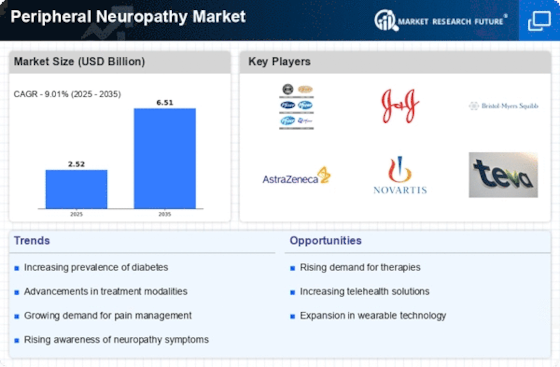
As per MRFR analysis, the Peripheral Neuropathy Market Size was estimated at 2.52 USD Billion in 2024. The Peripheral Neuropathy industry is projected to grow from 2.747 USD Billion in 2025 to 6.511 USD Billion by 2035, exhibiting a compound annual growth rate (CAGR) of 9.01 during the forecast period 2025 - 2035.

Key Market Trends & Highlights

The Peripheral Neuropathy Market is experiencing a transformative shift towards personalized and technologically integrated treatment solutions.

  • Personalized treatment approaches are gaining traction, reflecting a broader trend towards individualized patient care. Technological integration in care is enhancing treatment delivery and patient monitoring, particularly in North America. Increased awareness and early diagnosis are driving growth in the Diabetic Peripheral Neuropathy Market segment, which remains the largest market segment. The rising prevalence of diabetes and advancements in neurological research are key drivers propelling the market forward, especially in the Asia-Pacific region.

Market Size & Forecast

2024 Market Size 2.52 (USD Billion)
2035 Market Size 6.511 (USD Billion)
CAGR (2025 - 2035) 9.01%
Largest Regional Market Share in 2024 North America

Major Players

<p>Pfizer Inc (US), Johnson &amp; Johnson (US), <a href="https://www.bmsclinicaltrials.com/us/en/clinical-trials/NCT01314222">Bristol-Myers Squibb</a> Company (US), AstraZeneca PLC (GB), Novartis AG (CH), Teva Pharmaceutical Industries Ltd (IL), Eli Lilly and Company (US), Sanofi S.A. (FR), Mylan N.V. (US), Amgen Inc (US)</p>

Market Trends

The Peripheral Neuropathy Market is currently experiencing notable transformations driven by advancements in treatment modalities and an increasing understanding of the condition's underlying mechanisms. As healthcare providers and researchers delve deeper into the complexities of peripheral neuropathy, there appears to be a growing emphasis on personalized medicine. This approach may enhance patient outcomes by tailoring therapies to individual genetic and phenotypic profiles. Furthermore, the integration of technology in treatment protocols, such as telemedicine and digital health solutions, seems to be reshaping patient engagement and monitoring, potentially leading to improved adherence to treatment regimens. In addition, the rising prevalence of diabetes and other chronic conditions that contribute to peripheral neuropathy is likely to fuel market growth. As awareness of the condition expands, healthcare systems are increasingly prioritizing early diagnosis and intervention strategies. This shift may result in a more proactive approach to managing peripheral neuropathy, thereby enhancing the quality of life for affected individuals. Overall, the Peripheral Neuropathy Market appears poised for continued evolution, with innovative therapies and a focus on patient-centered care at the forefront of its development.

Personalized Treatment Approaches

The trend towards personalized medicine in the Peripheral Neuropathy Market indicates a shift in how therapies are developed and administered. By focusing on individual patient characteristics, healthcare providers may enhance treatment efficacy and minimize adverse effects, leading to better overall outcomes.

Technological Integration in Care

The incorporation of technology into the management of peripheral neuropathy is becoming increasingly prevalent. Digital health tools, including telehealth services and mobile applications, are facilitating improved patient monitoring and engagement, which may contribute to better adherence to treatment plans.

Increased Awareness and Early Diagnosis

Growing awareness of peripheral neuropathy is prompting healthcare systems to prioritize early diagnosis and intervention. This trend suggests a potential shift towards more proactive management strategies, which could significantly improve patient quality of life and reduce long-term complications.

Peripheral Neuropathy Market Market Drivers

Growing Geriatric Population

The growing geriatric population is a significant driver of the Peripheral Neuropathy Market. As individuals age, the risk of developing peripheral neuropathy increases, often due to age-related conditions such as diabetes, vitamin deficiencies, and other chronic diseases. According to demographic data, the proportion of individuals aged 65 and older is projected to rise substantially in the coming years, leading to a higher incidence of neuropathic conditions. This demographic shift necessitates the development of targeted treatment options and comprehensive care strategies within the Peripheral Neuropathy Market. Healthcare providers are likely to focus on improving patient outcomes through tailored therapies, thereby enhancing the overall market landscape.

Rising Prevalence of Diabetes

The increasing prevalence of diabetes is a notable driver for the Peripheral Neuropathy Market. Diabetes is one of the leading causes of peripheral neuropathy, with studies indicating that approximately 60 to 70% of individuals with diabetes may experience some form of nerve damage. This alarming statistic underscores the urgent need for effective treatment options and management strategies within the Peripheral Neuropathy Market. As the global population ages and lifestyle-related diseases become more common, the demand for therapies targeting diabetic neuropathy is expected to rise. Consequently, pharmaceutical companies are likely to invest in research and development to create innovative solutions, thereby expanding their market presence and addressing the growing patient population.

Increased Focus on Pain Management

The increased focus on pain management is driving growth in the Peripheral Neuropathy Market. Chronic pain associated with peripheral neuropathy can significantly impact patients' quality of life, leading to a heightened demand for effective pain relief solutions. Healthcare systems are increasingly prioritizing pain management strategies, which include pharmacological treatments, physical therapy, and alternative therapies. This shift in focus is prompting pharmaceutical companies to develop new analgesics and adjunct therapies specifically targeting neuropathic pain. As awareness of the importance of pain management continues to grow, the Peripheral Neuropathy Market is likely to expand, offering a wider array of treatment options to meet patient needs.

Advancements in Neurological Research

Recent advancements in neurological research are propelling the Peripheral Neuropathy Market forward. Innovative studies are uncovering the underlying mechanisms of nerve damage and regeneration, leading to the development of novel therapeutic approaches. For instance, the exploration of neuroprotective agents and regenerative medicine has shown promise in treating various forms of peripheral neuropathy. The market is witnessing a surge in clinical trials aimed at evaluating the efficacy of these new treatments, which could potentially reshape the therapeutic landscape. As researchers continue to unveil new insights into nerve health, the Peripheral Neuropathy Market is likely to benefit from an influx of cutting-edge therapies that address unmet medical needs.

Emerging Technologies in Treatment Delivery

Emerging technologies in treatment delivery are reshaping the Peripheral Neuropathy Market. Innovations such as telemedicine, wearable devices, and digital health platforms are enhancing patient access to care and treatment options. These technologies facilitate remote monitoring and personalized treatment plans, allowing healthcare providers to tailor interventions based on individual patient needs. The integration of technology into the management of peripheral neuropathy not only improves patient engagement but also streamlines the delivery of care. As these technologies continue to evolve, they are expected to play a crucial role in the Peripheral Neuropathy Market, potentially leading to improved patient outcomes and satisfaction.

Market Segment Insights

By Type: Diabetic Peripheral Neuropathy Market (Largest) vs. Chemotherapy-induced Peripheral Neuropathy Market (Fastest-Growing)

<p>The Peripheral Neuropathy Market demonstrates varied segmentation with 'Diabetic Peripheral Neuropathy Market' holding the largest share due to the rising prevalence of diabetes globally, which significantly contributes to the incidence of neuropathy. Following this, 'Chemotherapy-induced Peripheral Neuropathy Market' is gaining traction as it arises from cancer treatments, becoming increasingly recognized in the medical community. Other segments, while still relevant, reflect a smaller proportion of market share when compared to these two. The growth trends indicate that 'Chemotherapy-induced Peripheral Neuropathy Market' is emerging as a key player due to the increasing advancements in cancer treatment, which lead to a growing population of survivors experiencing neuropathy as a side effect. Additionally, the increase in awareness and diagnosis of 'HIV/AIDS Associated Peripheral Neuropathy Market' aids in its incremental growth, while 'Idiopathic Peripheral Neuropathy Market' remains more stagnant without significant drivers of change.</p>

<p>Diabetic Peripheral Neuropathy Market (Dominant) vs. HIV/AIDS Associated Peripheral Neuropathy Market (Emerging)</p>

<p>Diabetic Peripheral Neuropathy Market (DPN) remains the dominant segment within the Peripheral Neuropathy Market, primarily driven by high diabetes prevalence rates. DPN typically manifests as painful tingling or numbness in the extremities and is pivotal in the overall neuropathy landscape. In contrast, HIV/AIDS Associated Peripheral Neuropathy Market (HIV-APN) is emerging as an increasingly recognized condition stemming from the disease and associated treatments, highlighting the need for targeted therapies. The growing focus on patient care and management in HIV populations reflects a shift towards addressing these complications effectively. As healthcare providers prioritize neuropathic symptoms in these patients, both segments will see distinctive growth trajectories influenced by their underlying causes and the effectiveness of interventions.</p>

By Treatment: Pharmacological Therapies (Largest) vs. Non-Pharmacological Therapies (Fastest-Growing)

<p>In the Peripheral Neuropathy Market, the treatment segment is primarily dominated by pharmacological therapies, which account for the majority share. These therapies include medications that directly target neuropathic pain and improve nerve function, such as antidepressants and anticonvulsants. Meanwhile, non-pharmacological therapies, such as physical therapy and cognitive behavioral therapy, are witnessing a faster growth rate as they offer alternative solutions with fewer side effects. As patients and healthcare providers increasingly seek holistic approaches to treatment, the balance within this segment is shifting towards these non-pharmacological options.</p>

<p>Pharmacological Therapies (Dominant) vs. Non-Pharmacological Therapies (Emerging)</p>

<p>Pharmacological therapies have established themselves as the dominant force in treating peripheral neuropathy due to their proven efficacy and widespread acceptance. These treatments often provide quick relief from symptoms, making them the go-to solution in clinical settings. Conversely, non-pharmacological therapies are emerging as a significant alternative. They focus on improving the quality of life through methods that include exercise, dietary adjustments, and psychological support. With rising awareness about the importance of comprehensive management in chronic conditions, these alternatives are becoming increasingly popular. As more clinical studies validate their effectiveness, non-pharmacological therapies are set to gain a larger share of the market.</p>

By End User: Hospitals and Clinics (Largest) vs. Ambulatory Centers (Fastest-Growing)

<p>In the Peripheral Neuropathy Market, the distribution of end-user segments reveals a significant dominance of Hospitals and Clinics, which account for the largest market share. These facilities are equipped with comprehensive treatment options and specialized staff capable of addressing complex neuropathy cases. Ambulatory Centers follow as a remarkable segment, capturing a growing share of the market as they offer convenient and less expensive alternatives for patients seeking timely care. Overall, the Others segment, encompassing various healthcare providers, represents a smaller but crucial part of the market, aiding in fostering access to diverse care options. Looking ahead, Ambulatory Centers are expected to experience the highest growth among end-user segments, driven by increasing patient preference for outpatient services and advancements in treatment technologies. This trend is further fueled by the rising prevalence of peripheral neuropathy and the emphasis on accessible care. Hospitals and Clinics will continue to play a vital role in complex case management and advanced diagnostic services, maintaining their significant share while adapting to evolving healthcare delivery models. The demand for integrated care solutions will also shape the growth trajectory of these segments, ensuring a competitive and dynamic market landscape.</p>

<p>Hospitals and Clinics (Dominant) vs. Ambulatory Centers (Emerging)</p>

<p>Hospitals and Clinics constitute the dominant force in the Peripheral Neuropathy Market, characterized by their extensive resources and specialized healthcare professionals. These facilities provide a comprehensive range of diagnostic tests, advanced treatment options, and management solutions for patients with neuropathy. Their robust infrastructure supports thorough patient assessments and complex procedures, making them a preferred choice for severe cases. Meanwhile, Ambulatory Centers represent an emerging segment, focusing on delivering efficient outpatient care. These centers cater to the growing demand for convenience and affordability, attracting patients who seek timely intervention without the need for overnight stays. As the healthcare system evolves, the role of these centers is likely to expand, balancing the need for specialized care with the increasing preference for outpatient services.</p>

Get more detailed insights about Peripheral Neuropathy Market Research Report - Forecast till 2035

Regional Insights

North America : Market Leader in Innovation

North America is the largest market for peripheral neuropathy, accounting for approximately 45% of the global share. The region benefits from advanced healthcare infrastructure, high prevalence of diabetes, and increasing awareness of neuropathic disorders. Regulatory support from agencies like the FDA accelerates the approval of new therapies, driving market growth. The demand for effective pain management solutions is also a significant catalyst for market expansion. The United States is the leading country in this market, with major pharmaceutical companies such as Pfizer Inc, Johnson & Johnson, and Eli Lilly and Company actively involved in developing innovative treatments. The competitive landscape is characterized by a mix of established players and emerging biotech firms, all striving to capture market share through novel therapies and strategic partnerships. The presence of robust research institutions further enhances the region's competitive edge.

Europe : Emerging Market with Potential

Europe is witnessing significant growth in the peripheral neuropathy market, holding approximately 30% of the global share. The region's aging population and rising incidence of chronic diseases, such as diabetes and cancer, are key drivers of demand. Regulatory frameworks, including the European Medicines Agency's guidelines, facilitate the introduction of new therapies, enhancing treatment options for patients. Increased healthcare spending across European nations also supports market expansion. Leading countries in this region include Germany, France, and the UK, where major players like Novartis AG and Sanofi S.A. are actively engaged in research and development. The competitive landscape is marked by collaborations between pharmaceutical companies and research institutions, aiming to innovate and improve treatment outcomes. The presence of a well-established healthcare system further bolsters the market's growth potential.

Asia-Pacific : Rapidly Growing Market

Asia-Pacific is emerging as a rapidly growing market for peripheral neuropathy, accounting for about 20% of the global share. The region's growth is driven by increasing healthcare investments, rising awareness of neuropathic disorders, and a growing aging population. Countries like China and India are witnessing a surge in diabetes cases, which significantly contributes to the demand for effective treatments. Regulatory bodies are also becoming more supportive of new drug approvals, further catalyzing market growth. China and India are the leading countries in this region, with a mix of local and international pharmaceutical companies vying for market share. Key players such as Teva Pharmaceutical Industries and Mylan N.V. are focusing on expanding their product portfolios to cater to the growing demand. The competitive landscape is characterized by a focus on affordability and accessibility, with companies striving to develop cost-effective solutions for patients suffering from peripheral neuropathy.

Middle East and Africa : Untapped Market Potential

The Middle East and Africa represent an untapped market for peripheral neuropathy, holding approximately 5% of the global share. The region faces challenges such as limited healthcare infrastructure and varying levels of access to treatment. However, increasing awareness of neuropathic disorders and rising healthcare investments are driving growth. Regulatory bodies are beginning to implement frameworks that support the introduction of new therapies, which is expected to enhance market dynamics in the coming years. Countries like South Africa and the UAE are leading the way in this region, with a growing number of healthcare facilities and initiatives aimed at improving patient care. The competitive landscape is still developing, with both local and international players exploring opportunities to enter the market. Companies are focusing on building partnerships with healthcare providers to enhance treatment accessibility and improve patient outcomes.

Key Players and Competitive Insights

The Peripheral Neuropathy Market is characterized by a complex interplay of competitive dynamics, driven by an increasing prevalence of neuropathic disorders and a growing demand for effective treatment options. Major players such as Pfizer Inc (US), Johnson & Johnson (US), and Novartis AG (CH) are strategically positioned to leverage their extensive research and development capabilities, focusing on innovative therapies and advanced drug delivery systems. These companies are actively pursuing partnerships and collaborations to enhance their product portfolios and expand their market reach, thereby shaping a competitive environment that emphasizes both innovation and strategic alliances.

In terms of business tactics, companies are increasingly localizing manufacturing and optimizing supply chains to enhance operational efficiency and reduce costs. The market structure appears moderately fragmented, with a mix of established pharmaceutical giants and emerging players. This fragmentation allows for diverse approaches to treatment and innovation, as key players like AstraZeneca PLC (GB) and Eli Lilly and Company (US) adopt tailored strategies to cater to regional demands and regulatory environments.

In August 2025, Pfizer Inc (US) announced a collaboration with a leading biotechnology firm to develop a novel gene therapy aimed at treating hereditary neuropathies. This strategic move underscores Pfizer's commitment to pioneering innovative solutions that address unmet medical needs in the peripheral neuropathy space. The partnership is expected to accelerate the development timeline and enhance the therapeutic options available to patients, thereby reinforcing Pfizer's competitive edge in the market.

In September 2025, Johnson & Johnson (US) launched a new digital health platform designed to support patients with chronic pain, including those suffering from peripheral neuropathy. This initiative reflects the company's focus on integrating technology into patient care, potentially improving treatment adherence and outcomes. By leveraging digital tools, Johnson & Johnson aims to create a more personalized treatment experience, which may enhance patient engagement and satisfaction.

In July 2025, Novartis AG (CH) received regulatory approval for a new oral medication specifically targeting diabetic neuropathy. This approval marks a significant milestone for Novartis, as it expands their portfolio in the peripheral neuropathy market. The introduction of this medication is likely to address a critical need among diabetic patients, positioning Novartis as a key player in this therapeutic area and potentially increasing their market share.

As of October 2025, current competitive trends indicate a strong emphasis on digitalization, sustainability, and the integration of artificial intelligence in drug development and patient management. Strategic alliances are increasingly shaping the landscape, allowing companies to pool resources and expertise to drive innovation. Looking ahead, competitive differentiation is expected to evolve, with a shift from traditional price-based competition towards a focus on technological advancements, innovative therapies, and reliable supply chains. This transition may redefine how companies position themselves in the market, ultimately benefiting patients through improved treatment options.

Key Companies in the Peripheral Neuropathy Market market include

Industry Developments

In January 2023 Salk Institute (US) in Nature revealed that low levels of amino acid serine increased the risk of developing peripheral neuropathy for diabetic mice. These new findings could be used to explore the use of serine supplementation to alleviate the symptoms of neuropathy symptoms and possibly take us one step closer to developing a possible cure

In January 2023 Neuralace Medical Inc. (US) announced the enrollment of the first patients for its Axon Therapy and Painful Diabetic Neuropathy (AT-PDN) study with a target of around 80 patients. The study was estimated to be conducted at five clinical sites and led by Dr. Lora Brown at TruWell Health, Florida

In August 2022 Yostra Labs (India) announced that it had raised USD 484,16  million in a seed funding round that was led by Villgro Innovations Foundation, Indian Angel Network, and other investors. The company has a specialized portfolio of products for the management and diagnosis of peripheral neuropathy. The company was expected to use the raised capital to expand its workforce and marketing teams

Future Outlook

Peripheral Neuropathy Market Future Outlook

<p>The Peripheral Neuropathy Market is projected to grow at a 9.01% CAGR from 2024 to 2035, driven by increasing prevalence, advancements in treatment options, and rising awareness.</p>

New opportunities lie in:

  • <p>Development of telehealth platforms for remote patient monitoring</p><p>Investment in regenerative medicine therapies targeting nerve repair</p><p>Expansion of personalized medicine approaches for neuropathy treatment</p>

<p>By 2035, the Peripheral Neuropathy Market is expected to achieve substantial growth and innovation.</p>

Market Segmentation

Peripheral Neuropathy Market Type Outlook

  • Diabetic Peripheral Neuropathy
  • Chemotherapy-induced Peripheral Neuropathy
  • Idiopathic Peripheral Neuropathy
  • HIV/AIDS Associated Peripheral Neuropathy

Peripheral Neuropathy Market End User Outlook

  • Hospitals and Clinics
  • Ambulatory Centers
  • Others

Peripheral Neuropathy Market Treatment Outlook

  • Pharmacological Therapies
  • Non-Pharmacological Therapies
  • Others

Report Scope

MARKET SIZE 20242.52(USD Billion)
MARKET SIZE 20252.747(USD Billion)
MARKET SIZE 20356.511(USD Billion)
COMPOUND ANNUAL GROWTH RATE (CAGR)9.01% (2024 - 2035)
REPORT COVERAGERevenue Forecast, Competitive Landscape, Growth Factors, and Trends
BASE YEAR2024
Market Forecast Period2025 - 2035
Historical Data2019 - 2024
Market Forecast UnitsUSD Billion
Key Companies ProfiledMarket analysis in progress
Segments CoveredMarket segmentation analysis in progress
Key Market OpportunitiesAdvancements in digital therapeutics enhance treatment options in the Peripheral Neuropathy Market.
Key Market DynamicsRising prevalence of diabetes drives demand for innovative treatments in the Peripheral Neuropathy Market.
Countries CoveredNorth America, Europe, APAC, South America, MEA

FAQs

What is the projected market valuation of the Peripheral Neuropathy Market by 2035?

The Peripheral Neuropathy Market is projected to reach approximately 6.511 USD Billion by 2035.

What was the market valuation of the Peripheral Neuropathy Market in 2024?

In 2024, the market valuation of Peripheral Neuropathy was 2.52 USD Billion.

What is the expected CAGR for the Peripheral Neuropathy Market during the forecast period 2025 - 2035?

The expected CAGR for the Peripheral Neuropathy Market during the forecast period 2025 - 2035 is 9.01%.

Which segment is anticipated to have the highest valuation in the Peripheral Neuropathy Market by 2035?

The Diabetic Peripheral Neuropathy segment is anticipated to have the highest valuation, projected to reach 3.1 USD Billion by 2035.

What are the key treatment types in the Peripheral Neuropathy Market?

Key treatment types include Pharmacological Therapies, Non-Pharmacological Therapies, and Others, with Pharmacological Therapies projected to reach 3.1 USD Billion by 2035.

Who are the leading companies in the Peripheral Neuropathy Market?

Leading companies in the Peripheral Neuropathy Market include Pfizer Inc, Johnson & Johnson, and Bristol-Myers Squibb Company.

What is the projected valuation for the Chemotherapy-induced Peripheral Neuropathy segment by 2035?

The Chemotherapy-induced Peripheral Neuropathy segment is projected to reach approximately 1.8 USD Billion by 2035.

  1. SECTION I: EXECUTIVE SUMMARY AND KEY HIGHLIGHTS
    1. EXECUTIVE SUMMARY
      1. Market Overview
      2. Key Findings
      3. Market Segmentation
      4. Competitive Landscape
      5. Challenges and Opportunities
      6. Future Outlook 2 SECTION II: SCOPING, METHODOLOGY AND MARKET STRUCTURE
    2. MARKET INTRODUCTION
      1. Definition
      2. Scope of the study
    3. RESEARCH METHODOLOGY
      1. Overview
      2. Data Mining
      3. Secondary Research
      4. Primary Research
      5. Forecasting Model
      6. Market Size Estimation
      7. Data Triangulation
      8. Validation 3 SECTION III: QUALITATIVE ANALYSIS
    4. MARKET DYNAMICS
      1. Overview
      2. Drivers
      3. Restraints
      4. Opportunities
    5. MARKET FACTOR ANALYSIS
      1. Value chain Analysis
      2. Porter's Five Forces Analysis
      3. COVID-19 Impact Analysis
    6. Healthcare, BY Type (USD Billion)
      1. Diabetic Peripheral Neuropathy
      2. Chemotherapy-induced Peripheral Neuropathy
      3. Idiopathic Peripheral Neuropathy
      4. HIV/AIDS Associated Peripheral Neuropathy
    7. Healthcare, BY Treatment (USD Billion)
      1. Pharmacological Therapies
      2. Non-Pharmacological Therapies
      3. Others
    8. Healthcare, BY End User (USD Billion)
      1. Hospitals and Clinics
      2. Ambulatory Centers
      3. Others
    9. Healthcare, BY Region (USD Billion)
      1. North America
      2. Europe
      3. APAC
      4. South America
      5. MEA
    10. Competitive Landscape
      1. Overview
      2. Competitive Analysis
      3. Market share Analysis
      4. Major Growth Strategy in the Healthcare
      5. Competitive Benchmarking
      6. Leading Players in Terms of Number of Developments in the Healthcare
      7. Key developments and growth strategies
      8. Major Players Financial Matrix
    11. Company Profiles
      1. Pfizer Inc (US)
      2. Johnson & Johnson (US)
      3. Bristol-Myers Squibb Company (US)
      4. AstraZeneca PLC (GB)
      5. Novartis AG (CH)
      6. Teva Pharmaceutical Industries Ltd (IL)
      7. Eli Lilly and Company (US)
      8. Sanofi S.A. (FR)
      9. Mylan N.V. (US)
      10. Amgen Inc (US)
    12. Appendix
      1. References
      2. Related Reports 6 LIST OF FIGURES
    13. MARKET SYNOPSIS
    14. NORTH AMERICA MARKET ANALYSIS
    15. US MARKET ANALYSIS BY TYPE
    16. US MARKET ANALYSIS BY TREATMENT
    17. US MARKET ANALYSIS BY END USER
    18. CANADA MARKET ANALYSIS BY TYPE
    19. CANADA MARKET ANALYSIS BY TREATMENT
    20. CANADA MARKET ANALYSIS BY END USER
    21. EUROPE MARKET ANALYSIS
    22. GERMANY MARKET ANALYSIS BY TYPE
    23. GERMANY MARKET ANALYSIS BY TREATMENT
    24. GERMANY MARKET ANALYSIS BY END USER
    25. UK MARKET ANALYSIS BY TYPE
    26. UK MARKET ANALYSIS BY TREATMENT
    27. UK MARKET ANALYSIS BY END USER
    28. FRANCE MARKET ANALYSIS BY TYPE
    29. FRANCE MARKET ANALYSIS BY TREATMENT
    30. FRANCE MARKET ANALYSIS BY END USER
    31. RUSSIA MARKET ANALYSIS BY TYPE
    32. RUSSIA MARKET ANALYSIS BY TREATMENT
    33. RUSSIA MARKET ANALYSIS BY END USER
    34. ITALY MARKET ANALYSIS BY TYPE
    35. ITALY MARKET ANALYSIS BY TREATMENT
    36. ITALY MARKET ANALYSIS BY END USER
    37. SPAIN MARKET ANALYSIS BY TYPE
    38. SPAIN MARKET ANALYSIS BY TREATMENT
    39. SPAIN MARKET ANALYSIS BY END USER
    40. REST OF EUROPE MARKET ANALYSIS BY TYPE
    41. REST OF EUROPE MARKET ANALYSIS BY TREATMENT
    42. REST OF EUROPE MARKET ANALYSIS BY END USER
    43. APAC MARKET ANALYSIS
    44. CHINA MARKET ANALYSIS BY TYPE
    45. CHINA MARKET ANALYSIS BY TREATMENT
    46. CHINA MARKET ANALYSIS BY END USER
    47. INDIA MARKET ANALYSIS BY TYPE
    48. INDIA MARKET ANALYSIS BY TREATMENT
    49. INDIA MARKET ANALYSIS BY END USER
    50. JAPAN MARKET ANALYSIS BY TYPE
    51. JAPAN MARKET ANALYSIS BY TREATMENT
    52. JAPAN MARKET ANALYSIS BY END USER
    53. SOUTH KOREA MARKET ANALYSIS BY TYPE
    54. SOUTH KOREA MARKET ANALYSIS BY TREATMENT
    55. SOUTH KOREA MARKET ANALYSIS BY END USER
    56. MALAYSIA MARKET ANALYSIS BY TYPE
    57. MALAYSIA MARKET ANALYSIS BY TREATMENT
    58. MALAYSIA MARKET ANALYSIS BY END USER
    59. THAILAND MARKET ANALYSIS BY TYPE
    60. THAILAND MARKET ANALYSIS BY TREATMENT
    61. THAILAND MARKET ANALYSIS BY END USER
    62. INDONESIA MARKET ANALYSIS BY TYPE
    63. INDONESIA MARKET ANALYSIS BY TREATMENT
    64. INDONESIA MARKET ANALYSIS BY END USER
    65. REST OF APAC MARKET ANALYSIS BY TYPE
    66. REST OF APAC MARKET ANALYSIS BY TREATMENT
    67. REST OF APAC MARKET ANALYSIS BY END USER
    68. SOUTH AMERICA MARKET ANALYSIS
    69. BRAZIL MARKET ANALYSIS BY TYPE
    70. BRAZIL MARKET ANALYSIS BY TREATMENT
    71. BRAZIL MARKET ANALYSIS BY END USER
    72. MEXICO MARKET ANALYSIS BY TYPE
    73. MEXICO MARKET ANALYSIS BY TREATMENT
    74. MEXICO MARKET ANALYSIS BY END USER
    75. ARGENTINA MARKET ANALYSIS BY TYPE
    76. ARGENTINA MARKET ANALYSIS BY TREATMENT
    77. ARGENTINA MARKET ANALYSIS BY END USER
    78. REST OF SOUTH AMERICA MARKET ANALYSIS BY TYPE
    79. REST OF SOUTH AMERICA MARKET ANALYSIS BY TREATMENT
    80. REST OF SOUTH AMERICA MARKET ANALYSIS BY END USER
    81. MEA MARKET ANALYSIS
    82. GCC COUNTRIES MARKET ANALYSIS BY TYPE
    83. GCC COUNTRIES MARKET ANALYSIS BY TREATMENT
    84. GCC COUNTRIES MARKET ANALYSIS BY END USER
    85. SOUTH AFRICA MARKET ANALYSIS BY TYPE
    86. SOUTH AFRICA MARKET ANALYSIS BY TREATMENT
    87. SOUTH AFRICA MARKET ANALYSIS BY END USER
    88. REST OF MEA MARKET ANALYSIS BY TYPE
    89. REST OF MEA MARKET ANALYSIS BY TREATMENT
    90. REST OF MEA MARKET ANALYSIS BY END USER
    91. KEY BUYING CRITERIA OF HEALTHCARE
    92. RESEARCH PROCESS OF MRFR
    93. DRO ANALYSIS OF HEALTHCARE
    94. DRIVERS IMPACT ANALYSIS: HEALTHCARE
    95. RESTRAINTS IMPACT ANALYSIS: HEALTHCARE
    96. SUPPLY / VALUE CHAIN: HEALTHCARE
    97. HEALTHCARE, BY TYPE, 2024 (% SHARE)
    98. HEALTHCARE, BY TYPE, 2024 TO 2035 (USD Billion)
    99. HEALTHCARE, BY TREATMENT, 2024 (% SHARE)
    100. HEALTHCARE, BY TREATMENT, 2024 TO 2035 (USD Billion)
    101. HEALTHCARE, BY END USER, 2024 (% SHARE)
    102. HEALTHCARE, BY END USER, 2024 TO 2035 (USD Billion)
    103. BENCHMARKING OF MAJOR COMPETITORS 7 LIST OF TABLES
    104. LIST OF ASSUMPTIONS
    105. North America MARKET SIZE ESTIMATES; FORECAST
      1. BY TYPE, 2025-2035 (USD Billion)
      2. BY TREATMENT, 2025-2035 (USD Billion)
      3. BY END USER, 2025-2035 (USD Billion)
    106. US MARKET SIZE ESTIMATES; FORECAST
      1. BY TYPE, 2025-2035 (USD Billion)
      2. BY TREATMENT, 2025-2035 (USD Billion)
      3. BY END USER, 2025-2035 (USD Billion)
    107. Canada MARKET SIZE ESTIMATES; FORECAST
      1. BY TYPE, 2025-2035 (USD Billion)
      2. BY TREATMENT, 2025-2035 (USD Billion)
      3. BY END USER, 2025-2035 (USD Billion)
    108. Europe MARKET SIZE ESTIMATES; FORECAST
      1. BY TYPE, 2025-2035 (USD Billion)
      2. BY TREATMENT, 2025-2035 (USD Billion)
      3. BY END USER, 2025-2035 (USD Billion)
    109. Germany MARKET SIZE ESTIMATES; FORECAST
      1. BY TYPE, 2025-2035 (USD Billion)
      2. BY TREATMENT, 2025-2035 (USD Billion)
      3. BY END USER, 2025-2035 (USD Billion)
    110. UK MARKET SIZE ESTIMATES; FORECAST
      1. BY TYPE, 2025-2035 (USD Billion)
      2. BY TREATMENT, 2025-2035 (USD Billion)
      3. BY END USER, 2025-2035 (USD Billion)
    111. France MARKET SIZE ESTIMATES; FORECAST
      1. BY TYPE, 2025-2035 (USD Billion)
      2. BY TREATMENT, 2025-2035 (USD Billion)
      3. BY END USER, 2025-2035 (USD Billion)
    112. Russia MARKET SIZE ESTIMATES; FORECAST
      1. BY TYPE, 2025-2035 (USD Billion)
      2. BY TREATMENT, 2025-2035 (USD Billion)
      3. BY END USER, 2025-2035 (USD Billion)
    113. Italy MARKET SIZE ESTIMATES; FORECAST
      1. BY TYPE, 2025-2035 (USD Billion)
      2. BY TREATMENT, 2025-2035 (USD Billion)
      3. BY END USER, 2025-2035 (USD Billion)
    114. Spain MARKET SIZE ESTIMATES; FORECAST
      1. BY TYPE, 2025-2035 (USD Billion)
      2. BY TREATMENT, 2025-2035 (USD Billion)
      3. BY END USER, 2025-2035 (USD Billion)
    115. Rest of Europe MARKET SIZE ESTIMATES; FORECAST
      1. BY TYPE, 2025-2035 (USD Billion)
      2. BY TREATMENT, 2025-2035 (USD Billion)
      3. BY END USER, 2025-2035 (USD Billion)
    116. APAC MARKET SIZE ESTIMATES; FORECAST
      1. BY TYPE, 2025-2035 (USD Billion)
      2. BY TREATMENT, 2025-2035 (USD Billion)
      3. BY END USER, 2025-2035 (USD Billion)
    117. China MARKET SIZE ESTIMATES; FORECAST
      1. BY TYPE, 2025-2035 (USD Billion)
      2. BY TREATMENT, 2025-2035 (USD Billion)
      3. BY END USER, 2025-2035 (USD Billion)
    118. India MARKET SIZE ESTIMATES; FORECAST
      1. BY TYPE, 2025-2035 (USD Billion)
      2. BY TREATMENT, 2025-2035 (USD Billion)
      3. BY END USER, 2025-2035 (USD Billion)
    119. Japan MARKET SIZE ESTIMATES; FORECAST
      1. BY TYPE, 2025-2035 (USD Billion)
      2. BY TREATMENT, 2025-2035 (USD Billion)
      3. BY END USER, 2025-2035 (USD Billion)
    120. South Korea MARKET SIZE ESTIMATES; FORECAST
      1. BY TYPE, 2025-2035 (USD Billion)
      2. BY TREATMENT, 2025-2035 (USD Billion)
      3. BY END USER, 2025-2035 (USD Billion)
    121. Malaysia MARKET SIZE ESTIMATES; FORECAST
      1. BY TYPE, 2025-2035 (USD Billion)
      2. BY TREATMENT, 2025-2035 (USD Billion)
      3. BY END USER, 2025-2035 (USD Billion)
    122. Thailand MARKET SIZE ESTIMATES; FORECAST
      1. BY TYPE, 2025-2035 (USD Billion)
      2. BY TREATMENT, 2025-2035 (USD Billion)
      3. BY END USER, 2025-2035 (USD Billion)
    123. Indonesia MARKET SIZE ESTIMATES; FORECAST
      1. BY TYPE, 2025-2035 (USD Billion)
      2. BY TREATMENT, 2025-2035 (USD Billion)
      3. BY END USER, 2025-2035 (USD Billion)
    124. Rest of APAC MARKET SIZE ESTIMATES; FORECAST
      1. BY TYPE, 2025-2035 (USD Billion)
      2. BY TREATMENT, 2025-2035 (USD Billion)
      3. BY END USER, 2025-2035 (USD Billion)
    125. South America MARKET SIZE ESTIMATES; FORECAST
      1. BY TYPE, 2025-2035 (USD Billion)
      2. BY TREATMENT, 2025-2035 (USD Billion)
      3. BY END USER, 2025-2035 (USD Billion)
    126. Brazil MARKET SIZE ESTIMATES; FORECAST
      1. BY TYPE, 2025-2035 (USD Billion)
      2. BY TREATMENT, 2025-2035 (USD Billion)
      3. BY END USER, 2025-2035 (USD Billion)
    127. Mexico MARKET SIZE ESTIMATES; FORECAST
      1. BY TYPE, 2025-2035 (USD Billion)
      2. BY TREATMENT, 2025-2035 (USD Billion)
      3. BY END USER, 2025-2035 (USD Billion)
    128. Argentina MARKET SIZE ESTIMATES; FORECAST
      1. BY TYPE, 2025-2035 (USD Billion)
      2. BY TREATMENT, 2025-2035 (USD Billion)
      3. BY END USER, 2025-2035 (USD Billion)
    129. Rest of South America MARKET SIZE ESTIMATES; FORECAST
      1. BY TYPE, 2025-2035 (USD Billion)
      2. BY TREATMENT, 2025-2035 (USD Billion)
      3. BY END USER, 2025-2035 (USD Billion)
    130. MEA MARKET SIZE ESTIMATES; FORECAST
      1. BY TYPE, 2025-2035 (USD Billion)
      2. BY TREATMENT, 2025-2035 (USD Billion)
      3. BY END USER, 2025-2035 (USD Billion)
    131. GCC Countries MARKET SIZE ESTIMATES; FORECAST
      1. BY TYPE, 2025-2035 (USD Billion)
      2. BY TREATMENT, 2025-2035 (USD Billion)
      3. BY END USER, 2025-2035 (USD Billion)
    132. South Africa MARKET SIZE ESTIMATES; FORECAST
      1. BY TYPE, 2025-2035 (USD Billion)
      2. BY TREATMENT, 2025-2035 (USD Billion)
      3. BY END USER, 2025-2035 (USD Billion)
    133. Rest of MEA MARKET SIZE ESTIMATES; FORECAST
      1. BY TYPE, 2025-2035 (USD Billion)
      2. BY TREATMENT, 2025-2035 (USD Billion)
      3. BY END USER, 2025-2035 (USD Billion)
    134. PRODUCT LAUNCH/PRODUCT DEVELOPMENT/APPROVAL
    135. ACQUISITION/PARTNERSHIP

Peripheral Neuropathy Market Segmentation

Peripheral Neuropathy Market Type Outlook (USD Billion, 2019-2030)

Diabetic Peripheral Neuropathy

Chemotherapy-induced Peripheral Neuropathy

Idiopathic Peripheral Neuropathy

HIV/AIDS Associated Peripheral Neuropathy

Peripheral Neuropathy Market Treatment Outlook (USD Billion, 2019-2030)

Pharmacological Therapies

Pain Relievers

Anti-seizure Medications

Antidepressants

Non-Pharmacological Therapies

Transcutaneous Electrical Nerve Stimulation

Plasma Exchange

Intravenous Immune Globulin

Others

Peripheral Neuropathy Market End User Outlook (USD Billion, 2019-2030)

Hospitals and Clinics

Ambulatory Centers

Others

Peripheral Neuropathy Market Regional Outlook (USD Billion, 2019-2030)

North America Outlook (USD Billion, 2019-2030)

North America Peripheral Neuropathy Market by Type

Diabetic Peripheral Neuropathy

Chemotherapy-induced Peripheral Neuropathy

Idiopathic Peripheral Neuropathy

HIV/AIDS Associated Peripheral Neuropathy

North America Peripheral Neuropathy Market by Treatment

Pharmacological Therapies

Pain Relievers

Anti-seizure Medications

Antidepressants

Non-Pharmacological Therapies

Transcutaneous Electrical Nerve Stimulation

Plasma Exchange

Intravenous Immune Globulin

Others

North America Peripheral Neuropathy Market by End User

Hospitals and Clinics

Ambulatory Centers

Others

US Outlook (USD Billion, 2019-2030)

US Peripheral Neuropathy Market by Type

Diabetic Peripheral Neuropathy

Chemotherapy-induced Peripheral Neuropathy

Idiopathic Peripheral Neuropathy

HIV/AIDS Associated Peripheral Neuropathy

US Peripheral Neuropathy Market by Treatment

Pharmacological Therapies

Pain Relievers

Anti-seizure Medications

Antidepressants

Non-Pharmacological Therapies

Transcutaneous Electrical Nerve Stimulation

Plasma Exchange

Intravenous Immune Globulin

Others

US Peripheral Neuropathy Market by End User

Hospitals and Clinics

Ambulatory Centers

Others

Canada Outlook (USD Billion, 2019-2030)

Canada Peripheral Neuropathy Market by Type

Diabetic Peripheral Neuropathy

Chemotherapy-induced Peripheral Neuropathy

Idiopathic Peripheral Neuropathy

HIV/AIDS Associated Peripheral Neuropathy

Canada Peripheral Neuropathy Market by Treatment

Pharmacological Therapies

Pain Relievers

Anti-seizure Medications

Antidepressants

Non-Pharmacological Therapies

Transcutaneous Electrical Nerve Stimulation

Plasma Exchange

Intravenous Immune Globulin

Others

Canada Peripheral Neuropathy Market by End User

Hospitals and Clinics

Ambulatory Centers

Others

Europe Outlook (USD Billion, 2019-2030)

Europe Peripheral Neuropathy Market by Type

Diabetic Peripheral Neuropathy

Chemotherapy-induced Peripheral Neuropathy

Idiopathic Peripheral Neuropathy

HIV/AIDS Associated Peripheral Neuropathy

Europe Peripheral Neuropathy Market by Treatment

Pharmacological Therapies

Pain Relievers

Anti-seizure Medications

Antidepressants

Non-Pharmacological Therapies

Transcutaneous Electrical Nerve Stimulation

Plasma Exchange

Intravenous Immune Globulin

Others

Europe Peripheral Neuropathy Market by End User

Hospitals and Clinics

Ambulatory Centers

Others

Germany Outlook (USD Billion, 2019-2030)

Germany Peripheral Neuropathy Market by Type

Diabetic Peripheral Neuropathy

Chemotherapy-induced Peripheral Neuropathy

Idiopathic Peripheral Neuropathy

HIV/AIDS Associated Peripheral Neuropathy

Germany Peripheral Neuropathy Market by Treatment

Pharmacological Therapies

Pain Relievers

Anti-seizure Medications

Antidepressants

Non-Pharmacological Therapies

Transcutaneous Electrical Nerve Stimulation

Plasma Exchange

Intravenous Immune Globulin

Others

Germany Peripheral Neuropathy Market by End User

Hospitals and Clinics

Ambulatory Centers

Others

France Outlook (USD Billion, 2019-2030)

France Peripheral Neuropathy Market by Type

Diabetic Peripheral Neuropathy

Chemotherapy-induced Peripheral Neuropathy

Idiopathic Peripheral Neuropathy

HIV/AIDS Associated Peripheral Neuropathy

France Peripheral Neuropathy Market Treatment

Pharmacological Therapies

Pain Relievers

Anti-seizure Medications

Antidepressants

Non-Pharmacological Therapies

Transcutaneous Electrical Nerve Stimulation

Plasma Exchange

Intravenous Immune Globulin

Others

France Peripheral Neuropathy Market by End User

Hospitals and Clinics

Ambulatory Centers

Others

UK Outlook (USD Billion, 2019-2030)

UK Peripheral Neuropathy Market by Type

Diabetic Peripheral Neuropathy

Chemotherapy-induced Peripheral Neuropathy

Idiopathic Peripheral Neuropathy

HIV/AIDS Associated Peripheral Neuropathy

UK Peripheral Neuropathy Market by Treatment

Pharmacological Therapies

Pain Relievers

Anti-seizure Medications

Antidepressants

Non-Pharmacological Therapies

Transcutaneous Electrical Nerve Stimulation

Plasma Exchange

Intravenous Immune Globulin

Others

UK Peripheral Neuropathy Market by End User

Hospitals and Clinics

Ambulatory Centers

Others

Italy Outlook (USD Billion, 2019-2030)

Italy Peripheral Neuropathy Market by Type

Diabetic Peripheral Neuropathy

Chemotherapy-induced Peripheral Neuropathy

Idiopathic Peripheral Neuropathy

HIV/AIDS Associated Peripheral Neuropathy

Italy Peripheral Neuropathy Market by Treatment

Pharmacological Therapies

Pain Relievers

Anti-seizure Medications

Antidepressants

Non-Pharmacological Therapies

Transcutaneous Electrical Nerve Stimulation

Plasma Exchange

Intravenous Immune Globulin

Others

Italy Peripheral Neuropathy Market by End User

Hospitals and Clinics

Ambulatory Centers

Others

Spain Outlook (USD Billion, 2019-2030)

Spain Peripheral Neuropathy Market by Type

Diabetic Peripheral Neuropathy

Chemotherapy-induced Peripheral Neuropathy

Idiopathic Peripheral Neuropathy

HIV/AIDS Associated Peripheral Neuropathy

Spain Peripheral Neuropathy Market by Treatment

Pharmacological Therapies

Pain Relievers

Anti-seizure Medications

Antidepressants

Non-Pharmacological Therapies

Transcutaneous Electrical Nerve Stimulation

Plasma Exchange

Intravenous Immune Globulin

Others

Spain Peripheral Neuropathy Market by End User

Hospitals and Clinics

Ambulatory Centers

Others

Rest Of Europe Outlook (USD Billion, 2019-2030)

Rest Of Europe Peripheral Neuropathy Market by Type

Diabetic Peripheral Neuropathy

Chemotherapy-induced Peripheral Neuropathy

Idiopathic Peripheral Neuropathy

HIV/AIDS Associated Peripheral Neuropathy

Rest of Europe Peripheral Neuropathy Market by Treatment

Pharmacological Therapies

Pain Relievers

Anti-seizure Medications

Antidepressants

Non-Pharmacological Therapies

Transcutaneous Electrical Nerve Stimulation

Plasma Exchange

Intravenous Immune Globulin

Others

Rest of Europe Peripheral Neuropathy Market by End User

Hospitals and Clinics

Ambulatory Centers

Others

Asia-Pacific Outlook (USD Billion, 2019-2030)

Asia-Pacific Peripheral Neuropathy Market by Type

Diabetic Peripheral Neuropathy

Chemotherapy-induced Peripheral Neuropathy

Idiopathic Peripheral Neuropathy

HIV/AIDS Associated Peripheral Neuropathy

Asia-Pacific Peripheral Neuropathy Market by Treatment

Pharmacological Therapies

Pain Relievers

Anti-seizure Medications

Antidepressants

Non-Pharmacological Therapies

Transcutaneous Electrical Nerve Stimulation

Plasma Exchange

Intravenous Immune Globulin

Others

Asia-Pacific Peripheral Neuropathy Market by End User

Hospitals and Clinics

Ambulatory Centers

Others

China Outlook (USD Billion, 2019-2030)

China Peripheral Neuropathy Market by Type

Diabetic Peripheral Neuropathy

Chemotherapy-induced Peripheral Neuropathy

Idiopathic Peripheral Neuropathy

HIV/AIDS Associated Peripheral Neuropathy

China Peripheral Neuropathy Market by Treatment

Pharmacological Therapies

Pain Relievers

Anti-seizure Medications

Antidepressants

Non-Pharmacological Therapies

Transcutaneous Electrical Nerve Stimulation

Plasma Exchange

Intravenous Immune Globulin

Others

China Peripheral Neuropathy Market by End User

Hospitals and Clinics

Ambulatory Centers

Others

Japan Outlook (USD Billion, 2019-2030)

Japan Peripheral Neuropathy Market by Type

Diabetic Peripheral Neuropathy

Chemotherapy-induced Peripheral Neuropathy

Idiopathic Peripheral Neuropathy

HIV/AIDS Associated Peripheral Neuropathy

Japan Peripheral Neuropathy Market by Treatment

Pharmacological Therapies

Pain Relievers

Anti-seizure Medications

Antidepressants

Non-Pharmacological Therapies

Transcutaneous Electrical Nerve Stimulation

Plasma Exchange

Intravenous Immune Globulin

Others

Japan Peripheral Neuropathy Market by End User

Hospitals and Clinics

Ambulatory Centers

Others

India Outlook (USD Billion, 2019-2030)

India Peripheral Neuropathy Market by Type

Diabetic Peripheral Neuropathy

Chemotherapy-induced Peripheral Neuropathy

Idiopathic Peripheral Neuropathy

HIV/AIDS Associated Peripheral Neuropathy

India Peripheral Neuropathy Market by Treatment

Pharmacological Therapies

Pain Relievers

Anti-seizure Medications

Antidepressants

Non-Pharmacological Therapies

Transcutaneous Electrical Nerve Stimulation

Plasma Exchange

Intravenous Immune Globulin

Others

India Peripheral Neuropathy Market by End User

Hospitals and Clinics

Ambulatory Centers

Others

Australia Outlook (USD Billion, 2019-2030)

Australia Peripheral Neuropathy Market by Type

Diabetic Peripheral Neuropathy

Chemotherapy-induced Peripheral Neuropathy

Idiopathic Peripheral Neuropathy

HIV/AIDS Associated Peripheral Neuropathy

Australia Peripheral Neuropathy Market by Treatment

Pharmacological Therapies

Pain Relievers

Anti-seizure Medications

Antidepressants

Non-Pharmacological Therapies

Transcutaneous Electrical Nerve Stimulation

Plasma Exchange

Intravenous Immune Globulin

Others

Australia Peripheral Neuropathy Market by End User

Hospitals and Clinics

Ambulatory Centers

Others

South Korea Outlook (USD Billion, 2019-2030)

South Korea Peripheral Neuropathy Market by Type

Diabetic Peripheral Neuropathy

Chemotherapy-induced Peripheral Neuropathy

Idiopathic Peripheral Neuropathy

HIV/AIDS Associated Peripheral Neuropathy

South Korea Peripheral Neuropathy Market by Treatment

Pharmacological Therapies

Pain Relievers

Anti-seizure Medications

Antidepressants

Non-Pharmacological Therapies

Transcutaneous Electrical Nerve Stimulation

Plasma Exchange

Intravenous Immune Globulin

Others

South Korea Peripheral Neuropathy Market by End User

Hospitals and Clinics

Ambulatory Centers

Others

Rest of Asia-Pacific Outlook (USD Billion, 2019-2030)

Rest of Asia-Pacific Peripheral Neuropathy Market by Type

Diabetic Peripheral Neuropathy

Chemotherapy-induced Peripheral Neuropathy

Idiopathic Peripheral Neuropathy

HIV/AIDS Associated Peripheral Neuropathy

Rest of Asia-Pacific Peripheral Neuropathy Market by Treatment

Pharmacological Therapies

Pain Relievers

Anti-seizure Medications

Antidepressants

Non-Pharmacological Therapies

Transcutaneous Electrical Nerve Stimulation

Plasma Exchange

Intravenous Immune Globulin

Others

Rest of Asia-Pacific Peripheral Neuropathy Market by End User

Hospitals and Clinics

Ambulatory Centers

Others

Rest of the World Outlook (USD Billion, 2019-2030)

Rest of the World Peripheral Neuropathy Market by Type

Diabetic Peripheral Neuropathy

Chemotherapy-induced Peripheral Neuropathy

Idiopathic Peripheral Neuropathy

HIV/AIDS Associated Peripheral Neuropathy

Rest of the World Peripheral Neuropathy Market by Treatment

Pharmacological Therapies

Pain Relievers

Anti-seizure Medications

Antidepressants

Non-Pharmacological Therapies

Transcutaneous Electrical Nerve Stimulation

Plasma Exchange

Intravenous Immune Globulin

Others

Rest of the World Peripheral Neuropathy Market by End User

Hospitals and Clinics

Ambulatory Centers

Others

Middle East Outlook (USD Billion, 2019-2030)

Middle East Peripheral Neuropathy Market by Type

Diabetic Peripheral Neuropathy

Chemotherapy-induced Peripheral Neuropathy

Idiopathic Peripheral Neuropathy

HIV/AIDS Associated Peripheral Neuropathy

Middle East Peripheral Neuropathy Market by Treatment

Pharmacological Therapies

Pain Relievers

Anti-seizure Medications

Antidepressants

Non-Pharmacological Therapies

Transcutaneous Electrical Nerve Stimulation

Plasma Exchange

Intravenous Immune Globulin

Others

Middle East Peripheral Neuropathy Market by End User

Hospitals and Clinics

Ambulatory Centers

Others

Africa Outlook (USD Billion, 2019-2030)

Africa Peripheral Neuropathy Market by Type

Diabetic Peripheral Neuropathy

Chemotherapy-induced Peripheral Neuropathy

Idiopathic Peripheral Neuropathy

HIV/AIDS Associated Peripheral Neuropathy

Africa Peripheral Neuropathy Market by Treatment

Pharmacological Therapies

Pain Relievers

Anti-seizure Medications

Antidepressants

Non-Pharmacological Therapies

Transcutaneous Electrical Nerve Stimulation

Plasma Exchange

Intravenous Immune Globulin

Others

Africa Peripheral Neuropathy Market by End User

Hospitals and Clinics

Ambulatory Centers

Others

Latin America Outlook (USD Billion, 2019-2030)

Latin America Peripheral Neuropathy Market by Type

Diabetic Peripheral Neuropathy

Chemotherapy-induced Peripheral Neuropathy

Idiopathic Peripheral Neuropathy

HIV/AIDS Associated Peripheral Neuropathy

Latin America Peripheral Neuropathy Market by Treatment

Pharmacological Therapies

Pain Relievers

Anti-seizure Medications

Antidepressants

Non-Pharmacological Therapies

Transcutaneous Electrical Nerve Stimulation

Plasma Exchange

Intravenous Immune Globulin

Others

Latin America Peripheral Neuropathy Market by End User

Hospitals and Clinics

Ambulatory Centers

Others

Infographic

Free Sample Request

Kindly complete the form below to receive a free sample of this Report

Get Free Sample

Customer Strories

Compare Licence

×
Features License Type
Single User Multiuser License Enterprise User
Price $4,950 $5,950 $7,250
Maximum User Access Limit 1 User Upto 10 Users Unrestricted Access Throughout the Organization
Free Customization
Direct Access to Analyst
Deliverable Format
Platform Access
Discount on Next Purchase 10% 15% 15%
Printable Versions