×
Request Free Sample ×

Kindly complete the form below to receive a free sample of this Report

* Please use a valid business email

Leading companies partner with us for data-driven Insights

clients tt-cursor
Hero Background
English
Chinese
French
Japanese
Korean
German
Spanish

PEGylated Drugs Market Size

ID: MRFR/Pharma/6964-CR
173 Pages
Rahul Gotadki
July 2025

Pegylated Drugs Market Research Report Information by Molecule (Macromolecular Drugs (Protein and Peptide, Enzyme, Aptamer), Small Molecular Drugs, Lipid Nanoparticles (LNP) and Liposomes), by Application (Oncology, Neurology, Autoimmune Diseases, Haematology, Others), by Distribution Channel (Hospital Pharmacy, Online Pharmacy, Retail Pharmacy) and Region (North America, Europe, Asia-Pacific, Rest of the World) - Forecast till 2035

Share:
Download PDF ×

We do not share your information with anyone. However, we may send you emails based on your report interest from time to time. You may contact us at any time to opt-out.

PEGylated Drugs Market Infographic
Purchase Options

Pegylated Drugs Size

PEGylated Drugs Market Growth Projections and Opportunities

PEGylated drugs represent an innovative approach to delivering medicines, providing various advantages that enhance the effectiveness of treatments. This technology involves modifying molecules such as proteins, peptides, enzymes, antibody fragments, and oligonucleotides by attaching chains of ethylene glycol, a process known as PEGylation. This modification brings about benefits like reduced degradation by enzymes and minimized immune responses, ultimately improving the therapeutic efficacy of drugs.

The primary goal of PEGylation is to increase the bioavailability of drugs during the pharmacological process, ensuring that the drugs reach their intended targets more effectively. Consequently, PEGylated drugs tend to exhibit a significantly more efficient impact in treating various medical conditions.

The global PEGylated drugs market is anticipated to experience substantial growth due to several factors. The rise in chronic diseases, especially cancer, plays a significant role, with PEGylated drugs being increasingly recognized for their effectiveness in such conditions. The pharmaceutical industry's continuous expansion and advancements in the biologics sector also contribute to the positive outlook for the PEGylated drugs market. However, challenges exist, notably adverse reactions associated with PEGylated drugs and instances of drug recalls, which may hinder the market's growth during the assessment period.

Looking at the market forecast, it is estimated that the PEGylated Drugs Market will reach a value of USD 5900.55 Million by 2030, with a compound annual growth rate (CAGR) of 10% during the forecast period from 2022 to 2030.

The segmentation of the global PEGylated drugs market is based on the type of molecules and the medical indications they target. In terms of molecules, the protein segment holds the largest market share, accounting for 64.80% in 2018, with a market value of USD 6,017.50 million. This segment is projected to register a CAGR of 5.84% during the forecast period. On the other hand, when considering medical indications, the cancer segment dominates, constituting 62.46% of the market share in 2018, with a market value of USD 5,799.52 million. This segment is expected to witness a CAGR of 6.10% during the review period.

The dominance of the protein segment underscores the significance of PEGylated proteins in the pharmaceutical landscape. These modified proteins exhibit enhanced stability and extended circulation time in the body, making them valuable for various therapeutic applications.

In the realm of medical indications, the prominence of the cancer segment highlights the crucial role PEGylated drugs play in oncology. The unique properties conferred by PEGylation, such as prolonged circulation and reduced immunogenicity, make these drugs particularly effective in targeting and treating cancer cells.

While the market outlook is positive, it is essential to address challenges associated with adverse drug reactions and recalls. These issues emphasize the importance of rigorous testing and monitoring throughout the development and commercialization of PEGylated drugs to ensure patient safety and maintain the market's integrity.

PEGylated Drugs Market Size Graph
Author
Rahul Gotadki
Research Manager

He holds an experience of about 9+ years in Market Research and Business Consulting, working under the spectrum of Life Sciences and Healthcare domains. Rahul conceptualizes and implements a scalable business strategy and provides strategic leadership to the clients. His expertise lies in market estimation, competitive intelligence, pipeline analysis, customer assessment, etc.

Leave a Comment

FAQs

What is the projected market valuation of the Pegylated Drugs Market by 2035?

<p>The Pegylated Drugs Market is projected to reach a valuation of 26.43 USD Billion by 2035.</p>

What was the market valuation of Pegylated Drugs in 2024?

<p>In 2024, the Pegylated Drugs Market was valued at 15.18 USD Billion.</p>

What is the expected CAGR for the Pegylated Drugs Market during the forecast period 2025 - 2035?

<p>The expected CAGR for the Pegylated Drugs Market during the forecast period 2025 - 2035 is 5.17%.</p>

Which companies are considered key players in the Pegylated Drugs Market?

<p>Key players in the Pegylated Drugs Market include Amgen, Roche, Merck & Co., Pfizer, and Bristol-Myers Squibb.</p>

What are the main segments of the Pegylated Drugs Market?

<p>The main segments of the Pegylated Drugs Market include Macromolecular Drugs, Small Molecular Drugs, Lipid Nanoparticles, and Liposomes.</p>

How does the Oncology segment perform in the Pegylated Drugs Market?

The Oncology segment was valued at 5.0 USD Billion in 2024 and is projected to grow to 8.5 USD Billion by 2035.

What is the valuation of the Retail Pharmacy distribution channel in the Pegylated Drugs Market?

The Retail Pharmacy distribution channel was valued at 7.18 USD Billion in 2024 and is expected to reach 12.93 USD Billion by 2035.

What is the projected growth for the Liposomes segment in the Pegylated Drugs Market?

The Liposomes segment was valued at 3.18 USD Billion in 2024 and is projected to grow to 6.43 USD Billion by 2035.

How does the distribution channel of Online Pharmacy compare to Hospital Pharmacy in the Pegylated Drugs Market?

In 2024, the Online Pharmacy channel was valued at 3.0 USD Billion, while Hospital Pharmacy was valued at 5.0 USD Billion.

What applications are driving growth in the Pegylated Drugs Market?

Applications such as Neurology and Autoimmune Diseases are driving growth, with valuations of 3.0 USD Billion and 2.5 USD Billion in 2024, respectively.

Market Summary

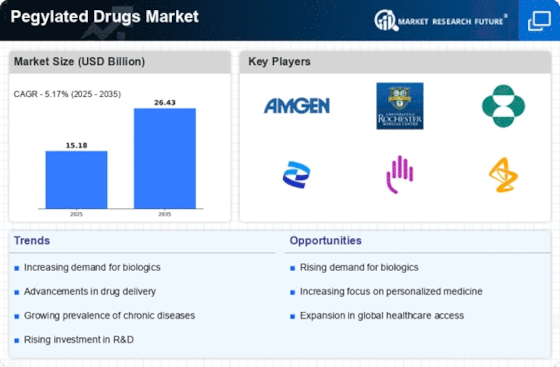
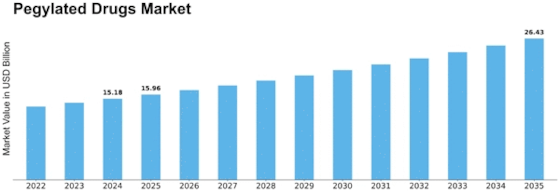
As per Market Research Future analysis, the Pegylated Drugs Market Size was estimated at 15.18 USD Billion in 2024. The Pegylated Drugs industry is projected to grow from 15.96 USD Billion in 2025 to 26.43 USD Billion by 2035, exhibiting a compound annual growth rate (CAGR) of 5.17% during the forecast period 2025 - 2035

Key Market Trends & Highlights

The Pegylated Drugs Market is experiencing robust growth driven by advancements in targeted therapies and increasing investment in biotechnology.

  • The market is witnessing a rising demand for targeted therapies, particularly in oncology, which remains the largest segment. Expansion in therapeutic applications is evident, with macromolecular drugs leading the market in terms of size. Increased investment in research and development is propelling growth, especially in the Asia-Pacific region, which is the fastest-growing market. Key drivers include the growing prevalence of chronic diseases and advancements in drug delivery systems, fostering a favorable environment for pegylated drugs.

Market Size & Forecast

2024 Market Size 15.18 (USD Billion)
2035 Market Size 26.43 (USD Billion)
CAGR (2025 - 2035) 5.17%
Largest Regional Market Share in 2024 North America

Major Players

Amgen (US), Roche (CH), Merck &amp; Co. (US), Pfizer (US), <a href="https://news.bms.com/news/details/2017/Bristol-Myers-Squibbs-BMS-986036-Pegylated-FGF21-Shows-Consistent-Improvement-in-Liver-Fat-Liver-Injury-and-Fibrosis-in-Patients-with-Nonalcoholic-Steatohepatitis-NASH-in-Phase-2-Trial/default.aspx">Bristol-Myers Squibb </a>(US), AstraZeneca (GB), Novartis (CH), Eli Lilly and Company (US), Teva Pharmaceutical Industries (IL)

Market Trends

The Pegylated Drugs Market is currently experiencing a dynamic evolution, driven by advancements in biotechnology and a growing understanding of the therapeutic benefits of pegylation. This innovative process enhances the pharmacokinetic properties of drugs, leading to improved efficacy and reduced side effects. As a result, there is an increasing demand for pegylated formulations across various therapeutic areas, including oncology, infectious diseases, and autoimmune disorders. The market landscape is characterized by a surge in research and development activities, with numerous pharmaceutical companies investing in the creation of novel pegylated drugs. This trend suggests a robust pipeline of products that may soon enter the market, potentially transforming treatment paradigms. Moreover, the Pegylated Drugs Market is witnessing a shift towards personalized medicine, where tailored therapies are becoming more prevalent. This approach aligns with the growing emphasis on patient-centric care, as healthcare providers seek to optimize treatment outcomes based on individual patient profiles. Additionally, regulatory agencies are increasingly supportive of innovative drug delivery systems, which may further facilitate the approval and adoption of pegylated therapies. Overall, the market appears poised for substantial growth, driven by technological advancements and a commitment to enhancing patient care.

Rising Demand for Targeted Therapies

The Pegylated Drugs Market is seeing a notable increase in the demand for targeted therapies. This trend is largely attributed to the growing recognition of the benefits of precision medicine, which aims to tailor treatments to individual patient needs. Pegylated drugs, with their enhanced delivery mechanisms, are particularly well-suited for this approach, as they can improve drug stability and reduce systemic toxicity.

Expansion in Therapeutic Applications

There is a discernible expansion in the therapeutic applications of pegylated drugs. Initially prominent in oncology, these formulations are now being explored for a wider range of conditions, including chronic diseases and rare disorders. This diversification indicates a broader acceptance of pegylation technology across various medical fields, potentially leading to new treatment options for patients.

Increased Investment in Research and Development

Investment in research and development within the Pegylated Drugs Market is on the rise. Pharmaceutical companies are allocating significant resources to explore innovative pegylation techniques and develop new formulations. This trend reflects a commitment to advancing drug efficacy and safety, as well as a response to the competitive landscape that demands continuous innovation.

PEGylated Drugs Market Market Drivers

Rising Investment in Biotechnology

The surge investment within the biotechnology sector is propelling the Pegylated Drugs Market forward. Venture capital and private equity funding are increasingly directed towards companies developing pegylated therapies, recognizing their potential to address unmet medical needs. This influx of capital enables research and development efforts to accelerate, leading to the introduction of novel pegylated drugs. The biotechnology sector is projected to grow at a CAGR of 10% through 2027, with pegylated drugs playing a pivotal role in this expansion. The financial backing not only supports innovation but also enhances competition within the market, ultimately benefiting patients through improved treatment options.

Advancements in Drug Delivery Systems

Innovations in drug delivery systems are significantly influencing the Pegylated Drugs Market. The incorporation of pegylation technology enhances the pharmacokinetics of drugs, allowing for more efficient delivery and improved therapeutic efficacy. This advancement is particularly relevant in oncology, where pegylated formulations can target tumors more effectively while minimizing side effects. The market is witnessing a shift towards personalized medicine, where pegylated drugs are tailored to individual patient profiles, further driving demand. As a result, the pegylated drugs segment is expected to grow at a compound annual growth rate (CAGR) of 8% over the next five years, indicating a robust market trajectory fueled by these technological advancements.

Growing Prevalence of Chronic Diseases

The rising incidence of chronic diseases such as cancer, diabetes, and autoimmune disorders is a primary driver for the Pegylated Drugs Market. As these conditions become more prevalent, the demand for effective treatment options increases. Pegylated drugs, known for their extended half-life and reduced immunogenicity, are increasingly utilized in therapeutic regimens. For instance, pegylated interferon is widely used in the treatment of hepatitis C, contributing to a substantial market share. The market for pegylated drugs is projected to reach USD 30 billion by 2026, reflecting the urgent need for innovative therapies that can improve patient outcomes. This trend underscores the importance of pegylated formulations in addressing the healthcare challenges posed by chronic diseases.

Regulatory Support for Biopharmaceuticals

Regulatory bodies are increasingly supportive of biopharmaceutical innovations, which is a crucial factor for the Pegylated Drugs Market. Streamlined approval processes and incentives for the development of pegylated drugs encourage pharmaceutical companies to invest in this area. For example, the FDA has established guidelines that facilitate the approval of pegylated formulations, recognizing their potential to improve therapeutic outcomes. This regulatory environment not only fosters innovation but also enhances market access for new pegylated drugs. As a result, the market is expected to expand, with an estimated increase in the number of approved pegylated drugs by 20% over the next few years, reflecting the positive impact of regulatory support.

Increasing Awareness and Acceptance of Biologics

There is a growing awareness and acceptance of biologics among healthcare professionals and patients, which is positively impacting the Pegylated Drugs Market. As more stakeholders recognize the benefits of biologic therapies, including pegylated drugs, the demand for these treatments is likely to rise. Educational initiatives and marketing efforts by pharmaceutical companies are contributing to this trend, highlighting the efficacy and safety profiles of pegylated formulations. The market for biologics is expected to reach USD 400 billion by 2025, with pegylated drugs constituting a significant portion of this growth. This increasing acceptance is crucial for the sustained expansion of the pegylated drugs market.

Market Segment Insights

By Molecule: Macromolecular Drugs (Largest) vs. Lipid Nanoparticles (Fastest-Growing)

In the Pegylated Drugs Market, the segment distribution reveals that Macromolecular Drugs hold a prominent share due to their extensive applications in chronic and rare disease treatments. These drugs are characterized by their large molecular size, which often translates to enhanced efficacy and better therapeutic outcomes. In contrast, Lipid Nanoparticles (LNP) are quickly gaining traction, especially in the context of mRNA therapies and vaccines, thus marking them as an emerging powerhouse in the segment.

Macromolecular Drugs (Dominant) vs. Liposomes (Emerging)

Macromolecular Drugs, with their high molecular weight and targeted delivery mechanisms, dominate the Pegylated Drugs Market, primarily used in oncology and autoimmune diseases. They offer prolonged circulation times and reduced immunogenicity through pegylation, making them a preferred choice among healthcare providers. On the other hand, Liposomes are emerging as a valuable delivery system for both macromolecules and small molecules, improving bioavailability and reducing toxicity. Their unique ability to encapsulate hydrophilic and hydrophobic drugs allows them to play a critical role in enhancing drug efficacy while minimizing side effects. This adaptability positions Liposomes as a promising segment within the industry.

By Application: Oncology (Largest) vs. Neurology (Fastest-Growing)

The Pegylated Drugs Market is predominantly driven by the oncology application, which commands the largest share in the market, owing to the increasing incidence of various cancers and advancements in targeted therapies. Oncology therapies utilizing pegylated drugs enhance the therapeutic efficacy and reduce side effects, making them preferred choices among healthcare providers. Neurology follows as the fastest-growing segment, driven by an increase in neurological disorders and the demand for innovative treatments.

Oncology (Dominant) vs. Neurology (Emerging)

Oncology remains the dominant application within the Pegylated Drugs Market, characterized by a robust pipeline of drugs designed to treat multiple cancer types effectively. The use of pegylated formulations not only prolongs drug circulation time but also enhances patient compliance due to reduced dosing frequency. In contrast, neurology is an emerging application driven by the increasing prevalence of neurological conditions such as Alzheimer’s and multiple sclerosis. This segment is witnessing rapid innovation, with newer pegylated drugs being developed to improve efficacy and minimize adverse effects, reflecting a strong trend towards personalized medicine in neurological care.

By Distribution Channel: Hospital Pharmacy (Largest) vs. Online Pharmacy (Fastest-Growing)

In the Pegylated Drugs Market, the distribution channel landscape is characterized by three primary avenues: Hospital Pharmacy, Online Pharmacy, and <a href="https://www.marketresearchfuture.com/reports/retail-pharmacy-market-22432">Retail Pharmacy.</a> Among these, Hospital Pharmacies hold the largest share, primarily due to the high volume of pegylated drugs utilized in in-patient treatments. Meanwhile, Retail Pharmacies have a steady presence, appealing to out-patients and those receiving drug treatments at home. Online Pharmacies, although currently smaller in market share, are rapidly gaining traction, meeting the growing demand for convenient access to medications.

Hospital Pharmacy (Dominant) vs. Online Pharmacy (Emerging)

Hospital Pharmacies play a crucial role in the Pegylated Drugs Market as they provide the essential drugs needed for complex treatments, particularly in oncology and <a href="https://www.marketresearchfuture.com/reports/chronic-disease-management-market-981">chronic disease management</a>. The dominance of these pharmacies stems from their ability to offer specialized services and sincere patient care. On the other hand, Online Pharmacies represent an emerging segment, leveraging e-commerce trends to reach patients directly. This growth can be attributed to a demand for convenience, especially among tech-savvy patients. The rise of telemedicine and increased accessibility of online services are further enhancing the appeal of online pharmacies, making them a formidable competitor in the distribution of pegylated drugs.

Get more detailed insights about Pegylated Drugs Market Research Report – Forecast Till 2035

Regional Insights

Based on the Region, the global Pegylated Drugs are segmented into North America, Europe, Asia-Pacific and Rest of the World. The North America dominated the global market in 2024, while the Asia-Pacific is projected to be the fastest–growing segment during the forecast period. Major demand factors driving the North America market are the increasing incidences of chronic diseases and advancements in biologics and recently approved Pegylated Drugs. 

The North America Pegylated Drugs market, encompassing the US and Canada, is witnessing robust growth, fueled by advancements in drug delivery systems and the rising demand for improved therapeutic outcomes. PEGylation, the process of attaching polyethylene glycol (PEG) to drugs, enhances their stability, reduces immunogenicity, and prolongs their half-life in the bloodstream. This technology has revolutionized the treatment of chronic diseases such as cancer, hepatitis, and autoimmune disorders, driving its adoption across the region.

FIGURE 3: PEGYLATED DRUGS MARKET VALUE BY REGION 2024 AND 2035 (USD BILLION)

Further, the countries considered in the scope of the Application Tracking System Market are the US, Canada, Germany, France, UK, Italy, Spain, China, India, Japan, Australia, South Korea, Middle East and Africa, South America and others.

Key Players and Competitive Insights

Many global, regional, and local vendors characterize the Pegylated Drugs Market. The market is highly competitive, with all the players competing to gain market share. Intense competition, rapid advances in technology, frequent changes in government policies, and environmental regulations are key factors that confront market growth. The vendors compete based on cost, product quality, reliability, and government regulations. Vendors must provide cost-efficient, high-quality products to survive and succeed in an intensely competitive market.The major competitors in the market are Amgen Inc., Pfizer Inc., Biogen, Bayer AG, Takeda Pharmaceutical Company Limited, Novo Nordisk A/S, Sandoz Group Ag, AstraZeneca, Coherus BioSciences, Inc., F. Hoffmann-La Roche Ltd, Johnson & Johnson Inc., Alnylam Pharmaceuticals, Inc., LES Laboratoires Servier are among others. The Pegylated Drugs Market is a consolidated market due to increasing competition, acquisitions, mergers and other strategic market developments and decisions to improve operational effectiveness.

Key Companies in the PEGylated Drugs Market include

Industry Developments

November 2024: Amgen presented new data from its rare disease portfolio and pipeline at the American College of Rheumatology (ACR) Convergence 2024 conference in Washington, D.C. The AGILE trial evaluated the safety, tolerability, and efficacy of KRYSTEXXA administered with a shorter infusion duration in patients with uncontrolled gout who received methotrexate as co-administration.

December 2024: Coherus BioSciences, Inc. announced that it had entered into an asset purchase agreement (the Agreement) dated December 2, 2024, with Intas Pharmaceuticals Ltd. (Intas) for the divestiture of the UDENYCA (pegfilgrastim-cbqv) franchise for up to $558.4 million.

October 2023: The FDA declined to approve Alnylam's Onpattro in ATTR-CM. The judgment has no bearing on Onpattro's current indication for another type of ATTR known as polyneuropathy, which affects peripheral nerves.

February 2021: Biogen received FDA Approval of PLEGRIDY (peginterferon beta-1a) Intramuscular Administration for Multiple Sclerosis.

Future Outlook

PEGylated Drugs Market Future Outlook

The Pegylated Drugs Market is projected to grow at a 5.17% CAGR from 2025 to 2035, driven by advancements in drug delivery systems and increasing chronic disease prevalence.

New opportunities lie in:

  • Expansion of biosimilar pegylated drugs in emerging markets.</p><p>Development of personalized pegylated therapies for oncology.</p><p>Investment in automated manufacturing technologies for cost efficiency.

By 2035, the Pegylated Drugs Market is expected to achieve substantial growth, reflecting evolving healthcare needs.

Market Segmentation

PEGylated Drugs Market Molecule Outlook

  • Macromolecular Drugs
  • Small Molecular Drugs
  • Lipid Nanoparticles (LNP)
  • Liposomes

PEGylated Drugs Market Application Outlook

  • Oncology
  • Neurology
  • Autoimmune Diseases
  • Rare Haematology
  • Others

PEGylated Drugs Market Distribution Channel Outlook

  • Hospital Pharmacy
  • Online Pharmacy
  • Retail Pharmacy

Report Scope

MARKET SIZE 2024 15.18(USD Billion)
MARKET SIZE 2025 15.96(USD Billion)
MARKET SIZE 2035 26.43(USD Billion)
COMPOUND ANNUAL GROWTH RATE (CAGR) 5.17% (2025 - 2035)
REPORT COVERAGE Revenue Forecast, Competitive Landscape, Growth Factors, and Trends
BASE YEAR 2024
Market Forecast Period 2025 - 2035
Historical Data 2019 - 2024
Market Forecast Units USD Billion
Key Companies Profiled Amgen (US), Roche (CH), Merck & Co. (US), Pfizer (US), Bristol-Myers Squibb (US), AstraZeneca (GB), Novartis (CH), Eli Lilly and Company (US), Teva Pharmaceutical Industries (IL)
Segments Covered Molecule, Application, Distribution Channel
Key Market Opportunities Advancements in targeted therapies enhance growth potential in the Pegylated Drugs Market.
Key Market Dynamics Rising demand for targeted therapies drives innovation and competition in the pegylated drugs market.
Countries Covered North America, Europe, APAC, South America, MEA

FAQs

What is the projected market valuation of the Pegylated Drugs Market by 2035?

<p>The Pegylated Drugs Market is projected to reach a valuation of 26.43 USD Billion by 2035.</p>

What was the market valuation of Pegylated Drugs in 2024?

<p>In 2024, the Pegylated Drugs Market was valued at 15.18 USD Billion.</p>

What is the expected CAGR for the Pegylated Drugs Market during the forecast period 2025 - 2035?

<p>The expected CAGR for the Pegylated Drugs Market during the forecast period 2025 - 2035 is 5.17%.</p>

Which companies are considered key players in the Pegylated Drugs Market?

<p>Key players in the Pegylated Drugs Market include Amgen, Roche, Merck & Co., Pfizer, and Bristol-Myers Squibb.</p>

What are the main segments of the Pegylated Drugs Market?

<p>The main segments of the Pegylated Drugs Market include Macromolecular Drugs, Small Molecular Drugs, Lipid Nanoparticles, and Liposomes.</p>

How does the Oncology segment perform in the Pegylated Drugs Market?

The Oncology segment was valued at 5.0 USD Billion in 2024 and is projected to grow to 8.5 USD Billion by 2035.

What is the valuation of the Retail Pharmacy distribution channel in the Pegylated Drugs Market?

The Retail Pharmacy distribution channel was valued at 7.18 USD Billion in 2024 and is expected to reach 12.93 USD Billion by 2035.

What is the projected growth for the Liposomes segment in the Pegylated Drugs Market?

The Liposomes segment was valued at 3.18 USD Billion in 2024 and is projected to grow to 6.43 USD Billion by 2035.

How does the distribution channel of Online Pharmacy compare to Hospital Pharmacy in the Pegylated Drugs Market?

In 2024, the Online Pharmacy channel was valued at 3.0 USD Billion, while Hospital Pharmacy was valued at 5.0 USD Billion.

What applications are driving growth in the Pegylated Drugs Market?

Applications such as Neurology and Autoimmune Diseases are driving growth, with valuations of 3.0 USD Billion and 2.5 USD Billion in 2024, respectively.

  1. SECTION I: EXECUTIVE SUMMARY AND KEY HIGHLIGHTS
    1. | 1.1 EXECUTIVE SUMMARY
    2. | | 1.1.1 Market Overview
    3. | | 1.1.2 Key Findings
    4. | | 1.1.3 Market Segmentation
    5. | | 1.1.4 Competitive Landscape
    6. | | 1.1.5 Challenges and Opportunities
    7. | | 1.1.6 Future Outlook
  2. SECTION II: SCOPING, METHODOLOGY AND MARKET STRUCTURE
    1. | 2.1 MARKET INTRODUCTION
    2. | | 2.1.1 Definition
    3. | | 2.1.2 Scope of the study
    4. | | | 2.1.2.1 Research Objective
    5. | | | 2.1.2.2 Assumption
    6. | | | 2.1.2.3 Limitations
    7. | 2.2 RESEARCH METHODOLOGY
    8. | | 2.2.1 Overview
    9. | | 2.2.2 Data Mining
    10. | | 2.2.3 Secondary Research
    11. | | 2.2.4 Primary Research
    12. | | | 2.2.4.1 Primary Interviews and Information Gathering Process
    13. | | | 2.2.4.2 Breakdown of Primary Respondents
    14. | | 2.2.5 Forecasting Model
    15. | | 2.2.6 Market Size Estimation
    16. | | | 2.2.6.1 Bottom-Up Approach
    17. | | | 2.2.6.2 Top-Down Approach
    18. | | 2.2.7 Data Triangulation
    19. | | 2.2.8 Validation
  3. SECTION III: QUALITATIVE ANALYSIS
    1. | 3.1 MARKET DYNAMICS
    2. | | 3.1.1 Overview
    3. | | 3.1.2 Drivers
    4. | | 3.1.3 Restraints
    5. | | 3.1.4 Opportunities
    6. | 3.2 MARKET FACTOR ANALYSIS
    7. | | 3.2.1 Value chain Analysis
    8. | | 3.2.2 Porter's Five Forces Analysis
    9. | | | 3.2.2.1 Bargaining Power of Suppliers
    10. | | | 3.2.2.2 Bargaining Power of Buyers
    11. | | | 3.2.2.3 Threat of New Entrants
    12. | | | 3.2.2.4 Threat of Substitutes
    13. | | | 3.2.2.5 Intensity of Rivalry
    14. | | 3.2.3 COVID-19 Impact Analysis
    15. | | | 3.2.3.1 Market Impact Analysis
    16. | | | 3.2.3.2 Regional Impact
    17. | | | 3.2.3.3 Opportunity and Threat Analysis
  4. SECTION IV: QUANTITATIVE ANALYSIS
    1. | 4.1 Healthcare, BY Molecule (USD Billion)
    2. | | 4.1.1 Macromolecular Drugs
    3. | | 4.1.2 Small Molecular Drugs
    4. | | 4.1.3 Lipid Nanoparticles (LNP)
    5. | | 4.1.4 Liposomes
    6. | 4.2 Healthcare, BY Application (USD Billion)
    7. | | 4.2.1 Oncology
    8. | | 4.2.2 Neurology
    9. | | 4.2.3 Autoimmune Diseases
    10. | | 4.2.4 Rare Haematology
    11. | | 4.2.5 Others
    12. | 4.3 Healthcare, BY Distribution Channel (USD Billion)
    13. | | 4.3.1 Hospital Pharmacy
    14. | | 4.3.2 Online Pharmacy
    15. | | 4.3.3 Retail Pharmacy
    16. | 4.4 Healthcare, BY Region (USD Billion)
    17. | | 4.4.1 North America
    18. | | | 4.4.1.1 US
    19. | | | 4.4.1.2 Canada
    20. | | 4.4.2 Europe
    21. | | | 4.4.2.1 Germany
    22. | | | 4.4.2.2 UK
    23. | | | 4.4.2.3 France
    24. | | | 4.4.2.4 Russia
    25. | | | 4.4.2.5 Italy
    26. | | | 4.4.2.6 Spain
    27. | | | 4.4.2.7 Rest of Europe
    28. | | 4.4.3 APAC
    29. | | | 4.4.3.1 China
    30. | | | 4.4.3.2 India
    31. | | | 4.4.3.3 Japan
    32. | | | 4.4.3.4 South Korea
    33. | | | 4.4.3.5 Malaysia
    34. | | | 4.4.3.6 Thailand
    35. | | | 4.4.3.7 Indonesia
    36. | | | 4.4.3.8 Rest of APAC
    37. | | 4.4.4 South America
    38. | | | 4.4.4.1 Brazil
    39. | | | 4.4.4.2 Mexico
    40. | | | 4.4.4.3 Argentina
    41. | | | 4.4.4.4 Rest of South America
    42. | | 4.4.5 MEA
    43. | | | 4.4.5.1 GCC Countries
    44. | | | 4.4.5.2 South Africa
    45. | | | 4.4.5.3 Rest of MEA
  5. SECTION V: COMPETITIVE ANALYSIS
    1. | 5.1 Competitive Landscape
    2. | | 5.1.1 Overview
    3. | | 5.1.2 Competitive Analysis
    4. | | 5.1.3 Market share Analysis
    5. | | 5.1.4 Major Growth Strategy in the Healthcare
    6. | | 5.1.5 Competitive Benchmarking
    7. | | 5.1.6 Leading Players in Terms of Number of Developments in the Healthcare
    8. | | 5.1.7 Key developments and growth strategies
    9. | | | 5.1.7.1 New Product Launch/Service Deployment
    10. | | | 5.1.7.2 Merger & Acquisitions
    11. | | | 5.1.7.3 Joint Ventures
    12. | | 5.1.8 Major Players Financial Matrix
    13. | | | 5.1.8.1 Sales and Operating Income
    14. | | | 5.1.8.2 Major Players R&D Expenditure. 2023
    15. | 5.2 Company Profiles
    16. | | 5.2.1 Amgen (US)
    17. | | | 5.2.1.1 Financial Overview
    18. | | | 5.2.1.2 Products Offered
    19. | | | 5.2.1.3 Key Developments
    20. | | | 5.2.1.4 SWOT Analysis
    21. | | | 5.2.1.5 Key Strategies
    22. | | 5.2.2 Roche (CH)
    23. | | | 5.2.2.1 Financial Overview
    24. | | | 5.2.2.2 Products Offered
    25. | | | 5.2.2.3 Key Developments
    26. | | | 5.2.2.4 SWOT Analysis
    27. | | | 5.2.2.5 Key Strategies
    28. | | 5.2.3 Merck & Co. (US)
    29. | | | 5.2.3.1 Financial Overview
    30. | | | 5.2.3.2 Products Offered
    31. | | | 5.2.3.3 Key Developments
    32. | | | 5.2.3.4 SWOT Analysis
    33. | | | 5.2.3.5 Key Strategies
    34. | | 5.2.4 Pfizer (US)
    35. | | | 5.2.4.1 Financial Overview
    36. | | | 5.2.4.2 Products Offered
    37. | | | 5.2.4.3 Key Developments
    38. | | | 5.2.4.4 SWOT Analysis
    39. | | | 5.2.4.5 Key Strategies
    40. | | 5.2.5 Bristol-Myers Squibb (US)
    41. | | | 5.2.5.1 Financial Overview
    42. | | | 5.2.5.2 Products Offered
    43. | | | 5.2.5.3 Key Developments
    44. | | | 5.2.5.4 SWOT Analysis
    45. | | | 5.2.5.5 Key Strategies
    46. | | 5.2.6 AstraZeneca (GB)
    47. | | | 5.2.6.1 Financial Overview
    48. | | | 5.2.6.2 Products Offered
    49. | | | 5.2.6.3 Key Developments
    50. | | | 5.2.6.4 SWOT Analysis
    51. | | | 5.2.6.5 Key Strategies
    52. | | 5.2.7 Novartis (CH)
    53. | | | 5.2.7.1 Financial Overview
    54. | | | 5.2.7.2 Products Offered
    55. | | | 5.2.7.3 Key Developments
    56. | | | 5.2.7.4 SWOT Analysis
    57. | | | 5.2.7.5 Key Strategies
    58. | | 5.2.8 Eli Lilly and Company (US)
    59. | | | 5.2.8.1 Financial Overview
    60. | | | 5.2.8.2 Products Offered
    61. | | | 5.2.8.3 Key Developments
    62. | | | 5.2.8.4 SWOT Analysis
    63. | | | 5.2.8.5 Key Strategies
    64. | | 5.2.9 Teva Pharmaceutical Industries (IL)
    65. | | | 5.2.9.1 Financial Overview
    66. | | | 5.2.9.2 Products Offered
    67. | | | 5.2.9.3 Key Developments
    68. | | | 5.2.9.4 SWOT Analysis
    69. | | | 5.2.9.5 Key Strategies
    70. | 5.3 Appendix
    71. | | 5.3.1 References
    72. | | 5.3.2 Related Reports
  6. LIST OF FIGURES
    1. | 6.1 MARKET SYNOPSIS
    2. | 6.2 NORTH AMERICA MARKET ANALYSIS
    3. | 6.3 US MARKET ANALYSIS BY MOLECULE
    4. | 6.4 US MARKET ANALYSIS BY APPLICATION
    5. | 6.5 US MARKET ANALYSIS BY DISTRIBUTION CHANNEL
    6. | 6.6 CANADA MARKET ANALYSIS BY MOLECULE
    7. | 6.7 CANADA MARKET ANALYSIS BY APPLICATION
    8. | 6.8 CANADA MARKET ANALYSIS BY DISTRIBUTION CHANNEL
    9. | 6.9 EUROPE MARKET ANALYSIS
    10. | 6.10 GERMANY MARKET ANALYSIS BY MOLECULE
    11. | 6.11 GERMANY MARKET ANALYSIS BY APPLICATION
    12. | 6.12 GERMANY MARKET ANALYSIS BY DISTRIBUTION CHANNEL
    13. | 6.13 UK MARKET ANALYSIS BY MOLECULE
    14. | 6.14 UK MARKET ANALYSIS BY APPLICATION
    15. | 6.15 UK MARKET ANALYSIS BY DISTRIBUTION CHANNEL
    16. | 6.16 FRANCE MARKET ANALYSIS BY MOLECULE
    17. | 6.17 FRANCE MARKET ANALYSIS BY APPLICATION
    18. | 6.18 FRANCE MARKET ANALYSIS BY DISTRIBUTION CHANNEL
    19. | 6.19 RUSSIA MARKET ANALYSIS BY MOLECULE
    20. | 6.20 RUSSIA MARKET ANALYSIS BY APPLICATION
    21. | 6.21 RUSSIA MARKET ANALYSIS BY DISTRIBUTION CHANNEL
    22. | 6.22 ITALY MARKET ANALYSIS BY MOLECULE
    23. | 6.23 ITALY MARKET ANALYSIS BY APPLICATION
    24. | 6.24 ITALY MARKET ANALYSIS BY DISTRIBUTION CHANNEL
    25. | 6.25 SPAIN MARKET ANALYSIS BY MOLECULE
    26. | 6.26 SPAIN MARKET ANALYSIS BY APPLICATION
    27. | 6.27 SPAIN MARKET ANALYSIS BY DISTRIBUTION CHANNEL
    28. | 6.28 REST OF EUROPE MARKET ANALYSIS BY MOLECULE
    29. | 6.29 REST OF EUROPE MARKET ANALYSIS BY APPLICATION
    30. | 6.30 REST OF EUROPE MARKET ANALYSIS BY DISTRIBUTION CHANNEL
    31. | 6.31 APAC MARKET ANALYSIS
    32. | 6.32 CHINA MARKET ANALYSIS BY MOLECULE
    33. | 6.33 CHINA MARKET ANALYSIS BY APPLICATION
    34. | 6.34 CHINA MARKET ANALYSIS BY DISTRIBUTION CHANNEL
    35. | 6.35 INDIA MARKET ANALYSIS BY MOLECULE
    36. | 6.36 INDIA MARKET ANALYSIS BY APPLICATION
    37. | 6.37 INDIA MARKET ANALYSIS BY DISTRIBUTION CHANNEL
    38. | 6.38 JAPAN MARKET ANALYSIS BY MOLECULE
    39. | 6.39 JAPAN MARKET ANALYSIS BY APPLICATION
    40. | 6.40 JAPAN MARKET ANALYSIS BY DISTRIBUTION CHANNEL
    41. | 6.41 SOUTH KOREA MARKET ANALYSIS BY MOLECULE
    42. | 6.42 SOUTH KOREA MARKET ANALYSIS BY APPLICATION
    43. | 6.43 SOUTH KOREA MARKET ANALYSIS BY DISTRIBUTION CHANNEL
    44. | 6.44 MALAYSIA MARKET ANALYSIS BY MOLECULE
    45. | 6.45 MALAYSIA MARKET ANALYSIS BY APPLICATION
    46. | 6.46 MALAYSIA MARKET ANALYSIS BY DISTRIBUTION CHANNEL
    47. | 6.47 THAILAND MARKET ANALYSIS BY MOLECULE
    48. | 6.48 THAILAND MARKET ANALYSIS BY APPLICATION
    49. | 6.49 THAILAND MARKET ANALYSIS BY DISTRIBUTION CHANNEL
    50. | 6.50 INDONESIA MARKET ANALYSIS BY MOLECULE
    51. | 6.51 INDONESIA MARKET ANALYSIS BY APPLICATION
    52. | 6.52 INDONESIA MARKET ANALYSIS BY DISTRIBUTION CHANNEL
    53. | 6.53 REST OF APAC MARKET ANALYSIS BY MOLECULE
    54. | 6.54 REST OF APAC MARKET ANALYSIS BY APPLICATION
    55. | 6.55 REST OF APAC MARKET ANALYSIS BY DISTRIBUTION CHANNEL
    56. | 6.56 SOUTH AMERICA MARKET ANALYSIS
    57. | 6.57 BRAZIL MARKET ANALYSIS BY MOLECULE
    58. | 6.58 BRAZIL MARKET ANALYSIS BY APPLICATION
    59. | 6.59 BRAZIL MARKET ANALYSIS BY DISTRIBUTION CHANNEL
    60. | 6.60 MEXICO MARKET ANALYSIS BY MOLECULE
    61. | 6.61 MEXICO MARKET ANALYSIS BY APPLICATION
    62. | 6.62 MEXICO MARKET ANALYSIS BY DISTRIBUTION CHANNEL
    63. | 6.63 ARGENTINA MARKET ANALYSIS BY MOLECULE
    64. | 6.64 ARGENTINA MARKET ANALYSIS BY APPLICATION
    65. | 6.65 ARGENTINA MARKET ANALYSIS BY DISTRIBUTION CHANNEL
    66. | 6.66 REST OF SOUTH AMERICA MARKET ANALYSIS BY MOLECULE
    67. | 6.67 REST OF SOUTH AMERICA MARKET ANALYSIS BY APPLICATION
    68. | 6.68 REST OF SOUTH AMERICA MARKET ANALYSIS BY DISTRIBUTION CHANNEL
    69. | 6.69 MEA MARKET ANALYSIS
    70. | 6.70 GCC COUNTRIES MARKET ANALYSIS BY MOLECULE
    71. | 6.71 GCC COUNTRIES MARKET ANALYSIS BY APPLICATION
    72. | 6.72 GCC COUNTRIES MARKET ANALYSIS BY DISTRIBUTION CHANNEL
    73. | 6.73 SOUTH AFRICA MARKET ANALYSIS BY MOLECULE
    74. | 6.74 SOUTH AFRICA MARKET ANALYSIS BY APPLICATION
    75. | 6.75 SOUTH AFRICA MARKET ANALYSIS BY DISTRIBUTION CHANNEL
    76. | 6.76 REST OF MEA MARKET ANALYSIS BY MOLECULE
    77. | 6.77 REST OF MEA MARKET ANALYSIS BY APPLICATION
    78. | 6.78 REST OF MEA MARKET ANALYSIS BY DISTRIBUTION CHANNEL
    79. | 6.79 KEY BUYING CRITERIA OF HEALTHCARE
    80. | 6.80 RESEARCH PROCESS OF MRFR
    81. | 6.81 DRO ANALYSIS OF HEALTHCARE
    82. | 6.82 DRIVERS IMPACT ANALYSIS: HEALTHCARE
    83. | 6.83 RESTRAINTS IMPACT ANALYSIS: HEALTHCARE
    84. | 6.84 SUPPLY / VALUE CHAIN: HEALTHCARE
    85. | 6.85 HEALTHCARE, BY MOLECULE, 2024 (% SHARE)
    86. | 6.86 HEALTHCARE, BY MOLECULE, 2024 TO 2035 (USD Billion)
    87. | 6.87 HEALTHCARE, BY APPLICATION, 2024 (% SHARE)
    88. | 6.88 HEALTHCARE, BY APPLICATION, 2024 TO 2035 (USD Billion)
    89. | 6.89 HEALTHCARE, BY DISTRIBUTION CHANNEL, 2024 (% SHARE)
    90. | 6.90 HEALTHCARE, BY DISTRIBUTION CHANNEL, 2024 TO 2035 (USD Billion)
    91. | 6.91 BENCHMARKING OF MAJOR COMPETITORS
  7. LIST OF TABLES
    1. | 7.1 LIST OF ASSUMPTIONS
    2. | | 7.1.1
    3. | 7.2 North America MARKET SIZE ESTIMATES; FORECAST
    4. | | 7.2.1 BY MOLECULE, 2025-2035 (USD Billion)
    5. | | 7.2.2 BY APPLICATION, 2025-2035 (USD Billion)
    6. | | 7.2.3 BY DISTRIBUTION CHANNEL, 2025-2035 (USD Billion)
    7. | 7.3 US MARKET SIZE ESTIMATES; FORECAST
    8. | | 7.3.1 BY MOLECULE, 2025-2035 (USD Billion)
    9. | | 7.3.2 BY APPLICATION, 2025-2035 (USD Billion)
    10. | | 7.3.3 BY DISTRIBUTION CHANNEL, 2025-2035 (USD Billion)
    11. | 7.4 Canada MARKET SIZE ESTIMATES; FORECAST
    12. | | 7.4.1 BY MOLECULE, 2025-2035 (USD Billion)
    13. | | 7.4.2 BY APPLICATION, 2025-2035 (USD Billion)
    14. | | 7.4.3 BY DISTRIBUTION CHANNEL, 2025-2035 (USD Billion)
    15. | 7.5 Europe MARKET SIZE ESTIMATES; FORECAST
    16. | | 7.5.1 BY MOLECULE, 2025-2035 (USD Billion)
    17. | | 7.5.2 BY APPLICATION, 2025-2035 (USD Billion)
    18. | | 7.5.3 BY DISTRIBUTION CHANNEL, 2025-2035 (USD Billion)
    19. | 7.6 Germany MARKET SIZE ESTIMATES; FORECAST
    20. | | 7.6.1 BY MOLECULE, 2025-2035 (USD Billion)
    21. | | 7.6.2 BY APPLICATION, 2025-2035 (USD Billion)
    22. | | 7.6.3 BY DISTRIBUTION CHANNEL, 2025-2035 (USD Billion)
    23. | 7.7 UK MARKET SIZE ESTIMATES; FORECAST
    24. | | 7.7.1 BY MOLECULE, 2025-2035 (USD Billion)
    25. | | 7.7.2 BY APPLICATION, 2025-2035 (USD Billion)
    26. | | 7.7.3 BY DISTRIBUTION CHANNEL, 2025-2035 (USD Billion)
    27. | 7.8 France MARKET SIZE ESTIMATES; FORECAST
    28. | | 7.8.1 BY MOLECULE, 2025-2035 (USD Billion)
    29. | | 7.8.2 BY APPLICATION, 2025-2035 (USD Billion)
    30. | | 7.8.3 BY DISTRIBUTION CHANNEL, 2025-2035 (USD Billion)
    31. | 7.9 Russia MARKET SIZE ESTIMATES; FORECAST
    32. | | 7.9.1 BY MOLECULE, 2025-2035 (USD Billion)
    33. | | 7.9.2 BY APPLICATION, 2025-2035 (USD Billion)
    34. | | 7.9.3 BY DISTRIBUTION CHANNEL, 2025-2035 (USD Billion)
    35. | 7.10 Italy MARKET SIZE ESTIMATES; FORECAST
    36. | | 7.10.1 BY MOLECULE, 2025-2035 (USD Billion)
    37. | | 7.10.2 BY APPLICATION, 2025-2035 (USD Billion)
    38. | | 7.10.3 BY DISTRIBUTION CHANNEL, 2025-2035 (USD Billion)
    39. | 7.11 Spain MARKET SIZE ESTIMATES; FORECAST
    40. | | 7.11.1 BY MOLECULE, 2025-2035 (USD Billion)
    41. | | 7.11.2 BY APPLICATION, 2025-2035 (USD Billion)
    42. | | 7.11.3 BY DISTRIBUTION CHANNEL, 2025-2035 (USD Billion)
    43. | 7.12 Rest of Europe MARKET SIZE ESTIMATES; FORECAST
    44. | | 7.12.1 BY MOLECULE, 2025-2035 (USD Billion)
    45. | | 7.12.2 BY APPLICATION, 2025-2035 (USD Billion)
    46. | | 7.12.3 BY DISTRIBUTION CHANNEL, 2025-2035 (USD Billion)
    47. | 7.13 APAC MARKET SIZE ESTIMATES; FORECAST
    48. | | 7.13.1 BY MOLECULE, 2025-2035 (USD Billion)
    49. | | 7.13.2 BY APPLICATION, 2025-2035 (USD Billion)
    50. | | 7.13.3 BY DISTRIBUTION CHANNEL, 2025-2035 (USD Billion)
    51. | 7.14 China MARKET SIZE ESTIMATES; FORECAST
    52. | | 7.14.1 BY MOLECULE, 2025-2035 (USD Billion)
    53. | | 7.14.2 BY APPLICATION, 2025-2035 (USD Billion)
    54. | | 7.14.3 BY DISTRIBUTION CHANNEL, 2025-2035 (USD Billion)
    55. | 7.15 India MARKET SIZE ESTIMATES; FORECAST
    56. | | 7.15.1 BY MOLECULE, 2025-2035 (USD Billion)
    57. | | 7.15.2 BY APPLICATION, 2025-2035 (USD Billion)
    58. | | 7.15.3 BY DISTRIBUTION CHANNEL, 2025-2035 (USD Billion)
    59. | 7.16 Japan MARKET SIZE ESTIMATES; FORECAST
    60. | | 7.16.1 BY MOLECULE, 2025-2035 (USD Billion)
    61. | | 7.16.2 BY APPLICATION, 2025-2035 (USD Billion)
    62. | | 7.16.3 BY DISTRIBUTION CHANNEL, 2025-2035 (USD Billion)
    63. | 7.17 South Korea MARKET SIZE ESTIMATES; FORECAST
    64. | | 7.17.1 BY MOLECULE, 2025-2035 (USD Billion)
    65. | | 7.17.2 BY APPLICATION, 2025-2035 (USD Billion)
    66. | | 7.17.3 BY DISTRIBUTION CHANNEL, 2025-2035 (USD Billion)
    67. | 7.18 Malaysia MARKET SIZE ESTIMATES; FORECAST
    68. | | 7.18.1 BY MOLECULE, 2025-2035 (USD Billion)
    69. | | 7.18.2 BY APPLICATION, 2025-2035 (USD Billion)
    70. | | 7.18.3 BY DISTRIBUTION CHANNEL, 2025-2035 (USD Billion)
    71. | 7.19 Thailand MARKET SIZE ESTIMATES; FORECAST
    72. | | 7.19.1 BY MOLECULE, 2025-2035 (USD Billion)
    73. | | 7.19.2 BY APPLICATION, 2025-2035 (USD Billion)
    74. | | 7.19.3 BY DISTRIBUTION CHANNEL, 2025-2035 (USD Billion)
    75. | 7.20 Indonesia MARKET SIZE ESTIMATES; FORECAST
    76. | | 7.20.1 BY MOLECULE, 2025-2035 (USD Billion)
    77. | | 7.20.2 BY APPLICATION, 2025-2035 (USD Billion)
    78. | | 7.20.3 BY DISTRIBUTION CHANNEL, 2025-2035 (USD Billion)
    79. | 7.21 Rest of APAC MARKET SIZE ESTIMATES; FORECAST
    80. | | 7.21.1 BY MOLECULE, 2025-2035 (USD Billion)
    81. | | 7.21.2 BY APPLICATION, 2025-2035 (USD Billion)
    82. | | 7.21.3 BY DISTRIBUTION CHANNEL, 2025-2035 (USD Billion)
    83. | 7.22 South America MARKET SIZE ESTIMATES; FORECAST
    84. | | 7.22.1 BY MOLECULE, 2025-2035 (USD Billion)
    85. | | 7.22.2 BY APPLICATION, 2025-2035 (USD Billion)
    86. | | 7.22.3 BY DISTRIBUTION CHANNEL, 2025-2035 (USD Billion)
    87. | 7.23 Brazil MARKET SIZE ESTIMATES; FORECAST
    88. | | 7.23.1 BY MOLECULE, 2025-2035 (USD Billion)
    89. | | 7.23.2 BY APPLICATION, 2025-2035 (USD Billion)
    90. | | 7.23.3 BY DISTRIBUTION CHANNEL, 2025-2035 (USD Billion)
    91. | 7.24 Mexico MARKET SIZE ESTIMATES; FORECAST
    92. | | 7.24.1 BY MOLECULE, 2025-2035 (USD Billion)
    93. | | 7.24.2 BY APPLICATION, 2025-2035 (USD Billion)
    94. | | 7.24.3 BY DISTRIBUTION CHANNEL, 2025-2035 (USD Billion)
    95. | 7.25 Argentina MARKET SIZE ESTIMATES; FORECAST
    96. | | 7.25.1 BY MOLECULE, 2025-2035 (USD Billion)
    97. | | 7.25.2 BY APPLICATION, 2025-2035 (USD Billion)
    98. | | 7.25.3 BY DISTRIBUTION CHANNEL, 2025-2035 (USD Billion)
    99. | 7.26 Rest of South America MARKET SIZE ESTIMATES; FORECAST
    100. | | 7.26.1 BY MOLECULE, 2025-2035 (USD Billion)
    101. | | 7.26.2 BY APPLICATION, 2025-2035 (USD Billion)
    102. | | 7.26.3 BY DISTRIBUTION CHANNEL, 2025-2035 (USD Billion)
    103. | 7.27 MEA MARKET SIZE ESTIMATES; FORECAST
    104. | | 7.27.1 BY MOLECULE, 2025-2035 (USD Billion)
    105. | | 7.27.2 BY APPLICATION, 2025-2035 (USD Billion)
    106. | | 7.27.3 BY DISTRIBUTION CHANNEL, 2025-2035 (USD Billion)
    107. | 7.28 GCC Countries MARKET SIZE ESTIMATES; FORECAST
    108. | | 7.28.1 BY MOLECULE, 2025-2035 (USD Billion)
    109. | | 7.28.2 BY APPLICATION, 2025-2035 (USD Billion)
    110. | | 7.28.3 BY DISTRIBUTION CHANNEL, 2025-2035 (USD Billion)
    111. | 7.29 South Africa MARKET SIZE ESTIMATES; FORECAST
    112. | | 7.29.1 BY MOLECULE, 2025-2035 (USD Billion)
    113. | | 7.29.2 BY APPLICATION, 2025-2035 (USD Billion)
    114. | | 7.29.3 BY DISTRIBUTION CHANNEL, 2025-2035 (USD Billion)
    115. | 7.30 Rest of MEA MARKET SIZE ESTIMATES; FORECAST
    116. | | 7.30.1 BY MOLECULE, 2025-2035 (USD Billion)
    117. | | 7.30.2 BY APPLICATION, 2025-2035 (USD Billion)
    118. | | 7.30.3 BY DISTRIBUTION CHANNEL, 2025-2035 (USD Billion)
    119. | 7.31 PRODUCT LAUNCH/PRODUCT DEVELOPMENT/APPROVAL
    120. | | 7.31.1
    121. | 7.32 ACQUISITION/PARTNERSHIP
    122. | | 7.32.1

Healthcare Market Segmentation

Healthcare By Molecule (USD Billion, 2025-2035)

  • Macromolecular Drugs
  • Small Molecular Drugs
  • Lipid Nanoparticles (LNP)
  • Liposomes

Healthcare By Application (USD Billion, 2025-2035)

  • Oncology
  • Neurology
  • Autoimmune Diseases
  • Rare Haematology
  • Others

Healthcare By Distribution Channel (USD Billion, 2025-2035)

  • Hospital Pharmacy
  • Online Pharmacy
  • Retail Pharmacy
Infographic

Free Sample Request

Kindly complete the form below to receive a free sample of this Report

Get Free Sample

Customer Strories

Compare Licence

×
Features License Type
Single User Multiuser License Enterprise User
Price $4,950 $5,950 $7,250
Maximum User Access Limit 1 User Upto 10 Users Unrestricted Access Throughout the Organization
Free Customization
Direct Access to Analyst
Deliverable Format
Platform Access
Discount on Next Purchase 10% 15% 15%
Printable Versions