×
Request Free Sample ×

Kindly complete the form below to receive a free sample of this Report

* Please use a valid business email

Leading companies partner with us for data-driven Insights

clients tt-cursor
Hero Background
English
Chinese
French
Japanese
Korean
German
Spanish

Particle Therapy Market Trends

ID: MRFR/MED/5535-HCR
85 Pages
Kinjoll Dey
October 2025

Particle Therapy Market Research Report: Size, Share, Trend Analysis By Types (Proton Therapy & Heavy Ion Therapy), Product & Service (Products & Others), Cancer Type (Prostate, Lung), System (Multi-Room & Single Room), Application (Treatment & Research) —  Forecast till 2035

Share:
Download PDF ×

We do not share your information with anyone. However, we may send you emails based on your report interest from time to time. You may contact us at any time to opt-out.

Particle Therapy Market Infographic
×
Particle Therapy Market Infographic Full View
Purchase Options

Market Trends

Key Emerging Trends in the Particle Therapy Market

Recently, the particle therapy market has been experiencing significant movements. These trends are driven by technological advancement, rising cancer prevalence, and a growing awareness of the benefits offered by this novel treatment method. One key market trend is that the use of particle therapy as the preferred option for various cancer types is increasing at an alarming rate. In delivering high doses to tumors located near critical organs, traditional radiation therapy methods may be challenging. However, particle therapy addresses this challenge by allowing more focused targeting, hence reducing the risks of affecting healthy tissues around them. Thus, healthcare providers are currently incorporating particle therapy in their cancer treatment plans, thus contributing to the growth of the market. In addition, technology continues to shape particle therapy market dynamics considerably. Ongoing research and development efforts have resulted in advanced particle therapy systems with improved precision, efficiency, and patient outcomes, among other aspects. Some of these advances consist of real-time imaging during treatment, which enhances the accuracy of tumor targeting. Moreover, these market trends illustrate a rise in strategic partnerships and alliances between major companies related to the particle therapies industry that exist today. Collaboration between healthcare providers and research agencies with key players within the industry facilitates the sharing of expertise, resources, and technology. It also accelerates the development and implementation of new solutions for particle therapies, therefore making it more comprehensive and accessible in terms of cancer treatments. Furthermore, an increase in global cancer incidences significantly drives demand for particle therapy as a market player. The surge in cases has necessitated the need for sophisticated therapeutic interventions that can achieve effective results against cancers, which are becoming incisive now and then due to several factors, such as environmental pollution or lifestyle factors, among others. The targeted nature and precision involved when using particle therapies make it an attractive option for both patient and caregivers' consideration, particularly those who regard cost implications prior to diagnosis. Nonetheless, until recently, there were issues about cost-effectiveness, which hindered the spread of particle therapy. However, there seems to be a shift in these trends over the past few years. The increasing maturity and diffusion of technology have resulted in more emphasis on expenses and reimbursement models applied in the industry. Thus, streamlining workflow, improving treatment efficiency, and reducing equipment costs will make this technique more economically feasible, thereby increasing its acceptance by the market.

Author
Kinjoll Dey
Research Analyst Level I

He is an extremely curious individual currently working in Healthcare and Medical Devices Domain. Kinjoll is comfortably versed in data centric research backed by healthcare educational background. He leverages extensive data mining and analytics tools such as Primary and Secondary Research, Statistical Analysis, Machine Learning, Data Modelling. His key role also involves Technical Sales Support, Client Interaction and Project management within the Healthcare team. Lastly, he showcases extensive affinity towards learning new skills and remain fascinated in implementing them.

Leave a Comment

FAQs

What is the latest valuation of the particle therapy market?

The latest valuation of the particle therapy market in 2032 was USD 2.40 Billion.

What is the projected CAGR for the particle therapy market during the forecast period of 2024 to 2032?

The forecasted CAGR for the particle therapy market is 9.89% for the duration of 2024 to 2032.

What would be the driving factors for the particle therapy market?

The particle therapy market would be driven by factors like rising cases of cancer, an increasing number of particle therapy center, low risk of treatment, and potential retreatment opportunity can trigger better market growth.

Which application segment would lead the global particle therapy market?

The pediatric cancer segment has the opportunity to register the highest growth in the particle therapy market.

Which region has the upper hand in the particle therapy market?

The Americas has the setup to continue their domination of the particle therapy market.

Market Summary

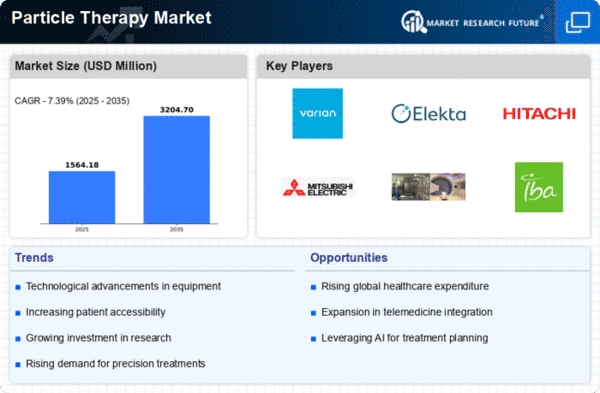
As per MRFR analysis, the Particle Therapy Market Size was estimated at 1456.54 USD Million in 2024. The Particle Therapy industry is projected to grow from 1580.87 USD Million in 2025 to 3204.7 USD Million by 2035, exhibiting a compound annual growth rate (CAGR) of 7.39 during the forecast period 2025 - 2035.

Key Market Trends & Highlights

The Particle Therapy Market is experiencing robust growth driven by technological advancements and increasing demand for non-invasive treatments.

  • Technological advancements in particle therapy are enhancing treatment precision and patient outcomes. North America remains the largest market, while the Asia-Pacific region is emerging as the fastest-growing market for particle therapy. Oncology continues to dominate the market, with proton therapy leading in terms of market share, whereas carbon ion therapy is gaining traction rapidly. The rising incidence of cancer and growing awareness of non-invasive treatment options are key drivers propelling market expansion.

Market Size & Forecast

2024 Market Size 1456.54 (USD Million)
2035 Market Size 3204.7 (USD Million)
CAGR (2025 - 2035) 7.39%
Largest Regional Market Share in 2024 North America

Major Players

<a href="https://www.varian.com/products">Varian Medical Systems</a> (US), Elekta AB (SE), Hitachi Ltd (JP), Mitsubishi Electric Corporation (JP), Proton Therapy Solutions (US), Ion Beam Applications (BE), Accuray Incorporated (US), RaySearch Laboratories (SE), Siemens Healthineers (DE)

Market Trends

The Particle Therapy Market is currently experiencing a notable evolution, driven by advancements in technology and an increasing recognition of the benefits associated with particle therapy. This innovative treatment modality, which utilizes charged particles such as protons and carbon ions, offers a more targeted approach to cancer treatment compared to conventional methods. As healthcare providers and patients alike become more aware of the potential advantages, including reduced side effects and improved outcomes, the demand for particle therapy facilities is likely to rise. Furthermore, ongoing research and clinical trials continue to expand the applications of particle therapy, suggesting a promising future for this sector. In addition to technological advancements, the Particle Therapy Market is influenced by the growing emphasis on personalized medicine. As treatment becomes more tailored to individual patient needs, the role of particle therapy is expected to become increasingly prominent. The integration of artificial intelligence and machine learning into treatment planning may further enhance the precision and effectiveness of particle therapy. Overall, the Particle Therapy Market appears poised for growth, with a focus on innovation and patient-centered care driving its development.

Technological Advancements

Recent innovations in particle therapy equipment and techniques are enhancing treatment precision and efficacy. Newer technologies, such as advanced imaging systems and treatment planning software, are likely to improve patient outcomes and streamline operational processes.

Personalized Medicine

The shift towards personalized medicine is influencing the Particle Therapy Market significantly. Tailoring treatments to individual patient profiles may lead to better therapeutic results, thereby increasing the adoption of particle therapy in clinical settings.

Expansion of Treatment Facilities

The establishment of new particle therapy centers is on the rise, reflecting the growing demand for advanced cancer treatment options. This trend may facilitate greater access to particle therapy, particularly in regions previously underserved by such technologies.

Particle Therapy Market Market Drivers

Technological Advancements

Technological innovations play a pivotal role in the Global Particle Therapy Market Industry. The development of advanced particle accelerators and imaging technologies enhances the efficacy and safety of treatments. Innovations such as real-time imaging and adaptive therapy allow for personalized treatment plans, improving patient outcomes. As technology continues to evolve, the cost of particle therapy systems is expected to decrease, making them more accessible. This trend is likely to attract more healthcare facilities to invest in particle therapy, contributing to the market's growth. By 2035, the market could potentially reach 3.18 USD Billion, driven by these advancements.

Increasing Cancer Incidence

The Global Particle Therapy Market Industry is significantly driven by the rising incidence of cancer worldwide. As per recent statistics, cancer cases are projected to increase, necessitating advanced treatment modalities. Particle therapy, particularly proton therapy, offers targeted treatment with minimal damage to surrounding healthy tissues. This precision is crucial for treating complex tumors, which are becoming more prevalent. The market is expected to reach 1.7 USD Billion in 2024, reflecting the growing demand for innovative cancer treatments. The increasing awareness among patients and healthcare providers about the benefits of particle therapy further propels market growth.

Expansion of Treatment Centers

The expansion of treatment centers offering particle therapy is a significant driver of the Global Particle Therapy Market Industry. As more hospitals and specialized cancer treatment centers incorporate particle therapy into their treatment offerings, patient access to these advanced therapies increases. This expansion is often supported by partnerships between healthcare institutions and technology providers, facilitating the establishment of new facilities equipped with state-of-the-art particle therapy systems. The growing number of treatment centers not only enhances patient access but also fosters competition, potentially leading to improved treatment options and reduced costs. This trend is expected to contribute to the overall market growth.

Growing Awareness and Acceptance

The growing awareness and acceptance of particle therapy among patients and healthcare professionals are crucial drivers of the Global Particle Therapy Market Industry. Educational campaigns and clinical trial results highlighting the effectiveness of particle therapy in treating various cancers have led to increased patient demand. As more patients seek out advanced treatment options, healthcare providers are more inclined to offer particle therapy services. This trend is further supported by patient advocacy groups that promote awareness of innovative cancer treatments. Consequently, the market is poised for growth as acceptance of particle therapy continues to rise.

Government Initiatives and Funding

Government initiatives and funding significantly influence the Global Particle Therapy Market Industry. Various countries are recognizing the importance of advanced cancer treatment options and are investing in research and infrastructure for particle therapy. For instance, several governments have launched programs to subsidize the costs of particle therapy equipment and treatment, making it more accessible to patients. This support not only enhances the availability of particle therapy but also encourages healthcare providers to adopt these technologies. As a result, the market is likely to experience robust growth, with a projected CAGR of 5.87% from 2025 to 2035.

Market Segment Insights

By Application: Oncology (Largest) vs. Cardiology (Fastest-Growing)

In the Particle Therapy Market, Oncology stands out as the largest application segment, commanding the majority share due to the increasing prevalence of cancer and rising awareness of advanced treatment options. Other applications such as Cardiology, Neurology, and Pediatrics, while significant, hold comparatively smaller shares, with Cardiology witnessing notable advancements and adoption rates.

Oncology (Dominant) vs. Cardiology (Emerging)

Oncology is currently the dominant application segment in the Particle Therapy Market, driven by a wide range of therapies designed to treat different types of cancer, including proton and heavy ion therapies. Its established infrastructure and ongoing research support further enhance its market position. Conversely, Cardiology represents an emerging application segment, gaining traction through innovative treatments targeting cardiovascular diseases. With advancements in particle therapy techniques specifically aimed at heart-related ailments, Cardiology is expected to grow rapidly, reflecting increased investment and interest in non-invasive therapeutic options.

By Technology: Proton Therapy (Largest) vs. Carbon Ion Therapy (Fastest-Growing)

The technology segment of the Particle Therapy Market is characterized by a diverse range of treatment modalities, including Proton Therapy, Heavy Ion Therapy, Carbon Ion Therapy, and Neutron Therapy. Proton Therapy holds the largest share, owing to its well-established clinical efficacy and widespread adoption in cancer treatment. In contrast, Carbon Ion Therapy, while currently smaller in market share, is rapidly gaining traction due to its unique ability to deliver higher doses of radiation with precision, making it particularly effective for certain tumors.

Technology: Proton Therapy (Dominant) vs. Carbon Ion Therapy (Emerging)

Proton Therapy has emerged as the dominant technology in the Particle Therapy Market, primarily due to its precision in targeting tumors while minimizing damage to surrounding healthy tissues. This technology has been integrated into numerous cancer treatment centers, receiving substantial clinical validation. Meanwhile, Carbon Ion Therapy represents an emerging trend, distinguished by its high biological effectiveness against resistant cancers. As the demand for advanced cancer treatment options escalates, Carbon Ion Therapy's innovative approach and ability to deliver targeted treatment are expected to foster its market evolution, attracting investment in research and development.

By End Use: Cancer Treatment Centers (Largest) vs. Hospitals (Fastest-Growing)

The Particle Therapy Market is segmented by end use into Hospitals, Cancer Treatment Centers, Research Institutions, and Academic Institutions. Among these, Cancer Treatment Centers hold the largest market share, owing to their specialized services and facilities dedicated to advanced cancer therapies. Hospitals are witnessing significant adoption due to the increasing incorporation of particle therapy in comprehensive cancer treatment plans, thereby growing their significance in this market segment.

Hospitals (Growing) vs. Cancer Treatment Centers (Dominant)

Cancer Treatment Centers are currently the dominant players in the Particle Therapy Market, as they possess the infrastructure and specialized staff required for high-quality cancer treatment. Conversely, Hospitals are emerging as a rapidly growing segment due to the increasing demand for advanced treatment techniques in general healthcare settings. The convergence of technical advancements and improved patient outcomes in hospitals is driving their growth. Both segments illustrate unique characteristics, with Cancer Treatment Centers focusing on specialized solutions and Hospitals expanding their capabilities to offer comprehensive treatment options.

By Patient Type: Adult (Largest) vs. Pediatric (Fastest-Growing)

In the Particle Therapy Market, the distribution of patient types reveals that adults represent the largest segment due to the prevalence of cancer among this demographic. The aging population and increased screening for various cancers contribute significantly to this trend. Pediatric patients, while constituting a smaller share, are emerging rapidly, driven by rising incidences of childhood cancers and advancements in treatment options tailored for younger patients. These dynamics paint a picture of a diverse market shaped by varying patient needs across age groups.

Adult (Dominant) vs. Pediatric (Emerging)

The Adult patient segment remains dominant in the Particle Therapy Market, accounting for a significant portion of overall treatments due to higher rates of cancer incidences in this population. The advancements in technology have made it more accessible and effective for treating various malignancies in adults. Conversely, the Pediatric segment is emerging as a vital area in the market. As childhood cancer rates rise, specialized research and tailored therapies are gaining attention, making this segment one of the fastest-growing. The unique physiological needs of children necessitate innovative treatment approaches, fostering a rapid development of pediatric particle therapy solutions.

By Treatment Type: Curative Treatment (Largest) vs. Palliative Treatment (Fastest-Growing)

In the Particle Therapy Market, Curative Treatment holds the largest market share, driven by its effectiveness in targeting tumors and reducing damage to surrounding tissues. This segment accounts for a significant portion of the total market, as healthcare providers increasingly adopt advanced techniques for curative purposes. In contrast, Palliative Treatment, while smaller in market share, is rapidly gaining traction due to the growing focus on improving the quality of life for patients with advanced diseases. Its adoption is driven by the increasing recognition of the need for non-curative therapies that alleviate symptoms and enhance patient comfort.

Adjuvant Treatment (Dominant) vs. Palliative Treatment (Emerging)

Adjuvant Treatment is regarded as a dominant approach in the Particle Therapy Market, utilized primarily to eliminate remaining cancer cells post-surgery. This treatment modality complements surgical procedures by enhancing the chances of recovery through targeted therapy. On the other hand, Palliative Treatment is emerging as a vital aspect of cancer care, focusing on symptom management rather than cure. As the healthcare landscape shifts towards patient-centered care, Palliative Treatment is increasingly integrated into treatment plans, ensuring comprehensive support for patients with serious illness. The dual focus on curative and palliative approaches reflects a balanced strategy aimed at improving both survival rates and quality of life.

Get more detailed insights about Particle Therapy Market Research Report – Global Forecast till 2035

Regional Insights

North America : Leading Market Innovators

North America is poised to maintain its leadership in the Particle Therapy Market, holding a significant market share of $730.0M in 2024. The region's growth is driven by advanced healthcare infrastructure, increasing cancer prevalence, and supportive regulatory frameworks. The demand for innovative treatment options, including proton therapy, is on the rise, fueled by technological advancements and a growing focus on precision medicine. The competitive landscape is robust, with key players such as Varian Medical Systems, Proton Therapy Solutions, and Accuray Incorporated leading the charge. The U.S. remains the dominant country, supported by substantial investments in research and development. The presence of established companies and ongoing collaborations with healthcare institutions further enhance market dynamics, ensuring North America's continued prominence in the global arena.

Europe : Emerging Regulatory Frameworks

Europe is witnessing a significant transformation in the Particle Therapy Market, with a market size of $450.0M in 2024. The region benefits from a strong emphasis on research and development, alongside increasing government support for advanced cancer treatment technologies. Regulatory bodies are actively promoting the adoption of particle therapy, which is expected to drive market growth. The rising incidence of cancer and the demand for effective treatment options are key factors contributing to this upward trend. Leading countries such as Germany, France, and the UK are at the forefront of this market, with major players like Elekta AB and Siemens Healthineers making substantial contributions. The competitive landscape is characterized by strategic partnerships and collaborations aimed at enhancing treatment efficacy. As Europe continues to innovate, it is set to become a pivotal player in the global particle therapy landscape.

Asia-Pacific : Rapidly Growing Market Potential

The Asia-Pacific region is emerging as a significant player in the Particle Therapy Market, with a market size of $220.0M in 2024. The growth is driven by increasing healthcare expenditure, rising cancer rates, and a growing awareness of advanced treatment options. Governments are investing in healthcare infrastructure and technology, which is expected to catalyze the adoption of particle therapy solutions. Regulatory support is also enhancing market dynamics, making it an attractive region for investment. Countries like Japan and Australia are leading the charge, with key players such as Hitachi Ltd and Mitsubishi Electric Corporation actively participating in the market. The competitive landscape is evolving, with new entrants and established companies vying for market share. As the region continues to develop, it is poised for substantial growth in the particle therapy sector, driven by innovation and demand for effective cancer treatments.

Middle East and Africa : Untapped Market Opportunities

The Middle East and Africa region is gradually emerging in the Particle Therapy Market, with a market size of $56.54M in 2024. The growth is primarily driven by increasing investments in healthcare infrastructure and a rising awareness of advanced cancer treatment options. Governments are beginning to recognize the importance of innovative therapies, which is expected to catalyze market growth. The demand for effective cancer treatments is on the rise, creating opportunities for market expansion. Countries like the UAE and South Africa are leading the way, with a growing number of healthcare facilities adopting advanced technologies. The competitive landscape is still developing, with both local and international players exploring opportunities in this region. As awareness and investment continue to grow, the Middle East and Africa are set to become significant players in The Particle Therapy.

Key Players and Competitive Insights

The Particle Therapy Market is currently characterized by a dynamic competitive landscape, driven by advancements in technology, increasing prevalence of cancer, and a growing emphasis on precision medicine. Key players such as Varian Medical Systems (US), Elekta AB (SE), and Hitachi Ltd (JP) are at the forefront, each adopting distinct strategies to enhance their market positioning. Varian Medical Systems (US) focuses on innovation through the development of advanced treatment solutions, while Elekta AB (SE) emphasizes partnerships to expand its global reach. Hitachi Ltd (JP) is investing in regional expansion, particularly in Asia, to capitalize on the rising demand for particle therapy solutions. Collectively, these strategies contribute to a competitive environment that is increasingly shaped by technological advancements and collaborative efforts. In terms of business tactics, companies are localizing manufacturing and optimizing supply chains to enhance operational efficiency. The market appears moderately fragmented, with several key players exerting influence over various segments. This fragmentation allows for a diverse range of offerings, yet the collective impact of major companies like Siemens Healthineers (DE) and Accuray Incorporated (US) is significant, as they drive innovation and set industry standards. In November 2025, Siemens Healthineers (DE) announced the launch of a new particle therapy system designed to improve treatment accuracy and patient outcomes. This strategic move underscores the company's commitment to innovation and positions it as a leader in the market. By enhancing treatment capabilities, Siemens Healthineers (DE) aims to capture a larger share of the growing demand for advanced cancer therapies. In October 2025, Elekta AB (SE) entered into a strategic partnership with a leading research institution to develop next-generation particle therapy technologies. This collaboration is expected to accelerate the development of innovative solutions, thereby enhancing Elekta's competitive edge. The partnership reflects a broader trend in the industry, where collaboration between technology providers and research entities is becoming increasingly vital for driving advancements in treatment methodologies. In September 2025, Hitachi Ltd (JP) expanded its operations in Southeast Asia by establishing a new facility dedicated to the production of particle therapy equipment. This expansion is indicative of Hitachi's strategy to localize manufacturing and meet the growing demand in emerging markets. By enhancing its production capabilities in the region, Hitachi (JP) is likely to strengthen its market presence and improve supply chain reliability. As of December 2025, the Particle Therapy Market is witnessing trends such as digitalization, sustainability, and the integration of AI technologies. These trends are reshaping competitive dynamics, with companies increasingly forming strategic alliances to leverage complementary strengths. The shift from price-based competition to a focus on innovation and technology is evident, as firms prioritize the development of advanced solutions and reliable supply chains. Looking ahead, competitive differentiation will likely hinge on the ability to innovate and adapt to evolving market demands, positioning companies for sustained success in a rapidly changing landscape.

Key Companies in the Particle Therapy Market include

Industry Developments

In July 2023, Hitachi, Ltd. delivered a proton therapy system to the HKSH Medical Group ("HKSH"), which includes Hong Kong Sanatorium and Hospital. The system has begun treatment, signaling the start of proton therapy treatment services in Hong Kong.

In May 2022, Mevion Medical Systems has been selected to install a MEVION S250i Proton Therapy System with HYPERSCAN Pencil Beam Scanning (PBS) in a comprehensive hospital in Southern China.

In April 2022, The Connecticut Office of Health Strategy (OHS) approved with conditions, the certificate of need application to allow Harford HealthCare Corporation and Yale New Haven Health Services Corporation to establish proton therapy services through a newly established joint venture, Connecticut Proton Therapy Center, LLC.

In December 2021, Moffitt announced proton therapy treatment facility as part of its ongoing expansion and will allow radiation oncologists to treat cancer with precisely directed doses of radiation, which protects healthy tissue.

in September 2021, ProTom International entered into an agreement with the Behnke Group. The relationship would enhance ProTom's expansion of United States markets through connections with the Behnke Group's network in the industry, allowing a greater number of cancer patients to benefit from ProTom's world-class proton therapy treatments. Also, in April 2020, Mevion Medical Systems received a medical device license from Health Canada for MEVION S250i Proton Therapy System with HYPERSCAN Pencil Beam Scanning (PBS). 

A comprehensive hospital in Southern China has been awarded to install a MEVION S250i Proton Therapy System with HYPERSCAN Pencil Beam Scanning (PBS) by Mevion Medical Systems scheduled for completion in May 2022. 

Moreover, The Connecticut Office of Health Strategy (OHS) approved, with conditions, the certificate of need application to allow Harford HealthCare Corporation and Yale New Haven Health Services Corporation to establish proton therapy services through a newly established joint venture, Connecticut Proton Therapy Center, LLC in April 2022.

In addition to that, IBA Worldwide announced a collaboration agreement with Tractebel in April 2021. This will fill the niche of proton therapy design and construction projects for IBA’s clients. 

For example, Moffitt Cancer Center announced its plans for a new proton therapy treatment facility in December 2021 that will offer precise radiation doses while sparing healthy tissues from damage.

Thus, Behnke Group was contracted by ProTom International in September 2021. To expand into the United States market, this association would increase the number of referrals made to ProTom from cancer patients who would be better served by having access to their best-in-class proton therapies through industry-leading contacts held by Behnke Group.

Hitachi Ltd. also revealed plans for an advanced proton therapy system at Clinica Universidad de Navarra in Spain in May 2020. It is powered using spot scanning technology that dispatches protons straight into tumors.

Also worth noting is that in April 2020, Mevion Medical Systems was awarded a medical device license from Health Canada for MEVION S250i Proton Therapy System with HYPERSCAN Pencil Beam Scanning (PBS).

Advanced Oncotherapy plc stated in December 2017 that it has secured new finance of USD 46.75 million, with USD 37.5 million coming from a new Chinese investor. During the assessment period, the lack of an acceptable reimbursement mechanism and the significant expenditures associated with the development of these centers may stifle particle therapy market expansion. In 2017, Mitsubishi Electric agreed to sell its particle therapy systems business to Hitachi and merge the two companies into one. Hitachi was able to strengthen its position in the proton therapy business as a result of this. The first compact proton therapy system in the Middle East was developed by Royal Philips (US) and Proton Partners International (UK) in collaboration with IBA (Belgium). Intended Audience:

    • Medical devices manufacturers
    • Medical devices product distributors and suppliers
    • Healthcare providers
    • Research institutes and academic centers
    • Contract manufacturing organizations
    • Government associations
    • Market research and consulting

Future Outlook

Particle Therapy Market Future Outlook

The Particle Therapy Market is projected to grow at a 7.39% CAGR from 2024 to 2035, driven by technological advancements, increasing cancer prevalence, and rising healthcare investments.

New opportunities lie in:

  • Expansion of proton therapy centers in emerging markets
  • Development of compact particle therapy systems for smaller hospitals
  • Partnerships with insurance providers to enhance patient access

By 2035, the Particle Therapy Market is expected to achieve substantial growth and increased global penetration.

Market Segmentation

Particle Therapy Market End Use Outlook

  • Hospitals
  • Cancer Treatment Centers
  • Research Institutions
  • Academic Institutions

Particle Therapy Market Technology Outlook

  • Proton Therapy
  • Heavy Ion Therapy
  • Carbon Ion Therapy
  • Neutron Therapy

Particle Therapy Market Application Outlook

  • Oncology
  • Cardiology
  • Neurology
  • Pediatrics

Particle Therapy Market Patient Type Outlook

  • Adult
  • Pediatric
  • Geriatric

Particle Therapy Market Treatment Type Outlook

  • Curative Treatment
  • Palliative Treatment
  • Adjuvant Treatment

Report Scope

MARKET SIZE 2024 1456.54(USD Million)
MARKET SIZE 2025 1580.87(USD Million)
MARKET SIZE 2035 3204.7(USD Million)
COMPOUND ANNUAL GROWTH RATE (CAGR) 7.39% (2025 - 2035)
REPORT COVERAGE Revenue Forecast, Competitive Landscape, Growth Factors, and Trends
BASE YEAR 2024
Market Forecast Period 2025 - 2035
Historical Data 2019 - 2024
Market Forecast Units USD Million
Key Companies Profiled Varian Medical Systems (US), Elekta AB (SE), Hitachi Ltd (JP), Mitsubishi Electric Corporation (JP), Proton Therapy Solutions (US), Ion Beam Applications (BE), Accuray Incorporated (US), RaySearch Laboratories (SE), Siemens Healthineers (DE)
Segments Covered Application, Technology, End Use, Patient Type, Treatment Type
Key Market Opportunities Advancements in particle therapy technology enhance treatment precision and expand patient access to innovative cancer therapies.
Key Market Dynamics Technological advancements and regulatory support drive growth in the Particle Therapy Market, enhancing treatment options and accessibility.
Countries Covered North America, Europe, APAC, South America, MEA

FAQs

What is the latest valuation of the particle therapy market?

The latest valuation of the particle therapy market in 2032 was USD 2.40 Billion.

What is the projected CAGR for the particle therapy market during the forecast period of 2024 to 2032?

The forecasted CAGR for the particle therapy market is 9.89% for the duration of 2024 to 2032.

What would be the driving factors for the particle therapy market?

The particle therapy market would be driven by factors like rising cases of cancer, an increasing number of particle therapy center, low risk of treatment, and potential retreatment opportunity can trigger better market growth.

Which application segment would lead the global particle therapy market?

The pediatric cancer segment has the opportunity to register the highest growth in the particle therapy market.

Which region has the upper hand in the particle therapy market?

The Americas has the setup to continue their domination of the particle therapy market.

  1. SECTION I: EXECUTIVE SUMMARY AND KEY HIGHLIGHTS |
    1. EXECUTIVE SUMMARY 2
  2. SECTION II: SCOPING, METHODOLOGY AND MARKET STRUCTURE |
    1. MARKET INTRODUCTION |
    2. RESEARCH METHODOLOGY 3
  3. SECTION III: QUALITATIVE ANALYSIS |
    1. MARKET DYNAMICS |
    2. MARKET FACTOR ANALYSIS 4
  4. SECTION IV: QUANTITATIVE ANALYSIS |
    1. Healthcare, BY Application (USD Million) |
    2. Healthcare, BY Technology (USD Million) |
    3. Healthcare, BY End Use (USD Million) |
    4. Healthcare, BY Patient Type (USD Million) |
    5. Healthcare, BY Treatment Type (USD Million) |
    6. Healthcare, BY Region (USD Million) 5
  5. SECTION V: COMPETITIVE ANALYSIS |
    1. Competitive Landscape |
    2. Company Profiles |
    3. Appendix

Particle Therapy Market Segmentation

Market Segmentation Overview

  • Detailed segmentation data will be available in the full report
  • Comprehensive analysis by multiple parameters
  • Regional and country-level breakdowns
  • Market size forecasts by segment
Infographic

Free Sample Request

Kindly complete the form below to receive a free sample of this Report

Get Free Sample

Customer Strories

Compare Licence

×
Features License Type
Single User Multiuser License Enterprise User
Price $4,950 $5,950 $7,250
Maximum User Access Limit 1 User Upto 10 Users Unrestricted Access Throughout the Organization
Free Customization
Direct Access to Analyst
Deliverable Format
Platform Access
Discount on Next Purchase 10% 15% 15%
Printable Versions