Request Free Sample ×

Kindly complete the form below to receive a free sample of this Report

* Please use a valid business email

Leading companies partner with us for data-driven Insights

clients tt-cursor
Hero Background
English
Chinese
French
Japanese
Korean
German
Spanish

Orthopedic Devices Market Share

ID: MRFR/MED/2390-CR
200 Pages
Satyendra Maurya
August 2019

Orthopedic Devices Market Research Report: Size, Share, Trend Analysis By Product Type (Joint Reconstruction Devices, Spinal Devices, Cranial Orthoses, Orthobiologics, Support Devices), By Material (Metal, Plastic, Ceramics, Composite, Biodegradable Materials), By End Users (Hospitals, Orthopedic Clinics, Rehabilitation Centers, Ambulatory Surgical Centers) - Growth Outlook & Industry Forecast Till 2035

Share:
Download PDF ×

We do not share your information with anyone. However, we may send you emails based on your report interest from time to time. You may contact us at any time to opt-out.

Orthopedic Devices Market Infographic
Purchase Options

Market Share

Orthopedic Devices Market Share Analysis

Expanding into new topographical districts is an essential move for organizations in the orthopedic devices market. This includes understanding neighborhood healthcare needs, exploring assorted administrative circumstances, and establishing successful flow organizations. A worldwide presence permits organizations to take advantage of developing markets and broaden their client base, adding to expanded market share. Instruction and preparing programs are imperative for market share positioning inside the orthopedic devices area. Organizations put resources into giving preparation to orthopedic specialists and healthcare experts on the appropriate use and advantages of their devices. By adding to the education of professionals, organizations not just upgrade the reception of their orthopedic devices yet in addition position themselves as pioneers in the business. In a cost sensitive market, cost seriousness and value based valuing methodologies are vital. Orthopedic gadget organizations center around streamlining fabricating processes, decreasing manufacture expenses, and offering cutthroat valuing without settling for less on quality. Reasonable and esteem driven orthopedic arrangements draw in a more extensive client base, adding to expanded market share. Constant interest in innovative work is a foundation of market share positioning in the orthopedic devices area. Organizations dispense assets to investigate new materials, innovations, and assembling processes. Remaining at the front of development empowers organizations to address arising healthcare drifts and secure an upper hand, prompting expanded market share. Laying out a strong electronic presence is significant for arriving at both healthcare experts and patients. Orthopedic gadget organizations put resources into advanced marketing methodologies, including internet promoting, virtual entertainment commitment, and educational substance creation. A compelling internet-based presence improves brand perceivability, cultivates trust, and adds to expanded market share. Giving exhaustive post-medical procedure backing and administrations is imperative for consumer loyalty. Organizations offer continuous education, restoration help, and effective client assistance to healthcare experts and patients. Building a standing for solid post-medical procedure support upgrades client devotion and emphatically influences market share.

Author
Author Profile
Satyendra Maurya
Research Analyst

An accomplished research analyst with high proficiency in market forecasting, data visualization, competitive benchmarking, and others. He holds a pronounced track record in research and consulting projects for sectors such as life sciences, medical devices, and healthcare IT. His capabilities in qualitative and quantitative analysis have resulted in positive client outcomes. Working on niche market trends, opportunities, sales, and forecasted value is part of his skill set.

Leave a Comment

FAQs

What is the projected market valuation of the Orthopedic Devices Market by 2035?

The projected market valuation of the market is expected to reach 65.85 USD Billion by 2035.

What was the market valuation of the Orthopedic Devices Market in 2024?

The market valuation of the market was 40.92 USD Billion in 2024.

What is the expected CAGR for the Orthopedic Devices Market during the forecast period 2025 - 2035?

The expected CAGR during the forecast period 2025 - 2035 is 4.42%.

Which segment is projected to have the highest valuation in the Orthopedic Devices Market by 2035?

<p>The Joint Reconstruction Devices segment is projected to reach a valuation of 24.0 USD Billion by 2035.</p>

What are the key materials used in the Orthopedic Devices Market?

Key materials in the market include Metal, Plastic, Ceramics, Composite, and Biodegradable Materials.

Which end-user segment is expected to grow the most by 2035?

<p>The Hospitals segment is expected to grow the most, reaching a valuation of 24.0 USD Billion by 2035.</p>

What are the primary indications driving the Orthopedic Devices Market?

<p>Primary indications driving the market include Osteoarthritis, Trauma, Spinal Disorders, Fractures, and Sports Injuries.</p>

Who are the leading companies in the Orthopedic Devices Market?

Leading companies in the market include DePuy Synthes, Stryker, Zimmer Biomet, and Smith &amp; Nephew.

What is the projected valuation for the Spinal Devices segment by 2035?

<p>The Spinal Devices segment is projected to reach a valuation of 16.0 USD Billion by 2035.</p>

How does the market for Orthobiologics compare to other segments by 2035?

<p>The Orthobiologics segment is expected to reach a valuation of 9.0 USD Billion by 2035, indicating robust growth.</p>

Market Summary

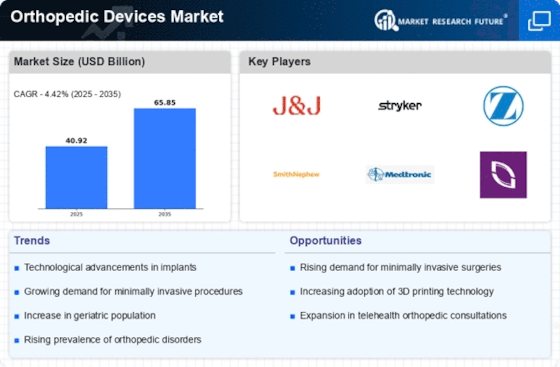
As per MRFR analysis, the Orthopedic Devices Market size was valued at USD 40.92 Billion in 2024. The market is projected to grow from USD 42.73 Billion in 2025 to USD 65.85 Billion by 2035, exhibiting a CAGR of 4.42% during the forecast period 2026–2035. North America led the market with over 40.08% share, generating around USD 16.4 Billion in revenue.
 
The Orthopedic Devices Market is primarily driven by the rising prevalence of musculoskeletal disorders and increasing aging population, boosting demand for joint replacement and orthopedic treatments, supported by technological advancements that enhance surgical outcomes and improve patient mobility globally.
 
According to the World Health Organization (WHO), musculoskeletal conditions affect over 1.71 billion people worldwide, making them the leading cause of disability. This growing burden significantly increases demand for orthopedic devices, supporting advancements in joint replacement, spinal treatments, and rehabilitation technologies globally.

Key Market Trends & Highlights

The Orthopedic Devices Market is experiencing robust growth driven by technological advancements and increasing healthcare demands.

  • North America holds 40.08% share in 2024, driven by high orthopedic procedure volumes. Europe accounts for 30% share, valued at USD 12.276 billion in 2024. Joint reconstruction devices lead with 52% share, driven by rising osteoarthritis prevalence and joint replacement demand globally. Metal materials dominate with 66% share, supported by durability and widespread use in orthopedic implants.

Market Size & Forecast

2024 Market Size 40.92 (USD Billion)
2035 Market Size 65.85 (USD Billion)
CAGR (2025 - 2035) 4.42%
Largest Regional Market Share in 2024 North America

Major Players

Companies such as <a href="https://www.jnjmedtech.com/en-US/companies/depuy-synthes">DePuy Synthes</a> (US), Stryker (US), <a title="Zimmer Biomet" href="https://www.zimmerbiomet.com/en/products-and-solutions.html" target="_blank" rel="noopener">Zimmer Biomet</a> (US), Smith &amp; Nephew (GB), Medtronic (US), NuVasive (US), Orthofix (US), Aesculap (DE), B. Braun (DE), Conmed (US) are some of the major participants in the global market.

Market Trends

The Orthopedic Devices Market is currently experiencing a dynamic evolution, driven by advancements in technology and an increasing prevalence of musculoskeletal disorders. The integration of innovative materials and smart technologies into orthopedic devices appears to enhance patient outcomes and improve recovery times. Furthermore, the growing geriatric population, which is more susceptible to orthopedic conditions, seems to be a significant factor influencing market growth.

As healthcare systems worldwide adapt to these demographic changes, the demand for effective orthopedic solutions is likely to rise, prompting orthopedics manufacturers to invest in research and development. In addition, the Orthopedic Devices Market is witnessing a shift towards minimally invasive surgical techniques. These approaches not only reduce recovery times but also minimize complications associated with traditional surgeries. The emphasis on patient-centric care is becoming increasingly prominent, with healthcare providers focusing on personalized treatment plans.

This trend suggests that the market will continue to evolve, with an emphasis on enhancing the quality of life for patients suffering from orthopedic issues. Overall, the Orthopedic Devices Market is poised for substantial growth, driven by technological advancements and changing patient needs.

Technological Advancements

The Orthopedic Devices Market is seeing a surge in the adoption of advanced technologies, such as robotics and artificial intelligence. These innovations are enhancing surgical precision and improving patient outcomes, thereby reshaping the landscape of orthopedic care.

The Institute for Health Metrics and Evaluation (IHME) reports that musculoskeletal disorders are among the leading causes of disability globally, contributing significantly to years lived with disability. This rising burden is accelerating adoption of advanced technologies such as robotics and AI in orthopedic procedures, improving surgical precision and patient outcomes.

Minimally Invasive Procedures

There is a noticeable trend towards minimally invasive surgical techniques within the Orthopedic Devices Market. These methods are favored for their ability to reduce recovery times and complications, aligning with the growing demand for patient-friendly treatment options.

According to the Centers for Disease Control and Prevention (CDC), millions of orthopedic procedures, including joint replacements, are performed annually in the U.S. Minimally invasive techniques are increasingly adopted due to reduced recovery time and complications, enhancing patient outcomes and driving demand for advanced orthopedic surgical devices.

Personalized Treatment Approaches

The focus on personalized medicine is becoming increasingly relevant in the Orthopedic Devices Market. Tailoring treatment plans to individual patient needs is likely to enhance satisfaction and effectiveness, reflecting a broader shift towards patient-centered care.

The United Nations Population Fund (UNFPA) highlights that the global population aged 65 and above is rapidly increasing, contributing to higher demand for tailored healthcare solutions. Personalized orthopedic treatments improve patient-specific outcomes, driving adoption of customized implants and advanced orthopedic devices worldwide.

Orthopedic Devices Market Market Drivers

Aging Population

The increasing proportion of elderly individuals is a primary driver of the Orthopedic Devices Market. As people age, they often experience musculoskeletal disorders, leading to a higher demand for orthopedic devices. According to recent statistics, the population aged 65 and older is projected to reach 1.5 billion by 2050, which suggests a substantial rise in conditions such as arthritis and osteoporosis.
 
This demographic shift necessitates advanced orthopedic solutions, including joint replacements and spinal implants, thereby propelling market growth. Furthermore, the aging population is likely to require ongoing orthopedic care, which could lead to sustained demand for innovative devices and technologies within the market.

Technological Innovations

Technological advancements are revolutionizing the Orthopedic Devices Market, leading to the development of more effective and efficient treatment options. Innovations such as 3D printing, robotics, and smart implants are enhancing surgical precision and patient outcomes. For instance, 3D printing allows for the customization of implants tailored to individual patient anatomy, which may improve the success rates of orthopedic procedures.
 
Additionally, robotic-assisted surgeries are becoming increasingly prevalent, offering surgeons enhanced control and accuracy. The market for orthopedic devices is projected to grow significantly, with estimates suggesting a compound annual growth rate of over 5% in the coming years, driven by these technological breakthroughs.

Increasing Healthcare Expenditure

Rising healthcare expenditure is a crucial factor influencing the Orthopedic Devices Market. As countries invest more in healthcare infrastructure and services, the accessibility and availability of orthopedic treatments improve. This trend is particularly evident in emerging economies, where increased spending is facilitating the adoption of advanced orthopedic technologies.
 
Reports indicate that healthcare spending is expected to reach trillions of dollars globally, which could lead to enhanced funding for orthopedic research and development. Consequently, the market is likely to experience growth as healthcare systems prioritize orthopedic care, leading to greater investment in innovative devices and treatment methodologies.

Rising Incidence of Sports Injuries

The growing participation in sports and physical activities has led to an increase in sports-related injuries, significantly impacting the Orthopedic Devices Market. Data indicates that sports injuries account for a considerable percentage of orthopedic cases, with millions of individuals seeking treatment annually.
 
This trend is particularly evident among younger populations, where active lifestyles contribute to a higher risk of injuries such as ligament tears and fractures. Consequently, the demand for orthopedic devices, including braces, supports, and surgical implants, is expected to rise. The Orthopedic Devices Market is likely to benefit from innovations aimed at enhancing recovery and performance, catering to both amateur and professional athletes.

Growing Awareness of Orthopedic Health

There is a notable increase in awareness regarding orthopedic health, which is driving demand within the Orthopedic Devices Market. Educational campaigns and initiatives aimed at promoting musculoskeletal health are encouraging individuals to seek preventive care and treatment for orthopedic conditions.
 
This heightened awareness is leading to earlier diagnosis and intervention, which may result in a greater need for orthopedic devices. Furthermore, as patients become more informed about their treatment options, they are more likely to opt for advanced orthopedic solutions, including minimally invasive surgeries and high-tech implants. The Orthopedic Devices Market stands to benefit from this trend, as it aligns with the growing emphasis on proactive healthcare.

Market Segment Insights

By Type: Joint Reconstruction Devices (Largest) vs. Spinal Devices (Fastest-Growing)

The Orthopedic Devices Market is comprised of several key segments including <a title="joint reconstruction device" href="https://www.marketresearchfuture.com/reports/joint-reconstruction-device-market-32709" target="_blank" rel="noopener">Joint Reconstruction Devices</a>, Spinal Devices, Cranial Orthoses, Orthobiologics, and Support Devices. Joint Reconstruction Devices hold the largest market share of 52% due to the increasing prevalence of orthopedic disorders and an aging population. These devices are crucial for restoring functionality and alleviating pain in patients who have suffered joint injuries or degenerative diseases. On the other hand, Spinal Devices have emerged as the fastest-growing segment, driven by rising incidences of spinal disorders and advancements in surgical technologies. As minimally invasive procedures gain popularity, spinal device orthopedics manufacturers are innovating and expanding their product lines, contributing to significant growth in this area. This trend reflects a shift towards more effective and less invasive treatment options for patients, stimulating the overall market for orthopedic devices.

Joint Reconstruction Devices (Dominant) vs. Orthobiologics (Emerging)

Joint Reconstruction Devices have established themselves as a dominant force within the orthopedic devices market, largely due to their critical role in surgeries aimed at repairing and rejuvenating joint function. These devices include various implants that are used in knee, hip, and shoulder surgeries, portraying robust demand fueled by a growing elderly population and rising rates of sports injuries. Conversely, Orthobiologics represent an emerging segment in this landscape, incorporating natural substances into treatment protocols to enhance healing and tissue regeneration. Their innovative approach provides alternatives to traditional surgical methods, appealing particularly to patients seeking less invasive solutions. As research advances, the integration of Orthobiologics within the treatment paradigm of orthopedic care is expected to increase, broadening their market presence.

By Material: Metal (Largest) vs. Plastic (Fastest-Growing)

In the Orthopedic Devices Market, the material segment shows a diverse distribution, with metals being the largest contributor. Metal components, primarily titanium and stainless steel, are widely used due to their strength and biocompatibility, dominating the market share with 66%. Plastics, while traditionally seen as secondary materials, have gained traction rapidly, especially in lower-cost devices and disposable instruments, reflecting significant growth in recent years.

Metals (Dominant) vs. Plastics (Emerging)

Metals, particularly titanium and stainless steel, hold a dominant position in the orthopedic devices sector, providing unmatched strength and durability. Their biocompatibility makes them ideal for implants and surgical tools, catering to a wide range of complex surgical procedures. In contrast, plastics are emerging as a vital component, particularly in low-cost applications and single-use devices, driven by innovation in polymer technologies. These materials offer flexibility and are increasingly being utilized in advanced orthopedic solutions, such as trauma fixation. As the demand for cost-effective and versatile orthopedic medical devices rises, plastics are positioned to rapidly expand their market presence.

By End User: Hospitals (Largest) vs. Orthopedic Clinics (Fastest-Growing)

In the orthopedic devices market, hospitals hold the largest share of 61% among end users, driven by their comprehensive services and high patient volume. Hospitals' expansive access to advanced technology enables a wide variety of orthopedic procedures, making them the primary adopters of orthopedic devices. Meanwhile, orthopedic clinics are gaining traction and are recognized as the fastest-growing segment, benefiting from an increasing number of outpatient surgeries and specialized services tailored to orthopedic care.

Hospitals (Dominant) vs. Orthopedic Clinics (Emerging)

Hospitals are the dominant players in the orthopedic devices market due to their ability to integrate a wide range of devices across various specialties. They typically possess advanced imaging and surgical technologies, which attract patients requiring complex surgeries. On the other hand, orthopedic clinics are emerging as vital competitiors by providing focused and specialized care, often resulting in quicker recovery times. Their popularity is on the rise as more patients prefer outpatient settings for elective surgeries, driving an increase in the demand for orthopedic medical devices tailored to this sector.

By Indication: Osteoarthritis (Largest) vs. Sports Injuries (Fastest-Growing)

In the orthopedic devices market, the 'By Indication' segment showcases distinct distribution patterns among its components. <a href="https://www.marketresearchfuture.com/reports/osteoarthritis-market-1609" data-mce-href="https://www.marketresearchfuture.com/reports/osteoarthritis-market-1609">Osteoarthritis</a> holds the largest share of 57%, driven by the aging population and prevalence of joint-related issues. Other indications, including trauma and spinal disorders, contribute significantly, yet the market remains fragmented with various players focusing on niche areas. Sports injuries are gaining traction as more people participate in sports, increasing demand for effective treatment options.

Osteoarthritis (Dominant) vs. Sports Injuries (Emerging)

Osteoarthritis represents the dominant force within the orthopedic devices market, attributed to its widespread prevalence among older adults and the continual advancements in treatment technology. This condition leads to significant demand for medical devices orthopedics designed for improved mobility and pain relief. On the other hand, sports injuries are emerging as a significant segment due to rising sports participation and awareness about injury prevention and rehabilitation. Market players are innovating rapidly to introduce advanced devices tailored for sports injuries, such as braces and supports, reflecting a growing understanding of the specific needs of athletes and active individuals.

Get more detailed insights about Orthopedic Devices Market Research Report - Forecast till 2035

Regional Insights

North America : Market Leader in Innovation

North America accounted for the largest share of the global Orthopedic Devices Market size, reaching USD 16.4 Billion in 2024. The region benefits from advanced healthcare infrastructure, high disposable incomes, and a growing elderly population, which drives demand for orthopedic surgeries. Regulatory support from agencies like the FDA further catalyzes market growth by ensuring the safety and efficacy of new devices.

The United States is the primary contributor, with key players such as DePuy Synthes, Stryker, and Zimmer Biomet leading the competitive landscape. The presence of these major orthopedic devices companies fosters innovation and enhances product offerings. Additionally, the increasing prevalence of orthopedic conditions and the rising number of joint replacement surgeries are significant factors propelling market expansion.

Growth is driven by advanced healthcare infrastructure, high surgical volumes, and increasing prevalence of orthopedic conditions. The Centers for Disease Control and Prevention (CDC) reports that arthritis affects over 58 million adults in the U.S., making it a leading cause of disability. This high prevalence is driving demand for joint replacement procedures and advanced orthopedic devices across North America.

Europe : Emerging Market Dynamics

Europe is the second-largest market for orthopedic devices, accounting for approximately 30% of the global market share. The region is characterized by a robust healthcare system and increasing investments in medical Implants technology. Regulatory frameworks, such as the Medical Device Regulation (MDR), are enhancing product safety and efficacy, thereby boosting consumer confidence and market growth.

Leading countries include Germany, France, and the UK, where orthopedic devices companies like Smith & Nephew and B. Braun are prominent. The competitive landscape is marked by a focus on innovation and collaboration among key players. The rising incidence of musculoskeletal disorders and an aging population are driving demand for advanced orthopedic solutions, making Europe a vital market for future growth.

Growth is driven by increasing healthcare investments, aging population, and strong adoption of advanced orthopedic technologies. According to the World Health Organization (WHO), musculoskeletal conditions are a leading cause of disability across Europe, affecting millions annually. Rising healthcare spending and adoption of advanced orthopedic implants are improving treatment outcomes and driving market growth across the region.

Asia-Pacific : Rapidly Growing Market

Asia-Pacific is an emerging powerhouse in the orthopedic devices market, holding approximately 20% of the global share. The region is witnessing rapid economic growth, urbanization, and an increasing prevalence of orthopedic conditions, which are significant drivers of market demand. Government initiatives aimed at improving healthcare access and affordability are also contributing to market expansion.

Countries like China and India are leading the charge, with a growing number of local and international players entering the market. Orthopedic devices companies such as Medtronic and NuVasive are expanding their presence in this region. The orthopedic device market is evolving, with a focus on cost-effective solutions and innovative technologies to cater to the diverse needs of the population.

Middle East and Africa : Untapped Market Potential

The Middle East and Africa represent a resource-rich frontier for the orthopedic devices market, holding approximately 10% of the global share. The region is characterized by increasing healthcare investments and a growing awareness of orthopedic health. Regulatory bodies are working to improve standards and facilitate market entry for innovative devices, which is expected to drive growth in the coming years.

Countries like South Africa and the UAE are at the forefront, with a rising number of orthopedic surgeries and a demand for advanced medical technologies. The competitive landscape includes both local and international players, with a focus on addressing the unique healthcare challenges of the region. The increasing prevalence of lifestyle-related orthopedic conditions is further fueling orthopedic device market demand

Key Players and Competitive Insights

The Orthopedic Devices Market is currently characterized by a dynamic competitive landscape, driven by technological advancements, an aging population, and increasing demand for minimally invasive surgical procedures. Major players such as DePuy Synthes (US), Stryker (US), and Zimmer Biomet (US) are strategically positioned to leverage innovation and expand their market share. DePuy Synthes (US) focuses on enhancing its product portfolio through continuous innovation, while Stryker (US) emphasizes strategic acquisitions to bolster its capabilities in robotics and digital surgery. Zimmer Biomet (US) is actively pursuing partnerships to enhance its offerings in joint reconstruction and trauma care, collectively shaping a competitive environment that prioritizes technological superiority and comprehensive service delivery.
 

Key business tactics within the Orthopedic Devices Market include localizing manufacturing to reduce costs and optimize supply chains, which is particularly relevant in the context of global economic fluctuations. The market structure appears moderately fragmented, with a mix of established players and emerging top orthopedic medical device companies vying for market share. The collective influence of these key players fosters a competitive atmosphere where innovation and operational efficiency are paramount.
 

In August 2025, Stryker (US) announced the launch of its latest robotic-assisted surgical system, which is designed to enhance precision in orthopedic procedures. This strategic move not only reinforces Stryker's commitment to innovation but also positions the company to capture a larger share of the growing market for robotic surgery. The introduction of this technology is likely to improve surgical outcomes and patient satisfaction, thereby enhancing Stryker's competitive edge.
 

In September 2025, Zimmer Biomet (US) entered into a partnership with a leading digital health company to integrate artificial intelligence into its orthopedic solutions. This collaboration aims to develop predictive analytics tools that can assist surgeons in making more informed decisions during procedures. The strategic importance of this partnership lies in its potential to revolutionize surgical practices, thereby setting a new standard in the medical devices orthopedics sector.
 

In July 2025, Medtronic (US) expanded its product line by acquiring a startup specializing in advanced orthopedic implants. This acquisition is indicative of Medtronic's strategy to diversify its offerings and enhance its technological capabilities. By integrating innovative implant technologies, Medtronic is likely to strengthen its position in the market and respond effectively to evolving customer needs.
 

As of October 2025, current competitive trends in the market are increasingly defined by digitalization, sustainability, and the integration of artificial intelligence. Strategic alliances are becoming more prevalent, as orthopedic device companies recognize the value of collaboration in driving innovation and improving operational efficiencies. Looking ahead, competitive differentiation is expected to evolve from traditional price-based competition to a focus on technological innovation, enhanced patient outcomes, and reliable supply chains. This shift underscores the importance of adaptability and forward-thinking strategies in maintaining a competitive advantage in the orthopedic devices landscape.

Key Companies in the Orthopedic Devices Market include

Industry Developments

Orthopedic companies rolled out smart implants equipped with embedded sensors capable of tracking healing progress post-surgery, signaling a significant move toward digitally connected orthopedics.

The Orthopedic Devices Market is still growing. This is because top orthopedic medical device companies like Stryker and Zimmer Biomet are coming up with new ideas and expanding their minimally invasive and cost-effective surgical options. We can't independently confirm the exact product launches, like DePuy Synthes' advanced screw fixation system in August 2023 or Wright Medical's total ankle arthroplasty in September 2023, but they show the kinds of improvements that are happening in the orthopedic device market.

Medtronic's purchase of Mazor Robotics in December 2021 was a big strategic move that strengthened its position in robotic spine surgery. There is no proof that Aesculap and Johnson & Johnson worked together in October 2023, probably because Aesculap is a B. Braun brand. Overall, the market's value keeps going up because orthopedic technology is getting better and more people are using patient-centered surgical solutions around the world.

Future Outlook

Orthopedic Devices Market Future Outlook

The Orthopedic Devices Market size is projected to reach USD 65.85 Billion by 2035, growing at a CAGR of 4.42%, driven by technological advancements, increasing aging population, and rising prevalence of orthopedic disorders.

New opportunities lie in:

  • <p>Expansion of telehealth services for remote orthopedic consultations Development of biodegradable <a title="orthopedic implant" href="https://www.marketresearchfuture.com/reports/orthopedic-implant-market-838" target="_blank" rel="noopener">orthopedic implants</a> Integration of AI in surgical planning and rehabilitation processes</p>

By 2035, the market is expected to achieve substantial growth, reflecting evolving healthcare needs.

Market Segmentation

Orthopedic Devices Market Type Outlook

  • Joint Reconstruction Devices
  • Spinal Devices
  • Cranial Orthoses
  • Orthobiologics
  • Support Devices

Orthopedic Devices Market End User Outlook

  • Hospitals
  • Orthopedic Clinics
  • Rehabilitation Centers
  • Ambulatory Surgical Centers

Orthopedic Devices Market Material Outlook

  • Metal
  • Plastic
  • Ceramics
  • Composite
  • Biodegradable Materials

Orthopedic Devices Market Indication Outlook

  • Osteoarthritis
  • Trauma
  • Spinal Disorders
  • Fractures
  • Sports Injuries

Report Scope

MARKET SIZE 2024 40.92(USD Billion)
MARKET SIZE 2025 42.73(USD Billion)
MARKET SIZE 2035 65.85(USD Billion)
COMPOUND ANNUAL GROWTH RATE (CAGR) 4.42% (2025 - 2035)
REPORT COVERAGE Revenue Forecast, Competitive Landscape, Growth Factors, and Trends
BASE YEAR 2024
Market Forecast Period 2026 - 2035
Historical Data 2019 - 2024
Market Forecast Units USD Billion
Key Companies Profiled DePuy Synthes (US), Stryker (US), Zimmer Biomet (US), Smith & Nephew (GB), Medtronic (US), NuVasive (US), Orthofix (US), Aesculap (DE), B. Braun (DE), Conmed (US)
Segments Covered Product Type, Material, End Users
Key Market Opportunities Integration of advanced robotics and artificial intelligence in orthopedic surgical procedures.
Key Market Dynamics Technological advancements and regulatory changes drive innovation and competition in the orthopedic devices market.
Countries Covered North America, Europe, APAC, South America, MEA

FAQs

What is the projected market valuation of the Orthopedic Devices Market by 2035?

The projected market valuation of the market is expected to reach 65.85 USD Billion by 2035.

What was the market valuation of the Orthopedic Devices Market in 2024?

The market valuation of the market was 40.92 USD Billion in 2024.

What is the expected CAGR for the Orthopedic Devices Market during the forecast period 2025 - 2035?

The expected CAGR during the forecast period 2025 - 2035 is 4.42%.

Which segment is projected to have the highest valuation in the Orthopedic Devices Market by 2035?

<p>The Joint Reconstruction Devices segment is projected to reach a valuation of 24.0 USD Billion by 2035.</p>

What are the key materials used in the Orthopedic Devices Market?

Key materials in the market include Metal, Plastic, Ceramics, Composite, and Biodegradable Materials.

Which end-user segment is expected to grow the most by 2035?

<p>The Hospitals segment is expected to grow the most, reaching a valuation of 24.0 USD Billion by 2035.</p>

What are the primary indications driving the Orthopedic Devices Market?

<p>Primary indications driving the market include Osteoarthritis, Trauma, Spinal Disorders, Fractures, and Sports Injuries.</p>

Who are the leading companies in the Orthopedic Devices Market?

Leading companies in the market include DePuy Synthes, Stryker, Zimmer Biomet, and Smith &amp; Nephew.

What is the projected valuation for the Spinal Devices segment by 2035?

<p>The Spinal Devices segment is projected to reach a valuation of 16.0 USD Billion by 2035.</p>

How does the market for Orthobiologics compare to other segments by 2035?

<p>The Orthobiologics segment is expected to reach a valuation of 9.0 USD Billion by 2035, indicating robust growth.</p>

  1. SECTION I: EXECUTIVE SUMMARY AND KEY HIGHLIGHTS |
    1. EXECUTIVE SUMMARY | |
      1. Market Overview | |
      2. Key Findings | |
      3. Market Segmentation | |
      4. Competitive Landscape | |
      5. Challenges and Opportunities | |
      6. Future Outlook 2
  2. SECTION II: SCOPING, METHODOLOGY AND MARKET STRUCTURE |
    1. MARKET INTRODUCTION | |
      1. Definition | |
      2. Scope of the study | | |
    2. RESEARCH METHODOLOGY | |
      1. Overview | |
      2. Data Mining | |
      3. Secondary Research | |
      4. Primary Research | | |
      5. Forecasting Model | |
      6. Market Size Estimation | | |
      7. Data Triangulation | |
      8. Validation 3
  3. SECTION III: QUALITATIVE ANALYSIS |
    1. MARKET DYNAMICS | |
      1. Overview | |
      2. Drivers | |
      3. Restraints | |
      4. Opportunities |
    2. MARKET FACTOR ANALYSIS | |
      1. Value chain Analysis | |
      2. Porter's Five Forces Analysis | | |
      3. COVID-19 Impact Analysis | | |
  4. SECTION IV: QUANTITATIVE ANALYSIS |
    1. Healthcare, BY Type (USD Billion) | |
      1. Joint Reconstruction Devices | |
      2. Spinal Devices | |
      3. Cranial Orthoses | |
      4. Orthobiologics | |
      5. Support Devices |
    2. Healthcare, BY Material (USD Billion) | |
      1. Metal | |
      2. Plastic | |
      3. Ceramics | |
      4. Composite | |
      5. Biodegradable Materials |
    3. Healthcare, BY End User (USD Billion) | |
      1. Hospitals | |
      2. Orthopedic Clinics | |
      3. Rehabilitation Centers | |
      4. Ambulatory Surgical Centers |
    4. Healthcare, BY Indication (USD Billion) | |
      1. Osteoarthritis | |
      2. Trauma | |
      3. Spinal Disorders | |
      4. Fractures | |
      5. Sports Injuries |
    5. Healthcare, BY Region (USD Billion) | |
      1. North America | | |
      2. Europe | | |
      3. APAC | | |
      4. South America | | |
      5. MEA | | |
  5. SECTION V: COMPETITIVE ANALYSIS |
    1. Competitive Landscape | |
      1. Overview | |
      2. Competitive Analysis | |
      3. Market share Analysis | |
      4. Major Growth Strategy in the Healthcare | |
      5. Competitive Benchmarking | |
      6. Leading Players in Terms of Number of Developments in the Healthcare | |
      7. Key developments and growth strategies | | |
      8. Major Players Financial Matrix | | |
    2. Company Profiles | |
      1. DePuy Synthes (US) | | |
      2. Stryker (US) | | |
      3. Zimmer Biomet (US) | | |
      4. Smith & Nephew (GB) | | |
      5. Medtronic (US) | | |
      6. NuVasive (US) | | |
      7. Orthofix (US) | | |
      8. Aesculap (DE) | | |
      9. B. Braun (DE) | | |
      10. Conmed (US) | | |
    3. Appendix | |
      1. References | |
      2. Related Reports 6 LIST OF FIGURES |
    4. MARKET SYNOPSIS |
    5. NORTH AMERICA MARKET ANALYSIS |
    6. US MARKET ANALYSIS BY TYPE |
    7. US MARKET ANALYSIS BY MATERIAL |
    8. US MARKET ANALYSIS BY END USER |
    9. US MARKET ANALYSIS BY INDICATION |
    10. CANADA MARKET ANALYSIS BY TYPE |
    11. CANADA MARKET ANALYSIS BY MATERIAL |
    12. CANADA MARKET ANALYSIS BY END USER |
    13. CANADA MARKET ANALYSIS BY INDICATION |
    14. EUROPE MARKET ANALYSIS |
    15. GERMANY MARKET ANALYSIS BY TYPE |
    16. GERMANY MARKET ANALYSIS BY MATERIAL |
    17. GERMANY MARKET ANALYSIS BY END USER |
    18. GERMANY MARKET ANALYSIS BY INDICATION |
    19. UK MARKET ANALYSIS BY TYPE |
    20. UK MARKET ANALYSIS BY MATERIAL |
    21. UK MARKET ANALYSIS BY END USER |
    22. UK MARKET ANALYSIS BY INDICATION |
    23. FRANCE MARKET ANALYSIS BY TYPE |
    24. FRANCE MARKET ANALYSIS BY MATERIAL |
    25. FRANCE MARKET ANALYSIS BY END USER |
    26. FRANCE MARKET ANALYSIS BY INDICATION |
    27. RUSSIA MARKET ANALYSIS BY TYPE |
    28. RUSSIA MARKET ANALYSIS BY MATERIAL |
    29. RUSSIA MARKET ANALYSIS BY END USER |
    30. RUSSIA MARKET ANALYSIS BY INDICATION |
    31. ITALY MARKET ANALYSIS BY TYPE |
    32. ITALY MARKET ANALYSIS BY MATERIAL |
    33. ITALY MARKET ANALYSIS BY END USER |
    34. ITALY MARKET ANALYSIS BY INDICATION |
    35. SPAIN MARKET ANALYSIS BY TYPE |
    36. SPAIN MARKET ANALYSIS BY MATERIAL |
    37. SPAIN MARKET ANALYSIS BY END USER |
    38. SPAIN MARKET ANALYSIS BY INDICATION |
    39. REST OF EUROPE MARKET ANALYSIS BY TYPE |
    40. REST OF EUROPE MARKET ANALYSIS BY MATERIAL |
    41. REST OF EUROPE MARKET ANALYSIS BY END USER |
    42. REST OF EUROPE MARKET ANALYSIS BY INDICATION |
    43. APAC MARKET ANALYSIS |
    44. CHINA MARKET ANALYSIS BY TYPE |
    45. CHINA MARKET ANALYSIS BY MATERIAL |
    46. CHINA MARKET ANALYSIS BY END USER |
    47. CHINA MARKET ANALYSIS BY INDICATION |
    48. INDIA MARKET ANALYSIS BY TYPE |
    49. INDIA MARKET ANALYSIS BY MATERIAL |
    50. INDIA MARKET ANALYSIS BY END USER |
    51. INDIA MARKET ANALYSIS BY INDICATION |
    52. JAPAN MARKET ANALYSIS BY TYPE |
    53. JAPAN MARKET ANALYSIS BY MATERIAL |
    54. JAPAN MARKET ANALYSIS BY END USER |
    55. JAPAN MARKET ANALYSIS BY INDICATION |
    56. SOUTH KOREA MARKET ANALYSIS BY TYPE |
    57. SOUTH KOREA MARKET ANALYSIS BY MATERIAL |
    58. SOUTH KOREA MARKET ANALYSIS BY END USER |
    59. SOUTH KOREA MARKET ANALYSIS BY INDICATION |
    60. MALAYSIA MARKET ANALYSIS BY TYPE |
    61. MALAYSIA MARKET ANALYSIS BY MATERIAL |
    62. MALAYSIA MARKET ANALYSIS BY END USER |
    63. MALAYSIA MARKET ANALYSIS BY INDICATION |
    64. THAILAND MARKET ANALYSIS BY TYPE |
    65. THAILAND MARKET ANALYSIS BY MATERIAL |
    66. THAILAND MARKET ANALYSIS BY END USER |
    67. THAILAND MARKET ANALYSIS BY INDICATION |
    68. INDONESIA MARKET ANALYSIS BY TYPE |
    69. INDONESIA MARKET ANALYSIS BY MATERIAL |
    70. INDONESIA MARKET ANALYSIS BY END USER |
    71. INDONESIA MARKET ANALYSIS BY INDICATION |
    72. REST OF APAC MARKET ANALYSIS BY TYPE |
    73. REST OF APAC MARKET ANALYSIS BY MATERIAL |
    74. REST OF APAC MARKET ANALYSIS BY END USER |
    75. REST OF APAC MARKET ANALYSIS BY INDICATION |
    76. SOUTH AMERICA MARKET ANALYSIS |
    77. BRAZIL MARKET ANALYSIS BY TYPE |
    78. BRAZIL MARKET ANALYSIS BY MATERIAL |
    79. BRAZIL MARKET ANALYSIS BY END USER |
    80. BRAZIL MARKET ANALYSIS BY INDICATION |
    81. MEXICO MARKET ANALYSIS BY TYPE |
    82. MEXICO MARKET ANALYSIS BY MATERIAL |
    83. MEXICO MARKET ANALYSIS BY END USER |
    84. MEXICO MARKET ANALYSIS BY INDICATION |
    85. ARGENTINA MARKET ANALYSIS BY TYPE |
    86. ARGENTINA MARKET ANALYSIS BY MATERIAL |
    87. ARGENTINA MARKET ANALYSIS BY END USER |
    88. ARGENTINA MARKET ANALYSIS BY INDICATION |
    89. REST OF SOUTH AMERICA MARKET ANALYSIS BY TYPE |
    90. REST OF SOUTH AMERICA MARKET ANALYSIS BY MATERIAL |
    91. REST OF SOUTH AMERICA MARKET ANALYSIS BY END USER |
    92. REST OF SOUTH AMERICA MARKET ANALYSIS BY INDICATION |
    93. MEA MARKET ANALYSIS |
    94. GCC COUNTRIES MARKET ANALYSIS BY TYPE |
    95. GCC COUNTRIES MARKET ANALYSIS BY MATERIAL |
    96. GCC COUNTRIES MARKET ANALYSIS BY END USER |
    97. GCC COUNTRIES MARKET ANALYSIS BY INDICATION |
    98. SOUTH AFRICA MARKET ANALYSIS BY TYPE |
    99. SOUTH AFRICA MARKET ANALYSIS BY MATERIAL |
    100. SOUTH AFRICA MARKET ANALYSIS BY END USER |
    101. SOUTH AFRICA MARKET ANALYSIS BY INDICATION |
    102. REST OF MEA MARKET ANALYSIS BY TYPE |
    103. REST OF MEA MARKET ANALYSIS BY MATERIAL |
    104. REST OF MEA MARKET ANALYSIS BY END USER |
    105. REST OF MEA MARKET ANALYSIS BY INDICATION |
    106. KEY BUYING CRITERIA OF HEALTHCARE |
    107. RESEARCH PROCESS OF MRFR |
    108. DRO ANALYSIS OF HEALTHCARE |
    109. DRIVERS IMPACT ANALYSIS: HEALTHCARE |
    110. RESTRAINTS IMPACT ANALYSIS: HEALTHCARE |
    111. SUPPLY / VALUE CHAIN: HEALTHCARE |
    112. HEALTHCARE, BY TYPE, 2024 (% SHARE) |
    113. HEALTHCARE, BY TYPE, 2024 TO 2035 (USD Billion) |
    114. HEALTHCARE, BY MATERIAL, 2024 (% SHARE) |
    115. HEALTHCARE, BY MATERIAL, 2024 TO 2035 (USD Billion) |
    116. HEALTHCARE, BY END USER, 2024 (% SHARE) |
    117. HEALTHCARE, BY END USER, 2024 TO 2035 (USD Billion) |
    118. HEALTHCARE, BY INDICATION, 2024 (% SHARE) |
    119. HEALTHCARE, BY INDICATION, 2024 TO 2035 (USD Billion) |
    120. BENCHMARKING OF MAJOR COMPETITORS 7 LIST OF TABLES |
    121. LIST OF ASSUMPTIONS | |
      1. |
    122. North America MARKET SIZE ESTIMATES; FORECAST | |
      1. BY TYPE, 2025-2035 (USD Billion) | |
      2. BY MATERIAL, 2025-2035 (USD Billion) | |
      3. BY END USER, 2025-2035 (USD Billion) | |
      4. BY INDICATION, 2025-2035 (USD Billion) |
    123. US MARKET SIZE ESTIMATES; FORECAST | |
      1. BY TYPE, 2025-2035 (USD Billion) | |
      2. BY MATERIAL, 2025-2035 (USD Billion) | |
      3. BY END USER, 2025-2035 (USD Billion) | |
      4. BY INDICATION, 2025-2035 (USD Billion) |
    124. Canada MARKET SIZE ESTIMATES; FORECAST | |
      1. BY TYPE, 2025-2035 (USD Billion) | |
      2. BY MATERIAL, 2025-2035 (USD Billion) | |
      3. BY END USER, 2025-2035 (USD Billion) | |
      4. BY INDICATION, 2025-2035 (USD Billion) |
    125. Europe MARKET SIZE ESTIMATES; FORECAST | |
      1. BY TYPE, 2025-2035 (USD Billion) | |
      2. BY MATERIAL, 2025-2035 (USD Billion) | |
      3. BY END USER, 2025-2035 (USD Billion) | |
      4. BY INDICATION, 2025-2035 (USD Billion) |
    126. Germany MARKET SIZE ESTIMATES; FORECAST | |
      1. BY TYPE, 2025-2035 (USD Billion) | |
      2. BY MATERIAL, 2025-2035 (USD Billion) | |
      3. BY END USER, 2025-2035 (USD Billion) | |
      4. BY INDICATION, 2025-2035 (USD Billion) |
    127. UK MARKET SIZE ESTIMATES; FORECAST | |
      1. BY TYPE, 2025-2035 (USD Billion) | |
      2. BY MATERIAL, 2025-2035 (USD Billion) | |
      3. BY END USER, 2025-2035 (USD Billion) | |
      4. BY INDICATION, 2025-2035 (USD Billion) |
    128. France MARKET SIZE ESTIMATES; FORECAST | |
      1. BY TYPE, 2025-2035 (USD Billion) | |
      2. BY MATERIAL, 2025-2035 (USD Billion) | |
      3. BY END USER, 2025-2035 (USD Billion) | |
      4. BY INDICATION, 2025-2035 (USD Billion) |
    129. Russia MARKET SIZE ESTIMATES; FORECAST | |
      1. BY TYPE, 2025-2035 (USD Billion) | |
      2. BY MATERIAL, 2025-2035 (USD Billion) | |
      3. BY END USER, 2025-2035 (USD Billion) | |
      4. BY INDICATION, 2025-2035 (USD Billion) |
    130. Italy MARKET SIZE ESTIMATES; FORECAST | |
      1. BY TYPE, 2025-2035 (USD Billion) | |
      2. BY MATERIAL, 2025-2035 (USD Billion) | |
      3. BY END USER, 2025-2035 (USD Billion) | |
      4. BY INDICATION, 2025-2035 (USD Billion) |
    131. Spain MARKET SIZE ESTIMATES; FORECAST | |
      1. BY TYPE, 2025-2035 (USD Billion) | |
      2. BY MATERIAL, 2025-2035 (USD Billion) | |
      3. BY END USER, 2025-2035 (USD Billion) | |
      4. BY INDICATION, 2025-2035 (USD Billion) |
    132. Rest of Europe MARKET SIZE ESTIMATES; FORECAST | |
      1. BY TYPE, 2025-2035 (USD Billion) | |
      2. BY MATERIAL, 2025-2035 (USD Billion) | |
      3. BY END USER, 2025-2035 (USD Billion) | |
      4. BY INDICATION, 2025-2035 (USD Billion) |
    133. APAC MARKET SIZE ESTIMATES; FORECAST | |
      1. BY TYPE, 2025-2035 (USD Billion) | |
      2. BY MATERIAL, 2025-2035 (USD Billion) | |
      3. BY END USER, 2025-2035 (USD Billion) | |
      4. BY INDICATION, 2025-2035 (USD Billion) |
    134. China MARKET SIZE ESTIMATES; FORECAST | |
      1. BY TYPE, 2025-2035 (USD Billion) | |
      2. BY MATERIAL, 2025-2035 (USD Billion) | |
      3. BY END USER, 2025-2035 (USD Billion) | |
      4. BY INDICATION, 2025-2035 (USD Billion) |
    135. India MARKET SIZE ESTIMATES; FORECAST | |
      1. BY TYPE, 2025-2035 (USD Billion) | |
      2. BY MATERIAL, 2025-2035 (USD Billion) | |
      3. BY END USER, 2025-2035 (USD Billion) | |
      4. BY INDICATION, 2025-2035 (USD Billion) |
    136. Japan MARKET SIZE ESTIMATES; FORECAST | |
      1. BY TYPE, 2025-2035 (USD Billion) | |
      2. BY MATERIAL, 2025-2035 (USD Billion) | |
      3. BY END USER, 2025-2035 (USD Billion) | |
      4. BY INDICATION, 2025-2035 (USD Billion) |
    137. South Korea MARKET SIZE ESTIMATES; FORECAST | |
      1. BY TYPE, 2025-2035 (USD Billion) | |
      2. BY MATERIAL, 2025-2035 (USD Billion) | |
      3. BY END USER, 2025-2035 (USD Billion) | |
      4. BY INDICATION, 2025-2035 (USD Billion) |
    138. Malaysia MARKET SIZE ESTIMATES; FORECAST | |
      1. BY TYPE, 2025-2035 (USD Billion) | |
      2. BY MATERIAL, 2025-2035 (USD Billion) | |
      3. BY END USER, 2025-2035 (USD Billion) | |
      4. BY INDICATION, 2025-2035 (USD Billion) |
    139. Thailand MARKET SIZE ESTIMATES; FORECAST | |
      1. BY TYPE, 2025-2035 (USD Billion) | |
      2. BY MATERIAL, 2025-2035 (USD Billion) | |
      3. BY END USER, 2025-2035 (USD Billion) | |
      4. BY INDICATION, 2025-2035 (USD Billion) |
    140. Indonesia MARKET SIZE ESTIMATES; FORECAST | |
      1. BY TYPE, 2025-2035 (USD Billion) | |
      2. BY MATERIAL, 2025-2035 (USD Billion) | |
      3. BY END USER, 2025-2035 (USD Billion) | |
      4. BY INDICATION, 2025-2035 (USD Billion) |
    141. Rest of APAC MARKET SIZE ESTIMATES; FORECAST | |
      1. BY TYPE, 2025-2035 (USD Billion) | |
      2. BY MATERIAL, 2025-2035 (USD Billion) | |
      3. BY END USER, 2025-2035 (USD Billion) | |
      4. BY INDICATION, 2025-2035 (USD Billion) |
    142. South America MARKET SIZE ESTIMATES; FORECAST | |
      1. BY TYPE, 2025-2035 (USD Billion) | |
      2. BY MATERIAL, 2025-2035 (USD Billion) | |
      3. BY END USER, 2025-2035 (USD Billion) | |
      4. BY INDICATION, 2025-2035 (USD Billion) |
    143. Brazil MARKET SIZE ESTIMATES; FORECAST | |
      1. BY TYPE, 2025-2035 (USD Billion) | |
      2. BY MATERIAL, 2025-2035 (USD Billion) | |
      3. BY END USER, 2025-2035 (USD Billion) | |
      4. BY INDICATION, 2025-2035 (USD Billion) |
    144. Mexico MARKET SIZE ESTIMATES; FORECAST | |
      1. BY TYPE, 2025-2035 (USD Billion) | |
      2. BY MATERIAL, 2025-2035 (USD Billion) | |
      3. BY END USER, 2025-2035 (USD Billion) | |
      4. BY INDICATION, 2025-2035 (USD Billion) |
    145. Argentina MARKET SIZE ESTIMATES; FORECAST | |
      1. BY TYPE, 2025-2035 (USD Billion) | |
      2. BY MATERIAL, 2025-2035 (USD Billion) | |
      3. BY END USER, 2025-2035 (USD Billion) | |
      4. BY INDICATION, 2025-2035 (USD Billion) |
    146. Rest of South America MARKET SIZE ESTIMATES; FORECAST | |
      1. BY TYPE, 2025-2035 (USD Billion) | |
      2. BY MATERIAL, 2025-2035 (USD Billion) | |
      3. BY END USER, 2025-2035 (USD Billion) | |
      4. BY INDICATION, 2025-2035 (USD Billion) |
    147. MEA MARKET SIZE ESTIMATES; FORECAST | |
      1. BY TYPE, 2025-2035 (USD Billion) | |
      2. BY MATERIAL, 2025-2035 (USD Billion) | |
      3. BY END USER, 2025-2035 (USD Billion) | |
      4. BY INDICATION, 2025-2035 (USD Billion) |
    148. GCC Countries MARKET SIZE ESTIMATES; FORECAST | |
      1. BY TYPE, 2025-2035 (USD Billion) | |
      2. BY MATERIAL, 2025-2035 (USD Billion) | |
      3. BY END USER, 2025-2035 (USD Billion) | |
      4. BY INDICATION, 2025-2035 (USD Billion) |
    149. South Africa MARKET SIZE ESTIMATES; FORECAST | |
      1. BY TYPE, 2025-2035 (USD Billion) | |
      2. BY MATERIAL, 2025-2035 (USD Billion) | |
      3. BY END USER, 2025-2035 (USD Billion) | |
      4. BY INDICATION, 2025-2035 (USD Billion) |
    150. Rest of MEA MARKET SIZE ESTIMATES; FORECAST | |
      1. BY TYPE, 2025-2035 (USD Billion) | |
      2. BY MATERIAL, 2025-2035 (USD Billion) | |
      3. BY END USER, 2025-2035 (USD Billion) | |
      4. BY INDICATION, 2025-2035 (USD Billion) |
    151. PRODUCT LAUNCH/PRODUCT DEVELOPMENT/APPROVAL | |
      1. |
    152. ACQUISITION/PARTNERSHIP | |

Healthcare Market Segmentation

Healthcare By Type (USD Billion, 2025-2035)

  • Joint Reconstruction Devices
  • Spinal Devices
  • Cranial Orthoses
  • Orthobiologics
  • Support Devices

Healthcare By Material (USD Billion, 2025-2035)

  • Metal
  • Plastic
  • Ceramics
  • Composite
  • Biodegradable Materials

Healthcare By End User (USD Billion, 2025-2035)

  • Hospitals
  • Orthopedic Clinics
  • Rehabilitation Centers
  • Ambulatory Surgical Centers

Healthcare By Indication (USD Billion, 2025-2035)

  • Osteoarthritis
  • Trauma
  • Spinal Disorders
  • Fractures
  • Sports Injuries
Infographic

Free Sample Request

Kindly complete the form below to receive a free sample of this Report

Get Free Sample

Customer Strories

Compare Licence

×
Features License Type
Single User Multiuser License Enterprise User
Price $4,950 $5,950 $7,250
Maximum User Access Limit 1 User Upto 10 Users Unrestricted Access Throughout the Organization
Free Customization
Direct Access to Analyst
Deliverable Format
Platform Access
Discount on Next Purchase 10% 15% 15%
Printable Versions
%>