×
Hero Background
English
Chinese
French
Japanese
Korean
German
Spanish

Organosilicon Polymers Polysiloxane Market Trends

ID: MRFR/CnM/9173-HCR
180 Pages
Anshula Mandaokar
October 2025

Organosilicon Polymers (Polysiloxane) Market Research Report Information by Product Type (Silicone Oil, Silicone Rubber, Silicone Resin, and Silicone Emulsion), by Application (Coatings, Elastomers, Foams, Adhesives & Sealants, and Others), and Region (North America, Europe, Asia-Pacific, Latin America, and Middle East & Africa) - Forecast till 2035

Share:
Download PDF ×

We do not share your information with anyone. However, we may send you emails based on your report interest from time to time. You may contact us at any time to opt-out.

Organosilicon Polymers Polysiloxane Market Infographic
Purchase Options

Market Trends

Key Emerging Trends in the Organosilicon Polymers Polysiloxane Market

Organosilicon Polymers, or Polysiloxanes, have witnessed late market shifts brought about by several circumstances. Beauty items, hardware, and development use these polymers with exchanging silicon and oxygen iotas. Superior performance materials are in demand throughout sectors. Polysiloxanes are preferred for their adaptability, warmth dependability, and dampness resistance in applications that need durability and adaptability.

Organosilicon polymer use is driven by the development industry's focus on costs and energy efficiency. Sealants, glues, and coatings use these polymers to block and protect the climate. Attention to the natural effect of traditional development materials has spurred the search for eco-friendly alternatives, increasing organosilicon polymer interest.

Hardware drives Polysiloxanes market trends. Electronic gadgets are improving, thus materials that can withstand harsh conditions should ensure part life and quality. Organosilicon polymers are essential to semiconductor, link, and association development, promoting business sector growth due to their high thermal strength and electrical protection.

The makeup industry has also used organosilicon polymers. These polymers give shampoos, conditioners, and styling products shine, moisture, and perfection. As consumers grow more aware of product ingredients, organosilicon polymers with improved performance are in demand.

Market trends indicate product customisation and evolution. Industry-specific organosilicon polymers are being made by innovators. This trend is driven by the need for more materials that can meet changing challenges and improve performance in varied applications. Ventures optimize cycles and improve efficiency, changing arrangements.

Global guidelines also affect organosilicon polymer market trends. Organizations are exploring consistency-compliant substitutes due to strict chemical requirements. Organosilicon polymers can adapt to regulatory changes.

Author
Anshula Mandaokar
Team Lead - Research

Anshula Mandaokar holds an academic degree in Chemical Engineering and has been contributing to the field for more than 5 years. She has expertise in Market Research and Business Consulting and serves as a Team Lead for a reputed Market Research firm under the Chemicals and Materials domain spectrum. She has worked on multiple projects, generating explicit results in a quick turnaround time. Her understanding of data interpretation justifies her role as a leader.

Leave a Comment

FAQs

At what CAGR is the Organosilicon Polymers Polysiloxane Market predicted to grow during the forecast period?

Organosilicon Polymers Polysiloxane Market is predicted to grow at Significant through forecast period of 2025-2035.

What is the forecast period of Organosilicon Polymers Polysiloxane Market research report?

The forecast period for Organosilicon Polymers Polysiloxane Market research report is 2025-2035.

Which region will lead the global Organosilicon Polymers Polysiloxane Market?

Global Organosilicon Polymers Polysiloxane Market is dominated by APAC region.

What are the key factors driving the Organosilicon Polymers Polysiloxane Market?

Increase the demand for Industrial cleaning sector

What are the key factors driving the Organosilicon Polymers Polysiloxane Market?

Increase the demand for Industrial cleaning sector

Market Summary

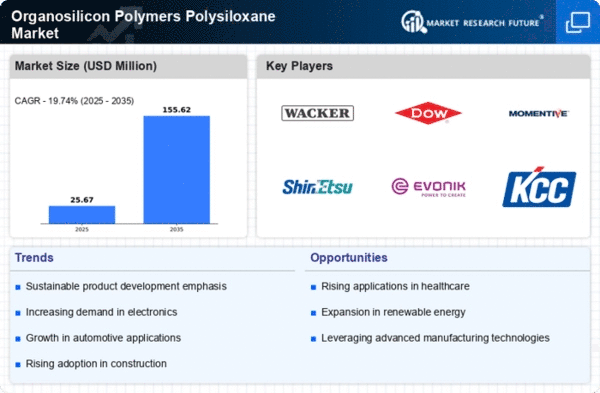
As per MRFR analysis, the Organosilicon Polymers Polysiloxane Size was estimated at 21.44 USD Million in 2024. The Organosilicon Polymers Polysiloxane industry is projected to grow from 25.67 in 2025 to 155.62 by 2035, exhibiting a compound annual growth rate (CAGR) of 19.74 during the forecast period 2025 - 2035.

Key Market Trends & Highlights

The Organosilicon Polymers Polysiloxane Market is experiencing robust growth driven by sustainability and technological advancements.

  • North America remains the largest market for organosilicon polymers, reflecting a strong demand across various applications.
  • The Asia-Pacific region is emerging as the fastest-growing market, propelled by rapid industrialization and innovation.
  • Sealants dominate the market, while adhesives are witnessing the fastest growth due to increasing customization needs.
  • Rising demand in the automotive sector and growth in electronics applications are key drivers fueling market expansion.

Market Size & Forecast

2024 Market Size 21.44 (USD Million)
2035 Market Size 155.62 (USD Million)
CAGR (2025 - 2035) 19.74%
Largest Regional Market Share in 2024 Asia-Pacific

Major Players

<p>Wacker Chemie AG (DE), Dow Inc. (US), Momentive Performance Materials Inc. (US), Shin-Etsu Chemical Co. Ltd. (JP), Evonik Industries AG (DE), KCC Corporation (KR), Hubei Xingfa Chemicals Group Co. Ltd. (CN), Silicone Solutions (US)</p>

Market Trends

The Organosilicon Polymers Polysiloxane Market is currently experiencing notable growth, driven by increasing demand across various industries. These versatile materials are utilized in applications ranging from construction to electronics, owing to their unique properties such as thermal stability, chemical resistance, and flexibility. The market appears to be influenced by advancements in technology, which enhance the performance characteristics of polysiloxanes. Furthermore, the rising emphasis on sustainable materials is prompting manufacturers to innovate and develop eco-friendly alternatives, thereby expanding the market's potential. In addition, the Organosilicon Polymers Polysiloxane Market is witnessing a shift towards customization, as industries seek tailored solutions to meet specific requirements. This trend suggests that companies are investing in research and development to create specialized formulations that cater to niche applications. As the market evolves, collaboration between manufacturers and end-users is likely to intensify, fostering innovation and driving growth. Overall, the future of the Organosilicon Polymers Polysiloxane Market appears promising, with opportunities for expansion across diverse sectors.

Sustainability Initiatives

The focus on sustainable practices is reshaping the Organosilicon Polymers Polysiloxane Market. Manufacturers are increasingly exploring eco-friendly formulations and production methods to reduce environmental impact. This trend indicates a growing awareness of sustainability among consumers and businesses alike.

Technological Advancements

Innovations in technology are enhancing the performance of polysiloxanes, leading to new applications and improved product characteristics. This trend suggests that ongoing research and development efforts are crucial for maintaining competitiveness in the Organosilicon Polymers Polysiloxane Market.

Customization and Specialization

There is a rising demand for customized solutions within the Organosilicon Polymers Polysiloxane Market. Industries are seeking tailored products that meet specific needs, prompting manufacturers to invest in specialized formulations and collaborative development efforts.

Organosilicon Polymers Polysiloxane Market Market Drivers

Rising Demand in Automotive Sector

The Global Organosilicon Polymers (Polysiloxane) Market Industry experiences a notable surge in demand driven by the automotive sector. Polysiloxanes are increasingly utilized in automotive applications due to their excellent thermal stability and resistance to environmental factors. As the automotive industry shifts towards lightweight materials to enhance fuel efficiency, the incorporation of organosilicon polymers is becoming more prevalent. In 2024, the market is projected to reach 1.35 USD Billion, reflecting the growing preference for advanced materials in vehicle manufacturing. This trend is expected to continue, with the market potentially expanding as automotive manufacturers seek innovative solutions to meet regulatory standards and consumer expectations.

Advancements in Medical Applications

The Global Organosilicon Polymers (Polysiloxane) Market Industry is witnessing growth due to advancements in medical applications. Polysiloxanes are utilized in various medical devices and implants owing to their biocompatibility and flexibility. The increasing focus on healthcare innovation and the development of new medical technologies drive the demand for organosilicon polymers. As the healthcare sector continues to evolve, the need for materials that can withstand sterilization processes while maintaining performance is paramount. This trend suggests a promising future for polysiloxanes, as they are likely to play a crucial role in the development of next-generation medical devices, further solidifying their market presence.

Diverse Applications Across Industries

The Global Organosilicon Polymers (Polysiloxane) Market Industry benefits from the versatility of polysiloxanes across various applications. These polymers are employed in industries ranging from construction to personal care, showcasing their adaptability. In construction, polysiloxanes are used in sealants and coatings due to their durability and weather resistance. In personal care, they enhance product performance in cosmetics and skincare formulations. This broad applicability is likely to fuel market growth as industries increasingly recognize the benefits of incorporating organosilicon polymers into their products. The diverse application spectrum positions polysiloxanes as a critical component in numerous sectors, potentially driving the market to new heights.

Sustainability and Eco-Friendly Solutions

The Global Organosilicon Polymers (Polysiloxane) Market Industry is increasingly shaped by the demand for sustainable and eco-friendly materials. As industries strive to reduce their environmental footprint, polysiloxanes are emerging as a viable alternative due to their low toxicity and potential for recyclability. This shift towards sustainability is prompting manufacturers to explore organosilicon polymers as part of their green initiatives. The market is expected to grow at a CAGR of 6.58% from 2025 to 2035, indicating a robust interest in environmentally responsible materials. This trend not only aligns with global sustainability goals but also enhances the competitive edge of companies adopting these innovative solutions.

Growth in Electronics and Electrical Applications

The Global Organosilicon Polymers (Polysiloxane) Market Industry is significantly influenced by the expansion of the electronics and electrical sectors. Polysiloxanes are favored for their dielectric properties and thermal stability, making them ideal for insulation and encapsulation in electronic devices. As the demand for consumer electronics continues to rise, manufacturers are increasingly adopting organosilicon polymers to enhance product performance and reliability. This trend is likely to contribute to the market's growth, with projections indicating a market size of 2.71 USD Billion by 2035. The increasing complexity of electronic components further underscores the importance of polysiloxanes in ensuring device longevity and efficiency.

Market Segment Insights

By Application: Sealants (Largest) vs. Adhesives (Fastest-Growing)

<p>In the Organosilicon Polymers Polysiloxane Market, the application segment showcases a diverse range of uses, with sealants holding the largest market share. Sealants are widely favored in industries such as construction and automotive, where their superior adhesion and weather-resistant properties make them essential. Adhesives, while currently smaller in market share, have been rapidly gaining traction due to innovation in formulation and increased demand for lightweight bonding solutions across various sectors, including electronics and aerospace.</p>

<p>Adhesives (Emerging) vs. Sealants (Dominant)</p>

<p>Adhesives represent an emerging force in the Organosilicon Polymers Polysiloxane Market, characterized by their flexibility and versatility in applications ranging from automotive to consumer goods. Their lightweight nature and ability to bond dissimilar materials make them increasingly popular as industries focus on efficiency and sustainability. Conversely, sealants remain the dominant application, known for their excellent performance in sealing gaps and joints in harsh conditions. Their longevity and effectiveness in protecting structures against moisture and environmental degradation underscore their importance in key construction and infrastructure projects.</p>

By End Use Industry: Automotive (Largest) vs. Electronics (Fastest-Growing)

<p>The Organosilicon Polymers Polysiloxane market demonstrates a heterogeneous landscape with significant contributions from various end-use industries. Automotive leads the charge, characterized by its extensive applications in sealants, adhesives, and coatings, which leverage the material's low viscosity and thermal stability. Following closely, the electronics sector is also prominent, utilizing polysiloxanes in advanced insulation materials and components essential for modern electronics. Other sectors, such as construction, healthcare, and consumer goods, while valuable, hold comparatively lesser market shares.</p>

<p>Automotive: Sealants (Dominant) vs. Electronics: Insulation (Emerging)</p>

<p>In the automotive sector, polysiloxane-based sealants are paramount, offering durability and resilience in vehicles. This segment's dominance is largely due to rigorous industry standards demanding high-performance materials that withstand extreme temperatures and environmental conditions. In contrast, the electronics segment is witnessing a rapid shift towards polysiloxanes for insulation applications, driven by a surge in demand for miniaturized and efficient electronic devices. These materials provide not only thermal stability but also excellent dielectric properties, making them ideal for next-generation technologies. As the electronics industry continues to expand, polysiloxanes are emerging as critical components for innovation.</p>

By Product Type: Silicone Fluids (Largest) vs. Silicone Gels (Fastest-Growing)

<p>In the Organosilicon Polymers Polysiloxane Market, Silicone Fluids account for the largest share due to their extensive applications across various industries including automotive, cosmetics, and electronics. The versatility of Silicone Fluids in providing excellent lubrication and thermal stability has solidified their dominant position. Conversely, while Silicone Gels represent a smaller portion of the market currently, they are rapidly gaining traction owing to their unique properties such as low thermal conductivity and high transparency, making them ideal for medical and cosmetic applications. Growth trends in this segment are prominently driven by increased demand for high-performance materials that can withstand extreme conditions. Silicone Gels are emerging as a preferred choice in advanced medical applications due to their biocompatibility and superior performance characteristics. Furthermore, the rising use of Silicone Fluids in personal care and automotive applications is expected to propel this segment, supported by ongoing innovations in polysiloxane formulations that enhance their functionality and application scope.</p>

<p>Silicone Fluids (Dominant) vs. Silicone Resins (Emerging)</p>

<p>Silicone Fluids are recognized for their dominant role within the Organosilicon Polymers Polysiloxane Market, offering exceptional properties like thermal stability, low volatility, and high flexibility. Their applications are widespread, ranging from lubricants and surfactants to components in the cosmetic industry, which benefit from their smooth texture and skin compatibility. In contrast, Silicone Resins are identified as an emerging segment, showcasing significant growth potential, particularly in coatings and sealants where durability and weather resistance are crucial. As automotive and construction industries increasingly shift towards eco-friendly and resilient materials, Silicone Resins are becoming more prominent due to their ability to provide a robust solution without compromising on environmental standards.</p>

By Formulation Type: One Component (Largest) vs. Two Component (Fastest-Growing)

<p>In the Organosilicon Polymers Polysiloxane Market, the formulation types are categorized primarily into One Component, Two Component, and Multi Component. Among these, the One Component formulation commands the largest market share, benefiting from its ease of application and versatility. In contrast, the Two Component formulation, while currently smaller in overall market size, is rapidly gaining traction due to its superior performance characteristics and specific applications that require precise curing and enhanced durability.</p>

<p>Formulation Type: One Component (Dominant) vs. Two Component (Emerging)</p>

<p>The One Component formulation has established itself as a dominant player in the Organosilicon Polymers Polysiloxane Market due to its user-friendly application and effective performance across a range of applications. This formulation is often preferred in environments where simplicity and speed are critical. On the other hand, the Two Component formulation is emerging as a significant contender, driven by its ability to provide customized solutions for demanding applications, including those in the automotive and construction industries. This segment's growth is fueled by increasing demand for high-performance materials that exhibit greater resistance to environmental stresses and require tailored formulation for optimal results.</p>

By Chemical Structure: Linear Polysiloxanes (Largest) vs. Crosslinked Polysiloxanes (Fastest-Growing)

<p>Within the Organosilicon Polymers Polysiloxane Market, Linear Polysiloxanes dominate the market with a significant share, attributed to their versatile applications in various industries including automotive, construction, and electronics. Their favorable properties such as thermal stability and flexibility make them a preferred choice for many end-users. On the other hand, Crosslinked Polysiloxanes, while currently smaller in market share, exhibit rapid growth due to increasing demand for durable and high-performance materials. Companies are investing in innovations to expand their functionalities, contributing to their rising popularity.</p>

<p>Linear Polysiloxanes (Dominant) vs. Crosslinked Polysiloxanes (Emerging)</p>

<p>Linear Polysiloxanes are characterized by their straight-chain molecular structure, offering excellent fluidity and chemical resistance, which are essential for various applications in coatings, sealants, and adhesives. These properties enable them to effectively serve industries requiring reliable performance and longevity. Conversely, Crosslinked Polysiloxanes have a three-dimensional network structure that enhances their strength and thermal stability, making them suitable for advanced applications such as electrical insulators and high-temperature seals. This structural distinction allows Crosslinked Polysiloxanes to respond more effectively to trends that prioritize durability and performance in increasingly demanding environments.</p>

Get more detailed insights about Organosilicon Polymers (Polysiloxane) Market Research Report - Forecast till 2035

Regional Insights

North America : Innovation and Demand Growth

The North American Organosilicon Polymers Polysiloxane market is projected to reach $5.0 billion by 2025, driven by increasing demand in automotive, construction, and electronics sectors. Regulatory support for sustainable materials and innovations in product formulations are key growth catalysts. The region's focus on R&D and technological advancements further enhances market potential, making it a significant player in the global landscape. Leading countries such as the US and Canada dominate the market, with major players like Dow Inc. and Momentive Performance Materials Inc. establishing a strong foothold. The competitive landscape is characterized by strategic partnerships and collaborations aimed at enhancing product offerings. The presence of established companies ensures a robust supply chain, catering to diverse industrial applications.

Europe : Sustainability and Innovation Focus

Europe's Organosilicon Polymers Polysiloxane market is expected to reach $4.5 billion by 2025, fueled by stringent environmental regulations and a shift towards sustainable materials. The region's commitment to reducing carbon footprints and enhancing product efficiency drives demand across various sectors, including automotive and construction. Regulatory frameworks promote innovation, ensuring compliance with environmental standards. Germany, France, and the UK are leading countries in this market, with key players like Wacker Chemie AG and Evonik Industries AG playing pivotal roles. The competitive landscape is marked by a focus on R&D and sustainable practices, enabling companies to meet evolving consumer demands. The presence of advanced manufacturing facilities further strengthens Europe's position in The Organosilicon Polymers Polysiloxane.

Asia-Pacific : Dominating Global Market Share

The Asia-Pacific region is projected to dominate the Organosilicon Polymers Polysiloxane market, reaching $11.0 billion by 2025. Rapid industrialization, urbanization, and increasing demand for high-performance materials in electronics and automotive sectors are key growth drivers. Government initiatives promoting innovation and sustainability further catalyze market expansion, making it a focal point for global investments. China, Japan, and South Korea are the leading countries in this market, with major players like Shin-Etsu Chemical Co. Ltd. and KCC Corporation establishing strong market positions. The competitive landscape is characterized by aggressive pricing strategies and a focus on technological advancements. The presence of numerous manufacturers ensures a diverse product range, catering to various industrial applications.

Middle East and Africa : Emerging Market Potential

The Middle East and Africa (MEA) Organosilicon Polymers Polysiloxane market is anticipated to reach $1.94 billion by 2025, driven by increasing industrial activities and demand for advanced materials. The region's focus on infrastructure development and diversification of economies enhances market potential. Regulatory support for sustainable practices is also emerging, fostering growth in this sector. Countries like South Africa and the UAE are leading the market, with a growing presence of key players such as Hubei Xingfa Chemicals Group Co. Ltd. The competitive landscape is evolving, with local manufacturers increasingly investing in R&D to enhance product offerings. The region's strategic location serves as a gateway for international trade, further boosting market opportunities.

Key Players and Competitive Insights

The Organosilicon Polymers Polysiloxane Market is characterized by a dynamic competitive landscape, driven by innovation, sustainability, and strategic partnerships. Key players such as Wacker Chemie AG (DE), Dow Inc. (US), and Shin-Etsu Chemical Co. Ltd. (JP) are at the forefront, each adopting distinct strategies to enhance their market positioning. Wacker Chemie AG (DE) focuses on expanding its product portfolio through research and development, while Dow Inc. (US) emphasizes digital transformation and sustainability initiatives. Shin-Etsu Chemical Co. Ltd. (JP) is leveraging its strong manufacturing capabilities to optimize supply chains and enhance operational efficiency. Collectively, these strategies contribute to a competitive environment that is increasingly shaped by technological advancements and a commitment to sustainable practices.

In terms of business tactics, companies are localizing manufacturing to reduce lead times and optimize supply chains, which appears to be a critical factor in maintaining competitiveness. The market structure is moderately fragmented, with several players vying for market share. However, the influence of major companies is substantial, as they set industry standards and drive innovation. This competitive structure allows for a diverse range of products and applications, catering to various end-user industries.

In November 2025, Wacker Chemie AG (DE) announced the launch of a new line of eco-friendly polysiloxane products aimed at the automotive sector. This strategic move not only aligns with the growing demand for sustainable materials but also positions Wacker as a leader in environmentally conscious manufacturing. The introduction of these products is expected to enhance their market share and appeal to eco-aware consumers.

In October 2025, Dow Inc. (US) unveiled a partnership with a leading tech firm to integrate AI into its manufacturing processes. This collaboration is anticipated to streamline operations and improve product quality, reflecting Dow's commitment to digital transformation. By harnessing AI, Dow aims to enhance its competitive edge and respond more effectively to market demands.

In September 2025, Shin-Etsu Chemical Co. Ltd. (JP) expanded its production capacity in response to increasing global demand for polysiloxane. This expansion is significant as it not only strengthens Shin-Etsu's market position but also demonstrates its proactive approach to meeting customer needs. The increased capacity is likely to facilitate quicker delivery times and enhance customer satisfaction.

As of December 2025, the competitive trends in the Organosilicon Polymers Polysiloxane Market are increasingly defined by digitalization, sustainability, and the integration of advanced technologies. Strategic alliances are becoming more prevalent, as companies recognize the value of collaboration in driving innovation and enhancing supply chain reliability. Looking ahead, competitive differentiation is expected to evolve, with a shift from price-based competition to a focus on innovation and technological advancements. This transition underscores the importance of reliability in supply chains and the need for companies to adapt to changing market dynamics.

Key Companies in the Organosilicon Polymers Polysiloxane Market market include

Industry Developments

Future Outlook

Organosilicon Polymers Polysiloxane Market Future Outlook

<p>The Organosilicon Polymers Polysiloxane Market is projected to grow at a 19.74% CAGR from 2024 to 2035, driven by increasing demand in automotive, electronics, and construction sectors.</p>

New opportunities lie in:

  • <p>Development of bio-based polysiloxane products for sustainable applications.</p>
  • <p>Expansion into emerging markets with tailored product offerings.</p>
  • <p>Investment in R&D for innovative polysiloxane formulations enhancing performance.</p>

<p>By 2035, the market is expected to solidify its position as a leader in advanced material solutions.</p>

Market Segmentation

Organosilicon Polymers Polysiloxane Market Application Outlook

  • Adhesives
  • Coatings
  • Sealants
  • Elastomers
  • Textiles

Organosilicon Polymers Polysiloxane Market Product Type Outlook

  • Silicone Fluids
  • Silicone Gels
  • Silicone Resins
  • Silicone Rubbers

Organosilicon Polymers Polysiloxane Market End Use Industry Outlook

  • Automotive
  • Construction
  • Electronics
  • Healthcare
  • Consumer Goods

Organosilicon Polymers Polysiloxane Market Formulation Type Outlook

  • One Component
  • Two Component
  • Multi Component

Organosilicon Polymers Polysiloxane Market Chemical Structure Outlook

  • Linear Polysiloxanes
  • Cyclic Polysiloxanes
  • Crosslinked Polysiloxanes

Report Scope

MARKET SIZE 202421.44(USD Million)
MARKET SIZE 202525.67(USD Million)
MARKET SIZE 2035155.62(USD Million)
COMPOUND ANNUAL GROWTH RATE (CAGR)19.74% (2024 - 2035)
REPORT COVERAGERevenue Forecast, Competitive Landscape, Growth Factors, and Trends
BASE YEAR2024
Market Forecast Period2025 - 2035
Historical Data2019 - 2024
Market Forecast UnitsUSD Million
Key Companies ProfiledWacker Chemie AG (DE), Dow Inc. (US), Momentive Performance Materials Inc. (US), Shin-Etsu Chemical Co. Ltd. (JP), Evonik Industries AG (DE), KCC Corporation (KR), Hubei Xingfa Chemicals Group Co. Ltd. (CN), Silicone Solutions (US)
Segments CoveredApplication, End Use Industry, Product Type, Formulation Type, Chemical Structure
Key Market OpportunitiesGrowing demand for eco-friendly materials drives innovation in the Organosilicon Polymers Polysiloxane Market.
Key Market DynamicsRising demand for eco-friendly materials drives innovation in the Organosilicon Polymers Polysiloxane Market.
Countries CoveredNorth America, Europe, APAC, South America, MEA

FAQs

At what CAGR is the Organosilicon Polymers Polysiloxane Market predicted to grow during the forecast period?

Organosilicon Polymers Polysiloxane Market is predicted to grow at Significant through forecast period of 2025-2035.

What is the forecast period of Organosilicon Polymers Polysiloxane Market research report?

The forecast period for Organosilicon Polymers Polysiloxane Market research report is 2025-2035.

Which region will lead the global Organosilicon Polymers Polysiloxane Market?

Global Organosilicon Polymers Polysiloxane Market is dominated by APAC region.

What are the key factors driving the Organosilicon Polymers Polysiloxane Market?

Increase the demand for Industrial cleaning sector

What are the key factors driving the Organosilicon Polymers Polysiloxane Market?

Increase the demand for Industrial cleaning sector

  1. Executive Summary
  2. Market Introduction
    1. Market Definition
    2. Scope of the Study
    3. Assumptions
    4. & Limitations
    5. Market Structure
    6. Key Takeaways
    7. Market Insights
    8. Research Methodology
    9. Research Process
    10. Primary Research
    11. Secondary Research
    12. Market Size Estimation
    13. Forecast Model
    14. Market Dynamics
    15. Introduction
    16. Drivers
    17. Restraints
    18. Opportunities
    19. Challenges
    20. Trends
  3. Market
    1. Factor Analysis
    2. Supply Chain Analysis
    3. Raw Material Suppliers
    4. Manufacturers/Producers
    5. Distributors/Retailers/Wholesalers/E-Commerce Merchants
    6. Power of Buyers
    7. Bargaining Power of Suppliers
    8. Threat of Substitutes
    9. Intensity of Rivalry
    10. Pricing Overview (USD/Ton)
    11. Impact of COVID-19 on the Organosilicon Polymers (Polysiloxane) Market
  4. EndUsers
    1. Porter’s Five Forces Analysis
      1. Threat of New Entrants
      2. Bargaining
  5. Global Organosilicon
  6. Polymers (Polysiloxane) Market,by Product Type
    1. Introduction
    2. Silicone Oil
      1. Market Estimates & Forecast, 2019–2028
      2. Market Estimates
    3. & Forecast, by Region, 2019–2028
    4. Silicone Rubber
      1. Market Estimates & Forecast, 2019–2028
      2. Market Estimates
    5. & Forecast, by Region, 2019–2028
    6. Silicone Resin
      1. Market Estimates & Forecast, 2019–2028
      2. Market Estimates
    7. & Forecast, by Region, 2019–2028
    8. Silicone Emulsion
      1. Market Estimates & Forecast, 2019–2028
      2. Market Estimates
    9. & Forecast, by Region, 2019–2028
  7. Global Organosilicon Polymers (Polysiloxane) Market,by
    1. Application
    2. Introduction
    3. Coatings
    4. Market Estimates & Forecast, 2019–2028
    5. 8.2.2Market Estimates & Forecast, by Region, 2019–2028
    6. Elastomers
      1. Market Estimates
    7. & Forecast, 2019–2028
    8. 8.3.2Market
    9. Estimates & Forecast, by Region, 2019–2028
    10. Foams
    11. Market Estimates & Forecast, 2019–2028
    12. 8.4.2Market Estimates & Forecast, by Region, 2019–2028
    13. Adhesives & Sealants
      1. Market Estimates
    14. & Forecast, 2019–2028
  8. Market Estimates & Forecast, by Region, 2019–2028
    1. Others
      1. Market Estimates & Forecast, by Region, 2019–2028
    2. Market Estimates & Forecast, 2019–2028
  9. Global Organosilicon
  10. Polymers (Polysiloxane) Market, by Region
    1. Introduction
    2. North America
      1. Market Estimates & Forecast, 2019–2028
      2. Market Estimates
      3. Market Estimates & Forecast, by Application,
      4. Canada
      5. Market Estimates & Forecast, by Product Type,
    3. & Forecast, by Product Type, 2019–2028
    4. US
    5. Estimates & Forecast, 2019–2028
    6. Type, 2019–2028
    7. 9.2.4.3Market
    8. Estimates & Forecast, by Application, 2019–2028
    9. & Forecast, by Product Type, 2019–2028
    10. 9.2.5.3Market Estimates & Forecast, by Application,
    11. Europe
    12. Market Estimates & Forecast, 2019–2028
  11. Market Estimates & Forecast, by Application, 2019–2028
    1. 9.3.4.1Market Estimates & Forecast,
  12. Germany
  13. Market Estimates & Forecast, by Product Type, 2019–2028
    1. 9.3.4.3Market Estimates & Forecast,
    2. by Application, 2019–2028
    3. France
    4. Market Estimates & Forecast, 2019–2028
    5. Type, 2019–2028
    6. 9.3.5.3Market
    7. Estimates & Forecast, by Application, 2019–2028
    8. 9.3.6.1Market
    9. Estimates & Forecast, 2019–2028
    10. 9.3.6.2Market Estimates & Forecast, by Product
    11. Type, 2019–2028
    12. 9.3.6.3Market
    13. Estimates & Forecast, by Application, 2019–2028
    14. Market Estimates & Forecast, 2019–2028
    15. Type, 2019–2028
    16. 9.3.7.3Market
    17. Estimates & Forecast, by Application, 2019–2028
    18. Market Estimates & Forecast, 2019–2028
    19. 9.3.8.2Market Estimates & Forecast, by Product
    20. Type, 2019–2028
    21. 9.3.8.3Market
    22. Estimates & Forecast, by Application, 2019–2028
    23. & Forecast, by Product Type, 2019–2028
    24. 9.3.9.3Market Estimates & Forecast, by Application,
    25. Poland
    26. Market Estimates & Forecast, 2019–2028
    27. Type, 2019–2028
    28. 9.3.10.3Market
    29. Estimates & Forecast, by Application, 2019–2028
    30. & Forecast, by Product Type, 2019–2028
    31. Asia-Pacific
    32. Market Estimates & Forecast, 2019–2028
    33. 9.4.3Market
    34. Estimates & Forecast, by Application, 2019–2028
    35. Market Estimates & Forecast, 2019–2028
    36. 9.4.4.2Market Estimates & Forecast, by Product
    37. Type, 2019–2028
    38. 9.4.4.3Market
    39. Estimates & Forecast, by Application, 2019–2028
    40. 9.4.5.1Market
    41. Estimates & Forecast, 2019–2028
    42. 9.4.5.2Market Estimates & Forecast, by Product
    43. Type, 2019–2028
    44. 9.4.4.3Market
    45. Estimates & Forecast, by Application, 2019–2028
    46. Market Estimates & Forecast, 2019–2028
    47. Type, 2019–2028
    48. 9.4.6.3Market
    49. Estimates & Forecast, by Application, 2019–2028
    50. & Forecast, by Product Type, 2019–2028
    51. 9.4.7.3Market Estimates & Forecast, by Application,
    52. New Zealand
    53. Market Estimates & Forecast, 2019–2028
    54. Type, 2019–2028
    55. 9.4.8.3Market
    56. Estimates & Forecast, by Application, 2019–2028
    57. & Forecast, by Product Type, 2019–2028
    58. 9.4.9.3Market Estimates & Forecast, by Application,
    59. Middle East & Africa
    60. Market Estimates & Forecast, 2019–2028
    61. 9.5.3Market
    62. Estimates & Forecast, by Application, 2019–2028
    63. & Forecast, by Product Type, 2019–2028
    64. 9.5.4.3Market Estimates & Forecast, by Application,
    65. Israel
    66. Market Estimates & Forecast, 2019–2028
    67. Type, 2019–2028
    68. 9.5.5.3Market
    69. Estimates & Forecast, by Application, 2019–2028
    70. 9.5.6South Africa
    71. & Forecast, by Product Type, 2019–2028
    72. 9.5.6.3Market Estimates & Forecast, by Application,
    73. GCC
    74. Estimates & Forecast, 2019–2028
    75. Type, 2019–2028
    76. 9.5.7.3Market
    77. Estimates & Forecast, by Application, 2019–2028
    78. & Forecast, 2019–2028
  14. Market Estimates & Forecast, by Product
  15. Italy
  16. Spain
  17. Market Estimates & Forecast, by Product
  18. UK
  19. Russia
  20. Market Estimates & Forecast, 2019–2028
  21. Market Estimates
  22. Market Estimates & Forecast, by Product
  23. Rest of Europe
  24. Market Estimates & Forecast, 2019–2028
  25. Market Estimates
  26. Market Estimates & Forecast, by Application,
  27. Market Estimates & Forecast, by Product Type,
  28. China
  29. India
  30. Japan
  31. Market Estimates & Forecast, by Product
  32. Australia
  33. Market Estimates & Forecast, 2019–2028
  34. Market Estimates
  35. Market Estimates & Forecast, by Product
  36. Rest of Asia-Pacific
  37. Market Estimates & Forecast, 2019–2028
  38. Market Estimates
  39. Market Estimates & Forecast, by Product Type,
  40. Turkey
  41. Market Estimates & Forecast, 2019–2028
  42. Market Estimates
  43. Market Estimates & Forecast, by Product
  44. Market Estimates & Forecast, 2019–2028
  45. Market Estimates
  46. Market
  47. Market Estimates & Forecast, by Product
  48. Rest of the Middle East & Africa
  49. Market Estimates
  50. Market Estimates & Forecast, by Product Type, 2019–2028
    1. 9.5.8.3Market Estimates & Forecast,
    2. by Application, 2019–2028
    3. Latin America
    4. Market Estimates & Forecast, 2019–2028
    5. 9.6.3Market
    6. Estimates & Forecast, by Application, 2019–2028
    7. & Forecast, by Product Type, 2019–2028
    8. 9.6.4.3Market Estimates & Forecast, by Application,
    9. Argentina
    10. Market Estimates & Forecast, 2019–2028
    11. Type, 2019–2028
    12. 9.6.5.3Market
    13. Estimates & Forecast, by Application, 2019–2028
    14. & Forecast, by Product Type, 2019–2028
    15. Rest of Latin America
    16. Market Estimates & Forecast, 2019–2028
    17. Type, 2019–2028
    18. 9.6.7.3Market
    19. Estimates & Forecast, by Application, 2019–2028
  51. Market Estimates & Forecast, by Product Type,
  52. Brazil
  53. Market Estimates & Forecast, 2019–2028
  54. Market Estimates
  55. Market Estimates & Forecast, by Product
  56. Mexico
  57. Market Estimates & Forecast, 2019–2028
  58. Market Estimates
  59. Market Estimates & Forecast, by Application,
  60. Market Estimates & Forecast, by Product
  61. Competitive Landscape
    1. Introduction
    2. Global Organosilicon Polymers (Polysiloxane)Market
    3. Strategy
    4. Key Development Analysis (Expansions/Mergers& Acquisitions/Joint Ventures/New
    5. Product Developments/Agreements/Investments)
  62. Company Profiles
    1. BASF SE
      1. Company Overview
      2. Financial Updates
      3. Product Overview
      4. Key Developments
      5. SWOT Analysis
      6. Strategies
    2. 11.2Dow
    3. Company Overview
    4. Financial Updates
    5. Product Overview
    6. Key Developments
    7. SWOT Analysis
    8. Strategies
    9. Huntsman International
    10. Company Overview
    11. Financial Updates
    12. Product Overview
    13. Key Developments
    14. SWOT Analysis
    15. Strategies
    16. DIC Corporation
    17. Company Overview
    18. Financial Updates
    19. Product Overview
    20. Key Developments
    21. SWOT Analysis
    22. Strategies
    23. LANXESS
    24. Company Overview
    25. Financial Updates
    26. Product Overview
    27. Key Developments
    28. SWOT Analysis
    29. Strategies
    30. Mitsui Chemicals
    31. Company Overview
    32. Financial Updates
    33. Product Overview
    34. Key Developments
    35. SWOT Analysis
    36. Strategies
    37. Kuwait Polyurethane Industry w.l.l
    38. Company Overview
    39. Financial Updates
    40. Product Overview
    41. Key Developments
    42. SWOT Analysis
    43. Strategies
    44. Recticel
    45. Company Overview
    46. Financial Updates
    47. Product Overview
    48. Key Developments
    49. SWOT Analysis
    50. Strategies
    51. Covestro
    52. Company Overview
    53. Financial Updates
    54. Product Overview
    55. Key Developments
    56. SWOT Analysis
    57. Strategies
    58. BCI Holding
    59. Company Overview
    60. Financial Updates
    61. Product Overview
    62. Key Developments
    63. SWOT Analysis
    64. Strategies
    65. Tosoh Corporation
    66. Company Overview
    67. Financial Updates
    68. Product Overview
    69. Key Developments
    70. SWOT Analysis
    71. Strategies
    72. Rogers Corporation
    73. Company Overview
    74. Financial Updates
    75. Product Overview
    76. Key Developments
    77. SWOT Analysis
    78. Strategies
    79. Others
  63. Appendix
  64. LIST OF TABLES
  65. Global Organosilicon
  66. Polymers (Polysiloxane) Market, by Region, 2019–2028
  67. North America: Organosilicon Polymers (Polysiloxane)
  68. Market, by Country, 2019–2028
    1. Table
  69. Europe: Organosilicon Polymers (Polysiloxane) Market, by Country, 2019–2028
  70. Asia-Pacific: Organosilicon
  71. Polymers (Polysiloxane) Market, by Country, 2019–2028
  72. Middle East & Africa: Organosilicon Polymers
  73. (Polysiloxane) Market, by Country, 2019–2028
  74. Latin America: Organosilicon Polymers (Polysiloxane)
  75. Market, by Country, 2019–2028
    1. Table
  76. Global Organosilicon Polymers (Polysiloxane) Market Product Type, by Region, 2019–2028
  77. North America:
  78. Organosilicon Polymers (Polysiloxane) Market Product Type, by Country, 2019–2028
  79. Europe: Organosilicon
  80. Polymers (Polysiloxane) Market Product Type, by Country, 2019–2028
  81. Asia-Pacific:
  82. Organosilicon Polymers (Polysiloxane) Market Product Type, by Country, 2019–2028
  83. Middle East &
  84. Africa: Organosilicon Polymers (Polysiloxane) Market Product Type, by Country, 2019–2028
  85. Latin America:
  86. Organosilicon Polymers (Polysiloxane) Market Product Type, by Country, 2019–2028
  87. Global Organosilicon
  88. Polymers (Polysiloxane)Market Application, by Region, 2019–2028
  89. North America:
  90. Organosilicon Polymers (Polysiloxane)Market Application, by Country, 2019–2028
  91. Europe: Organosilicon
  92. Polymers (Polysiloxane)Market Application, by Country, 2019–2028
  93. Asia-Pacific:
  94. Organosilicon Polymers (Polysiloxane)Market Application, by Country, 2019–2028
  95. Middle East &
  96. Africa: Organosilicon Polymers (Polysiloxane)Market Application, by Country, 2019–2028
  97. Latin America:
  98. Organosilicon Polymers (Polysiloxane)Market Application, by Country, 2019–2028
  99. Global Product
  100. Type Market, by Region, 2019–2028
    1. Table
  101. Global Market Application, by Region, 2019–2028
  102. North America: Organosilicon Polymers (Polysiloxane)
  103. Market, by Country, 2019–2028
    1. Table
  104. North America: Organosilicon Polymers (Polysiloxane) Market Product Type, 2019–2028
  105. North America:
    1. Organosilicon Polymers (Polysiloxane)Market Application, 2019–2028
  106. Europe: Organosilicon
  107. Polymers (Polysiloxane) Market, by Country, 2019–2028
  108. Europe: Organosilicon Polymers (Polysiloxane)
    1. Market Product Type, 2019–2028
    2. Table
  109. Europe: Organosilicon Polymers (Polysiloxane)Market Application, 2019–2028
  110. Asia-Pacific:
  111. Organosilicon Polymers (Polysiloxane) Market, by Country, 2019–2028
  112. Asia-Pacific:
    1. Organosilicon Polymers (Polysiloxane) Market Product Type, 2019–2028
  113. Asia-Pacific:
    1. Organosilicon Polymers (Polysiloxane)Market Application, 2019–2028
  114. Middle East &
  115. Africa: Organosilicon Polymers (Polysiloxane)Market, by Country, 2019–2028
  116. Middle East &
    1. Africa: Organosilicon Polymers (Polysiloxane) Market Product Type, 2019–2028
  117. Middle East &
    1. Africa: Organosilicon Polymers (Polysiloxane)Market Application, 2019–2028
  118. Latin America:
  119. Organosilicon Polymers (Polysiloxane) Market, by Country, 2019–2028
  120. Latin America:
    1. Organosilicon Polymers (Polysiloxane) Market Product Type, 2019–2028
  121. Latin America:
    1. Organosilicon Polymers (Polysiloxane)Market Application, 2019–2028

Organosilicon Polymers (Polysiloxane) Market Segmentation

Market Segmentation Overview

  • Detailed segmentation data will be available in the full report
  • Comprehensive analysis by multiple parameters
  • Regional and country-level breakdowns
  • Market size forecasts by segment
Infographic

Free Sample Request

Kindly complete the form below to receive a free sample of this Report

Get Free Sample

Customer Strories

Compare Licence

×
Features License Type
Single User Multiuser License Enterprise User
Price $4,950 $5,950 $7,250
Maximum User Access Limit 1 User Upto 10 Users Unrestricted Access Throughout the Organization
Free Customization
Direct Access to Analyst
Deliverable Format
Platform Access
Discount on Next Purchase 10% 15% 15%
Printable Versions