×
Hero Background
English
Chinese
French
Japanese
Korean
German
Spanish

Organic Drinks Market Size

ID: MRFR/FnB/1974-HCR
90 Pages
Pradeep Nandi
October 2025

Organic Drinks Market Research Report Information By Type [Alcoholic and Non-Alcoholic), By Distribution Channel (Store-Based and Non-Store-Based), By Packaging Type (Bottles, Cans and Others), And By Region (North America, Europe, Asia-Pacific, And Rest Of The World) –Market Forecast Till 2035

Share:
Download PDF ×

We do not share your information with anyone. However, we may send you emails based on your report interest from time to time. You may contact us at any time to opt-out.

Organic Drinks Market Infographic
Purchase Options

Organic Drinks Size

Organic Drinks Market Growth Projections and Opportunities

The organic drinks market is influenced by a multitude of factors that collectively shape its dynamics and growth patterns. One of the pivotal drivers is the increasing consumer awareness and preference for healthier beverage options. As individuals become more conscious of the potential health risks associated with artificial additives, sweeteners, and preservatives in conventional drinks, there is a growing demand for organic alternatives. Consumers are drawn to organic drinks for their perceived health benefits, including the absence of synthetic chemicals and a focus on natural, high-quality ingredients.

Regulatory factors play a significant role in shaping the landscape of the organic drinks market. Governments worldwide are implementing stringent regulations and certification standards to ensure the authenticity and quality of organic products. Certification bodies such as the USDA Organic and European Organic Certification play a crucial role in building consumer trust. Compliance with these standards not only serves as a quality assurance measure but also acts as a market differentiator, allowing certified organic drinks to stand out in a crowded marketplace. As per the most recent research report, the Organic Drinks Market is anticipated to exhibit substantial growth at a rate of 13.00% from 2023 to 2032, ultimately reaching a market size of USD 50.76 billion by the conclusion of 2032. The increasing popularity of organic drinks on a global scale is attributed to their numerous health benefits, driving consumers to gravitate towards these beverages. There is a growing consumer preference for organic and natural teas and coffees, contributing significantly to the surge in demand for organic drinks. This heightened consumer inclination towards organically labeled products extends beyond just beverages, as individuals are increasingly opting for organic choices even when purchasing fruits and vegetables. The market research underscores the rising consumer awareness and preference for organic options in the realm of beverages and food products. Economic factors, particularly rising disposable incomes, contribute to the growth of the organic drinks market. As consumers have more spending power, they are increasingly willing to invest in premium and healthier beverage options. The perception that organic drinks are a worthwhile investment in personal well-being has led to a willingness to pay a premium for these products. However, companies in the organic drinks market need to navigate the balance between offering high-quality organic beverages and maintaining competitive pricing to cater to a broader consumer base.

Technological advancements in food and beverage production also play a role in shaping the organic drinks market. Innovations in processing techniques, packaging, and distribution contribute to the overall efficiency of organic drink production. Additionally, advancements in organic farming practices and sustainable agriculture techniques impact the availability and cost of organic ingredients, influencing the market dynamics.

Consumer preferences and trends significantly impact the product offerings within the organic drinks market. Manufacturers respond to the demand for diverse flavors, functional benefits, and novel ingredient combinations. Organic drinks encompass a wide range of beverages, including organic juices, teas, energy drinks, and plant-based milk alternatives. Brands that can align their product portfolios with evolving consumer preferences are better positioned to capture market share and maintain consumer loyalty.

Sustainability and environmental considerations are increasingly influencing the organic drinks market. Consumers are not only seeking healthier beverage options but also showing a preference for products that adhere to sustainable and eco-friendly practices. Companies that emphasize environmentally conscious sourcing, production, and packaging can gain a competitive edge, resonating with consumers who prioritize sustainability in their purchasing decisions.

Global trends, such as the rise of plant-based diets and the emphasis on clean labels, intersect with the organic drinks market. Plant-based organic beverages, free from artificial additives and preservatives, appeal to consumers looking for natural and ethical choices. The alignment of organic drinks with broader lifestyle trends positions the market for sustained growth, reflecting the evolving consumer consciousness in the beverage sector.

Organic Drinks Market Size Graph
Author
Pradeep Nandi
Senior Research Analyst

I have a bachelor's degree in mechanical engineering and an MBA. I have more than two years of expertise in the retail, food, and beverage, chemical, and material industries, and hence have developed a sound cross-domain expertise. A firm believer in lifelong learning and sharing of knowledge. Having a proclivity for hatching ideas and trying to absorb as much information as possible in a short amount of time. Introducing corporates to the data and insight, which enables them to move from probability to possibility, has been my key areas of interest. 

Leave a Comment

FAQs

What is the current valuation of the Organic Drinks Market as of 2024?

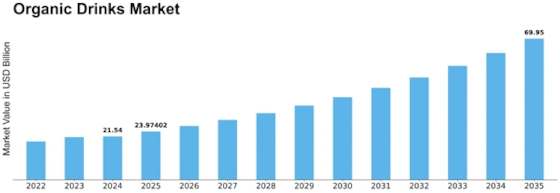
The Organic Drinks Market was valued at 21.54 USD Billion in 2024.

What is the projected market size for the Organic Drinks Market by 2035?

The market is projected to reach 69.95 USD Billion by 2035.

What is the expected CAGR for the Organic Drinks Market during the forecast period 2025 - 2035?

The expected CAGR for the Organic Drinks Market during this period is 11.3%.

Which companies are considered key players in the Organic Drinks Market?

Key players include Coca-Cola, PepsiCo, Nestle, Danone, Unilever, Monster Beverage Corporation, Kraft Heinz, Hain Celestial Group, and Organic Valley.

How is the Organic Drinks Market segmented by type?

The market is segmented into Alcoholic drinks valued at 2.15 USD Billion and Non-Alcoholic drinks valued at 19.39 USD Billion.

What are the distribution channels for Organic Drinks?

The market features Store-Based distribution valued at 12.92 USD Billion and Non-Store-Based distribution valued at 8.62 USD Billion.

Market Summary

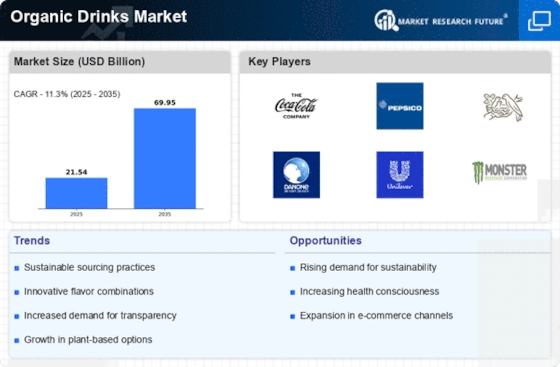
As per MRFR analysis, the Organic Drinks Market Size was estimated at 21.54 USD Billion in 2024. The Organic Drinks industry is projected to grow from 23.97 USD Billion in 2025 to 69.95 USD Billion by 2035, exhibiting a compound annual growth rate (CAGR) of 11.3 during the forecast period 2025 - 2035.

Key Market Trends & Highlights

The Organic Drinks Market is experiencing robust growth driven by health consciousness and sustainability trends.

  • The North American region remains the largest market for organic drinks, reflecting a strong health and wellness focus among consumers. In contrast, the Asia-Pacific region is emerging as the fastest-growing market, driven by evolving consumer preferences for organic products. The non-alcoholic segment continues to dominate the market, while the alcoholic segment is witnessing rapid growth due to innovative flavor profiles. Key market drivers include rising health consciousness and sustainability trends, which are shaping consumer choices in both store-based and non-store-based segments.

Market Size & Forecast

2024 Market Size 21.54 (USD Billion)
2035 Market Size 69.95 (USD Billion)
CAGR (2025 - 2035) 11.3%
Largest Regional Market Share in 2024 North America

Major Players

<p>Coca-Cola (US), PepsiCo (US), <a href="https://www.nestle.ch/de">Nestle (CH)</a>, Danone (FR), Unilever (GB), Monster Beverage Corporation (US), Kraft Heinz (US), Hain Celestial Group (US), Organic Valley (US)</p>

Market Trends

The Organic Drinks Market is currently experiencing a notable transformation, driven by a growing consumer preference for health-conscious choices. This shift is largely influenced by an increasing awareness of the benefits associated with organic ingredients, which are perceived as safer and more nutritious compared to their conventional counterparts. As consumers become more discerning, they tend to gravitate towards beverages that not only satisfy their taste preferences but also align with their values regarding sustainability and environmental impact. This trend is further amplified by the rise of social media, where information about organic products spreads rapidly, influencing purchasing decisions and brand loyalty. Moreover, the Organic Drinks Market is witnessing a diversification of product offerings, as manufacturers innovate to meet the evolving demands of consumers. This includes the introduction of unique flavors, functional beverages that promote wellness, and options catering to specific dietary needs. The market appears to be expanding beyond traditional categories, incorporating elements such as adaptogens and superfoods, which may enhance the appeal of organic drinks. As the landscape continues to evolve, it seems likely that the Organic Drinks Market will further solidify its position as a key player in the broader beverage industry, reflecting a shift towards healthier lifestyles and conscious consumption.

Health and Wellness Focus

The Organic Drinks Market is increasingly characterized by a strong emphasis on health and wellness. Consumers are actively seeking beverages that contribute positively to their overall well-being, leading to a rise in demand for organic options that are free from artificial additives and preservatives.

Sustainability and Ethical Sourcing

Sustainability has emerged as a critical factor influencing consumer choices within the Organic Drinks Market. There is a growing expectation for brands to demonstrate ethical sourcing practices, which resonates with environmentally conscious consumers who prioritize products that support sustainable agriculture.

Innovative Product Development

Innovation plays a pivotal role in the Organic Drinks Market, as companies strive to differentiate their offerings. This trend encompasses the introduction of novel flavors, functional ingredients, and beverages designed to cater to specific dietary preferences, thereby attracting a broader audience.

Organic Drinks Market Market Drivers

Sustainability Trends

Sustainability has emerged as a pivotal driver within the Organic Drinks Market, as consumers increasingly seek products that align with their environmental values. The demand for sustainably sourced ingredients and eco-friendly packaging is on the rise, with many consumers willing to pay a premium for products that demonstrate a commitment to environmental stewardship. Reports suggest that nearly 60% of consumers consider sustainability when making beverage choices, indicating a significant shift in purchasing behavior. This trend compels companies in the Organic Drinks Market to adopt sustainable practices, from sourcing organic ingredients to implementing eco-friendly production methods. As a result, brands that prioritize sustainability are likely to gain a competitive edge, appealing to a growing segment of environmentally conscious consumers.

Innovative Flavor Profiles

Innovation in flavor profiles is becoming a key differentiator in the Organic Drinks Market, as brands strive to capture consumer interest in a crowded marketplace. The introduction of unique and exotic flavors, often derived from organic sources, is attracting adventurous consumers looking for novel taste experiences. Market analysis reveals that beverages featuring innovative flavors are witnessing higher sales growth compared to traditional options, suggesting that consumers are eager to explore new taste sensations. This trend encourages companies within the Organic Drinks Market to invest in research and development, creating products that not only meet health standards but also excite the palate. As a result, the ability to offer distinctive flavors may become a crucial factor in brand loyalty and market share.

Rising Health Consciousness

The Organic Drinks Market is experiencing a notable surge in demand driven by an increasing awareness of health and wellness among consumers. As individuals become more informed about the benefits of organic ingredients, they are gravitating towards beverages that promise natural and wholesome nutrition. Recent data indicates that the organic beverage segment has seen a growth rate of approximately 10% annually, reflecting a shift in consumer preferences towards healthier options. This trend is particularly pronounced among younger demographics, who are more likely to prioritize organic products in their purchasing decisions. Consequently, brands within the Organic Drinks Market are responding by expanding their product lines to include a variety of organic options, catering to the evolving tastes and preferences of health-conscious consumers.

Evolving Consumer Preferences

Consumer preferences are rapidly evolving, significantly impacting the Organic Drinks Market. A growing segment of the population is shifting towards plant-based diets and organic lifestyles, which is reflected in their beverage choices. Data indicates that approximately 40% of consumers are actively seeking organic options, driven by a desire for transparency in ingredient sourcing and a preference for natural flavors. This shift is prompting brands within the Organic Drinks Market to adapt their marketing strategies and product formulations to align with these changing preferences. Companies are increasingly focusing on clean labels and minimal processing, appealing to consumers who prioritize authenticity and simplicity in their food and beverage choices. As these preferences continue to evolve, the Organic Drinks Market must remain agile to meet the demands of a discerning consumer base.

Increased Availability of Organic Ingredients

The Organic Drinks Market is benefiting from an enhanced supply chain for organic ingredients, which has made it easier for manufacturers to source high-quality components. As more farmers transition to organic farming practices, the availability of organic fruits, herbs, and other ingredients has expanded significantly. This increase in supply is crucial for the growth of the Organic Drinks Market, as it allows brands to innovate and diversify their product offerings without facing significant cost barriers. Furthermore, the establishment of certification programs and regulatory frameworks has bolstered consumer confidence in organic labeling, ensuring that products meet stringent quality standards. Consequently, the improved accessibility of organic ingredients is likely to fuel further growth in the market, as companies can respond more effectively to consumer demand for organic beverages.

Market Segment Insights

By Type: Non-Alcoholic (Largest) vs. Alcoholic (Fastest-Growing)

<p>The Organic Drinks Market is currently dominated by the Non-Alcoholic segment, which has significantly outpaced the Alcoholic segment in market share. Non-Alcoholic organic drinks appeal to a broad consumer base, capitalizing on the increasing health consciousness among individuals. The organic certification and the absence of artificial ingredients in these products have led to growing demand, particularly among families and health-oriented consumers seeking natural alternatives. In contrast, the Alcoholic segment is on a rapid growth trajectory, becoming increasingly popular among millennials and younger demographics looking for organic choices in their beverages. This trend is driven by a growing preference for quality over quantity and a heightened awareness of the origins and ingredients of alcoholic products.</p>

<p>Non-Alcoholic (Dominant) vs. Alcoholic (Emerging)</p>

<p>In the Organic Drinks Market, the Non-Alcoholic segment stands out as the dominant player, characterized by its wide variety of options, including organic juices, teas, and soft drinks. This dominance is supported by robust consumer demand for healthier options that provide taste without compromising well-being. In contrast, the Alcoholic segment, while emerging, is rapidly capturing attention with a diverse range of organic wines, <a href="https://www.marketresearchfuture.com/reports/beer-market-1647">beers</a>, and spirits that cater to discerning consumers. This segment appeals to those seeking unique flavor profiles and environmentally-friendly production methods, reflecting a significant shift in consumer preferences towards organic offerings. The growth of the Alcoholic segment indicates a promising future for organic alcoholic beverages as they carve out their niche in a competitive market.</p>

By Distribution Channel: Store-Based (Largest) vs. Non-Store-Based (Fastest-Growing)

<p>The distribution of organic drinks across various channels shows a significant preference for store-based shopping, which captures the majority of the market share. Retail outlets such as supermarkets and health food stores provide consumers with immediate access to organic beverages, leveraging established customer trust and brand recognition. In contrast, non-store-based channels, including e-commerce platforms and direct-to-consumer delivery services, have begun to carve out a notable presence, especially among younger consumers who prioritize convenience and variety in their shopping experience.</p>

<p>Distribution Channel: Store-Based (Dominant) vs. Non-Store-Based (Emerging)</p>

<p>Store-based distribution channels dominate the organic drinks market by providing a familiar shopping environment with well-established products that appeal to health-conscious consumers. These traditional retail outlets are pivotal for brand exposure, allowing customers to browse various offerings firsthand. On the other hand, non-store-based channels are rapidly emerging as a significant force, driven by the digital transformation of shopping habits and an increased demand for convenience. Many consumers now prefer to purchase organic drinks online, influenced by the ease of comparing brands and accessing exclusive products. This channel is characterized by innovative marketing strategies, direct engagement with consumers, and a wider selection of niche products that cater to evolving consumer tastes.</p>

By Packaging Type: Bottles (Largest) vs. Cans (Fastest-Growing)

<p>In the Organic Drinks Market, the packaging type segment is predominantly dominated by bottles, which hold the largest market share among various packaging formats. Bottles are favored for their convenient handling and perceived sustainability, attracting health-conscious and environmentally aware consumers. Following bottles, cans are gaining significant traction, thanks to their portable nature and recyclability, appealing to a broader range of consumers seeking convenience and sustainability in their beverage choices.</p>

<p>Bottles (Dominant) vs. Cans (Emerging)</p>

<p>Bottles have established themselves as the dominant packaging type in the Organic Drinks Market due to their extensive use for various types of organic beverages, including juices, smoothies, and teas. They offer an appealing aesthetic, which enhances brand visibility and consumer trust. On the other hand, cans represent an emerging segment, characterized by their lightweight nature and ability to preserve freshness, thus appealing to on-the-go lifestyles. The rising trend towards sustainability is shaping the growth of cans, as they are increasingly viewed as eco-friendly options, positioning them strongly for future market expansion.</p>

Get more detailed insights about Organic Drinks Market Research Report - Forecast till 2035

Regional Insights

By Region, the study provides market insights into North America, Europe, Asia-Pacific and the Rest of the World. The North American Organic Drinks Market accounted for USD 7.74 billion in 2022 and is expected to exhibit a significant CAGR growth during the study period. Consumer use of organic drinks has increased due to the Region's growing interest in health and well-being. In several nations, like the U.S. and Mexico, consumers are embracing the meal replacement trend, raising the demand for organic drinks.

The organic drink market is anticipated to increase sales value due to the expansion in demand for such beverages.

Further, the major countries studied in the market report are The U.S., Canada, German, France, the U.K., Italy, Spain, China, Japan, India, Australia, South Korea, and Brazil.

Figure 2: ORGANIC DRINKS MARKET SHARE BY REGION 2022 (%)

ORGANIC DRINKS MARKET SHARE BY REGION 2022

Source: Secondary Research, Primary Research, Market Research Future Database and Analyst Review

Europe's Organic Drinks Market accounts for the second-largest market share during the forecast period. Natural and nutritious beverages are becoming more popular among the nation's health-conscious customers. There is a great need for organic beverages in the area since shoppers are concerned about the effects of synthetic components, food additives, and stabilizers used by beverage production corporations. Emerging businesses earn considerable market share through unconventional sales channels like social media and e-commerce. Further, the Germany Organic Drinks Market held the largest market share, and the U.K. Organic Drinks Market was the fastest-growing market in the European Region.

Asia-Pacific Organic Drinks Market is also emerging at a rapid rate. The consumption of alcoholic beverages is rising in countries such as India, China, and Australia. The rising economic conditions and wellness concerns among consumers are shifting towards organic beverages, driving the demand for organic alcoholic beverages throughout the Region and contributing to the growth of the organic beverages market. Moreover, China's Organic Drinks Market held the largest market share, and the India Organic Drinks Market was the fastest-growing market in the Asia-Pacific region.

Key Players and Competitive Insights

Leading industry companies are investing significantly in R&D to broaden their product offerings, which will spur further expansion of the organic drink product market. Important market developments include new product releases, contractual agreements, mergers and acquisitions, greater investments, and collaboration with other organizations. Market participants also engage in several strategic actions to increase their worldwide presence. The Organic Drinks industry must offer reasonably priced products to grow and thrive in a more cutthroat and competitive environment.

One of the primary business strategies manufacturers employ in the worldwide Organic Drinks industry to benefit customers and expand the market sector is local manufacturing to reduce operating costs. The Organic Drinks industry has recently provided some of medicine's most important benefits.

Major players in the Organic Drinks Market, Hain Celestial (U.S.),  Suja Life LLC (U.S.), the Coca-Cola Company (U.S.), Danone S.A. (France),  Purity Organic LLC (U.S.), the Better Drinks Co. (New Zealand), Parker's Organic Juices Pty Ltd (Australia),  Bison Organic Beer (U.S.), James White Drinks Ltd. (U.K.),  PepsiCo Inc. (U.S.), Nutrition & Sante Iberia S.L. (Spain), Republica Coffee (Australia),  The WhiteWave Foods Company (U.S.), Alnatura Produktions & Handels GmbH (Germany), Parkers Organic Juices PTY LTD (Australia), and others, are attempting to increase market demand by investing in research and development operations.

The only spirits firm that distills its alcoholic beverages using solely natural cane sugar grown in Colombia's Cauca Valley is Drake's Organic Spirits, certified USDA Organic, Gluten Free®, Non-GMO, Vegan, and Kosher. Drake's Organic Spirits debuted a brand-new BOXTAIL flavor in January 2022 called Drake's Perfect Margarita BOXTAIL. It joins Drake's lineup of RTD drinks, including the Black Cherry Limeade, Watermelon-Tini, Mango Punch, and Minted Mojito.

Anheuser-Busch InBev SA/NV, also known as A.B. InBev, is a Belgian beverage and brewing business headquartered in Leuven, Belgium. A worldwide functional management office for A.B. InBev is in New York City. At the same time, regional offices are also located in So Paulo, London, St. Louis, Mexico City, Bremen, and Johannesburg. In March 2022, Anheuser-Busch InBev will introduce a new line of Michelob Ultra hard seltzers that use coconut water as an ingredient. There are four tastes in all in this line: Kiwi Lime, Berry Hibiscus, Strawberry Guava, and Blueberry Watermelon.

Key Companies in the Organic Drinks Market market include

Industry Developments

  • In June 2022, System Foods, a food and beverage company, purchased Chameleon Organic Coffee from Nestlé USA. The product line offered by Chameleon Organic Coffee consists of multi-serve concentrations and single-serve ready-to-drink items.
  • March 2022: Graasi Barley Water has launched a brand-new collection of ready-to-drink (RTD) organic waters in flavors including Citrus Mint, Cucumber Lime and Lemongrass Ginger.

Future Outlook

Organic Drinks Market Future Outlook

<p>The Organic Drinks Market is projected to grow at an 11.3% CAGR from 2024 to 2035, driven by increasing health consciousness, sustainable practices, and innovative product offerings.</p>

New opportunities lie in:

  • <p>Expansion of organic beverage subscription services</p><p>Development of plant-based functional drinks</p><p>Investment in eco-friendly packaging solutions</p>

<p>By 2035, the market is expected to be robust, reflecting strong consumer demand and innovative growth strategies.</p>

Market Segmentation

Organic Drinks Market Type Outlook

  • Alcoholic
  • Non-Alcoholic

Organic Drinks Market Packaging Type Outlook

  • Bottles
  • Cans
  • Others

Organic Drinks Market Distribution Channel Outlook

  • Store-Based
  • Non-Store-Based

Report Scope

MARKET SIZE 202421.54(USD Billion)
MARKET SIZE 202523.97(USD Billion)
MARKET SIZE 203569.95(USD Billion)
COMPOUND ANNUAL GROWTH RATE (CAGR)11.3% (2024 - 2035)
REPORT COVERAGERevenue Forecast, Competitive Landscape, Growth Factors, and Trends
BASE YEAR2024
Market Forecast Period2025 - 2035
Historical Data2019 - 2024
Market Forecast UnitsUSD Billion
Key Companies ProfiledMarket analysis in progress
Segments CoveredMarket segmentation analysis in progress
Key Market OpportunitiesGrowing consumer preference for health-conscious, sustainable beverages drives innovation in the Organic Drinks Market.
Key Market DynamicsRising consumer preference for health-conscious beverages drives innovation and competition in the organic drinks sector.
Countries CoveredNorth America, Europe, APAC, South America, MEA

FAQs

What is the current valuation of the Organic Drinks Market as of 2024?

The Organic Drinks Market was valued at 21.54 USD Billion in 2024.

What is the projected market size for the Organic Drinks Market by 2035?

The market is projected to reach 69.95 USD Billion by 2035.

What is the expected CAGR for the Organic Drinks Market during the forecast period 2025 - 2035?

The expected CAGR for the Organic Drinks Market during this period is 11.3%.

Which companies are considered key players in the Organic Drinks Market?

Key players include Coca-Cola, PepsiCo, Nestle, Danone, Unilever, Monster Beverage Corporation, Kraft Heinz, Hain Celestial Group, and Organic Valley.

How is the Organic Drinks Market segmented by type?

The market is segmented into Alcoholic drinks valued at 2.15 USD Billion and Non-Alcoholic drinks valued at 19.39 USD Billion.

What are the distribution channels for Organic Drinks?

The market features Store-Based distribution valued at 12.92 USD Billion and Non-Store-Based distribution valued at 8.62 USD Billion.

  1. SECTION I: EXECUTIVE SUMMARY AND KEY HIGHLIGHTS
    1. EXECUTIVE SUMMARY
      1. Market Overview
      2. Key Findings
      3. Market Segmentation
      4. Competitive Landscape
      5. Challenges and Opportunities
      6. Future Outlook 2
  2. SECTION II: SCOPING, METHODOLOGY AND MARKET STRUCTURE
    1. MARKET INTRODUCTION
      1. Definition
      2. Scope of the study
    2. RESEARCH METHODOLOGY
      1. Overview
      2. Data Mining
      3. Secondary Research
      4. Primary Research
      5. Forecasting Model
      6. Market Size Estimation
      7. Data Triangulation
      8. Validation 3
  3. SECTION III: QUALITATIVE ANALYSIS
    1. MARKET DYNAMICS
      1. Overview
      2. Drivers
      3. Restraints
      4. Opportunities
    2. MARKET FACTOR ANALYSIS
      1. Value chain Analysis
      2. Porter's Five Forces Analysis
      3. COVID-19 Impact Analysis
  4. SECTION IV: QUANTITATIVE ANALYSIS
    1. Food, Beverages & Nutrition, BY Type (USD Billion)
      1. Alcoholic
      2. Non-Alcoholic
    2. Food, Beverages & Nutrition, BY Distribution Channel (USD Billion)
      1. Store-Based
      2. Non-Store-Based
    3. Food, Beverages & Nutrition, BY Packaging Type (USD Billion)
      1. Bottles
      2. Cans
      3. Others
    4. Food, Beverages & Nutrition, BY Region (USD Billion)
      1. North America
      2. Europe
      3. APAC
      4. South America
      5. MEA
  5. SECTION V: COMPETITIVE ANALYSIS
    1. Competitive Landscape
      1. Overview
      2. Competitive Analysis
      3. Market share Analysis
      4. Major Growth Strategy in the Food, Beverages & Nutrition
      5. Competitive Benchmarking
      6. Leading Players in Terms of Number of Developments in the Food, Beverages & Nutrition
      7. Key developments and growth strategies
      8. Major Players Financial Matrix
    2. Company Profiles
      1. Coca-Cola (US)
      2. PepsiCo (US)
      3. Nestle (CH)
      4. Danone (FR)
      5. Unilever (GB)
      6. Monster Beverage Corporation (US)
      7. Kraft Heinz (US)
      8. Hain Celestial Group (US)
      9. Organic Valley (US)
    3. Appendix
      1. References
      2. Related Reports 6 LIST OF FIGURES
    4. MARKET SYNOPSIS
    5. NORTH AMERICA MARKET ANALYSIS
    6. US MARKET ANALYSIS BY TYPE
    7. US MARKET ANALYSIS BY DISTRIBUTION CHANNEL
    8. US MARKET ANALYSIS BY PACKAGING TYPE
    9. CANADA MARKET ANALYSIS BY TYPE
    10. CANADA MARKET ANALYSIS BY DISTRIBUTION CHANNEL
    11. CANADA MARKET ANALYSIS BY PACKAGING TYPE
    12. EUROPE MARKET ANALYSIS
    13. GERMANY MARKET ANALYSIS BY TYPE
    14. GERMANY MARKET ANALYSIS BY DISTRIBUTION CHANNEL
    15. GERMANY MARKET ANALYSIS BY PACKAGING TYPE
    16. UK MARKET ANALYSIS BY TYPE
    17. UK MARKET ANALYSIS BY DISTRIBUTION CHANNEL
    18. UK MARKET ANALYSIS BY PACKAGING TYPE
    19. FRANCE MARKET ANALYSIS BY TYPE
    20. FRANCE MARKET ANALYSIS BY DISTRIBUTION CHANNEL
    21. FRANCE MARKET ANALYSIS BY PACKAGING TYPE
    22. RUSSIA MARKET ANALYSIS BY TYPE
    23. RUSSIA MARKET ANALYSIS BY DISTRIBUTION CHANNEL
    24. RUSSIA MARKET ANALYSIS BY PACKAGING TYPE
    25. ITALY MARKET ANALYSIS BY TYPE
    26. ITALY MARKET ANALYSIS BY DISTRIBUTION CHANNEL
    27. ITALY MARKET ANALYSIS BY PACKAGING TYPE
    28. SPAIN MARKET ANALYSIS BY TYPE
    29. SPAIN MARKET ANALYSIS BY DISTRIBUTION CHANNEL
    30. SPAIN MARKET ANALYSIS BY PACKAGING TYPE
    31. REST OF EUROPE MARKET ANALYSIS BY TYPE
    32. REST OF EUROPE MARKET ANALYSIS BY DISTRIBUTION CHANNEL
    33. REST OF EUROPE MARKET ANALYSIS BY PACKAGING TYPE
    34. APAC MARKET ANALYSIS
    35. CHINA MARKET ANALYSIS BY TYPE
    36. CHINA MARKET ANALYSIS BY DISTRIBUTION CHANNEL
    37. CHINA MARKET ANALYSIS BY PACKAGING TYPE
    38. INDIA MARKET ANALYSIS BY TYPE
    39. INDIA MARKET ANALYSIS BY DISTRIBUTION CHANNEL
    40. INDIA MARKET ANALYSIS BY PACKAGING TYPE
    41. JAPAN MARKET ANALYSIS BY TYPE
    42. JAPAN MARKET ANALYSIS BY DISTRIBUTION CHANNEL
    43. JAPAN MARKET ANALYSIS BY PACKAGING TYPE
    44. SOUTH KOREA MARKET ANALYSIS BY TYPE
    45. SOUTH KOREA MARKET ANALYSIS BY DISTRIBUTION CHANNEL
    46. SOUTH KOREA MARKET ANALYSIS BY PACKAGING TYPE
    47. MALAYSIA MARKET ANALYSIS BY TYPE
    48. MALAYSIA MARKET ANALYSIS BY DISTRIBUTION CHANNEL
    49. MALAYSIA MARKET ANALYSIS BY PACKAGING TYPE
    50. THAILAND MARKET ANALYSIS BY TYPE
    51. THAILAND MARKET ANALYSIS BY DISTRIBUTION CHANNEL
    52. THAILAND MARKET ANALYSIS BY PACKAGING TYPE
    53. INDONESIA MARKET ANALYSIS BY TYPE
    54. INDONESIA MARKET ANALYSIS BY DISTRIBUTION CHANNEL
    55. INDONESIA MARKET ANALYSIS BY PACKAGING TYPE
    56. REST OF APAC MARKET ANALYSIS BY TYPE
    57. REST OF APAC MARKET ANALYSIS BY DISTRIBUTION CHANNEL
    58. REST OF APAC MARKET ANALYSIS BY PACKAGING TYPE
    59. SOUTH AMERICA MARKET ANALYSIS
    60. BRAZIL MARKET ANALYSIS BY TYPE
    61. BRAZIL MARKET ANALYSIS BY DISTRIBUTION CHANNEL
    62. BRAZIL MARKET ANALYSIS BY PACKAGING TYPE
    63. MEXICO MARKET ANALYSIS BY TYPE
    64. MEXICO MARKET ANALYSIS BY DISTRIBUTION CHANNEL
    65. MEXICO MARKET ANALYSIS BY PACKAGING TYPE
    66. ARGENTINA MARKET ANALYSIS BY TYPE
    67. ARGENTINA MARKET ANALYSIS BY DISTRIBUTION CHANNEL
    68. ARGENTINA MARKET ANALYSIS BY PACKAGING TYPE
    69. REST OF SOUTH AMERICA MARKET ANALYSIS BY TYPE
    70. REST OF SOUTH AMERICA MARKET ANALYSIS BY DISTRIBUTION CHANNEL
    71. REST OF SOUTH AMERICA MARKET ANALYSIS BY PACKAGING TYPE
    72. MEA MARKET ANALYSIS
    73. GCC COUNTRIES MARKET ANALYSIS BY TYPE
    74. GCC COUNTRIES MARKET ANALYSIS BY DISTRIBUTION CHANNEL
    75. GCC COUNTRIES MARKET ANALYSIS BY PACKAGING TYPE
    76. SOUTH AFRICA MARKET ANALYSIS BY TYPE
    77. SOUTH AFRICA MARKET ANALYSIS BY DISTRIBUTION CHANNEL
    78. SOUTH AFRICA MARKET ANALYSIS BY PACKAGING TYPE
    79. REST OF MEA MARKET ANALYSIS BY TYPE
    80. REST OF MEA MARKET ANALYSIS BY DISTRIBUTION CHANNEL
    81. REST OF MEA MARKET ANALYSIS BY PACKAGING TYPE
    82. KEY BUYING CRITERIA OF FOOD, BEVERAGES & NUTRITION
    83. RESEARCH PROCESS OF MRFR
    84. DRO ANALYSIS OF FOOD, BEVERAGES & NUTRITION
    85. DRIVERS IMPACT ANALYSIS: FOOD, BEVERAGES & NUTRITION
    86. RESTRAINTS IMPACT ANALYSIS: FOOD, BEVERAGES & NUTRITION
    87. SUPPLY / VALUE CHAIN: FOOD, BEVERAGES & NUTRITION
    88. FOOD, BEVERAGES & NUTRITION, BY TYPE, 2024 (% SHARE)
    89. FOOD, BEVERAGES & NUTRITION, BY TYPE, 2024 TO 2035 (USD Billion)
    90. FOOD, BEVERAGES & NUTRITION, BY DISTRIBUTION CHANNEL, 2024 (% SHARE)
    91. FOOD, BEVERAGES & NUTRITION, BY DISTRIBUTION CHANNEL, 2024 TO 2035 (USD Billion)
    92. FOOD, BEVERAGES & NUTRITION, BY PACKAGING TYPE, 2024 (% SHARE)
    93. FOOD, BEVERAGES & NUTRITION, BY PACKAGING TYPE, 2024 TO 2035 (USD Billion)
    94. BENCHMARKING OF MAJOR COMPETITORS 7 LIST OF TABLES
    95. LIST OF ASSUMPTIONS
    96. North America MARKET SIZE ESTIMATES; FORECAST
      1. BY TYPE, 2025-2035 (USD Billion)
      2. BY DISTRIBUTION CHANNEL, 2025-2035 (USD Billion)
      3. BY PACKAGING TYPE, 2025-2035 (USD Billion)
    97. US MARKET SIZE ESTIMATES; FORECAST
      1. BY TYPE, 2025-2035 (USD Billion)
      2. BY DISTRIBUTION CHANNEL, 2025-2035 (USD Billion)
      3. BY PACKAGING TYPE, 2025-2035 (USD Billion)
    98. Canada MARKET SIZE ESTIMATES; FORECAST
      1. BY TYPE, 2025-2035 (USD Billion)
      2. BY DISTRIBUTION CHANNEL, 2025-2035 (USD Billion)
      3. BY PACKAGING TYPE, 2025-2035 (USD Billion)
    99. Europe MARKET SIZE ESTIMATES; FORECAST
      1. BY TYPE, 2025-2035 (USD Billion)
      2. BY DISTRIBUTION CHANNEL, 2025-2035 (USD Billion)
      3. BY PACKAGING TYPE, 2025-2035 (USD Billion)
    100. Germany MARKET SIZE ESTIMATES; FORECAST
      1. BY TYPE, 2025-2035 (USD Billion)
      2. BY DISTRIBUTION CHANNEL, 2025-2035 (USD Billion)
      3. BY PACKAGING TYPE, 2025-2035 (USD Billion)
    101. UK MARKET SIZE ESTIMATES; FORECAST
      1. BY TYPE, 2025-2035 (USD Billion)
      2. BY DISTRIBUTION CHANNEL, 2025-2035 (USD Billion)
      3. BY PACKAGING TYPE, 2025-2035 (USD Billion)
    102. France MARKET SIZE ESTIMATES; FORECAST
      1. BY TYPE, 2025-2035 (USD Billion)
      2. BY DISTRIBUTION CHANNEL, 2025-2035 (USD Billion)
      3. BY PACKAGING TYPE, 2025-2035 (USD Billion)
    103. Russia MARKET SIZE ESTIMATES; FORECAST
      1. BY TYPE, 2025-2035 (USD Billion)
      2. BY DISTRIBUTION CHANNEL, 2025-2035 (USD Billion)
      3. BY PACKAGING TYPE, 2025-2035 (USD Billion)
    104. Italy MARKET SIZE ESTIMATES; FORECAST
      1. BY TYPE, 2025-2035 (USD Billion)
      2. BY DISTRIBUTION CHANNEL, 2025-2035 (USD Billion)
      3. BY PACKAGING TYPE, 2025-2035 (USD Billion)
    105. Spain MARKET SIZE ESTIMATES; FORECAST
      1. BY TYPE, 2025-2035 (USD Billion)
      2. BY DISTRIBUTION CHANNEL, 2025-2035 (USD Billion)
      3. BY PACKAGING TYPE, 2025-2035 (USD Billion)
    106. Rest of Europe MARKET SIZE ESTIMATES; FORECAST
      1. BY TYPE, 2025-2035 (USD Billion)
      2. BY DISTRIBUTION CHANNEL, 2025-2035 (USD Billion)
      3. BY PACKAGING TYPE, 2025-2035 (USD Billion)
    107. APAC MARKET SIZE ESTIMATES; FORECAST
      1. BY TYPE, 2025-2035 (USD Billion)
      2. BY DISTRIBUTION CHANNEL, 2025-2035 (USD Billion)
      3. BY PACKAGING TYPE, 2025-2035 (USD Billion)
    108. China MARKET SIZE ESTIMATES; FORECAST
      1. BY TYPE, 2025-2035 (USD Billion)
      2. BY DISTRIBUTION CHANNEL, 2025-2035 (USD Billion)
      3. BY PACKAGING TYPE, 2025-2035 (USD Billion)
    109. India MARKET SIZE ESTIMATES; FORECAST
      1. BY TYPE, 2025-2035 (USD Billion)
      2. BY DISTRIBUTION CHANNEL, 2025-2035 (USD Billion)
      3. BY PACKAGING TYPE, 2025-2035 (USD Billion)
    110. Japan MARKET SIZE ESTIMATES; FORECAST
      1. BY TYPE, 2025-2035 (USD Billion)
      2. BY DISTRIBUTION CHANNEL, 2025-2035 (USD Billion)
      3. BY PACKAGING TYPE, 2025-2035 (USD Billion)
    111. South Korea MARKET SIZE ESTIMATES; FORECAST
      1. BY TYPE, 2025-2035 (USD Billion)
      2. BY DISTRIBUTION CHANNEL, 2025-2035 (USD Billion)
      3. BY PACKAGING TYPE, 2025-2035 (USD Billion)
    112. Malaysia MARKET SIZE ESTIMATES; FORECAST
      1. BY TYPE, 2025-2035 (USD Billion)
      2. BY DISTRIBUTION CHANNEL, 2025-2035 (USD Billion)
      3. BY PACKAGING TYPE, 2025-2035 (USD Billion)
    113. Thailand MARKET SIZE ESTIMATES; FORECAST
      1. BY TYPE, 2025-2035 (USD Billion)
      2. BY DISTRIBUTION CHANNEL, 2025-2035 (USD Billion)
      3. BY PACKAGING TYPE, 2025-2035 (USD Billion)
    114. Indonesia MARKET SIZE ESTIMATES; FORECAST
      1. BY TYPE, 2025-2035 (USD Billion)
      2. BY DISTRIBUTION CHANNEL, 2025-2035 (USD Billion)
      3. BY PACKAGING TYPE, 2025-2035 (USD Billion)
    115. Rest of APAC MARKET SIZE ESTIMATES; FORECAST
      1. BY TYPE, 2025-2035 (USD Billion)
      2. BY DISTRIBUTION CHANNEL, 2025-2035 (USD Billion)
      3. BY PACKAGING TYPE, 2025-2035 (USD Billion)
    116. South America MARKET SIZE ESTIMATES; FORECAST
      1. BY TYPE, 2025-2035 (USD Billion)
      2. BY DISTRIBUTION CHANNEL, 2025-2035 (USD Billion)
      3. BY PACKAGING TYPE, 2025-2035 (USD Billion)
    117. Brazil MARKET SIZE ESTIMATES; FORECAST
      1. BY TYPE, 2025-2035 (USD Billion)
      2. BY DISTRIBUTION CHANNEL, 2025-2035 (USD Billion)
      3. BY PACKAGING TYPE, 2025-2035 (USD Billion)
    118. Mexico MARKET SIZE ESTIMATES; FORECAST
      1. BY TYPE, 2025-2035 (USD Billion)
      2. BY DISTRIBUTION CHANNEL, 2025-2035 (USD Billion)
      3. BY PACKAGING TYPE, 2025-2035 (USD Billion)
    119. Argentina MARKET SIZE ESTIMATES; FORECAST
      1. BY TYPE, 2025-2035 (USD Billion)
      2. BY DISTRIBUTION CHANNEL, 2025-2035 (USD Billion)
      3. BY PACKAGING TYPE, 2025-2035 (USD Billion)
    120. Rest of South America MARKET SIZE ESTIMATES; FORECAST
      1. BY TYPE, 2025-2035 (USD Billion)
      2. BY DISTRIBUTION CHANNEL, 2025-2035 (USD Billion)
      3. BY PACKAGING TYPE, 2025-2035 (USD Billion)
    121. MEA MARKET SIZE ESTIMATES; FORECAST
      1. BY TYPE, 2025-2035 (USD Billion)
      2. BY DISTRIBUTION CHANNEL, 2025-2035 (USD Billion)
      3. BY PACKAGING TYPE, 2025-2035 (USD Billion)
    122. GCC Countries MARKET SIZE ESTIMATES; FORECAST
      1. BY TYPE, 2025-2035 (USD Billion)
      2. BY DISTRIBUTION CHANNEL, 2025-2035 (USD Billion)
      3. BY PACKAGING TYPE, 2025-2035 (USD Billion)
    123. South Africa MARKET SIZE ESTIMATES; FORECAST
      1. BY TYPE, 2025-2035 (USD Billion)
      2. BY DISTRIBUTION CHANNEL, 2025-2035 (USD Billion)
      3. BY PACKAGING TYPE, 2025-2035 (USD Billion)
    124. Rest of MEA MARKET SIZE ESTIMATES; FORECAST
      1. BY TYPE, 2025-2035 (USD Billion)
      2. BY DISTRIBUTION CHANNEL, 2025-2035 (USD Billion)
      3. BY PACKAGING TYPE, 2025-2035 (USD Billion)
    125. PRODUCT LAUNCH/PRODUCT DEVELOPMENT/APPROVAL
    126. ACQUISITION/PARTNERSHIP

Organic Drinks Market Segmentation

Market Segmentation Overview

  • Detailed segmentation data will be available in the full report
  • Comprehensive analysis by multiple parameters
  • Regional and country-level breakdowns
  • Market size forecasts by segment
Infographic

Free Sample Request

Kindly complete the form below to receive a free sample of this Report

Get Free Sample

Customer Strories

Compare Licence

×
Features License Type
Single User Multiuser License Enterprise User
Price $4,950 $5,950 $7,250
Maximum User Access Limit 1 User Upto 10 Users Unrestricted Access Throughout the Organization
Free Customization
Direct Access to Analyst
Deliverable Format
Platform Access
Discount on Next Purchase 10% 15% 15%
Printable Versions