Request Free Sample ×

Kindly complete the form below to receive a free sample of this Report

* Please use a valid business email

Leading companies partner with us for data-driven Insights

clients tt-cursor
Hero Background
English
Chinese
French
Japanese
Korean
German
Spanish

Organic Chemicals Market Size

ID: MRFR/CnM/9293-HCR
100 Pages
Chitranshi Jaiswal
March 2026

Organic Chemicals Market Research Report Information By Source (Natural and Synthetic), By Type (Aliphatic, Aromatic, and Carbonyl), By Application (Food & Beverages, Agrochemicals, Pharmaceuticals, Personal Care & Cosmetics, and Plastics Polymers), and By Region (North America, Europe, Asia-Pacific, and Rest Of The World) –Market Forecast Till 2035

Share:
Download PDF ×

We do not share your information with anyone. However, we may send you emails based on your report interest from time to time. You may contact us at any time to opt-out.

Organic Chemicals Market Infographic
Purchase Options

Organic Chemicals Size

Organic Chemicals Market Growth Projections and Opportunities

A multitude of factors influencing production, demand, and market dynamics form the organic chemicals industry. In order to traverse the complicated terrain of the organic chemicals sector and make educated decisions, industry participants must have a thorough understanding of key market aspects. Feedstock Price and Availability: The market for organic chemicals is heavily influenced by the cost and accessibility of feedstock, which includes natural gas and crude oil. The production costs of organic chemical producers can be greatly impacted by fluctuations in feedstock prices, which can also have an influence on their overall competitiveness. Situation of the World Economy: The state of the world economy has a direct impact on the market for organic chemicals. The cyclical character of the industry is reflected in the influence that economic growth and stability have on the demand for organic chemicals across a range of industries, including consumer products, manufacturing, and construction. Regulatory Environment: The market for organic compounds is significantly impacted by strict laws and environmental initiatives. Regulation adherence has an impact on industry-wide sustainability practices, product compositions, and production methods. Technological Developments: Innovation in the procedures used to produce organic chemicals is fueled by technological developments. New and specialized organic chemical products are developed, efficiency is increased, and environmental impact is decreased with the help of improved technology. Transition to Sustainable Methods: In the world of organic chemicals, sustainable techniques are becoming more and more popular. Businesses that focus on environmentally friendly manufacturing techniques, lower emissions, and embrace green chemistry concepts will be better positioned to satisfy changing customer and regulatory demands. need from End-User sectors: The pharmaceutical, agricultural, textile, and automotive sectors are among those with a strong correlation with the need for organic chemicals. The total demand for organic compounds is greatly influenced by the economic activity and trends within various industries. customer tastes and Market Trends: The kinds of organic compounds that are in demand are influenced by shifting customer tastes and market trends. For instance, growing consumer awareness and environmental trends are driving the need for eco-friendly goods and bio-based chemicals. Global Trade Dynamics: Trade agreements and tariffs have an impact on the market for organic chemicals. Trade policy changes may have an impact on the competitiveness of imports and exports of organic chemicals, which may have an effect on price and market dynamics.
Organic Chemicals Market Size Graph
Author
Author Profile
Chitranshi Jaiswal
Team Lead - Research

Chitranshi is a Team Leader in the Chemicals & Materials (CnM) and Energy & Power (EnP) domains, with 6+ years of experience in market research. She leads and mentors teams to deliver cross-domain projects that equip clients with actionable insights and growth strategies. She is skilled in market estimation, forecasting, competitive benchmarking, and both primary & secondary research, enabling her to turn complex data into decision-ready insights. An engineer and MBA professional, she combines technical expertise with strategic acumen to solve dynamic market challenges. Chitranshi has successfully managed projects that support market entry, investment planning, and competitive positioning, while building strong client relationships. Certified in Advanced Excel & Power BI she leverages data-driven approaches to ensure accuracy, clarity, and impactful outcomes.

Leave a Comment

FAQs

What is the projected market valuation of the Organic Chemicals Market by 2035?

<p>The Organic Chemicals Market is projected to reach a valuation of 26.2 USD Billion by 2035.</p>

What was the market valuation of the Organic Chemicals Market in 2024?

<p>In 2024, the Organic Chemicals Market had a valuation of 13.06 USD Billion.</p>

What is the expected CAGR for the Organic Chemicals Market during the forecast period 2025 - 2035?

<p>The expected CAGR for the Organic Chemicals Market during the forecast period 2025 - 2035 is 6.53%.</p>

Which companies are considered key players in the Organic Chemicals Market?

<p>Key players in the Organic Chemicals Market include BASF, Dow, SABIC, LyondellBasell, and Eastman Chemical Company.</p>

What are the projected valuations for natural and synthetic organic chemicals by 2035?

<p>By 2035, natural organic chemicals are projected to reach 10.84 USD Billion, while synthetic organic chemicals may reach 15.36 USD Billion.</p>

How do the valuations of aliphatic, aromatic, and carbonyl organic chemicals compare by 2035?

<p>By 2035, aliphatic organic chemicals are projected at 9.0 USD Billion, aromatic at 10.0 USD Billion, and carbonyl at 7.2 USD Billion.</p>

What applications are driving growth in the Organic Chemicals Market?

<p>Key applications driving growth include pharmaceuticals, agrochemicals, and food and beverages, with projected valuations of 8.0, 6.0, and 5.0 USD Billion respectively by 2035.</p>

What is the significance of the personal care and cosmetics segment in the Organic Chemicals Market?

The personal care and cosmetics segment is projected to reach 4.0 USD Billion by 2035, indicating its growing importance in the market.

How does the growth of the Organic Chemicals Market compare across different segments?

The market shows varied growth across segments, with synthetic chemicals and pharmaceuticals likely experiencing the highest growth rates.

What trends are influencing the Organic Chemicals Market in 2025?

In 2025, trends such as sustainability and innovation in chemical production appear to be influencing the Organic Chemicals Market.

Market Summary

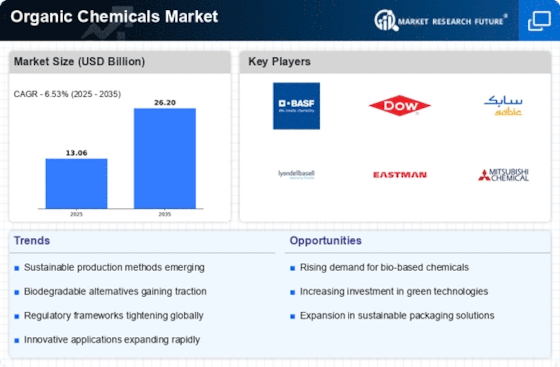
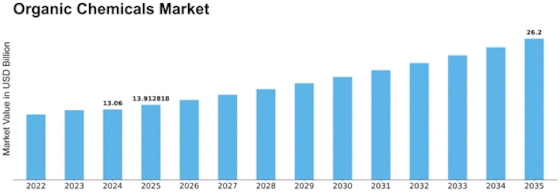
As per Market Research Future analysis, the Organic Chemicals Market Size was estimated at 13.06 USD Billion in 2024. The Organic Chemicals industry is projected to grow from 13.91 USD Billion in 2025 to 26.2 USD Billion by 2035, exhibiting a compound annual growth rate (CAGR) of 6.53% during the forecast period 2025 - 2035

Key Market Trends & Highlights

The Organic Chemicals Market is poised for robust growth driven by sustainability and innovation.

  • North America remains the largest market for organic chemicals, driven by strong industrial demand and regulatory frameworks.
  • The Asia-Pacific region is emerging as the fastest-growing market, fueled by rapid industrialization and increasing consumer awareness.
  • Natural organic chemicals dominate the market, while synthetic organic chemicals are experiencing the fastest growth due to technological advancements.
  • Rising demand for eco-friendly products and regulatory support for green chemistry are key drivers propelling market expansion.

Market Size & Forecast

2024 Market Size 13.06 (USD Billion)
2035 Market Size 26.2 (USD Billion)
CAGR (2025 - 2035) 6.53%
Largest Regional Market Share in 2024 North America

Major Players

BASF (DE), Dow (US), SABIC (SA), LyondellBasell (US), Eastman Chemical Company (US), Mitsubishi Chemical Corporation (JP), AkzoNobel (NL), Solvay (BE), Covestro (DE), Huntsman Corporation (US)

Market Trends

The Organic Chemicals Market is currently experiencing a dynamic evolution, driven by various factors that influence production and consumption patterns. The increasing demand for sustainable and eco-friendly products appears to be reshaping the landscape, as consumers and industries alike prioritize environmentally responsible choices. This shift is likely to encourage manufacturers to innovate and develop organic chemical solutions that align with these preferences. Furthermore, regulatory frameworks are becoming more stringent, compelling companies to adopt greener practices and reduce their environmental footprint. As a result, the market is witnessing a gradual transition towards bio-based feedstocks and processes, which may enhance the overall sustainability of organic chemicals. In addition to sustainability, technological advancements are playing a crucial role in the Organic Chemicals Market. Innovations in production techniques and the integration of digital technologies are streamlining operations and improving efficiency. This trend suggests that companies are increasingly investing in research and development to enhance their product offerings and meet the evolving needs of consumers. Moreover, the globalization of trade is facilitating the exchange of organic chemicals across borders, potentially expanding market reach and fostering competition. Overall, the Organic Chemicals Market is poised for growth, driven by sustainability initiatives, technological progress, and global trade dynamics.

Sustainability Initiatives

The Organic Chemicals Market is witnessing a notable shift towards sustainability, as both consumers and industries prioritize eco-friendly products. This trend encourages manufacturers to innovate and develop organic chemical solutions that align with environmental considerations.

Technological Advancements

Technological progress is significantly impacting the Organic Chemicals Market, with innovations in production techniques enhancing efficiency. Companies are increasingly investing in research and development to improve their offerings and adapt to changing consumer demands.

Global Trade Dynamics

The globalization of trade is facilitating the exchange of organic chemicals across borders, potentially expanding market reach. This trend fosters competition and encourages companies to adapt their strategies to meet diverse market needs.

Organic Chemicals Market Market Drivers

Regulatory Support for Green Chemistry

Regulatory frameworks are increasingly favoring the use of organic chemicals, which is a significant driver for the Organic Chemicals Market. Governments worldwide are implementing stringent regulations aimed at reducing the environmental impact of chemical production. These regulations often promote the adoption of green chemistry principles, which encourage the use of renewable resources and minimize hazardous substances. As a result, companies that invest in organic chemical production are likely to benefit from incentives and support, fostering growth in this sector. The regulatory landscape is expected to evolve, further bolstering the Organic Chemicals Market as businesses adapt to comply with these new standards.

Rising Demand for Eco-Friendly Products

The Organic Chemicals Market is experiencing a notable increase in demand for eco-friendly products. Consumers are becoming increasingly aware of environmental issues, leading to a shift towards sustainable alternatives. This trend is reflected in the growing preference for organic chemicals in various applications, including agriculture, personal care, and cleaning products. According to recent data, the organic chemicals segment is projected to grow at a compound annual growth rate of approximately 5.2% over the next five years. This shift not only aligns with consumer preferences but also encourages manufacturers to innovate and develop greener products, thereby enhancing their market position within the Organic Chemicals Market.

Expanding Applications Across Industries

The versatility of organic chemicals is driving their adoption across various industries, which is a key factor in the growth of the Organic Chemicals Market. From pharmaceuticals to agriculture, organic chemicals are finding applications that enhance product performance and sustainability. For example, the use of organic solvents in the pharmaceutical industry is increasing due to their lower toxicity and environmental impact. Additionally, the agricultural sector is increasingly utilizing organic pesticides and fertilizers, which are perceived as safer alternatives. This broadening scope of applications is expected to contribute to a robust growth trajectory for the Organic Chemicals Market, as diverse sectors seek to incorporate organic solutions.

Increased Investment in Research and Development

Investment in research and development is a significant driver for the Organic Chemicals Market. Companies are recognizing the importance of innovation in maintaining competitive advantage and meeting evolving consumer demands. Increased funding for R&D initiatives is leading to the discovery of new organic compounds and improved production methods. This focus on innovation is crucial, as it allows companies to develop products that align with sustainability goals and regulatory requirements. As a result, the Organic Chemicals Market is likely to witness a surge in new product offerings and enhanced production capabilities, further solidifying its position in the broader chemical market.

Technological Innovations in Production Processes

Technological advancements are playing a crucial role in shaping the Organic Chemicals Market. Innovations in production processes, such as biocatalysis and advanced separation techniques, are enhancing efficiency and reducing costs. These technologies enable manufacturers to produce organic chemicals with lower energy consumption and waste generation. For instance, the implementation of continuous flow chemistry has been shown to improve reaction efficiency and product yield. As these technologies become more accessible, they are likely to drive the growth of the Organic Chemicals Market, allowing companies to meet the increasing demand for sustainable products while maintaining profitability.

Market Segment Insights

By Source: Natural (Largest) vs. Synthetic (Fastest-Growing)

<p>In the Organic Chemicals Market, the distribution of market share between natural and synthetic sources is notably uneven, with natural chemicals commanding a significant portion of the market. This dominance is primarily attributed to the growing consumer preference for environmentally-friendly and sustainable products, which has led to an increased adoption of natural chemicals across various sectors. Synthetic chemicals, while historically prevalent, are seeing a decline due to rising health and environmental concerns surrounding their use. On the other hand, the synthetic segment is experiencing a rapid growth trend, fueled by innovations in chemical processing and the demand for high-performance products. The versatility and efficiency of synthetic organic chemicals are being recognized, especially in specialty applications, fostering their increase in popularity. As industries seek to balance performance with sustainability, this trend is expected to continue, propelling synthetic chemicals to new heights in the coming years.</p>

<p>Organic Chemicals: Natural (Dominant) vs. Synthetic (Emerging)</p>

<p>The natural segment of the Organic Chemicals Market is characterized by its reliance on renewable resources, appealing to both consumers and manufacturers who prioritize sustainability. Natural chemicals are not only seen as safer alternatives but are also backed by increasing regulatory frameworks supporting their use. This segment thrives on innovations that enhance the efficacy of natural products, solidifying its dominant position in the market. Conversely, the synthetic segment is emerging strongly, driven by advancements in chemical engineering that lead to the production of high-performance materials with tailored functionalities. Although synthetic chemicals face scrutiny, they are widely used across various applications due to their adaptability and cost-effectiveness, thus capturing a growing share in niche markets.</p>

By Type: Aliphatic (Largest) vs. Aromatic (Fastest-Growing)

<p>The Organic Chemicals Market is comprised of three primary types: Aliphatic, Aromatic, and Carbonyl. Currently, Aliphatic compounds constitute the largest share within the market, attributed to their widespread use in various applications such as solvents, lubricants, and pharmaceuticals. In contrast, Aromatic compounds are rapidly gaining traction, driven by their extensive applications in the production of dyes, plastics, and agricultural chemicals. The Carbonyl segment, while essential, holds a smaller share compared to the other two types, leading to a more balanced distribution across the segment values. Growth trends in the Organic Chemicals Market indicate a robust expansion for Aromatic compounds, propelled by their versatility and increasing demand in various industries. The shift towards sustainable and eco-friendly products is also playing a critical role in driving growth, as manufacturers seek to harness Aromatic compounds in innovative ways. Aliphatic compounds maintain their position due to their established market presence; however, the rise in eco-conscious alternatives could influence market dynamics in the coming years. Carbonyl may witness growth as demand for specialty chemicals increases, although it remains overshadowed by the dominance of Aliphatic and Aromatic segments.</p>

<p>Aromatic (Dominant) vs. Carbonyl (Emerging)</p>

<p>Aromatic compounds hold a dominant position in the Organic Chemicals Market due to their unique properties and extensive applications across various industries. Known for their stability and ability to engage in electrophilic substitutions, Aromatic chemicals are critical in the production of essential goods like perfumes, dyes, and pharmaceuticals. The growing demand for more advanced products has spurred innovation in this segment, ensuring that Aromatic remains at the forefront of market activity. In contrast, Carbonyl compounds are emerging as a niche segment with potential for growth in specific applications, including agrochemicals and high-performance materials. Their role in synthesis and functionalization positions them as a valuable asset for researchers and manufacturers aiming for specialized solutions, although they currently lag behind both Aliphatic and Aromatic compounds in market share.</p>

By Application: Food and Beverages (Largest) vs. Pharmaceuticals (Fastest-Growing)

<p>The Organic Chemicals Market showcases a diverse distribution across various application segments, with Food and Beverages holding the largest share due to its essential role in consumer products. This segment benefits from consistent demand driven by changing consumer preferences towards natural and organic ingredients. Meanwhile, Pharmaceuticals, while not the largest in share, are emerging rapidly, fuelled by technological advancements and a growing need for innovative drug compounds derived from organic chemicals. Growth trends in the Organic Chemicals Market are propelled by the increasing demand for sustainable products across applications. The Food and Beverages segment is thriving on trends towards organic consumption, while Pharmaceuticals are witnessing robust growth due to a focus on bio-based solutions. Additionally, regulatory initiatives emphasizing environmentally friendly practices further enhance the market potential, allowing each segment to flourish independently while also tapping into synergies across applications.</p>

<p>Food and Beverages: Largest vs. Pharmaceuticals: Fastest-Growing</p>

<p>The Food and Beverages application in the Organic Chemicals Market remains dominant, attributed to increased consumer consciousness around health and wellness. This segment prioritizes natural additives and organic ingredients, reinforcing its leading position. In contrast, the Pharmaceuticals sector is marked as the fastest-growing, driven by innovations in drug development and the increasing integration of organic chemicals in pharmaceutical formulations. Strong demand for effective, safer medicines coupled with R&D investments signifies its potential. Both segments reflect the market's commitment to sustainability and enhanced consumer experiences, though Food and Beverages retains a stronghold while Pharmaceuticals rapidly expands.</p>

Get more detailed insights about Organic Chemicals Market Research Report—Global Forecast till 2035

Regional Insights

North America : Innovation and Demand Growth

North America is the largest market for organic chemicals, holding approximately 40% of the global share. The region's growth is driven by robust demand from the automotive, construction, and consumer goods sectors. Regulatory support for sustainable practices and innovation in chemical processes further catalyzes market expansion. The U.S. and Canada are the primary contributors, with significant investments in R&D and production facilities. The competitive landscape is dominated by key players such as Dow, BASF, and LyondellBasell, which leverage advanced technologies to enhance production efficiency. The presence of established companies fosters a dynamic environment for innovation, while emerging startups are also making strides in specialty chemicals. The region's focus on sustainability and eco-friendly products is shaping future trends in the organic chemicals market.

Europe : Sustainability and Innovation Focus

Europe is a significant player in the organic chemicals market, accounting for around 30% of the global share. The region's growth is propelled by stringent environmental regulations and a strong emphasis on sustainability. Countries like Germany and France are at the forefront, driving demand for bio-based chemicals and innovative solutions that align with the European Green Deal. Regulatory frameworks are increasingly supportive of sustainable practices, enhancing market dynamics. Leading countries such as Germany, France, and the Netherlands host major chemical companies like BASF and AkzoNobel, which are investing heavily in green technologies. The competitive landscape is characterized by a mix of established firms and innovative startups focusing on sustainable products. The region's commitment to reducing carbon footprints and promoting circular economy principles is shaping the future of the organic chemicals market.

Asia-Pacific : Rapid Growth and Expansion

Asia-Pacific is rapidly emerging as a powerhouse in the organic chemicals market, holding approximately 25% of the global share. The region's growth is driven by increasing industrialization, urbanization, and rising demand from sectors such as automotive and electronics. Countries like China and India are leading this growth, supported by favorable government policies and investments in infrastructure and manufacturing capabilities. China is the largest market in the region, with significant contributions from local players and multinational corporations. The competitive landscape is marked by a mix of established companies and new entrants, focusing on innovation and cost-effective production methods. The presence of key players like Mitsubishi Chemical and SABIC further strengthens the market, as they adapt to changing consumer preferences and regulatory requirements.

Middle East and Africa : Resource-Rich and Growing Market

The Middle East and Africa region is an emerging frontier in the organic chemicals market, accounting for about 5% of the global share. The growth is primarily driven by the availability of natural resources and increasing investments in petrochemical industries. Countries like Saudi Arabia and the UAE are leading the charge, leveraging their oil and gas resources to expand chemical production capabilities and meet rising domestic and international demand. The competitive landscape is evolving, with key players such as SABIC and local firms investing in new technologies and sustainable practices. The region's focus on diversifying its economy beyond oil is fostering growth in the organic chemicals sector. As infrastructure improves and regulatory frameworks become more supportive, the market is poised for significant expansion in the coming years.

Key Players and Competitive Insights

Leading market players are investing heavily in research and development to expand their product lines, which will help the organic chemicals market, grow even more. Participants in the market are also engaging in a variety of strategic initiatives to footprint, with important market developments including new product launches, contracts, acquisitions, heftier investments, and cooperation with other parties organizations. To expand and survive in a more competitive and rising market climate, the organic chemicals industry must offer cost-effective items.Manufacturing locally to minimize operational costs is one of the key business tactics manufacturers use in the global organic chemicals industry to benefit clients and increase the market sector. In recent years, the organic chemicals industry has offered some of the most significant advantages to medicine. Major players in the Organic Chemicals Market, Global organic chemicals market leaders include Cargill (US), Eastman Chemical Company (US), BASF SE (Germany), Koninklijke DSM N.V. (Netherlands), Royal Dutch Shell (Netherlands), PPG Industries (US), AkzoNobel (Netherlands), Sinopec (China), ExxonMobil (US), Ineos (UK), Reliance Industries (India), LyondellBasell Industries (Netherlands), and The Dow Company (US).BASF SE is a chemical company. Chemicals, plastics, performance goods, practical solutions, agricultural solutions, and oil and gas are among the six business segments that the company engages in. In addition to offering items for these industries, BASF also offers a variety of system solutions and services. These include products for the chemical, automotive, construction, agriculture, oil, plastics, electrical, electronics, furniture, and paper sectors. A new production line for propionic acid with a capacity of 30 kilotons per year was created in May 2019 by BASF-YPC Company Limited, a joint venture between BASF and Sinopec owned equally by both companies.Akzo Nobel N.V. manufactures specialty chemicals. The business sells decorative paints, coatings, surfactants, polymers, pulp and paper, bleaching and oxidizing, salt chlorine, and other chemical goods. Products from Akzo Nobel are available for purchase by customers worldwide. AkzoNobel, a producer of performance coatings, said in January 2018 that its facility in Los Reyes, Mexico, would be upgraded and its manufacturing capacity would be increased.

Key Companies in the Organic Chemicals Market include

Industry Developments

August 2019: The chemical intermediates division of Huntsman Corporation will be purchased by Indorama Ventures, a Thai-based petrochemical firm, for US$ 2.1 billion.

January 2019: A joint venture between BP and Lotte called Lotte BP Chemical Company Limited has agreed to increase production capacity in Ulsan, South Korea. The factory is anticipated to raise its annual production capacity to 650 kilotons by adding a 100,000-tonne capacity for acetic acid.

November 2018: The acetic acid production at Clear Lake, Texas, will increase to 2,000 kilotons per year by the end of 2021, according to an announcement by Celanese Corporation, a multinational specialty chemicals manufacturer.

Future Outlook

Organic Chemicals Market Future Outlook

The Organic Chemicals Market is projected to grow at a 6.53% CAGR from 2025 to 2035, driven by increasing demand for sustainable products and technological advancements.

New opportunities lie in:

  • Development of bio-based organic chemicals for eco-friendly applications.
  • Investment in advanced manufacturing technologies to enhance production efficiency.
  • Expansion into emerging markets with tailored organic chemical solutions.

By 2035, the Organic Chemicals Market is expected to achieve robust growth, positioning itself as a leader in sustainable chemical solutions.

Market Segmentation

Organic Chemicals Market Type Outlook

  • Aliphatic
  • Aromatic
  • Carbonyl

Organic Chemicals Market Source Outlook

  • Natural
  • Synthetic

Organic Chemicals Market Application Outlook

  • Food and Beverages
  • Agrochemicals
  • Pharmaceuticals
  • Personal Care and Cosmetics
  • Plastics and Polymers

Report Scope

MARKET SIZE 2024 13.06(USD Billion)
MARKET SIZE 2025 13.91(USD Billion)
MARKET SIZE 2035 26.2(USD Billion)
COMPOUND ANNUAL GROWTH RATE (CAGR) 6.53% (2025 - 2035)
REPORT COVERAGE Revenue Forecast, Competitive Landscape, Growth Factors, and Trends
BASE YEAR 2024
Market Forecast Period 2025 - 2035
Historical Data 2019 - 2024
Market Forecast Units USD Billion
Key Companies Profiled BASF (DE), Dow (US), SABIC (SA), LyondellBasell (US), Eastman Chemical Company (US), Mitsubishi Chemical Corporation (JP), AkzoNobel (NL), Solvay (BE), Covestro (DE), Huntsman Corporation (US)
Segments Covered Source, Type, Application, Region
Key Market Opportunities Growing demand for sustainable and biodegradable organic chemicals in various industries presents significant market opportunities.
Key Market Dynamics Rising demand for sustainable organic chemicals drives innovation and regulatory adaptations across various industries.
Countries Covered North America, Europe, APAC, South America, MEA

FAQs

What is the projected market valuation of the Organic Chemicals Market by 2035?

<p>The Organic Chemicals Market is projected to reach a valuation of 26.2 USD Billion by 2035.</p>

What was the market valuation of the Organic Chemicals Market in 2024?

<p>In 2024, the Organic Chemicals Market had a valuation of 13.06 USD Billion.</p>

What is the expected CAGR for the Organic Chemicals Market during the forecast period 2025 - 2035?

<p>The expected CAGR for the Organic Chemicals Market during the forecast period 2025 - 2035 is 6.53%.</p>

Which companies are considered key players in the Organic Chemicals Market?

<p>Key players in the Organic Chemicals Market include BASF, Dow, SABIC, LyondellBasell, and Eastman Chemical Company.</p>

What are the projected valuations for natural and synthetic organic chemicals by 2035?

<p>By 2035, natural organic chemicals are projected to reach 10.84 USD Billion, while synthetic organic chemicals may reach 15.36 USD Billion.</p>

How do the valuations of aliphatic, aromatic, and carbonyl organic chemicals compare by 2035?

<p>By 2035, aliphatic organic chemicals are projected at 9.0 USD Billion, aromatic at 10.0 USD Billion, and carbonyl at 7.2 USD Billion.</p>

What applications are driving growth in the Organic Chemicals Market?

<p>Key applications driving growth include pharmaceuticals, agrochemicals, and food and beverages, with projected valuations of 8.0, 6.0, and 5.0 USD Billion respectively by 2035.</p>

What is the significance of the personal care and cosmetics segment in the Organic Chemicals Market?

The personal care and cosmetics segment is projected to reach 4.0 USD Billion by 2035, indicating its growing importance in the market.

How does the growth of the Organic Chemicals Market compare across different segments?

The market shows varied growth across segments, with synthetic chemicals and pharmaceuticals likely experiencing the highest growth rates.

What trends are influencing the Organic Chemicals Market in 2025?

In 2025, trends such as sustainability and innovation in chemical production appear to be influencing the Organic Chemicals Market.

  1. SECTION I: EXECUTIVE SUMMARY AND KEY HIGHLIGHTS
    1. | 1.1 EXECUTIVE SUMMARY
    2. | | 1.1.1 Market Overview
    3. | | 1.1.2 Key Findings
    4. | | 1.1.3 Market Segmentation
    5. | | 1.1.4 Competitive Landscape
    6. | | 1.1.5 Challenges and Opportunities
    7. | | 1.1.6 Future Outlook
  2. SECTION II: SCOPING, METHODOLOGY AND MARKET STRUCTURE
    1. | 2.1 MARKET INTRODUCTION
    2. | | 2.1.1 Definition
    3. | | 2.1.2 Scope of the study
    4. | | | 2.1.2.1 Research Objective
    5. | | | 2.1.2.2 Assumption
    6. | | | 2.1.2.3 Limitations
    7. | 2.2 RESEARCH METHODOLOGY
    8. | | 2.2.1 Overview
    9. | | 2.2.2 Data Mining
    10. | | 2.2.3 Secondary Research
    11. | | 2.2.4 Primary Research
    12. | | | 2.2.4.1 Primary Interviews and Information Gathering Process
    13. | | | 2.2.4.2 Breakdown of Primary Respondents
    14. | | 2.2.5 Forecasting Model
    15. | | 2.2.6 Market Size Estimation
    16. | | | 2.2.6.1 Bottom-Up Approach
    17. | | | 2.2.6.2 Top-Down Approach
    18. | | 2.2.7 Data Triangulation
    19. | | 2.2.8 Validation
  3. SECTION III: QUALITATIVE ANALYSIS
    1. | 3.1 MARKET DYNAMICS
    2. | | 3.1.1 Overview
    3. | | 3.1.2 Drivers
    4. | | 3.1.3 Restraints
    5. | | 3.1.4 Opportunities
    6. | 3.2 MARKET FACTOR ANALYSIS
    7. | | 3.2.1 Value chain Analysis
    8. | | 3.2.2 Porter's Five Forces Analysis
    9. | | | 3.2.2.1 Bargaining Power of Suppliers
    10. | | | 3.2.2.2 Bargaining Power of Buyers
    11. | | | 3.2.2.3 Threat of New Entrants
    12. | | | 3.2.2.4 Threat of Substitutes
    13. | | | 3.2.2.5 Intensity of Rivalry
    14. | | 3.2.3 COVID-19 Impact Analysis
    15. | | | 3.2.3.1 Market Impact Analysis
    16. | | | 3.2.3.2 Regional Impact
    17. | | | 3.2.3.3 Opportunity and Threat Analysis
  4. SECTION IV: QUANTITATIVE ANALYSIS
    1. | 4.1 Chemicals and Materials, BY Source (USD Billion)
    2. | | 4.1.1 Natural
    3. | | 4.1.2 Synthetic
    4. | 4.2 Chemicals and Materials, BY Type (USD Billion)
    5. | | 4.2.1 Aliphatic
    6. | | 4.2.2 Aromatic
    7. | | 4.2.3 Carbonyl
    8. | 4.3 Chemicals and Materials, BY Application (USD Billion)
    9. | | 4.3.1 Food and Beverages
    10. | | 4.3.2 Agrochemicals
    11. | | 4.3.3 Pharmaceuticals
    12. | | 4.3.4 Personal Care and Cosmetics
    13. | | 4.3.5 Plastics and Polymers
    14. | 4.4 Chemicals and Materials, BY Region (USD Billion)
    15. | | 4.4.1 North America
    16. | | | 4.4.1.1 US
    17. | | | 4.4.1.2 Canada
    18. | | 4.4.2 Europe
    19. | | | 4.4.2.1 Germany
    20. | | | 4.4.2.2 UK
    21. | | | 4.4.2.3 France
    22. | | | 4.4.2.4 Russia
    23. | | | 4.4.2.5 Italy
    24. | | | 4.4.2.6 Spain
    25. | | | 4.4.2.7 Rest of Europe
    26. | | 4.4.3 APAC
    27. | | | 4.4.3.1 China
    28. | | | 4.4.3.2 India
    29. | | | 4.4.3.3 Japan
    30. | | | 4.4.3.4 South Korea
    31. | | | 4.4.3.5 Malaysia
    32. | | | 4.4.3.6 Thailand
    33. | | | 4.4.3.7 Indonesia
    34. | | | 4.4.3.8 Rest of APAC
    35. | | 4.4.4 South America
    36. | | | 4.4.4.1 Brazil
    37. | | | 4.4.4.2 Mexico
    38. | | | 4.4.4.3 Argentina
    39. | | | 4.4.4.4 Rest of South America
    40. | | 4.4.5 MEA
    41. | | | 4.4.5.1 GCC Countries
    42. | | | 4.4.5.2 South Africa
    43. | | | 4.4.5.3 Rest of MEA
  5. SECTION V: COMPETITIVE ANALYSIS
    1. | 5.1 Competitive Landscape
    2. | | 5.1.1 Overview
    3. | | 5.1.2 Competitive Analysis
    4. | | 5.1.3 Market share Analysis
    5. | | 5.1.4 Major Growth Strategy in the Chemicals and Materials
    6. | | 5.1.5 Competitive Benchmarking
    7. | | 5.1.6 Leading Players in Terms of Number of Developments in the Chemicals and Materials
    8. | | 5.1.7 Key developments and growth strategies
    9. | | | 5.1.7.1 New Product Launch/Service Deployment
    10. | | | 5.1.7.2 Merger & Acquisitions
    11. | | | 5.1.7.3 Joint Ventures
    12. | | 5.1.8 Major Players Financial Matrix
    13. | | | 5.1.8.1 Sales and Operating Income
    14. | | | 5.1.8.2 Major Players R&D Expenditure. 2023
    15. | 5.2 Company Profiles
    16. | | 5.2.1 BASF (DE)
    17. | | | 5.2.1.1 Financial Overview
    18. | | | 5.2.1.2 Products Offered
    19. | | | 5.2.1.3 Key Developments
    20. | | | 5.2.1.4 SWOT Analysis
    21. | | | 5.2.1.5 Key Strategies
    22. | | 5.2.2 Dow (US)
    23. | | | 5.2.2.1 Financial Overview
    24. | | | 5.2.2.2 Products Offered
    25. | | | 5.2.2.3 Key Developments
    26. | | | 5.2.2.4 SWOT Analysis
    27. | | | 5.2.2.5 Key Strategies
    28. | | 5.2.3 SABIC (SA)
    29. | | | 5.2.3.1 Financial Overview
    30. | | | 5.2.3.2 Products Offered
    31. | | | 5.2.3.3 Key Developments
    32. | | | 5.2.3.4 SWOT Analysis
    33. | | | 5.2.3.5 Key Strategies
    34. | | 5.2.4 LyondellBasell (US)
    35. | | | 5.2.4.1 Financial Overview
    36. | | | 5.2.4.2 Products Offered
    37. | | | 5.2.4.3 Key Developments
    38. | | | 5.2.4.4 SWOT Analysis
    39. | | | 5.2.4.5 Key Strategies
    40. | | 5.2.5 Eastman Chemical Company (US)
    41. | | | 5.2.5.1 Financial Overview
    42. | | | 5.2.5.2 Products Offered
    43. | | | 5.2.5.3 Key Developments
    44. | | | 5.2.5.4 SWOT Analysis
    45. | | | 5.2.5.5 Key Strategies
    46. | | 5.2.6 Mitsubishi Chemical Corporation (JP)
    47. | | | 5.2.6.1 Financial Overview
    48. | | | 5.2.6.2 Products Offered
    49. | | | 5.2.6.3 Key Developments
    50. | | | 5.2.6.4 SWOT Analysis
    51. | | | 5.2.6.5 Key Strategies
    52. | | 5.2.7 AkzoNobel (NL)
    53. | | | 5.2.7.1 Financial Overview
    54. | | | 5.2.7.2 Products Offered
    55. | | | 5.2.7.3 Key Developments
    56. | | | 5.2.7.4 SWOT Analysis
    57. | | | 5.2.7.5 Key Strategies
    58. | | 5.2.8 Solvay (BE)
    59. | | | 5.2.8.1 Financial Overview
    60. | | | 5.2.8.2 Products Offered
    61. | | | 5.2.8.3 Key Developments
    62. | | | 5.2.8.4 SWOT Analysis
    63. | | | 5.2.8.5 Key Strategies
    64. | | 5.2.9 Covestro (DE)
    65. | | | 5.2.9.1 Financial Overview
    66. | | | 5.2.9.2 Products Offered
    67. | | | 5.2.9.3 Key Developments
    68. | | | 5.2.9.4 SWOT Analysis
    69. | | | 5.2.9.5 Key Strategies
    70. | | 5.2.10 Huntsman Corporation (US)
    71. | | | 5.2.10.1 Financial Overview
    72. | | | 5.2.10.2 Products Offered
    73. | | | 5.2.10.3 Key Developments
    74. | | | 5.2.10.4 SWOT Analysis
    75. | | | 5.2.10.5 Key Strategies
    76. | 5.3 Appendix
    77. | | 5.3.1 References
    78. | | 5.3.2 Related Reports
  6. LIST OF FIGURES
    1. | 6.1 MARKET SYNOPSIS
    2. | 6.2 NORTH AMERICA MARKET ANALYSIS
    3. | 6.3 US MARKET ANALYSIS BY SOURCE
    4. | 6.4 US MARKET ANALYSIS BY TYPE
    5. | 6.5 US MARKET ANALYSIS BY APPLICATION
    6. | 6.6 CANADA MARKET ANALYSIS BY SOURCE
    7. | 6.7 CANADA MARKET ANALYSIS BY TYPE
    8. | 6.8 CANADA MARKET ANALYSIS BY APPLICATION
    9. | 6.9 EUROPE MARKET ANALYSIS
    10. | 6.10 GERMANY MARKET ANALYSIS BY SOURCE
    11. | 6.11 GERMANY MARKET ANALYSIS BY TYPE
    12. | 6.12 GERMANY MARKET ANALYSIS BY APPLICATION
    13. | 6.13 UK MARKET ANALYSIS BY SOURCE
    14. | 6.14 UK MARKET ANALYSIS BY TYPE
    15. | 6.15 UK MARKET ANALYSIS BY APPLICATION
    16. | 6.16 FRANCE MARKET ANALYSIS BY SOURCE
    17. | 6.17 FRANCE MARKET ANALYSIS BY TYPE
    18. | 6.18 FRANCE MARKET ANALYSIS BY APPLICATION
    19. | 6.19 RUSSIA MARKET ANALYSIS BY SOURCE
    20. | 6.20 RUSSIA MARKET ANALYSIS BY TYPE
    21. | 6.21 RUSSIA MARKET ANALYSIS BY APPLICATION
    22. | 6.22 ITALY MARKET ANALYSIS BY SOURCE
    23. | 6.23 ITALY MARKET ANALYSIS BY TYPE
    24. | 6.24 ITALY MARKET ANALYSIS BY APPLICATION
    25. | 6.25 SPAIN MARKET ANALYSIS BY SOURCE
    26. | 6.26 SPAIN MARKET ANALYSIS BY TYPE
    27. | 6.27 SPAIN MARKET ANALYSIS BY APPLICATION
    28. | 6.28 REST OF EUROPE MARKET ANALYSIS BY SOURCE
    29. | 6.29 REST OF EUROPE MARKET ANALYSIS BY TYPE
    30. | 6.30 REST OF EUROPE MARKET ANALYSIS BY APPLICATION
    31. | 6.31 APAC MARKET ANALYSIS
    32. | 6.32 CHINA MARKET ANALYSIS BY SOURCE
    33. | 6.33 CHINA MARKET ANALYSIS BY TYPE
    34. | 6.34 CHINA MARKET ANALYSIS BY APPLICATION
    35. | 6.35 INDIA MARKET ANALYSIS BY SOURCE
    36. | 6.36 INDIA MARKET ANALYSIS BY TYPE
    37. | 6.37 INDIA MARKET ANALYSIS BY APPLICATION
    38. | 6.38 JAPAN MARKET ANALYSIS BY SOURCE
    39. | 6.39 JAPAN MARKET ANALYSIS BY TYPE
    40. | 6.40 JAPAN MARKET ANALYSIS BY APPLICATION
    41. | 6.41 SOUTH KOREA MARKET ANALYSIS BY SOURCE
    42. | 6.42 SOUTH KOREA MARKET ANALYSIS BY TYPE
    43. | 6.43 SOUTH KOREA MARKET ANALYSIS BY APPLICATION
    44. | 6.44 MALAYSIA MARKET ANALYSIS BY SOURCE
    45. | 6.45 MALAYSIA MARKET ANALYSIS BY TYPE
    46. | 6.46 MALAYSIA MARKET ANALYSIS BY APPLICATION
    47. | 6.47 THAILAND MARKET ANALYSIS BY SOURCE
    48. | 6.48 THAILAND MARKET ANALYSIS BY TYPE
    49. | 6.49 THAILAND MARKET ANALYSIS BY APPLICATION
    50. | 6.50 INDONESIA MARKET ANALYSIS BY SOURCE
    51. | 6.51 INDONESIA MARKET ANALYSIS BY TYPE
    52. | 6.52 INDONESIA MARKET ANALYSIS BY APPLICATION
    53. | 6.53 REST OF APAC MARKET ANALYSIS BY SOURCE
    54. | 6.54 REST OF APAC MARKET ANALYSIS BY TYPE
    55. | 6.55 REST OF APAC MARKET ANALYSIS BY APPLICATION
    56. | 6.56 SOUTH AMERICA MARKET ANALYSIS
    57. | 6.57 BRAZIL MARKET ANALYSIS BY SOURCE
    58. | 6.58 BRAZIL MARKET ANALYSIS BY TYPE
    59. | 6.59 BRAZIL MARKET ANALYSIS BY APPLICATION
    60. | 6.60 MEXICO MARKET ANALYSIS BY SOURCE
    61. | 6.61 MEXICO MARKET ANALYSIS BY TYPE
    62. | 6.62 MEXICO MARKET ANALYSIS BY APPLICATION
    63. | 6.63 ARGENTINA MARKET ANALYSIS BY SOURCE
    64. | 6.64 ARGENTINA MARKET ANALYSIS BY TYPE
    65. | 6.65 ARGENTINA MARKET ANALYSIS BY APPLICATION
    66. | 6.66 REST OF SOUTH AMERICA MARKET ANALYSIS BY SOURCE
    67. | 6.67 REST OF SOUTH AMERICA MARKET ANALYSIS BY TYPE
    68. | 6.68 REST OF SOUTH AMERICA MARKET ANALYSIS BY APPLICATION
    69. | 6.69 MEA MARKET ANALYSIS
    70. | 6.70 GCC COUNTRIES MARKET ANALYSIS BY SOURCE
    71. | 6.71 GCC COUNTRIES MARKET ANALYSIS BY TYPE
    72. | 6.72 GCC COUNTRIES MARKET ANALYSIS BY APPLICATION
    73. | 6.73 SOUTH AFRICA MARKET ANALYSIS BY SOURCE
    74. | 6.74 SOUTH AFRICA MARKET ANALYSIS BY TYPE
    75. | 6.75 SOUTH AFRICA MARKET ANALYSIS BY APPLICATION
    76. | 6.76 REST OF MEA MARKET ANALYSIS BY SOURCE
    77. | 6.77 REST OF MEA MARKET ANALYSIS BY TYPE
    78. | 6.78 REST OF MEA MARKET ANALYSIS BY APPLICATION
    79. | 6.79 KEY BUYING CRITERIA OF CHEMICALS AND MATERIALS
    80. | 6.80 RESEARCH PROCESS OF MRFR
    81. | 6.81 DRO ANALYSIS OF CHEMICALS AND MATERIALS
    82. | 6.82 DRIVERS IMPACT ANALYSIS: CHEMICALS AND MATERIALS
    83. | 6.83 RESTRAINTS IMPACT ANALYSIS: CHEMICALS AND MATERIALS
    84. | 6.84 SUPPLY / VALUE CHAIN: CHEMICALS AND MATERIALS
    85. | 6.85 CHEMICALS AND MATERIALS, BY SOURCE, 2024 (% SHARE)
    86. | 6.86 CHEMICALS AND MATERIALS, BY SOURCE, 2024 TO 2035 (USD Billion)
    87. | 6.87 CHEMICALS AND MATERIALS, BY TYPE, 2024 (% SHARE)
    88. | 6.88 CHEMICALS AND MATERIALS, BY TYPE, 2024 TO 2035 (USD Billion)
    89. | 6.89 CHEMICALS AND MATERIALS, BY APPLICATION, 2024 (% SHARE)
    90. | 6.90 CHEMICALS AND MATERIALS, BY APPLICATION, 2024 TO 2035 (USD Billion)
    91. | 6.91 BENCHMARKING OF MAJOR COMPETITORS
  7. LIST OF TABLES
    1. | 7.1 LIST OF ASSUMPTIONS
    2. | | 7.1.1
    3. | 7.2 North America MARKET SIZE ESTIMATES; FORECAST
    4. | | 7.2.1 BY SOURCE, 2025-2035 (USD Billion)
    5. | | 7.2.2 BY TYPE, 2025-2035 (USD Billion)
    6. | | 7.2.3 BY APPLICATION, 2025-2035 (USD Billion)
    7. | 7.3 US MARKET SIZE ESTIMATES; FORECAST
    8. | | 7.3.1 BY SOURCE, 2025-2035 (USD Billion)
    9. | | 7.3.2 BY TYPE, 2025-2035 (USD Billion)
    10. | | 7.3.3 BY APPLICATION, 2025-2035 (USD Billion)
    11. | 7.4 Canada MARKET SIZE ESTIMATES; FORECAST
    12. | | 7.4.1 BY SOURCE, 2025-2035 (USD Billion)
    13. | | 7.4.2 BY TYPE, 2025-2035 (USD Billion)
    14. | | 7.4.3 BY APPLICATION, 2025-2035 (USD Billion)
    15. | 7.5 Europe MARKET SIZE ESTIMATES; FORECAST
    16. | | 7.5.1 BY SOURCE, 2025-2035 (USD Billion)
    17. | | 7.5.2 BY TYPE, 2025-2035 (USD Billion)
    18. | | 7.5.3 BY APPLICATION, 2025-2035 (USD Billion)
    19. | 7.6 Germany MARKET SIZE ESTIMATES; FORECAST
    20. | | 7.6.1 BY SOURCE, 2025-2035 (USD Billion)
    21. | | 7.6.2 BY TYPE, 2025-2035 (USD Billion)
    22. | | 7.6.3 BY APPLICATION, 2025-2035 (USD Billion)
    23. | 7.7 UK MARKET SIZE ESTIMATES; FORECAST
    24. | | 7.7.1 BY SOURCE, 2025-2035 (USD Billion)
    25. | | 7.7.2 BY TYPE, 2025-2035 (USD Billion)
    26. | | 7.7.3 BY APPLICATION, 2025-2035 (USD Billion)
    27. | 7.8 France MARKET SIZE ESTIMATES; FORECAST
    28. | | 7.8.1 BY SOURCE, 2025-2035 (USD Billion)
    29. | | 7.8.2 BY TYPE, 2025-2035 (USD Billion)
    30. | | 7.8.3 BY APPLICATION, 2025-2035 (USD Billion)
    31. | 7.9 Russia MARKET SIZE ESTIMATES; FORECAST
    32. | | 7.9.1 BY SOURCE, 2025-2035 (USD Billion)
    33. | | 7.9.2 BY TYPE, 2025-2035 (USD Billion)
    34. | | 7.9.3 BY APPLICATION, 2025-2035 (USD Billion)
    35. | 7.10 Italy MARKET SIZE ESTIMATES; FORECAST
    36. | | 7.10.1 BY SOURCE, 2025-2035 (USD Billion)
    37. | | 7.10.2 BY TYPE, 2025-2035 (USD Billion)
    38. | | 7.10.3 BY APPLICATION, 2025-2035 (USD Billion)
    39. | 7.11 Spain MARKET SIZE ESTIMATES; FORECAST
    40. | | 7.11.1 BY SOURCE, 2025-2035 (USD Billion)
    41. | | 7.11.2 BY TYPE, 2025-2035 (USD Billion)
    42. | | 7.11.3 BY APPLICATION, 2025-2035 (USD Billion)
    43. | 7.12 Rest of Europe MARKET SIZE ESTIMATES; FORECAST
    44. | | 7.12.1 BY SOURCE, 2025-2035 (USD Billion)
    45. | | 7.12.2 BY TYPE, 2025-2035 (USD Billion)
    46. | | 7.12.3 BY APPLICATION, 2025-2035 (USD Billion)
    47. | 7.13 APAC MARKET SIZE ESTIMATES; FORECAST
    48. | | 7.13.1 BY SOURCE, 2025-2035 (USD Billion)
    49. | | 7.13.2 BY TYPE, 2025-2035 (USD Billion)
    50. | | 7.13.3 BY APPLICATION, 2025-2035 (USD Billion)
    51. | 7.14 China MARKET SIZE ESTIMATES; FORECAST
    52. | | 7.14.1 BY SOURCE, 2025-2035 (USD Billion)
    53. | | 7.14.2 BY TYPE, 2025-2035 (USD Billion)
    54. | | 7.14.3 BY APPLICATION, 2025-2035 (USD Billion)
    55. | 7.15 India MARKET SIZE ESTIMATES; FORECAST
    56. | | 7.15.1 BY SOURCE, 2025-2035 (USD Billion)
    57. | | 7.15.2 BY TYPE, 2025-2035 (USD Billion)
    58. | | 7.15.3 BY APPLICATION, 2025-2035 (USD Billion)
    59. | 7.16 Japan MARKET SIZE ESTIMATES; FORECAST
    60. | | 7.16.1 BY SOURCE, 2025-2035 (USD Billion)
    61. | | 7.16.2 BY TYPE, 2025-2035 (USD Billion)
    62. | | 7.16.3 BY APPLICATION, 2025-2035 (USD Billion)
    63. | 7.17 South Korea MARKET SIZE ESTIMATES; FORECAST
    64. | | 7.17.1 BY SOURCE, 2025-2035 (USD Billion)
    65. | | 7.17.2 BY TYPE, 2025-2035 (USD Billion)
    66. | | 7.17.3 BY APPLICATION, 2025-2035 (USD Billion)
    67. | 7.18 Malaysia MARKET SIZE ESTIMATES; FORECAST
    68. | | 7.18.1 BY SOURCE, 2025-2035 (USD Billion)
    69. | | 7.18.2 BY TYPE, 2025-2035 (USD Billion)
    70. | | 7.18.3 BY APPLICATION, 2025-2035 (USD Billion)
    71. | 7.19 Thailand MARKET SIZE ESTIMATES; FORECAST
    72. | | 7.19.1 BY SOURCE, 2025-2035 (USD Billion)
    73. | | 7.19.2 BY TYPE, 2025-2035 (USD Billion)
    74. | | 7.19.3 BY APPLICATION, 2025-2035 (USD Billion)
    75. | 7.20 Indonesia MARKET SIZE ESTIMATES; FORECAST
    76. | | 7.20.1 BY SOURCE, 2025-2035 (USD Billion)
    77. | | 7.20.2 BY TYPE, 2025-2035 (USD Billion)
    78. | | 7.20.3 BY APPLICATION, 2025-2035 (USD Billion)
    79. | 7.21 Rest of APAC MARKET SIZE ESTIMATES; FORECAST
    80. | | 7.21.1 BY SOURCE, 2025-2035 (USD Billion)
    81. | | 7.21.2 BY TYPE, 2025-2035 (USD Billion)
    82. | | 7.21.3 BY APPLICATION, 2025-2035 (USD Billion)
    83. | 7.22 South America MARKET SIZE ESTIMATES; FORECAST
    84. | | 7.22.1 BY SOURCE, 2025-2035 (USD Billion)
    85. | | 7.22.2 BY TYPE, 2025-2035 (USD Billion)
    86. | | 7.22.3 BY APPLICATION, 2025-2035 (USD Billion)
    87. | 7.23 Brazil MARKET SIZE ESTIMATES; FORECAST
    88. | | 7.23.1 BY SOURCE, 2025-2035 (USD Billion)
    89. | | 7.23.2 BY TYPE, 2025-2035 (USD Billion)
    90. | | 7.23.3 BY APPLICATION, 2025-2035 (USD Billion)
    91. | 7.24 Mexico MARKET SIZE ESTIMATES; FORECAST
    92. | | 7.24.1 BY SOURCE, 2025-2035 (USD Billion)
    93. | | 7.24.2 BY TYPE, 2025-2035 (USD Billion)
    94. | | 7.24.3 BY APPLICATION, 2025-2035 (USD Billion)
    95. | 7.25 Argentina MARKET SIZE ESTIMATES; FORECAST
    96. | | 7.25.1 BY SOURCE, 2025-2035 (USD Billion)
    97. | | 7.25.2 BY TYPE, 2025-2035 (USD Billion)
    98. | | 7.25.3 BY APPLICATION, 2025-2035 (USD Billion)
    99. | 7.26 Rest of South America MARKET SIZE ESTIMATES; FORECAST
    100. | | 7.26.1 BY SOURCE, 2025-2035 (USD Billion)
    101. | | 7.26.2 BY TYPE, 2025-2035 (USD Billion)
    102. | | 7.26.3 BY APPLICATION, 2025-2035 (USD Billion)
    103. | 7.27 MEA MARKET SIZE ESTIMATES; FORECAST
    104. | | 7.27.1 BY SOURCE, 2025-2035 (USD Billion)
    105. | | 7.27.2 BY TYPE, 2025-2035 (USD Billion)
    106. | | 7.27.3 BY APPLICATION, 2025-2035 (USD Billion)
    107. | 7.28 GCC Countries MARKET SIZE ESTIMATES; FORECAST
    108. | | 7.28.1 BY SOURCE, 2025-2035 (USD Billion)
    109. | | 7.28.2 BY TYPE, 2025-2035 (USD Billion)
    110. | | 7.28.3 BY APPLICATION, 2025-2035 (USD Billion)
    111. | 7.29 South Africa MARKET SIZE ESTIMATES; FORECAST
    112. | | 7.29.1 BY SOURCE, 2025-2035 (USD Billion)
    113. | | 7.29.2 BY TYPE, 2025-2035 (USD Billion)
    114. | | 7.29.3 BY APPLICATION, 2025-2035 (USD Billion)
    115. | 7.30 Rest of MEA MARKET SIZE ESTIMATES; FORECAST
    116. | | 7.30.1 BY SOURCE, 2025-2035 (USD Billion)
    117. | | 7.30.2 BY TYPE, 2025-2035 (USD Billion)
    118. | | 7.30.3 BY APPLICATION, 2025-2035 (USD Billion)
    119. | 7.31 PRODUCT LAUNCH/PRODUCT DEVELOPMENT/APPROVAL
    120. | | 7.31.1
    121. | 7.32 ACQUISITION/PARTNERSHIP
    122. | | 7.32.1

Chemicals and Materials Market Segmentation

Chemicals and Materials By Source (USD Billion, 2025-2035)

  • Natural
  • Synthetic

Chemicals and Materials By Type (USD Billion, 2025-2035)

  • Aliphatic
  • Aromatic
  • Carbonyl

Chemicals and Materials By Application (USD Billion, 2025-2035)

  • Food and Beverages
  • Agrochemicals
  • Pharmaceuticals
  • Personal Care and Cosmetics
  • Plastics and Polymers
Infographic

Free Sample Request

Kindly complete the form below to receive a free sample of this Report

Get Free Sample

Customer Strories

Compare Licence

×
Features License Type
Single User Multiuser License Enterprise User
Price $4,950 $5,950 $7,250
Maximum User Access Limit 1 User Upto 10 Users Unrestricted Access Throughout the Organization
Free Customization
Direct Access to Analyst
Deliverable Format
Platform Access
Discount on Next Purchase 10% 15% 15%
Printable Versions