Request Free Sample ×

Kindly complete the form below to receive a free sample of this Report

* Please use a valid business email

Leading companies partner with us for data-driven Insights

clients tt-cursor
Hero Background
English
Chinese
French
Japanese
Korean
German
Spanish

Orange Extract Market Share

ID: MRFR/FnB/6129-HCR
90 Pages
Snehal Singh
Last Updated: April 06, 2026

Global Orange Extract Market Size, Share, Industry Trend & Analysis Research Report Information By Form (Powder and Liquid), By Category (Organic and Conventional), By Application (Food & Beverage, Personal Care Products, Pharmaceuticals), And By Region (Asia-Pacific, Europe, North America, And Rest Of The World) – Forecast Till 2035

Share:
Download PDF ×

We do not share your information with anyone. However, we may send you emails based on your report interest from time to time. You may contact us at any time to opt-out.

Orange Extract Market Infographic
Purchase Options

Market Share

Orange Extract Market Share Analysis

Market share positioning is crucial in the Orange Extract Market, as natural flavor and extract demand is rising. Companies in this industry use numerous methods to gain market share and stay competitive while meeting customer demands. The worldwide orange extract market is expected to increase significantly due to its extensive use to add flavor to a variety of dishes. Orange extract enhances the flavor of baked goods, sauces, ice cream, and drinks. Orange extract consumption is expected to rise as people prefer robust, natural tastes in their food. Orange essence adds zesty flavor to cakes, cookies, and pastries, making them more enjoyable. It also adds tanginess and perfume to sauces, making savory meals more complex. Orange extract adds a delicious citrus flavor to ice cream. Orange extract becomes a popular ingredient for tasty and fragrant beverages, benefiting the beverage sector. Orange extract's many uses will fuel its market development as customers embrace its role in improving taste sensations in a wide variety of culinary creations. In the Orange Extract Market, product differentiation is key. Orange extract firms attempt to stand out by concentrating on taste, scent, and processing. Some prioritize particular orange varietals, while others focus extraction to boost taste purity and intensity. Differentiated goods increase market share by attracting loyal customers. Price methods affect market share positioning. Companies sometimes use cost leadership to make orange extracts cheaper than rivals. This lets them compete on price, drawing budget-conscious customers and perhaps increasing market share. Premium pricing tactics present orange extracts as high-grade, premium goods, appealing to customers prepared to spend more for better flavor and quality. The Orange Extract Market requires market segmentation due to customer preferences and applications. Companies examine client segment demands and generate market-specific extracts. Extracts for baking may emphasize a concentrated taste profile, while those for drinks may emphasize freshness and adaptability. Companies may dominate market niches by adapting items to certain groups. Establishing a significant Orange Extract Market share requires brand development. Orange extract manufacturers emphasize its authenticity, purity, and natural origin. A strong brand attracts new consumers and builds confidence and loyalty among current ones, sustaining market share growth. The orange extract business thrives on innovation. Research & development for new items keeps companies ahead of the competition. Innovation helps firms attract customers and stay ahead of the competition by creating new flavour combinations, organic choices, and sustainable extraction processes.


Author
Author Profile
Snehal Singh
Manager - Research

High acumen in analyzing complex macro & micro markets with more than 6 years of work experience in the field of market research. By implementing her analytical skills in forecasting and estimation into market research reports, she has expertise in Packaging, Construction, and Equipment domains. She handles a team size of 20-25 resources and ensures smooth running of the projects, associated marketing activities, and client servicing.

Leave a Comment

FAQs

What is the current valuation of the Orange Extract Market as of 2024?

<p>The Orange Extract Market was valued at 0.78 USD Billion in 2024.</p>

What is the projected market size for the Orange Extract Market in 2035?

<p>The market is projected to reach 1.403 USD Billion by 2035.</p>

What is the expected CAGR for the Orange Extract Market during the forecast period 2025 - 2035?

<p>The expected CAGR for the Orange Extract Market during 2025 - 2035 is 5.48%.</p>

Which companies are considered key players in the Orange Extract Market?

<p>Key players include Symrise AG, Givaudan SA, Firmenich SA, and others.</p>

What are the main segments of the Orange Extract Market?

<p>The main segments include Form, Category, and Application.</p>

How did the Powder and Liquid segments perform in 2024?

<p>In 2024, the Powder segment was valued at 0.39 USD Billion, while the Liquid segment was valued at 0.39 USD Billion.</p>

What is the valuation of the Organic and Conventional categories in 2024?

The Conventional category was valued at 0.5 USD Billion, whereas the Organic category was valued at 0.28 USD Billion in 2024.

What applications are driving the Orange Extract Market?

The Food &amp; Beverage sector, Personal Care Products, and Pharmaceuticals are key applications driving the market.

What were the valuations for the Food & Beverage and Personal Care Products segments in 2024?

In 2024, the Food &amp; Beverage segment was valued at 0.39 USD Billion, and the Personal Care Products segment was valued at 0.25 USD Billion.

What is the anticipated growth trend for the Orange Extract Market in the coming years?

The market is expected to grow steadily, reaching 1.403 USD Billion by 2035, indicating a positive growth trend.

Market Summary

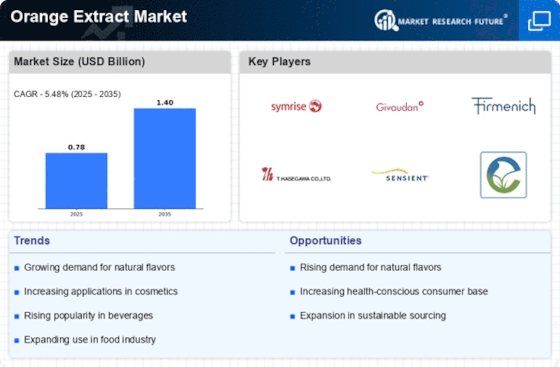
As per Market Research Future analysis, the Orange Extract Market Size was estimated at 0.78 USD Billion in 2024. The Orange Extract industry is projected to grow from USD 0.8228 Billion in 2025 to USD 1.403 Billion by 2035, exhibiting a compound annual growth rate (CAGR) of 5.48% during the forecast period 2025 - 2035

Key Market Trends & Highlights

The Orange Extract Market is experiencing a dynamic shift towards health-conscious and sustainable products.

  • The North American region remains the largest market for orange extract, driven by a strong demand for natural ingredients.
  • In contrast, the Asia-Pacific region is the fastest-growing market, reflecting increasing consumer interest in health and wellness.
  • The powder segment holds the largest share, while the liquid segment is rapidly gaining traction due to its versatility in applications.
  • Key market drivers include the rising demand for natural ingredients and the expansion of the food and beverage sector, which are fueling growth across both conventional and organic segments.

Market Size & Forecast

2024 Market Size 0.78 (USD Billion)
2035 Market Size 1.403 (USD Billion)
CAGR (2025 - 2035) 5.48%
Largest Regional Market Share in 2024 North America

Major Players

Symrise AG (DE), Givaudan SA (CH), Firmenich SA (CH), T. Hasegawa Co., Ltd. (JP), Sensient Technologies Corporation (US), Citrus and Allied Essences Ltd. (US), Florida Chemical Company (US), Döhler GmbH (DE)

Market Trends

The Orange Extract Market is currently experiencing a dynamic phase characterized by evolving consumer preferences and increasing demand for natural ingredients. As health consciousness rises, consumers are gravitating towards products that offer both flavor and functional benefits. This shift is prompting manufacturers to innovate and diversify their offerings, integrating orange extract into a variety of applications ranging from food and beverages to cosmetics and dietary supplements. The market appears to be influenced by a growing trend towards clean label products, where transparency in ingredient sourcing and processing is paramount. Moreover, the rise of e-commerce platforms is reshaping distribution channels, allowing consumers easier access to a wider array of orange extract products. This trend may lead to increased competition among suppliers, as they strive to enhance their online presence and cater to a more informed consumer base. Additionally, sustainability concerns are becoming more pronounced, with companies exploring eco-friendly sourcing and production methods. As the Orange Extract Market continues to evolve, it seems poised for further growth, driven by these multifaceted trends that reflect broader societal shifts towards health, sustainability, and convenience.

Health and Wellness Focus

The emphasis on health and wellness is reshaping the Orange Extract Market. Consumers are increasingly seeking natural ingredients that provide health benefits, leading to a surge in demand for orange extract in functional foods and beverages.

Sustainability Initiatives

Sustainability is becoming a critical factor in the Orange Extract Market. Companies are exploring eco-friendly sourcing and production practices, responding to consumer demand for environmentally responsible products.

E-commerce Growth

The expansion of e-commerce is transforming how orange extract products reach consumers. Online platforms are facilitating access to a diverse range of offerings, enabling brands to connect with a broader audience.

Orange Extract Market Market Drivers

Rising Demand for Natural Ingredients

The increasing consumer preference for natural and organic products is a pivotal driver in the Orange Extract Market. As health-conscious consumers seek alternatives to synthetic additives, the demand for natural flavorings and fragrances, such as orange extract, has surged. According to recent data, the market for natural food additives is projected to grow at a compound annual growth rate of approximately 6.5% over the next five years. This trend is particularly pronounced in the food and beverage sector, where orange extract is utilized for its flavor and aroma. Consequently, manufacturers are increasingly incorporating orange extract into their products to meet consumer expectations, thereby propelling the growth of the Orange Extract Market.

Growing Popularity of Functional Foods

The increasing consumer interest in functional foods is a significant driver for the Orange Extract Market. Functional foods, which offer health benefits beyond basic nutrition, are becoming more prevalent as consumers seek to enhance their well-being through diet. Orange extract, rich in vitamin C and antioxidants, is often marketed for its health benefits, making it an attractive ingredient for functional food products. Market Research Future indicates that the functional food market is expected to grow substantially, with a projected value of over 300 billion dollars by 2025. This growth presents a lucrative opportunity for the orange extract segment, as manufacturers look to incorporate beneficial ingredients into their offerings, thereby driving the expansion of the Orange Extract Market.

Innovations in Extraction Technologies

Advancements in extraction technologies are transforming the Orange Extract Market by improving the efficiency and quality of orange extract production. Techniques such as cold pressing and supercritical fluid extraction are gaining traction, allowing for higher yields and better preservation of flavor and aroma compounds. These innovations not only enhance the quality of the final product but also reduce production costs, making orange extract more accessible to manufacturers. As the demand for high-quality natural extracts continues to rise, the adoption of these advanced extraction methods is likely to increase, thereby propelling the growth of the Orange Extract Market. This technological evolution may also lead to the development of new applications for orange extract across various sectors.

Increased Use in Personal Care Products

The rising trend of using natural ingredients in personal care products is a notable driver for the Orange Extract Market. Consumers are increasingly aware of the potential harmful effects of synthetic chemicals, leading to a shift towards products that contain natural extracts. Orange extract, with its antioxidant properties and pleasant fragrance, is being incorporated into skincare and cosmetic formulations. Market analysis suggests that the personal care industry is projected to grow at a rate of 4.5% annually, creating a favorable environment for the inclusion of orange extract. This trend not only enhances product appeal but also aligns with consumer preferences for clean beauty, thereby fostering the growth of the Orange Extract Market.

Expansion of the Food and Beverage Sector

The ongoing expansion of the food and beverage sector significantly influences the Orange Extract Market. With the rise in dining out and the popularity of gourmet cooking, there is a heightened demand for flavoring agents that enhance culinary experiences. Orange extract, known for its versatility, is widely used in various applications, including desserts, beverages, and sauces. Market data indicates that the food and beverage industry is expected to reach a valuation of over 5 trillion dollars by 2026, which bodes well for the orange extract segment. As manufacturers strive to innovate and differentiate their offerings, the incorporation of orange extract is likely to become more prevalent, thus driving the growth of the Orange Extract Market.

Market Segment Insights

By Form: Powder (Largest) vs. Liquid (Fastest-Growing)

In the Orange Extract Market, the 'Form' segment is predominantly led by Powder, which commands a substantial market share over Liquid. The appeal of Powder lies in its stability and convenience, making it a preferred choice among consumers and manufacturers alike. While Liquid extracts are gaining traction, their share remains comparatively lower, indicating a strong preference for powdered formulations in various applications, including food and beverages.

Form: Powder (Dominant) vs. Liquid (Emerging)

Powdered Orange Extract is recognized as the dominant form due to its versatility and long shelf-life, making it an ideal ingredient for a wide range of food products, particularly in dry mixes and baked goods. The ease of storage and transportation of powdered forms fuels their popularity. On the other hand, Liquid Orange Extract is emerging rapidly, capitalizing on trends toward fresh and convenient flavoring solutions. This form appeals to segments looking for immediacy and enhanced flavor presence in beverages and culinary applications, driven by consumer preferences for ready-to-use products.

By Category: Conventional (Largest) vs. Organic (Fastest-Growing)

In the Orange Extract Market, the category segment is primarily dominated by conventional orange extracts, which have established a strong foothold due to their widespread availability and cost-effectiveness. Conventional extracts are favored for large-scale production because they are more accessible and less expensive to produce compared to their organic counterparts. As a result, they hold the largest share of the market, appealing to a broad spectrum of consumers looking for affordability and consistency in quality. On the other hand, organic orange extracts are emerging as the fastest-growing segment within the market. The increasing consumer demand for natural and health-oriented products has spurred interest in organic extracts, leading to substantial growth in this area. Factors such as changing dietary preferences and a heightened awareness of the benefits of organic foods are driving the expansion of this category, making it a significant player in the overall market landscape.

Category: Conventional (Dominant) vs. Organic (Emerging)

Conventional orange extracts are currently the dominant category in the market, as they offer a reliable, cost-effective solution for manufacturers and consumers alike. These extracts are produced from oranges that may be grown using conventional agricultural practices, which often involve the use of synthetic fertilizers and pesticides. This category appeals to a wide range of industries, including food and beverage, cosmetics, and cleaning products, due to its availability and lower production costs. In contrast, organic orange extracts are rapidly becoming an emerging segment, characterized by their growth under organic certification, which prohibits the use of synthetic additives. These extracts attract health-conscious consumers and those seeking sustainable options, reflecting a growing market trend towards organic products that meet both environmental and wellness standards.

By Application: Food & Beverage (Largest) vs. Personal Care Products (Fastest-Growing)

In the Orange Extract Market, the application segment is primarily dominated by the Food & Beverage sector, which holds the largest share due to its extensive usage in flavoring and fragrance applications. Citrus flavors and natural extracts from oranges are increasingly sought after for their freshness and natural appeal, catering to diverse consumer preferences. The Personal Care Products sector, while smaller, is emerging rapidly as brands leverage orange extract for its skin benefits and refreshing aroma, making it a key player in this market distribution.

Food & Beverage (Dominant) vs. Personal Care Products (Emerging)

The Food & Beverage segment is characterized by its robust demand for natural flavoring agents, where orange extract plays a vital role in enhancing flavor profiles and consumer appeal. This segment benefits from the rising trend of clean label products that emphasize the use of natural ingredients. On the other hand, the Personal Care Products sector is rapidly gaining momentum as companies integrate orange extract into formulations for skincare and cosmetic products owing to its antioxidant properties. Both segments are driven by increasing consumer awareness regarding health and wellness, with orange extract tapped into as a safer alternative to synthetic additives.

Get more detailed insights about Orange Extract Market Research Report – Global Forecast till 2035

Regional Insights

North America : Market Leader in Innovation

North America is the largest market for orange extract, holding approximately 40% of the global share. The region benefits from a robust food and beverage industry, with increasing consumer demand for natural flavors and ingredients. Regulatory support for natural products and health-conscious trends further drive market growth. The U.S. is the primary contributor, followed by Canada, which is witnessing a rise in demand for organic and natural extracts. The competitive landscape in North America is characterized by the presence of major players such as Sensient Technologies Corporation and Florida Chemical Company. These companies are investing in innovative extraction technologies and expanding their product portfolios to meet the growing consumer preferences for clean-label products. The market is also supported by a strong distribution network, enhancing accessibility to various sectors including food, cosmetics, and pharmaceuticals.

Europe : Emerging Market with Regulations

Europe is the second-largest market for orange extract, accounting for approximately 30% of the global share. The region's growth is driven by stringent regulations favoring natural ingredients in food and cosmetics, alongside a rising trend towards health and wellness. Countries like Germany and France are leading the market, with increasing consumer awareness about the benefits of natural flavors and extracts, which is further supported by EU regulations promoting organic products. The competitive landscape in Europe features key players such as Givaudan SA and Firmenich SA, who are focusing on sustainable sourcing and innovative extraction methods. The presence of a well-established food and beverage sector, along with a growing demand for natural flavors in personal care products, is propelling market growth. The region's commitment to sustainability and quality assurance is also attracting investments in research and development for new product formulations.

Asia-Pacific : Rapid Growth in Emerging Markets

Asia-Pacific is witnessing rapid growth in the orange extract market, holding approximately 20% of the global share. The region's expansion is fueled by increasing disposable incomes, urbanization, and a growing preference for natural flavors in food and beverages. Countries like China and India are at the forefront, with rising demand for processed foods and beverages that incorporate natural extracts, supported by favorable government policies promoting agricultural exports. The competitive landscape in Asia-Pacific is evolving, with both local and international players vying for market share. Companies such as T. Hasegawa Co., Ltd. are expanding their operations in the region to cater to the growing demand. The market is characterized by a mix of established firms and emerging startups focusing on innovative extraction techniques and product development, enhancing the overall market dynamics.

Middle East and Africa : Untapped Potential in Flavor Market

The Middle East and Africa region is gradually emerging in the orange extract market, holding about 10% of the global share. The growth is driven by increasing consumer interest in natural flavors and the expansion of the food and beverage industry. Countries like South Africa and the UAE are leading the market, with a rising trend towards health-conscious products and natural ingredients, supported by local regulations promoting food safety and quality standards. The competitive landscape in this region is characterized by a mix of local and international players, with companies exploring opportunities in the growing food sector. The presence of key players such as Döhler GmbH is enhancing market dynamics, as they invest in local sourcing and production capabilities. The region's untapped potential presents opportunities for growth, particularly in the organic and natural extract segments, as consumer preferences continue to evolve.

Key Players and Competitive Insights

Leading industry companies are making significant R&D investments to diversify their product offerings, which will spur further expansion of the market for orange extract. Market participants also engage in various strategic actions to increase their worldwide footprint. Important market developments include introducing new products, increased investments, contractual agreements, mergers and acquisitions, and collaboration with other organizations. The orange extract sector must provide affordable products to grow and thrive in a more cutthroat and competitive market environment.
One of the main business strategies manufacturers use in the worldwide gluten-free beer industry to benefit customers and expand the market sector is local manufacturing to reduce operational costs. The orange extract sector has recently provided some of the most important medicinal benefits. Major players in the orange extract market, including Döhler GmbH (Germany), RC Fine Foods, Inc. (US), McCormick & Company, Inc. (US), Nielsen-Massey Vanillas, Inc. (US), Kerry Group Plc. (Ireland), Nutrizo Advancis Health Care (India), Cook Flavoring Company (US), and others.
Döhler is a leading producer, marketer, and supplier of technology-based natural ingredients and ingredient systems, also known as food additives, for the food and beverage industries. They offer a wide variety of products, including flavors, colors, specialty & performance ingredients, cereal components, dairy ingredients, fruit & vegetable ingredients, and ingredient systems. Döhler, a German company headquartered in Darmstadt, has 23 production facilities, 24 application centers, 50 sales offices, and sales representation in over 130 nations. From concept to completion, integrated food and beverage solutions are offered by more than 5,000 personnel.
An American food firm named McCormick & Firm, Incorporated creates, markets, and provides retail establishments, food producers, and food service companies with spices, seasoning mixes, condiments, and other flavoring items. Based on income, they are the world's largest producer of spices and related food goods, and their products are sold in many nations. McCormick, a Fortune 500 corporation, employs over 14,000 people worldwide. In the third quarter of 2018, the corporate headquarters relocated from Sparks to Hunt Valley, Maryland.

Key Companies in the Orange Extract Market include

Industry Developments

October 2020: The food giant Kerry introduced a new non-thermal liquid extraction technology to extract citrus from fruits more effectively. Highly concentrated extracts produced with this novel process can be used instead of citrus oils. It can be used on various citrus fruits in flavored waters, herbal tea, juices, energy drinks, alcoholic beverages, and flavored spirits, among other applications.

April 2022: Citrus is a top trending ingredient, driven by the rising number of health-conscious consumers. Therefore, TREATT's maker of natural extracts and ingredients increased its selection of TreattClear, natural citrus extracts for the beverages sector.

Future Outlook

Orange Extract Market Future Outlook

The Orange Extract Market is projected to grow at a 5.48% CAGR from 2025 to 2035, driven by rising demand in food, cosmetics, and pharmaceuticals.

New opportunities lie in:

  • Expansion into organic and natural product lines
  • Development of innovative packaging solutions for freshness
  • Strategic partnerships with beverage manufacturers for flavor enhancement

By 2035, the market is expected to achieve robust growth, solidifying its position in diverse industries.

Market Segmentation

Orange Extract Market Form Outlook

  • Powder
  • Liquid

Orange Extract Market Category Outlook

  • Conventional
  • Organic

Orange Extract Market Application Outlook

  • Food & Beverage
  • Personal Care Products
  • Pharmaceuticals

Report Scope

MARKET SIZE 2024 0.78(USD Billion)
MARKET SIZE 2025 0.8228(USD Billion)
MARKET SIZE 2035 1.403(USD Billion)
COMPOUND ANNUAL GROWTH RATE (CAGR) 5.48% (2025 - 2035)
REPORT COVERAGE Revenue Forecast, Competitive Landscape, Growth Factors, and Trends
BASE YEAR 2024
Market Forecast Period 2025 - 2035
Historical Data 2019 - 2024
Market Forecast Units USD Billion
Key Companies Profiled Symrise AG (DE), Givaudan SA (CH), Firmenich SA (CH), T. Hasegawa Co., Ltd. (JP), Sensient Technologies Corporation (US), Citrus and Allied Essences Ltd. (US), Florida Chemical Company (US), Döhler GmbH (DE)
Segments Covered Form, Category, Application, Region
Key Market Opportunities Growing demand for natural flavoring in food and beverages drives innovation in the Orange Extract Market.
Key Market Dynamics Rising consumer demand for natural flavors drives innovation and competition in the orange extract market.
Countries Covered North America, Europe, APAC, South America, MEA

FAQs

What is the current valuation of the Orange Extract Market as of 2024?

<p>The Orange Extract Market was valued at 0.78 USD Billion in 2024.</p>

What is the projected market size for the Orange Extract Market in 2035?

<p>The market is projected to reach 1.403 USD Billion by 2035.</p>

What is the expected CAGR for the Orange Extract Market during the forecast period 2025 - 2035?

<p>The expected CAGR for the Orange Extract Market during 2025 - 2035 is 5.48%.</p>

Which companies are considered key players in the Orange Extract Market?

<p>Key players include Symrise AG, Givaudan SA, Firmenich SA, and others.</p>

What are the main segments of the Orange Extract Market?

<p>The main segments include Form, Category, and Application.</p>

How did the Powder and Liquid segments perform in 2024?

<p>In 2024, the Powder segment was valued at 0.39 USD Billion, while the Liquid segment was valued at 0.39 USD Billion.</p>

What is the valuation of the Organic and Conventional categories in 2024?

The Conventional category was valued at 0.5 USD Billion, whereas the Organic category was valued at 0.28 USD Billion in 2024.

What applications are driving the Orange Extract Market?

The Food &amp; Beverage sector, Personal Care Products, and Pharmaceuticals are key applications driving the market.

What were the valuations for the Food & Beverage and Personal Care Products segments in 2024?

In 2024, the Food &amp; Beverage segment was valued at 0.39 USD Billion, and the Personal Care Products segment was valued at 0.25 USD Billion.

What is the anticipated growth trend for the Orange Extract Market in the coming years?

The market is expected to grow steadily, reaching 1.403 USD Billion by 2035, indicating a positive growth trend.

  1. SECTION I: EXECUTIVE SUMMARY AND KEY HIGHLIGHTS
    1. | 1.1 EXECUTIVE SUMMARY
    2. | | 1.1.1 Market Overview
    3. | | 1.1.2 Key Findings
    4. | | 1.1.3 Market Segmentation
    5. | | 1.1.4 Competitive Landscape
    6. | | 1.1.5 Challenges and Opportunities
    7. | | 1.1.6 Future Outlook
  2. SECTION II: SCOPING, METHODOLOGY AND MARKET STRUCTURE
    1. | 2.1 MARKET INTRODUCTION
    2. | | 2.1.1 Definition
    3. | | 2.1.2 Scope of the study
    4. | | | 2.1.2.1 Research Objective
    5. | | | 2.1.2.2 Assumption
    6. | | | 2.1.2.3 Limitations
    7. | 2.2 RESEARCH METHODOLOGY
    8. | | 2.2.1 Overview
    9. | | 2.2.2 Data Mining
    10. | | 2.2.3 Secondary Research
    11. | | 2.2.4 Primary Research
    12. | | | 2.2.4.1 Primary Interviews and Information Gathering Process
    13. | | | 2.2.4.2 Breakdown of Primary Respondents
    14. | | 2.2.5 Forecasting Model
    15. | | 2.2.6 Market Size Estimation
    16. | | | 2.2.6.1 Bottom-Up Approach
    17. | | | 2.2.6.2 Top-Down Approach
    18. | | 2.2.7 Data Triangulation
    19. | | 2.2.8 Validation
  3. SECTION III: QUALITATIVE ANALYSIS
    1. | 3.1 MARKET DYNAMICS
    2. | | 3.1.1 Overview
    3. | | 3.1.2 Drivers
    4. | | 3.1.3 Restraints
    5. | | 3.1.4 Opportunities
    6. | 3.2 MARKET FACTOR ANALYSIS
    7. | | 3.2.1 Value chain Analysis
    8. | | 3.2.2 Porter's Five Forces Analysis
    9. | | | 3.2.2.1 Bargaining Power of Suppliers
    10. | | | 3.2.2.2 Bargaining Power of Buyers
    11. | | | 3.2.2.3 Threat of New Entrants
    12. | | | 3.2.2.4 Threat of Substitutes
    13. | | | 3.2.2.5 Intensity of Rivalry
    14. | | 3.2.3 COVID-19 Impact Analysis
    15. | | | 3.2.3.1 Market Impact Analysis
    16. | | | 3.2.3.2 Regional Impact
    17. | | | 3.2.3.3 Opportunity and Threat Analysis
  4. SECTION IV: QUANTITATIVE ANALYSIS
    1. | 4.1 Food, Beverages & Nutrition, BY Form (USD Billion)
    2. | | 4.1.1 Powder
    3. | | 4.1.2 Liquid
    4. | 4.2 Food, Beverages & Nutrition, BY Category (USD Billion)
    5. | | 4.2.1 Conventional
    6. | | 4.2.2 Organic
    7. | 4.3 Food, Beverages & Nutrition, BY Application (USD Billion)
    8. | | 4.3.1 Food & Beverage
    9. | | 4.3.2 Personal Care Products
    10. | | 4.3.3 Pharmaceuticals
    11. | 4.4 Food, Beverages & Nutrition, BY Region (USD Billion)
    12. | | 4.4.1 North America
    13. | | | 4.4.1.1 US
    14. | | | 4.4.1.2 Canada
    15. | | 4.4.2 Europe
    16. | | | 4.4.2.1 Germany
    17. | | | 4.4.2.2 UK
    18. | | | 4.4.2.3 France
    19. | | | 4.4.2.4 Russia
    20. | | | 4.4.2.5 Italy
    21. | | | 4.4.2.6 Spain
    22. | | | 4.4.2.7 Rest of Europe
    23. | | 4.4.3 APAC
    24. | | | 4.4.3.1 China
    25. | | | 4.4.3.2 India
    26. | | | 4.4.3.3 Japan
    27. | | | 4.4.3.4 South Korea
    28. | | | 4.4.3.5 Malaysia
    29. | | | 4.4.3.6 Thailand
    30. | | | 4.4.3.7 Indonesia
    31. | | | 4.4.3.8 Rest of APAC
    32. | | 4.4.4 South America
    33. | | | 4.4.4.1 Brazil
    34. | | | 4.4.4.2 Mexico
    35. | | | 4.4.4.3 Argentina
    36. | | | 4.4.4.4 Rest of South America
    37. | | 4.4.5 MEA
    38. | | | 4.4.5.1 GCC Countries
    39. | | | 4.4.5.2 South Africa
    40. | | | 4.4.5.3 Rest of MEA
  5. SECTION V: COMPETITIVE ANALYSIS
    1. | 5.1 Competitive Landscape
    2. | | 5.1.1 Overview
    3. | | 5.1.2 Competitive Analysis
    4. | | 5.1.3 Market share Analysis
    5. | | 5.1.4 Major Growth Strategy in the Food, Beverages & Nutrition
    6. | | 5.1.5 Competitive Benchmarking
    7. | | 5.1.6 Leading Players in Terms of Number of Developments in the Food, Beverages & Nutrition
    8. | | 5.1.7 Key developments and growth strategies
    9. | | | 5.1.7.1 New Product Launch/Service Deployment
    10. | | | 5.1.7.2 Merger & Acquisitions
    11. | | | 5.1.7.3 Joint Ventures
    12. | | 5.1.8 Major Players Financial Matrix
    13. | | | 5.1.8.1 Sales and Operating Income
    14. | | | 5.1.8.2 Major Players R&D Expenditure. 2023
    15. | 5.2 Company Profiles
    16. | | 5.2.1 Symrise AG (DE)
    17. | | | 5.2.1.1 Financial Overview
    18. | | | 5.2.1.2 Products Offered
    19. | | | 5.2.1.3 Key Developments
    20. | | | 5.2.1.4 SWOT Analysis
    21. | | | 5.2.1.5 Key Strategies
    22. | | 5.2.2 Givaudan SA (CH)
    23. | | | 5.2.2.1 Financial Overview
    24. | | | 5.2.2.2 Products Offered
    25. | | | 5.2.2.3 Key Developments
    26. | | | 5.2.2.4 SWOT Analysis
    27. | | | 5.2.2.5 Key Strategies
    28. | | 5.2.3 Firmenich SA (CH)
    29. | | | 5.2.3.1 Financial Overview
    30. | | | 5.2.3.2 Products Offered
    31. | | | 5.2.3.3 Key Developments
    32. | | | 5.2.3.4 SWOT Analysis
    33. | | | 5.2.3.5 Key Strategies
    34. | | 5.2.4 T. Hasegawa Co., Ltd. (JP)
    35. | | | 5.2.4.1 Financial Overview
    36. | | | 5.2.4.2 Products Offered
    37. | | | 5.2.4.3 Key Developments
    38. | | | 5.2.4.4 SWOT Analysis
    39. | | | 5.2.4.5 Key Strategies
    40. | | 5.2.5 Sensient Technologies Corporation (US)
    41. | | | 5.2.5.1 Financial Overview
    42. | | | 5.2.5.2 Products Offered
    43. | | | 5.2.5.3 Key Developments
    44. | | | 5.2.5.4 SWOT Analysis
    45. | | | 5.2.5.5 Key Strategies
    46. | | 5.2.6 Citrus and Allied Essences Ltd. (US)
    47. | | | 5.2.6.1 Financial Overview
    48. | | | 5.2.6.2 Products Offered
    49. | | | 5.2.6.3 Key Developments
    50. | | | 5.2.6.4 SWOT Analysis
    51. | | | 5.2.6.5 Key Strategies
    52. | | 5.2.7 Florida Chemical Company (US)
    53. | | | 5.2.7.1 Financial Overview
    54. | | | 5.2.7.2 Products Offered
    55. | | | 5.2.7.3 Key Developments
    56. | | | 5.2.7.4 SWOT Analysis
    57. | | | 5.2.7.5 Key Strategies
    58. | | 5.2.8 Döhler GmbH (DE)
    59. | | | 5.2.8.1 Financial Overview
    60. | | | 5.2.8.2 Products Offered
    61. | | | 5.2.8.3 Key Developments
    62. | | | 5.2.8.4 SWOT Analysis
    63. | | | 5.2.8.5 Key Strategies
    64. | 5.3 Appendix
    65. | | 5.3.1 References
    66. | | 5.3.2 Related Reports
  6. LIST OF FIGURES
    1. | 6.1 MARKET SYNOPSIS
    2. | 6.2 NORTH AMERICA MARKET ANALYSIS
    3. | 6.3 US MARKET ANALYSIS BY FORM
    4. | 6.4 US MARKET ANALYSIS BY CATEGORY
    5. | 6.5 US MARKET ANALYSIS BY APPLICATION
    6. | 6.6 CANADA MARKET ANALYSIS BY FORM
    7. | 6.7 CANADA MARKET ANALYSIS BY CATEGORY
    8. | 6.8 CANADA MARKET ANALYSIS BY APPLICATION
    9. | 6.9 EUROPE MARKET ANALYSIS
    10. | 6.10 GERMANY MARKET ANALYSIS BY FORM
    11. | 6.11 GERMANY MARKET ANALYSIS BY CATEGORY
    12. | 6.12 GERMANY MARKET ANALYSIS BY APPLICATION
    13. | 6.13 UK MARKET ANALYSIS BY FORM
    14. | 6.14 UK MARKET ANALYSIS BY CATEGORY
    15. | 6.15 UK MARKET ANALYSIS BY APPLICATION
    16. | 6.16 FRANCE MARKET ANALYSIS BY FORM
    17. | 6.17 FRANCE MARKET ANALYSIS BY CATEGORY
    18. | 6.18 FRANCE MARKET ANALYSIS BY APPLICATION
    19. | 6.19 RUSSIA MARKET ANALYSIS BY FORM
    20. | 6.20 RUSSIA MARKET ANALYSIS BY CATEGORY
    21. | 6.21 RUSSIA MARKET ANALYSIS BY APPLICATION
    22. | 6.22 ITALY MARKET ANALYSIS BY FORM
    23. | 6.23 ITALY MARKET ANALYSIS BY CATEGORY
    24. | 6.24 ITALY MARKET ANALYSIS BY APPLICATION
    25. | 6.25 SPAIN MARKET ANALYSIS BY FORM
    26. | 6.26 SPAIN MARKET ANALYSIS BY CATEGORY
    27. | 6.27 SPAIN MARKET ANALYSIS BY APPLICATION
    28. | 6.28 REST OF EUROPE MARKET ANALYSIS BY FORM
    29. | 6.29 REST OF EUROPE MARKET ANALYSIS BY CATEGORY
    30. | 6.30 REST OF EUROPE MARKET ANALYSIS BY APPLICATION
    31. | 6.31 APAC MARKET ANALYSIS
    32. | 6.32 CHINA MARKET ANALYSIS BY FORM
    33. | 6.33 CHINA MARKET ANALYSIS BY CATEGORY
    34. | 6.34 CHINA MARKET ANALYSIS BY APPLICATION
    35. | 6.35 INDIA MARKET ANALYSIS BY FORM
    36. | 6.36 INDIA MARKET ANALYSIS BY CATEGORY
    37. | 6.37 INDIA MARKET ANALYSIS BY APPLICATION
    38. | 6.38 JAPAN MARKET ANALYSIS BY FORM
    39. | 6.39 JAPAN MARKET ANALYSIS BY CATEGORY
    40. | 6.40 JAPAN MARKET ANALYSIS BY APPLICATION
    41. | 6.41 SOUTH KOREA MARKET ANALYSIS BY FORM
    42. | 6.42 SOUTH KOREA MARKET ANALYSIS BY CATEGORY
    43. | 6.43 SOUTH KOREA MARKET ANALYSIS BY APPLICATION
    44. | 6.44 MALAYSIA MARKET ANALYSIS BY FORM
    45. | 6.45 MALAYSIA MARKET ANALYSIS BY CATEGORY
    46. | 6.46 MALAYSIA MARKET ANALYSIS BY APPLICATION
    47. | 6.47 THAILAND MARKET ANALYSIS BY FORM
    48. | 6.48 THAILAND MARKET ANALYSIS BY CATEGORY
    49. | 6.49 THAILAND MARKET ANALYSIS BY APPLICATION
    50. | 6.50 INDONESIA MARKET ANALYSIS BY FORM
    51. | 6.51 INDONESIA MARKET ANALYSIS BY CATEGORY
    52. | 6.52 INDONESIA MARKET ANALYSIS BY APPLICATION
    53. | 6.53 REST OF APAC MARKET ANALYSIS BY FORM
    54. | 6.54 REST OF APAC MARKET ANALYSIS BY CATEGORY
    55. | 6.55 REST OF APAC MARKET ANALYSIS BY APPLICATION
    56. | 6.56 SOUTH AMERICA MARKET ANALYSIS
    57. | 6.57 BRAZIL MARKET ANALYSIS BY FORM
    58. | 6.58 BRAZIL MARKET ANALYSIS BY CATEGORY
    59. | 6.59 BRAZIL MARKET ANALYSIS BY APPLICATION
    60. | 6.60 MEXICO MARKET ANALYSIS BY FORM
    61. | 6.61 MEXICO MARKET ANALYSIS BY CATEGORY
    62. | 6.62 MEXICO MARKET ANALYSIS BY APPLICATION
    63. | 6.63 ARGENTINA MARKET ANALYSIS BY FORM
    64. | 6.64 ARGENTINA MARKET ANALYSIS BY CATEGORY
    65. | 6.65 ARGENTINA MARKET ANALYSIS BY APPLICATION
    66. | 6.66 REST OF SOUTH AMERICA MARKET ANALYSIS BY FORM
    67. | 6.67 REST OF SOUTH AMERICA MARKET ANALYSIS BY CATEGORY
    68. | 6.68 REST OF SOUTH AMERICA MARKET ANALYSIS BY APPLICATION
    69. | 6.69 MEA MARKET ANALYSIS
    70. | 6.70 GCC COUNTRIES MARKET ANALYSIS BY FORM
    71. | 6.71 GCC COUNTRIES MARKET ANALYSIS BY CATEGORY
    72. | 6.72 GCC COUNTRIES MARKET ANALYSIS BY APPLICATION
    73. | 6.73 SOUTH AFRICA MARKET ANALYSIS BY FORM
    74. | 6.74 SOUTH AFRICA MARKET ANALYSIS BY CATEGORY
    75. | 6.75 SOUTH AFRICA MARKET ANALYSIS BY APPLICATION
    76. | 6.76 REST OF MEA MARKET ANALYSIS BY FORM
    77. | 6.77 REST OF MEA MARKET ANALYSIS BY CATEGORY
    78. | 6.78 REST OF MEA MARKET ANALYSIS BY APPLICATION
    79. | 6.79 KEY BUYING CRITERIA OF FOOD, BEVERAGES & NUTRITION
    80. | 6.80 RESEARCH PROCESS OF MRFR
    81. | 6.81 DRO ANALYSIS OF FOOD, BEVERAGES & NUTRITION
    82. | 6.82 DRIVERS IMPACT ANALYSIS: FOOD, BEVERAGES & NUTRITION
    83. | 6.83 RESTRAINTS IMPACT ANALYSIS: FOOD, BEVERAGES & NUTRITION
    84. | 6.84 SUPPLY / VALUE CHAIN: FOOD, BEVERAGES & NUTRITION
    85. | 6.85 FOOD, BEVERAGES & NUTRITION, BY FORM, 2024 (% SHARE)
    86. | 6.86 FOOD, BEVERAGES & NUTRITION, BY FORM, 2024 TO 2035 (USD Billion)
    87. | 6.87 FOOD, BEVERAGES & NUTRITION, BY CATEGORY, 2024 (% SHARE)
    88. | 6.88 FOOD, BEVERAGES & NUTRITION, BY CATEGORY, 2024 TO 2035 (USD Billion)
    89. | 6.89 FOOD, BEVERAGES & NUTRITION, BY APPLICATION, 2024 (% SHARE)
    90. | 6.90 FOOD, BEVERAGES & NUTRITION, BY APPLICATION, 2024 TO 2035 (USD Billion)
    91. | 6.91 BENCHMARKING OF MAJOR COMPETITORS
  7. LIST OF TABLES
    1. | 7.1 LIST OF ASSUMPTIONS
    2. | | 7.1.1
    3. | 7.2 North America MARKET SIZE ESTIMATES; FORECAST
    4. | | 7.2.1 BY FORM, 2025-2035 (USD Billion)
    5. | | 7.2.2 BY CATEGORY, 2025-2035 (USD Billion)
    6. | | 7.2.3 BY APPLICATION, 2025-2035 (USD Billion)
    7. | 7.3 US MARKET SIZE ESTIMATES; FORECAST
    8. | | 7.3.1 BY FORM, 2025-2035 (USD Billion)
    9. | | 7.3.2 BY CATEGORY, 2025-2035 (USD Billion)
    10. | | 7.3.3 BY APPLICATION, 2025-2035 (USD Billion)
    11. | 7.4 Canada MARKET SIZE ESTIMATES; FORECAST
    12. | | 7.4.1 BY FORM, 2025-2035 (USD Billion)
    13. | | 7.4.2 BY CATEGORY, 2025-2035 (USD Billion)
    14. | | 7.4.3 BY APPLICATION, 2025-2035 (USD Billion)
    15. | 7.5 Europe MARKET SIZE ESTIMATES; FORECAST
    16. | | 7.5.1 BY FORM, 2025-2035 (USD Billion)
    17. | | 7.5.2 BY CATEGORY, 2025-2035 (USD Billion)
    18. | | 7.5.3 BY APPLICATION, 2025-2035 (USD Billion)
    19. | 7.6 Germany MARKET SIZE ESTIMATES; FORECAST
    20. | | 7.6.1 BY FORM, 2025-2035 (USD Billion)
    21. | | 7.6.2 BY CATEGORY, 2025-2035 (USD Billion)
    22. | | 7.6.3 BY APPLICATION, 2025-2035 (USD Billion)
    23. | 7.7 UK MARKET SIZE ESTIMATES; FORECAST
    24. | | 7.7.1 BY FORM, 2025-2035 (USD Billion)
    25. | | 7.7.2 BY CATEGORY, 2025-2035 (USD Billion)
    26. | | 7.7.3 BY APPLICATION, 2025-2035 (USD Billion)
    27. | 7.8 France MARKET SIZE ESTIMATES; FORECAST
    28. | | 7.8.1 BY FORM, 2025-2035 (USD Billion)
    29. | | 7.8.2 BY CATEGORY, 2025-2035 (USD Billion)
    30. | | 7.8.3 BY APPLICATION, 2025-2035 (USD Billion)
    31. | 7.9 Russia MARKET SIZE ESTIMATES; FORECAST
    32. | | 7.9.1 BY FORM, 2025-2035 (USD Billion)
    33. | | 7.9.2 BY CATEGORY, 2025-2035 (USD Billion)
    34. | | 7.9.3 BY APPLICATION, 2025-2035 (USD Billion)
    35. | 7.10 Italy MARKET SIZE ESTIMATES; FORECAST
    36. | | 7.10.1 BY FORM, 2025-2035 (USD Billion)
    37. | | 7.10.2 BY CATEGORY, 2025-2035 (USD Billion)
    38. | | 7.10.3 BY APPLICATION, 2025-2035 (USD Billion)
    39. | 7.11 Spain MARKET SIZE ESTIMATES; FORECAST
    40. | | 7.11.1 BY FORM, 2025-2035 (USD Billion)
    41. | | 7.11.2 BY CATEGORY, 2025-2035 (USD Billion)
    42. | | 7.11.3 BY APPLICATION, 2025-2035 (USD Billion)
    43. | 7.12 Rest of Europe MARKET SIZE ESTIMATES; FORECAST
    44. | | 7.12.1 BY FORM, 2025-2035 (USD Billion)
    45. | | 7.12.2 BY CATEGORY, 2025-2035 (USD Billion)
    46. | | 7.12.3 BY APPLICATION, 2025-2035 (USD Billion)
    47. | 7.13 APAC MARKET SIZE ESTIMATES; FORECAST
    48. | | 7.13.1 BY FORM, 2025-2035 (USD Billion)
    49. | | 7.13.2 BY CATEGORY, 2025-2035 (USD Billion)
    50. | | 7.13.3 BY APPLICATION, 2025-2035 (USD Billion)
    51. | 7.14 China MARKET SIZE ESTIMATES; FORECAST
    52. | | 7.14.1 BY FORM, 2025-2035 (USD Billion)
    53. | | 7.14.2 BY CATEGORY, 2025-2035 (USD Billion)
    54. | | 7.14.3 BY APPLICATION, 2025-2035 (USD Billion)
    55. | 7.15 India MARKET SIZE ESTIMATES; FORECAST
    56. | | 7.15.1 BY FORM, 2025-2035 (USD Billion)
    57. | | 7.15.2 BY CATEGORY, 2025-2035 (USD Billion)
    58. | | 7.15.3 BY APPLICATION, 2025-2035 (USD Billion)
    59. | 7.16 Japan MARKET SIZE ESTIMATES; FORECAST
    60. | | 7.16.1 BY FORM, 2025-2035 (USD Billion)
    61. | | 7.16.2 BY CATEGORY, 2025-2035 (USD Billion)
    62. | | 7.16.3 BY APPLICATION, 2025-2035 (USD Billion)
    63. | 7.17 South Korea MARKET SIZE ESTIMATES; FORECAST
    64. | | 7.17.1 BY FORM, 2025-2035 (USD Billion)
    65. | | 7.17.2 BY CATEGORY, 2025-2035 (USD Billion)
    66. | | 7.17.3 BY APPLICATION, 2025-2035 (USD Billion)
    67. | 7.18 Malaysia MARKET SIZE ESTIMATES; FORECAST
    68. | | 7.18.1 BY FORM, 2025-2035 (USD Billion)
    69. | | 7.18.2 BY CATEGORY, 2025-2035 (USD Billion)
    70. | | 7.18.3 BY APPLICATION, 2025-2035 (USD Billion)
    71. | 7.19 Thailand MARKET SIZE ESTIMATES; FORECAST
    72. | | 7.19.1 BY FORM, 2025-2035 (USD Billion)
    73. | | 7.19.2 BY CATEGORY, 2025-2035 (USD Billion)
    74. | | 7.19.3 BY APPLICATION, 2025-2035 (USD Billion)
    75. | 7.20 Indonesia MARKET SIZE ESTIMATES; FORECAST
    76. | | 7.20.1 BY FORM, 2025-2035 (USD Billion)
    77. | | 7.20.2 BY CATEGORY, 2025-2035 (USD Billion)
    78. | | 7.20.3 BY APPLICATION, 2025-2035 (USD Billion)
    79. | 7.21 Rest of APAC MARKET SIZE ESTIMATES; FORECAST
    80. | | 7.21.1 BY FORM, 2025-2035 (USD Billion)
    81. | | 7.21.2 BY CATEGORY, 2025-2035 (USD Billion)
    82. | | 7.21.3 BY APPLICATION, 2025-2035 (USD Billion)
    83. | 7.22 South America MARKET SIZE ESTIMATES; FORECAST
    84. | | 7.22.1 BY FORM, 2025-2035 (USD Billion)
    85. | | 7.22.2 BY CATEGORY, 2025-2035 (USD Billion)
    86. | | 7.22.3 BY APPLICATION, 2025-2035 (USD Billion)
    87. | 7.23 Brazil MARKET SIZE ESTIMATES; FORECAST
    88. | | 7.23.1 BY FORM, 2025-2035 (USD Billion)
    89. | | 7.23.2 BY CATEGORY, 2025-2035 (USD Billion)
    90. | | 7.23.3 BY APPLICATION, 2025-2035 (USD Billion)
    91. | 7.24 Mexico MARKET SIZE ESTIMATES; FORECAST
    92. | | 7.24.1 BY FORM, 2025-2035 (USD Billion)
    93. | | 7.24.2 BY CATEGORY, 2025-2035 (USD Billion)
    94. | | 7.24.3 BY APPLICATION, 2025-2035 (USD Billion)
    95. | 7.25 Argentina MARKET SIZE ESTIMATES; FORECAST
    96. | | 7.25.1 BY FORM, 2025-2035 (USD Billion)
    97. | | 7.25.2 BY CATEGORY, 2025-2035 (USD Billion)
    98. | | 7.25.3 BY APPLICATION, 2025-2035 (USD Billion)
    99. | 7.26 Rest of South America MARKET SIZE ESTIMATES; FORECAST
    100. | | 7.26.1 BY FORM, 2025-2035 (USD Billion)
    101. | | 7.26.2 BY CATEGORY, 2025-2035 (USD Billion)
    102. | | 7.26.3 BY APPLICATION, 2025-2035 (USD Billion)
    103. | 7.27 MEA MARKET SIZE ESTIMATES; FORECAST
    104. | | 7.27.1 BY FORM, 2025-2035 (USD Billion)
    105. | | 7.27.2 BY CATEGORY, 2025-2035 (USD Billion)
    106. | | 7.27.3 BY APPLICATION, 2025-2035 (USD Billion)
    107. | 7.28 GCC Countries MARKET SIZE ESTIMATES; FORECAST
    108. | | 7.28.1 BY FORM, 2025-2035 (USD Billion)
    109. | | 7.28.2 BY CATEGORY, 2025-2035 (USD Billion)
    110. | | 7.28.3 BY APPLICATION, 2025-2035 (USD Billion)
    111. | 7.29 South Africa MARKET SIZE ESTIMATES; FORECAST
    112. | | 7.29.1 BY FORM, 2025-2035 (USD Billion)
    113. | | 7.29.2 BY CATEGORY, 2025-2035 (USD Billion)
    114. | | 7.29.3 BY APPLICATION, 2025-2035 (USD Billion)
    115. | 7.30 Rest of MEA MARKET SIZE ESTIMATES; FORECAST
    116. | | 7.30.1 BY FORM, 2025-2035 (USD Billion)
    117. | | 7.30.2 BY CATEGORY, 2025-2035 (USD Billion)
    118. | | 7.30.3 BY APPLICATION, 2025-2035 (USD Billion)
    119. | 7.31 PRODUCT LAUNCH/PRODUCT DEVELOPMENT/APPROVAL
    120. | | 7.31.1
    121. | 7.32 ACQUISITION/PARTNERSHIP
    122. | | 7.32.1

Food, Beverages & Nutrition Market Segmentation

Food, Beverages & Nutrition By Form (USD Billion, 2025-2035)

  • Powder
  • Liquid

Food, Beverages & Nutrition By Category (USD Billion, 2025-2035)

  • Conventional
  • Organic

Food, Beverages & Nutrition By Application (USD Billion, 2025-2035)

  • Food & Beverage
  • Personal Care Products
  • Pharmaceuticals
Infographic

Free Sample Request

Kindly complete the form below to receive a free sample of this Report

Get Free Sample

Customer Strories

Compare Licence

×
Features License Type
Single User Multiuser License Enterprise User
Price $4,950 $5,950 $7,250
Maximum User Access Limit 1 User Upto 10 Users Unrestricted Access Throughout the Organization
Free Customization
Direct Access to Analyst
Deliverable Format
Platform Access
Discount on Next Purchase 10% 15% 15%
Printable Versions