Request Free Sample ×

Kindly complete the form below to receive a free sample of this Report

* Please use a valid business email

Leading companies partner with us for data-driven Insights

clients tt-cursor
Hero Background
English
Chinese
French
Japanese
Korean
German
Spanish

Oral Care Market Trends

ID: MRFR/CG/5064-HCR
128 Pages
Snehal Singh
March 2026

Global Oral Care Market Size, Share, Industry Trend & Analysis Research Report: By Product Type (Toothpaste, Toothbrush, Mouthwash, Dental Floss, Whitening Products), By Distribution Channel (Supermarkets, E-commerce, Pharmacies, Convenience Stores), By End User (Children, Adults, Elderly), By Form (Liquid, Solid, Gel) andBy Regional (North America, Europe, South America, Asia Pacific, Middle East and Africa)- Forecast to 2035

Share:
Download PDF ×

We do not share your information with anyone. However, we may send you emails based on your report interest from time to time. You may contact us at any time to opt-out.

Oral Care Market Infographic
Purchase Options

Market Trends

Key Emerging Trends in the Oral Care Market

The Oral care market is as of now going through unique patterns that are demonstrative of the changing inclinations of purchasers and the headway made in oral wellbeing innovation. A compact outline of the chief market patterns follows: A heightening awareness among purchasers in regard to the criticality of Oral care has provoked them to seek after preventive oral consideration items effectively. There has been a prominent expansion in the market's interest for toothpaste, mouthwash, and dental floss, which can be credited to the growing mindfulness encompassing dental wellbeing. A detectable pattern is arising towards the usage of regular and natural Oral care items. There is a developing pattern among purchasers to choose toothpaste and mouthwash definitions that reject the utilization of additives, rough synthetics, and fake flavors. This peculiarity is reliable with the more extensive pattern toward maintainable and ecologically cognizant customer choices. Oral care gadget mechanical advancements stand out. Expanding in unmistakable quality are savvy toothbrushes with network abilities, oscillating brushes, and super advanced dental flossers. Customers are leaning towards items that give further developed cleaning functionalities and the capacity to screen their Oral care rehearses continuously. Expanded Accentuation on Gum Wellbeing: A rising spotlight is being seen on gum wellbeing items inside the market. A rising consciousness of the relationship between Oral care and by and large prosperity and a maturing populace have created a requirement for items formed explicitly to treat periodontal infection and gum disease, which are conditions influencing the gums. The market for Oral care items has seen a huge expansion in its web-based deals. The comfort of web-based buying for Oral care items is profoundly esteemed by customers, and the internet business channel fills in as a medium through which specialty and specialty oral consideration brands can extend their compass to an overall crowd. The interest in customized and tweaked Oral care arrangements is expanding because of shoppers' longing for things that are explicitly intended to meet their singular necessities. This includes tweaked toothbrushes, individualized toothpaste definitions, and particular mouthwash options. Innovation is being used by brands to give modified proposals that are predicated on the Oral care profiles of people. Supportability Drives: The Oral care market is essentially impacted by maintainability. A developing number of purchasers are drawn to items that highlight feasible fixing obtaining, recyclable materials, and eco-accommodating bundling. As per customer values, oral consideration brands are utilizing ecologically cognizant practices as a reaction.


Author
Author Profile
Snehal Singh
Manager - Research

High acumen in analyzing complex macro & micro markets with more than 6 years of work experience in the field of market research. By implementing her analytical skills in forecasting and estimation into market research reports, she has expertise in Packaging, Construction, and Equipment domains. She handles a team size of 20-25 resources and ensures smooth running of the projects, associated marketing activities, and client servicing.

Leave a Comment

FAQs

What is the current valuation of the Oral Care Market in 2025?

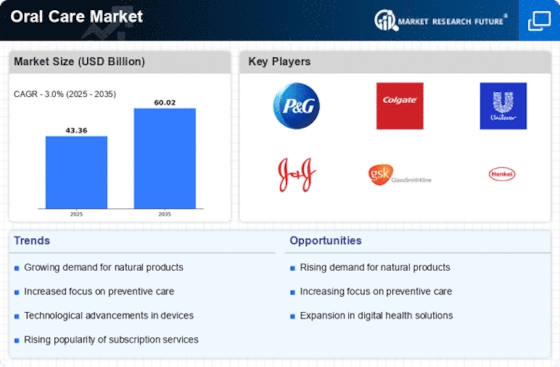
<p>The Oral Care Market is valued at approximately 43.36 USD Billion in 2024.</p>

What is the projected market size for the Oral Care Market by 2035?

<p>The market is expected to reach around 60.02 USD Billion by 2035.</p>

What is the expected CAGR for the Oral Care Market during the forecast period 2025 - 2035?

<p>The anticipated CAGR for the Oral Care Market during 2025 - 2035 is 3.0%.</p>

Which distribution channel is projected to generate the highest revenue in the Oral Care Market?

<p>Pharmacies are projected to generate the highest revenue, with an expected growth from 15.0 to 20.0 USD Billion.</p>

How do toothpaste sales compare to other oral care products in 2025?

<p>Toothpaste sales are expected to grow from 12.0 to 16.0 USD Billion, indicating strong demand.</p>

What segment of the Oral Care Market is expected to see the most growth among end users?

<p>The adult segment is projected to grow significantly, from 25.0 to 35.0 USD Billion.</p>

Which key players dominate the Oral Care Market?

<p>Key players include Procter & Gamble, Colgate-Palmolive, Unilever, and Johnson & Johnson.</p>

What form of oral care products is expected to have the highest market valuation?

<p>Gel products are anticipated to grow from 18.36 to 27.02 USD Billion, indicating a strong preference.</p>

How does the e-commerce channel compare to traditional retail in the Oral Care Market?

<p>E-commerce is expected to grow from 8.0 to 12.0 USD Billion, reflecting a shift towards online shopping.</p>

What is the projected growth for whitening products in the Oral Care Market?

<p>Whitening products are expected to grow from 14.36 to 21.02 USD Billion, suggesting increasing consumer interest.</p>

Market Summary

As per Market Research Future analysis, the Oral Care Market Size was estimated at 37.8 USD Billion in 2024. The Oral Care industry is projected to grow from 40.1 USD Billion in 2025 to 73.3 USD Billion by 2035, exhibiting a compound annual growth rate (CAGR) of 6.2 % during the forecast period 2025 - 2035

Key Market Trends & Highlights

The Oral Care Market is experiencing a dynamic shift towards technological integration and sustainability, driven by evolving consumer preferences.

  • Technological integration in oral care products is enhancing user experience and effectiveness, particularly in North America. A growing focus on sustainability is influencing product development, with eco-friendly packaging gaining traction in the Asia-Pacific region. Holistic health awareness is prompting consumers to seek products that align with overall wellness, impacting both toothpaste and mouthwash segments. Rising consumer awareness and innovative product development are key drivers, particularly in the toothpaste and e-commerce segments.

Market Size & Forecast

2024 Market Size 37.8 (USD Billion)
2035 Market Size 40.1 (USD Billion)
CAGR (2025 - 2035) 6.2%
Largest Regional Market Share in 2024 Asia Pacific

Major Players

Procter &amp; Gamble (US), <a href="https://www.colgatepalmolive.co.in/">Colgate-Palmolive (US)</a>, Unilever (GB), Johnson &amp; Johnson (US), GlaxoSmithKline (GB), Henkel (DE), Church &amp; Dwight (US), Crest (US)

Market Trends

The Oral Care Market is currently experiencing a dynamic evolution, driven by a confluence of consumer awareness and technological advancements. The trends in the oral care market highlight a growing preference for technologically advanced, sustainable, and health-focused oral hygiene solutions. As individuals become increasingly cognizant of the importance of oral hygiene, there is a noticeable shift towards products that not only promise effective cleaning but also enhance overall oral health. This heightened awareness is fostering a demand for innovative solutions, such as electric toothbrushes and advanced whitening agents, which are perceived as superior alternatives to traditional methods. Furthermore, the integration of digital technologies into oral care products is reshaping consumer experiences, making oral hygiene routines more engaging and personalized. In addition to technological innovations, sustainability is emerging as a pivotal theme within the Oral Care Market. Consumers are gravitating towards eco-friendly products, reflecting a broader societal trend towards environmental consciousness. Brands that prioritize sustainable practices, such as biodegradable packaging and natural ingredients, are likely to resonate with a growing segment of the market. This shift not only aligns with consumer values but also presents opportunities for companies to differentiate themselves in a competitive landscape. As the Oral Care Market continues to evolve, the interplay between innovation, consumer preferences, and sustainability will likely shape its trajectory in the coming years.

Technological Integration

The Oral Care Market is witnessing a surge in the adoption of smart technologies. Products equipped with sensors and connectivity features are becoming increasingly popular, allowing users to monitor their oral hygiene habits in real-time. This trend suggests a shift towards more personalized and data-driven approaches to oral care, enhancing user engagement and compliance.

Sustainability Focus

There is a growing emphasis on sustainability within the Oral Care Market. Consumers are increasingly seeking products that are environmentally friendly, prompting brands to innovate with biodegradable materials and natural ingredients. This trend indicates a potential shift in consumer purchasing behavior, favoring brands that align with eco-conscious values.

Holistic Health Awareness

The Oral Care Market is experiencing a rise in consumer interest in holistic health approaches. Individuals are recognizing the connection between oral health and overall well-being, leading to increased demand for products that promote not just dental hygiene but also systemic health. This trend may encourage brands to expand their offerings to include multifunctional products.

Oral Care Market Market Drivers

Aging Population

The Oral Care Market is significantly influenced by the aging population, which presents both challenges and opportunities. As individuals age, they often experience various dental issues, including gum disease and tooth decay, necessitating increased oral care. This demographic shift is expected to drive demand for specialized oral care products, such as denture adhesives and sensitive toothpaste. Data indicates that the population aged 65 and older is projected to double by 2050, which could lead to a substantial increase in the market for oral care products tailored to this age group. Companies are likely to focus on developing solutions that address the unique needs of older adults, thereby expanding their market reach.

E-commerce Growth

The Oral Care Market is witnessing a significant transformation due to the rapid growth of e-commerce. Online shopping platforms have become increasingly popular, providing consumers with convenient access to a wide range of oral care products. This shift in purchasing behavior is supported by data showing that e-commerce sales in the personal care sector are expected to grow at a rate of over 10% annually. As a result, traditional retailers are adapting their strategies to include online sales channels, thereby enhancing their market presence. Furthermore, the rise of subscription services for oral care products is changing how consumers purchase and use these items, fostering brand loyalty and ensuring consistent sales.

Rising Consumer Awareness

The Oral Care Market experiences a notable increase in consumer awareness regarding oral hygiene. This heightened awareness is driven by educational campaigns and the proliferation of information through digital platforms. Consumers are now more informed about the importance of maintaining oral health, which has led to a surge in demand for various oral care products. According to recent data, the market for toothpaste alone is projected to reach approximately 20 billion USD by 2026. This trend indicates that consumers are actively seeking products that not only clean but also provide additional benefits such as whitening and sensitivity relief. As a result, manufacturers are compelled to innovate and diversify their product offerings to meet these evolving consumer expectations.

Preventive Healthcare Trends

The Oral Care Market is increasingly aligned with the broader trends in preventive healthcare. Consumers are becoming more proactive about their health, recognizing the link between oral hygiene and overall well-being. This awareness has led to a growing demand for preventive oral care products, such as fluoride toothpaste and mouth rinses that promote gum health. Market data suggests that the preventive oral care segment is expected to witness substantial growth, driven by consumers seeking to avoid costly dental procedures. As a result, manufacturers are focusing on developing products that emphasize prevention, thereby positioning themselves favorably within the competitive landscape of the oral care market.

Innovative Product Development

Innovation plays a crucial role in the Oral Care Market, as companies continuously strive to develop new and improved products. The introduction of advanced technologies, such as electric toothbrushes with smart features, has transformed consumer habits and preferences. For instance, the market for electric toothbrushes is expected to grow significantly, with estimates suggesting a compound annual growth rate of over 7% in the coming years. Additionally, the emergence of natural and organic oral care products reflects a shift in consumer preferences towards safer and environmentally friendly options. This trend not only caters to health-conscious consumers but also aligns with the broader movement towards sustainability in personal care products.

Oral Care Industry Market Research: Product Categories and Market Share Analysis

Detailed oral care industry market research reveals that the oral care products market is segmented into distinct categories with varying growth trajectories and competitive dynamics. Toothpaste continues to hold the largest oral care market share at 35%, while mouthwash and whitening products are experiencing the fastest growth rates. Emerging trends in oral care market show that consumers are increasingly seeking multi-benefit products that combine cleaning, whitening, and enamel protection in single formulations. The UK oral care market mirrors these global patterns while showing unique preferences for tea tree oil-based products and cruelty-free certifications.

Market Segment Insights

By Type: Toothpaste (Largest) vs. Mouthwash (Fastest-Growing)

<p>The oral care market presents a diverse array of products, with toothpaste holding the largest market share thanks to its widespread use in daily hygiene routines. Toothbrushes and mouthwash follow closely, each contributing significantly to the market dynamics. Dental floss and whitening products, while essential, command smaller portions of the overall market. As consumers become more health-conscious, their choices in oral care products reflect a growing preference for proactive dental hygiene, driving overall growth in the segment.</p>

<p>Toothpaste (Dominant) vs. Whitening Products (Emerging)</p>

<p>Toothpaste stands as the dominant force within the oral care market, renowned for its essential role in daily dental hygiene and its broad consumer acceptance. Variants catering to specific needs, such as sensitivity or whitening, further enhance its appeal. In contrast, whitening products are emerging as an increasingly popular choice among consumers seeking aesthetic enhancements for their smiles. These products have gained traction due to elevating consumer awareness regarding oral aesthetics and the impact of social media on beauty standards. As trends shift towards both functional and cosmetic oral care, the market is seeing dynamic growth fueled by innovations in whitening technologies and the development of effective formulations.</p>

By Distribution Channel: E-commerce (Largest) vs. Supermarkets (Fastest-Growing)

<p>The Oral Care Market exhibits diverse distribution channels, with E-commerce standing out as the largest segment due to its convenience and extensive reach. Supermarkets follow closely, playing a significant role in driving traditional retail interactions. Pharmacies and convenience stores serve as important channels, catering to consumers seeking immediate access to oral care products, yet their market share remains comparatively lower than that of E-commerce and supermarkets. As consumer preferences shift, these channels must adapt to maintain their relevance in the market.</p>

<p>E-commerce (Dominant) vs. Supermarkets (Emerging)</p>

<p>The E-commerce segment holds a dominant position in the Oral Care Market, driven by an increasing preference for online shopping and targeted marketing strategies. It allows for easy comparison and greater product variety, appealing particularly to tech-savvy consumers. In contrast, supermarkets are emerging as a significant channel, leveraging their physical presence and convenience to attract shoppers seeking immediate purchases. While E-commerce is thriving from digital transformation trends, supermarkets are re-evaluating their strategies, incorporating online sales to enhance their offerings, ensuring they remain competitive in this evolving market landscape.</p>

By End User: Children (Largest) vs. Elderly (Fastest-Growing)

<p>In the Oral Care Market, the distribution of end users reveals that Children represent the largest segment, capturing significant attention from manufacturers due to the need for specialized products that cater to their dental health requirements. Meanwhile, the Elderly demographic is witnessing rapid growth in recent years, driven by increasing awareness about oral health and the specific challenges related to aging, such as dry mouth and tooth decay. Adults, while substantial, are closely following behind as they prioritize preventive care and advanced oral hygiene products.</p>

<p>Children (Dominant) vs. Elderly (Emerging)</p>

<p>The Children segment dominates the Oral Care Market, characterized by a wide range of products designed to appeal to younger audiences, including flavored toothpastes and fun packaging. This segment benefits from the emphasis on early dental care, with parents increasingly investing in quality oral health products for their kids. In contrast, the Elderly segment is emerging rapidly due to an aging population that demands specialized oral care solutions. Marketers are innovating products to address common issues faced by older adults, such as gum sensitivity and dentures, leading to greater consumer loyalty and increased market offerings.</p>

By Form: Liquid (Largest) vs. Gel (Fastest-Growing)

<p>In the Oral Care Market, the segment distribution favors Liquid formulations due to their widespread acceptance and ease of use. Liquid products, including mouthwashes and rinses, dominate this segment as they cater to a diverse range of customer preferences, ensuring significant market presence. Conversely, Gel products are gaining traction, appealing to consumers who prefer a thicker application that may provide a feeling of extra freshness and effectiveness. Solid products, while traditional, are gradually losing share compared to more innovative offerings.</p>

<p>Liquid (Dominant) vs. Gel (Emerging)</p>

<p>Liquid products are well-established in the Oral Care Market, recognized for their convenience and effectiveness in maintaining oral hygiene. They cater to a broad audience, including those seeking quick solutions for fresh breath and complete mouth care. On the other hand, Gel products are emerging rapidly, particularly among younger consumers who find the texture appealing and effective. These gels often incorporate advanced formulations that promise enhanced cleaning benefits and sensory experiences, thus positioning themselves as a modern alternative. As consumer preferences shift towards innovative and varied textures in oral care, Gel products are expected to capture an increasing share of the market.</p>

Get more detailed insights about Oral Care Market Research Report – Forecast to 2035

Regional Insights

North America : Market Leader in Oral Care Market

North America is the largest market for oral care products, holding approximately 35% of the global market share. The growth is driven by increasing awareness of oral hygiene, innovative product launches, and strong marketing strategies by key players. Regulatory support from health organizations further boosts demand, ensuring compliance with safety standards and promoting oral health initiatives. The United States is the leading country in this region, with major companies like Procter & Gamble, Colgate-Palmolive, and Johnson & Johnson dominating the market. The competitive landscape is characterized by continuous innovation, with a focus on natural ingredients and advanced technology in product formulations. This region's strong retail presence and e-commerce growth also contribute to its market leadership.

Europe : Emerging Trends in Oral Care Market

Europe is the second-largest market for oral care, accounting for about 25% of the global share. The region is witnessing a shift towards sustainable and eco-friendly products, driven by consumer demand for environmentally responsible options. Regulatory frameworks, such as the EU's REACH regulations, are encouraging manufacturers to adopt safer and more sustainable practices in product development. Leading countries in this market include Germany, the UK, and France, where companies like Unilever and Henkel are making significant strides. Within Europe, the UK oral care market represents a mature yet evolving landscape, driven by high consumer awareness, demand for sustainable products, and strong regulatory standards. The competitive landscape is marked by a growing emphasis on natural ingredients and innovative packaging solutions. The presence of established brands alongside emerging startups is fostering a dynamic market environment, enhancing consumer choice and driving growth.

Asia-Pacific : Rapid Growth and Innovation

The Middle East and Africa region is witnessing a gradual increase in the oral care market share, currently holding about 10% of the global share. The growth is driven by rising awareness of oral health, urbanization, and an increase in disposable income. Regulatory bodies are beginning to implement standards that promote better oral hygiene practices, which is expected to further boost market growth in the coming years. Leading countries in this region include South Africa and the UAE, where the presence of international brands is growing. Companies like Johnson & Johnson and Colgate-Palmolive are expanding their product lines to cater to local preferences. The competitive landscape is evolving, with an increasing number of local players entering the market, focusing on affordability and accessibility of oral care products.

Middle East and Africa : Untapped Potential in Oral Care Market

The Middle East and Africa region is witnessing a gradual increase in the oral care market, currently holding about 10% of the global share. The growth is driven by rising awareness of oral health, urbanization, and an increase in disposable income. Regulatory bodies are beginning to implement standards that promote better oral hygiene practices, which is expected to further boost market growth in the coming years. Leading countries in this region include South Africa and the UAE, where the presence of international brands is growing. Companies like Johnson & Johnson and Colgate-Palmolive are expanding their product lines to cater to local preferences. The competitive landscape is evolving, with an increasing number of local players entering the market, focusing on affordability and accessibility of oral care products.

Key Players and Competitive Insights

The Global Oral Care Market is characterized by a highly competitive landscape, driven by continuous innovation and evolving consumer preferences. The marketplace encompasses various segments such as toothpaste, mouthwash, and dental floss, which are dominated by both established players and emerging brands. With growing awareness about oral hygiene and the increasing prevalence of dental issues worldwide, companies are focusing on expanding their product ranges and enhancing their market presence to capture consumer attention. In addition, technological advancements and the rise of e-commerce platforms have transformed the way oral care products are marketed and sold, pushing companies to adopt new strategies and engage with consumers more directly. Research and development play a significant role in this market, as companies strive to create effective products that meet the changing needs of consumers while also addressing environmental concerns.Crest has firmly established itself as a leading brand in the Global Oral Care Market, known for its premium toothpaste products and oral hygiene solutions. The brand's notable strengths include a strong reputation for efficacy, a diverse range of innovative offerings tailored to various consumer groups, and strategic marketing campaigns that enhance brand visibility and consumer loyalty. Crest has managed to build a competitive edge through its emphasis on scientific research, resulting in formulations that address specific dental concerns such as cavity prevention, whitening, and sensitivity. Additionally, Crest's widespread distribution network ensures availability in multiple retail channels globally, enabling it to maintain a significant market share. The company continues to invest in advertising and promotional efforts, leveraging both traditional and digital media to effectively reach its target audience and drive product adoption.Listerine, another prominent player in the Global Oral Care Market, is widely recognized for its effective mouthwash products that promote oral hygiene and fresh breath. The brand's portfolio includes a variety of mouthwash formulations and dental hygiene products, which cater to different consumer preferences and needs. Listerine's strengths lie in its strong brand recognition and loyal customer base, along with a history of scientific support for its products. The company has also expanded its presence through various mergers and acquisitions, broadening its product range and enhancing its market stability. Listerine's commitment to innovation is evident in its continued development of new formulations that target specific oral health issues, making it a trusted choice among consumers. Enhanced product visibility, cohesive marketing strategies, and collaboration with dental professionals further amplify Listerine's presence in the global market, allowing it to capitalize on growth opportunities while addressing the increasing demand for effective oral care solutions.

Key Companies in the Oral Care Market include

Industry Developments

The Global Oral Care Market has experienced notable developments recently. Companies like Unilever and Procter and Gamble continue to innovate with eco-friendly products, focusing on sustainability, which is increasingly important to consumers. In October 2023, Reckitt Benckiser reported an increase in demand for Oral B oral care products, pushing their market valuation upwards. Mergers and acquisitions have also shaped the landscape; Johnson and Johnson announced in September 2023 its decision to acquire Sunstar's oral care division, a move aimed at expanding its product portfolio in the premium segment.

Additionally, Colgate-Palmolive has been actively developing partnerships with technology firms to enhance smart toothbrushes, integrating Research and Development efforts for user-centric advancements. The continuous growth observed over the last few years is attributed to rising dental health awareness and an expanding consumer base in emerging markets. This increased focus on oral hygiene is driving competition among key players, including Crest, Henkel, and GlaxoSmithKline, as they strive to capture market share through innovative solutions and consumer engagement strategies. Amidst these dynamics, major industry players are keeping a close eye on evolving consumer preferences for product offerings.

Future Outlook

Oral Care Market Future Outlook

The Oral Care Market is projected to grow at a 6.2 % CAGR from 2025 to 2035, driven by increasing consumer awareness and technological advancements.

New opportunities lie in:

  • <p>Expansion of subscription-based oral care products Development of AI-driven personalized dental care solutions Introduction of eco-friendly and biodegradable oral hygiene products</p>

By 2035, the Oral Care Market is expected to be robust, reflecting sustained growth and innovation.

Market Segmentation

Oral Care Market Form Outlook

  • Liquid
  • Solid
  • Gel

Oral Care Market Type Outlook

  • Toothpaste
  • Toothbrush
  • Mouthwash
  • Dental Floss
  • Whitening Products

Oral Care Market End User Outlook

  • Children
  • Adults
  • Elderly

Oral Care Market Distribution Channel Outlook

  • Supermarkets
  • E-commerce
  • Pharmacies
  • Convenience Stores

Report Scope

MARKET SIZE 2024 37.8 (USD Billion)
MARKET SIZE 2025 40.1(USD Billion)
MARKET SIZE 2035 73.3 (USD Billion)
COMPOUND ANNUAL GROWTH RATE (CAGR) 6.2 % (2025 - 2035)
REPORT COVERAGE Revenue Forecast, Competitive Landscape, Growth Factors, and Trends
BASE YEAR 2024
Market Forecast Period 2025 - 2035
Historical Data 2019 - 2024
Market Forecast Units USD Billion
Key Companies Profiled Procter & Gamble (US), Colgate-Palmolive (US), Unilever (GB), Johnson & Johnson (US), GlaxoSmithKline (GB), Henkel (DE), Church & Dwight (US), Crest (US)
Segments Covered Product Type, Distribution Channel, End User, Form, Regional
Key Market Opportunities Integration of smart technology in oral hygiene products enhances consumer engagement and health monitoring.
Key Market Dynamics Rising consumer demand for natural ingredients drives innovation and competition in the Oral Care Market.
Countries Covered North America, Europe, APAC, South America, MEA

FAQs

What is the current valuation of the Oral Care Market in 2025?

<p>The Oral Care Market is valued at approximately 43.36 USD Billion in 2024.</p>

What is the projected market size for the Oral Care Market by 2035?

<p>The market is expected to reach around 60.02 USD Billion by 2035.</p>

What is the expected CAGR for the Oral Care Market during the forecast period 2025 - 2035?

<p>The anticipated CAGR for the Oral Care Market during 2025 - 2035 is 3.0%.</p>

Which distribution channel is projected to generate the highest revenue in the Oral Care Market?

<p>Pharmacies are projected to generate the highest revenue, with an expected growth from 15.0 to 20.0 USD Billion.</p>

How do toothpaste sales compare to other oral care products in 2025?

<p>Toothpaste sales are expected to grow from 12.0 to 16.0 USD Billion, indicating strong demand.</p>

What segment of the Oral Care Market is expected to see the most growth among end users?

<p>The adult segment is projected to grow significantly, from 25.0 to 35.0 USD Billion.</p>

Which key players dominate the Oral Care Market?

<p>Key players include Procter & Gamble, Colgate-Palmolive, Unilever, and Johnson & Johnson.</p>

What form of oral care products is expected to have the highest market valuation?

<p>Gel products are anticipated to grow from 18.36 to 27.02 USD Billion, indicating a strong preference.</p>

How does the e-commerce channel compare to traditional retail in the Oral Care Market?

<p>E-commerce is expected to grow from 8.0 to 12.0 USD Billion, reflecting a shift towards online shopping.</p>

What is the projected growth for whitening products in the Oral Care Market?

<p>Whitening products are expected to grow from 14.36 to 21.02 USD Billion, suggesting increasing consumer interest.</p>

  1. SECTION I: EXECUTIVE SUMMARY AND KEY HIGHLIGHTS
    1. | 1.1 EXECUTIVE SUMMARY
    2. | | 1.1.1 Market Overview
    3. | | 1.1.2 Key Findings
    4. | | 1.1.3 Market Segmentation
    5. | | 1.1.4 Competitive Landscape
    6. | | 1.1.5 Challenges and Opportunities
    7. | | 1.1.6 Future Outlook
  2. SECTION II: SCOPING, METHODOLOGY AND MARKET STRUCTURE
    1. | 2.1 MARKET INTRODUCTION
    2. | | 2.1.1 Definition
    3. | | 2.1.2 Scope of the study
    4. | | | 2.1.2.1 Research Objective
    5. | | | 2.1.2.2 Assumption
    6. | | | 2.1.2.3 Limitations
    7. | 2.2 RESEARCH METHODOLOGY
    8. | | 2.2.1 Overview
    9. | | 2.2.2 Data Mining
    10. | | 2.2.3 Secondary Research
    11. | | 2.2.4 Primary Research
    12. | | | 2.2.4.1 Primary Interviews and Information Gathering Process
    13. | | | 2.2.4.2 Breakdown of Primary Respondents
    14. | | 2.2.5 Forecasting Model
    15. | | 2.2.6 Market Size Estimation
    16. | | | 2.2.6.1 Bottom-Up Approach
    17. | | | 2.2.6.2 Top-Down Approach
    18. | | 2.2.7 Data Triangulation
    19. | | 2.2.8 Validation
  3. SECTION III: QUALITATIVE ANALYSIS
    1. | 3.1 MARKET DYNAMICS
    2. | | 3.1.1 Overview
    3. | | 3.1.2 Drivers
    4. | | 3.1.3 Restraints
    5. | | 3.1.4 Opportunities
    6. | 3.2 MARKET FACTOR ANALYSIS
    7. | | 3.2.1 Value chain Analysis
    8. | | 3.2.2 Porter's Five Forces Analysis
    9. | | | 3.2.2.1 Bargaining Power of Suppliers
    10. | | | 3.2.2.2 Bargaining Power of Buyers
    11. | | | 3.2.2.3 Threat of New Entrants
    12. | | | 3.2.2.4 Threat of Substitutes
    13. | | | 3.2.2.5 Intensity of Rivalry
    14. | | 3.2.3 COVID-19 Impact Analysis
    15. | | | 3.2.3.1 Market Impact Analysis
    16. | | | 3.2.3.2 Regional Impact
    17. | | | 3.2.3.3 Opportunity and Threat Analysis
  4. SECTION IV: QUANTITATIVE ANALYSIS
    1. | 4.1 Consumer and Retail, BY Type (USD Billion)
    2. | | 4.1.1 Toothpaste
    3. | | 4.1.2 Toothbrush
    4. | | 4.1.3 Mouthwash
    5. | | 4.1.4 Dental Floss
    6. | | 4.1.5 Whitening Products
    7. | 4.2 Consumer and Retail, BY Distribution Channel (USD Billion)
    8. | | 4.2.1 Supermarkets
    9. | | 4.2.2 E-commerce
    10. | | 4.2.3 Pharmacies
    11. | | 4.2.4 Convenience Stores
    12. | 4.3 Consumer and Retail, BY End User (USD Billion)
    13. | | 4.3.1 Children
    14. | | 4.3.2 Adults
    15. | | 4.3.3 Elderly
    16. | 4.4 Consumer and Retail, BY Form (USD Billion)
    17. | | 4.4.1 Liquid
    18. | | 4.4.2 Solid
    19. | | 4.4.3 Gel
    20. | 4.5 Consumer and Retail, BY Region (USD Billion)
    21. | | 4.5.1 North America
    22. | | | 4.5.1.1 US
    23. | | | 4.5.1.2 Canada
    24. | | 4.5.2 Europe
    25. | | | 4.5.2.1 Germany
    26. | | | 4.5.2.2 UK
    27. | | | 4.5.2.3 France
    28. | | | 4.5.2.4 Russia
    29. | | | 4.5.2.5 Italy
    30. | | | 4.5.2.6 Spain
    31. | | | 4.5.2.7 Rest of Europe
    32. | | 4.5.3 APAC
    33. | | | 4.5.3.1 China
    34. | | | 4.5.3.2 India
    35. | | | 4.5.3.3 Japan
    36. | | | 4.5.3.4 South Korea
    37. | | | 4.5.3.5 Malaysia
    38. | | | 4.5.3.6 Thailand
    39. | | | 4.5.3.7 Indonesia
    40. | | | 4.5.3.8 Rest of APAC
    41. | | 4.5.4 South America
    42. | | | 4.5.4.1 Brazil
    43. | | | 4.5.4.2 Mexico
    44. | | | 4.5.4.3 Argentina
    45. | | | 4.5.4.4 Rest of South America
    46. | | 4.5.5 MEA
    47. | | | 4.5.5.1 GCC Countries
    48. | | | 4.5.5.2 South Africa
    49. | | | 4.5.5.3 Rest of MEA
  5. SECTION V: COMPETITIVE ANALYSIS
    1. | 5.1 Competitive Landscape
    2. | | 5.1.1 Overview
    3. | | 5.1.2 Competitive Analysis
    4. | | 5.1.3 Market share Analysis
    5. | | 5.1.4 Major Growth Strategy in the Consumer and Retail
    6. | | 5.1.5 Competitive Benchmarking
    7. | | 5.1.6 Leading Players in Terms of Number of Developments in the Consumer and Retail
    8. | | 5.1.7 Key developments and growth strategies
    9. | | | 5.1.7.1 New Product Launch/Service Deployment
    10. | | | 5.1.7.2 Merger & Acquisitions
    11. | | | 5.1.7.3 Joint Ventures
    12. | | 5.1.8 Major Players Financial Matrix
    13. | | | 5.1.8.1 Sales and Operating Income
    14. | | | 5.1.8.2 Major Players R&D Expenditure. 2023
    15. | 5.2 Company Profiles
    16. | | 5.2.1 Procter & Gamble (US)
    17. | | | 5.2.1.1 Financial Overview
    18. | | | 5.2.1.2 Products Offered
    19. | | | 5.2.1.3 Key Developments
    20. | | | 5.2.1.4 SWOT Analysis
    21. | | | 5.2.1.5 Key Strategies
    22. | | 5.2.2 Colgate-Palmolive (US)
    23. | | | 5.2.2.1 Financial Overview
    24. | | | 5.2.2.2 Products Offered
    25. | | | 5.2.2.3 Key Developments
    26. | | | 5.2.2.4 SWOT Analysis
    27. | | | 5.2.2.5 Key Strategies
    28. | | 5.2.3 Unilever (GB)
    29. | | | 5.2.3.1 Financial Overview
    30. | | | 5.2.3.2 Products Offered
    31. | | | 5.2.3.3 Key Developments
    32. | | | 5.2.3.4 SWOT Analysis
    33. | | | 5.2.3.5 Key Strategies
    34. | | 5.2.4 Johnson & Johnson (US)
    35. | | | 5.2.4.1 Financial Overview
    36. | | | 5.2.4.2 Products Offered
    37. | | | 5.2.4.3 Key Developments
    38. | | | 5.2.4.4 SWOT Analysis
    39. | | | 5.2.4.5 Key Strategies
    40. | | 5.2.5 GlaxoSmithKline (GB)
    41. | | | 5.2.5.1 Financial Overview
    42. | | | 5.2.5.2 Products Offered
    43. | | | 5.2.5.3 Key Developments
    44. | | | 5.2.5.4 SWOT Analysis
    45. | | | 5.2.5.5 Key Strategies
    46. | | 5.2.6 Henkel (DE)
    47. | | | 5.2.6.1 Financial Overview
    48. | | | 5.2.6.2 Products Offered
    49. | | | 5.2.6.3 Key Developments
    50. | | | 5.2.6.4 SWOT Analysis
    51. | | | 5.2.6.5 Key Strategies
    52. | | 5.2.7 Church & Dwight (US)
    53. | | | 5.2.7.1 Financial Overview
    54. | | | 5.2.7.2 Products Offered
    55. | | | 5.2.7.3 Key Developments
    56. | | | 5.2.7.4 SWOT Analysis
    57. | | | 5.2.7.5 Key Strategies
    58. | | 5.2.8 Crest (US)
    59. | | | 5.2.8.1 Financial Overview
    60. | | | 5.2.8.2 Products Offered
    61. | | | 5.2.8.3 Key Developments
    62. | | | 5.2.8.4 SWOT Analysis
    63. | | | 5.2.8.5 Key Strategies
    64. | 5.3 Appendix
    65. | | 5.3.1 References
    66. | | 5.3.2 Related Reports
  6. LIST OF FIGURES
    1. | 6.1 MARKET SYNOPSIS
    2. | 6.2 NORTH AMERICA MARKET ANALYSIS
    3. | 6.3 US MARKET ANALYSIS BY TYPE
    4. | 6.4 US MARKET ANALYSIS BY DISTRIBUTION CHANNEL
    5. | 6.5 US MARKET ANALYSIS BY END USER
    6. | 6.6 US MARKET ANALYSIS BY FORM
    7. | 6.7 CANADA MARKET ANALYSIS BY TYPE
    8. | 6.8 CANADA MARKET ANALYSIS BY DISTRIBUTION CHANNEL
    9. | 6.9 CANADA MARKET ANALYSIS BY END USER
    10. | 6.10 CANADA MARKET ANALYSIS BY FORM
    11. | 6.11 EUROPE MARKET ANALYSIS
    12. | 6.12 GERMANY MARKET ANALYSIS BY TYPE
    13. | 6.13 GERMANY MARKET ANALYSIS BY DISTRIBUTION CHANNEL
    14. | 6.14 GERMANY MARKET ANALYSIS BY END USER
    15. | 6.15 GERMANY MARKET ANALYSIS BY FORM
    16. | 6.16 UK MARKET ANALYSIS BY TYPE
    17. | 6.17 UK MARKET ANALYSIS BY DISTRIBUTION CHANNEL
    18. | 6.18 UK MARKET ANALYSIS BY END USER
    19. | 6.19 UK MARKET ANALYSIS BY FORM
    20. | 6.20 FRANCE MARKET ANALYSIS BY TYPE
    21. | 6.21 FRANCE MARKET ANALYSIS BY DISTRIBUTION CHANNEL
    22. | 6.22 FRANCE MARKET ANALYSIS BY END USER
    23. | 6.23 FRANCE MARKET ANALYSIS BY FORM
    24. | 6.24 RUSSIA MARKET ANALYSIS BY TYPE
    25. | 6.25 RUSSIA MARKET ANALYSIS BY DISTRIBUTION CHANNEL
    26. | 6.26 RUSSIA MARKET ANALYSIS BY END USER
    27. | 6.27 RUSSIA MARKET ANALYSIS BY FORM
    28. | 6.28 ITALY MARKET ANALYSIS BY TYPE
    29. | 6.29 ITALY MARKET ANALYSIS BY DISTRIBUTION CHANNEL
    30. | 6.30 ITALY MARKET ANALYSIS BY END USER
    31. | 6.31 ITALY MARKET ANALYSIS BY FORM
    32. | 6.32 SPAIN MARKET ANALYSIS BY TYPE
    33. | 6.33 SPAIN MARKET ANALYSIS BY DISTRIBUTION CHANNEL
    34. | 6.34 SPAIN MARKET ANALYSIS BY END USER
    35. | 6.35 SPAIN MARKET ANALYSIS BY FORM
    36. | 6.36 REST OF EUROPE MARKET ANALYSIS BY TYPE
    37. | 6.37 REST OF EUROPE MARKET ANALYSIS BY DISTRIBUTION CHANNEL
    38. | 6.38 REST OF EUROPE MARKET ANALYSIS BY END USER
    39. | 6.39 REST OF EUROPE MARKET ANALYSIS BY FORM
    40. | 6.40 APAC MARKET ANALYSIS
    41. | 6.41 CHINA MARKET ANALYSIS BY TYPE
    42. | 6.42 CHINA MARKET ANALYSIS BY DISTRIBUTION CHANNEL
    43. | 6.43 CHINA MARKET ANALYSIS BY END USER
    44. | 6.44 CHINA MARKET ANALYSIS BY FORM
    45. | 6.45 INDIA MARKET ANALYSIS BY TYPE
    46. | 6.46 INDIA MARKET ANALYSIS BY DISTRIBUTION CHANNEL
    47. | 6.47 INDIA MARKET ANALYSIS BY END USER
    48. | 6.48 INDIA MARKET ANALYSIS BY FORM
    49. | 6.49 JAPAN MARKET ANALYSIS BY TYPE
    50. | 6.50 JAPAN MARKET ANALYSIS BY DISTRIBUTION CHANNEL
    51. | 6.51 JAPAN MARKET ANALYSIS BY END USER
    52. | 6.52 JAPAN MARKET ANALYSIS BY FORM
    53. | 6.53 SOUTH KOREA MARKET ANALYSIS BY TYPE
    54. | 6.54 SOUTH KOREA MARKET ANALYSIS BY DISTRIBUTION CHANNEL
    55. | 6.55 SOUTH KOREA MARKET ANALYSIS BY END USER
    56. | 6.56 SOUTH KOREA MARKET ANALYSIS BY FORM
    57. | 6.57 MALAYSIA MARKET ANALYSIS BY TYPE
    58. | 6.58 MALAYSIA MARKET ANALYSIS BY DISTRIBUTION CHANNEL
    59. | 6.59 MALAYSIA MARKET ANALYSIS BY END USER
    60. | 6.60 MALAYSIA MARKET ANALYSIS BY FORM
    61. | 6.61 THAILAND MARKET ANALYSIS BY TYPE
    62. | 6.62 THAILAND MARKET ANALYSIS BY DISTRIBUTION CHANNEL
    63. | 6.63 THAILAND MARKET ANALYSIS BY END USER
    64. | 6.64 THAILAND MARKET ANALYSIS BY FORM
    65. | 6.65 INDONESIA MARKET ANALYSIS BY TYPE
    66. | 6.66 INDONESIA MARKET ANALYSIS BY DISTRIBUTION CHANNEL
    67. | 6.67 INDONESIA MARKET ANALYSIS BY END USER
    68. | 6.68 INDONESIA MARKET ANALYSIS BY FORM
    69. | 6.69 REST OF APAC MARKET ANALYSIS BY TYPE
    70. | 6.70 REST OF APAC MARKET ANALYSIS BY DISTRIBUTION CHANNEL
    71. | 6.71 REST OF APAC MARKET ANALYSIS BY END USER
    72. | 6.72 REST OF APAC MARKET ANALYSIS BY FORM
    73. | 6.73 SOUTH AMERICA MARKET ANALYSIS
    74. | 6.74 BRAZIL MARKET ANALYSIS BY TYPE
    75. | 6.75 BRAZIL MARKET ANALYSIS BY DISTRIBUTION CHANNEL
    76. | 6.76 BRAZIL MARKET ANALYSIS BY END USER
    77. | 6.77 BRAZIL MARKET ANALYSIS BY FORM
    78. | 6.78 MEXICO MARKET ANALYSIS BY TYPE
    79. | 6.79 MEXICO MARKET ANALYSIS BY DISTRIBUTION CHANNEL
    80. | 6.80 MEXICO MARKET ANALYSIS BY END USER
    81. | 6.81 MEXICO MARKET ANALYSIS BY FORM
    82. | 6.82 ARGENTINA MARKET ANALYSIS BY TYPE
    83. | 6.83 ARGENTINA MARKET ANALYSIS BY DISTRIBUTION CHANNEL
    84. | 6.84 ARGENTINA MARKET ANALYSIS BY END USER
    85. | 6.85 ARGENTINA MARKET ANALYSIS BY FORM
    86. | 6.86 REST OF SOUTH AMERICA MARKET ANALYSIS BY TYPE
    87. | 6.87 REST OF SOUTH AMERICA MARKET ANALYSIS BY DISTRIBUTION CHANNEL
    88. | 6.88 REST OF SOUTH AMERICA MARKET ANALYSIS BY END USER
    89. | 6.89 REST OF SOUTH AMERICA MARKET ANALYSIS BY FORM
    90. | 6.90 MEA MARKET ANALYSIS
    91. | 6.91 GCC COUNTRIES MARKET ANALYSIS BY TYPE
    92. | 6.92 GCC COUNTRIES MARKET ANALYSIS BY DISTRIBUTION CHANNEL
    93. | 6.93 GCC COUNTRIES MARKET ANALYSIS BY END USER
    94. | 6.94 GCC COUNTRIES MARKET ANALYSIS BY FORM
    95. | 6.95 SOUTH AFRICA MARKET ANALYSIS BY TYPE
    96. | 6.96 SOUTH AFRICA MARKET ANALYSIS BY DISTRIBUTION CHANNEL
    97. | 6.97 SOUTH AFRICA MARKET ANALYSIS BY END USER
    98. | 6.98 SOUTH AFRICA MARKET ANALYSIS BY FORM
    99. | 6.99 REST OF MEA MARKET ANALYSIS BY TYPE
    100. | 6.100 REST OF MEA MARKET ANALYSIS BY DISTRIBUTION CHANNEL
    101. | 6.101 REST OF MEA MARKET ANALYSIS BY END USER
    102. | 6.102 REST OF MEA MARKET ANALYSIS BY FORM
    103. | 6.103 KEY BUYING CRITERIA OF CONSUMER AND RETAIL
    104. | 6.104 RESEARCH PROCESS OF MRFR
    105. | 6.105 DRO ANALYSIS OF CONSUMER AND RETAIL
    106. | 6.106 DRIVERS IMPACT ANALYSIS: CONSUMER AND RETAIL
    107. | 6.107 RESTRAINTS IMPACT ANALYSIS: CONSUMER AND RETAIL
    108. | 6.108 SUPPLY / VALUE CHAIN: CONSUMER AND RETAIL
    109. | 6.109 CONSUMER AND RETAIL, BY TYPE, 2024 (% SHARE)
    110. | 6.110 CONSUMER AND RETAIL, BY TYPE, 2024 TO 2035 (USD Billion)
    111. | 6.111 CONSUMER AND RETAIL, BY DISTRIBUTION CHANNEL, 2024 (% SHARE)
    112. | 6.112 CONSUMER AND RETAIL, BY DISTRIBUTION CHANNEL, 2024 TO 2035 (USD Billion)
    113. | 6.113 CONSUMER AND RETAIL, BY END USER, 2024 (% SHARE)
    114. | 6.114 CONSUMER AND RETAIL, BY END USER, 2024 TO 2035 (USD Billion)
    115. | 6.115 CONSUMER AND RETAIL, BY FORM, 2024 (% SHARE)
    116. | 6.116 CONSUMER AND RETAIL, BY FORM, 2024 TO 2035 (USD Billion)
    117. | 6.117 BENCHMARKING OF MAJOR COMPETITORS
  7. LIST OF TABLES
    1. | 7.1 LIST OF ASSUMPTIONS
    2. | | 7.1.1
    3. | 7.2 North America MARKET SIZE ESTIMATES; FORECAST
    4. | | 7.2.1 BY TYPE, 2025-2035 (USD Billion)
    5. | | 7.2.2 BY DISTRIBUTION CHANNEL, 2025-2035 (USD Billion)
    6. | | 7.2.3 BY END USER, 2025-2035 (USD Billion)
    7. | | 7.2.4 BY FORM, 2025-2035 (USD Billion)
    8. | 7.3 US MARKET SIZE ESTIMATES; FORECAST
    9. | | 7.3.1 BY TYPE, 2025-2035 (USD Billion)
    10. | | 7.3.2 BY DISTRIBUTION CHANNEL, 2025-2035 (USD Billion)
    11. | | 7.3.3 BY END USER, 2025-2035 (USD Billion)
    12. | | 7.3.4 BY FORM, 2025-2035 (USD Billion)
    13. | 7.4 Canada MARKET SIZE ESTIMATES; FORECAST
    14. | | 7.4.1 BY TYPE, 2025-2035 (USD Billion)
    15. | | 7.4.2 BY DISTRIBUTION CHANNEL, 2025-2035 (USD Billion)
    16. | | 7.4.3 BY END USER, 2025-2035 (USD Billion)
    17. | | 7.4.4 BY FORM, 2025-2035 (USD Billion)
    18. | 7.5 Europe MARKET SIZE ESTIMATES; FORECAST
    19. | | 7.5.1 BY TYPE, 2025-2035 (USD Billion)
    20. | | 7.5.2 BY DISTRIBUTION CHANNEL, 2025-2035 (USD Billion)
    21. | | 7.5.3 BY END USER, 2025-2035 (USD Billion)
    22. | | 7.5.4 BY FORM, 2025-2035 (USD Billion)
    23. | 7.6 Germany MARKET SIZE ESTIMATES; FORECAST
    24. | | 7.6.1 BY TYPE, 2025-2035 (USD Billion)
    25. | | 7.6.2 BY DISTRIBUTION CHANNEL, 2025-2035 (USD Billion)
    26. | | 7.6.3 BY END USER, 2025-2035 (USD Billion)
    27. | | 7.6.4 BY FORM, 2025-2035 (USD Billion)
    28. | 7.7 UK MARKET SIZE ESTIMATES; FORECAST
    29. | | 7.7.1 BY TYPE, 2025-2035 (USD Billion)
    30. | | 7.7.2 BY DISTRIBUTION CHANNEL, 2025-2035 (USD Billion)
    31. | | 7.7.3 BY END USER, 2025-2035 (USD Billion)
    32. | | 7.7.4 BY FORM, 2025-2035 (USD Billion)
    33. | 7.8 France MARKET SIZE ESTIMATES; FORECAST
    34. | | 7.8.1 BY TYPE, 2025-2035 (USD Billion)
    35. | | 7.8.2 BY DISTRIBUTION CHANNEL, 2025-2035 (USD Billion)
    36. | | 7.8.3 BY END USER, 2025-2035 (USD Billion)
    37. | | 7.8.4 BY FORM, 2025-2035 (USD Billion)
    38. | 7.9 Russia MARKET SIZE ESTIMATES; FORECAST
    39. | | 7.9.1 BY TYPE, 2025-2035 (USD Billion)
    40. | | 7.9.2 BY DISTRIBUTION CHANNEL, 2025-2035 (USD Billion)
    41. | | 7.9.3 BY END USER, 2025-2035 (USD Billion)
    42. | | 7.9.4 BY FORM, 2025-2035 (USD Billion)
    43. | 7.10 Italy MARKET SIZE ESTIMATES; FORECAST
    44. | | 7.10.1 BY TYPE, 2025-2035 (USD Billion)
    45. | | 7.10.2 BY DISTRIBUTION CHANNEL, 2025-2035 (USD Billion)
    46. | | 7.10.3 BY END USER, 2025-2035 (USD Billion)
    47. | | 7.10.4 BY FORM, 2025-2035 (USD Billion)
    48. | 7.11 Spain MARKET SIZE ESTIMATES; FORECAST
    49. | | 7.11.1 BY TYPE, 2025-2035 (USD Billion)
    50. | | 7.11.2 BY DISTRIBUTION CHANNEL, 2025-2035 (USD Billion)
    51. | | 7.11.3 BY END USER, 2025-2035 (USD Billion)
    52. | | 7.11.4 BY FORM, 2025-2035 (USD Billion)
    53. | 7.12 Rest of Europe MARKET SIZE ESTIMATES; FORECAST
    54. | | 7.12.1 BY TYPE, 2025-2035 (USD Billion)
    55. | | 7.12.2 BY DISTRIBUTION CHANNEL, 2025-2035 (USD Billion)
    56. | | 7.12.3 BY END USER, 2025-2035 (USD Billion)
    57. | | 7.12.4 BY FORM, 2025-2035 (USD Billion)
    58. | 7.13 APAC MARKET SIZE ESTIMATES; FORECAST
    59. | | 7.13.1 BY TYPE, 2025-2035 (USD Billion)
    60. | | 7.13.2 BY DISTRIBUTION CHANNEL, 2025-2035 (USD Billion)
    61. | | 7.13.3 BY END USER, 2025-2035 (USD Billion)
    62. | | 7.13.4 BY FORM, 2025-2035 (USD Billion)
    63. | 7.14 China MARKET SIZE ESTIMATES; FORECAST
    64. | | 7.14.1 BY TYPE, 2025-2035 (USD Billion)
    65. | | 7.14.2 BY DISTRIBUTION CHANNEL, 2025-2035 (USD Billion)
    66. | | 7.14.3 BY END USER, 2025-2035 (USD Billion)
    67. | | 7.14.4 BY FORM, 2025-2035 (USD Billion)
    68. | 7.15 India MARKET SIZE ESTIMATES; FORECAST
    69. | | 7.15.1 BY TYPE, 2025-2035 (USD Billion)
    70. | | 7.15.2 BY DISTRIBUTION CHANNEL, 2025-2035 (USD Billion)
    71. | | 7.15.3 BY END USER, 2025-2035 (USD Billion)
    72. | | 7.15.4 BY FORM, 2025-2035 (USD Billion)
    73. | 7.16 Japan MARKET SIZE ESTIMATES; FORECAST
    74. | | 7.16.1 BY TYPE, 2025-2035 (USD Billion)
    75. | | 7.16.2 BY DISTRIBUTION CHANNEL, 2025-2035 (USD Billion)
    76. | | 7.16.3 BY END USER, 2025-2035 (USD Billion)
    77. | | 7.16.4 BY FORM, 2025-2035 (USD Billion)
    78. | 7.17 South Korea MARKET SIZE ESTIMATES; FORECAST
    79. | | 7.17.1 BY TYPE, 2025-2035 (USD Billion)
    80. | | 7.17.2 BY DISTRIBUTION CHANNEL, 2025-2035 (USD Billion)
    81. | | 7.17.3 BY END USER, 2025-2035 (USD Billion)
    82. | | 7.17.4 BY FORM, 2025-2035 (USD Billion)
    83. | 7.18 Malaysia MARKET SIZE ESTIMATES; FORECAST
    84. | | 7.18.1 BY TYPE, 2025-2035 (USD Billion)
    85. | | 7.18.2 BY DISTRIBUTION CHANNEL, 2025-2035 (USD Billion)
    86. | | 7.18.3 BY END USER, 2025-2035 (USD Billion)
    87. | | 7.18.4 BY FORM, 2025-2035 (USD Billion)
    88. | 7.19 Thailand MARKET SIZE ESTIMATES; FORECAST
    89. | | 7.19.1 BY TYPE, 2025-2035 (USD Billion)
    90. | | 7.19.2 BY DISTRIBUTION CHANNEL, 2025-2035 (USD Billion)
    91. | | 7.19.3 BY END USER, 2025-2035 (USD Billion)
    92. | | 7.19.4 BY FORM, 2025-2035 (USD Billion)
    93. | 7.20 Indonesia MARKET SIZE ESTIMATES; FORECAST
    94. | | 7.20.1 BY TYPE, 2025-2035 (USD Billion)
    95. | | 7.20.2 BY DISTRIBUTION CHANNEL, 2025-2035 (USD Billion)
    96. | | 7.20.3 BY END USER, 2025-2035 (USD Billion)
    97. | | 7.20.4 BY FORM, 2025-2035 (USD Billion)
    98. | 7.21 Rest of APAC MARKET SIZE ESTIMATES; FORECAST
    99. | | 7.21.1 BY TYPE, 2025-2035 (USD Billion)
    100. | | 7.21.2 BY DISTRIBUTION CHANNEL, 2025-2035 (USD Billion)
    101. | | 7.21.3 BY END USER, 2025-2035 (USD Billion)
    102. | | 7.21.4 BY FORM, 2025-2035 (USD Billion)
    103. | 7.22 South America MARKET SIZE ESTIMATES; FORECAST
    104. | | 7.22.1 BY TYPE, 2025-2035 (USD Billion)
    105. | | 7.22.2 BY DISTRIBUTION CHANNEL, 2025-2035 (USD Billion)
    106. | | 7.22.3 BY END USER, 2025-2035 (USD Billion)
    107. | | 7.22.4 BY FORM, 2025-2035 (USD Billion)
    108. | 7.23 Brazil MARKET SIZE ESTIMATES; FORECAST
    109. | | 7.23.1 BY TYPE, 2025-2035 (USD Billion)
    110. | | 7.23.2 BY DISTRIBUTION CHANNEL, 2025-2035 (USD Billion)
    111. | | 7.23.3 BY END USER, 2025-2035 (USD Billion)
    112. | | 7.23.4 BY FORM, 2025-2035 (USD Billion)
    113. | 7.24 Mexico MARKET SIZE ESTIMATES; FORECAST
    114. | | 7.24.1 BY TYPE, 2025-2035 (USD Billion)
    115. | | 7.24.2 BY DISTRIBUTION CHANNEL, 2025-2035 (USD Billion)
    116. | | 7.24.3 BY END USER, 2025-2035 (USD Billion)
    117. | | 7.24.4 BY FORM, 2025-2035 (USD Billion)
    118. | 7.25 Argentina MARKET SIZE ESTIMATES; FORECAST
    119. | | 7.25.1 BY TYPE, 2025-2035 (USD Billion)
    120. | | 7.25.2 BY DISTRIBUTION CHANNEL, 2025-2035 (USD Billion)
    121. | | 7.25.3 BY END USER, 2025-2035 (USD Billion)
    122. | | 7.25.4 BY FORM, 2025-2035 (USD Billion)
    123. | 7.26 Rest of South America MARKET SIZE ESTIMATES; FORECAST
    124. | | 7.26.1 BY TYPE, 2025-2035 (USD Billion)
    125. | | 7.26.2 BY DISTRIBUTION CHANNEL, 2025-2035 (USD Billion)
    126. | | 7.26.3 BY END USER, 2025-2035 (USD Billion)
    127. | | 7.26.4 BY FORM, 2025-2035 (USD Billion)
    128. | 7.27 MEA MARKET SIZE ESTIMATES; FORECAST
    129. | | 7.27.1 BY TYPE, 2025-2035 (USD Billion)
    130. | | 7.27.2 BY DISTRIBUTION CHANNEL, 2025-2035 (USD Billion)
    131. | | 7.27.3 BY END USER, 2025-2035 (USD Billion)
    132. | | 7.27.4 BY FORM, 2025-2035 (USD Billion)
    133. | 7.28 GCC Countries MARKET SIZE ESTIMATES; FORECAST
    134. | | 7.28.1 BY TYPE, 2025-2035 (USD Billion)
    135. | | 7.28.2 BY DISTRIBUTION CHANNEL, 2025-2035 (USD Billion)
    136. | | 7.28.3 BY END USER, 2025-2035 (USD Billion)
    137. | | 7.28.4 BY FORM, 2025-2035 (USD Billion)
    138. | 7.29 South Africa MARKET SIZE ESTIMATES; FORECAST
    139. | | 7.29.1 BY TYPE, 2025-2035 (USD Billion)
    140. | | 7.29.2 BY DISTRIBUTION CHANNEL, 2025-2035 (USD Billion)
    141. | | 7.29.3 BY END USER, 2025-2035 (USD Billion)
    142. | | 7.29.4 BY FORM, 2025-2035 (USD Billion)
    143. | 7.30 Rest of MEA MARKET SIZE ESTIMATES; FORECAST
    144. | | 7.30.1 BY TYPE, 2025-2035 (USD Billion)
    145. | | 7.30.2 BY DISTRIBUTION CHANNEL, 2025-2035 (USD Billion)
    146. | | 7.30.3 BY END USER, 2025-2035 (USD Billion)
    147. | | 7.30.4 BY FORM, 2025-2035 (USD Billion)
    148. | 7.31 PRODUCT LAUNCH/PRODUCT DEVELOPMENT/APPROVAL
    149. | | 7.31.1
    150. | 7.32 ACQUISITION/PARTNERSHIP
    151. | | 7.32.1

Consumer and Retail Market Segmentation

Consumer and Retail By Type (USD Billion, 2025-2035)

  • Toothpaste
  • Toothbrush
  • Mouthwash
  • Dental Floss
  • Whitening Products

Consumer and Retail By Distribution Channel (USD Billion, 2025-2035)

  • Supermarkets
  • E-commerce
  • Pharmacies
  • Convenience Stores

Consumer and Retail By End User (USD Billion, 2025-2035)

  • Children
  • Adults
  • Elderly

Consumer and Retail By Form (USD Billion, 2025-2035)

  • Liquid
  • Solid
  • Gel
Infographic

Free Sample Request

Kindly complete the form below to receive a free sample of this Report

Get Free Sample

Customer Strories

Compare Licence

×
Features License Type
Single User Multiuser License Enterprise User
Price $4,950 $5,950 $7,250
Maximum User Access Limit 1 User Upto 10 Users Unrestricted Access Throughout the Organization
Free Customization
Direct Access to Analyst
Deliverable Format
Platform Access
Discount on Next Purchase 10% 15% 15%
Printable Versions