
×
  • Cat-intel
  • MedIntelliX
  • Resources
  • About Us
  • Hero Background
    English
    Chinese
    French
    Japanese
    Korean
    German
    Spanish

    Optical Ceramics Market Analysis

    ID: MRFR/CnM/6670-HCR
    140 Pages
    Priya Nagrale
    October 2025

    Optical Ceramics Market Research Report Information By Material (Sapphire, Yttrium Aluminum Garnet [YAG], Aluminum Oxynitride, Spinel, And others), By Application (Optics & Optoelectronics, Semiconductor, And others), By End-Use Industry (Aerospace & Defense, Energy, Electrical & Electronics, And others) And By Region (North America, Asia Pacific, Europe, And Rest Of The World) –Mar...

    Share:
    Download PDF ×

    We do not share your information with anyone. However, we may send you emails based on your report interest from time to time. You may contact us at any time to opt-out.

    Optical Ceramics Market Infographic
    Purchase Options

    Market Analysis

    Optical Ceramics market (Global, 2024)

    Introduction

    The Optical Ceramics market is poised to play a pivotal role in the advancement of various high-tech applications, driven by the increasing demand for materials that offer superior optical properties and durability. As industries such as telecommunications, defense, and consumer electronics continue to evolve, the need for innovative solutions that can withstand extreme conditions while providing exceptional performance is more critical than ever. Optical ceramics, known for their unique characteristics such as high transparency, low scattering, and resistance to thermal shock, are becoming essential components in the development of advanced optical systems. This market analysis delves into the key trends, technological advancements, and competitive landscape shaping the future of optical ceramics, highlighting the opportunities and challenges that stakeholders may encounter in this dynamic environment.

    PESTLE Analysis

    Political
    In 2024, the Optical Ceramics market is influenced by various political factors, including government policies on manufacturing and trade. For instance, the U.S. government has allocated approximately $1.5 billion to support advanced manufacturing technologies, which includes optical materials. Additionally, trade agreements such as the USMCA have implications for the import and export of optical ceramics, affecting supply chains and market accessibility. Countries like China and Germany are also implementing policies to enhance their domestic production capabilities, which could impact global competition.
    Economic
    The economic landscape for the Optical Ceramics market in 2024 is shaped by fluctuations in raw material costs and consumer demand. The price of alumina, a key raw material for optical ceramics, has seen an increase of about 12% in the past year, reaching approximately $1,200 per ton. Furthermore, the global economic recovery post-pandemic has led to a projected increase in consumer electronics sales by 8%, driving demand for optical components. This economic environment is crucial for manufacturers as they navigate cost pressures while trying to meet rising demand.
    Social
    Social trends in 2024 indicate a growing consumer preference for high-quality optical products, particularly in the fields of healthcare and consumer electronics. Surveys show that 75% of consumers are willing to pay a premium for products that offer superior optical clarity and durability. Additionally, the increasing awareness of the importance of eye health has led to a rise in demand for optical ceramics used in eyewear and medical devices. This shift in consumer behavior is prompting manufacturers to innovate and enhance product offerings to meet these expectations.
    Technological
    Technological advancements are playing a pivotal role in the Optical Ceramics market in 2024. The introduction of advanced manufacturing techniques, such as additive manufacturing, has reduced production times by approximately 30%, allowing for more efficient production of complex optical components. Moreover, the integration of AI in quality control processes has improved defect detection rates by 25%, ensuring higher product reliability. These technological innovations are essential for companies aiming to maintain competitive advantages in a rapidly evolving market.
    Legal
    Legal factors affecting the Optical Ceramics market in 2024 include stringent regulations regarding product safety and environmental compliance. The European Union has implemented the REACH regulation, which requires manufacturers to register chemical substances used in their products, impacting around 10,000 companies in the optical materials sector. Additionally, intellectual property laws are becoming increasingly important, with over 1,200 patents filed in the optical ceramics domain in the past year, highlighting the competitive nature of innovation in this market.
    Environmental
    Environmental considerations are increasingly influencing the Optical Ceramics market in 2024, with a focus on sustainable practices. Approximately 40% of manufacturers are now adopting eco-friendly production methods to reduce carbon emissions, in line with global sustainability goals. Furthermore, the recycling of optical ceramics is gaining traction, with an estimated 15% of materials being recycled in the production process, which not only conserves resources but also reduces waste. This shift towards sustainability is becoming a key differentiator for companies in the market.

    Porter's Five Forces

    Threat of New Entrants
    Medium - The Optical Ceramics market has moderate barriers to entry due to the need for specialized technology and expertise in manufacturing. While the initial investment can be high, the growing demand for advanced optical materials may attract new players. However, established companies with strong brand recognition and customer loyalty pose a challenge for newcomers.
    Bargaining Power of Suppliers
    Low - The bargaining power of suppliers in the Optical Ceramics market is relatively low. There are numerous suppliers of raw materials and components, which reduces their influence over pricing. Additionally, companies can often switch suppliers without significant costs, further diminishing supplier power.
    Bargaining Power of Buyers
    High - Buyers in the Optical Ceramics market have high bargaining power due to the availability of alternative products and the presence of multiple suppliers. Customers can easily compare prices and quality, leading to increased pressure on manufacturers to offer competitive pricing and superior products.
    Threat of Substitutes
    Medium - The threat of substitutes in the Optical Ceramics market is moderate. While there are alternative materials available, such as plastics and metals, they may not offer the same optical properties or performance. However, advancements in technology could lead to the development of new substitutes that may challenge traditional optical ceramics.
    Competitive Rivalry
    High - Competitive rivalry in the Optical Ceramics market is high, with several established players vying for market share. Companies are constantly innovating and improving their products to differentiate themselves. The rapid pace of technological advancements and the need for high-quality materials further intensify competition among manufacturers.

    SWOT Analysis

    Strengths

    • High durability and resistance to thermal shock, making optical ceramics suitable for various applications.
    • Growing demand in the electronics and telecommunications sectors for advanced optical components.
    • Innovative manufacturing techniques leading to improved product quality and performance.

    Weaknesses

    • High production costs associated with advanced optical ceramics.
    • Limited awareness and understanding of optical ceramics among potential end-users.
    • Challenges in scaling production to meet increasing demand.

    Opportunities

    • Expansion of applications in emerging technologies such as augmented reality and virtual reality.
    • Increasing investments in research and development for new optical ceramic materials.
    • Potential for partnerships with tech companies to integrate optical ceramics into new products.

    Threats

    • Intense competition from alternative materials and technologies.
    • Economic fluctuations that could impact investment in high-tech sectors.
    • Regulatory challenges related to material sourcing and environmental impact.

    Summary

    The Optical Ceramics market in 2024 is characterized by strong durability and growing demand in high-tech sectors, presenting significant opportunities for innovation and application expansion. However, challenges such as high production costs and competition from alternative materials may hinder growth. Strategic partnerships and investments in R&D could help leverage the strengths and opportunities while mitigating threats.


    Author
    Priya Nagrale
    Senior Research Analyst

    With an experience of over five years in market research industry (Chemicals & Materials domain), I gather and analyze market data from diverse sources to produce results, which are then presented back to a client. Also, provide recommendations based on the findings. As a Senior Research Analyst, I perform quality checks (QC) for market estimations, QC for reports, and handle queries and work extensively on client customizations. Also, handle the responsibilities of client proposals, report planning, report finalization, and execution

    Leave a Comment

    FAQs

    How much is the Optical Ceramics market?

    Optical Ceramics Market was valued at USD 0.37 Billion in 2024

    What is the growth rate of the Optical Ceramics market?

    Optical Ceramics Market is projected to register a CAGR of 10.92% from 2025-2035

    Which region held the largest market share in the Optical Ceramics market?

    Asia Pacific had the largest share of the Optical Ceramicsmarket

    Who are the key players in the Optical Ceramics market?

    The key players in the Optical Ceramics market are Surmet Corporation (US), CoorsTek Inc. (US), Konoshima Chemicals Co. Ltd (Japan), Saint-Gobain (France), CeramTec (Germany), Murata Manufacturing Co. Ltd (Japan), CeraNova (US), Schott AG (Germany), Shanghai SICCAS (China), Kyocera Corporation (Japan), II-VI Optical Systems Inc. (US), Brightcrystals Technology Inc. (China), CILAS ArianeGroup (France), General Electric (US) and Koninklijke Philips N.V. (Netherlands).

    Which material led the Optical Ceramics market?

    The Sapphire category dominated the Optical Ceramics market in 2024.

    Which application had the largest market share in the Optical Ceramics market?

    Optics & Optoelectronics had the largest share of the Optical Ceramicsmarket.

    Market Summary

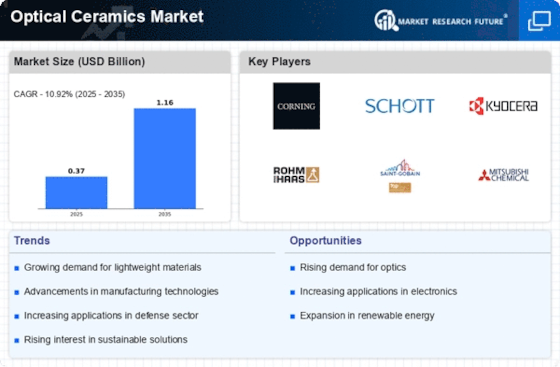
    As per MRFR analysis, the Optical Ceramics Market Size was estimated at 0.37 USD Billion in 2024. The Optical Ceramics industry is projected to grow from 0.4104 in 2025 to 1.157 by 2035, exhibiting a compound annual growth rate (CAGR) of 10.92 during the forecast period 2025 - 2035.

    Key Market Trends & Highlights

    The Optical Ceramics Market is poised for robust growth driven by technological advancements and increasing applications.

    • North America remains the largest market for optical ceramics, driven by high-performance optics demand.
    • Asia-Pacific is emerging as the fastest-growing region, fueled by rapid industrialization and technological innovation.
    • Sapphire dominates the market as the largest segment, while Yttrium Aluminum Garnet (YAG) is recognized as the fastest-growing segment.
    • Key market drivers include rising demand for high-performance optics and a growing focus on energy efficiency.

    Market Size & Forecast

    2024 Market Size 0.37 (USD Billion)
    2035 Market Size 1.157 (USD Billion)
    CAGR (2025 - 2035) 10.92%
    Largest Regional Market Share in 2024 Asia Pacific

    Major Players

    <p>Corning Inc (US), Schott AG (DE), Kyocera Corporation (JP), Rohm and Haas Company (US), Saint-Gobain (FR), Mitsubishi Chemical Corporation (JP), CeramTec GmbH (DE), Nippon Electric Glass Co., Ltd. (JP)</p>

    Market Trends

    The Optical Ceramics Market is currently experiencing a notable transformation, driven by advancements in material science and increasing demand across various sectors. These ceramics, known for their unique optical properties, are finding applications in industries such as telecommunications, defense, and consumer electronics. The growing emphasis on miniaturization and enhanced performance in optical devices is propelling manufacturers to innovate and develop new products that meet stringent specifications. Furthermore, the integration of optical ceramics in emerging technologies, such as augmented reality and smart devices, suggests a promising trajectory for market growth. In addition to technological advancements, sustainability concerns are influencing the Optical Ceramics Market. Manufacturers are increasingly focusing on eco-friendly production processes and materials, which may enhance their competitive edge. The shift towards sustainable practices not only aligns with global environmental goals but also caters to the evolving preferences of consumers who prioritize green products. As the market continues to evolve, it appears that the interplay between innovation and sustainability will shape the future landscape of optical ceramics, potentially leading to new opportunities and challenges for stakeholders in this dynamic field.

    Technological Advancements

    The Optical Ceramics Market is witnessing rapid technological advancements that enhance product performance and functionality. Innovations in material composition and processing techniques are enabling the development of ceramics with superior optical properties, which are essential for high-performance applications. This trend is likely to drive increased investment in research and development, fostering a competitive environment among manufacturers.

    Sustainability Initiatives

    There is a growing emphasis on sustainability within the Optical Ceramics Market, as companies strive to adopt eco-friendly practices. This includes the use of sustainable materials and energy-efficient manufacturing processes. Such initiatives not only address environmental concerns but also resonate with consumers who are increasingly inclined towards environmentally responsible products.

    Diverse Applications

    The range of applications for optical ceramics is expanding, particularly in sectors such as telecommunications, defense, and consumer electronics. This diversification indicates a robust demand for optical ceramics, as industries seek materials that can meet specific performance criteria. The potential for new applications in emerging technologies further underscores the market's growth prospects.

    Optical Ceramics Market Market Drivers

    Expansion of Application Areas

    The expansion of application areas is a critical driver for the Optical Ceramics Market. Optical ceramics are increasingly being utilized in various fields, including telecommunications, automotive, and medical imaging. The versatility of these materials allows for their integration into a wide range of products, from laser systems to optical sensors. As industries continue to explore new uses for optical ceramics, the market is expected to experience significant growth. For instance, the automotive sector's shift towards advanced driver-assistance systems (ADAS) is likely to create new opportunities for optical ceramics, further diversifying the market landscape.

    Increasing Focus on Energy Efficiency

    The Optical Ceramics Market is benefiting from an increasing focus on energy efficiency across various sectors. As industries strive to reduce their carbon footprint, the demand for energy-efficient optical components is on the rise. Optical ceramics, known for their superior thermal stability and low energy consumption, are becoming a preferred choice for applications in lighting, displays, and solar energy systems. This trend is expected to drive the market as manufacturers seek to develop products that align with sustainability goals. The integration of energy-efficient optical ceramics into consumer products is likely to enhance their appeal, thereby fostering market growth.

    Innovations in Manufacturing Techniques

    Innovations in manufacturing techniques are significantly influencing the Optical Ceramics Market. The introduction of advanced fabrication methods, such as additive manufacturing and precision molding, is enhancing the production efficiency and quality of optical ceramics. These innovations allow for the creation of complex geometries and customized solutions that meet specific application requirements. As a result, manufacturers are better equipped to cater to the diverse needs of various sectors, including aerospace and medical devices. The ability to produce high-quality optical ceramics at a lower cost is expected to attract new players into the market, further stimulating growth and competition.

    Rising Demand for High-Performance Optics

    The Optical Ceramics Market is experiencing a notable increase in demand for high-performance optical components. This surge is primarily driven by advancements in sectors such as telecommunications, defense, and consumer electronics. For instance, the need for superior optical materials that can withstand extreme conditions is becoming more pronounced. The market for optical ceramics is projected to grow at a compound annual growth rate of approximately 8% over the next five years, indicating a robust expansion. As industries seek to enhance the performance of optical systems, the demand for durable and efficient optical ceramics is likely to rise, thereby propelling the market forward.

    Growing Investment in Research and Development

    The Optical Ceramics Market is witnessing a surge in investment directed towards research and development activities. This trend is largely fueled by the increasing need for innovative optical materials that can meet the evolving demands of high-tech applications. Companies are allocating substantial resources to explore new compositions and processing techniques that enhance the performance of optical ceramics. For example, investments in nanotechnology and advanced coatings are expected to yield materials with superior optical properties. This focus on R&D is likely to result in the introduction of groundbreaking products, thereby expanding the market and attracting a wider customer base.

    Market Segment Insights

    By Material: Sapphire (Largest) vs. Yttrium Aluminum Garnet [YAG] (Fastest-Growing)

    <p>In the Optical Ceramics Market, the material segment is characterized by distinct categories such as Sapphire, Yttrium Aluminum Garnet (YAG), Aluminum Oxynitride, Spinel, and Others. Among these, Sapphire dominates the market with significant share due to its wide acceptance in high-performance applications, particularly in lasers and wear-resistant optics. YAG, recognized for its favorable optical properties, is rapidly gaining traction, thus marking itself as the fastest-growing component within this sector. Other materials have their niches, yet they currently represent a smaller portion of the overall market.</p>

    <p>Sapphire (Dominant) vs. Aluminum Oxynitride (Emerging)</p>

    <p>Sapphire is regarded as the dominant material in the Optical Ceramics Market, praised for its exceptional hardness, thermal stability, and transparency across a broad spectrum of wavelengths. Its unparalleled strength makes it ideal for applications in laser systems and advanced optics, supporting higher performance requirements. On the other hand, Aluminum Oxynitride, an emerging contender, is recognized for its innovative applications and potential to challenge traditional materials. With excellent optical transmission and resilience, it is increasingly being integrated into military and aerospace technologies. As these industries evolve, the demand for Aluminum Oxynitride is expected to grow, highlighting its promising future in high-tech applications.</p>

    By Application: Optics & Optoelectronics (Largest) vs. Semiconductors (Fastest-Growing)

    <p>In the Optical Ceramics Market, the application segment is predominantly driven by the Optics & Optoelectronics category, which holds the largest share among its counterparts. This segment encompasses various applications, including lenses, lasers, and optical systems, underlining its significance in the market. Conversely, the Semiconductors segment is emerging as a significant player, reflecting rapid growth due to increasing demand for advanced electronic applications that require high-performance optical ceramics, enabling manufacturers to innovate and enhance functionalities in industries such as telecommunications and consumer electronics.</p>

    <p>Optics & Optoelectronics (Dominant) vs. Semiconductors (Emerging)</p>

    <p>The Optics & Optoelectronics segment remains a cornerstone within the Optical Ceramics Market, characterized by its extensive use in high-precision applications, such as telecommunications, defense, and consumer electronics. Companies in this segment benefit from established technologies and ongoing innovations, allowing them to maintain a competitive edge. On the other hand, the Semiconductors segment is rapidly emerging as a critical area of growth, driven by the increasing adoption of optical components in semiconductor manufacturing processes. This shift reflects a growing trend towards miniaturization and enhanced performance capabilities of electronic devices, fostering opportunities for companies specializing in optical ceramics tailored for electronics applications.</p>

    By End-Use Industry: Aerospace & Defense (Largest) vs. Energy (Fastest-Growing)

    <p>In the Optical Ceramics Market, Aerospace & Defense holds the largest share among the end-use industries, reflecting its critical applications in high-performance optics and advanced technologies essential for military and aerospace operations. On the other hand, the Energy sector is witnessing rapid growth, driven by the increasing demand for optical materials that enhance the efficiency of renewable energy systems like solar panels and wind turbines. The growth trends within the Optical Ceramics Market are significantly influenced by technological advancements and the expanding use of optical ceramics in various applications. The Aerospace & Defense sector is consistently evolving with new materials and designs, while the Energy segment experiences a surge in R&D related to optical ceramics, especially in improving energy conversion processes. As sustainability becomes a key focus, innovations in energy-efficient optical ceramics will likely propel this sector's growth further.</p>

    <p>Aerospace & Defense: Dominant vs. Energy: Emerging</p>

    <p>The Aerospace & Defense sector remains dominant in the Optical Ceramics Market, benefiting from stringent quality standards and a need for high durability in harsh environments. Optical ceramics in this industry are utilized for applications such as night vision systems, high-resolution imaging, and laser systems, ensuring superior performance and reliability. On the other hand, the Energy sector is labeled as emerging due to its rapid adoption of optical ceramics for use in solar and wind energy technologies. This industry seeks to leverage the superior light transmission and thermal stability of optical ceramics to enhance the efficiency of energy generation. The cross-over potential between these sectors underscores the versatility and increasing importance of optical ceramics across various applications.</p>

    Get more detailed insights about Optical Ceramics Market Research Report - Global Forecast till 2035

    Regional Insights

    North America : Innovation and Demand Surge

    North America is the largest market for optical ceramics, holding approximately 40% of the global share. The region's growth is driven by advancements in technology, particularly in telecommunications and consumer electronics. Regulatory support for innovation and sustainability initiatives further catalyzes demand, with significant investments in R&D from key players. The U.S. leads the market, followed by Canada, which is also witnessing a rise in demand for high-performance optical materials. The competitive landscape in North America is robust, featuring major players like Corning Inc and Rohm and Haas Company. These companies are at the forefront of developing innovative optical ceramics that meet the evolving needs of industries such as aerospace, automotive, and healthcare. The presence of established manufacturing facilities and a skilled workforce enhances the region's capability to produce high-quality optical ceramics, ensuring its leadership in the global market.

    Europe : Strong Manufacturing Base

    Europe is the second-largest market for optical ceramics, accounting for approximately 30% of the global market share. The region benefits from a strong manufacturing base and a focus on high-quality production standards. Countries like Germany and France are leading the charge, driven by increasing demand in sectors such as automotive and renewable energy. Regulatory frameworks promoting energy efficiency and sustainability are also key growth drivers, encouraging innovation in optical materials. Germany stands out as a leader in optical ceramics production, with companies like Schott AG and CeramTec GmbH playing pivotal roles. The competitive landscape is characterized by a mix of established firms and innovative startups, fostering a dynamic environment for technological advancements. The presence of research institutions further supports the development of cutting-edge optical ceramics, positioning Europe as a significant player in the global market.

    Asia-Pacific : Rapid Growth and Adoption

    Asia-Pacific is witnessing rapid growth in the optical ceramics market, driven by increasing demand from electronics and telecommunications sectors. The region holds approximately 25% of the global market share, with countries like Japan and China leading the way. The rise of smart technologies and the expansion of 5G networks are significant catalysts for market growth. Additionally, supportive government policies aimed at boosting manufacturing capabilities are enhancing the region's market potential. Japan is home to key players such as Kyocera Corporation and Nippon Electric Glass Co., Ltd., which are instrumental in advancing optical ceramics technology. The competitive landscape is marked by a blend of established companies and emerging firms, all vying for market share. The region's focus on innovation and quality positions it as a formidable competitor in The Optical Ceramics, with ongoing investments in R&D to meet future demands.

    Middle East and Africa : Emerging Market Potential

    The Middle East and Africa region is gradually emerging in the optical ceramics market, currently holding about 5% of the global share. The growth is primarily driven by increasing investments in infrastructure and technology, particularly in the telecommunications sector. Countries like South Africa and the UAE are beginning to adopt advanced optical materials, supported by government initiatives aimed at enhancing technological capabilities and attracting foreign investment. The competitive landscape is still developing, with a few local players and international companies exploring opportunities in the region. The presence of key players is limited, but there is a growing interest in establishing manufacturing facilities to cater to the rising demand. As the region continues to invest in technology and infrastructure, the optical ceramics market is expected to expand, presenting new opportunities for growth and collaboration.

    Key Players and Competitive Insights

    The Optical Ceramics Market is currently characterized by a dynamic competitive landscape, driven by technological advancements and increasing demand across various applications, including telecommunications, defense, and consumer electronics. Key players such as Corning Inc (US), Schott AG (DE), and Kyocera Corporation (JP) are strategically positioned to leverage their innovative capabilities and extensive product portfolios. Corning Inc (US) focuses on enhancing its optical glass offerings, while Schott AG (DE) emphasizes its expertise in specialty glass and ceramics, particularly for high-performance applications. Kyocera Corporation (JP) is investing in advanced manufacturing techniques to improve product quality and reduce costs, collectively shaping a competitive environment that prioritizes innovation and operational efficiency.

    The business tactics employed by these companies reflect a concerted effort to optimize supply chains and localize manufacturing. The Optical Ceramics Market appears moderately fragmented, with several players vying for market share. However, the influence of major companies is substantial, as they set industry standards and drive technological advancements. This competitive structure encourages smaller firms to innovate and differentiate their offerings, fostering a vibrant ecosystem.

    In August 2025, Corning Inc (US) announced a significant investment in a new manufacturing facility aimed at increasing production capacity for its optical ceramics. This strategic move is likely to enhance Corning's ability to meet the growing demand for high-performance optical components, particularly in the telecommunications sector, where the need for advanced materials is escalating. The establishment of this facility not only signifies Corning's commitment to innovation but also positions the company to capitalize on emerging market opportunities.

    In September 2025, Schott AG (DE) unveiled a new line of optical ceramics designed for use in augmented reality applications. This launch underscores Schott's focus on expanding its product offerings to cater to the evolving needs of the tech industry. By entering the augmented reality space, Schott is likely to strengthen its market position and attract new customers, thereby enhancing its competitive edge in a rapidly growing segment.

    In July 2025, Kyocera Corporation (JP) entered into a strategic partnership with a leading telecommunications provider to develop next-generation optical components. This collaboration is expected to accelerate the development of innovative solutions that meet the demands of 5G networks. By aligning with a key player in the telecommunications sector, Kyocera is poised to enhance its technological capabilities and expand its market reach, reflecting a broader trend of strategic alliances in the industry.

    As of October 2025, the Optical Ceramics Market is witnessing trends such as digitalization, sustainability, and the integration of artificial intelligence in manufacturing processes. These trends are reshaping competitive dynamics, as companies increasingly prioritize sustainable practices and technological advancements. Strategic alliances are becoming more prevalent, enabling firms to pool resources and expertise to drive innovation. Looking ahead, competitive differentiation is likely to evolve from traditional price-based competition to a focus on innovation, technology, and supply chain reliability, as companies strive to meet the demands of a rapidly changing market.

    Key Companies in the Optical Ceramics Market market include

    Industry Developments

    • Q2 2024: Coherent Corp. Announces Launch of Next-Generation Transparent Ceramic for Defense Applications Coherent Corp. unveiled a new transparent ceramic product designed for advanced defense and aerospace applications, expanding its portfolio in the optical ceramics sector with enhanced ballistic and optical performance.
    • Q1 2024: Surmet Corporation Secures Major Contract for ALON Optical Ceramics with U.S. Department of Defense Surmet Corporation announced it has been awarded a multi-year contract to supply ALON optical ceramics for use in military vehicle transparent armor, marking a significant win in the defense sector.
    • Q2 2024: Kyocera Opens New Optical Ceramics Manufacturing Facility in Japan Kyocera inaugurated a state-of-the-art manufacturing plant dedicated to optical ceramics in Kagoshima, Japan, aiming to meet rising demand from electronics and photonics industries.
    • Q3 2024: Saint-Gobain Acquires Minority Stake in Spinel Optics Startup Saint-Gobain announced the acquisition of a minority stake in a U.S.-based startup specializing in spinel optical ceramics, strengthening its position in advanced materials for defense and medical imaging.
    • Q2 2024: CeramTec AG Appoints New CEO to Drive Optical Ceramics Expansion CeramTec AG named Dr. Anna Müller as CEO, tasking her with accelerating the company's growth in the optical ceramics market, particularly in laser and medical device applications.
    • Q1 2025: Coherent Corp. Partners with European Defense Consortium for Advanced Ceramic Domes Coherent Corp. entered a strategic partnership with a European defense consortium to develop and supply advanced ceramic domes for next-generation missile systems.
    • Q2 2025: Surmet Corporation Expands Production Capacity for Transparent Armor Ceramics Surmet Corporation announced the expansion of its Massachusetts facility to increase production of transparent armor ceramics, responding to growing global defense demand.
    • Q3 2024: Murata Manufacturing Launches New Optical Ceramic Substrates for High-Speed Data Transmission Murata Manufacturing introduced a new line of optical ceramic substrates designed for high-speed data transmission in next-generation communication networks.
    • Q4 2024: SCHOTT AG Wins Contract to Supply Optical Ceramics for European Space Agency Mission SCHOTT AG secured a contract to provide specialized optical ceramics for use in sensor windows and viewports on a forthcoming European Space Agency satellite mission.
    • Q1 2025: Saint-Gobain Launches New Spinel-Based Optical Ceramics for Medical Imaging Saint-Gobain announced the commercial launch of a new spinel-based optical ceramic product line targeting advanced medical imaging equipment manufacturers.
    • Q2 2025: CeramTec AG Signs Supply Agreement with Leading Laser Equipment Manufacturer CeramTec AG entered into a multi-year supply agreement to provide optical ceramics for high-power laser systems to a major European equipment manufacturer.
    • Q1 2024: Kyocera Invests in R&D for Next-Generation Optical Ceramics for Quantum Computing Kyocera announced a significant investment in research and development focused on creating advanced optical ceramics tailored for quantum computing applications.

    Future Outlook

    Optical Ceramics Market Future Outlook

    <p>The Optical Ceramics Market is projected to grow at a 10.92% CAGR from 2024 to 2035, driven by advancements in technology, increasing demand in optics, and expanding applications in various industries.</p>

    New opportunities lie in:

    • <p>Development of high-performance optical coatings for enhanced durability</p>
    • <p>Expansion into emerging markets with tailored product offerings</p>
    • <p>Investment in R&D for innovative optical ceramic materials and applications</p>

    <p>By 2035, the Optical Ceramics Market is expected to achieve substantial growth and diversification.</p>

    Market Segmentation

    Optical Ceramics Market Material Outlook

    • Sapphire
    • Yttrium Aluminum Garnet [YAG]
    • Aluminum Oxynitride
    • Spinel
    • Others

    Optical Ceramics Market Application Outlook

    • Optics & Optoelectronics
    • Semiconductors
    • Others

    Optical Ceramics Market End-Use Industry Outlook

    • Aerospace & Defense
    • Energy
    • Electrical & Electronics
    • Others

    Report Scope

    MARKET SIZE 20240.37(USD Billion)
    MARKET SIZE 20250.4104(USD Billion)
    MARKET SIZE 20351.157(USD Billion)
    COMPOUND ANNUAL GROWTH RATE (CAGR)10.92% (2024 - 2035)
    REPORT COVERAGERevenue Forecast, Competitive Landscape, Growth Factors, and Trends
    BASE YEAR2024
    Market Forecast Period2025 - 2035
    Historical Data2019 - 2024
    Market Forecast UnitsUSD Billion
    Key Companies ProfiledMarket analysis in progress
    Segments CoveredMarket segmentation analysis in progress
    Key Market OpportunitiesAdvancements in laser technologies drive demand for high-performance materials in the Optical Ceramics Market.
    Key Market DynamicsRising demand for advanced optical applications drives innovation and competition in the optical ceramics market.
    Countries CoveredNorth America, Europe, APAC, South America, MEA

    FAQs

    How much is the Optical Ceramics market?

    Optical Ceramics Market was valued at USD 0.37 Billion in 2024

    What is the growth rate of the Optical Ceramics market?

    Optical Ceramics Market is projected to register a CAGR of 10.92% from 2025-2035

    Which region held the largest market share in the Optical Ceramics market?

    Asia Pacific had the largest share of the Optical Ceramicsmarket

    Who are the key players in the Optical Ceramics market?

    The key players in the Optical Ceramics market are Surmet Corporation (US), CoorsTek Inc. (US), Konoshima Chemicals Co. Ltd (Japan), Saint-Gobain (France), CeramTec (Germany), Murata Manufacturing Co. Ltd (Japan), CeraNova (US), Schott AG (Germany), Shanghai SICCAS (China), Kyocera Corporation (Japan), II-VI Optical Systems Inc. (US), Brightcrystals Technology Inc. (China), CILAS ArianeGroup (France), General Electric (US) and Koninklijke Philips N.V. (Netherlands).

    Which material led the Optical Ceramics market?

    The Sapphire category dominated the Optical Ceramics market in 2024.

    Which application had the largest market share in the Optical Ceramics market?

    Optics &amp; Optoelectronics had the largest share of the Optical Ceramicsmarket.

    1. SECTION I: EXECUTIVE SUMMARY AND KEY HIGHLIGHTS
      1. | 1.1 EXECUTIVE SUMMARY
      2. | | 1.1.1 Market Overview
      3. | | 1.1.2 Key Findings
      4. | | 1.1.3 Market Segmentation
      5. | | 1.1.4 Competitive Landscape
      6. | | 1.1.5 Challenges and Opportunities
      7. | | 1.1.6 Future Outlook
    2. SECTION II: SCOPING, METHODOLOGY AND MARKET STRUCTURE
      1. | 2.1 MARKET INTRODUCTION
      2. | | 2.1.1 Definition
      3. | | 2.1.2 Scope of the study
      4. | | | 2.1.2.1 Research Objective
      5. | | | 2.1.2.2 Assumption
      6. | | | 2.1.2.3 Limitations
      7. | 2.2 RESEARCH METHODOLOGY
      8. | | 2.2.1 Overview
      9. | | 2.2.2 Data Mining
      10. | | 2.2.3 Secondary Research
      11. | | 2.2.4 Primary Research
      12. | | | 2.2.4.1 Primary Interviews and Information Gathering Process
      13. | | | 2.2.4.2 Breakdown of Primary Respondents
      14. | | 2.2.5 Forecasting Model
      15. | | 2.2.6 Market Size Estimation
      16. | | | 2.2.6.1 Bottom-Up Approach
      17. | | | 2.2.6.2 Top-Down Approach
      18. | | 2.2.7 Data Triangulation
      19. | | 2.2.8 Validation
    3. SECTION III: QUALITATIVE ANALYSIS
      1. | 3.1 MARKET DYNAMICS
      2. | | 3.1.1 Overview
      3. | | 3.1.2 Drivers
      4. | | 3.1.3 Restraints
      5. | | 3.1.4 Opportunities
      6. | 3.2 MARKET FACTOR ANALYSIS
      7. | | 3.2.1 Value chain Analysis
      8. | | 3.2.2 Porter's Five Forces Analysis
      9. | | | 3.2.2.1 Bargaining Power of Suppliers
      10. | | | 3.2.2.2 Bargaining Power of Buyers
      11. | | | 3.2.2.3 Threat of New Entrants
      12. | | | 3.2.2.4 Threat of Substitutes
      13. | | | 3.2.2.5 Intensity of Rivalry
      14. | | 3.2.3 COVID-19 Impact Analysis
      15. | | | 3.2.3.1 Market Impact Analysis
      16. | | | 3.2.3.2 Regional Impact
      17. | | | 3.2.3.3 Opportunity and Threat Analysis
    4. SECTION IV: QUANTITATIVE ANALYSIS
      1. | 4.1 Chemicals and Materials, BY Material (USD Billion)
      2. | | 4.1.1 Sapphire
      3. | | 4.1.2 Yttrium Aluminum Garnet [YAG]
      4. | | 4.1.3 Aluminum Oxynitride
      5. | | 4.1.4 Spinel
      6. | | 4.1.5 Others
      7. | 4.2 Chemicals and Materials, BY Application (USD Billion)
      8. | | 4.2.1 Optics & Optoelectronics
      9. | | 4.2.2 Semiconductors
      10. | | 4.2.3 Others
      11. | 4.3 Chemicals and Materials, BY End-Use Industry (USD Billion)
      12. | | 4.3.1 Aerospace & Defense
      13. | | 4.3.2 Energy
      14. | | 4.3.3 Electrical & Electronics
      15. | | 4.3.4 Others
      16. | 4.4 Chemicals and Materials, BY Region (USD Billion)
      17. | | 4.4.1 North America
      18. | | | 4.4.1.1 US
      19. | | | 4.4.1.2 Canada
      20. | | 4.4.2 Europe
      21. | | | 4.4.2.1 Germany
      22. | | | 4.4.2.2 UK
      23. | | | 4.4.2.3 France
      24. | | | 4.4.2.4 Russia
      25. | | | 4.4.2.5 Italy
      26. | | | 4.4.2.6 Spain
      27. | | | 4.4.2.7 Rest of Europe
      28. | | 4.4.3 APAC
      29. | | | 4.4.3.1 China
      30. | | | 4.4.3.2 India
      31. | | | 4.4.3.3 Japan
      32. | | | 4.4.3.4 South Korea
      33. | | | 4.4.3.5 Malaysia
      34. | | | 4.4.3.6 Thailand
      35. | | | 4.4.3.7 Indonesia
      36. | | | 4.4.3.8 Rest of APAC
      37. | | 4.4.4 South America
      38. | | | 4.4.4.1 Brazil
      39. | | | 4.4.4.2 Mexico
      40. | | | 4.4.4.3 Argentina
      41. | | | 4.4.4.4 Rest of South America
      42. | | 4.4.5 MEA
      43. | | | 4.4.5.1 GCC Countries
      44. | | | 4.4.5.2 South Africa
      45. | | | 4.4.5.3 Rest of MEA
    5. SECTION V: COMPETITIVE ANALYSIS
      1. | 5.1 Competitive Landscape
      2. | | 5.1.1 Overview
      3. | | 5.1.2 Competitive Analysis
      4. | | 5.1.3 Market share Analysis
      5. | | 5.1.4 Major Growth Strategy in the Chemicals and Materials
      6. | | 5.1.5 Competitive Benchmarking
      7. | | 5.1.6 Leading Players in Terms of Number of Developments in the Chemicals and Materials
      8. | | 5.1.7 Key developments and growth strategies
      9. | | | 5.1.7.1 New Product Launch/Service Deployment
      10. | | | 5.1.7.2 Merger & Acquisitions
      11. | | | 5.1.7.3 Joint Ventures
      12. | | 5.1.8 Major Players Financial Matrix
      13. | | | 5.1.8.1 Sales and Operating Income
      14. | | | 5.1.8.2 Major Players R&D Expenditure. 2023
      15. | 5.2 Company Profiles
      16. | | 5.2.1 Corning Inc (US)
      17. | | | 5.2.1.1 Financial Overview
      18. | | | 5.2.1.2 Products Offered
      19. | | | 5.2.1.3 Key Developments
      20. | | | 5.2.1.4 SWOT Analysis
      21. | | | 5.2.1.5 Key Strategies
      22. | | 5.2.2 Schott AG (DE)
      23. | | | 5.2.2.1 Financial Overview
      24. | | | 5.2.2.2 Products Offered
      25. | | | 5.2.2.3 Key Developments
      26. | | | 5.2.2.4 SWOT Analysis
      27. | | | 5.2.2.5 Key Strategies
      28. | | 5.2.3 Kyocera Corporation (JP)
      29. | | | 5.2.3.1 Financial Overview
      30. | | | 5.2.3.2 Products Offered
      31. | | | 5.2.3.3 Key Developments
      32. | | | 5.2.3.4 SWOT Analysis
      33. | | | 5.2.3.5 Key Strategies
      34. | | 5.2.4 Rohm and Haas Company (US)
      35. | | | 5.2.4.1 Financial Overview
      36. | | | 5.2.4.2 Products Offered
      37. | | | 5.2.4.3 Key Developments
      38. | | | 5.2.4.4 SWOT Analysis
      39. | | | 5.2.4.5 Key Strategies
      40. | | 5.2.5 Saint-Gobain (FR)
      41. | | | 5.2.5.1 Financial Overview
      42. | | | 5.2.5.2 Products Offered
      43. | | | 5.2.5.3 Key Developments
      44. | | | 5.2.5.4 SWOT Analysis
      45. | | | 5.2.5.5 Key Strategies
      46. | | 5.2.6 Mitsubishi Chemical Corporation (JP)
      47. | | | 5.2.6.1 Financial Overview
      48. | | | 5.2.6.2 Products Offered
      49. | | | 5.2.6.3 Key Developments
      50. | | | 5.2.6.4 SWOT Analysis
      51. | | | 5.2.6.5 Key Strategies
      52. | | 5.2.7 CeramTec GmbH (DE)
      53. | | | 5.2.7.1 Financial Overview
      54. | | | 5.2.7.2 Products Offered
      55. | | | 5.2.7.3 Key Developments
      56. | | | 5.2.7.4 SWOT Analysis
      57. | | | 5.2.7.5 Key Strategies
      58. | | 5.2.8 Nippon Electric Glass Co., Ltd. (JP)
      59. | | | 5.2.8.1 Financial Overview
      60. | | | 5.2.8.2 Products Offered
      61. | | | 5.2.8.3 Key Developments
      62. | | | 5.2.8.4 SWOT Analysis
      63. | | | 5.2.8.5 Key Strategies
      64. | 5.3 Appendix
      65. | | 5.3.1 References
      66. | | 5.3.2 Related Reports
    6. LIST OF FIGURES
      1. | 6.1 MARKET SYNOPSIS
      2. | 6.2 NORTH AMERICA MARKET ANALYSIS
      3. | 6.3 US MARKET ANALYSIS BY MATERIAL
      4. | 6.4 US MARKET ANALYSIS BY APPLICATION
      5. | 6.5 US MARKET ANALYSIS BY END-USE INDUSTRY
      6. | 6.6 CANADA MARKET ANALYSIS BY MATERIAL
      7. | 6.7 CANADA MARKET ANALYSIS BY APPLICATION
      8. | 6.8 CANADA MARKET ANALYSIS BY END-USE INDUSTRY
      9. | 6.9 EUROPE MARKET ANALYSIS
      10. | 6.10 GERMANY MARKET ANALYSIS BY MATERIAL
      11. | 6.11 GERMANY MARKET ANALYSIS BY APPLICATION
      12. | 6.12 GERMANY MARKET ANALYSIS BY END-USE INDUSTRY
      13. | 6.13 UK MARKET ANALYSIS BY MATERIAL
      14. | 6.14 UK MARKET ANALYSIS BY APPLICATION
      15. | 6.15 UK MARKET ANALYSIS BY END-USE INDUSTRY
      16. | 6.16 FRANCE MARKET ANALYSIS BY MATERIAL
      17. | 6.17 FRANCE MARKET ANALYSIS BY APPLICATION
      18. | 6.18 FRANCE MARKET ANALYSIS BY END-USE INDUSTRY
      19. | 6.19 RUSSIA MARKET ANALYSIS BY MATERIAL
      20. | 6.20 RUSSIA MARKET ANALYSIS BY APPLICATION
      21. | 6.21 RUSSIA MARKET ANALYSIS BY END-USE INDUSTRY
      22. | 6.22 ITALY MARKET ANALYSIS BY MATERIAL
      23. | 6.23 ITALY MARKET ANALYSIS BY APPLICATION
      24. | 6.24 ITALY MARKET ANALYSIS BY END-USE INDUSTRY
      25. | 6.25 SPAIN MARKET ANALYSIS BY MATERIAL
      26. | 6.26 SPAIN MARKET ANALYSIS BY APPLICATION
      27. | 6.27 SPAIN MARKET ANALYSIS BY END-USE INDUSTRY
      28. | 6.28 REST OF EUROPE MARKET ANALYSIS BY MATERIAL
      29. | 6.29 REST OF EUROPE MARKET ANALYSIS BY APPLICATION
      30. | 6.30 REST OF EUROPE MARKET ANALYSIS BY END-USE INDUSTRY
      31. | 6.31 APAC MARKET ANALYSIS
      32. | 6.32 CHINA MARKET ANALYSIS BY MATERIAL
      33. | 6.33 CHINA MARKET ANALYSIS BY APPLICATION
      34. | 6.34 CHINA MARKET ANALYSIS BY END-USE INDUSTRY
      35. | 6.35 INDIA MARKET ANALYSIS BY MATERIAL
      36. | 6.36 INDIA MARKET ANALYSIS BY APPLICATION
      37. | 6.37 INDIA MARKET ANALYSIS BY END-USE INDUSTRY
      38. | 6.38 JAPAN MARKET ANALYSIS BY MATERIAL
      39. | 6.39 JAPAN MARKET ANALYSIS BY APPLICATION
      40. | 6.40 JAPAN MARKET ANALYSIS BY END-USE INDUSTRY
      41. | 6.41 SOUTH KOREA MARKET ANALYSIS BY MATERIAL
      42. | 6.42 SOUTH KOREA MARKET ANALYSIS BY APPLICATION
      43. | 6.43 SOUTH KOREA MARKET ANALYSIS BY END-USE INDUSTRY
      44. | 6.44 MALAYSIA MARKET ANALYSIS BY MATERIAL
      45. | 6.45 MALAYSIA MARKET ANALYSIS BY APPLICATION
      46. | 6.46 MALAYSIA MARKET ANALYSIS BY END-USE INDUSTRY
      47. | 6.47 THAILAND MARKET ANALYSIS BY MATERIAL
      48. | 6.48 THAILAND MARKET ANALYSIS BY APPLICATION
      49. | 6.49 THAILAND MARKET ANALYSIS BY END-USE INDUSTRY
      50. | 6.50 INDONESIA MARKET ANALYSIS BY MATERIAL
      51. | 6.51 INDONESIA MARKET ANALYSIS BY APPLICATION
      52. | 6.52 INDONESIA MARKET ANALYSIS BY END-USE INDUSTRY
      53. | 6.53 REST OF APAC MARKET ANALYSIS BY MATERIAL
      54. | 6.54 REST OF APAC MARKET ANALYSIS BY APPLICATION
      55. | 6.55 REST OF APAC MARKET ANALYSIS BY END-USE INDUSTRY
      56. | 6.56 SOUTH AMERICA MARKET ANALYSIS
      57. | 6.57 BRAZIL MARKET ANALYSIS BY MATERIAL
      58. | 6.58 BRAZIL MARKET ANALYSIS BY APPLICATION
      59. | 6.59 BRAZIL MARKET ANALYSIS BY END-USE INDUSTRY
      60. | 6.60 MEXICO MARKET ANALYSIS BY MATERIAL
      61. | 6.61 MEXICO MARKET ANALYSIS BY APPLICATION
      62. | 6.62 MEXICO MARKET ANALYSIS BY END-USE INDUSTRY
      63. | 6.63 ARGENTINA MARKET ANALYSIS BY MATERIAL
      64. | 6.64 ARGENTINA MARKET ANALYSIS BY APPLICATION
      65. | 6.65 ARGENTINA MARKET ANALYSIS BY END-USE INDUSTRY
      66. | 6.66 REST OF SOUTH AMERICA MARKET ANALYSIS BY MATERIAL
      67. | 6.67 REST OF SOUTH AMERICA MARKET ANALYSIS BY APPLICATION
      68. | 6.68 REST OF SOUTH AMERICA MARKET ANALYSIS BY END-USE INDUSTRY
      69. | 6.69 MEA MARKET ANALYSIS
      70. | 6.70 GCC COUNTRIES MARKET ANALYSIS BY MATERIAL
      71. | 6.71 GCC COUNTRIES MARKET ANALYSIS BY APPLICATION
      72. | 6.72 GCC COUNTRIES MARKET ANALYSIS BY END-USE INDUSTRY
      73. | 6.73 SOUTH AFRICA MARKET ANALYSIS BY MATERIAL
      74. | 6.74 SOUTH AFRICA MARKET ANALYSIS BY APPLICATION
      75. | 6.75 SOUTH AFRICA MARKET ANALYSIS BY END-USE INDUSTRY
      76. | 6.76 REST OF MEA MARKET ANALYSIS BY MATERIAL
      77. | 6.77 REST OF MEA MARKET ANALYSIS BY APPLICATION
      78. | 6.78 REST OF MEA MARKET ANALYSIS BY END-USE INDUSTRY
      79. | 6.79 KEY BUYING CRITERIA OF CHEMICALS AND MATERIALS
      80. | 6.80 RESEARCH PROCESS OF MRFR
      81. | 6.81 DRO ANALYSIS OF CHEMICALS AND MATERIALS
      82. | 6.82 DRIVERS IMPACT ANALYSIS: CHEMICALS AND MATERIALS
      83. | 6.83 RESTRAINTS IMPACT ANALYSIS: CHEMICALS AND MATERIALS
      84. | 6.84 SUPPLY / VALUE CHAIN: CHEMICALS AND MATERIALS
      85. | 6.85 CHEMICALS AND MATERIALS, BY MATERIAL, 2024 (% SHARE)
      86. | 6.86 CHEMICALS AND MATERIALS, BY MATERIAL, 2024 TO 2035 (USD Billion)
      87. | 6.87 CHEMICALS AND MATERIALS, BY APPLICATION, 2024 (% SHARE)
      88. | 6.88 CHEMICALS AND MATERIALS, BY APPLICATION, 2024 TO 2035 (USD Billion)
      89. | 6.89 CHEMICALS AND MATERIALS, BY END-USE INDUSTRY, 2024 (% SHARE)
      90. | 6.90 CHEMICALS AND MATERIALS, BY END-USE INDUSTRY, 2024 TO 2035 (USD Billion)
      91. | 6.91 BENCHMARKING OF MAJOR COMPETITORS
    7. LIST OF TABLES
      1. | 7.1 LIST OF ASSUMPTIONS
      2. | | 7.1.1
      3. | 7.2 North America MARKET SIZE ESTIMATES; FORECAST
      4. | | 7.2.1 BY MATERIAL, 2025-2035 (USD Billion)
      5. | | 7.2.2 BY APPLICATION, 2025-2035 (USD Billion)
      6. | | 7.2.3 BY END-USE INDUSTRY, 2025-2035 (USD Billion)
      7. | 7.3 US MARKET SIZE ESTIMATES; FORECAST
      8. | | 7.3.1 BY MATERIAL, 2025-2035 (USD Billion)
      9. | | 7.3.2 BY APPLICATION, 2025-2035 (USD Billion)
      10. | | 7.3.3 BY END-USE INDUSTRY, 2025-2035 (USD Billion)
      11. | 7.4 Canada MARKET SIZE ESTIMATES; FORECAST
      12. | | 7.4.1 BY MATERIAL, 2025-2035 (USD Billion)
      13. | | 7.4.2 BY APPLICATION, 2025-2035 (USD Billion)
      14. | | 7.4.3 BY END-USE INDUSTRY, 2025-2035 (USD Billion)
      15. | 7.5 Europe MARKET SIZE ESTIMATES; FORECAST
      16. | | 7.5.1 BY MATERIAL, 2025-2035 (USD Billion)
      17. | | 7.5.2 BY APPLICATION, 2025-2035 (USD Billion)
      18. | | 7.5.3 BY END-USE INDUSTRY, 2025-2035 (USD Billion)
      19. | 7.6 Germany MARKET SIZE ESTIMATES; FORECAST
      20. | | 7.6.1 BY MATERIAL, 2025-2035 (USD Billion)
      21. | | 7.6.2 BY APPLICATION, 2025-2035 (USD Billion)
      22. | | 7.6.3 BY END-USE INDUSTRY, 2025-2035 (USD Billion)
      23. | 7.7 UK MARKET SIZE ESTIMATES; FORECAST
      24. | | 7.7.1 BY MATERIAL, 2025-2035 (USD Billion)
      25. | | 7.7.2 BY APPLICATION, 2025-2035 (USD Billion)
      26. | | 7.7.3 BY END-USE INDUSTRY, 2025-2035 (USD Billion)
      27. | 7.8 France MARKET SIZE ESTIMATES; FORECAST
      28. | | 7.8.1 BY MATERIAL, 2025-2035 (USD Billion)
      29. | | 7.8.2 BY APPLICATION, 2025-2035 (USD Billion)
      30. | | 7.8.3 BY END-USE INDUSTRY, 2025-2035 (USD Billion)
      31. | 7.9 Russia MARKET SIZE ESTIMATES; FORECAST
      32. | | 7.9.1 BY MATERIAL, 2025-2035 (USD Billion)
      33. | | 7.9.2 BY APPLICATION, 2025-2035 (USD Billion)
      34. | | 7.9.3 BY END-USE INDUSTRY, 2025-2035 (USD Billion)
      35. | 7.10 Italy MARKET SIZE ESTIMATES; FORECAST
      36. | | 7.10.1 BY MATERIAL, 2025-2035 (USD Billion)
      37. | | 7.10.2 BY APPLICATION, 2025-2035 (USD Billion)
      38. | | 7.10.3 BY END-USE INDUSTRY, 2025-2035 (USD Billion)
      39. | 7.11 Spain MARKET SIZE ESTIMATES; FORECAST
      40. | | 7.11.1 BY MATERIAL, 2025-2035 (USD Billion)
      41. | | 7.11.2 BY APPLICATION, 2025-2035 (USD Billion)
      42. | | 7.11.3 BY END-USE INDUSTRY, 2025-2035 (USD Billion)
      43. | 7.12 Rest of Europe MARKET SIZE ESTIMATES; FORECAST
      44. | | 7.12.1 BY MATERIAL, 2025-2035 (USD Billion)
      45. | | 7.12.2 BY APPLICATION, 2025-2035 (USD Billion)
      46. | | 7.12.3 BY END-USE INDUSTRY, 2025-2035 (USD Billion)
      47. | 7.13 APAC MARKET SIZE ESTIMATES; FORECAST
      48. | | 7.13.1 BY MATERIAL, 2025-2035 (USD Billion)
      49. | | 7.13.2 BY APPLICATION, 2025-2035 (USD Billion)
      50. | | 7.13.3 BY END-USE INDUSTRY, 2025-2035 (USD Billion)
      51. | 7.14 China MARKET SIZE ESTIMATES; FORECAST
      52. | | 7.14.1 BY MATERIAL, 2025-2035 (USD Billion)
      53. | | 7.14.2 BY APPLICATION, 2025-2035 (USD Billion)
      54. | | 7.14.3 BY END-USE INDUSTRY, 2025-2035 (USD Billion)
      55. | 7.15 India MARKET SIZE ESTIMATES; FORECAST
      56. | | 7.15.1 BY MATERIAL, 2025-2035 (USD Billion)
      57. | | 7.15.2 BY APPLICATION, 2025-2035 (USD Billion)
      58. | | 7.15.3 BY END-USE INDUSTRY, 2025-2035 (USD Billion)
      59. | 7.16 Japan MARKET SIZE ESTIMATES; FORECAST
      60. | | 7.16.1 BY MATERIAL, 2025-2035 (USD Billion)
      61. | | 7.16.2 BY APPLICATION, 2025-2035 (USD Billion)
      62. | | 7.16.3 BY END-USE INDUSTRY, 2025-2035 (USD Billion)
      63. | 7.17 South Korea MARKET SIZE ESTIMATES; FORECAST
      64. | | 7.17.1 BY MATERIAL, 2025-2035 (USD Billion)
      65. | | 7.17.2 BY APPLICATION, 2025-2035 (USD Billion)
      66. | | 7.17.3 BY END-USE INDUSTRY, 2025-2035 (USD Billion)
      67. | 7.18 Malaysia MARKET SIZE ESTIMATES; FORECAST
      68. | | 7.18.1 BY MATERIAL, 2025-2035 (USD Billion)
      69. | | 7.18.2 BY APPLICATION, 2025-2035 (USD Billion)
      70. | | 7.18.3 BY END-USE INDUSTRY, 2025-2035 (USD Billion)
      71. | 7.19 Thailand MARKET SIZE ESTIMATES; FORECAST
      72. | | 7.19.1 BY MATERIAL, 2025-2035 (USD Billion)
      73. | | 7.19.2 BY APPLICATION, 2025-2035 (USD Billion)
      74. | | 7.19.3 BY END-USE INDUSTRY, 2025-2035 (USD Billion)
      75. | 7.20 Indonesia MARKET SIZE ESTIMATES; FORECAST
      76. | | 7.20.1 BY MATERIAL, 2025-2035 (USD Billion)
      77. | | 7.20.2 BY APPLICATION, 2025-2035 (USD Billion)
      78. | | 7.20.3 BY END-USE INDUSTRY, 2025-2035 (USD Billion)
      79. | 7.21 Rest of APAC MARKET SIZE ESTIMATES; FORECAST
      80. | | 7.21.1 BY MATERIAL, 2025-2035 (USD Billion)
      81. | | 7.21.2 BY APPLICATION, 2025-2035 (USD Billion)
      82. | | 7.21.3 BY END-USE INDUSTRY, 2025-2035 (USD Billion)
      83. | 7.22 South America MARKET SIZE ESTIMATES; FORECAST
      84. | | 7.22.1 BY MATERIAL, 2025-2035 (USD Billion)
      85. | | 7.22.2 BY APPLICATION, 2025-2035 (USD Billion)
      86. | | 7.22.3 BY END-USE INDUSTRY, 2025-2035 (USD Billion)
      87. | 7.23 Brazil MARKET SIZE ESTIMATES; FORECAST
      88. | | 7.23.1 BY MATERIAL, 2025-2035 (USD Billion)
      89. | | 7.23.2 BY APPLICATION, 2025-2035 (USD Billion)
      90. | | 7.23.3 BY END-USE INDUSTRY, 2025-2035 (USD Billion)
      91. | 7.24 Mexico MARKET SIZE ESTIMATES; FORECAST
      92. | | 7.24.1 BY MATERIAL, 2025-2035 (USD Billion)
      93. | | 7.24.2 BY APPLICATION, 2025-2035 (USD Billion)
      94. | | 7.24.3 BY END-USE INDUSTRY, 2025-2035 (USD Billion)
      95. | 7.25 Argentina MARKET SIZE ESTIMATES; FORECAST
      96. | | 7.25.1 BY MATERIAL, 2025-2035 (USD Billion)
      97. | | 7.25.2 BY APPLICATION, 2025-2035 (USD Billion)
      98. | | 7.25.3 BY END-USE INDUSTRY, 2025-2035 (USD Billion)
      99. | 7.26 Rest of South America MARKET SIZE ESTIMATES; FORECAST
      100. | | 7.26.1 BY MATERIAL, 2025-2035 (USD Billion)
      101. | | 7.26.2 BY APPLICATION, 2025-2035 (USD Billion)
      102. | | 7.26.3 BY END-USE INDUSTRY, 2025-2035 (USD Billion)
      103. | 7.27 MEA MARKET SIZE ESTIMATES; FORECAST
      104. | | 7.27.1 BY MATERIAL, 2025-2035 (USD Billion)
      105. | | 7.27.2 BY APPLICATION, 2025-2035 (USD Billion)
      106. | | 7.27.3 BY END-USE INDUSTRY, 2025-2035 (USD Billion)
      107. | 7.28 GCC Countries MARKET SIZE ESTIMATES; FORECAST
      108. | | 7.28.1 BY MATERIAL, 2025-2035 (USD Billion)
      109. | | 7.28.2 BY APPLICATION, 2025-2035 (USD Billion)
      110. | | 7.28.3 BY END-USE INDUSTRY, 2025-2035 (USD Billion)
      111. | 7.29 South Africa MARKET SIZE ESTIMATES; FORECAST
      112. | | 7.29.1 BY MATERIAL, 2025-2035 (USD Billion)
      113. | | 7.29.2 BY APPLICATION, 2025-2035 (USD Billion)
      114. | | 7.29.3 BY END-USE INDUSTRY, 2025-2035 (USD Billion)
      115. | 7.30 Rest of MEA MARKET SIZE ESTIMATES; FORECAST
      116. | | 7.30.1 BY MATERIAL, 2025-2035 (USD Billion)
      117. | | 7.30.2 BY APPLICATION, 2025-2035 (USD Billion)
      118. | | 7.30.3 BY END-USE INDUSTRY, 2025-2035 (USD Billion)
      119. | 7.31 PRODUCT LAUNCH/PRODUCT DEVELOPMENT/APPROVAL
      120. | | 7.31.1
      121. | 7.32 ACQUISITION/PARTNERSHIP
      122. | | 7.32.1

    Optical Ceramics Material Outlook (USD Billion, 2018-2032)

    • Sapphire
    • Yttrium Aluminum Garnet [YAG]
    • Aluminum Oxynitride
    • Spinel
    • Others

    Optical Ceramics Application Outlook (USD Billion, 2018-2032)

    • Optics & Optoelectronics
    • Semiconductor
    • Others

    Optical Ceramics End-Use Industry Outlook (USD Billion, 2018-2032)

    • Aerospace & Defense
    • Energy
    • Electrical & Electronics
    • Others

    Optical Ceramics Regional Outlook (USD Billion, 2018-2032)

    • North America Outlook (USD Billion, 2018-2032)

      • North America Optical Ceramics by Material
        • Sapphire
        • Yttrium Aluminum Garnet [YAG]
        • Aluminum Oxynitride
        • Spinel
        • Others
      • North America Optical Ceramics by Application
        • Optics & Optoelectronics
        • Semiconductor
        • Others
      • North America Optical Ceramics by End-Use Industry
        • Aerospace & Defense
        • Energy
        • Electrical & Electronics
        • Others
      • US Outlook (USD Billion, 2018-2032)

      • US Optical Ceramics by Material
        • Sapphire
        • Yttrium Aluminum Garnet [YAG]
        • Aluminum Oxynitride
        • Spinel
        • Others
      • US Optical Ceramics by Application
        • Optics & Optoelectronics
        • Semiconductor
        • Others
      • US Optical Ceramics by End-Use Industry
        • Aerospace & Defense
        • Energy
        • Electrical & Electronics
        • Others
      • CANADA Outlook (USD Billion, 2018-2032)

      • CANADA Optical Ceramics by Material
        • Sapphire
        • Yttrium Aluminum Garnet [YAG]
        • Aluminum Oxynitride
        • Spinel
        • Others
      • CANADA Optical Ceramics by Application
        • Optics & Optoelectronics
        • Semiconductor
        • Others
      • CANADA Optical Ceramics by End-Use Industry
        • Aerospace & Defense
        • Energy
        • Electrical & Electronics
        • Others
    • Europe Outlook (USD Billion, 2018-2032)

      • Europe Optical Ceramics by Material
        • Sapphire
        • Yttrium Aluminum Garnet [YAG]
        • Aluminum Oxynitride
        • Spinel
        • Others
      • Europe Optical Ceramics by Application
        • Optics & Optoelectronics
        • Semiconductor
        • Others
      • Europe Optical Ceramics by End-Use Industry
        • Aerospace & Defense
        • Energy
        • Electrical & Electronics
        • Others
      • Germany Outlook (USD Billion, 2018-2032)

      • Germany Optical Ceramics by Material
        • Sapphire
        • Yttrium Aluminum Garnet [YAG]
        • Aluminum Oxynitride
        • Spinel
        • Others
      • Germany Optical Ceramics by Application
        • Optics & Optoelectronics
        • Semiconductor
        • Others
      • Germany Optical Ceramics by End-Use Industry
        • Aerospace & Defense
        • Energy
        • Electrical & Electronics
        • Others
      • France Outlook (USD Billion, 2018-2032)

      • France Optical Ceramics by Material
        • Sapphire
        • Yttrium Aluminum Garnet [YAG]
        • Aluminum Oxynitride
        • Spinel
        • Others
      • France Optical Ceramics by Application
        • Optics & Optoelectronics
        • Semiconductor
        • Others
      • France Optical Ceramics by End-Use Industry
        • Aerospace & Defense
        • Energy
        • Electrical & Electronics
        • Others
      • UK Outlook (USD Billion, 2018-2032)

      • UK Optical Ceramics by Material
        • Sapphire
        • Yttrium Aluminum Garnet [YAG]
        • Aluminum Oxynitride
        • Spinel
        • Others
      • UK Optical Ceramics by Application
        • Optics & Optoelectronics
        • Semiconductor
        • Others
      • UK Optical Ceramics by End-Use Industry
        • Aerospace & Defense
        • Energy
        • Electrical & Electronics
        • Others
      • ITALY Outlook (USD Billion, 2018-2032)

      • ITALY Optical Ceramics by Material
        • Sapphire
        • Yttrium Aluminum Garnet [YAG]
        • Aluminum Oxynitride
        • Spinel
        • Others
      • ITALY Optical Ceramics by Application
        • Optics & Optoelectronics
        • Semiconductor
        • Others
      • ITALY Optical Ceramics by End-Use Industry
        • Aerospace & Defense
        • Energy
        • Electrical & Electronics
        • Others
      • SPAIN Outlook (USD Billion, 2018-2032)

      • Spain Optical Ceramics by Material
        • Sapphire
        • Yttrium Aluminum Garnet [YAG]
        • Aluminum Oxynitride
        • Spinel
        • Others
      • Spain Optical Ceramics by Application
        • Optics & Optoelectronics
        • Semiconductor
        • Others
      • Spain Optical Ceramics by End-Use Industry
        • Aerospace & Defense
        • Energy
        • Electrical & Electronics
        • Others
      • Rest Of Europe Outlook (USD Billion, 2018-2032)

      • Rest Of Europe Optical Ceramics by Material
        • Sapphire
        • Yttrium Aluminum Garnet [YAG]
        • Aluminum Oxynitride
        • Spinel
        • Others
      • REST OF EUROPE Optical Ceramics by Application
        • Optics & Optoelectronics
        • Semiconductor
        • Others
      • REST OF EUROPE Optical Ceramics by End-Use Industry
        • Aerospace & Defense
        • Energy
        • Electrical & Electronics
        • Others
    • Asia-Pacific Outlook (USD Billion, 2018-2032)

      • Asia-Pacific Optical Ceramics by Material
        • Sapphire
        • Yttrium Aluminum Garnet [YAG]
        • Aluminum Oxynitride
        • Spinel
        • Others
      • Asia-Pacific Optical Ceramics by Application
        • Optics & Optoelectronics
        • Semiconductor
        • Others
      • Asia-Pacific Optical Ceramics by End-Use Industry
        • Aerospace & Defense
        • Energy
        • Electrical & Electronics
        • Others
      • China Outlook (USD Billion, 2018-2032)

      • China Optical Ceramics by Material
        • Sapphire
        • Yttrium Aluminum Garnet [YAG]
        • Aluminum Oxynitride
        • Spinel
        • Others
      • China Optical Ceramics by Application
        • Optics & Optoelectronics
        • Semiconductor
        • Others
      • China Optical Ceramics by End-Use Industry
        • Aerospace & Defense
        • Energy
        • Electrical & Electronics
        • Others
      • Japan Outlook (USD Billion, 2018-2032)

      • Japan Optical Ceramics by Material
        • Sapphire
        • Yttrium Aluminum Garnet [YAG]
        • Aluminum Oxynitride
        • Spinel
        • Others
      • Japan Optical Ceramics by Application
        • Optics & Optoelectronics
        • Semiconductor
        • Others
      • Japan Optical Ceramics by End-Use Industry
        • Aerospace & Defense
        • Energy
        • Electrical & Electronics
        • Others
      • India Outlook (USD Billion, 2018-2032)

      • India Optical Ceramics by Material
        • Sapphire
        • Yttrium Aluminum Garnet [YAG]
        • Aluminum Oxynitride
        • Spinel
        • Others
      • India Optical Ceramics by Application
        • Optics & Optoelectronics
        • Semiconductor
        • Others
      • India Optical Ceramics by End-Use Industry
        • Aerospace & Defense
        • Energy
        • Electrical & Electronics
        • Others
      • Australia Outlook (USD Billion, 2018-2032)

      • Australia Optical Ceramics by Material
        • Sapphire
        • Yttrium Aluminum Garnet [YAG]
        • Aluminum Oxynitride
        • Spinel
        • Others
      • Australia Optical Ceramics by Application
        • Optics & Optoelectronics
        • Semiconductor
        • Others
      • Australia Optical Ceramics by End-Use Industry
        • Aerospace & Defense
        • Energy
        • Electrical & Electronics
        • Others
      • Rest of Asia-Pacific Outlook (USD Billion, 2018-2032)

      • Rest of Asia-Pacific Optical Ceramics by Material
        • Sapphire
        • Yttrium Aluminum Garnet [YAG]
        • Aluminum Oxynitride
        • Spinel
        • Others
      • Rest of Asia-Pacific Optical Ceramics by Application
        • Optics & Optoelectronics
        • Semiconductor
        • Others
      • Rest of Asia-Pacific Optical Ceramics by End-Use Industry
        • Aerospace & Defense
        • Energy
        • Electrical & Electronics
        • Others
    • Rest of the World Outlook (USD Billion, 2018-2032)

      • Rest of the World Optical Ceramics by Material
        • Sapphire
        • Yttrium Aluminum Garnet [YAG]
        • Aluminum Oxynitride
        • Spinel
        • Others
      • Rest of the World Optical Ceramics by Application
        • Optics & Optoelectronics
        • Semiconductor
        • Others
      • Rest of the World Optical Ceramics by End-Use Industry
        • Aerospace & Defense
        • Energy
        • Electrical & Electronics
        • Others
      • Middle East Outlook (USD Billion, 2018-2032)

      • Middle East Optical Ceramics by Material
        • Sapphire
        • Yttrium Aluminum Garnet [YAG]
        • Aluminum Oxynitride
        • Spinel
        • Others
      • Middle East Optical Ceramics by Application
        • Optics & Optoelectronics
        • Semiconductor
        • Others
      • Middle East Optical Ceramics by End-Use Industry
        • Aerospace & Defense
        • Energy
        • Electrical & Electronics
        • Others
      • Africa Outlook (USD Billion, 2018-2032)

      • Africa Optical Ceramics by Material
        • Sapphire
        • Yttrium Aluminum Garnet [YAG]
        • Aluminum Oxynitride
        • Spinel
        • Others
      • Africa Optical Ceramics by Application
        • Optics & Optoelectronics
        • Semiconductor
        • Others
      • Africa Optical Ceramics by End-Use Industry
        • Aerospace & Defense
        • Energy
        • Electrical & Electronics
        • Others
      • Latin America Outlook (USD Billion, 2018-2032)

      • Latin America Optical Ceramics by Material
        • Sapphire
        • Yttrium Aluminum Garnet [YAG]
        • Aluminum Oxynitride
        • Spinel
        • Others
      • Latin America Optical Ceramics by Application
        • Optics & Optoelectronics
        • Semiconductor
        • Others
      • Latin America Optical Ceramics by End-Use Industry
        • Aerospace & Defense
        • Energy
        • Electrical & Electronics
        • Others
    Infographic

    Free Sample Request

    Kindly complete the form below to receive a free sample of this Report

    Get Free Sample

    Customer Strories

    “I am very pleased with how market segments have been defined in a relevant way for my purposes (such as "Portable Freezers & refrigerators" and "last-mile"). In general the report is well structured. Thanks very much for your efforts.”

    Victoria Milne

    Founder
    Case Study
    Chemicals and Materials

    Compare Licence

    ×
    Features License Type
    Single User Multiuser License Enterprise User
    Price $4,950 $5,950 $7,250
    Maximum User Access Limit 1 User Upto 10 Users Unrestricted Access Throughout the Organization
    Free Customization
    Direct Access to Analyst
    Deliverable Format
    Platform Access
    Discount on Next Purchase 10% 15% 15%
    Printable Versions