
×
Request Free Sample ×

Kindly complete the form below to receive a free sample of this Report

* Please use a valid business email

Leading companies partner with us for data-driven Insights

clients tt-cursor
Hero Background
English
Chinese
French
Japanese
Korean
German
Spanish

Operational Intelligence Market Analysis

ID: MRFR/ICT/4417-HCR
100 Pages
Aarti Dhapte
October 2025

Operational Intelligence Market Research Report Information By Type (Enterprise Manufacturing, Enterprise Operational Intelligence Software, IT Service Intelligence, Enterprise Security), by Application (Smart Meter Analysis), by Vertical – Forecast till 2035

Share:
Download PDF ×

We do not share your information with anyone. However, we may send you emails based on your report interest from time to time. You may contact us at any time to opt-out.

Operational Intelligence Market Infographic
Purchase Options

Market Analysis

In-depth Analysis of Operational Intelligence Market Industry Landscape

The OpInt (OI) market is undergoing dynamic shifts as companies increasingly recognize its crucial role in improving operational efficiency and decision-making processes. OI involves real-time analysis of data generated by various systems and processes within an organization, which produces actionable insights for improved overall performance. One major driver behind the evolving dynamics of operational intelligence is the skyrocketing volume and complexity of data produced across industries globally. The Internet of Things (IoT) has brought about numerous connected devices, leading to huge data volumes that are overwhelming organizations today. Enterprises turn to OI to harness the power of such data, extracting meaningful insights that drive informed autonomous direction and streamline operations. Furthermore, the growing demand for real-time monitoring and response mechanisms is fueling growth in the operational intelligence market. In today's fast-paced business environment, delays in identifying and resolving issues can have significant consequences. The increasing adoption of cloud-based operational intelligence solutions also shapes the market dynamics. Cloud platforms offer scalability, flexibility, and cost-effectiveness, thus making them attractive to companies seeking to deploy OI capabilities. This move towards cloud-based solutions facilitates easier implementation but, at the same time, guarantees seamless integration with existing IT systems. Cutting-edge innovations like AI (ML) and artificial intelligence have penetrated operational intelligence systems. These two techniques enhance the intelligent capabilities of OI systems, enabling them to detect previously unnoticed trends and patterns that are hidden by conventional methodology. The competitive environment in the operational intelligence market is saturated with numerous suppliers providing various solutions. This variety caters to the unique needs and preferences of different industries, which range from manufacturing and healthcare to finance and integrated factors. In addition, global regulatory environments as well as data privacy concerns also play a crucial role in shaping market dynamics. Governments globally have enacted strict data protection regulations, leading organizations to adopt only OI solutions that comply with these regulations.


Author
Aarti Dhapte
Team Lead - Research

She holds an experience of about 6+ years in Market Research and Business Consulting, working under the spectrum of Information Communication Technology, Telecommunications and Semiconductor domains. Aarti conceptualizes and implements a scalable business strategy and provides strategic leadership to the clients. Her expertise lies in market estimation, competitive intelligence, pipeline analysis, customer assessment, etc.

Leave a Comment

FAQs

How big is the market Operational intelligence industry?

Operational Intelligence Market is Expected to Reach USD 6.2 Billion with 10.45% CAGR by 2030.

What are the types of intelligence operations?

The Operational Intelligence Market mainly divided in to four types these are Enterprise Manufacturing, Enterprise Operational Intelligence Software, It Service Intelligence, Enterprise security

What are the top players operating in the Operational intelligence market?

The major vendors who offer Cloud Testing Market are OpsVeda Inc., Splunk Inc., Axway Inc., Siemens, Flexeye Ltd. & more

What is the vertical segment of the global operational intelligence market expected to witness the highest growth?

The BFSI segment is slated to expand as the fastest-growing segment.

Market Summary

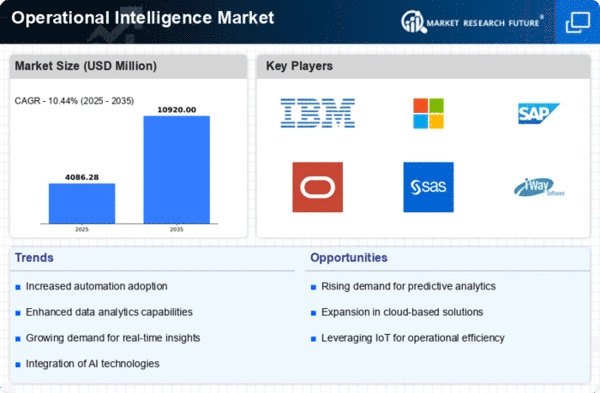
As per MRFR analysis, the Operational Intelligence Market Size was estimated at 3700.0 USD Million in 2024. The Operational Intelligence industry is projected to grow from 4043.86 in 2025 to 10920.0 by 2035, exhibiting a compound annual growth rate (CAGR) of 10.44 during the forecast period 2025 - 2035.

Key Market Trends & Highlights

The Operational Intelligence Market is experiencing robust growth driven by technological advancements and increasing demand for real-time insights.

  • The integration of AI and Machine Learning is transforming operational intelligence capabilities across various industries. North America remains the largest market, while Asia-Pacific is emerging as the fastest-growing region in operational intelligence solutions. Data Analytics continues to dominate the market, whereas Real-Time Monitoring is witnessing the fastest growth due to rising demand for immediate insights. The growing need for regulatory compliance and the rise of IoT and connected devices are key drivers propelling market expansion.

Market Size & Forecast

2024 Market Size 3700.0 (USD Million)
2035 Market Size 10920.0 (USD Million)
CAGR (2025 - 2035) 10.44%
Largest Regional Market Share in 2024 North America

Major Players

<a title="IBM" href="https://www.ibm.com/think/topics/ai-in-operations-management" target="_blank" rel="noopener">IBM</a> (US), Microsoft (US), SAP (DE), <a title="Oracle" href="https://www.oracle.com/in/big-data/data-intelligence-platform/" target="_blank" rel="noopener">Oracle</a> (US), SAS (US), TIBCO Software (US), Qlik (US), MicroStrategy (US), Domo (US)

Market Trends

The Operational Intelligence Market is currently experiencing a transformative phase, driven by the increasing need for real-time data analysis and decision-making capabilities across various industries. Organizations are recognizing the value of operational intelligence in enhancing efficiency, reducing costs, and improving overall performance. This market encompasses a range of technologies and solutions that facilitate the collection, analysis, and visualization of operational data, enabling businesses to respond swiftly to changing conditions. As companies strive to remain competitive, the demand for advanced analytics and insights continues to grow, fostering innovation and the development of new applications. In December 2025, the landscape of the Operational Intelligence Market appears to be evolving rapidly, with a notable emphasis on integrating artificial intelligence and machine learning into operational processes. This integration is likely to enhance predictive capabilities, allowing organizations to anticipate challenges and opportunities more effectively. Furthermore, the increasing adoption of cloud-based solutions is facilitating greater accessibility and scalability, enabling businesses of all sizes to leverage operational intelligence tools. As the market matures, collaboration between technology providers and end-users is expected to deepen, fostering a more robust ecosystem that supports continuous improvement and operational excellence.

Integration of AI and Machine Learning

The Operational Intelligence Market is witnessing a growing trend towards the incorporation of artificial intelligence and machine learning technologies. This integration enhances the ability to analyze vast amounts of data, providing organizations with predictive insights that can inform strategic decisions. As businesses seek to optimize their operations, the use of AI-driven analytics is likely to become increasingly prevalent.

Cloud-Based Solutions

There is a marked shift towards cloud-based operational intelligence solutions, which offer flexibility and scalability. These solutions enable organizations to access real-time data and analytics from anywhere, facilitating remote work and collaboration. The trend towards cloud adoption is expected to continue, as businesses recognize the benefits of reduced infrastructure costs and improved data accessibility.

Focus on Real-Time Decision Making

The emphasis on real-time decision-making is becoming a defining characteristic of the Operational Intelligence Market. Organizations are prioritizing tools and technologies that allow for immediate data analysis and response. This trend reflects a broader shift towards agility in business operations, where timely insights are crucial for maintaining a competitive edge.

Operational Intelligence Market Market Drivers

Integration of Advanced Technologies

The integration of advanced technologies such as artificial intelligence and machine learning into the Global Operational Intelligence Market Industry is transforming how organizations operate. These technologies enable businesses to automate processes, predict trends, and optimize resource allocation. For instance, AI-driven analytics can identify patterns in operational data that human analysts might overlook. This technological advancement not only enhances operational efficiency but also provides a competitive edge in the marketplace. As organizations continue to adopt these technologies, the demand for operational intelligence solutions is expected to rise significantly, contributing to the overall market growth.

Focus on Enhanced Customer Experience

In the Global Operational Intelligence Market Industry, there is a growing emphasis on enhancing customer experience through data-driven insights. Organizations are increasingly utilizing operational intelligence to understand customer behavior, preferences, and feedback. By analyzing this data, companies can tailor their services and products to meet customer needs more effectively. This focus on customer-centric strategies is likely to drive the adoption of operational intelligence solutions, as businesses recognize the importance of retaining customers in a competitive landscape. Consequently, the market is poised for substantial growth as organizations prioritize customer satisfaction.

Growing Adoption of Cloud-Based Solutions

The shift towards cloud-based solutions is significantly influencing the Global Operational Intelligence Market Industry. Organizations are increasingly adopting cloud technologies to enhance scalability, flexibility, and cost-effectiveness in their operations. Cloud-based operational intelligence solutions allow businesses to access real-time data from anywhere, facilitating better decision-making and collaboration among teams. This trend is particularly prominent among small and medium-sized enterprises that seek to leverage advanced analytics without the burden of heavy infrastructure investments. As cloud adoption continues to rise, the operational intelligence market is likely to expand, driven by the need for agile and responsive business operations.

Regulatory Compliance and Risk Management

The necessity for regulatory compliance and effective risk management is a key driver in the Global Operational Intelligence Market Industry. Organizations are required to adhere to various regulations that mandate transparency and accountability in their operations. Operational intelligence tools assist companies in monitoring compliance and identifying potential risks in real-time. For example, financial institutions utilize these tools to detect fraudulent activities and ensure adherence to regulatory standards. As regulatory landscapes evolve, the demand for operational intelligence solutions that facilitate compliance and risk management is expected to increase, further propelling market growth.

Increasing Demand for Real-Time Data Analysis

The Global Operational Intelligence Market Industry experiences a surge in demand for real-time data analysis as organizations strive to enhance decision-making processes. Companies are increasingly leveraging operational intelligence tools to gain insights from vast amounts of data generated daily. This trend is particularly evident in sectors such as manufacturing and logistics, where timely data can lead to improved efficiency and reduced operational costs. As a result, the market is projected to grow from 3.7 USD Billion in 2024 to 10.2 USD Billion by 2035, reflecting a compound annual growth rate of 9.64% from 2025 to 2035.

Market Segment Insights

By Application: Data Analytics (Largest) vs. Real-Time Monitoring (Fastest-Growing)

In the Operational Intelligence Market, the application segment showcases notable distribution with Data Analytics holding the largest share. This method leverages historical and real-time data insights to enhance decision-making processes across various industries. Real-Time Monitoring, while smaller in market share, is gaining traction as businesses recognize the importance of instant data analysis to improve operational efficiency and responsiveness. In addition, the trends indicate a growing emphasis on predictive maintenance and process optimization as organizations strive to be more data-driven and efficient in their operations, indicating a healthy balance across all application segments. The growth trajectory of the Operational Intelligence Market emphasizes the rising importance of Real-Time Monitoring as an indispensable tool for maintaining a competitive edge. Increasing adoption of IoT devices and advanced analytics fuels demand for predictive maintenance tailored to reduce downtimes and prolong equipment life. Process optimization remains critical as organizations seek to identify inefficiencies and adapt to changing market conditions. Overall, the combination of these trends reflects a shift towards a more data-centric operational model where agile responses to market dynamics are prioritized.

Data Analytics: Dominant vs. Predictive Maintenance: Emerging

Data Analytics has emerged as the dominant force in the Operational Intelligence Market, serving as the cornerstone for data-driven decision-making. This application facilitates the transformative analysis of vast data sets, enabling organizations to make informed choices that enhance operational efficiency. In contrast, Predictive Maintenance is an emerging application but is rapidly gaining recognition due to its ability to foresee equipment failures and enhance reliability. The proactive nature of predictive analytics helps businesses reduce downtime and maintenance costs while ensuring operational continuity. Both applications, while differing in maturity and impact, complement each other in an organization’s broader operational strategy, with Data Analytics enabling informed insights and Predictive Maintenance providing timely actions to improve overall operational performance.

By Deployment Type: Cloud-Based (Largest) vs. Hybrid (Fastest-Growing)

In the Operational Intelligence Market, the deployment type segment is prominently dominated by Cloud-Based solutions, which have garnered significant market share due to their scalability and accessibility. In juxtaposition, On-Premises solutions retain a stable share as they cater to enterprises with stringent data security requirements. Meanwhile, the Hybrid model is steadily gaining traction, appealing to businesses that seek a balance between flexibility and control, thus carving out a notable space within the market.

Cloud-Based (Dominant) vs. Hybrid (Emerging)

Cloud-Based deployment is characterized by its ability to provide real-time analytics and ease of integration with other cloud services, making it the dominant choice for organizations aiming to leverage data insights swiftly. On the other hand, the Hybrid deployment is emerging as a preferred option for businesses looking for a middle ground, allowing them to maintain some data on-premises while utilizing cloud capabilities. This blend offers organizations the flexibility to scale resources as needed while ensuring compliance with regulatory demands. As enterprises continue to evolve in their operational intelligence strategies, the hybrid model is expected to witness accelerated adoption.

By End User: Manufacturing (Largest) vs. Healthcare (Fastest-Growing)

In the operational intelligence market, the distribution of market share among end-user segments reveals manufacturing as the dominant sector, utilizing advanced data analytics for efficiency and productivity improvements. Retail follows, leveraging operational intelligence to enhance customer experiences and streamline supply chains. Healthcare is rapidly gaining traction with the implementation of AI-driven solutions to improve patient care, while transportation benefits from real-time data insights for logistics optimization.

Manufacturing: Dominant vs. Healthcare: Emerging

The manufacturing sector stands as a robust pillar in the operational intelligence market, characterized by its extensive adoption of IoT and data-driven decision-making processes. Companies in this segment prioritize efficiency, employing operational intelligence systems to monitor production lines and reduce downtime. In contrast, healthcare is emerging as a dynamic player, harnessing operational intelligence tools to revolutionize patient management and resource allocation. This segment is driven by the rising demand for personalized care and data interoperability that facilitates seamless patient journeys. As healthcare organizations increasingly seek innovative ways to leverage data, this sector is poised for substantial growth.

By Technology: Artificial Intelligence (Largest) vs. Machine Learning (Fastest-Growing)

The Operational Intelligence Market is witnessing a dynamic distribution of market share among key technological segments, with Artificial Intelligence (AI) leading the way. AI's sophisticated capabilities are being leveraged across various industries, resulting in a substantial portion of the market. Meanwhile, Machine Learning (ML) has emerged as a critical component of AI, rapidly gaining traction due to its ability to constantly evolve and adapt through data learning. As a result, both AI and ML are shaping the landscape of operational intelligence significantly.

Technology: AI (Dominant) vs. ML (Emerging)

Artificial Intelligence (AI) stands as the dominant force in the Operational Intelligence Market, characterized by its extensive applications in automation, data analysis, and decision-making processes. Companies are increasingly integrating AI to enhance efficiency, reduce operational costs, and improve service delivery. Conversely, Machine Learning (ML) is positioned as an emerging segment, noted for its rapid growth and adaptability. ML techniques allow systems to learn from data and make informed predictions, creating a compelling value proposition for organizations striving for innovation and enhanced performance. As AI continues to thrive, the role of ML becomes increasingly vital, supporting AI with real-time data processing and insight generation.

Get more detailed insights about Operational Intelligence Market Research Report – Forecast to 2035

Regional Insights

North America : Market Leader in Innovation

North America continues to lead the Operational Intelligence market, holding a significant share of 1850.0M in 2024. The region's growth is driven by rapid technological advancements, increasing demand for real-time data analytics, and a strong focus on digital transformation across industries. Regulatory support for data privacy and security further catalyzes market expansion, ensuring compliance while fostering innovation. The competitive landscape is robust, with key players like IBM, Microsoft, and Oracle dominating the market. The U.S. is the primary contributor, leveraging its technological infrastructure and investment in AI and machine learning. Companies are increasingly adopting operational intelligence solutions to enhance decision-making processes, optimize operations, and improve customer experiences, solidifying North America's position as a market leader.

Europe : Emerging Market with Growth Potential

Europe's Operational Intelligence market is poised for growth, with a market size of 950.0M in 2024. The region benefits from a strong regulatory framework that encourages data-driven decision-making and innovation. Initiatives aimed at digital transformation and sustainability are driving demand for operational intelligence solutions, as organizations seek to enhance efficiency and comply with stringent regulations. Leading countries such as Germany, the UK, and France are at the forefront of this growth, with a competitive landscape featuring major players like SAP and Oracle. The presence of a skilled workforce and a focus on research and development further bolster the market. As organizations increasingly recognize the value of data analytics, Europe is set to become a significant player in the operational intelligence space.

Asia-Pacific : Rapid Growth in Emerging Markets

The Asia-Pacific region is witnessing a rapid expansion in the Operational Intelligence market, with a size of 700.0M in 2024. This growth is fueled by increasing digitalization, a surge in data generation, and a growing emphasis on analytics across various sectors. Governments are also promoting smart city initiatives and digital economies, which act as catalysts for market development and adoption of operational intelligence solutions. Countries like China, India, and Japan are leading the charge, with a competitive landscape that includes both global and local players. Companies are investing heavily in AI and machine learning technologies to enhance their operational capabilities. As businesses strive for efficiency and agility, the demand for operational intelligence solutions is expected to rise significantly in this dynamic region.

Middle East and Africa : Emerging Market with Untapped Potential

The Middle East and Africa (MEA) region is emerging as a potential growth hub for the Operational Intelligence market, with a size of 200.0M in 2024. The region is experiencing a digital transformation, driven by government initiatives aimed at diversifying economies and enhancing technological capabilities. Increased investment in infrastructure and smart technologies is expected to boost demand for operational intelligence solutions, particularly in sectors like oil and gas, finance, and telecommunications. Countries such as the UAE and South Africa are leading the way, with a growing number of startups and established companies entering the market. The competitive landscape is evolving, with both local and international players vying for market share. As organizations recognize the importance of data analytics in decision-making, the MEA region is set to unlock significant opportunities in operational intelligence.

Key Players and Competitive Insights

The Operational Intelligence Market is currently characterized by a dynamic competitive landscape, driven by the increasing demand for real-time data analytics and decision-making capabilities. Key players such as IBM (US), Microsoft (US), and SAP (DE) are strategically positioned to leverage their technological advancements and extensive portfolios. IBM (US) focuses on integrating AI and machine learning into its operational intelligence solutions, enhancing predictive analytics capabilities. Meanwhile, Microsoft (US) emphasizes cloud-based solutions, facilitating seamless data integration and collaboration across various sectors. SAP (DE) is concentrating on expanding its enterprise resource planning (ERP) systems to include operational intelligence features, thereby enhancing its value proposition to existing customers. Collectively, these strategies indicate a trend towards comprehensive solutions that not only address immediate operational needs but also foster long-term digital transformation.
In terms of business tactics, companies are increasingly localizing their operations to better serve regional markets, optimizing supply chains to enhance efficiency and responsiveness. The market structure appears moderately fragmented, with a mix of established players and emerging startups. This fragmentation allows for diverse offerings, yet the collective influence of major companies like Oracle (US) and SAS (US) remains substantial, as they continue to set benchmarks for innovation and service delivery.
In November 2025, Oracle (US) announced a strategic partnership with a leading cloud provider to enhance its operational intelligence capabilities. This collaboration aims to integrate advanced analytics into Oracle's cloud services, thereby enabling clients to derive actionable insights from their data more effectively. The significance of this partnership lies in its potential to broaden Oracle's market reach and solidify its position as a leader in cloud-based operational intelligence solutions.
In October 2025, SAS (US) launched a new suite of AI-driven analytics tools designed specifically for operational intelligence applications. This initiative reflects SAS's commitment to innovation and its understanding of the growing need for sophisticated analytical tools in various industries. By enhancing its product offerings, SAS aims to attract a broader customer base and address the evolving demands of the market.
In September 2025, Microsoft (US) unveiled an upgraded version of its Power BI platform, incorporating enhanced operational intelligence features. This upgrade is particularly noteworthy as it aligns with the increasing trend towards data democratization, allowing users across organizations to access and analyze data without requiring extensive technical expertise. This move not only strengthens Microsoft's competitive position but also highlights the importance of user-friendly solutions in the current market.
As of December 2025, the competitive trends in the Operational Intelligence Market are increasingly defined by digitalization, sustainability, and the integration of AI technologies. Strategic alliances are becoming pivotal, as companies recognize the need to collaborate to enhance their technological capabilities and market offerings. Looking ahead, competitive differentiation is likely to evolve from traditional price-based competition towards a focus on innovation, technological advancement, and supply chain reliability. This shift underscores the necessity for companies to adapt and innovate continuously to maintain their competitive edge.

Key Companies in the Operational Intelligence Market include

Industry Developments

  • Opentext in July 2019, along with collaboration with Mastercard raises the financial efficiencies throughout the supply chain where the initiation is taken in the automotive industry.
  • A famous French startup company in March 2019, published software that specialized in driving up the event of API management where the launching of Amxay software took place.
  • The invention of the most popular version 8.0 in its collaboration with JUNI was put forward by OpsVeda.

Future Outlook

Operational Intelligence Market Future Outlook

The Operational Intelligence Market is projected to grow at a 10.44% CAGR from 2025 to 2035, driven by advancements in AI, data analytics, and increased demand for real-time decision-making.

New opportunities lie in:

  • Integration of AI-driven predictive maintenance solutions
  • Development of real-time operational dashboards for enterprises
  • Expansion of cloud-based operational intelligence platforms

By 2035, the Operational Intelligence Market is expected to be robust, reflecting substantial growth and innovation.

Market Segmentation

Operational Intelligence Market End User Outlook

  • Manufacturing
  • Retail
  • Healthcare
  • Transportation

Operational Intelligence Market Technology Outlook

  • Machine Learning
  • Artificial Intelligence
  • Big Data Analytics
  • Internet of Things

Operational Intelligence Market Application Outlook

  • Data Analytics
  • Real-Time Monitoring
  • Predictive Maintenance
  • Process Optimization

Operational Intelligence Market Deployment Type Outlook

  • On-Premises
  • Cloud-Based
  • Hybrid

Report Scope

MARKET SIZE 2024 3700.0(USD Million)
MARKET SIZE 2025 4043.86(USD Million)
MARKET SIZE 2035 10920.0(USD Million)
COMPOUND ANNUAL GROWTH RATE (CAGR) 10.44% (2025 - 2035)
REPORT COVERAGE Revenue Forecast, Competitive Landscape, Growth Factors, and Trends
BASE YEAR 2024
Market Forecast Period 2025 - 2035
Historical Data 2019 - 2024
Market Forecast Units USD Million
Key Companies Profiled IBM (US), Microsoft (US), SAP (DE), Oracle (US), SAS (US), TIBCO Software (US), Qlik (US), MicroStrategy (US), Domo (US)
Segments Covered Application, Deployment Type, End User, Technology
Key Market Opportunities Integration of artificial intelligence and machine learning enhances real-time decision-making in the Operational Intelligence Market.
Key Market Dynamics Rising demand for real-time data analytics drives innovation and competition in the Operational Intelligence Market.
Countries Covered North America, Europe, APAC, South America, MEA

FAQs

How big is the market Operational intelligence industry?

Operational Intelligence Market is Expected to Reach USD 6.2 Billion with 10.45% CAGR by 2030.

What are the types of intelligence operations?

The Operational Intelligence Market mainly divided in to four types these are Enterprise Manufacturing, Enterprise Operational Intelligence Software, It Service Intelligence, Enterprise security

What are the top players operating in the Operational intelligence market?

The major vendors who offer Cloud Testing Market are OpsVeda Inc., Splunk Inc., Axway Inc., Siemens, Flexeye Ltd. &amp; more

What is the vertical segment of the global operational intelligence market expected to witness the highest growth?

The BFSI segment is slated to expand as the fastest-growing segment.

  1. SECTION I: EXECUTIVE SUMMARY AND KEY HIGHLIGHTS
    1. | 1.1 EXECUTIVE SUMMARY
    2. | 1.1.1 Market Overview
    3. | 1.1.2 Key Findings
    4. | 1.1.3 Market Segmentation
    5. | 1.1.4 Competitive Landscape
    6. | 1.1.5 Challenges and Opportunities
    7. | 1.1.6 Future Outlook
  2. SECTION II: SCOPING, METHODOLOGY AND MARKET STRUCTURE
    1. | 2.1 MARKET INTRODUCTION
    2. | 2.1.1 Definition
    3. | 2.1.2 Scope of the study
    4. |-- 2.1.2.1 Research Objective
    5. |-- 2.1.2.2 Assumption
    6. |-- 2.1.2.3 Limitations
    7. | 2.2 RESEARCH METHODOLOGY
    8. | 2.2.1 Overview
    9. | 2.2.2 Data Mining
    10. | 2.2.3 Secondary Research
    11. | 2.2.4 Primary Research
    12. |-- 2.2.4.1 Primary Interviews and Information Gathering Process
    13. |-- 2.2.4.2 Breakdown of Primary Respondents
    14. | 2.2.5 Forecasting Model
    15. | 2.2.6 Market Size Estimation
    16. |-- 2.2.6.1 Bottom-Up Approach
    17. |-- 2.2.6.2 Top-Down Approach
    18. | 2.2.7 Data Triangulation
    19. | 2.2.8 Validation
  3. SECTION III: QUALITATIVE ANALYSIS
    1. | 3.1 MARKET DYNAMICS
    2. | 3.1.1 Overview
    3. | 3.1.2 Drivers
    4. | 3.1.3 Restraints
    5. | 3.1.4 Opportunities
    6. | 3.2 MARKET FACTOR ANALYSIS
    7. | 3.2.1 Value chain Analysis
    8. | 3.2.2 Porter's Five Forces Analysis
    9. |-- 3.2.2.1 Bargaining Power of Suppliers
    10. |-- 3.2.2.2 Bargaining Power of Buyers
    11. |-- 3.2.2.3 Threat of New Entrants
    12. |-- 3.2.2.4 Threat of Substitutes
    13. |-- 3.2.2.5 Intensity of Rivalry
    14. | 3.2.3 COVID-19 Impact Analysis
    15. |-- 3.2.3.1 Market Impact Analysis
    16. |-- 3.2.3.2 Regional Impact
    17. |-- 3.2.3.3 Opportunity and Threat Analysis
  4. SECTION IV: QUANTITATIVE ANALYSIS
    1. | 4.1 Information and Communications Technology, BY Application (USD Million)
    2. | 4.1.1 Data Analytics
    3. | 4.1.2 Real-Time Monitoring
    4. | 4.1.3 Predictive Maintenance
    5. | 4.1.4 Process Optimization
    6. | 4.2 Information and Communications Technology, BY Deployment Type (USD Million)
    7. | 4.2.1 On-Premises
    8. | 4.2.2 Cloud-Based
    9. | 4.2.3 Hybrid
    10. | 4.3 Information and Communications Technology, BY End User (USD Million)
    11. | 4.3.1 Manufacturing
    12. | 4.3.2 Retail
    13. | 4.3.3 Healthcare
    14. | 4.3.4 Transportation
    15. | 4.4 Information and Communications Technology, BY Technology (USD Million)
    16. | 4.4.1 Machine Learning
    17. | 4.4.2 Artificial Intelligence
    18. | 4.4.3 Big Data Analytics
    19. | 4.4.4 Internet of Things
    20. | 4.5 Information and Communications Technology, BY Region (USD Million)
    21. | 4.5.1 North America
    22. |-- 4.5.1.1 US
    23. |-- 4.5.1.2 Canada
    24. | 4.5.2 Europe
    25. |-- 4.5.2.1 Germany
    26. |-- 4.5.2.2 UK
    27. |-- 4.5.2.3 France
    28. |-- 4.5.2.4 Russia
    29. |-- 4.5.2.5 Italy
    30. |-- 4.5.2.6 Spain
    31. |-- 4.5.2.7 Rest of Europe
    32. | 4.5.3 APAC
    33. |-- 4.5.3.1 China
    34. |-- 4.5.3.2 India
    35. |-- 4.5.3.3 Japan
    36. |-- 4.5.3.4 South Korea
    37. |-- 4.5.3.5 Malaysia
    38. |-- 4.5.3.6 Thailand
    39. |-- 4.5.3.7 Indonesia
    40. |-- 4.5.3.8 Rest of APAC
    41. | 4.5.4 South America
    42. |-- 4.5.4.1 Brazil
    43. |-- 4.5.4.2 Mexico
    44. |-- 4.5.4.3 Argentina
    45. |-- 4.5.4.4 Rest of South America
    46. | 4.5.5 MEA
    47. |-- 4.5.5.1 GCC Countries
    48. |-- 4.5.5.2 South Africa
    49. |-- 4.5.5.3 Rest of MEA
  5. SECTION V: COMPETITIVE ANALYSIS
    1. | 5.1 Competitive Landscape
    2. | 5.1.1 Overview
    3. | 5.1.2 Competitive Analysis
    4. | 5.1.3 Market share Analysis
    5. | 5.1.4 Major Growth Strategy in the Information and Communications Technology
    6. | 5.1.5 Competitive Benchmarking
    7. | 5.1.6 Leading Players in Terms of Number of Developments in the Information and Communications Technology
    8. | 5.1.7 Key developments and growth strategies
    9. |-- 5.1.7.1 New Product Launch/Service Deployment
    10. |-- 5.1.7.2 Merger & Acquisitions
    11. |-- 5.1.7.3 Joint Ventures
    12. | 5.1.8 Major Players Financial Matrix
    13. |-- 5.1.8.1 Sales and Operating Income
    14. |-- 5.1.8.2 Major Players R&D Expenditure. 2023
    15. | 5.2 Company Profiles
    16. | 5.2.1 IBM (US)
    17. |-- 5.2.1.1 Financial Overview
    18. |-- 5.2.1.2 Products Offered
    19. |-- 5.2.1.3 Key Developments
    20. |-- 5.2.1.4 SWOT Analysis
    21. |-- 5.2.1.5 Key Strategies
    22. | 5.2.2 Microsoft (US)
    23. |-- 5.2.2.1 Financial Overview
    24. |-- 5.2.2.2 Products Offered
    25. |-- 5.2.2.3 Key Developments
    26. |-- 5.2.2.4 SWOT Analysis
    27. |-- 5.2.2.5 Key Strategies
    28. | 5.2.3 SAP (DE)
    29. |-- 5.2.3.1 Financial Overview
    30. |-- 5.2.3.2 Products Offered
    31. |-- 5.2.3.3 Key Developments
    32. |-- 5.2.3.4 SWOT Analysis
    33. |-- 5.2.3.5 Key Strategies
    34. | 5.2.4 Oracle (US)
    35. |-- 5.2.4.1 Financial Overview
    36. |-- 5.2.4.2 Products Offered
    37. |-- 5.2.4.3 Key Developments
    38. |-- 5.2.4.4 SWOT Analysis
    39. |-- 5.2.4.5 Key Strategies
    40. | 5.2.5 SAS (US)
    41. |-- 5.2.5.1 Financial Overview
    42. |-- 5.2.5.2 Products Offered
    43. |-- 5.2.5.3 Key Developments
    44. |-- 5.2.5.4 SWOT Analysis
    45. |-- 5.2.5.5 Key Strategies
    46. | 5.2.6 TIBCO Software (US)
    47. |-- 5.2.6.1 Financial Overview
    48. |-- 5.2.6.2 Products Offered
    49. |-- 5.2.6.3 Key Developments
    50. |-- 5.2.6.4 SWOT Analysis
    51. |-- 5.2.6.5 Key Strategies
    52. | 5.2.7 Qlik (US)
    53. |-- 5.2.7.1 Financial Overview
    54. |-- 5.2.7.2 Products Offered
    55. |-- 5.2.7.3 Key Developments
    56. |-- 5.2.7.4 SWOT Analysis
    57. |-- 5.2.7.5 Key Strategies
    58. | 5.2.8 MicroStrategy (US)
    59. |-- 5.2.8.1 Financial Overview
    60. |-- 5.2.8.2 Products Offered
    61. |-- 5.2.8.3 Key Developments
    62. |-- 5.2.8.4 SWOT Analysis
    63. |-- 5.2.8.5 Key Strategies
    64. | 5.2.9 Domo (US)
    65. |-- 5.2.9.1 Financial Overview
    66. |-- 5.2.9.2 Products Offered
    67. |-- 5.2.9.3 Key Developments
    68. |-- 5.2.9.4 SWOT Analysis
    69. |-- 5.2.9.5 Key Strategies
    70. | 5.3 Appendix
    71. | 5.3.1 References
    72. | 5.3.2 Related Reports

Information and Communications Technology Market Segmentation

Information and Communications Technology By Application (USD Million, 2025-2035)

  • Data Analytics
  • Real-Time Monitoring
  • Predictive Maintenance
  • Process Optimization

Information and Communications Technology By Deployment Type (USD Million, 2025-2035)

  • On-Premises
  • Cloud-Based
  • Hybrid

Information and Communications Technology By End User (USD Million, 2025-2035)

  • Manufacturing
  • Retail
  • Healthcare
  • Transportation

Information and Communications Technology By Technology (USD Million, 2025-2035)

  • Machine Learning
  • Artificial Intelligence
  • Big Data Analytics
  • Internet of Things
Infographic

Free Sample Request

Kindly complete the form below to receive a free sample of this Report

Get Free Sample

Customer Strories

Compare Licence

×
Features License Type
Single User Multiuser License Enterprise User
Price $4,950 $5,950 $7,250
Maximum User Access Limit 1 User Upto 10 Users Unrestricted Access Throughout the Organization
Free Customization
Direct Access to Analyst
Deliverable Format
Platform Access
Discount on Next Purchase 10% 15% 15%
Printable Versions