Request Free Sample ×

Kindly complete the form below to receive a free sample of this Report

* Please use a valid business email

Leading companies partner with us for data-driven Insights

clients tt-cursor
Hero Background
English
Chinese
French
Japanese
Korean
German
Spanish

OLED Materials Market Share

ID: MRFR/CnM/10259-HCR
111 Pages
Chitranshi Jaiswal
April 2026

OLED Materials Market Research Report Information By Type (Substrates, Encapsulation, Anode, HIL, HTL, ETL, EML, and Cathode), By Application (Display and Lighting), By End User (Residential, Commercial, and Industrial), and By Region (North America, Europe, Asia-Pacific, and Rest Of The World) – Market Forecast Till 2035

Share:
Download PDF ×

We do not share your information with anyone. However, we may send you emails based on your report interest from time to time. You may contact us at any time to opt-out.

OLED Materials Market Infographic
Purchase Options

Market Share

OLED Materials Market Share Analysis

The market for OLED (Organic Light Emitting Diode) materials is influenced by several key factors that shape its growth and dynamics. One significant factor is technological advancements. As OLED technology evolves, there's a constant demand for materials that can enhance performance, durability, and efficiency. Innovations in OLED materials, such as improved light-emitting molecules and more efficient charge transport layers, drive market growth as manufacturers seek to enhance the quality and longevity of OLED displays.

Global demand for OLED materials is rising as a result of the growing use of wireless devices to sustain connectivity in faraway locations without the need for long cable cables.

Another crucial factor is the demand for consumer electronics. OLED displays are increasingly popular in smartphones, TVs, tablets, and wearable devices due to their superior image quality, energy efficiency, and flexibility. As consumer demand for these products continues to rise, so does the demand for OLED materials. Additionally, the automotive industry is emerging as a significant market for OLED displays, particularly for high-end vehicles where OLEDs are used for dashboard displays, entertainment systems, and lighting.

Market factors also include regulations and environmental considerations. As governments worldwide push for energy-efficient and eco-friendly technologies, OLED materials must comply with stringent regulations regarding hazardous substances and energy consumption. Manufacturers are under pressure to develop materials that are not only high-performing but also environmentally sustainable, driving investment in research and development for greener alternatives.

Moreover, competition within the OLED materials market plays a crucial role. With numerous players vying for market share, companies are constantly innovating to gain a competitive edge. This competition fosters innovation and drives down costs, making OLED technology more accessible to a broader range of applications and industries. Strategic partnerships and collaborations between material suppliers, display manufacturers, and technology developers further accelerate market growth and innovation.

Global economic conditions also impact the OLED materials market. Economic stability, consumer purchasing power, and market trends influence the demand for electronic devices and, consequently, OLED materials. Economic downturns can lead to decreased consumer spending on electronics, affecting the demand for OLED displays and materials. Conversely, economic growth and rising disposable incomes spur demand for premium electronic products, driving the adoption of OLED technology.

Supply chain dynamics are another critical factor in the OLED materials market. The availability and cost of raw materials, manufacturing capabilities, and distribution networks all influence market trends and pricing. Disruptions in the supply chain, such as shortages of key materials or logistical challenges, can impact production schedules and lead to fluctuations in OLED material prices.

Lastly, technological convergence and emerging applications contribute to the growth of the OLED materials market. As OLED technology integrates with other technologies such as sensors, IoT (Internet of Things) devices, and augmented reality (AR) systems, new opportunities for OLED materials emerge. For example, OLED materials with specific properties may be developed for use in medical devices, signage, or architectural lighting, expanding the market beyond traditional consumer electronics.

Author
Author Profile
Chitranshi Jaiswal
Team Lead - Research

Chitranshi is a Team Leader in the Chemicals & Materials (CnM) and Energy & Power (EnP) domains, with 6+ years of experience in market research. She leads and mentors teams to deliver cross-domain projects that equip clients with actionable insights and growth strategies. She is skilled in market estimation, forecasting, competitive benchmarking, and both primary & secondary research, enabling her to turn complex data into decision-ready insights. An engineer and MBA professional, she combines technical expertise with strategic acumen to solve dynamic market challenges. Chitranshi has successfully managed projects that support market entry, investment planning, and competitive positioning, while building strong client relationships. Certified in Advanced Excel & Power BI she leverages data-driven approaches to ensure accuracy, clarity, and impactful outcomes.

Leave a Comment

FAQs

What is the current valuation of the OLED Materials Market as of 2024?

<p>The OLED Materials Market was valued at 31.24 USD Billion in 2024.</p>

What is the projected market size for the OLED Materials Market by 2035?

<p>The market is projected to reach 291.25 USD Billion by 2035.</p>

What is the expected CAGR for the OLED Materials Market during the forecast period 2025 - 2035?

<p>The expected CAGR for the OLED Materials Market during 2025 - 2035 is 22.5%.</p>

Which companies are considered key players in the OLED Materials Market?

<p>Key players include Universal Display Corporation, Samsung Display Co., LG Display Co., Idemitsu Kosan, Merck KGaA, Sumitomo Chemical, BASF SE, Dow Inc., and Osram Licht AG.</p>

What are the main segments of the OLED Materials Market?

<p>The main segments include Type, Application, and End User.</p>

How much was the valuation for the Display application segment in 2024?

<p>The Display application segment was valued at 20.0 USD Billion in 2024.</p>

What is the projected valuation for the Lighting application segment by 2035?

The Lighting application segment is projected to reach 91.25 USD Billion by 2035.

What was the valuation of the Commercial end user segment in 2024?

The Commercial end user segment was valued at 12.0 USD Billion in 2024.

What is the expected growth for the Industrial end user segment by 2035?

The Industrial end user segment is expected to grow to 126.0 USD Billion by 2035.

Which type of OLED material segment had the highest valuation in 2024?

The EML segment had the highest valuation at 5.0 USD Billion in 2024.

Market Summary

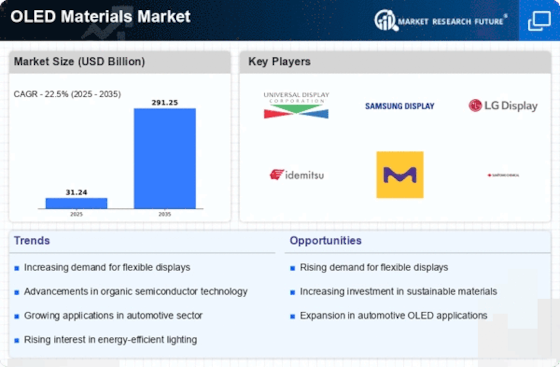
As per Market Research Future analysis, the OLED Materials Market was estimated at 31.24 USD Billion in 2024. The OLED Materials industry is projected to grow from 38.27 USD Billion in 2025 to 291.25 USD Billion by 2035, exhibiting a compound annual growth rate (CAGR) of 22.5% during the forecast period 2025 - 2035

Key Market Trends & Highlights

The OLED Materials Market is poised for substantial growth driven by technological advancements and increasing consumer demand.

  • North America remains the largest market for OLED materials, driven by high consumer demand for energy-efficient displays. Asia-Pacific is emerging as the fastest-growing region, fueled by rapid technological advancements and increasing investments in OLED technology. The substrates segment continues to dominate the market, while the encapsulation segment is witnessing the fastest growth due to rising application needs. Key market drivers include the rising demand for energy-efficient displays and government initiatives supporting OLED technology.

Market Size & Forecast

2024 Market Size 31.24 (USD Billion)
2035 Market Size 291.25 (USD Billion)
CAGR (2025 - 2035) 22.5%
Largest Regional Market Share in 2024 North America

Major Players

Universal Display Corporation (US), Samsung Display Co., Ltd. (KR), LG Display Co., Ltd. (KR), Idemitsu Kosan Co., Ltd. (JP), Merck KGaA (DE), Sumitomo Chemical Co., Ltd. (JP), BASF SE (DE), Dow Inc. (US), Osram Licht AG (DE)

Market Trends

The OLED Materials Market is currently experiencing a dynamic evolution, driven by advancements in technology and increasing consumer demand for high-quality displays. This market encompasses a variety of materials essential for the production of organic light-emitting diodes, which are widely utilized in televisions, smartphones, and other electronic devices. As manufacturers strive to enhance performance and efficiency, the focus on developing innovative materials is becoming more pronounced. The growing trend towards energy-efficient solutions further propels the market, as consumers and industries alike seek sustainable alternatives. In addition, the OLED Materials Market is witnessing a shift towards flexible and transparent displays, which are gaining traction in various applications. This trend is indicative of a broader movement towards personalization and customization in consumer electronics. As technology continues to advance, the potential for new applications in sectors such as automotive and healthcare appears promising. Overall, the OLED Materials Market is poised for substantial growth, driven by technological innovations and evolving consumer preferences.

Sustainability Initiatives

The OLED Materials Market is increasingly influenced by sustainability initiatives, as manufacturers prioritize eco-friendly materials and processes. This trend reflects a growing awareness of environmental impacts and a commitment to reducing carbon footprints. Companies are exploring biodegradable and recyclable materials, which may enhance their market appeal and align with consumer values.

Advancements in Material Science

Recent advancements in material science are significantly shaping the OLED Materials Market. Innovations in organic compounds and conductive materials are leading to improved efficiency and longevity of OLED displays. This trend suggests that ongoing research and development efforts could yield materials that enhance performance while reducing production costs.

Integration with Emerging Technologies

The integration of OLED technology with emerging technologies, such as artificial intelligence and the Internet of Things, is becoming more prevalent. This trend indicates a potential for OLED displays to be utilized in smart devices and connected systems, thereby expanding their application scope and driving further market growth.

OLED Materials Market Market Drivers

Rising Demand for Energy Efficient Displays

The OLED Materials Market is experiencing a notable surge in demand for energy-efficient display technologies. As consumers increasingly prioritize sustainability, manufacturers are compelled to adopt OLED technology, which offers superior energy efficiency compared to traditional LCDs. Reports indicate that OLED displays consume approximately 30 to 50% less power than their LCD counterparts, making them an attractive option for both consumers and manufacturers. This shift is further fueled by the growing popularity of smart devices, where battery life is paramount. Consequently, the OLED Materials Market is poised for growth as manufacturers seek to enhance their product offerings with energy-efficient solutions that align with consumer preferences.

Technological Advancements in OLED Materials

Innovations in material science are significantly impacting the OLED Materials Market. Recent developments in organic compounds and phosphorescent materials have led to improved performance characteristics, such as enhanced brightness and color accuracy. For instance, advancements in blue OLED materials have resulted in longer lifespans and better efficiency, which are critical for consumer electronics. The introduction of new materials is expected to drive down production costs while improving the overall quality of OLED displays. As a result, manufacturers are likely to invest heavily in research and development, further propelling the growth of the OLED Materials Market as they strive to meet the evolving demands of consumers.

Expansion of OLED Applications Beyond Displays

The OLED Materials Market is witnessing an expansion of applications beyond traditional display technologies. Industries such as automotive, lighting, and wearables are increasingly adopting OLED technology due to its flexibility and superior visual performance. For example, OLED lighting solutions are gaining traction in architectural and automotive lighting, providing unique design opportunities and energy savings. The automotive sector, in particular, is exploring OLED displays for dashboard interfaces and rear lighting systems, which enhances both aesthetics and functionality. This diversification of applications is likely to create new revenue streams for the OLED Materials Market, as manufacturers adapt their offerings to cater to these emerging sectors.

Government Initiatives Supporting OLED Technology

Government initiatives aimed at promoting energy-efficient technologies are playing a crucial role in the growth of the OLED Materials Market. Various countries are implementing policies and incentives to encourage the adoption of OLED technology in consumer electronics and lighting applications. These initiatives often include funding for research and development, tax incentives for manufacturers, and regulations that favor energy-efficient products. As governments recognize the environmental benefits of OLED technology, the support provided is likely to stimulate investment in the OLED Materials Market, fostering innovation and accelerating market growth. This supportive regulatory environment may also enhance consumer awareness and acceptance of OLED products.

Increasing Consumer Awareness and Preference for OLED Technology

Consumer awareness regarding the advantages of OLED technology is steadily increasing, which is positively influencing the OLED Materials Market. As consumers become more informed about the benefits of OLED displays, such as superior contrast ratios, vibrant colors, and faster response times, their preference for OLED products is likely to grow. This trend is particularly evident in the television and smartphone markets, where consumers are willing to invest in higher-quality displays. Market data suggests that OLED televisions are projected to capture a significant share of the premium TV segment, further driving demand for OLED materials. As consumer preferences shift towards high-performance displays, the OLED Materials Market is expected to benefit from this growing inclination.

Market Segment Insights

By Type: Substrates (Largest) vs. Encapsulation (Fastest-Growing)

The OLED materials market showcases distinct segment values with varying shares, particularly highlighting Substrates as the largest segment. This segment includes materials that support the active layers of OLED devices, providing structural integrity and electro-optical performance. On the other hand, Encapsulation, which protects OLEDs from moisture and oxygen, is noted as the fastest-growing segment, reflecting increasing demand for longevity and enhanced operational performance in OLED displays. Given the critical roles of these segments, they are pivotal in shaping the overall dynamics of the OLED materials marketplace. The growth trends within the OLED materials market are propelled by advancements in display technology and rising consumer electronics demand. The Substrates segment continues to dominate due to its foundational role in OLED structure. Conversely, the Encapsulation segment is rapidly expanding as manufacturers seek improved reliability and durability, driven by innovation in encapsulation techniques and materials. This trend is increasingly aligned with the overall push towards more sustainable and efficient OLED products, enabling broader adoption in various applications ranging from mobile devices to large-scale displays.

Substrates (Dominant) vs. Encapsulation (Emerging)

In the OLED materials market, Substrates are recognized as the dominant segment, forming the essential base for OLED devices. They are typically made from <a href="https://www.marketresearchfuture.com/reports/glass-market-11515">glass</a>, plastic, or flexible materials, each offering unique properties vital for device performance. These materials ensure effective electronic and optical functions, making them indispensable in high-quality OLED applications. The growth of flexible and transparent electronics has further solidified the role of substrates. Conversely, the Encapsulation segment is emerging as a key player; it specializes in safeguarding OLED components against environmental factors, which is increasingly necessary as operational requirements evolve. Enhanced encapsulation materials are paramount for extending the lifespan of OLED devices, thus representing a significant growth opportunity in response to market demands for durability and efficiency.

By Application: Display (Largest) vs. Lighting (Fastest-Growing)

The OLED Materials Market's application segment is primarily divided into Display and Lighting. The Display application dominates the market, driven by the increasing demand for high-resolution screens in smartphones, televisions, and other devices. This application captures a significant portion of the market share, reflecting consumer preference for OLED technology, which offers superior color accuracy and energy efficiency. In contrast, the Lighting application is emerging as a significant player, supported by advances in solid-state lighting technology and an increasing demand for energy-efficient lighting solutions across residential, commercial, and industrial sectors.

Application: Display (Dominant) vs. Lighting (Emerging)

The Display segment in the OLED Materials Market is characterized by its widespread adoption in consumer electronics, particularly in high-end televisions and smartphones, due to its ability to deliver exceptional picture quality and energy efficiency. This segment is seen as dominant because it benefits from continual advancements in display technology and increasing consumer demand for larger and more vibrant displays. On the other hand, the Lighting segment is viewed as emerging, with significant growth potential driven by innovations in OLED lighting solutions that provide flexible design options and improved efficiency. This growing interest in OLED lighting is fostering technological advancements and wider adoption in smart homes and buildings.

By End User: Residential (Largest) vs. Commercial (Fastest-Growing)

In the OLED materials market, the end user segment is primarily divided into residential, commercial, and industrial applications. The residential segment holds the largest market share, driven by the increasing adoption of OLED technology in consumer electronics such as televisions and smartphones. Commercial applications, while currently smaller in share, are witnessing rapid adoption, especially in sectors like advertising and retail, where vibrant displays are becoming essential for branding and customer engagement.

Residential (Dominant) vs. Commercial (Emerging)

The residential segment of the OLED materials market is characterized by its extensive application in high-end consumer electronics, particularly in televisions and smartphones. It appeals to consumers seeking superior display quality and energy efficiency, making it the dominant force in the market. Conversely, the commercial segment is emerging due to its growing utilization in large-scale displays for advertising and promotional purposes. As businesses increasingly prioritize visually compelling interfaces to capture customer attention, the demand for OLED materials in commercial applications is expected to surge, making it a key area of growth.

Get more detailed insights about OLED Materials Market Research Report—Global Forecast till 2035

Regional Insights

North America : Innovation and Demand Surge

North America is witnessing significant growth in the OLED materials market, driven by increasing demand for high-quality displays in consumer electronics and automotive sectors. The region holds approximately 35% of the global market share, making it the largest market. Regulatory support for advanced manufacturing technologies and sustainability initiatives further catalyzes this growth. The United States leads the market, with key players like Universal Display Corporation and Dow Inc. driving innovation. The competitive landscape is characterized by a focus on research and development, with companies investing heavily in new materials and technologies to enhance performance and reduce costs. This dynamic environment positions North America as a hub for OLED material advancements.

Europe : Sustainability and Innovation Focus

Europe is rapidly evolving in the OLED materials market, driven by stringent environmental regulations and a strong push for sustainable technologies. The region accounts for about 30% of the global market share, making it the second-largest market. Initiatives from the European Union to promote green technologies and reduce carbon footprints are significant growth catalysts. Germany, France, and the UK are leading countries in this sector, with major companies like Merck KGaA and BASF SE at the forefront. The competitive landscape is marked by collaborations between industry players and research institutions, fostering innovation in OLED materials. This synergy is crucial for developing next-generation solutions that meet both performance and sustainability standards.

Asia-Pacific : Manufacturing Powerhouse

Asia-Pacific is a manufacturing powerhouse in the OLED materials market, driven by high demand from consumer electronics and automotive industries. The region holds approximately 25% of the global market share, with countries like South Korea and Japan leading the charge. Government initiatives to support technology advancements and manufacturing capabilities are key growth drivers. South Korea, with giants like Samsung Display and LG Display, dominates the market, while Japan's Idemitsu Kosan and Sumitomo Chemical contribute significantly. The competitive landscape is intense, with a focus on innovation and cost efficiency. This region's robust supply chain and technological expertise position it as a critical player in The OLED Materials Market.

Middle East and Africa : Emerging Market Potential

The Middle East and Africa are emerging markets for OLED materials, driven by increasing investments in technology and infrastructure. The region currently holds about 10% of the global market share, with potential for significant growth as demand for advanced display technologies rises. Government initiatives to diversify economies and promote technology adoption are key catalysts for this growth. Countries like the UAE and South Africa are leading the way, with investments in smart technologies and digital infrastructure. The competitive landscape is still developing, with opportunities for both local and international players to enter the market. As awareness of OLED technology increases, the region is poised for substantial advancements in the coming years.

Key Players and Competitive Insights

Leading market players are investing heavily in research and development in order to expand their product lines, which will help the OLED Materials Market, grow even more. Market participants are also undertaking a variety of strategic activities to expand their global footprint, with important market developments including new product launches, contractual agreements, mergers and acquisitions, higher investments, and collaboration with other organizations. To expand and survive in a more competitive and rising market climate, OLED Materials industry must offer cost-effective items.Manufacturing locally to minimize operational costs is one of the key business tactics used by manufacturers in the global OLED Materials industry to benefit clients and increase the market sector. In recent years, the OLED Materials industry has offered some of the most significant advantages to medicine. Major players in the OLED Materials Market, including Sigma-Aldrich Co. LLC., Dupont, Novaled GmBH, Merck KgAA, Lg Chem, TCI America, Sumitomo Chemical, Universal Display, The Dow Chemical Company, Idemitsu Kosan, are attempting to increase market demand by investing in research and development operations. The leading market key players are Samsung, LG, Universal Display Corporation, Merck kGaA, BASF SEA provider of optoelectronic solutions is AUO Corp (AUO), formerly known as AU Optronics Corp. The business develops, produces, assembles, and designs a variety of panel display products. Its panels are mostly utilised in televisions, monitors, wearable technology, mobile technology, commercial applications, and other things. The business produces solar products such solar wafers, ingots, cells, and modules. For solar system projects, AUO also provides technical engineering services and maintenance services. True-circle displays, which are round AMOLED displays with thinner salient edges than the current round OLED displays from AU Optronics, were created in May 2017.Developed by Kateeva, inkjet printing machinery is used to create organic light-emitting diode (OLED) displays. The company's equipment solutions are utilised to mass-produce flat panel displays that are category-defining and have the ability to print billions of pixels quickly. This new wave of innovation helped bring flexible and foldable display goods to the worldwide market. Developer of OLED inkjet printing Kateeva declared in 2021 that it has partnered strategically with the producer of high-index materials Pixelligent Technologies. By printing planarization layers onto micro lens arrays using an inkjet printer, the cooperation intends to maximise the light output efficiency.

Key Companies in the OLED Materials Market include

Industry Developments

June 2020: In order to produce OLED displays at a significantly lower cost, researchers at Queensland University of Technology (QUT) suggested using human hair, which is a natural source of carbon and nitrogen.

Future Outlook

OLED Materials Market Future Outlook

The OLED Materials Market is projected to grow at a 22.5% CAGR from 2025 to 2035, driven by advancements in display technology, increased consumer demand, and energy efficiency.

New opportunities lie in:

  • Development of eco-friendly OLED materials for sustainable production</p><p>Expansion into emerging markets with tailored product offerings</p><p>Investment in R&amp;D for next-generation OLED technologies and applications

By 2035, the OLED Materials Market is expected to achieve substantial growth and innovation.

Market Segmentation

OLED Materials Market Type Outlook

  • Substrates
  • Encapsulation
  • Anode
  • HIL
  • HTL
  • ETL
  • EML
  • Cathode

OLED Materials Market End User Outlook

  • Residential
  • Commercial
  • Industrial

OLED Materials Market Application Outlook

  • Display
  • Lighting

Report Scope

MARKET SIZE 2024 31.24(USD Billion)
MARKET SIZE 2025 38.27(USD Billion)
MARKET SIZE 2035 291.25(USD Billion)
COMPOUND ANNUAL GROWTH RATE (CAGR) 22.5% (2025 - 2035)
REPORT COVERAGE Revenue Forecast, Competitive Landscape, Growth Factors, and Trends
BASE YEAR 2024
Market Forecast Period 2025 - 2035
Historical Data 2019 - 2024
Market Forecast Units USD Billion
Key Companies Profiled Universal Display Corporation (US), Samsung Display Co., Ltd. (KR), LG Display Co., Ltd. (KR), Idemitsu Kosan Co., Ltd. (JP), Merck KGaA (DE), Sumitomo Chemical Co., Ltd. (JP), BASF SE (DE), Dow Inc. (US), Osram Licht AG (DE)
Segments Covered Type, Application, End User, Region
Key Market Opportunities Advancements in flexible OLED materials drive innovation in consumer electronics and automotive displays.
Key Market Dynamics Technological advancements in OLED materials drive innovation, enhancing display performance and expanding application areas across industries.
Countries Covered North America, Europe, APAC, South America, MEA

FAQs

What is the current valuation of the OLED Materials Market as of 2024?

<p>The OLED Materials Market was valued at 31.24 USD Billion in 2024.</p>

What is the projected market size for the OLED Materials Market by 2035?

<p>The market is projected to reach 291.25 USD Billion by 2035.</p>

What is the expected CAGR for the OLED Materials Market during the forecast period 2025 - 2035?

<p>The expected CAGR for the OLED Materials Market during 2025 - 2035 is 22.5%.</p>

Which companies are considered key players in the OLED Materials Market?

<p>Key players include Universal Display Corporation, Samsung Display Co., LG Display Co., Idemitsu Kosan, Merck KGaA, Sumitomo Chemical, BASF SE, Dow Inc., and Osram Licht AG.</p>

What are the main segments of the OLED Materials Market?

<p>The main segments include Type, Application, and End User.</p>

How much was the valuation for the Display application segment in 2024?

<p>The Display application segment was valued at 20.0 USD Billion in 2024.</p>

What is the projected valuation for the Lighting application segment by 2035?

The Lighting application segment is projected to reach 91.25 USD Billion by 2035.

What was the valuation of the Commercial end user segment in 2024?

The Commercial end user segment was valued at 12.0 USD Billion in 2024.

What is the expected growth for the Industrial end user segment by 2035?

The Industrial end user segment is expected to grow to 126.0 USD Billion by 2035.

Which type of OLED material segment had the highest valuation in 2024?

The EML segment had the highest valuation at 5.0 USD Billion in 2024.

  1. SECTION I: EXECUTIVE SUMMARY AND KEY HIGHLIGHTS
    1. | 1.1 EXECUTIVE SUMMARY
    2. | | 1.1.1 Market Overview
    3. | | 1.1.2 Key Findings
    4. | | 1.1.3 Market Segmentation
    5. | | 1.1.4 Competitive Landscape
    6. | | 1.1.5 Challenges and Opportunities
    7. | | 1.1.6 Future Outlook
  2. SECTION II: SCOPING, METHODOLOGY AND MARKET STRUCTURE
    1. | 2.1 MARKET INTRODUCTION
    2. | | 2.1.1 Definition
    3. | | 2.1.2 Scope of the study
    4. | | | 2.1.2.1 Research Objective
    5. | | | 2.1.2.2 Assumption
    6. | | | 2.1.2.3 Limitations
    7. | 2.2 RESEARCH METHODOLOGY
    8. | | 2.2.1 Overview
    9. | | 2.2.2 Data Mining
    10. | | 2.2.3 Secondary Research
    11. | | 2.2.4 Primary Research
    12. | | | 2.2.4.1 Primary Interviews and Information Gathering Process
    13. | | | 2.2.4.2 Breakdown of Primary Respondents
    14. | | 2.2.5 Forecasting Model
    15. | | 2.2.6 Market Size Estimation
    16. | | | 2.2.6.1 Bottom-Up Approach
    17. | | | 2.2.6.2 Top-Down Approach
    18. | | 2.2.7 Data Triangulation
    19. | | 2.2.8 Validation
  3. SECTION III: QUALITATIVE ANALYSIS
    1. | 3.1 MARKET DYNAMICS
    2. | | 3.1.1 Overview
    3. | | 3.1.2 Drivers
    4. | | 3.1.3 Restraints
    5. | | 3.1.4 Opportunities
    6. | 3.2 MARKET FACTOR ANALYSIS
    7. | | 3.2.1 Value chain Analysis
    8. | | 3.2.2 Porter's Five Forces Analysis
    9. | | | 3.2.2.1 Bargaining Power of Suppliers
    10. | | | 3.2.2.2 Bargaining Power of Buyers
    11. | | | 3.2.2.3 Threat of New Entrants
    12. | | | 3.2.2.4 Threat of Substitutes
    13. | | | 3.2.2.5 Intensity of Rivalry
    14. | | 3.2.3 COVID-19 Impact Analysis
    15. | | | 3.2.3.1 Market Impact Analysis
    16. | | | 3.2.3.2 Regional Impact
    17. | | | 3.2.3.3 Opportunity and Threat Analysis
  4. SECTION IV: QUANTITATIVE ANALYSIS
    1. | 4.1 Chemicals and Materials, BY Type (USD Billion)
    2. | | 4.1.1 Substrates
    3. | | 4.1.2 Encapsulation
    4. | | 4.1.3 Anode
    5. | | 4.1.4 HIL
    6. | | 4.1.5 HTL
    7. | | 4.1.6 ETL
    8. | | 4.1.7 EML
    9. | | 4.1.8 Cathode
    10. | 4.2 Chemicals and Materials, BY Application (USD Billion)
    11. | | 4.2.1 Display
    12. | | 4.2.2 Lighting
    13. | 4.3 Chemicals and Materials, BY End User (USD Billion)
    14. | | 4.3.1 Residential
    15. | | 4.3.2 Commercial
    16. | | 4.3.3 Industrial
    17. | 4.4 Chemicals and Materials, BY Region (USD Billion)
    18. | | 4.4.1 North America
    19. | | | 4.4.1.1 US
    20. | | | 4.4.1.2 Canada
    21. | | 4.4.2 Europe
    22. | | | 4.4.2.1 Germany
    23. | | | 4.4.2.2 UK
    24. | | | 4.4.2.3 France
    25. | | | 4.4.2.4 Russia
    26. | | | 4.4.2.5 Italy
    27. | | | 4.4.2.6 Spain
    28. | | | 4.4.2.7 Rest of Europe
    29. | | 4.4.3 APAC
    30. | | | 4.4.3.1 China
    31. | | | 4.4.3.2 India
    32. | | | 4.4.3.3 Japan
    33. | | | 4.4.3.4 South Korea
    34. | | | 4.4.3.5 Malaysia
    35. | | | 4.4.3.6 Thailand
    36. | | | 4.4.3.7 Indonesia
    37. | | | 4.4.3.8 Rest of APAC
    38. | | 4.4.4 South America
    39. | | | 4.4.4.1 Brazil
    40. | | | 4.4.4.2 Mexico
    41. | | | 4.4.4.3 Argentina
    42. | | | 4.4.4.4 Rest of South America
    43. | | 4.4.5 MEA
    44. | | | 4.4.5.1 GCC Countries
    45. | | | 4.4.5.2 South Africa
    46. | | | 4.4.5.3 Rest of MEA
  5. SECTION V: COMPETITIVE ANALYSIS
    1. | 5.1 Competitive Landscape
    2. | | 5.1.1 Overview
    3. | | 5.1.2 Competitive Analysis
    4. | | 5.1.3 Market share Analysis
    5. | | 5.1.4 Major Growth Strategy in the Chemicals and Materials
    6. | | 5.1.5 Competitive Benchmarking
    7. | | 5.1.6 Leading Players in Terms of Number of Developments in the Chemicals and Materials
    8. | | 5.1.7 Key developments and growth strategies
    9. | | | 5.1.7.1 New Product Launch/Service Deployment
    10. | | | 5.1.7.2 Merger & Acquisitions
    11. | | | 5.1.7.3 Joint Ventures
    12. | | 5.1.8 Major Players Financial Matrix
    13. | | | 5.1.8.1 Sales and Operating Income
    14. | | | 5.1.8.2 Major Players R&D Expenditure. 2023
    15. | 5.2 Company Profiles
    16. | | 5.2.1 Universal Display Corporation (US)
    17. | | | 5.2.1.1 Financial Overview
    18. | | | 5.2.1.2 Products Offered
    19. | | | 5.2.1.3 Key Developments
    20. | | | 5.2.1.4 SWOT Analysis
    21. | | | 5.2.1.5 Key Strategies
    22. | | 5.2.2 Samsung Display Co., Ltd. (KR)
    23. | | | 5.2.2.1 Financial Overview
    24. | | | 5.2.2.2 Products Offered
    25. | | | 5.2.2.3 Key Developments
    26. | | | 5.2.2.4 SWOT Analysis
    27. | | | 5.2.2.5 Key Strategies
    28. | | 5.2.3 LG Display Co., Ltd. (KR)
    29. | | | 5.2.3.1 Financial Overview
    30. | | | 5.2.3.2 Products Offered
    31. | | | 5.2.3.3 Key Developments
    32. | | | 5.2.3.4 SWOT Analysis
    33. | | | 5.2.3.5 Key Strategies
    34. | | 5.2.4 Idemitsu Kosan Co., Ltd. (JP)
    35. | | | 5.2.4.1 Financial Overview
    36. | | | 5.2.4.2 Products Offered
    37. | | | 5.2.4.3 Key Developments
    38. | | | 5.2.4.4 SWOT Analysis
    39. | | | 5.2.4.5 Key Strategies
    40. | | 5.2.5 Merck KGaA (DE)
    41. | | | 5.2.5.1 Financial Overview
    42. | | | 5.2.5.2 Products Offered
    43. | | | 5.2.5.3 Key Developments
    44. | | | 5.2.5.4 SWOT Analysis
    45. | | | 5.2.5.5 Key Strategies
    46. | | 5.2.6 Sumitomo Chemical Co., Ltd. (JP)
    47. | | | 5.2.6.1 Financial Overview
    48. | | | 5.2.6.2 Products Offered
    49. | | | 5.2.6.3 Key Developments
    50. | | | 5.2.6.4 SWOT Analysis
    51. | | | 5.2.6.5 Key Strategies
    52. | | 5.2.7 BASF SE (DE)
    53. | | | 5.2.7.1 Financial Overview
    54. | | | 5.2.7.2 Products Offered
    55. | | | 5.2.7.3 Key Developments
    56. | | | 5.2.7.4 SWOT Analysis
    57. | | | 5.2.7.5 Key Strategies
    58. | | 5.2.8 Dow Inc. (US)
    59. | | | 5.2.8.1 Financial Overview
    60. | | | 5.2.8.2 Products Offered
    61. | | | 5.2.8.3 Key Developments
    62. | | | 5.2.8.4 SWOT Analysis
    63. | | | 5.2.8.5 Key Strategies
    64. | | 5.2.9 Osram Licht AG (DE)
    65. | | | 5.2.9.1 Financial Overview
    66. | | | 5.2.9.2 Products Offered
    67. | | | 5.2.9.3 Key Developments
    68. | | | 5.2.9.4 SWOT Analysis
    69. | | | 5.2.9.5 Key Strategies
    70. | 5.3 Appendix
    71. | | 5.3.1 References
    72. | | 5.3.2 Related Reports
  6. LIST OF FIGURES
    1. | 6.1 MARKET SYNOPSIS
    2. | 6.2 NORTH AMERICA MARKET ANALYSIS
    3. | 6.3 US MARKET ANALYSIS BY TYPE
    4. | 6.4 US MARKET ANALYSIS BY APPLICATION
    5. | 6.5 US MARKET ANALYSIS BY END USER
    6. | 6.6 CANADA MARKET ANALYSIS BY TYPE
    7. | 6.7 CANADA MARKET ANALYSIS BY APPLICATION
    8. | 6.8 CANADA MARKET ANALYSIS BY END USER
    9. | 6.9 EUROPE MARKET ANALYSIS
    10. | 6.10 GERMANY MARKET ANALYSIS BY TYPE
    11. | 6.11 GERMANY MARKET ANALYSIS BY APPLICATION
    12. | 6.12 GERMANY MARKET ANALYSIS BY END USER
    13. | 6.13 UK MARKET ANALYSIS BY TYPE
    14. | 6.14 UK MARKET ANALYSIS BY APPLICATION
    15. | 6.15 UK MARKET ANALYSIS BY END USER
    16. | 6.16 FRANCE MARKET ANALYSIS BY TYPE
    17. | 6.17 FRANCE MARKET ANALYSIS BY APPLICATION
    18. | 6.18 FRANCE MARKET ANALYSIS BY END USER
    19. | 6.19 RUSSIA MARKET ANALYSIS BY TYPE
    20. | 6.20 RUSSIA MARKET ANALYSIS BY APPLICATION
    21. | 6.21 RUSSIA MARKET ANALYSIS BY END USER
    22. | 6.22 ITALY MARKET ANALYSIS BY TYPE
    23. | 6.23 ITALY MARKET ANALYSIS BY APPLICATION
    24. | 6.24 ITALY MARKET ANALYSIS BY END USER
    25. | 6.25 SPAIN MARKET ANALYSIS BY TYPE
    26. | 6.26 SPAIN MARKET ANALYSIS BY APPLICATION
    27. | 6.27 SPAIN MARKET ANALYSIS BY END USER
    28. | 6.28 REST OF EUROPE MARKET ANALYSIS BY TYPE
    29. | 6.29 REST OF EUROPE MARKET ANALYSIS BY APPLICATION
    30. | 6.30 REST OF EUROPE MARKET ANALYSIS BY END USER
    31. | 6.31 APAC MARKET ANALYSIS
    32. | 6.32 CHINA MARKET ANALYSIS BY TYPE
    33. | 6.33 CHINA MARKET ANALYSIS BY APPLICATION
    34. | 6.34 CHINA MARKET ANALYSIS BY END USER
    35. | 6.35 INDIA MARKET ANALYSIS BY TYPE
    36. | 6.36 INDIA MARKET ANALYSIS BY APPLICATION
    37. | 6.37 INDIA MARKET ANALYSIS BY END USER
    38. | 6.38 JAPAN MARKET ANALYSIS BY TYPE
    39. | 6.39 JAPAN MARKET ANALYSIS BY APPLICATION
    40. | 6.40 JAPAN MARKET ANALYSIS BY END USER
    41. | 6.41 SOUTH KOREA MARKET ANALYSIS BY TYPE
    42. | 6.42 SOUTH KOREA MARKET ANALYSIS BY APPLICATION
    43. | 6.43 SOUTH KOREA MARKET ANALYSIS BY END USER
    44. | 6.44 MALAYSIA MARKET ANALYSIS BY TYPE
    45. | 6.45 MALAYSIA MARKET ANALYSIS BY APPLICATION
    46. | 6.46 MALAYSIA MARKET ANALYSIS BY END USER
    47. | 6.47 THAILAND MARKET ANALYSIS BY TYPE
    48. | 6.48 THAILAND MARKET ANALYSIS BY APPLICATION
    49. | 6.49 THAILAND MARKET ANALYSIS BY END USER
    50. | 6.50 INDONESIA MARKET ANALYSIS BY TYPE
    51. | 6.51 INDONESIA MARKET ANALYSIS BY APPLICATION
    52. | 6.52 INDONESIA MARKET ANALYSIS BY END USER
    53. | 6.53 REST OF APAC MARKET ANALYSIS BY TYPE
    54. | 6.54 REST OF APAC MARKET ANALYSIS BY APPLICATION
    55. | 6.55 REST OF APAC MARKET ANALYSIS BY END USER
    56. | 6.56 SOUTH AMERICA MARKET ANALYSIS
    57. | 6.57 BRAZIL MARKET ANALYSIS BY TYPE
    58. | 6.58 BRAZIL MARKET ANALYSIS BY APPLICATION
    59. | 6.59 BRAZIL MARKET ANALYSIS BY END USER
    60. | 6.60 MEXICO MARKET ANALYSIS BY TYPE
    61. | 6.61 MEXICO MARKET ANALYSIS BY APPLICATION
    62. | 6.62 MEXICO MARKET ANALYSIS BY END USER
    63. | 6.63 ARGENTINA MARKET ANALYSIS BY TYPE
    64. | 6.64 ARGENTINA MARKET ANALYSIS BY APPLICATION
    65. | 6.65 ARGENTINA MARKET ANALYSIS BY END USER
    66. | 6.66 REST OF SOUTH AMERICA MARKET ANALYSIS BY TYPE
    67. | 6.67 REST OF SOUTH AMERICA MARKET ANALYSIS BY APPLICATION
    68. | 6.68 REST OF SOUTH AMERICA MARKET ANALYSIS BY END USER
    69. | 6.69 MEA MARKET ANALYSIS
    70. | 6.70 GCC COUNTRIES MARKET ANALYSIS BY TYPE
    71. | 6.71 GCC COUNTRIES MARKET ANALYSIS BY APPLICATION
    72. | 6.72 GCC COUNTRIES MARKET ANALYSIS BY END USER
    73. | 6.73 SOUTH AFRICA MARKET ANALYSIS BY TYPE
    74. | 6.74 SOUTH AFRICA MARKET ANALYSIS BY APPLICATION
    75. | 6.75 SOUTH AFRICA MARKET ANALYSIS BY END USER
    76. | 6.76 REST OF MEA MARKET ANALYSIS BY TYPE
    77. | 6.77 REST OF MEA MARKET ANALYSIS BY APPLICATION
    78. | 6.78 REST OF MEA MARKET ANALYSIS BY END USER
    79. | 6.79 KEY BUYING CRITERIA OF CHEMICALS AND MATERIALS
    80. | 6.80 RESEARCH PROCESS OF MRFR
    81. | 6.81 DRO ANALYSIS OF CHEMICALS AND MATERIALS
    82. | 6.82 DRIVERS IMPACT ANALYSIS: CHEMICALS AND MATERIALS
    83. | 6.83 RESTRAINTS IMPACT ANALYSIS: CHEMICALS AND MATERIALS
    84. | 6.84 SUPPLY / VALUE CHAIN: CHEMICALS AND MATERIALS
    85. | 6.85 CHEMICALS AND MATERIALS, BY TYPE, 2024 (% SHARE)
    86. | 6.86 CHEMICALS AND MATERIALS, BY TYPE, 2024 TO 2035 (USD Billion)
    87. | 6.87 CHEMICALS AND MATERIALS, BY APPLICATION, 2024 (% SHARE)
    88. | 6.88 CHEMICALS AND MATERIALS, BY APPLICATION, 2024 TO 2035 (USD Billion)
    89. | 6.89 CHEMICALS AND MATERIALS, BY END USER, 2024 (% SHARE)
    90. | 6.90 CHEMICALS AND MATERIALS, BY END USER, 2024 TO 2035 (USD Billion)
    91. | 6.91 BENCHMARKING OF MAJOR COMPETITORS
  7. LIST OF TABLES
    1. | 7.1 LIST OF ASSUMPTIONS
    2. | | 7.1.1
    3. | 7.2 North America MARKET SIZE ESTIMATES; FORECAST
    4. | | 7.2.1 BY TYPE, 2025-2035 (USD Billion)
    5. | | 7.2.2 BY APPLICATION, 2025-2035 (USD Billion)
    6. | | 7.2.3 BY END USER, 2025-2035 (USD Billion)
    7. | 7.3 US MARKET SIZE ESTIMATES; FORECAST
    8. | | 7.3.1 BY TYPE, 2025-2035 (USD Billion)
    9. | | 7.3.2 BY APPLICATION, 2025-2035 (USD Billion)
    10. | | 7.3.3 BY END USER, 2025-2035 (USD Billion)
    11. | 7.4 Canada MARKET SIZE ESTIMATES; FORECAST
    12. | | 7.4.1 BY TYPE, 2025-2035 (USD Billion)
    13. | | 7.4.2 BY APPLICATION, 2025-2035 (USD Billion)
    14. | | 7.4.3 BY END USER, 2025-2035 (USD Billion)
    15. | 7.5 Europe MARKET SIZE ESTIMATES; FORECAST
    16. | | 7.5.1 BY TYPE, 2025-2035 (USD Billion)
    17. | | 7.5.2 BY APPLICATION, 2025-2035 (USD Billion)
    18. | | 7.5.3 BY END USER, 2025-2035 (USD Billion)
    19. | 7.6 Germany MARKET SIZE ESTIMATES; FORECAST
    20. | | 7.6.1 BY TYPE, 2025-2035 (USD Billion)
    21. | | 7.6.2 BY APPLICATION, 2025-2035 (USD Billion)
    22. | | 7.6.3 BY END USER, 2025-2035 (USD Billion)
    23. | 7.7 UK MARKET SIZE ESTIMATES; FORECAST
    24. | | 7.7.1 BY TYPE, 2025-2035 (USD Billion)
    25. | | 7.7.2 BY APPLICATION, 2025-2035 (USD Billion)
    26. | | 7.7.3 BY END USER, 2025-2035 (USD Billion)
    27. | 7.8 France MARKET SIZE ESTIMATES; FORECAST
    28. | | 7.8.1 BY TYPE, 2025-2035 (USD Billion)
    29. | | 7.8.2 BY APPLICATION, 2025-2035 (USD Billion)
    30. | | 7.8.3 BY END USER, 2025-2035 (USD Billion)
    31. | 7.9 Russia MARKET SIZE ESTIMATES; FORECAST
    32. | | 7.9.1 BY TYPE, 2025-2035 (USD Billion)
    33. | | 7.9.2 BY APPLICATION, 2025-2035 (USD Billion)
    34. | | 7.9.3 BY END USER, 2025-2035 (USD Billion)
    35. | 7.10 Italy MARKET SIZE ESTIMATES; FORECAST
    36. | | 7.10.1 BY TYPE, 2025-2035 (USD Billion)
    37. | | 7.10.2 BY APPLICATION, 2025-2035 (USD Billion)
    38. | | 7.10.3 BY END USER, 2025-2035 (USD Billion)
    39. | 7.11 Spain MARKET SIZE ESTIMATES; FORECAST
    40. | | 7.11.1 BY TYPE, 2025-2035 (USD Billion)
    41. | | 7.11.2 BY APPLICATION, 2025-2035 (USD Billion)
    42. | | 7.11.3 BY END USER, 2025-2035 (USD Billion)
    43. | 7.12 Rest of Europe MARKET SIZE ESTIMATES; FORECAST
    44. | | 7.12.1 BY TYPE, 2025-2035 (USD Billion)
    45. | | 7.12.2 BY APPLICATION, 2025-2035 (USD Billion)
    46. | | 7.12.3 BY END USER, 2025-2035 (USD Billion)
    47. | 7.13 APAC MARKET SIZE ESTIMATES; FORECAST
    48. | | 7.13.1 BY TYPE, 2025-2035 (USD Billion)
    49. | | 7.13.2 BY APPLICATION, 2025-2035 (USD Billion)
    50. | | 7.13.3 BY END USER, 2025-2035 (USD Billion)
    51. | 7.14 China MARKET SIZE ESTIMATES; FORECAST
    52. | | 7.14.1 BY TYPE, 2025-2035 (USD Billion)
    53. | | 7.14.2 BY APPLICATION, 2025-2035 (USD Billion)
    54. | | 7.14.3 BY END USER, 2025-2035 (USD Billion)
    55. | 7.15 India MARKET SIZE ESTIMATES; FORECAST
    56. | | 7.15.1 BY TYPE, 2025-2035 (USD Billion)
    57. | | 7.15.2 BY APPLICATION, 2025-2035 (USD Billion)
    58. | | 7.15.3 BY END USER, 2025-2035 (USD Billion)
    59. | 7.16 Japan MARKET SIZE ESTIMATES; FORECAST
    60. | | 7.16.1 BY TYPE, 2025-2035 (USD Billion)
    61. | | 7.16.2 BY APPLICATION, 2025-2035 (USD Billion)
    62. | | 7.16.3 BY END USER, 2025-2035 (USD Billion)
    63. | 7.17 South Korea MARKET SIZE ESTIMATES; FORECAST
    64. | | 7.17.1 BY TYPE, 2025-2035 (USD Billion)
    65. | | 7.17.2 BY APPLICATION, 2025-2035 (USD Billion)
    66. | | 7.17.3 BY END USER, 2025-2035 (USD Billion)
    67. | 7.18 Malaysia MARKET SIZE ESTIMATES; FORECAST
    68. | | 7.18.1 BY TYPE, 2025-2035 (USD Billion)
    69. | | 7.18.2 BY APPLICATION, 2025-2035 (USD Billion)
    70. | | 7.18.3 BY END USER, 2025-2035 (USD Billion)
    71. | 7.19 Thailand MARKET SIZE ESTIMATES; FORECAST
    72. | | 7.19.1 BY TYPE, 2025-2035 (USD Billion)
    73. | | 7.19.2 BY APPLICATION, 2025-2035 (USD Billion)
    74. | | 7.19.3 BY END USER, 2025-2035 (USD Billion)
    75. | 7.20 Indonesia MARKET SIZE ESTIMATES; FORECAST
    76. | | 7.20.1 BY TYPE, 2025-2035 (USD Billion)
    77. | | 7.20.2 BY APPLICATION, 2025-2035 (USD Billion)
    78. | | 7.20.3 BY END USER, 2025-2035 (USD Billion)
    79. | 7.21 Rest of APAC MARKET SIZE ESTIMATES; FORECAST
    80. | | 7.21.1 BY TYPE, 2025-2035 (USD Billion)
    81. | | 7.21.2 BY APPLICATION, 2025-2035 (USD Billion)
    82. | | 7.21.3 BY END USER, 2025-2035 (USD Billion)
    83. | 7.22 South America MARKET SIZE ESTIMATES; FORECAST
    84. | | 7.22.1 BY TYPE, 2025-2035 (USD Billion)
    85. | | 7.22.2 BY APPLICATION, 2025-2035 (USD Billion)
    86. | | 7.22.3 BY END USER, 2025-2035 (USD Billion)
    87. | 7.23 Brazil MARKET SIZE ESTIMATES; FORECAST
    88. | | 7.23.1 BY TYPE, 2025-2035 (USD Billion)
    89. | | 7.23.2 BY APPLICATION, 2025-2035 (USD Billion)
    90. | | 7.23.3 BY END USER, 2025-2035 (USD Billion)
    91. | 7.24 Mexico MARKET SIZE ESTIMATES; FORECAST
    92. | | 7.24.1 BY TYPE, 2025-2035 (USD Billion)
    93. | | 7.24.2 BY APPLICATION, 2025-2035 (USD Billion)
    94. | | 7.24.3 BY END USER, 2025-2035 (USD Billion)
    95. | 7.25 Argentina MARKET SIZE ESTIMATES; FORECAST
    96. | | 7.25.1 BY TYPE, 2025-2035 (USD Billion)
    97. | | 7.25.2 BY APPLICATION, 2025-2035 (USD Billion)
    98. | | 7.25.3 BY END USER, 2025-2035 (USD Billion)
    99. | 7.26 Rest of South America MARKET SIZE ESTIMATES; FORECAST
    100. | | 7.26.1 BY TYPE, 2025-2035 (USD Billion)
    101. | | 7.26.2 BY APPLICATION, 2025-2035 (USD Billion)
    102. | | 7.26.3 BY END USER, 2025-2035 (USD Billion)
    103. | 7.27 MEA MARKET SIZE ESTIMATES; FORECAST
    104. | | 7.27.1 BY TYPE, 2025-2035 (USD Billion)
    105. | | 7.27.2 BY APPLICATION, 2025-2035 (USD Billion)
    106. | | 7.27.3 BY END USER, 2025-2035 (USD Billion)
    107. | 7.28 GCC Countries MARKET SIZE ESTIMATES; FORECAST
    108. | | 7.28.1 BY TYPE, 2025-2035 (USD Billion)
    109. | | 7.28.2 BY APPLICATION, 2025-2035 (USD Billion)
    110. | | 7.28.3 BY END USER, 2025-2035 (USD Billion)
    111. | 7.29 South Africa MARKET SIZE ESTIMATES; FORECAST
    112. | | 7.29.1 BY TYPE, 2025-2035 (USD Billion)
    113. | | 7.29.2 BY APPLICATION, 2025-2035 (USD Billion)
    114. | | 7.29.3 BY END USER, 2025-2035 (USD Billion)
    115. | 7.30 Rest of MEA MARKET SIZE ESTIMATES; FORECAST
    116. | | 7.30.1 BY TYPE, 2025-2035 (USD Billion)
    117. | | 7.30.2 BY APPLICATION, 2025-2035 (USD Billion)
    118. | | 7.30.3 BY END USER, 2025-2035 (USD Billion)
    119. | 7.31 PRODUCT LAUNCH/PRODUCT DEVELOPMENT/APPROVAL
    120. | | 7.31.1
    121. | 7.32 ACQUISITION/PARTNERSHIP
    122. | | 7.32.1

Chemicals and Materials Market Segmentation

Chemicals and Materials By Type (USD Billion, 2025-2035)

  • Substrates
  • Encapsulation
  • Anode
  • HIL
  • HTL
  • ETL
  • EML
  • Cathode

Chemicals and Materials By Application (USD Billion, 2025-2035)

  • Display
  • Lighting

Chemicals and Materials By End User (USD Billion, 2025-2035)

  • Residential
  • Commercial
  • Industrial
Infographic

Free Sample Request

Kindly complete the form below to receive a free sample of this Report

Get Free Sample

Customer Strories

Compare Licence

×
Features License Type
Single User Multiuser License Enterprise User
Price $4,950 $5,950 $7,250
Maximum User Access Limit 1 User Upto 10 Users Unrestricted Access Throughout the Organization
Free Customization
Direct Access to Analyst
Deliverable Format
Platform Access
Discount on Next Purchase 10% 15% 15%
Printable Versions